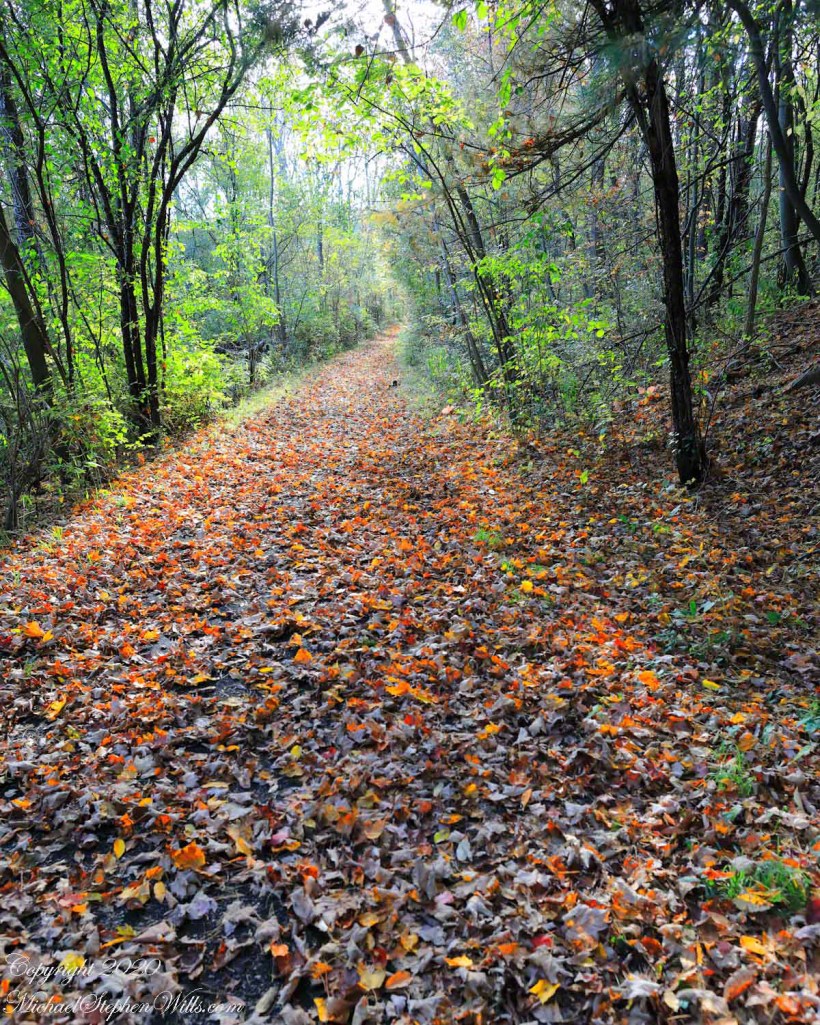
Shuffling through the hot coals of autumn on All Souls Day.
Click image for a larger version.

All Souls’ Day, observed on November 2nd, is a day of prayer and remembrance for the souls of the deceased. Stemming from ancient traditions and solidified within the Christian liturgical calendar, this day serves as a solemn occasion to commemorate the departed. Its roots are deep, with a rich history that intertwines with both religious and cultural practices over centuries.
Origins
The concept of dedicating a day to remember the dead predates Christianity. Many ancient civilizations, such as the Egyptians and the Celts, held ceremonies and festivals to honor the deceased. The Celts, for instance, celebrated Samhain, which marked the end of harvest and the beginning of winter. This was believed to be a time when the veil between the living and the dead was thinnest.
As Christianity spread across Europe, there was an attempt to integrate pagan practices into the Christian framework, leading to the establishment of days dedicated to the deceased. By the 7th century, monastic communities in Europe had begun to designate a day to pray for the departed members of their communities.
Establishment
All Souls’ Day was formally institutionalized by St. Odilo of Cluny in 998 AD. He declared November 2nd as a day for all the monasteries associated with his Benedictine congregation to pray for the souls in purgatory. This practice quickly spread, and by the 11th century, it was widely celebrated throughout Christian Europe.
Theology Behind the Celebration
Central to All Souls’ Day is the belief in Purgatory – an interim state where souls undergo purification before entering Heaven. It’s believed that the prayers of the living can aid these souls, expediting their journey to paradise.
Modern Observations
Today, All Souls’ Day is observed with varying levels of prominence across Christian denominations. In Roman Catholicism, it retains significant importance, with masses dedicated to the departed. In other Christian traditions, it may merge with other observances, like All Saints’ Day (November 1st) or be passed over entirely.
Cultural Influences
Over time, All Souls’ Day has influenced and been influenced by local customs and traditions. In Mexico, for instance, Día de los Muertos (Day of the Dead) coincides with All Souls’ Day but has its distinct flair, involving vibrant parades, elaborate altars, and specific foods.
Bullet Points Summary:
Ancient Foundations: All Souls’ Day has its roots in ancient civilizations that honored the dead.
Samhain: The Celts observed Samhain, marking a time of close proximity between the living and the dead.
Christian Integration: Early Christians attempted to integrate existing pagan rituals into their religious framework.
Monastic Observances: By the 7th century, monastic communities began designating days for the departed.
St. Odilo of Cluny: He formalized All Souls’ Day in 998 AD for his Benedictine congregation.
Spread: By the 11th century, the observance had spread throughout Christian Europe.
Purgatory: Central to the day’s theology is the belief in purgatory and the power of prayers to aid souls.
Variation in Observance: The day’s significance varies across Christian denominations.
Cultural Mergers: Local traditions, like Mexico’s Día de los Muertos, have both influenced and been influenced by All Souls’ Day.
Modern Practices: Today, the day may involve attending masses, lighting candles, and visiting graves of loved ones.
In essence, All Souls’ Day is not just a day on the liturgical calendar; it’s a reflection of humanity’s timeless effort to understand, honor, and find meaning in the cyclical nature of life and death. Through rituals and observances, we bridge the gap between the past, present, and the profound mystery of the hereafter.
Click Me for another Malloryville post, “Formed By Water.”
 Michael Stephen Wills Photography