The Irish Rebellion of 1798, particularly the events in County Wexford, remains a pivotal chapter in Irish history. This uprising, which lasted from 27 May until 21 June 1798, saw the Society of United Irishmen, an underground republican group established in 1791, inspired by the American and French revolutions, taking a stand against British rule. The rebellion in Wexford, sometimes referred to as the Wexford Rebellion, was marked by several significant confrontations and battles, including the Battle of New Ross and the Battle of Enniscorthy, where rebels faced off against the British forces garrisoning the towns.
A central figure in the rebellion in Wexford was Father John Murphy, a Roman Catholic priest, remembered for his key role in the uprising. His participation underscores the complex interplay of religious and political motivations that characterized the rebellion. The culminating point of the conflict in Wexford was the Battle of Vinegar Hill, which took place on 21 June 1798. It was a major clash between roughly 13,000 British government troops and 16,000 rebels. Despite their strong resistance, the rebels were defeated, marking a turning point in the rebellion.
The rebellion had profound consequences. It led to severe repressions against the United Irishmen, with violence against them continuing until at least 1804. Many of the rebellion’s leaders, such as Bagenal Harvey and Matthew Keogh, faced execution and punishment. The immediate political outcome was the Act of Union in 1800, which saw Ireland’s legislature abolished and the country formally united with Great Britain. The historian Roy Foster described the rebellion as “the most concentrated outbreak of violence in recorded Irish history,” and County Wexford was at the heart of this turmoil.
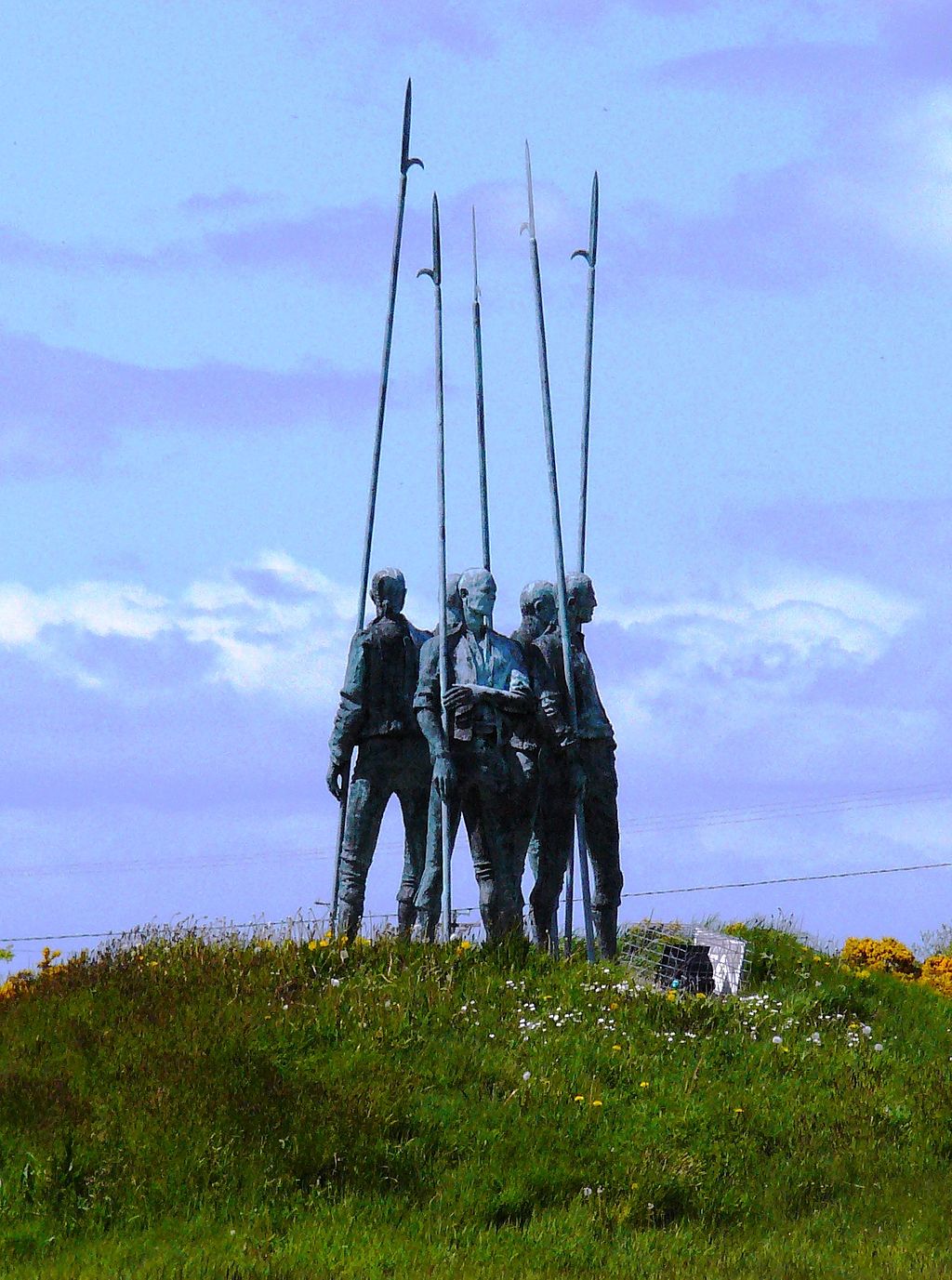
On May 30th, 1798, United Irish Insurgent forces intercepted
the reinforcements for the Wexford garrison at this place.
The overwhelming of the troops resulted in the evacuation
of Wexford by Crown forces. In this engagement Colonel
Thomas Cloney, of the Bantry Battalion of the United
Irishmen commanded the Insurgent forces. In the nearby
Church Meadow lie some 80 men of the Royal Artillery and
Meath Militia who were killed in the battle.
“There is nothing surer than that Irishmen of every denom-
ination must stand or fall together.”
William Orr,
1797.
Unveiled by Mr. Hugh Byrne, Minister of State at the,
Department of the Marine and Natural Resources on the
16th of November 1998.
Chairman of Wexford County Council Leo Cartney,
County Manager Seamus Dooley,
Sculptor Éamonn O’Doherty.
Osioni, CC BY-SA 4.0, via Wikimedia Commons
The bronze statue, captured in the above photograph and created by Sculptor Éamonn O’Doherty, pays homage to the men of Wexford who participated in the 1798 Rebellion. Known as the Pikemen statue, it stands as a poignant reminder of the courage and sacrifice of those who fought for Irish independence. The statue’s presence on the Wexford landscape serves both as a memorial and a symbol of the enduring spirit of rebellion that spurred the fight for Irish self-determination, reflecting the atmosphere of the time when ordinary men took up arms in a bid for freedom. The pike, which features prominently in the statue, was a common weapon used by the rebels, symbolizing the agrarian and popular nature of their army.
The tragic events in Wexford, including the atrocities committed by both sides, such as the piking of 70 loyalists at Wexford Bridge, highlight the brutal reality of the rebellion. The conflict in Wexford and the broader 1798 Rebellion not only reflected the desire for political change and resistance against British rule but also left a deep imprint on Ireland’s national consciousness, fanning the flames of revolution that would continue to burn for centuries. The statue by Éamonn O’Doherty is thus not just an artistic representation but a tangible connection to Ireland’s turbulent past and the quest for national identity and freedom.
Click this link for another interesting post, this one from Killarney


💙
LikeLiked by 1 person
Thank You!!
LikeLike
Michael, I appreciate your efforts in sharing this poignant piece of Irish history. As with many Americans, there is a fragment of Irish ancestry in me, from my maternal grandmother.
LikeLiked by 1 person
Nice!! Where did you grandmother hale from in Ireland?
LikeLike