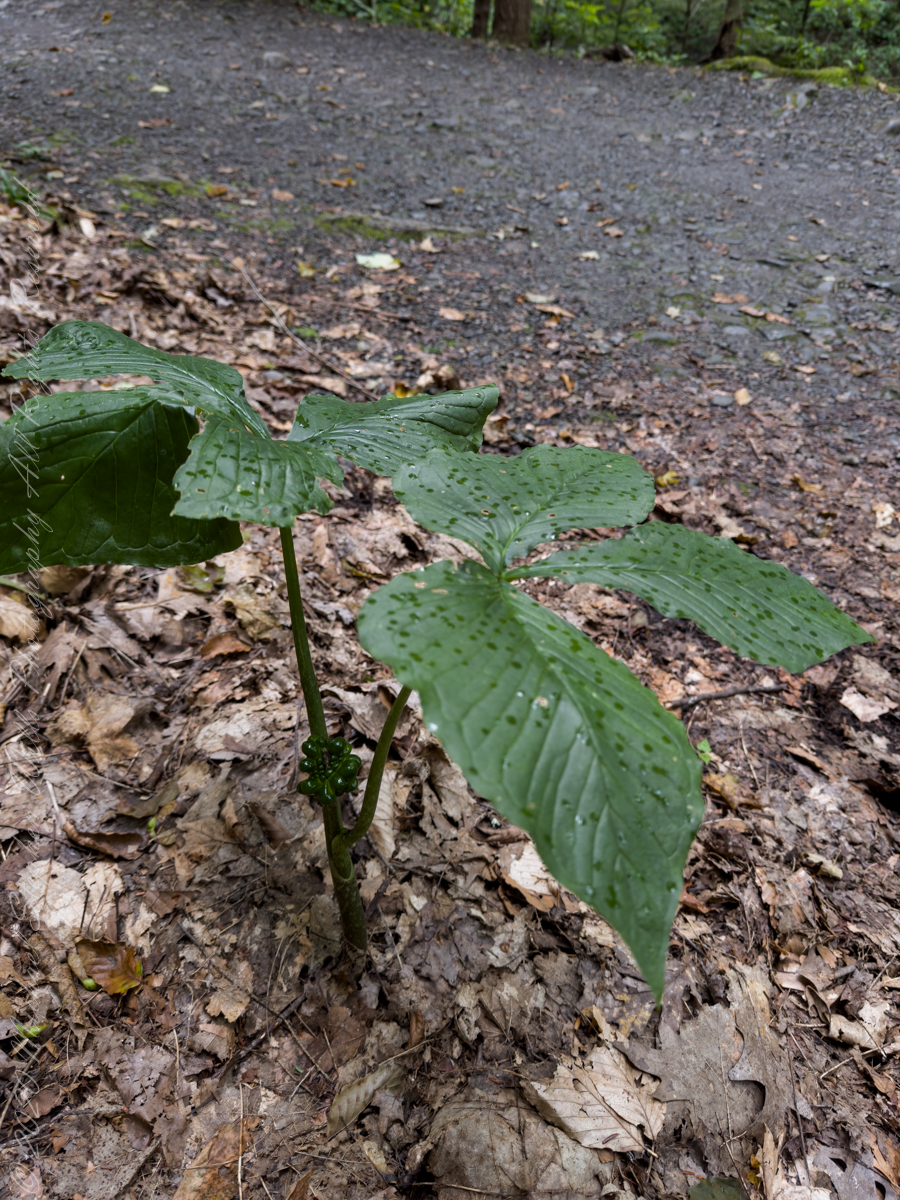
“Arisaema triphyllum sensu lato is a herbaceous, perennial, flowering plant growing from a corm. It typically grows up to two feet tall, but populations in Georgia and Florida are known to reach almost twice that height. It has 1 or 2 leaves, each with three leaflets (triphyllum). Occasionally the lateral leaflets will be two-parted or lobed, giving the appearance of five leaflets per leaf. One species (A. quinatum) typically has five pseudo-leaflets per leaf.”
Those of you who know Georgia O’Keefe may be familiar with the form and coloring of Jack-in-the-pulpit from the series of six oil canvasses from 1930, her time in the east living near a spring. There is a spathe, the pulpit, strongly colored in dramatic vertical, flowing stripes, wrapped around a spandix, the “jack”, being a stem covered with male and female flowers.
Around the time my photography habit started in 2002 I was surprised by the jacks growing from the walls of Fillmore Glen, spying the distinctive forms flowing a bit above eye level under the three large leaves. Seeing them was like recognizing a friend in Halloween disguise, the exotic O’Keefe shapes in a known place.
“The small, inconspicuous flowers of Jack-in-the-pulpit are borne on a fleshy, spike-like inflorescence called a spadix (“Jack”), which is enclosed (or nearly enclosed) by a large, sometimes colorful bract called a spathe (“pulpit”). The flowers are clustered around the base of the spadix inside the spathe. A sterile spadix appendix protrudes from the mouth of the spathe tube. The appendix is covered by the leafy tip of the spathe, referred to as the spathe hood (or spathe lamina). The lip along the mouth of the spathe tube, used as a landing platform for winged insects, is called the spathe flange.”
“The inflorescence can be male (with male flowers only), bisexual (with both male and female flowers), or female (with female flowers only). In a small plant, most if not all of the flowers are male. As the plant matures and grows larger, the spadix produces female flowers as well as male flowers. The transition from male to female continues until eventually the plant produces female flowers only.[6] This is an example of dichogamy, a rare phenomenon in flowering plants. Due to this sex-change lifecycle, this species is sometimes called colloquially as Jack or Jill in the pulpit or Jill-in-the-pulpit.”
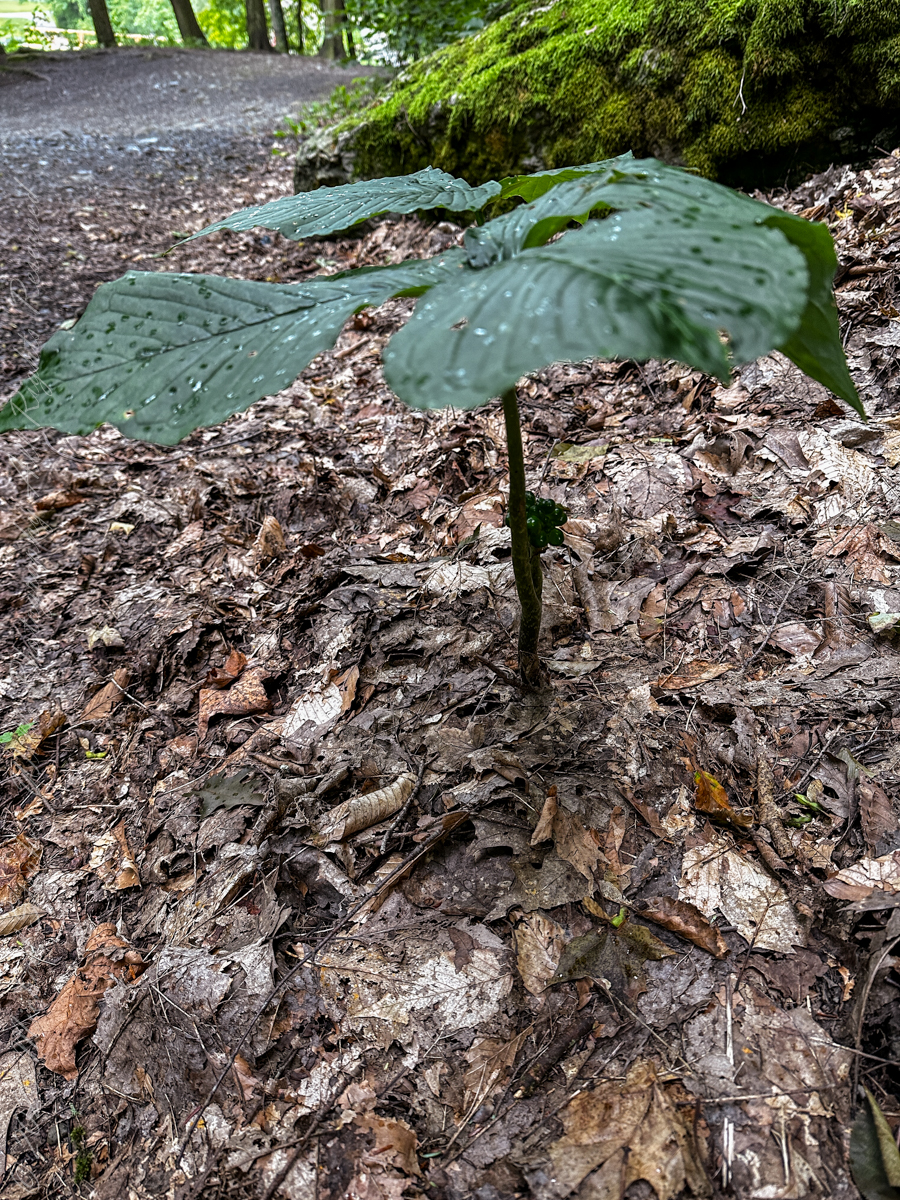
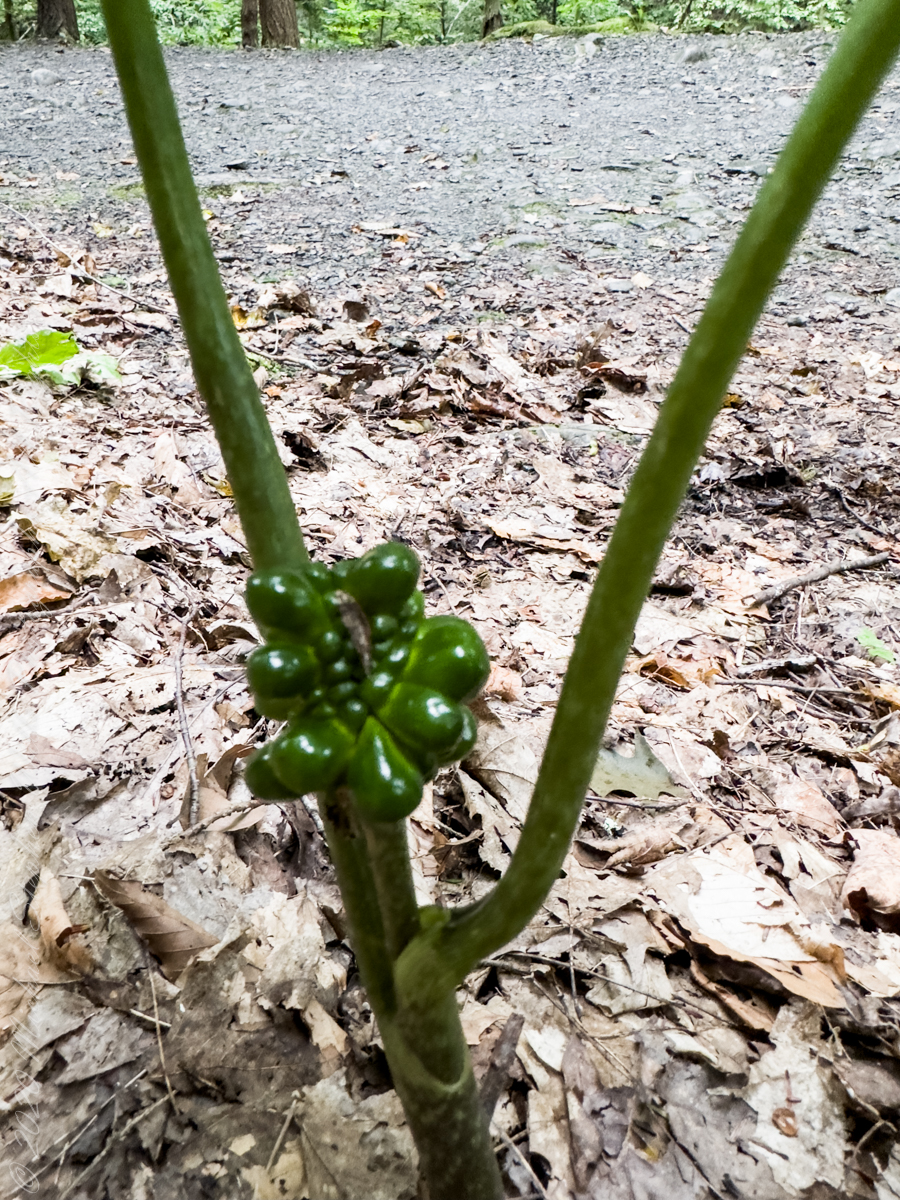
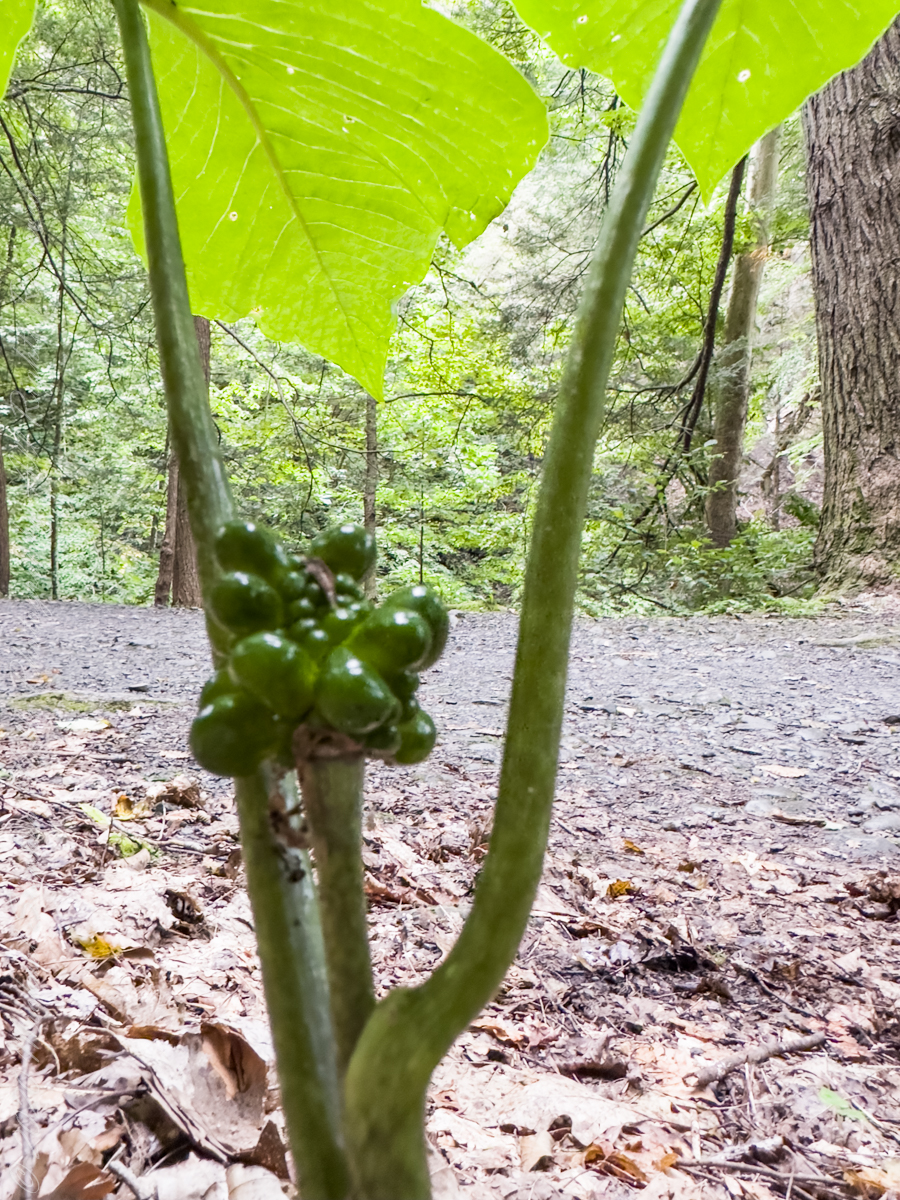
“The unripe fruits are smooth, shiny green berries (each 1 cm wide) clustered around the thickened spadix. Fruits ripen in the late summer and early fall, turning a conspicuous bright red color. Each berry typically produces 1–5 seeds, which are white to light tan in color, rounded, often with flattened edges and a short sharp point at the top. If the seeds are freed from the berry, they will germinate the next spring, producing seedlings each with a single rounded leaf. A seedling needs three or more years of growth before it becomes mature enough to flower.”
“The Arisaema triphyllum complex includes four closely-related species: Arisaema pusillum, Arisaema stewardsonii, Arisaema quinatum, and Arisaema triphyllum sensu stricto. A fifth species (Arisaema acuminatum) is sometimes included but its validity is controversial.”
Ecology
“Arisaema triphyllum sensu lato flowers from April to June.[citation needed] Arisaema triphyllum sensu stricto is the first to flower in the spring. In regions where the species are sympatric, Arisaema stewardsonii and Arisaema pusillum begin to flower 1–2 and 2–3 weeks later, respectively. Since an individual flowering period can last 1–3 weeks or more, it is not unusual to find all three species in flower at the same time. In the southeastern United States, Arisaema quinatum is reported to flower later than either A. pusillum or A. triphyllum s.s.”
“Arisaema triphyllum sensu lato is pollinated by fungus gnats, which it attracts by smell and are trapped by the flower. They manage to escape from a hole at the bottom of the male’s pulpit, but cannot do so when they fall inside a female pulpit, which do not have exit holes Thus the Jill-in-the-pulpit is a rare femme fatale in the plant world: luring the gnats in with scent, but ultimately killing the pollinators in a death trap.”
“Other insects are known to visit the flowers as well, such as gall gnats and beetles.[6] The plant is not self-pollinating since the male flowers on a specific plant have already matured and died before the female flowers of that same plant are mature. So the female flowers need to be pollinated by the male flowers of a different plant. This inhibits inbreeding and contributes to the health of the species.”
Here is another “jack” posting
Reference: text in italics and quotes is from the Wikipedia, “Arisaema triphyllum.”
 Michael Stephen Wills Photography
Another interesting post! The title is definitely an attention getter.
LikeLiked by 1 person
ha ha, yes the preacher’s gone to seed
LikeLike