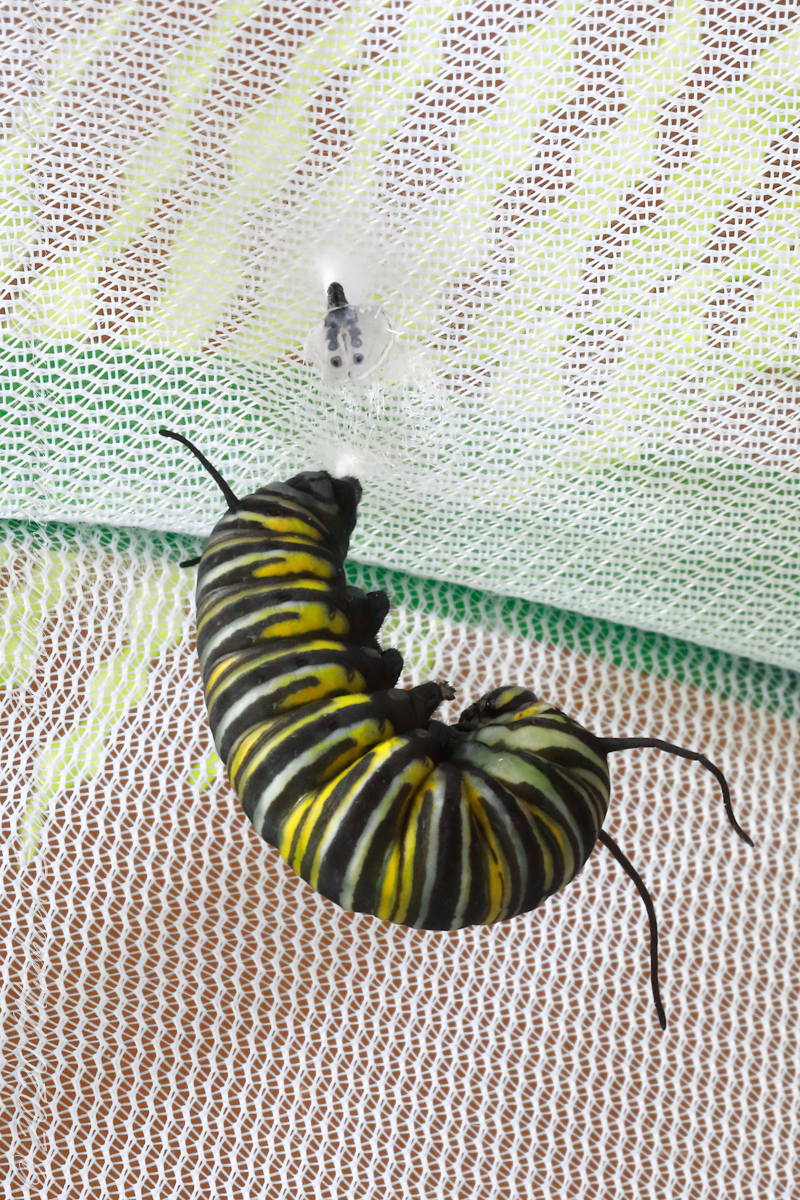
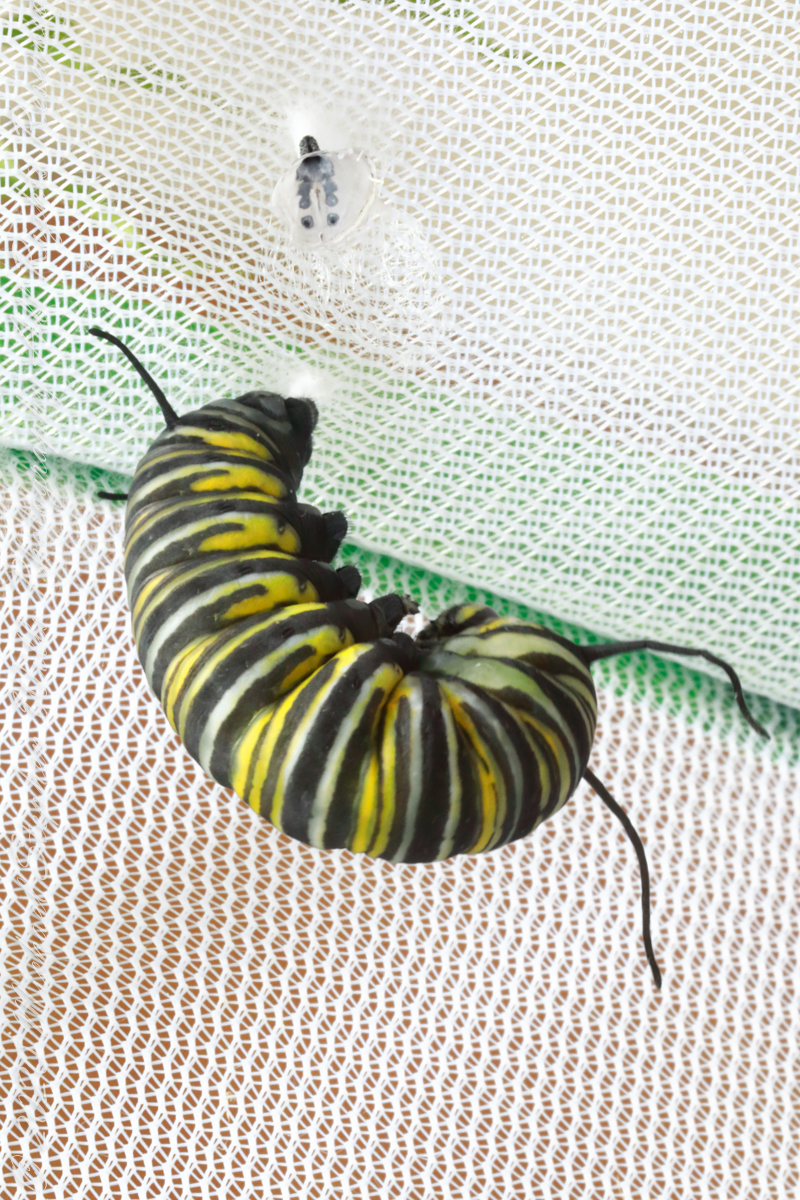
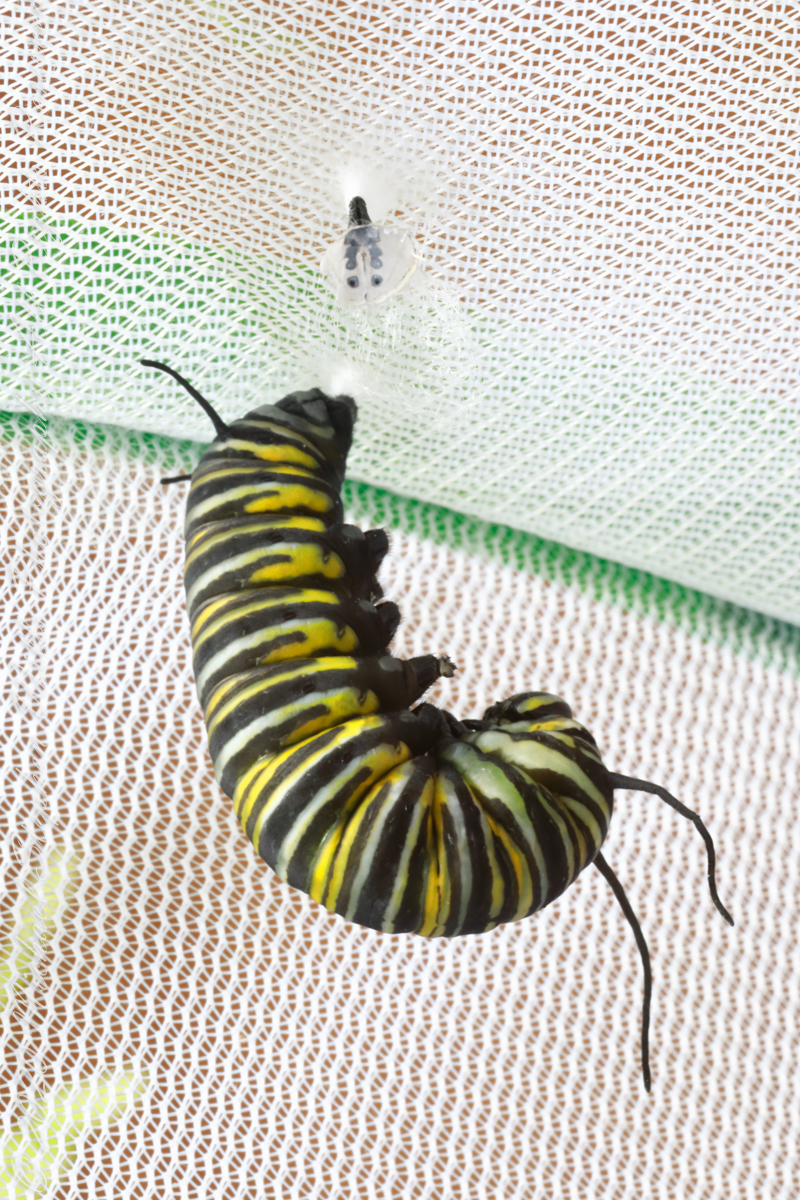
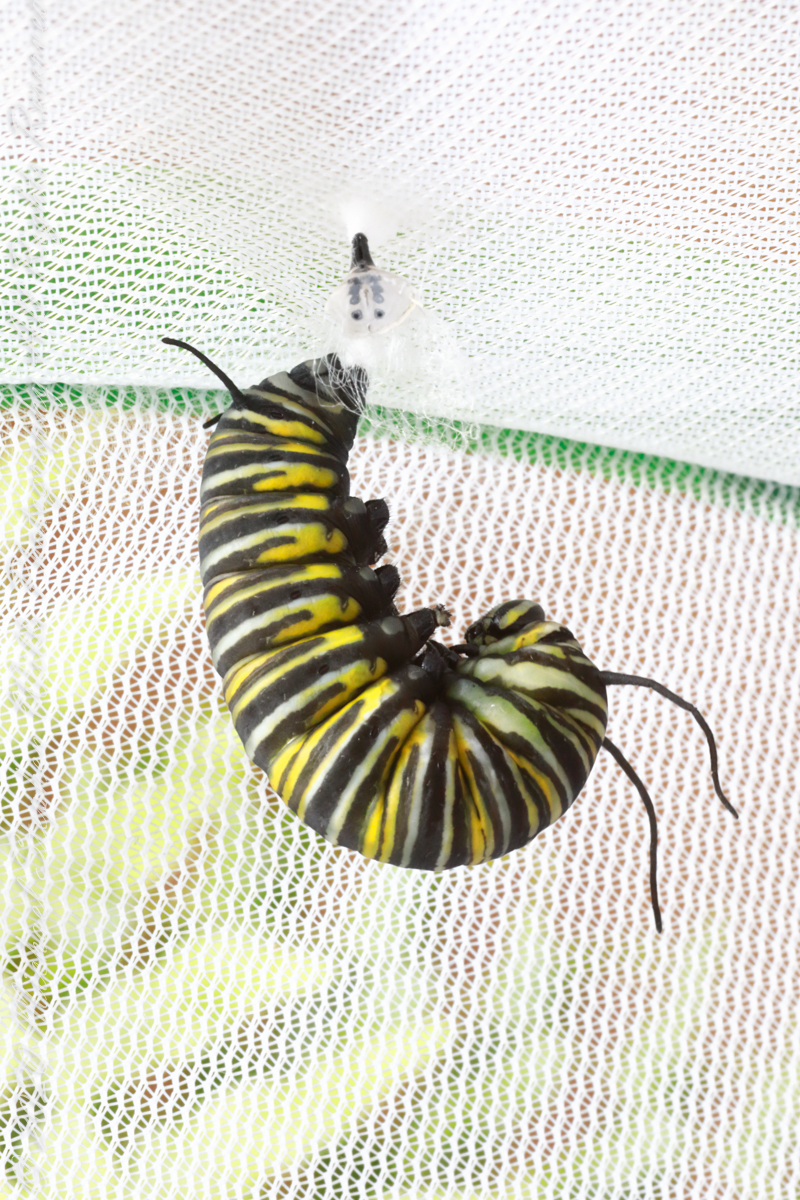
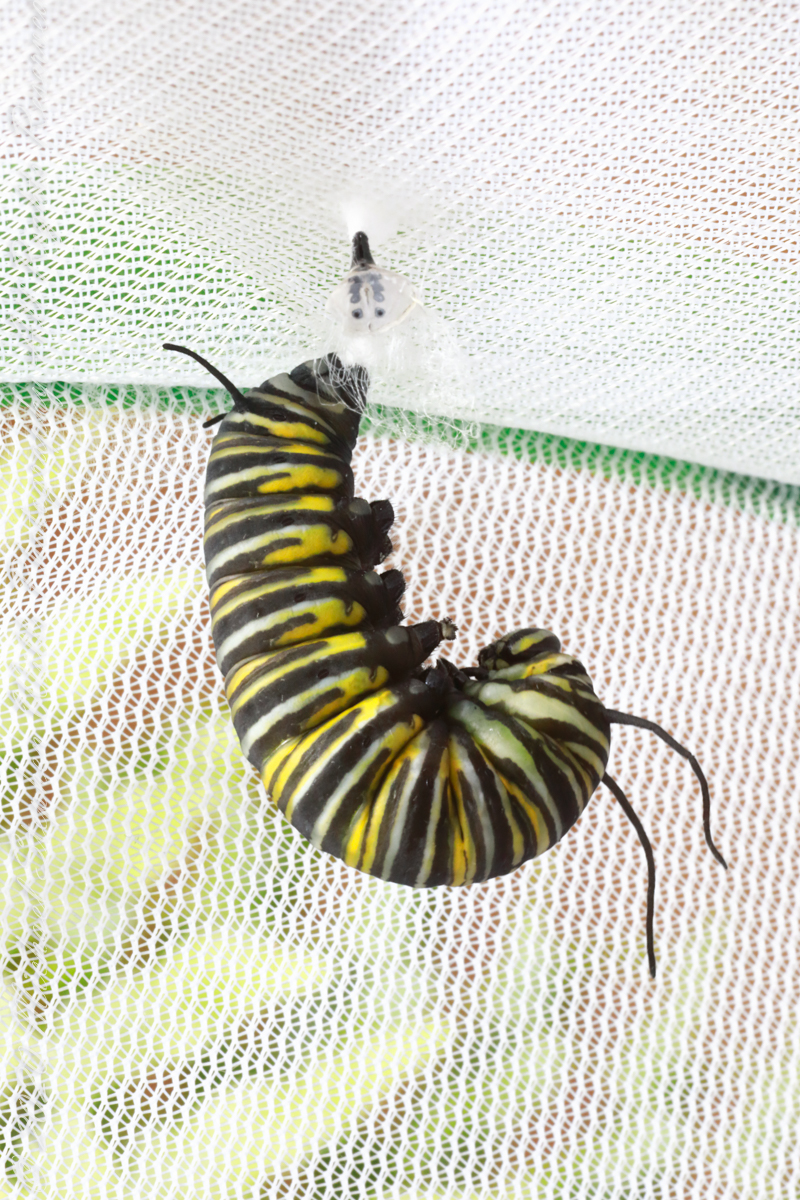
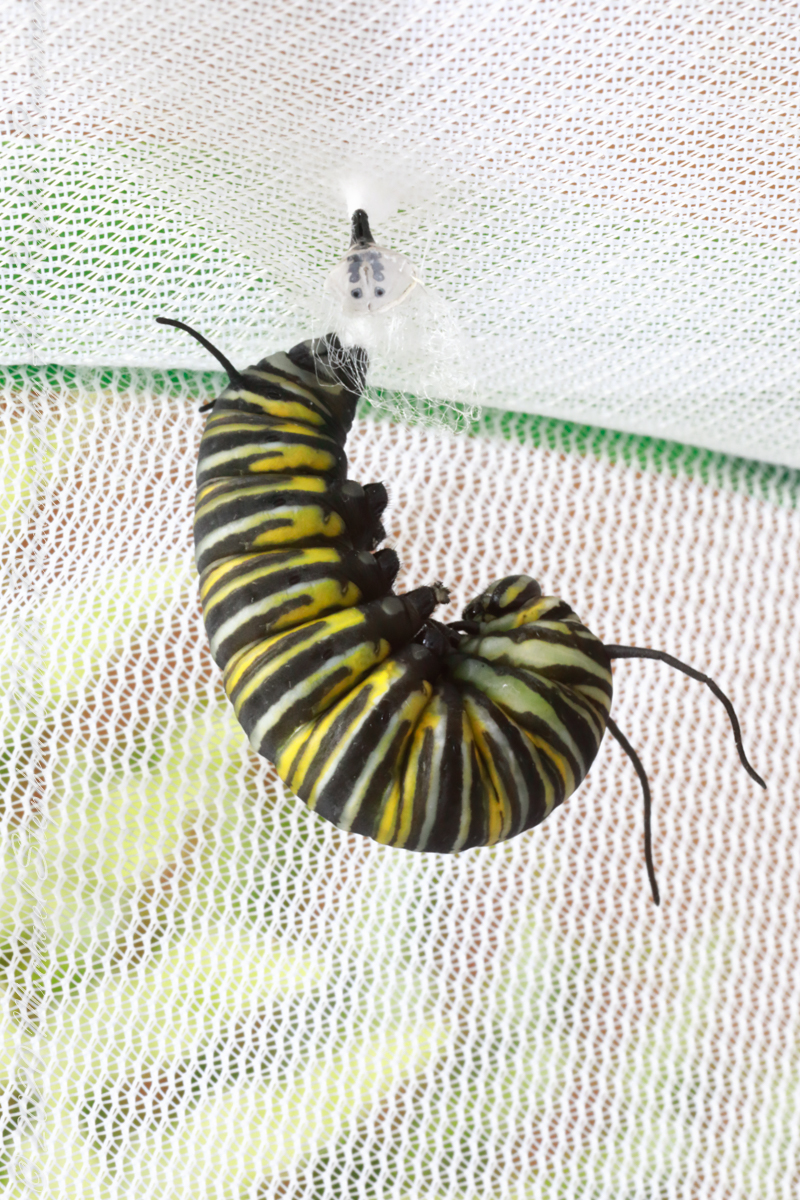
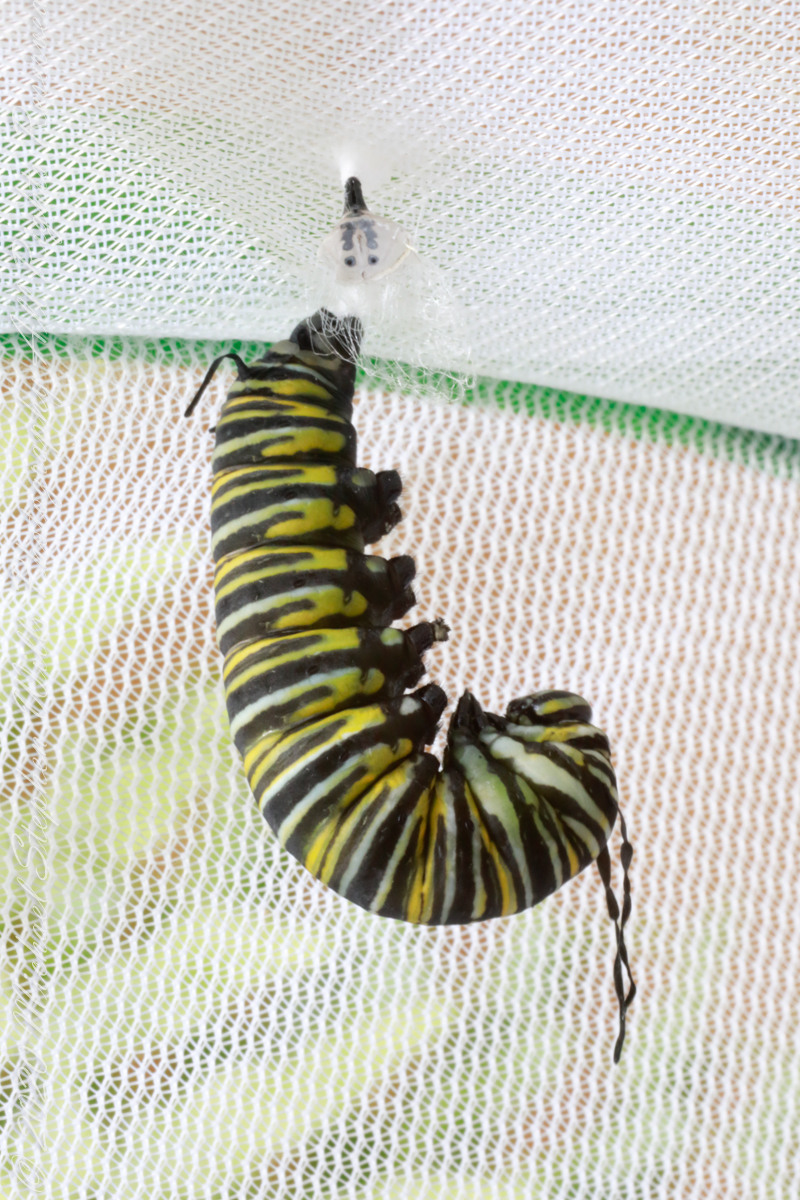
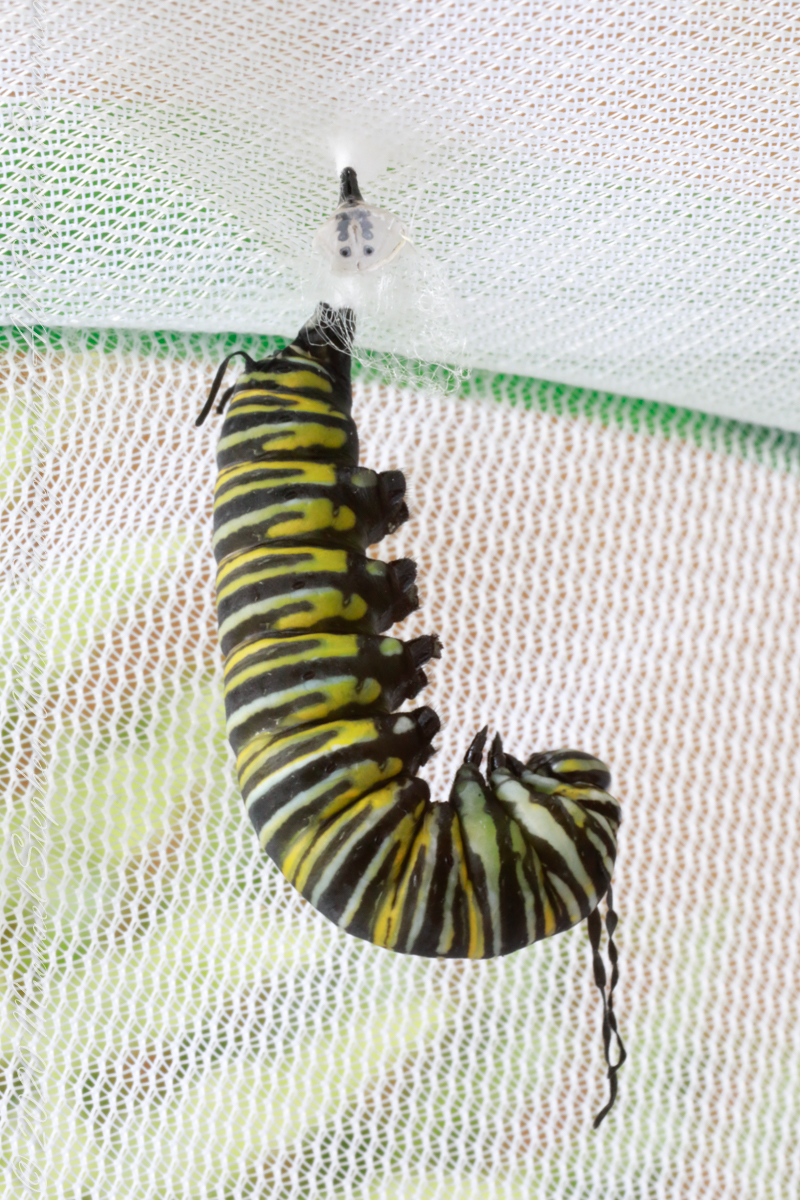
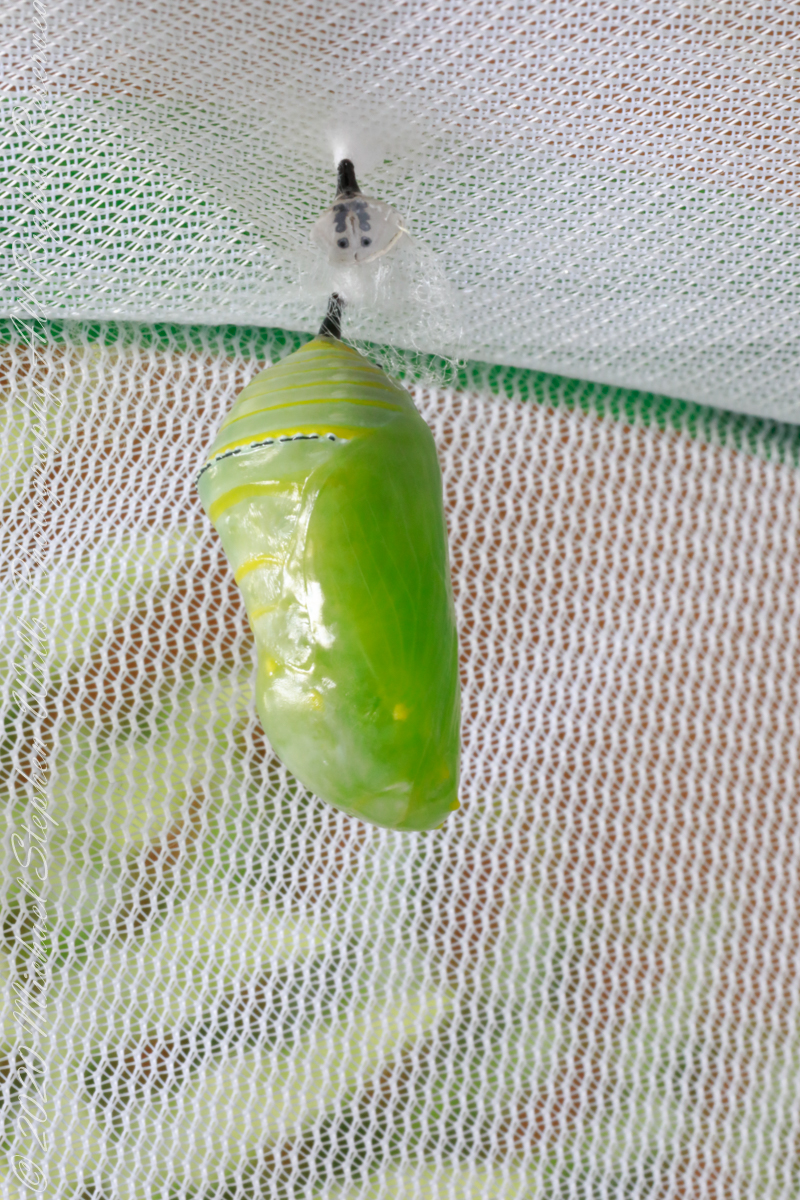
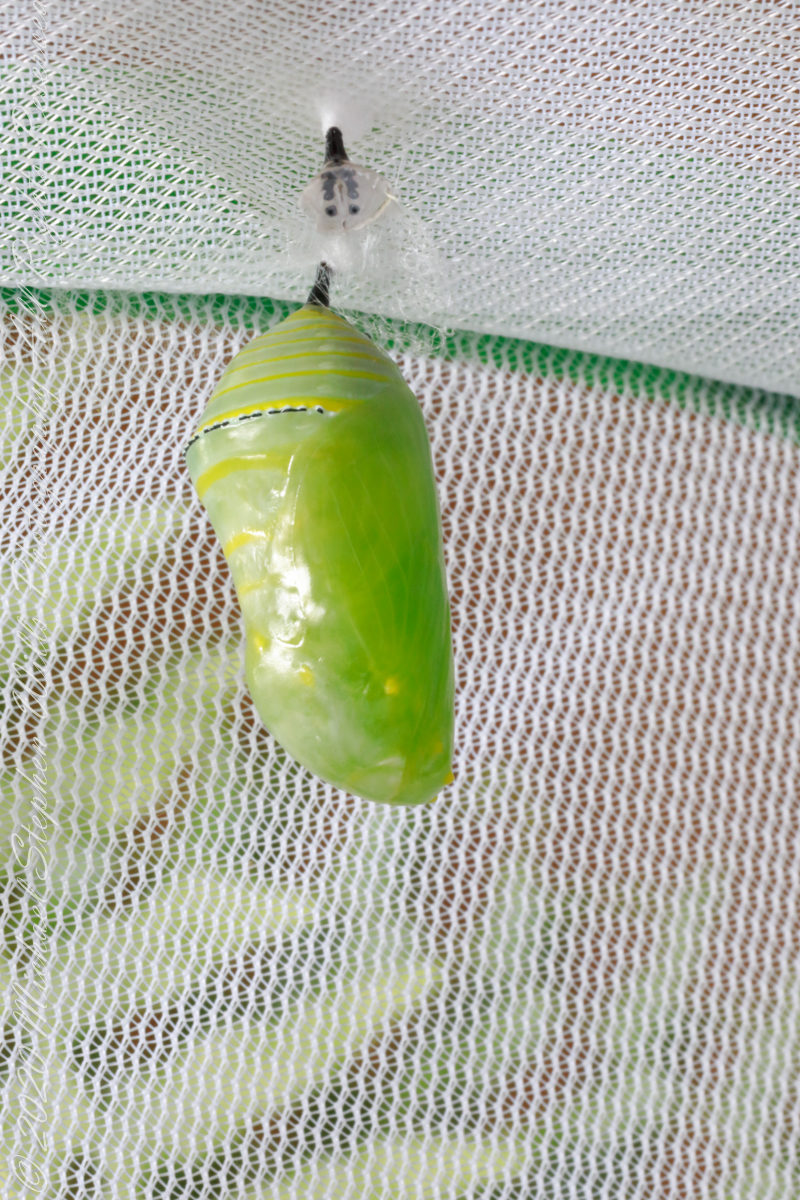
Here is a photographic Series of a Monarch caterpillar chrysalis transformation, a step in the life cycle of the Monarch butterfly. The caterpillar attaches to a silk pad from which it hangs. Underneath the skin, the caterpillar is transforming to the chrysalis. In these photographs the silk pad and chrysalis attachment from a previous transformation are in the foreground.
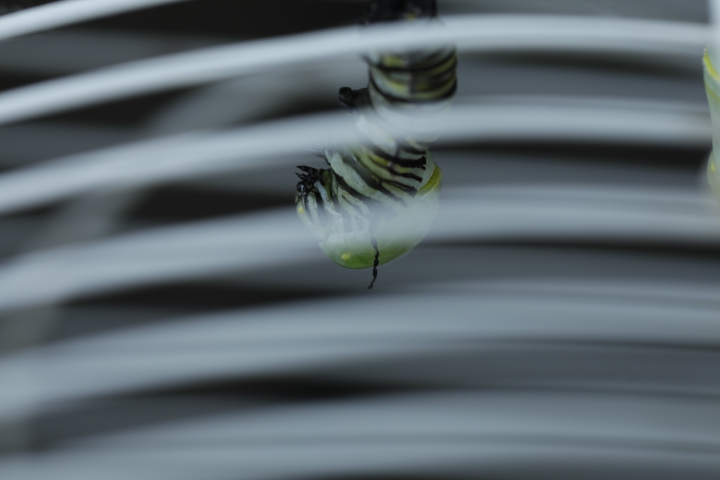
About 34 minutes transpired between the previous photograph of the caterpillar in “J” formation, attached and hanging upside down to the chrysalis. In this time the outer skin was shed, revealing the chrysalis.
Copyright 2022 Michael Stephen Wills All Rights Reserved
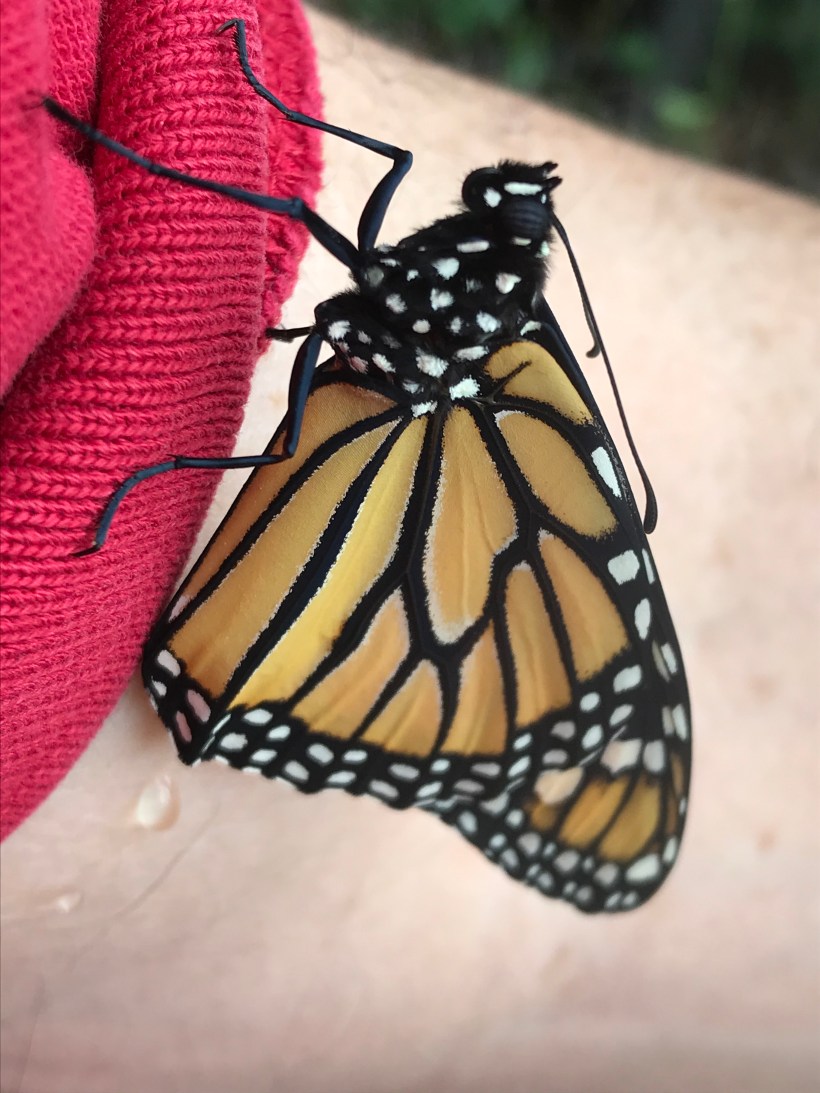
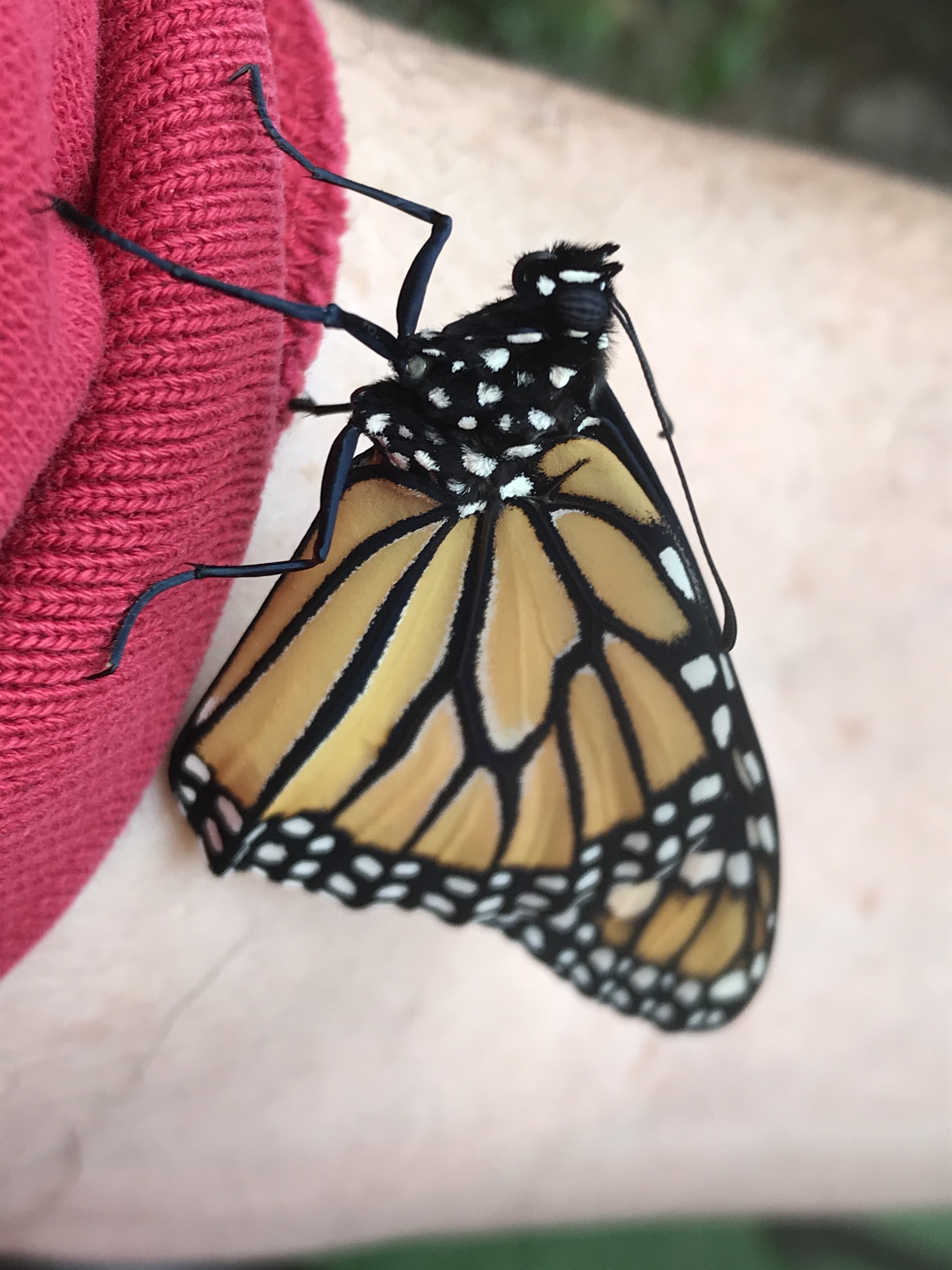
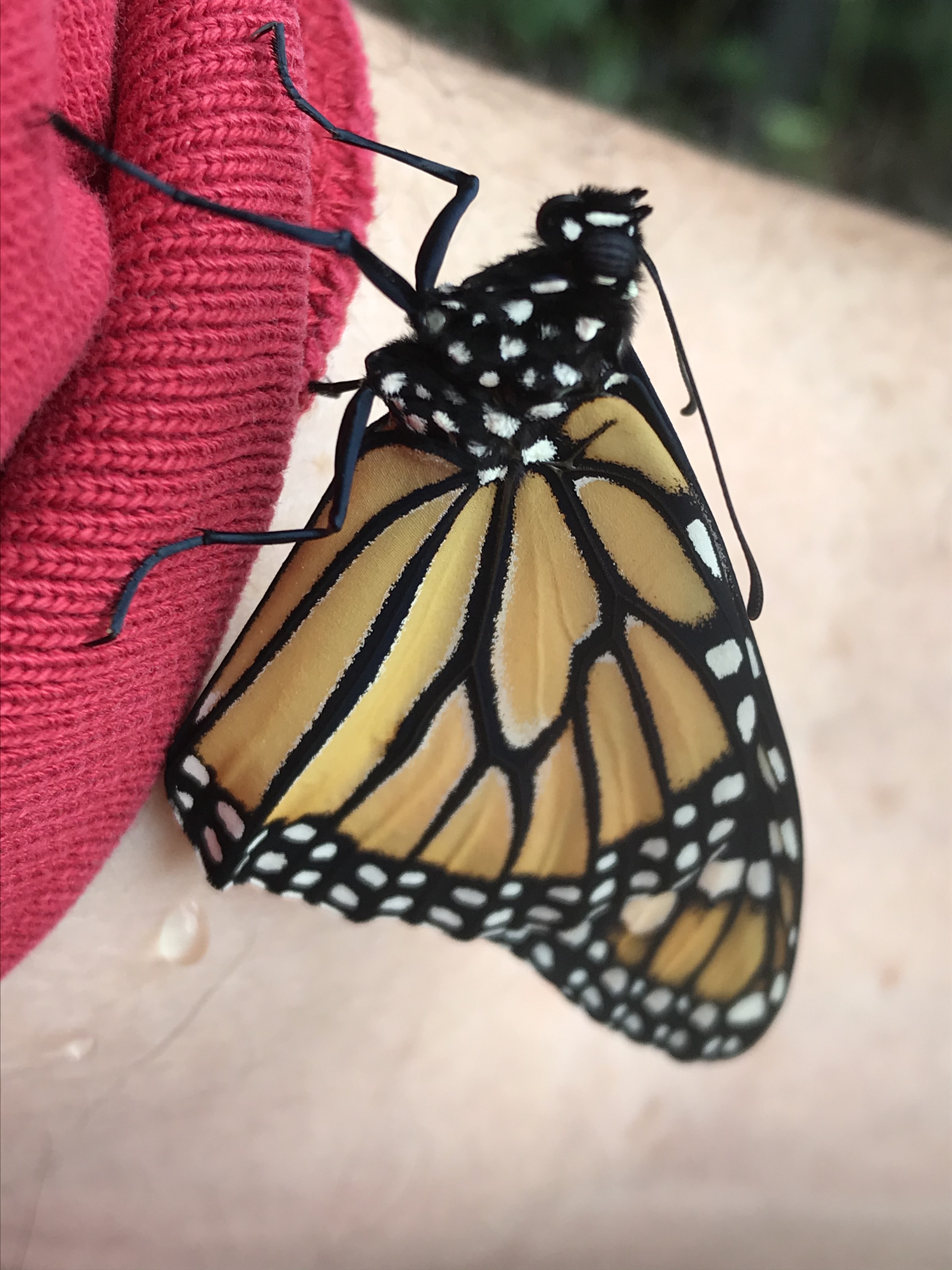
Misjudged by over an hour, I reached into the cage to allow the Monarch butterfly to crawl onto my hand for the first flight. Instead, it crawled up my arm and clung to my cotton shirt sleeve.
Click photograph for a larger view and use Ctrl-x to zoom in closer.
Clinging to my sleeve, this newly emerged Monarch wings dried. It is a process of excreting the fluids pumped into wings, crumpled from folding within the chrysalis, to expand them. The clear drips of water on my arm are this fluid.
Click photograph for a larger view and use Ctrl-x to zoom in closer.
Here is a video from this year, a Monarch emerging from the chrysalis, then expanding crumpled wings. Notice, this butterfly has a problem: once emerged the butterfly swings back and forth continually as it clings to the chrysalis. While interesting to us, the movement is caused from a missing front leg. Monarch butterflies have four legs, this butterfly is missing the right front leg, the imbalance causes the swinging movement. Freshly emerged, a large, distended with fluid abdomen is prominent between small, crumpled wings. With time, the abdomen pumps fluid, expanding the wings. Over several hours the fluid runs from the wings and is expelled from the abdomen, as seen in the above photograph.
For Father’s Day 2021 I received cages for raising Monarch butterflies. A large zippered door is a great feature, one side of the cage drops away for easier access and photography. Here are some photographs of the developing chrysalis and emergence.
In the first step of chrysalis development, the caterpillar climbs to a chosen location and weaves a silk pad from the abdomen. We are looking down on the caterpillar through the top of the woven material that forms our cage. The silk pad is a small white dot to the right.
Click photograph for a larger view and use Ctrl-+ (press down Ctrl, hold, then click plus sign repeatedly) to zoom in closer.
After the silk attachment pad is complete, the caterpillar releases itself to hang in a shape of the letter “J.”
The caterpillar sheds the outer skin as the chrysalis forms around it.
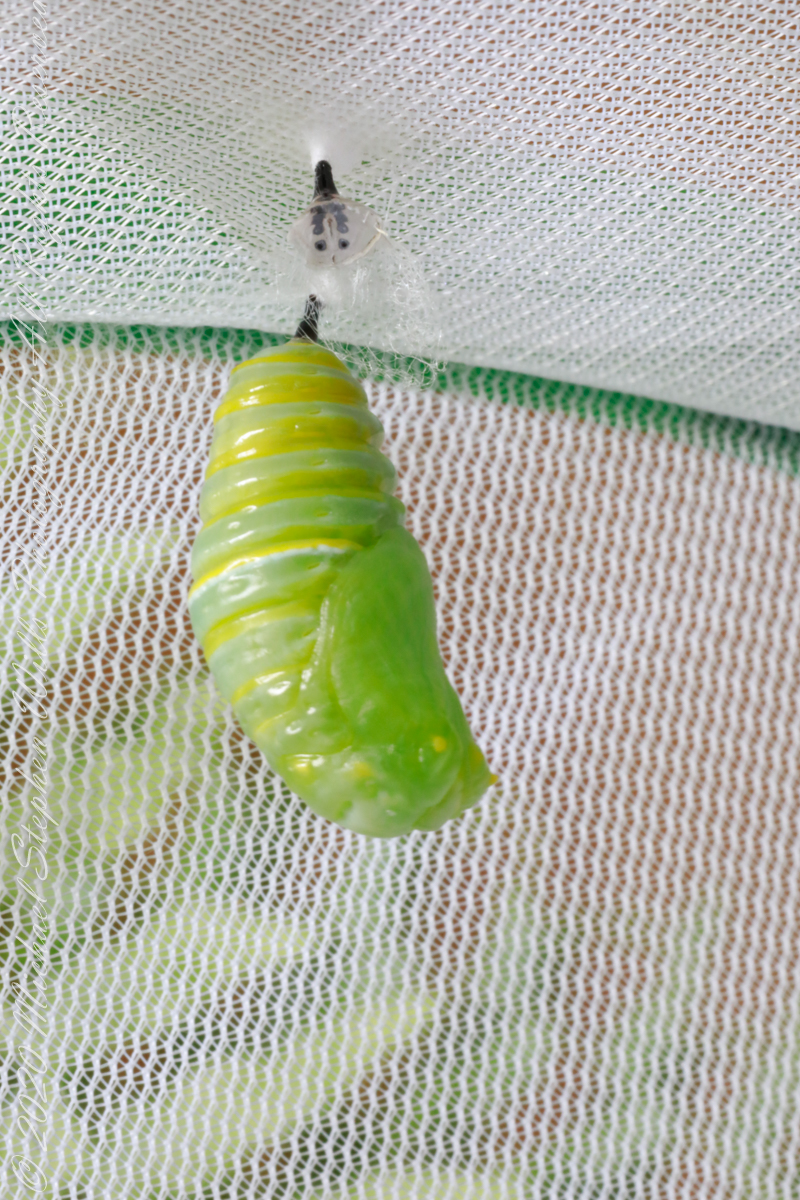
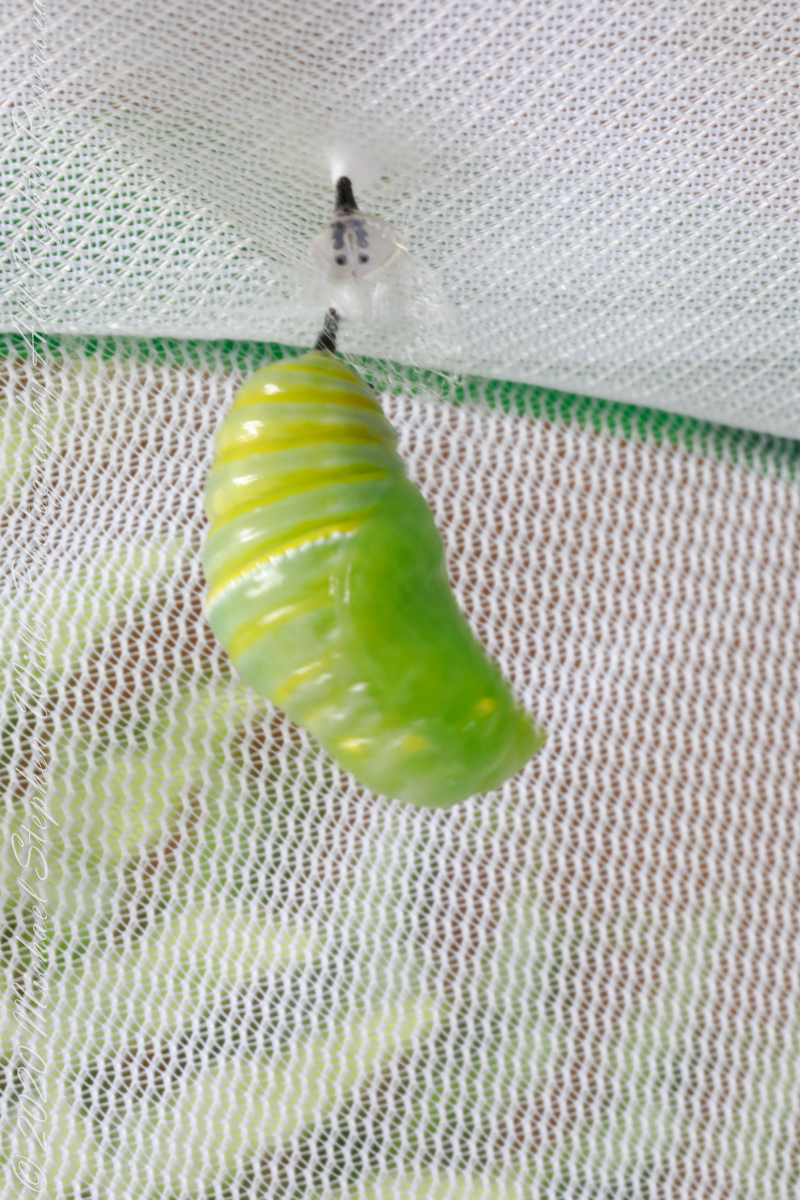
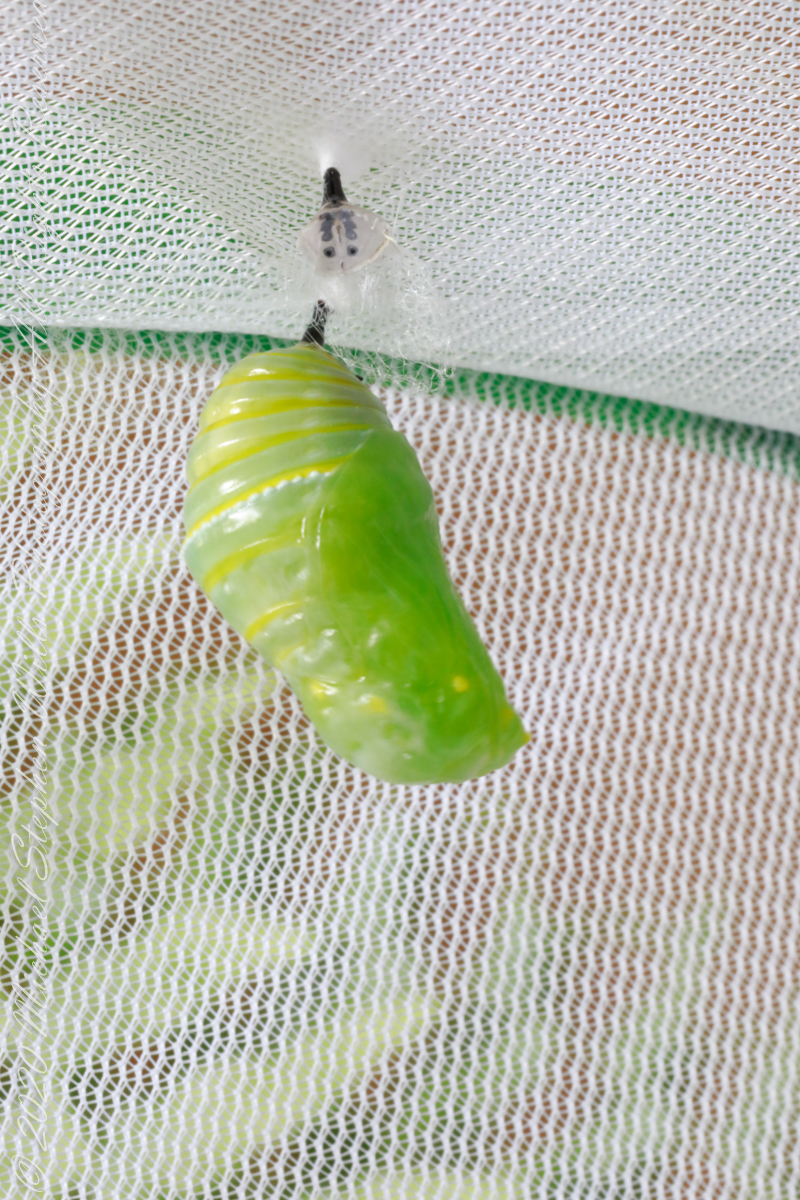
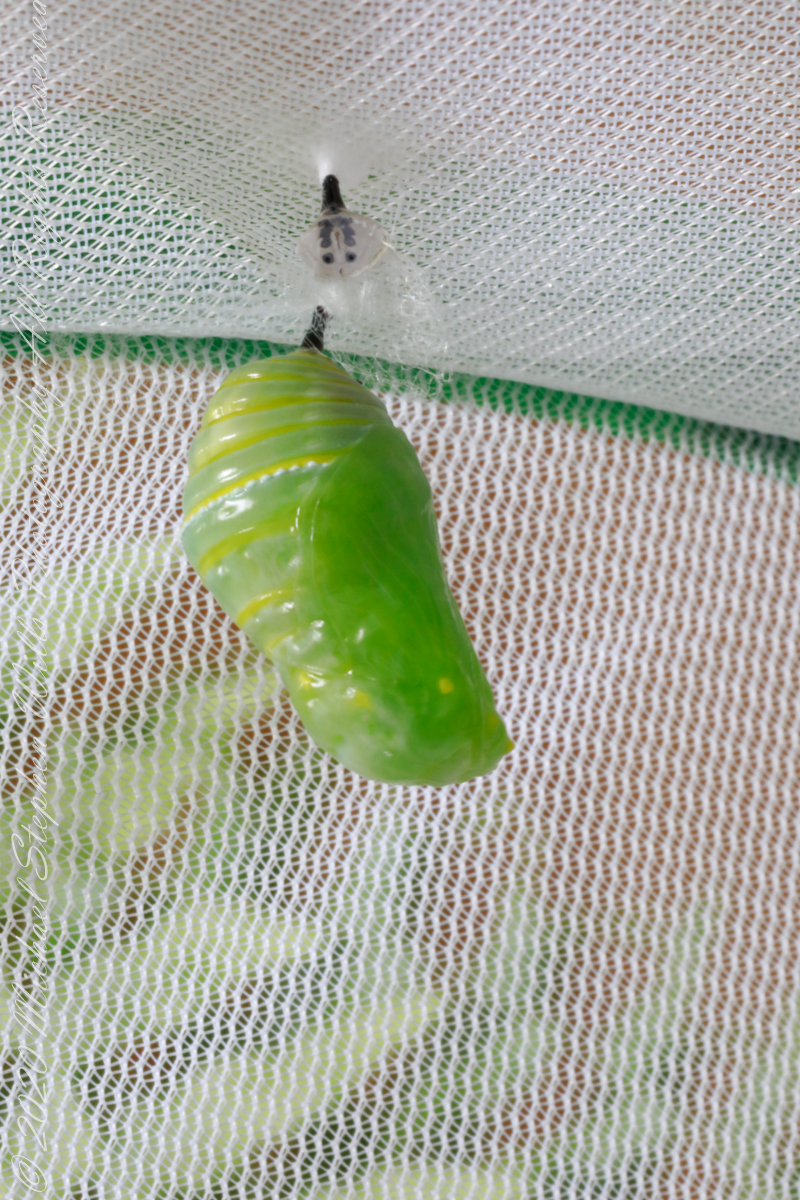
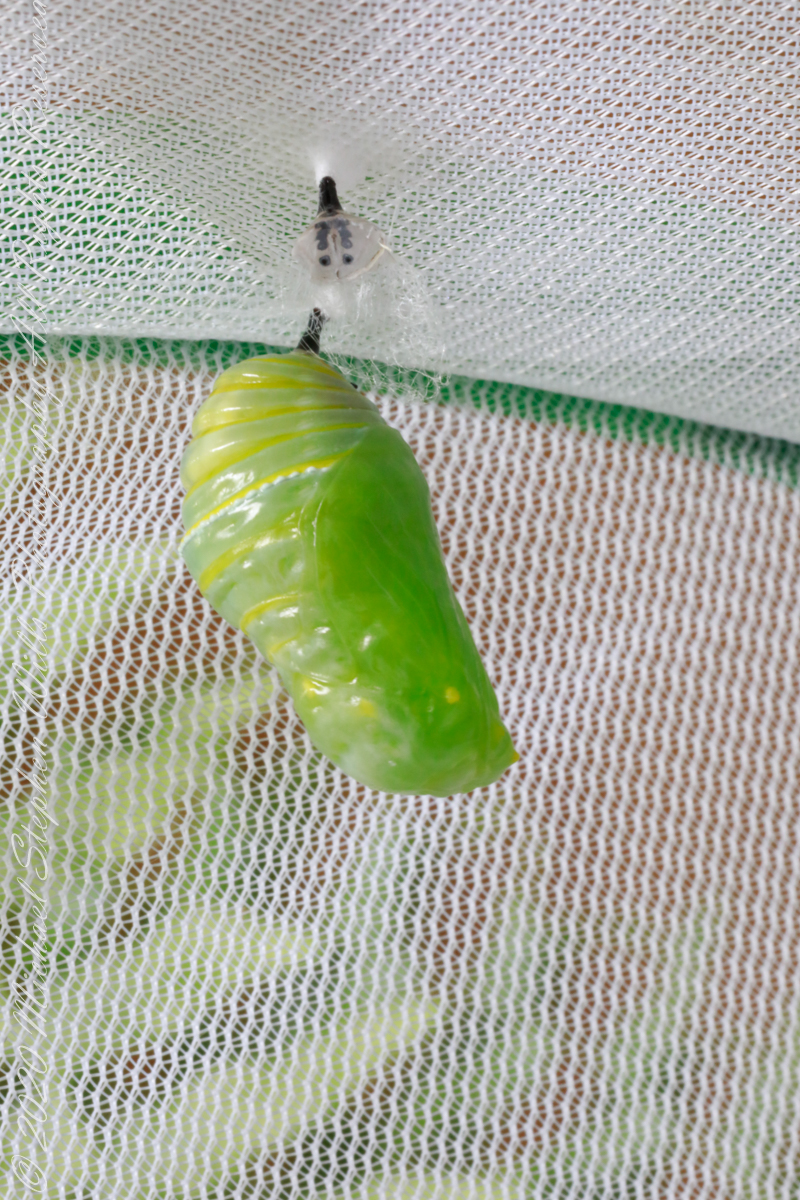
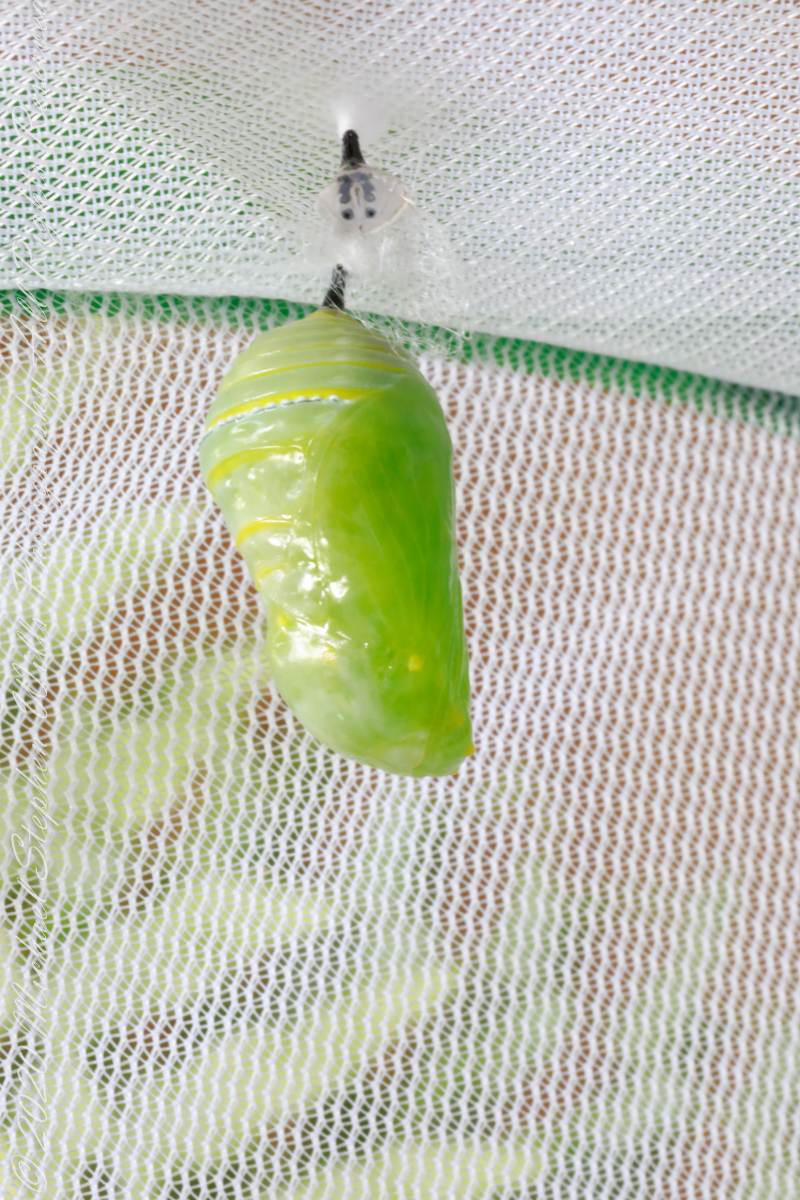
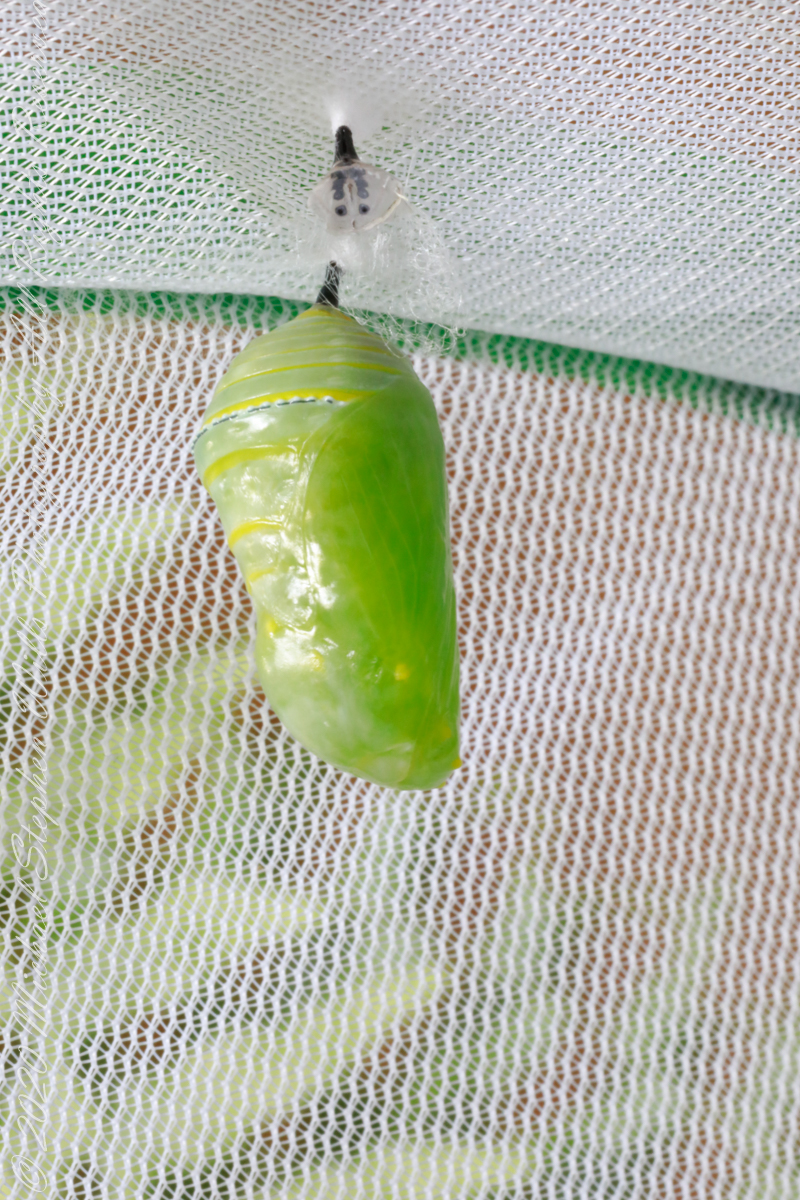
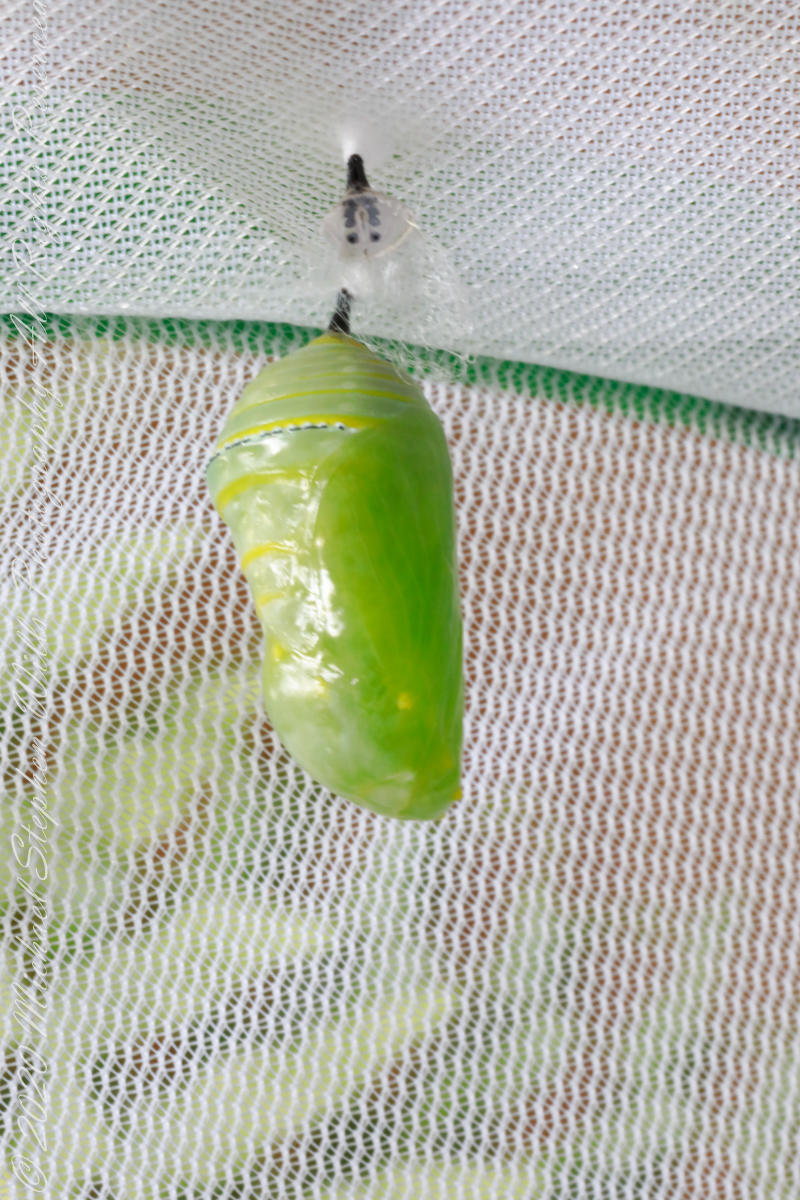
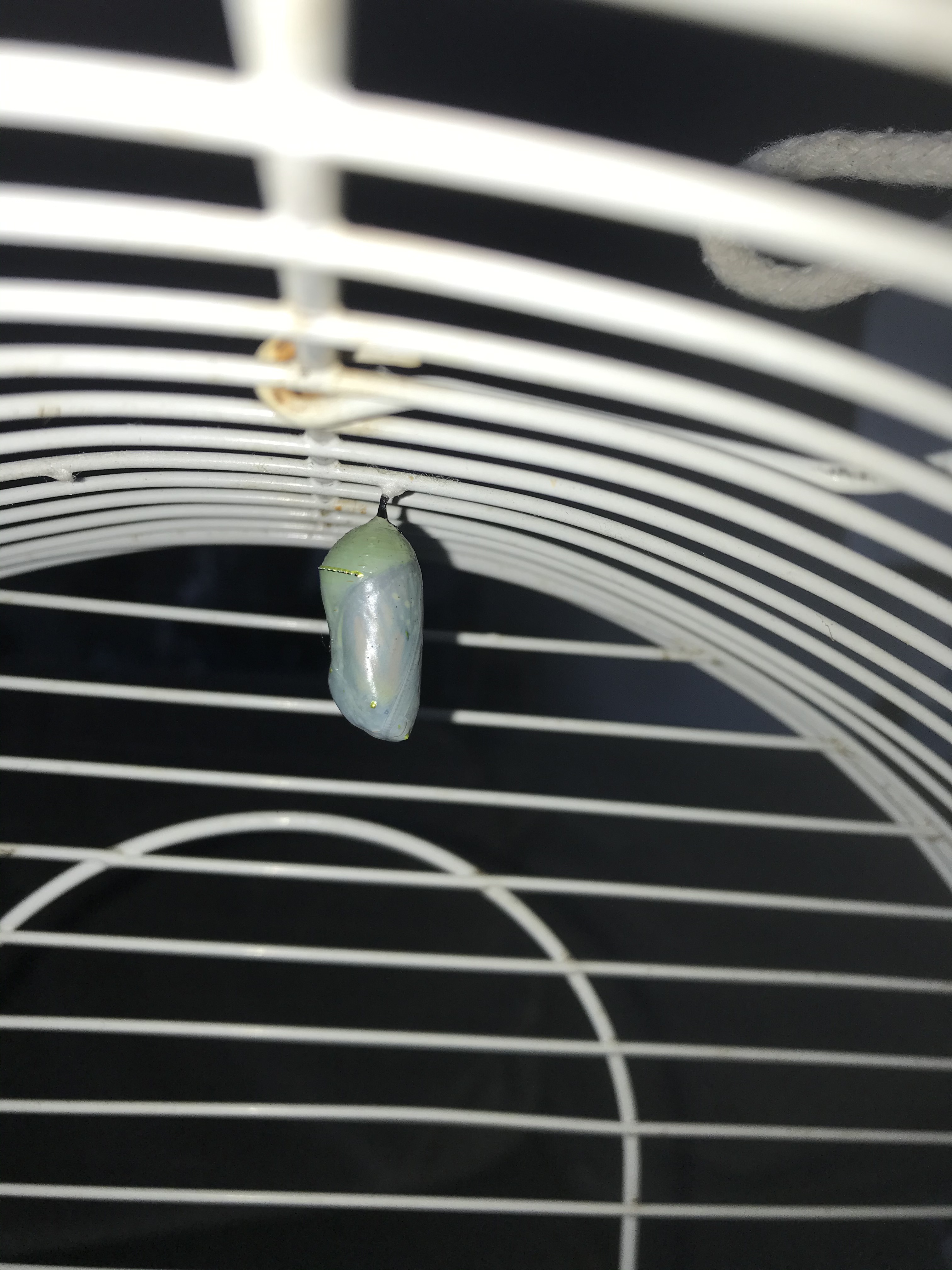
Four Monarch Butterfly Chrysalis.
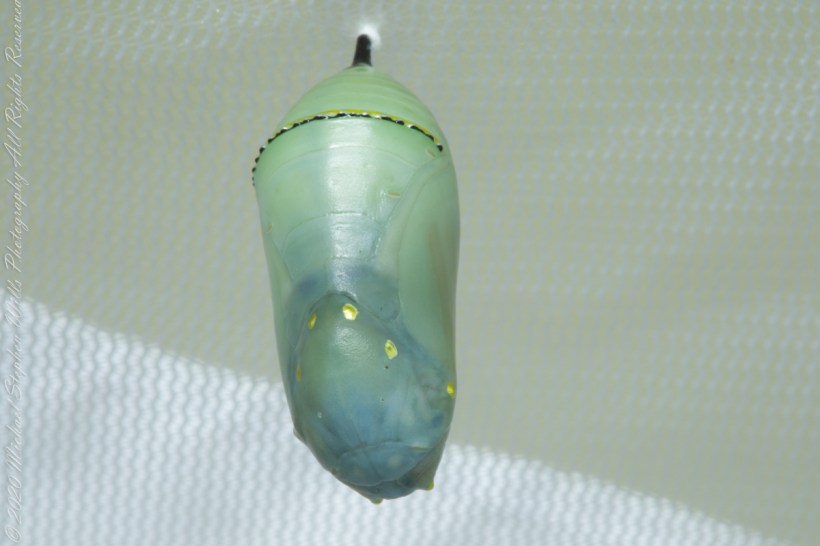
Macro of the Monarch butterfly chrysalis. The black stalk attached to the silk pad is call a cremaster.
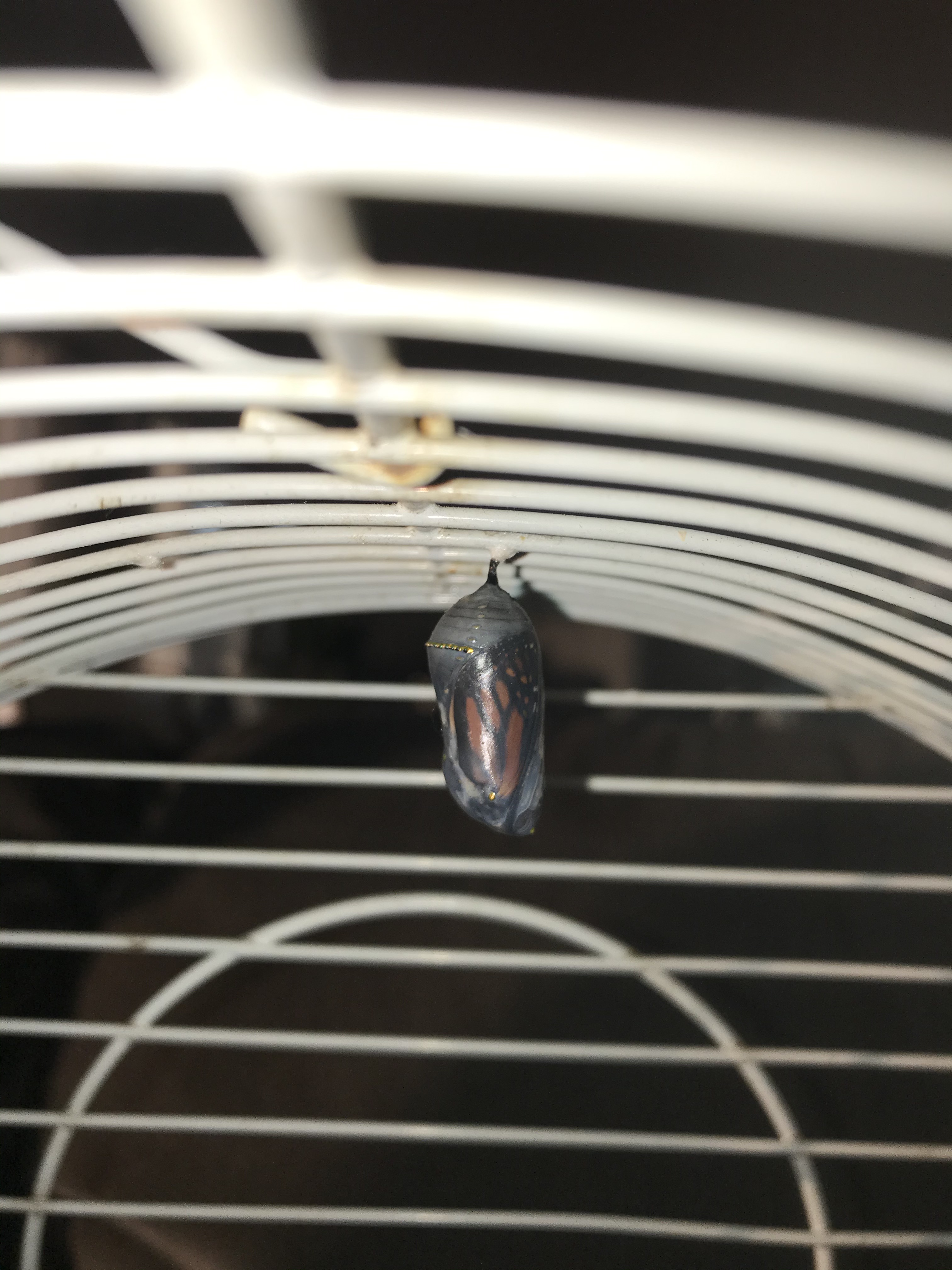
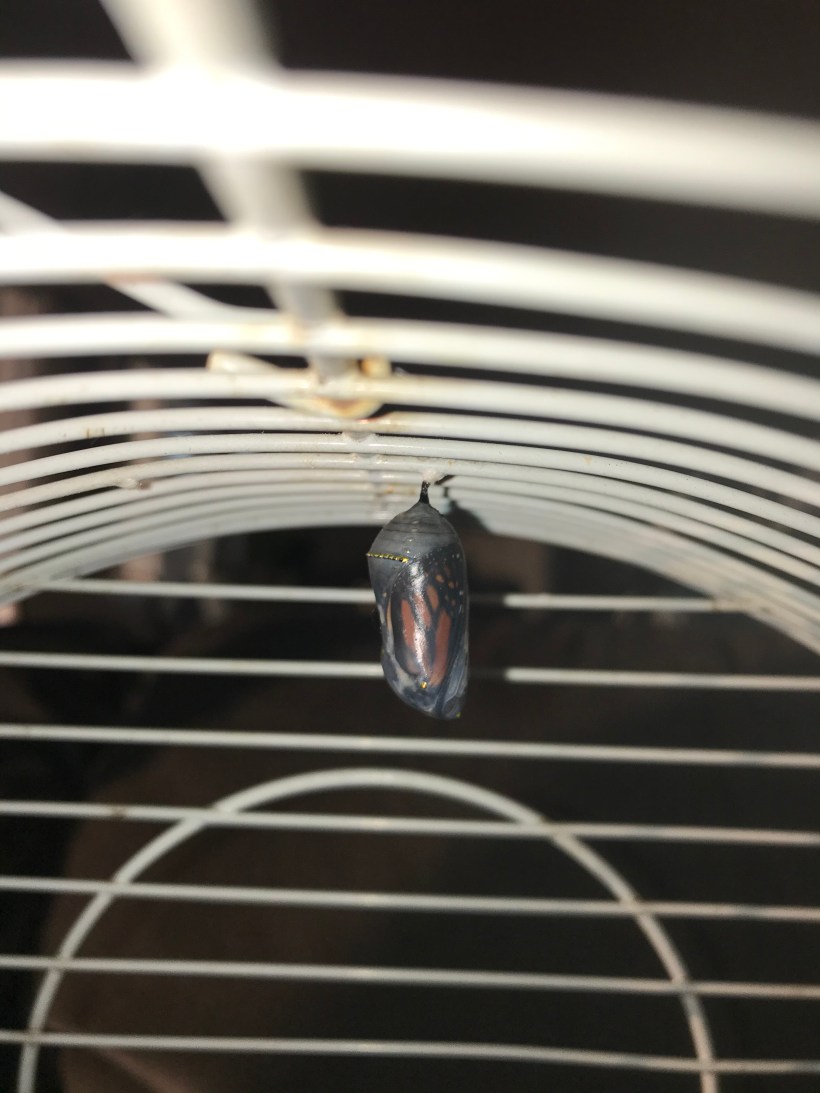
Just prior to emergence the chrysalis turns from opaque green to translucent Iappears dark). Here the wing pattern and body markings (white dots) are visible.
I used a Manfrotto tripod, the Canon EOS 5D Mark IV dslr (high resolution video capability) and Canon’s EF 100mm f/2.8 USB macro lens for the following up close coverage of a Monarch emerging followed by wing expansion.
Clinging to my sleeve, the newly emerged Monarch wings dried. It is a process of excreting the fluids pumped into wings, crumpled from folding within the chrysalis, to expand them. The clear drips of water on my arm are this fluid. I spent the hour sitting by our pool, savoring the summer morning. The butterfly signaled readiness, wings dried and hardened, opening and closing them slowly. Offered my finger it crawled to my hand, across to the thumb and, running out of space, took off.
Click photograph for a larger view and use Ctrl-x to zoom in closer.
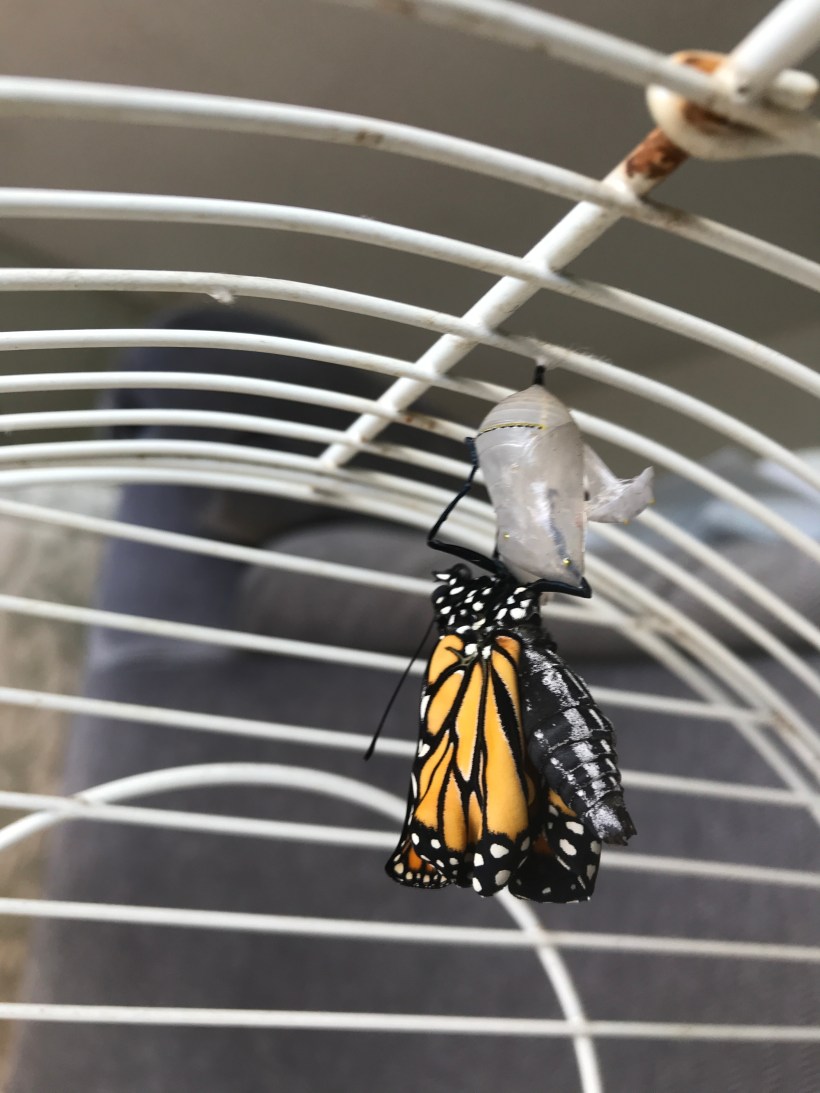
Emerged from the chrysalis a butterfly’s wings are crumpled, useless. Here it is fifteen minutes into freedom after abdominal fluid is pumped into the wings, opening them. Full of this fluid, the wings are soft, still useless.
Click photograph for a larger view and use Ctrl-x to zoom in closer.
Our monarch butterfly sanctuary is a dense stand of milkweed, over the years the established plants grow rapidly late May through June, blooming in July. The flowers have an incredible scent, attracting numerous pollinating insects.
A colony of pesky sparrows nest nearby. In spite of a reputation for tasting bad, the sparrow actively feed on the hatched caterpillars. My strategy is to examine the plants early morning, placing rescued caterpillars in this old birdcage.
Click photograph for a larger view and use Ctrl-x to zoom in closer.
The caterpillars and milkweed leaf is placed on the cage floor. I pile up the dried leaves, replacing with fresh each morning.
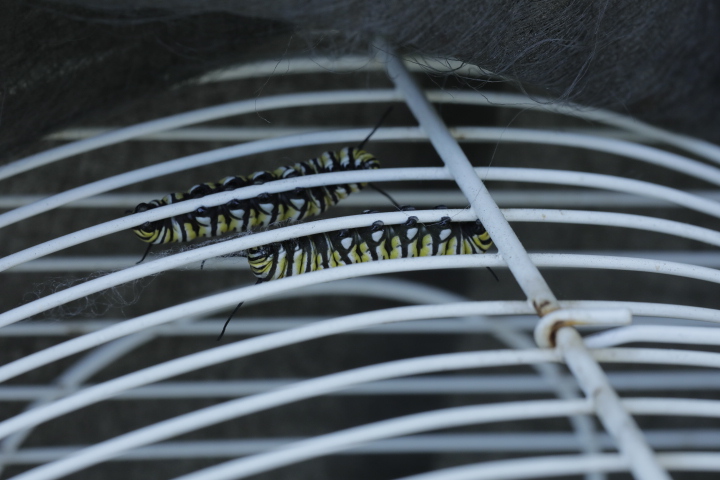
Sadly to report, the last, ravenous caterpillar stage is also carnivorous, cannibalistic. These two, below, were the only ones left except for one in the pile of dried leaves.
Here is a closer view of the two fifth stage instars searching for a safe location to pupate.
A few hours later one has successfully created a silk pad, attached itself and assumed the “J” shape. To the left a second caterpillar and silk pad.
The next morning, the first has formed a chrysalis. The second, hung spent.
This unsuccessful individual never completed the chrysalis, dried up and fell. My sources write the pupa transforms to a chrysalis through shedding of skin, the following photograph tells a different story. The chrysalis appears to extrude from the skin; arising over, or from, the skin rather and beneath it. I have never recovered a shed skin underneath a successful chrysalis.
Nine days later, Tuesday, July 28, the chrysalis hangs. I check several times a day.
These photographs are from a 100mm “macro” lens, handheld. The birdcage works well for protecting the monarchs. Is a poor location for photography.
Thank You for visiting.
Copyright 2020 Michael Stephen Wills All Rights Reserved










 Michael Stephen Wills Photography