
While my wife was recovering from major surgery at Saint Francis Hospital in Syracuse, New York, I spent a morning at the nearby Shrine and Museum of Saint Marianne Cope. There, I delved into the early life of this remarkable saint, born Barbara Koob. As I explored her story, I found myself drawn to the experiences of her parents, Peter and Barbara Wirzenbacher Koob, who endured some of the most challenging times in early 19th-century Germany. Their struggles, shaped by the economic and social crises of the time, played a pivotal role in the Koob family’s eventual emigration to the United States, setting the stage for their daughter’s life of service.

The story begins in Heppenheim, a small town nestled in the southern part of Hesse, Germany. Like many other towns in the region, Heppenheim was reliant on agriculture for survival. However, the year 1816 brought unprecedented hardship. Known as the “Year Without a Summer,” this period was marked by extreme cold and wet conditions, caused by the catastrophic eruption of Mount Tambora in Indonesia. The volcanic ash released into the atmosphere blocked sunlight and disrupted weather patterns across the globe.

For the people of Heppenheim, this meant crop failures on an unimaginable scale. Rye and wheat, staples of their diet, rotted in the fields. Food became scarce, and prices soared. The ensuing famine left families, including the Koobs and their ancestors, struggling to survive. As hunger gnawed at them, they faced a bleak future. This economic strain was compounded by broader challenges: industrialization was beginning to transform the German economy, leaving traditional agrarian lifestyles in its wake, while political unrest simmered as the fragmented German states wrestled with issues of governance and unity.
These hardships were not unique to Heppenheim. Across Germany, the “Hunger Years” of 1816-1817 prompted widespread despair. For many, including the Koob family, the promise of a better life beckoned from across the Atlantic. The United States, with its vast expanses of fertile land and burgeoning economy, seemed to offer a way out of the grinding poverty and instability that had taken hold in their homeland.

Barbara Koob was born on January 23, 1838, into a family deeply rooted in their community. Peter Koob was identified as a “Citizen and Farmer,” and shortly after her birth, Barbara was baptized at St. Peter’s Church, marking the beginning of her journey in a devout Catholic family.

By 1839, Peter and Barbara Koob, like many others from their region, made the difficult decision to leave Heppenheim behind. With their young daughter Barbara, they embarked on a journey to the United States. They settled in Utica, New York, where the opportunities for a new beginning were more promising, even though the bustling industrial town was a far cry from the rural life they had known. In 1862, Barbara committed herself to the Sisters of the Third Order of St. Francis in Syracuse, New York, taking the name “Marianne Cope.”
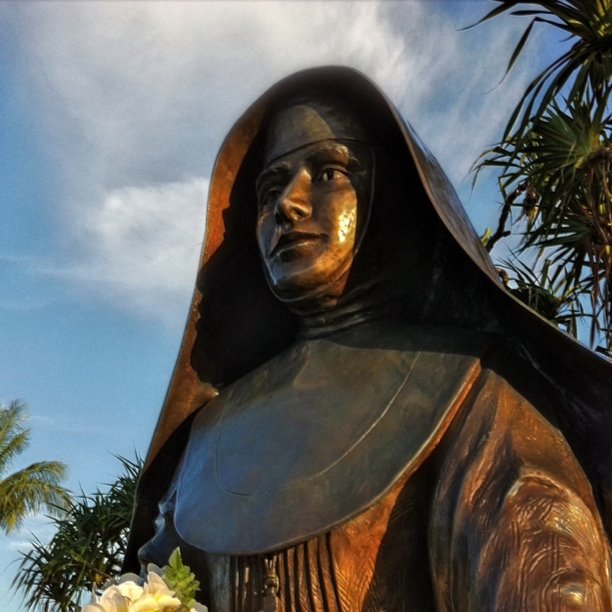
Attribution: billsoPHOTO, CC BY-SA 2.0 , via Wikimedia Commons
Reflecting on these events, it becomes clear how deeply the early experiences of famine and economic hardship must have influenced the Koob family’s decisions and, ultimately, the life of their daughter. The struggles of her parents during those hard years in Germany laid the foundation for Marianne Cope’s own resilience and dedication to serving those in need. Their story is a testament to the strength of the human spirit in the face of adversity and the powerful role that faith and hope can play in guiding one’s path.
 Michael Stephen Wills Photography