This past summer, an absence visited our garden—a loss more profound than the quieting of wind. It was the virtual silence of an empty sky where monarch butterflies should have danced. Each day, we waited, hoping to catch a glimpse of those delicate wings, vibrant with orange and black, fluttering above the milkweed. But the familiar sight never came.
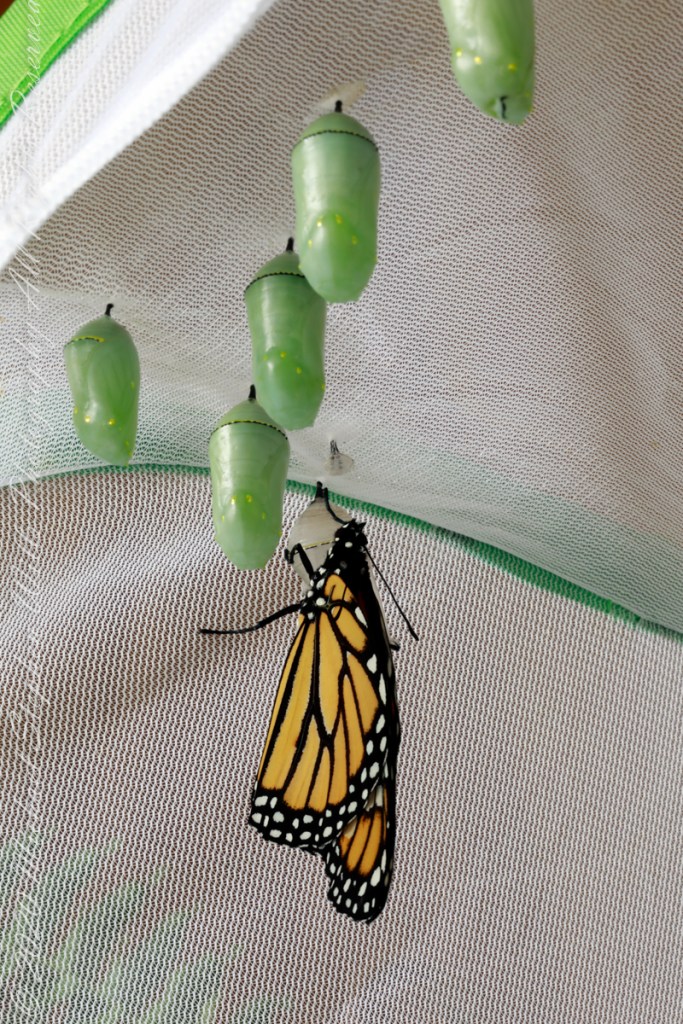
Monarch butterflies, those ethereal creatures that once graced our summers, seemed to have forgotten us.

The photograph of the monarch chrysalis, a delicate gem hanging on a thread of life, speaks to the fragility of nature itself. Each chrysalis is a promise—a quiet, patient promise of transformation and renewal. Yet this summer, those promises vanished, leaving us to wonder where the monarchs had gone, what changes in the world pulled them away from our home in the Finger Lakes.
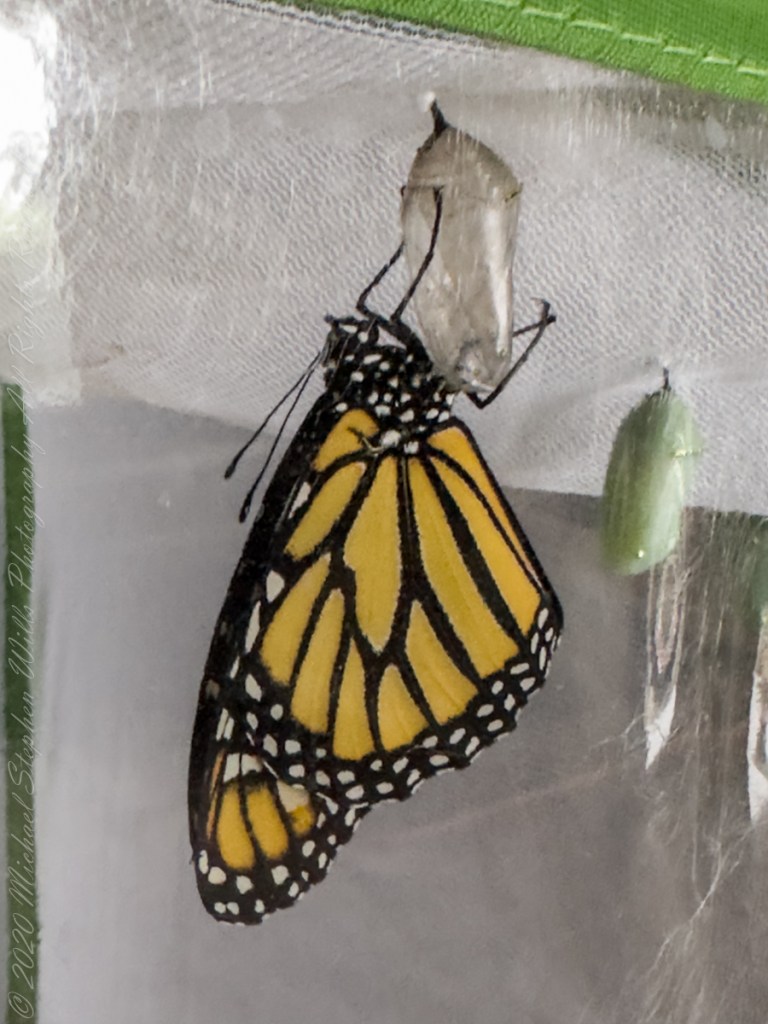
Another image from a time not so long ago, yet now seeming distant, shows a monarch caterpillar nestled among the milkweed blossoms. This was a time when our garden was alive with their presence, each caterpillar a testament to the cycle of life that once thrived here. The sight of them devouring the leaves was a sign of hope, a prelude to the transformation that would soon unfold. Now, that vibrant energy has vanished, leaving behind a quiet that speaks of loss and absence.
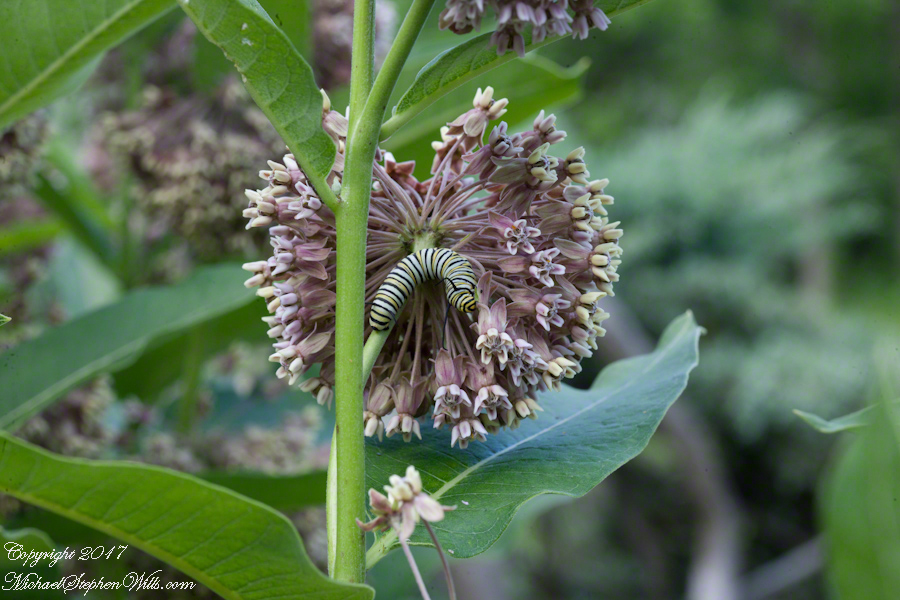
We are left to reflect on this silence, on the empty milkweed leaves and the air where monarchs once flew. The memories of summers past, when the monarchs filled our garden with their grace, are bittersweet now. They remind us of a time when the connection between the earth and its creatures was still intact, when the balance of nature had not yet been so precariously tipped.
In their absence, the monarchs leave behind a message—a reminder that their delicate beauty is not guaranteed, that the balance we once took for granted can be lost. The summer without monarchs urges us to look inward, to consider what must change, what must be protected, so that future summers may once again be filled with the fluttering of wings and the promise of life renewed.
The garden absence this year is a call to action, a plea from the earth itself to remember the delicate threads that connect us all. May we answer that call, so that this summer of loss will not reach into the future, but will be a pause, a moment of reflection before the return of the monarchs, and with them, the return of hope.
Request to my North American readers: leave comments exploring your experiences of Monarch butterflies the summer of 2024
Here are links to more Monarch photographs and videos.
Flight
Monarch Caterpillar to Chrysalis
Monarch Emergence
 Michael Stephen Wills Photography
We had a few Monarchs this summer in the mid-West Canadian prairies, especially in areas where natural grasslands and plants are preserved. I did not see significant numbers. I have ongoing concerns about the decades of persistent use of high altitude chemicals (weather geoengineering and sky-cloud seeding) and the effects on all natural habitats…it appears to be a taboo subject to discuss, but definitely remains on my radar.
LikeLiked by 1 person
In the mid-west Canadian Prairies, particularly in Alberta and Saskatchewan, cloud seeding is actively used to enhance precipitation, mainly to support agriculture by increasing rainfall and snowfall during critical periods. While cloud seeding is seen as beneficial for water management, there is ongoing debate about its long-term environmental effects and overall efficacy. Your voice would be welcome to the discussions.
LikeLiked by 1 person
Thank you for calling attention to this important issue!
LikeLiked by 1 person
My pleasure, Marie.
LikeLike
Oh no! We had hoped to see them in Mexico, but of course we were there at the wrong time of year. I have seen a few monarchs in Alberta this summer, but we don’t usually get a lot, so I think it’s normal. Maggie
LikeLiked by 1 person
Hi Maggie,
It’s always tricky to catch the monarchs at the right time, isn’t it? I’m glad to hear you spotted a few in Alberta this summer. It’s fascinating how their migration patterns vary so much across regions. Perhaps next time in Mexico, you’ll time it perfectly to witness their arrival. The writer W.S. Merwin has a fascinating essay on the Monarch over-wintering sites of Mexico, written years ago in a volume “The Ends of the Earth: Essays” in two essays titled, “The Winter Palace” and “The Winter Palace Revisited”. Thanks for sharing your experience—it’s always comforting to hear from others who appreciate these delicate travelers!
Best, Mike
LikeLiked by 1 person
Next time 😊
LikeLiked by 1 person
I hardly ever see butterflies
LikeLiked by 1 person
Hi Sheree,
It’s always a bit disheartening not to see many butterflies, especially when they add such beauty to our surroundings. I wonder if there are specific factors in your region that affect their numbers. Sometimes, even small changes in our gardens can make a difference—planting more nectar-rich flowers, for example. I hope that with time, you’ll start to see more of these delicate creatures fluttering about!
Best wishes, Mike
LikeLiked by 1 person
We live in an area of outstanding natural beauty, free from pesticides which has changed little in the past 20 years. We have plenty of bees and wasps.
LikeLiked by 1 person
Monarchs are rarely seen here these days. I used to photograph the Monarch caterpillars only to see them dead a few days later. Our environment is getting lethal, it seems.
LikeLiked by 1 person
Hi Tom,
It’s heartbreaking to hear about the decline in Monarchs and the struggles they face even at the caterpillar stage. The environment is indeed becoming more challenging for these delicate creatures, with habitat loss and pesticides taking a heavy toll. It’s a sobering reminder of the impact we have on our natural world. I hope that by raising awareness and making small changes, we can help create safer spaces for Monarchs and other species to thrive.
Take care, Mike
LikeLike
We haven’t seen too many Monarchs this year either. It’s really quite sad.
LikeLiked by 1 person
Hi Linda,
It really is sad to see so few Monarchs this year. It’s a troubling sign of the challenges they’re facing, and it makes us appreciate even more the times when they do visit. Hopefully, with continued efforts in conservation and awareness, we can help turn things around for these beautiful butterflies. Let’s keep hoping for their return in greater numbers in the future.
Best regards, Mike
LikeLiked by 1 person
Beautiful photos, and I can understand the sadness at the silence of your delicate friends this summer. My dad has planted milkweed around his pond in hopes that the ones that used to come around will someday reappear…
LikeLiked by 1 person
We also maintain patches of milkweed in the same hope. Best wishes in this endeavor.
LikeLike
Thank you Michael for reminding us of nature’s fragile balance. While I’m not an active Monarch observer, I share your concern about the future.
LikeLiked by 1 person
These past few day I’ve seen 2 – 3 Monarchs, though none visiting our yard.
LikeLike