It was a gentle May morning, the kind that seems to hush even the wind, as though nature were holding its breath for something wonderful. Through the kitchen window, just past the black iron gate entwined with the fresh green of climbing rose, I spotted them—feathered heralds of spring’s deepening promise—perched like jeweled notes on a musical staff.
The Rose-breasted Grosbeaks had arrived.
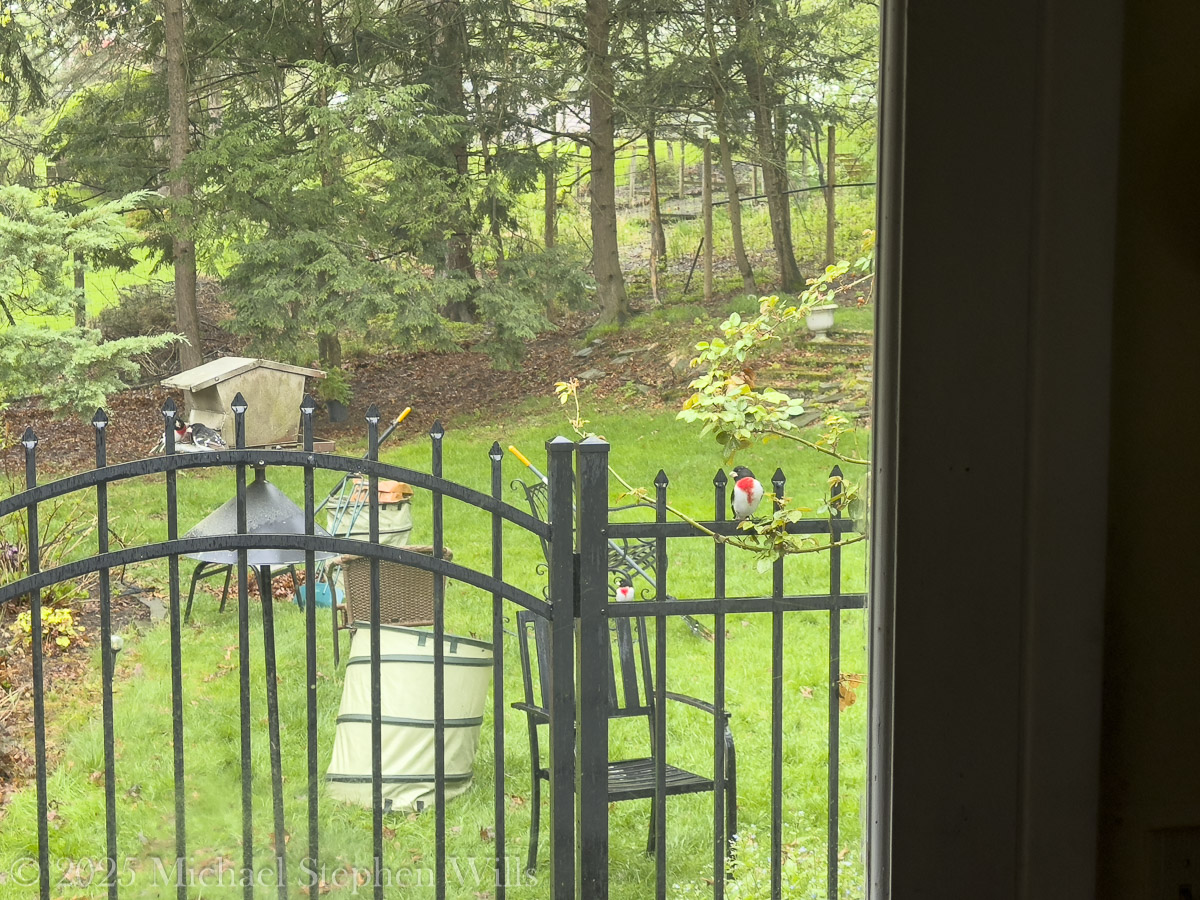
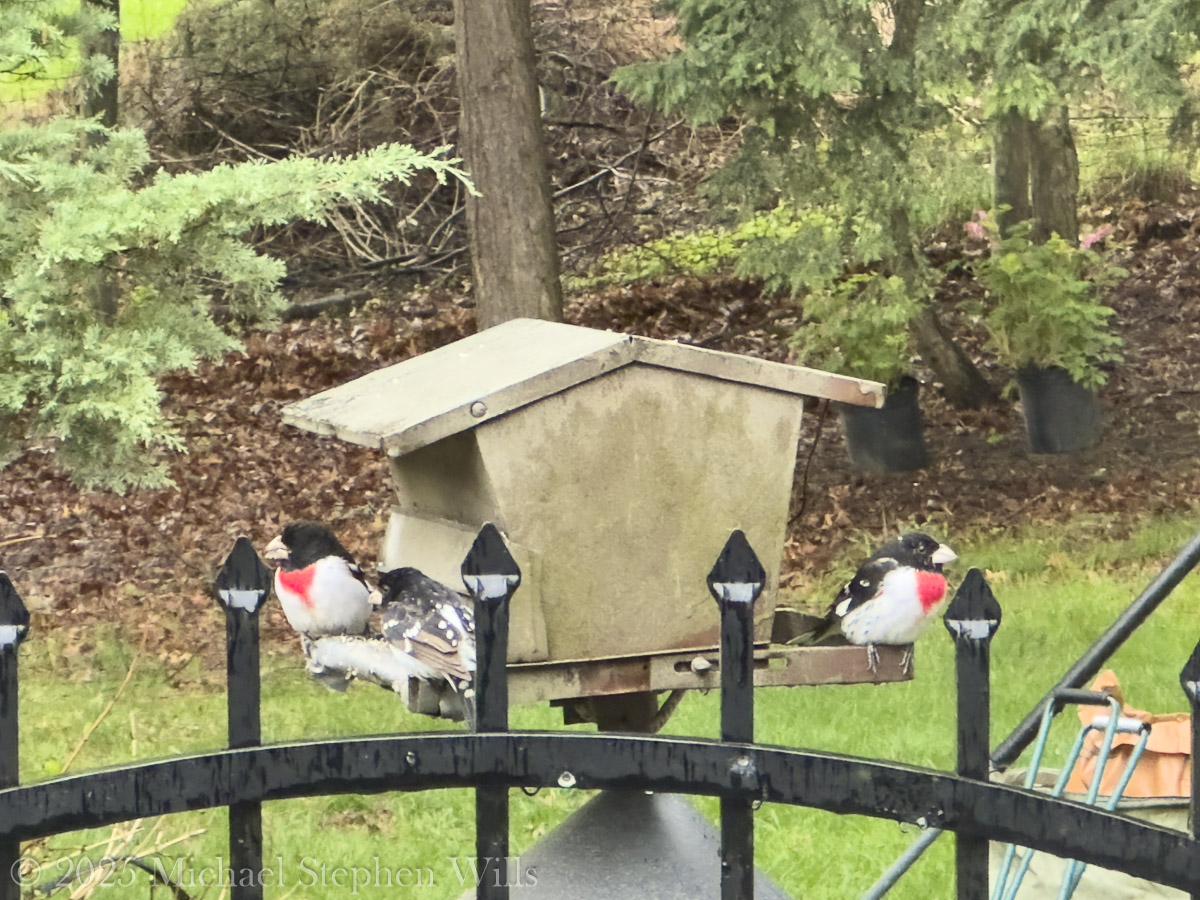
Not one or two, but a small flock, draped in raindrops, feathered in contrast and charm. They gathered around our backyard feeder like guests invited to a familiar table. At 5:56 a.m., the camera captured the first image: two males on the feeder and one each on fence and chair, a bold bib of crimson splashed across snowy chests, huddled against the gray of the feeder, their plumage brilliant even in the diffused dawn light. I couldn’t help but smile. This was a scene of quiet splendor, a symphony for the eyes and soul.
The males, unmistakable in their attire, wore tuxedos of black and white, with the defining rose-red marking on the breast that gives the species its common name. Their scientific name, Pheucticus ludovicianus, is less poetic but equally telling. “Pheucticus” comes from the Greek pheuktikos, meaning “shy” or “avoiding,” reflecting their reclusive habits in forested nesting grounds. “Ludovicianus” refers to Louisiana, an early French colonial name for a vast region including their breeding range—a nod to their North American roots.
At 5:58 a.m., the lens captured more details: a male with slightly mottled wing feathers, suggesting he was a younger bird, still dressing up in adult finery. The trio clung to the feeder’s edge, their heavy, conical beaks—perfect for cracking seeds—clearly visible. That oversized bill gives them the name “grosbeak,” from the French gros bec, literally “large beak.” Functional beauty, you might say.
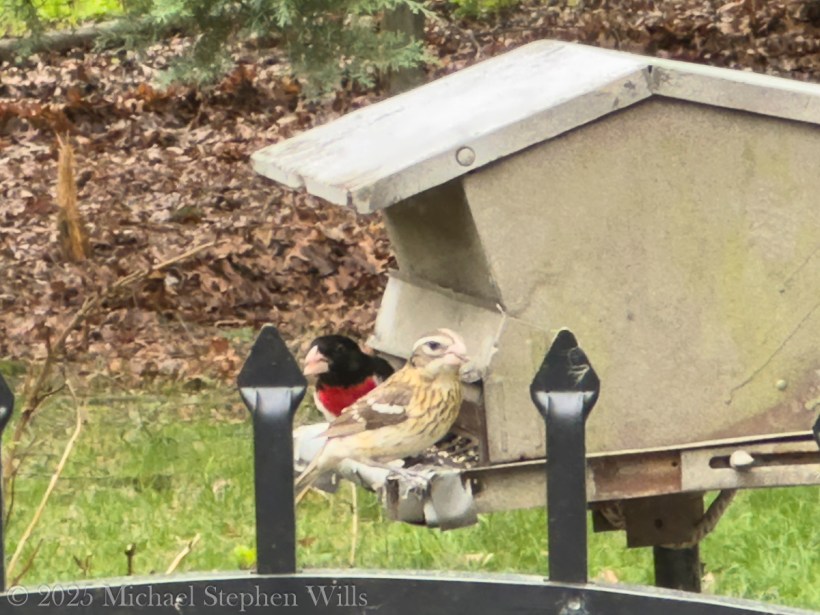
Then, at 6:08 a.m., came the contrast—the female. Subtly adorned in warm browns, with creamy streaks and a wash of yellow near the wings, she perched beside her flamboyant mate, as if to say: elegance need not shout. The two birds looked momentarily toward each other, and I was struck by their balance—his flair and her grace. Her eyebrow stripe, called a supercilium, lent her a composed, alert expression. While the male might catch the eye, the female commands attention in her own, quieter way.
Rose-breasted Grosbeaks are migratory, long-distance travelers who winter in Central and South America and return each spring to North America’s deciduous and mixed woodlands to breed. Here in upstate New York, our yard is a brief rest stop on their northward journey—or, if I’m lucky, a summer home. They often nest in dense foliage, and their song, a melodic, whistled warble—like a robin who’s taken voice lessons—is often the first clue to their presence.
This morning, no song was needed. Their silent presence was enough.
Watching them, I felt time slow, the kind of moment when the ordinary yard becomes cathedral. Watching them, I felt time slow, the kind of moment when the ordinary yard becomes cathedral. The wet fence and chair under the feeder, even the crumpled leaf bag—everything was blessed by the company of these birds. Rain softened the world, and the birds brought color to its hush.
Later that day, reviewing the photos with metadata timestamps from my iPhone—each image like a verse in a poem—I marveled at what I had witnessed. These weren’t just birds. They were stories in flight, living punctuation marks in the sentence of my morning.
Nature gives us these moments, brief as birdsong and just as sweet. You only have to be still, and ready to receive them.
Enter your email to receive notification of future postings. I will not sell or share your email address.
Copyright 2025 All Rights Reserved Michael Stephen Wills
References
- Pheucticus ludovicianus (Rose-breasted Grosbeak). Cornell Lab of Ornithology – All About Birds.
- Jobling, James A. The Helm Dictionary of Scientific Bird Names. London: Christopher Helm, 2010.
- Merriam-Webster Dictionary: Etymology of “Grosbeak.”
- iPhone 14 Pro Max image metadata (May 3, 2025; 5:56 a.m. to 6:08 a.m.; Ithaca, NY).


Thank you. I love them too. A few years ago we saw a male with an unusually long red breast marking. I call him Mr Tie.
LikeLiked by 1 person
Thank you, Susan! What a delightful name—Mr. Tie! I can just picture him with that bold, extended marking. It’s amazing how individual each grosbeak can be.
LikeLike
They’re very pretty and well named with both a rose breast and a gross beak😊 Maggie
LikeLiked by 1 person
Thank you, Maggie! I couldn’t agree more—both the name and the bird are wonderfully descriptive. That bold beak and rosy chest make them unforgettable! 😊
LikeLike
Such a contrast between them. He so elegant wth his flush of red. She demure in her soft colouring.
A delightful read intermingled with gorgeous images. Thank you for slowing down my hectic morning, Michael. A meditation extraordinaire!
LikeLiked by 1 person
Thank you so much, Carolyn. Your words are a gift—I’m touched that the post offered a quiet moment amid your busy morning. The contrast between them is part of their charm, isn’t it? I’m glad it spoke to you.
LikeLiked by 1 person
Hello Michael,
What a joy it must have been to welcome these visitors to your yard.
I love both the subtle colors of the female and the rosy colors of the male. The reminder to “slow down” resonated deeply, and we think fondly of our trip to Ithaca earlier this year.
Apologies for the radio silence, I hope to write a proper email to you soon. All our best to your wife and lovely grandsons☺️
LikeLiked by 1 person
Dear Takami,
It’s always such a pleasure to hear from you—no apologies needed. I’m so glad the post and our feathered visitors resonated with you. The reminder to slow down is one I’m trying to heed myself, as I’ll be taking some time off this summer to do just that. We often think of your visit with fondness too. Pam, Sam and Rory will be delighted by your kind wishes—sending warmest regards back to David and yourself. I look forward to your email whenever the time is right.
LikeLiked by 1 person
Thank you dear friend. We wish you and Pam a wonderful summer ahead. Of course our fond wishes to Sam and Rory too.
LikeLiked by 1 person
Michael, I feel extra inspired from your photographs and narrative. Thank you for sharing this amazing visit from these long distance travelers.
LikeLiked by 1 person
Dear Bigskybuckeye, Thank you so much for your kind words. I’m truly glad the photos and story struck a chord with you. It felt like a small miracle to witness these elegant travelers up close—and even more rewarding to share that moment with thoughtful readers like you.
LikeLiked by 1 person