Colored lights of our skies are lifelong triggers for the imagination. On any moonless, crystal night—far from the town-glow—three thousand or so stars and the wandering planets scatter across the dark. We read them instinctively, stitching patterns the way our ancestors did, turning a brilliant chaos into stories. Along the ecliptic, twelve of those patterns became the constellations, a starry calendar by which careful observers told the seasons. When Cancer, the Crab rides high, winter has the northern hemisphere in its grip

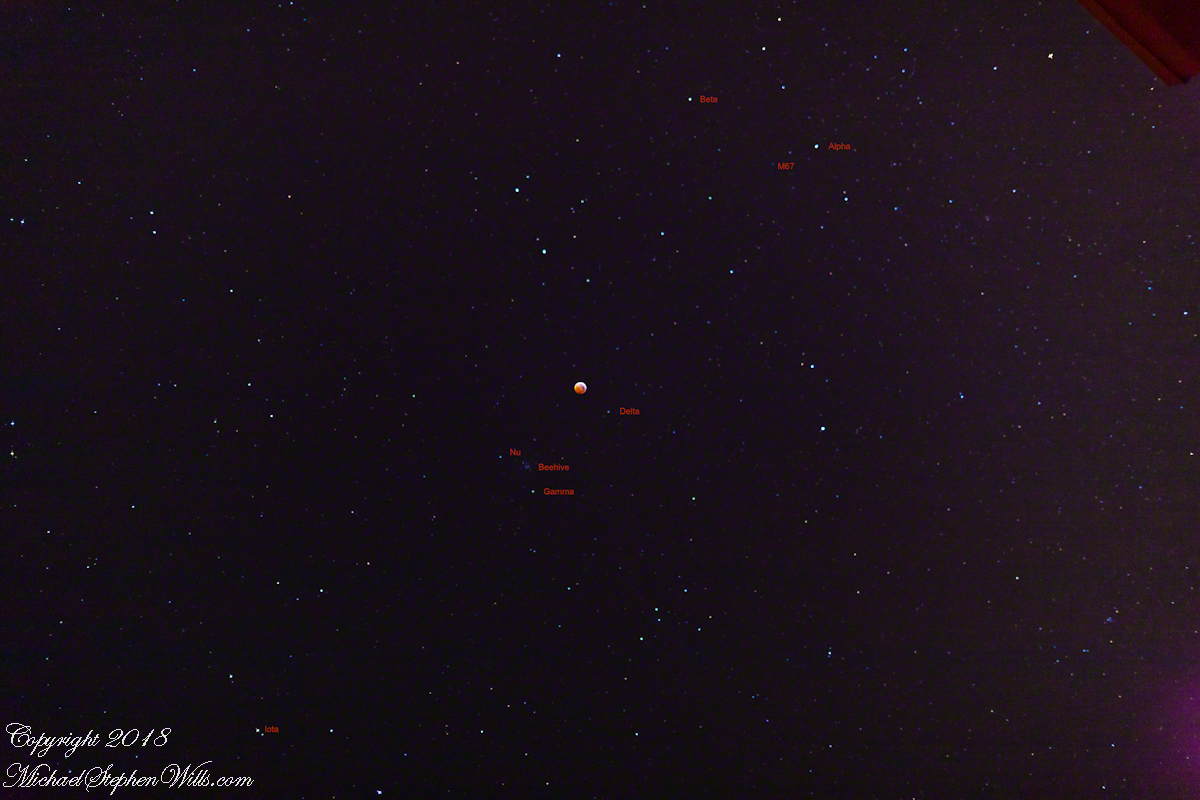
On the night of January 20–21, 2019, a full moon climbed from the horizon and slid into Earth’s shadow, transforming a familiar face into a copper coin. As it rose, that low-horizon “larger” moon—an illusion born of context—felt close enough to pocket. Hours later, the moon darkened to a dull copper color and appeared to float amid Cancer’s dim stars.
I set up a Canon DSLR on a tripod with a 24mm f/1.4 lens, pushed the ISO to 3200, and shortened the exposure to 1.3 seconds—a compromise between freezing star points and preserving the feel of the sky. The moon, of course, was overexposed in that wide frame; later, I overlaid a correctly exposed moon (from a telephoto shot later in the night) at its true apparent size to match the scene as the eye saw it. Is it the most “technical” astrophotograph of the eclipse? No. But it is faithful to the moment I witnessed and good enough to carry the story forward.
The Moon on the Crab’s back
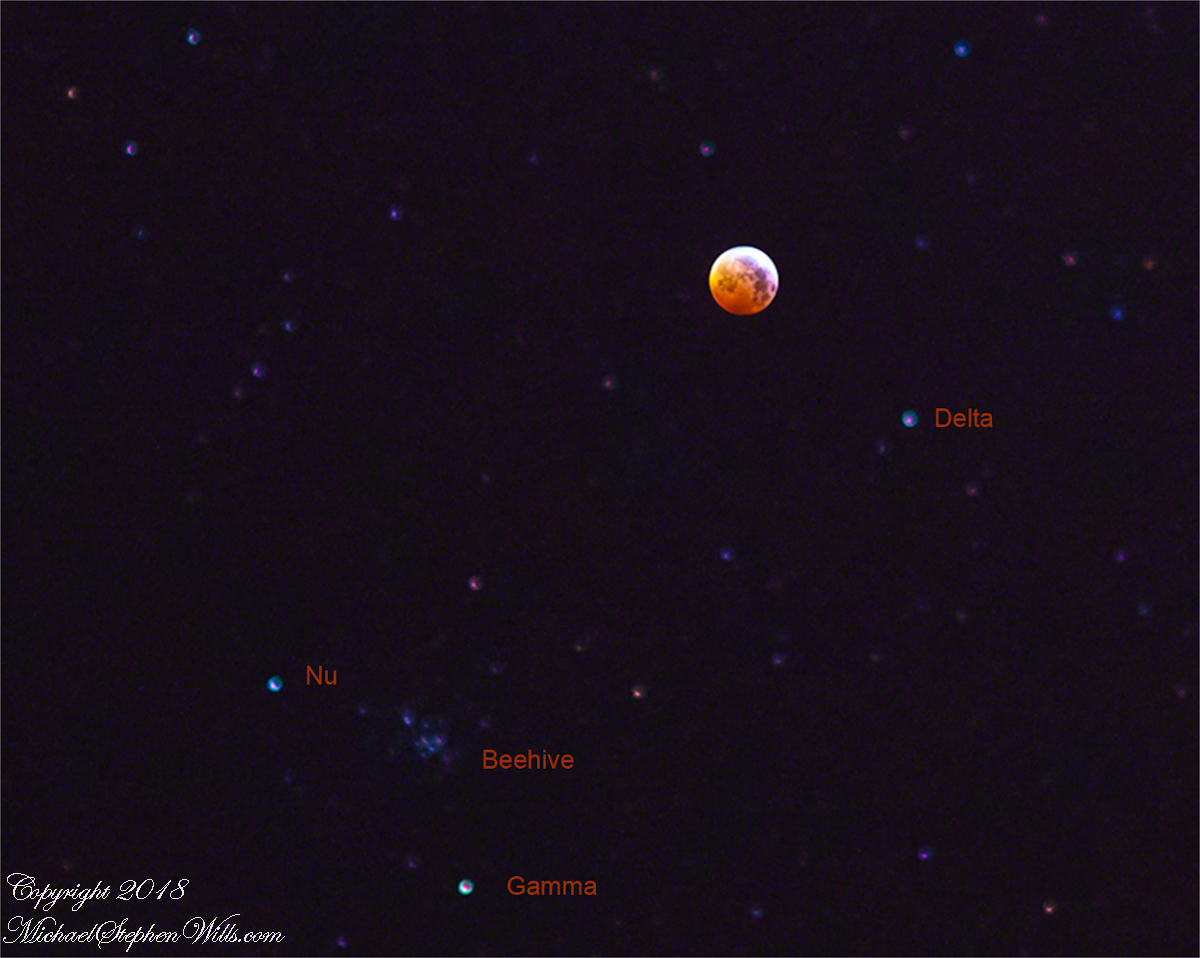
Cancer is never an easy connect-the-dots. Its stars are modest, more suggestion than signature. Look just to the side of the moon’s position that night and you come to Delta Cancri, the orange giant nicknamed the Southern Donkey. Draw a mental line down and slightly right to the faint pair Nu and Gamma Cancri—white stars that only masquerade as twins. They are not physically bound, merely near each other by line of sight: Nu about 390 light-years away, Gamma at 181. Scatter in Alpha and Beta off the Crab’s back and the outline becomes more plausible, the way a minimal sketch becomes a creature once the eye knows what to look for.
The Beehive
Between Nu and Gamma, edged closer to the moon, lies the real prize: the Beehive Cluster—also known as Praesepe or M44. Even with modest binoculars, Praesepe explodes into a field of delicate sparks, a thousand stars loosely wrapped into a hive. Galileo famously turned his early telescope on this cloud and teased forty separate points from the mist; modern optics reveal a populous neighborhood of stellar siblings in shades from ice-blue to ember-red. It is one of those sights that converts a casual sky-gazer into a repeat offender.
Click for more information about this view
Later in the night I lifted the telephoto—70–300mm at 300mm, ISO 3200, 3.2 seconds—and let the moon fill more of the frame. At totality, the light thinned to a clay-jar red as Earth’s atmosphere bent sunlight around the planet and into its shadow. The effect is both simple and profound: every sunset on Earth happening at once, projected onto the moon’s face. Craters and maria softened into relief, and the globe stopped being a flat disk and became a round, ancient body again. Even without Delta, Gamma, Nu, and the Beehive in that tighter field, the sense of placement remained; I knew the Crab’s back was there in the dark, and that the moon had joined it—just for an hour—as a guest at the manger.
The Total Eclipse
What I love most about an eclipse is its pace. Nothing is impatient: the bite appears, the light drains, the color warms, and the world around you changes temperament. As the bright glare wanes, neighborhood sounds recalibrate—the hush between footfalls, the small click of a door, even the steadying breath you didn’t know you were holding. A total lunar eclipse is an astronomy lesson that behaves like a poem; it teaches by arranging time and light until awe and understanding meet.
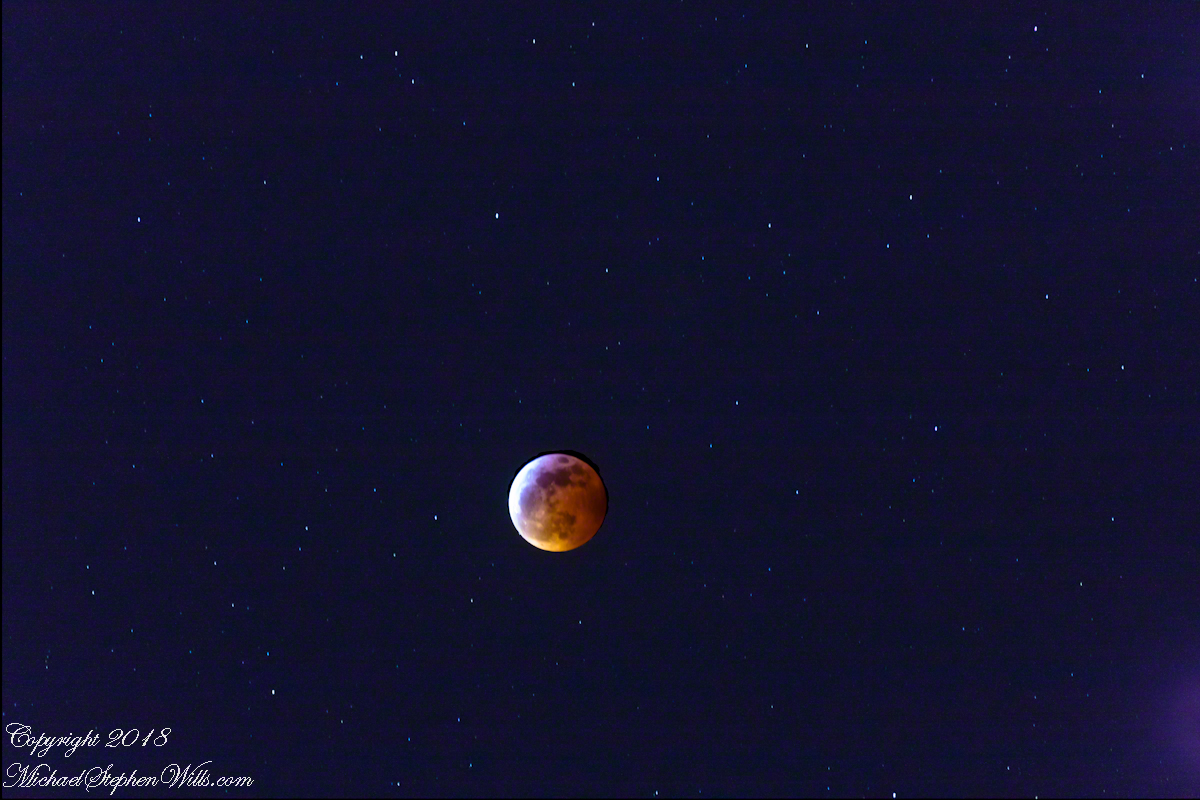
And then, quietly, it returns what it borrowed. A thin wedge of white blooms at one edge, a rehearsal for dawn. Copper gives way to pearl, and the old moon looks new again, just higher and smaller against the deepening night. Cancer recedes into suggestion; Praesepe goes back to being a faint cloud to the unaided eye. The camera is packed away, the tripod shoulders its own shadow, and you keep the best exposure of the night where it can’t be corrupted: in memory.
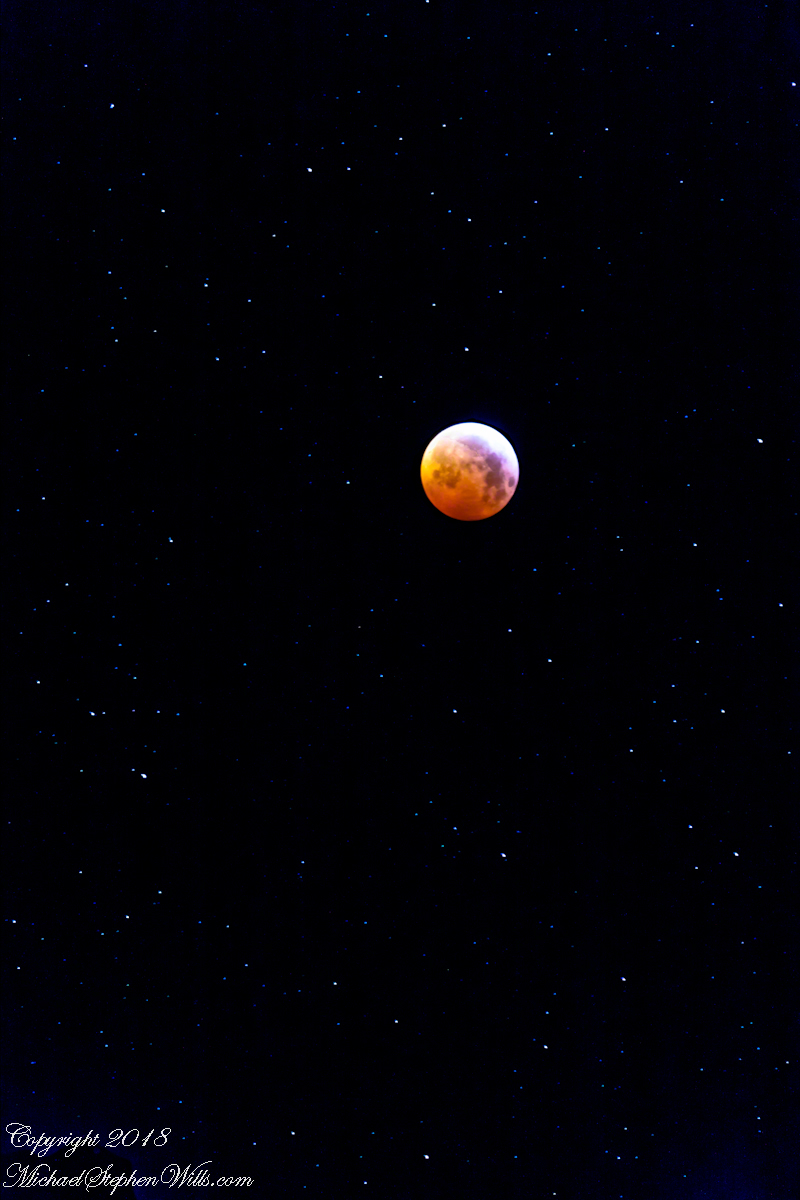
If you have binoculars, mark Cancer on a winter chart and step outside when the sky is clear. Find Delta, sweep toward the dim pair of Nu and Gamma, and then rest your gaze on that hazy patch between them. Bring a friend into the circle and let the cluster resolve, star by star, into something alive with depth. It will not be the last time you look for it. And if you’re lucky enough, as we were that January, the moon will pass nearby, reminding you that even the most familiar companion can be made strange and beautiful by the turn of a shadow.
The sky is a storybook, yes—but also an instrument. Nights like this tune both.
Enter your email to receive notification of future postings. I will not sell or share your email address.



That is beautiful… I wish I could pick out constellations like that.
LikeLiked by 2 people
A dark sky and lots of free time plus a red light and reference are requirements. There are tricks to follow, such as finding an easy pattern or object (such as the Beehive) and build from there.
LikeLiked by 1 person
These are the best moon eclipse photos I have ever seen!
LikeLiked by 2 people
This is always great to hear, Hien. Your support is much appreciated.
LikeLike
Michael, thanks for sharing your amazing photography and descriptions. You are very talented with your photography art. Great title for this post!
LikeLiked by 2 people
Thanks for your compliments for this float among the stars.
LikeLiked by 1 person
These are amazing shots of the moon and stars. Thanks for the explanations that went along the pics. Always ready to learn. 😊
LikeLiked by 1 person
I am working on improvements to the post and have just posted improved photographs (with labels).
LikeLiked by 1 person
I will check out the changes. 😊
LikeLiked by 1 person
Nice moon pics. Our typical January weather obscured that wolf moon, and living in the city my view of the stars is obscured even on the clearest of nights. Perhaps that’s why I’ve never learned the constellations. Enjoy your views!
LikeLiked by 1 person
Your situation is the rule for much of humanity, unfortunately. Good to hear from you, Dave.
LikeLike
Amazing photos and very interesting post! Thank’s Michael.
LikeLiked by 1 person
What a beautiful set of night sky photos! A telescope has been on my bucket list for some time now. Up here night views are rare because of the rainy season. The best viewing is in summer dry season.
LikeLiked by 1 person
Epsilon Lyrae is a summer sky object rewarding to view and contemplate.
LikeLiked by 1 person
So beautifully captured, truly wonderfully done.
LikeLiked by 1 person
Thank you so much, Sheree! Your kind words mean a lot. That night felt magical—Beehive Cluster sparkling beside the Blood Moon. I hope the skies over France are clear for the next eclipse so we can marvel together from afar. Grateful for your steady encouragement. —Michael
LikeLiked by 1 person
I didn’t know about the beehive cluster — fascinating!
LikeLiked by 1 person
Thanks, LightWriters! The Beehive (M44, Praesepe) is a lovely open cluster in Cancer—naked-eye from dark skies and gorgeous in binoculars. During the Jan 20–21, 2019 eclipse the Moon passed right by it, which is why the scene looked “abuzz” with stars. Appreciate you reading and stargazing with me!
LikeLiked by 1 person
Beautifully articulated and illustrated, thank you Michael.
LikeLike
Delightful, Michael. Your photography, understandings, and stellar tour guidance was magical.
LikeLiked by 2 people
Thank you, Carolyn! I’m so glad the images and little sky tour resonated. That eclipse felt like a shared hush—one of those nights you don’t forget. Here’s to the next clear evening and another bit of celestial company—if you catch the Southern Pleiades (IC 2602) in Carina, think of us! 🌝✨
LikeLiked by 1 person