These four images and YouTube video document a winter visit by a juvenile Cooper’s Hawk (Accipiter cooperii) to our backyard feeder, captured on February 7, 2026, during a snowstorm in mid-morning light in sub-zero temperatures. The metadata places the sequence between 10:35 and 10:37 a.m., recorded on an iPhone 14 Pro Max with a 9 mm f/2.8 lens at low ISO (32) and fast shutter speeds—conditions that make sense for a bright, snowy day when reflected light is abundant and a moving subject demands short exposures. The bird itself, however, tells a longer story than the camera settings can.
Cooper’s Hawks are medium-sized accipiters, built for pursuit in cluttered spaces. Short, rounded wings and a long, banded tail allow them to thread through trees and shrubs with startling agility. In the Finger Lakes region in winter, they increasingly overlap with human habitats because bird feeders concentrate prey. The metal feeder roof in these images is mounded with snow, and the hawk has chosen it as a temporary perch—an elevated, stable platform that offers both a view of potential prey and a place to rest after a chase or to wait out a flurry of weather.
The bird’s plumage marks it as a juvenile, likely hatched the previous summer. Instead of the blue-gray back and fine rufous barring of an adult, this hawk wears brown upperparts patterned with pale, teardrop-shaped spots and a buffy, vertically streaked breast. In the first image, where the bird faces forward through a lattice of branches, those bold brown streaks on a whitish background are especially clear. The eye is yellow rather than the deep red of a mature adult—another reliable sign of youth. Over the next year or two, those eyes will darken and the plumage will transition to the cleaner, more uniform adult pattern.
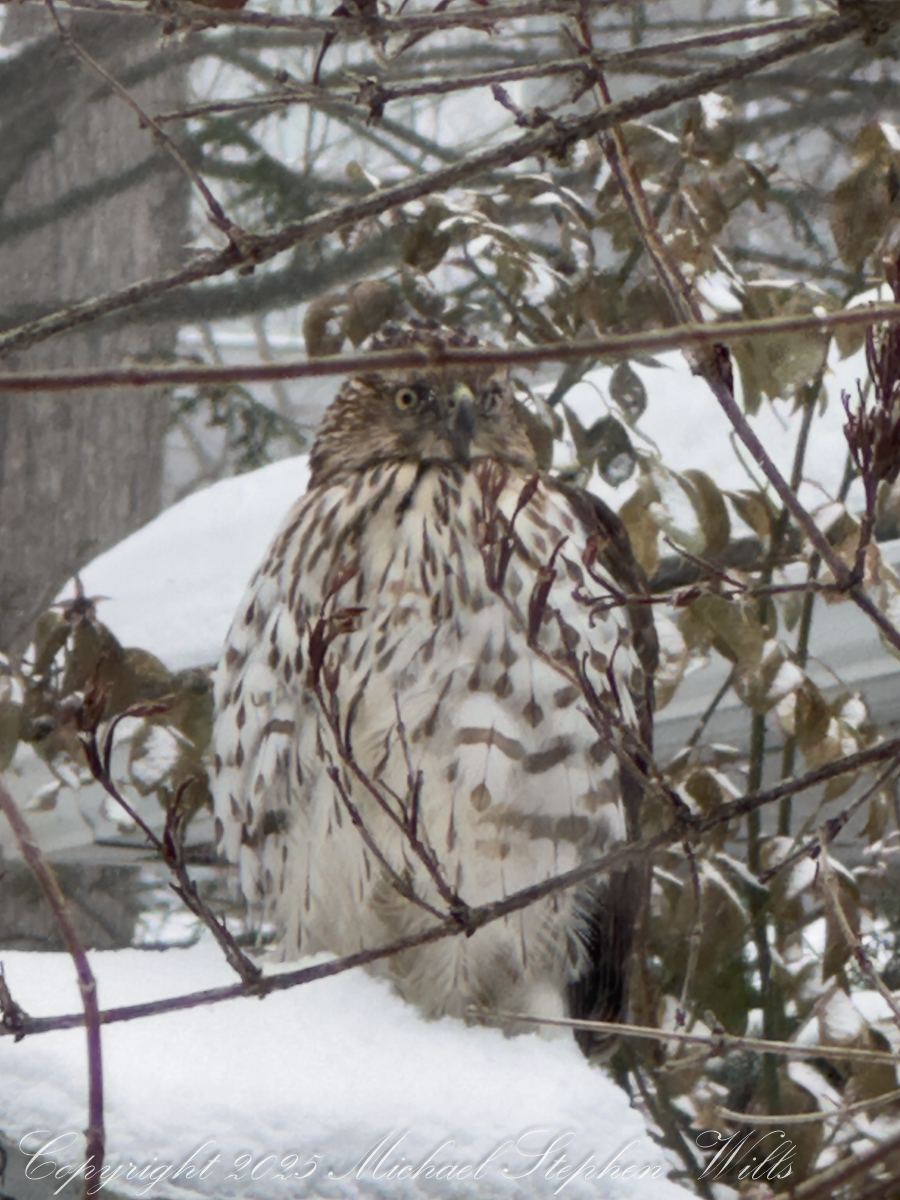
The long tail, visible in the rear views, shows broad, dark bands and a pale tip. That tail is not just decorative; it is the rudder that lets the hawk brake, pivot, and surge forward in tight quarters. The posture here—upright, alert, feathers slightly fluffed against the cold—suggests a bird conserving heat while remaining ready to launch. In winter, energy balance is critical. Each failed chase costs calories, and each successful one must pay back the effort many times over.
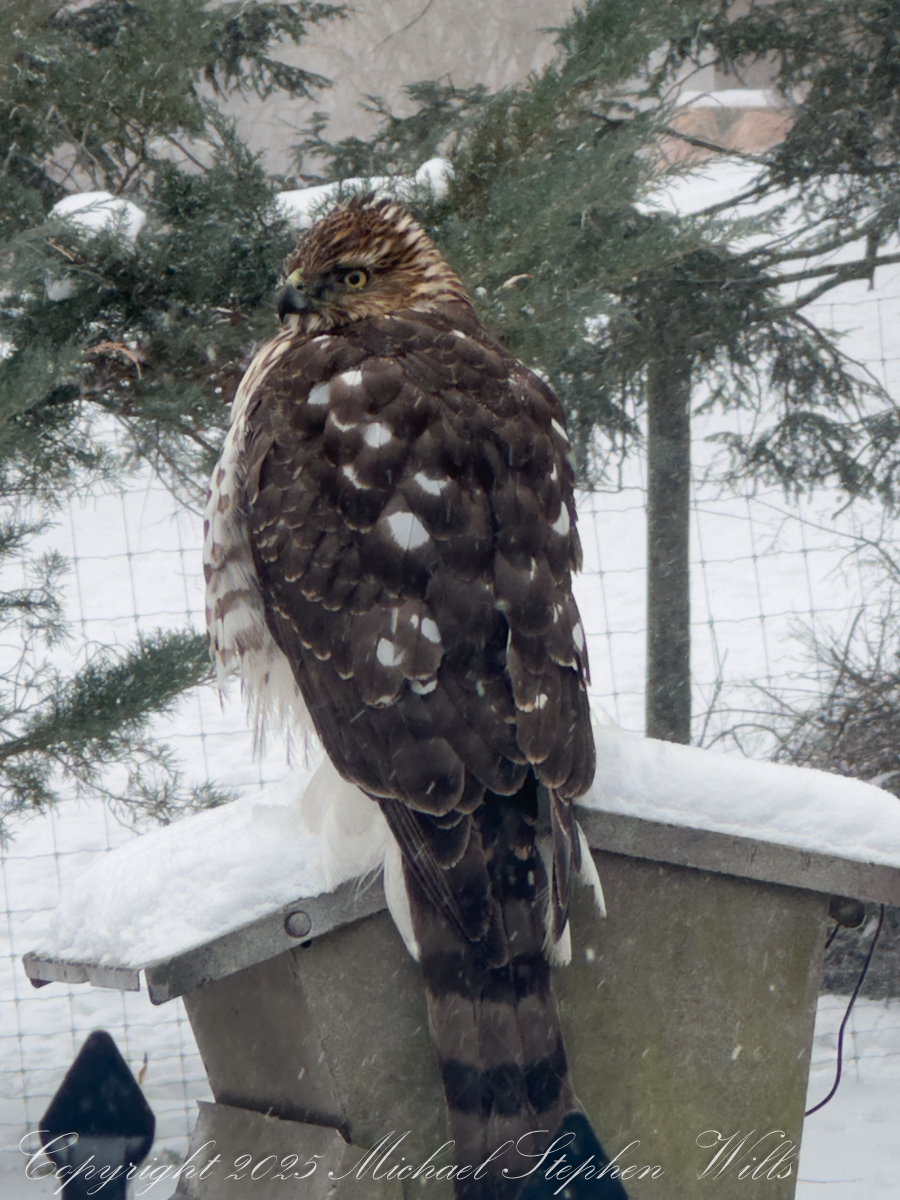
Cooper’s Hawks specialize in birds roughly the size of starlings, doves, and jays, though they will also take small mammals. Feeders unintentionally simplify the hunt by bringing many potential targets to a predictable spot. The hawk’s presence does not mean the feeder is “bad” for the ecosystem; rather, it shows the food web functioning in real time. Predators follow prey, and prey follow resources. In snowy conditions, when natural seed and cover are harder to find, that concentration effect is even stronger.
Click me for my Cooper’s Hawk photograph on Getty Istock.
The sequence of images reads like a brief behavioral study. In the first, it faces forward, squarely watching the yard. In the second and fourth, the hawk looks over its shoulder, scanning. In the third, it turns again, keeping its head in near-constant motion—classic raptor vigilance. Accipiters often hunt by surprise, bursting from cover rather than soaring and stooping like falcons or buteos.
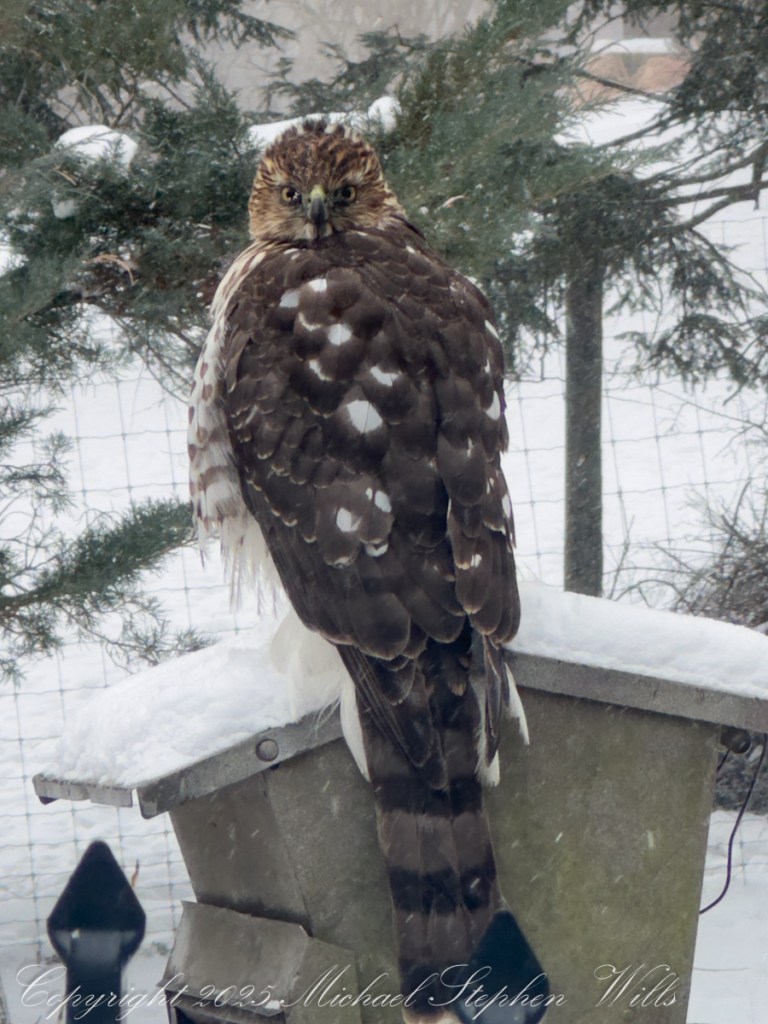
Winter also shapes the hawk’s relationship with humans. Juveniles, in particular, are more willing to explore unfamiliar structures and take calculated risks. A feeder roof is not a natural perch, but it offers height, stability, and a clear line of sight. Over time, many individuals learn the rhythms of a yard—when sparrows or doves are most active, where cover is thickest, where escape routes lie. Some succeed and stay; others move on.
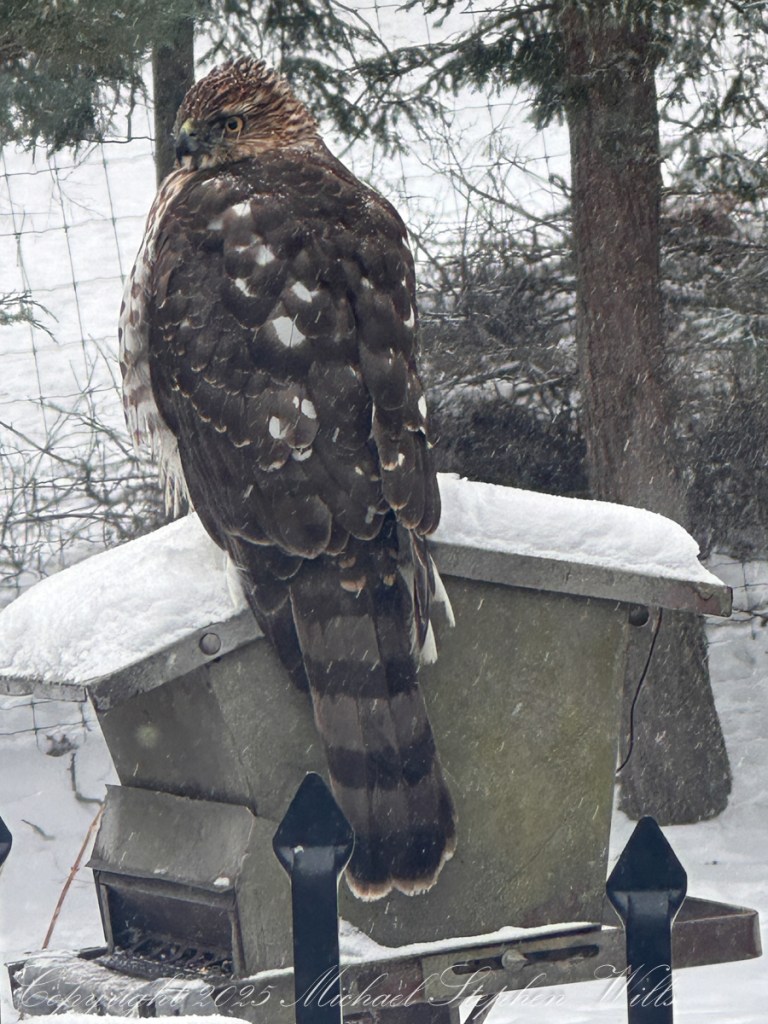
From a broader natural history perspective, this bird represents a conservation success story. Cooper’s Hawks suffered declines in the mid-20th century due to pesticide use, but populations rebounded after bans on DDT and related chemicals. Today they are again common across much of North America, including upstate New York, occupying forests, edges, and increasingly suburban landscapes.
The file metadata anchors this encounter in a precise moment—February light, a cold morning, a quiet pause between hunts. The images, however, capture something timeless: a young predator learning its craft, reading the winter landscape, and testing the boundaries between wild and human-made spaces. For the backyard observer, it is a reminder that even in the most familiar settings, the ancient choreography of predator and prey continues, written in feathers, snow, and a long, banded tail poised for flight.
 Michael Stephen Wills Photography
They are such beautiful birds and skilled hunters. I am 99% sure that a Coopers Hawk has been killing the Mourning Doves that congregate on my fence in the backyard each eve just before dark. I have a photo of it. All I find are feathers scattered everywhere.
LikeLiked by 2 people
Hi John—thanks for sharing that, and I’m glad the post resonated with you. Your description is classic Cooper’s Hawk behavior: the “snowstorm” of feathers is exactly what they leave behind after plucking a dove or pigeon at a favorite perch. Dusk is prime time for them too, especially where birds congregate predictably, like your fence line.
They really are beautiful and efficient hunters—graceful in the air, ruthless in the details. If you’re able to, I’d love to see your photo over on the Vegas photoblog. It’s always fascinating to compare how these same backyard dramas play out from the Finger Lakes to the desert Southwest.
All best,
Michael
LikeLiked by 1 person
Thank you Michael!! 👍🏻
LikeLiked by 1 person
What an impressive bird. The photos in the snow are absolutely beautiful, the contrast makes it even more striking. You really captured the intensity and focus of this powerful hawk. Fascinating to see such a wild presence in a backyard setting. Thank you for sharing.
LikeLiked by 2 people
Thank you, Matroos, that means a great deal to me. Moments like this are a reminder of how close nature is, even in the backyard. I was lucky to be there smartphone in hand when it happened, and I’m glad the images were able to convey some of the energy and presence of the bird. I really appreciate you taking the time to share your thoughts.
LikeLiked by 1 person
Wonderful! 👏
LikeLiked by 2 people
Thank you, Pepper! I really appreciate that—glad you enjoyed it. 😊
LikeLiked by 1 person
My pleasure. 😊
LikeLiked by 1 person
Such a magnificent bird beautifully captured Michael
LikeLiked by 2 people
Thank you, Sheree—that’s very kind of you. I was fortunate to have the smart phone in hand for a special moment, and I’m glad the images resonated with you. Always appreciate your encouragement.
LikeLiked by 1 person
You’re very welcome, as always
LikeLiked by 1 person
We have them here, and I have seen them scoping out the bird feeder from time to time. Your photos and video are beautiful, Michael.
LikeLiked by 2 people
Thank you, Lavinia—I really appreciate that. It’s always a bit of a jolt to notice one quietly watching the feeder, isn’t it? Moments like that make you realize how much drama is playing out just beyond our windows. I’m glad you enjoyed the photos and video, and it’s nice to know you’ve had similar encounters where you are.
LikeLiked by 1 person
Fantastic captures of such a majestic looking bird!
LikeLiked by 1 person
Thanks so much, Linda—I’m glad you enjoyed seeing this winter visitor. It was a special moment to watch such a skilled hunter working the backyard, and I’m happy the images could share a bit of that with you.
LikeLiked by 1 person
Michael, your photography and attention to details offers a welcome look at this younger Cooper’s Hawk. Even in winter’s environment, the cycle of life continues to breath.
LikeLike