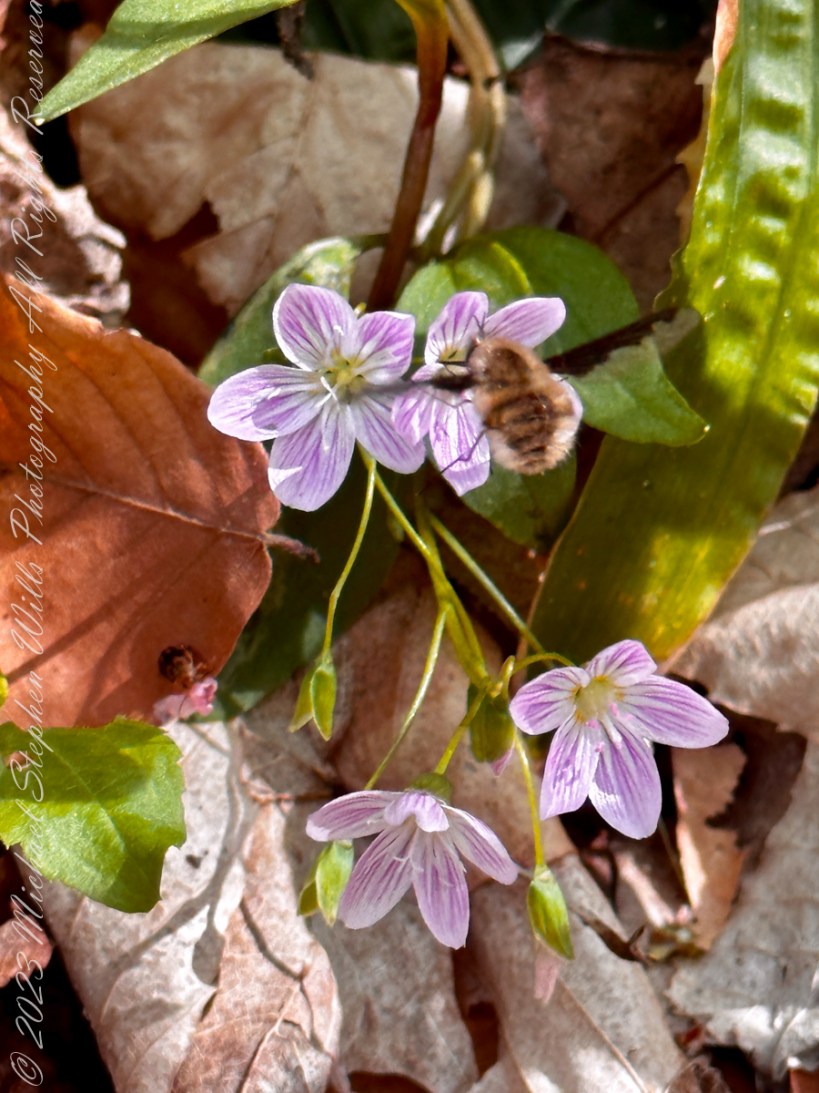
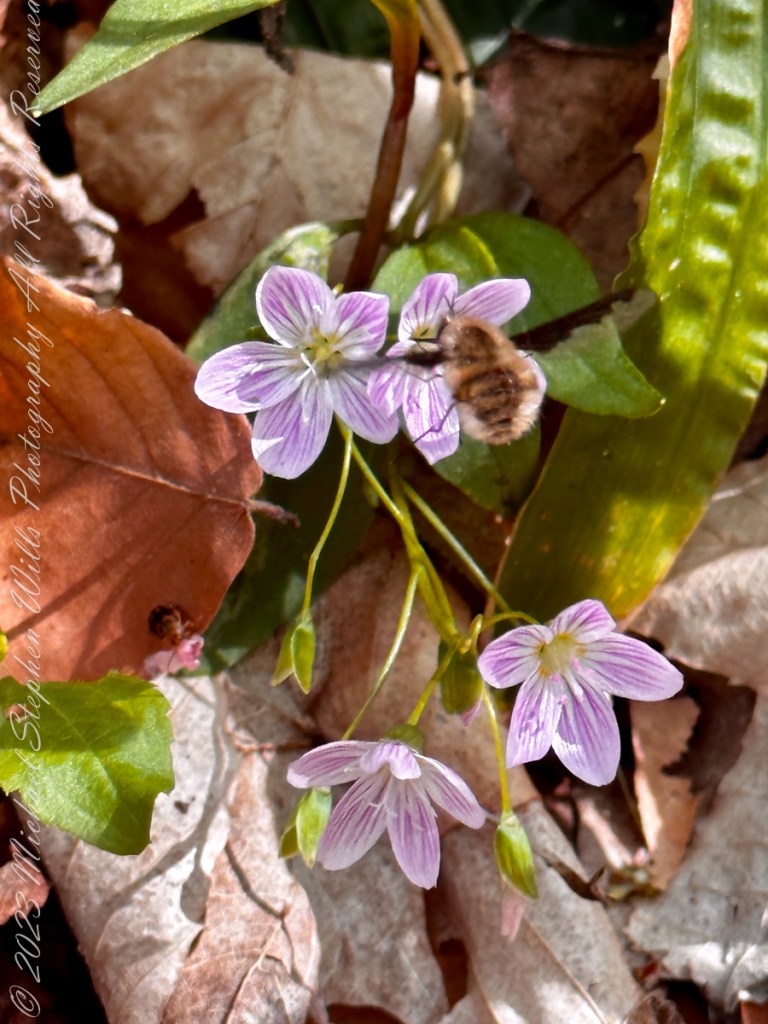
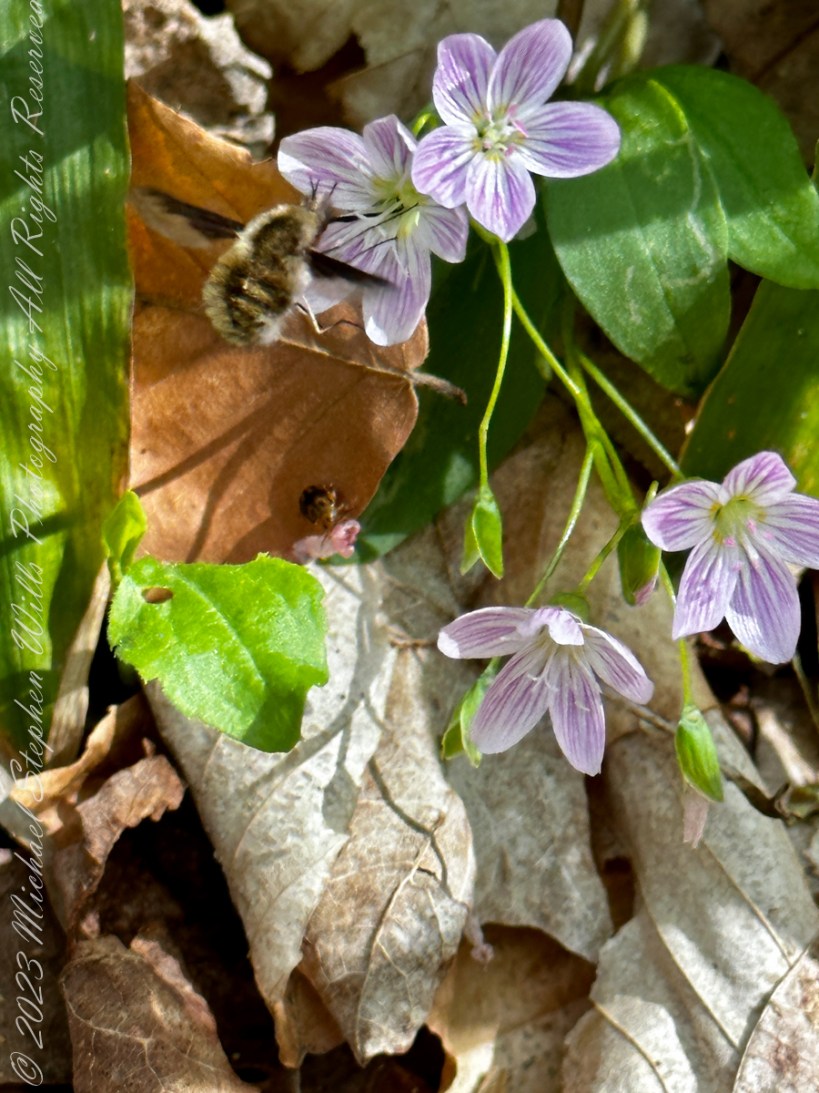
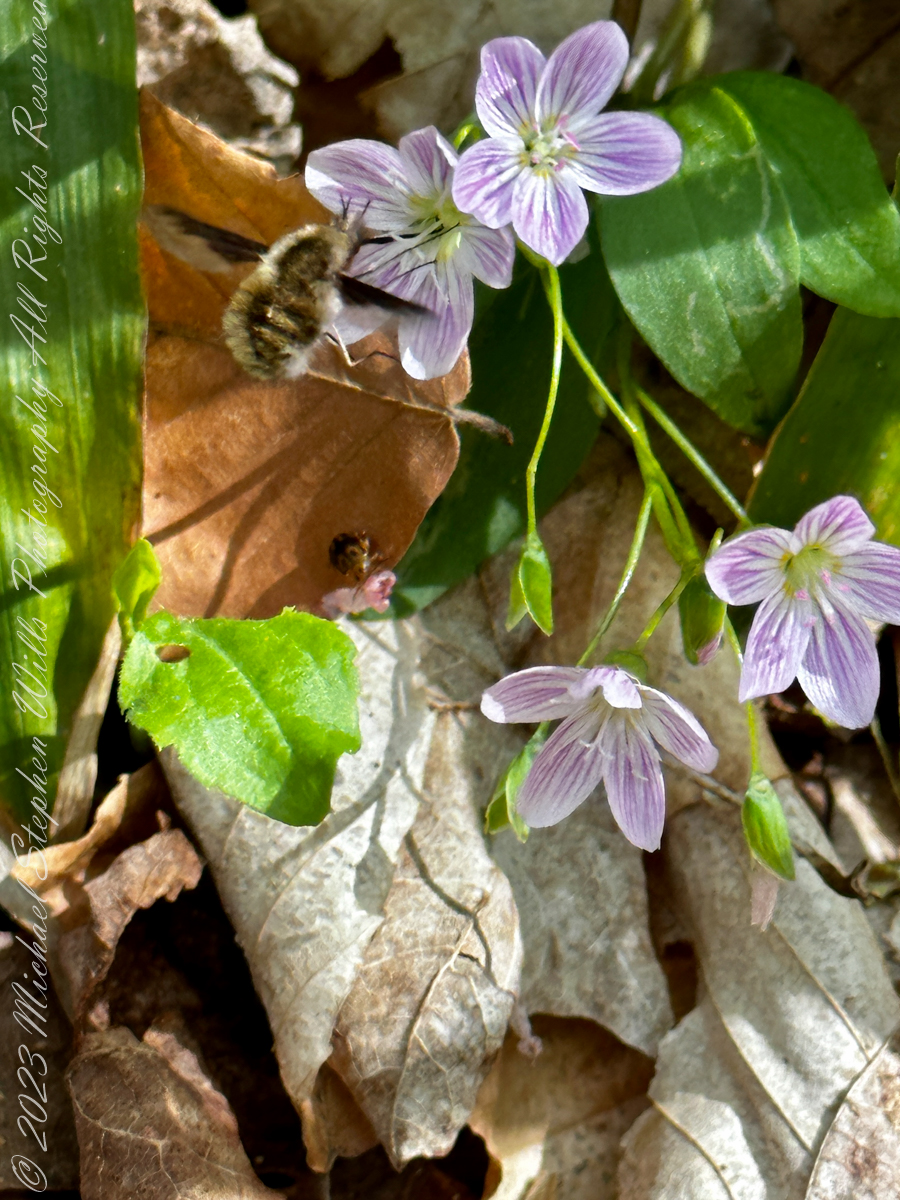
Greater Bee Fly is reputed to be a nectar thief, making a cut in flower base to siphon off nectar without fertilizing the flower. This behavior is not in evidence here as it approaches this Carolina spring beauty on a late April afternoon along the South Rim trail of Fillmore Glen State Park.
Instead, what we see is this fly using a long rigid proboscis, found in the front of the head, to probe and feed nectar from the flower base as would any other respectable bumblebee that is resembles and is commonly mistaken for.
Copyright 2023 All Rights Reserved Michael Stephen Wills
Claytonia caroliniana, the Carolina Spring Beauty, is an herbaceous perennial in the family Montiaceae. It was formerly placed in family Portulacaceae. Its native range is eastern and central North America. It is most found in the New England area of the United States, but its habitat extends from Ontario and a northern limit in the Cape Anguille Mountains of Newfoundland and south to Alabama.
It grows approximately 6 inches tall in forests of the Appalachian Mountains and piedmont.Claytonia caroliniana is a flowering, woodland perennial herb. It grows from March though June and is one of the earliest spring ephemerals. The plant grows from spherical underground tubers in light humus. They sprout and bloom before the tree canopy develops. Once the area is shaded, the plants whither leaving only the tuberous roots underground.
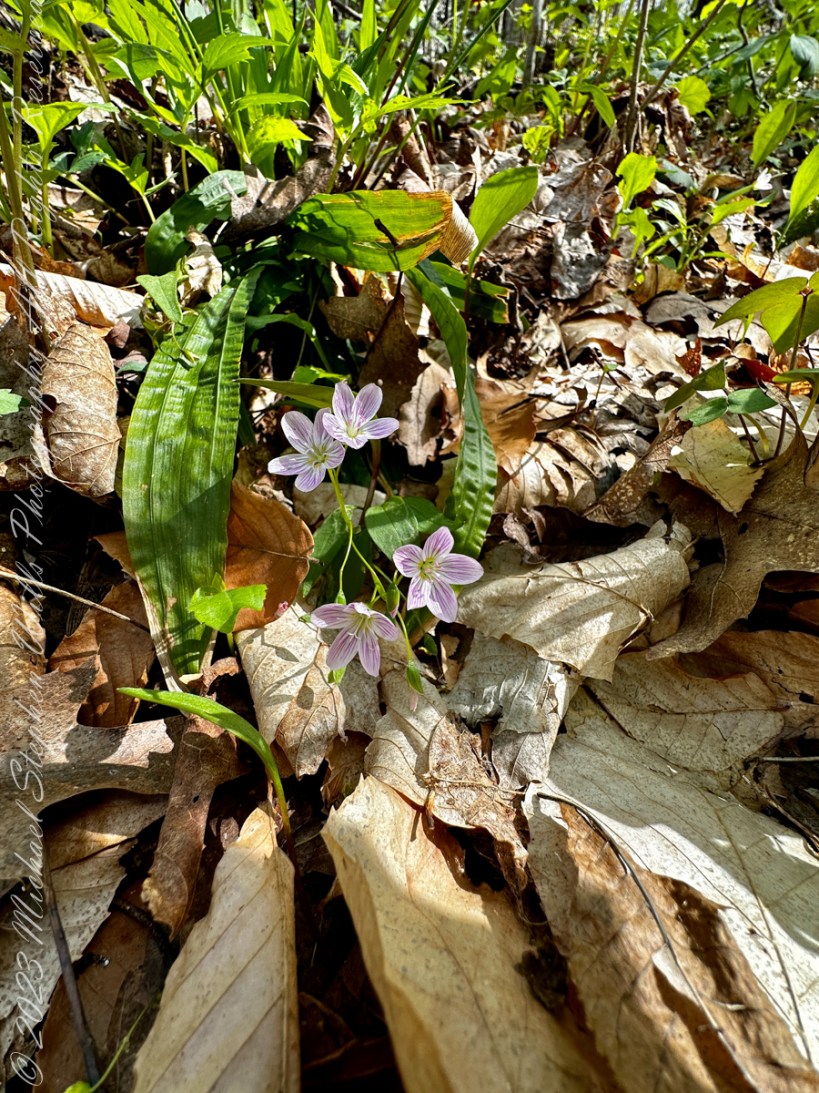
The flowers consist of five pink and purple petals. Dark pink veins accent the petals and give them a striped appearance. The carpels are fused together. I have heard the flowers are white when first opened, have not experienced this myself. They grow on a stem 3 – 10 inches tall that bears a single pair of broad leaves. There are two green leaves that grow opposite each other on a node. The leaf has no teeth or lobes and a prominent central vein. They grow up to three inches long and 1/2 to 3/4 inches wide.
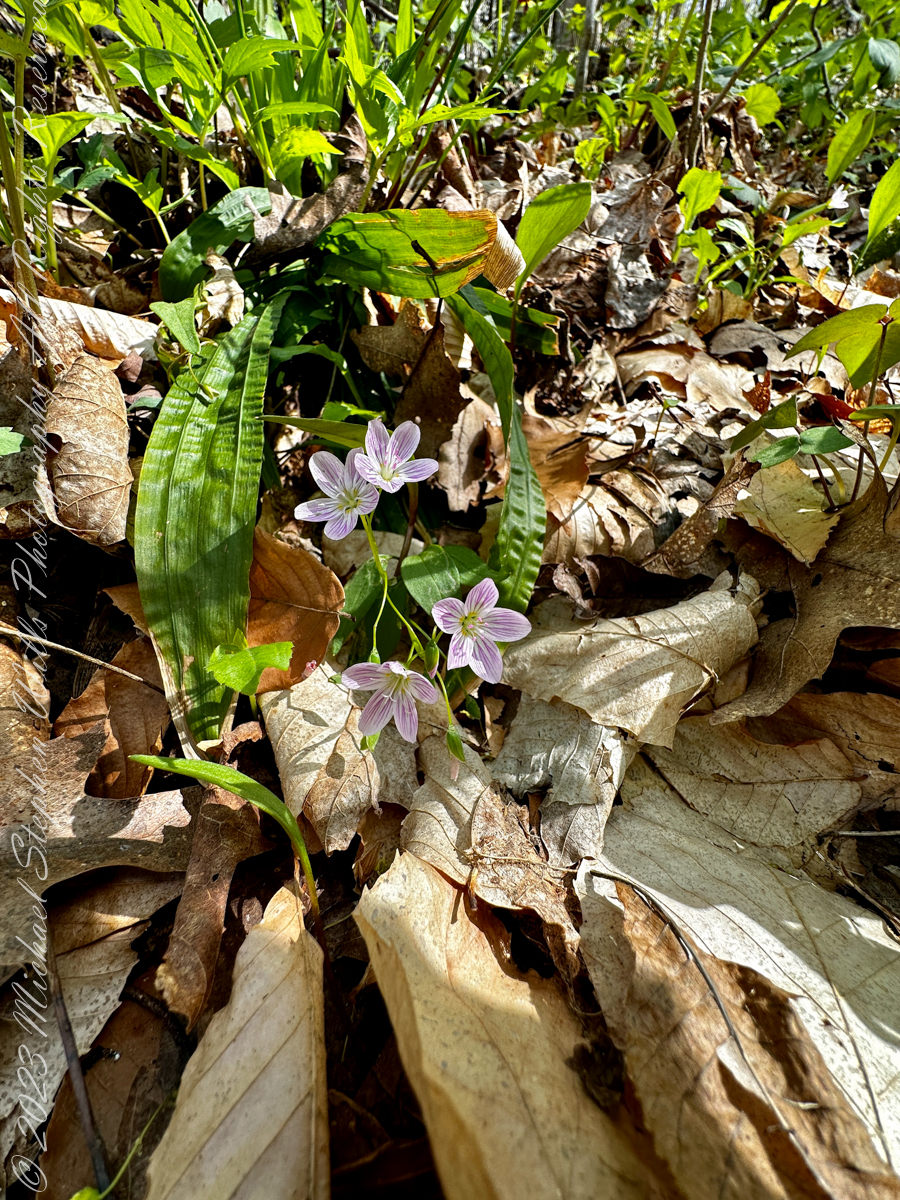
In the photograph, Carolina Spring Beauty flowers bracket the leaves just visible under leaf litter.
Edible
The plant is edible, but its usability is limited due to difficulty harvesting and the small quantities each plant produces. Its tuberous roots are edible and rich in starch and can be cooked or eaten raw. The leaves can be eaten as well. The tuberous roots are eaten by eastern chipmunks and white-footed mice.
History
The plant was named after John Clayton. Clayton was an early collector of plant specimens.
Source: Wikipedia”Claytonia caroliniana. Direct quotations are in italics.
Copyright 2023 All Rights Reserved Michael Stephen Wills
Bombylius major (commonly named the large bee-fly, the dark-edged bee-fly or the greater bee fly) is a parasitic bee mimic fly. Bombylius major is the most common type of fly within the Bombylius genus. The fly derives its name from its close resemblance to bumblebees and are often mistaken for them.
Bombylius major exhibits a unique flight behavior known as “yawing” and plays a role in general pollination, without preference of flower types. The fly does not bite, sting, or spread disease. However, the fly uses this mimicry of bumblebees to its own advantage, allowing close access to host solitary bee and wasp nests to deposit its eggs. After hatching, the larvae find their way into the nests to parasitically feed on the grubs.
Flight
It has been discovered that the fly is capable of a unique behavior, which was discovered with the use of a high speed camera. In this behavior, the flies are seen to rotate around a vertical axis as they fly (this action is known as “yawing”). However, it is still unknown what can cause this behavior to be triggered and what purpose it serves, but a proposed explanation includes mating habits. Here is an illustration of “Yaw” in the context of an airplane…substitute the fly body with head facing forward (to left).
The Bombylius major bee-fly is a common, generalist floral pollinator, meaning that it does not give preference to one flower over another, instead pollinating a wide variety of plant families and species. The fly uses its proboscis to carry and transfer the pollen. The species is a dominant pollinator within its community, sometimes even pollinating up to two thirds of the local flowers. In addition, Bombylius major will visit and pollinate plants that attract few other species. Some types of flowers, for example Pulmonaria officinalis, will be almost exclusively pollinated by Bombylius major, with other species contributing a negligible amount to that plants pollination. Some flower species, such as Delphinium tricorne, are even specifically adapted to the fly in terms of color, shape, and form. If given the choice, Bombylius major will have a consistency in plant choice.
Flower Attraction
Long distance floral attraction is governed by optical sense, with color being the most important factor. The flies are typically more attracted to blue and violet colors, and occasionally yellow, over orange and pink. However, short distance floral attraction is based on the fly’s olfactory sense.
Sunbathing Activity
The fly is mostly active during day hours when the weather conditions are warm and sunny. Bombylius major is attracted to sunnier places and is more likely to pollinate these areas, with a larger average of flower visits in areas of higher amounts of sunshine. The fly will hide in the trees during the night and usually dart away from a cast shadow and occasionally hide in clean washing brought in fresh from the washing line and fly out causing unsettled behavior in the discoverer.
Flower Description
Claytonia caroliniana is a flowering, woodland perennial herb. It grows from March though June and is one of the earliest spring ephemerals. The plant grows from spherical underground tubers in light humus. They sprout and bloom before the tree canopy develops. Once the area is shaded, the plants whither leaving only the tuberous roots underground.
The plant is edible, but its usability is limited due to difficulty harvesting and the small quantities each plant produces. Its tuberous roots are edible and rich in starch and can be cooked or eaten raw. The leaves can be eaten as well. The tuberous roots are eaten by eastern chipmunks and white-footed mice.
Source: Wikipedia “Bombylius major ” and “Claytonia caroliniana. Direct quotations are in italics.
Copyright 2023 All Rights Reserved Michael Stephen Wills

 Michael Stephen Wills Photography