Discovering Large-Flowered Bellwort Near Mundy Wildflower Garden in Ithaca, New York

On an April afternoon along Fall Creek near Cornell Botanic Gardens, I found my first colony of Large-flowered Bellwort, Uvularia grandiflora—a quiet woodland wildflower shaped by spring light, pollinators, and rich forest soil.

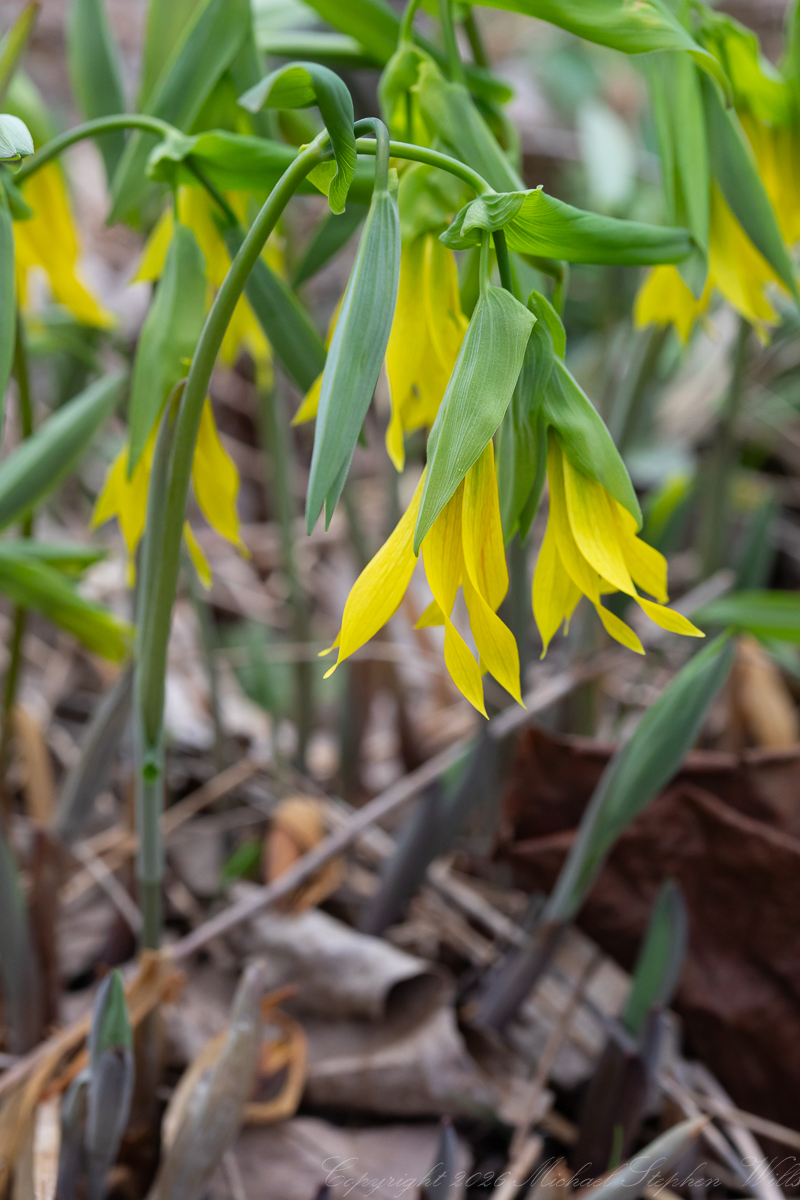
On an April afternoon in 2026, walking along Fall Creek near the Mundy Wildflower Garden at Cornell Botanic Gardens, I came for the first time upon a colony of Large-flowered Bellwort, Uvularia grandiflora, and stopped with the immediate feeling that spring had spoken in a new dialect. I had seen the season gathering itself all around me in buds, in damp leaf litter, in the first loosening of the woods from winter’s gray restraint. But this was different. These flowers did not announce themselves with bravado. They hung quietly beneath their leaves, as though the forest had shaped small yellow lanterns and then thought better of showing them too openly.

I raised my Canon EOS 5D Mark IV with the Canon EF 100 mm f/2.8 Macro USM lens and photographed them handheld at 1/640 second, f/8.0, trying to honor both their delicacy and their poise. Macro work often feels like an act of courtship with detail. One does not seize the subject; one approaches, waits, adjusts, breathes. In the bellworts, I found a plant that rewarded just this kind of attention. At first glance they seemed merely graceful. Then, looking more closely, I began to see their architecture.

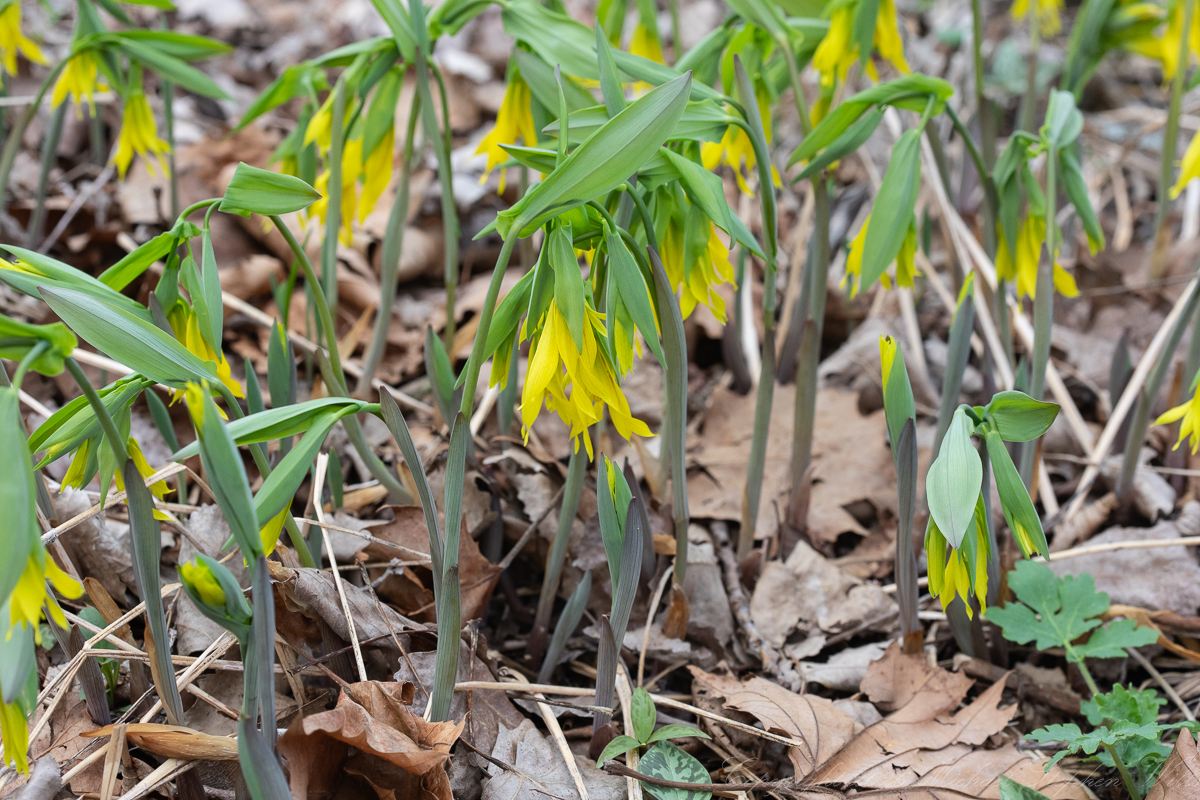
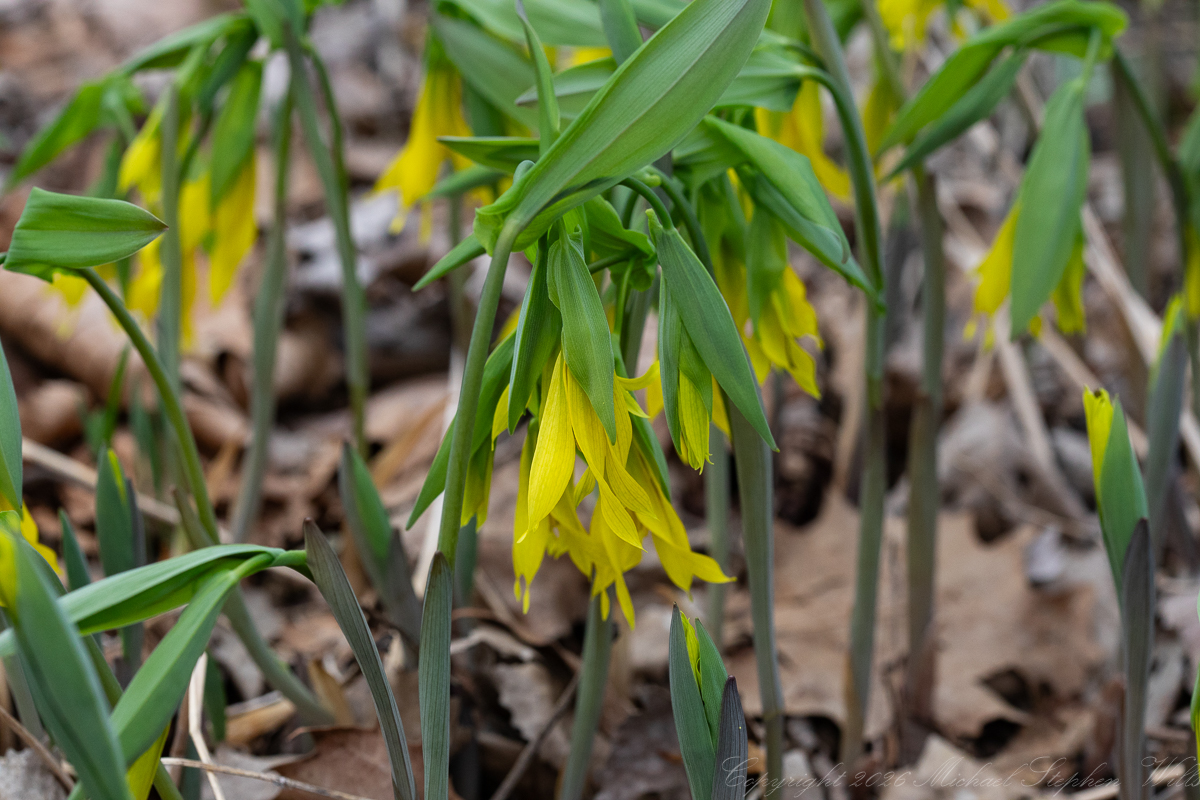
These Largeflower Bellworts (Uvularia grandflora) are flourishing on the Cornell University Campus along Fall Creek, adjacent to the Mundy Wildflower Garden. Cornell University, Tompkins County, finger Lakes Region, New York State

Large-flowered Bellwort is a woodland perennial of rich deciduous forests, and it wears that identity in every part of its form. The stems rise smooth and pale, slender but assured, each seeming to carry its burden effortlessly. The leaves clasp the stem in that distinctive bellwort manner, as though the plant were being held in green hands. Beneath them hang the flowers, elongated and drooping, their six yellow tepals twisted and tapered into points. They are not the symmetrical stars of more open-faced blossoms. They are pendants, streamers, tassels of sunlight. In these flowers, yellow becomes motion. Even when still, they seem to trail the memory of a breeze.

The plant’s drooping habit is part of an evolutionary strategy. In the spring woods, before the canopy fully leafs out, ephemeral light reaches the forest floor in a brief annual inheritance. Bellwort rises into that window. It gathers energy quickly, blooms early, and makes use of the few bright weeks before the trees above turn the woodland dim and green. Its season is a narrow one, but not a meager one. This is a plant shaped by timing, by patience, by fidelity to a recurring opportunity. It lives where sunlight is not constant but bestowed.

There is something deeply moving in such an existence. We humans often admire the grand gestures of nature—the waterfall, the hawk, the thunderhead. But woodland wildflowers teach another lesson: that persistence may take the form of exquisite brevity. Uvularia grandiflora does not dominate the landscape. It waits for its rightful hour, then enters the year with quiet authority. It is one of spring’s soft-spoken triumphs.

Ecologically, the bellwort belongs to a community rather than a spectacle. It grows in moist, humus-rich soil, among the remains of last year’s leaves, where decay has become nourishment. Around it are the signatures of a healthy eastern woodland: filtered light, fungal work below ground, the gradual release of nutrients from the forest’s own past. Its roots do not stand apart from this economy of return. They participate in it. The beauty of the flower is inseparable from the labor of decomposition, the unseen commerce of roots and microbes, the long winter’s accumulation of leaf mold. Even here, elegance rises from compost.

And then there are its relationships with other living things. The flowers, nodding and somewhat enclosed, invite a certain intimacy from insect visitors. Bellwort is not a billboard flower. It asks a pollinator to come close, to enter its hanging chamber. Bumblebees, mason bees in the genus Osmia, sweat bees in Halictus and Lasioglossum, and mining bees in Andrena are among its visitors. One bee, Andrena uvulariae, bears in its very name the mark of this botanical relationship, having evolved a close association with Uvularia. To stand before these flowers is to imagine that hidden commerce of spring proceeding just beyond the edge of one’s notice: a queen bumblebee nosing into a drooping bloom, a small Osmia working deliberately among the tepals, an Andrena bee moving with ancient purpose through a plant lineage it has learned by evolution to trust.

What we call a wildflower is also an agreement, a contract written between blossom and insect long before we arrived to admire it. Even after flowering, the bellwort participates in the forest. Its seeds bear fleshy appendages that attract ants, which help carry them away and disperse them through the woodland.

Human beings, of course, enter this world differently. We bring names, lenses, curiosity, memory. We kneel in leaf litter with cameras. We identify, compare, and sometimes misidentify. We make gardens to protect what once grew without us, and then discover that our finest role is not mastery but attention. Finding Large-flowered Bellwort near Fall Creek reminded me that our relationship to such plants is at its best when it is grounded in humility. We do not improve these flowers by naming them; we improve ourselves by learning to see them.

And seeing them, truly seeing them, is no small thing. The petals in these photographs are veined with light. The stems carry a woodland grace, as if drawn in one uninterrupted line. The colony as a whole had the look of a little parliament of bells, each one bowed, each one speaking in silence. They seemed to me like fragments of sun that had slipped through the trees and decided to remain rooted there.

I left Fall Creek that afternoon with the feeling that I had been admitted to a finer scale of perception. Large-flowered Bellwort asks little of the passerby except slowness. Yet in return it offers a great deal: form, adaptation, timing, kinship, restraint. It shows how life in the spring woods is built from tact. Not only from survival, but from style.

Some plants shout the season into being. Bellwort lets it ring softly. And once heard, that note stays with you.

Enter your email to receive notification of future postings. I will not sell or share your email address.
Where Winter Yields: Skunk Cabbage, Pitcher Plants, and Milky Ice at Malloryville Preserve

A late winter walk through Malloryville Preserve reveals milky ice, emerging skunk cabbage, and hidden wetland life—seen through the curious eyes of grandchildren.

The morning began in that quiet register peculiar to late winter in the Finger Lakes—when the calendar insists on spring, yet the land, still half-claimed by frost, speaks in a more cautious dialect. At the O.D. von Engeln Preserve at Malloryville, the woods held both seasons in tension. Snow lingered in shaded hollows, while the exposed ground, damp and rust-colored, breathed with thaw.

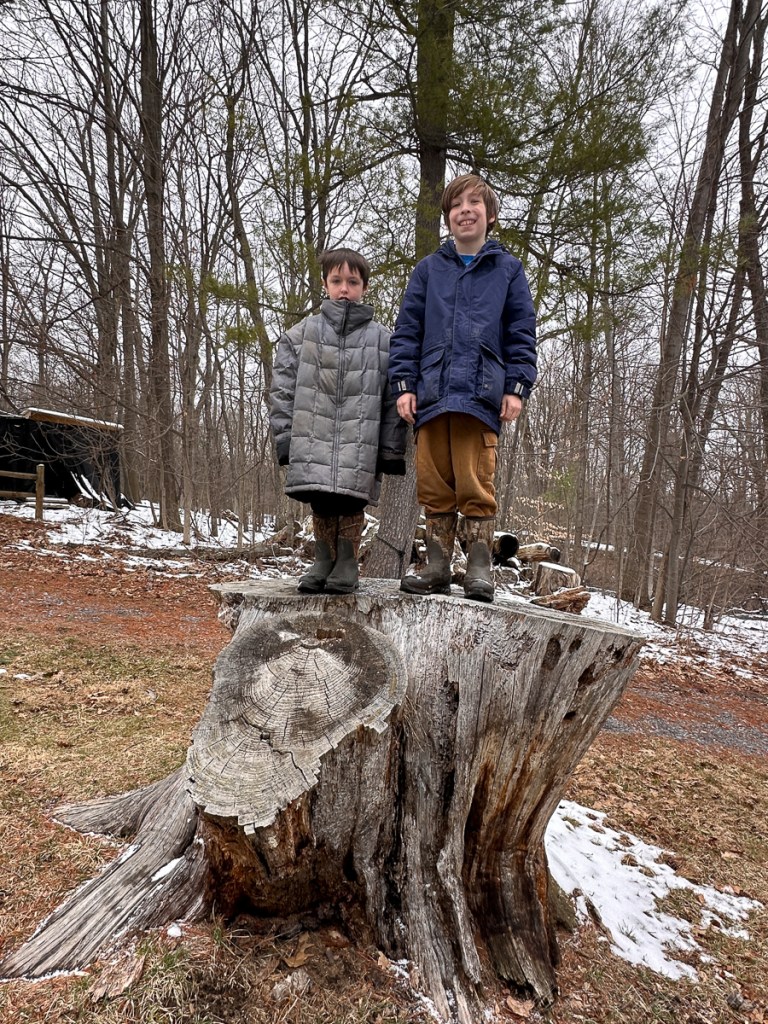
Sam and Rory—boots muddied almost immediately—climbed atop a great, weathered stump, its cut face fanned with the geometry of years. There is something about a stump that invites children upward, as though it were not a remnant but a stage. From their perch they surveyed a kingdom of bare trunks and quiet trails, their laughter momentarily lifting the stillness. Behind them, the forest rose in gray-brown columns, and beneath them, the history of a tree—rings like a clock no one can wind backward.

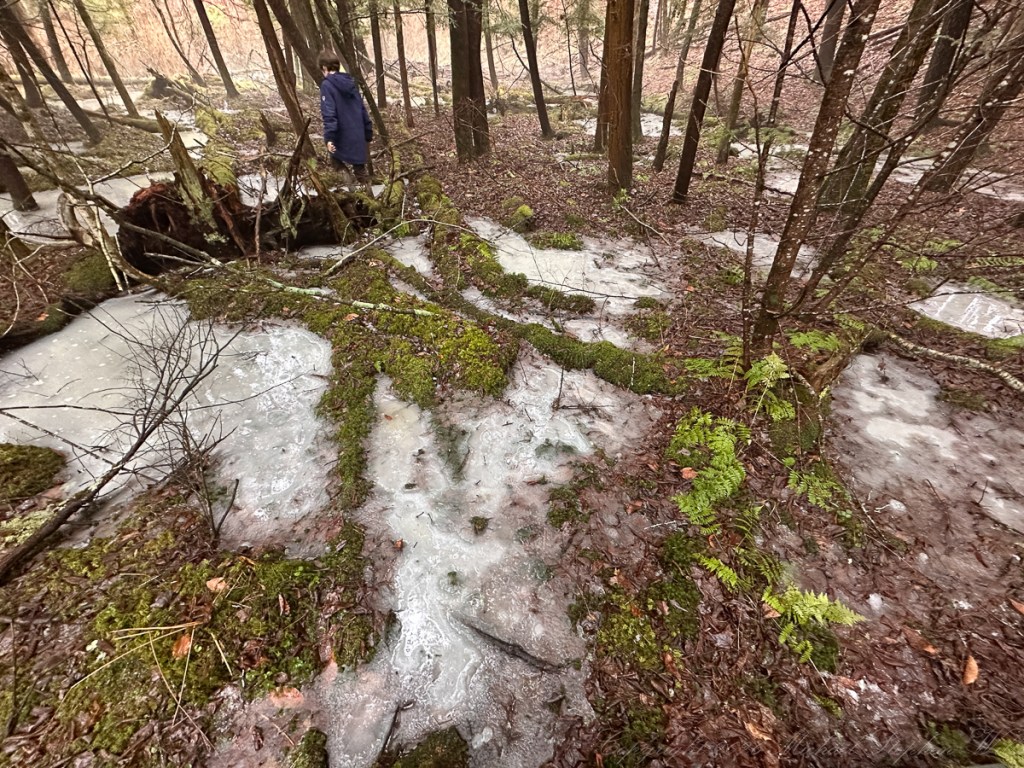
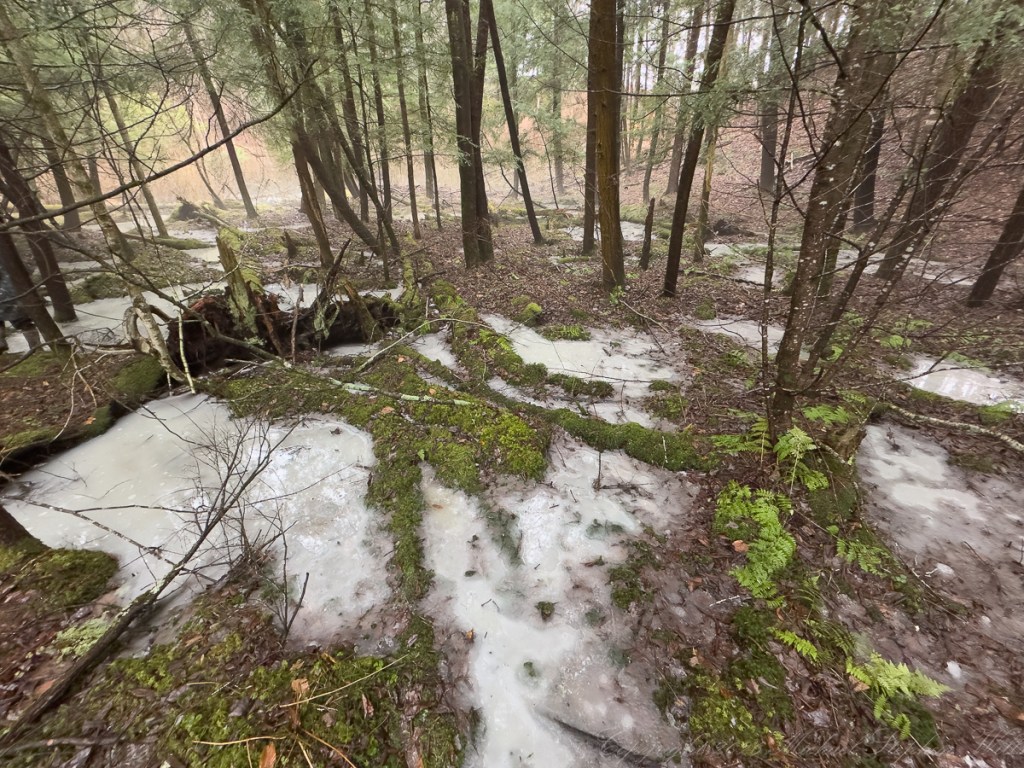
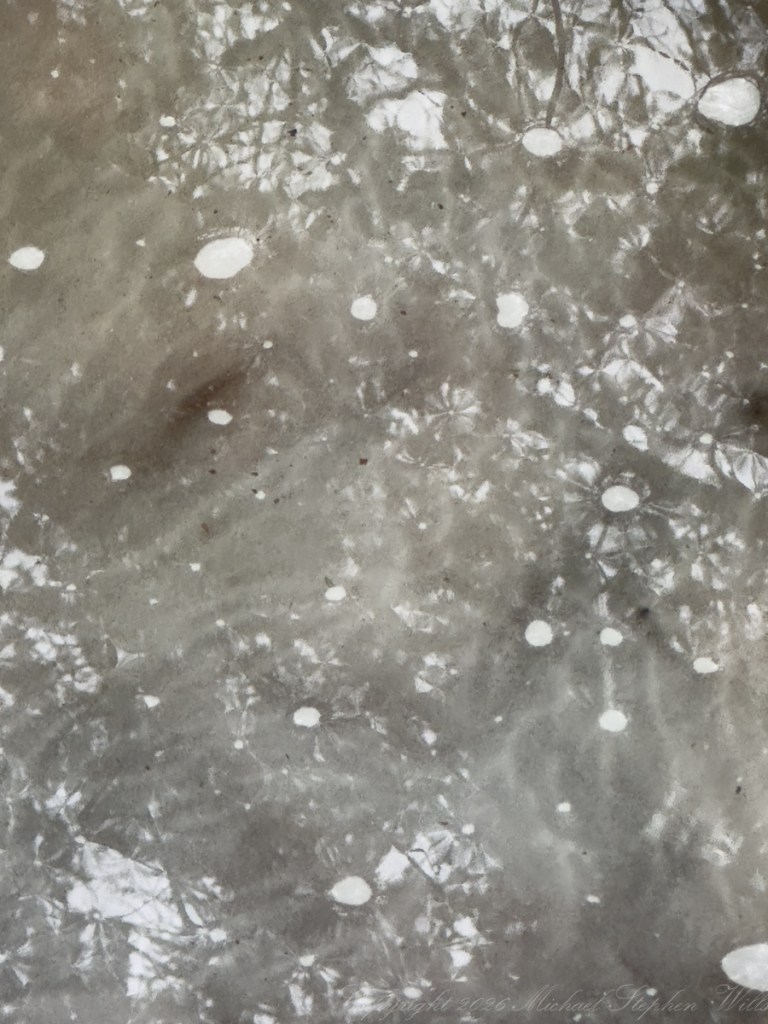
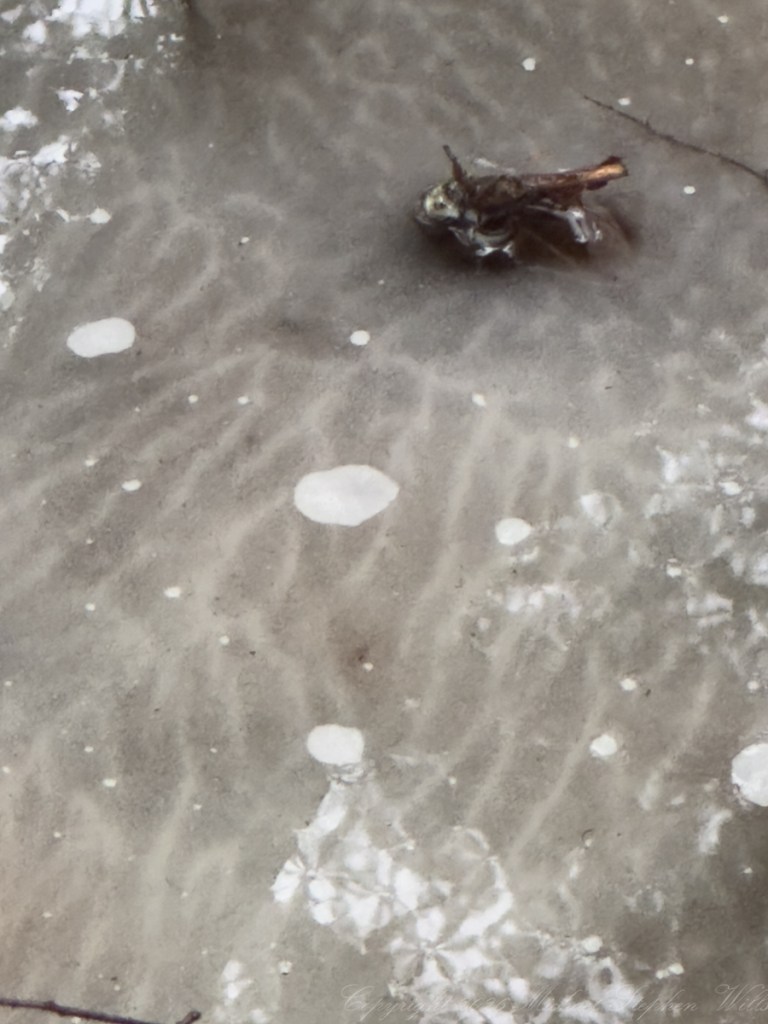
We moved downslope toward the seepage-fed lowlands that give this preserve its particular character. Here, the ground softens, water gathers, and winter lingers longer in pockets of ice that seem reluctant to relinquish their hold. The ice itself told a story—not clear and crystalline, but cloudy, milky, almost opalescent. This opacity is the signature of trapped air, minute bubbles frozen in suspension as water repeatedly melts and refreezes. Each cycle interrupts the orderly lattice of ice, scattering light and transforming transparency into a pale, diffused glow. It is ice that remembers its instability.

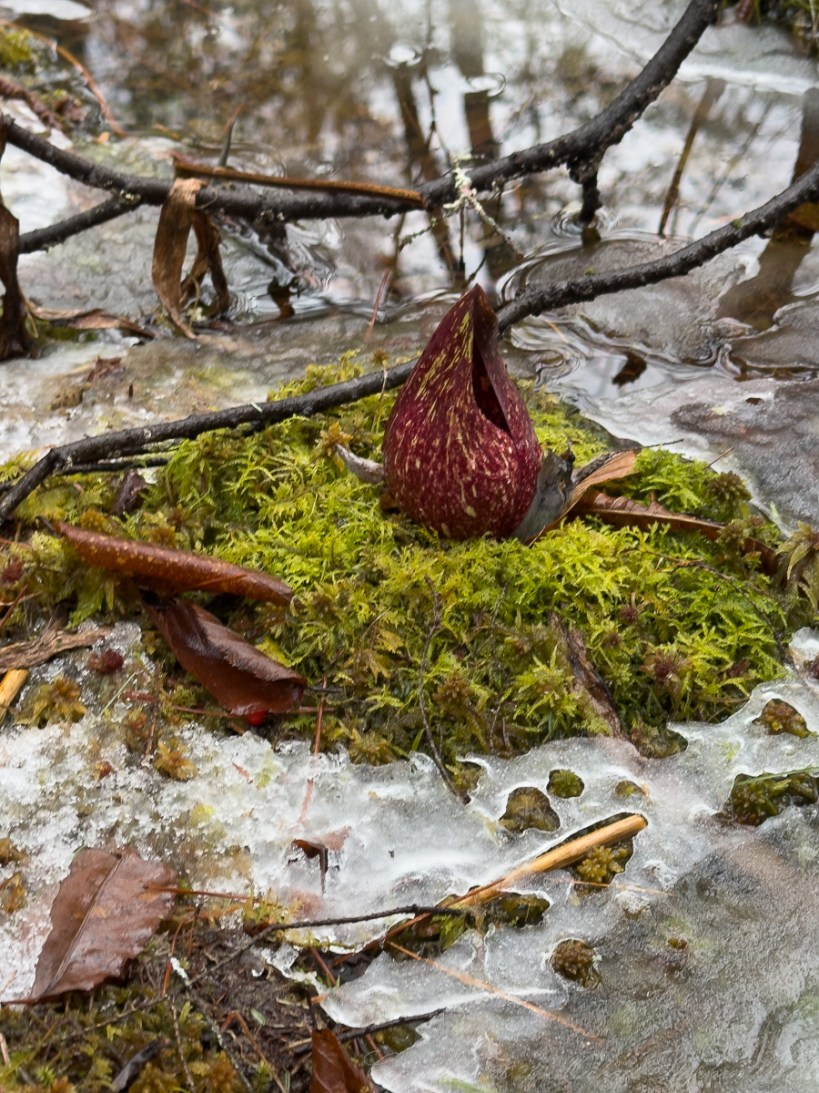
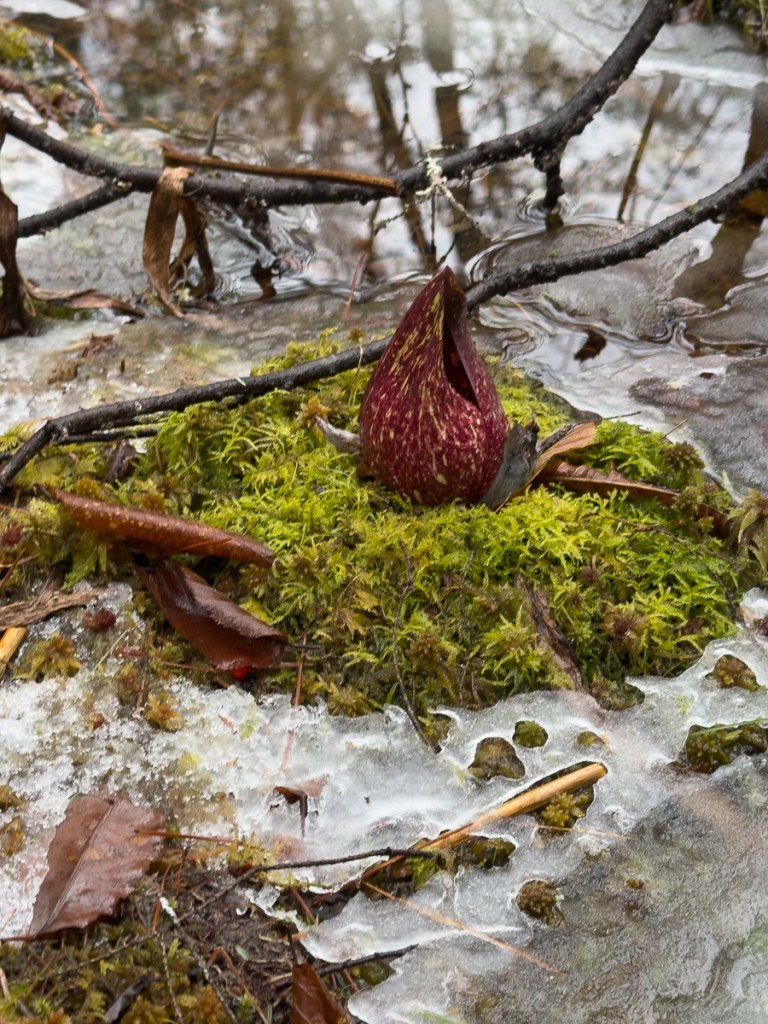
Threading through this ice were narrow rivulets of meltwater, tracing paths around moss-covered hummocks. These islands—bright green even in winter—rose like miniature continents in a frozen sea. On one such hummock, we found this skunk cabbage. Its mottled spathe, deep maroon flecked with yellow, pushed upward through the cold, its form both alien and ancient. I pointed out to the boys that this plant generates its own heat—a metabolic furnace capable of melting the surrounding snow. It is one of the earliest heralds of spring, though it announces itself not with color alone, but with scent—a pungency that walked with us that day.

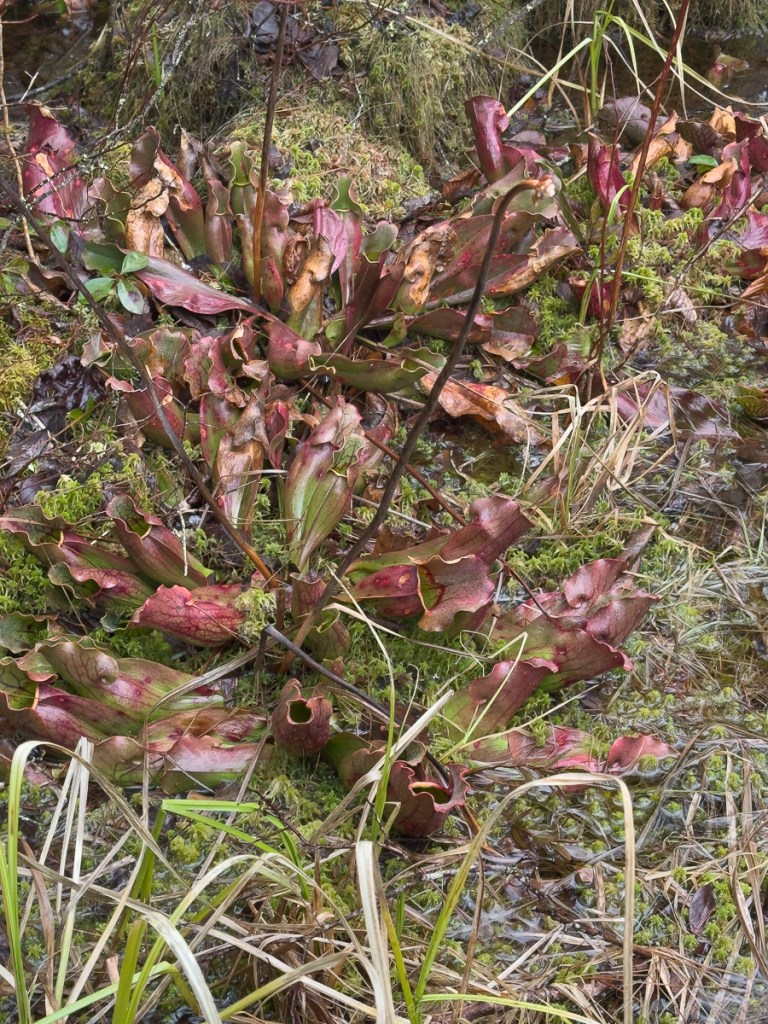
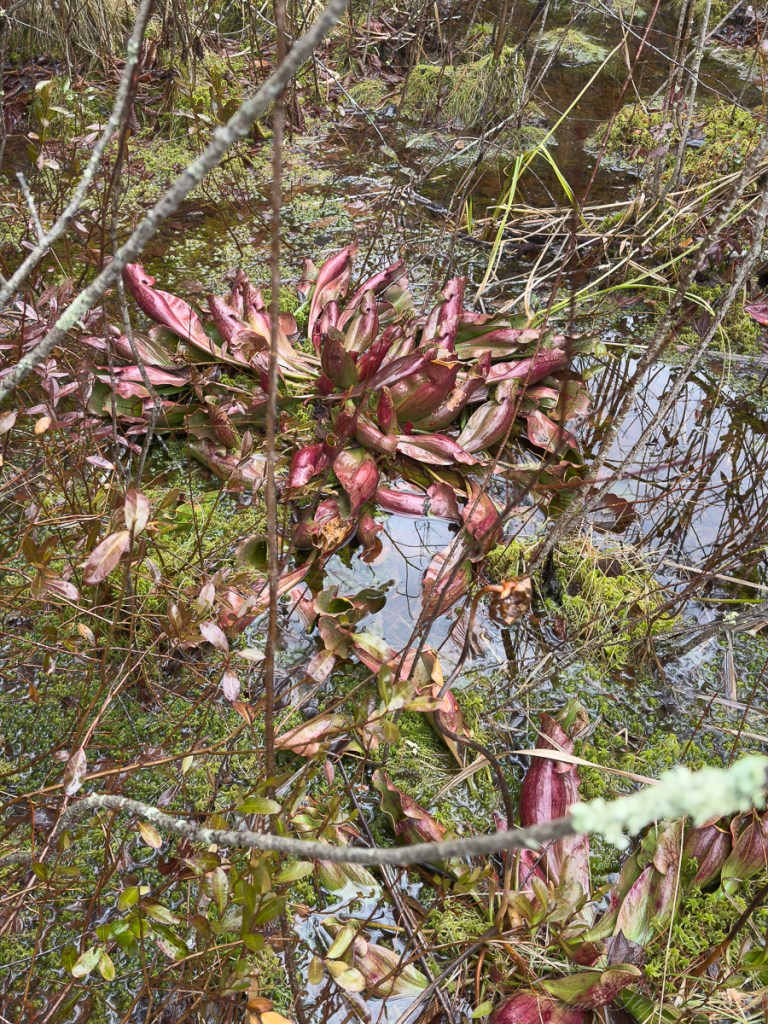
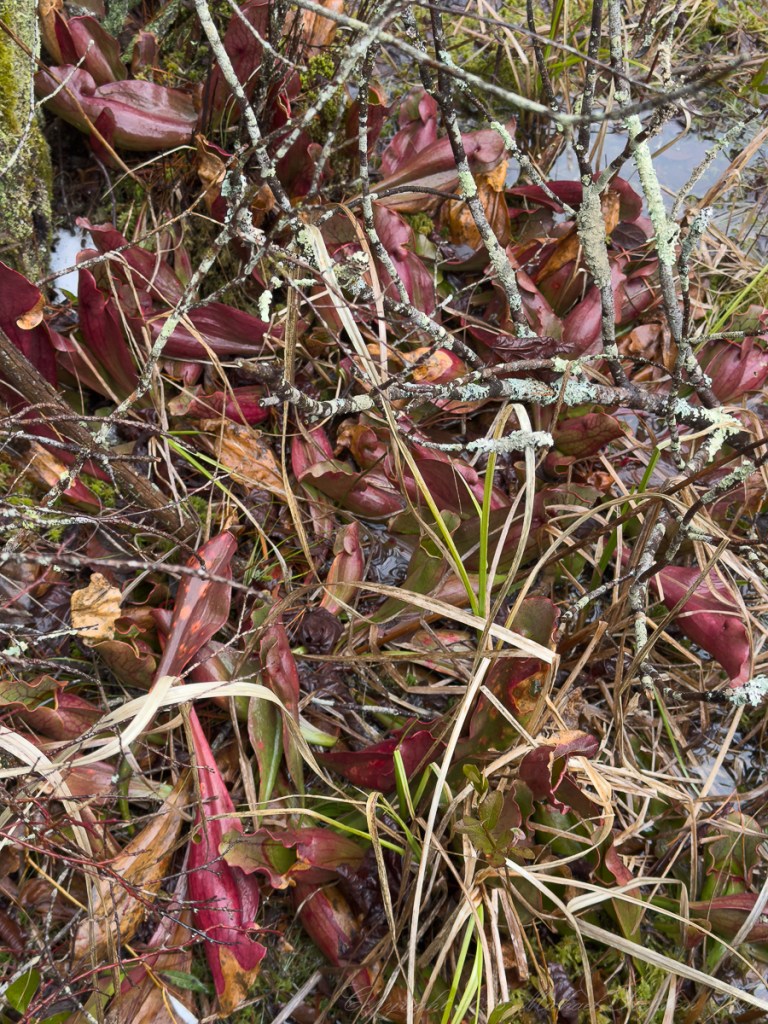
Nearby, nestled in the sphagnum, were the pitcher plants—Sarracenia purpurea—their tubular leaves tinged with winter’s reds and greens. Even in dormancy, they held their form, each pitcher a small reservoir. I explained how these plants supplement the nutrient-poor conditions of the bog by capturing insects, their modified leaves forming a subtle trap. The boys leaned in, curious, perhaps imagining the unseen dramas that would unfold here in warmer months.

The wetland was a place of plants and textures. The ice thinned near the edges, revealing water beneath that reflected the vertical lines of trees above. Droplets fell intermittently from branches, punctuating the quiet with soft, irregular taps. It was a landscape in transition, each element negotiating its passage from one state to another.

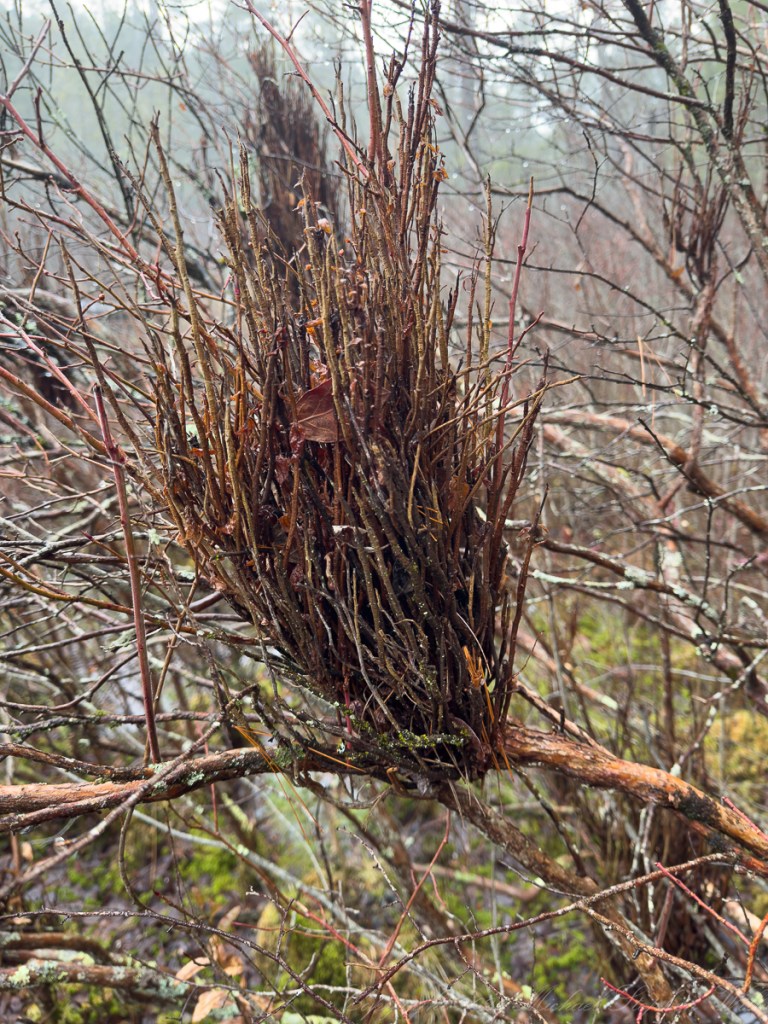
Along a tangle of shrubs, I noticed an unusual growth—a dense, broom-like cluster of twigs protruding from what appeared to be a highbush blueberry. This “witches’ broom” is often the result of fungal infection or other physiological stress, causing the plant to produce a profusion of shoots from a single point. To a child’s eye, it might seem like a bird’s nest or some deliberate construction, but it is, in fact, the plant’s own altered architecture—a distortion that nonetheless becomes part of the ecosystem, offering shelter to small creatures.

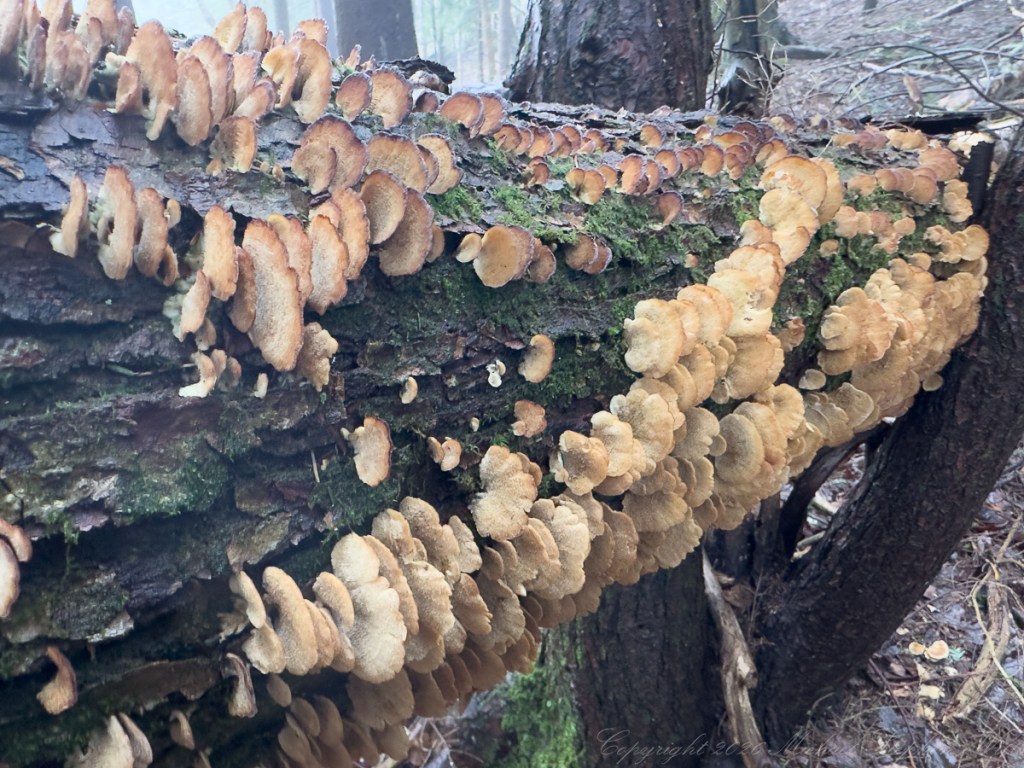
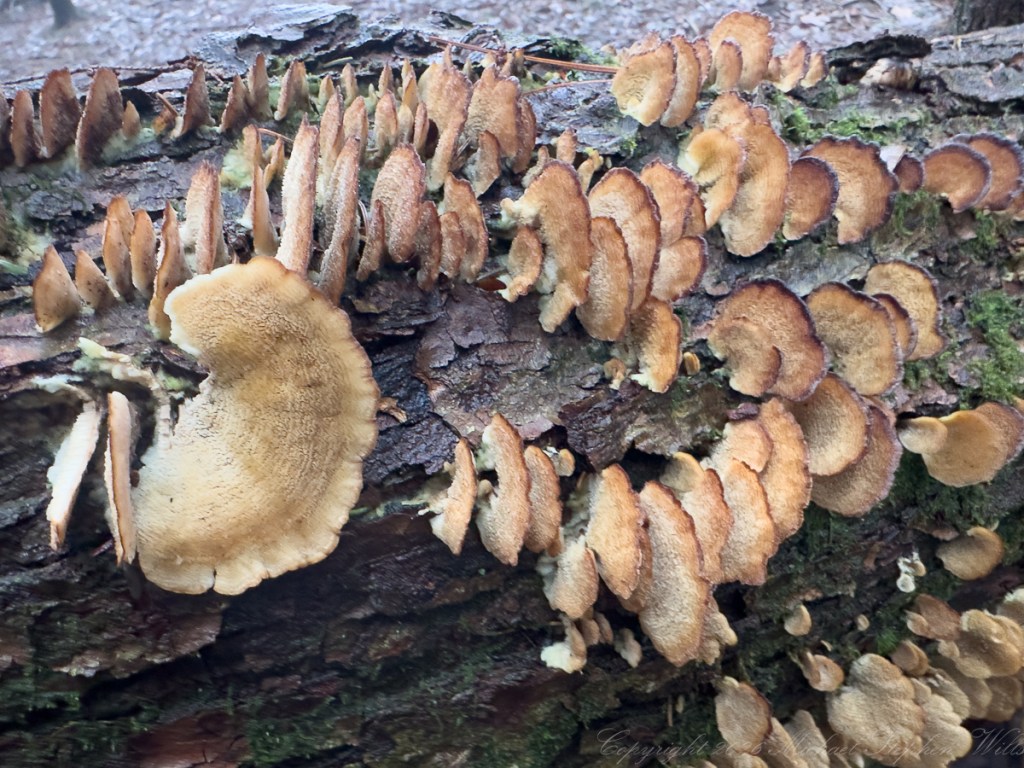
Further along, a fallen log bore the layered forms of shelf fungi, each bracket extending outward like a series of pages half-opened. Their colors—muted tans and browns—blended with the wood, yet their structure was unmistakable. These polypores are the quiet recyclers of the forest, breaking down lignin and cellulose, returning the substance of the tree to the soil. I ran my fingers lightly along their surface, feeling the fine texture, while the boys, less cautious, tapped them as though testing their solidity.

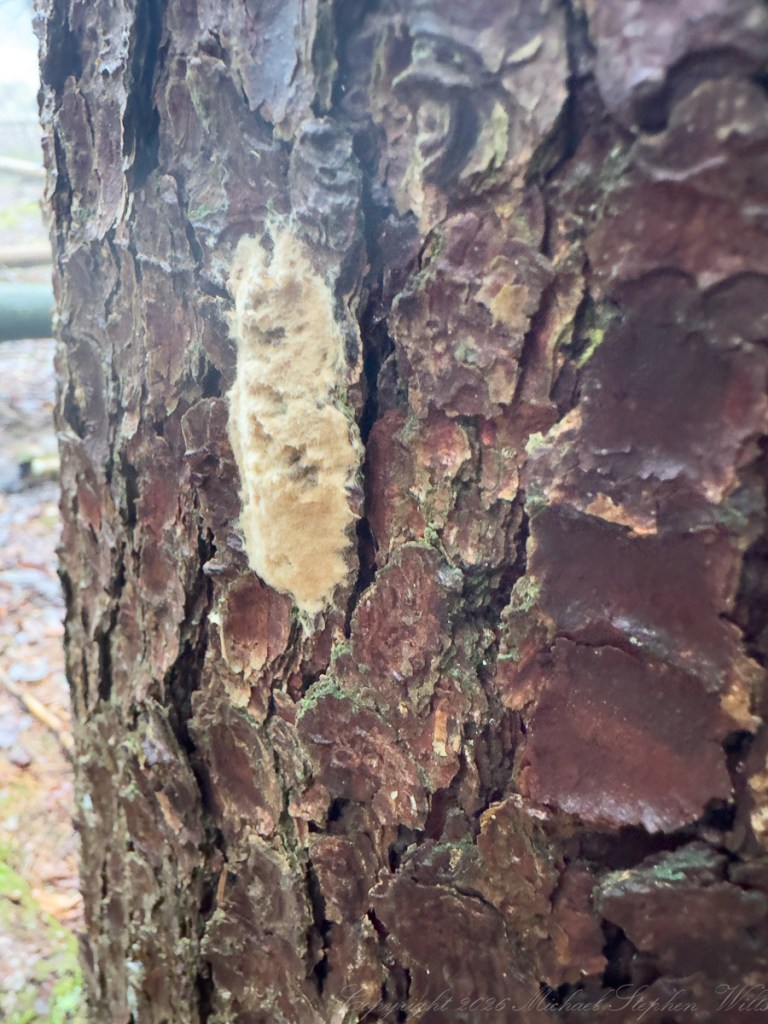
On the bark of a nearby tree, we encountered a patch of what looked like pale, fuzzy insulation—the egg mass of the spongy moth. I explained that each of these masses could contain hundreds of eggs, waiting for the warmth of spring to hatch. It was a reminder that even in this subdued season, the next wave of life was already prepared, concealed in plain sight.

As we made our way back, the boys’ boots squelched in the soft ground, their earlier perch on the stump now a distant memory. Yet the morning had offered them—and me—something more enduring than a climb. It had revealed a landscape in flux, where ice is not merely frozen water but a record of change, where plants defy cold through chemistry, and where even decay participates in renewal.

Late winter, in a place like Malloryville, is not an absence of life but a study in persistence. It asks for attention, for patience, and for a willingness to see beauty in transition. Walking with Sam and Rory, I was reminded that discovery does not wait for spring. It is already here, written in ice, moss, and the quiet industry of the forest.

Enter your email to receive notification of future postings. I will not sell or share your email address.
Monarch Butterfly Life Cycle: Egg to Adult (Danaus plexippus) with Photos

From milkweed egg to striped caterpillar, jade chrysalis, and fluttering monarch, witness metamorphosis, migration, and our role in protecting Danaus plexippus across North America today.

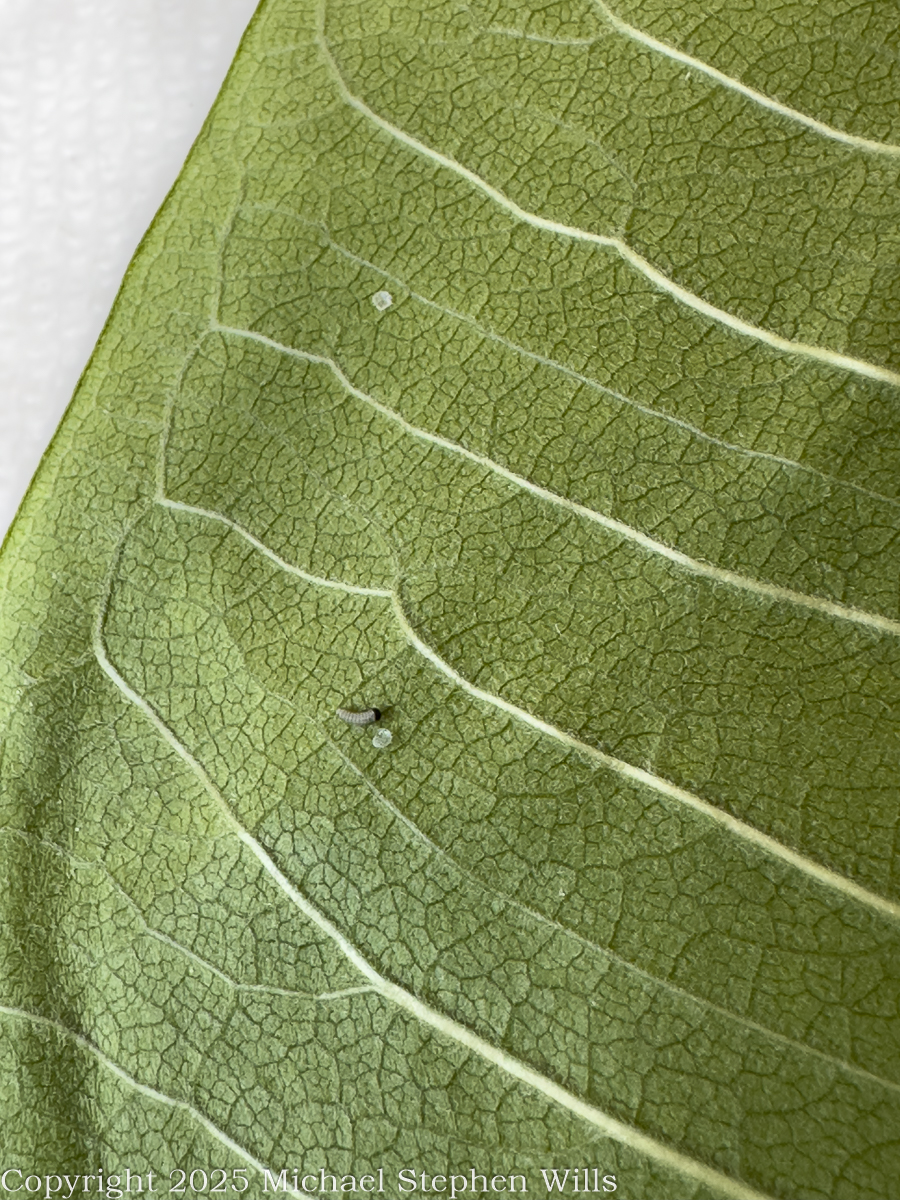
On the underside of a milkweed leaf, the world begins small enough to miss unless you kneel and look closely. In this first photograph the newborn is still a whisper of life, a pale pinhead egg collapsed into a glistening scrap, the tiny caterpillar beside it like a gray comma punctuating the green. It has just eaten the soft shell that cradled it—its first meal, its first thrift. The leaf’s pale roads of veins radiate around the hatchling; within that simple map lies all the geography it needs.

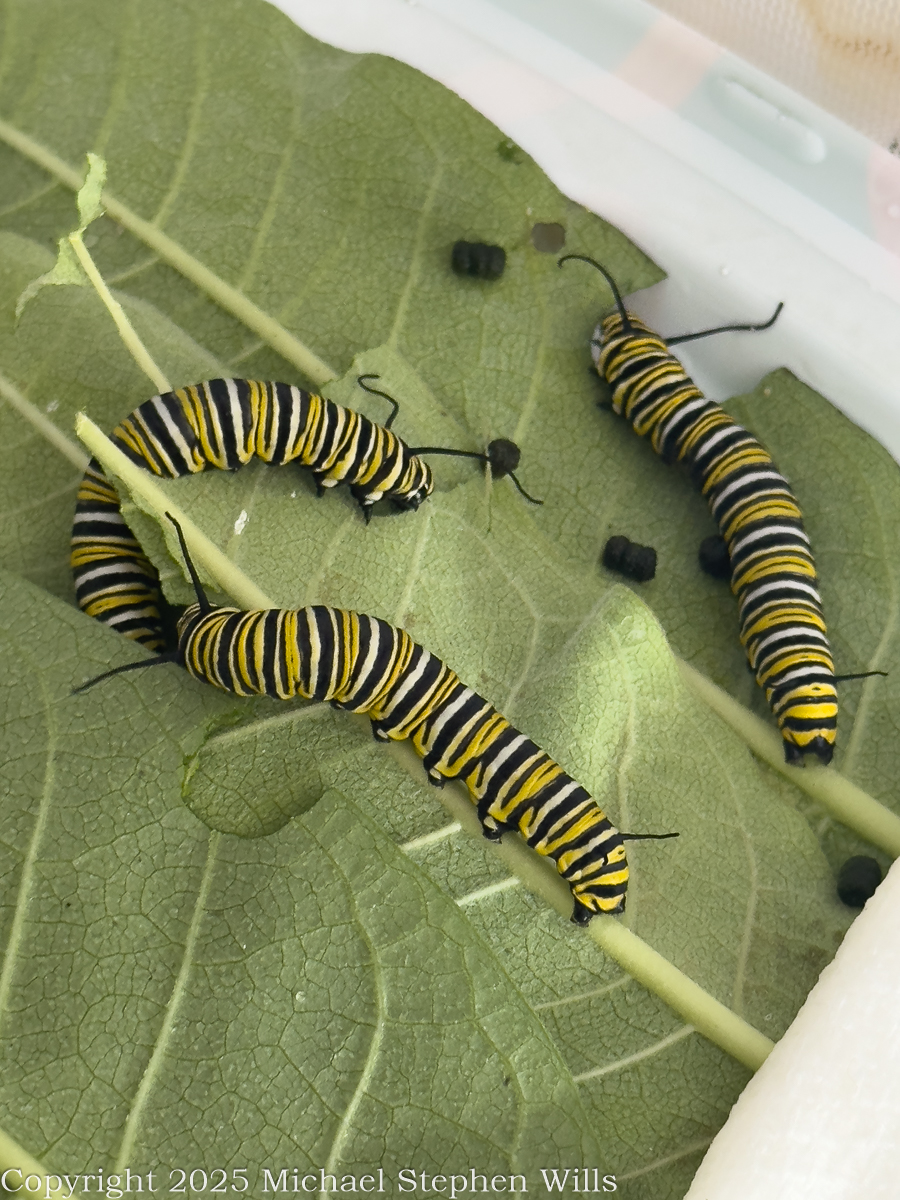
By the second photograph appetite has taken its proper throne. These pilgrims wear a uniform of warning: bands of yellow, black, and white—stripes as bright as hazard tape, a heraldic banner advertising the bitterness borrowed from milkweed. Each bite draws down defensive latex; yet the caterpillars feed undeterred, pausing to snip the leaf’s veins to quiet the flow. Their black, threadlike “tentacles” nod as they travel, and their peppery pellets—frass—collect like midnight hail. Five times they will outgrow themselves, shrugging off skins to reveal wider, hungrier versions within. The room is strewn with green rib and ragged edges; the air has the gentle smell of cut stems. All the while, milkweed’s poisons, the cardenolides, pass into growing bodies and become their bodyguard.

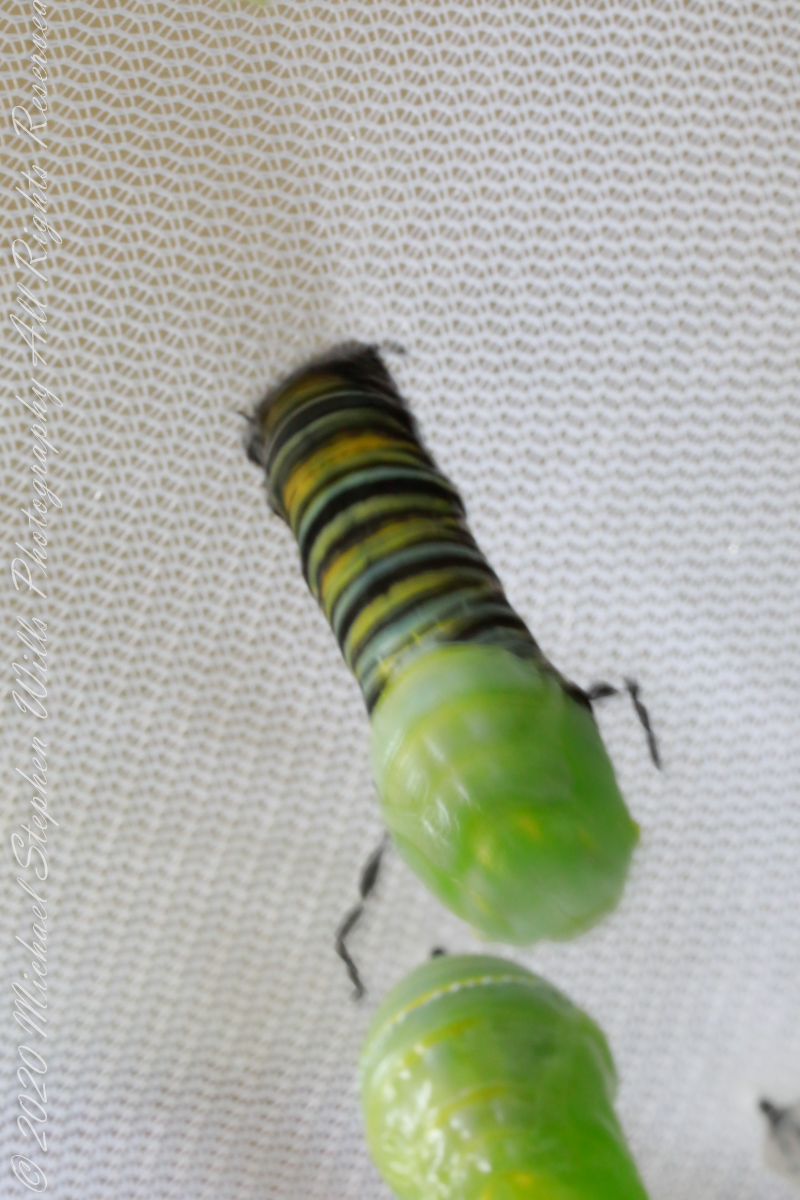
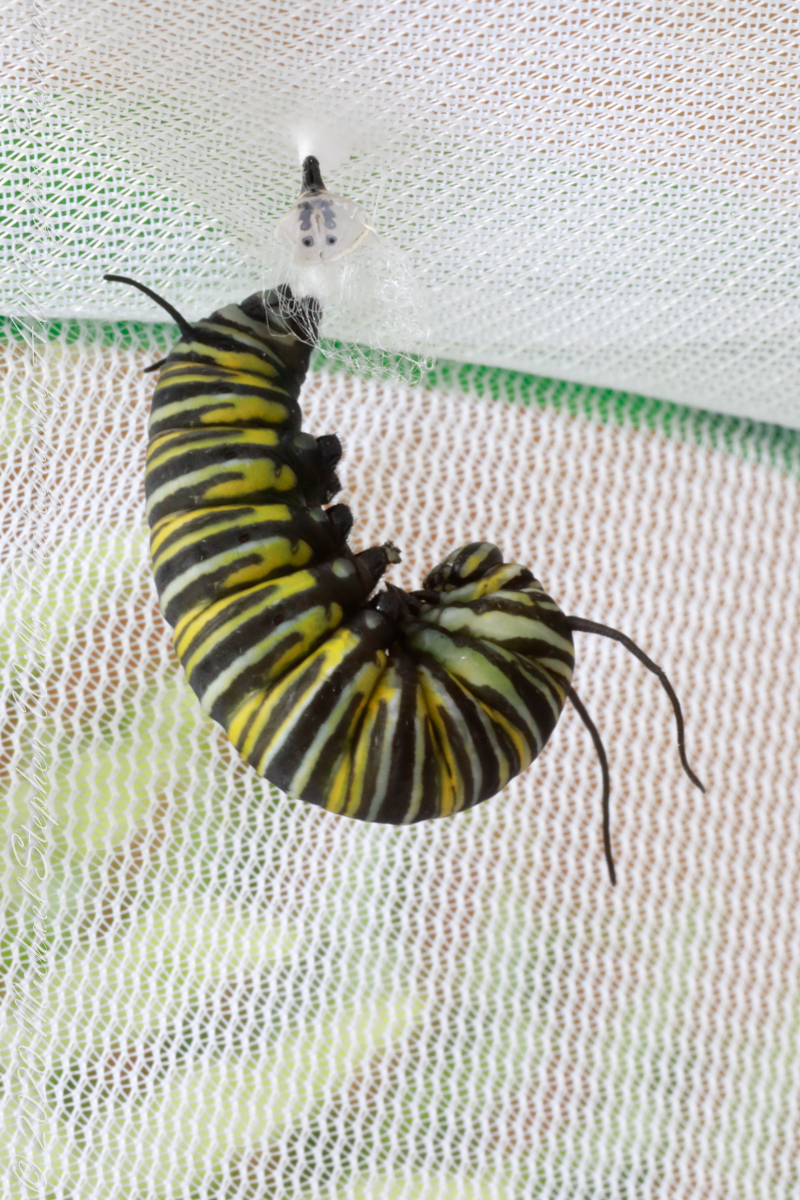
At last a hush. A final meal, a purposeful wander. The caterpillar chooses a high eave of the world—a stem, a stick, the corner of your rearing tent—and hooks itself into a downward J. Within hours the skin splits like a soft zipper; the striped creature pours itself out of itself and seals into a smooth chrysalis.

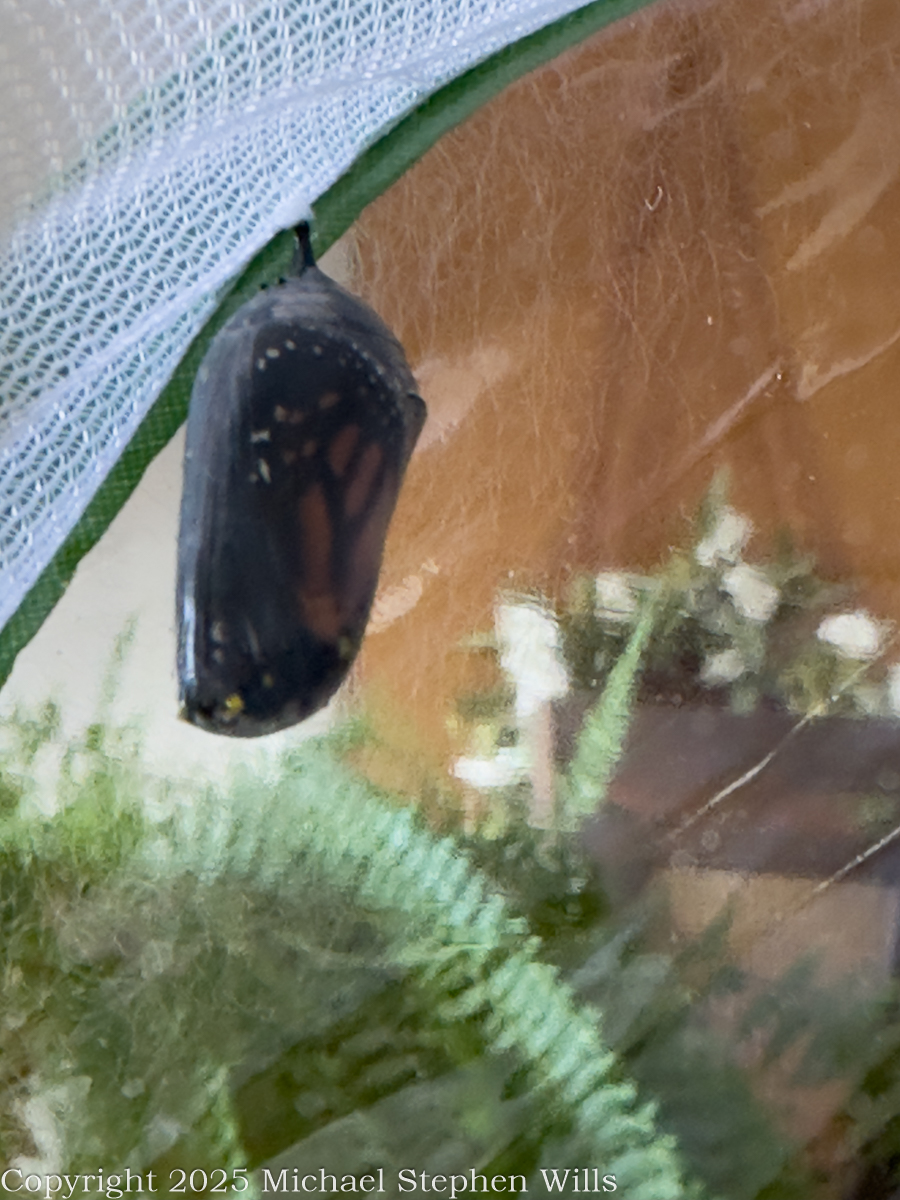
Here, the caterpillar has attached itself to a silk pad from which it hangs. Underneath the skin, the caterpillar is transforming to the chrysalis. In these photographs the silk pad and chrysalis attachment from a previous transformation are in the foreground.
Macro of the Monarch butterfly chrysalis. The black stalk attached to the silk pad is call a cremaster.

The following photograph and video catch the moments into becoming: the jade lantern has become transparent, darkening, its gold studs glinting like constellation points, and through the thinning walls the folded wings show, orange smoldering under smoke. Inside, old tissues have dissolved into a living broth; imaginal discs—tiny blueprints carried since the egg—have flowered into legs, eyes, and flight. To call it “metamorphosis” is correct; to call it mystery is truer.

Watch on YouTube for a better experience. Please “like” and “subscribe”

When the case opens the butterfly backs into the bright. It clings while the crumpled wings fill and flatten, hemolymph pumping life into every cell. In the next image the adult drinks from a petunia trumpet, a jeweled ember with white-spotted hems. The monarch—Danaus plexippus—tests the wind with new, purposeful wings. Its scientific name nods to ancient stories: Danaus after the Greek mythic king of Argos, a father who fled with his fifty daughters across the sea; plexippus for Plexippus, a figure of the same old tales—his name carried forward into this wanderer of the sky. The English name “monarch” is said to honor both its regal size and domain, and, some say, the orange-and-black of William of Orange. Kings and myths gathered like cloak and scepter around a creature that weighs less than a paperclip.

No butterfly has entered human life more completely. Schoolchildren cradle jars of milkweed sprigs and tape handwritten labels to chrysalides lined like seed pearls along a classroom window. Taggers kneel in September light, add a tiny disc to a wing, and write down time and place so the journey south can be traced. In the mountains of Mexico, where oyamel firs hold winter like a secret, people fold the monarch’s return into the Days of the Dead, believing that souls ride home on those wafers of flame. Gardeners tuck swamp milkweed into narrow beds and call their yards “waystations.” Photographers, such as myself, record the stories that happen leaf by leaf.

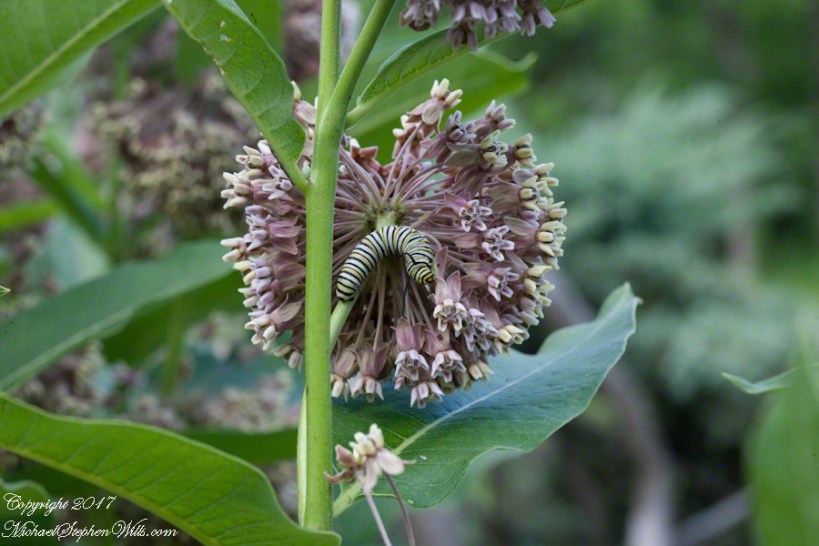
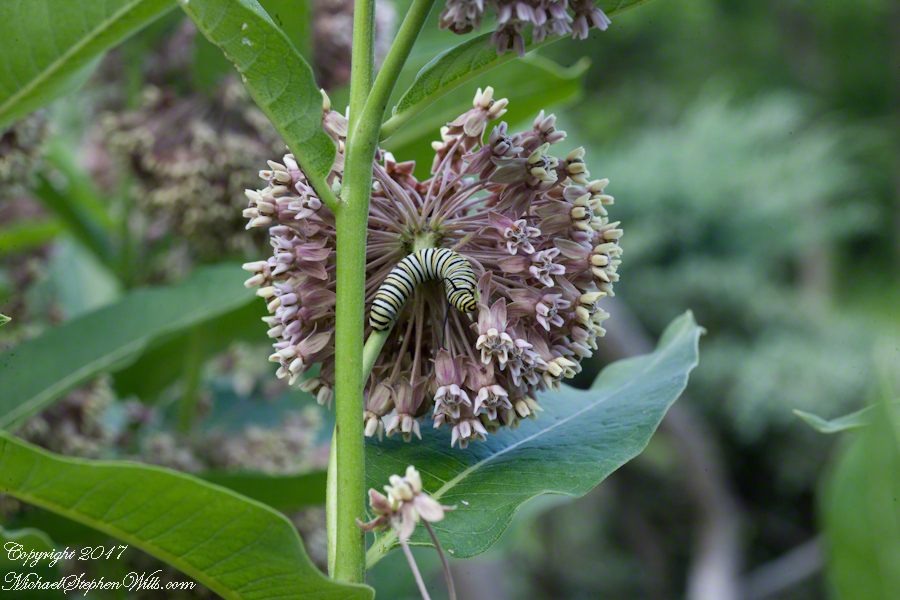
In early July a Monarch caterpillar revels in milkweed flowers.

Yet our touch is not simple. Fields simplified by herbicides have shaved milkweed from fencerows; tidy mowing removes nectar from roadsides in the tender weeks of migration; captive rearing in vast numbers, though done with reverence, may carry unintended risks of disease and weakened orientation. The monarch asks us to enlarge our sense of home beyond the fence: to let patches of milkweed lift their pale crowns in rough corners; to choose late-blooming asters and goldenrod; to keep a few ditches shaggy until the travelers pass. Conservation, like metamorphosis, is work that happens inside ordinary days.

Watch the cycle again in my images—egg to appetite, appetite to stillness, stillness to wing—and hear what it whispers in the steady voice of milkweed leaves and soft fall air. Rachel Carson wrote that “those who contemplate the beauty of the earth find reserves of strength that will endure as long as life lasts.” Here beauty wears stripes and beads of gold, sips from garden petals, and threads a continent with its frail insistence. The monarch’s life is a ribbon we can follow with our eyes and, if we are willing, with our hands—gentle hands that leave room for milkweed to rise, for caterpillars to feed, for a chrysalis to darken and a window to fill, one bright morning, with wings.

On a personal note, this season was a success. Monarchs visited our milkweed patch several times allowing me to save/harvest nineteen eggs/caterpillars and raise them until release.

Selected references
Carson, Rachel. The Sense of Wonder. New York: Harper & Row, 1965. (Reissued: HarperCollins, 1998; Open Road Media e-book, 2011.) The quoted passage (“Those who contemplate the beauty of the earth…”) appears early in the book; the Open Road edition places it on p. 41.
Wikipedia contributors. “Monarch butterfly — Etymology and taxonomy.” (useful overview with primary citations).
Oberhauser, K. S., and M. J. Solensky, eds. The Monarch Butterfly: Biology and Conservation. Cornell University Press, 2004.

Enter your email to receive notification of future postings. I will not sell or share your email address.
Buttonbush: The Secret Geometry of Wetlands

Discover the Buttonbush (Cephalanthus occidentalis), a wetland shrub of spherical blooms, sustaining pollinators, birds, and waterfowl while reminding us of life’s enduring cycles

In the quiet wetlands of late summer, when cattails lift their brown torches above the reeds and dragonflies skim the still water, there is a shrub that speaks in spheres. Its language is not the pointed spear of grass or the broad fan of lily pads, but the perfect symmetry of globes—round, intricate, and startling in their precision. This is the Buttonbush, Cephalanthus occidentalis, a native of swamps, pond margins, and the soft, yielding soils where water shapes the land.

At first glance, its clusters might be mistaken for something fashioned by human hands: spiky balls arrayed along slender stems, each one a small planet bristling with tiny cells. Only in memory can we recall their summer incarnation, when each ball was a constellation of snowy blossoms, white tubular flowers extending like delicate pins from a spherical center. Bees and butterflies crowded them then, drunk on nectar, wings glinting in the sun. Hummingbirds darted in as though drawn by an unseen magnet, their beaks fitting perfectly into the narrow blossoms, a partnership written long ago in the shared script of evolution.

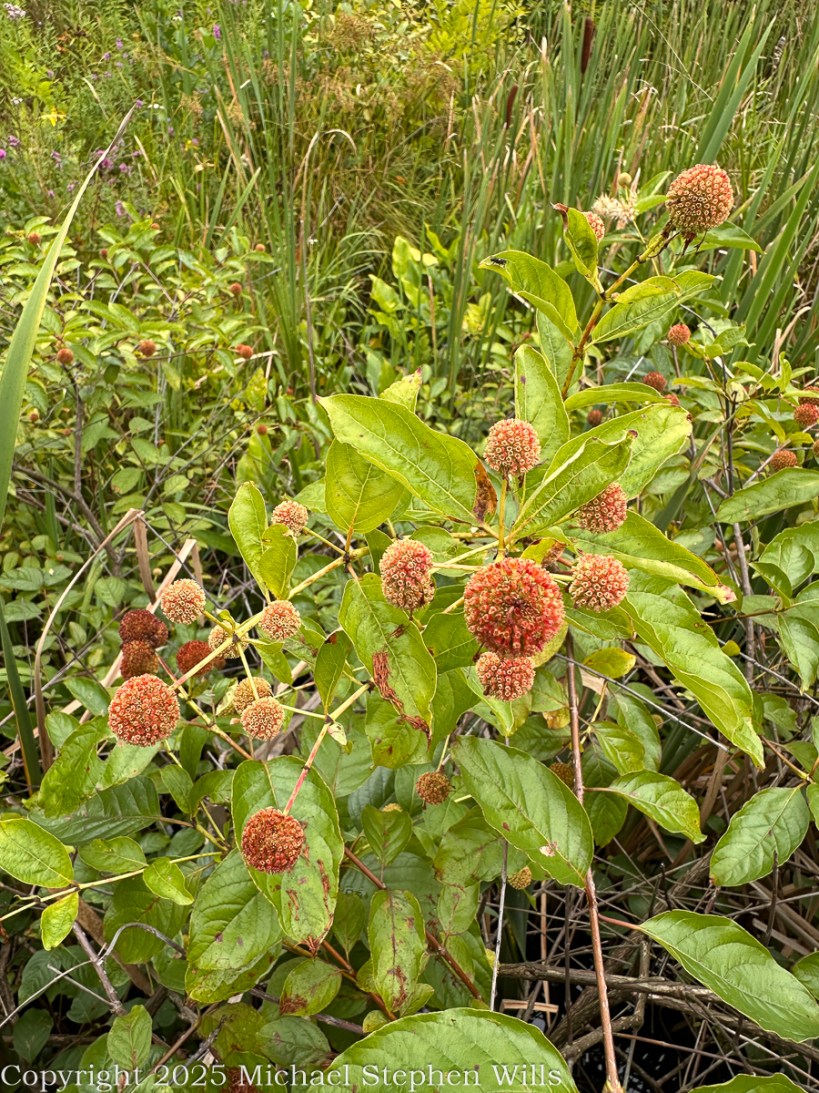
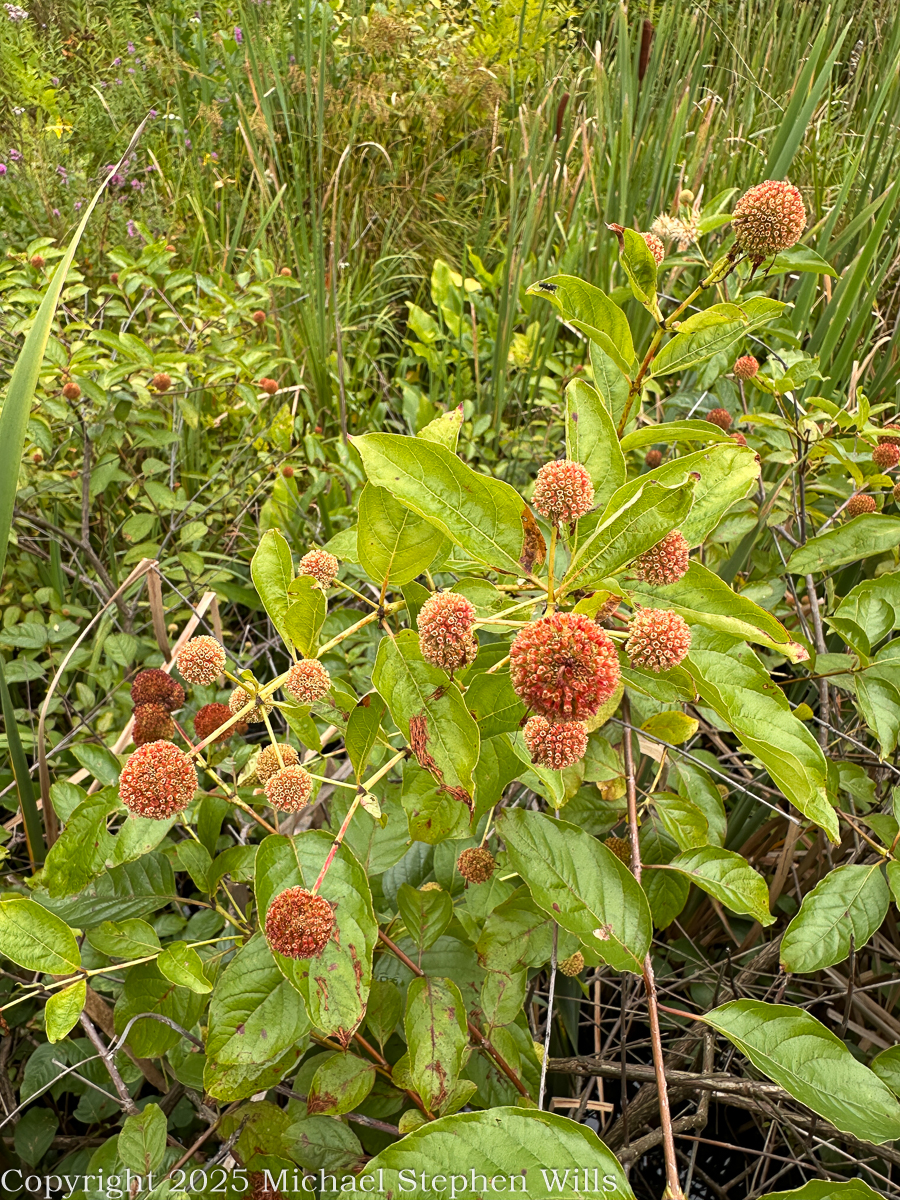
Buttonbush (Cephalanthus occidentalis) at Sapsucker Woods, Cornell Lab of Ornithology

Now, in August’s waning light, those blossoms have folded back into seed, transforming into the russet orbs captured in the photograph. What was once nectar is now promise—food for ducks, shorebirds, and the small lives that depend on wetlands for sustenance. In the hands of buttonbush, time itself is circular. Flower becomes fruit, fruit becomes seed, seed becomes shrub, and the cycle spins quietly on, just as the spheres themselves suggest: complete, unbroken, eternal.

A Wetland Companion

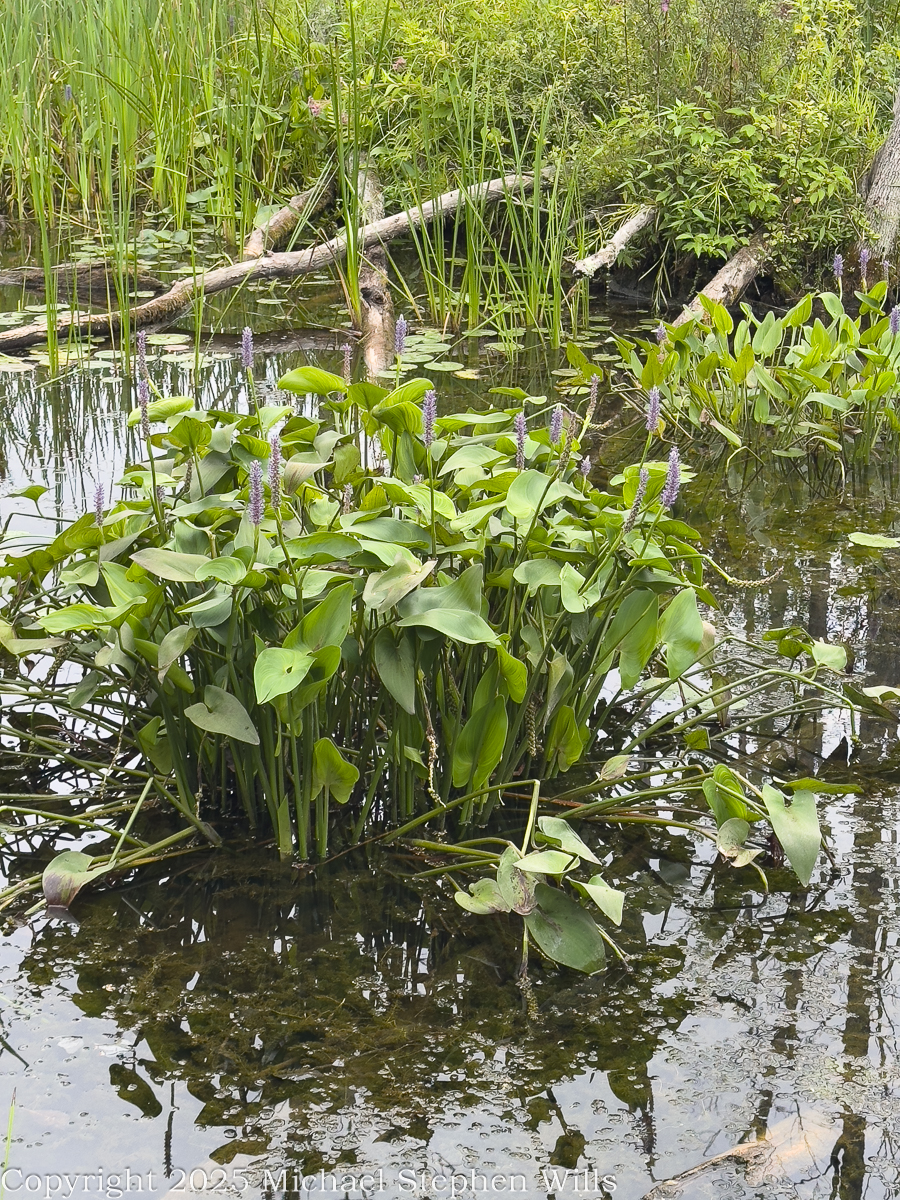
Buttonbush is rarely alone. It thrives where cattails whisper, where pickerelweed thrusts up spikes of purple bloom, where the air holds the scent of waterlogged earth. Its roots grip the muck at the edges of ponds and rivers, holding soil against the restless tug of currents. In doing so, it becomes part of the unseen architecture that holds wetlands together, slowing erosion, filtering water, providing shelter for fish in the shade of its stems.

Pickerelweed (Pontederia cordata) at Sapsucker Woods, Cornell Lab of Ornithology

This shrub, unassuming in stature, is an engineer of stability. It creates thickets where red-winged blackbirds perch, where frogs crouch in shade, where turtles bask on half-submerged branches. The wetlands of North America would be poorer without its presence, for it provides not just beauty but the scaffolding upon which entire communities of life depend.

The Human Thread

To the human eye, the buttonbush’s spherical blooms are so striking that they demand metaphor. Some have called them pincushions, others tiny planets, others fireworks arrested in mid-burst. Native American peoples, however, looked beyond metaphor to medicine. The bark and roots were used in remedies for ailments ranging from headaches to fevers, though with caution, for the plant holds mild toxicity when consumed raw. It is a reminder that many gifts of the natural world are edged with danger, and that wisdom lies in balance.

Today, gardeners and conservationists plant buttonbush intentionally. It is welcomed into rain gardens, where its thirst for moisture makes it a perfect ally for absorbing stormwater. It is used in wetland restoration projects, where its deep roots anchor new life. And it is cherished by those who walk the edges of ponds and discover in its round blossoms a geometry that feels both wild and deliberate, a gift of design from the living earth.

Fourth of July, 2019, Stewart Park

The Sphere as Symbol

Rachel Carson once wrote that in nature, “nothing exists alone.” The buttonbush embodies this truth with clarity. Its spheres are invitations, junctions where plant and pollinator meet, where flower and bird share a moment of mutual necessity. They are offerings to the eye as well, challenging us to see patterns where we might otherwise see only happenstance.

Standing before a buttonbush in bloom, one feels an almost childlike wonder: how could such symmetry arise unbidden from soil and sunlight? Yet this is the miracle of evolution, that order may spring from chance, that beauty may serve survival, that what pleases our senses also sustains life.

A Closing Reflection

In the wetlands, where water mirrors the sky, the buttonbush offers its own reflection of completeness. Its seed heads persist through autumn and winter, small orbs clinging even when leaves fall, reminders that the cycles of life turn steadily beneath the stillness.

To linger with buttonbush is to be reminded of nature’s quiet insistence on wholeness. It speaks in forms: round, repeating, enduring. To walk away from it is to carry a sense of connection, to know that in the pattern of its blooms we glimpse a truth both humble and profound—that life is not a line but a circle, and in every turning there is renewal.

For Further Reading

USDA NRCS. Plant Guide: Buttonbush (Cephalanthus occidentalis L.). United States Department of Agriculture, Natural Resources Conservation Service. Available online: https://plants.usda.gov
– Provides detailed information on identification, habitat, and ecological role.

Lady Bird Johnson Wildflower Center. Cephalanthus occidentalis (Common Buttonbush). Native Plant Information Network. Available online: https://www.wildflower.org/plants/result.php?id_plant=ceoc2
– Covers botanical features, bloom time, wildlife value, and landscape use.

Dirr, Michael A. Manual of Woody Landscape Plants: Their Identification, Ornamental Characteristics, Culture, Propagation and Uses. 6th Edition. Stipes Publishing, 2009.
– Authoritative horticultural reference on Buttonbush and other shrubs.

Peterson, Roger Tory, and Margaret McKenny. A Field Guide to Wildflowers: Northeastern and North-central North America. Houghton Mifflin, 1968.
– Classic field guide covering buttonbush’s wetland habitat.

Carson, Rachel. Silent Spring. Houghton Mifflin, 1962.
– Source of the quoted passage: “In nature nothing exists alone.” (Chapter 2, “The Obligation to Endure”).

Moerman, Daniel E. Native American Ethnobotany. Timber Press, 1998.
– Comprehensive reference documenting traditional medicinal uses of Buttonbush among Native American peoples.

Enter your email to receive notification of future postings. I will not sell or share your email address.
Wandering Glider: The Far-Traveling Dragonfly of Ithaca’s July Skies

A sun-worn dragonfly rests at journey’s end, its amber wings whispering of distant winds, silent skies, and the untold grace of nature’s farthest travelers.

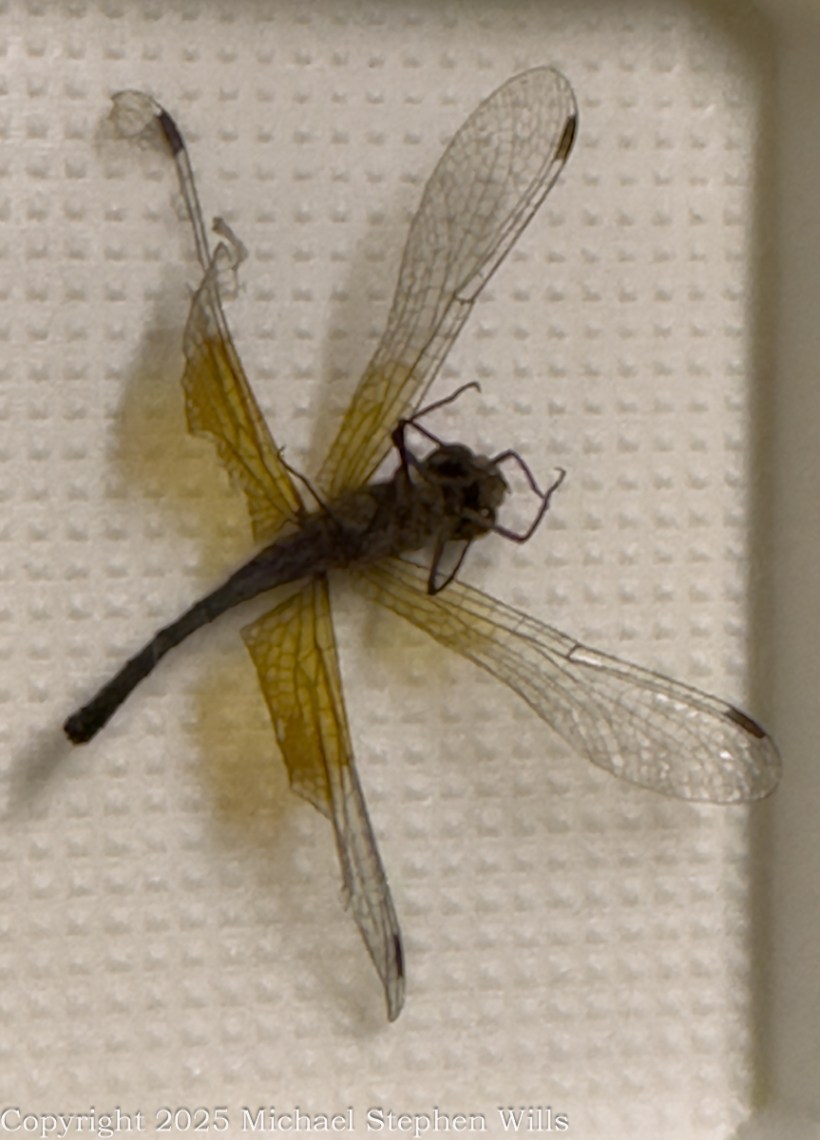
I found it trapped in the surface tension of standing water, motionless, its wings curled and clouded with the memory of flight. A dragonfly—worn, delicate, yet still resolute in form—lay before me like a token of the warm midsummer air that had lifted it through the fields and over the waters. July in Ithaca brings with it such winged travelers, borne on breezes scented with milkweed and bee balm, and this one, though grounded now, seemed still to carry the echo of great distances.

The dragonfly is not of the brooding sort; it lives neither in shadows nor secret places. It claims the sky as its own, ranging wide and far with a grace born of ceaseless motion. This particular specimen, its body some two inches in length and its wings veined like the bare branches of winter trees, bore the telltale marks of the Wandering Glider—Pantala flavescens. Each wing was tipped with a black bar, as though the artist who made it had laid down a final, definitive stroke to balance the creature in the air. Near the base, a wash of amber yellow glowed softly, like the last light of evening behind thin clouds.

There is something unquiet about the dragonfly. It does not hover long nor does it dawdle. It darts, it glides, it shimmers in and out of sight. It is a creature of action and of space. The glider, especially, seems to belong not to any one stream or meadow, but to the wind itself. Naturalists tell us this species is among the most traveled of all insects, crossing oceans, riding monsoons, appearing in lands where no memory of its departure remains. What must it see? What sunrises shimmer from its compound eyes, what shorelines flash beneath its outstretched wings?

In the dragonfly’s manner, I find no sign of labor, only the silent art of survival. It patrols its airspace like a hawk, yet it bears no menace, only the precise and relentless hunger of a born predator. With each dart and glide it performs a service to the air—clearing it of gnats and mosquitoes, feeding itself without waste. Nature, in her economy, grants no idle beauty, and the dragonfly is both elegant and essential.

As I gazed at the delicate carcass, I thought of the old philosophy that linked the soul’s journey to the flight of birds. But here, perhaps, is a more fitting image: this dragonfly, which lives but a brief summer, yet might travel farther in its span than many creatures do in a lifetime. We are apt to call it “wandering,” as though it lacked aim or anchor. But I think it follows a thread of purpose invisible to us—something stitched into the weave of wind and weather, of season and sun.

It had come far, and its journey was complete. My wife provided an empty saffron spice box to preserve and display it—for the grandchildren to marvel over.

Enter your email to receive notification of future postings. I will not sell or share your email address.
Discover the Bold Jumping Spider: Nature’s Agile Hunter

Small in size but vast in charisma, the Bold Jumping Spider hunts with precision, agility, and a gaze that almost seems to return your own.


There, pressed into the grain of the boardwalk like a dark fleck of forest lint, the Bold Jumping Spider (Phidippus audax) waits—motionless, yet alert. To the untrained eye, it may seem insignificant, even nondescript. But a closer look reveals a creature of fine design and surprising charisma: a compact body cloaked in velvety black, adorned with pale markings like runes, and forward-facing eyes that gleam with eerie intelligence.

Unlike the orb weavers and net-spinners of spider lore, Phidippus audax does not rely on traps. It is a hunter in the truest sense—an animal that lives by leaping toward its future. With eight powerful legs and a muscular abdomen, it can launch itself many times its own body length, arcing through the air toward an unsuspecting moth or beetle. Yet it does not leap blindly. It trails a single silken thread behind it—a safety line, a commitment to survival. It is an act of courage tethered to caution.

Most remarkable are its eyes. A quartet of simple lateral eyes scan for motion, but the two large, front-facing principal eyes are something more—a rarity among arthropods. They grant it acute vision, with the ability to detect detail, movement, and even depth. When it turns its gaze toward you, you feel seen—not just registered, but regarded.

Found lurking in a joint of wood frame enclosing a trail map. Sapsucker Woods, Cornell Lab of Ornithology, on a summer afternoon\.

These spiders are active thinkers, decision-makers. They test their environment with movements that can almost be described as exploratory. They do not walk so much as prowl, stepping into shadow and light with an awareness that seems out of scale for their size.

And though they are often met with fear or disdain, Phidippus audax poses no threat to humans. It asks only for a few square inches of wood or leaf to stake its claim. In return, it offers a glimpse into a different kind of grace—an agile, silk-spinning daredevil, leaping with acute precision.

To observe one is to witness the meeting of design and instinct, form and function, in perfect miniature. In the vast, humming network of woodland life, the Bold Jumping Spider may be a small player, but it performs its role with flair. If the trees are the spires of the forest cathedral, and the ferns its leafy congregation, then Phidippus audax is a kind of sacred rogue—silent, swift, and utterly unconcerned by our towering presence.

Enter your email to receive notification of future postings. I will not sell or share your email address.
Explore Louisa Duemling Meadows: Nature and Conservation

The Louisa Duemling Meadows celebrate conservation and biodiversity, showcasing vibrant flora and honoring Louisa Duemling’s legacy as a steward of nature.

The Louisa Duemling Meadows, nestled within the expansive embrace of Sapsucker Woods, offers a vibrant tableau of life, brimming with opportunities for exploration and a sense of wonder. This new trail, winding through golden fields and punctuated by bursts of wildflowers, whispers tales of the land’s natural and cultural heritage.

Louisa Duemling: A Steward of Nature
Louisa Duemling, the meadows’ namesake, was a dedicated conservationist and philanthropist who supported the Cornell Lab of Ornithology’s mission to protect birds and their habitats. Her legacy lives on in these serene fields, where her commitment to preserving the environment is reflected in every thriving plant and songbird.

Black-eyed Susans: The Meadow’s Golden Treasure
Dominating this summertime landscape with their radiant yellow petals and dark central disks, Black-eyed Susans (Rudbeckia hirta) are a hallmark of the meadows. These cheerful blooms are a delight to the eye, a cornerstone of meadow ecosystems. As members of the Asteraceae family, their composite flowers serve as a rich nectar source for pollinators like bees and butterflies, ensuring the vibrancy of these fields.

Historically, Black-eyed Susans have been used in traditional medicine by Native American tribes for their putative anti-inflammatory properties. Their ability to thrive in diverse conditions also makes them a symbol of resilience and adaptability.

A Symphony of Green and Gold
Walking through the trail, one is greeted by the harmonious interplay of goldenrods (Solidago spp.), milkweeds (Asclepias spp.), and asters (Symphyotrichum spp.). Goldenrods, with their feathery clusters of yellow blooms, are often mistaken as allergenic culprits, though it is the inconspicuous ragweed (Ambrosia artemisiifolia) that deserves this reputation. Milkweeds, with their milky sap and delicate pink or white flowers, are vital to monarch butterflies (Danaus plexippus), serving as the sole food source for their larvae.

Among these botanical wonders, the birdhouse stands as a sentinel, a reminder of the intricate relationship between flora and fauna. These wooden structures provide safe havens for cavity-nesting birds like Eastern Bluebirds (Sialia sialis) and Tree Swallows (Tachycineta bicolor), fostering biodiversity within the meadow.

A Horizon Framed by Pines and Clouds
The open meadow trails, flanked by clusters of Eastern White Pines (Pinus strobus) and punctuated by the azure sky, invite reflection and renewal. This is a place where the human spirit can align with the rhythms of nature, where each step reveals new layers of beauty and discovery.

Embracing the Spirit of Discovery
To wander the Louisa Duemling Meadows is to immerse oneself in the timeless dance of life. The trail, carefully marked yet wild in essence, invites visitors to lose themselves in its beauty while finding solace in its quietude. This is not just a path through nature—it is a journey into the heart of conservation and a celebration of the life that thrives under Louisa Duemling’s enduring legacy.

As you leave the meadow, carry with you not just the memory of golden flowers and vibrant skies but the inspiration to cherish and protect the natural world. The Louisa Duemling Meadows are not only a gift to those who walk its trails but a reminder of the profound impact one can have in preserving our planet’s fragile beauty.

Enter your email to receive notification of future postings. I will not sell or share your email address.
Monarch Chrysalis: A Symbol of Nature’s Resilience

On a September day, a Monarch chrysalis symbolizes resilience amidst environmental threats, prompting reflection on stewardship and hopeful change.

On a warm September afternoon, 2024, Pam and I passed a planting of shimmering grasses along the Cayuga Lake shore, the tips of their feathery plumes swaying in a gentle breeze. Amidst the verdant tapestry, my eyes caught a flash of delicate green—a Monarch chrysalis, hanging like a precious jewel beneath one of the seed heads. It was an unexpected encounter, a moment of grace that felt almost otherworldly. The chrysalis, pale jade with gold accents, looked like something born of magic rather than biology. For a moment, time paused.

The only Monarch chrysalis we found in 2024, notable for the absence of caterpillars around our home. Tompkins Park, Ithaca, New York, Finger Lakes Region

I knelt carefully, mindful not to disturb the fragile life suspended before me. As I leaned in closer, I marveled at the perfection of its design. The intricate gold dots along its casing seemed impossibly precise, as though a divine hand had painted them there. Yet, this chrysalis was also a paradox: it was a shield of stillness, promising the coming transformation of a creature known for motion and migration.

The significance of this discovery didn’t escape me. Just two years ago, the International Union for Conservation of Nature officially classified the Monarch butterfly as “endangered.” Habitat destruction, pesticide use, and climate change have decimated their numbers. Monarchs, once so plentiful they seemed a seasonal certainty, now teeter on the edge of disappearance. To find this chrysalis was to witness a quiet rebellion against those odds, a solitary emblem of resilience in a world fraught with loss.

I thought of their epic journey—a migration that spans thousands of miles, linking Canada to the forests of central Mexico. For generations, these butterflies have followed ancestral paths with unerring precision, defying every obstacle in their way. How can something so small carry the weight of such immense journeys? And how, in a world that seems to grow harsher each year, do they still persist?

This chrysalis, tucked in the grasses of Stewart Park, felt like an answer to those questions. It was a reminder of the resilience of life, the determination of nature to continue despite all that works against it. And yet, it also felt like a fragile promise. The Monarch’s survival is no longer assured; its future, like the butterfly within this chrysalis, hangs by a thread.

As I rose and continued our walk, I carried the image of the chrysalis with me, letting its quiet beauty settle in my mind. I thought of the interconnectedness of all things: the milkweed plants that sustain Monarch caterpillars, the winds that guide their migrations, and the people whose choices shape the landscapes they traverse. Stewardship is not just a responsibility; it is a privilege—an opportunity to ensure that these miraculous creatures continue to grace our skies.

By the time I left the park, the sun had sunk toward the west, its light no longer graced the grasses. I looked back one last time, hoping that this chrysalis would complete its transformation safely. In its stillness, I saw not just hope, but a call to action. The Monarch’s story is not just about survival; it’s about the courage to evolve and adapt, even when the odds seem insurmountable. And perhaps, in witnessing this moment of metamorphosis, we too are reminded of our capacity to change—to become better stewards of the world we share.

Enter your email to receive notification of future postings. I will not sell or share your email address.
Ecological Significance of False Solomon’s Seal

In Taughannock Falls State Park, False Solomon’s Seal captivates with its beauty, ecological role, and historical medicinal uses.

The trails of Taughannock Falls State Park always hold surprises, and on that July day, they did not disappoint. As I paused to take in the tranquility of the woods, my gaze fell upon a plant whose graceful arch and clusters of berries demanded attention. Its broad, lance-shaped leaves alternated along the stem, framing the stem’s terminal cluster of small green berries. Recognizing the plant as Maianthemum racemosum, commonly known as False Solomon’s Seal, I took a moment to admire its understated elegance.

False Solomon’s Seal, scientific name Maianthemum racemosum, is common in the Finger Lakes Region. I found this specimen during a walk with the grandchildren in a local fen among the post-glacial terrain of the Finger Lakes Region. Eames Memorial Natural Area, Cornell Botanic Gardens, Town of Dryden, Tompkins County, Finger Lakes Region, New York State

Characteristics of the Plant

False Solomon’s Seal is a perennial herbaceous plant belonging to the asparagus family (Asparagaceae). It can grow up to three feet tall, its arching stems giving it a unique and recognizable silhouette. The leaves are broad and lance-shaped, with prominent veins running their length, arranged alternately along the stem. At the tip of each stem is a cluster of tiny, spherical green berries, which later in the season ripen to a speckled reddish hue. The plant blooms in late spring to early summer, producing delicate, star-shaped white flowers before transitioning to its fruiting phase.

Found throughout much of North America, Maianthemum racemosum thrives in moist, shaded woodlands, making the lush forests of Taughannock Falls State Park an ideal home. Its ability to grow in the dappled light beneath the forest canopy highlights its adaptability to varying light conditions.

Etymology of the Name

The genus name, Maianthemum, comes from the Greek words “mai” (May) and “anthemon” (flower), reflecting the plant’s tendency to bloom in late spring or early summer. The species name, racemosum, refers to the plant’s inflorescence, which forms a raceme—a cluster of flowers or berries along a single stem. Its common name, False Solomon’s Seal, derives from its superficial resemblance to Solomon’s Seal (Polygonatum spp.), though the latter has bell-shaped flowers hanging beneath its stems, in contrast to the terminal clusters of Maianthemum racemosum.

History and Folklore

False Solomon’s Seal has long been valued for its medicinal and culinary uses by Indigenous peoples and early settlers. The young shoots were harvested and cooked as a vegetable, while the ripe berries were sometimes used in jellies or preserves, though their slightly bitter flavor limited their appeal. Medicinally, teas made from the roots and leaves were used to treat a variety of ailments, including digestive issues, coughs, and sore throats. The roots were also applied as poultices for cuts and bruises, reflecting the deep understanding of natural remedies held by those who lived in harmony with the land.

The plant’s name has sparked legends. While the “false” in its name denotes its distinction from Solomon’s Seal, some folklore suggests that the plant was used to counterfeit the medicinal properties of its namesake. Others believe that its graceful arch and persistent berries symbolize resilience and adaptability, qualities often attributed to those who lived in its native habitats.

Uses and Ecological Role

Although not widely cultivated, Maianthemum racemosum is a valuable plant in its native ecosystems. Its flowers provide nectar for pollinators such as bees and butterflies, while the berries are a food source for birds and small mammals. Its rhizomatous roots also play a role in stabilizing soil in forested environments, preventing erosion and supporting the health of the woodland floor.

For those contemplating harvesting these plants be advised that collection of plants from New York State Parks is prohibited to protect natural resources and maintain ecological balance. According to the New York State Office of Parks, Recreation and Historic Preservation (OPRHP) regulations, “No person shall… remove… any… plant life” within state parks without proper authorization. Therefore, collecting plants in state parks without explicit permission is not allowed. If you have a specific research or educational purpose, you may contact the park administration to inquire about obtaining the necessary permits. However, for casual visitors, it’s best to enjoy the flora from a distance. False Solomon Seal ecological contributions are significant. In addition to its pollinator support and soil stabilization, the plant’s presence is an indicator of a healthy woodland ecosystem.

A Moment of Reflection

As I rose from my crouched position, having taken in the details of Maianthemum racemosum, I felt a quiet gratitude for the opportunity to encounter such a plant. False Solomon’s Seal, with its graceful leaves and unassuming berries, serves as a reminder of the interconnectedness of life in the forest. Its role in the ecosystem, its history with humans, and its understated beauty all speak to the richness of the natural world.

Walking onward, I carried with me a sense of awe for the intricate web of life that thrives in the woods. The False Solomon’s Seal, standing quietly among the ferns and leaf litter, seemed to embody the resilience and balance of the forest—a gentle presence in a vibrant community.

Enter your email to receive notification of future postings. I will not sell or share your email address.
Hylodesmum glutinosum: Characteristics and Ecology

The author reflects on hiking at Taughannock Falls State Park, discovering the Large-Flowered Tick Trefoil’s beauty and ecological significance.

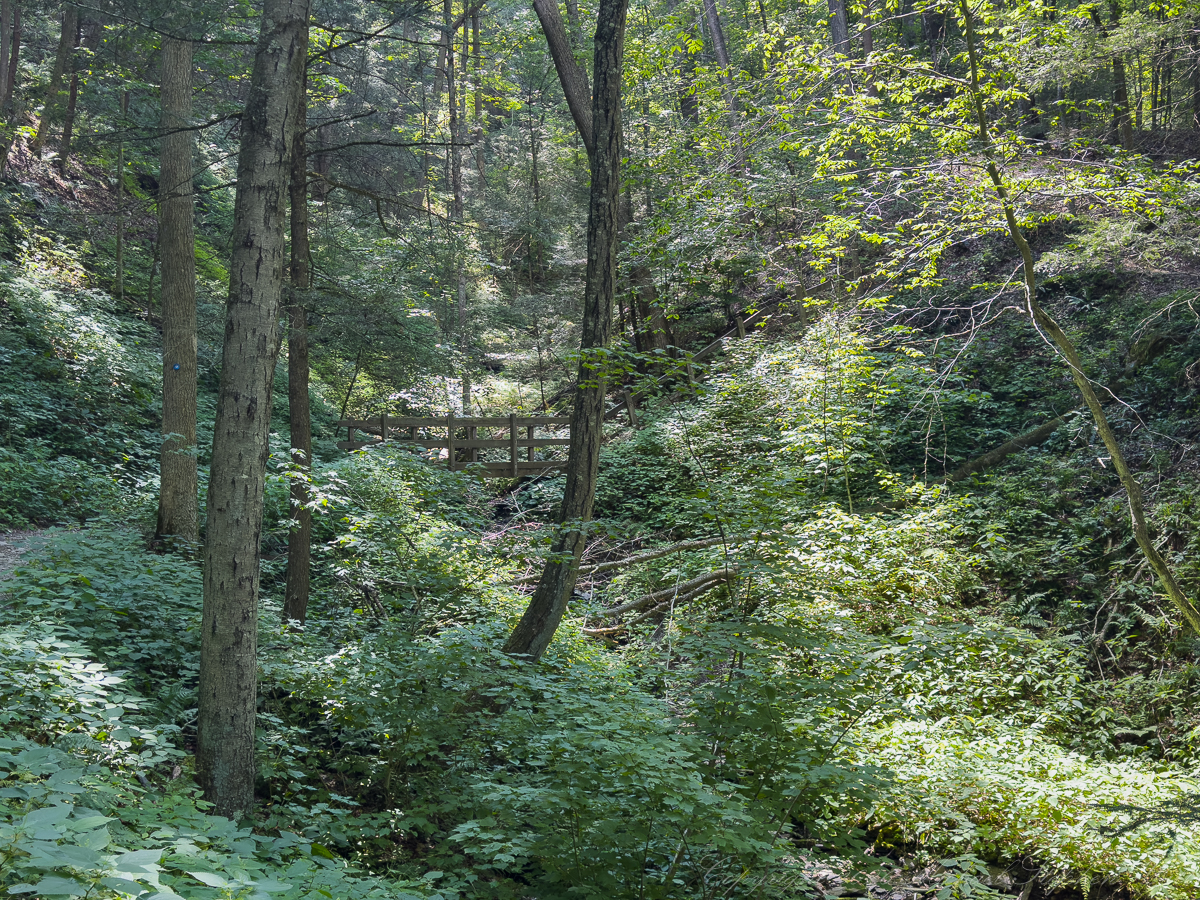
It was a high summer day as I enjoyed a customary hike around of Taughannock Falls State Park on the South and North Rim trails. Here sunlight filtered through the dense canopy, dappling the forest floor with shifting patches of light. Along the trail, my attention was drawn to a cluster of pink blossoms rising on slender, upright stems. Intrigued by their delicate beauty, I crouched down for a closer look. The plant rose above the forest floor, its trifoliate leaves broad and prominently veined, each leaflet slightly larger than I would have expected. These leaves seemed to anchor the plant to the shaded understory, while its flowers reached upward, as though eager to catch the fleeting rays of sun. I captured the plant in this photographs, later used it to identify Hylodesmum glutinosum, or Large-Flowered Tick Trefoil.
Characteristics of the Plant

The Large-Flowered Tick Trefoil is a striking member of the pea family (Fabaceae). Its pink, pea-like flowers are arranged in graceful racemes along the upper portions of its stems, their vibrant color contrasting beautifully with the green foliage around them. The leaves, broad and trifoliate, lend the plant its distinctive appearance. The name “tick trefoil” refers to the plant’s seed pods, which are flat and segmented, equipped with tiny hooks that cling stubbornly to passing animals or hikers, hitchhiking their way to new locations.

The plant is native to eastern North America, including the forests and trails of New York State. Its preference for rich, well-drained soils in partially shaded woodlands makes it a common sight in places like Taughannock Falls State Park. Blooming from mid to late summer, it provides an essential nectar source for bees and other pollinators, playing its part in the intricate web of the forest ecosystem.

Etymology of the Name

The genus name, Hylodesmum, was established only twenty-five years ago when the plant was reclassified from the genus Desmodium to a new genus within the tribe Desmodieae. The name reflects its forested habitat, with “hylo” derived from the Greek word for “wood” or “forest.” Previously described in 1802 as Hedysarum glutinosum and later placed in Desmodium, the species name glutinosum remains unchanged, meaning “sticky” in Latin. This aptly describes the plant’s seed pods, which adhere to anything that brushes past them. Together, these names encapsulate both the botanical structure and the unique dispersal strategy of this plant.

History and Folklore

Native Americans and early settlers were intimately familiar with tick trefoils. The plant’s seeds, notorious for clinging to clothing and fur, earned it a reputation as a nuisance, but its resilience and utility could not be overlooked. Indigenous peoples utilized various parts of the plant for medicinal purposes. The roots and leaves were brewed into teas to treat fevers and digestive ailments, while poultices made from the leaves were applied to wounds to promote healing. Such uses highlight the depth of knowledge early inhabitants had about their environment.

The plant’s sticky seed pods also became the subject of folklore. Children in rural communities would playfully call it “hitchhiker’s weed,” competing to see who could collect the most seeds on their clothing during outdoor adventures. These seeds, so adept at attaching themselves to passersby, were seen as symbols of persistence and adaptability, traits that many admired.

Uses and Ecological Role

While Hylodesmum glutinosum is not commonly cultivated, its ecological contributions are significant. As a member of the Fabaceae family, it has the ability to fix nitrogen in the soil through a symbiotic relationship with rhizobia bacteria in its root nodules. This makes it a valuable plant in maintaining soil fertility in its native ecosystems. Its flowers attract pollinators like bees and butterflies, ensuring that the forest remains vibrant and full of life.

In addition to its ecological importance, the plant’s seeds have a curious modern use: they’ve been studied for their ability to help detect movement in the environment. Researchers have examined the sticky pods’ structure as a natural model for creating adhesives and tracking devices, proving once again that even the smallest details in nature can inspire human ingenuity.

A Moment of Reflection

As I rose to my feet, brushing the leaf litter from my hands, I felt a renewed sense of wonder for the intricate lives of the plants surrounding me. The Large-Flowered Tick Trefoil, with its vivid pink flowers and ingenious seed pods, seemed to embody the essence of the forest: a harmonious blend of beauty, resilience, and interconnection.

Walking away, I carried with me not just the memory of its vibrant blooms, a deep respect for its role in the natural world. In the quiet of Taughannock’s wooded trails, Hylodesmum glutinosum had shared its story, a tale of persistence, adaptation, and the hidden wonders that flourish when we take the time to notice.

Enter your email to receive notification of future postings. I will not sell or share your email address.