A June Meditation at Houston Pond in Cornell’s F.R. Newman Arboretum

A June meditation at Houston Pond in Cornell’s F.R. Newman Arboretum, where water lilies, turtles, cattails, and summer light gather into green silence.

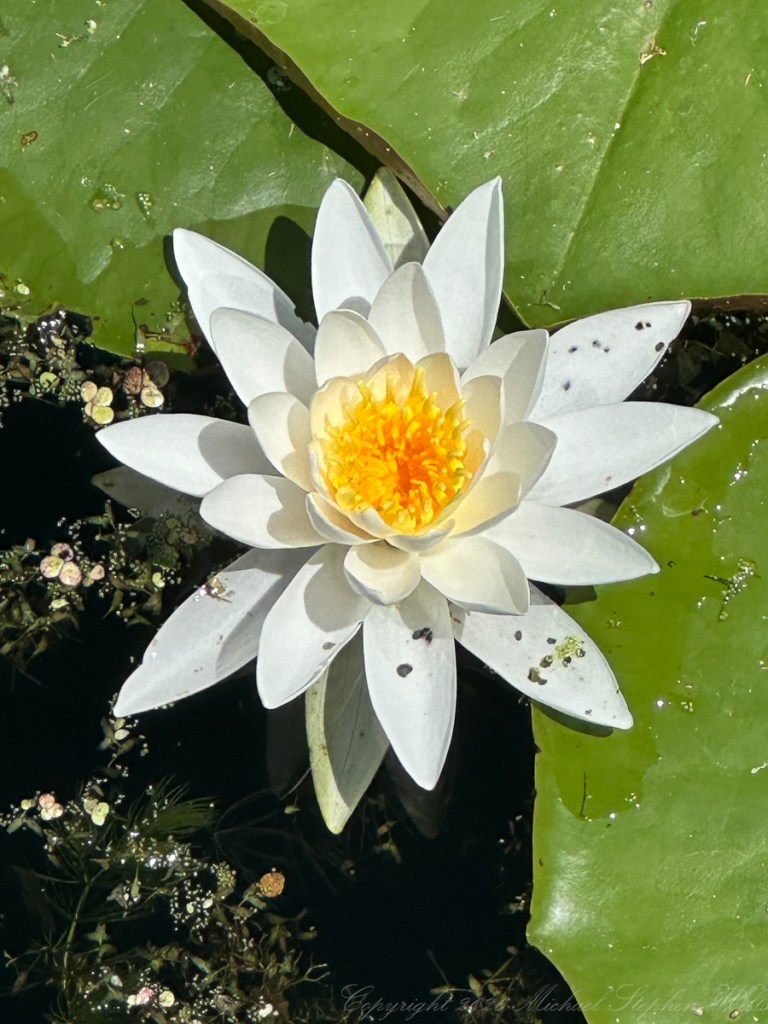
On June 21, 2026, just after noon, Houston Pond of the F.R. Newman Arboretum held the day in a green, breathing stillness. The sun stood high over Ithaca, bright enough to polish every lily pad, every cattail blade, every glossy fold of leaf. This light of the first summer day entered the scene, becoming part of the water, part of the trees, part of the quiet intelligence of the pond.

Houston Pond

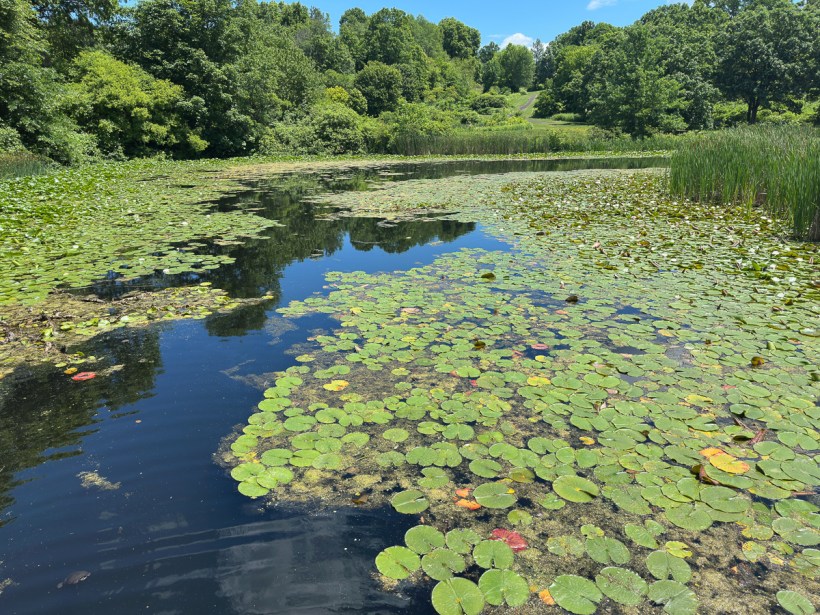
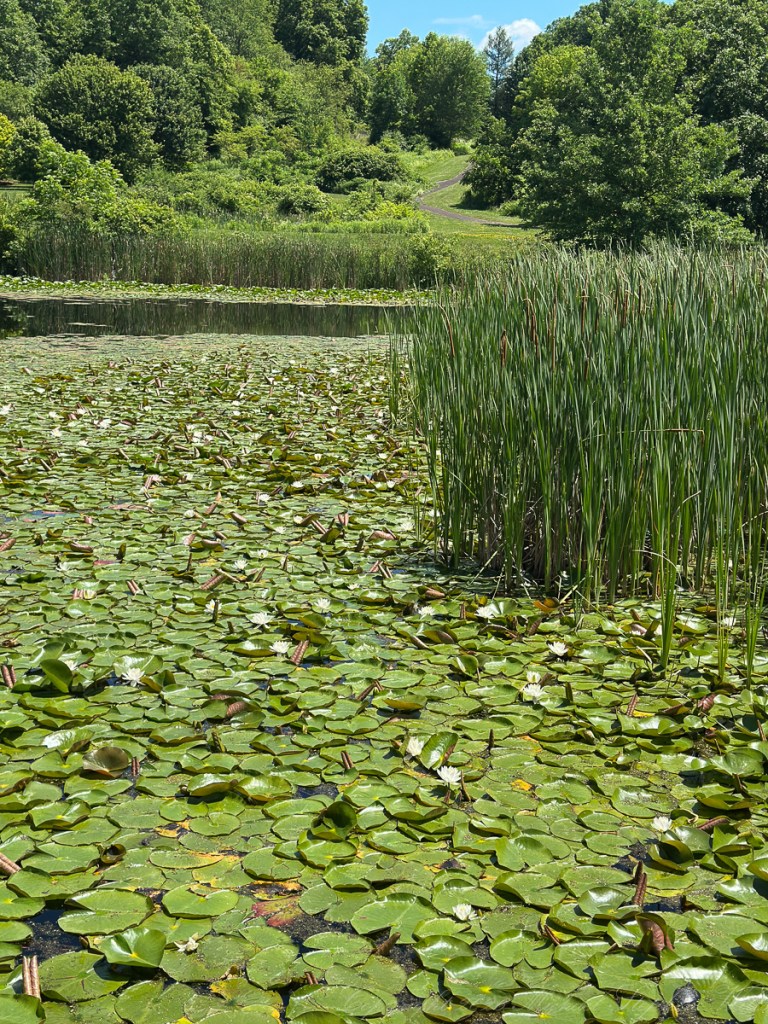
The pond was nearly covered with lily pads, a floating mosaic of green circles, some fresh and whole, others freckled, torn, yellowing. Between them, dark water opened in irregular channels, deep blue-black, mirroring trees and sky. These openings felt like pauses in a long sentence, small places where the pond allowed itself to breathe. Around the margins, cattails stood in dense ranks, upright and watchful, like a congregation listening to the sermon of light.

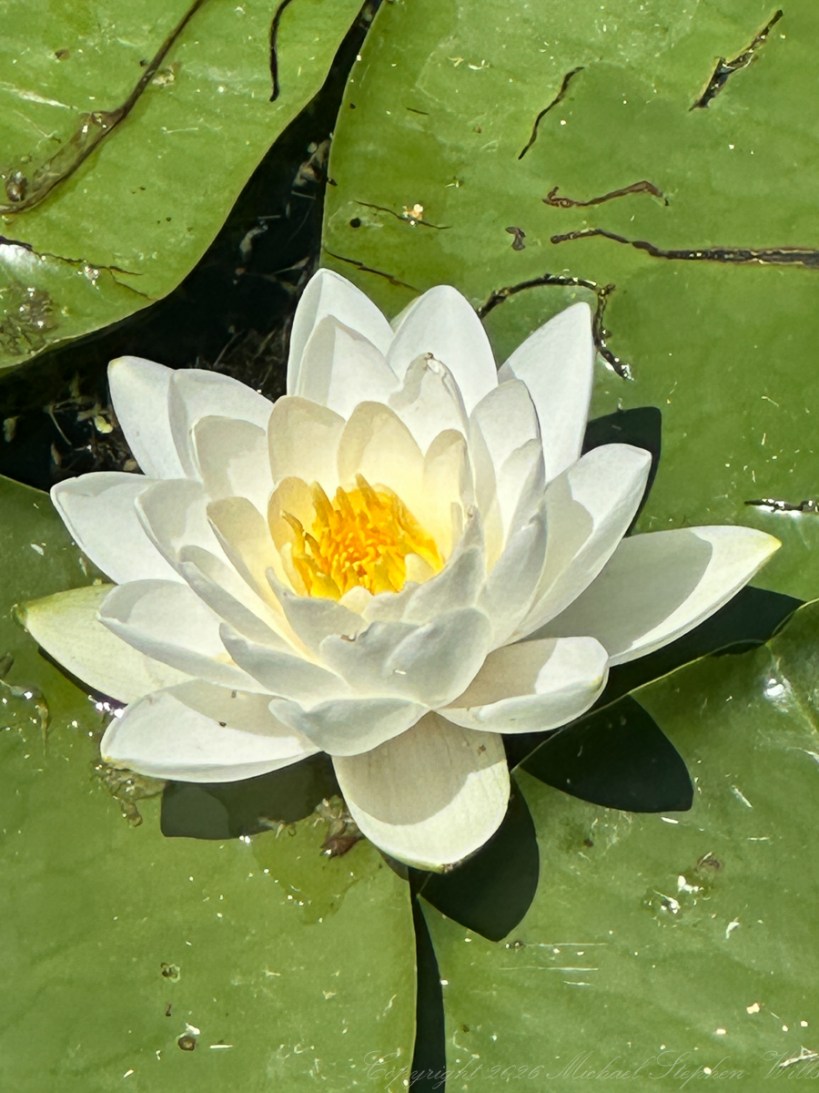
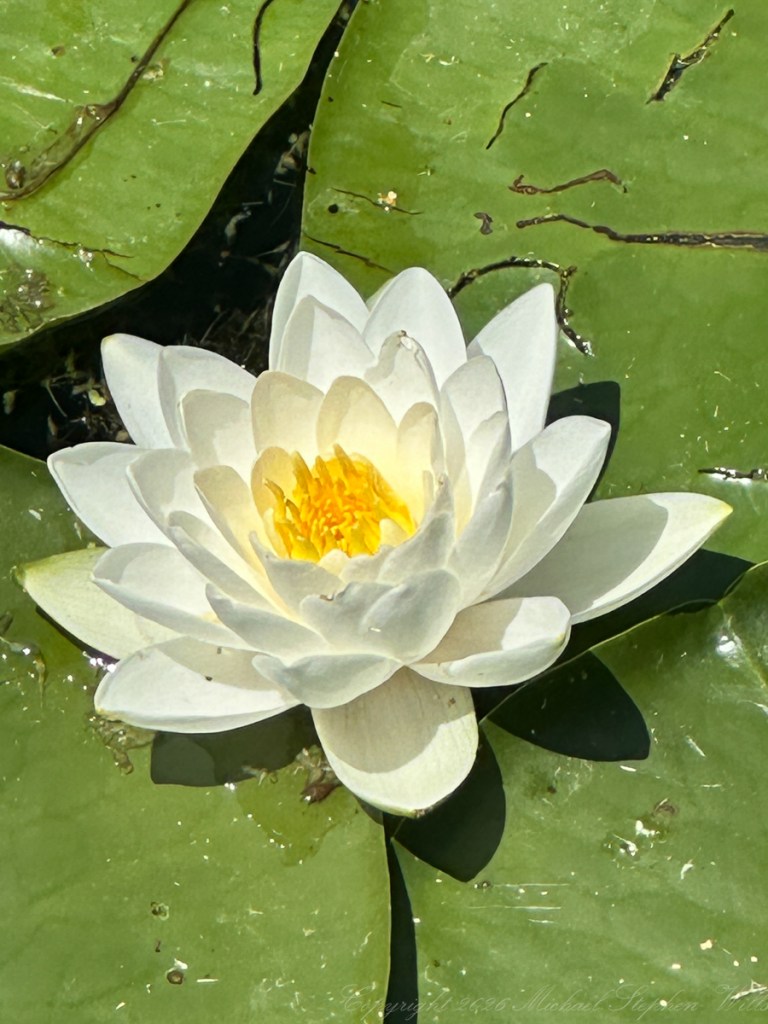
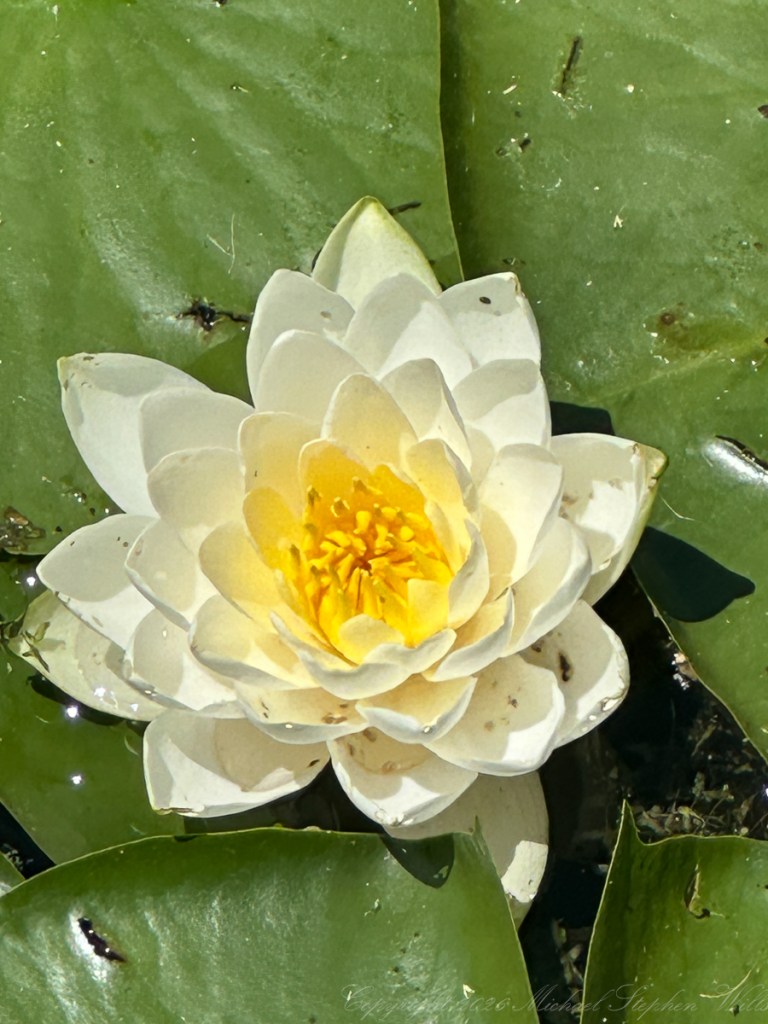
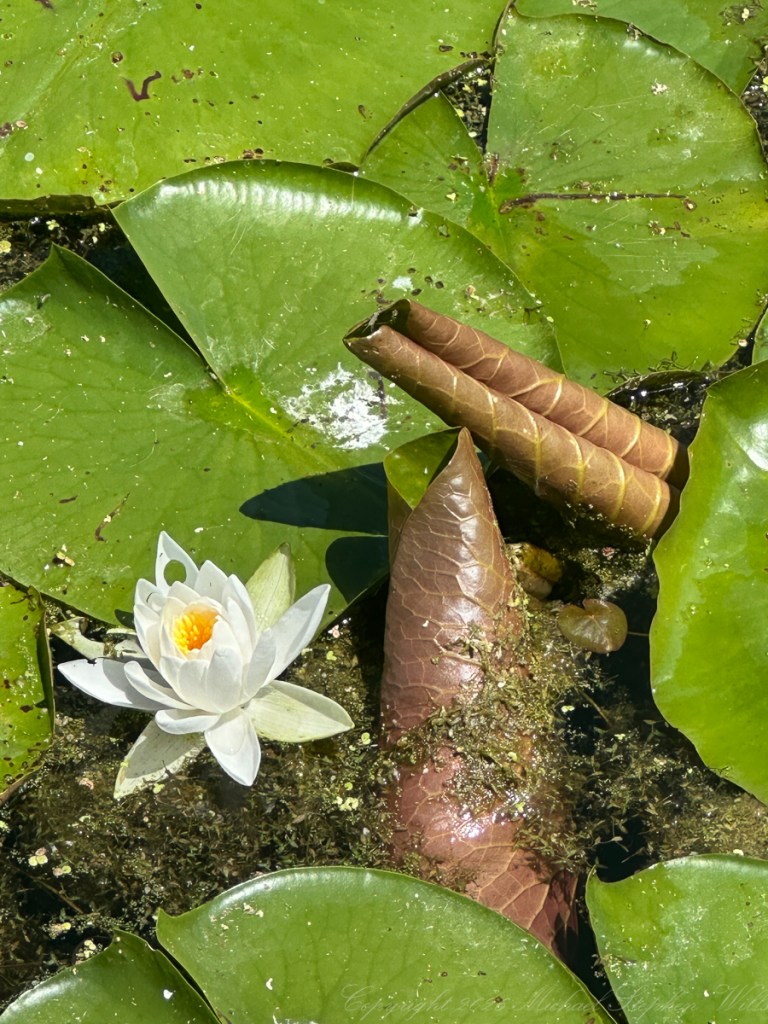
At the center of this water-world, white lilies opened with calm authority. Their petals rose cleanly from the surrounding abundance, white against green, flame-hearted with yellow. Each flower seemed impossible and inevitable at once: born from mud, rooted in darkness, arriving as a cup of light. A water lily is one of nature’s great acts of persuasion. It asks us to believe that beauty can rise without apology from what is hidden, tangled, and submerged.

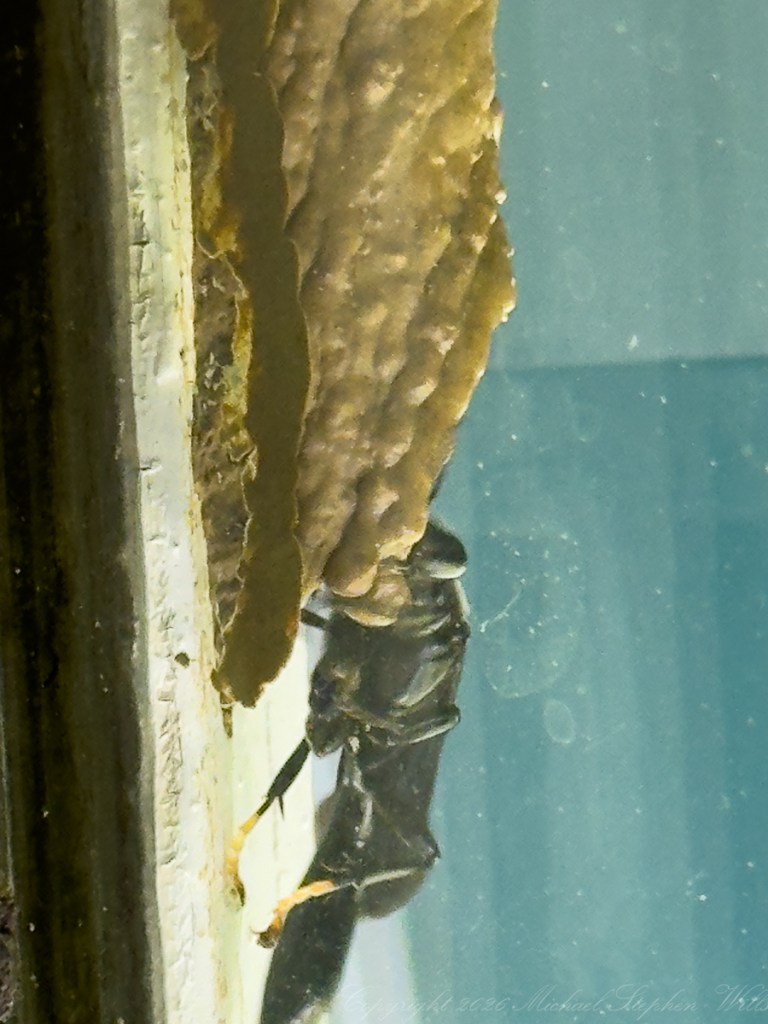
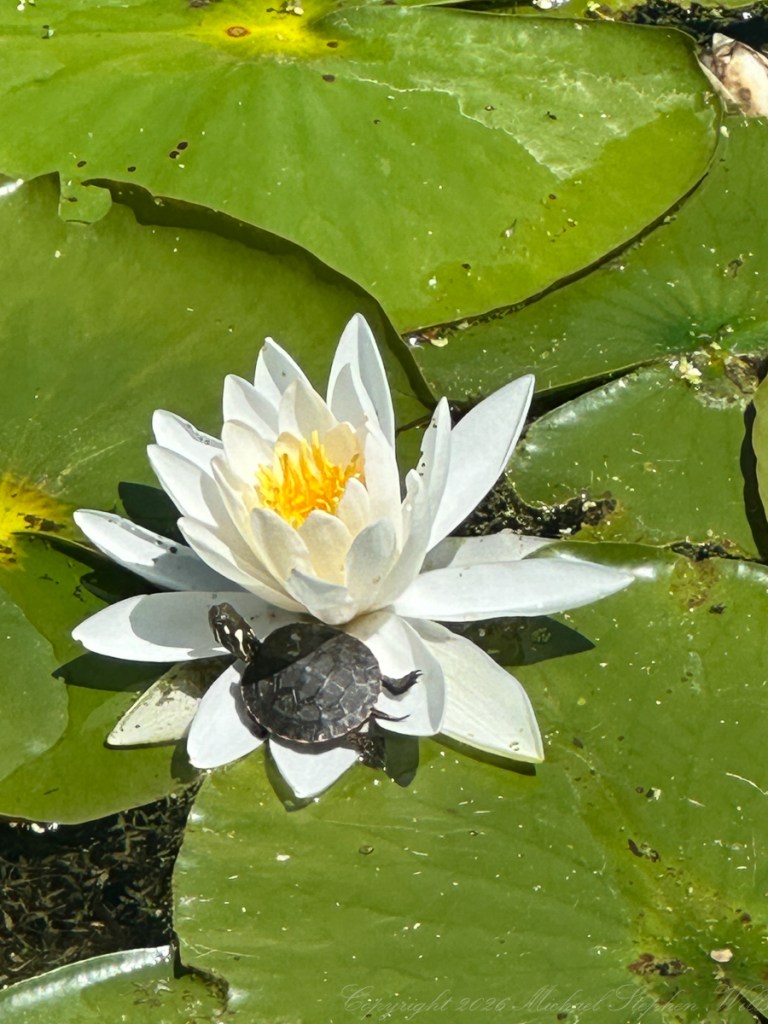
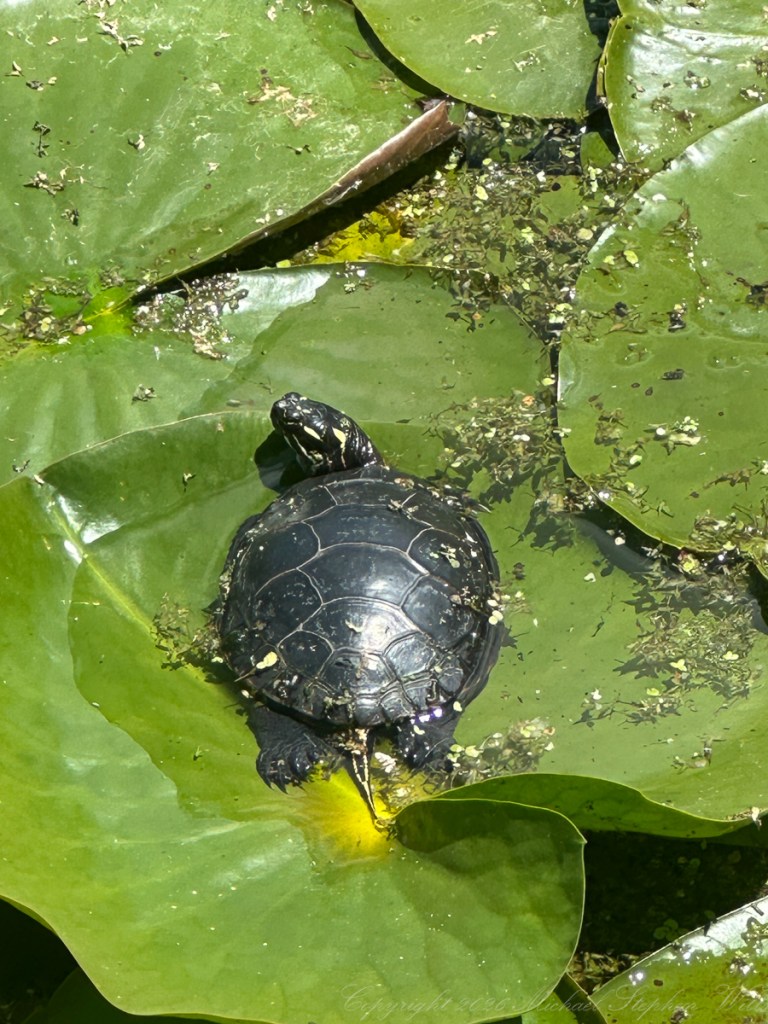
One blossom carried an unexpected visitor. A small turtle had climbed onto the flower, its dark shell resting against the white petals, one leg extended in complete confidence. The scene was both comic and profound. The lily was a raft, a chapel, a sun-warmed throne. The turtle seemed to understand what people often forget: beauty is not diminished by being used. It is completed by being entered. The flower did not become less beautiful because the turtle climbed aboard. It became more of the world.

Nearby, new lily leaves still held their rolled shapes, brown and burnished, rising like curled scrolls from the water. They had not yet flattened into the broad green plates surrounding them. In their tight forms was the promise of unfolding, the secret grammar of growth. Around them, older leaves floated with scars and stains, reminders that even in June’s fullness the season carries time within it. Summer is not a fixed paradise. It is motion disguised as abundance.

Beyond the pond, the arboretum rose in layers: meadow, shrubs, cattails, dark trees, open sky. A path climbed away through the greenery, pale and narrow, inviting without insisting. The woods stood dense and generous, every tree leafed out in the opulence of early summer. Clouds drifted over the blue, white and soft, their reflections briefly caught in the pond’s darker openings. The whole place seemed balanced between cultivation and surrender. Human hands had shaped the arboretum, named its paths, protected its plantings, opened it to walkers and watchers. Yet the pond itself answered in its own language: water, root, wing, shell, blossom, shadow.

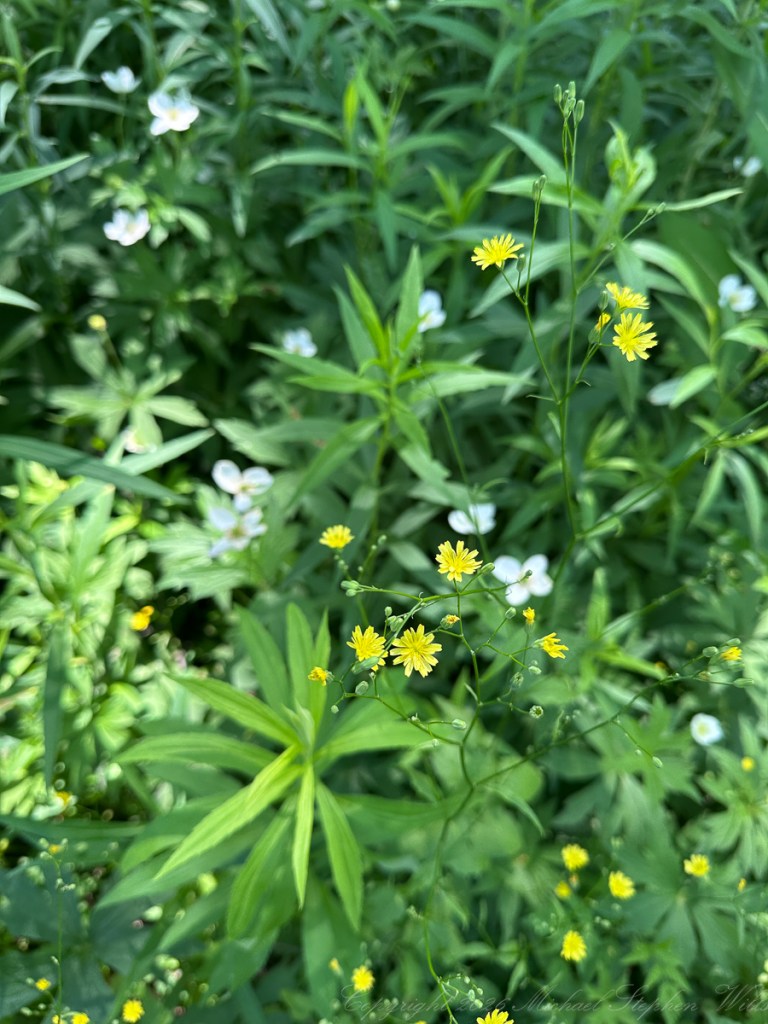
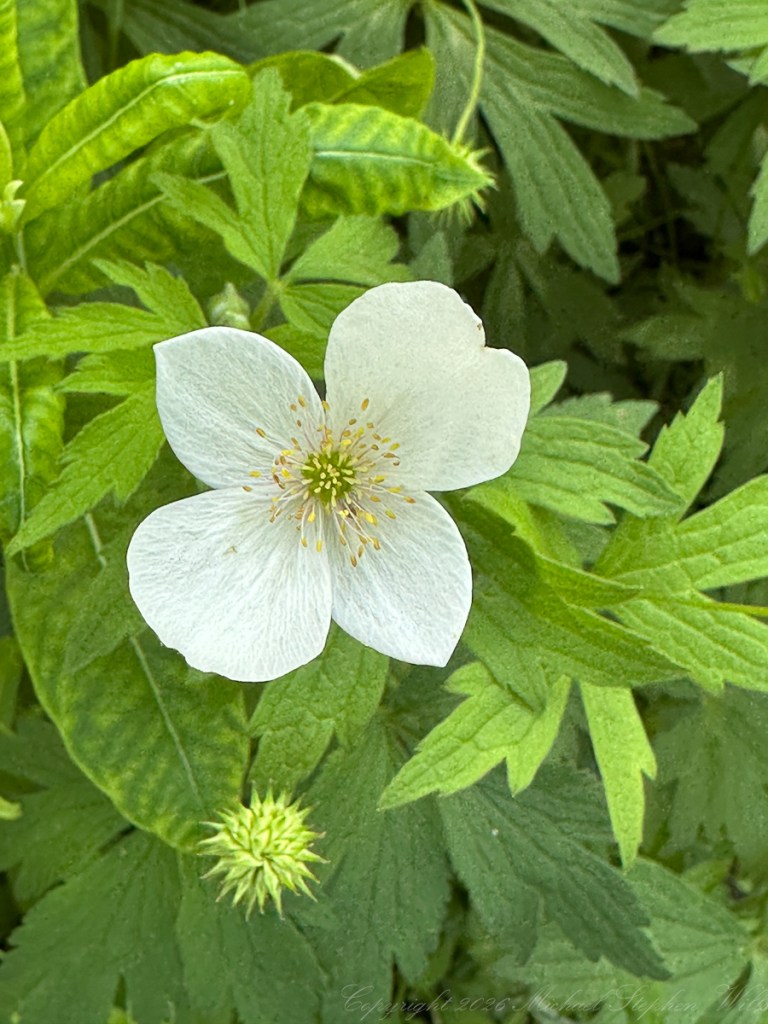
Away from the broad view, the smaller flowers made their quieter claims. Tiny yellow blooms lifted themselves on fine stems among the leaves, little sparks in a green hush. White blossoms hovered behind them, half blurred, like memories of spring still lingering in the understory. A single white flower opened over sharply cut leaves, its petals simple, its center delicate with stamens. It had none of the dramatic presence of the water lilies, but it possessed a different power: the power of being almost missed.

That is one of the arboretum’s gifts. It teaches scale. First the eye takes in the pond, the sweep of trees, the blue sky, the mass of cattails. Then attention narrows. A petal. A turtle’s foot. A torn leaf edge. A yellow flower no larger than a thought. The place asks us to look widely, then closely, then widely again. It trains the mind away from haste. It reminds us that wonder is not always a thunderclap. Sometimes it is a small white bloom waiting at ankle height.

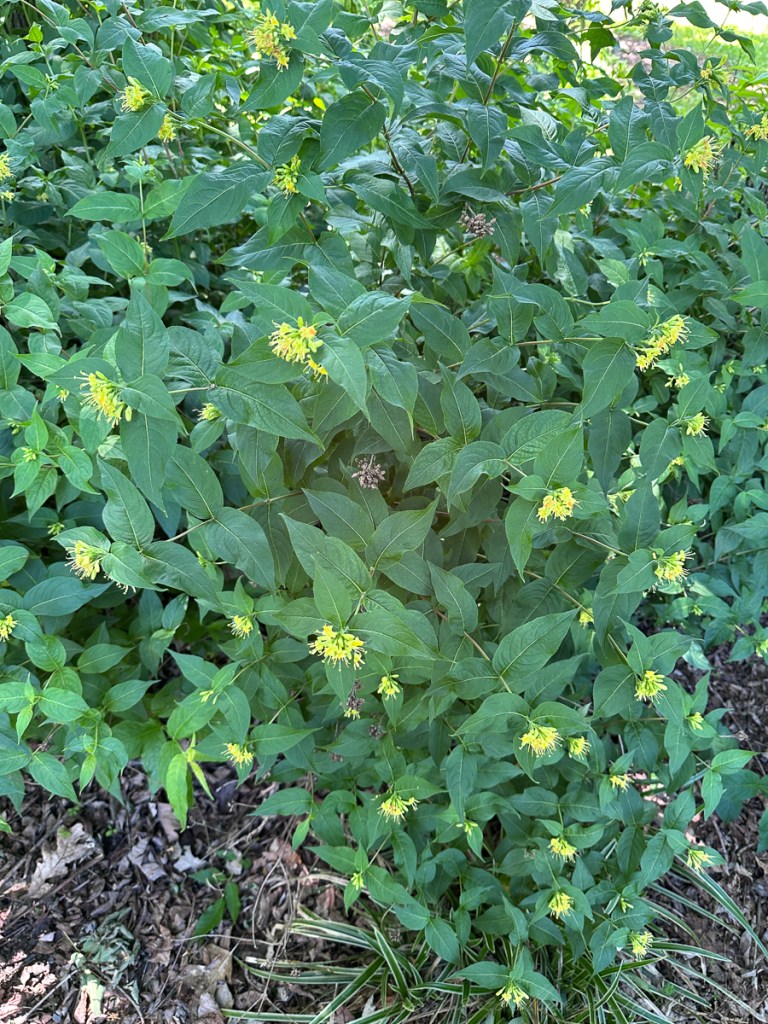
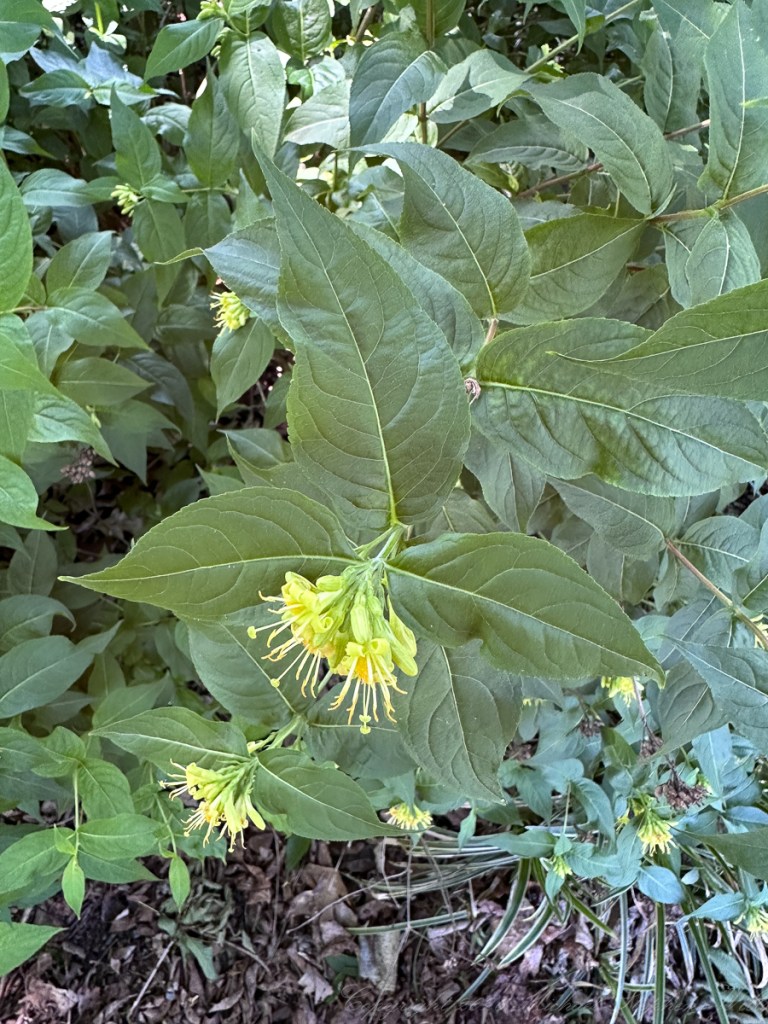
Northern Bush Honeysuckle (Diervilla lonicera)

The yellow honeysuckle-like blossoms tucked among broad leaves offered another kind of intimacy. Their pale tubes and slender filaments seemed made for visitors more delicate than us. They belonged to the hidden commerce of June: pollinators, fragrance, pollen, fruit-to-come. Much of what matters in a place like Houston Pond happens below notice. Roots thicken. Insects navigate. Turtles choose their sunning places. Flowers open and close according to laws older than memory. The pond is never still, only patient.

Northern Bush Honeysuckle (Diervilla lonicera)

Standing there, I felt the day gather itself into one phrase: green silence, golden heart. The white lilies held the light. The cattails guarded the edges. The turtle rested without concern for symbolism. And all around, the arboretum offered its deep reassurance: life does not need to announce itself loudly to be complete.

June in the F.R. Newman Arboretum is a state of attention within a season. Houston Pond receives the sky, feeds the lilies, shelters the small dark bodies of turtles, and gives back a vision of the world refreshed by reflection. To walk there at midday is to be reminded that the ordinary is only ordinary until we stop long enough to see it. Then the pond becomes a mirror with roots, the lily a white flame on dark water, and the whole green world a quiet invitation to belong.

Click me to visit Michael Stephen Wills Online Finger Lakes Gallery.

Enter your email to receive notification of future postings. I will not sell or share your email address.

The Wonder of Purple-Flowered Raspberry: Nature’s Thornless Native Treasure

The purple-flowered raspberry is a native shrub that confounds expectations, combining rose-like blossoms, maple-shaped leaves, edible fruit, and thornless stems into one of eastern North America’s most enchanting woodland plants.

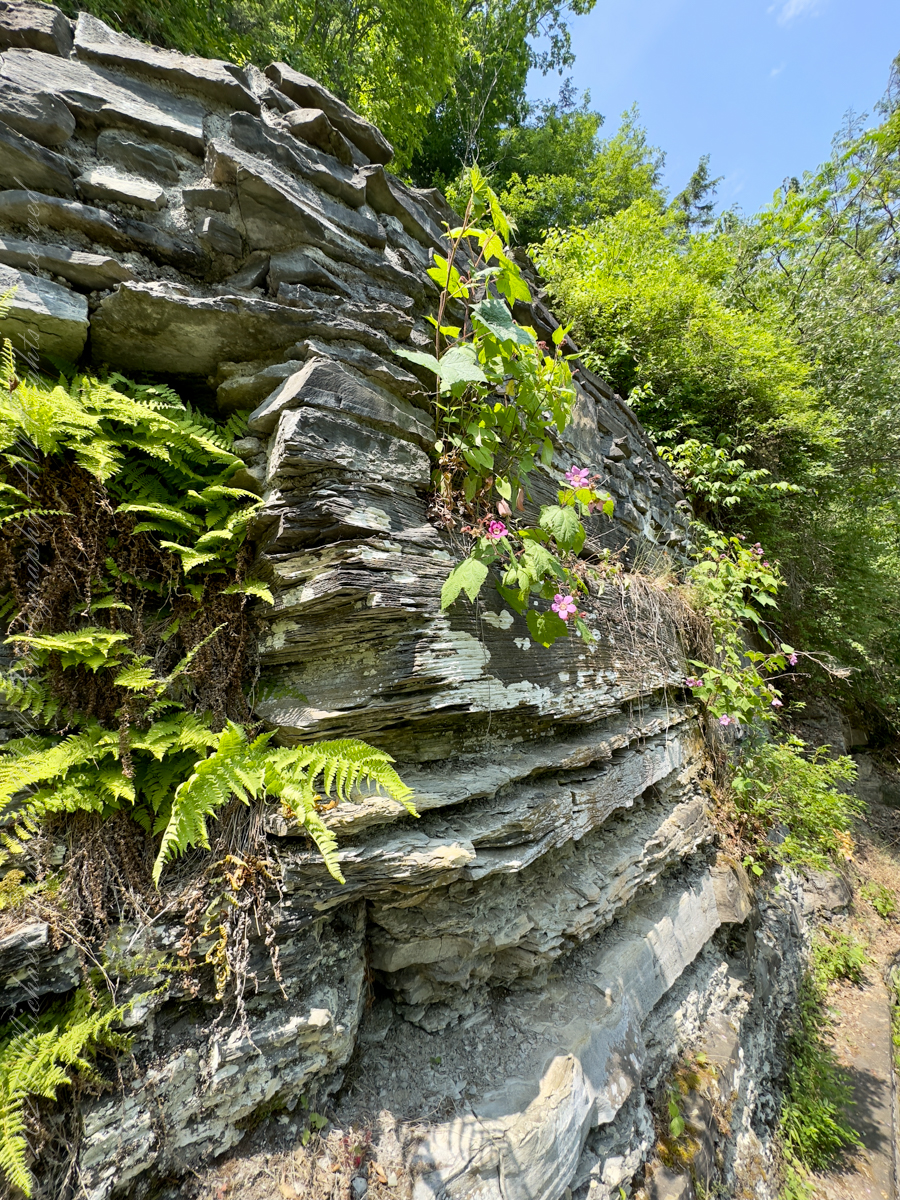
I first encountered the purple-flowered raspberry while walking the Gorge Trail at Fillmore Glen State Park. Dry Creek murmured below, working patiently within ancient shale walls that confine its course. Waterfalls spilled from ledges overhead, cool mist drifted through the narrow passage, and sunlight filtered down in shifting patches through the summer canopy. It was a landscape dramatic enough to command all of one’s attention.

Yet it was a flower growing quietly beside the trail that stopped me in my tracks.

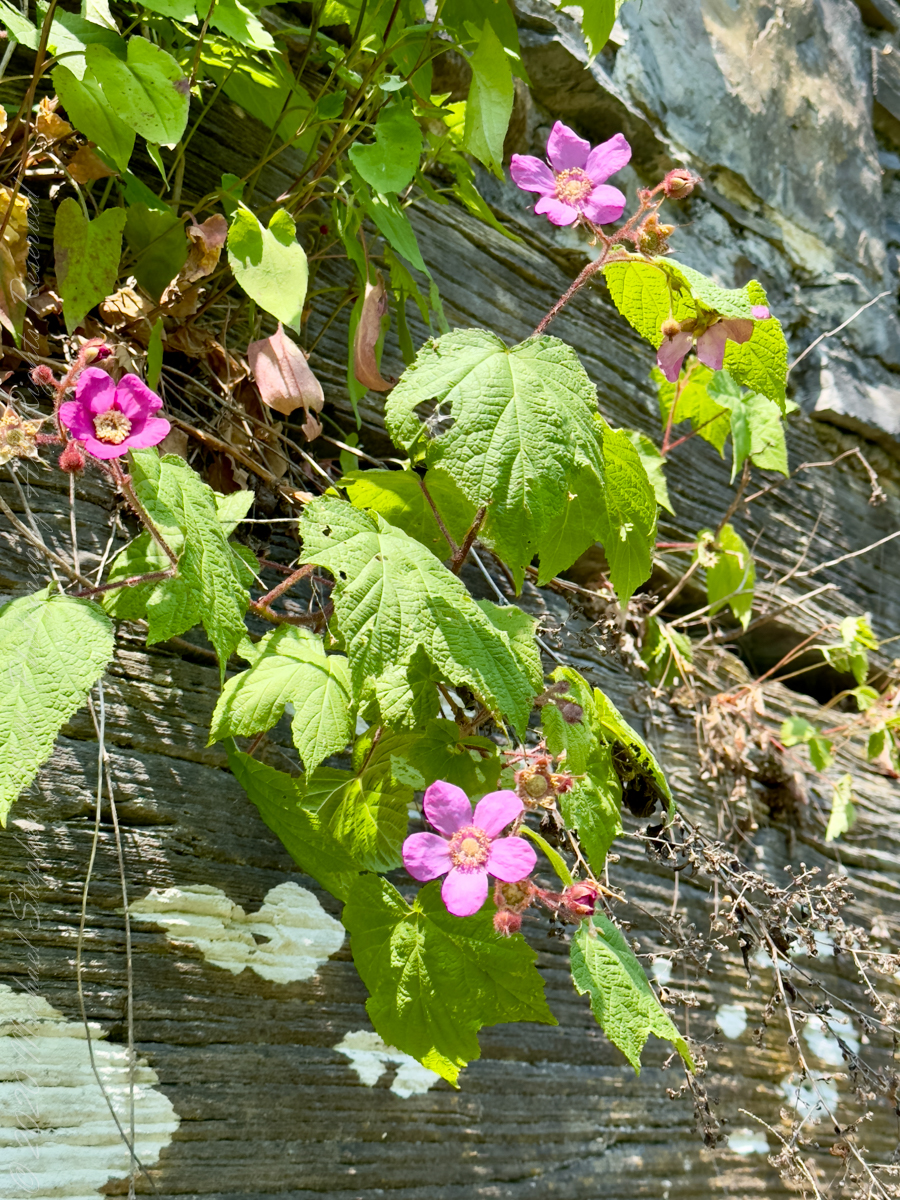
Purple-flowered Raspberry Growing Within Treman Gorge by the South Rim Trail

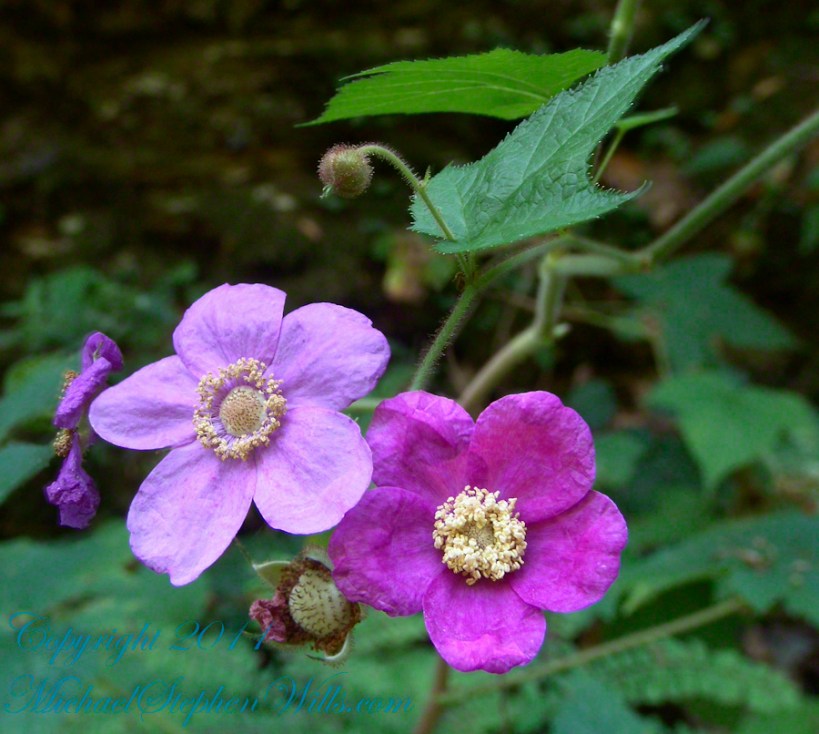
At first glance, I thought I had stumbled upon an escaped garden plant. The blossoms were  impossible to ignore—large, open, and an exuberant shade of rose-purple that glowed against the surrounding green. They seemed too extravagant for the subdued palette of a northeastern woodland. The petals had the simple elegance of wild roses, but there was something else about the plant that resisted easy identification.

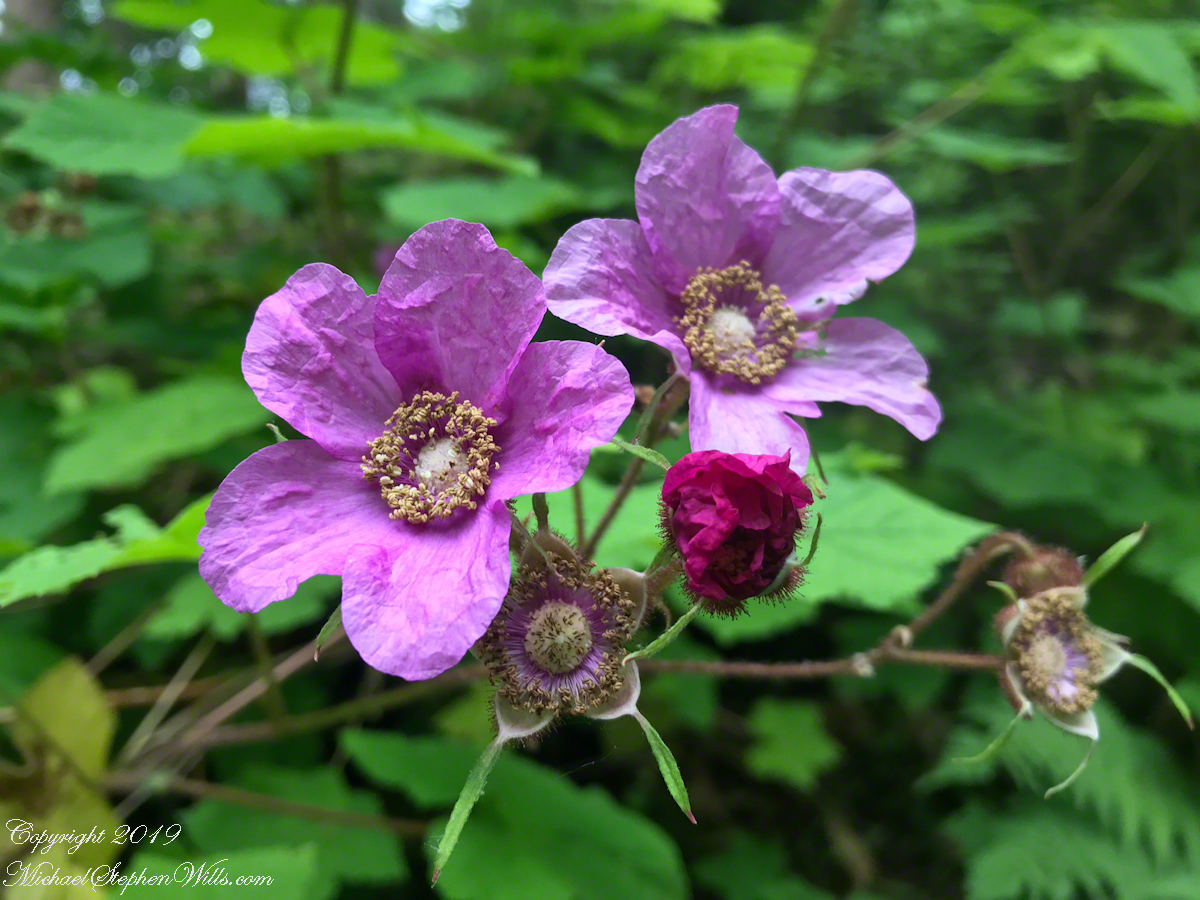
The purple-flowered raspberry, Rubus odoratus, is a plant of delightful contradictions. Its blossoms are among the largest in the raspberry family, often two inches across. They appear over an extended season, beginning in early summer and continuing well toward autumn. Unlike the brief fireworks of many woodland wildflowers, this plant stages an encore performance, offering fresh blooms long after others have taken their final bow.

Over the years, I returned often to Fillmore Glen. Dry Creek became an old acquaintance, its voice changing with the seasons—boisterous after spring rains, subdued during the heat of late summer. And almost every year, somewhere along the Gorge Trail, I would encounter those same remarkable shrubs. Familiarity deepened into appreciation, and appreciation eventually became affection.

The flowers also serve a practical purpose beyond their beauty. Native bees and other pollinating insects visit them regularly, gathering nectar and pollen throughout the season. The plant has become part of an intricate ecological conversation that has been unfolding for thousands of years.

Then there are the leaves. The first time I noticed them closely, they triggered another moment of confusion. Broad and softly textured, divided into five lobes, they looked uncannily like oversized maple leaves. Some can grow nearly ten inches across, creating islands of lush greenery along shaded streambanks and woodland edges.

It is as though nature, in one of her playful moods, decided to combine the leaf of a maple, the flower of a rose, and the fruit of a raspberry.

Most raspberries and blackberries demand respect from a distance. Their prickles and thorns snag clothing and skin with equal enthusiasm. Purple-flowered raspberry breaks that expectation as well. Its stems are fuzzy rather than fierce. There are no hooked defenses waiting to punish curiosity. The plant invites close examination.

By late summer, the blossoms yield to flattened red fruits. Technically, they are raspberries, though they lack the sugary richness of their cultivated cousins. I have sampled them occasionally, appreciating them more for the experience than the flavor. Birds, however, are less discriminating. The fruits provide nourishment for wildlife, becoming another thread in the web of life that surrounds Dry Creek and countless other woodland habitats.

Native to eastern North America, purple-flowered raspberry ranges from Nova Scotia westward into Ontario and Wisconsin, extending south through the Appalachian Mountains. It thrives along forest margins, rocky slopes, stream corridors, and disturbed areas where sunlight penetrates the canopy. Through underground shoots, it gradually forms colonies that stabilize soil and provide shelter for small creatures.

It belongs exactly where I first found it. There is a temptation, especially among gardeners, to seek novelty elsewhere—to import the exotic, the unusual, the unfamiliar. Yet some of the most extraordinary plants are those that have quietly shared our landscapes all along.

The purple-flowered raspberry reminds me of this truth each time I encounter it. It teaches the value of paying attention. A hurried walk through Fillmore Glen might focus exclusively on the waterfalls, the sculpted rock formations, or the cool refuge of the gorge itself. All are worthy of admiration. But along the margins of the trail stand these shrubs, offering their own quieter marvels.

My photograph captures all flowering forms of this member of the Rose family. This specimen was blooming in August within the shade of Fillmore Glen in the Finger Lakes of New York State.

A rose-colored flower where one expects white. Maple leaves on a raspberry cane. Soft stems where thorns should be. Fruit that feeds the forest. A native plant that asks for nothing more than the chance to flourish where it has always belonged. Years after that first encounter beside Dry Creek, the sight of those blossoms still stops me as I find them in all the Finger Lakes gorges.

Certain plants become landmarks in our personal geography. They root themselves not only in the soil but in memory. The purple-flowered raspberry has become one of those companions for me—a recurring presence marking the passage of summers, a familiar face in a beloved landscape.

Dry Creek continues its patient work of carving stone. The waterfalls continue to descend in silver ribbons through the gorge. And each year, as if renewing an old friendship, the purple-flowered raspberries lift their improbable blossoms toward the filtered light. In their presence, wonder becomes less an emotion than a habit of attention.

Sometimes the greatest discoveries are not rare because they are hidden. They are rare because we have not yet learned to see them. The purple-flowered raspberry taught me to look more closely. Along a trail I thought I knew by heart, it revealed that nature still keeps delightful surprises in reserve.

Click me to visit Michael Stephen Wills Online Finger Lakes Gallery.

Enter your email to receive notification of future postings. I will not sell or share your email address.

Cutleaf Toothwort and the Pure Green Sweat Bee: A Woodland Encounter in the Mundy Wildflower Garden

A close look at Cutleaf Toothwort and a Pure Green Sweat Bee in Cornell Botanic Gardens’ Mundy Wildflower Garden reveals a small but remarkable drama of spring pollination, adaptation, and woodland renewal.

That afternoon of April 14, 2026, in the Mundy Wildflower Garden, I was moving slowly enough for the woods to begin revealing their smaller intentions. Mid-April in Ithaca is a season of thresholds. The leaf litter still holds the color of last year’s weather—oak brown, beech tan, the dry parchment of a forest not yet fully wakened—but through it rise the first green declarations. Nothing shouts. Everything announces itself in a near-whisper.

It was in that spirit that I came upon the cutleaved toothwort.

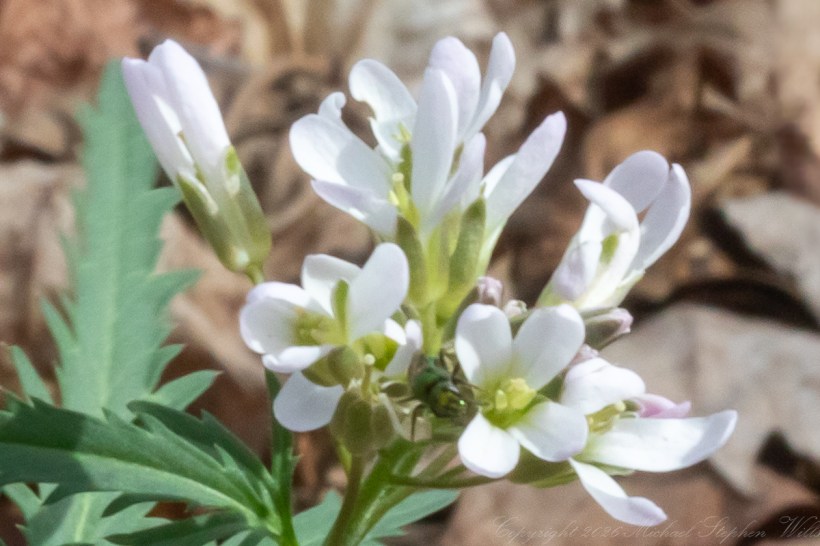
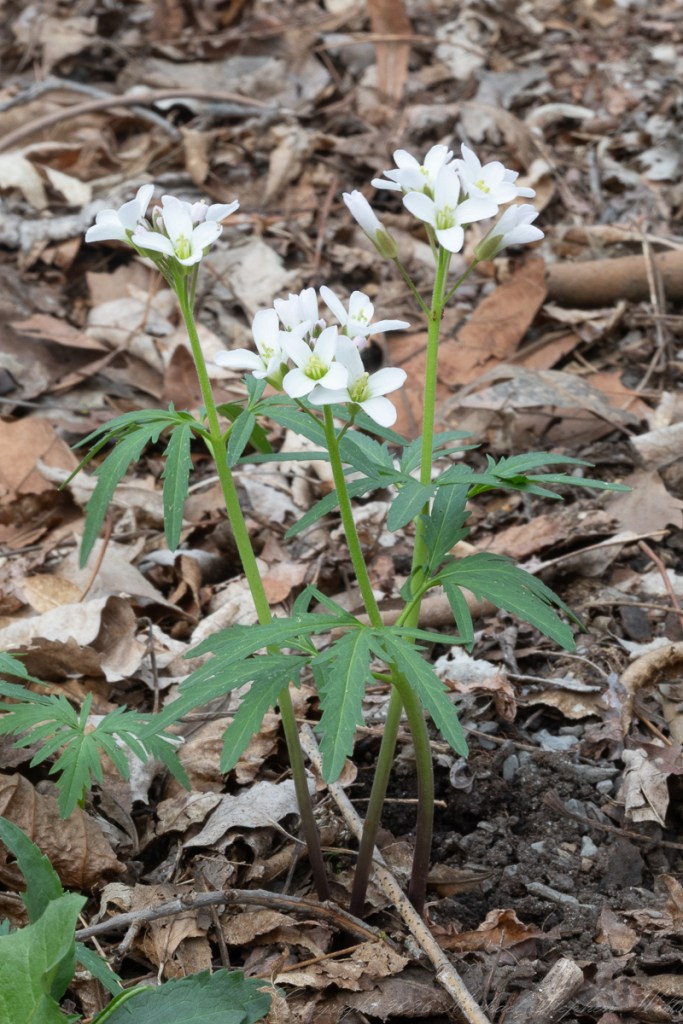
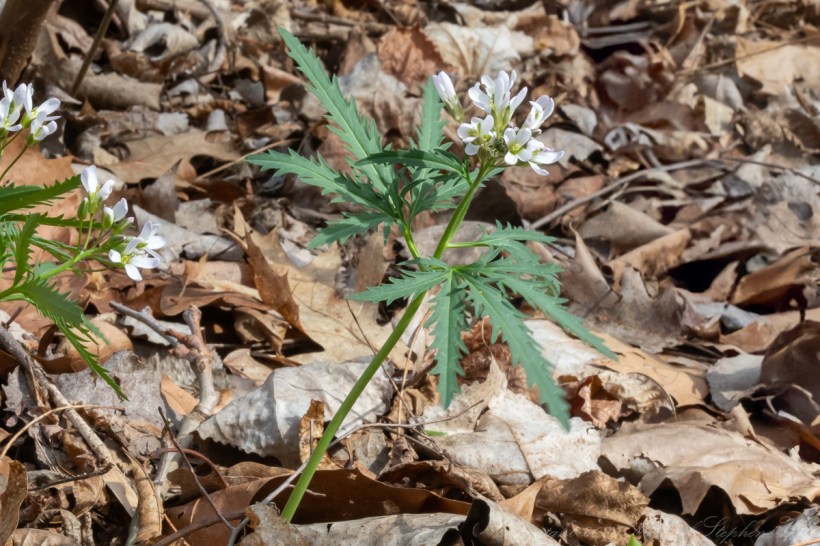
Cardamine concatenata, the cutleaved toothwort, crow’s toes, pepper root or purple-flowered toothwort, is a flowering plant in the family Brassicaceae. Mundy Wildflower Garden, Cornell Botanic Gardens, Ithaca, Tompkins County, Finger Lakes Region, New York State

At first glance the plant seemed almost improbably delicate, as if it had been assembled from a set of fine green gestures and then topped with small white crosses of bloom. The flowers hovered just above the leaf litter, each with four petals, clear evidence of the mustard family to which the plant belongs. The leaves were deeply divided, sharply cut, almost hand-like in their spread, giving the plant its common name. There is something elegant in that foliage: not the broad, self-confident green of summer, but a more intricate, provisional architecture, suited to the brief bright interval before the forest canopy closes.

This was Cutleaf Toothwort, Cardamine concatenata, one of the spring ephemerals, those woodland plants that have evolved to live by speed and timing. Their season is narrow. They rise, leaf out, flower, attract pollinators, set seed, and begin to withdraw before the trees above them fully leaf out and cast the deep shade of late spring and summer. To see one is to witness a life shaped by the economy of light. It does not waste time. It cannot.

And then I noticed the bee.

I had first been looking at the flowers themselves, admiring the small white petals and the poised buds still waiting to open, when a glint of green—alive, metallic, almost jewel-like—caught my eye. There on the bloom was a Pure Green Sweat Bee, almost certainly Augochlora pura, one of the loveliest native bees of eastern woodlands. The name hardly prepares one for the reality. “Green” suggests leaf or moss or some dull vegetal shade. But this bee wore green the way a gemstone wears light. It seemed less colored than illuminated, as though the afternoon sun had condensed into a living body and taken to wing.

What moved me most was the scale of it. The bee was tiny beside the flower, and the flower itself was small in the wide republic of the forest floor. Yet in that little meeting—bee and toothwort, insect and ephemeral—there existed an entire system of ancient reciprocity. The bee had not arrived there by accident. Nor had the flower opened in innocence. Each belonged to the other’s world.

Here is the Pure Green Sweat Bee in a detail of the previous photograph.

The life of a sweat bee is far more complex than its modest size suggests. Augochlora pura is one of our native solitary bees. Unlike honey bees, it does not belong to a great colony with combs and a queen. A female builds and provisions her own nest, often in rotting wood or soft decaying logs, an apt choice for a woodland species. She gathers pollen and nectar, forms a food mass for her offspring, lays an egg, and seals the chamber. Her labor is quiet, uncelebrated, and essential. She is one small carrier of spring fertility, moving genes through the forest one flower visit at a time.

The common name “sweat bee” comes from a habit some species have of landing on human skin to sip salts from perspiration, but there was nothing comic or pesky about this one. On the toothwort it was wholly itself: intent, methodical, radiant. It moved with a professional seriousness from bloom to bloom, entering the white flowers where the reproductive parts stood ready. Pollen clung to its body. The flower offered nectar and pollen as food; the bee, without contract or plan, carried the plant’s future outward. Evolution has made such meetings beautiful, but beauty is not the goal. Continuance is.

And yet beauty is what we are given to see.

The Cutleaf Toothwort has its own intricate life history. It spreads not only by seed but also through underground rhizomes, toothed in form, which gave rise to the older name “toothwort.” Those pale subterranean stems hold stored energy from previous seasons, allowing the plant to rise quickly when soil temperatures soften and light still reaches the woodland floor. It is a plant of patience and timing, of long preparation for a brief display. Its flowers are modest, not showy in the garden-center sense, but perfectly fitted to the early spring woods: visible enough to pollinators, pale enough to stand out against the brown duff, structured for efficiency.

There is also an evolutionary poignancy in the fact that many spring ephemerals depend on the first wave of insect activity after winter. Bees like Augochlora pura emerge into a world that is only beginning to supply forage. A flowering woodland plant in April is an opened pantry, a signal fire, a necessary event in the calendar of survival. Likewise, a native bee visiting those flowers is a participant in a relationship shaped over vast stretches of time. Forest floor, rhizome, petal, pollen grain, bee body, hollow wood nest—all of it is linked.

Standing there with my camera, I felt once again how often wonder arrives disguised as minuteness. The grand spectacles of nature announce themselves: waterfalls, hawks, autumn hillsides, a full moon lifting over a ridge. But this was a smaller magnificence, requiring the humility to stoop, to wait, to look closely enough for significance to emerge from what many walkers would simply call “little white flowers.” The Mundy Wildflower Garden, on an afternoon like this, was displaying as well as conducting spring.

The leaf litter around the plant only deepened the impression. Last year’s fallen leaves were still present, curled and dry, forming the brown text from which the new season writes its first green sentences. Out of that apparent dormancy rose the toothed leaves and white flowers of Cardamine concatenata, and upon them came the emerald bee, a living spark of pollinating purpose. Death feeding life; old canopy nourishing new growth; a forest renewing itself not through spectacle but through a thousand precise exchanges.

I lingered longer than I meant to. That happens to me often in spring. One flower leads to another, one patch of sunlight to another, and then some small drama of natural history arrests the day. But this encounter felt especially complete. The Cutleaf Toothwort embodied the speed, discipline, and elegance of the spring ephemeral strategy. The Pure Green Sweat Bee embodied the brilliance and necessity of native pollinators, creatures upon whose unrecorded labor the health of so many ecosystems depends. Together they made visible a truth the woods are always speaking: survival is collaborative, and beauty often arises where need and adaptation meet.

When I finally moved on, I carried with me the feeling that I had witnessed a brief transaction in the old woodland economy, a little shining exchange older than any path through the garden, older than the institutions built around it, older even than the names we now give to bee and blossom. On an April afternoon, among the leaves of last year, I had found a subject for a photograph within a moment in which evolution, ecology, and grace stood together in one small white flower.

Click me to visit Michael Stephen Wills Online Finger Lakes Gallery.

Enter your email to receive notification of future postings. I will not sell or share your email address.

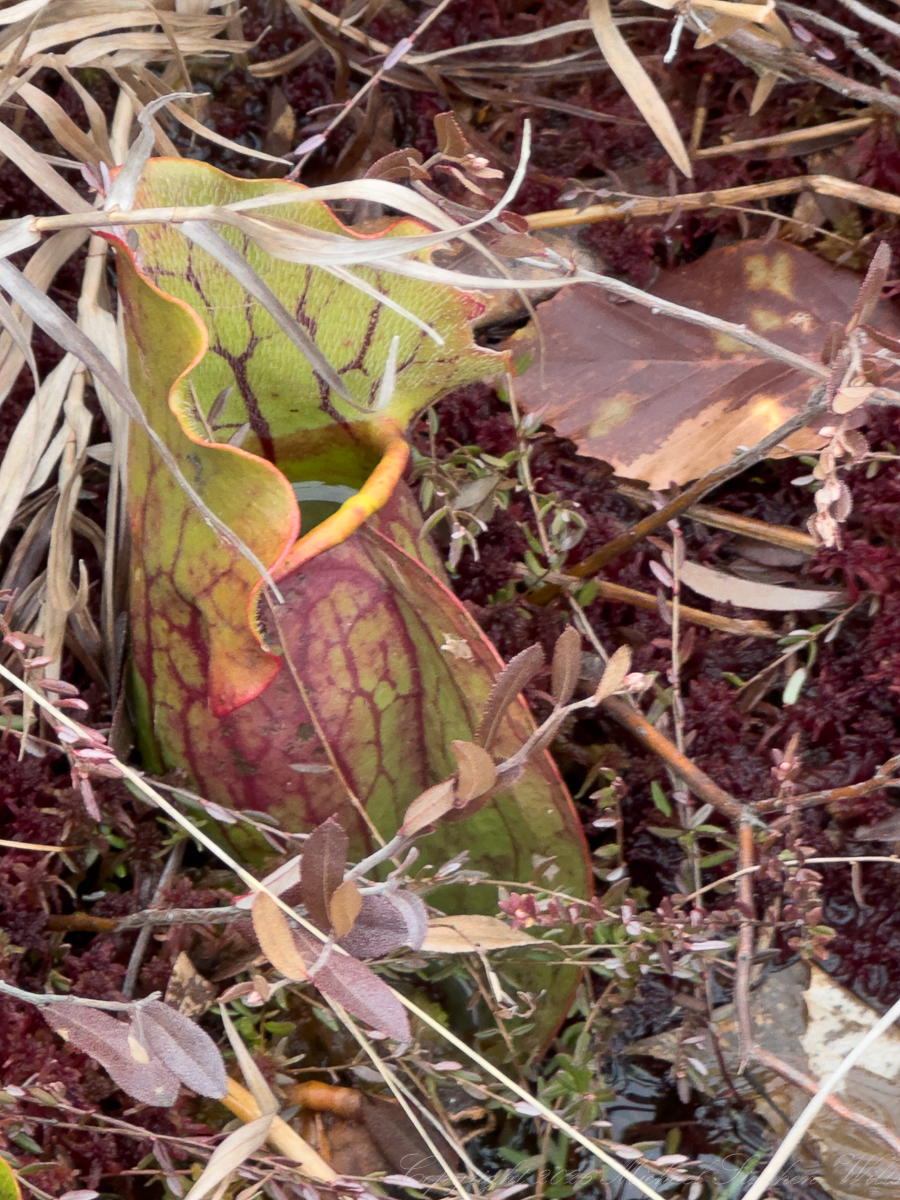
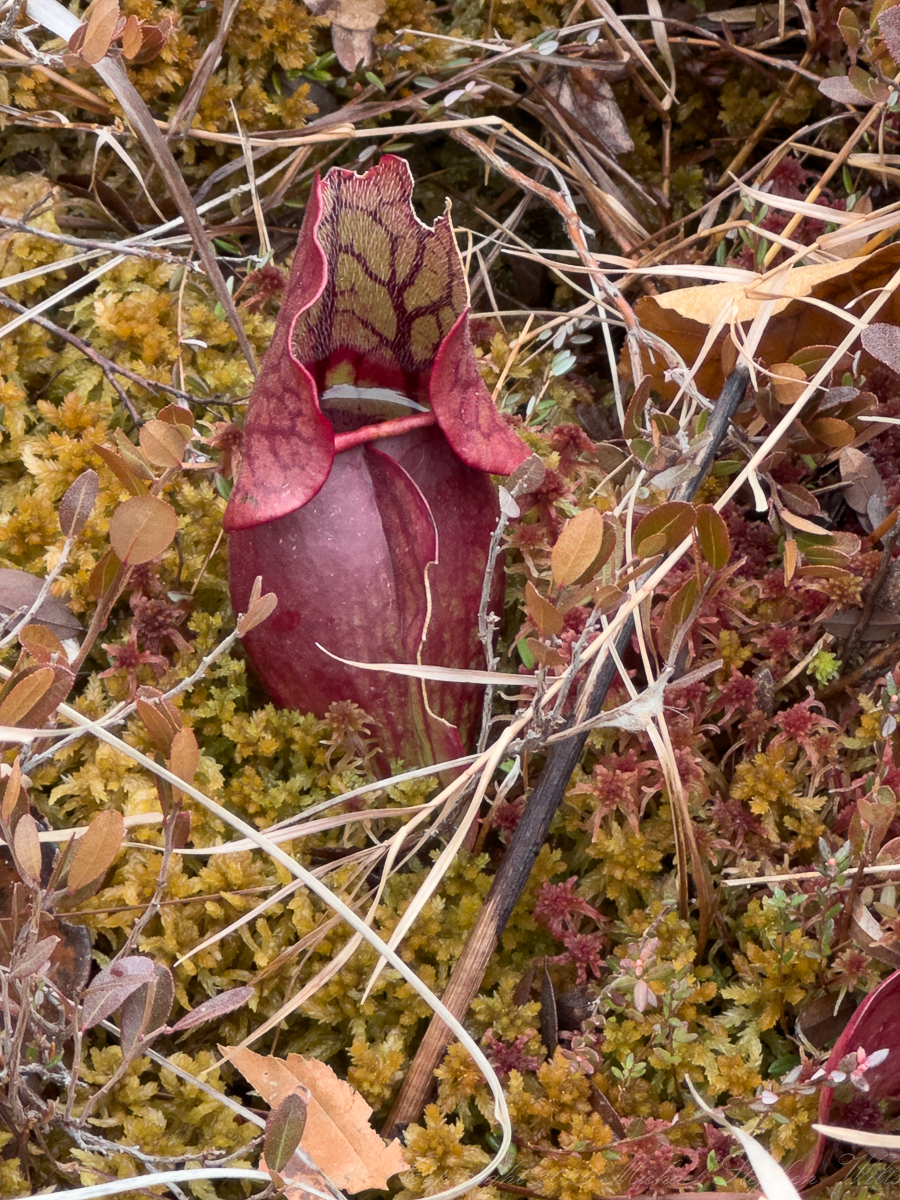
McLean Bogs in Early Spring: Pitcher Plants, Skunk Cabbage, a Quiet Walk with Grandchildren

A quiet early spring walk through McLean Bogs reveals pitcher plants, skunk cabbage, and the subtle beauty of glacial wetlands shared with grandchildren.

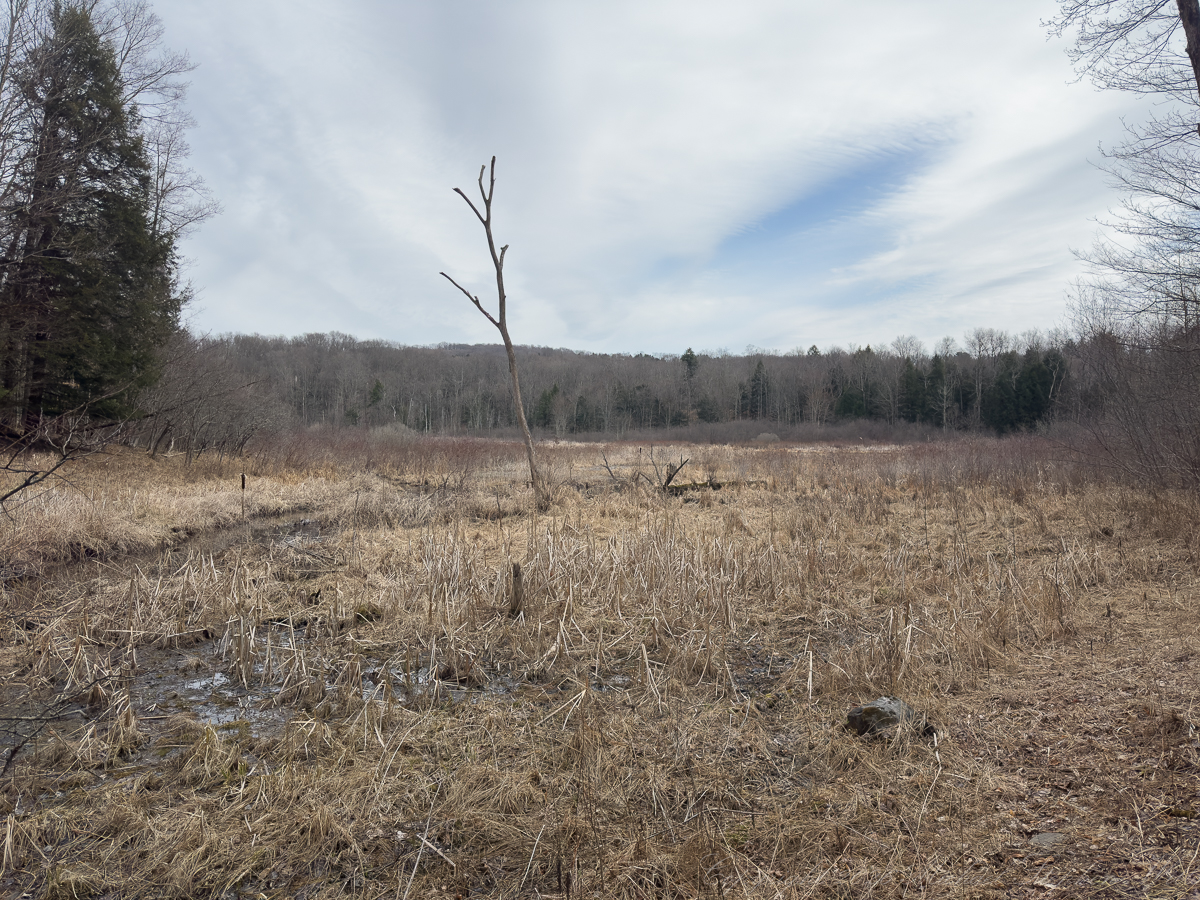
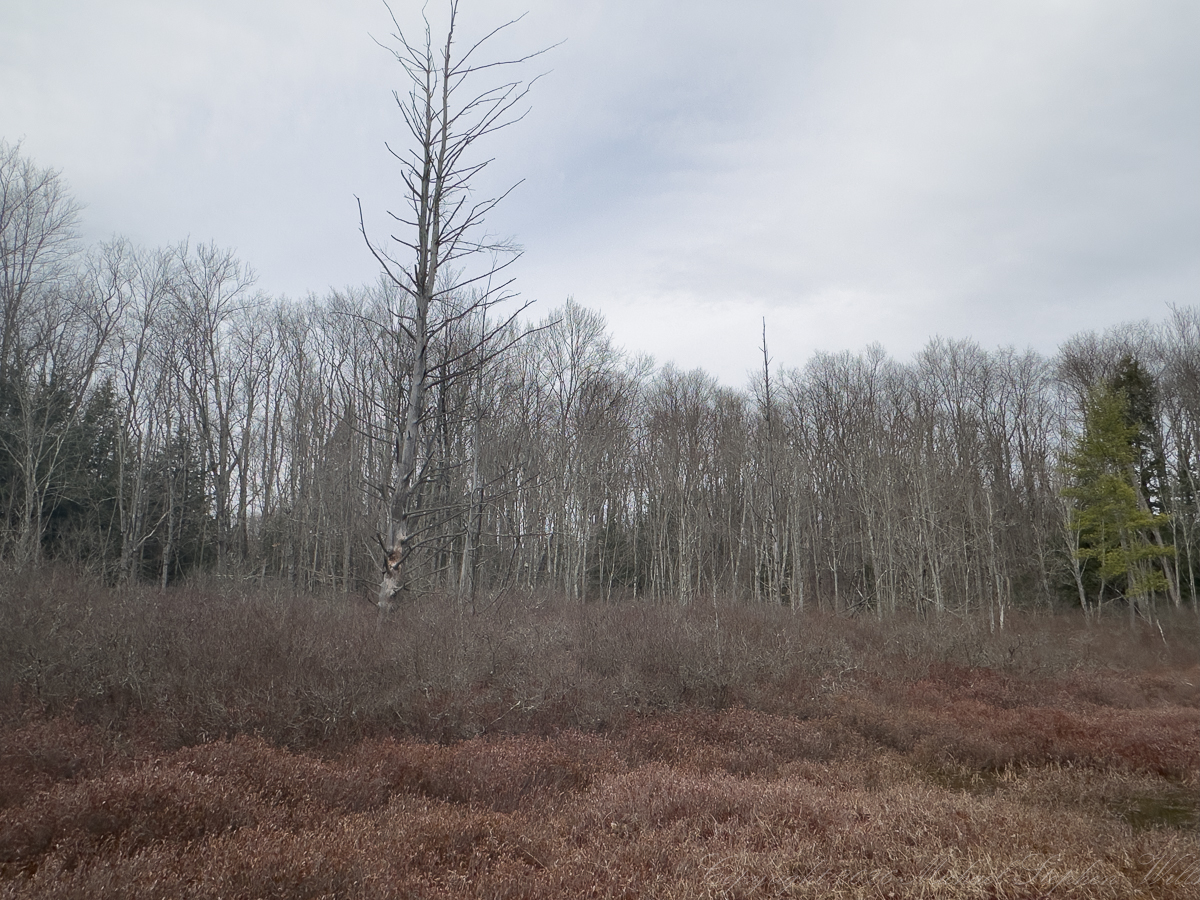
The path into McLean Bogs begins without ceremony, a narrowing of the world. The road falls away, the trees gather closer, and the ground softens underfoot, remembering water. You arrive at a threshold. The air seems altered, quieter, carrying a faint mineral stillness, as though the glacier that shaped this place has not entirely withdrawn its presence.

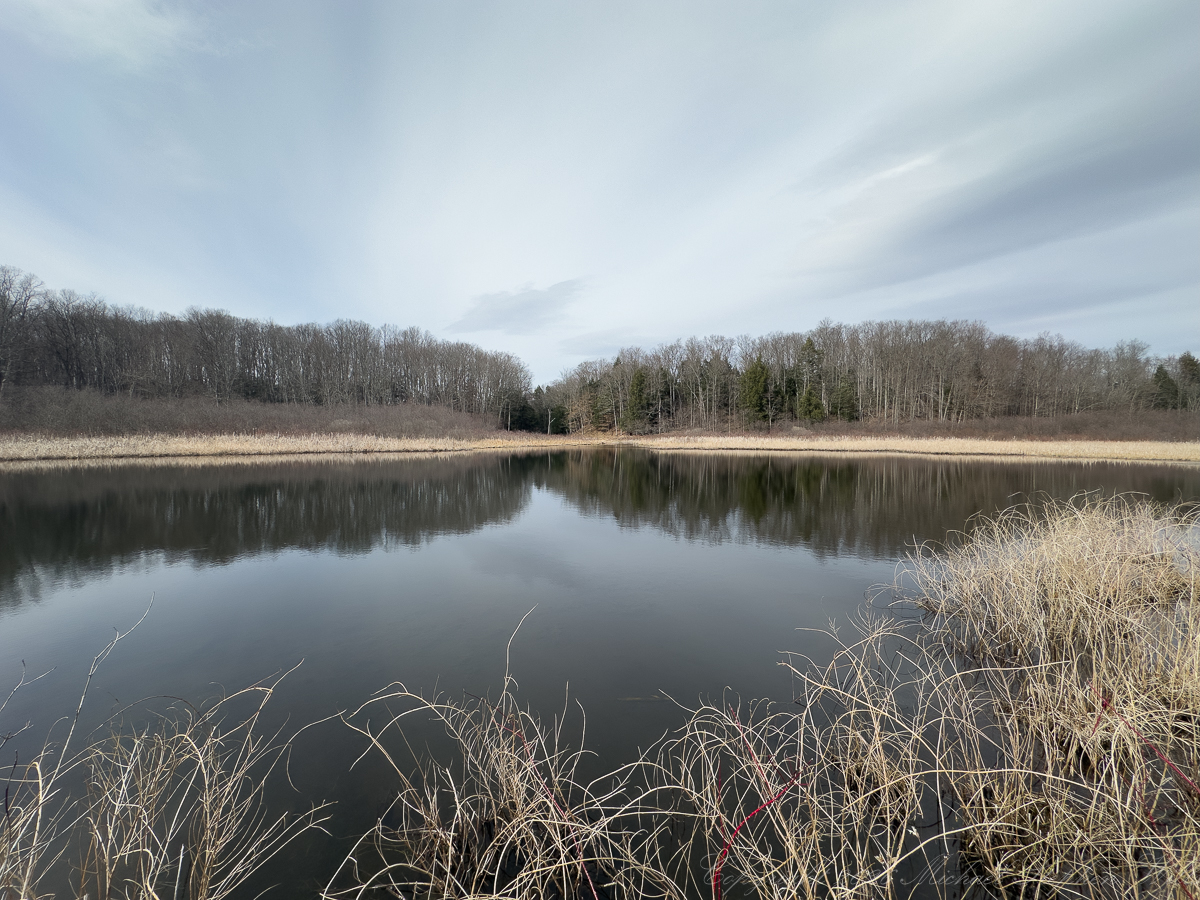
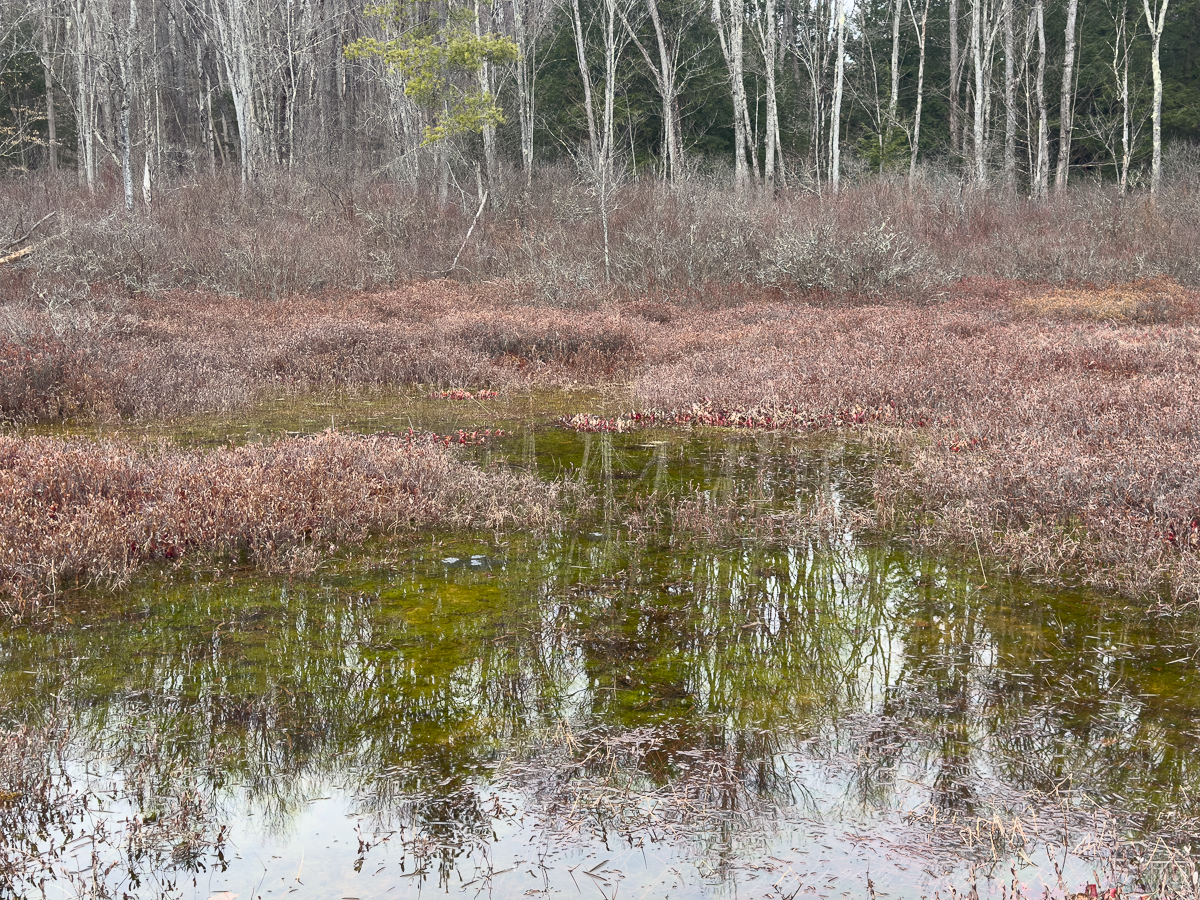
McLean Bog, Tompkins County, New York State part of Cornell Botanical Gardens

The pond holds the sky with patient fidelity. Its surface is dark, reflective, contemplative—mirroring a band of bare trees and the pale sweep of early-spring cloud. Nothing disturbs it. No wind, no bird, no ripple of urgency. It is the kind of water that asks nothing of you except attention. And in giving it, you feel the pace of your own thoughts begin to slow, as if they too must match the bog’s ancient tempo.

At the edge, grasses stand in muted gold, last year’s growth bowed but not broken. They frame the water as do an unfinished sentence. You can imagine how, in another month, this quiet will be interrupted by green—by the rising insistence of life. But today, the landscape is held in suspension, between endings and beginnings.

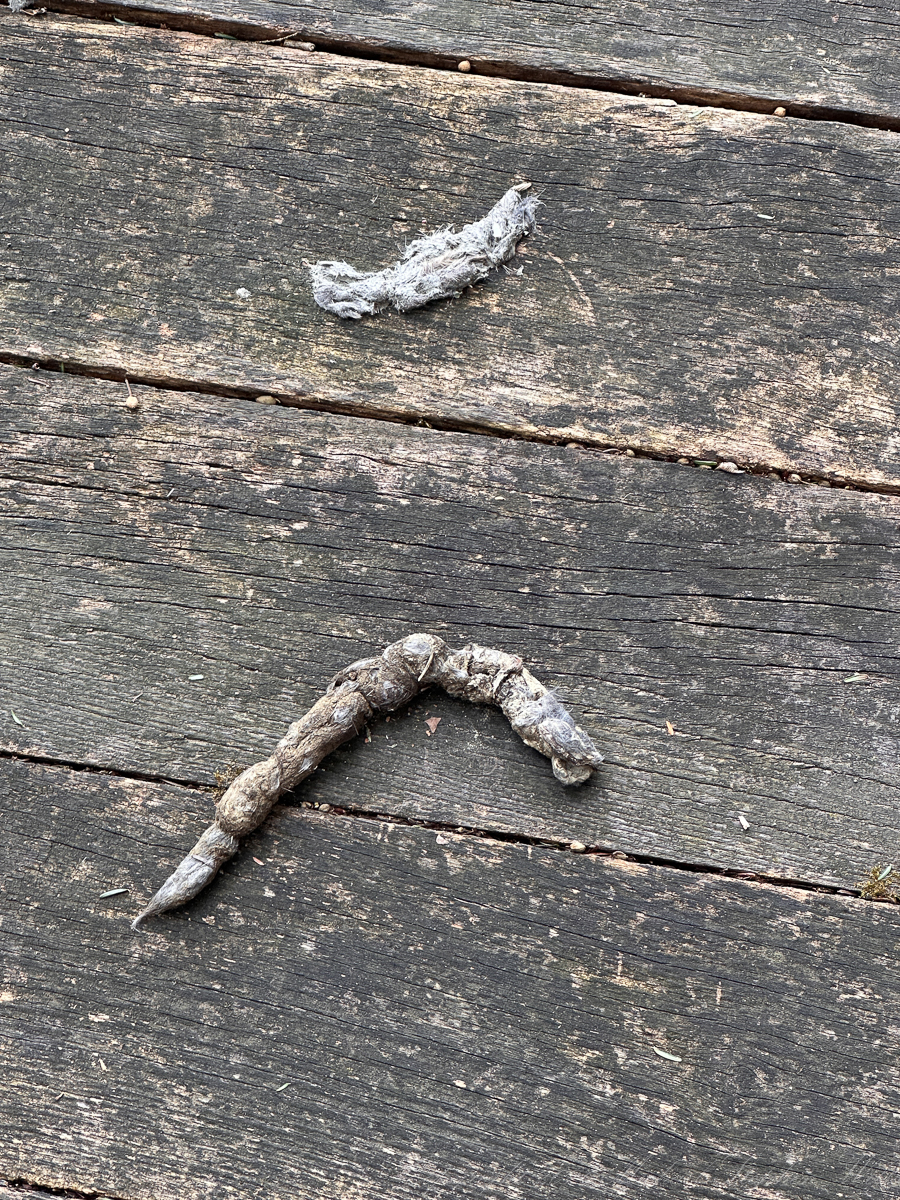
On the boardwalk, my grandsons, Sam and Rory, find what the place offers most readily: evidence. A small gray pellet of fur and bone delicately assembled and then discarded. Nearby, a twisting length of scat, marked with the unmistakable language of survival. These are not the symbols we teach in books, but they are legible all the same. The boys lean close, curious, unbothered by what adults might turn away from. To them, this is not unpleasant—it is a clue, a message left behind by an unseen life moving through the same narrow corridors of forest and marsh.

There is something honest in that exchange. The bog does not disguise itself. It offers no curated beauty, no ornamental flourish. What it gives instead is continuity—the quiet assurance that life persists in forms both delicate and stark. And the children, without pretense, receive it as it is.

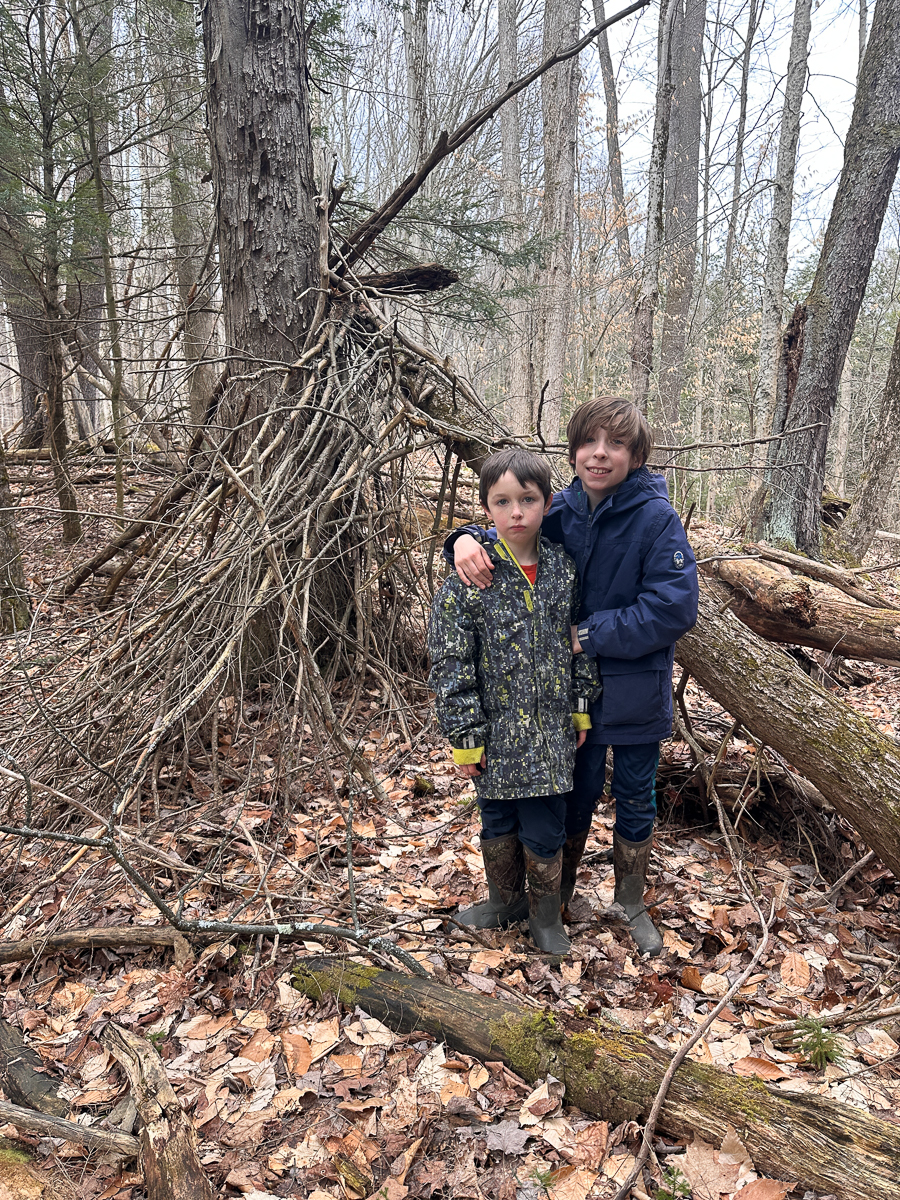
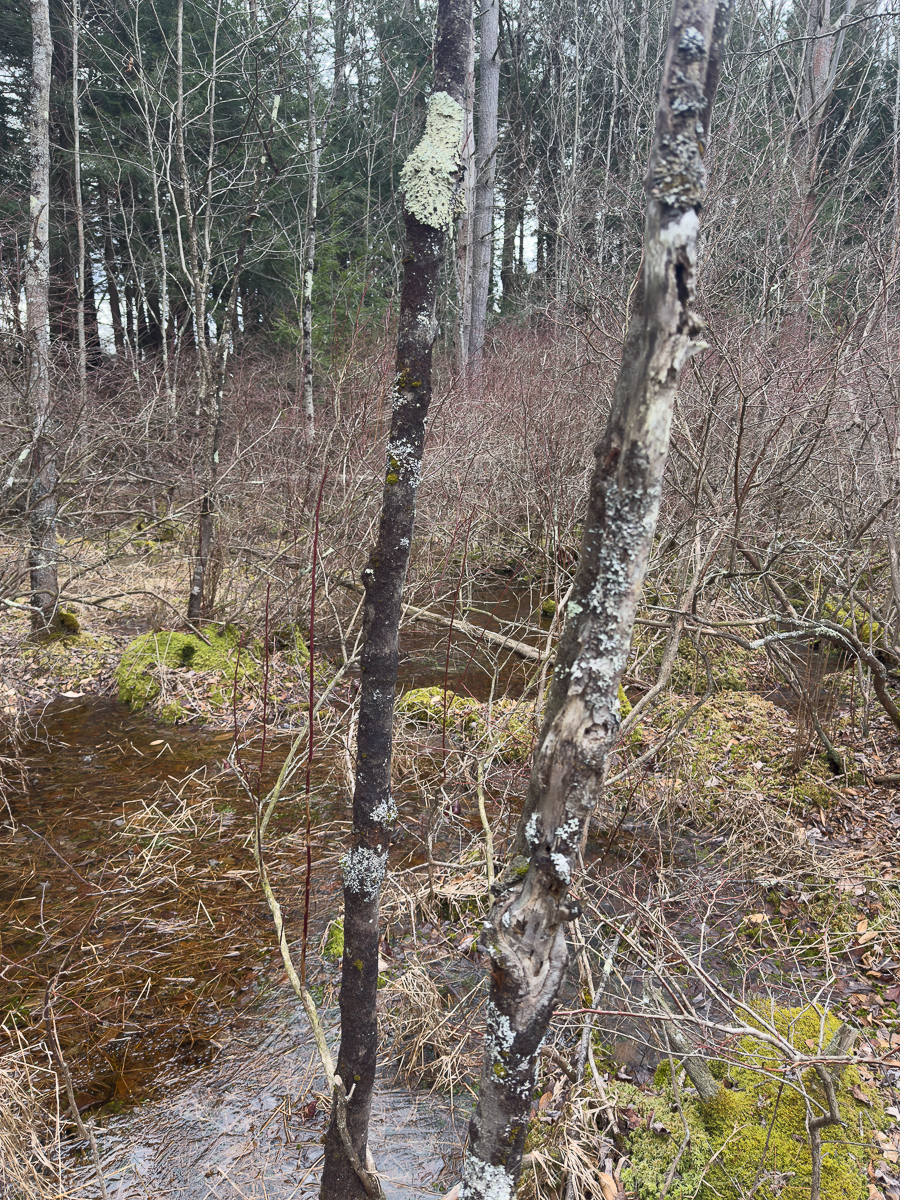
Deeper in the woods, a small structure of branches rises against the trunk of a tree, a lean-to, improvised and incomplete. Its architecture is simple, almost instinctive, a tentative answer to the question of shelter. Sam and Rory stand before it, boots sunk slightly in the soft ground, their bodies close together in that unconscious gesture of kinship. One leans into the other, not for support exactly, but for connection.

Behind them, the forest extends in gray and brown, a lattice of trunks and fallen limbs. It is not the lush abundance of summer, but something more revealing—a stripped-down anatomy of place. Here you see the bones of the landscape, the structure beneath the surface. And in that exposure, there is a different kind of beauty, one relies on form, on persistence, on time itself.

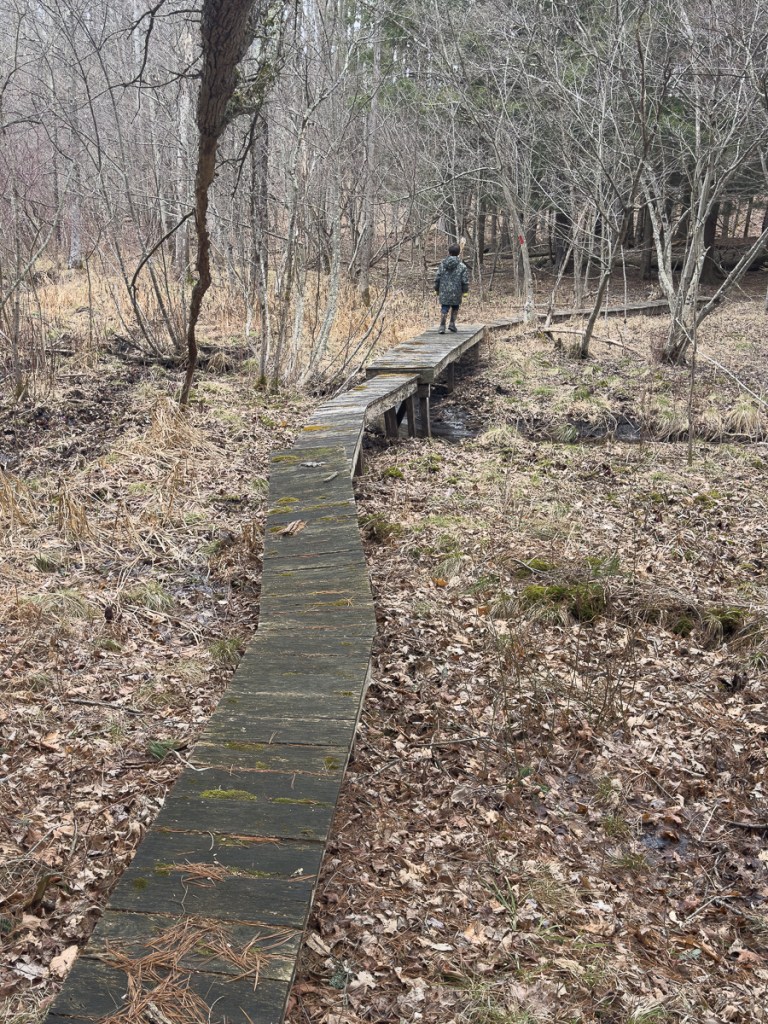
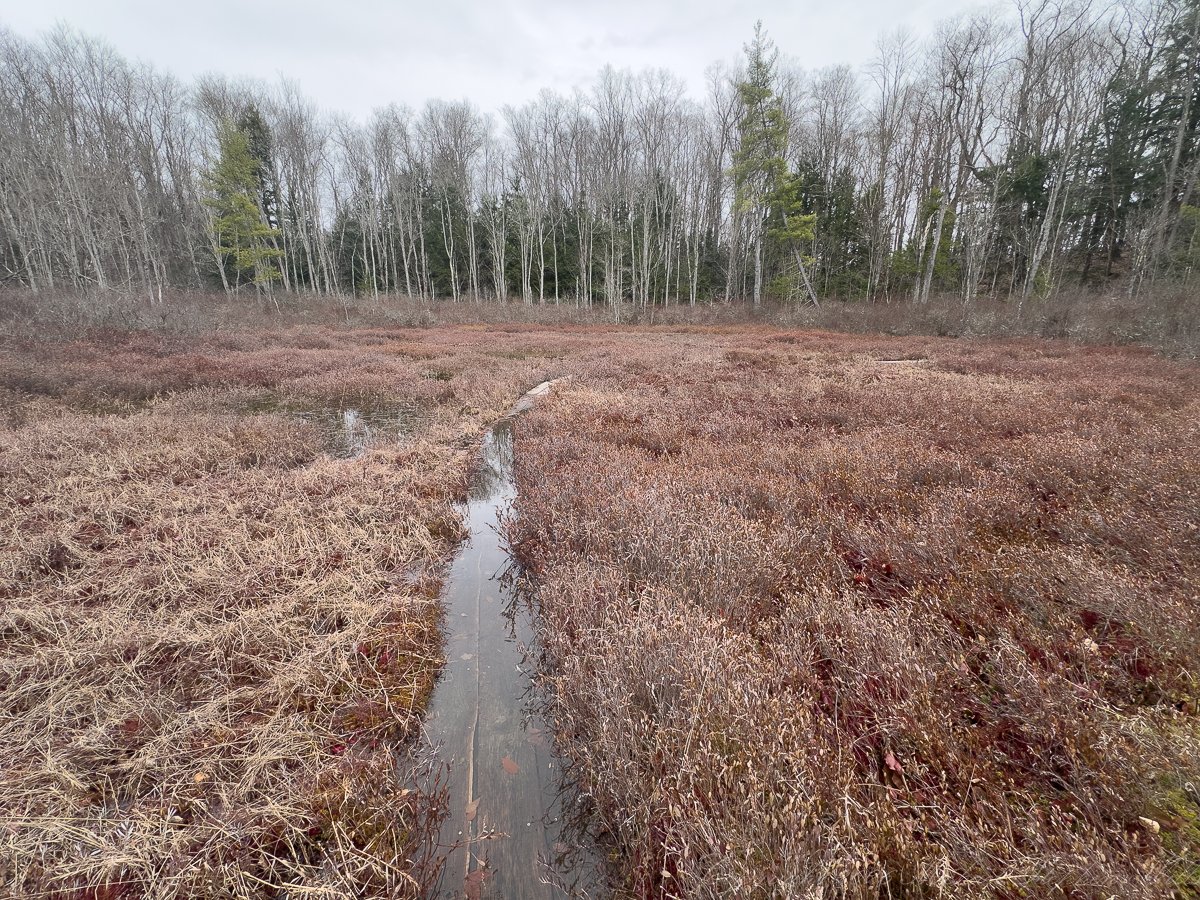
The boardwalk carries you out into the open bog, where the ground gives way to water and moss. It is a narrow path, elevated just enough to allow passage, and it bends gently, as though respecting the terrain rather than imposing upon it. Rory walks ahead, small against the expanse, following the curve without question. There is trust in that movement—the simple faith that the path will hold, that it leads somewhere worth going.

Around you, the bog stretches in subtle variation. Patches of standing water reflect a green that seems almost improbable in this season, the work of mosses and algae that thrive where others cannot. The vegetation is low, dense, textured—a mosaic rather than a meadow. And here and there, like small embers against the muted field, the pitchers rise.

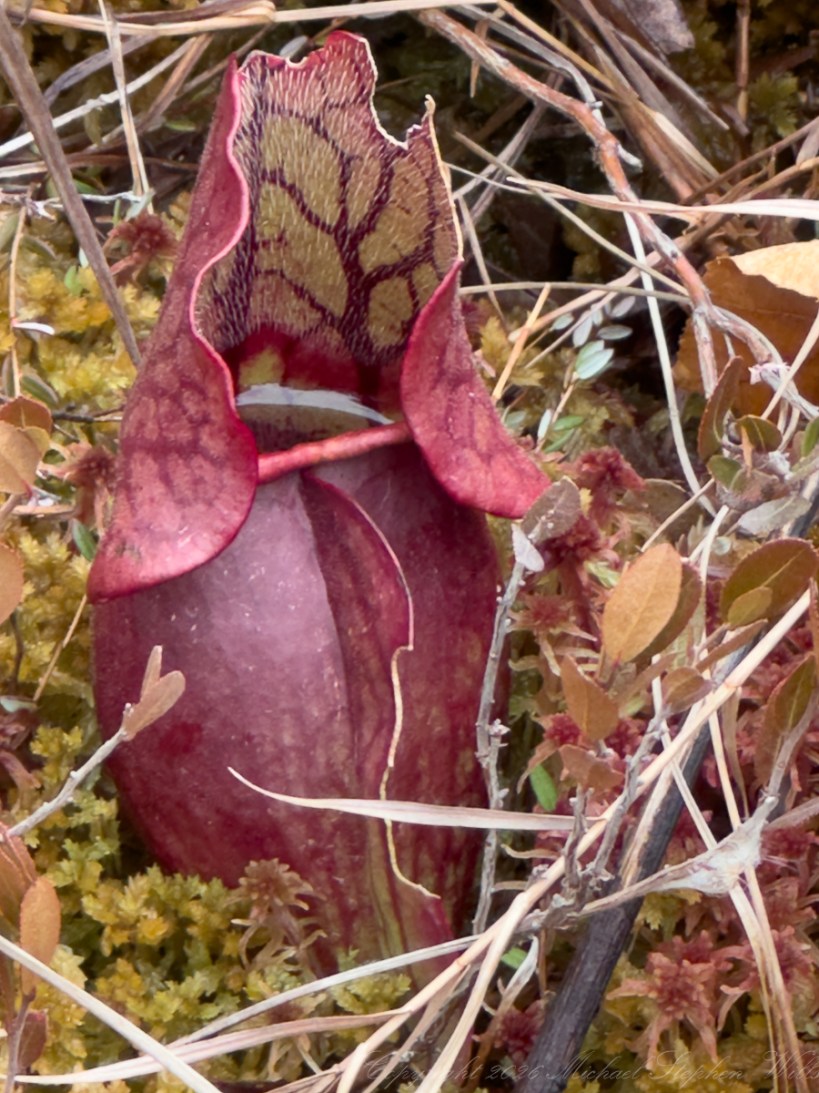
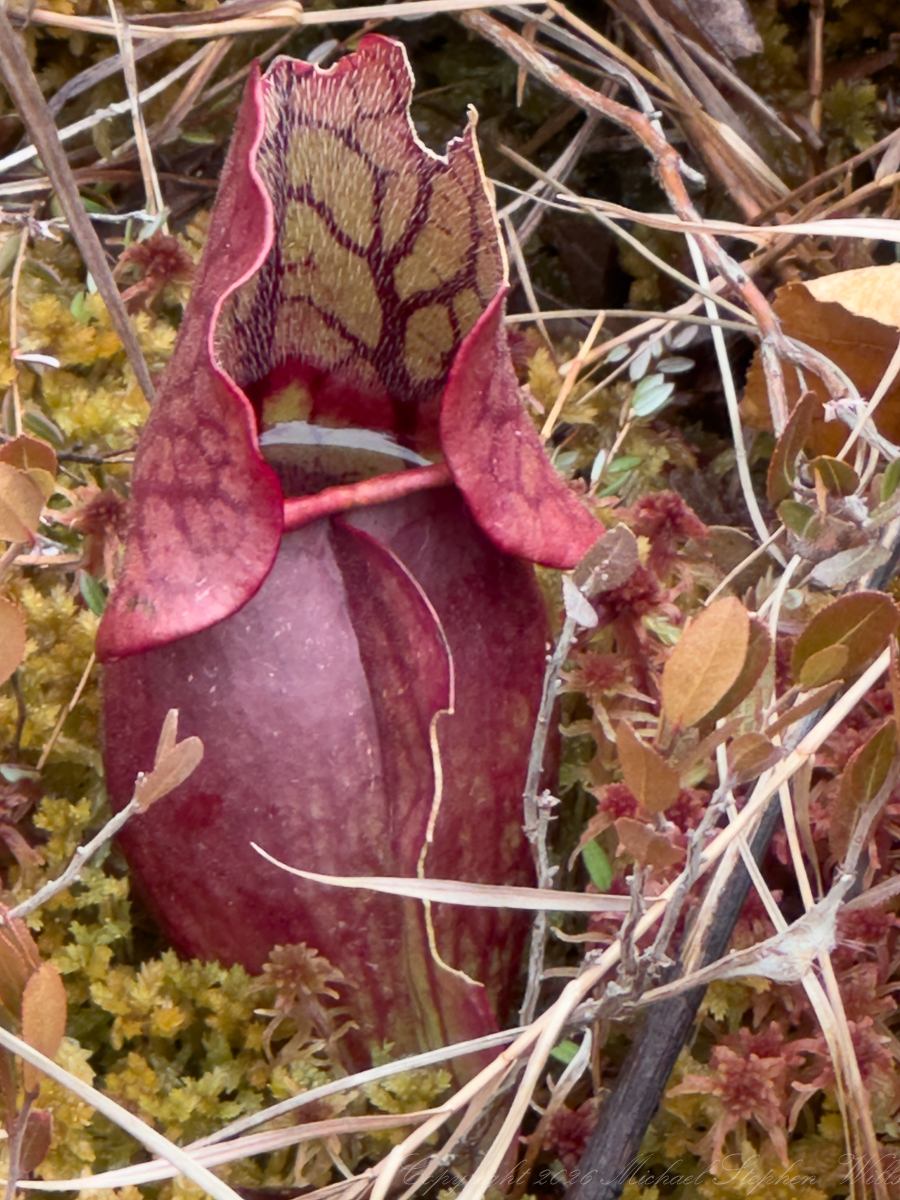
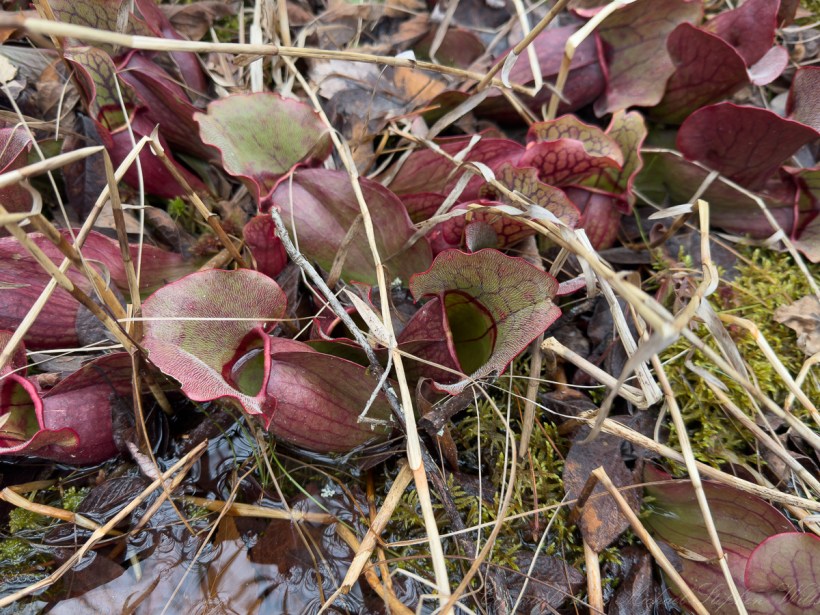
The pitcher plants are both beautiful and unsettling. Their deep red forms, veined with intricate patterns, hold themselves open to the world. They are vessels, yes, and thresholds, invitations with consequence. Insects, drawn by color or scent, enter and do not leave. It is easy to think of them as passive, but they are anything but. They are active participants in the exchange of life, taking what the poor soil cannot provide.
You kneel to look more closely, drawn in despite yourself. The interior of the pitcher is a map of intention—every line, every curve serving a purpose. And yet, there is an elegance to it, a precision that feels almost artistic. It is not cruelty, exactly, but necessity rendered with a kind of quiet grace.

McLean Bog, Tompkins County, New York State part of Cornell Botanical Gardens

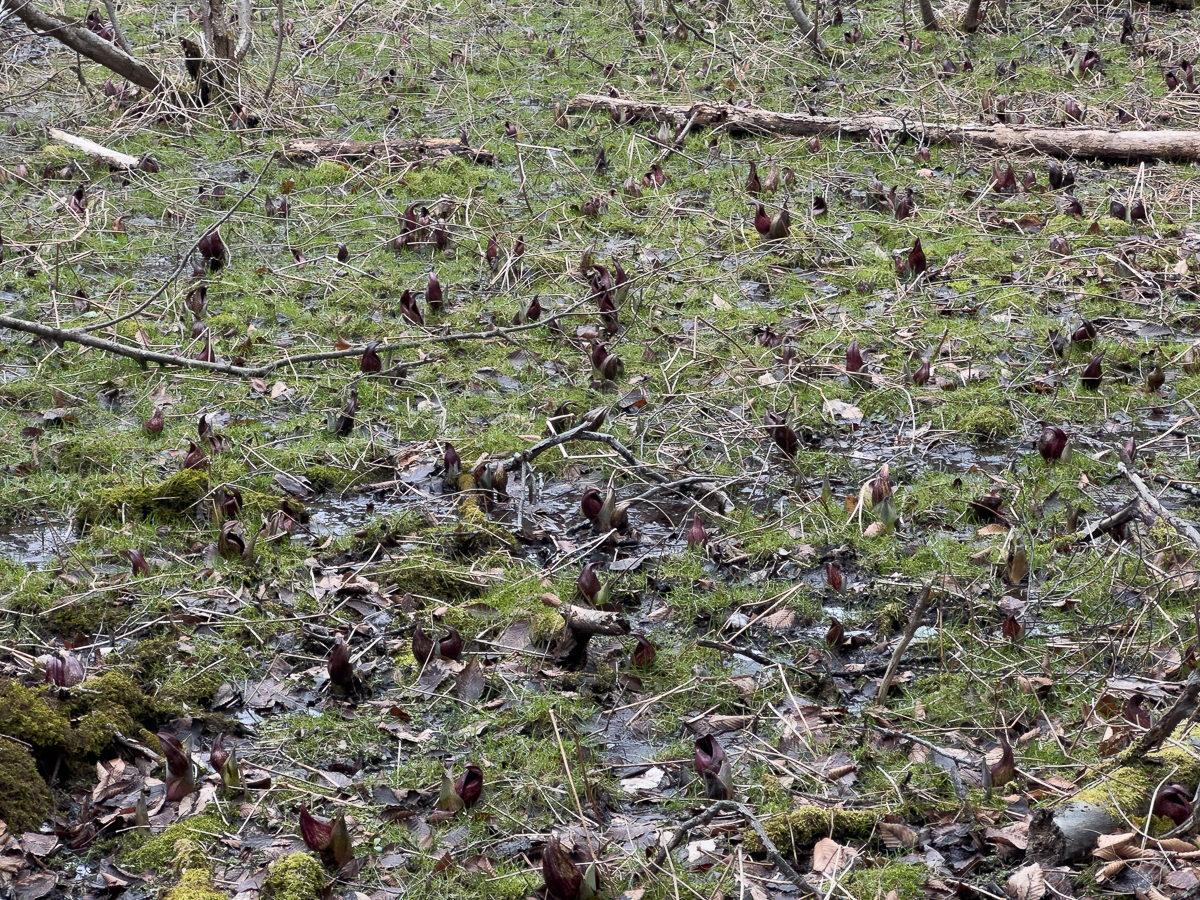
Elsewhere, the first signs of skunk cabbage emerge, their dark, curved forms pushing through saturated ground. They are early risers, indifferent to cold, generating their own heat to break through frost. They do not wait for spring; they create their own version of it. Scattered across the forest floor, they resemble a field of small, listening shapes—each one a declaration that life does not always arrive gently.

And so you move through the bog as a participant in its slow unfolding. Sam and Rory run ahead, then return, their boots muddy, their hands full of nothing in particular. They do not need to name what they have seen. The experience is enough.
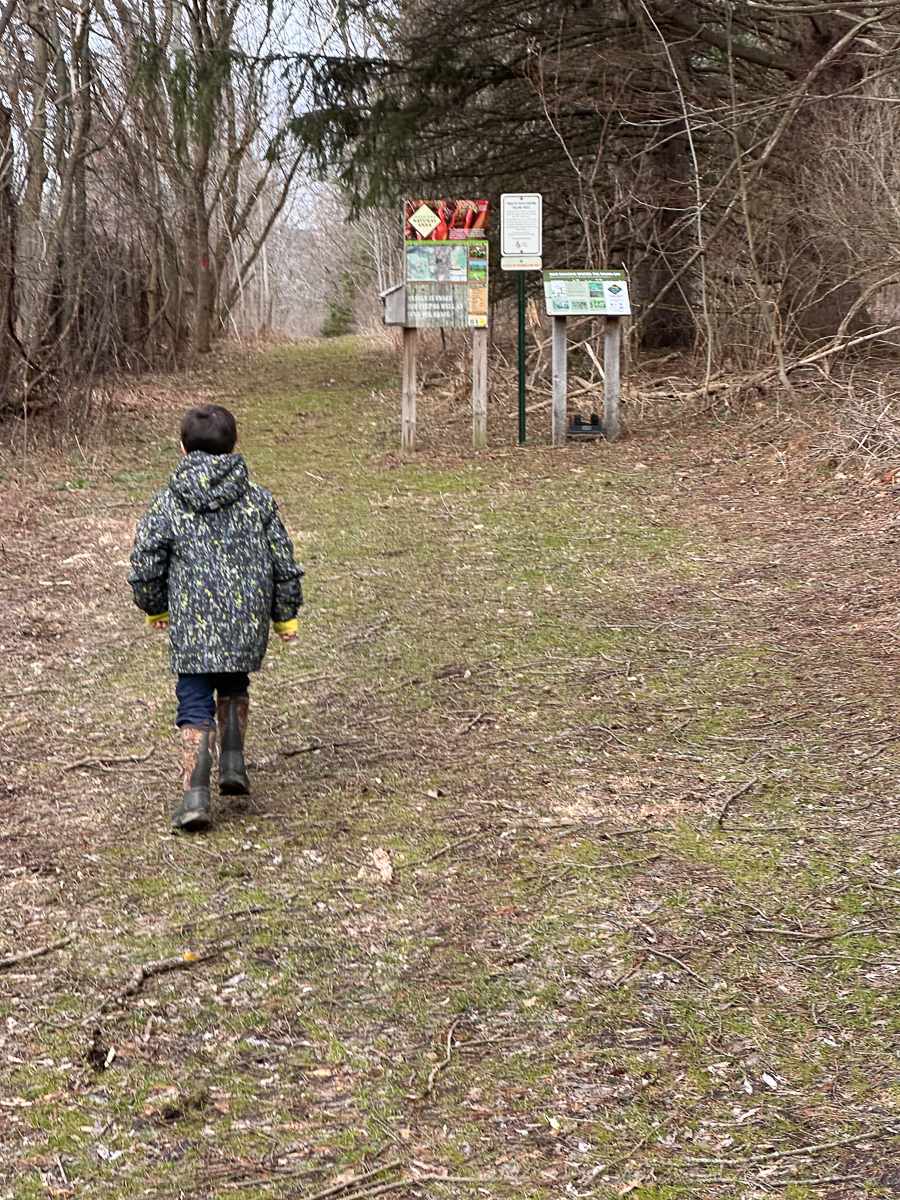
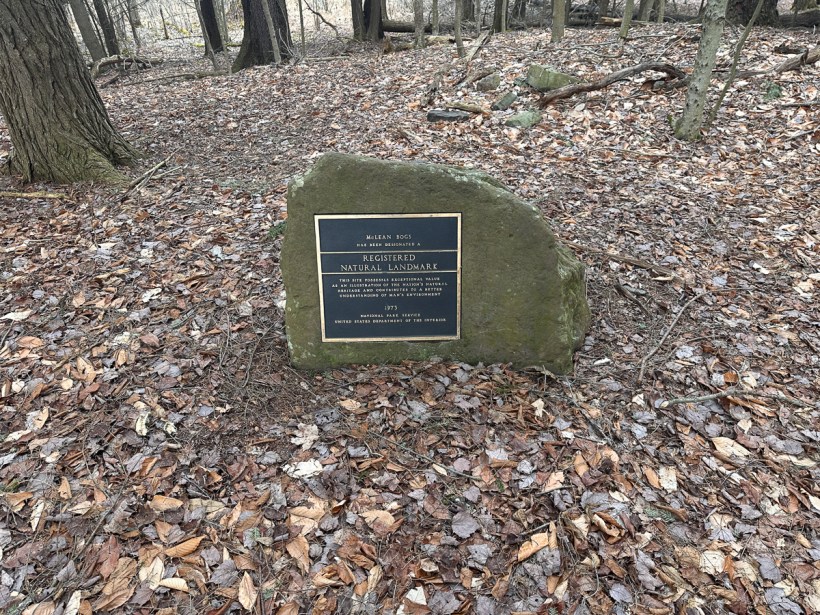
As we return to the preserve edge, this sign stands—formal, declarative, assigning significance in the language of designation: Registered Natural Landmark. This place is important, rare, worthy of protection. But the words feel almost secondary after what you have just walked through.

McLEAN BOGS has been designated a REGISTERED NATURAL LANDMARK

This site possesses exceptional value as an illustration of the nation’s natural heritage and contributes to a better understanding of man’s environment.
National Park Service, United States Department of the Interior 1973.

Because the true measure of McLean Bogs is not in its classification, but in its effect. It changes the rhythm of your thinking. It draws your attention downward—to the ground beneath your feet, to the subtle movements of water and growth, to the quiet negotiations of life that continues with or without witnesses.
And perhaps that is what Thoreau meant, though he said it more simply: that heaven is not only above us, distant and abstract, but also here, immediate and tangible, woven into the fabric of the earth itself.

In the bog, that idea does not feel like metaphor. It feels like observation.

Enter your email to receive notification of future postings. I will not sell or share your email address.

The Yarb Woman of Cornell: Elfriede Abbe’s Tribute to Herbal Wisdom in the Botanic Gardens

A quiet encounter with Elfriede Abbe’s Yarb Woman reveals the enduring wisdom of herbal traditions, inviting reflection in the intimate stillness of Cornell’s Herb Garden.

We did not come upon her the way you come upon a monument. On a late winter morning my sister and I chose to walk through the pergola alongside the Richard M. Lewis Education Center and there she was.

There is no plaza, no axial approach, no insistence. Instead, the Yarb Woman statue waits in a corner of the Robison New York State Herb Garden, where paths narrow and attention shifts from spectacle to detail. The pergola frames the space, the beds lie dormant or fragrant depending on the season, and there—almost at eye level with the plants—is the woman herself, bent into her work.

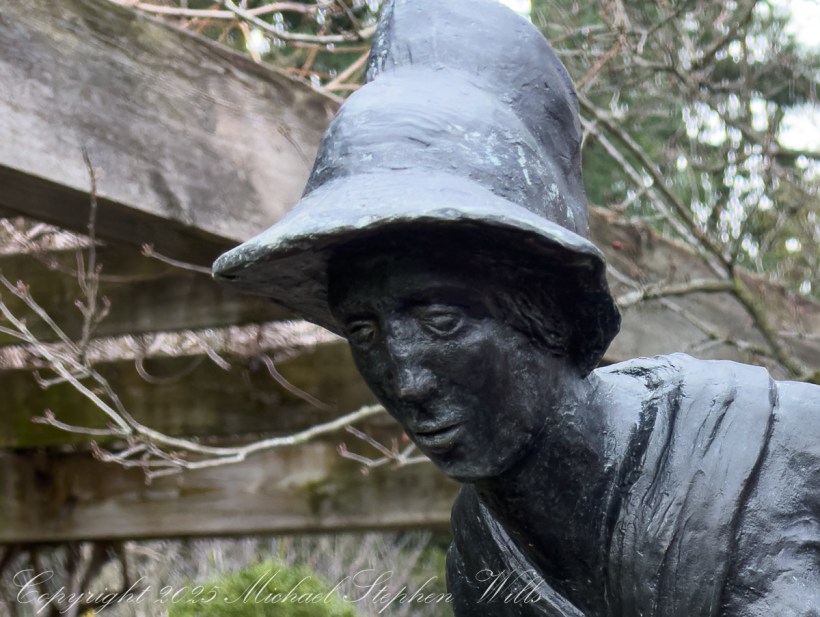
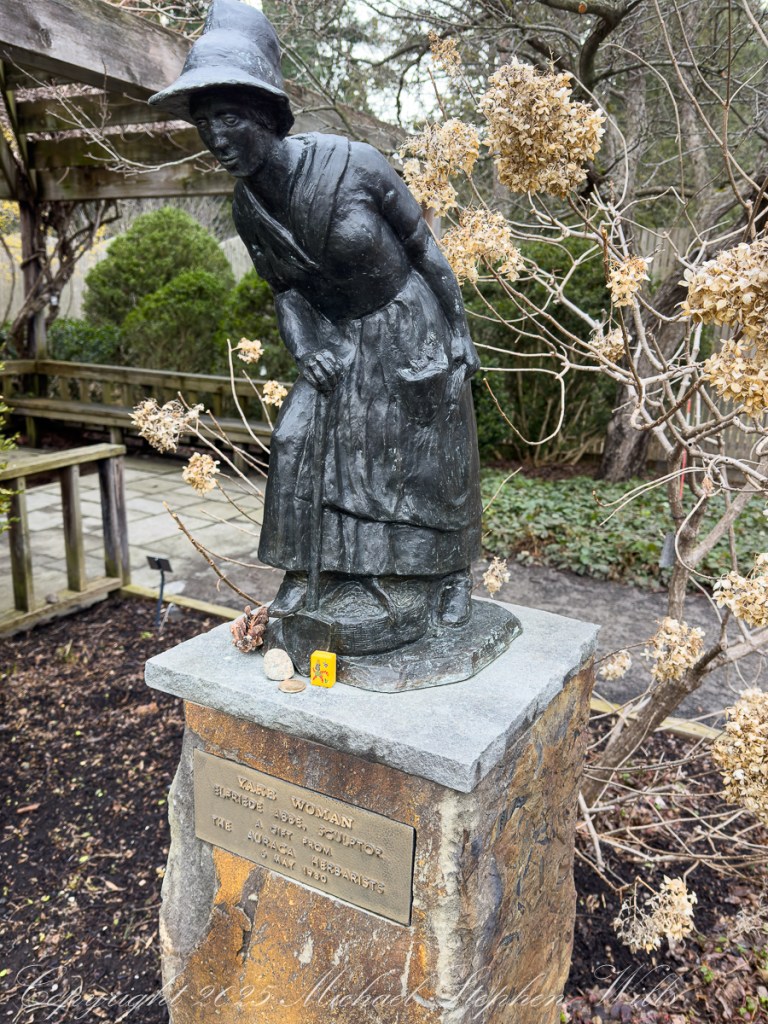
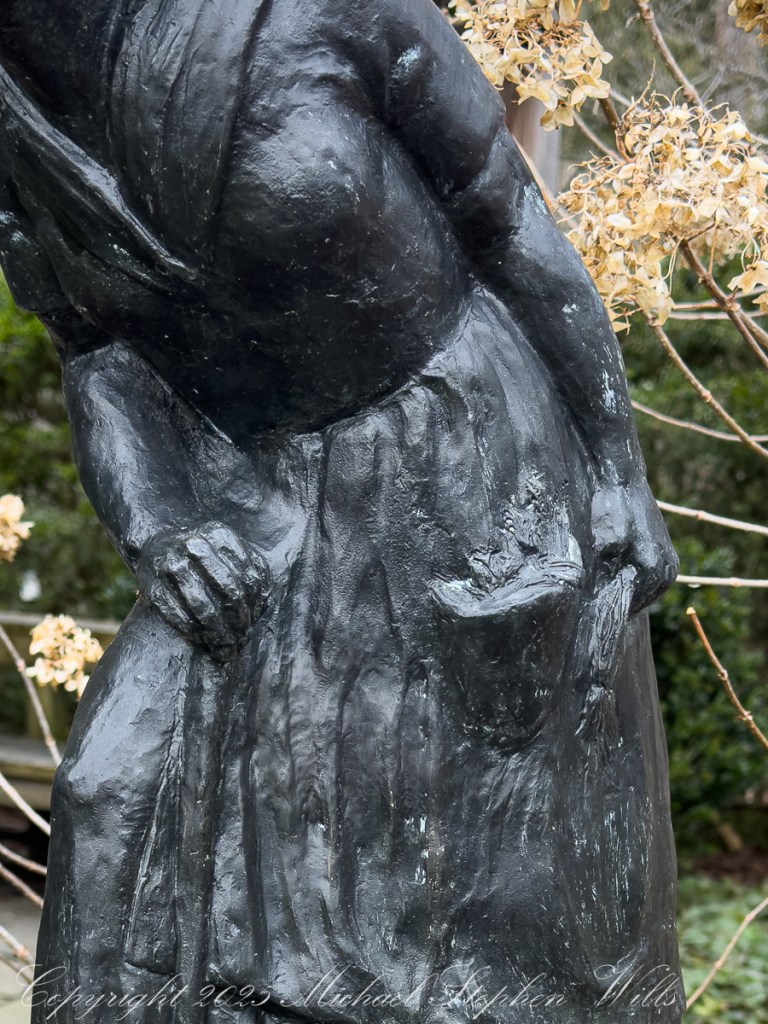
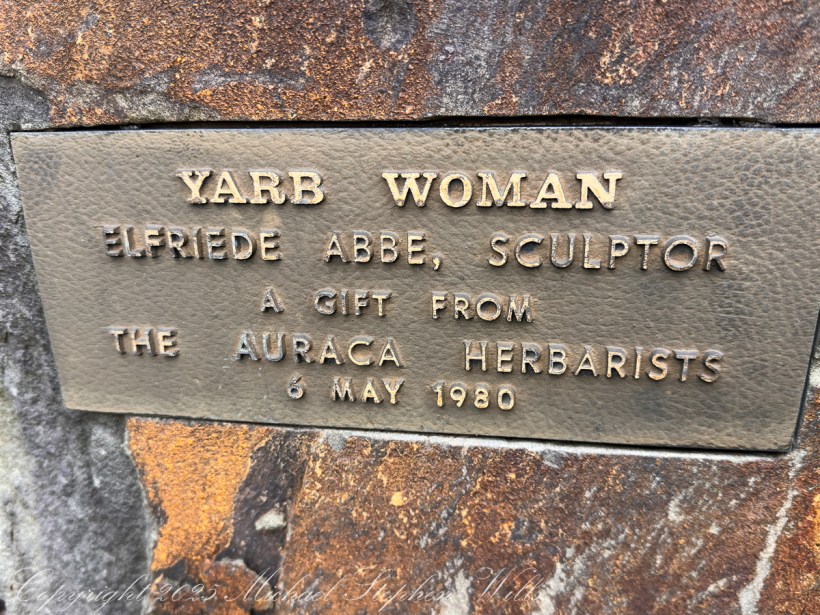
Yarb Woman, Elfriede Abbe, sculptor, The Auraca AHerbarists, May 6, 1980. Robison New York State Herb Garden, Cornell Botanical Gardens, Cornell University, Ithaca, Tompkins County, New York State.

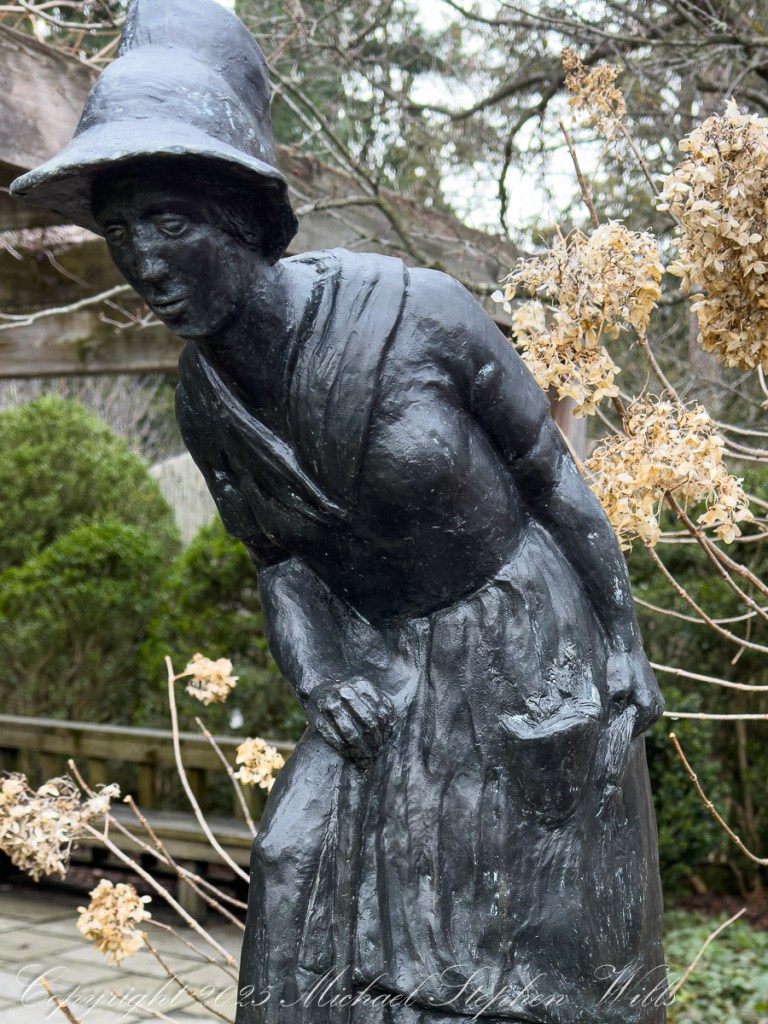
Her posture is one of reguard. That is the first instruction. Her posture is a study in intention: forward-leaning, balanced, attentive. One hand gathers, the other steadies. She is caught mid-action, not posed. This is a figure practicing herbal knowledge.

Right hand on spade handle

And because of that, she alters the space around her. Standing there to regard the statue the garden becomes a workplace—a field of quiet labor. Each plant is no longer merely labeled but noticed. The dried hydrangea beside her, the winter stems, the low green groundcover—everything begins to feel like it belongs to her attention.

Left hand grasping plants, pockets full

We began to notice the small offerings at her feet—stones, a tiny object left by a passerby—that suggest that others have felt this shift. Not worship, exactly, but recognition. A kind of informal acknowledgment that this figure gathers more than herbs; she gathers meaning from the overlooked.

There is something deliberate in her scale. She is not monumental. She does not dominate the garden. Instead, she invites you downward—to stoop, to look, to consider what is beneath your habitual line of sight.

This is consistent the sculptor, Elfriede Abbe’s, larger artistic life. She was not drawn to grand gestures but to process: carving wood, printing pages, observing the minute structures of plants. In “Yarb Woman”, that ethic becomes embodied. The sculpture is less about a person than about a way of being in the world.

To gather. To attend.To work with care.

Standing there, you may feel the subtle inversion: the garden becomes something you enter into, as she has. The distance between observer and participant narrows.

And time shifts slightly. The date on the plaque—1980—anchors the piece historically, but the figure herself resists that anchoring. Herbal practice stretches backward through centuries of unnamed practitioners, most of them women, most of them unrecorded. She could belong to any of them. Or to all.
Yarb Woman, Elfriede Abbe, sculptor, The Auraca AHerbarists, May 6, 1980. Robison New York State Herb Garden, Cornell Botanical Gardens, Cornell University, Ithaca, Tompkins County, New York State.

Even the word “yarb” participates in this temporal layering—an old word surviving in a modern garden, just as old knowledge survives in new forms.

Yarb Woman, Elfriede Abbe, sculptor, The Auraca AHerbarists, May 6, 1980. Robison New York State Herb Garden, Cornell Botanical Gardens, Cornell University, Ithaca, Tompkins County, New York State.

What we encountered, then, was not simply a sculpture. It was a quiet proposition:

That knowledge can be gathered slowly.
That attention is a form of reverence.
And that in the midst of a university—of speed, abstraction, and analysis—there remains a place where understanding begins with kneeling close to the ground.

And noticing what grows there.

Enter your email to receive notification of future postings. I will not sell or share your email address.

Copyright 2026 All Rights Reserved Michael Stephen Wills

The Science and Poetry of Melting Ice: Cayuga Lake During a Winter Thaw

Under a blue February sky, Cayuga Lake keeps its icy grip, revealing how light, time, and physics conspire to make winter’s farewell a slow, luminous negotiation.

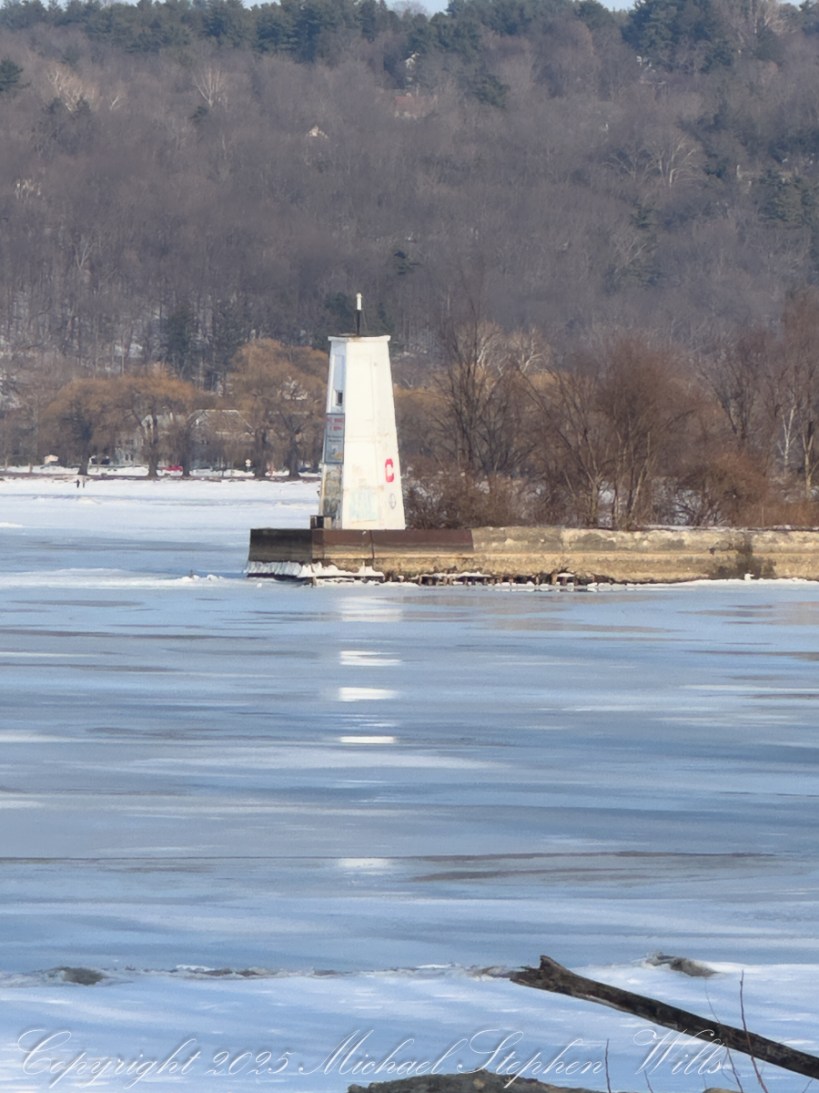
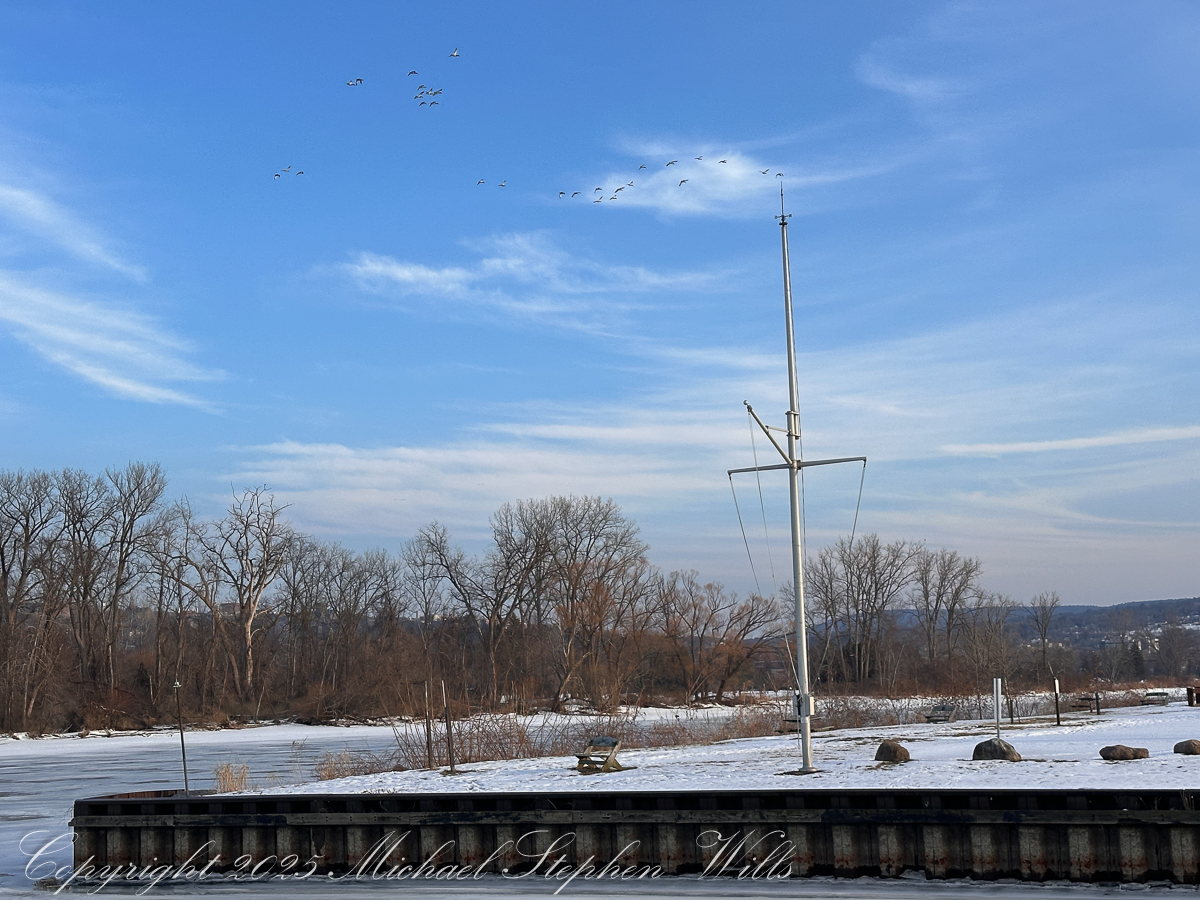
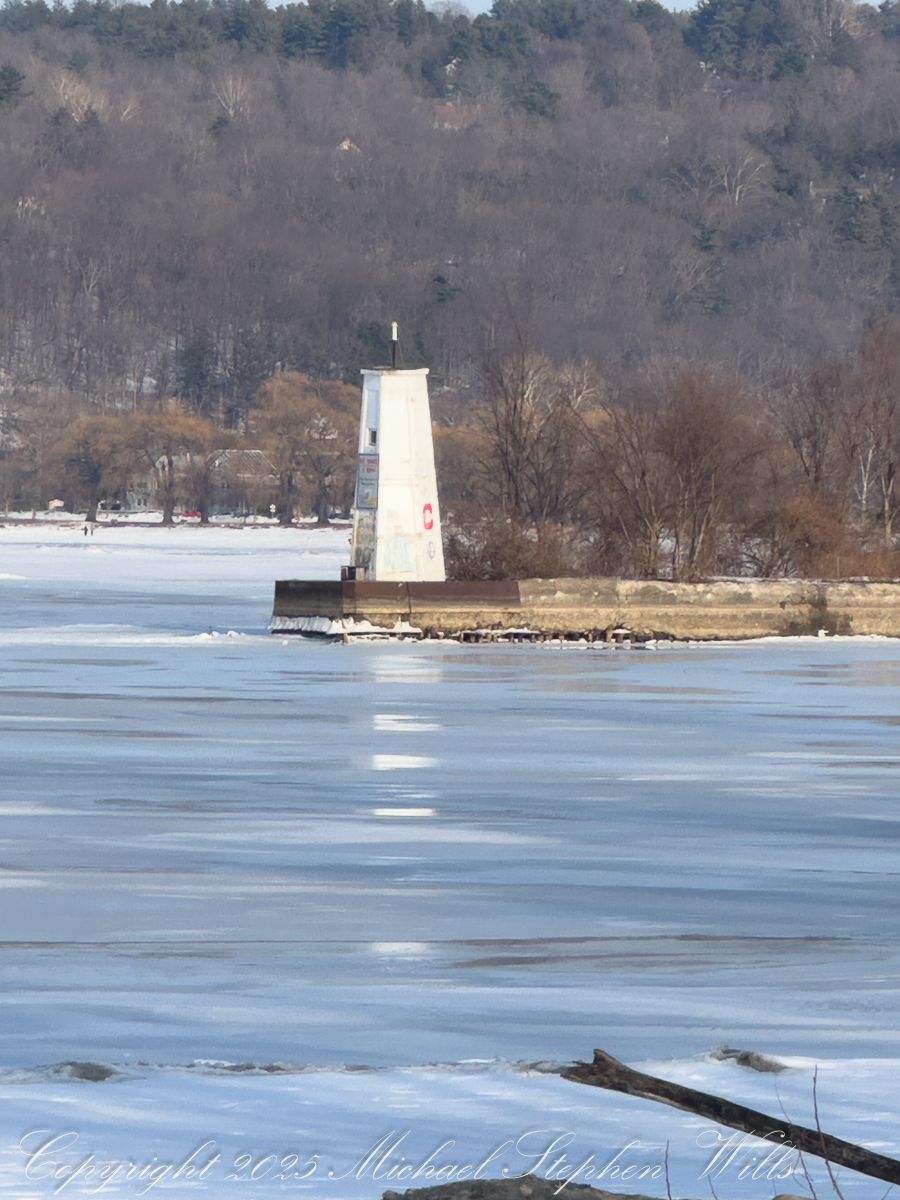
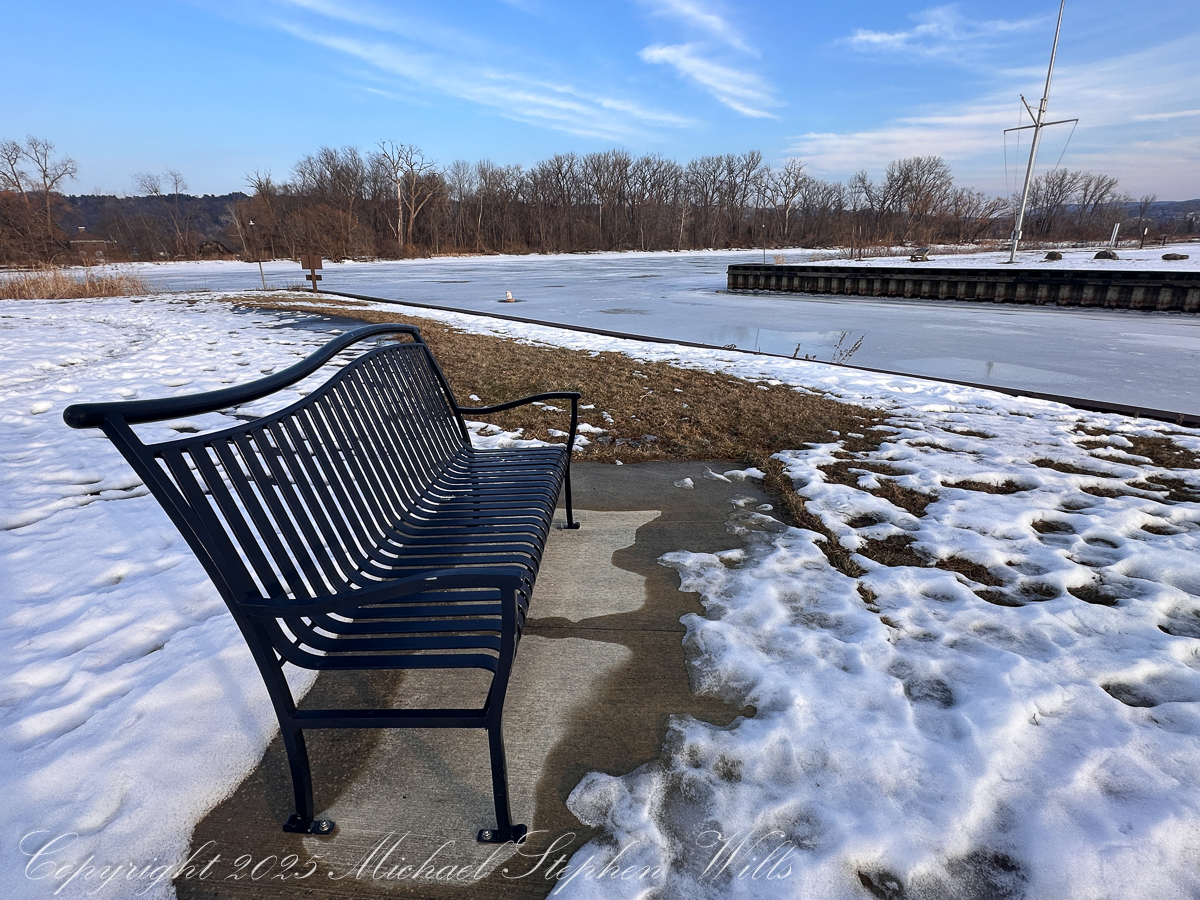
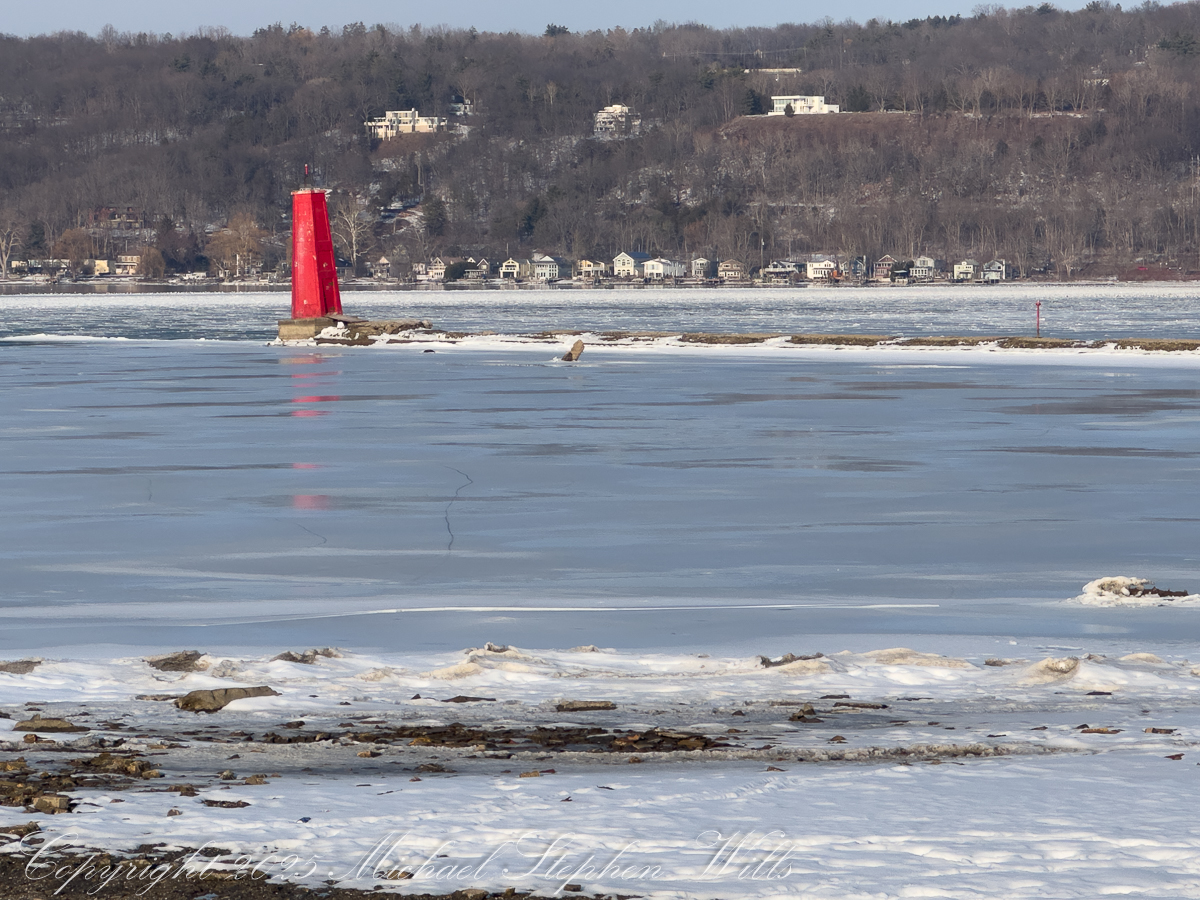
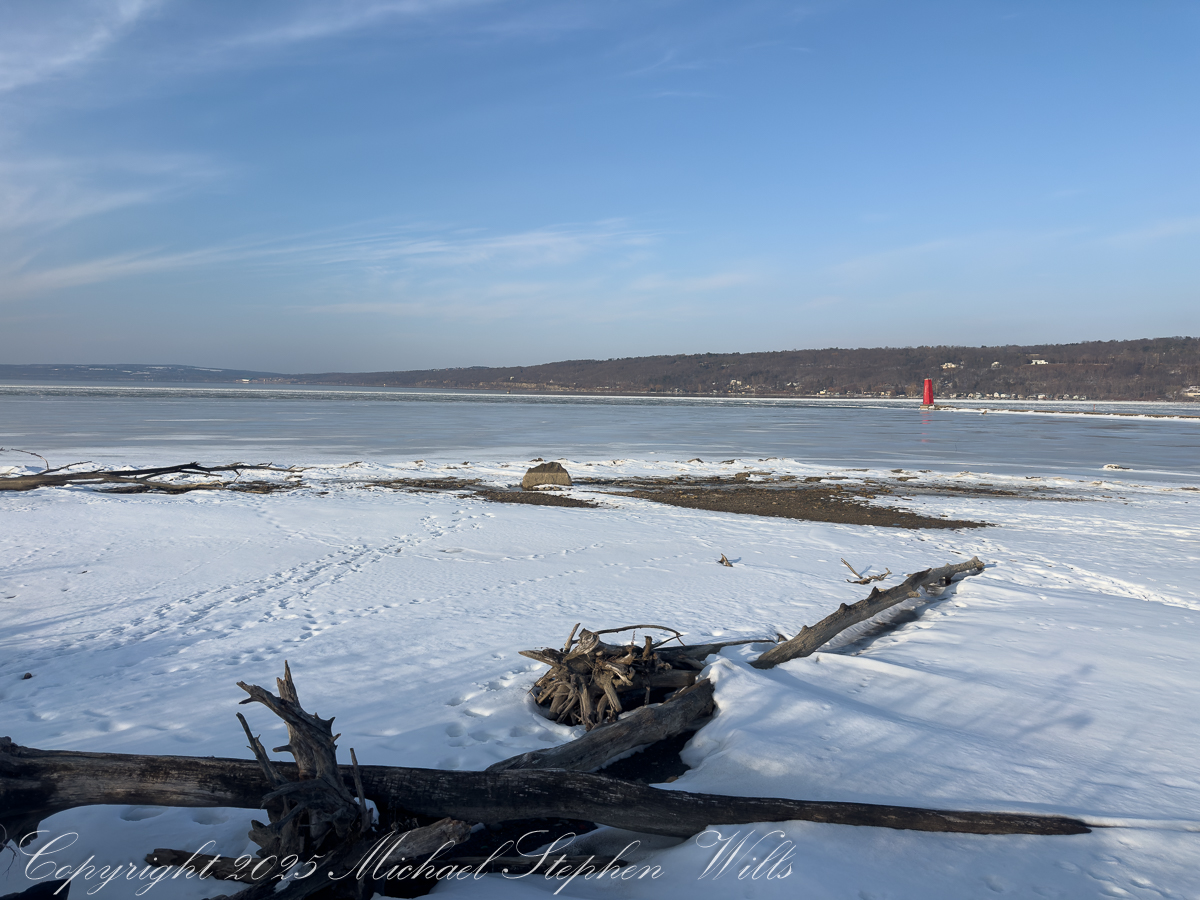
These photographs, made along the frozen margin of Cayuga Lake at Cass Park in mid-February 2026, carry a quiet paradox. The sky is a lucid blue, the light has that late-winter clarity that hints at spring, and yet the lake remains locked under a pale, glassy skin. A few geese stitch the air. A bench waits. Red and white beacons stand where water should be moving. The moment is fixed: late afternoon light in February, Finger Lakes winter—but the deeper story is written in physics, not pixels: why does lake ice linger so stubbornly during a thaw?

The short answer is that water is a hoarder of heat and ice is a keeper of promises. The long answer is the reason these scenes feel suspended between seasons.

Start with the cost of melting itself. Ice does not simply warm into water; it must first be converted, and that conversion demands a large, fixed payment of energy known as the latent heat of fusion. To melt just one kilogram of ice takes about 334,000 joules—and that energy raises the temperature not at all. It is spent entirely on changing solid to liquid.

Scale that up to a lake surface and the numbers become sobering. Even a modest sheet of ice—say ten centimeters thick—contains roughly ninety kilograms of ice per square meter. Melting that much requires on the order of thirty million joules per square meter. To put this in a human context, in 1 kcal there are 4,184 joules. Melting a square meter of ice requres 7,170 kilocalories (kcals) or 3.6 days for a person expending 2,000 kcals per day. Spread across square kilometers of lake, the energy bill climbs into the tens of terajoules. That is the hidden arithmetic behind the familiar disappointment of a February thaw: a few warm days feel dramatic to us, but to a lake they are only a small down payment.

This leads to the second, more subtle constraint: melting ice keeps itself cold. As long as ice is present, the surface of the lake is pinned near 0 °C (32 °F). Incoming heat does not make the surface warmer; it simply converts more ice into water at the same temperature. The thin layer of meltwater that forms on top is also near freezing, so the entire interface remains locked at winter’s threshold. There is no “warming momentum” here—no quick rise in temperature to accelerate the process. The system quietly consumes energy without changing its outward thermal expression.

That is why the lake in these images can look bright and almost springlike while remaining physically winterbound. Sunlight is being spent on erasure, not on warming.

A third rule of water deepens the delay. Freshwater is densest not at freezing, but at about 4 °C (39 °F). In early spring conditions, the coldest water—near 0 °C—floats. The slightly warmer, denser water below tends to stay below. This creates a stable stratification: a cold, near-freezing surface layer sitting like a lid on the lake.

The consequence is crucial. The lake cannot easily mix warmer subsurface water upward to attack the ice from below. The thaw must work mainly from the top and the edges—where sunlight, mild air, rain, and shoreline heat can do their work—rather than through a coordinated, whole-lake turnover. In practical terms, the ice is dismantled by margins and seams, not by a sudden, uniform collapse.

Add to this the reflective nature of ice and snow. The pale surface in these photographs is not merely beautiful; it is also defensive. Bright ice and snow reflect a significant fraction of incoming sunlight back into the sky. Dark, open water would absorb that energy eagerly and warm quickly. As long as the lake remains light-toned, it is actively rejecting some of the very energy that could hasten its release.

Thickness and structure matter too. Winter does not lay down a single, simple sheet. It builds layers: clear black ice, milky refrozen crusts, snow-ice composites, trapped bubbles—each a page in winter’s ledger. A brief thaw may soften the surface, open a lead near shore, or trace fine cracks across the sheet, but the bulk remains. In the closer views—the lighthouse and the red beacon standing in frozen sheen—you can see subtle tonal shifts and faint stress lines, the calligraphy of slow change. These are signs of negotiation, not surrender.

Scale, finally, is destiny. Cayuga is long and deep; it behaves more like a small inland sea than a pond. Small waters can change their minds quickly. Large waters are conservative. They remember. The heat they lost in autumn must be repaid, carefully and in full, before winter loosens its hold. This is why harbors and shallows darken first, why the margins in these scenes show hints of movement while the center keeps its pale composure.

Put together, these rules explain the peculiar patience of February ice. The thaw is not a switch but an accounting. Enormous quantities of energy must be delivered just to accomplish the phase change. While that work is underway, the surface temperature barely moves. The cold meltwater stays on top, limiting mixing. The bright surface reflects sunlight. The lake, in effect, resists haste through the ordinary, unromantic laws of physics.

There is an austere beauty in this. Ice is a temporary architecture built by the loss of heat, and its demolition requires an equally disciplined repayment. The quiet in these images is the quiet of bookkeeping—joules being transferred, layers being undone, thresholds being approached but not yet crossed. When the change finally comes, it often feels sudden: a windy day that breaks the sheet into plates, a warm rain that darkens the surface, a week when the margins retreat visibly. But that drama is only the visible last act of a long, invisible exchange.

So the lake lingers. Not out of stubbornness, but out of fidelity to the rules that govern it. Under a sky that already looks like April, Cayuga is still paying winter’s invoice. The ice remains until the account is settled—and when it finally goes, the benches will no longer face a mirror of light, but a moving field of dark water, ready once again to begin the long work of storing heat for another year.

Enter your email to receive notification of future postings. I will not sell or share your email address.

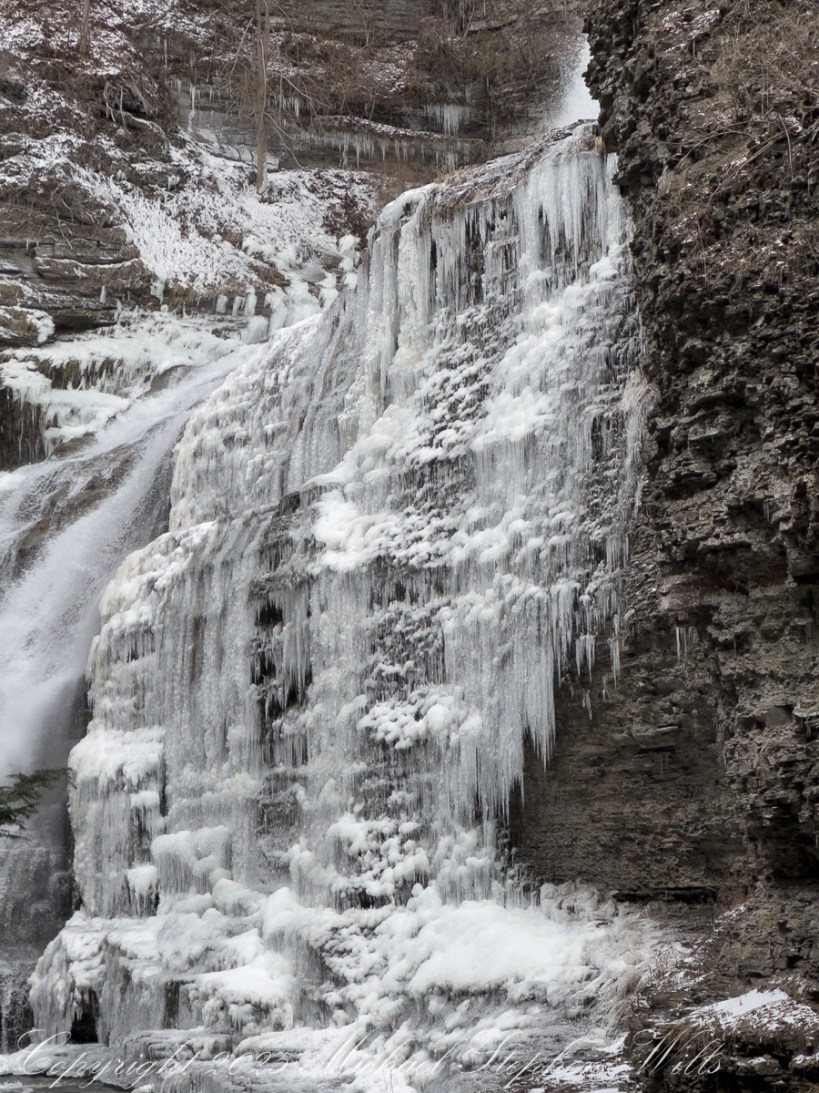
Lucifer Falls in Winter: Traversing Ice Chutes Along Ithaca’s South Rim Trail

A careful winter walk along the South Rim reveals Lucifer Falls transformed—ice chutes, frozen veils, and flowing water beneath stone, inviting patience, attention, and quiet awe.

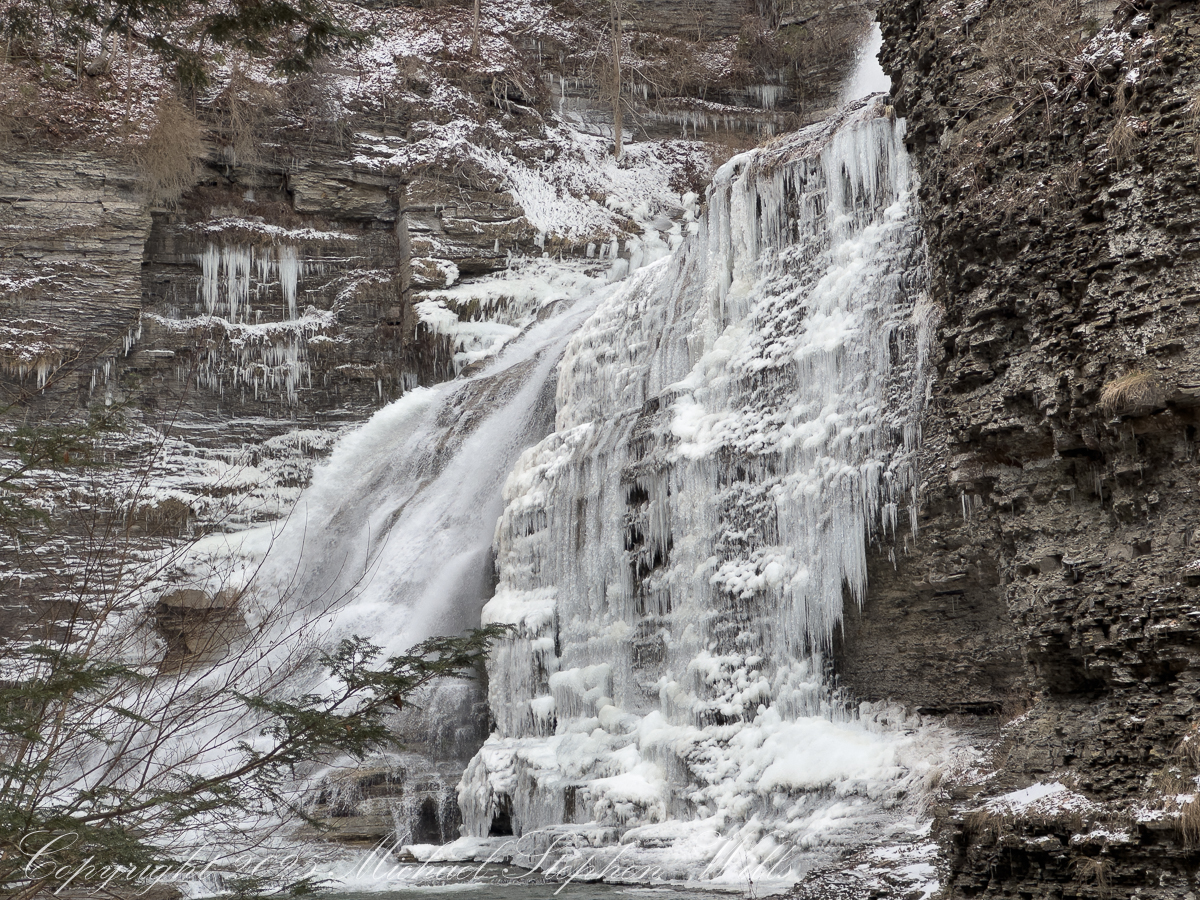
January pares the gorge to essentials. Color withdraws, sound sharpens, and the land reveals its underlying grammar—stone, water, cold, and time. Reaching Lucifer Falls by the South Rim Trail on a winter morning feels less like an initiation, a careful passage through ice-chutes and shadowed ledges where the creek rehearses its ancient work in a new key.

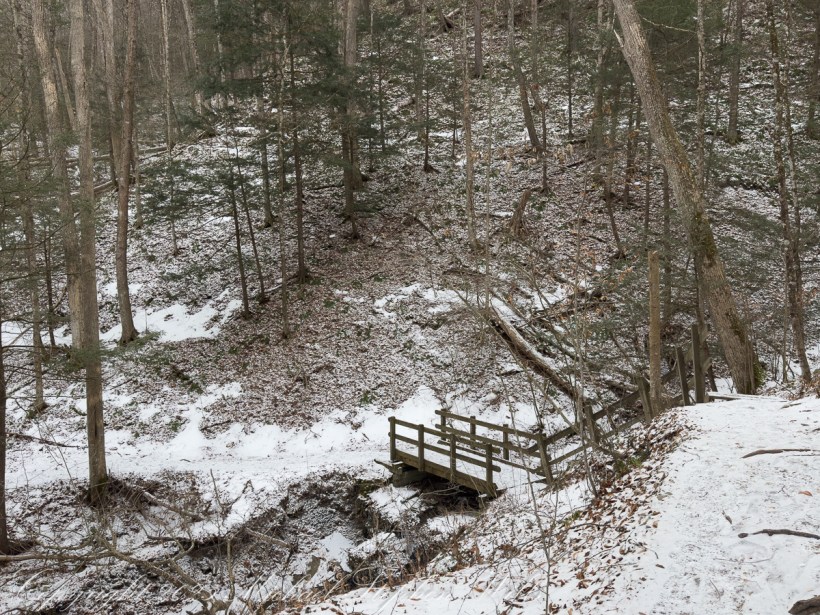
Wintertime scene along the South Rim Trail of Robert H. Treman State park. The trail is solid ice. Ithaca, Tompkins County New York State

The trail begins quietly, a soft crunch underfoot where snow thins to leaf litter. Hemlocks hold their breath. The gorge opens in increments, not all at once, and the creek’s voice arrives in fragments—first a whisper, then a steady insistence. Winter edits the landscape with a clean hand. The clutter of summer understory is gone; what remains is structure: stratified shale stacked like a book left open to a single, patient chapter. Every footfall demands attention. Ice slicks the stone where seeps cross the path, and the trail teaches a winter gait—short steps, weight centered, the quiet confidence of traction earned rather than assumed.

As the rim narrows, the air cools perceptibly. The gorge walls rise higher, their layered faces stippled with frost and snow. Icicles form a punctuation along ledges, commas and exclamation points caught mid-sentence. In places, the trail descends into ice chutes—steep, polished corridors where meltwater has glazed the rock. Here, the body listens more closely. Boots test, then commit. Hands brush the cold bark of a leaning tree, a borrowed handrail. There is pleasure in this concentration, the way winter insists on presence. You cannot hurry. You cannot drift.

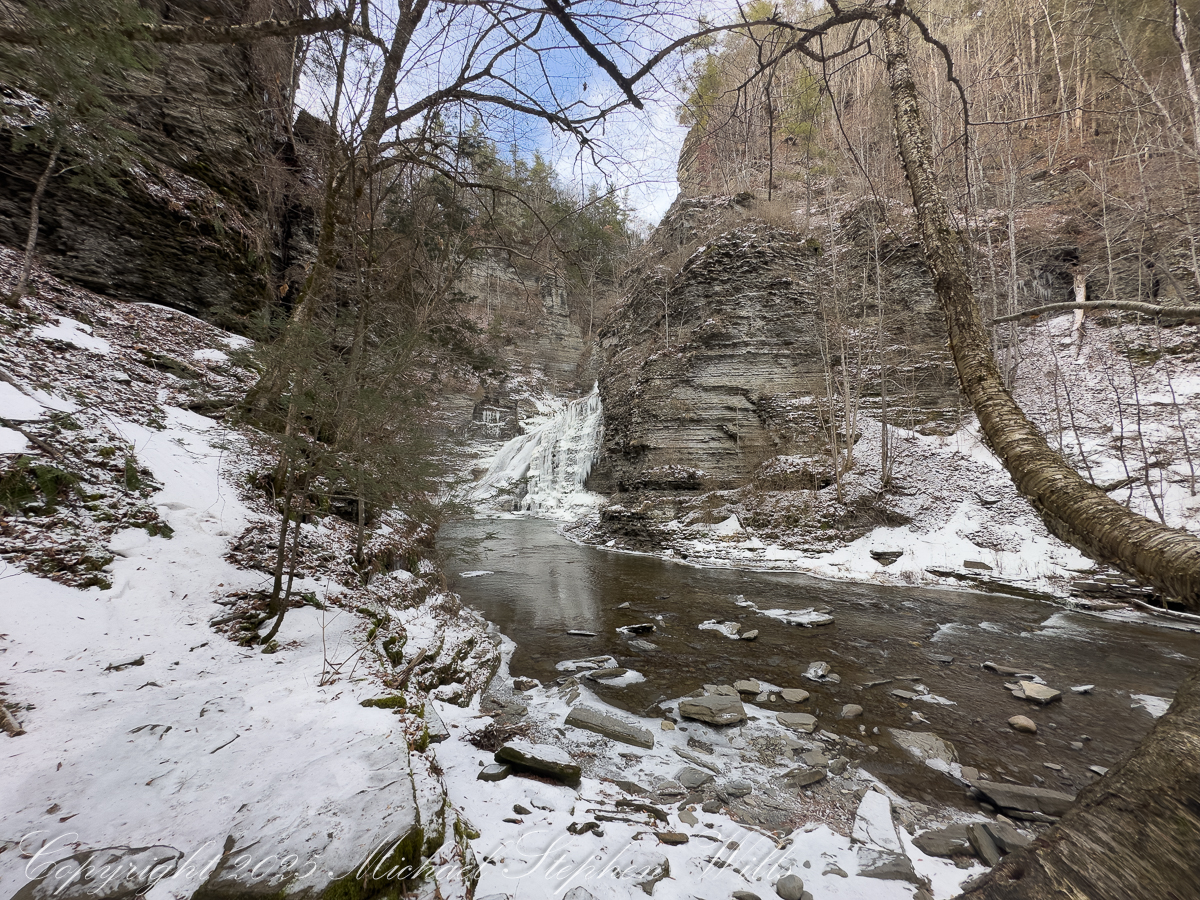
Below, the creek widens into a quiet pool, its surface a muted mirror. Thin plates of ice drift and collide, sounding a faint porcelain clink. The sound carries upward, amplified by the gorge’s acoustics, a delicate counterpoint to the deeper hush of falling water. The trail curves, and suddenly the falls announce themselves—not in full view, but as a white presence beyond the bend, a brightness lodged between walls of stone.

The trails this day were solid ice. I arrived via the South Rim Trail, the only way to access this site. Robert H. Treman State Park, Ithaca, Tompkins County, New York State

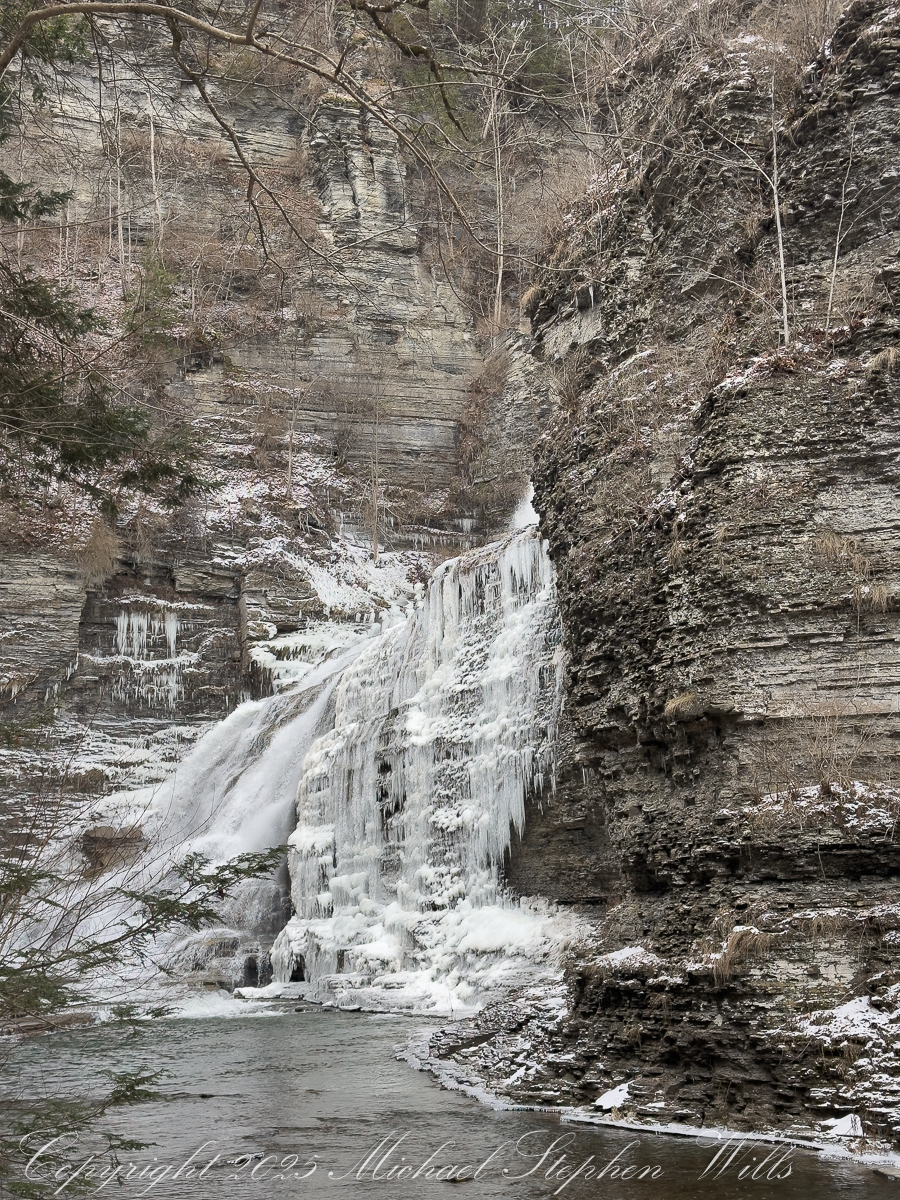
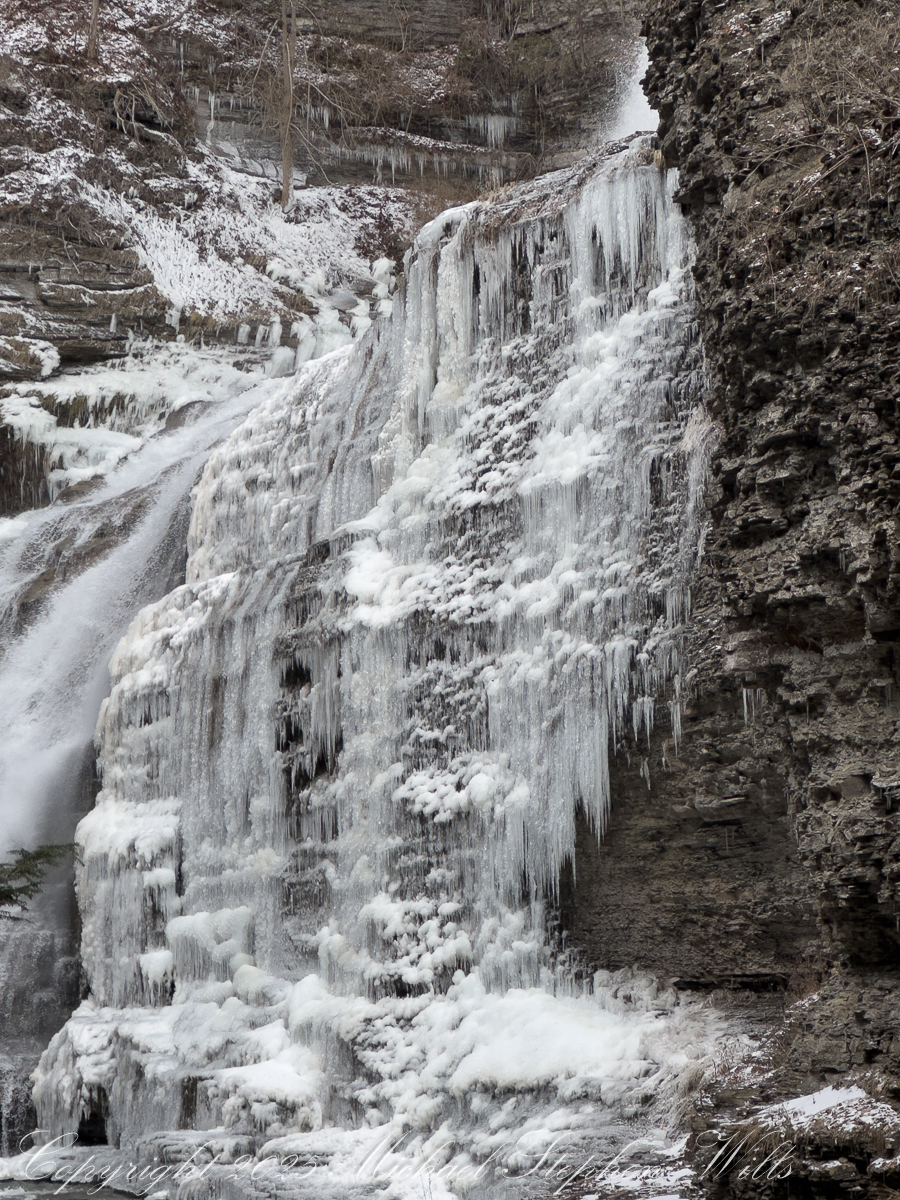
Approaching from the South Rim offers a measured reveal. First the upper cascades appear, water fanning across rock that has become a winter canvas. Ice has claimed the margins, building ribs and curtains that thicken day by day. The falls do not stop in January; they change. Water threads through ice, slips behind it, emerges again in translucent veils. Gravity persists, but its expression is altered—slower, more deliberate, sculptural.

At the base, Lucifer Falls stands transformed. The familiar plunge has become a tiered architecture of frozen flow, a stepped amphitheater where icicles hang like organ pipes and snow pillows settle into hollows. The water still moves, a silver ribbon finding its way down the left flank, while the right side has grown into a cathedral of ice. The gorge walls close in, amplifying the sound—a low, resonant murmur that feels as much felt as heard.

The cold sharpens every sense. Breath fogs, then clears. Fingers tingle through gloves as the camera comes out, metal biting through insulation. Framing becomes an act of translation: how to honor motion when much of it has paused; how to suggest the hidden currents beneath the frozen skin. A short video will later catch what stillness cannot—the soft shiver of water behind ice, the way the falls breathe even in winter—but for now, the eye lingers on texture and line. Shale layers echo the ice’s striations. Time repeats itself in different materials.

Standing there, it’s impossible not to feel the weight of deep history. These rocks remember glaciers and warmer seas; this creek has been at work since before memory had a word. January merely adds a chapter. Snow feathers the ledges. A stray sunbeam slips into the gorge, briefly igniting the ice, and then is gone. The falls return to their monochrome palette, as dignified as an old photograph.

The return along the rim is lighter, the path now familiar, confidence earned. The ice chutes yield more easily on the way back, as if acknowledging the careful passage. Above the gorge, the forest resumes its quiet, and the trail leads out into the open day. What lingers is the sense of having witnessed something intimate and exacting—a winter conversation between stone and water, conducted without haste, inviting those willing to slow down and listen.

January asks little and gives much. Reaching Lucifer Falls by the South Rim is a reminder that beauty is not diminished by cold; it is clarified.

Enter your email to receive notification of future postings. I will not sell or share your email address.

Atkinson Hall and the Quiet Confidence of Good Design

A new Cornell building settles into its hillside, glass and weathered metal catching sky and trees—less a declaration than an invitation to pause, wander, and think together.

Learning the Shape of a New Building

I first noticed the building from above.

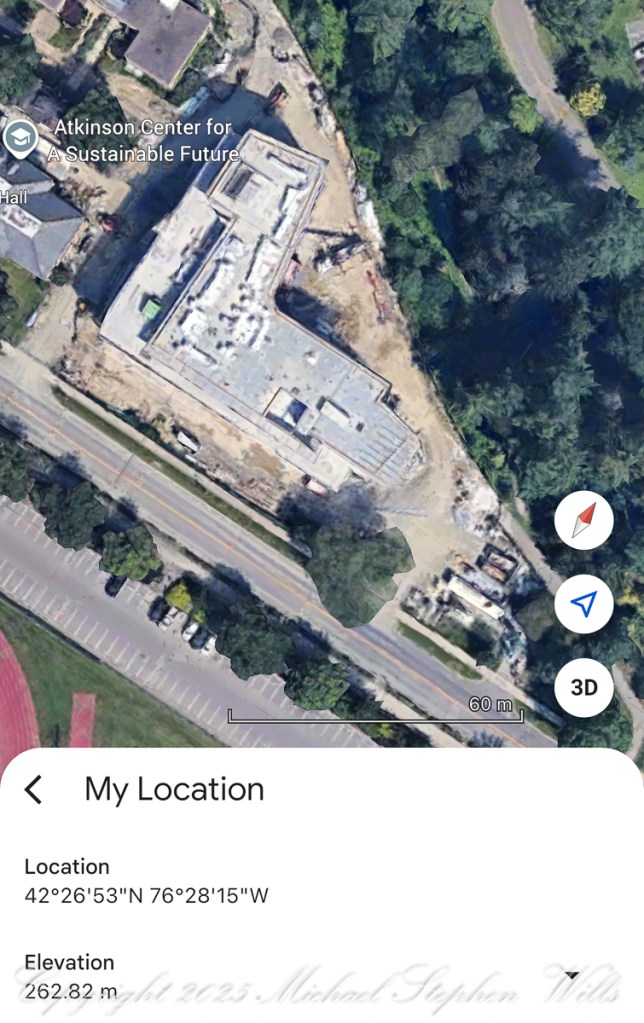
Not in person—on my screen, late at night, when I should have been revising a draft and instead opened Google Earth the way some people open a window. There it was, just off Tower Road, close to Stocking Hall, pale and newly settled into the slope. From that height it looked careful rather than confident, as if it had arrived recently and was still deciding how much of itself to show.

Atkinson Hall, Google Earth from August 2023, 350 Tower Rd, Ithaca, NY 14850

I remember thinking: good placement on a former triangular parking lot. Enough distance from the older buildings to breathe, close enough to feel included. The hill does most of the work. You can see that even from an overhead height.

The next morning I walked there.

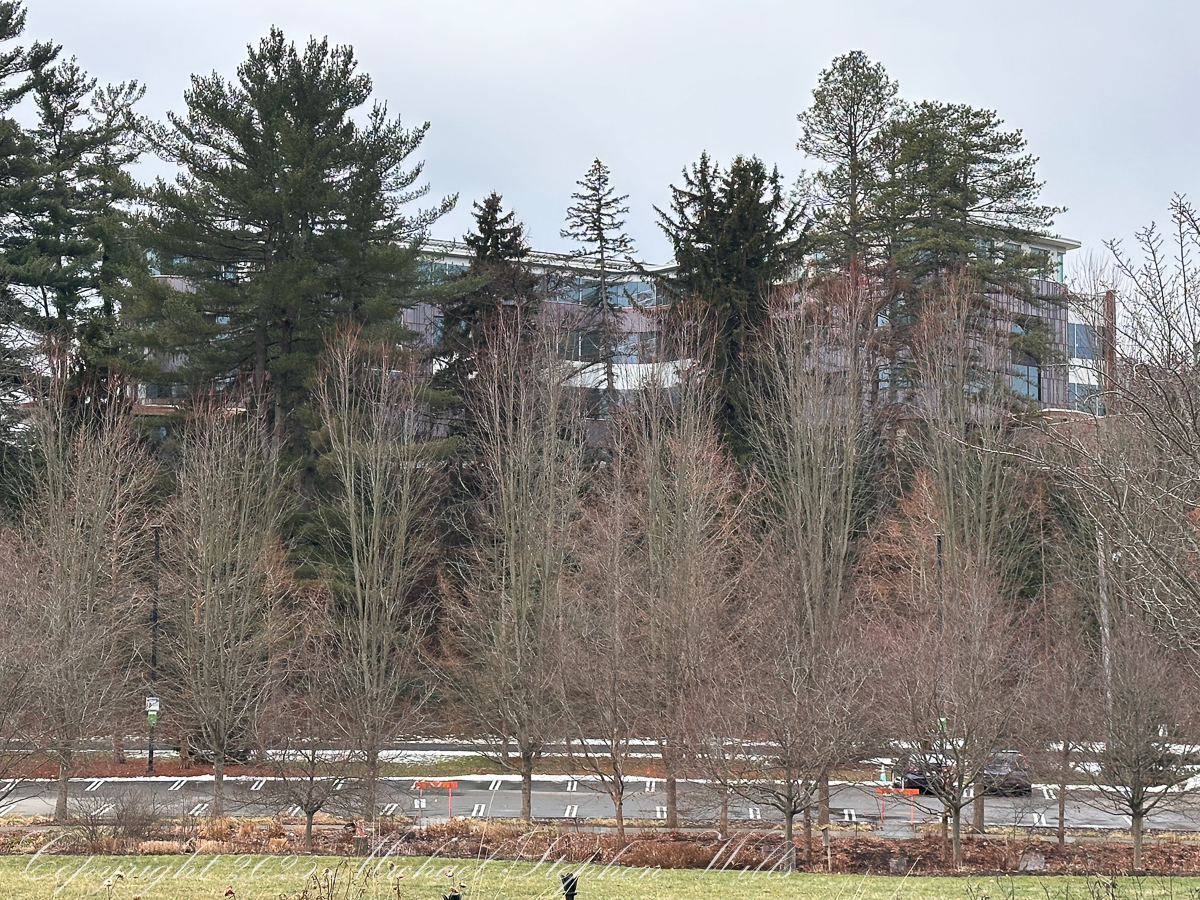
Atkinson Hall as viewed from the open field south of the Nevin Welcome Center of Cornell Botanic Gardens

Across the open field the building didn’t announce itself. Trees intervened—pines, bare hardwoods—so that it came into view in pieces: a curve of metal, a long line of glass, brick holding the ground. It felt less like approaching a destination than like gradually realizing you were already there. I liked that. Buildings that reveal themselves all at once tend to exhaust me.

The slope matters. You feel it in your legs as you walk, and the building seems to acknowledge it, stretching rather than standing tall. It does not pretend the land is flat. It follows the descent toward the creek, toward the older geological story underneath all of us.

Up close, the materials settle my attention.

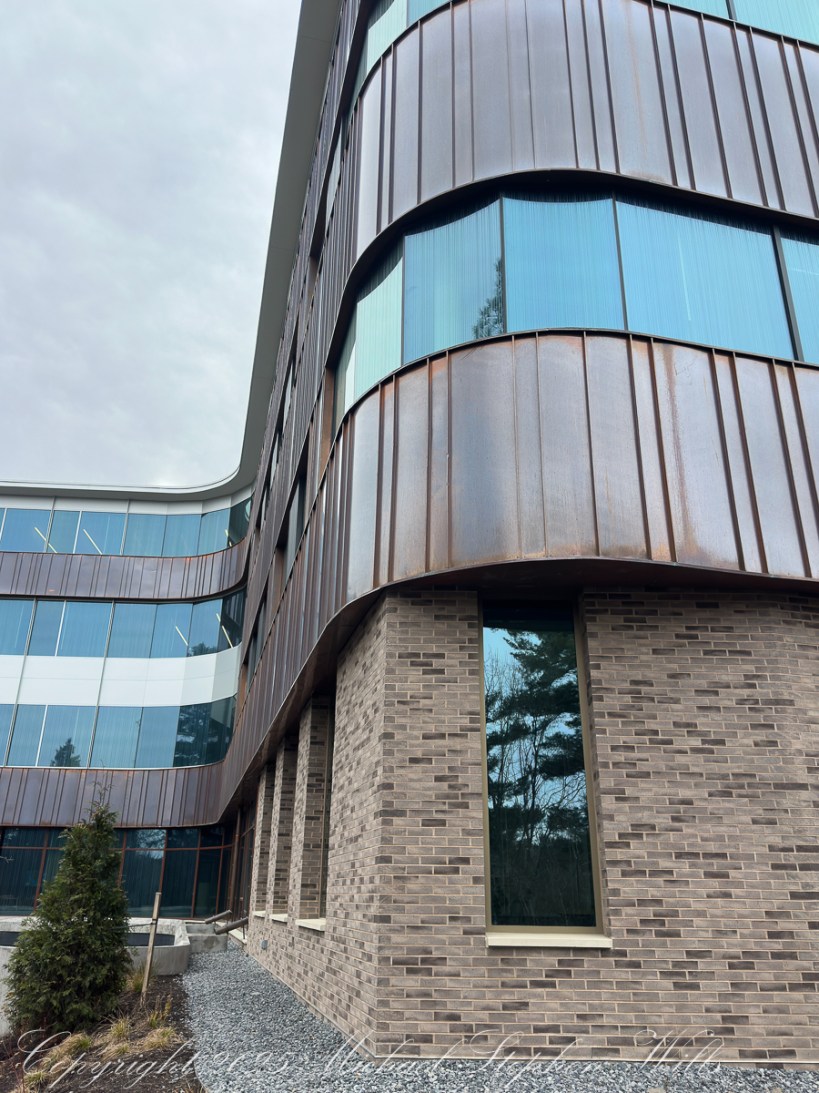
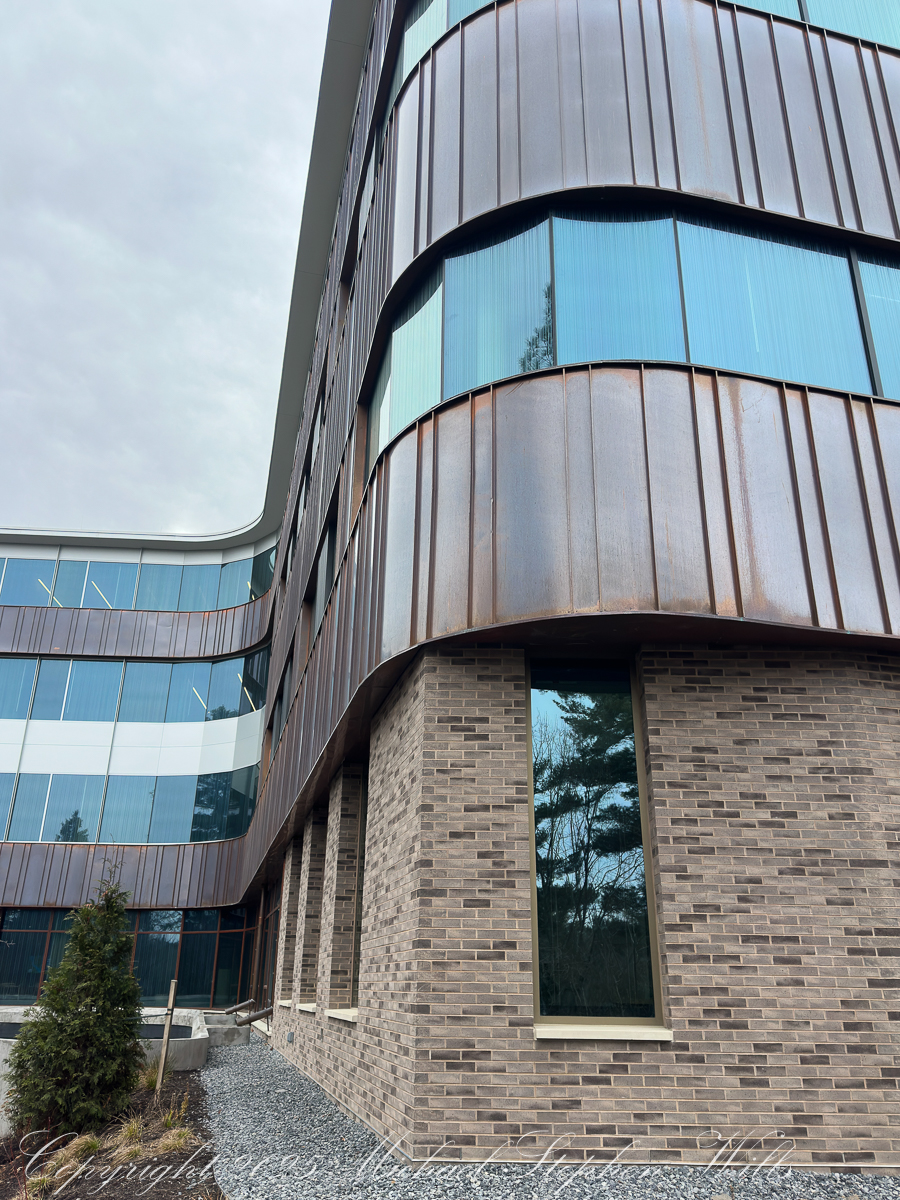
North Side of Atkinson Hall, 350 Tower Rd, Ithaca, NY 14850

Brick at the base—solid, Cornell-familiar, not trying to reinvent anything. Above it, bands of weathered metal curve gently, already carrying the muted browns of fallen leaves, old stone, and stream-worn shale—colors long familiar to the slopes and ravines that shape this campus. They look as though they have agreed to age, which feels like an underrated design choice. The glass holds the sky without insisting on transparency. Some days it reflects trees so clearly that the building nearly disappears into them.

Compare the facade brickwork of Warren Hall, one of the earliest buildings on the Cornell University campus, completed 1868. This is the southwest corner with facade signage, Cornell University, Ithaca, New York

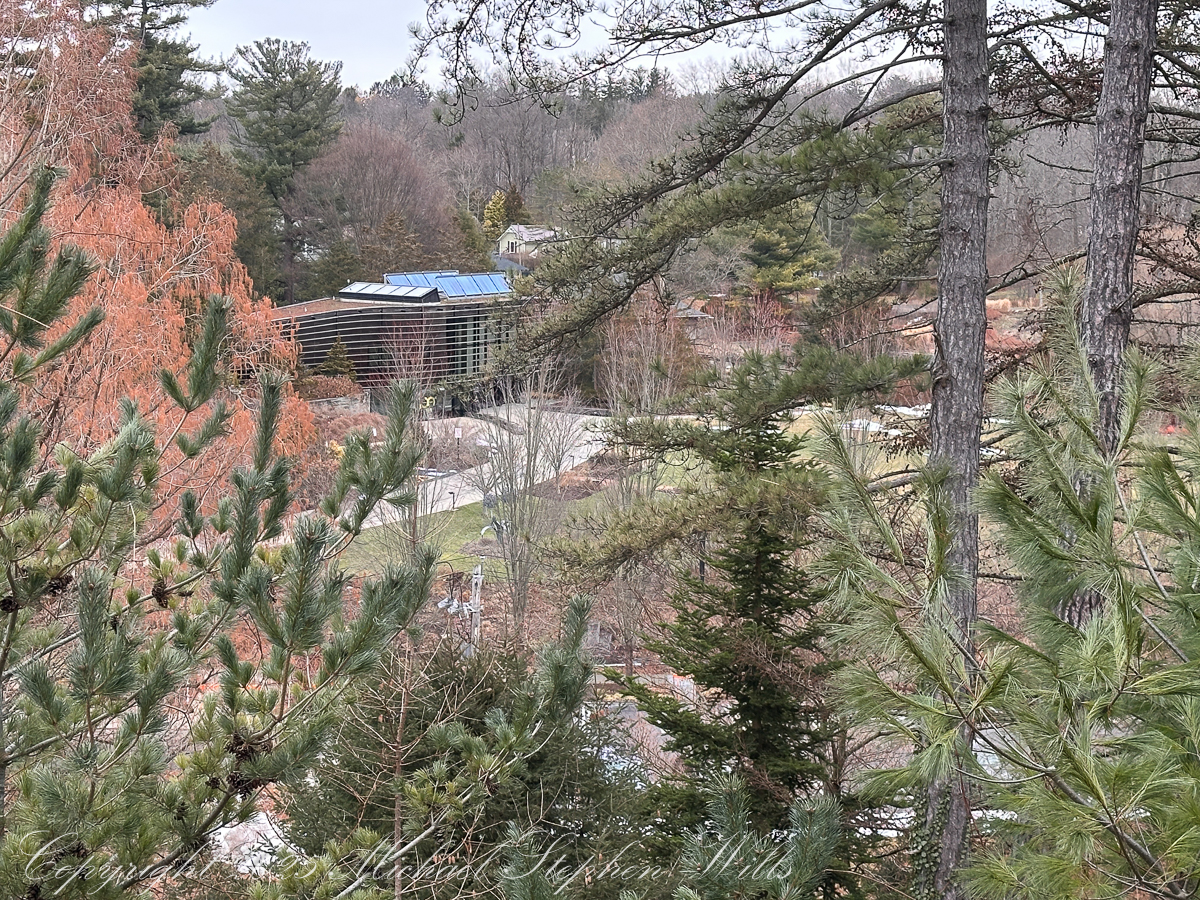
I stop near the windows longer than I intend to. The view steadies me. The hillside, the trees, the quiet persistence of winter light. My notebook stays closed for a few minutes. No one seems to mind.

View near Atkinson, Nevin Welcome Center, Cornell Botanical Gardens, 124 Comstock Knoll Dr, Ithaca, NY 14850

Inside, the building does not behave like a department.

That is the first thing I notice once I begin using it regularly. No single discipline claims the space. Offices and meeting rooms feel provisional, lightly held. Conversations drift. Someone from engineering crosses paths with someone from policy. A food systems researcher borrows a chair from a planner. No one looks lost.

It helps to remember who gathers here. The building hosts people from many parts of the university, each arriving with partial expertise, incomplete questions.

Cornell College / UnitAreas of Engagement
College of Agriculture and Life Sciences (CALS)Food systems, agroecology, climate resilience
College of EngineeringEnergy systems, materials, infrastructure
College of Arts and SciencesEarth systems, ecology, human dimensions
SC Johnson College of BusinessSustainable enterprise, supply chains
College of Architecture, Art, and Planning (AAP)Urban resilience, adaptive design
Cornell Law SchoolEnvironmental law and governance
Public & Global AffairsClimate policy, diplomacy

I keep this list taped inside my notebook. It reminds me that no one here is meant to arrive fully formed. The building expects us to be unfinished.

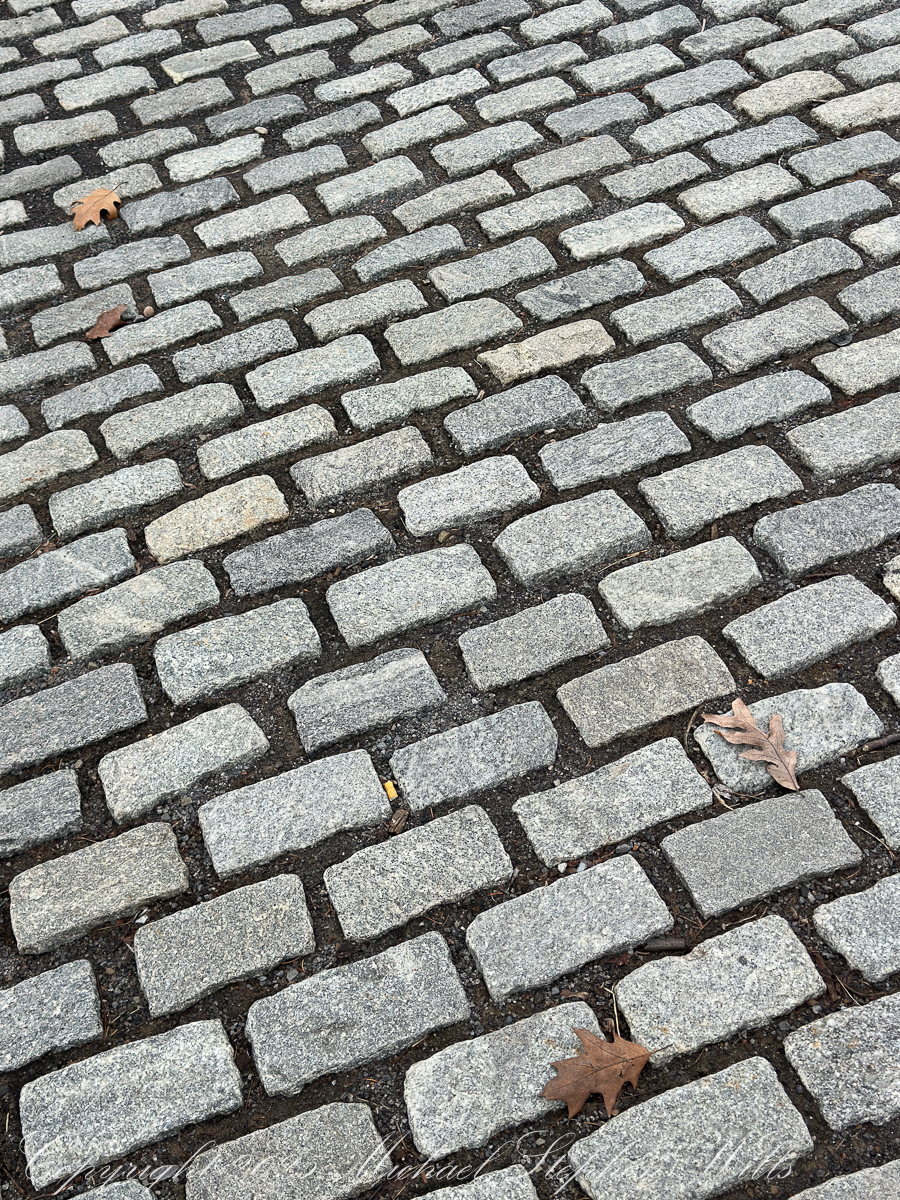
Cobblestones with fallen oak leaves along Feeny Way, Cornell University, Ithaca, New York

There is a quiet confidence in how the place is run. Systems hum discreetly. Heat holds steady even when the weather rips. Somewhere nearby, unseen, a generator waits, a reassurance. Work continues. Conversations do not end mid-sentence. I think about this more than I expected to. Stability has become a form of generosity.

On certain afternoons I walk the exterior again before heading home.

The curves soften what could have been institutional. Corners ease into one another. Nothing feels sharp. The building does not posture or instruct. It listens. It seems content to let weather, foot traffic, and time finish the job.

I have overheard visitors describe it as “restrained.” I think that is right. It does not wear sustainability as an emblem. It does not ask to be admired. It offers something quieter: space to think without being hurried, to talk without being territorial.

From some angles it nearly disappears into the hillside. From others it asserts itself just enough to be useful. That balance feels intentional, and also rare.

When I sit near the glass and look out, I sometimes imagine the building learning us in return—our habits, our pauses, the way we linger in doorways when a conversation matters. It seems designed for that kind of noticing.

If I were forced to describe it the way a realtor might, I would say it is well built in all the ways that matter. The structure is sound. The site is excellent. The materials will age well. But what I would mean is something less technical.

It is a building willing to wait.

Seen from above, it is still new.
Seen from the field, it is already settled.
Seen from inside, it feels patient.

That patience makes room—for uncertainty, for collaboration, for the long work that does not resolve quickly. I think that is why I keep returning, even on days when I do not strictly need to be there.

The building does not ask what I am producing.
It asks only that I stay awhile.

And for now, that is enough.

Enter your email to receive notification of future postings. I will not sell or share your email address.

Autumn Reflections: The Majesty of Acer Rubrum

On a serene autumn afternoon by Beebe Lake, a solitary red maple stood out against the backdrop, showcasing its vibrant colors and resilience, symbolizing autumn’s fleeting beauty.

It was one of those serene autumn afternoons that linger in memory, the kind where the sky seems impossibly clear, the air crisp and gently scented with fallen leaves. I stood at the edge of Beebe Lake, my gaze first drawn to the textured concrete dam holding back the water, its weathered facade contrasting sharply with the soft reflections shimmering across the lake’s calm surface. Beyond, the wooded hillside rose gently, a tapestry woven with the warm hues of autumn—golds, greens, oranges, and reds mingling like brush strokes on a canvas.


An October Glory, turning before all others

Yet amidst this collective beauty, one tree captured my attention, singular in its brilliance—a solitary red maple standing proudly on the lakeshore. Its leaves had turned a vivid crimson, blazing brightly as though defying the muted earth tones surrounding it. Even from a distance, framed and partially obscured by larger trees, its vibrant reflection cast a fiery echo on the water, rippling softly in the afternoon breeze.

The maple, Acer Rubrum, seemed perfectly at home here, thriving robustly at the water’s edge. I remembered reading how adaptable red maples are, able to flourish in conditions ranging from dry uplands to swampy shores. This spot, near the edge of the tranquil Beebe Lake, seemed to showcase its resilient character perfectly.

Up close, the maple’s glow was even more striking. Its leaves cascaded in fiery clusters, hues deepening from bright scarlet at the tips to a darker maroon closer to the branches. This dramatic gradient seemed symbolic of autumn itself—beautiful, fleeting, and subtly tinged with the melancholy reminder of winter’s approach.

The Red Maple (Acer Rubrum) to tolerant of diverse conditions, making it a perfect choice for this spot on the short of Beebe Lake.

A memory surfaced of early spring in the Finger Lakes region, a time when maples, including this red maple, generously share their sap. Though not traditionally tapped like its sweeter cousin, the sugar maple, this species’ sap can indeed be boiled down into syrup, a surprising sweetness hidden within its sturdy trunk. Standing in its shadow, imagining those early spring days, it seemed astonishing that the same tree could offer both the delicate sweetness of syrup and the fierce beauty now on display.

Curiously, the transformation of the tree appeared methodical yet whimsical—it changed colors from the top down, its upper branches already bare, exposing slender twigs pointing skyward. Like an artist carefully removing layers to reveal something deeper beneath, the maple unveiled its upper bare bones first, as though reminding observers of the quiet strength supporting its autumn splendor.

This Red Maple (Acer Rubrum) turns from the top down and has already bare for most top branches.

As I lingered, taking in this turning tree, joggers passed by along the path, their rhythmic footsteps a gentle percussion beneath the rustling leaves. Briefly, they glanced toward the vivid maple, perhaps drawn, like me, by its striking contrast to the surrounding foliage. It felt like we shared a secret admiration for this singular tree, recognizing in it a quiet assertion of individuality amidst conformity.

Eventually, I viewed the maple once more from afar, framed now by broader sweeps of branches and leaves, partially obscured but no less vivid. Through layers of leaves and dappled sunlight, it glowed like a distant flame, a beacon that seemed to encapsulate the entire mood of the season—warm yet cool, bright yet transient.

The Red Maple (Acer Rubrum) is the first to flower in spring and the first to turn in autumn.

Walking away, the image of that maple lingered, its reflection shimmering gently in the afternoon sun, a moment suspended between summer’s lush vitality and winter’s bare stillness. Beebe Lake had offered scenic beauty, a quiet meditation, a reflection mirrored not only on its tranquil surface but in the heart of an observer captivated by a single tree’s fleeting glory.

Enter your email to receive notification of future postings. I will not sell or share your email address.

The Autumn Tapestry of Cayuga Lake: A Journey on the Treman Park Lake Loop

Autumn’s Arrival Along Cayuga Lake

In Autumn 2024, the Treman Park Lake Loop of the Cayuga Waterfront Trail in Ithaca, New York, unfurled a vibrant display of seasonal transition. The natural landscape, adorned with fiery hues of reds, oranges, and yellows, reflected in the rippling waters of Cayuga Lake, creating a harmony of color and light. This is a scenic journey through stories of plant and animal life that call this place home—including the majestic Osprey (Pandion haliaetus) that nests along the shore.

The Osprey’s Watchtower

A sight to greet visitors is the solitary osprey nest perched high on a pole. Used by Osprey families during their breeding season, this nest stands as a testament to their remarkable recovery in the Finger Lakes region. Ospreys, once declining due to pesticide use, have rebounded significantly following conservation efforts.

With a wingspan of up to 6 feet, these raptors are expert fish hunters, often seen diving talons-first into the lake to snatch their prey. During autumn, as their young take flight, the nest remains an empty marker of the summer’s success—a reminder of the cyclical nature of life along the lake.

Did You Know? Ospreys are often referred to as “fish hawks” because fish make up 99% of their diet.

The Meadow and Its Golden Touch: Reedbeds and Goldenrod

Surrounding the osprey pole, expansive meadows of grasses and reeds sway with the breeze. Among these are stands of Common Reed (Phragmites australis), a tall grass with feathery plumes that catch the sunlight. While Phragmites can sometimes be invasive, they provide crucial shelter and food for various species of birds and insects.

Intermixed with the reeds are patches of Goldenrod (Solidago spp.), whose bright yellow flowers are a signature of late summer and autumn in the Northeast. Goldenrods are critical for pollinators, offering nectar to bees, butterflies, and migrating insects like the Monarch butterfly (Danaus plexippus).

Ecological Note: Goldenrods are often mistakenly blamed for allergies; the real culprit is ragweed (Ambrosia artemisiifolia), which blooms at the same time but releases airborne pollen.

A Lake Alive with History and Beauty

The shimmering blue waters of Cayuga Lake form the centerpiece of this trail. The lake, stretching nearly 40 miles, is the longest of the Finger Lakes and steeped in geological and cultural history. Its name is derived from the Cayuga Nation, part of the Haudenosaunee Confederacy, who inhabited the region for centuries.

The striking red lighthouse in the water serves as a vivid counterpoint to the natural surroundings. Built to aid navigation, it now stands as a picturesque focal point for photographers and nature enthusiasts alike.

Cayuga Inlet Light Beacon

In the distance, a sailboat glides across the lake—a serene reminder of the recreational draw that Cayuga Lake holds year-round.

West shore with sailboat and lake houses

The Forest Fringe: A Kaleidoscope of Color

The forests that fringe the meadow and the lake present an explosion of autumn color. Trees such as Sugar Maple (Acer saccharum), Red Oak (Quercus rubra), and Black Cherry (Prunus serotina) dominate the canopy, their leaves transforming into brilliant oranges, scarlets, and deep burgundies. The Sugar Maple, in particular, is renowned for its vibrant golden-orange foliage, a hallmark of the northeastern fall.

The Ithaca Yacht Club lies south of Maplewood Point

Closer to the ground, the understory hums with the activity of migrating birds and foraging mammals. Squirrels can be seen gathering acorns, preparing for the winter months ahead, while chickadees flit among the branches, calling their cheerful “fee-bee” notes.

Historical Fact: The Finger Lakes were carved out by retreating glaciers over 10,000 years ago, leaving behind these deep, elongated lakes and fertile soil that supports rich biodiversity.

A Path Through Time and Nature

Walking the Treman Park Lake Loop is a sensory journey—the crispness of the autumn air, the rustling of reeds, and the rhythmic lapping of waves against the shore combine to evoke a timeless tranquility.

From the vibrant meadows to the osprey’s lofty perch and the quiet expanse of Cayuga Lake, this section of the Waterfront Trail encapsulates the beauty and diversity of the Finger Lakes ecosystem. Whether for quiet reflection or active exploration, it remains a treasured destination in every season.

Closing Thoughts

As autumn deepens, this landscape prepares for the dormancy of winter. Yet the stories it holds—from the osprey’s nest to the goldenrod’s bloom—remain alive, waiting to be rediscovered with each new season. The Treman Park Lake Loop is not just a trail; it is a canvas of life, change, and history painted by nature’s hand.

Reflection: To walk this trail is to connect with a land shaped by glaciers, nurtured by waters, and home to countless species that continue to thrive amid the ever-turning wheel of the seasons.

Enter your email to receive notification of future postings. I will not sell or share your email address.