Cutleaf Toothwort and the Pure Green Sweat Bee: A Woodland Encounter in the Mundy Wildflower Garden

A close look at Cutleaf Toothwort and a Pure Green Sweat Bee in Cornell Botanic Gardens’ Mundy Wildflower Garden reveals a small but remarkable drama of spring pollination, adaptation, and woodland renewal.

That afternoon of April 14, 2026, in the Mundy Wildflower Garden, I was moving slowly enough for the woods to begin revealing their smaller intentions. Mid-April in Ithaca is a season of thresholds. The leaf litter still holds the color of last year’s weather—oak brown, beech tan, the dry parchment of a forest not yet fully wakened—but through it rise the first green declarations. Nothing shouts. Everything announces itself in a near-whisper.

It was in that spirit that I came upon the cutleaved toothwort.
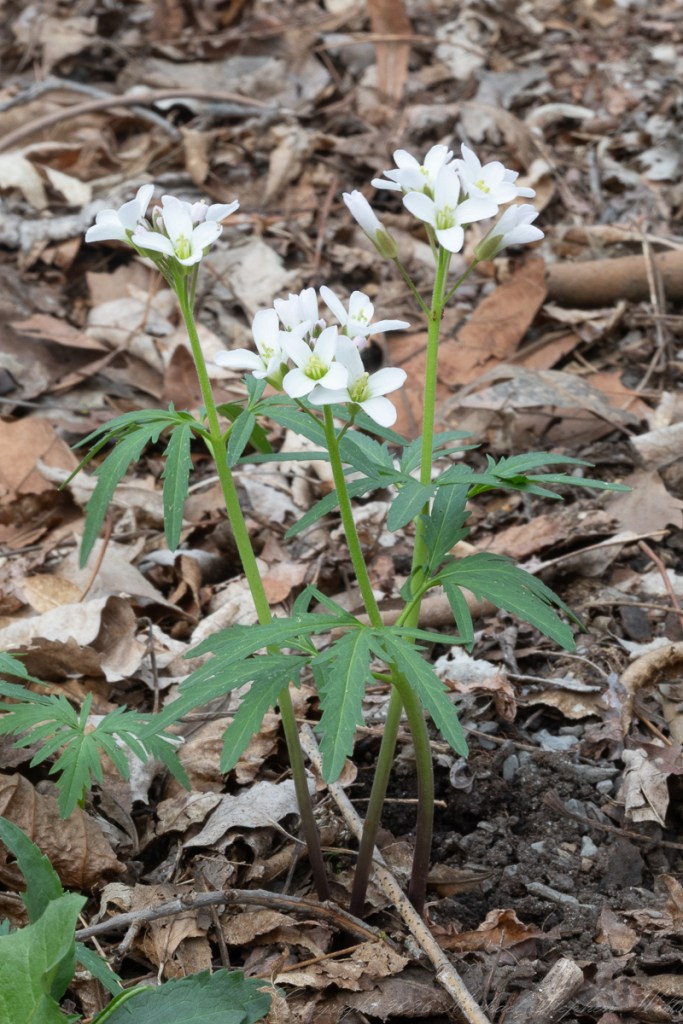
Cardamine concatenata, the cutleaved toothwort, crow’s toes, pepper root or purple-flowered toothwort, is a flowering plant in the family Brassicaceae. Mundy Wildflower Garden, Cornell Botanic Gardens, Ithaca, Tompkins County, Finger Lakes Region, New York State

At first glance the plant seemed almost improbably delicate, as if it had been assembled from a set of fine green gestures and then topped with small white crosses of bloom. The flowers hovered just above the leaf litter, each with four petals, clear evidence of the mustard family to which the plant belongs. The leaves were deeply divided, sharply cut, almost hand-like in their spread, giving the plant its common name. There is something elegant in that foliage: not the broad, self-confident green of summer, but a more intricate, provisional architecture, suited to the brief bright interval before the forest canopy closes.

This was Cutleaf Toothwort, Cardamine concatenata, one of the spring ephemerals, those woodland plants that have evolved to live by speed and timing. Their season is narrow. They rise, leaf out, flower, attract pollinators, set seed, and begin to withdraw before the trees above them fully leaf out and cast the deep shade of late spring and summer. To see one is to witness a life shaped by the economy of light. It does not waste time. It cannot.

And then I noticed the bee.

I had first been looking at the flowers themselves, admiring the small white petals and the poised buds still waiting to open, when a glint of green—alive, metallic, almost jewel-like—caught my eye. There on the bloom was a Pure Green Sweat Bee, almost certainly Augochlora pura, one of the loveliest native bees of eastern woodlands. The name hardly prepares one for the reality. “Green” suggests leaf or moss or some dull vegetal shade. But this bee wore green the way a gemstone wears light. It seemed less colored than illuminated, as though the afternoon sun had condensed into a living body and taken to wing.
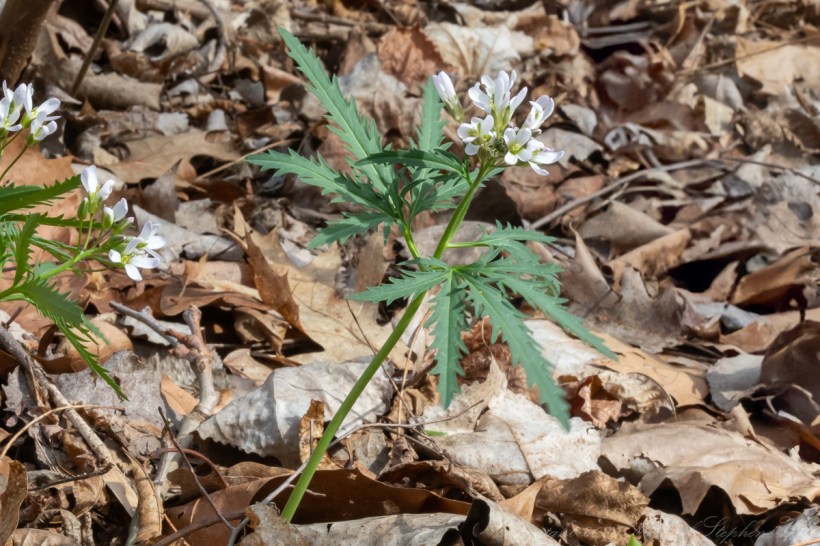
What moved me most was the scale of it. The bee was tiny beside the flower, and the flower itself was small in the wide republic of the forest floor. Yet in that little meeting—bee and toothwort, insect and ephemeral—there existed an entire system of ancient reciprocity. The bee had not arrived there by accident. Nor had the flower opened in innocence. Each belonged to the other’s world.
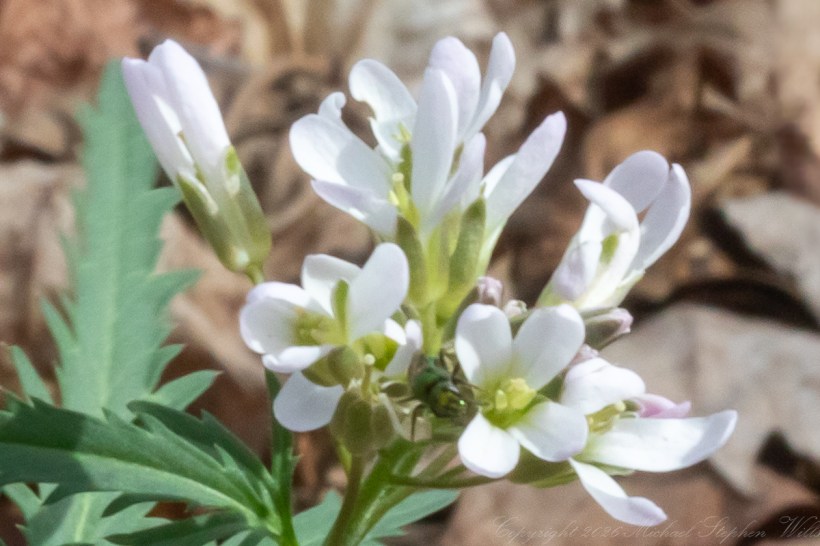
Here is the Pure Green Sweat Bee in a detail of the previous photograph.

The life of a sweat bee is far more complex than its modest size suggests. Augochlora pura is one of our native solitary bees. Unlike honey bees, it does not belong to a great colony with combs and a queen. A female builds and provisions her own nest, often in rotting wood or soft decaying logs, an apt choice for a woodland species. She gathers pollen and nectar, forms a food mass for her offspring, lays an egg, and seals the chamber. Her labor is quiet, uncelebrated, and essential. She is one small carrier of spring fertility, moving genes through the forest one flower visit at a time.

The common name “sweat bee” comes from a habit some species have of landing on human skin to sip salts from perspiration, but there was nothing comic or pesky about this one. On the toothwort it was wholly itself: intent, methodical, radiant. It moved with a professional seriousness from bloom to bloom, entering the white flowers where the reproductive parts stood ready. Pollen clung to its body. The flower offered nectar and pollen as food; the bee, without contract or plan, carried the plant’s future outward. Evolution has made such meetings beautiful, but beauty is not the goal. Continuance is.

And yet beauty is what we are given to see.

The Cutleaf Toothwort has its own intricate life history. It spreads not only by seed but also through underground rhizomes, toothed in form, which gave rise to the older name “toothwort.” Those pale subterranean stems hold stored energy from previous seasons, allowing the plant to rise quickly when soil temperatures soften and light still reaches the woodland floor. It is a plant of patience and timing, of long preparation for a brief display. Its flowers are modest, not showy in the garden-center sense, but perfectly fitted to the early spring woods: visible enough to pollinators, pale enough to stand out against the brown duff, structured for efficiency.

There is also an evolutionary poignancy in the fact that many spring ephemerals depend on the first wave of insect activity after winter. Bees like Augochlora pura emerge into a world that is only beginning to supply forage. A flowering woodland plant in April is an opened pantry, a signal fire, a necessary event in the calendar of survival. Likewise, a native bee visiting those flowers is a participant in a relationship shaped over vast stretches of time. Forest floor, rhizome, petal, pollen grain, bee body, hollow wood nest—all of it is linked.

Standing there with my camera, I felt once again how often wonder arrives disguised as minuteness. The grand spectacles of nature announce themselves: waterfalls, hawks, autumn hillsides, a full moon lifting over a ridge. But this was a smaller magnificence, requiring the humility to stoop, to wait, to look closely enough for significance to emerge from what many walkers would simply call “little white flowers.” The Mundy Wildflower Garden, on an afternoon like this, was displaying as well as conducting spring.

The leaf litter around the plant only deepened the impression. Last year’s fallen leaves were still present, curled and dry, forming the brown text from which the new season writes its first green sentences. Out of that apparent dormancy rose the toothed leaves and white flowers of Cardamine concatenata, and upon them came the emerald bee, a living spark of pollinating purpose. Death feeding life; old canopy nourishing new growth; a forest renewing itself not through spectacle but through a thousand precise exchanges.

I lingered longer than I meant to. That happens to me often in spring. One flower leads to another, one patch of sunlight to another, and then some small drama of natural history arrests the day. But this encounter felt especially complete. The Cutleaf Toothwort embodied the speed, discipline, and elegance of the spring ephemeral strategy. The Pure Green Sweat Bee embodied the brilliance and necessity of native pollinators, creatures upon whose unrecorded labor the health of so many ecosystems depends. Together they made visible a truth the woods are always speaking: survival is collaborative, and beauty often arises where need and adaptation meet.

When I finally moved on, I carried with me the feeling that I had witnessed a brief transaction in the old woodland economy, a little shining exchange older than any path through the garden, older than the institutions built around it, older even than the names we now give to bee and blossom. On an April afternoon, among the leaves of last year, I had found a subject for a photograph within a moment in which evolution, ecology, and grace stood together in one small white flower.
Enter your email to receive notification of future postings. I will not sell or share your email address.

Discovering Large-Flowered Bellwort Near Mundy Wildflower Garden in Ithaca, New York

On an April afternoon along Fall Creek near Cornell Botanic Gardens, I found my first colony of Large-flowered Bellwort, Uvularia grandiflora—a quiet woodland wildflower shaped by spring light, pollinators, and rich forest soil.

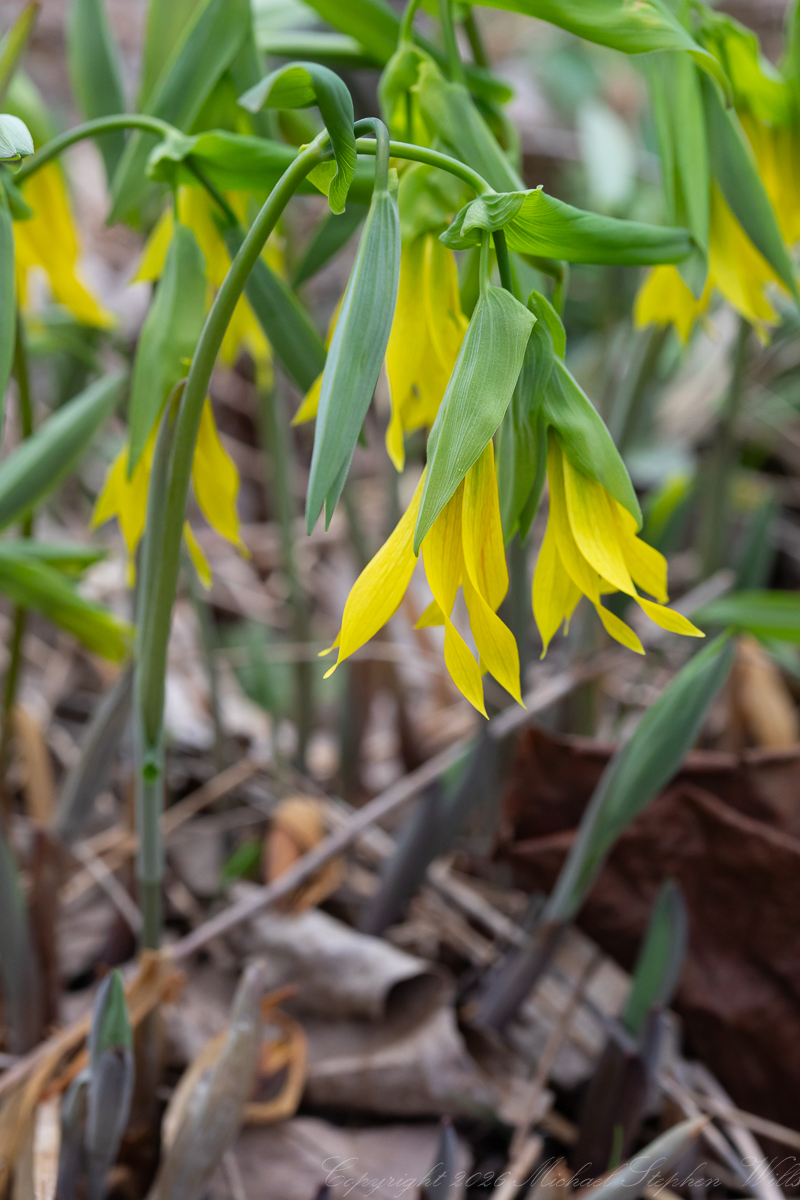
On an April afternoon in 2026, walking along Fall Creek near the Mundy Wildflower Garden at Cornell Botanic Gardens, I came for the first time upon a colony of Large-flowered Bellwort, Uvularia grandiflora, and stopped with the immediate feeling that spring had spoken in a new dialect. I had seen the season gathering itself all around me in buds, in damp leaf litter, in the first loosening of the woods from winter’s gray restraint. But this was different. These flowers did not announce themselves with bravado. They hung quietly beneath their leaves, as though the forest had shaped small yellow lanterns and then thought better of showing them too openly.

I raised my Canon EOS 5D Mark IV with the Canon EF 100 mm f/2.8 Macro USM lens and photographed them handheld at 1/640 second, f/8.0, trying to honor both their delicacy and their poise. Macro work often feels like an act of courtship with detail. One does not seize the subject; one approaches, waits, adjusts, breathes. In the bellworts, I found a plant that rewarded just this kind of attention. At first glance they seemed merely graceful. Then, looking more closely, I began to see their architecture.

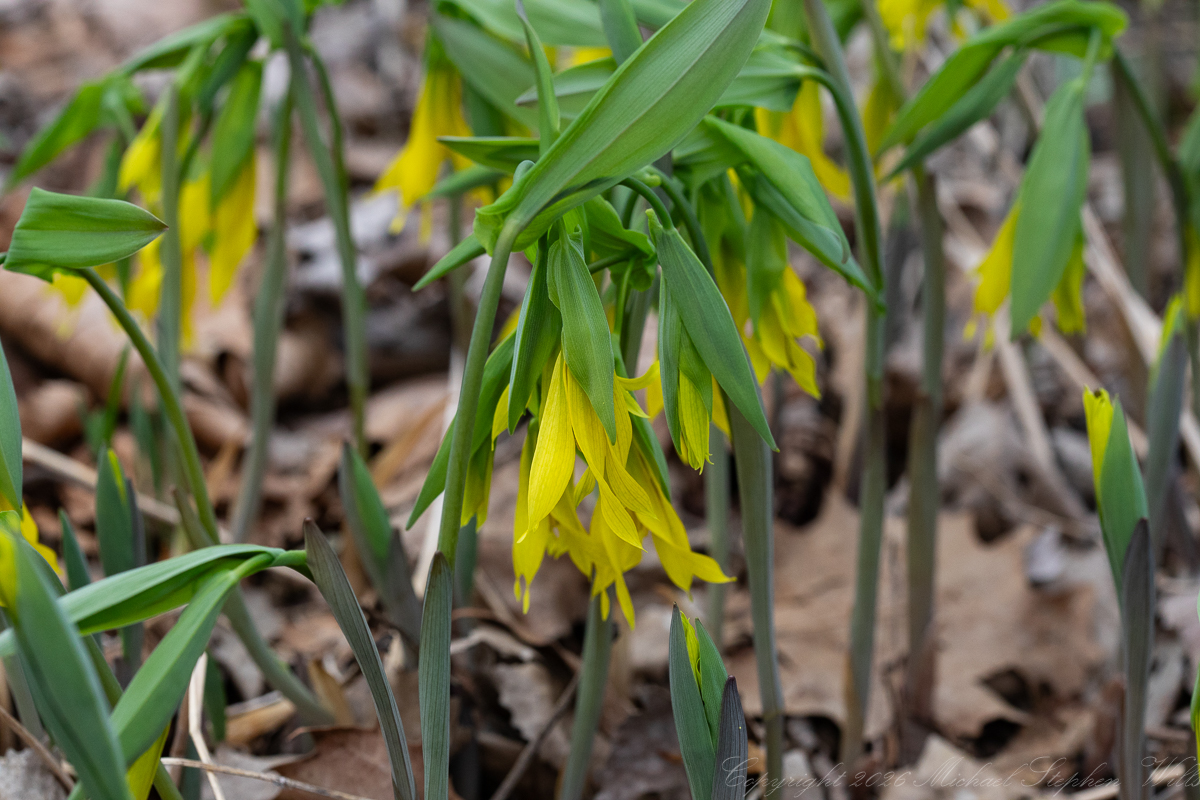
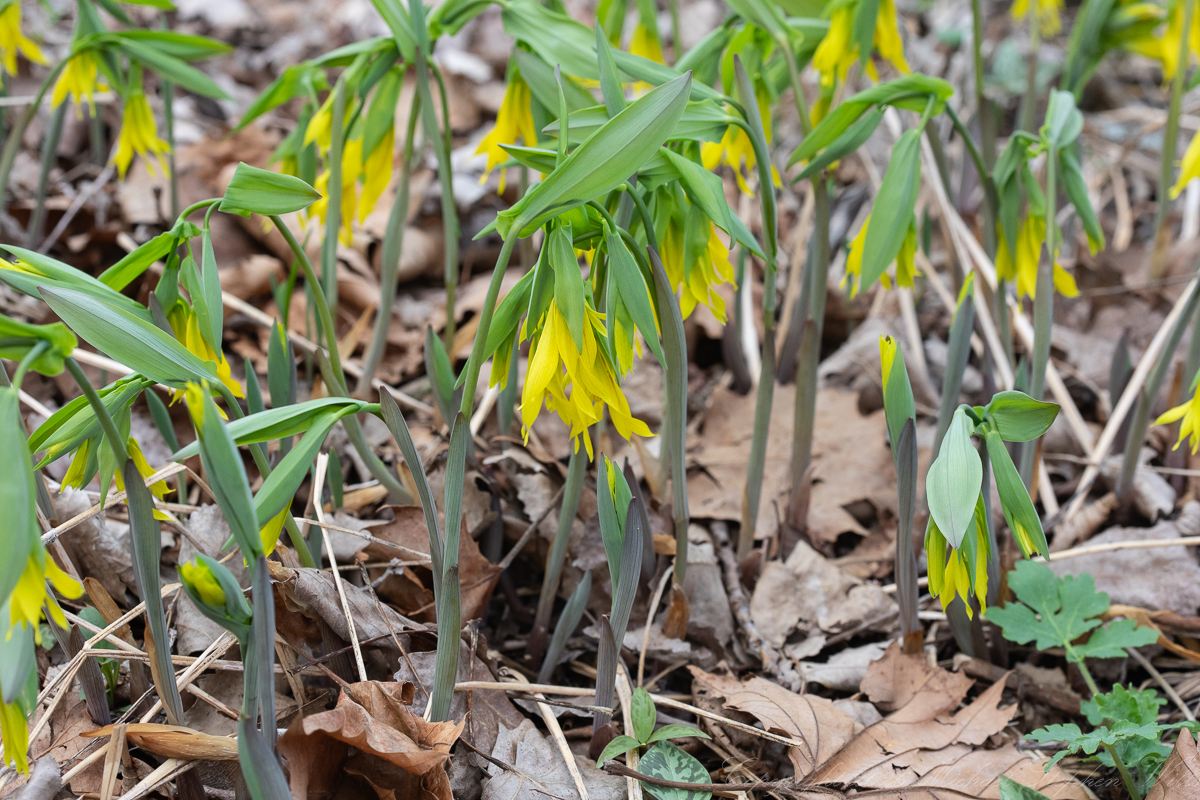
These Largeflower Bellworts (Uvularia grandflora) are flourishing on the Cornell University Campus along Fall Creek, adjacent to the Mundy Wildflower Garden. Cornell University, Tompkins County, finger Lakes Region, New York State

Large-flowered Bellwort is a woodland perennial of rich deciduous forests, and it wears that identity in every part of its form. The stems rise smooth and pale, slender but assured, each seeming to carry its burden effortlessly. The leaves clasp the stem in that distinctive bellwort manner, as though the plant were being held in green hands. Beneath them hang the flowers, elongated and drooping, their six yellow tepals twisted and tapered into points. They are not the symmetrical stars of more open-faced blossoms. They are pendants, streamers, tassels of sunlight. In these flowers, yellow becomes motion. Even when still, they seem to trail the memory of a breeze.

The plant’s drooping habit is part of an evolutionary strategy. In the spring woods, before the canopy fully leafs out, ephemeral light reaches the forest floor in a brief annual inheritance. Bellwort rises into that window. It gathers energy quickly, blooms early, and makes use of the few bright weeks before the trees above turn the woodland dim and green. Its season is a narrow one, but not a meager one. This is a plant shaped by timing, by patience, by fidelity to a recurring opportunity. It lives where sunlight is not constant but bestowed.

There is something deeply moving in such an existence. We humans often admire the grand gestures of nature—the waterfall, the hawk, the thunderhead. But woodland wildflowers teach another lesson: that persistence may take the form of exquisite brevity. Uvularia grandiflora does not dominate the landscape. It waits for its rightful hour, then enters the year with quiet authority. It is one of spring’s soft-spoken triumphs.

Ecologically, the bellwort belongs to a community rather than a spectacle. It grows in moist, humus-rich soil, among the remains of last year’s leaves, where decay has become nourishment. Around it are the signatures of a healthy eastern woodland: filtered light, fungal work below ground, the gradual release of nutrients from the forest’s own past. Its roots do not stand apart from this economy of return. They participate in it. The beauty of the flower is inseparable from the labor of decomposition, the unseen commerce of roots and microbes, the long winter’s accumulation of leaf mold. Even here, elegance rises from compost.

And then there are its relationships with other living things. The flowers, nodding and somewhat enclosed, invite a certain intimacy from insect visitors. Bellwort is not a billboard flower. It asks a pollinator to come close, to enter its hanging chamber. Bumblebees, mason bees in the genus Osmia, sweat bees in Halictus and Lasioglossum, and mining bees in Andrena are among its visitors. One bee, Andrena uvulariae, bears in its very name the mark of this botanical relationship, having evolved a close association with Uvularia. To stand before these flowers is to imagine that hidden commerce of spring proceeding just beyond the edge of one’s notice: a queen bumblebee nosing into a drooping bloom, a small Osmia working deliberately among the tepals, an Andrena bee moving with ancient purpose through a plant lineage it has learned by evolution to trust.

What we call a wildflower is also an agreement, a contract written between blossom and insect long before we arrived to admire it. Even after flowering, the bellwort participates in the forest. Its seeds bear fleshy appendages that attract ants, which help carry them away and disperse them through the woodland.

Human beings, of course, enter this world differently. We bring names, lenses, curiosity, memory. We kneel in leaf litter with cameras. We identify, compare, and sometimes misidentify. We make gardens to protect what once grew without us, and then discover that our finest role is not mastery but attention. Finding Large-flowered Bellwort near Fall Creek reminded me that our relationship to such plants is at its best when it is grounded in humility. We do not improve these flowers by naming them; we improve ourselves by learning to see them.

And seeing them, truly seeing them, is no small thing. The petals in these photographs are veined with light. The stems carry a woodland grace, as if drawn in one uninterrupted line. The colony as a whole had the look of a little parliament of bells, each one bowed, each one speaking in silence. They seemed to me like fragments of sun that had slipped through the trees and decided to remain rooted there.

I left Fall Creek that afternoon with the feeling that I had been admitted to a finer scale of perception. Large-flowered Bellwort asks little of the passerby except slowness. Yet in return it offers a great deal: form, adaptation, timing, kinship, restraint. It shows how life in the spring woods is built from tact. Not only from survival, but from style.

Some plants shout the season into being. Bellwort lets it ring softly. And once heard, that note stays with you.

Enter your email to receive notification of future postings. I will not sell or share your email address.

A Late Winter Walk Through Cornell University Campus

Explore a late winter walk through Cornell University’s scenic campus, discovering blooming snowdrops, historic landmarks, and the striking “Magna Dancer” sculpture. Uncover the beauty and heritage captured in each step of this serene journey.


On the late winter afternoon of March 1, 2024, I decided to take a long walk starting from Cascadilla Park Road, making my way up through the Cornell University campus, and ending at Fall Creek near the Mundy Wildflower Garden before returning to my starting point. The sun was shining brightly, casting long shadows, and the crisp air was filled with a hint of spring. Carrying an Apple IPhone 14 Pro Max smartphone, I set off to capture the beauty and essence of this serene day.

Starting Point: Cascadilla Park Road

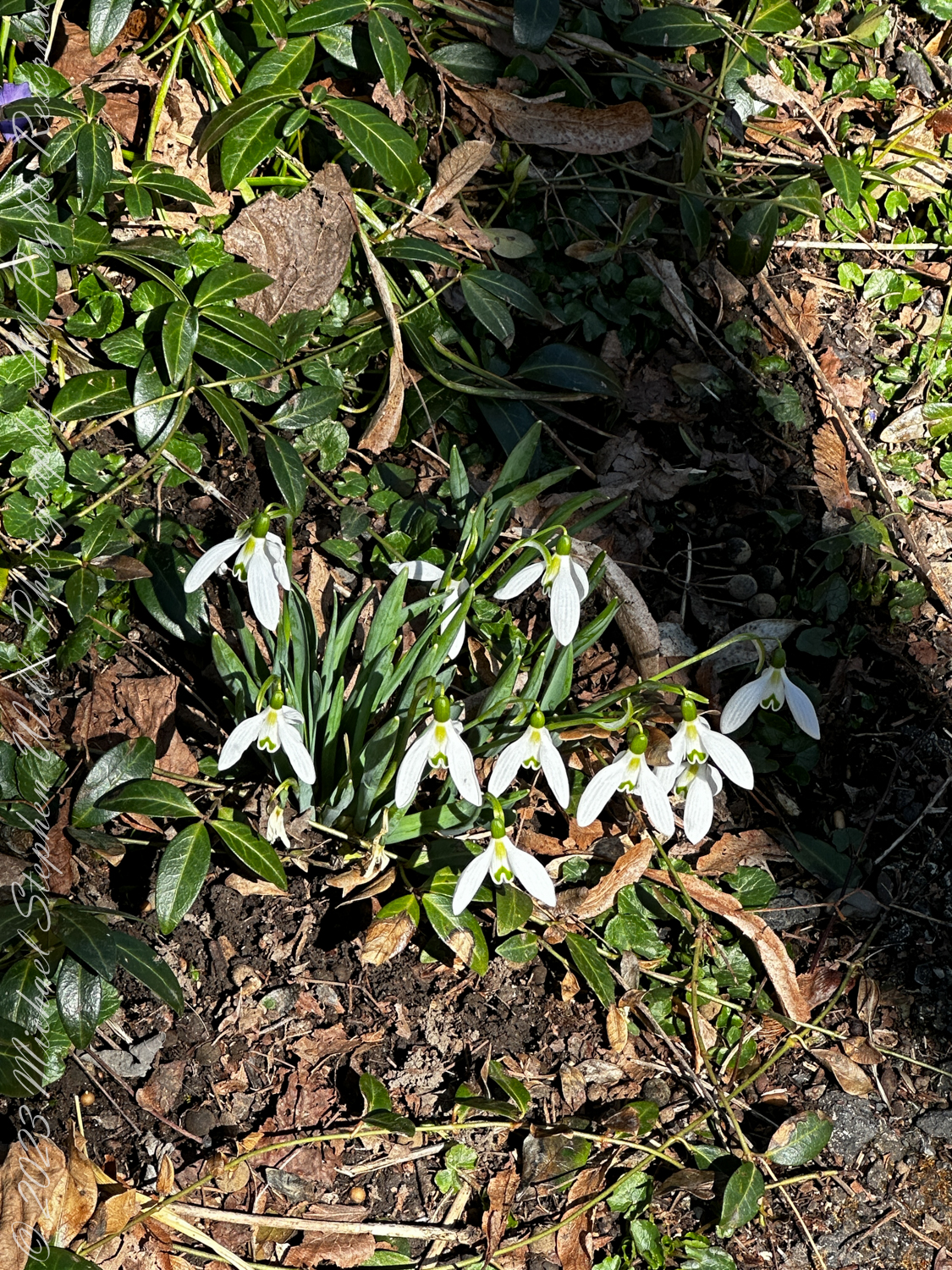
The walk began on Cascadilla Park Road, where I was greeted by a delightful patch of snowdrops (Galanthus nivalis) nestled among the glossy green leaves of periwinkle (Vinca minor). These delicate white flowers, blooming despite the chill, were a hopeful sign of the approaching spring. Their pristine petals contrasted beautifully with the dark, shiny leaves, creating a picturesque start to my journey.

These flowers were found in a garden on Cascadilla Park Road, Ithaca, March 1, 2024. Snowdrops (Galanthus nivalis) are among the first flowers to bloom in late winter and early spring, often pushing up through the snow. These plants are known for their nodding, white, bell-shaped flowers and are a common sight in gardens during this time of year. The glossy green leaves belong to a plant known as Periwinkle (Vinca minor). Periwinkle is a popular ground cover plant, often found in gardens due to its ability to spread quickly and form a dense mat of evergreen foliage. It typically has glossy, dark green leaves and produces small, blue or purple star-shaped flowers in the spring.

Climbing the Steps to Steps to Myron Taylor Hall

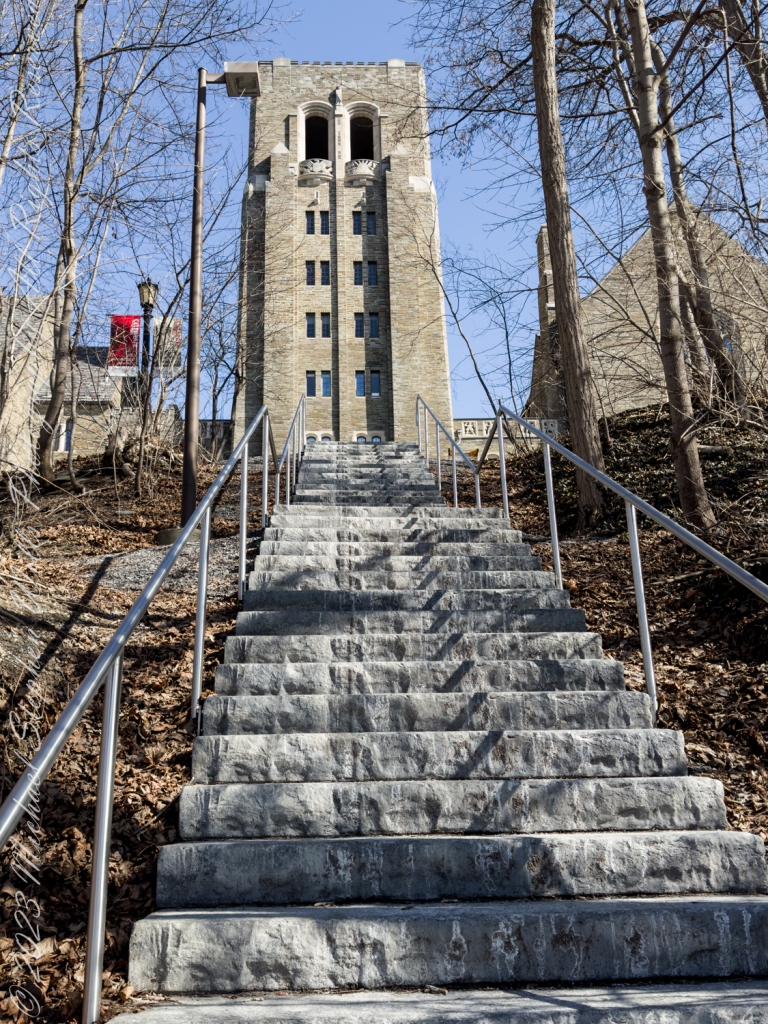
My path led me up flights of granite steps toward Myron Taylor Hall. As I climbed, I could feel the history and tradition of Cornell University enveloping me. The McGraw Tower bells chimed softly, adding a melodic backdrop to my ascent.

Steep steps leading from a parking lot off West Avenue to the Cornell Law School (Myron Taylor Hall).

Discovering “Magna Dancer”

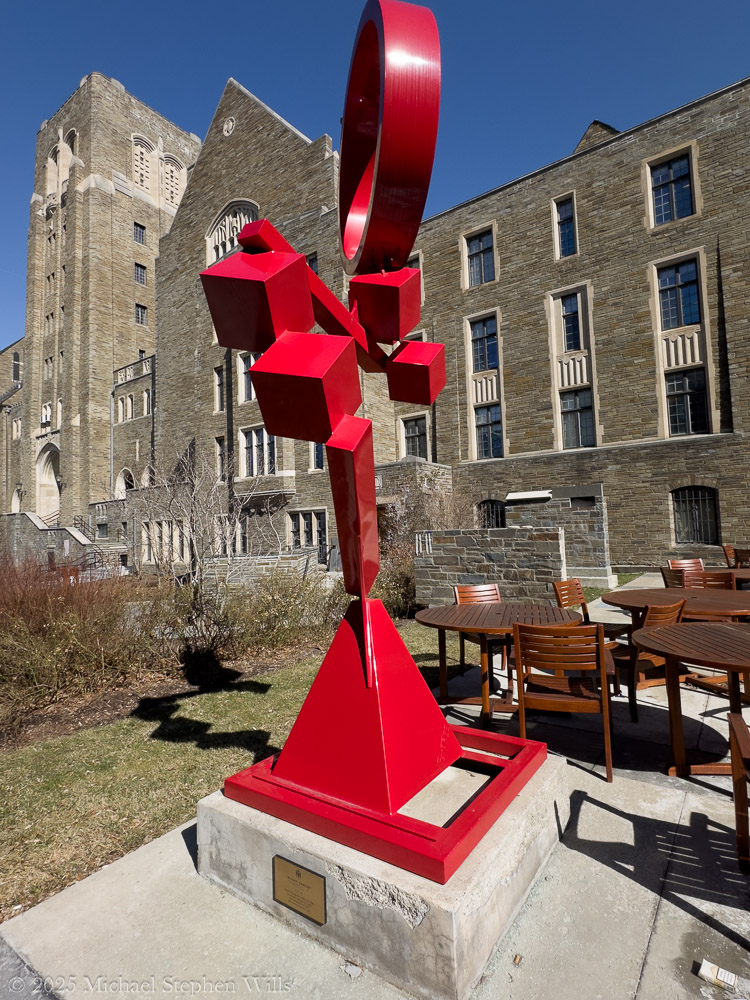
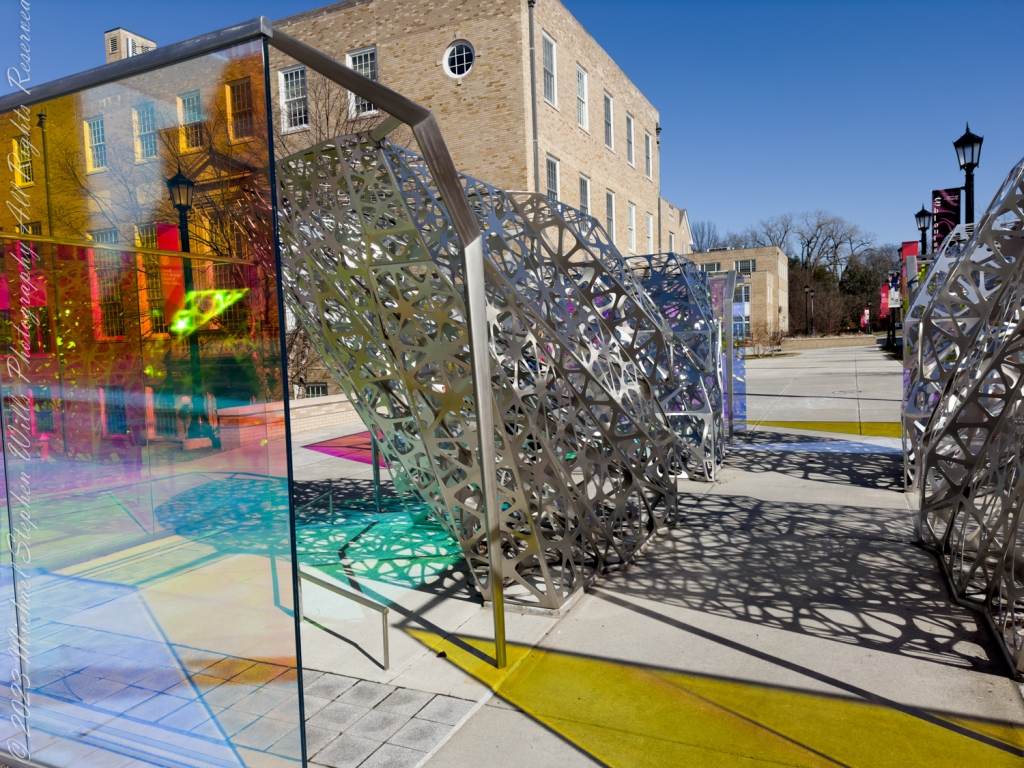
Reaching the top of the steps, I encountered, at the entrance to Hughes Hall museum, the striking “Magna Dancer” sculpture by Arline Peartree. Its bold red forms stood out vividly against the backdrop of the historic stone buildings. The plaque at the base provided a glimpse into its significance, commemorating the contributions of Cornell alumni. The sculpture’s dynamic lines and vibrant color injected a sense of modernity into the historic setting.

“Magna Dancer” steel and enamel sculpture, 1992 by Arline Peartree. Plaque on the sculpture plinth located outside Hughes Hall (behind Myron Taylor Hall – Cornell Law School), 241 Campus Road

Winter Buds and the Robinson Herb Garden

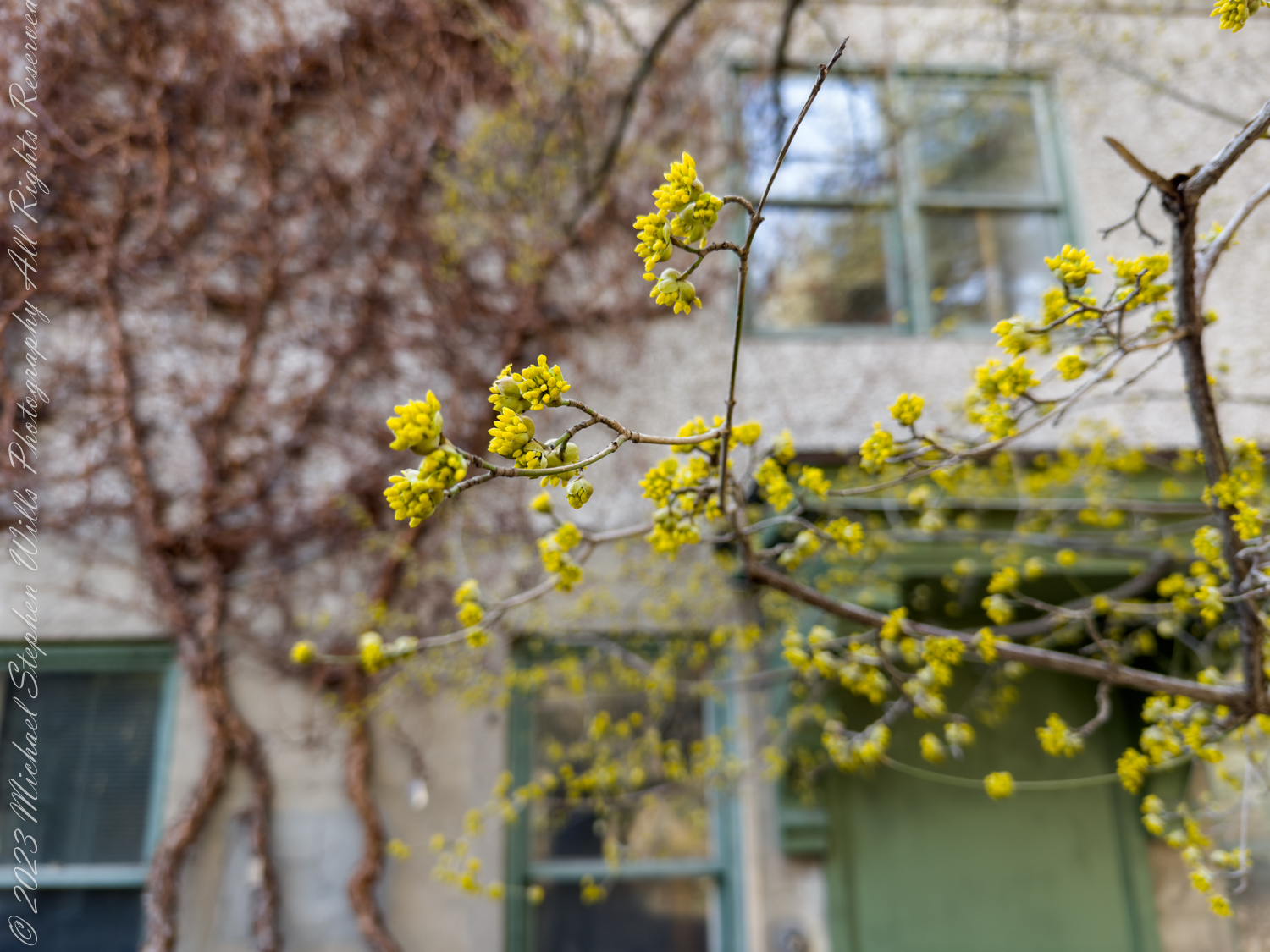
Here, I passed through the Robinson Herb Garden, where the late winter buds of a Cornelian Cherry Dogwood (Cornus mas) were beginning to unfurl. These bright yellow clusters heralded the arrival of spring, standing out against the bare branches and muted tones of the garden. It was a reminder of the cyclical nature of life and the resilience of the natural world.

The tree in the photograph with the yellow buds is a Cornelian Cherry Dogwood (Cornus mas). It is one of the first trees to bloom in late winter to early spring, producing clusters of small, bright yellow flowers before the leaves emerge. Cornelian Cherry Dogwood is often used in landscapes and gardens for its early bloom and attractive appearance. This tree grown in the Robinson Herb Garden, Cornell University

Mundy Wildflower Garden and Fall Creek

At Mundy Wildflower Garden, a hidden gem nestled beside Fall Creek, the landscape transformed into a tranquil haven, with the gentle sound of water flowing nearby. Though it was still early in the season, the promise of blooming wildflowers lingered in the air. The garden’s carefully maintained paths and rustic benches invited quiet contemplation.

These steps lead from the Robison New York State Herb Garden to Judd Falls Road and the Mundy Wildflower Garden

Exploring the Common Ferns Display

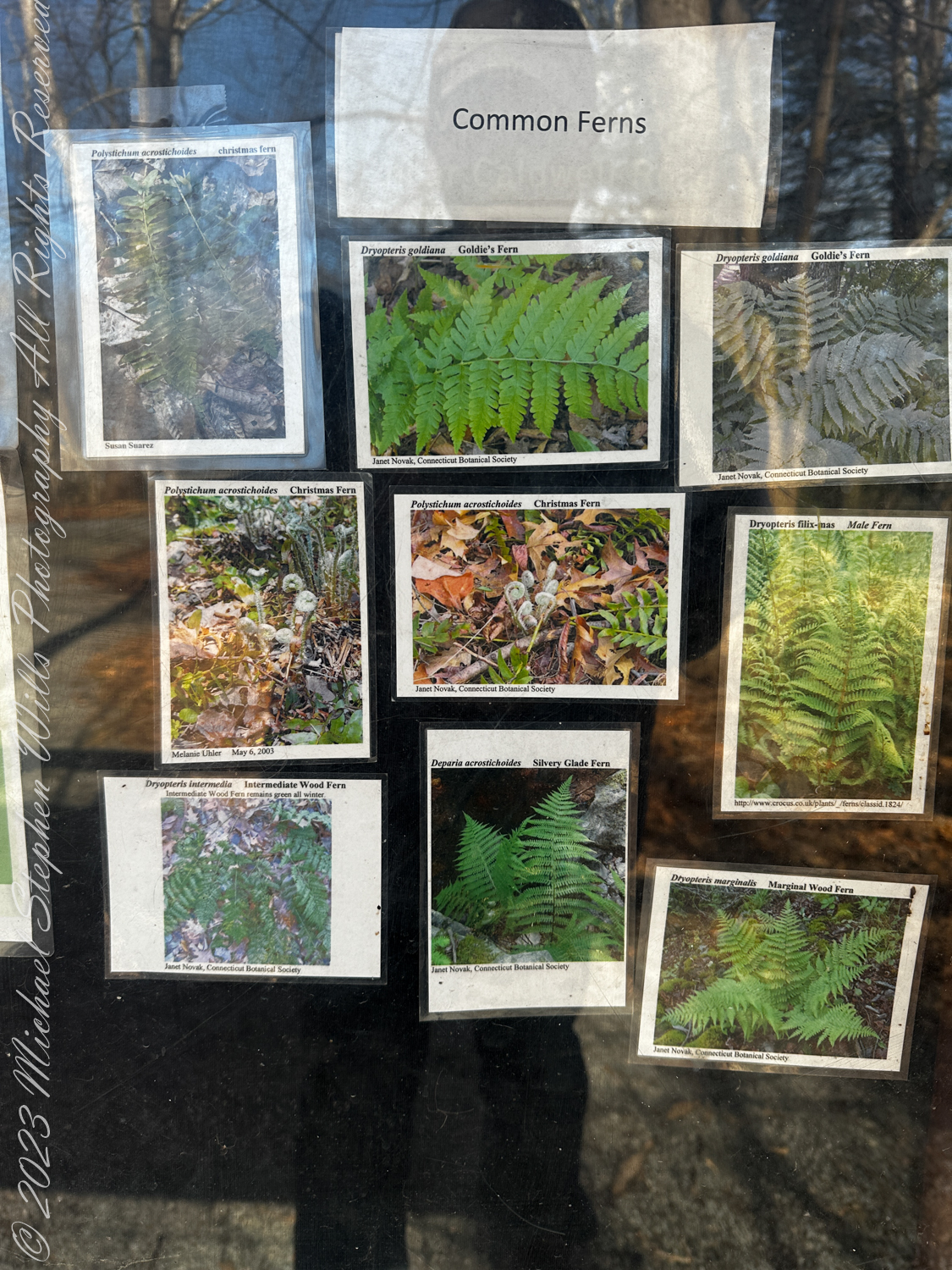
As I ventured further, I came across a display showcasing common ferns. The display included photographs and names of various ferns, such as the Christmas Fern (Polystichum acrostichoides) and Goldie’s Fern (Dryopteris goldiana). This educational exhibit was both informative and visually appealing, highlighting the diverse flora found on the campus.

Displayed on a display in the Mundy Wildflower Garden, part of Cornell (University) Botanical Gardens.

Observing the Weather Station

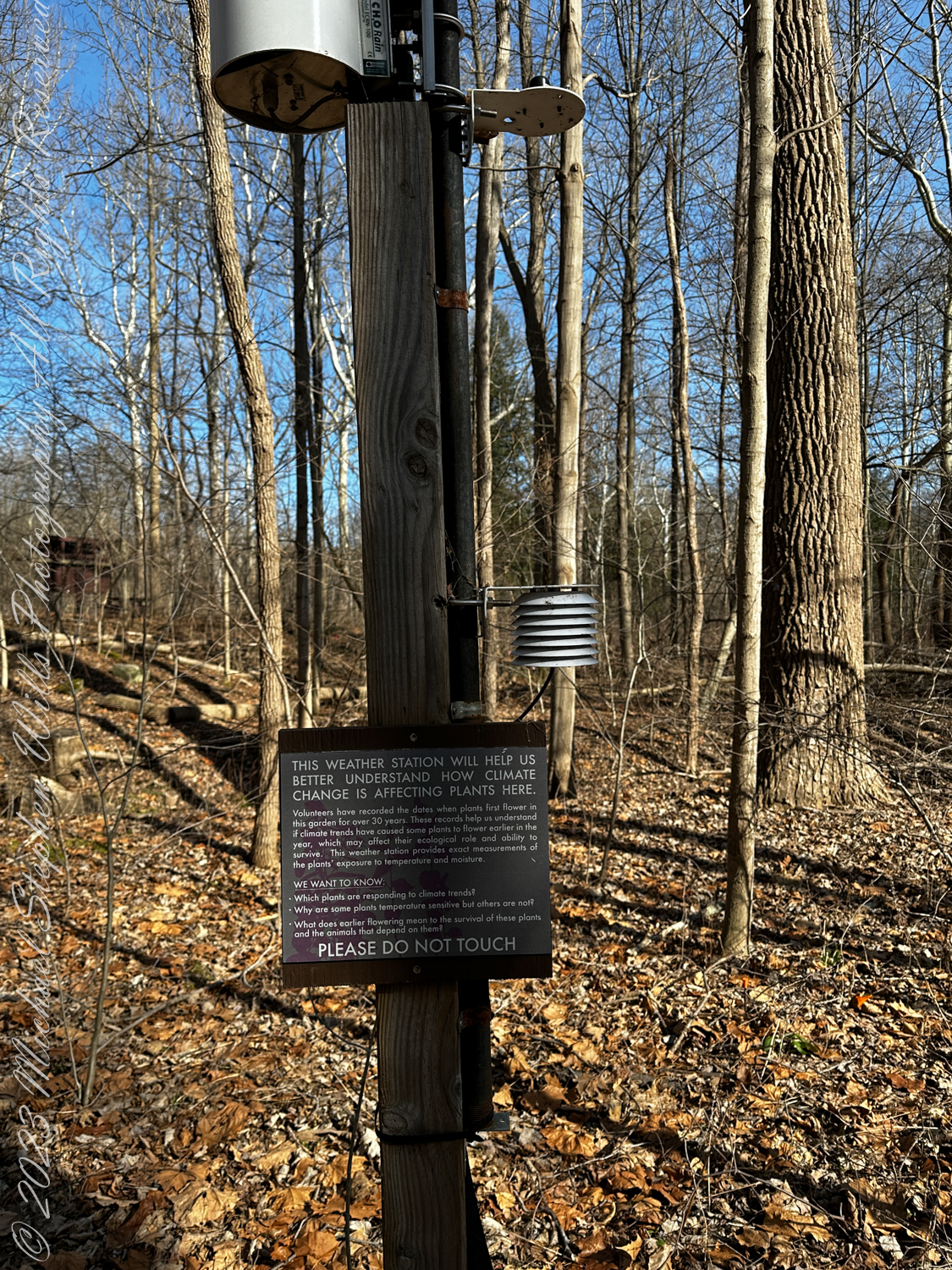
Nearby, a weather station stood tall, equipped with various sensors to monitor climate conditions. A sign explained its purpose: to help understand how climate change is affecting plants in the area. The data collected here would provide valuable insights into the phenological changes occurring within the garden.

Traversing the Slope to Olin Library

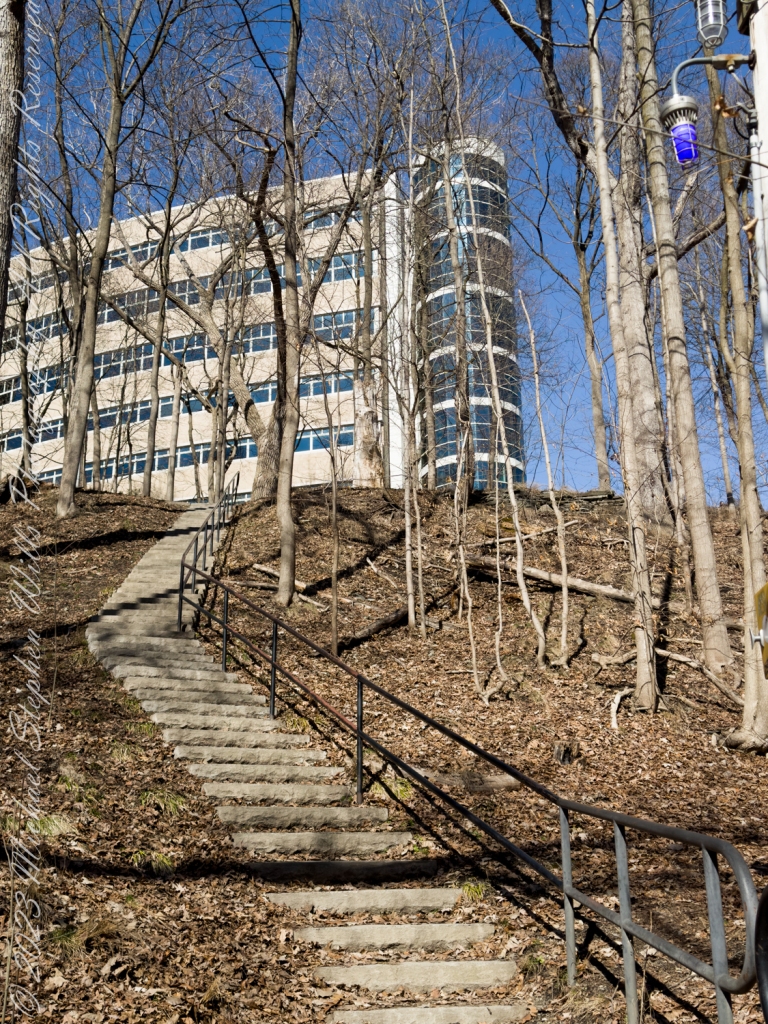
Returning, I made my way toward Olin Library. The path took me along a steep incline, “Lib Hill,” where I could see the stark branches of deciduous trees reaching toward the sky. The steps seemed to stretch endlessly upward, mirroring the journey of knowledge that students undertake within the library’s walls. The modern architecture of the library contrasted sharply with the surrounding natural landscape, symbolizing the intersection of nature and human achievement.

Approaching McGraw Tower

As I neared the heart of the campus, the McGraw Tower stood tall and prominent, albeit encased in scaffolding for restoration work. The historic building, with its distinctive clock face, was an emblem of Cornell’s rich heritage. Despite the scaffolding, the tower retained its majestic presence, a testament to the ongoing efforts to preserve its legacy.

This view is from Central Avenue. Morrill Hall is on the left. The tower is part of Uris Library. Cornell University, Ithaca, Tompkins County, New York State

Returning to Cascadilla Park Road

As descended the hill, following Cascadilla Creek, reflecting on the six mile journey, I felt a profound connection to the enduring beauty and resilience of both nature and human creativity. The walk had taken me through time and space, from historic landmarks to natural wonders, each step revealing a new facet of the Cornell University campus.

Reflecting on History

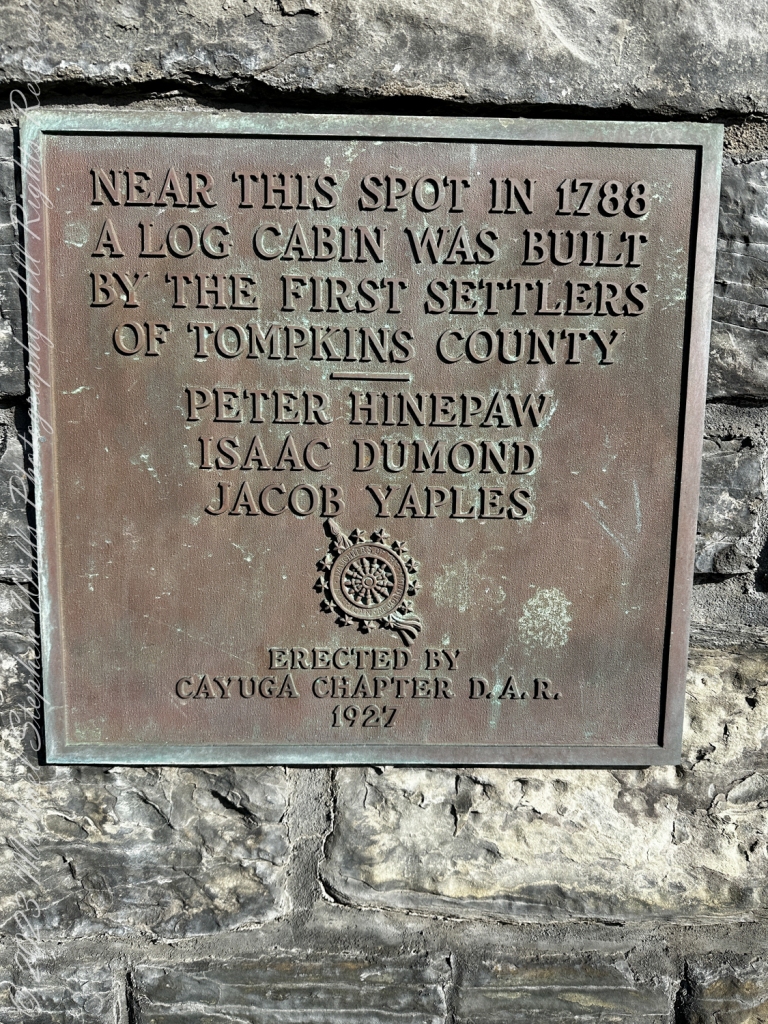
My walk took me past a plaque commemorating the site of the first settlers’ log cabin in Tompkins County, built in 1788. The plaque, erected by the Cayuga Chapter D.A.R. in 1927, was a poignant reminder of the area’s deep-rooted history and the pioneering spirit that shaped it.

This plaque on the corner of University Avenue and Cascadilla Park Road Road, “Near this spot in 1788 a log cabin was built by the first settlers of Tompkins County — Peter Hinepaw, Isaac Dumond, Jacob Yaples. Erected by Cayuga Chapter Daughters of the American Revolution 1927

This late winter walk, captured through my lens, was a celebration of the quiet splendor of the season and the enduring spirit of a place that thrives on discovery and growth.

Copyright 2024 Michael Stephen Wills All Rights Reserved