Hepatica at Fillmore Glen: Quiet Wonders Beneath the Leafless Trees

On a quiet April walk in Fillmore Glen State Park, I found Hepatica acutiloba blooming beneath leafless trees—small, luminous flowers that turned the still-brown woods into a meditation on patience, renewal, and grace.

On April 11, 2026, I walked Fillmore Glen State Park beneath trees still bare, their branches opening the woods to the cool, unguarded light of early spring. The forest had not yet put on its full green speech. Last year’s leaves still covered the ground in shades of russet and tan, and among them, close to the earth, I found Hepatica acutiloba beginning to bloom.

These are flowers that ask for slowness. No one hurrying through the woods would fully see them. I had to kneel, lower myself into their world, and let my eyes adjust to their scale. Only then did they begin to reveal themselves: first as closed buds, pale and self-contained, then as opened white blossoms shining from the leaf litter like small votives in the dim cathedral of the spring woods.

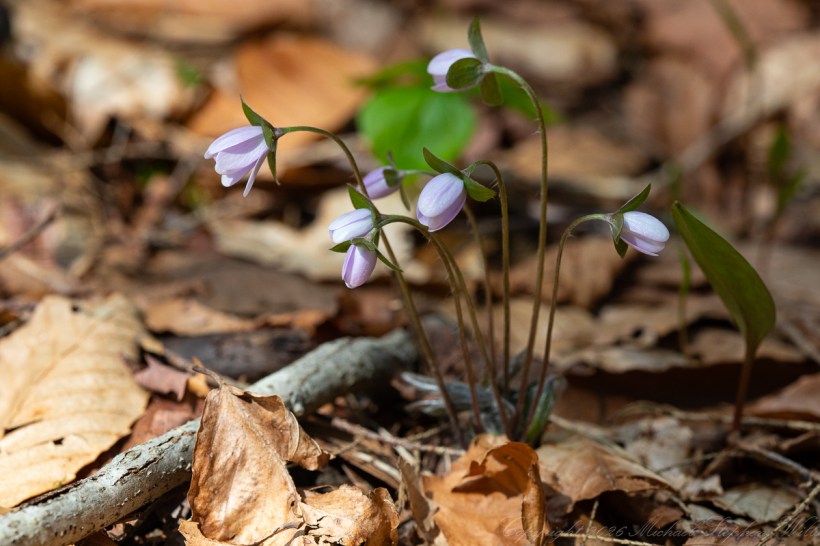
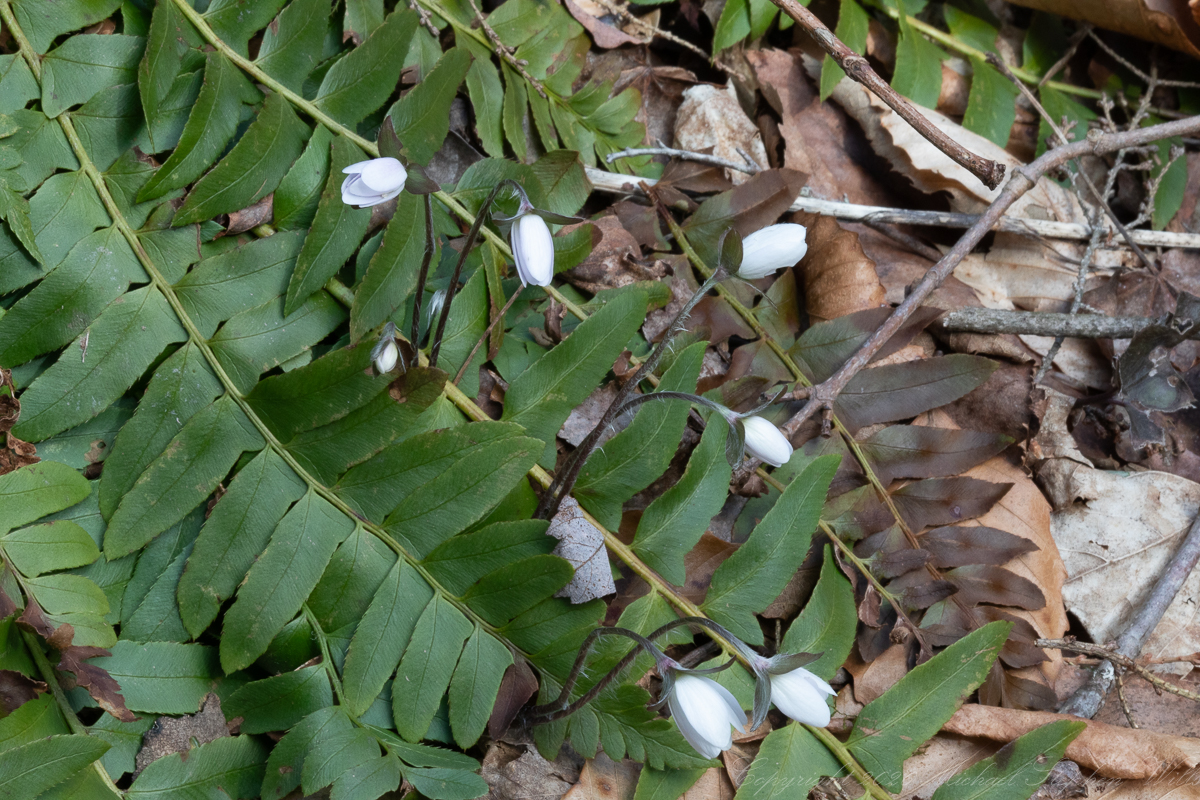
This flower was a light lavender blossoms, still closed, rising from the forest floor on a delicate stems. The sun had reached in, and I made the image handheld, steadying the camera on the ground. Even unopened, it seemed to hold light within itself, as though the day had touched it but not yet persuaded it to unfold. I have always loved that about hepatica. It does not fling itself into spring. It listens first. It waits with an old intelligence, answering warmth and brightness in its own time.

Lavender Hepatica Blossoms, closed

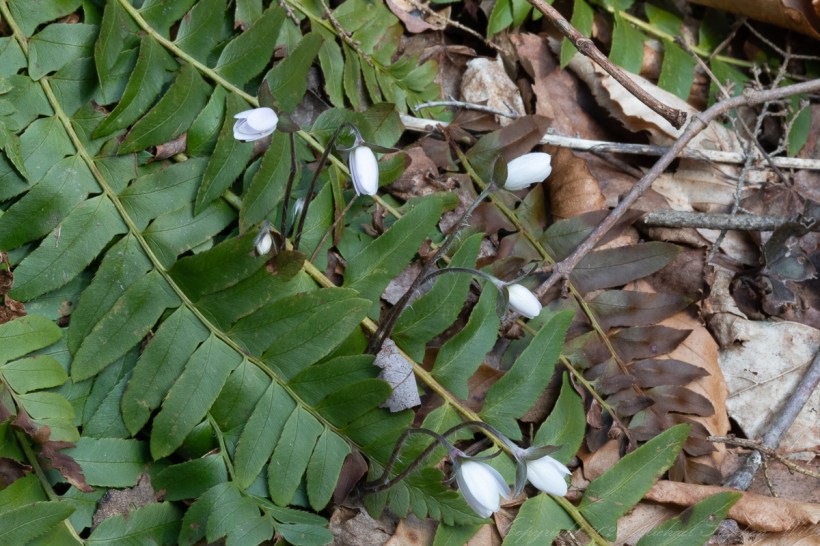
A second cluster of closed blossoms rested among evergreen fern fronds, which appear to be Christmas fern, Polystichum acrostichoides. Their leathery green pinnae, carried through the winter, formed a fitting companion to these early flowers. Together they seemed to embody one of the quiet truths of the April woods: that renewal does not come as a sudden trumpet blast, but by degrees. First the fern still holding its winter green. Then the bud. Then the opening. Then the day when the whole hillside begins to feel like a promise being kept.

White Hepatica Blossoms with Christmas Fern

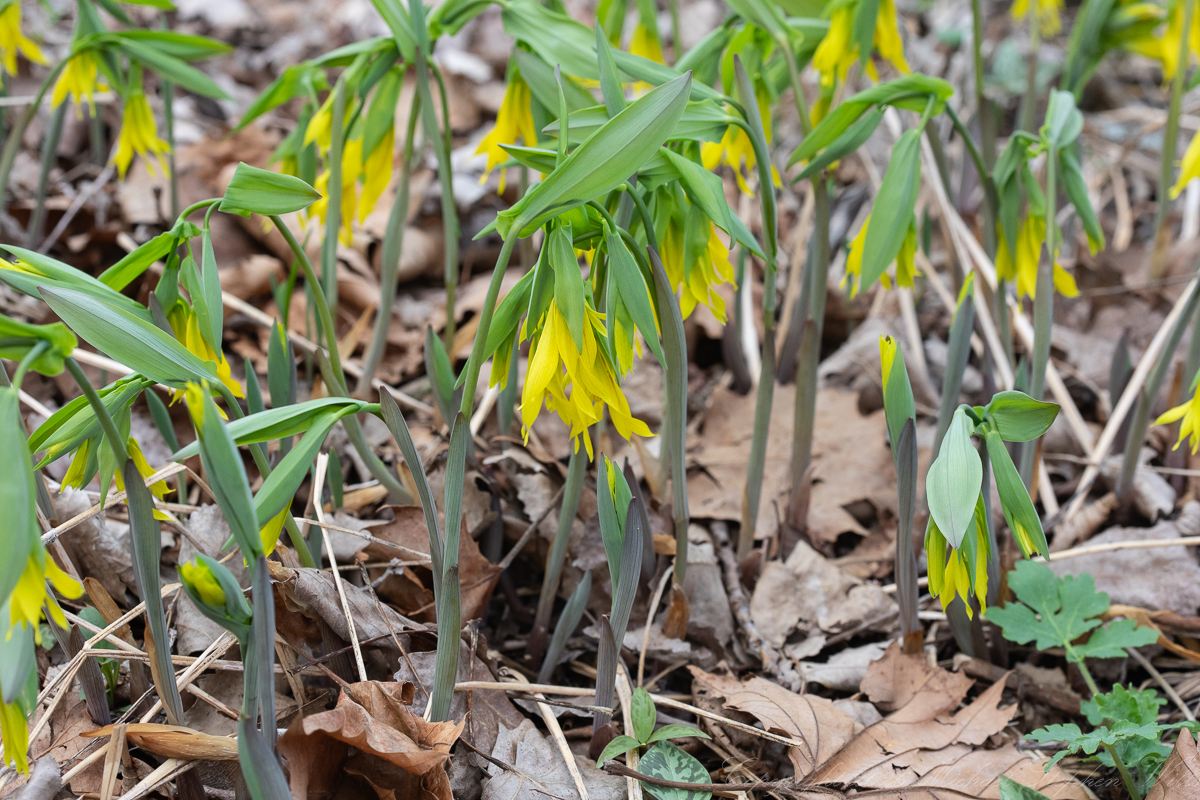
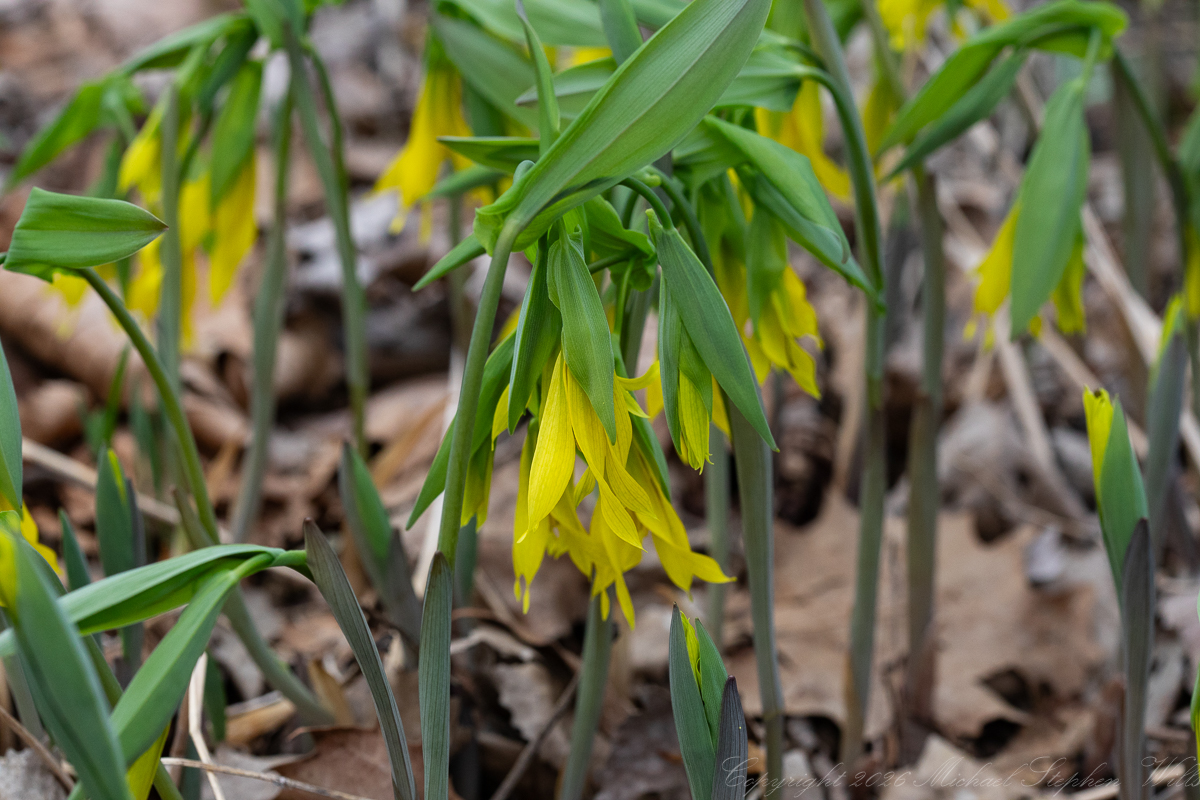
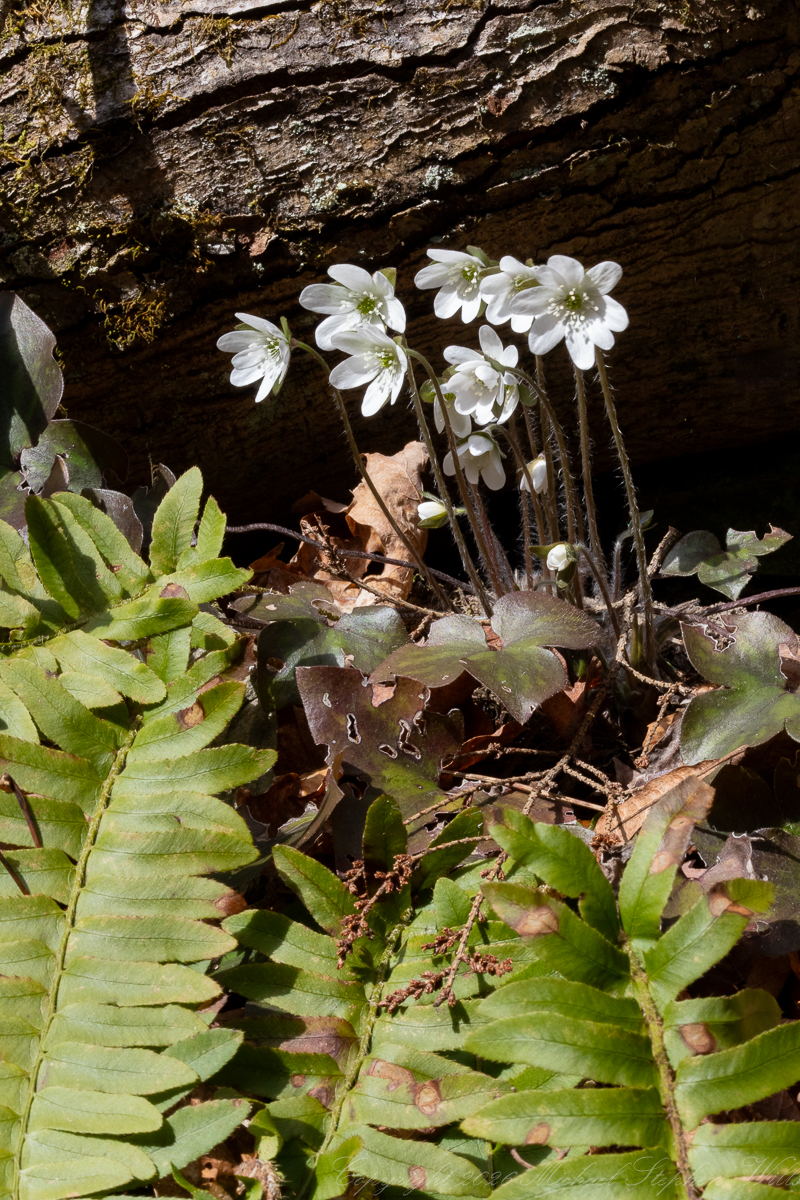
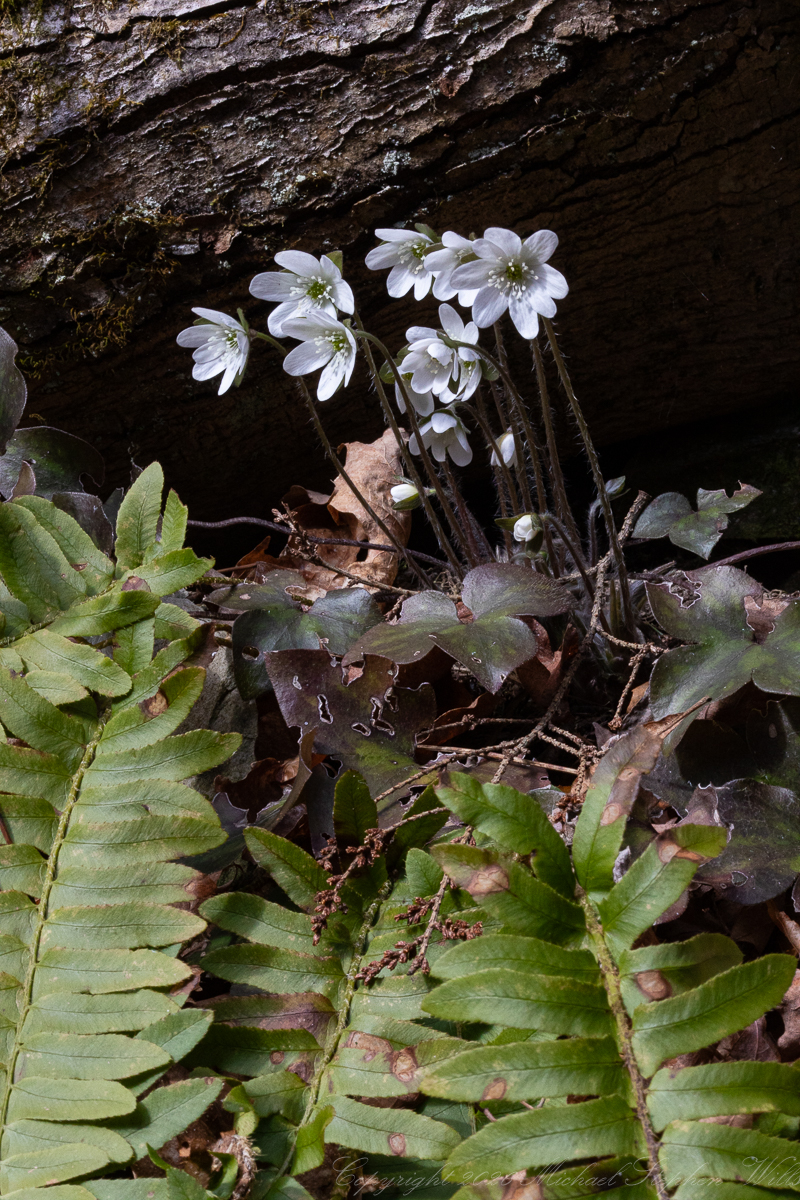
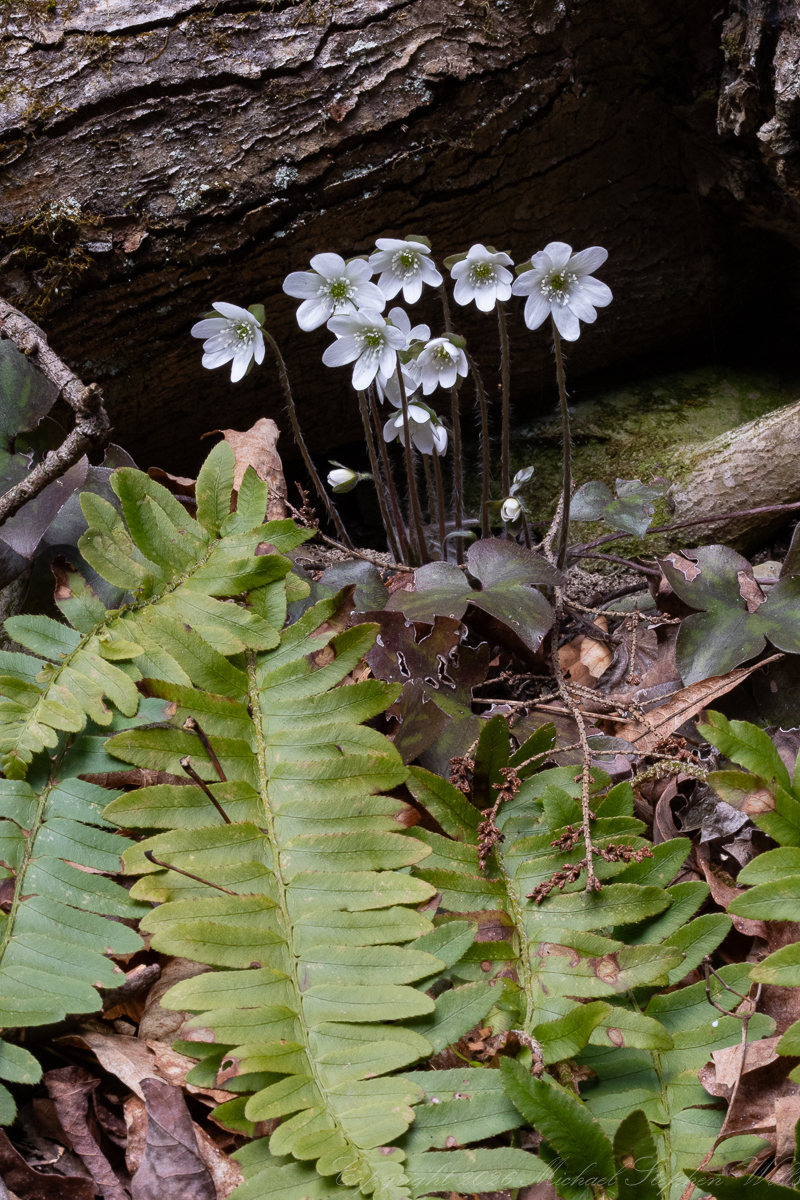
The last three photographs showed the same group of white hepatica blossoms growing on a south-facing slope beneath a tree root. By then I had placed the camera on my Manfrotto BeFree tripod, and I worked more deliberately, grateful for the patience that such flowers invite. One image was made in sunlight; the others when the sun had passed behind a cloud. That change mattered. In the sun, the white blossoms seemed almost to ring like little bells of light. Under cloud, they grew quieter, softer, more inward. The mood deepened. The exposed root above them became a rough shelter, a woodland lintel, and the blossoms beneath gathered into a hidden chapel of spring.

Hepatica acutiloba in sunlight on an early spring afternoon. Fillmore Glen New York State Park, Cayuga County, Finger Lakes Region, New York State. April 2026

I stood there for a long while, looking not only at the flowers but at the place that had made their blooming possible. A south-facing slope gathers warmth earlier in the season. The root held the bank in place and offered a small measure of protection. The leaf litter insulated the soil. The ferns kept their green nearby. Nothing in such a scene is accidental. The woods are full of these small negotiations between light, temperature, shelter, and time. Hepatica, for all its delicacy, is a master of them.

Here a cloud hid the sun, the blossoms in side view.

We call these flowers spring ephemerals, and the name is true in one sense. Their season of bloom is brief. Before long, the trees overhead will leaf out, and the bright interval in which they thrive will begin to close. Yet “ephemeral” can sound too fragile a word for a plant so well adapted, so seasoned in its timing. Hepatica does not merely appear and vanish. It endures. Its leaves persist through winter. Its flowering is tuned to a narrow ecological opening, one shaped by the still-bare canopy of the deciduous forest. For a few precious weeks, before shade deepens, it steps into the light and makes use of what the season offers.

The sun still hidden by a cloud, the blossoms face on.

Perhaps that is why hepatica has so often found a place in literature and nature writing. It carries a symbolism that feels earned rather than assigned. It arrives when the world still bears winter’s austerity, and so its bloom seems less decorative than revelatory. Generations of observers have seen in such flowers a sign that the year turns first in whispers. Not through spectacle, but through fidelity. A small flower opening under bare branches can change the whole moral weather of a walk.

That was how it felt to me at Fillmore Glen. The woods were still mostly brown and gray, still waiting for leaf and shade and birdsong in full chorus. Yet these blossoms had already crossed some invisible threshold. They were spring in its purest form: not abundance, but inception. Not the full choir, but the first clear note.

Photography, in such moments, becomes for me an act of receiving. The changing light, the choice of aperture, the longer exposures when the sun went behind a cloud, the shift from handholding to bracing to tripod—all of it asked for attention. Hepatica does not yield itself to haste. It asks me to be present enough to notice what kind of light it is standing in, what kind of slope it has chosen, what old leaves still surround it, what green companions remain from winter. The camera only deepens that act of seeing.

I left Fillmore Glen feeling that I had witnessed something both small and immense. These flowers were no larger than a coin, yet they altered the whole forest around them. The leaf litter no longer seemed merely dead, but sheltering. The bare trees no longer seemed empty, but expectant. In the presence of hepatica, the woods felt poised on the edge of utterance.

That may be the lasting wonder of these early blooms. They do not overwhelm. They steady. They remind me that beauty often comes close to the ground, half-hidden, speaking softly. In the leafless woods of April, that soft speech can feel like grace.

Enter your email to receive notification of future postings. I will not sell or share your email address.

Glacial Kettle Bog Wonders: Photographing Pitcher Plants at the O.D. Engeln Preserve in Freeville

Step onto Freeville’s O.D. Engeln Preserve boardwalk and meet purple pitcher plants in a glacial kettle bog—carnivorous beauty, hidden blooms, and macro-photo magic.

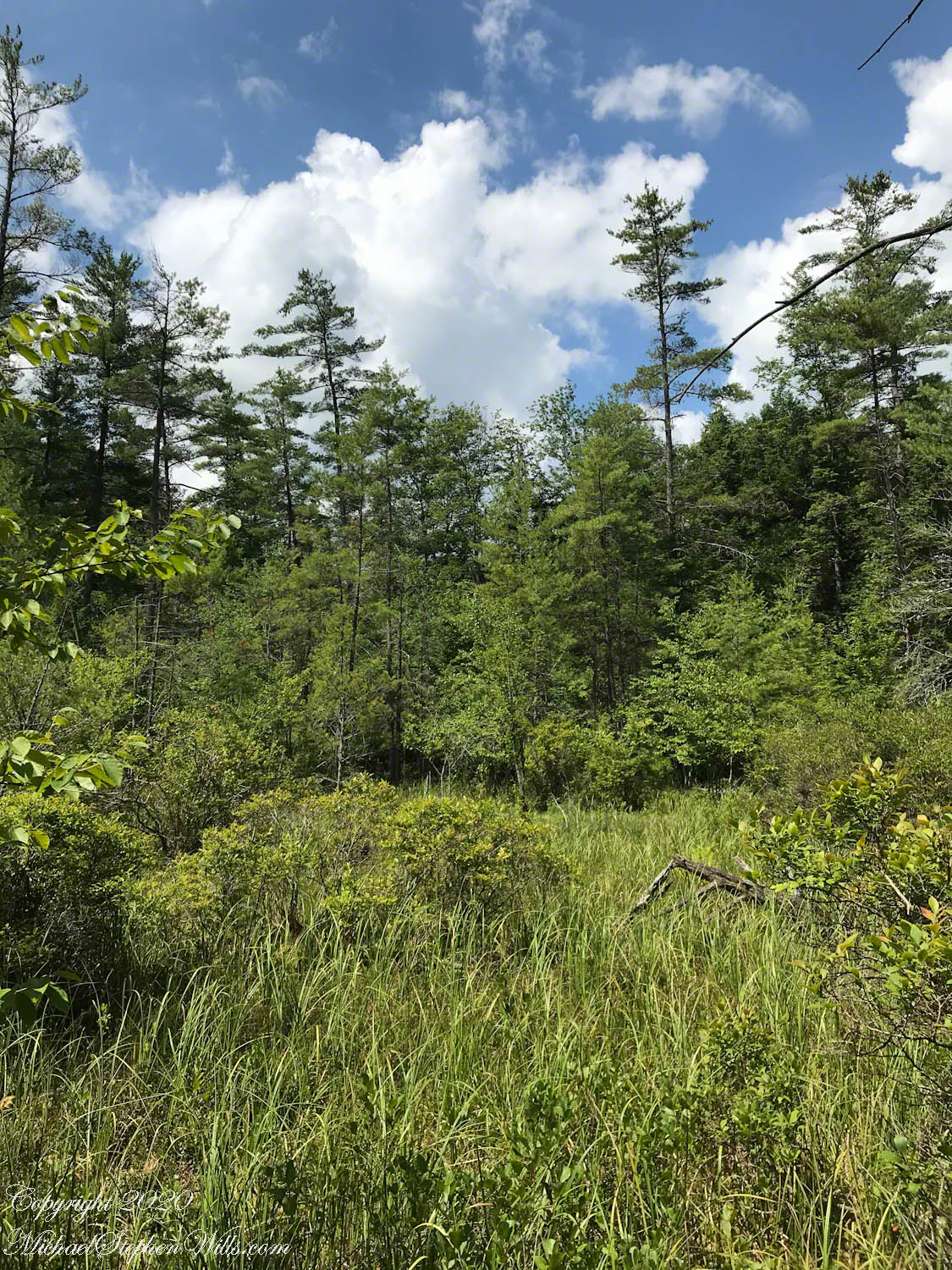
Seen from 1000 feet above in Google Earth, the O.D. (Von) Engeln Preserve at Malloryville Road lays itself out in two glacial “kettles,” pond and bog; a simple diagram drawn by ice and time, then complicated by everything that has happened since. In my photograph, taken from the bog observation platform on a July morning, the sky is rinsed blue, clouds billow, conifers stitch along the rim around open space. Step closer, or lower your lens, and the openness resolves into a crowded, intimate architecture of sedges and moss, twigs and standing water, sunlight and shadow.

I came here for a plant that does not announce itself the way wildflowers often do. The purple pitcher plant, Sarracenia purpurea, is a quiet scandal: a green vessel in a place where green should be satisfied simply to survive. I arrived equipped for attentiveness—an iPhone for the broad scene, and a Canon DSLR with the F2.8 100 mm macro lens for the stars of this bog. The macro lens is an instrument of humility. It forces you to admit that the important drama is often no bigger than your palm.

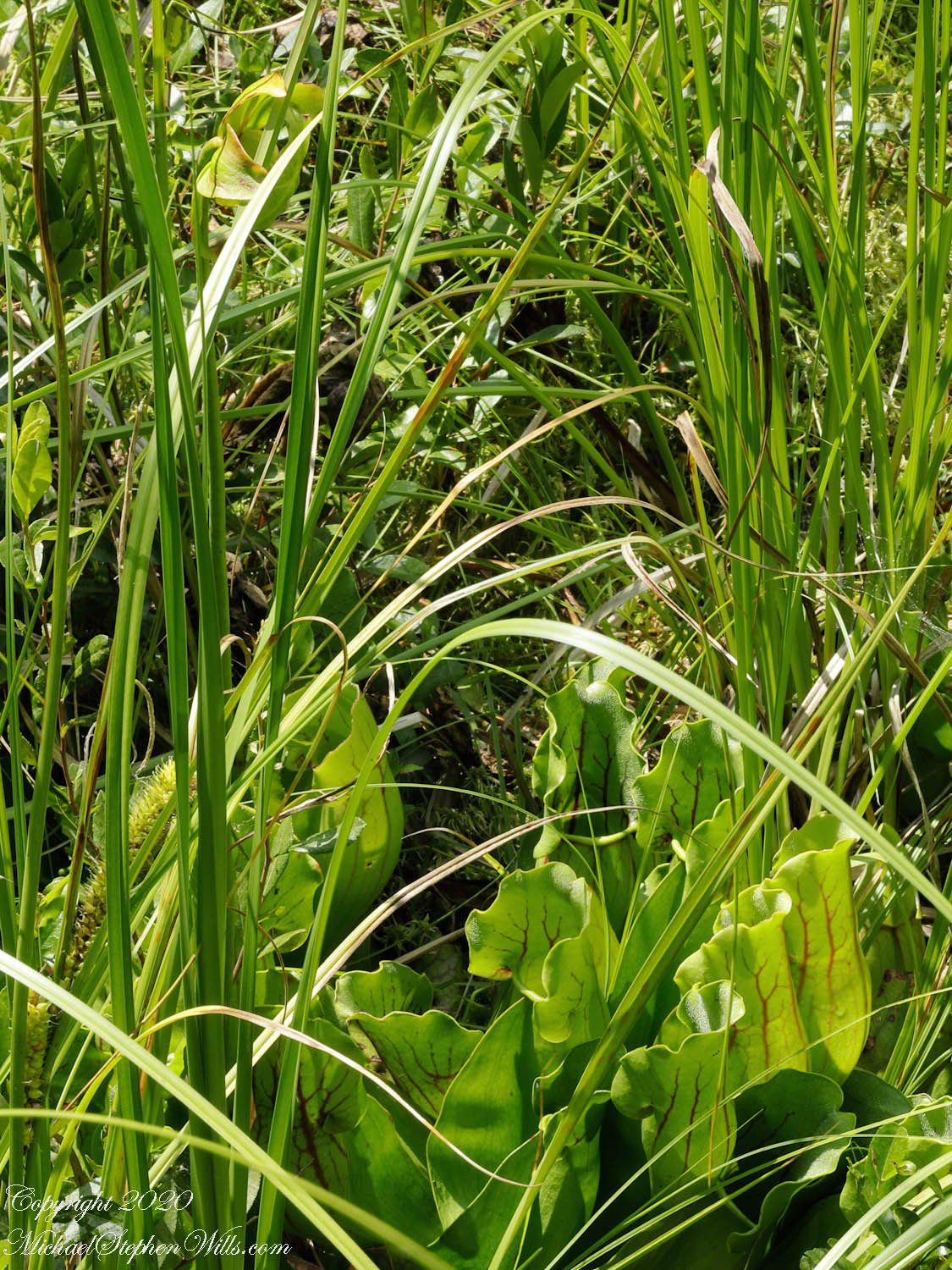
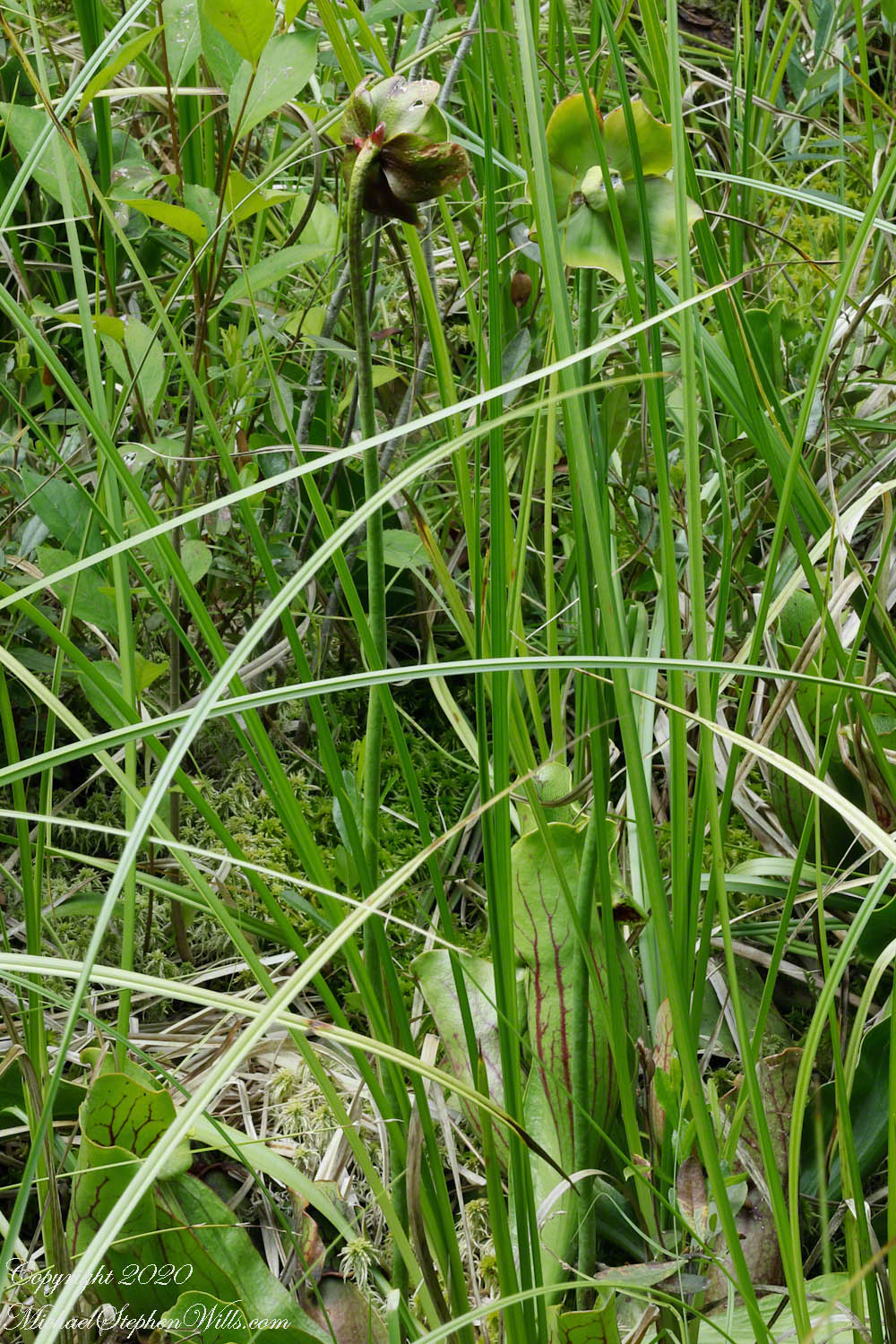
In earlier years, the pitchers could be found right where a visitor naturally looks—within the central cut-out of the observation deck, close enough to lean over and study. But the bog is not a museum display; it is a living negotiation. This season, highbush blueberries pressing in from the margin had crowded the pitchers out, pushing the flowering plants into the grasses eight to ten feet away. The shift is small in human terms, the kind of distance you cross without thinking. In bog terms, it is displacement—an erasure of a familiar scene, a reminder that rarity is not only about numbers but also about space.

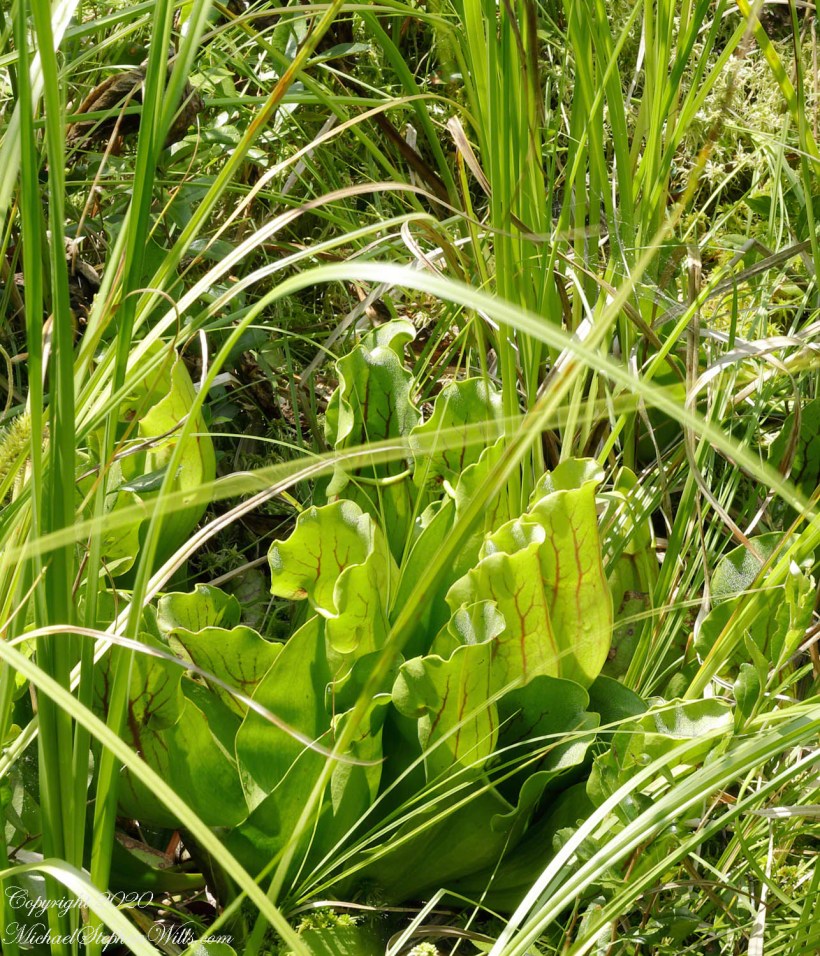
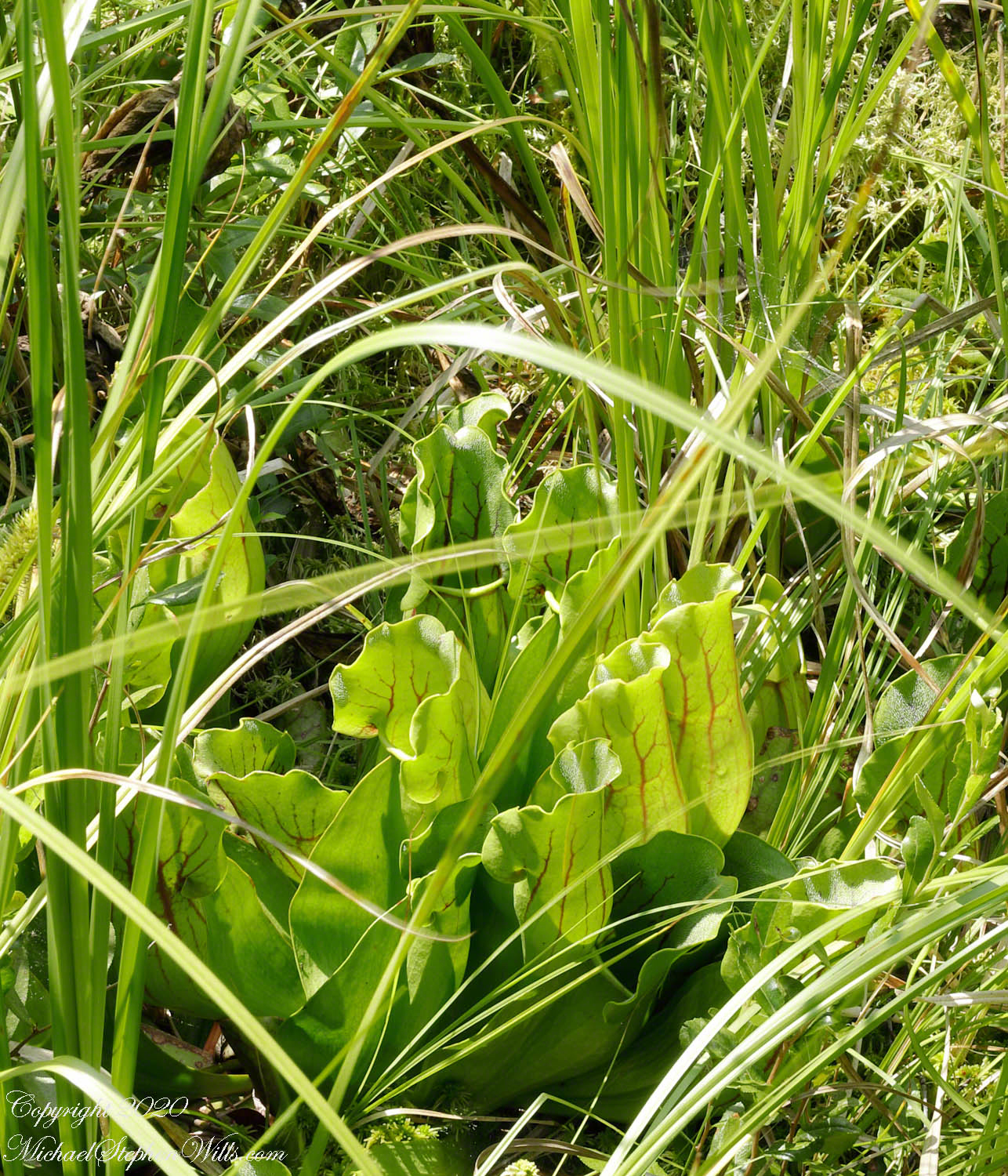
The pitchers themselves—those “turtle socks,” as they’ve been nicknamed—sit at ground level in a rosette, their mouths open to weather. Sunlight floods the cups and turns them into something both domestic and uncanny: a set of green, veined slippers left out to air, or a cluster of small amphorae awaiting an offering. In the bog’s thin soil, nourishment is hard-won. The pitcher plant answers that poverty with invention. Instead of arguing with the chemistry of peat, it borrows from the animal world—luring and taking what the air can spare. The cup is a trap, yes, but also a reservoir: rainwater gathered and held, a miniature wetland that mirrors the preserve’s larger one.

There is a tension here that never quite resolves: the plant’s beauty, and the plant’s appetite. We admire the cup’s red veining, the glossy rim, the way the opening flares like a lip; then we remember what the lip is for. We admire the flower’s elegant sheltering forms; then we realize the shelter is also a funnel, a choreography. This is not cruelty—no more than winter is cruelty. It is adaptation made visible, a lesson in how form follows need, and how need can produce something unexpectedly lovely.

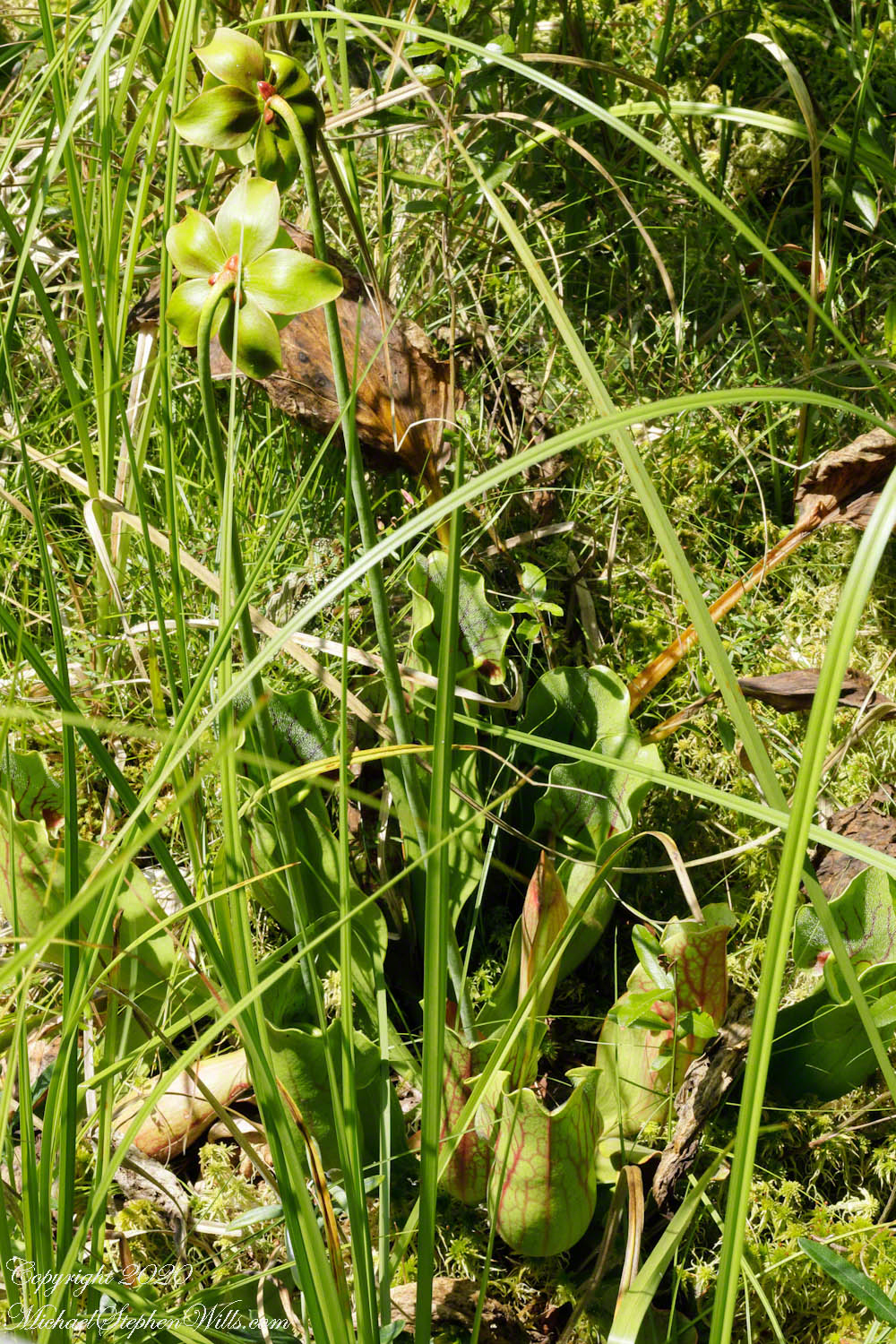
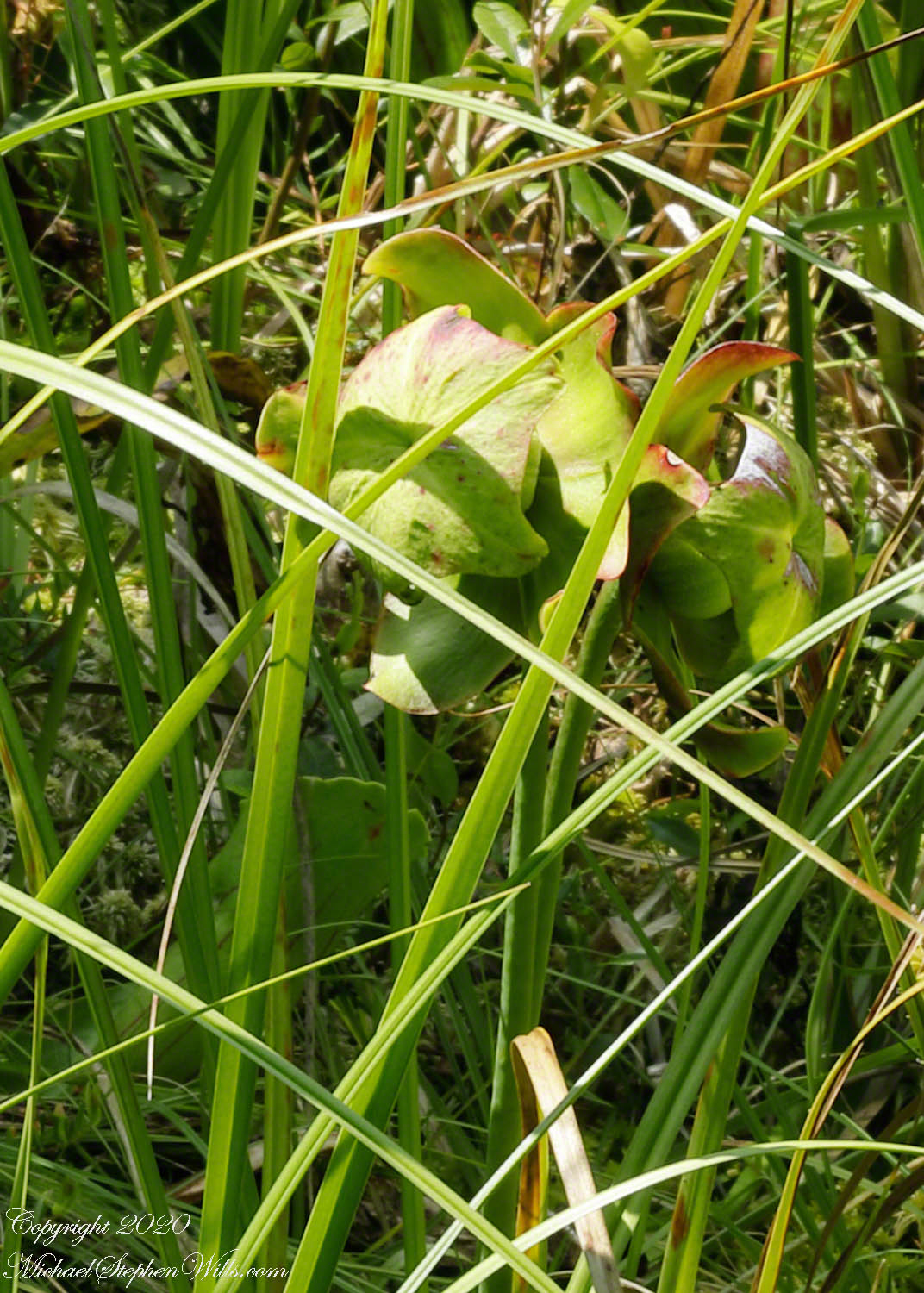
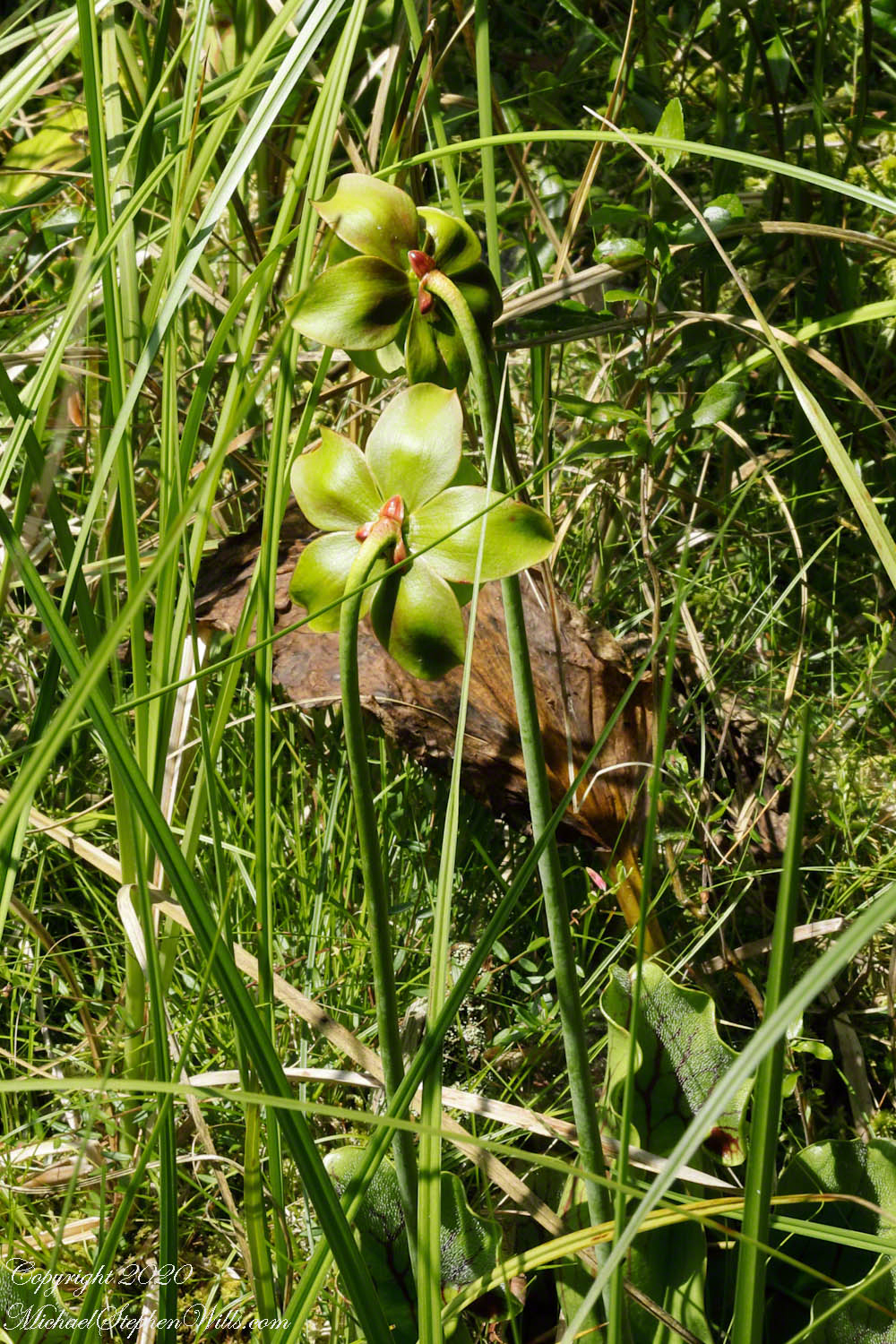
And yet the real marvel—the reason I came that day—rises above the traps on a strong stalk, lifted clear of the dangerous mouths below. The flower is not purple in the obvious way its common name promises. It is subtler and stranger: a suspended structure with the poise of a lantern and the protective logic of armor. It struck me as a flower unlike any I have experienced, resembling an insect carapace, with the reproductive element underneath a hood. That hooded design feels less like ornament than strategy—an architecture that guides a pollinator’s route, controlling entrances and exits the way the pitcher controls the fall of an insect.

Even the flower’s back side refuses to perform for the camera. From the posterior angle, “there are only bracts”—plain supporting structures, the botanical equivalent of scaffolding left in place once the facade is finished. The bog, too, shows its scaffolding everywhere: dead stems, old wood, peat-dark water, last year’s leaves. A preserve is never only what is blooming. It is what persists.

I found myself thinking about the details I wanted but could not quite capture that day: the downward facing hairs inside the pitcher—those one-way bristles that make retreat difficult once a victim has slipped in. I or my lens was not up to this challange. The shortcoming was minor, but instructive. The bog offers glimpses, not guarantees. It invites return visits, different light, different seasons, a different kind of patience.

Standing on the platform I felt the preserve’s central truth: these are landscapes shaped by constraint—by ice, by water, by nutrient scarcity, by the slow encroachment of shrubs—and yet they keep producing improbable forms. The purple pitcher plant is one of those forms: a green cup that drinks rain, a flower that wears a hood, a turtle sock that turns hunger into design. In a place where the ground itself seems to refuse abundance, the plant answers with a different kind of richness—an elegance that is also a solution.

Enter your email to receive notification of future postings. I will not sell or share your email address.

The Prison Group

Studded with tourists

Click Me for my Online Gallery

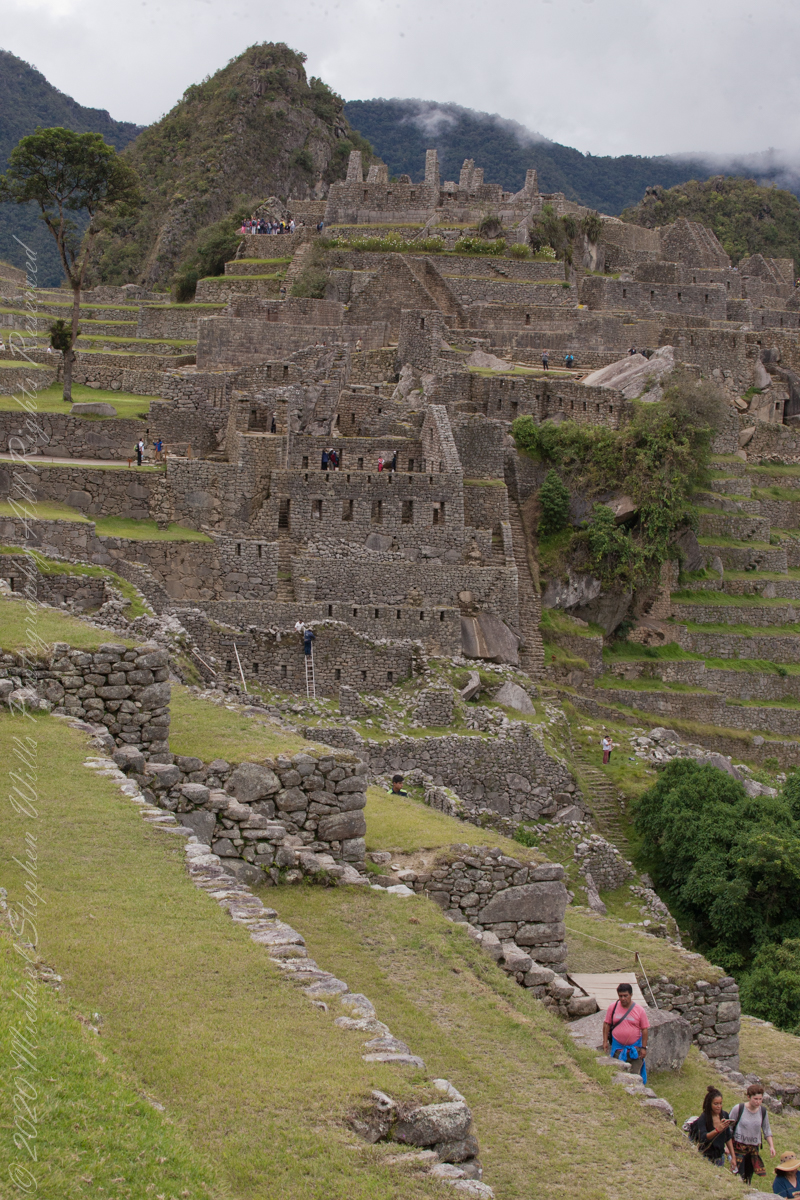
The wall with six rectangular windows is part of the “Prison Group”, a labyrinthine complex of cells, niches and passageways, positioned both under and above the ground. A portion of agricultural terraces is to the right and foreground. Look closely to see a group of tourists in the “Industrial Zone” district.

Copyright 2023 Michael Stephen Wills All Rights Reserved

Agricultural Terraces

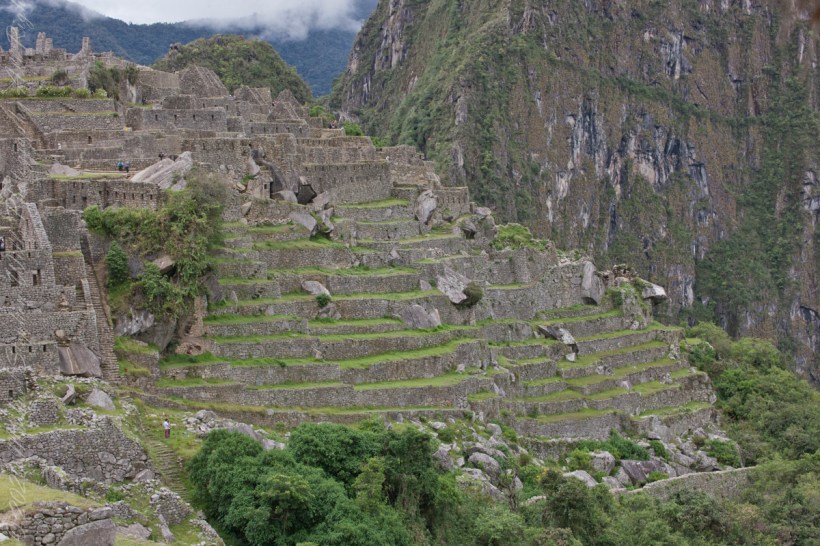
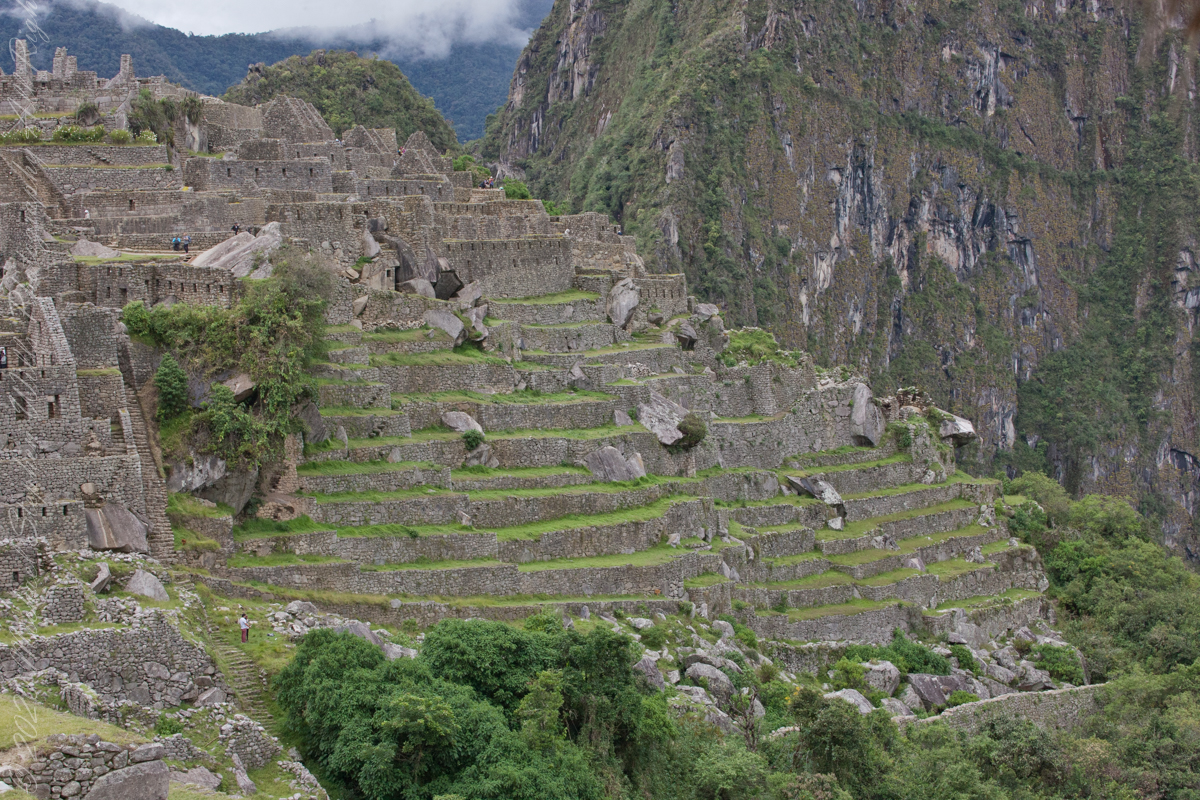
These terraces were a work of considerable engineering….

Click Me for my Online Gallery

These agricultural terraces, built in the 15th century, were still in limited use by local farmers when Bingham arrived in the early 20th century. These terraces were a work of considerable engineering, built to ensure good drainage and soil fertility while also protecting the mountain itself from erosion and landslides. Modern soil studies reveal the major crops were corn and potatoes. These terraces are below the districts named “Industrial Zone” and “Factory Houses.” A cliff of Huayna Picchu is in the background.

Copyright 2023 Michael Stephen Wills All Rights Reserved

Houses of Factories First Look

Click Me for my Online Gallery

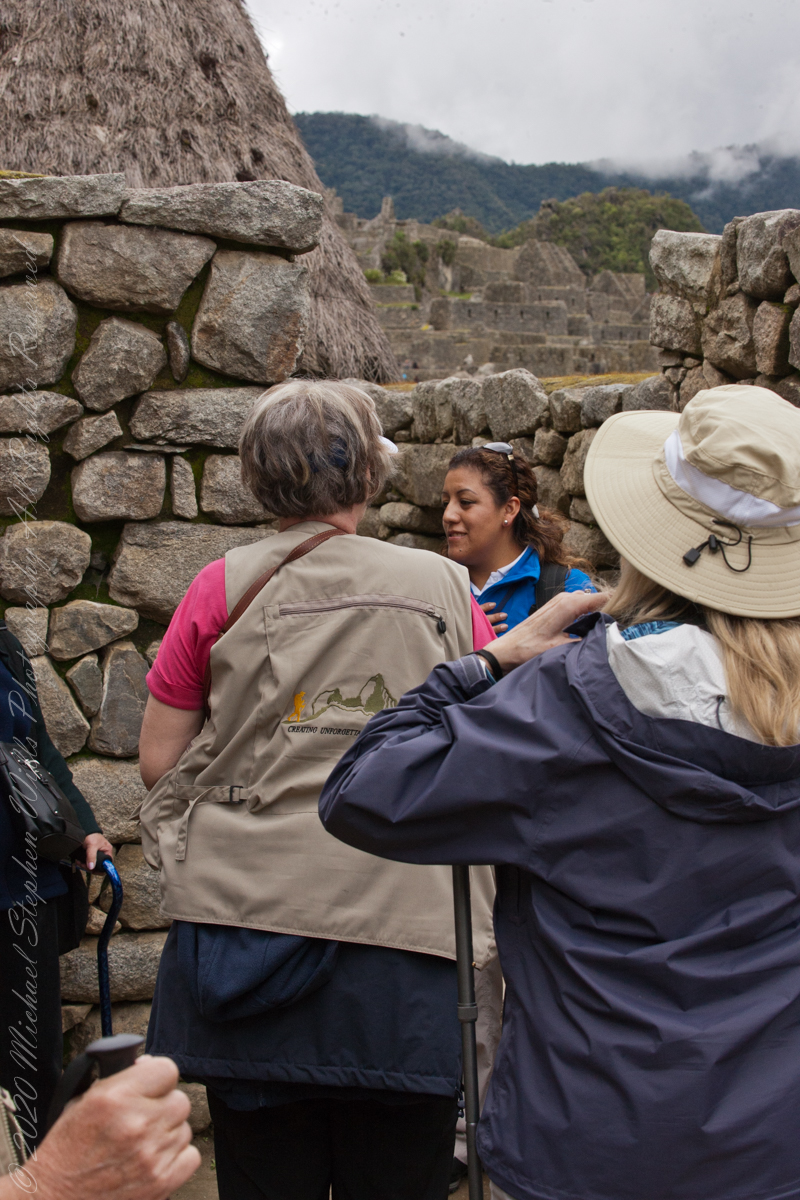
Our Excellent Guide

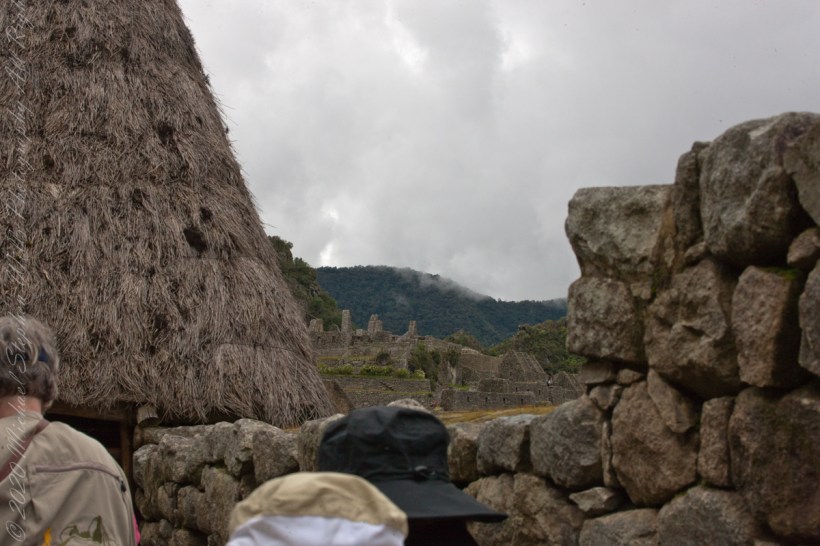
Thatched Hut

Houses of Factories in distance

Copyright 2023 Michael Stephen Wills All Rights Reserved

Guardhouse of Machu Picchu

…and medical evacuation.

Click Me for my Online Gallery

We enter Machu Picchu Sanctuary from the trail leading from Intipunku (the Sun Gate), which nowadays is the finish of the classic 4 days Inca Trail hike. There is also an entrance from the west from Vilcabamba.

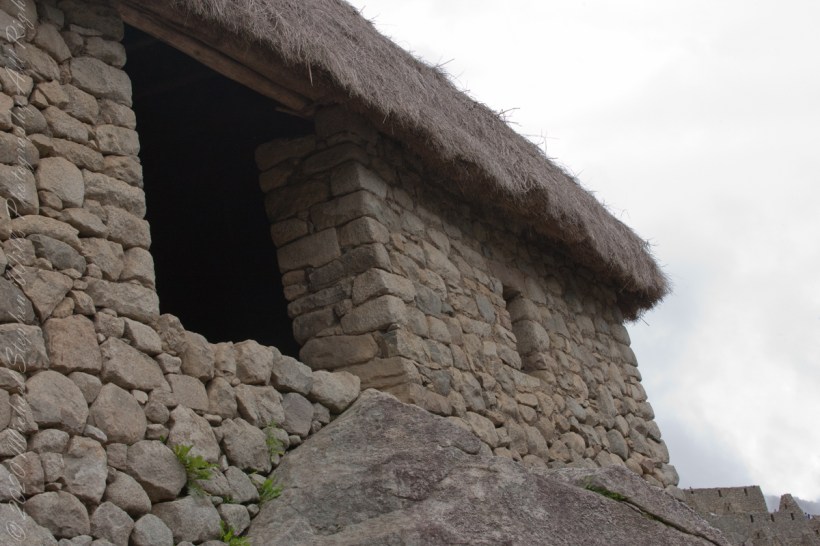
The Guardhouse also known as the Caretakers Hut was a thatched roofed building constructed from crude stones and featured 3 walls and one open long side. The Guardhouse was a building used by soldiers who guarded two main entrances to Machu Picchu.
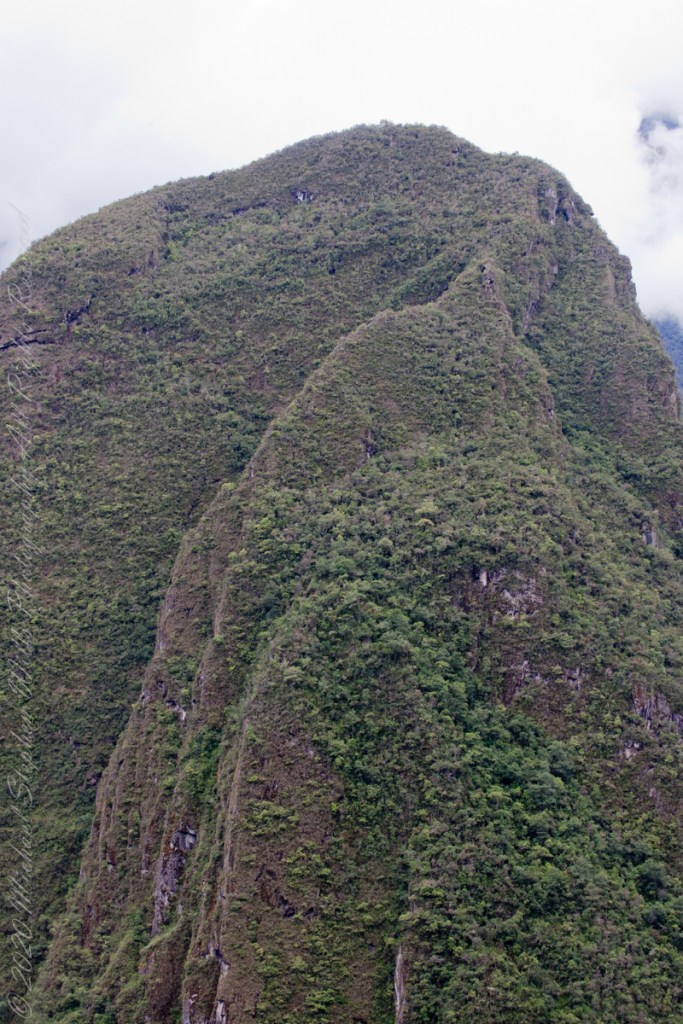
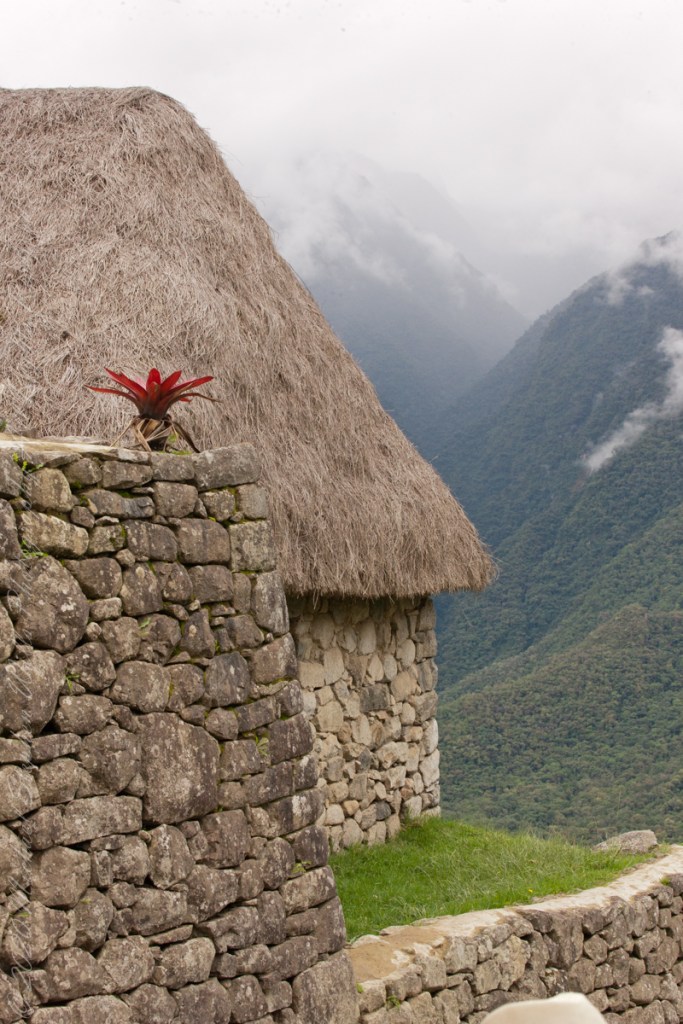
Below the Guardhouse are three thatch-roofed stone huts, the entrance trail passed beneath the lowest, shown here. A cliff of Huayna Picchu forms the background.
The Guardhouse is one of the first attractions on the upper tourist circuit around Machu Picchu. From its commanding high position in the south of the citadel, it is one of the best places for panoramic views of Machu Picchu, Huayna Picchu and surrounding mountains. On the stretcher descending the steps below the Caretaker’s Hut is a woman who collapsed during the tour. In attendance is her family and medical personnel.

Touring the site requires some stamina and care, there are many steep stone stairs to negotiate at approximate 8,000-foot altitude.

This is another view of the lowest stone hut with Urubamba River valley in background. We visited during rainy season and were well equipped with raincoats and umbrellas. By way of orientation, the red bromeliad in in the first photograph.

Copyright 2023 Michael Stephen Wills All Rights Reserved

Sun Gate of Machu Picchu

Inti Punku means “Sun Gate” in the native Quechua language.

Click Me for my Online Gallery

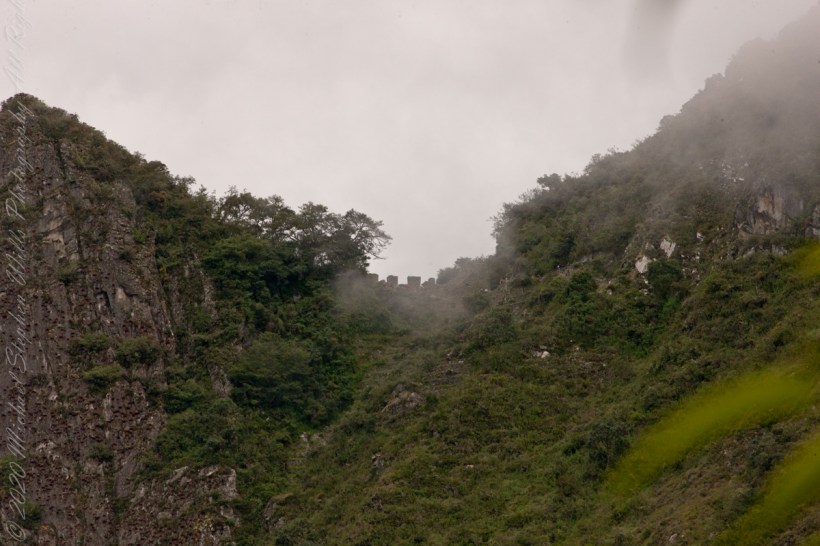
This was as close as we came to the Sun Gate, an important viewpoint in the Inca citadel. As Machu Picchu was originally designed and built, the Sun Gate was one of the main entrances to the citadel.

It was also considered at that time as a strategic point to protect the magical Inca citadel. It is one of the most incredible archaeological constructions of the archaeological complex. This usually connects directly with the Inca citadel of Machu Picchu. Its location makes historians think that the entrance to Machu Picchu was restricted and guarded by the military at that time, making it accessible only to visitors from the Imperial Inca Elite.

The Sun Gate in Machu Picchu is an ancient archaeological complex located on the outskirts of the Machu Picchu map. The actual name is Inti Punku and Its name means Sun Gate in the native Quechua language. It was dedicated to the worship of the Sun God or “Inti”. The sun illuminates the door during the winter solstice, giving all who visit the place a wonderful view. The construction is made up of a few walls, doors, windows, and terraces, all made of rustic stone. To get there, the Incas built a series of terraces, stairs, and many other minor buildings. The Sun Gate in Machu Picchu is located at a height of about 2745 meters above sea level. It is about 300 meters higher than where Machu Picchu is located. Being able to see the Inca citadel from Inti Punku is one of the best things to do in Machu Picchu.

Copyright 2023 Michael Stephen Wills All Rights Reserved

Machu Picchu Entrance Dedications

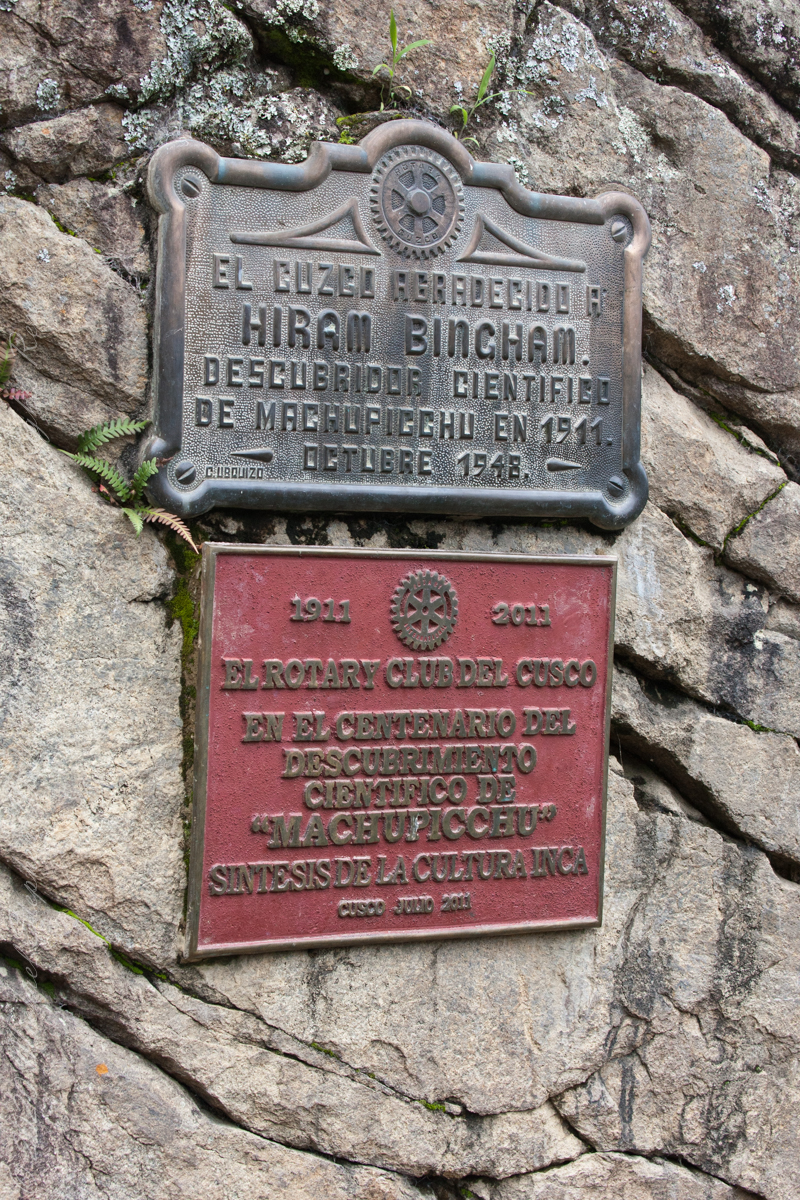
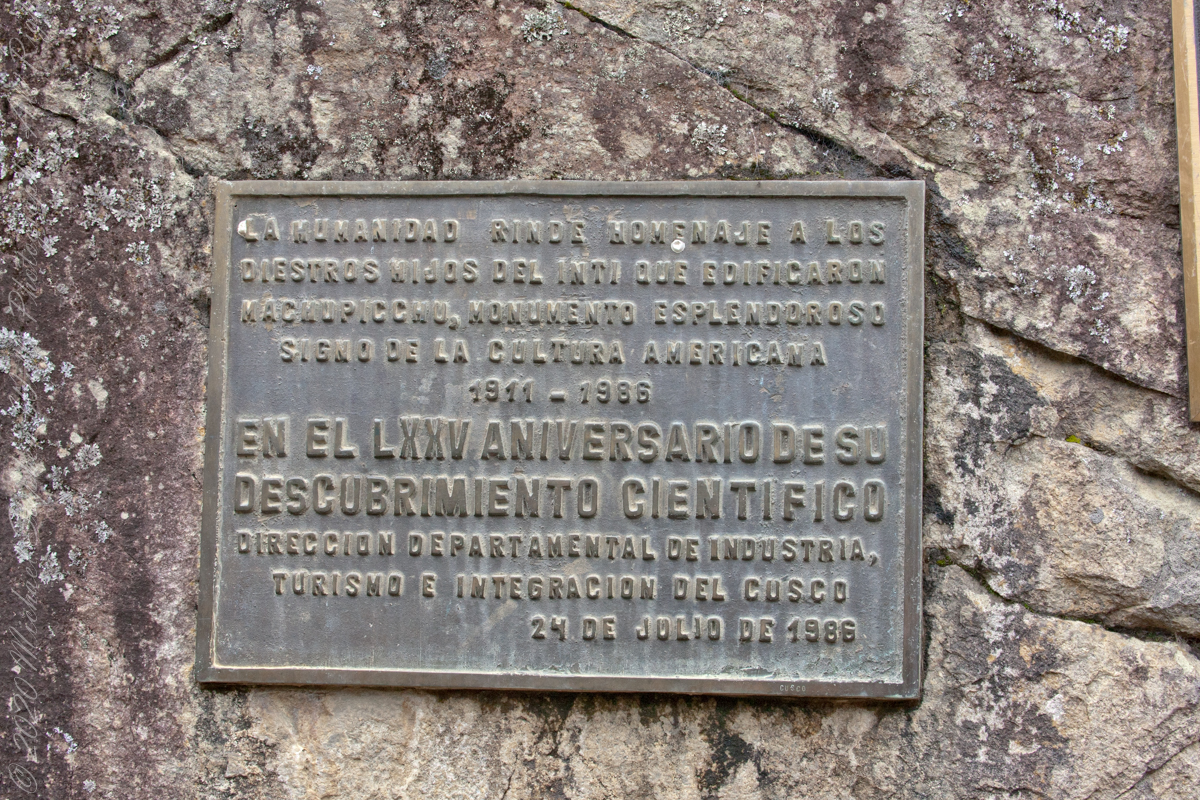
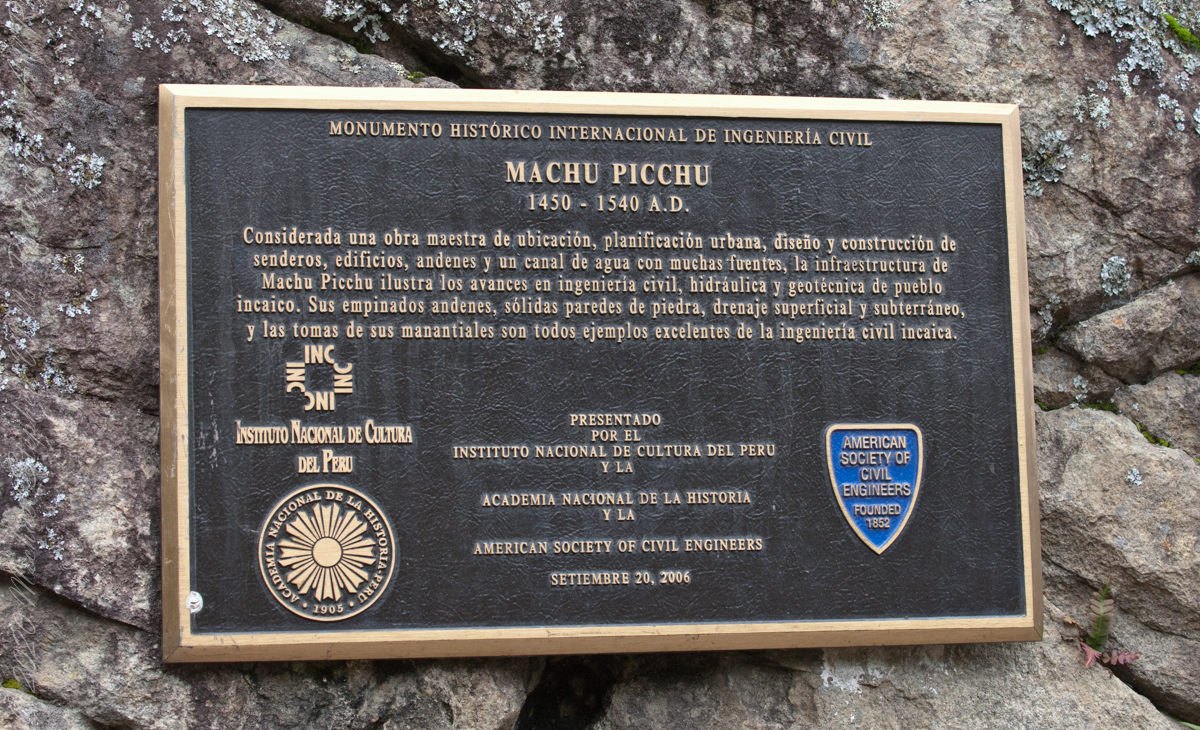
Plaques found at entrance to Machu Picchu

Click Me for my Online Gallery

In 1911 American historian and explorer Hiram Bingham traveled the region looking for the old Inca capital. On July 24, 1911 Bingham, led to Machu Picchu by a villager, Melchor Arteaga, crossed the Urubamba river on a rickety wood bridge. Bingham found the name Agustín Lizárraga and the date 1902 written in charcoal on one of the walls. Though Bingham was not the first to visit the ruins, he was considered the scientific discoverer who brought Machu Picchu to international attention.

“Humanidad Rinde Homenaje a diestros hijos del inti que edificaron MachuPicchu, monumento esplendoroso sign o de la cultura americacana 1911 – 1986 En el LXXV Aniversario Descubrimiento Cientifico Direccion Departmental de Industria, turismo e integracion del Cusco 24 de Julio de 1986” Translation “Humanity pays tribute to skilled sons of the Inca who built Machu Picchu, splendid monument sign or of American culture 1911 – 1986 In the LXXV Anniversary Scientific Discovery Departmental Directorate of Industry, Tourism and Integration of Cusco July 24, 1986”

“Considerada una obra maestra de ubicacion, planificacion urbana, diseno y construccion de senderos, edificios, andenes y un canal de agua con muchas fuentes, la infraestructura de Machu Picchu ilustra las avances en ingenieria civil, hidraulica y geotecnica de pueble incaico. Sus empinados andenes, solidas paredes de piedra, drenaje superficial y subterraneo, y las tomas de sus manantiales son todos ejemplos excelentes de la ingenieria civil incaica.” Translation “Considered a masterpiece of location, urban planning, design and construction of trails, buildings, platforms and a water channel with many fountains, the infrastructure of Machu Picchu illustrates the advances in civil, hydraulic and geotechnical engineering of Inca village. Its steep platforms, solid stone walls, surface and underground drainage, and intakes of its springs are all excellent examples of Inca civil engineering. September 20, 2006.”

Top: El Cuzco Agradecido a Hiram Bingham Descubridor Cientifico de MachuPicchu en 1911. October 1948 (made by C Ubquizo) Translation (The City of ) Cuzco (is) Grateful to Hiram Bingham Scientific Discoverer of Machu Picchu in 1911. October 1948 Bottom: 1911 2011 El Rotary Club del Cusco En el Centenario del Descubrimiento Cientifico co “AMachuPicchu” Sintesis de la Culture Inca Cusco Julio 2011 Translation: The Rotary Club of Cusco In the Centenary of the Scientific Discovery of “MachuPicchu” Synthesis of the Inca Culture Cusco July 2011.

Credits:
“Machu Picchu” Wikipedia
Translations Spanish are from Google Translate (with my editing).

Copyright 2023 Michael Stephen Wills All Rights Reserved

Switchbacks

940 foot climb to the Machu Picchu ruins

Click Me for my Online Gallery


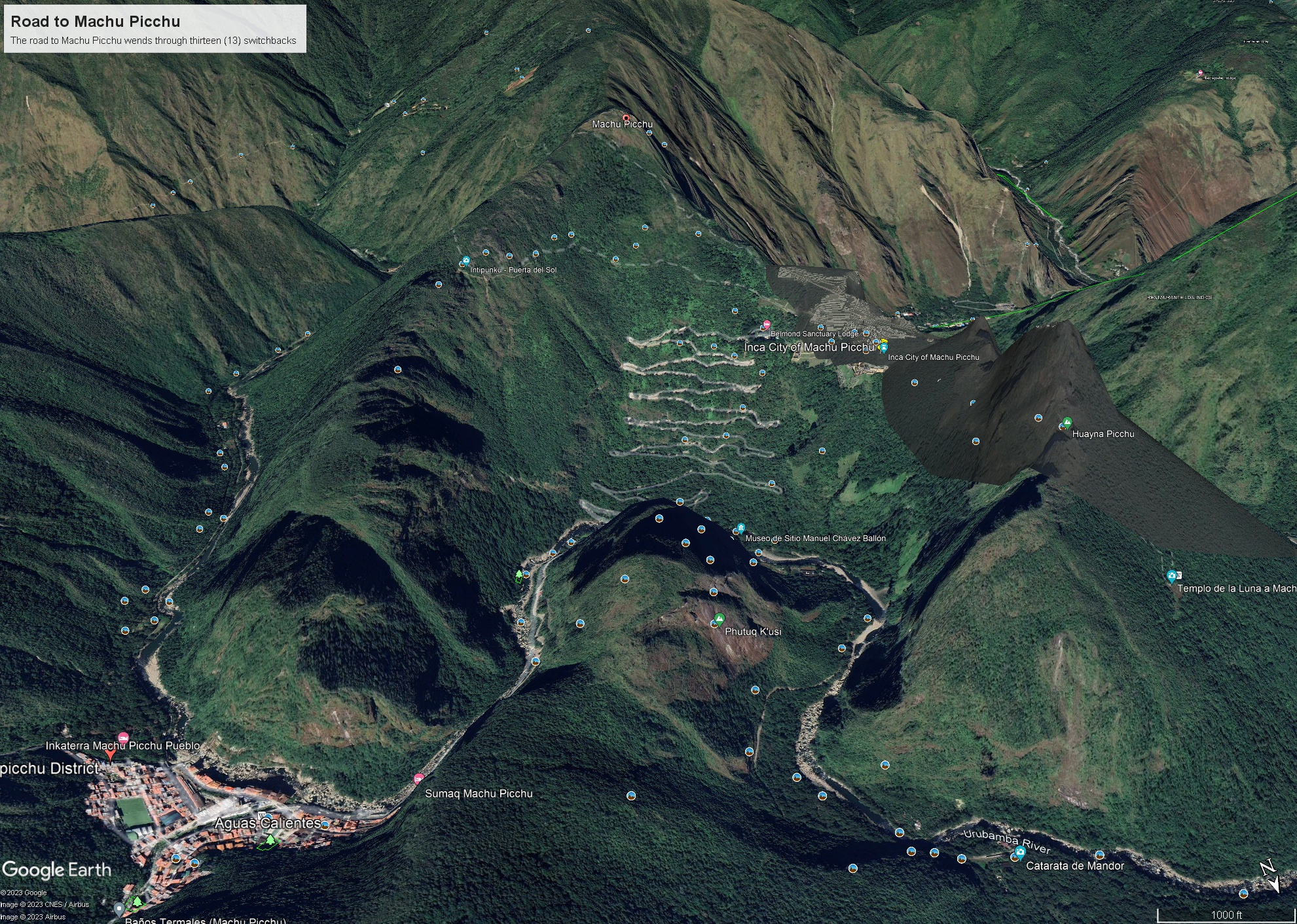
GoogleEarth: switchbacks look like a ladder to the top

Our modern bus climbed the thirteen (13) switchbacks up the steep 940 foot climb to the Machu Picchu ruins from the Sacred Valley floor.

Copyright 2023 Michael Stephen Wills All Rights Reserved

PeruRail to Machu Picchu X

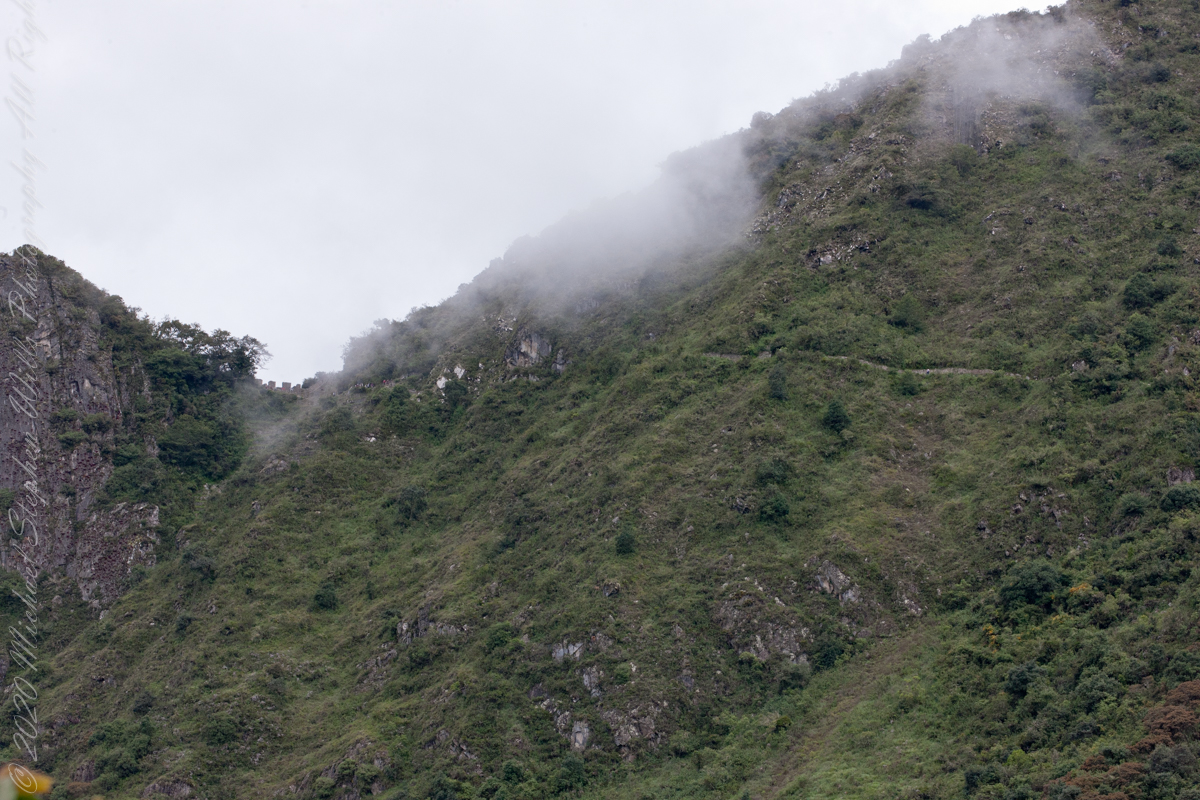
Intipata is an Inca archaeological site in Peru, two kilometers south of Machu Picchu, the eponymous peak of the archaeological site it dominates, to the north.

Click Me for my Online Gallery


GoogleEarth: The approach to Aguas Calientes with Intipata Ruins at lower left

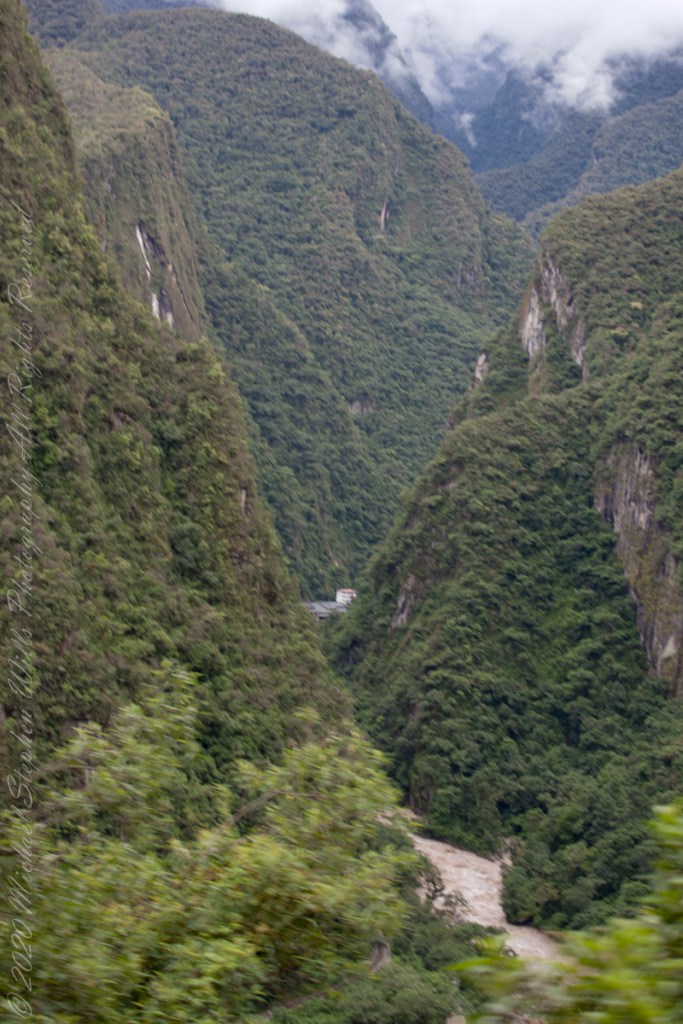
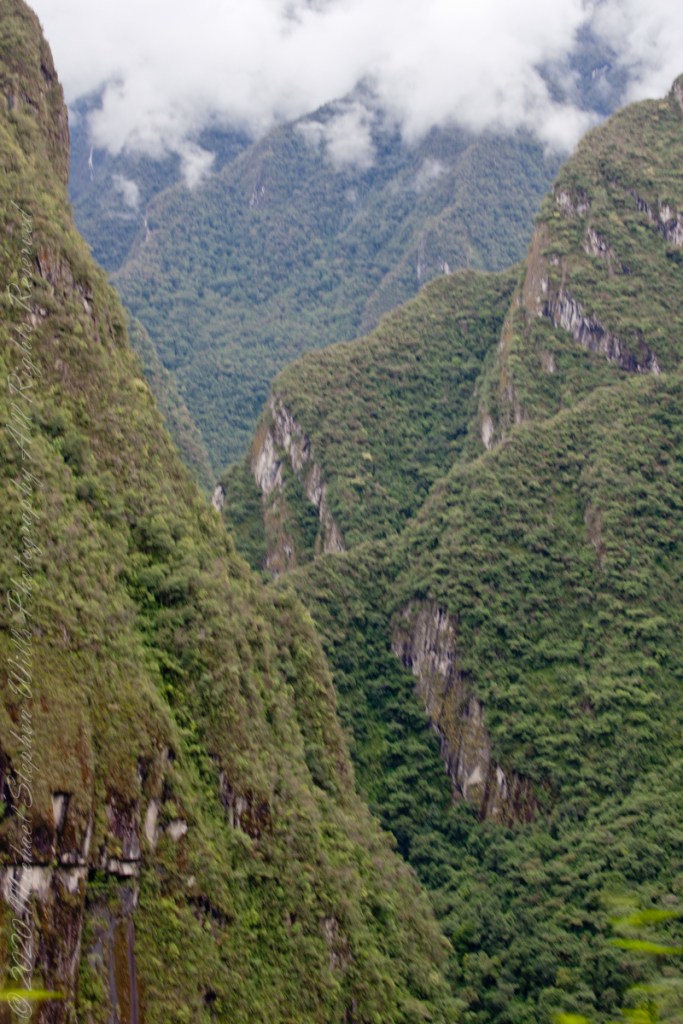
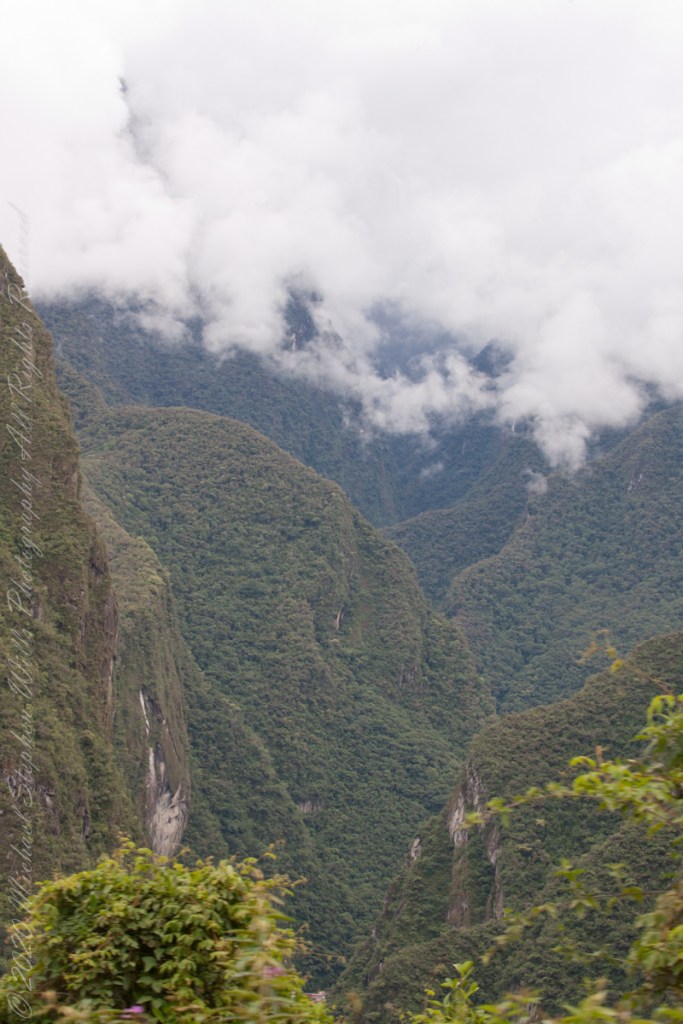
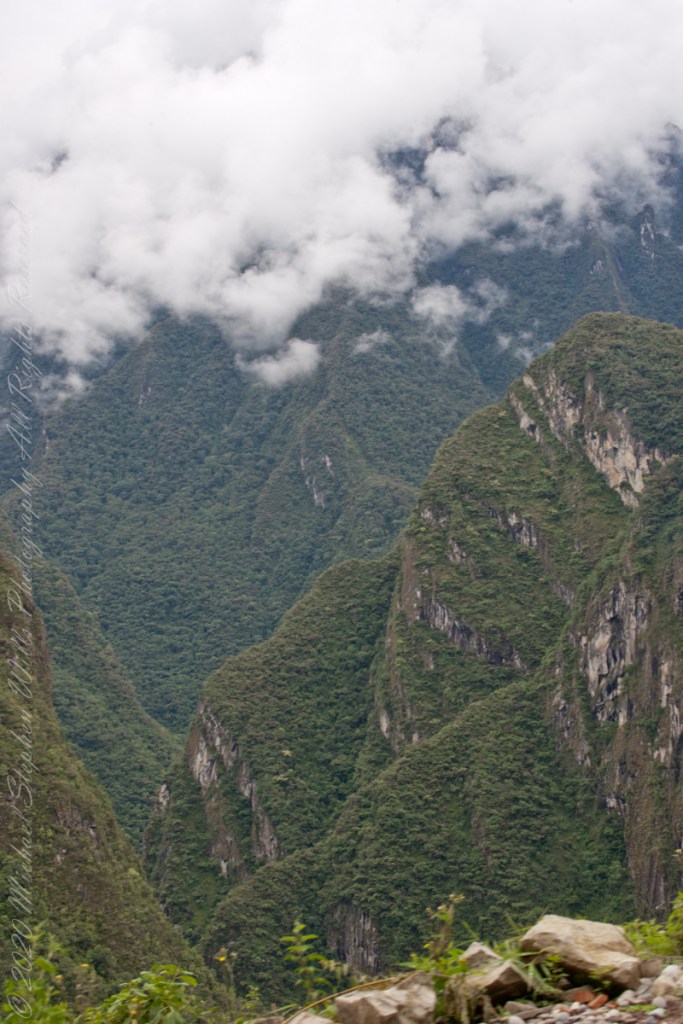
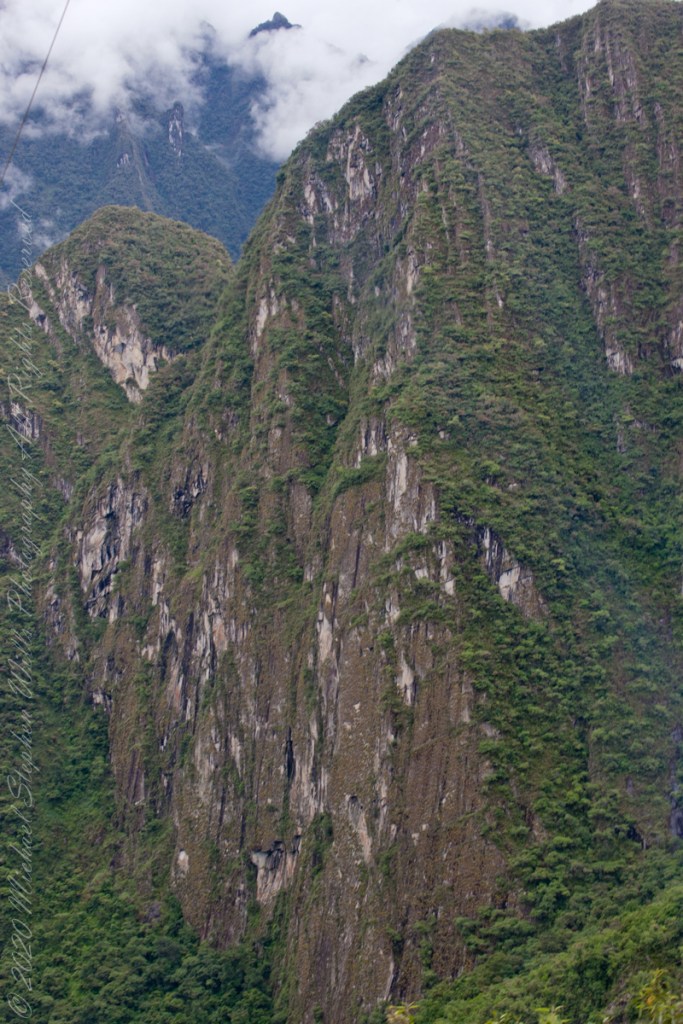
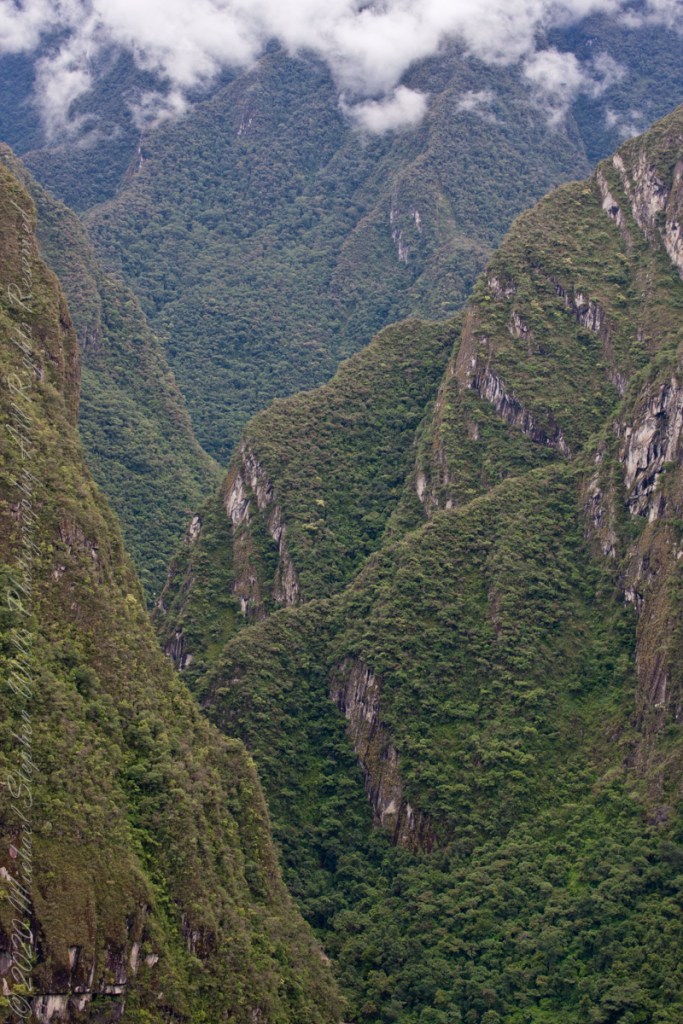
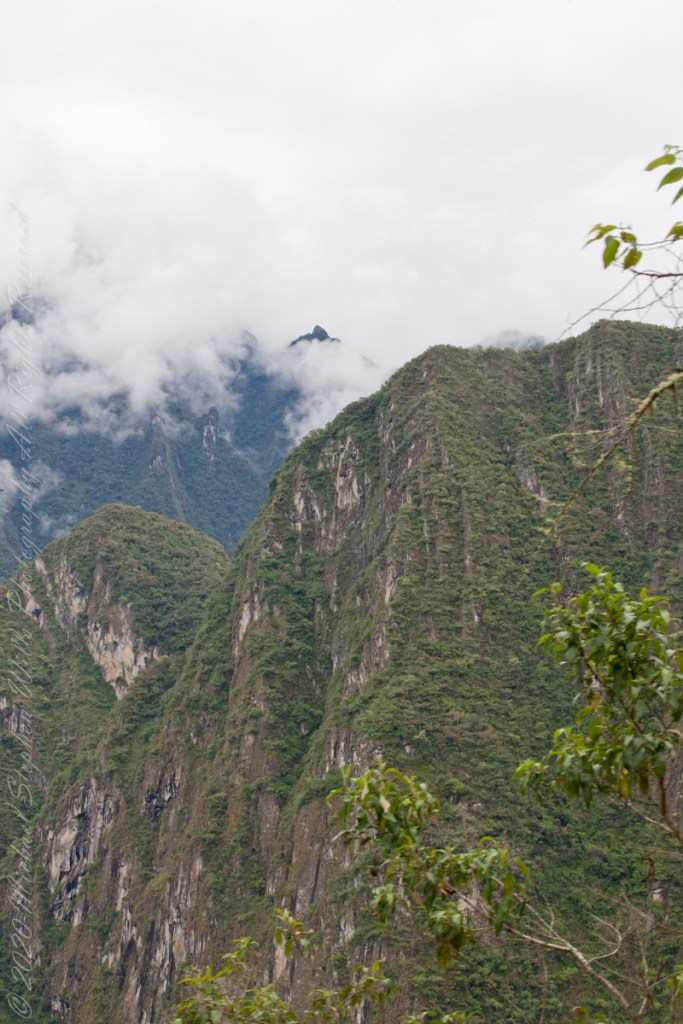
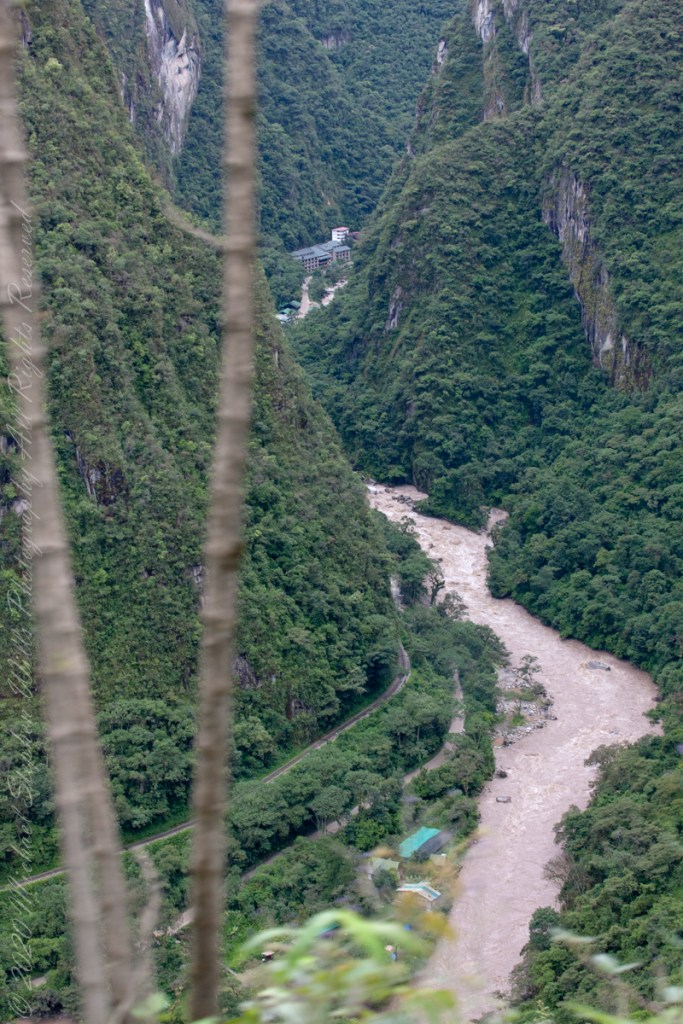
After passing Toronto Ruins, the train rounded a curve into the Amazonian rainforest. It was, frankly, boring, oppressive to proceed with greenery on either side blocking even the Sacred Valley walls rising on either side of the tracks. Thank goodness for the large roof viewing windows. I captured this photograph of the Intipata ruins on Machu Picchu peak by looking backwards through the roof window.

Intipata is an Inca archaeological site in Peru, two kilometers south of Machu Picchu, the eponymous peak of the archaeological site it dominates, to the north. It seems to be, at the current stage of research, a set of agricultural terraces, without the presence of habitat nearby.”

Similar to many Incan archaeological sites, Intipata shows great evidence of having canals to water crips. These canals are distributed among each of the levels of stairs in the Intipata ruins. These stairs or terraces are quite large and would have accommodated many different kinds of crops on different levels. Each level might have been specific to a certain plant. These ruins were mostly used for the domestication of wild plant species.”

When you visit Intipata you will be able to see over 150 types of edible plants along the way. Among the plants, the Inca domesticated would be the common potato. There are also quite a few aromatic plants and flowers in this region, so if you are into botany, this section should be quite entertaining. Among some of the local flowers, you will see over 200 types of orchids along this stretch of the Inca trail, some can only be found right in this part of the cloud forest.”

The purpose of the multi-leveled Intipata ruins was also to avoid the natural erosion of the mountain since this area was also used for religious ceremonies.”

The Incas tried to use as much land as effectively as possible in their crop growing ventures. The ever-increasing Incan empire needed food and this was the best way to secure it. The Inca conquered new tribes very often and instead of killing them would offer to have them join their empire. Intipata is located near the Inca Trail in Machu Picchu. Intipata is formed on two parts, Inti meaning the manifestation of the sun in Inca mythology, and pata which means in Quechua “high”, the “ledge”, the “platform”, the “place” or “square”, the “terrace” or “staircase”, so that the name means more.

Intipata is formed on two parts, Inti meaning the manifestation of the sun in Inca mythology, and pata which means in Quechua “high”, the “ledge”, the “platform”, the “place” or “square”, the “terrace” or “staircase”, so that the name means more or less “the terraces of Inti”.

Copyright 2023 Michael Stephen Wills All Rights Reserved