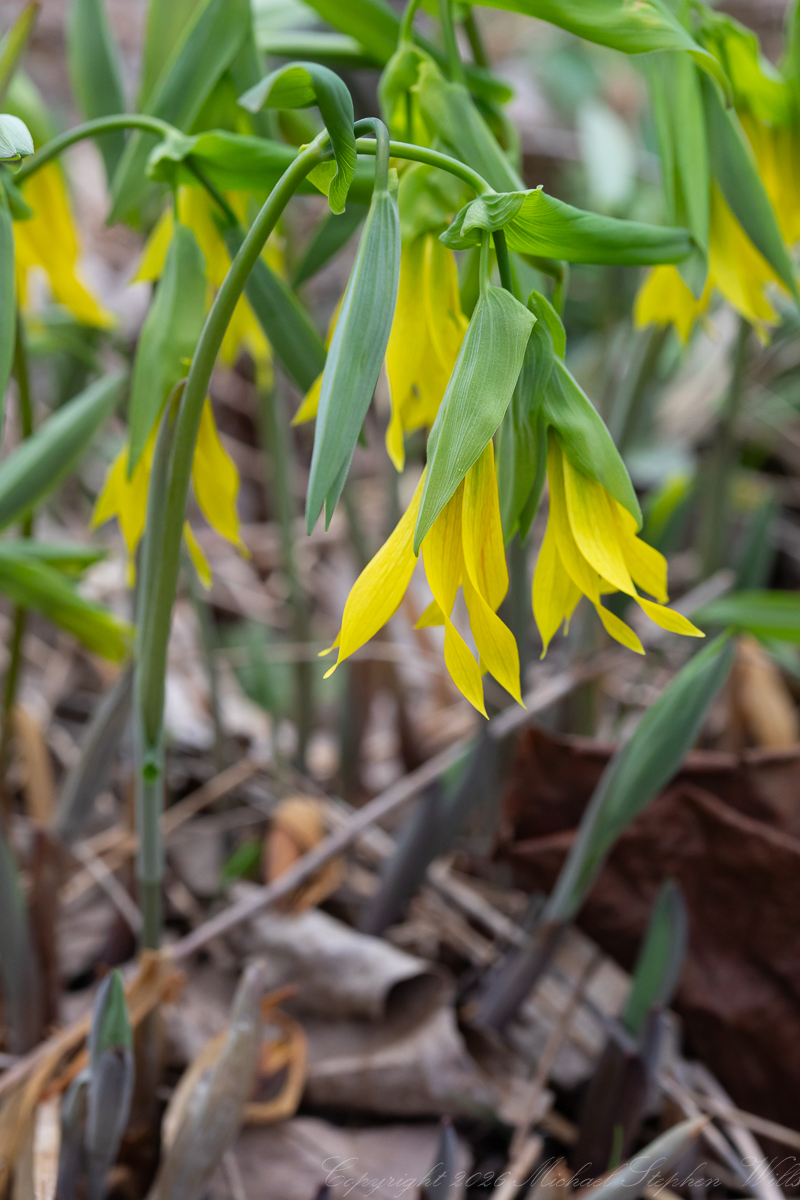
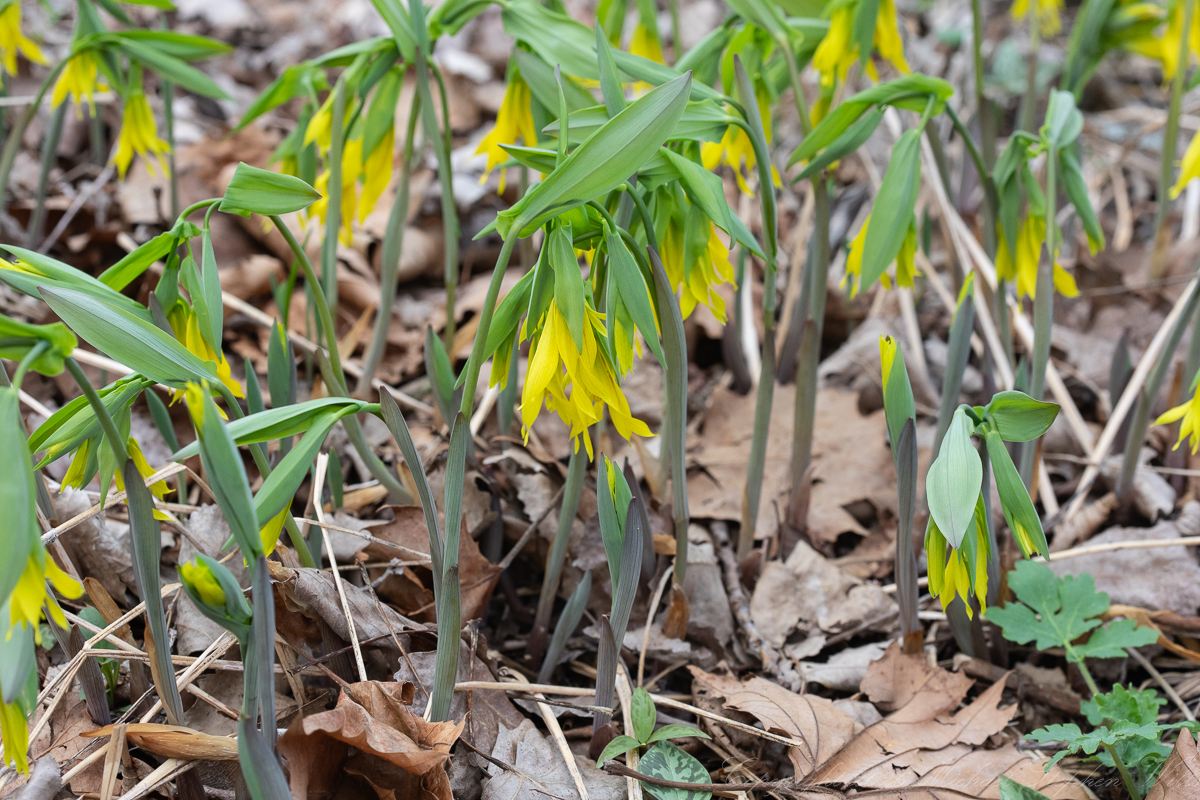
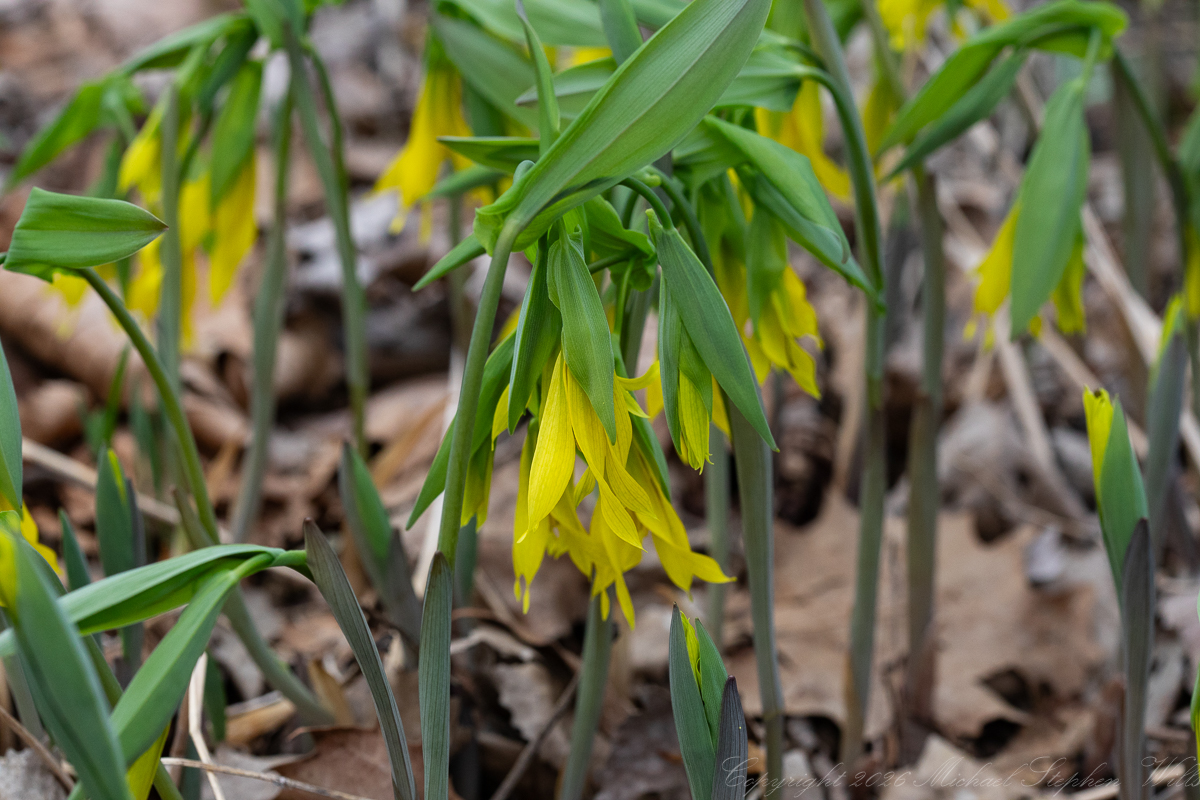
On an April afternoon in 2026, walking along Fall Creek near the Mundy Wildflower Garden at Cornell Botanic Gardens, I came for the first time upon a colony of Large-flowered Bellwort, Uvularia grandiflora, and stopped with the immediate feeling that spring had spoken in a new dialect. I had seen the season gathering itself all around me in buds, in damp leaf litter, in the first loosening of the woods from winter’s gray restraint. But this was different. These flowers did not announce themselves with bravado. They hung quietly beneath their leaves, as though the forest had shaped small yellow lanterns and then thought better of showing them too openly.
I raised my Canon EOS 5D Mark IV with the Canon EF 100 mm f/2.8 Macro USM lens and photographed them handheld at 1/640 second, f/8.0, trying to honor both their delicacy and their poise. Macro work often feels like an act of courtship with detail. One does not seize the subject; one approaches, waits, adjusts, breathes. In the bellworts, I found a plant that rewarded just this kind of attention. At first glance they seemed merely graceful. Then, looking more closely, I began to see their architecture.
Large-flowered Bellwort is a woodland perennial of rich deciduous forests, and it wears that identity in every part of its form. The stems rise smooth and pale, slender but assured, each seeming to carry its burden effortlessly. The leaves clasp the stem in that distinctive bellwort manner, as though the plant were being held in green hands. Beneath them hang the flowers, elongated and drooping, their six yellow tepals twisted and tapered into points. They are not the symmetrical stars of more open-faced blossoms. They are pendants, streamers, tassels of sunlight. In these flowers, yellow becomes motion. Even when still, they seem to trail the memory of a breeze.
The plant’s drooping habit is part of an evolutionary strategy. In the spring woods, before the canopy fully leafs out, ephemeral light reaches the forest floor in a brief annual inheritance. Bellwort rises into that window. It gathers energy quickly, blooms early, and makes use of the few bright weeks before the trees above turn the woodland dim and green. Its season is a narrow one, but not a meager one. This is a plant shaped by timing, by patience, by fidelity to a recurring opportunity. It lives where sunlight is not constant but bestowed.
There is something deeply moving in such an existence. We humans often admire the grand gestures of nature—the waterfall, the hawk, the thunderhead. But woodland wildflowers teach another lesson: that persistence may take the form of exquisite brevity. Uvularia grandiflora does not dominate the landscape. It waits for its rightful hour, then enters the year with quiet authority. It is one of spring’s soft-spoken triumphs.
Ecologically, the bellwort belongs to a community rather than a spectacle. It grows in moist, humus-rich soil, among the remains of last year’s leaves, where decay has become nourishment. Around it are the signatures of a healthy eastern woodland: filtered light, fungal work below ground, the gradual release of nutrients from the forest’s own past. Its roots do not stand apart from this economy of return. They participate in it. The beauty of the flower is inseparable from the labor of decomposition, the unseen commerce of roots and microbes, the long winter’s accumulation of leaf mold. Even here, elegance rises from compost.
And then there are its relationships with other living things. The flowers, nodding and somewhat enclosed, invite a certain intimacy from insect visitors. Bellwort is not a billboard flower. It asks a pollinator to come close, to enter its hanging chamber. Bumblebees, mason bees in the genus Osmia, sweat bees in Halictus and Lasioglossum, and mining bees in Andrena are among its visitors. One bee, Andrena uvulariae, bears in its very name the mark of this botanical relationship, having evolved a close association with Uvularia. To stand before these flowers is to imagine that hidden commerce of spring proceeding just beyond the edge of one’s notice: a queen bumblebee nosing into a drooping bloom, a small Osmia working deliberately among the tepals, an Andrena bee moving with ancient purpose through a plant lineage it has learned by evolution to trust.
What we call a wildflower is also an agreement, a contract written between blossom and insect long before we arrived to admire it. Even after flowering, the bellwort participates in the forest. Its seeds bear fleshy appendages that attract ants, which help carry them away and disperse them through the woodland.
Human beings, of course, enter this world differently. We bring names, lenses, curiosity, memory. We kneel in leaf litter with cameras. We identify, compare, and sometimes misidentify. We make gardens to protect what once grew without us, and then discover that our finest role is not mastery but attention. Finding Large-flowered Bellwort near Fall Creek reminded me that our relationship to such plants is at its best when it is grounded in humility. We do not improve these flowers by naming them; we improve ourselves by learning to see them.
And seeing them, truly seeing them, is no small thing. The petals in these photographs are veined with light. The stems carry a woodland grace, as if drawn in one uninterrupted line. The colony as a whole had the look of a little parliament of bells, each one bowed, each one speaking in silence. They seemed to me like fragments of sun that had slipped through the trees and decided to remain rooted there.
I left Fall Creek that afternoon with the feeling that I had been admitted to a finer scale of perception. Large-flowered Bellwort asks little of the passerby except slowness. Yet in return it offers a great deal: form, adaptation, timing, kinship, restraint. It shows how life in the spring woods is built from tact. Not only from survival, but from style.
Some plants shout the season into being. Bellwort lets it ring softly. And once heard, that note stays with you.