The Organ-Pipe Mud Dauber Wasp at Our Window

An persistant buzzing at an east-facing window led to an unexpected discovery: an organ-pipe mud dauber tending its earthen nest, revealing a hidden world of architecture, courtship, spider hunting, and parental care just beyond the glass.

On a morning in late July, the songs and raucous calls of Blue Jays, Cardinals, and Carolina Wrens were joined by another sound—an intermittent, insistent buzzing. It seemed to be an angry wasp, an unwelcome distraction as I worked facing the large east-facing picture window. Orchids line the window ledge, their pots and foliage blocking my view of the lower edge where I assumed the insect was trapped.

During one of the silences, I approached with a cup and stiff sheet of paper, prepared to capture the intruder and carry it outdoors. Peering cautiously around the orchid pots, I saw nothing. Then the buzzing resumed. Following the sound, I looked more carefully and discovered something entirely unexpected: affixed to the outside edge of the window was a long tan column of dried earth.
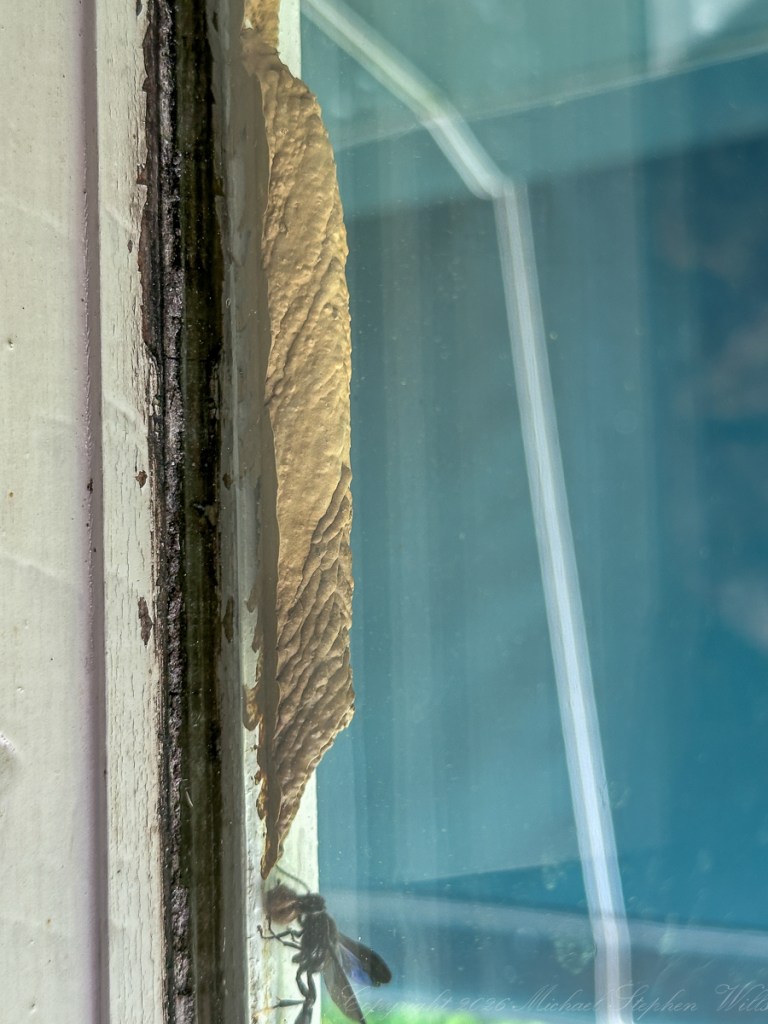
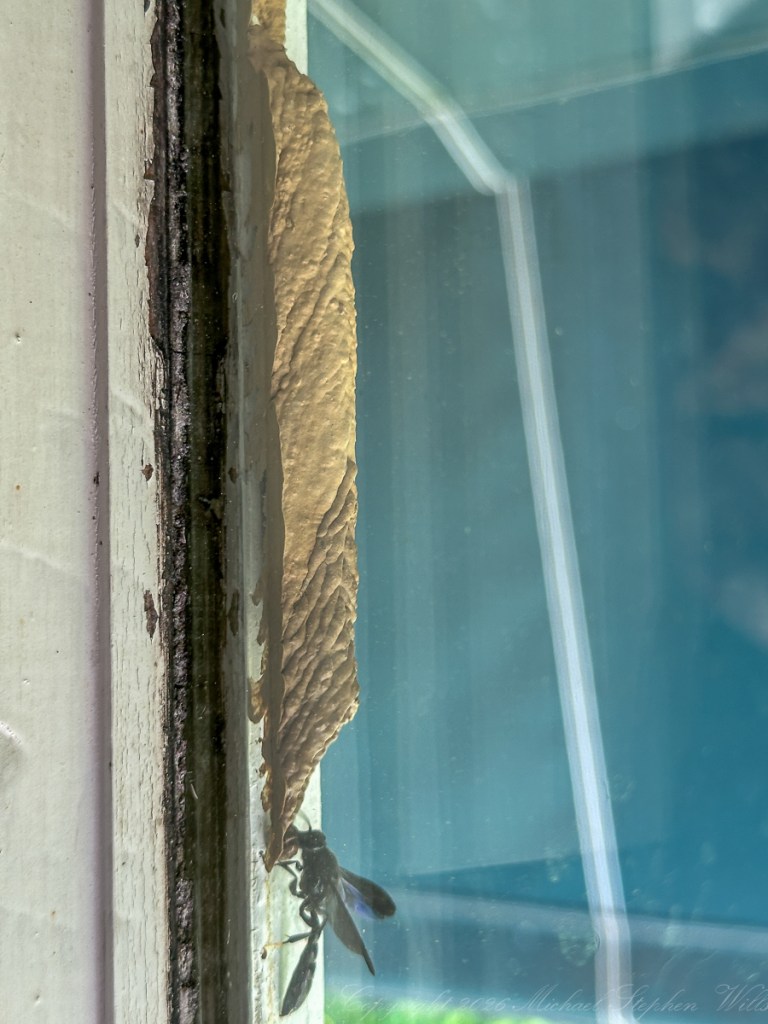
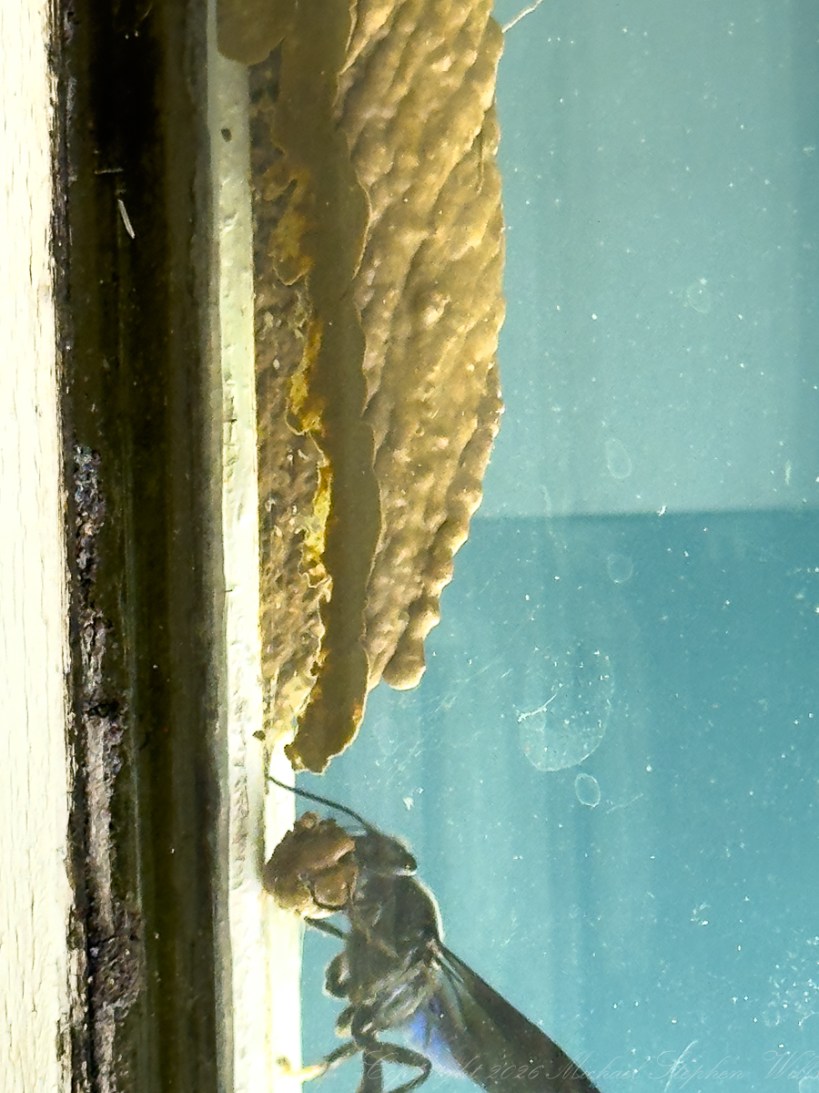
It looked geological—a miniature formation of hardened sediment affixed to the corner of painted wood and glass. Its surface was ridged and corrugated, each irregular band recording some earlier act of construction. At its lower end appeared the architect: a large, lustrous black wasp.

I discovered the wasp’s identity also explained both the strange earthen structure and that surprisingly loud buzz: this was an organ-pipe mud dauber, Trypoxylon politum. The species occurs through much of eastern North America and is the largest member of its genus in our region.
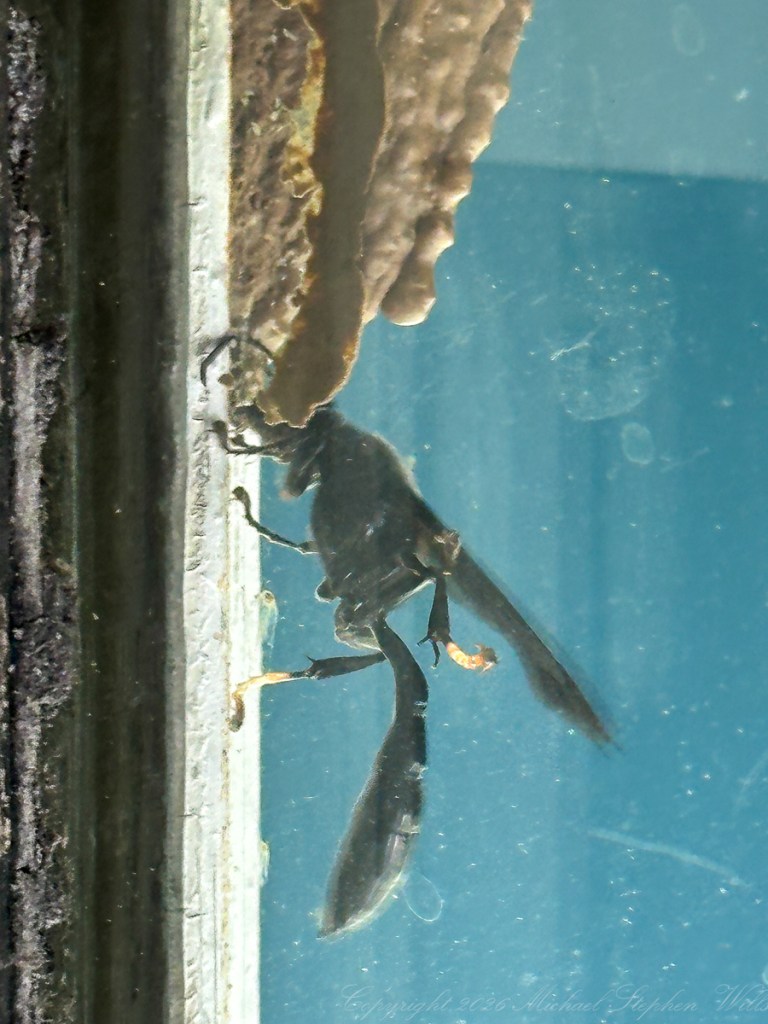
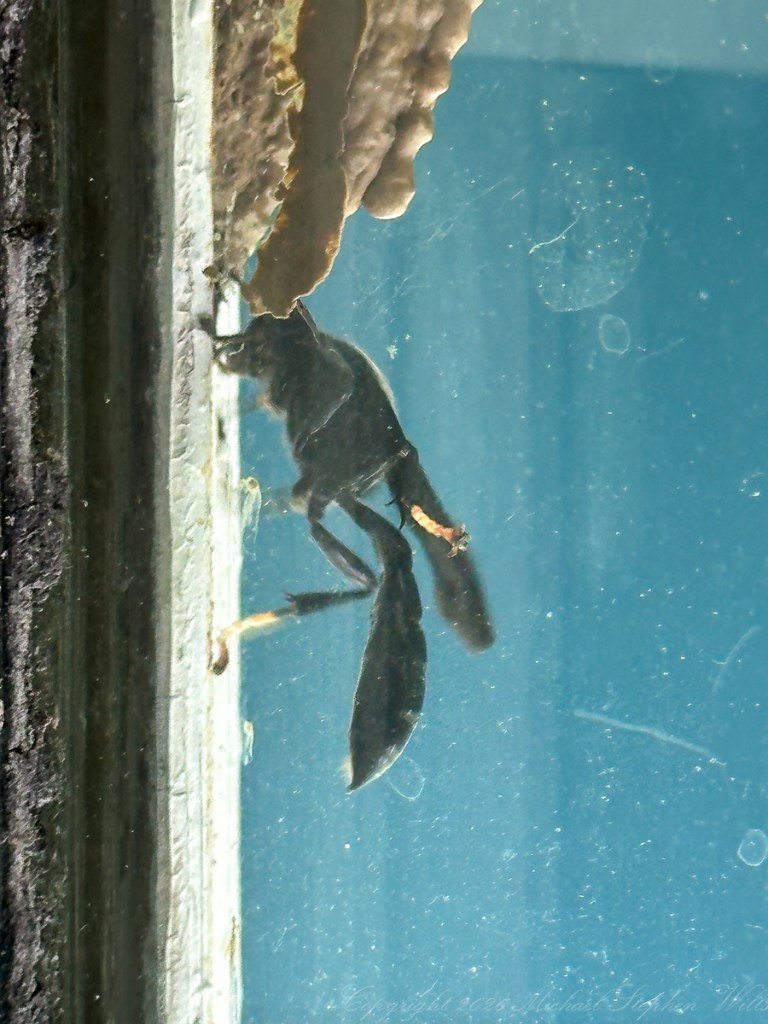
The name is wonderfully descriptive. The female constructs elongated tubes of mud side by side against sheltered walls, bridges, rock faces and buildings. A completed group resembles the vertical pipes of an old church organ. What I had initially taken for a crude column of dirt was, in fact, architecture.

The wasp itself has an austere beauty. Its body is predominantly polished black, sometimes seeming almost blue-black as sunlight catches the wings and exoskeleton. The abdomen is extraordinarily slender near its base before widening toward the end, giving the insect a delicate, elongated silhouette. Long black legs hang beneath it, with pale markings on portions of the hind feet. In my photographs the wings sometimes flash an unexpected smoky violet-blue, while the legs grasp the painted window frame beside the ocher-colored mud. Against that earthy structure the wasp looks almost metallic.

Yet the formidable appearance is misleading. Unlike yellowjackets and other colonial wasps, the organ-pipe mud dauber is essentially solitary. There is no queen commanding a workforce and no populous colony ready to defend the nest. A female constructs and provisions her own nest, and solitary wasps consequently tend to be much less defensive than social species.

But Trypoxylon politum adds a fascinating complication to the word solitary.

A male may remain at the nest while his mate is away. He guards its entrance against intruders—including parasitic insects and rival males—and may produce a conspicuous buzzing when something approaches. That behavior makes me reconsider my first encounter. The creature I heard behind the orchids was not an insect frantically trapped indoors at all. The window glass separated us. I was inside; the wasp was outside, stationed beside its earthen fortress. What sounded to me like anger was vigilance, though I also observed similar buzzing as the female shaped each ball of mud.

The female performs the more astonishing work. She gathers wet mud and carries it repeatedly to the nest, gradually extending a tube. Inside she creates a succession of chambers. Then she becomes a hunter.
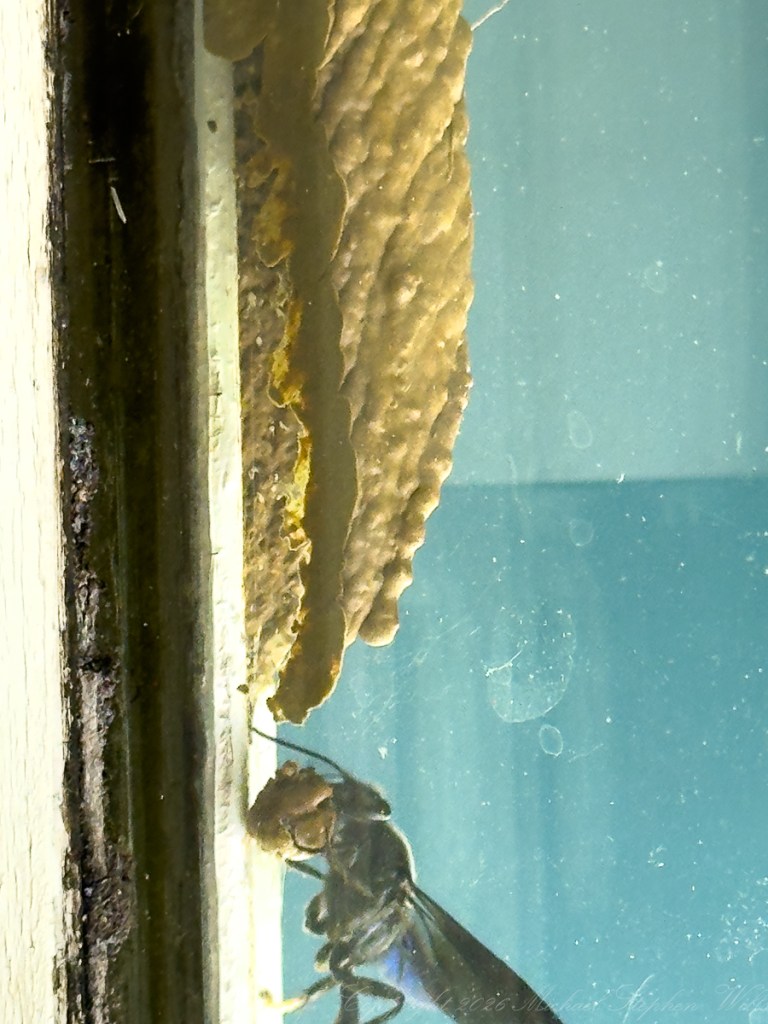
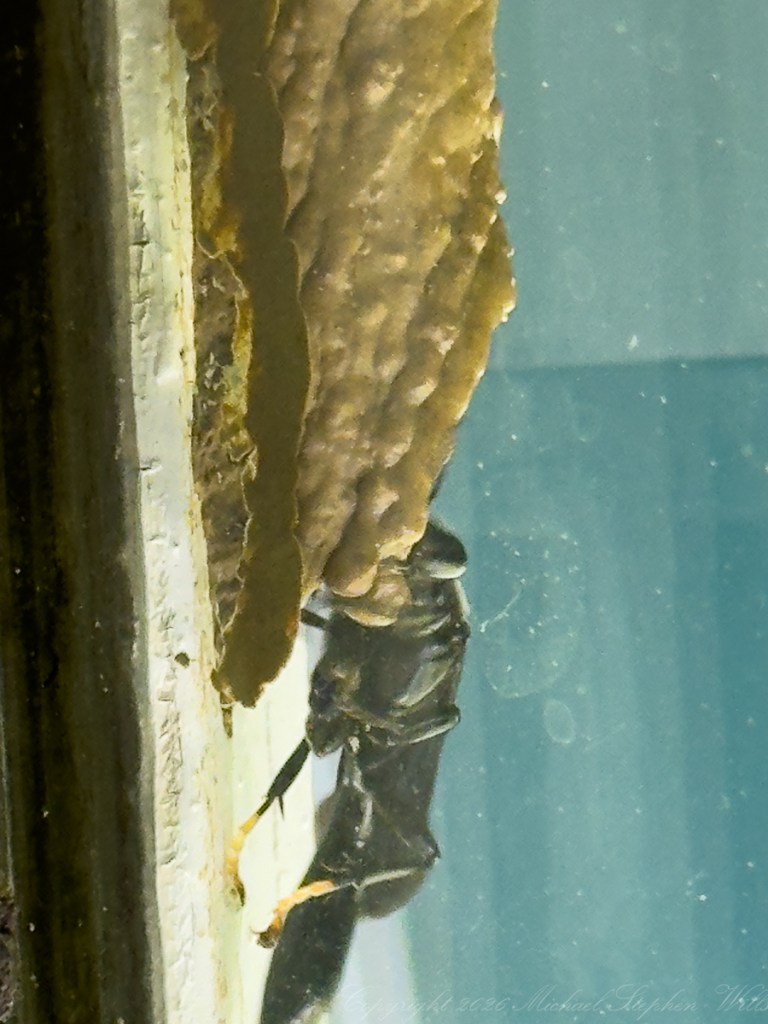
Her quarry is spiders.

She captures and paralyzes them, carrying them back to the nest and packing several into each cell—reported numbers range from about three to eighteen spiders with the fertilized female eggs better provisioned. Upon this living but immobilized store of food she lays an egg and seals the chamber with mud. The larva that hatches within has a private larder of fresh prey. Another chamber follows, and another, until the peculiar earthen pipe becomes a nursery divided into hidden rooms.

Watch two wasps building the nest.

There is something almost unsettling in that knowledge. Within the rough tan structure, a nest, on our window frame lie spiders gathered from our garden, each incorporated into the reproductive cycle of another animal. Predator becomes provision; mud becomes shelter; a few inches of ordinary window trim become an ecosystem.

That is what held my attention long after the original buzzing ceased. I had sat only a few feet away, day after day, unaware that another creature was carrying out an intricate sequence of hunting, construction, mating and parental investment on the opposite side of the glass.

The window had seemed a boundary between our house and the natural world. The organ-pipe mud dauber revealed it to be something else: a place where the two worlds meet.

And all it took for me to notice was a buzz.
Click me to visit Michael Stephen Wills Online Finger Lakes Gallery.

Enter your email to receive notification of future postings. I will not sell or share your email address.

Glacial Kettle Bog Wonders: Photographing Pitcher Plants at the O.D. Engeln Preserve in Freeville

Step onto Freeville’s O.D. Engeln Preserve boardwalk and meet purple pitcher plants in a glacial kettle bog—carnivorous beauty, hidden blooms, and macro-photo magic.

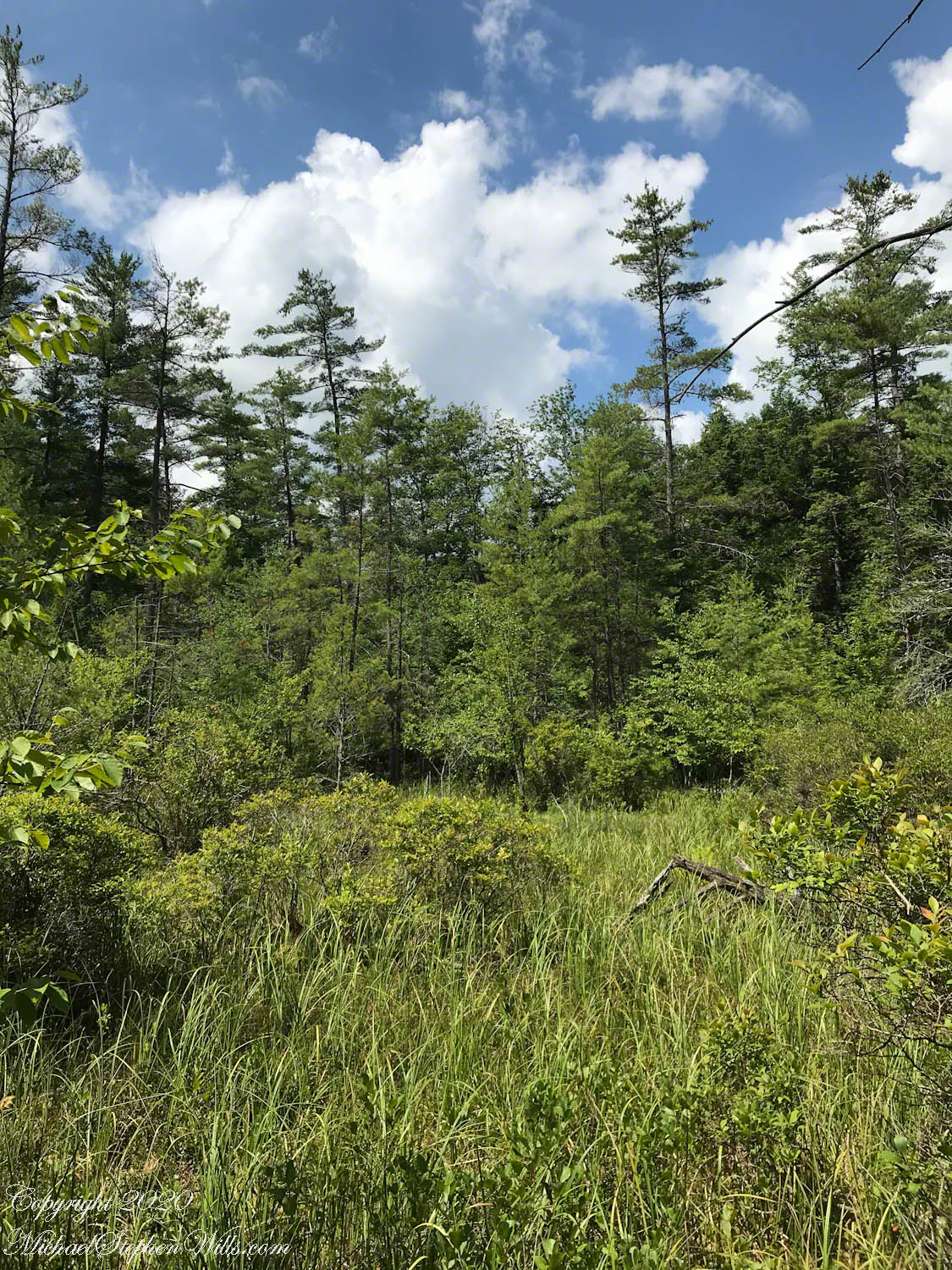
Seen from 1000 feet above in Google Earth, the O.D. (Von) Engeln Preserve at Malloryville Road lays itself out in two glacial “kettles,” pond and bog; a simple diagram drawn by ice and time, then complicated by everything that has happened since. In my photograph, taken from the bog observation platform on a July morning, the sky is rinsed blue, clouds billow, conifers stitch along the rim around open space. Step closer, or lower your lens, and the openness resolves into a crowded, intimate architecture of sedges and moss, twigs and standing water, sunlight and shadow.

I came here for a plant that does not announce itself the way wildflowers often do. The purple pitcher plant, Sarracenia purpurea, is a quiet scandal: a green vessel in a place where green should be satisfied simply to survive. I arrived equipped for attentiveness—an iPhone for the broad scene, and a Canon DSLR with the F2.8 100 mm macro lens for the stars of this bog. The macro lens is an instrument of humility. It forces you to admit that the important drama is often no bigger than your palm.

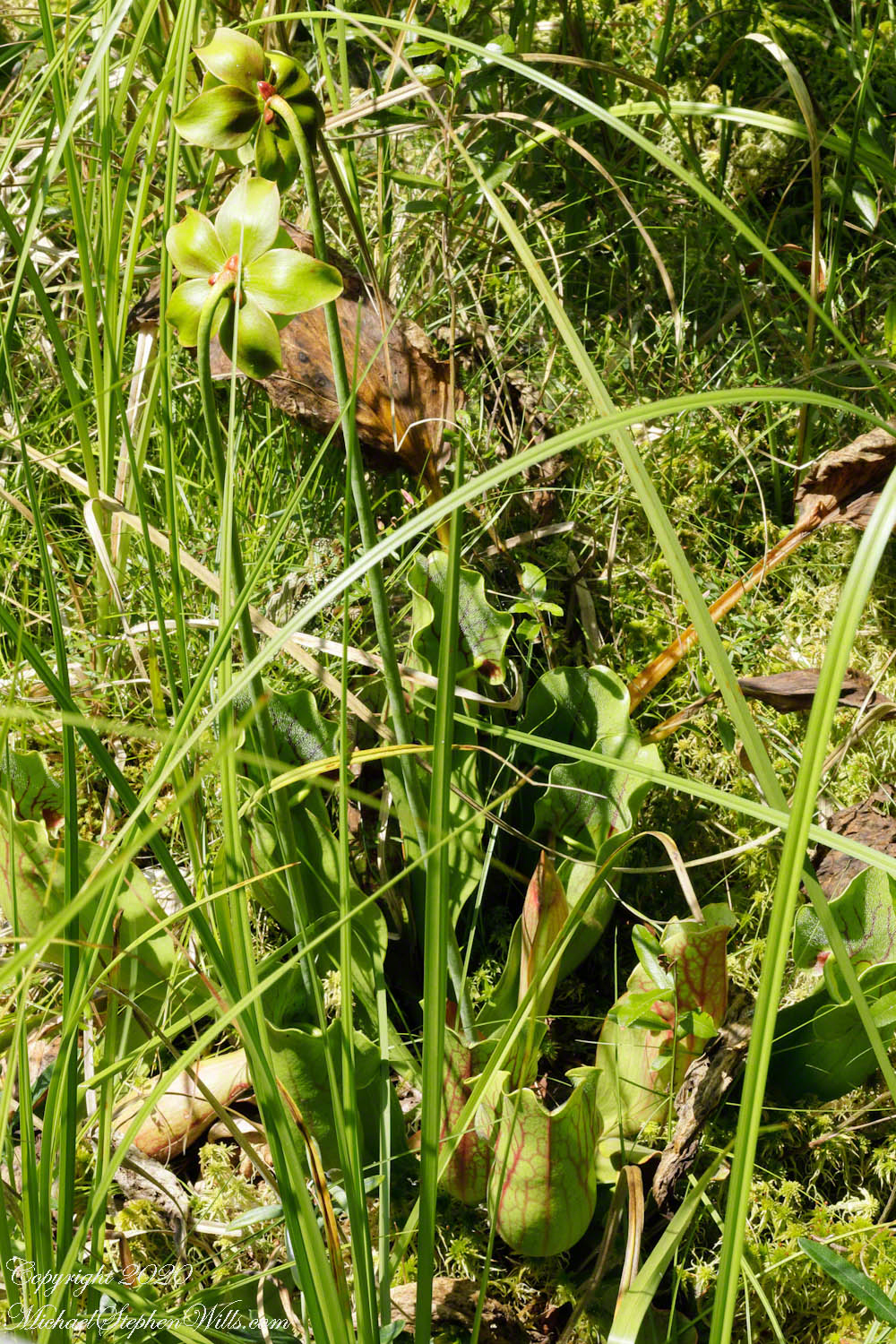
In earlier years, the pitchers could be found right where a visitor naturally looks—within the central cut-out of the observation deck, close enough to lean over and study. But the bog is not a museum display; it is a living negotiation. This season, highbush blueberries pressing in from the margin had crowded the pitchers out, pushing the flowering plants into the grasses eight to ten feet away. The shift is small in human terms, the kind of distance you cross without thinking. In bog terms, it is displacement—an erasure of a familiar scene, a reminder that rarity is not only about numbers but also about space.

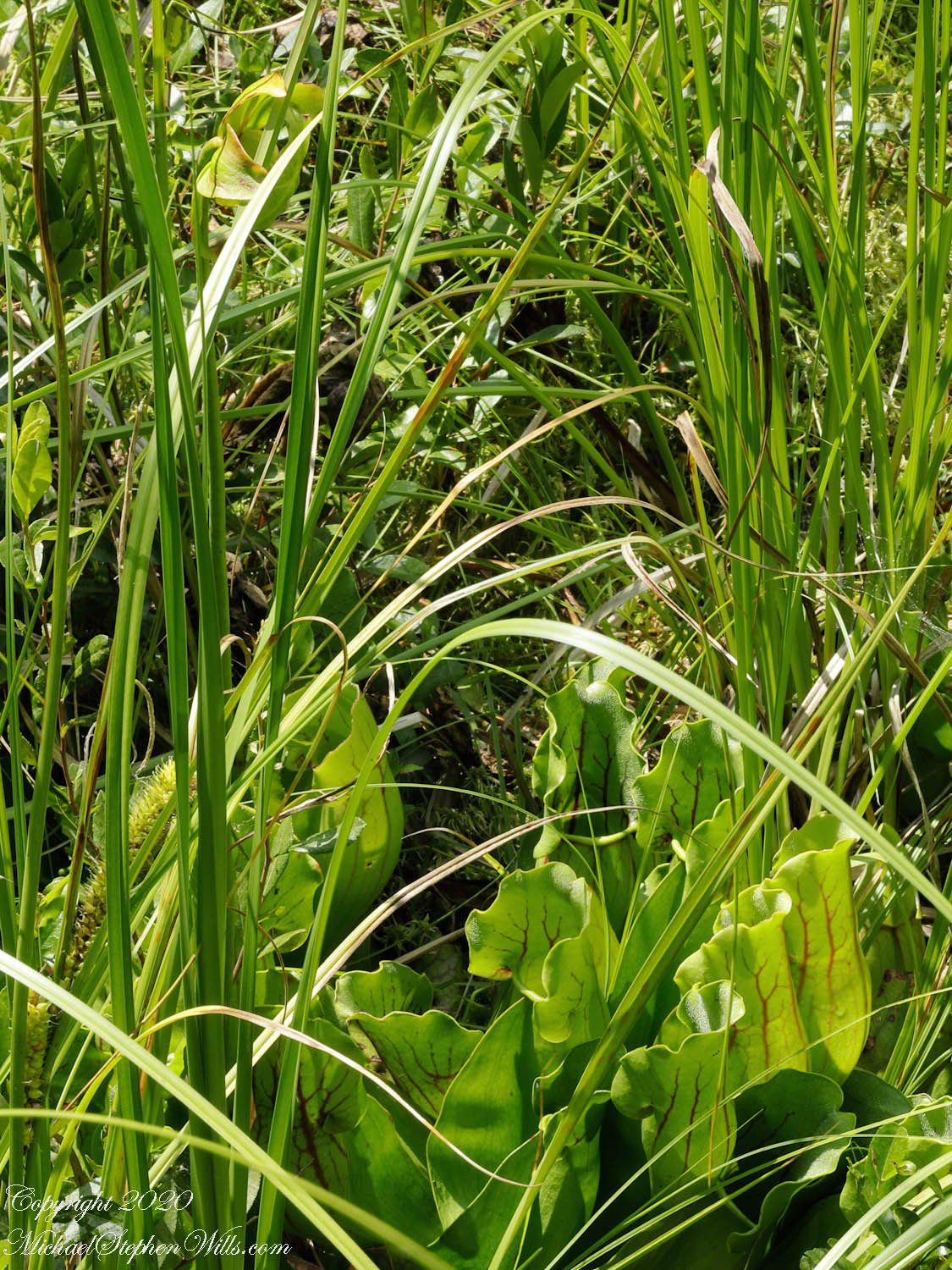
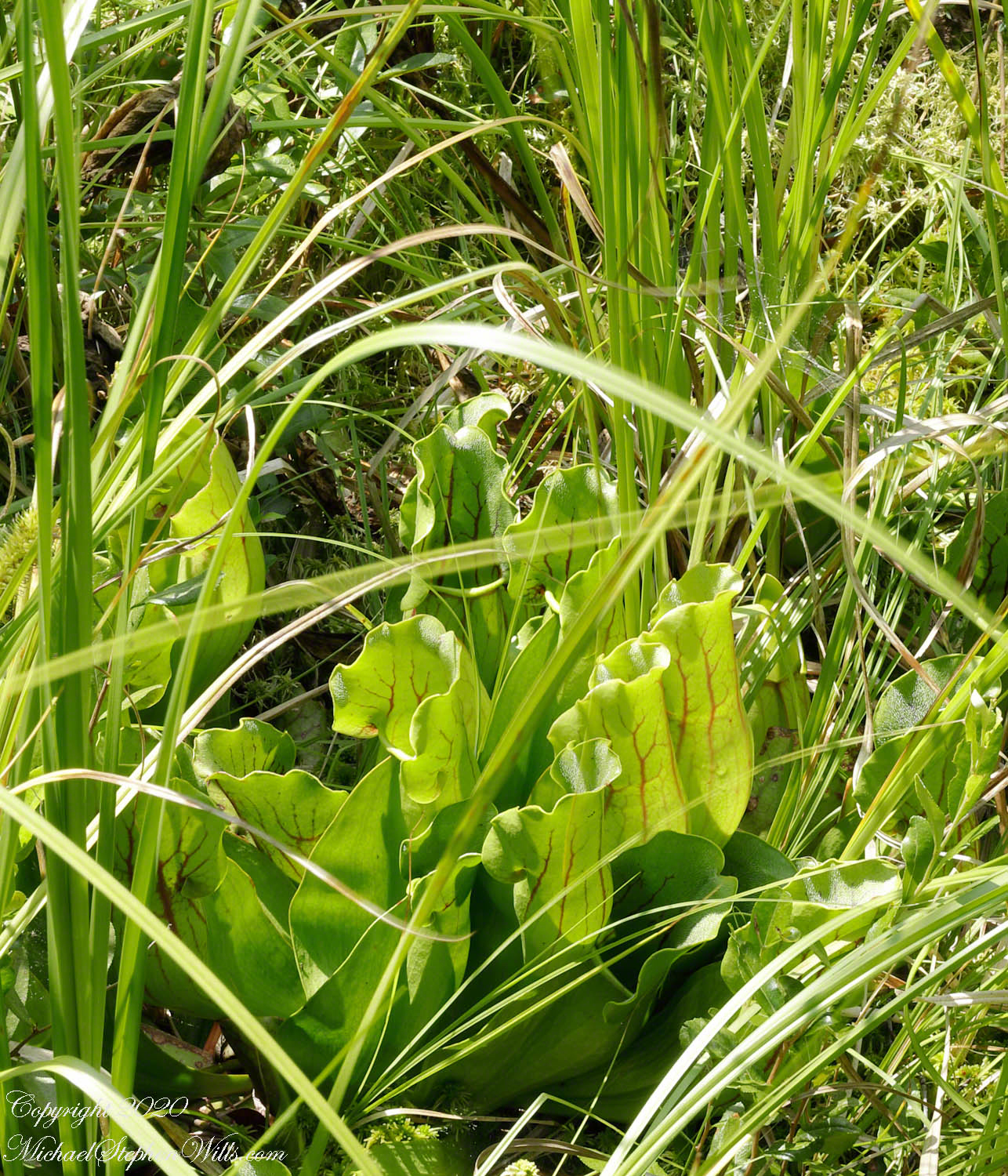
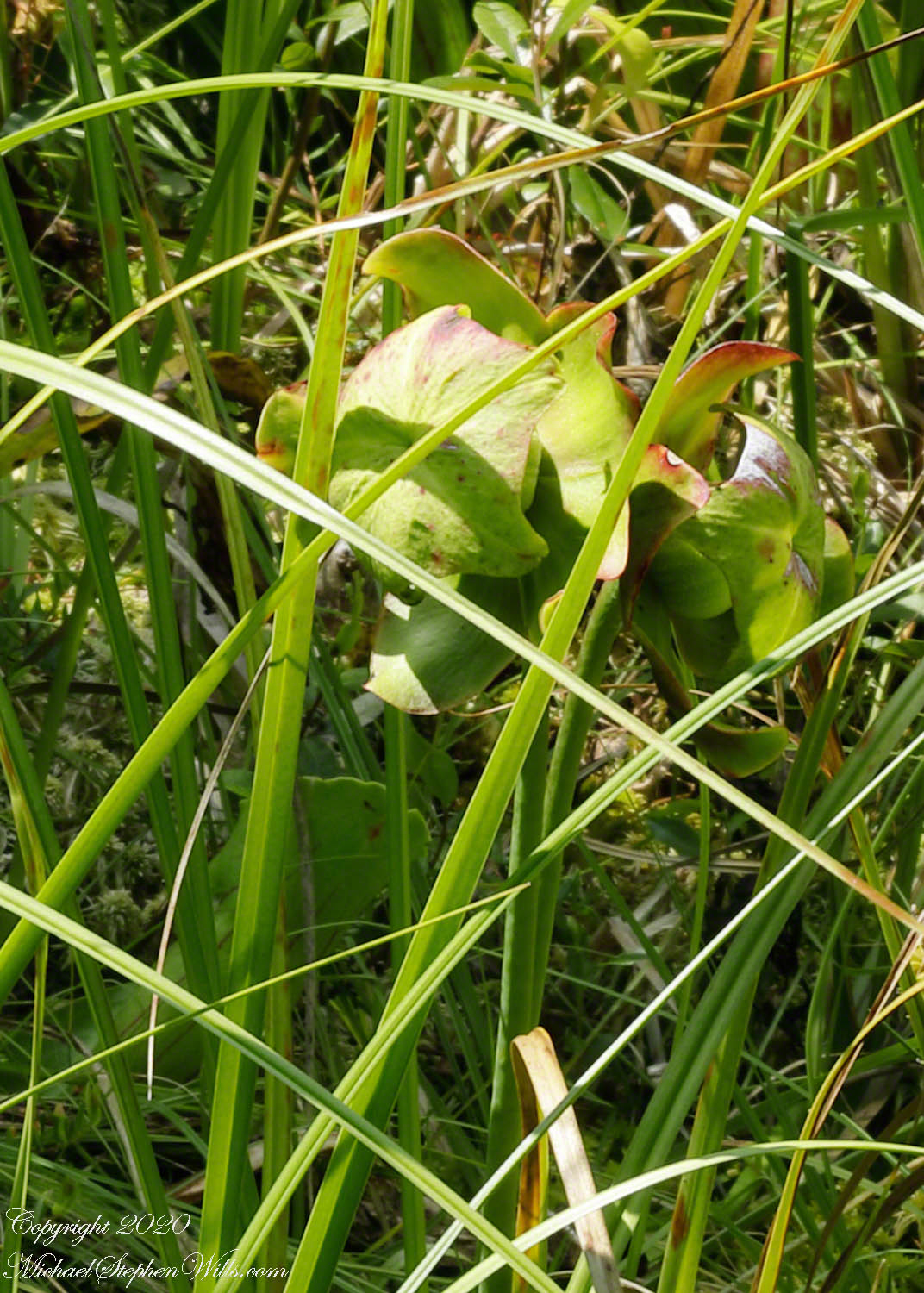
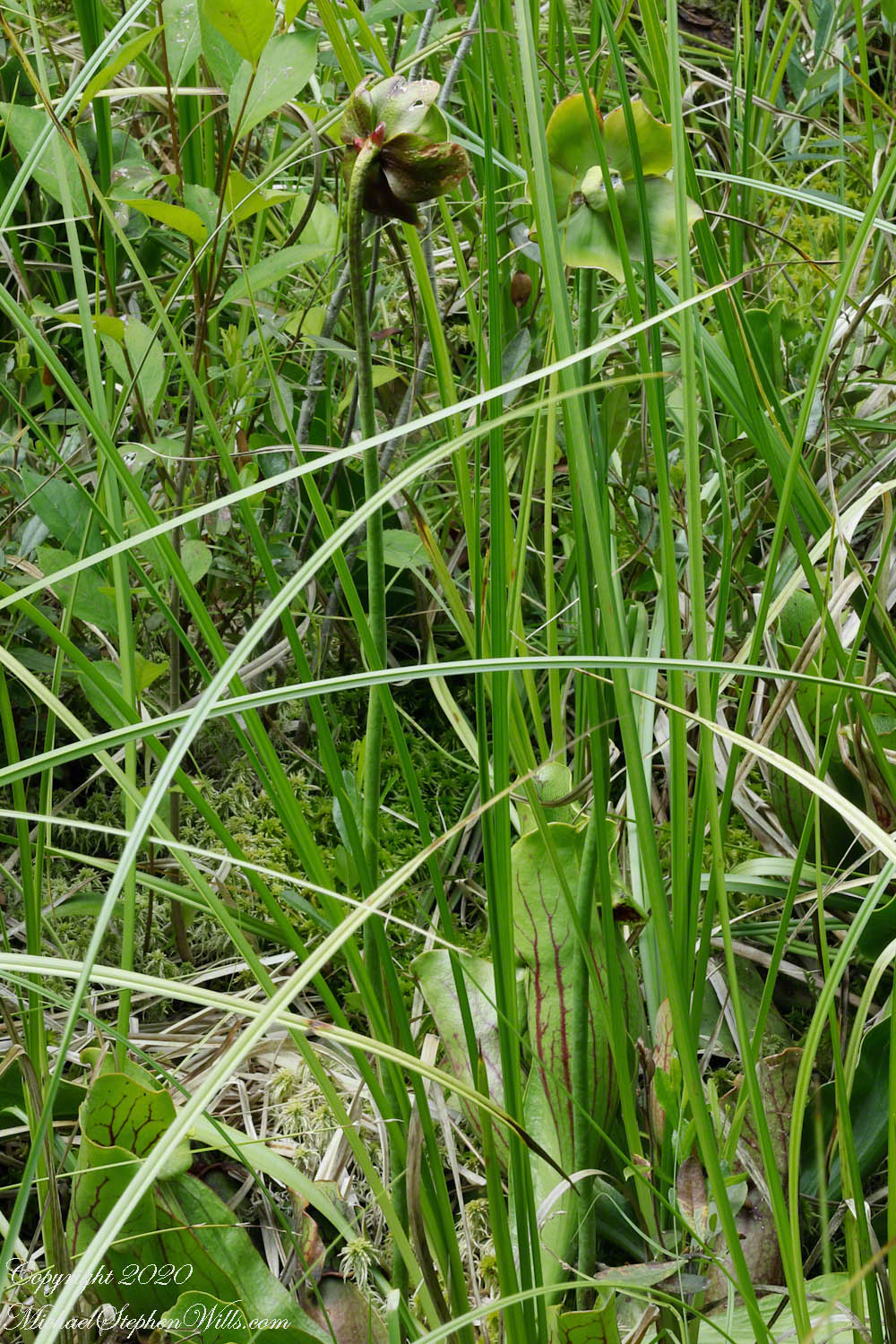
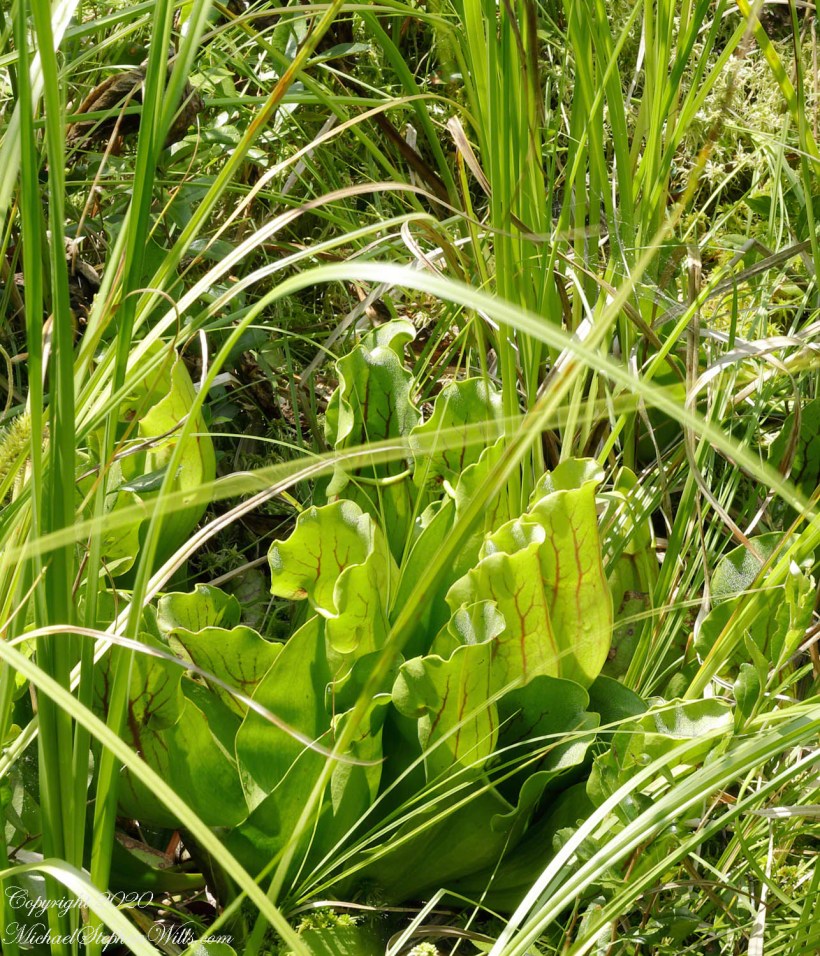
The pitchers themselves—those “turtle socks,” as they’ve been nicknamed—sit at ground level in a rosette, their mouths open to weather. Sunlight floods the cups and turns them into something both domestic and uncanny: a set of green, veined slippers left out to air, or a cluster of small amphorae awaiting an offering. In the bog’s thin soil, nourishment is hard-won. The pitcher plant answers that poverty with invention. Instead of arguing with the chemistry of peat, it borrows from the animal world—luring and taking what the air can spare. The cup is a trap, yes, but also a reservoir: rainwater gathered and held, a miniature wetland that mirrors the preserve’s larger one.

There is a tension here that never quite resolves: the plant’s beauty, and the plant’s appetite. We admire the cup’s red veining, the glossy rim, the way the opening flares like a lip; then we remember what the lip is for. We admire the flower’s elegant sheltering forms; then we realize the shelter is also a funnel, a choreography. This is not cruelty—no more than winter is cruelty. It is adaptation made visible, a lesson in how form follows need, and how need can produce something unexpectedly lovely.

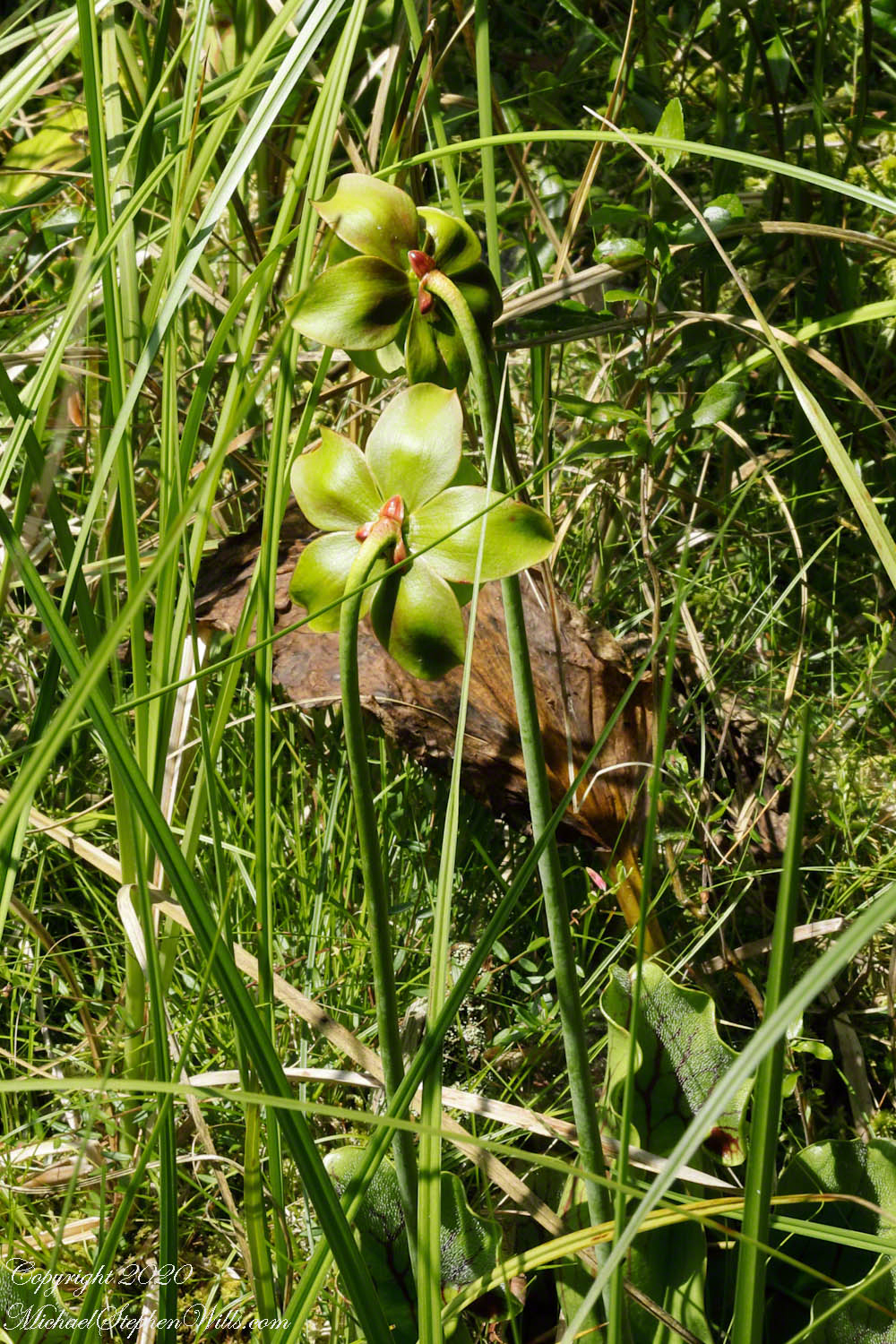
And yet the real marvel—the reason I came that day—rises above the traps on a strong stalk, lifted clear of the dangerous mouths below. The flower is not purple in the obvious way its common name promises. It is subtler and stranger: a suspended structure with the poise of a lantern and the protective logic of armor. It struck me as a flower unlike any I have experienced, resembling an insect carapace, with the reproductive element underneath a hood. That hooded design feels less like ornament than strategy—an architecture that guides a pollinator’s route, controlling entrances and exits the way the pitcher controls the fall of an insect.

Even the flower’s back side refuses to perform for the camera. From the posterior angle, “there are only bracts”—plain supporting structures, the botanical equivalent of scaffolding left in place once the facade is finished. The bog, too, shows its scaffolding everywhere: dead stems, old wood, peat-dark water, last year’s leaves. A preserve is never only what is blooming. It is what persists.

I found myself thinking about the details I wanted but could not quite capture that day: the downward facing hairs inside the pitcher—those one-way bristles that make retreat difficult once a victim has slipped in. I or my lens was not up to this challange. The shortcoming was minor, but instructive. The bog offers glimpses, not guarantees. It invites return visits, different light, different seasons, a different kind of patience.

Standing on the platform I felt the preserve’s central truth: these are landscapes shaped by constraint—by ice, by water, by nutrient scarcity, by the slow encroachment of shrubs—and yet they keep producing improbable forms. The purple pitcher plant is one of those forms: a green cup that drinks rain, a flower that wears a hood, a turtle sock that turns hunger into design. In a place where the ground itself seems to refuse abundance, the plant answers with a different kind of richness—an elegance that is also a solution.

Enter your email to receive notification of future postings. I will not sell or share your email address.