Frank and Rob: An Unexpected Meeting at Lamberton Conservatory

An unexpected encounter with Frank and Rob, two African tortoises in Rochester, becomes a meditation on discovery, deep time, adaptation, and the virtue of slowness.

There are discoveries we deliberately seek, and others that simply wait for us to notice them. On August 26, during a visit to the Lamberton Conservatory in Rochester’s Highland Park, Pam and I encountered two creatures that belonged firmly to the second category.

We had come to a conservatory, after all—a place where one expects palms reaching toward panes of glass, orchids suspended among roots and moss, and tropical foliage crowding the paths. I was looking at plants when something considerably more substantial appeared on the level, patterned brick path.

A tortoise.

Then another.
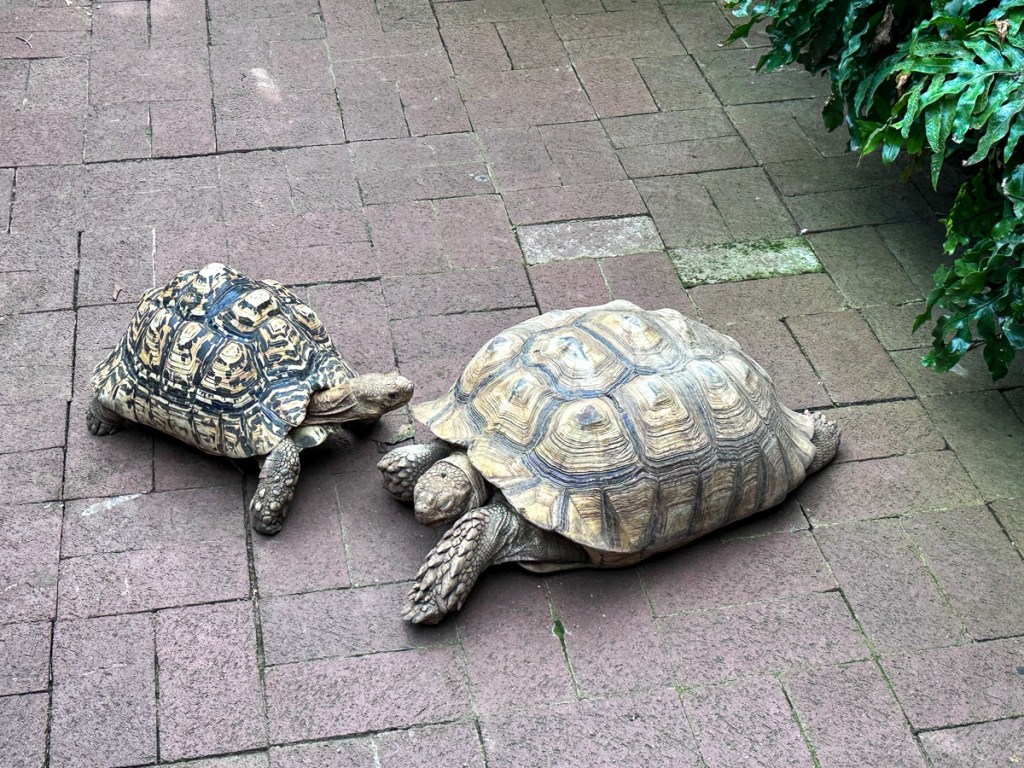
Two tortoises interacting on a paved pathway surrounded by greenery.

They moved freely among the vegetation, seemingly as much a part of the conservatory as the plants themselves. Nothing about their progress suggested urgency. Each foot was lifted, advanced and planted with deliberation. In a world increasingly measured in fractions of seconds, they seemed governed by another clock.

The smaller of the two immediately commanded my attention. His high, domed shell was covered with intricate patterns of yellow, tan and dark brown. Individual scutes carried irregular markings that radiated outward, giving the carapace something of the appearance of an ancient mosaic.
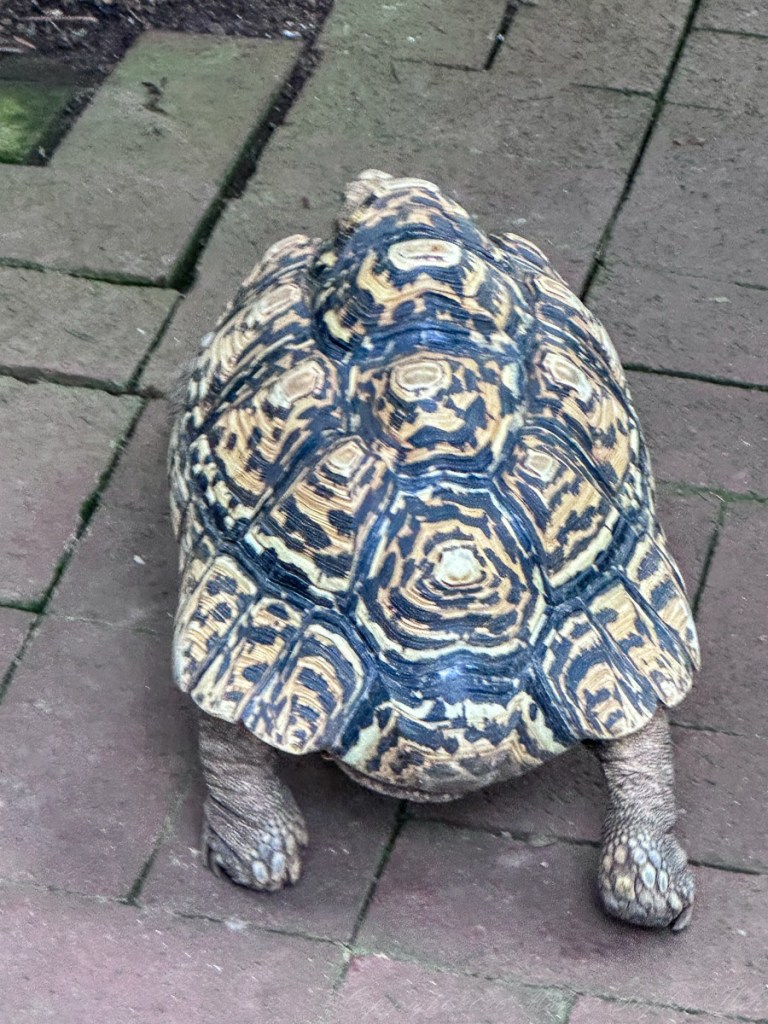
A tortoise walking on a brick path, showcasing its textured shell and limbs.

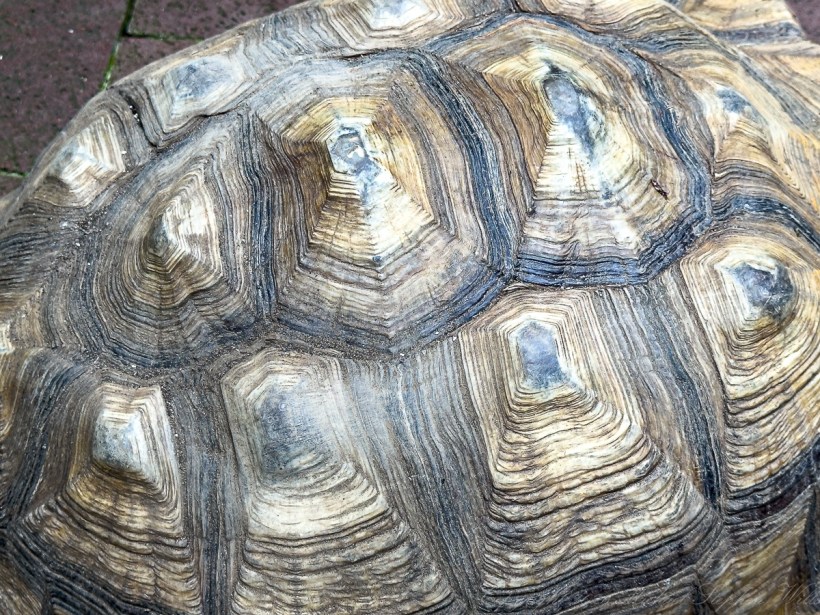
Beside him was an altogether different animal: larger, paler and immensely solid. Her shell was sandy brown, its individual scutes marked by concentric growth ridges. Massive forelegs, armored with heavy scales, supported a body that looked almost prehistoric. If the first tortoise suggested ornament, the second suggested architecture.

I photographed them, fascinated by the contrast.
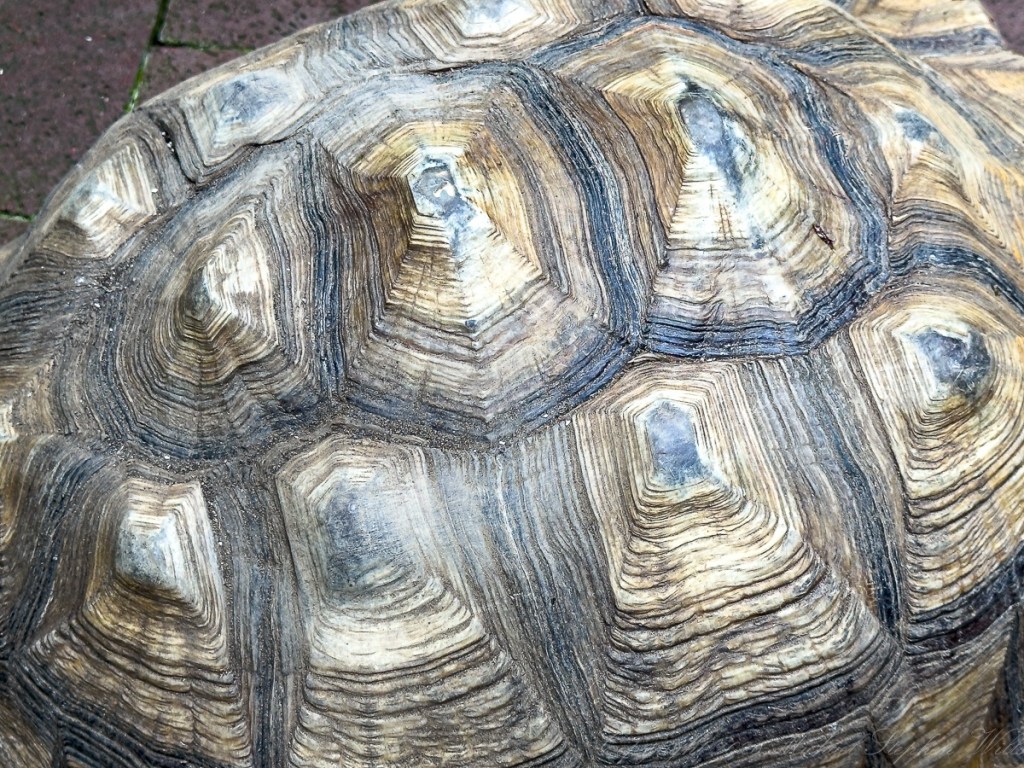
Close-up of a tortoise shell showcasing its intricate patterns and textures.

Only later did the two strangers acquire names and histories.

Nancy Mastin of Lamberton Conservatory identified the patterned tortoise as Frank, a male leopard tortoise (Stigmochelys pardalis), born in 2015. His much larger companion is Rob, a female African spurred, or sulcata, tortoise (Centrochelys sulcata), born in 2016. Both arrived at Lamberton sometime after 2020, donated by private owners who could no longer provide sufficient room for them.

That last detail transforms the encounter.

Frank’s species comes from eastern and southern Africa, where leopard tortoises inhabit savannas and dry grasslands. Their striking shells account for the name. The pattern varies enormously among individuals and changes with age, but Frank retains an especially handsome contrast of dark markings against a warm yellow-brown background.

Rob belongs to a species shaped by harsher country. The sulcata inhabits the semiarid belt along the southern margin of the Sahara, where survival depends partly upon escaping extreme heat. Powerful forelimbs equipped for digging allow these tortoises to excavate substantial burrows. They are giants among terrestrial reptiles—the largest tortoise native to mainland Africa—and their eventual size is precisely why animals purchased when small can become difficult for private owners to accommodate.

Rob is only about ten years old. Frank is about eleven. For animals capable of living for many decades, they are not venerable relics at all. They are comparatively young.

Perhaps that was the greatest surprise.

A tortoise carries age upon its back even when it is young. Its shell evokes fossils, vanished landscapes and evolutionary time. Watching Frank and Rob, I found it difficult not to imagine ancestors moving through African grasslands long before our own species began building conservatories—or cities—or anything else.

Their shells reinforce the illusion. The concentric ridges visible in my close photographs record periods of growth, although they cannot reliably be counted as annual rings. A tortoise shell is not an inert case carried by the animal. It is living anatomy: bone covered by keratinous scutes, growing with the tortoise and protecting a body intimately joined to it.

Yet what I remember most is not anatomy but pace.

Frank was still as Rob approached. Around them rose a manufactured tropics of glass, steel, soil and plants. We passed carefully, Iphones in hand. Somewhere outside, Rochester continued at the speed expected of a modern city.

The tortoises declined to participate in the hurry.

I felt a restoration while watching an animal for which slowness requires no apology. Every movement is sufficient unto itself. A foot advances. Weight shifts. A neck extends. A leaf is investigated. Nothing appears wasted, and nothing appears rushed.

Their presence also tells a quieter human story. Frank and Rob began life in private ownership. As they grew, their needs grew with them until their owners recognized that they could no longer provide adequate space. Donation brought them to Lamberton, where their lives intersected—and, one August afternoon, intersected briefly with mine.

We entered the Conservatory expecting tropical plants. I left with photographs of two African tortoises and, eventually, their names.

Frank and Rob.

That is one of the pleasures of remaining curious: a photograph leads to a species, a species to a name, a name to a history. What began as two unexpected shapes moving beneath tropical foliage became something more memorable—a glimpse of distant Africa, deep evolutionary time, and two remarkably unhurried lives being lived beneath the glass roof of a conservatory in Rochester, New York.
Click me to visit Michael Stephen Wills Online Finger Lakes Gallery.

Enter your email to receive notification of future postings. I will not sell or share your email address.

The Organ-Pipe Mud Dauber Wasp at Our Window

An persistant buzzing at an east-facing window led to an unexpected discovery: an organ-pipe mud dauber tending its earthen nest, revealing a hidden world of architecture, courtship, spider hunting, and parental care just beyond the glass.

On a morning in late July, the songs and raucous calls of Blue Jays, Cardinals, and Carolina Wrens were joined by another sound—an intermittent, insistent buzzing. It seemed to be an angry wasp, an unwelcome distraction as I worked facing the large east-facing picture window. Orchids line the window ledge, their pots and foliage blocking my view of the lower edge where I assumed the insect was trapped.

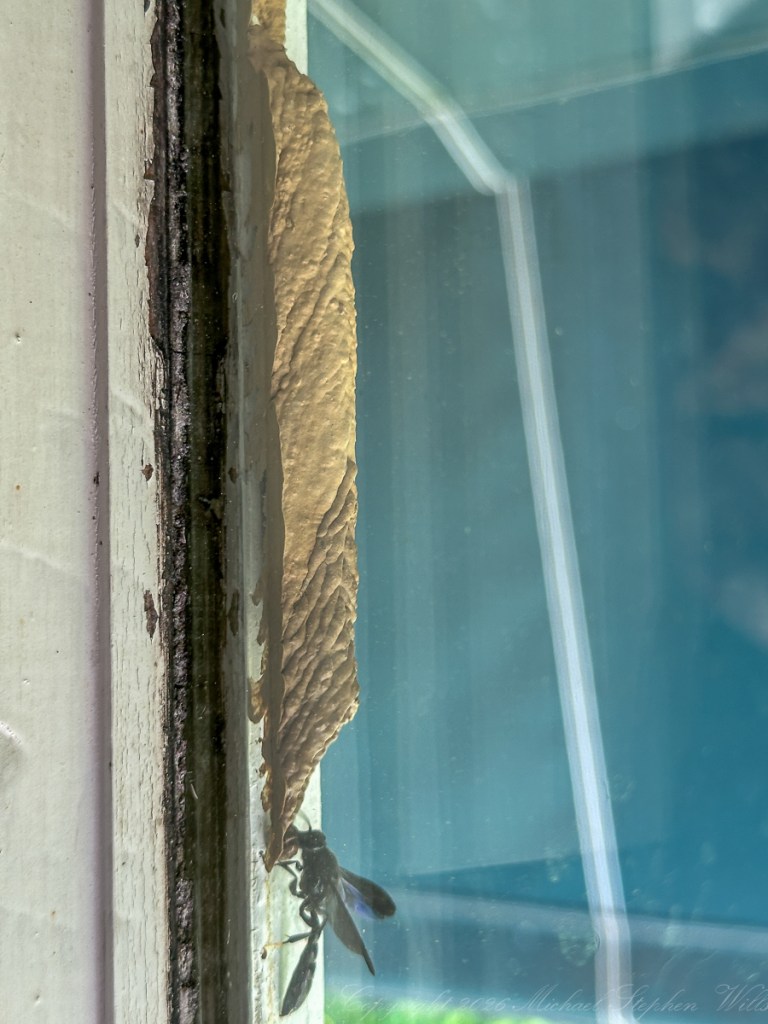
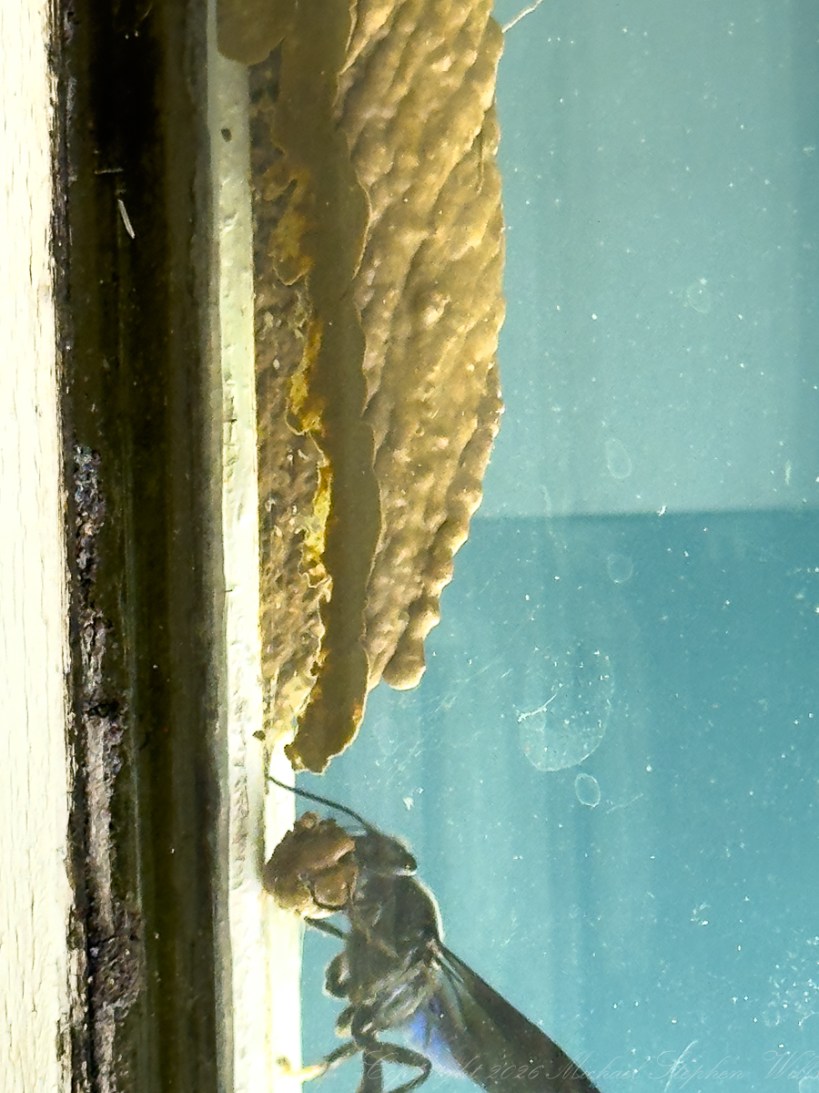
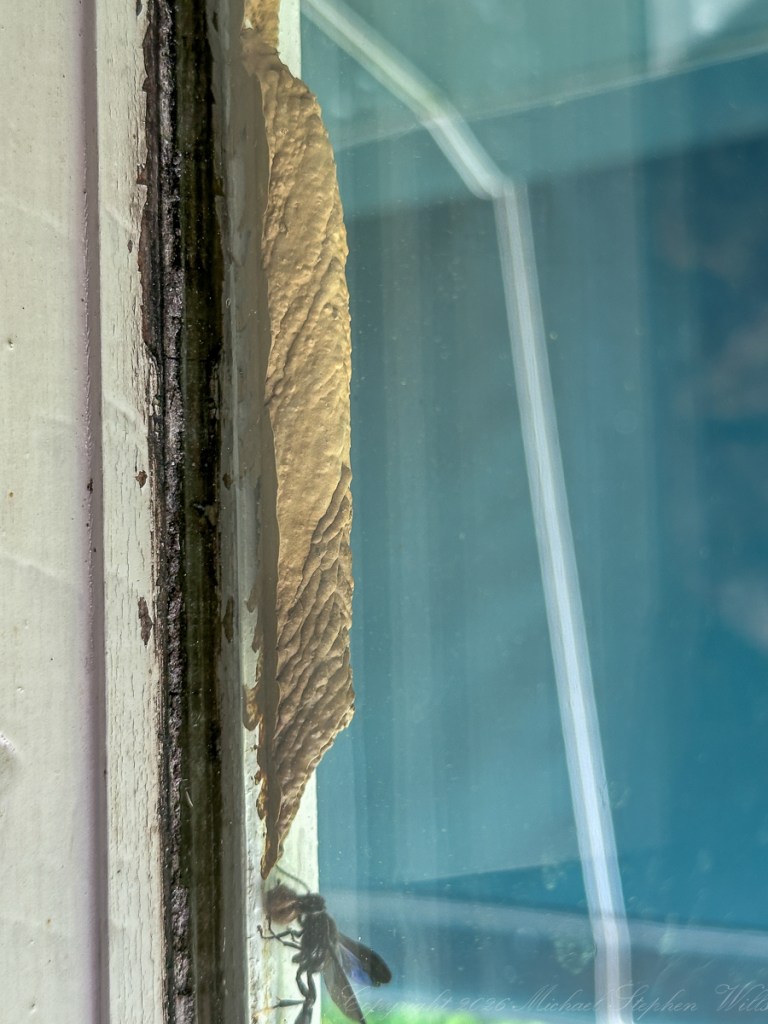
During one of the silences, I approached with a cup and stiff sheet of paper, prepared to capture the intruder and carry it outdoors. Peering cautiously around the orchid pots, I saw nothing. Then the buzzing resumed. Following the sound, I looked more carefully and discovered something entirely unexpected: affixed to the outside edge of the window was a long tan column of dried earth.

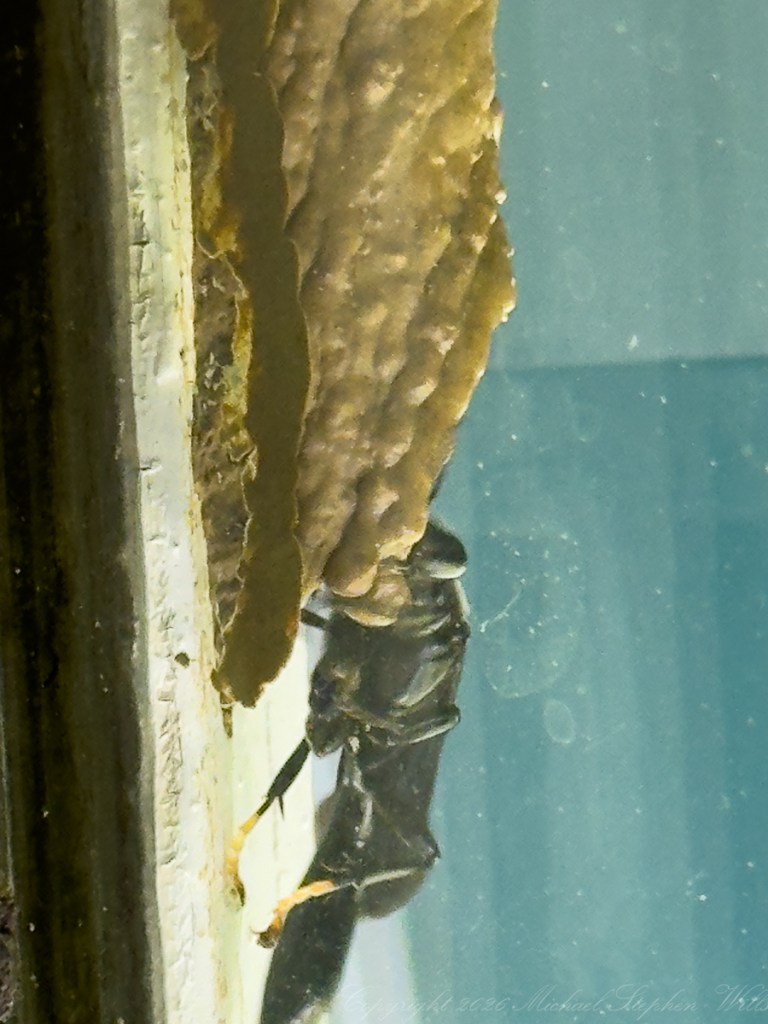
It looked geological—a miniature formation of hardened sediment affixed to the corner of painted wood and glass. Its surface was ridged and corrugated, each irregular band recording some earlier act of construction. At its lower end appeared the architect: a large, lustrous black wasp.

I discovered the wasp’s identity also explained both the strange earthen structure and that surprisingly loud buzz: this was an organ-pipe mud dauber, Trypoxylon politum. The species occurs through much of eastern North America and is the largest member of its genus in our region.

The name is wonderfully descriptive. The female constructs elongated tubes of mud side by side against sheltered walls, bridges, rock faces and buildings. A completed group resembles the vertical pipes of an old church organ. What I had initially taken for a crude column of dirt was, in fact, architecture.

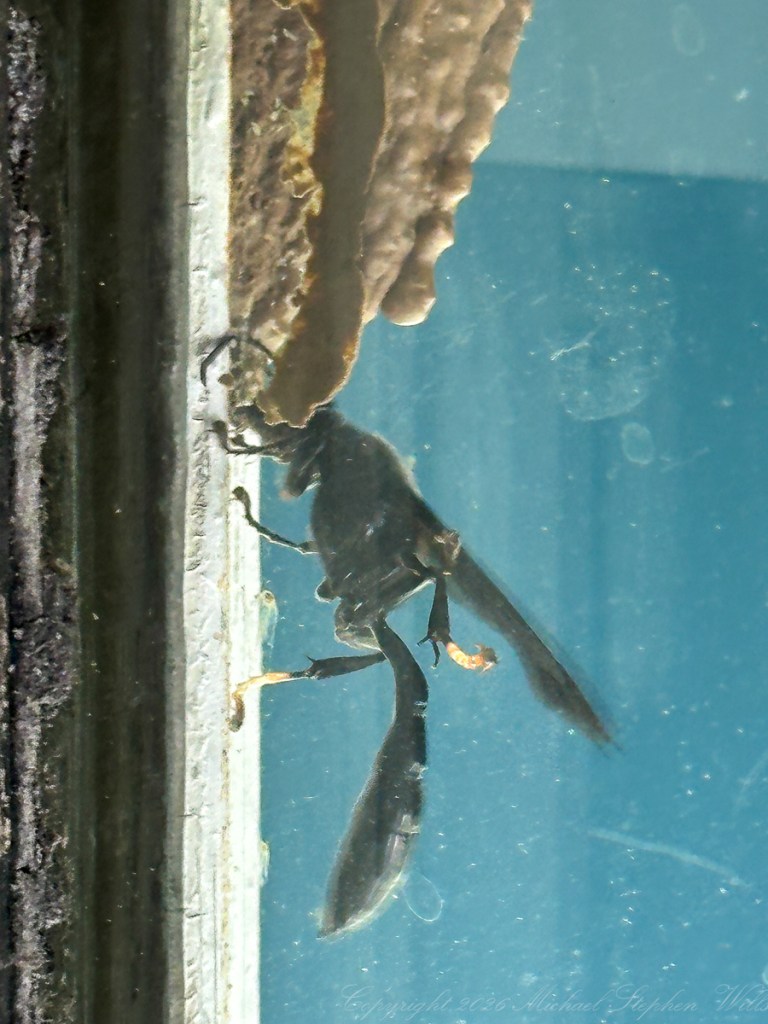
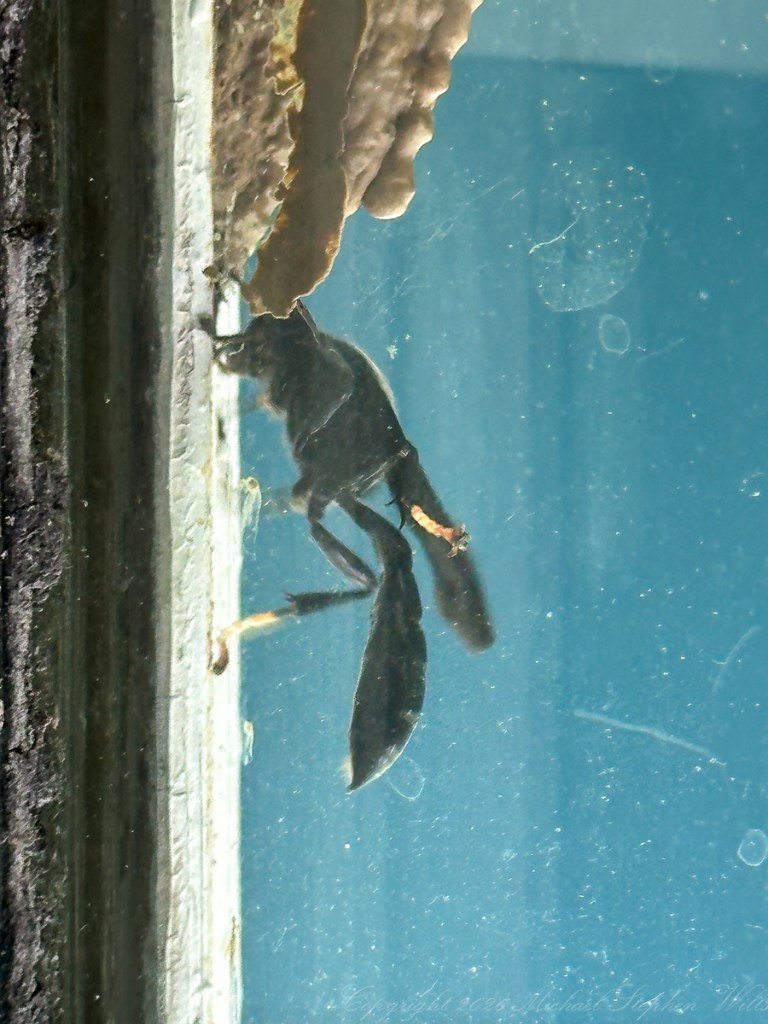
The wasp itself has an austere beauty. Its body is predominantly polished black, sometimes seeming almost blue-black as sunlight catches the wings and exoskeleton. The abdomen is extraordinarily slender near its base before widening toward the end, giving the insect a delicate, elongated silhouette. Long black legs hang beneath it, with pale markings on portions of the hind feet. In my photographs the wings sometimes flash an unexpected smoky violet-blue, while the legs grasp the painted window frame beside the ocher-colored mud. Against that earthy structure the wasp looks almost metallic.

Yet the formidable appearance is misleading. Unlike yellowjackets and other colonial wasps, the organ-pipe mud dauber is essentially solitary. There is no queen commanding a workforce and no populous colony ready to defend the nest. A female constructs and provisions her own nest, and solitary wasps consequently tend to be much less defensive than social species.

But Trypoxylon politum adds a fascinating complication to the word solitary.

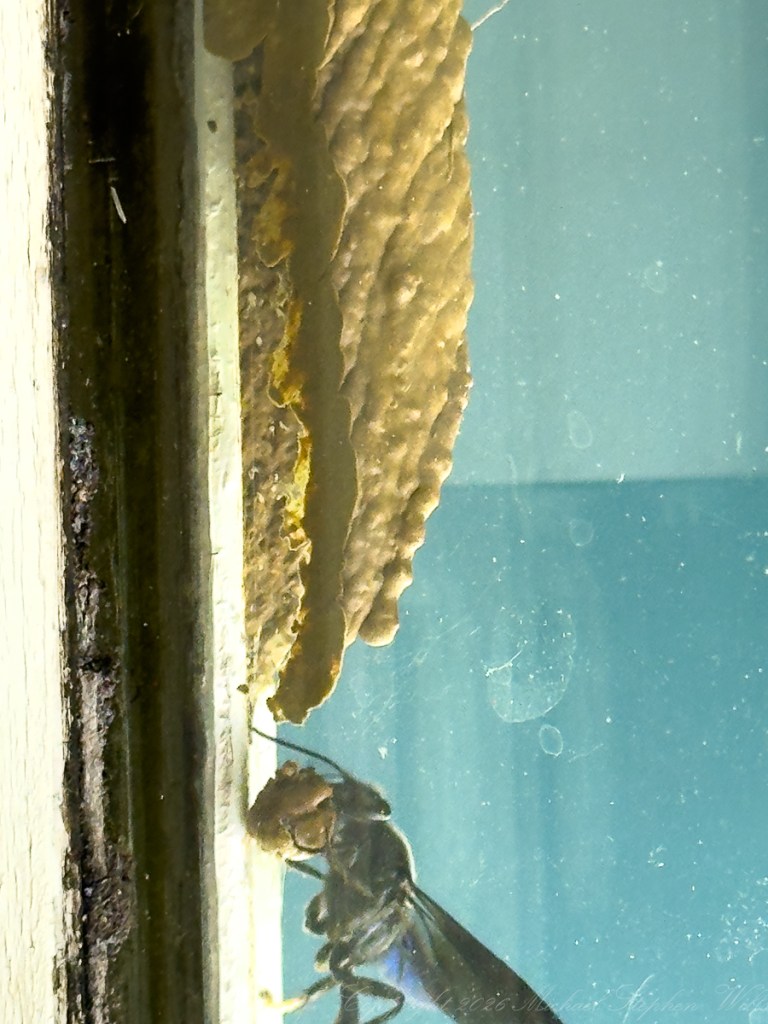
A male may remain at the nest while his mate is away. He guards its entrance against intruders—including parasitic insects and rival males—and may produce a conspicuous buzzing when something approaches. That behavior makes me reconsider my first encounter. The creature I heard behind the orchids was not an insect frantically trapped indoors at all. The window glass separated us. I was inside; the wasp was outside, stationed beside its earthen fortress. What sounded to me like anger was vigilance, though I also observed similar buzzing as the female shaped each ball of mud.

The female performs the more astonishing work. She gathers wet mud and carries it repeatedly to the nest, gradually extending a tube. Inside she creates a succession of chambers. Then she becomes a hunter.

Her quarry is spiders.

She captures and paralyzes them, carrying them back to the nest and packing several into each cell—reported numbers range from about three to eighteen spiders with the fertilized female eggs better provisioned. Upon this living but immobilized store of food she lays an egg and seals the chamber with mud. The larva that hatches within has a private larder of fresh prey. Another chamber follows, and another, until the peculiar earthen pipe becomes a nursery divided into hidden rooms.

Watch two wasps building the nest.

There is something almost unsettling in that knowledge. Within the rough tan structure, a nest, on our window frame lie spiders gathered from our garden, each incorporated into the reproductive cycle of another animal. Predator becomes provision; mud becomes shelter; a few inches of ordinary window trim become an ecosystem.

That is what held my attention long after the original buzzing ceased. I had sat only a few feet away, day after day, unaware that another creature was carrying out an intricate sequence of hunting, construction, mating and parental investment on the opposite side of the glass.

The window had seemed a boundary between our house and the natural world. The organ-pipe mud dauber revealed it to be something else: a place where the two worlds meet.

And all it took for me to notice was a buzz.

Click me to visit Michael Stephen Wills Online Finger Lakes Gallery.

Enter your email to receive notification of future postings. I will not sell or share your email address.

“Great Blue Herons at Cocoa Beach: A Space Coast Morning on the Atlantic

Along the luminous seam of surf and sand, a heron reads the tide’s slow grammar, patience embodied, until water yields a silver secret and morning becomes ceremony.

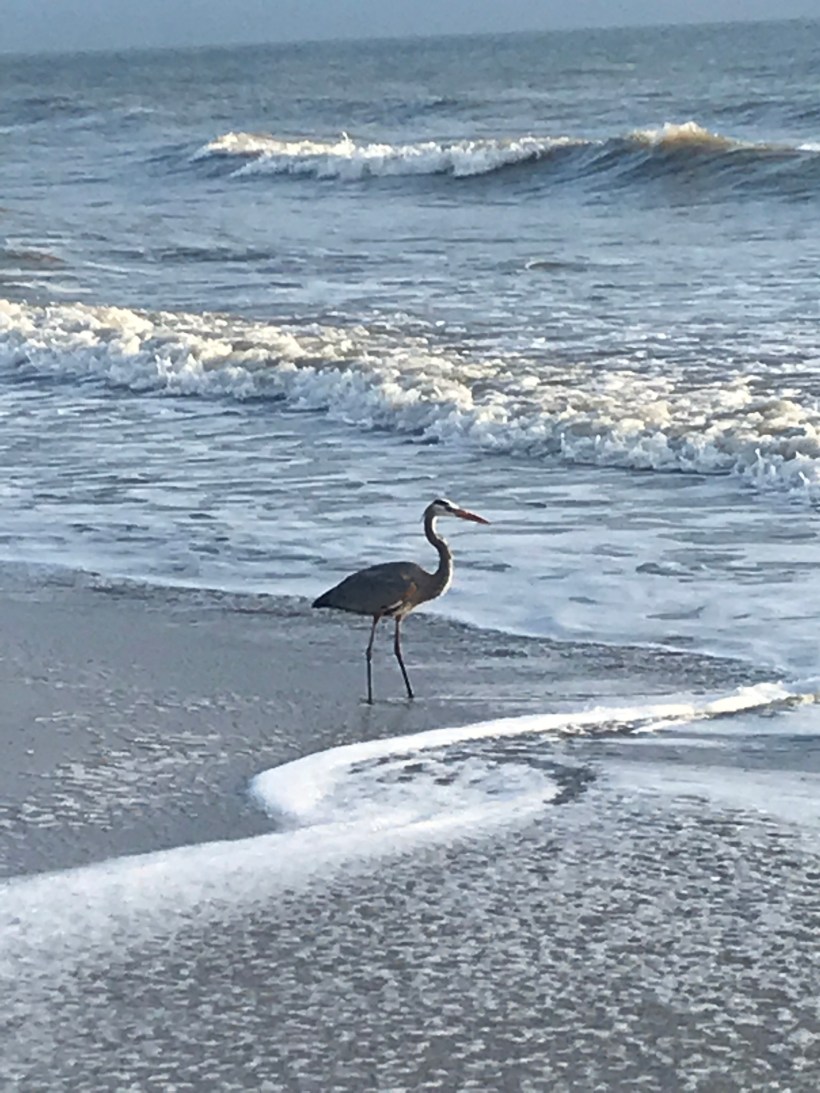
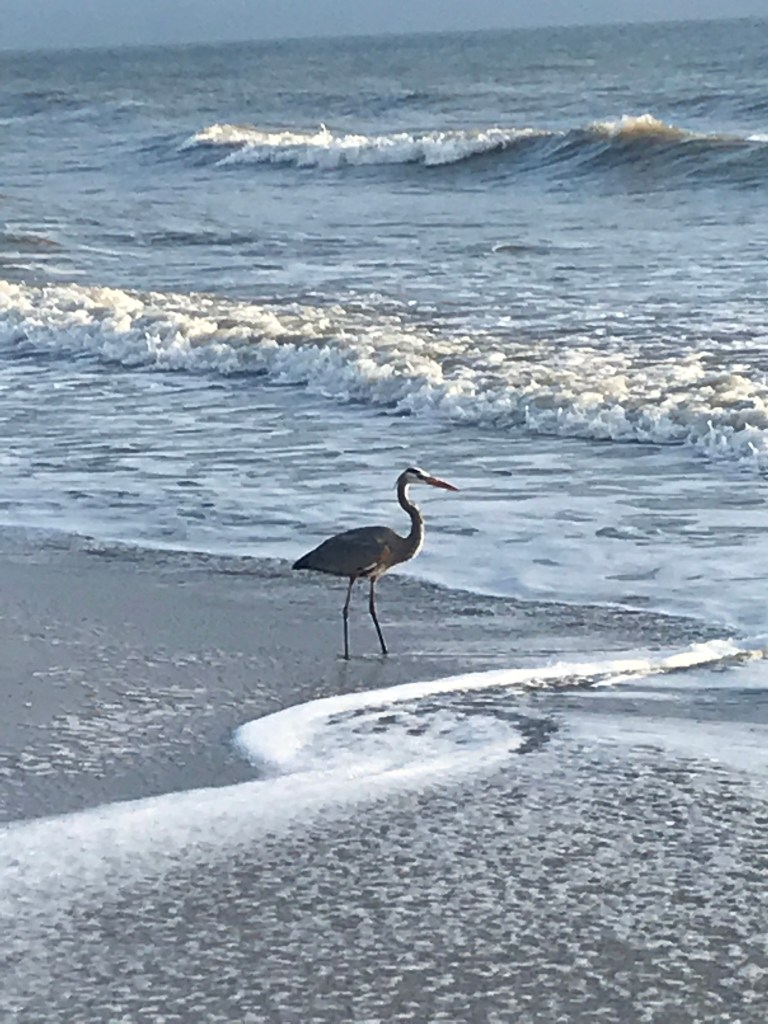
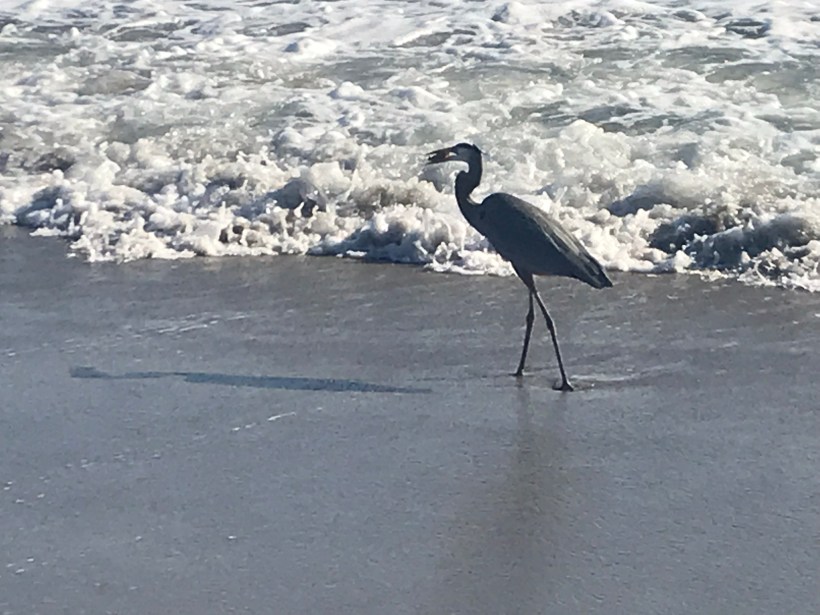
We walk the long seam where the Atlantic writes its restless script, and our beachcombing becomes a study in attention. The shore’s edge—where foam loosens shells from sand and the wind arranges salt on the tongue—draws other walkers too: grey herons, patient and arrow-straight, patrolling the surf line as if reading a language older than tides. They halt us without trying. We stand, quieted, while they work the boundary between water and land, between hunger and satisfaction.

I pack an iPhone sometimes for beachcombing as a lightweight alternative to SLRs. This post features iPhone photographs.

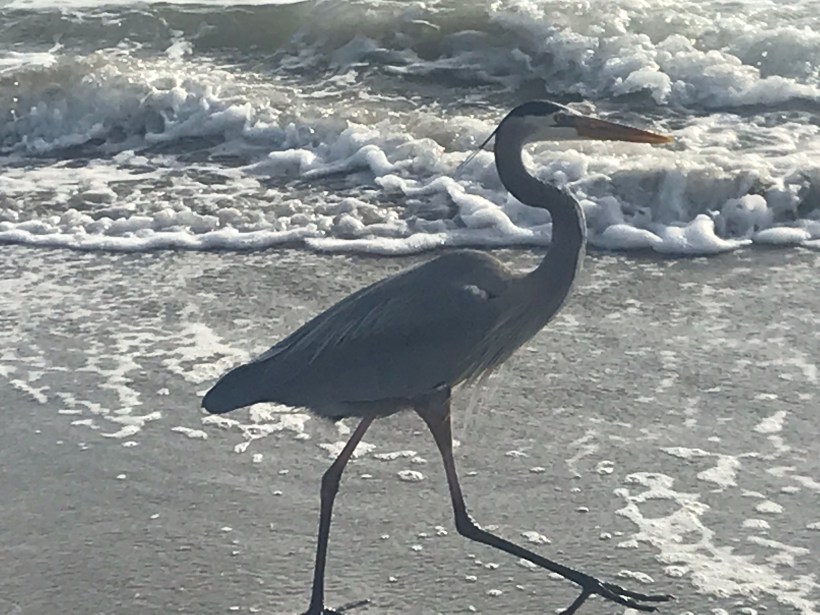
Along this narrow world of sand and surf, herons keep two distinct manners. Some linger near anglers, learning the thrift of handouts and the craft of appearing inevitable. Others refuse that bargain and hunt on their own, staking the wash with a slowness that is not delay but method. These independent operators move along the ocean’s margin: high enough to let the breakers fold ahead of them, low enough that their long legs stir the small lives hidden in the cross-hatching currents. To follow one with the eye is to adopt a different clock. Sandpipers skitter and dash; the heron lengthens time.

A perfect place to stalk the surf

At first the bird seems merely spellbound by light on water. Then a shift: a narrow cant of the head, the smallest realignment of the eye to the glare. The neck—serpentine and stored with intention—uncoils quick as a strike, and the bill cleaves the surface. The world either yields or it doesn’t. Often it doesn’t. When it does, the beak lifts an impossibly large, glinting fish, as if the ocean had lent out a secret.

Success!!

What follows is ceremony. The heron stands and calibrates, turning the silver length with almost invisible nods until head and prize agree. A sharp jerk aligns the fish with beak and gullet; the upper throat swells, accepting the whole, unchewed. Two more pulses and the catch is a memory traveling inward. It is an astonishment every time, not because we do not understand what is happening but because we do, and still it exceeds us.

We carry a smart phone on these morning circuits, a slim stand-in for heavier glass, enough to witness without intruding. Backlit by the early sun, the herons are cut from bronze and shadow, working the luminous edge while the day composes itself behind them. In the afternoons we meet fewer of the solitary hunters when the strand belongs more to the opportunists near the thinning knots of anglers. Why the shift, we cannot say. The ocean has its schedule; so, it seems, do its readers.

If we keep our distance, we are permitted to watch. Cross a line we don’t perceive and the bird will rise all at once, the long body unfolding, the voice a rasping scold torn from the throat of reed beds and marsh dawns; but, grant it enough space, and the heron returns us to the lesson it keeps teaching: that patience is a kind of movement; that the boundary of things is where change is clearest; that the most astonishing acts require the courage to do very little, very well, for a long time.

We come to linger where the waves erase our tracks, apprenticed to that slow grammar, trying to learn the tide’s careful verbs before the light turns and the day becomes something else—a different text, the same shore, the heron already a thin signature against the horizon.

Enter your email to receive notification of future postings. I will not sell or share your email address.

Hoverflies: Nature’s Mimicry Experts

Hoverflies, harmless pollinators often mistaken for bees, possess distinctive features and mimicry patterns that aid in their survival.

A hoverfly buzzing with cheer,
Lands softly, no sting to fear.
With wings all a-glitter,
It’s no wasp, just a critter,
Whose mimicry tricks year to year.

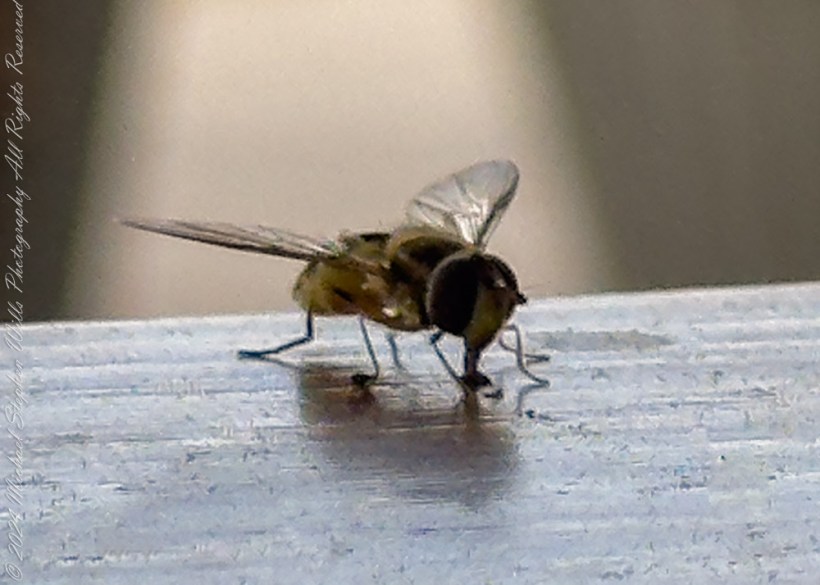
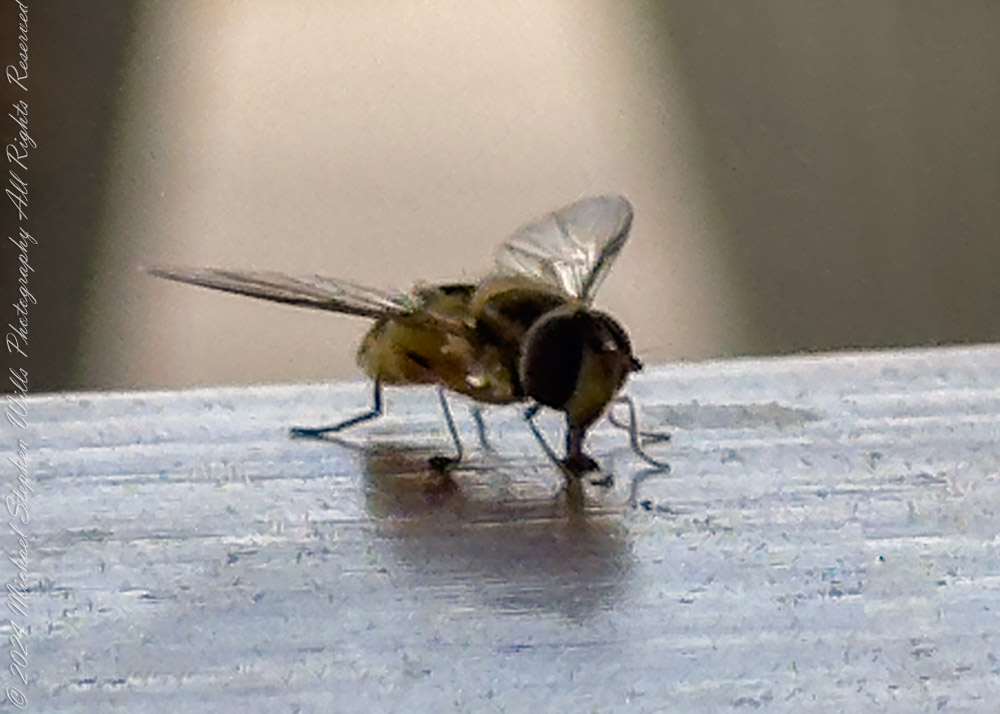
The photo shows the hoverfly on a smooth surface, possibly resting or feeding. Hoverflies are abundant in the fall as they are drawn to late-blooming flowers for nectar and pollen.

A hoverfly stopped for a snack,
On a table, just taking a crack.
It posed for a shot,
Not moving a lot,
Then flew off to plan its next act.

A hoverfly thought it was sly,
As it zipped ‘round, too quick for the eye.
“Are you a bee?” folks said,
With confusion widespread,
“Just a poser!” it said with a sigh.

Some useful facts about this relatively harmless visitor

This insect is a Hoverfly (family Syrphidae). Hoverflies are often mistaken for bees or wasps due to their yellow and black striped body, but they are harmless and lack the ability to sting. They are beneficial pollinators and are common in gardens, meadows, and near flowers.

Some key identifying features include:

Large compound eyes that meet at the top of the head in males.


Two clear wings (unlike bees/wasps, which have four wings).


A short, stubby antennae.


Mimicry coloration (yellow and black stripes) that helps them avoid predators.


A Raft of Coots on Merritt Island

Discover the elegance of the American Coot through our journey at Merritt Island, where these unsung avians dance across the water, crafting nature’s own symphony of survival and grace.

First Glimpse

There we were, Pam and I, standing before the serene waters of the Merritt Island National Wildlife Refuge, when a cluster of American Coots (Fulica americana) caught our eyes. Locally known as mud hens, marsh hens, or pond ducks, these coots were anything but mundane. Their dark plumage blended with the ripples, while their ivory bills gleamed like beacons, leading our gaze across the liquid expanse.

The Coot’s Constellation

As a throng, they moved with purposeful grace, a constellation of birds, each a star in their own right. With lobed toes spread like aquatic fans, they paddled through the water, their movements an embodiment of nature’s ingenuity. These “poule d’eau,” as the French settlers once called them, displayed a mastery over their domain, both in water and on land.

Social Weave

A Raft of American Coots

The coots assembled not as a random flock but as a deliberate collective, a raft in both name and function. They maneuvered with a collective intelligence, each bird’s action rippling through the group, exemplifying the coots’ penchant for community. Their group dynamics, a blend of cooperation and competition, painted a picture of the delicate balance within ecosystems.

An Ecological Perspective

In the tapestry of the refuge’s ecology, the American Coot stitched its niche with precision. Whether known as “baldpate” or “crow duck,” these birds were critical to the habitat they frequented, acting as both consumers and contributors. They pruned the vegetation, controlling its growth, and served as prey, connecting the food web in a cycle that spanned generations.


The Taxonomic Twist: Coots vs. Ducks

As the coots continued their ballet on the water, I turned to Pam, ready to demystify the common misconception that coots and ducks are close relatives. “Though they share the wetland stage,” I began, “these two are cast in different roles by nature’s hand.”

Orders Apart

Coots are members of the order Gruiformes, which includes rails and cranes, characterized by their elongated bodies and short wings. Ducks, on the other hand, belong to the order Anseriformes, which also encompasses swans and geese, known for their broad, flat bills and webbed feet.

Distinct Lineages

This taxonomic separation marks a deep evolutionary divide. The Gruiformes, with their lobed toes and distinctive calls, represent a lineage adapted for a life traversing the marshy edges of the world. Anseriformes, with their specialized bills for filtering and dabbling, reveal a lineage fine-tuned for exploiting the aquatic resources more extensively.

The Cultural Mosaic

Despite their commonality, coots have etched a place in cultural folklore, often overshadowed by more colorful avian neighbors. Yet, their ubiquity across North American wetlands has made them a familiar sight, a symbol of the wild’s persistent pulse. To us, they were the embodiment of the unsung wilderness, a chapter in the storybook of natural history.

Embracing the Ensemble

As the day waned, the water transformed into a canvas of orange and purple hues, with the coots as its subjects. “Behold the marsh’s musicians,” I mused to Pam, “each note they play is a beat in the heart of the wild.” Our encounter with the American Coot—a bird of many names but one singular, remarkable essence—was a harmonious reminder of nature’s interconnected ballet.

Copyright 2024 Michael Stephen Wills All Rights Reserved

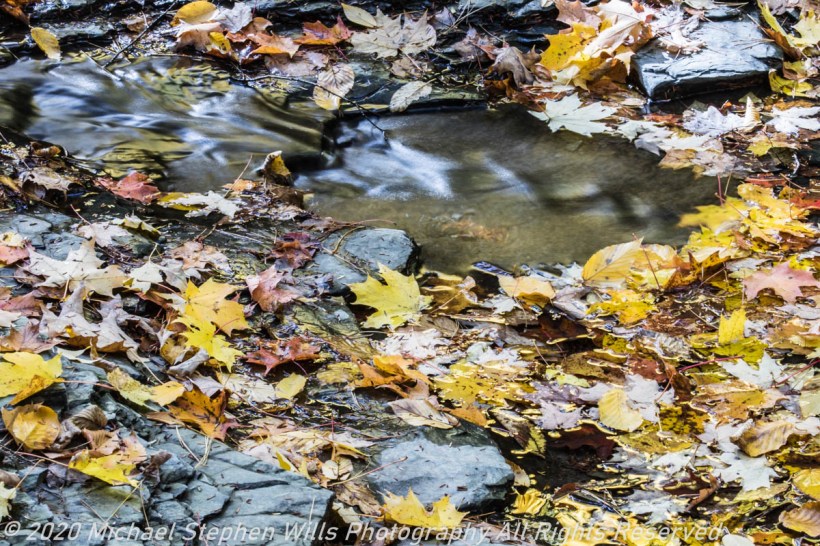
Thayer Preserve: Autumn Still Life 4

Explore the enchanting Lick Brook in the Finger Lakes region, where the Land Trust’s conservation efforts preserve nature’s beauty. Join me to uncover this hidden gem and its ecological wonders.

Continue reading “Thayer Preserve: Autumn Still Life 4”