Frank and Rob: An Unexpected Meeting at Lamberton Conservatory

An unexpected encounter with Frank and Rob, two African tortoises in Rochester, becomes a meditation on discovery, deep time, adaptation, and the virtue of slowness.

There are discoveries we deliberately seek, and others that simply wait for us to notice them. On August 26, during a visit to the Lamberton Conservatory in Rochester’s Highland Park, Pam and I encountered two creatures that belonged firmly to the second category.

We had come to a conservatory, after all—a place where one expects palms reaching toward panes of glass, orchids suspended among roots and moss, and tropical foliage crowding the paths. I was looking at plants when something considerably more substantial appeared on the level, patterned brick path.

A tortoise.

Then another.
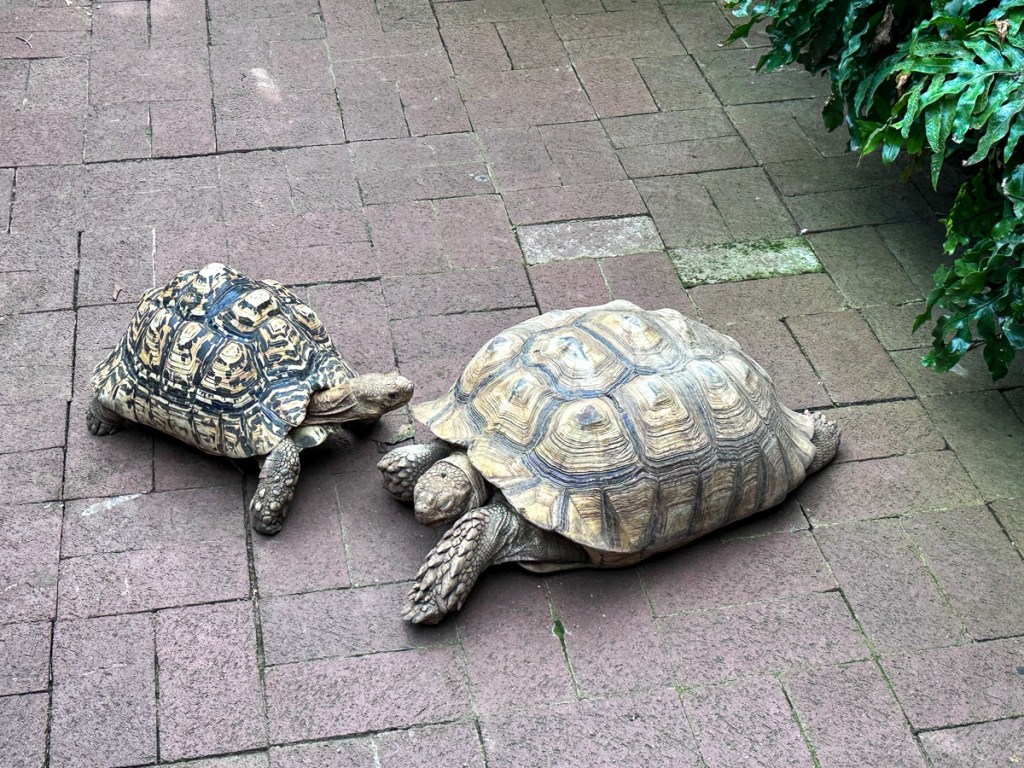
Two tortoises interacting on a paved pathway surrounded by greenery.

They moved freely among the vegetation, seemingly as much a part of the conservatory as the plants themselves. Nothing about their progress suggested urgency. Each foot was lifted, advanced and planted with deliberation. In a world increasingly measured in fractions of seconds, they seemed governed by another clock.

The smaller of the two immediately commanded my attention. His high, domed shell was covered with intricate patterns of yellow, tan and dark brown. Individual scutes carried irregular markings that radiated outward, giving the carapace something of the appearance of an ancient mosaic.
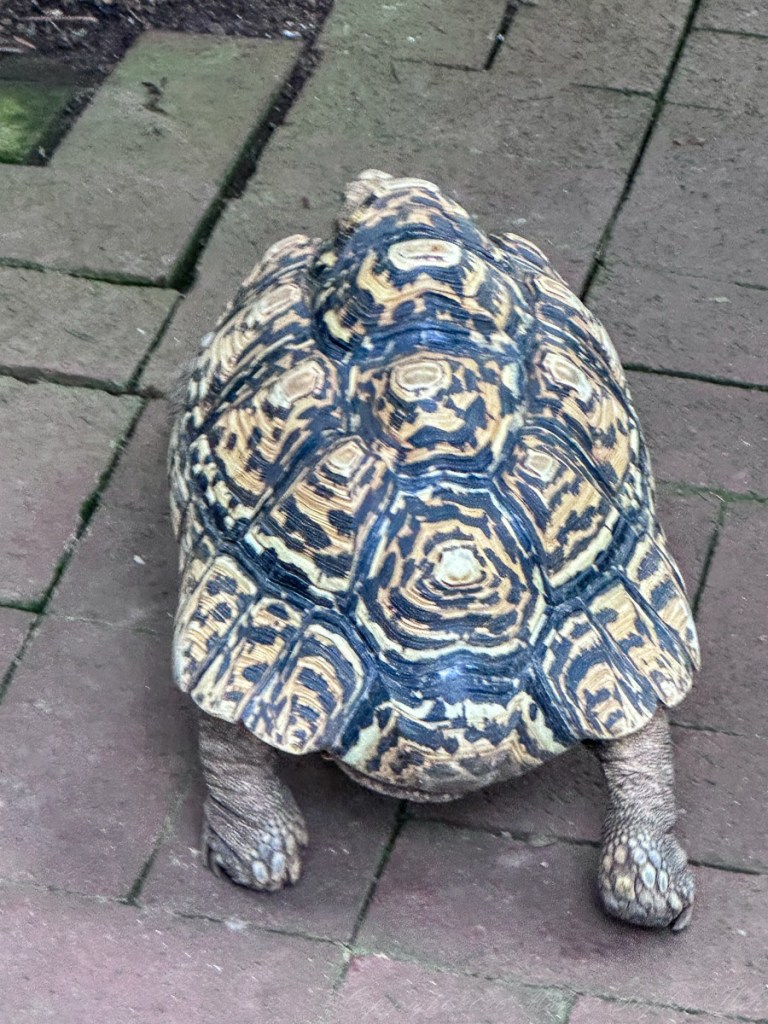
A tortoise walking on a brick path, showcasing its textured shell and limbs.

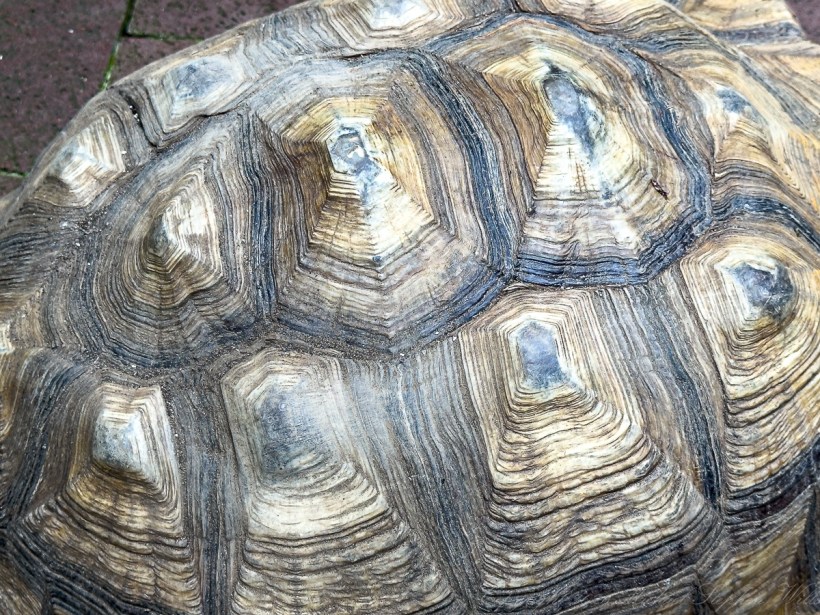
Beside him was an altogether different animal: larger, paler and immensely solid. Her shell was sandy brown, its individual scutes marked by concentric growth ridges. Massive forelegs, armored with heavy scales, supported a body that looked almost prehistoric. If the first tortoise suggested ornament, the second suggested architecture.

I photographed them, fascinated by the contrast.
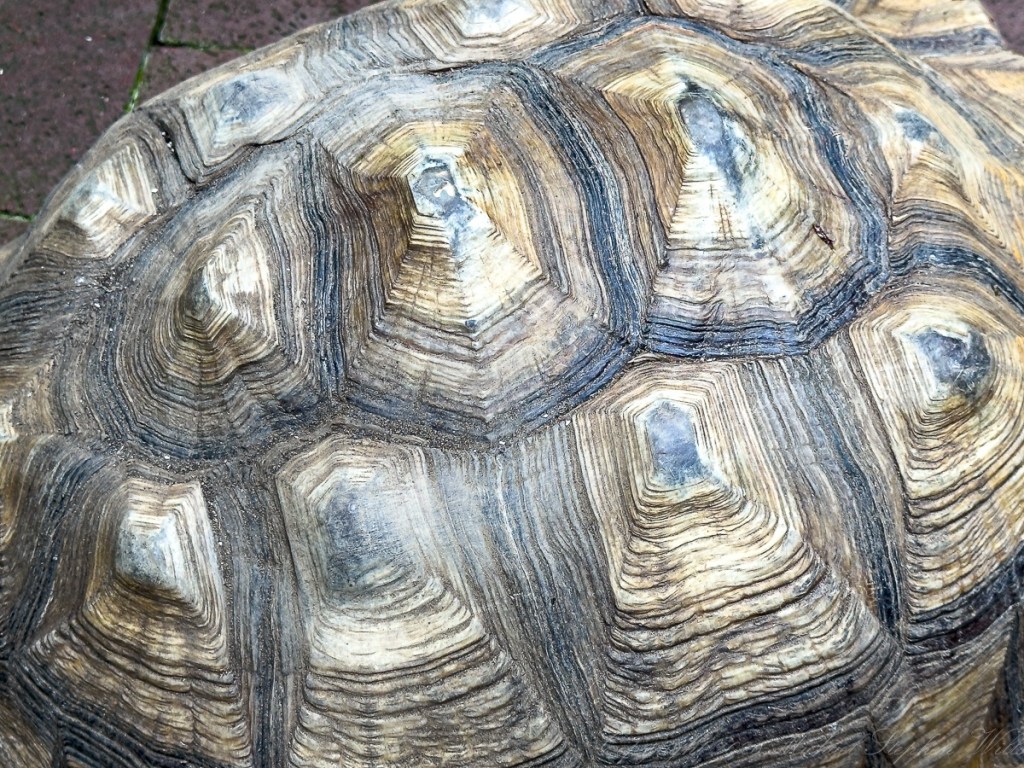
Close-up of a tortoise shell showcasing its intricate patterns and textures.

Only later did the two strangers acquire names and histories.

Nancy Mastin of Lamberton Conservatory identified the patterned tortoise as Frank, a male leopard tortoise (Stigmochelys pardalis), born in 2015. His much larger companion is Rob, a female African spurred, or sulcata, tortoise (Centrochelys sulcata), born in 2016. Both arrived at Lamberton sometime after 2020, donated by private owners who could no longer provide sufficient room for them.

That last detail transforms the encounter.

Frank’s species comes from eastern and southern Africa, where leopard tortoises inhabit savannas and dry grasslands. Their striking shells account for the name. The pattern varies enormously among individuals and changes with age, but Frank retains an especially handsome contrast of dark markings against a warm yellow-brown background.

Rob belongs to a species shaped by harsher country. The sulcata inhabits the semiarid belt along the southern margin of the Sahara, where survival depends partly upon escaping extreme heat. Powerful forelimbs equipped for digging allow these tortoises to excavate substantial burrows. They are giants among terrestrial reptiles—the largest tortoise native to mainland Africa—and their eventual size is precisely why animals purchased when small can become difficult for private owners to accommodate.

Rob is only about ten years old. Frank is about eleven. For animals capable of living for many decades, they are not venerable relics at all. They are comparatively young.

Perhaps that was the greatest surprise.

A tortoise carries age upon its back even when it is young. Its shell evokes fossils, vanished landscapes and evolutionary time. Watching Frank and Rob, I found it difficult not to imagine ancestors moving through African grasslands long before our own species began building conservatories—or cities—or anything else.

Their shells reinforce the illusion. The concentric ridges visible in my close photographs record periods of growth, although they cannot reliably be counted as annual rings. A tortoise shell is not an inert case carried by the animal. It is living anatomy: bone covered by keratinous scutes, growing with the tortoise and protecting a body intimately joined to it.

Yet what I remember most is not anatomy but pace.

Frank was still as Rob approached. Around them rose a manufactured tropics of glass, steel, soil and plants. We passed carefully, Iphones in hand. Somewhere outside, Rochester continued at the speed expected of a modern city.

The tortoises declined to participate in the hurry.

I felt a restoration while watching an animal for which slowness requires no apology. Every movement is sufficient unto itself. A foot advances. Weight shifts. A neck extends. A leaf is investigated. Nothing appears wasted, and nothing appears rushed.

Their presence also tells a quieter human story. Frank and Rob began life in private ownership. As they grew, their needs grew with them until their owners recognized that they could no longer provide adequate space. Donation brought them to Lamberton, where their lives intersected—and, one August afternoon, intersected briefly with mine.

We entered the Conservatory expecting tropical plants. I left with photographs of two African tortoises and, eventually, their names.

Frank and Rob.

That is one of the pleasures of remaining curious: a photograph leads to a species, a species to a name, a name to a history. What began as two unexpected shapes moving beneath tropical foliage became something more memorable—a glimpse of distant Africa, deep evolutionary time, and two remarkably unhurried lives being lived beneath the glass roof of a conservatory in Rochester, New York.
Click me to visit Michael Stephen Wills Online Finger Lakes Gallery.

Enter your email to receive notification of future postings. I will not sell or share your email address.

On Being Thankful

A garden, migrating geese, an unexpected balloon and flowers opening after dark remind me that gratitude begins by noticing the extraordinary within ordinary life.

There are times when gratitude arrives not as a grand revelation but quietly, almost unnoticed. It can begin by looking out a window, walking through a garden, hearing the calls of birds overhead, or watching something unexpected drift across an otherwise familiar sky. My video is made of such moments. It is a collection of things close at hand, yet when gathered together and accompanied by music, they become something more: a reminder of how extraordinarily rich an ordinary life can be.

I have much to be thankful for.

I am thankful, first, for home, a place on Earth intimately known to me. The opening views of the garden convey that sense wonderfully. There are great white clusters of hydrangea against deep green foliage, scattered pink blossoms, lawn, trees and the familiar boundaries of a yard. None of it is monumental. That is exactly the point. These are not the Alps or some distant wilderness. They are the landscape of everyday life, made beautiful by familiarity, care and the changing seasons.

A garden teaches gratitude because nothing in it remains still. Flowers arrive, flourish and disappear. Leaves that emerge with the almost translucent green of spring deepen through summer and eventually blaze red before falling. Brilliant red foliage is particularly striking, it carries within it both beauty and departure. Autumn diminishes and completes summer.

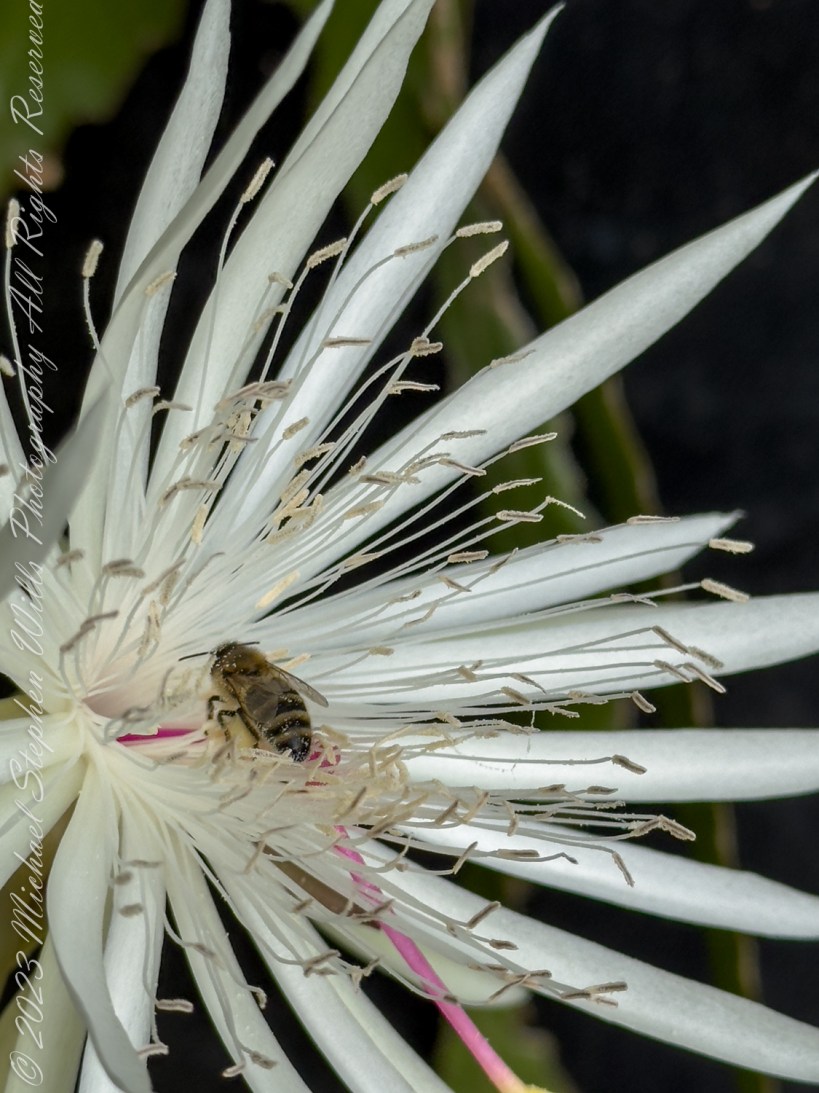
And then there are those remarkable white flowers opening in darkness—the extravagant, almost otherworldly blossoms of the night-blooming cactus. They seem fashioned from moonlight: long, narrow petals radiating from their centers, magnificent for such a brief interval. Their fleeting existence makes them more precious. To witness one requires being present at the right moment.

Perhaps that is true of much of life.

I am thankful that I have retained the impulse to notice.

There is a considerable difference between seeing something and noticing it. The world is filled with people who look at flowers, birds and skies every day without really seeing them. Curiosity changes that. It makes a flock of geese more than birds crossing the sky. they form their wavering lines beneath pale blue heavens shared with our moon. They are travelers following routes far older than our roads, houses or cities. Their passage reminds me that my home is part of a much larger landscape and that the seasons unfolding in my yard belong to rhythms extending across a continent.

I am thankful for the ability to look upward.

The balloon drifting above the neighborhood makes that thought almost literal. Suddenly an ordinary sky contains a great yellow, red and blue vessel, sometimes distant among the trees, sometimes passing wonderfully close overhead. We see the basket beneath it and the people aboard—human beings temporarily liberated from the ground, carried through the same air in which the geese travel.

There is something optimistic about a hot-air balloon. It accomplishes wonderfully nothing particularly urgent. It rises because people still want to know what the world looks like from somewhere else. Its presence in the video celebrates imagination, adventure and the persistence of wonder.

Yet gratitude also grows downward, into the earth.

The images of lush plants growing in raised beds and then harvested in abundance speak of another kind of wealth. Food does not simply appear. A seed becomes roots and leaves; sunlight is captured; water rises through stems; soil gives up minerals; human hands tend what is growing. Eventually the garden gives something back. To harvest food from plants one has watched develop is to participate, however modestly, in one of humanity’s oldest relationships with the living world.

I am thankful for that abundance—not abundance measured by possessions, but by experiences.

The sculpture of the young boy and girl quietly sharing a book adds a different note. Amid flowers, birds, harvests and skies is an image of companionship. Two figures sit close together, absorbed in the same story. It suggests affection, learning, intimacy and the pleasure of sharing something with another person. A life becomes immeasurably richer when its experiences are not ours alone.

That may be the deepest source of gratitude: the people with whom life has been shared. Family and friends give meaning to places and memories. A garden is more than plants when someone has walked through it with us. A meal is more than food when others sit at the table. A photograph becomes more valuable when it preserves something we want another person—or another generation—to see.

The music running through the video strengthens this sense of reflection. It does not demand attention so much as give the images emotional space. As the photographs succeed one another, the music turns observation into remembrance. The effect is almost like leafing through an album while realizing that the apparently unrelated pictures are chapters of the same story.

And perhaps that is why I find the video inspirational.

None of its subjects needs to be spectacular to matter. A flower opens. Geese cross the sky. Vegetables grow. Leaves turn red. Two children read together. A balloon unexpectedly floats over the neighborhood. Hydrangeas bloom beside a fence.

Meanwhile, time passes.

That last fact could make these images melancholy, but I do not think it does. Their transience is precisely what gives them value. Gratitude does not require pretending that beautiful things last forever. It comes from understanding that they do not—and loving them anyway.

I am thankful for the years behind me: for places visited, things learned, people loved, photographs made and memories accumulated. But I am equally thankful that the world still contains things capable of surprising me. There are still flowers I want to examine more closely, birds whose journeys I want to understand, stars I want to find through a telescope, landscapes I want to photograph, stories I want to tell, and mornings when I do not yet know what will appear outside my window.

That may be one of life’s greatest gifts: there is still something to look forward to.

The world does not owe us another summer, another migration overhead, another flower opening after dark, or another unexpected balloon sailing across a blue September sky. When such moments come, the proper response is not merely to record them.

It is to recognize them.

And to be thankful.

Click me to visit Michael Stephen Wills Online Finger Lakes Gallery.

Enter your email to receive notification of future postings. I will not sell or share your email address.

Exploring Lime Hollow: Nature Walks with My Grandsons

Enjoy a memorable visit to Lime Hollow Nature Preserve by a grandfather and his grandsons, exploring nature, observing wildlife, and connecting through shared experiences, fostering curiosity and appreciation for the environment.

The October sunlight was gentle as we entered Lime Hollow Nature Preserve from Gracie Road, my grandsons, Sam and Rory, bursting with excitement beside me. Sam, the eldest, took the lead, confidently striding ahead along the Sunset Trail while Rory, his younger brother, stayed close to my side, his eyes wide with wonder at the forest around us.

Descent to the Pond


The trail wound through the woods, dappled with the golds and reds of early autumn. Sam spotted a squirrel darting between trees, and Rory pointed to the sky, “Look, Grandpa, a woodpecker!” I smiled at their enthusiasm, feeling grateful for these moments of connection to nature and family.

We descended toward the pond via the Pond View Trail, the sound of trickling water drawing us closer. As we approached, the landscape opened up, revealing the calm, reflective surface of the water, bordered by reeds swaying in the light breeze. I remembered bringing the boys here last spring, how different the pond looked then—brimming with life as frogs leapt from the banks and dragonflies zipped across the water’s surface. Today, the scene was quieter, but no less magical.

Rory, ever the adventurer, crouched by the pond’s edge, watching for frogs. Sam, too, paused to observe but soon grew restless, his curiosity pushing him onward. “Come on, Grandpa! Let’s see what’s next!” His voice echoed through the trees as he darted back onto the trail, Rory quick to follow.

Encounter with the Giant Fungus


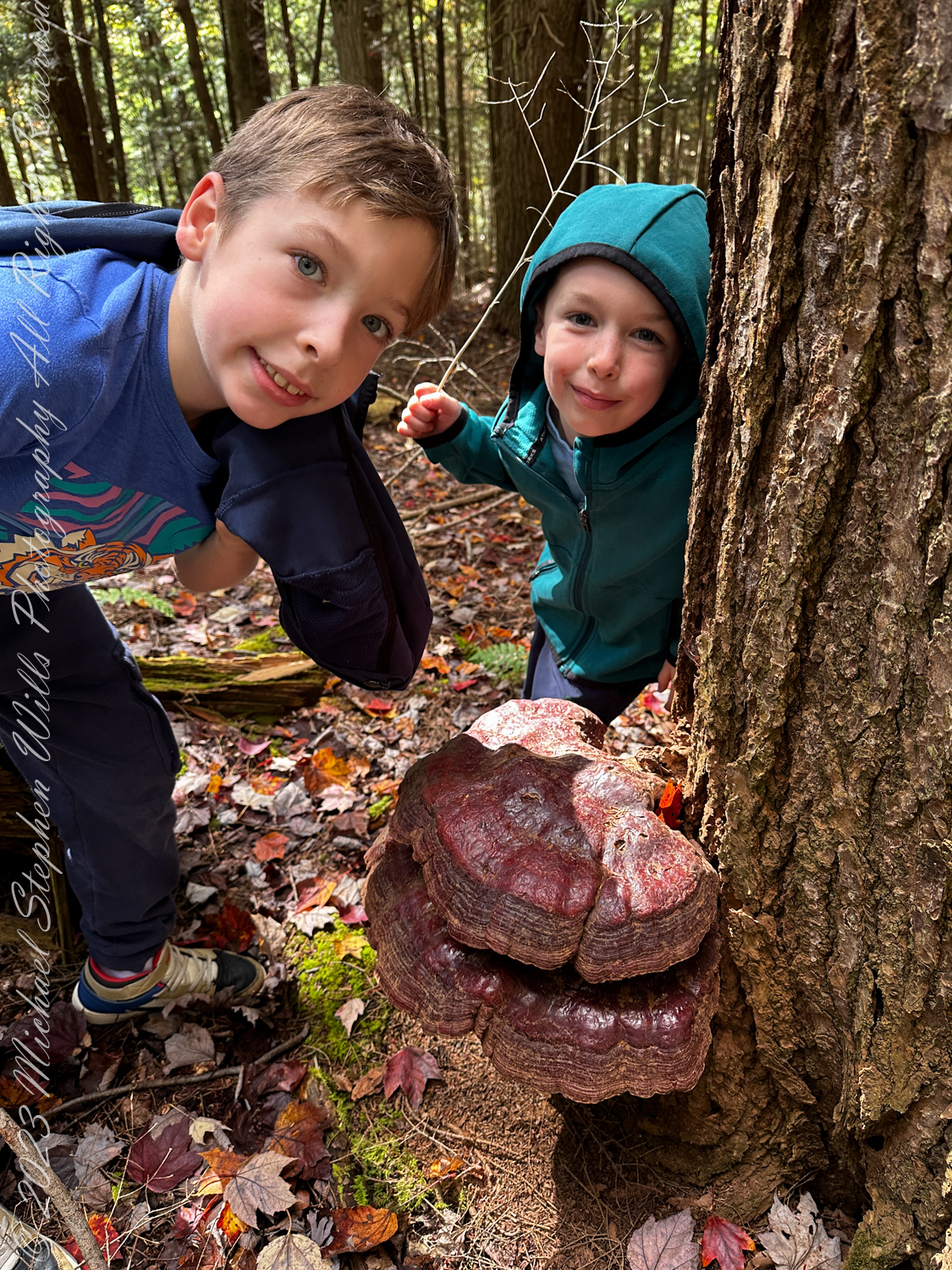
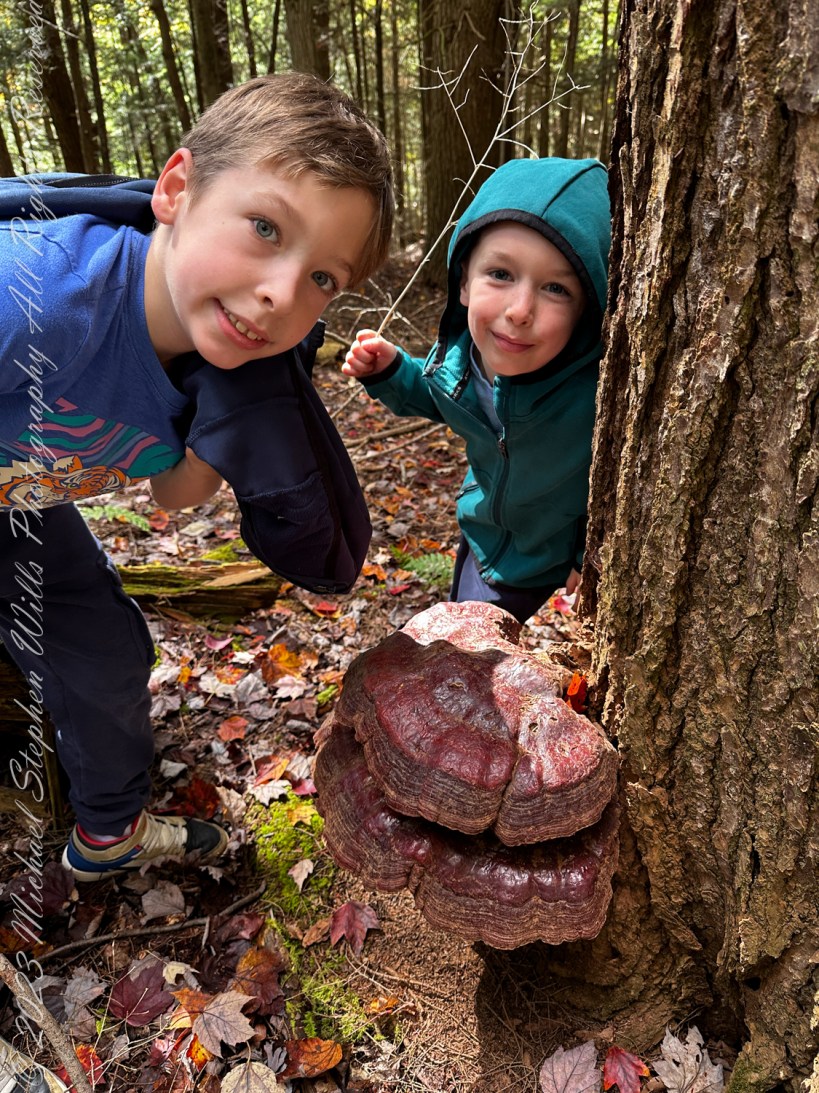
The path led us deeper into the forest, and soon we turned onto the Brookside Trail, which merged with the High Ridge Trail. Here, the air grew cooler under the dense canopy of trees, and the forest floor softened beneath our feet with layers of leaves. It was then that we stumbled upon the most magnificent sight of the day: an enormous bracket fungus, its wide, layered shelves clinging to the trunk a hoary snag.

Rory gasped in delight, running over to inspect it more closely. “Look how big it is!” he exclaimed, his small hands hovering just above its ridged surface. Sam, never one to be outdone, knelt beside it, carefully touching the spongy layers. “It’s a staircase for squirrels,” he said, grinning up at me.

Turkey Tail bracket fungus (Trametes versicolor) is a common wood decay fungus found on dead and decaying hardwoods. Named for its concentric, colorful bands resembling a turkey’s tail, it plays a vital role in forest ecosystems by breaking down lignin, facilitating nutrient recycling. It’s also valued for its medicinal properties. Lime Hollow Nature Center, Cortland, Cortland County, New York State. Finger Lakes Regions

As I watched them, I couldn’t help but think back to all the times I had wandered these trails alone before they were born. Now, these woods had become a classroom for them—full of discoveries that sparked their curiosity and wonder. It was a beautiful moment of generational connection, this passing on of my love for the natural world to Sam and Rory.

Fascinating Beech Tree Roots


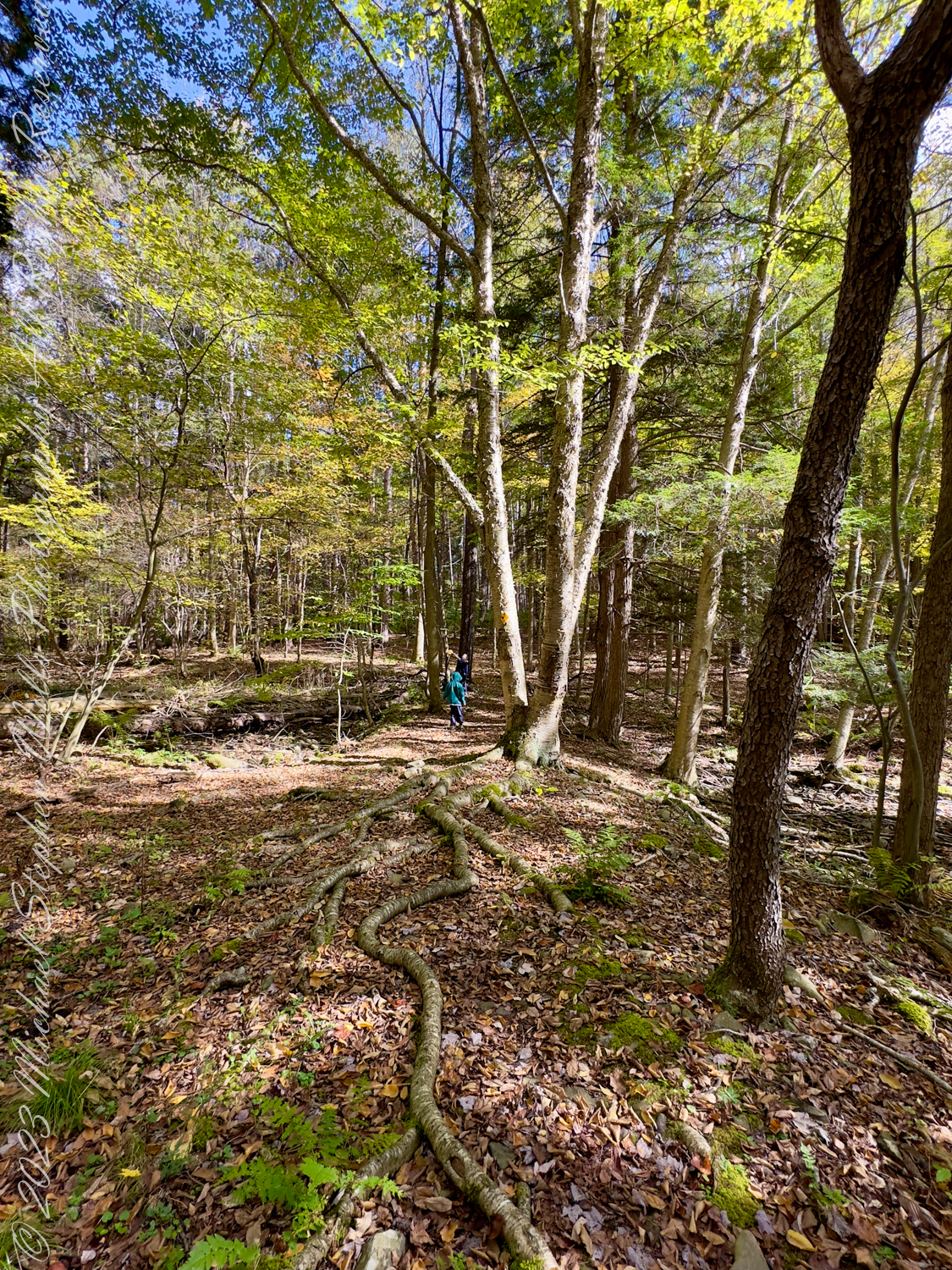
On the way out, we took the Brookside / Pond View / Sunset trails once again, but this time, this intricate network of roots from a massive beech tree fascinated us. The roots twisted and coiled across the path like veins, in our imaginations the gnarled shapes snagged our feet. Sam, ever the explorer, stepped cautiously along the roots, balancing himself as if walking a tightrope. Rory followed suit, his giggles filling the air.

An American beech (Fagus grandifolia). These trees are quite common in northeastern forests.
The beech tree is known for its smooth smooth, gray bark, which can become marked with scars or etchings as the tree ages. Additionally, its leaves are typically dark green, with serrated edges, and turn yellow to bronze in the fall, often staying on the tree through winter. Lime Hollow Nature Center, Cortland, New York State

“These roots are older than us,” I told them. “Beech trees can live for hundreds of years. Just think, this tree has seen many more seasons than we ever will.”

Sam’s eyes widened at the thought, while Rory gave the tree a gentle pat, as if to thank it for its wisdom. I marveled at how something as simple as a root system could captivate their imaginations and bring the lesson of time and growth to life.

Reminiscing on the Chicago Bog

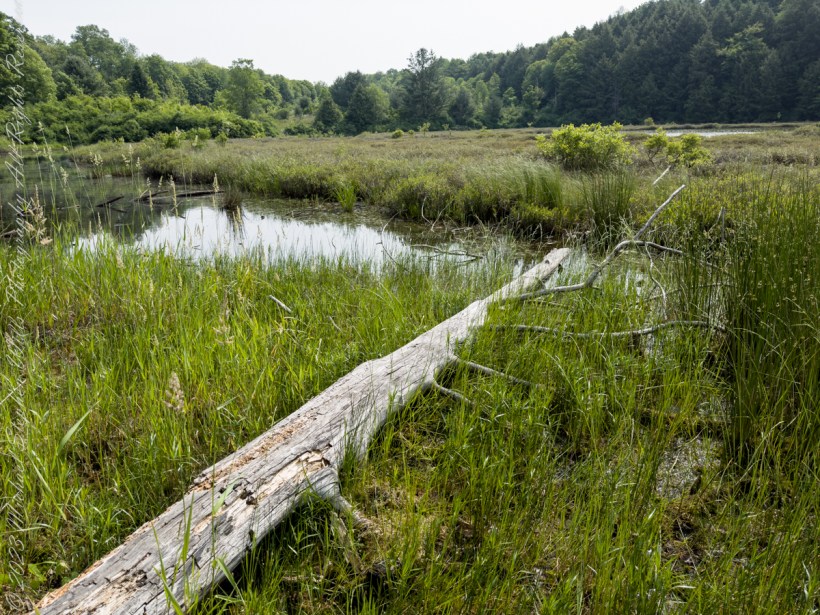
In the 1830’s there was a village named Chicago along Gracie Road, which gives it the name we have today. The Chicago Bog is home to many carnivorous plants, including sundew, the pitcher plant, and more. The deepest depth of the bog is about 7.2 ft. The bog is along the Phillips Memorial Trail, which can be found on Gracie Road. Lime Hollow Nature Center, Cortland, New York


As we walked, my mind wandered back to a visit we had made to the Chicago Bog just a year before. I remembered the day clearly—how we had trekked through the wetland on a warm June afternoon, the ground soft beneath our feet, alive with the buzzing of insects and the vibrant green of new growth.

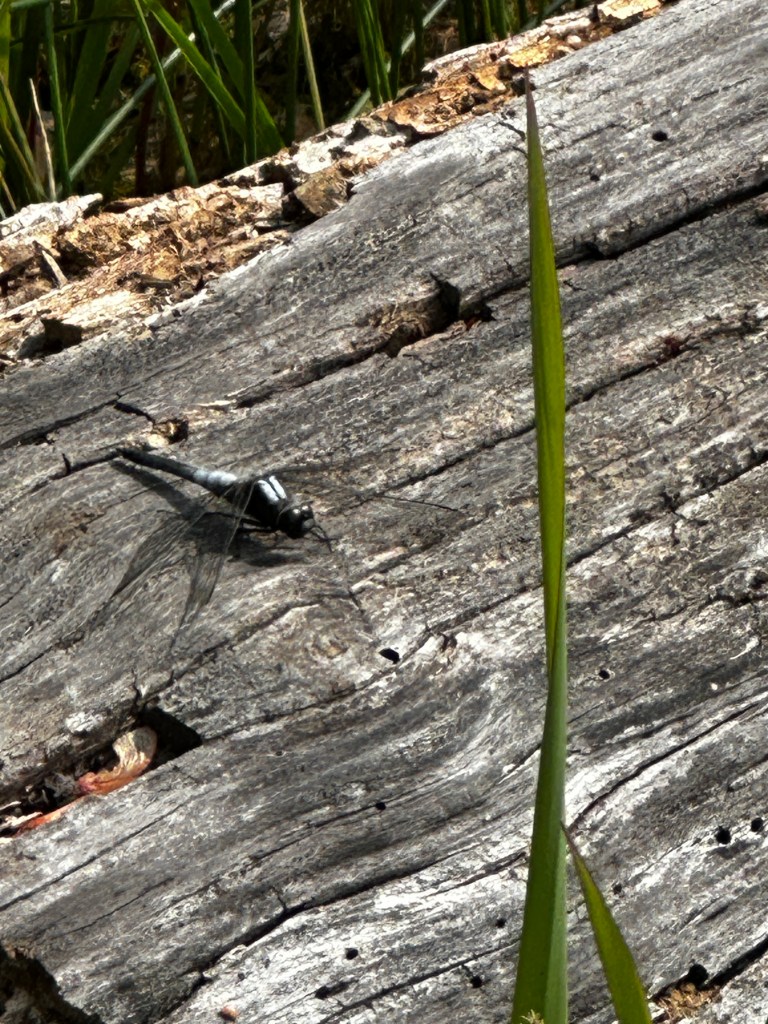
The chalk-fronted corporal (Ladona julia) is a skimmer dragonfly found in the northern United States and southern Canada.
Juveniles of both sexes are light reddish brown, with white shoulder stripes and a black stripe down the middle of the abdomen. As they mature, males develop a white pruinescence on the top of the thorax and at the base of the abdomen, while the rest of the abdomen turns black. Females become almost uniformly dark brown, with a dusting of gray pruinescence near the base of the abdomen; a few develop the same color pattern as the males.
Chalk-fronted corporals often perch horizontally on the ground or on floating objects in the water, flying up to take prey from the air. They are gregarious for dragonflies, and are commonly seen perching in groups. They readily approach humans to feed on the mosquitoes and biting flies that humans attract.

It was there, by the edge of the bog, that we had encountered a dragonfly, a Chalk-fronted Corporal, resting on a fallen log. Its dark, iridescent wings shimmered in the sunlight, and Sam had been mesmerized by its delicate beauty. He had asked so many questions that day—about how dragonflies flew, what they ate, and where they lived. I had done my best to answer, but truth be told, I learned as much as he did in that moment.

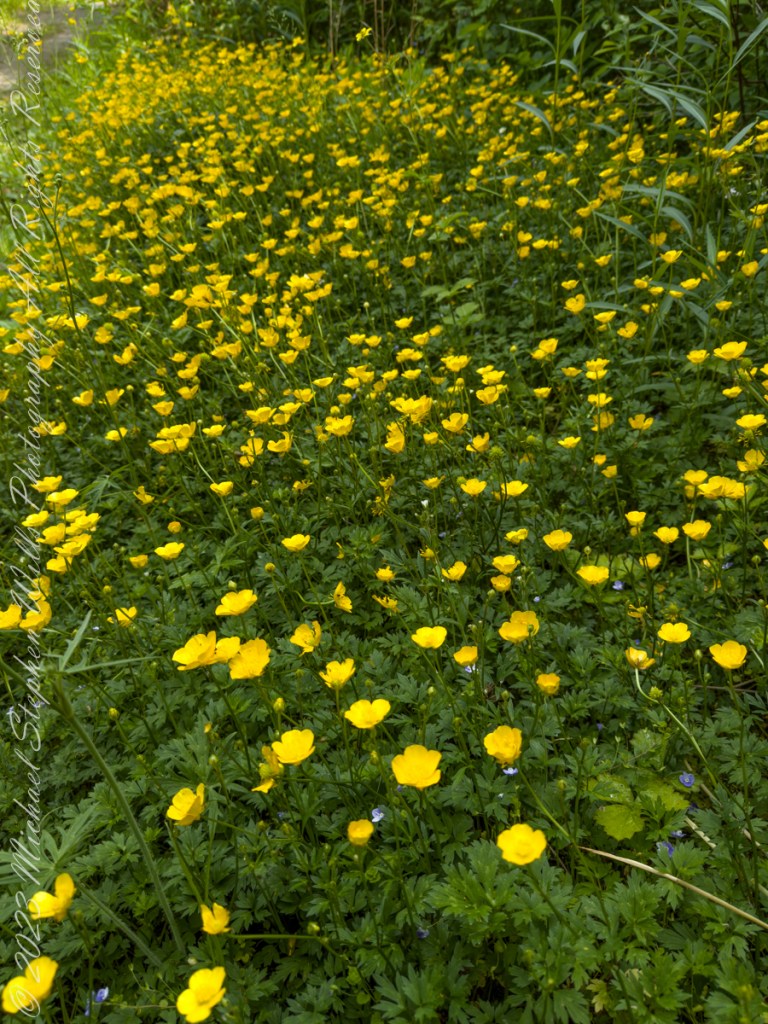
Nearby, a meadow of buttercups had stretched out before us, their yellow blooms dancing in the breeze. Rory had run through them, his laughter ringing out as he tried to catch a butterfly that flitted between the flowers. The memory of that field of gold still brought a smile to my face as we made our way through Lime Hollow today.

A Day to Remember


As we neared the end of our hike, the afternoon light filtering through the trees, I couldn’t help but feel a sense of contentment. These outings with Sam and Rory had become more than just walks in the woods—they were opportunities to share, to learn, and to make memories that I knew would last a lifetime.

“Grandpa, can we come back?” Rory asked, his face flushed with excitement.

“Of course,” I said, smiling. “We’ll always have time for another adventure.”

Iquique by Sea IV

Discover the vibrant blend of history and modern maritime traditions in Iquique. From the dramatic escarpment backdrop to the bustling harbor, join us on a journey exploring the city’s past and present, anchored in seafaring tales.

Continue reading “Iquique by Sea IV”

Iquique by Sea I

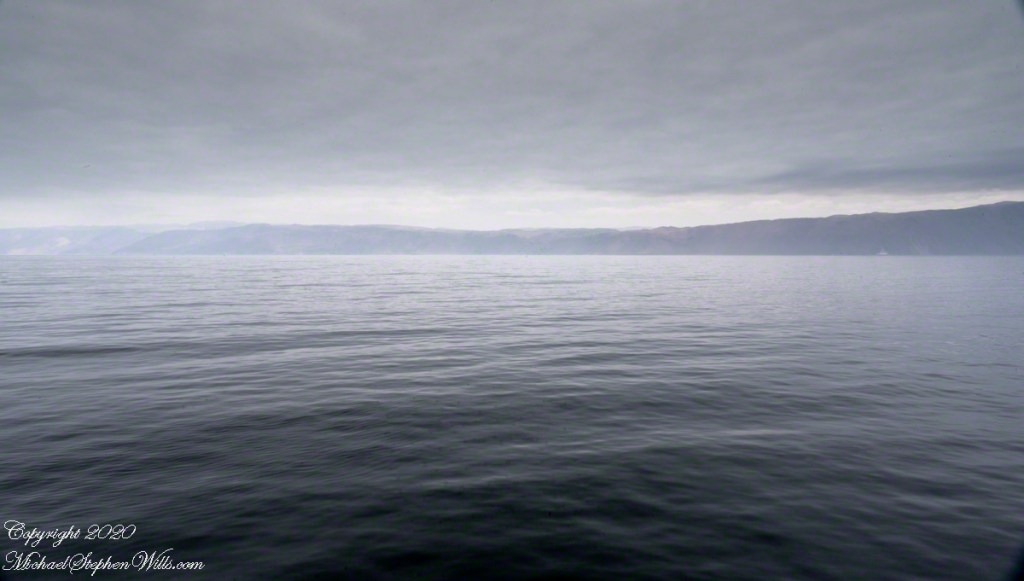
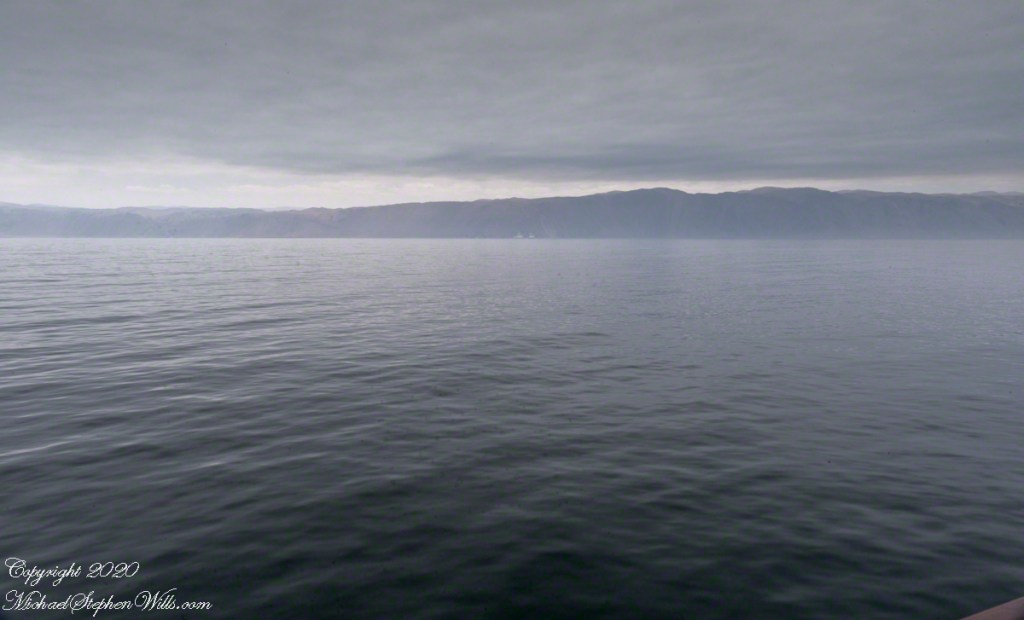
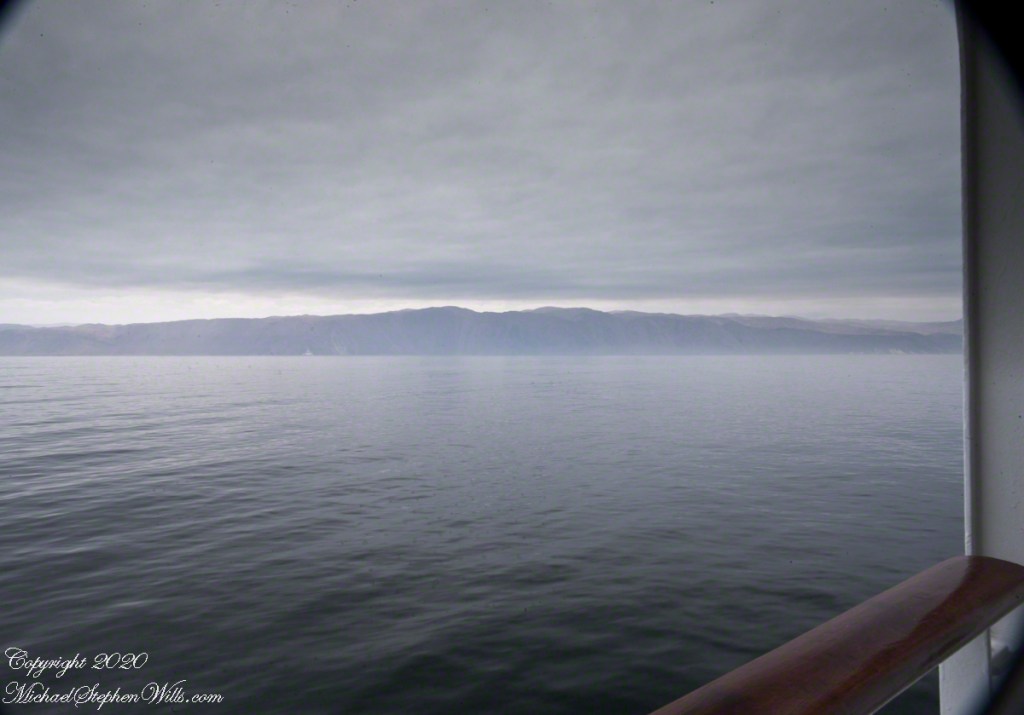
Join me on an early morning approach to Iquique, Chile, as we sail past the stark, mesmerizing Atacama Desert coastline. Experience the serene isolation and rugged beauty captured from the balcony of our cruise ship.

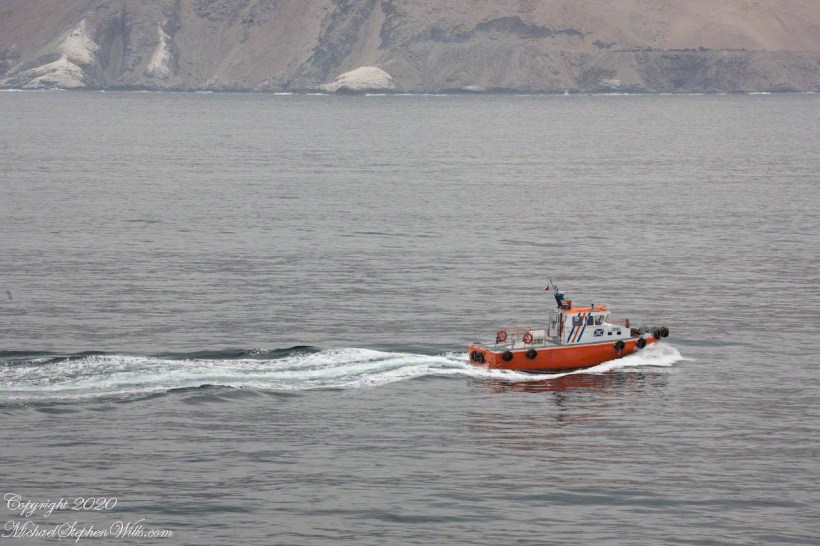
Standing on the balcony of our port side stateroom, the early morning light casts a subdued, almost ethereal glow over the vast expanse of the Pacific Ocean. The Oceania Regatta glides smoothly through the cold, dark waters, making its way toward Iquique, our first Chilean port of call. The sense of anticipation is palpable as we approach the coast of the Atacama Desert, a region renowned for being the driest place on Earth.

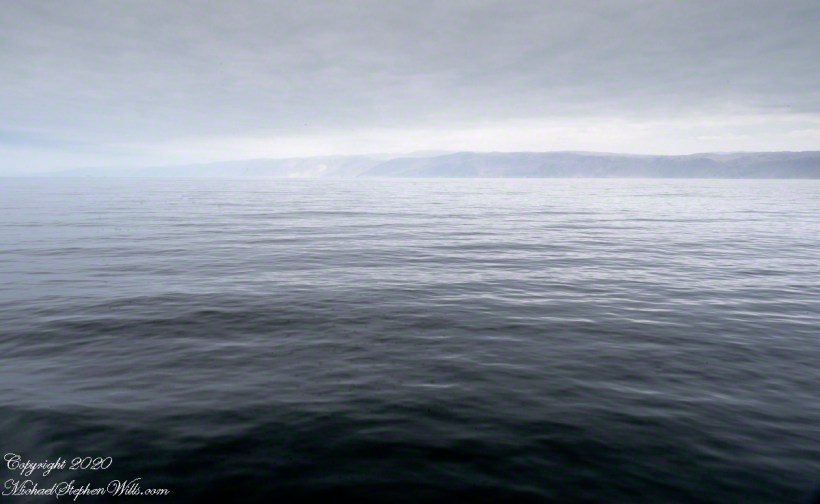
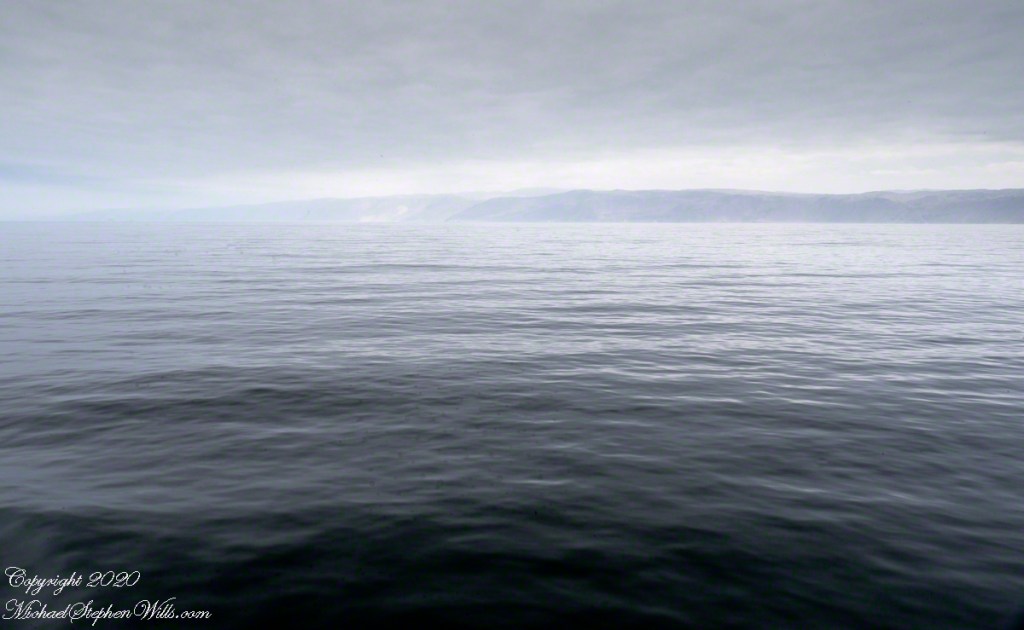
The view is both stark and mesmerizing. The coastline of the Atacama Desert rises sharply from the Pacific, a dramatic contrast to the vast, cold ocean that stretches out before us. The Humbolt current, a cold, nutrient-rich flow of water from southern Chile to northern Peru, swirls beneath the ship, adding a sense of dynamic movement to the scene. The chilly air, the muted colors of the sea and sky, and the barren, rugged landscape all combine to create an atmosphere of serene isolation.

In the distance, I imagine a dark point of land—the remnants of the abandoned town of Caleta Buena. Perched on a 750-foot escarpment, the town was once a bustling hub of nitrate mining, a vital industry that shaped the history of Iquique. The remains of piers jutting out into the ocean stand as silent witnesses to a bygone era, their weathered structures blending into the rugged coastline.

The sequence of photographs I’ve captured from this vantage point, working north to south, offers a panoramic view of this desolate yet captivating landscape. Using a 24 mm “wide angle” Canon lens mounted on a tripod, I’ve been able to frame the vastness of the ocean and the stark beauty of the Atacama coastline in a single, sweeping seascape.

Reflecting on our overnight journey from Matarani, Peru, I’m struck by the profound sense of isolation that accompanies travel along this desolate coast. During the 250-mile sail, the darkness was absolute, the inky blackness of the night broken only by the occasional glimmer of stars reflected in the ocean below. It was a journey through a void, a stark reminder of the sheer scale and remoteness of this part of the world.

As we draw closer to Iquique, the coastal mountains rise up, marking the transition from the Pacific to the arid plains of the Atacama Desert. The stark beauty of this landscape, with its rugged cliffs and barren expanses, is both humbling and awe-inspiring. It’s a reminder of the harsh conditions that have shaped this region, and of the resilience of the people who have carved out a living here over the centuries.

From the balcony of our stateroom, I feel a deep sense of connection to this place. The vastness of the ocean, the stark beauty of the desert coastline, and the rich history of the region all combine to create a profound sense of place. This is a land of extremes, a place where the forces of nature have sculpted a landscape of breathtaking beauty and unforgiving harshness.

As we approach Iquique, I feel a sense of gratitude for the opportunity to witness this unique corner of the world. The journey is a reminder of the incredible diversity and beauty of our planet, and of the importance of preserving these natural wonders for future generations. This approach to Iquique is a journey to a new port, a journey into the heart of one of the world’s most remarkable landscapes.

Copyright 2024 Michael Stephen Wills All Rights Reserved

Illuminating Discoveries: Solving the Red Light Enigma in Cocoa Beach

Dive into a fictional adventure in Cocoa Beach, where a mysterious red light sparks curiosity. Join Emma and Alex as they unravel the surprising truth behind a crimson glow.

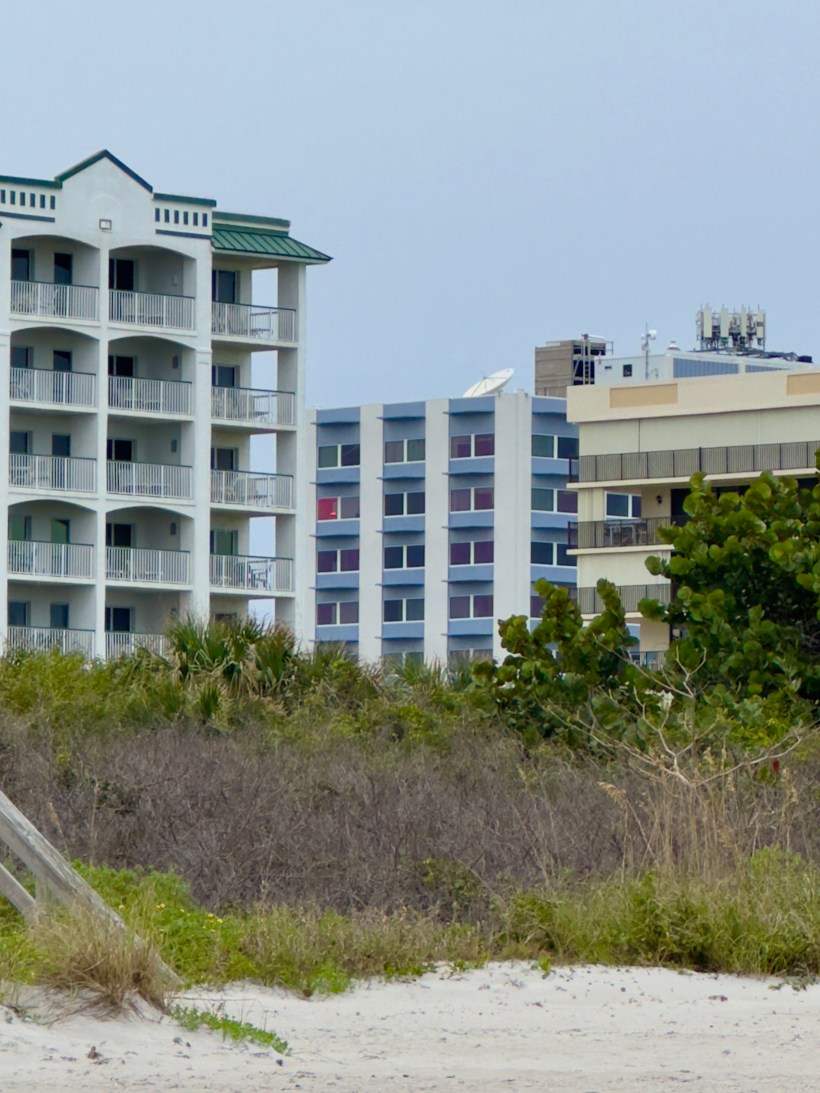
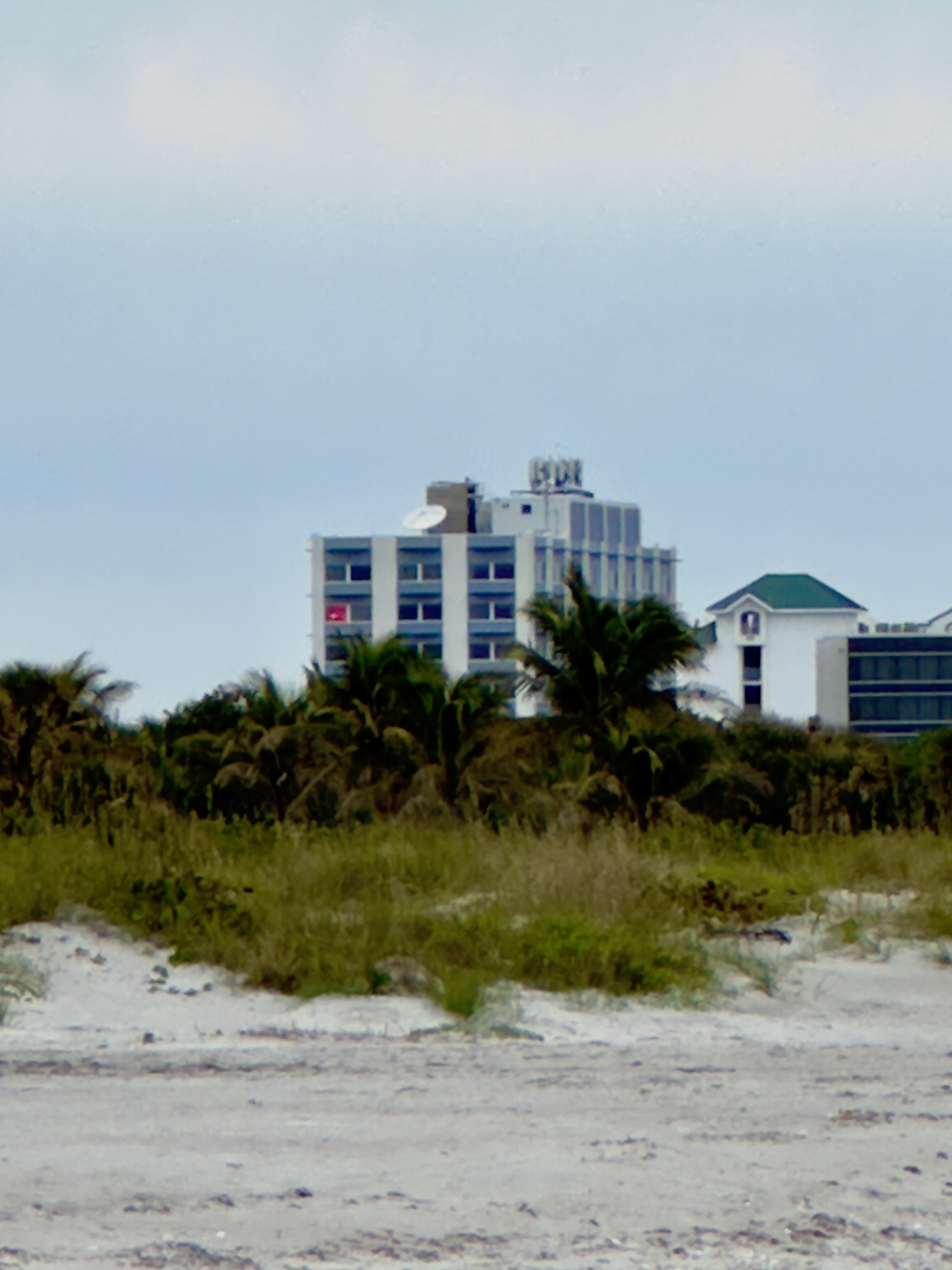
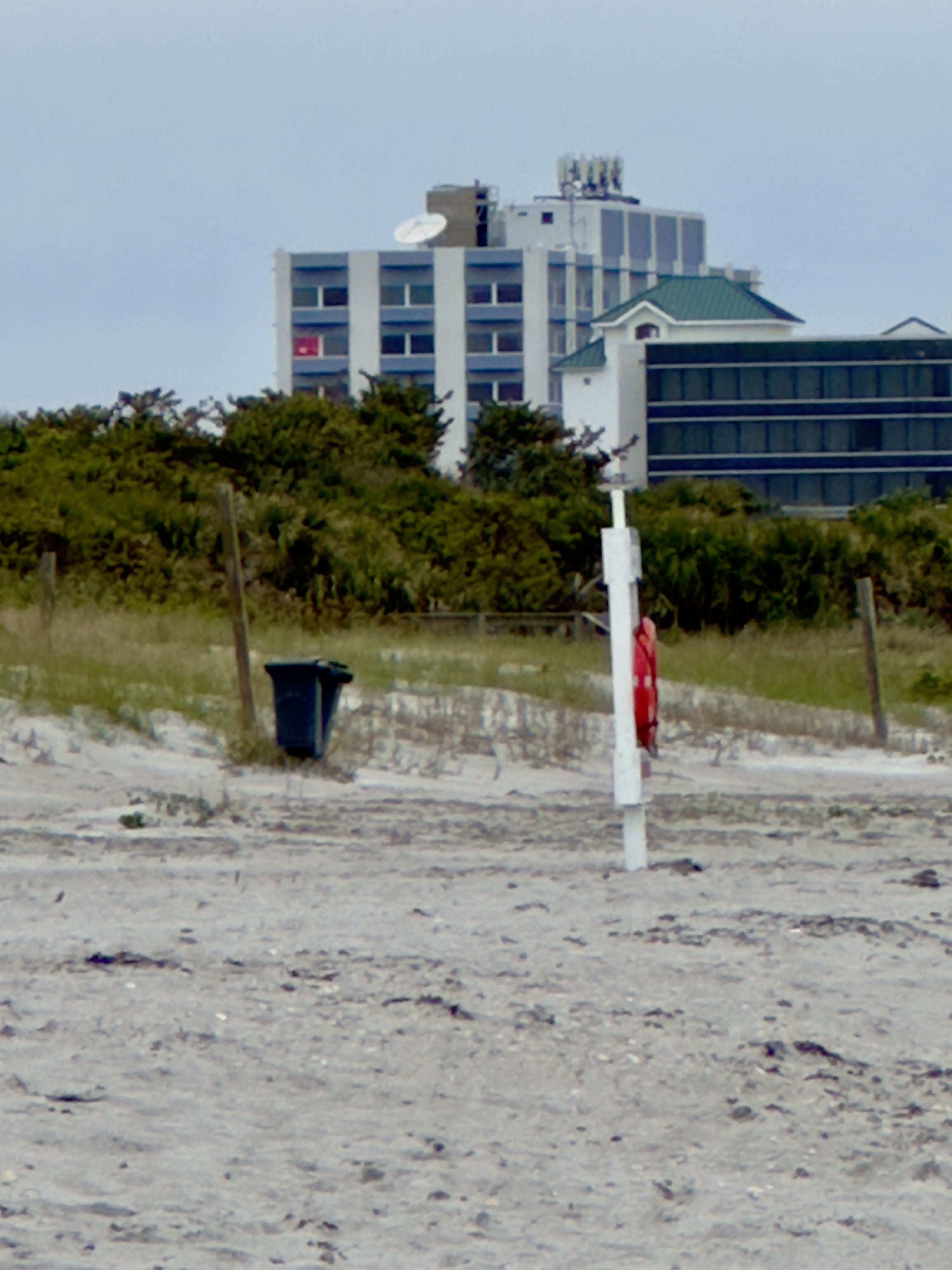
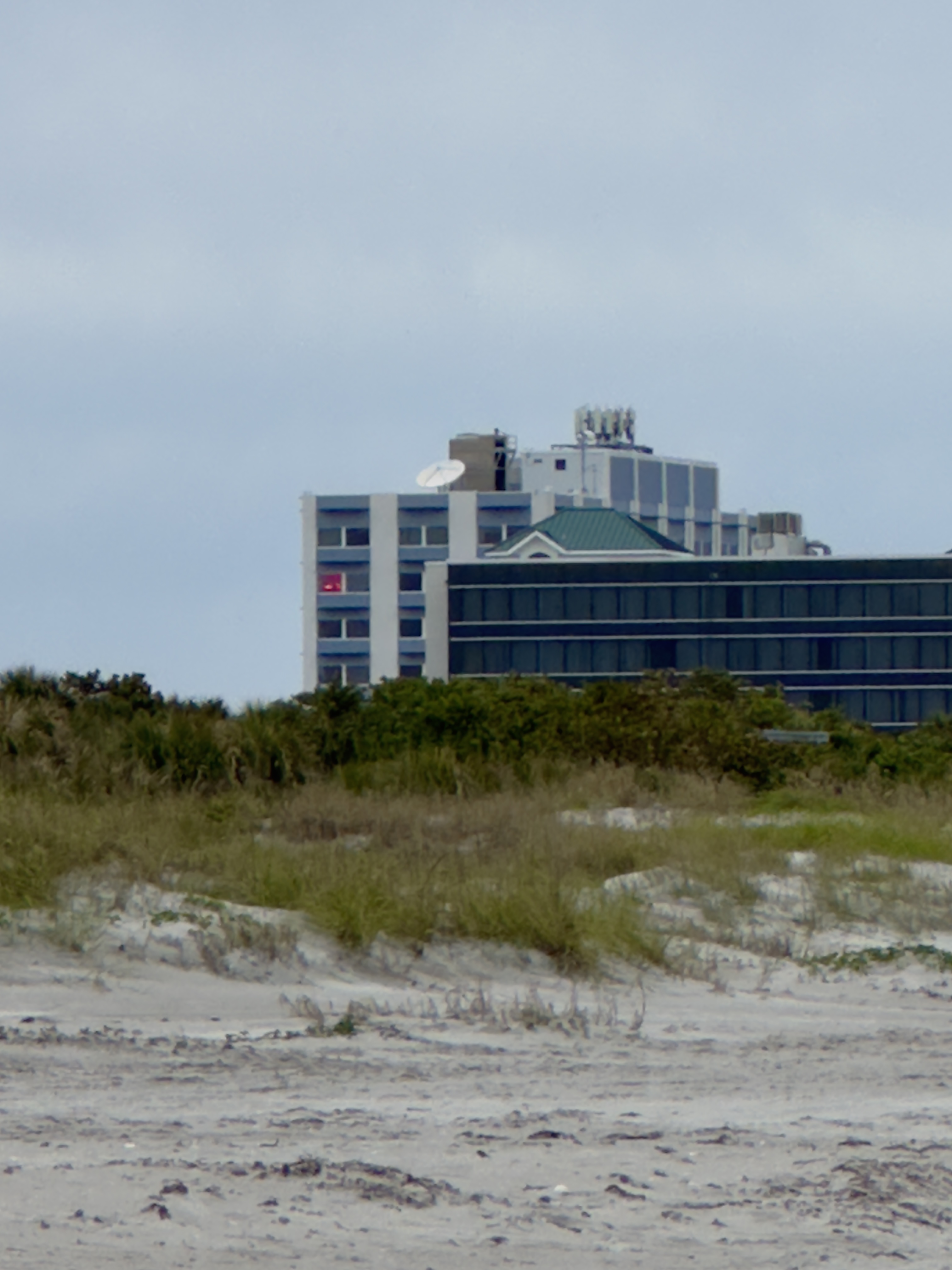
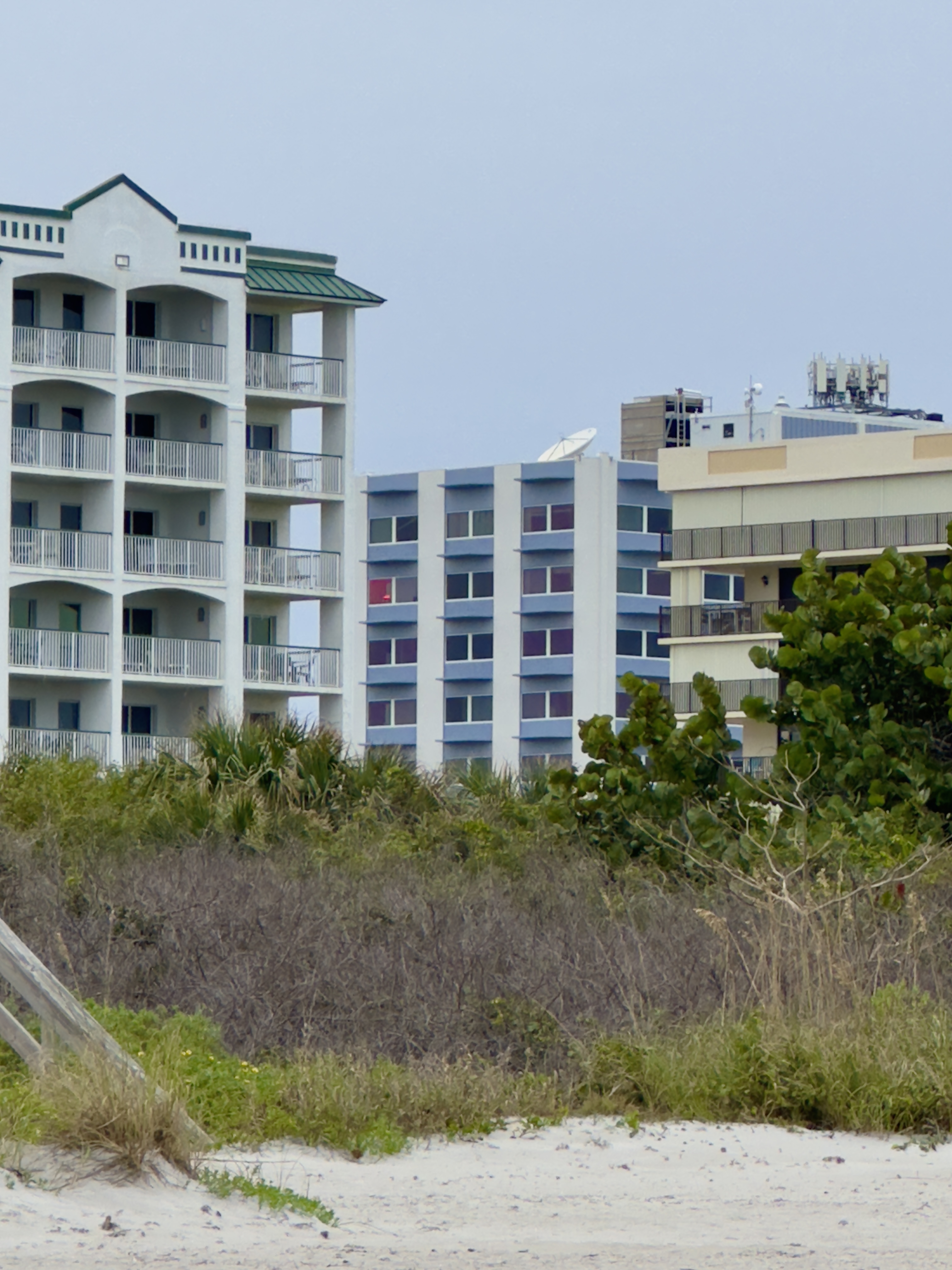
I’ve always been captivated by the unusual, so when I first saw that mysterious red light beaming from the ninth floor of the Cape Royal Office Condominium in Cocoa Beach, I was instantly hooked. The theories around town were wild—some said it was a secret alien signal, others whispered about hidden, illicit activities.

I knew I needed help to investigate, and who better than Emma, the local journalist with a knack for uncovering the truth? I approached her with my theory, and her eyes lit up with curiosity. “Alex, this sounds like a story worth exploring. Let’s see what’s really going on with that red light,” she said enthusiastically.

Disguised as potential clients, we managed to get access to the ninth floor. The anticipation was palpable as we walked through the doors of Howe Photonics, only to find a busy office, not the den of intrigue we’d imagined.

“Hi, I’m Gary Howe,” the managing director greeted us with a knowing smile. “I assume you’re here about the red light?”

I exchanged a look with Emma. “Yes, we are,” she said. “There’s been a lot of speculation in town about it.”

Gary chuckled. “Well, let me clear things up. We specialize in red light therapy systems. The light you’ve seen is from our custom-made LEDs used for therapeutic purposes. They’ve been approved by the FDA.”

I was stunned. “So, it’s not a signal to aliens or anything like that?” I asked, half-joking.

“No, Alex, nothing as exciting as that,” Gary replied with a smile.

Emma and I learned more about the therapy and its benefits from Gary and his son, Howard. I couldn’t help but feel a sense of wonder at the science behind it all. Emma, always the professional, asked insightful questions, capturing every detail.

Gary then offered us a chance to try the therapy. As I relaxed under the soothing red light, I felt a wave of calmness and rejuvenation. “This is incredible, Emma. It’s so different from what we imagined.”

Returning to Cocoa Beach, we were eager to share our findings. Emma penned a detailed article for the local paper, while I created a documentary featuring interviews with the Howes and locals like Judith Brinkly, who had seen remarkable results from the therapy.

The story of the red light shifted from mystery to a source of health and wellness. The once-feared glow now drew people in, eager to experience the benefits for themselves. The mysterious red light, previously the subject of wild rumors, became a celebrated part of our community.

Reflecting on our adventure, I’m grateful for Emma’s support and insight. “You know, Emma, we really changed the narrative here. It’s amazing what a little curiosity and investigation can do.”

Emma smiled. “Absolutely, Alex. We turned fear into understanding and appreciation. That’s the power of seeking the truth.”

The red light of the Cape Royal Office Condominium, once a symbol of mystery and intrigue, now stood as a beacon of hope and healing. Emma and I had uncovered not just a story, but a testament to the power of curiosity and the pursuit of truth.

Note: the persons named in this story are fictional characters. The building and the nature of the red light is real.

Copyright 2024 Michael Stephen Wills All Rights Reserved

The Flatiron

Where is the ironing board?

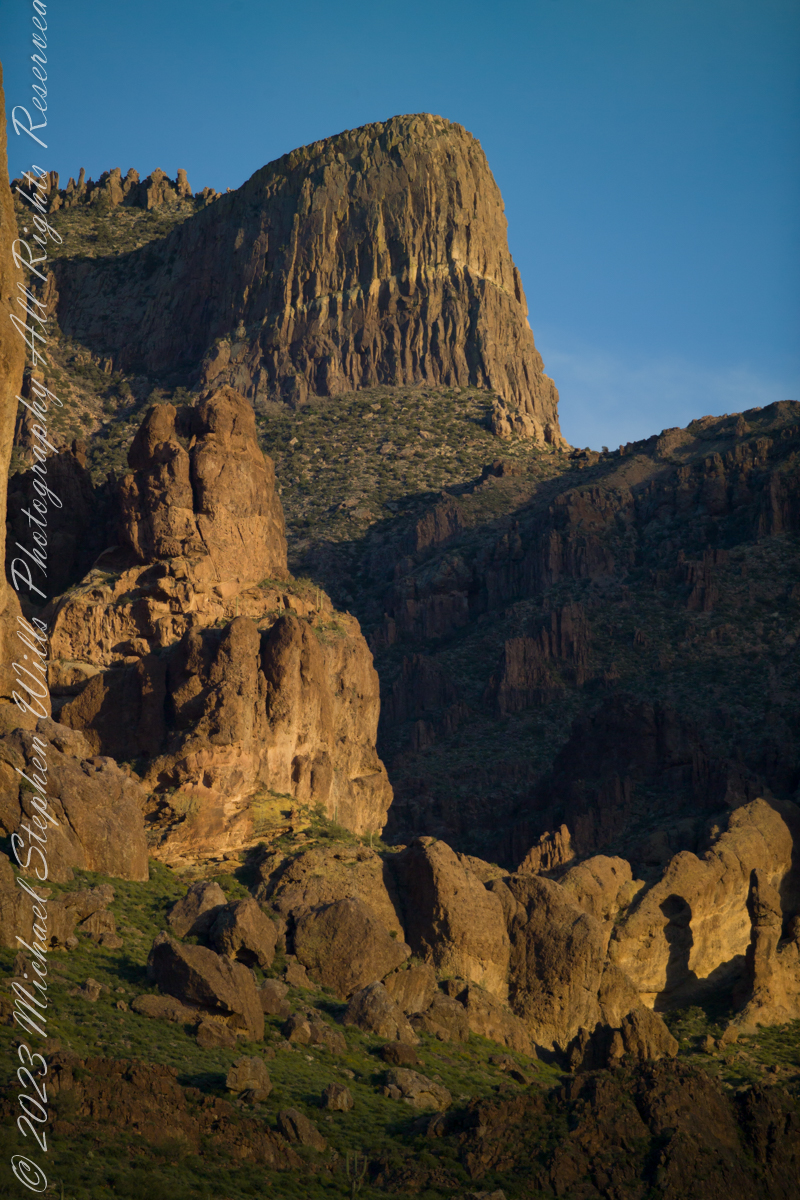
The setting sun’s glow on the end point of Upper Siphon Draw trail, The Flatiron.

Click Me for my Online Gallery

The mountain was formed by a series of volcanic eruptions between 20.5 and 18 million years ago. The west face of the mountain is composed of dacite lava and rhyolitic tuff. The overlying tuff was deposited during an eruption which created a collapse caldera bounded by faults. Dome resurgence reactivated these faults, causing uplift of the caldera floor which juxtaposed the softer tuff and more resistant dacite. Differential weathering caused the outer tuff to erode faster, leaving the dacite cliffs exposed and creating the prominent mountain visible today.

The Flatiron, the mesa-like projection above us in this view, is long solidified dacite lava. The word dacite comes from Dacia, a province of the Roman Empire which lay between the Danube River and Carpathian Mountains (now modern Romania and Moldova) where the rock was first described. Lost Dutchman State Park, Apache Junction, Maricopa County, Arizona

Reference: Wikipedia “Superstition Mountain” and “Dacite Lava.”

Copyright 2023 Michael Stephen Wills All Rights Reserved

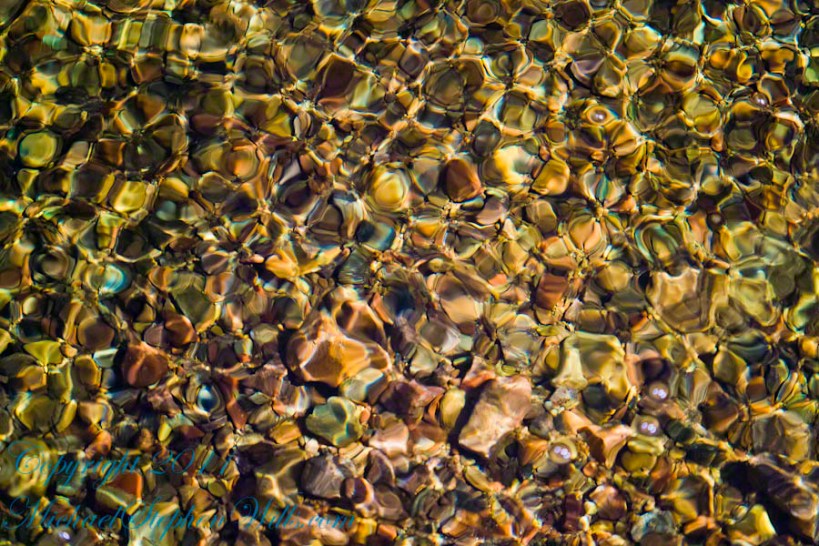
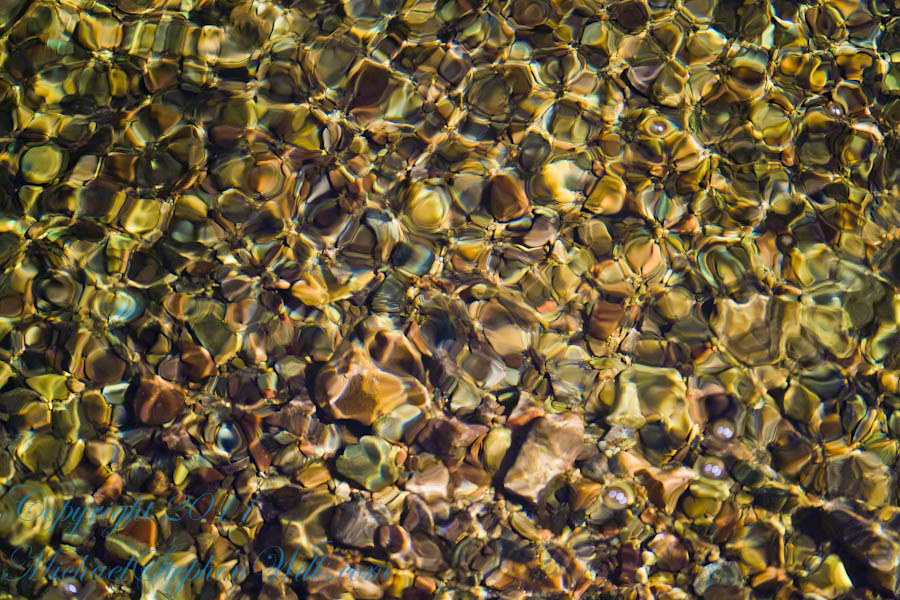
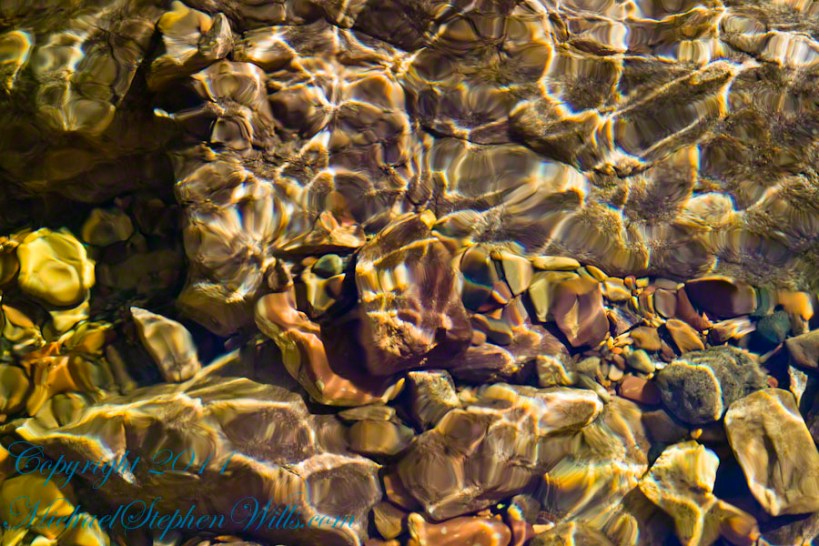
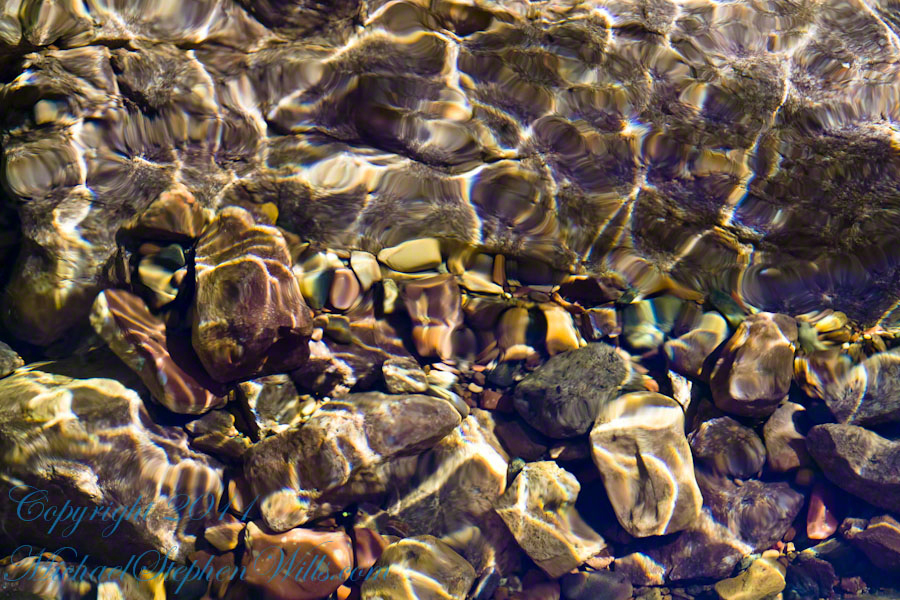
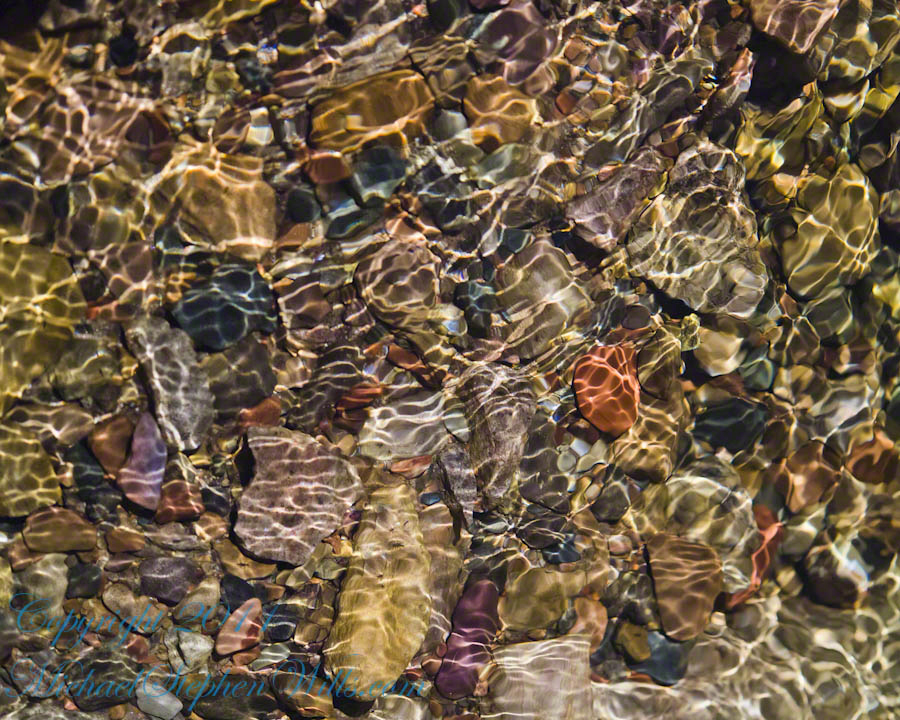
Abstracts: desert light and water

A Series of Nature Abstracts, macros of Reavis Creek below the falls

These four shots are of afternoon desert light playing on limpid water flowing over colorful rocks.

All are macro shots of the falls taken with a Canon 100mm f/2.8L lens.

From my solo expedition to this location in the remote eastern Superstition Wilderness of Arizona.

CLICK ME to learn more about my work and to purchase prints.

I chose portions of Reavis Creek stream bed carefully

The time of day was essential. This was late afternoon and before the sun disappeared behind the canyon walls.

Not all sections of the stream bed were suitable. I chose elements of strong compositions.

Variation between the shots is essential for holding the viewers attention.

Click Me to visit my previous post, “Canyoneering to Reavis Falls” for more of this story.

Copyright 2023 Michael Stephen Wills All Rights Reserved

Transcendent Beauty

Water and Shadows


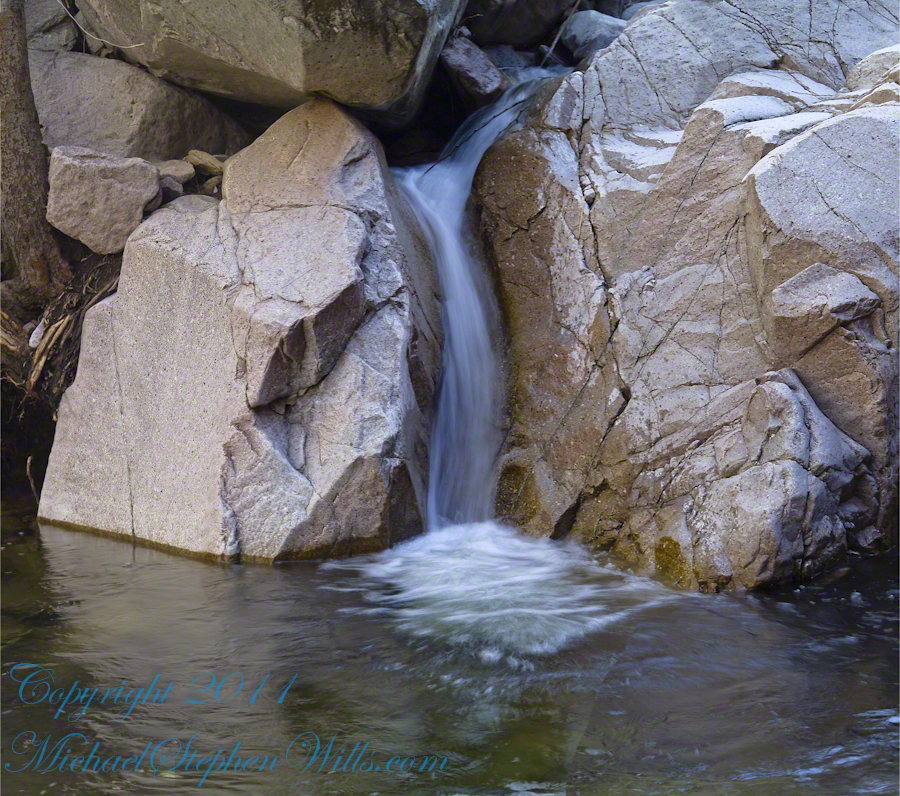
The canyon below 110 foot Reavis Falls is a wild place of transcendent beauty.

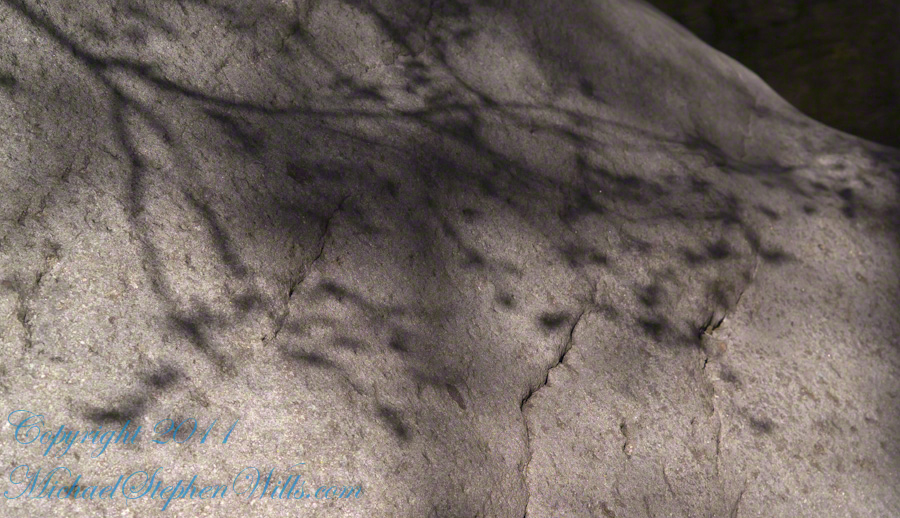
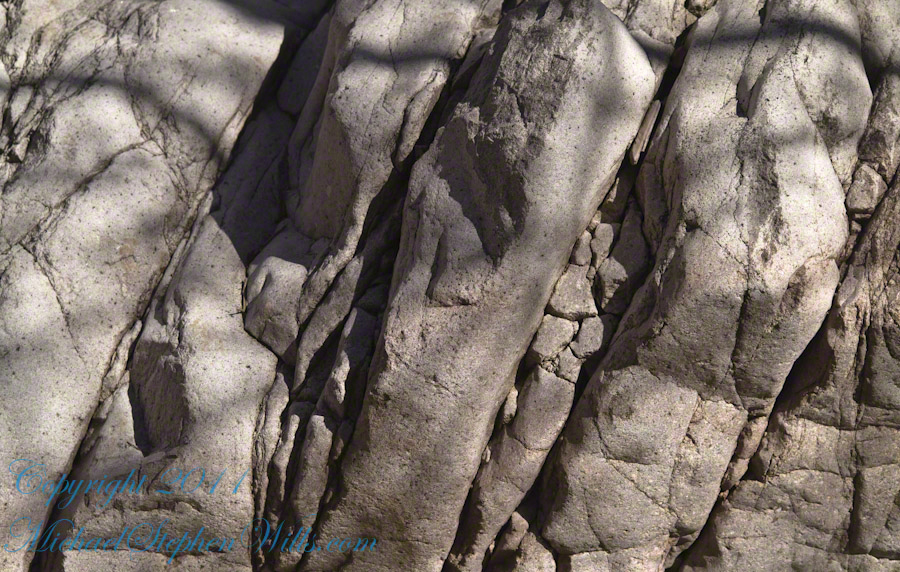
With the afternoon in front of me, the trip back to camp was a slow pleasure. On the way in, I noted several stopping points to capture photographs. Here a natural rock sluice offers a foot tall waterfall, mirroring Reavis Falls, bracketed by white igneous stone.

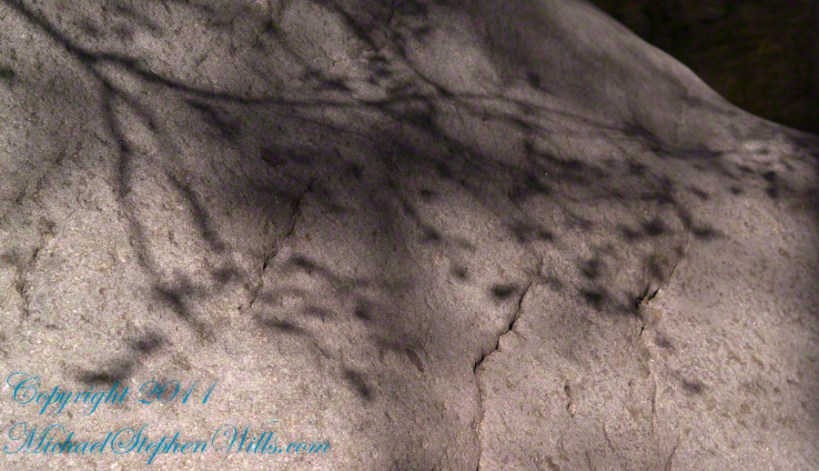
This same stone offers a screen, the bright spring sun throwing the sparse leaves into sharp relief.

Click Me to visit my previous post, “Canyoneering to Reavis Falls” for more of this story.

Copyright 2023 Michael Stephen Wills All Rights Reserved

Nature Abstracts from Reavis Falls

Basalt and Water

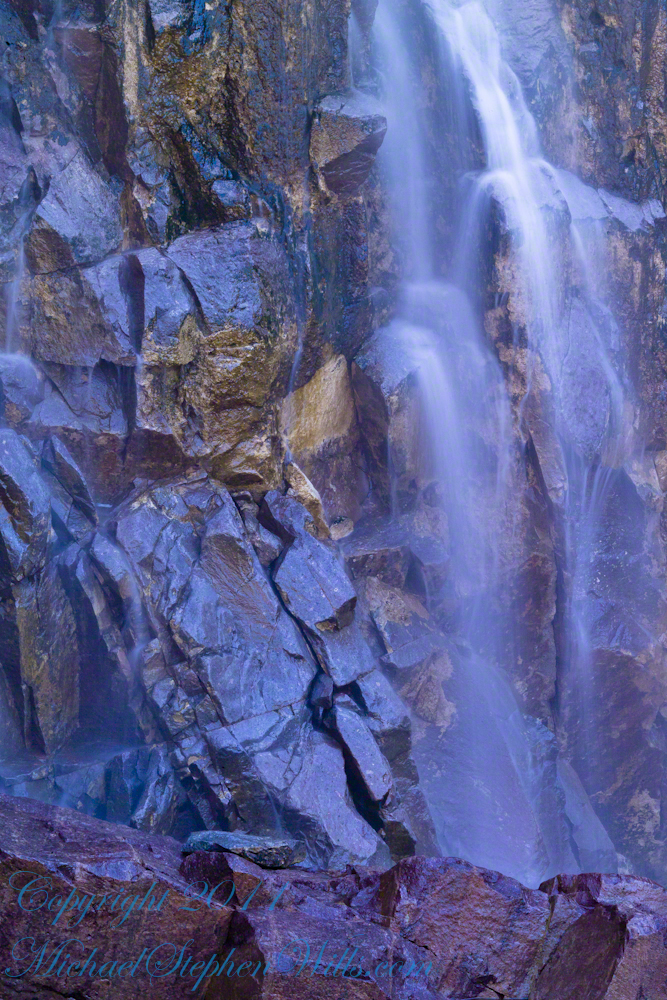
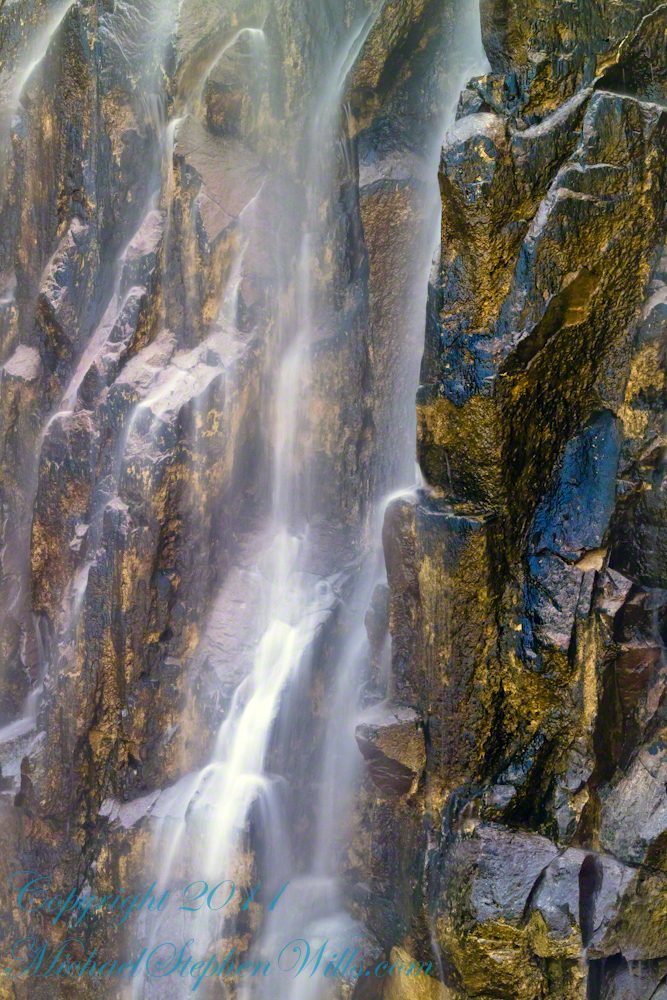
A Series of Nature Abstracts, macros of Reavis Falls

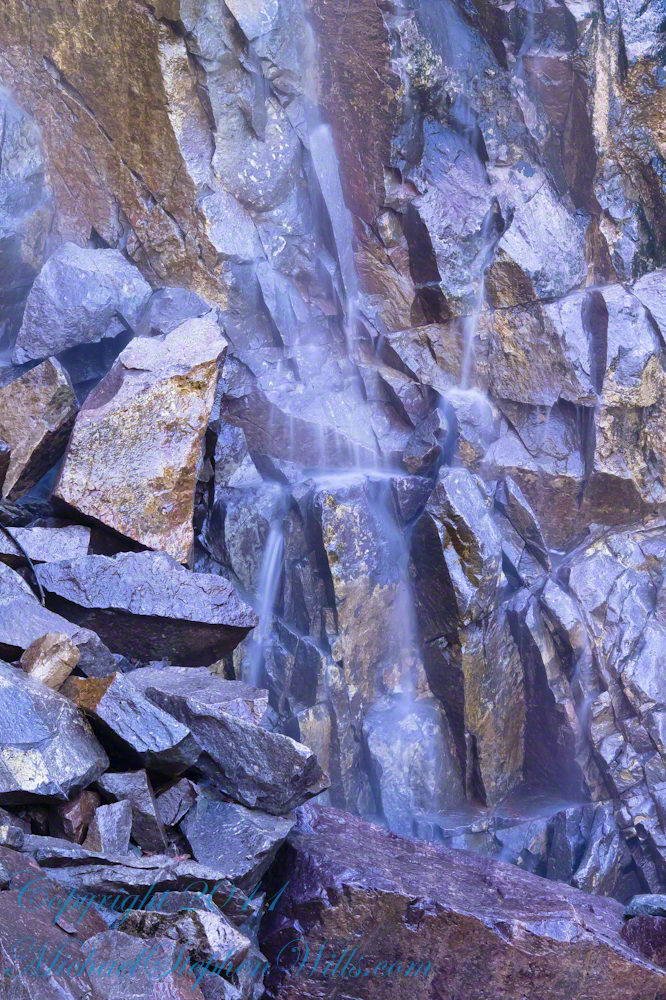
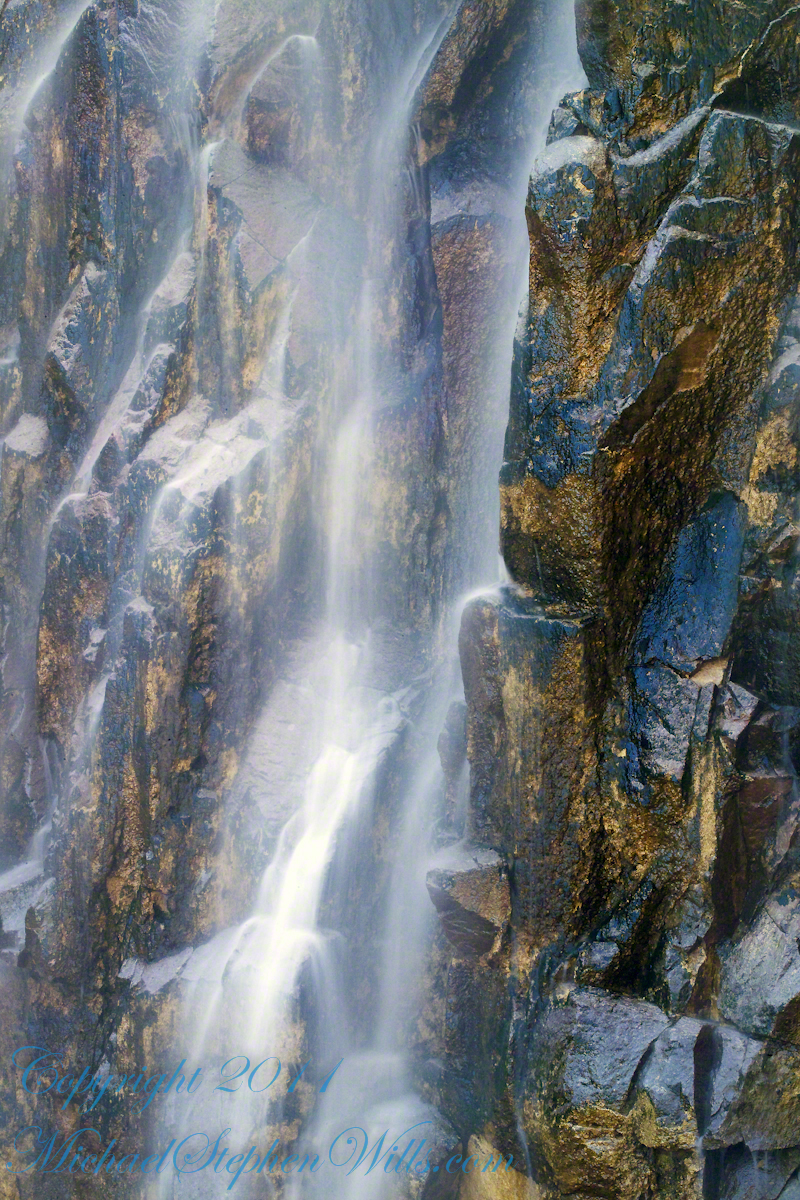
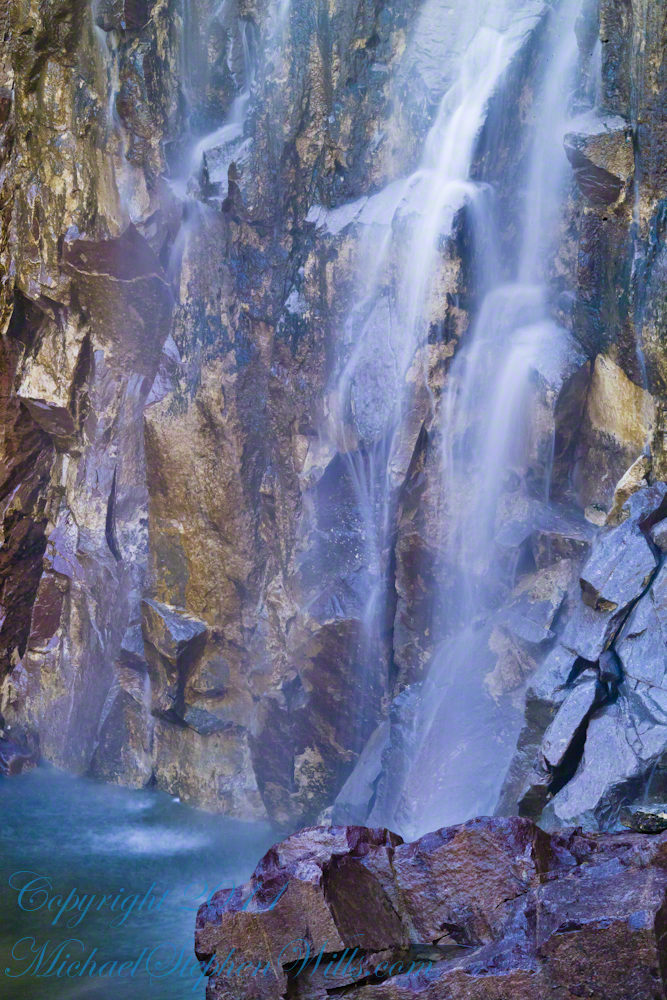
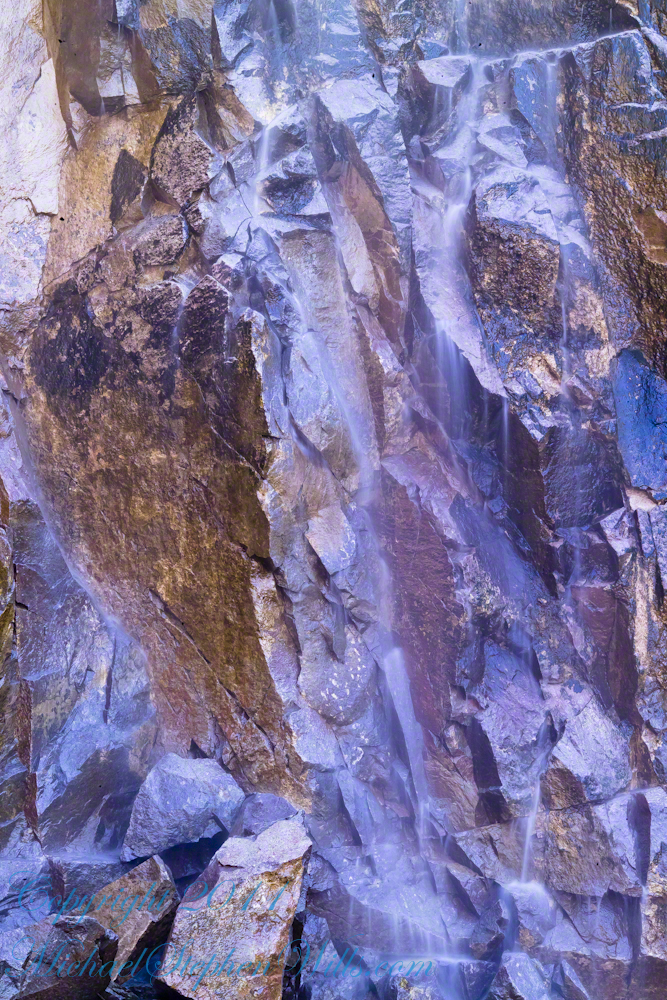
These are six shots of Reavis Falls from my solo expedition to this location in the remote eastern Superstition Wilderness of Arizona.

All are macro shots of the falls taken with a Canon 100mm f/2.8L lens.

“Reavis Falls Abstract V”

I took these while perched on a pile of talus beneath the falls.

Click Me To learn more about my work and to purchase prints

Reavis Falls Abstract XIV

Reavis Falls are 114 feet high in a canyon hidden in the folds of mountain ridges in the remote eastern Superstition Wilderness of Arizona.

Reavis Falls Abstract VI

Reavis Creek falls from a sheer basalt cliff, remnants of a volcanic eruption, cool a million years ago, a little colder today by this running water.

Reavis Falls Abstract VIII

Reavis Falls Abstract XI

Reavis Falls Abstract XV

Click Me to visit my previous post, “Canyoneering to Reavis Falls” for more of this story.

Copyright 2023 Michael Stephen Wills All Rights Reserved