There are discoveries we deliberately seek, and others that simply wait for us to notice them. On August 26, during a visit to the Lamberton Conservatory in Rochester’s Highland Park, Pam and I encountered two creatures that belonged firmly to the second category.
We had come to a conservatory, after all—a place where one expects palms reaching toward panes of glass, orchids suspended among roots and moss, and tropical foliage crowding the paths. I was looking at plants when something considerably more substantial appeared on the level, patterned brick path.
A tortoise.
Then another.
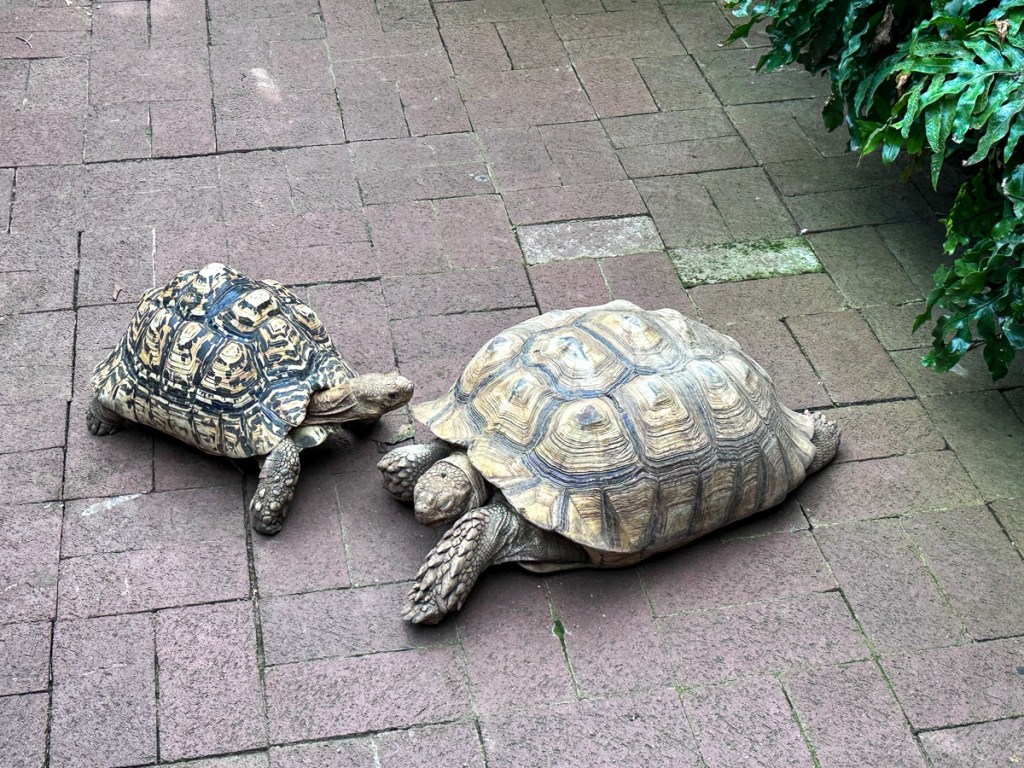
They moved freely among the vegetation, seemingly as much a part of the conservatory as the plants themselves. Nothing about their progress suggested urgency. Each foot was lifted, advanced and planted with deliberation. In a world increasingly measured in fractions of seconds, they seemed governed by another clock.
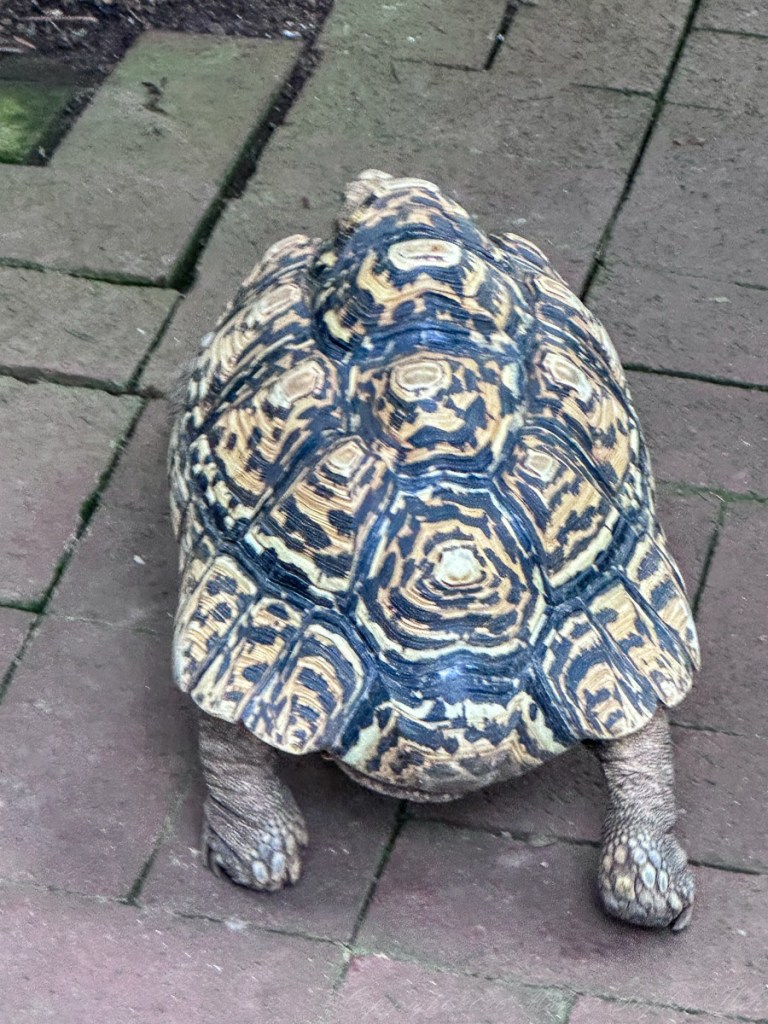
The smaller of the two immediately commanded my attention. His high, domed shell was covered with intricate patterns of yellow, tan and dark brown. Individual scutes carried irregular markings that radiated outward, giving the carapace something of the appearance of an ancient mosaic.
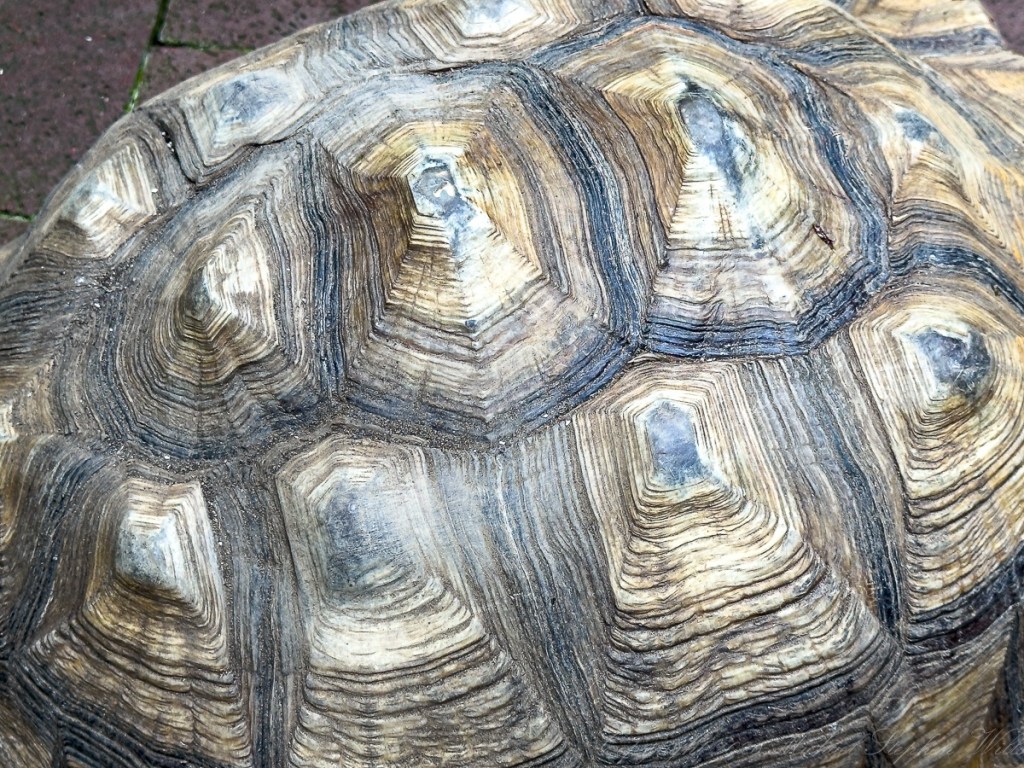
Beside him was an altogether different animal: larger, paler and immensely solid. Her shell was sandy brown, its individual scutes marked by concentric growth ridges. Massive forelegs, armored with heavy scales, supported a body that looked almost prehistoric. If the first tortoise suggested ornament, the second suggested architecture.
I photographed them, fascinated by the contrast.
Only later did the two strangers acquire names and histories.
Nancy Mastin of Lamberton Conservatory identified the patterned tortoise as Frank, a male leopard tortoise (Stigmochelys pardalis), born in 2015. His much larger companion is Rob, a female African spurred, or sulcata, tortoise (Centrochelys sulcata), born in 2016. Both arrived at Lamberton sometime after 2020, donated by private owners who could no longer provide sufficient room for them.
That last detail transforms the encounter.
Frank’s species comes from eastern and southern Africa, where leopard tortoises inhabit savannas and dry grasslands. Their striking shells account for the name. The pattern varies enormously among individuals and changes with age, but Frank retains an especially handsome contrast of dark markings against a warm yellow-brown background.
Rob belongs to a species shaped by harsher country. The sulcata inhabits the semiarid belt along the southern margin of the Sahara, where survival depends partly upon escaping extreme heat. Powerful forelimbs equipped for digging allow these tortoises to excavate substantial burrows. They are giants among terrestrial reptiles—the largest tortoise native to mainland Africa—and their eventual size is precisely why animals purchased when small can become difficult for private owners to accommodate.
Rob is only about ten years old. Frank is about eleven. For animals capable of living for many decades, they are not venerable relics at all. They are comparatively young.
Perhaps that was the greatest surprise.
A tortoise carries age upon its back even when it is young. Its shell evokes fossils, vanished landscapes and evolutionary time. Watching Frank and Rob, I found it difficult not to imagine ancestors moving through African grasslands long before our own species began building conservatories—or cities—or anything else.
Their shells reinforce the illusion. The concentric ridges visible in my close photographs record periods of growth, although they cannot reliably be counted as annual rings. A tortoise shell is not an inert case carried by the animal. It is living anatomy: bone covered by keratinous scutes, growing with the tortoise and protecting a body intimately joined to it.
Yet what I remember most is not anatomy but pace.
Frank was still as Rob approached. Around them rose a manufactured tropics of glass, steel, soil and plants. We passed carefully, Iphones in hand. Somewhere outside, Rochester continued at the speed expected of a modern city.
The tortoises declined to participate in the hurry.
I felt a restoration while watching an animal for which slowness requires no apology. Every movement is sufficient unto itself. A foot advances. Weight shifts. A neck extends. A leaf is investigated. Nothing appears wasted, and nothing appears rushed.
Their presence also tells a quieter human story. Frank and Rob began life in private ownership. As they grew, their needs grew with them until their owners recognized that they could no longer provide adequate space. Donation brought them to Lamberton, where their lives intersected—and, one August afternoon, intersected briefly with mine.
We entered the Conservatory expecting tropical plants. I left with photographs of two African tortoises and, eventually, their names.
Frank and Rob.
That is one of the pleasures of remaining curious: a photograph leads to a species, a species to a name, a name to a history. What began as two unexpected shapes moving beneath tropical foliage became something more memorable—a glimpse of distant Africa, deep evolutionary time, and two remarkably unhurried lives being lived beneath the glass roof of a conservatory in Rochester, New York.


What a delightful encounter!
LikeLiked by 1 person
It was a fun and unexpected fine in urban Rochester, NY
LikeLiked by 1 person
They are beautiful . Their shells , their species , where they are from .
Lovely story .
LikeLiked by 1 person
They have a charm….there were quail wandering around the conservatory, as well.
LikeLike
It is always a joy to read your articles. Thank you for sharing this lovely encounter with your attention to details & thoughtful observations. You and your wife are wonderful storytellers.
LikeLiked by 1 person
We released over 50 Monarch butterflies this year. Two set off from our backyard this morning, headed to Mexico.
LikeLiked by 1 person
What an unexpected sight at the conservatory! I love the colors in Rob’s shell! Thank you for sharing your fun encounter with us, Michael!
LikeLiked by 1 person
Rochester is a plesant city to visit. We are looking forward to the Lilac Festival next spring.
LikeLike