That afternoon of April 14, 2026, in the Mundy Wildflower Garden, I was moving slowly enough for the woods to begin revealing their smaller intentions. Mid-April in Ithaca is a season of thresholds. The leaf litter still holds the color of last year’s weather—oak brown, beech tan, the dry parchment of a forest not yet fully wakened—but through it rise the first green declarations. Nothing shouts. Everything announces itself in a near-whisper.
It was in that spirit that I came upon the cutleaved toothwort.
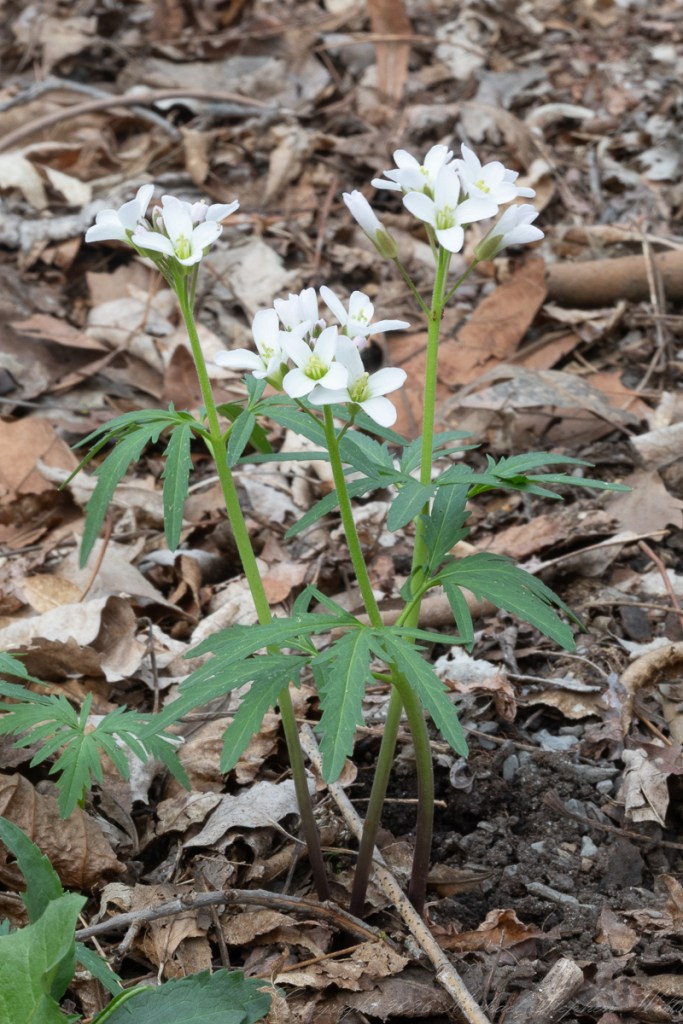
At first glance the plant seemed almost improbably delicate, as if it had been assembled from a set of fine green gestures and then topped with small white crosses of bloom. The flowers hovered just above the leaf litter, each with four petals, clear evidence of the mustard family to which the plant belongs. The leaves were deeply divided, sharply cut, almost hand-like in their spread, giving the plant its common name. There is something elegant in that foliage: not the broad, self-confident green of summer, but a more intricate, provisional architecture, suited to the brief bright interval before the forest canopy closes.
This was Cutleaf Toothwort, Cardamine concatenata, one of the spring ephemerals, those woodland plants that have evolved to live by speed and timing. Their season is narrow. They rise, leaf out, flower, attract pollinators, set seed, and begin to withdraw before the trees above them fully leaf out and cast the deep shade of late spring and summer. To see one is to witness a life shaped by the economy of light. It does not waste time. It cannot.
And then I noticed the bee.
I had first been looking at the flowers themselves, admiring the small white petals and the poised buds still waiting to open, when a glint of green—alive, metallic, almost jewel-like—caught my eye. There on the bloom was a Pure Green Sweat Bee, almost certainly Augochlora pura, one of the loveliest native bees of eastern woodlands. The name hardly prepares one for the reality. “Green” suggests leaf or moss or some dull vegetal shade. But this bee wore green the way a gemstone wears light. It seemed less colored than illuminated, as though the afternoon sun had condensed into a living body and taken to wing.
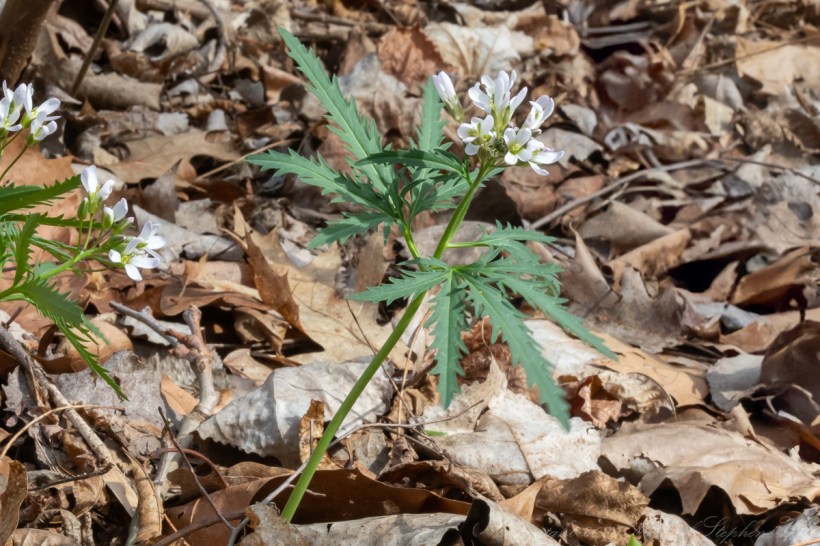
What moved me most was the scale of it. The bee was tiny beside the flower, and the flower itself was small in the wide republic of the forest floor. Yet in that little meeting—bee and toothwort, insect and ephemeral—there existed an entire system of ancient reciprocity. The bee had not arrived there by accident. Nor had the flower opened in innocence. Each belonged to the other’s world.
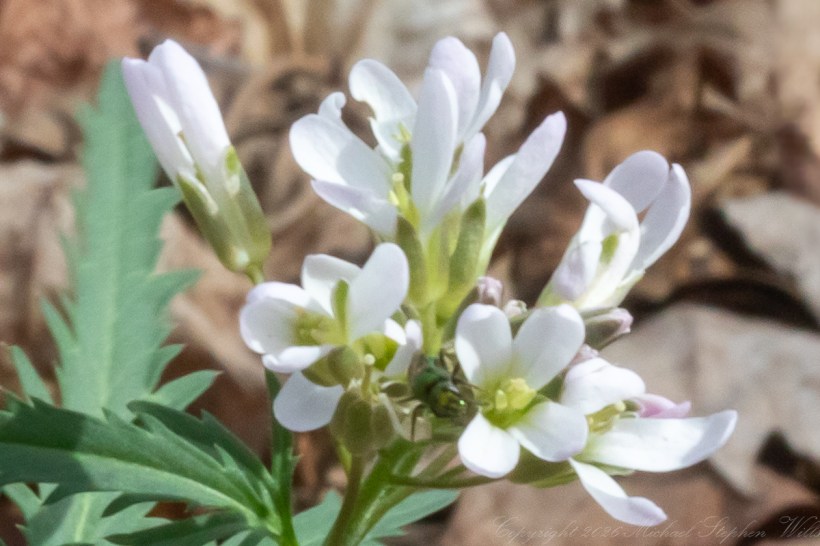
The life of a sweat bee is far more complex than its modest size suggests. Augochlora pura is one of our native solitary bees. Unlike honey bees, it does not belong to a great colony with combs and a queen. A female builds and provisions her own nest, often in rotting wood or soft decaying logs, an apt choice for a woodland species. She gathers pollen and nectar, forms a food mass for her offspring, lays an egg, and seals the chamber. Her labor is quiet, uncelebrated, and essential. She is one small carrier of spring fertility, moving genes through the forest one flower visit at a time.
The common name “sweat bee” comes from a habit some species have of landing on human skin to sip salts from perspiration, but there was nothing comic or pesky about this one. On the toothwort it was wholly itself: intent, methodical, radiant. It moved with a professional seriousness from bloom to bloom, entering the white flowers where the reproductive parts stood ready. Pollen clung to its body. The flower offered nectar and pollen as food; the bee, without contract or plan, carried the plant’s future outward. Evolution has made such meetings beautiful, but beauty is not the goal. Continuance is.
And yet beauty is what we are given to see.
The Cutleaf Toothwort has its own intricate life history. It spreads not only by seed but also through underground rhizomes, toothed in form, which gave rise to the older name “toothwort.” Those pale subterranean stems hold stored energy from previous seasons, allowing the plant to rise quickly when soil temperatures soften and light still reaches the woodland floor. It is a plant of patience and timing, of long preparation for a brief display. Its flowers are modest, not showy in the garden-center sense, but perfectly fitted to the early spring woods: visible enough to pollinators, pale enough to stand out against the brown duff, structured for efficiency.
There is also an evolutionary poignancy in the fact that many spring ephemerals depend on the first wave of insect activity after winter. Bees like Augochlora pura emerge into a world that is only beginning to supply forage. A flowering woodland plant in April is an opened pantry, a signal fire, a necessary event in the calendar of survival. Likewise, a native bee visiting those flowers is a participant in a relationship shaped over vast stretches of time. Forest floor, rhizome, petal, pollen grain, bee body, hollow wood nest—all of it is linked.
Standing there with my camera, I felt once again how often wonder arrives disguised as minuteness. The grand spectacles of nature announce themselves: waterfalls, hawks, autumn hillsides, a full moon lifting over a ridge. But this was a smaller magnificence, requiring the humility to stoop, to wait, to look closely enough for significance to emerge from what many walkers would simply call “little white flowers.” The Mundy Wildflower Garden, on an afternoon like this, was displaying as well as conducting spring.
The leaf litter around the plant only deepened the impression. Last year’s fallen leaves were still present, curled and dry, forming the brown text from which the new season writes its first green sentences. Out of that apparent dormancy rose the toothed leaves and white flowers of Cardamine concatenata, and upon them came the emerald bee, a living spark of pollinating purpose. Death feeding life; old canopy nourishing new growth; a forest renewing itself not through spectacle but through a thousand precise exchanges.
I lingered longer than I meant to. That happens to me often in spring. One flower leads to another, one patch of sunlight to another, and then some small drama of natural history arrests the day. But this encounter felt especially complete. The Cutleaf Toothwort embodied the speed, discipline, and elegance of the spring ephemeral strategy. The Pure Green Sweat Bee embodied the brilliance and necessity of native pollinators, creatures upon whose unrecorded labor the health of so many ecosystems depends. Together they made visible a truth the woods are always speaking: survival is collaborative, and beauty often arises where need and adaptation meet.
When I finally moved on, I carried with me the feeling that I had witnessed a brief transaction in the old woodland economy, a little shining exchange older than any path through the garden, older than the institutions built around it, older even than the names we now give to bee and blossom. On an April afternoon, among the leaves of last year, I had found a subject for a photograph within a moment in which evolution, ecology, and grace stood together in one small white flower.


Another beautiful and informative piece Michael, many thanks for taking us along with you.
LikeLiked by 2 people
This time of year the Mundy Wildflower garden is a wonder. I am spotting these toothworts elsewhere now that I know them from there.
LikeLiked by 2 people
Wonderful photographs and interesting narrative, Michael. At first sight, I thought how delicate the flowers looked, but I almost immediately realized how tough they have to be to come to life at the end of winter. Your references to sweat bees reminded me that I realized several years ago that I have not seen in decades the tiny sweat bees we used to see in abundance here in the North Carolina piedmont. Sadly, I can add Bobwhites, Whippoorwills, and flying squirrels to that list. And is gets rarer every year that we see a box turtle. Your blog post is lovely, so forgive me for letting it take me down a road to the disappearance of species. I have the privilege of living now on the exact property where I grew up in the 1950s and 1960s, so it is striking to consider the animals of my childhood that are no longer here. On the other hand, I did not see a deer here until probably the 1990s but now they are here in abundance as they are being squeezed from their habitats.
LikeLiked by 2 people
Just now I spotted the first (male) Rose Breasted Grosbeak at our feeder. The female is not far behind.
LikeLiked by 1 person
How wonderful! I’ve only seen a Rose Breasted Grosbeak about three times in my life. Last week I caught a glimpse of a male Indigo Bunting in the backyard — only the second or third time I’ve seen one in my life.
LikeLiked by 2 people
We’ve never seen an Indigo Bunting…I see they forage for insects, berries and such with seeds only in the winter (in Florida and South America). I’ll keep an eye out during walks.
LikeLiked by 1 person
Michael, I appreciate your narrative and photographs. Every patient breath of nature’s awakening offers beautiful evidence that springtime’s full bounty is nearly upon us.
LikeLiked by 1 person
Richard, I trust your Mother’s Day celebrations went off well.
LikeLiked by 2 people