The Wonder of Penstemon hirsutus in Treman Gorge

Discover the enchanting Hairy Beardtongue nestled in Treman Gorge. Learn about its striking lavender blooms, unique adaptations, and fascinating history in our latest nature exploration. Dive into the beauty of Penstemon hirsutus!

On a sunny day at the end of May 2024, I embarked on one of my cherished walks through Robert H. Treman Park, located in the heart of Ithaca, New York. The park, with its stunning gorges and waterfalls, never ceases to amaze me with its natural beauty and diverse plant life. This time, my exploration led me to a delightful discovery along the south-facing walls of Treman Gorge: Penstemon hirsutus, commonly known as the Hairy Beardtongue.

As I navigated the rocky terrain, my attention was caught by a cluster of delicate, tubular flowers emerging from the crevices of the gorge walls. Their soft lavender hues stood out against the rugged backdrop of moss-covered rocks and shale. Upon closer inspection, I noticed the characteristic hairy stems and leaves, confirming that I had indeed found Penstemon hirsutus.

Penstemon hirsutus is a perennial herbaceous plant native to eastern North America. It typically reaches a height of 1 to 3 feet, with erect stems covered in fine hairs. The leaves are lanceolate, arranged oppositely along the stem, and also bear a slight fuzziness. The flowers, which bloom from late spring to early summer, are tubular and two-lipped, resembling a small beard—a feature that likely inspired the common name “Beardtongue.” Each flower is about 1 to 1.5 inches long, with a delicate lavender color that fades to white at the throat.

The genus name “Penstemon” is derived from the Greek words “pente,” meaning five, and “stemon,” meaning stamen, referring to the plant’s five stamens—four fertile and one sterile, the latter often appearing as a small, hairy tongue within the flower. The species name “hirsutus” comes from Latin, meaning hairy, a nod to the plant’s hirsute stems and leaves.

The Hairy Beardtongue thrives in well-drained soils and can often be found in rocky, open woodlands, meadows, and along cliffs—exactly the kind of environment provided by Treman Gorge. This plant is well-adapted to the microhabitats created by the gorge’s south-facing walls, where sunlight and moisture create ideal growing conditions. The rock walls not only offer physical support but also help retain heat and moisture, creating a microclimate that supports a variety of plant species.

Historically, Penstemon hirsutus and its relatives have been valued for their ornamental beauty and ecological benefits. The flowers attract a variety of pollinators, including bees, butterflies, and hummingbirds, making them an important component of the local ecosystem. Native Americans also recognized the medicinal properties of some Penstemon species, using them to treat ailments such as toothaches, sore throats, and respiratory issues.

In recent times, gardeners and horticulturists have come to appreciate Penstemon hirsutus for its hardiness and low maintenance requirements. It is often used in native plant gardens, rock gardens, and naturalized areas to add a touch of wild beauty. The plant’s ability to thrive in poor soils and its resistance to deer browsing make it a valuable addition to any garden aiming to support local wildlife and biodiversity.

Finding the Hairy Beardtongue in Treman Gorge was a moment of pure joy and wonder. It reminded me of the resilience and adaptability of nature, as this delicate yet sturdy plant has carved out a niche for itself in the rocky walls of the gorge. The sight of its soft lavender blooms swaying gently in the breeze was a testament to the beauty and tenacity of life in even the most rugged environments.

As I continued my hike, I felt a renewed sense of connection to the natural world. The discovery of Penstemon hirsutus was not just a botanical find but a reminder of the intricate and interconnected web of life that thrives in Treman Gorge. Each plant, each flower, has a story to tell—a story of survival, adaptation, and beauty that enriches our understanding of the natural world and our place within it.

Copyright 2024 Michael Stephen Wills All Rights Reserved

Watching with the Willows

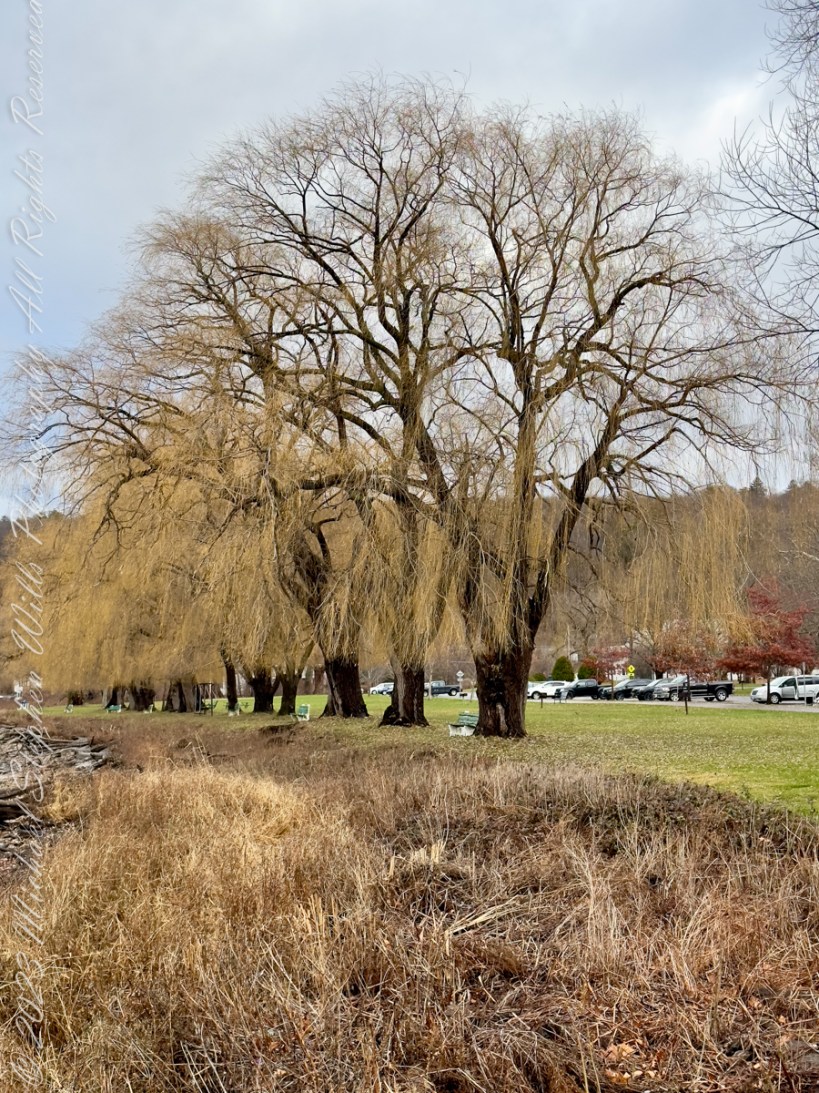
On a brisk day at Stewart Park, I stroll alongside Cayuga Lake, observing Canadian Geese and white willows. The tranquil, interconnected scene proves an enduring memory despite everyday worries.

Continue reading “Watching with the Willows”

Moonlit Parallels

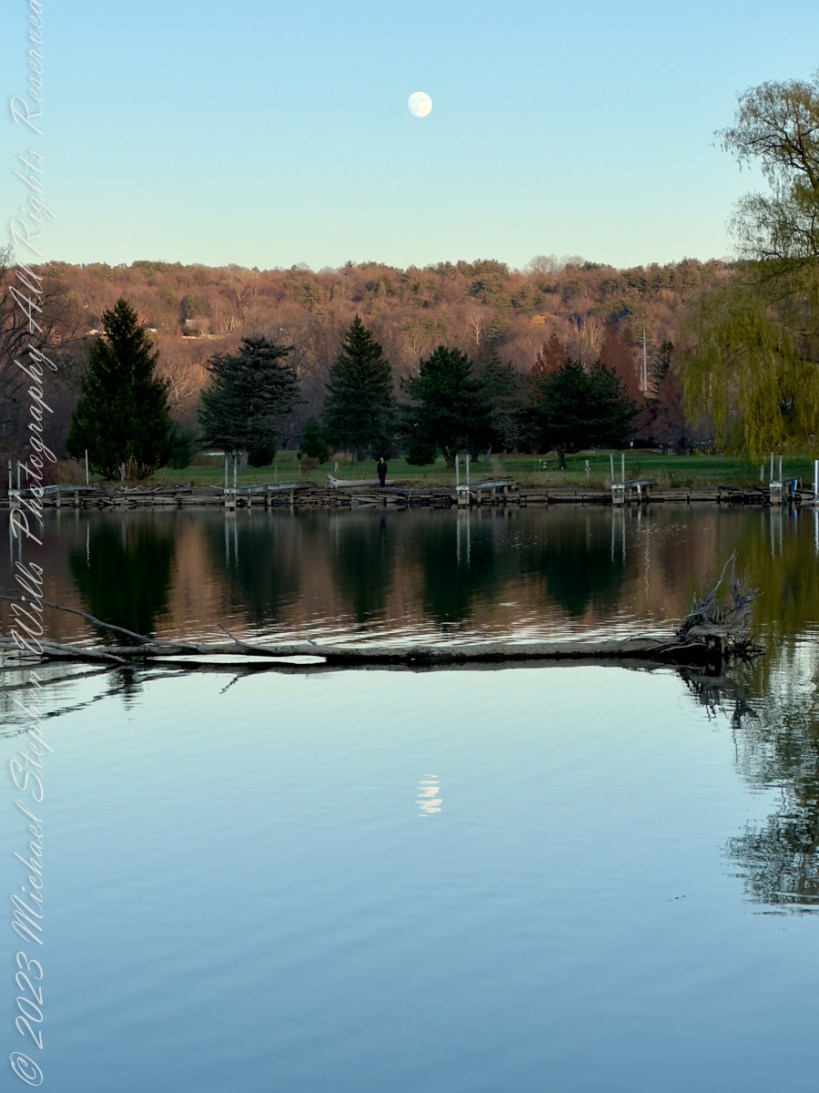
Discover this mysterious encounter at Cayuga Lake Inlet where I met Neven, my doppelganger. Who is he? Join me in unraveling this eerie twilight mystery.

Continue reading “Moonlit Parallels”

Thayer Preserve: Autumn Still Life 4

Explore the enchanting Lick Brook in the Finger Lakes region, where the Land Trust’s conservation efforts preserve nature’s beauty. Join me to uncover this hidden gem and its ecological wonders.

Continue reading “Thayer Preserve: Autumn Still Life 4”

New Beginnings

Embark on a photographic journey with me, armed with a Canon EOS 5D Mark IV and a keen eye, as we navigate the challenges and beauty of Taughannock Falls. Experience the blending of history and art through my lens, capturing nature’s grandeur and the legacy of the land. Join me in this adventure.

Continue reading “New Beginnings”

Winter People Watching

Happy New Year’s Eve

Continue reading “Winter People Watching”

Reflected Sunset

An evening at Cayuga Lake Inlet, home to the Cornell University Crew, is depicted as a serene haven for reflection. The Collyer Boathouse, vital to the local lore, sits across the inlet holding a rich history of crew camaraderie and competition.

Continue reading “Reflected Sunset”

Thayer Preserve: Autumn Still Life 5

Ithaca’s bedrock, formed 370 million years ago, deeply influences its landscape, neutralizes rainwater’s acidity, and carries a story of Earth’s resilience and transformation.

In Ithaca, New York, the story of the land is deeply rooted in its geology. Beneath the vibrant autumn leaves and along the path of Lick Creek lies a bedrock formed 370 million years ago. This ancient foundation, once the sediment of a vast inland sea, now forms the solid base upon which the city stands.

The bedrock here is a silent witness to Earth’s long history. Originating in the Devonian period, it marks a time when vast seas covered much of the Earth’s surface. Within these ancient waters, life flourished, leaving behind sediments that, over eons, transformed into the layered rock beneath Ithaca.

These layers are more than just historical records; they actively shape the landscape. The bedrock influences soil composition, affects plant growth, and directs the flow of streams. Lick Creek, with its clear waters, is one such stream that interacts intimately with this bedrock.

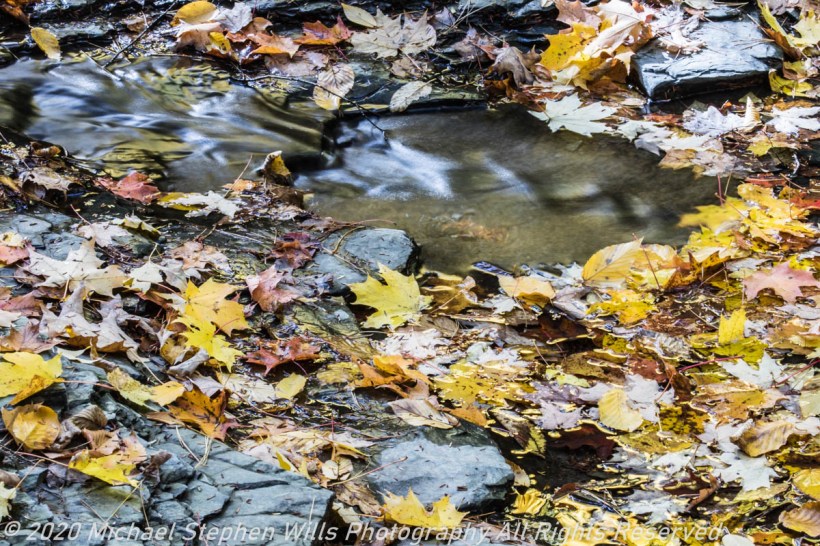
In autumn, the beauty of this interaction is vividly displayed. The red and yellow maple leaves create a striking contrast against the grey-blue backdrop of the bedrock, a blend of the vibrant present with the ancient past. These fallen leaves, over time, decompose and enrich the soil, continuing a cycle of life that this bedrock has supported for millions of years.

This bedrock also plays a crucial role in water chemistry. As acidic rainwater percolates through it, a remarkable transformation occurs. The bedrock naturally neutralizes the acidity of the rainwater. By the time the water emerges as streams, it is buffered to a neutral pH. This process is vital for maintaining the ecological balance of the area. The streams that flow out, including Lick Creek, support diverse ecosystems thanks to this natural filtration process.

Click photograph for larger view. Use combination keys to enlarge/reduce: Ctrl+ (Control / Plus) and Ctrl- (Control / Minus)

The neutral pH water is crucial for the flora and fauna of Ithaca. It sustains the forests, the wildlife, and the natural beauty that defines the region. This water, once acid rain, purified by the ancient bedrock, now nurtures life in its journey.

In Ithaca, the bedrock is a testament to the enduring nature of our planet. It reminds us of the continuous cycle of transformation that defines the Earth. The contrast of the autumn leaves against the bedrock is not just a scene of ephemeral beauty; it symbolizes the dynamic interplay between the living and the geological, between the present and the deep past.

The bedrock of Ithaca, with its ability to neutralize acidic water, highlights the interconnectedness of natural processes. It shows how the Earth self-regulates and sustains life in intricate ways. As the buffered, neutral pH water of Lick Creek flows over this bedrock, it carries with it the story of a planet that is constantly renewing and sustaining itself.

In this landscape, the past is not just a memory; it is an active participant in the present. The bedrock, the autumn leaves, and the flowing streams tell a story of resilience, continuity, and the beauty of nature’s balance. This is the legacy of Ithaca’s bedrock, a legacy of endurance, transformation, and life.

Click Me to view my photographs on Getty.

Copyright 2023 Michael Stephen Wills All Rights Reserved http://www.MichaelStephenWills.com

Lib Slope Hickory

the largest and brightest yellow canopy on Libe Slope.

Libe Slope

Cornell University is on a west-facing hill above Cayuga lake.  Libe Slope is between the West Campus and Quadrangle / Libraries.

Besides the exercise of walking the 18 degree incline several times each day,  Cornell students and alumni remember The Slope for autumn color.

Built in 1868, McGraw Hall has the honor of having the first of Cornell’s towers. The building is built of Ithaca stone and is home to the American Studies Program, Department of History, Department of Anthropology, and Archaeology Intercollege Program. The first floor of McGraw Hall houses the McGraw Hall Museum, a collection of roughly 20,000 objects from around the globe used for teaching by the Anthropology Department.

Hickory

This is a Pignut Hickory (Carya glabra),  the largest tree  according to a 2009 Campus Tree Inventory (see link, below).

Seen from the north on a cloudy October day, this Pignut Hickory (Carya glabra) is the largest tree on the Cornell Campus, at 79 inches in diameter.

This hickory grows south of the Johnson Museum and among the autumn glories, it is the largest and brightest yellow canopy on Libe Slope.

Contrast

I remember this hickory for the contrast between the canopy and trunk, the way the clumps of yellow hang from dark boughs.  An overcast day is the best to capture this spectacle.  October 20, 2012 provided both bright sun and dark, rolling autumn clouds.  I waited on the north side, sheltered from the glare of the sky, for these perfect moments.

Leaves and Nuts

The pignut hickory is native to these Eastern United States.  It is known to favor moist slopes and this specimen has thrived on The Slope.  The ground beneath it is thick with nuts.

One week later as Hurricane Sandy approached the east coast

Just one week later, late afternoon on a sunny Friday as hurricane Sandy approached the east coast the hickory has fewer, tawny golden leaves.

Later in October the bright yellow leaves of the Libe Slope Hickory darken to a tawny gold. The Johnson Museum is in the right background.

Wonderful Flow of Limbs among Gold

Seen from the north on a cloudy October day, this Pignut Hickory (Carya glabra) is the largest tree on the Cornell Campus, at 79 inches in diameter.

References

A Photo Tour of Key Buildings at Cornell University by Allen Grove

Websites

Cornell Tree Inventory

Copyright 2023 Michael Stephen Wills All Rights Reserved

Big Bend

A tripod and Neutral Density filter

Winter 2020 I posted “Winter People Watching” featuring the Sony F828 and candid street photography.

What I love about this place, a unique feature, is the size and different vantage points making it possible to view the same place from different angles. November 2019, readers were shown “The Bend,” a place with Taughannock gorge makes a 90 degree turn, changing from a southeastern to an eastern flow. Here are photographs from spot overlooked by that post.

Here the camera faces away from the sun, the graduated neutral density filter allowing me to capture the cloudless blue sky, a little milky the way it is here February with a hint of spring.

This little one is studying the information placard with rapt attention, learning how the African continent, pushing against North America, across the eaons, formed the right angle fractures mirrored by this dramatic change in Taughannock Gorge. For the Big Bend photographs I was standing behind them, along the stream bed.

Here is a broader slice of that sky.

Can you see the tiny figures of hikers, dwarfed by the frozen cliff?

Copyright 2023 All Rights Reserved Michael Stephen Wills