White Snakeroot: A Native Finger Lakes Wildflower with a Dangerous History

White snakeroot around the Finger Lakes reveals a native wildflower of beauty, poison, pollinator value, layered names, and deep human history.

The white snakeroot stood near the woods along the South Rim Trail, a pale branching spray of flowers lifted out of the shade. I had gone to Taughannock for the gorge walls, the lake light, the shale ledges, and the first yellowing leaves, but this modest herb held its own at the edge of the scene. It was knee to waist high, easy to overlook; yet once seen, it seemed to gather the late summer around itself.
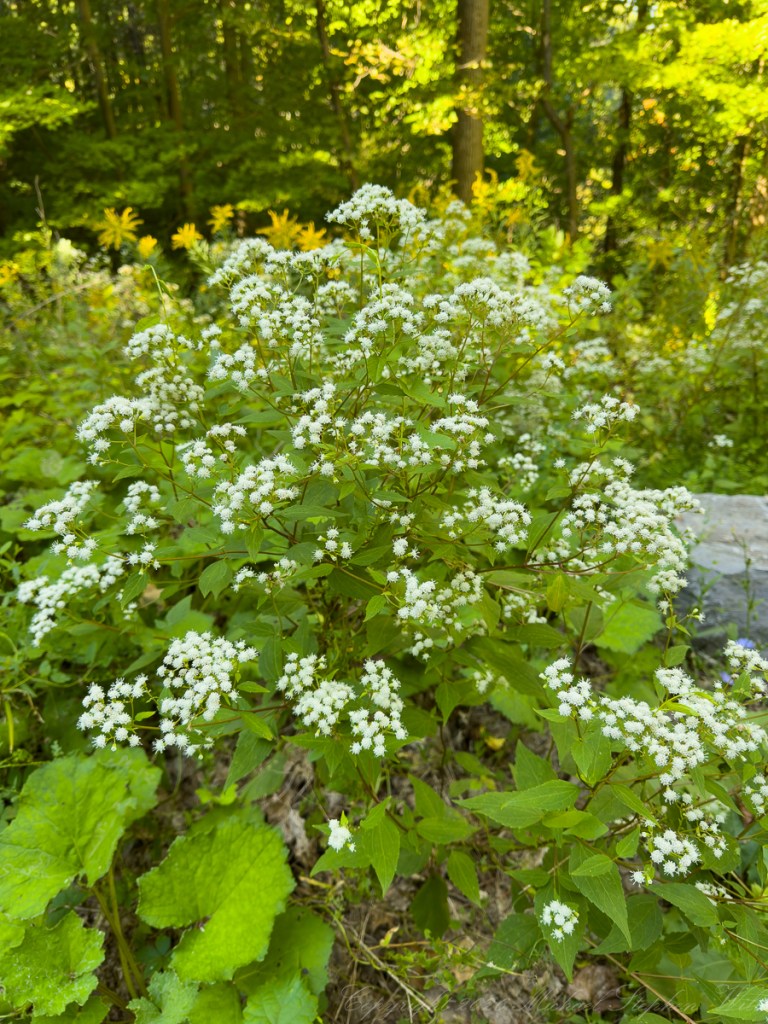
Found along the South Rim Trail. From a walk around Taughannock Falls State Park, down the South rim Trail, up the North Rim Trail. September 14, 2026

White snakeroot, Ageratina altissima, is a poisonous perennial herb in the aster family. It is native to woodland places in the eastern United States and often grows in rich or rocky woods, thickets, stream edges, roadsides, and disturbed ground. Its current accepted botanical name is Ageratina altissima, though older guides may still remember it as Eupatorium rugosum.
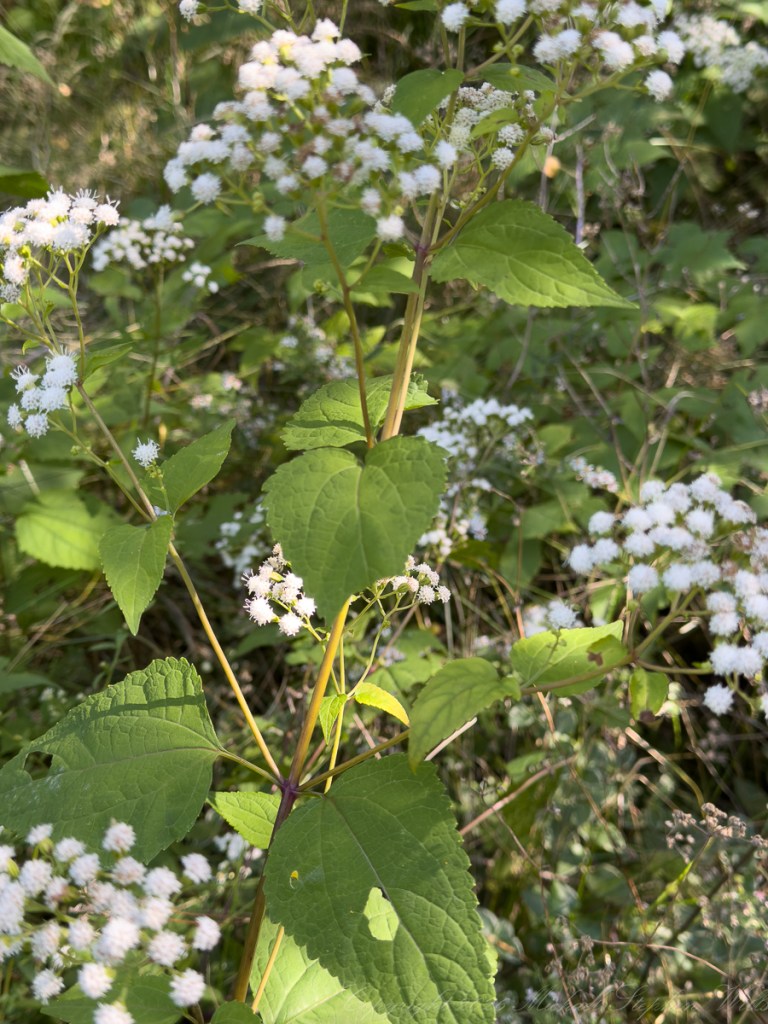
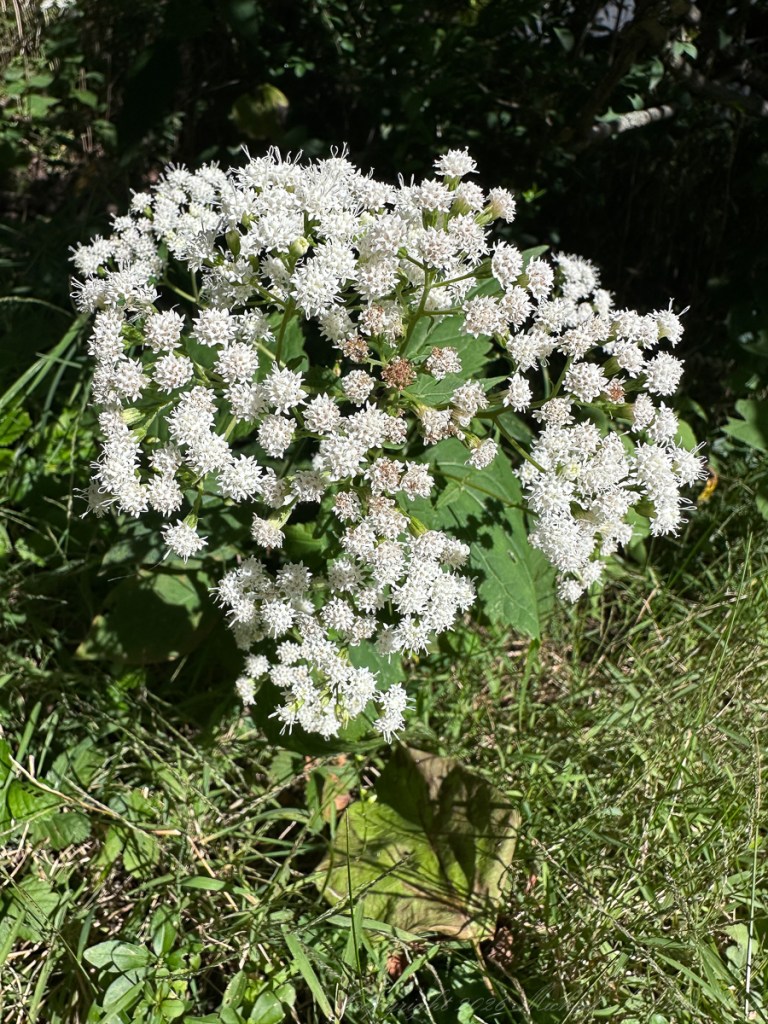
Leaves and flower clusters of white snakeroot, Tompkins County, New York.

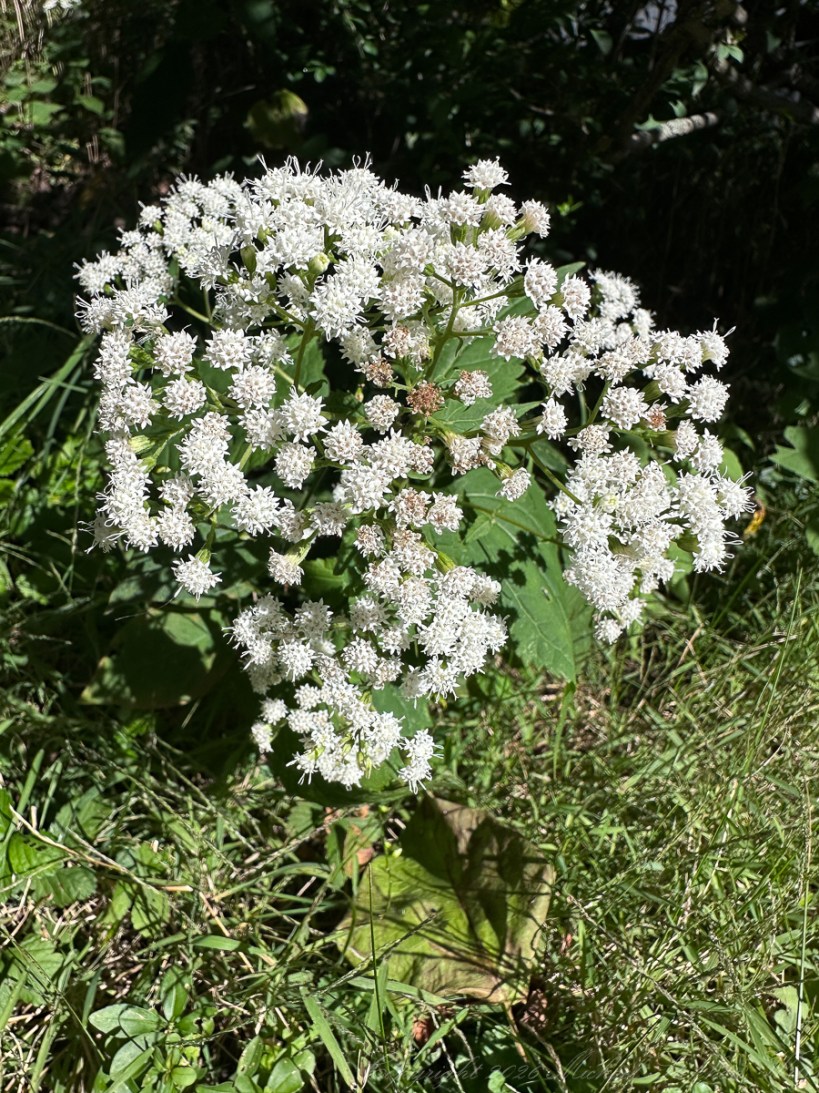
Later, I began seeing the same composed plainness in the white snakeroot growing in our own yard. Its leaves are opposite, toothed, broadly ovate to somewhat heart-shaped, with pointed tips and slender petioles. The stems rise and divide, and at their ends appear flat-topped clusters of white flower heads. At a closer look, the flowers are not like daisies or other familiar asters. They have no showy rays spreading outward like petals. They are made of small disk flowers, each head a tuft, and the whole plant in bloom becomes a cloud of minute, bristling whiteness. What looks from a distance like foam resolves, near at hand, into many small parts.
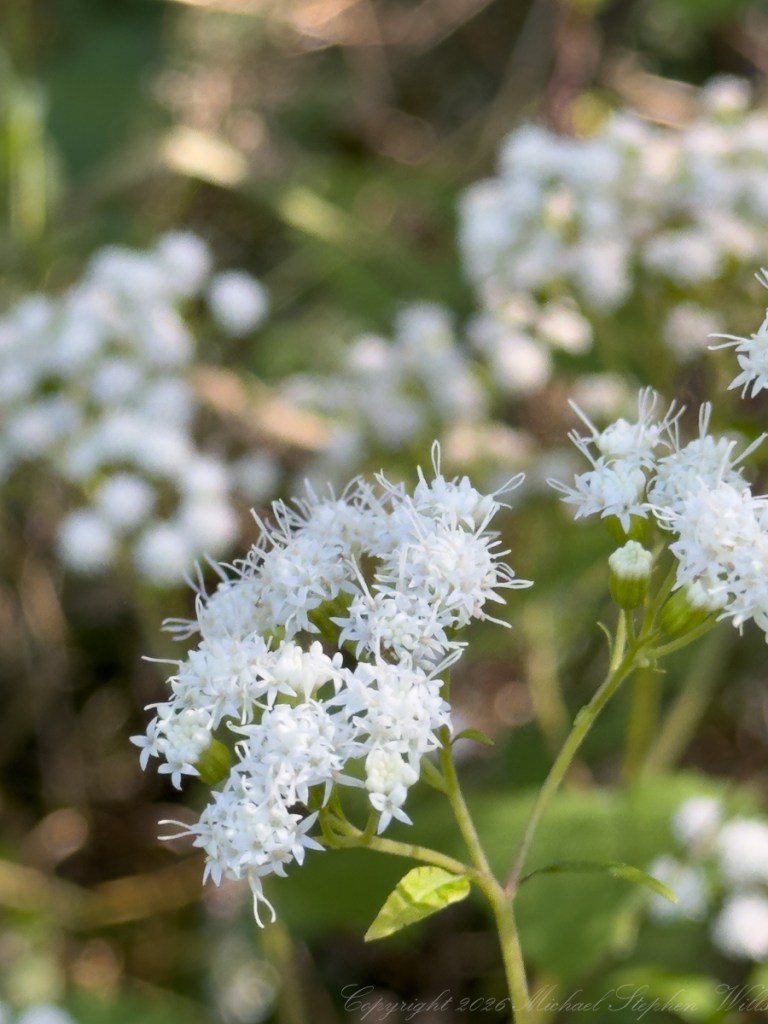
A closer look at the flowers of this member of the Aster family

The scientific name begins in a paradox. Ageratina comes from the same root as Ageratum, from Greek language associated with “not aging,” a reference to flowers that keep their color for a long time. The species name altissima means tallest or very tall, and in this case refers to its stature within the genus. A plant found in shade, at the edge of paths, among fallen leaves and shale-gray rock, is given a name that speaks of lasting freshness and height. The name seems, at first, too grand for it. But by September, when many flowers have passed into seed or exhaustion, white snakeroot is still offering its small whiteness to the air.
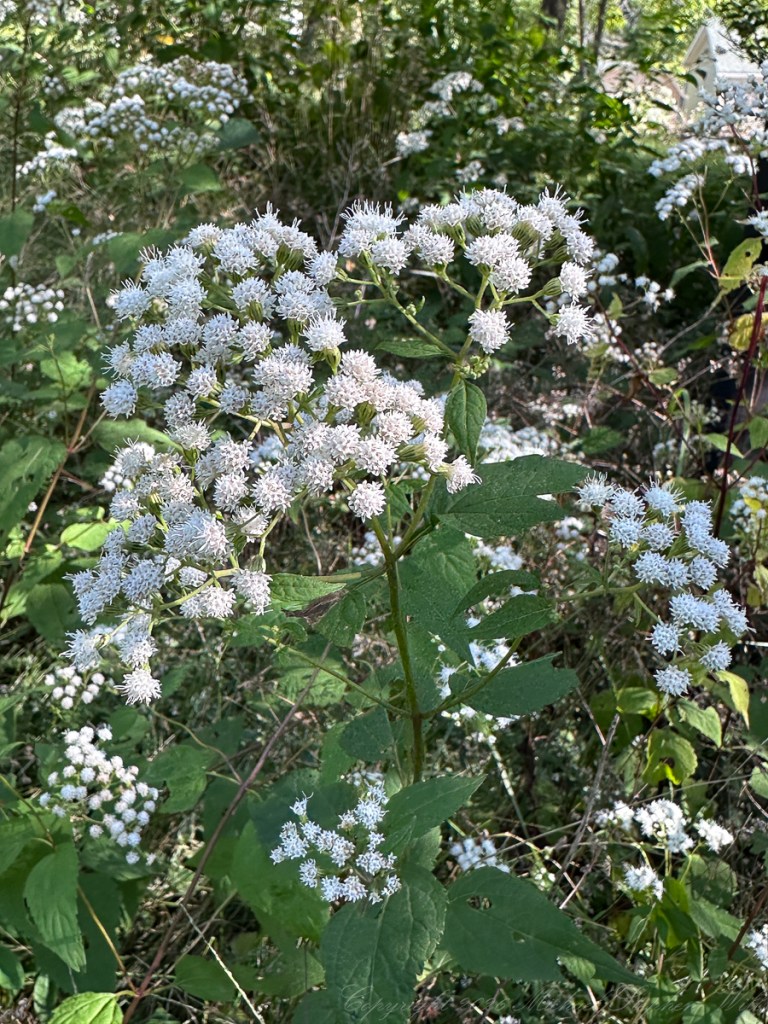
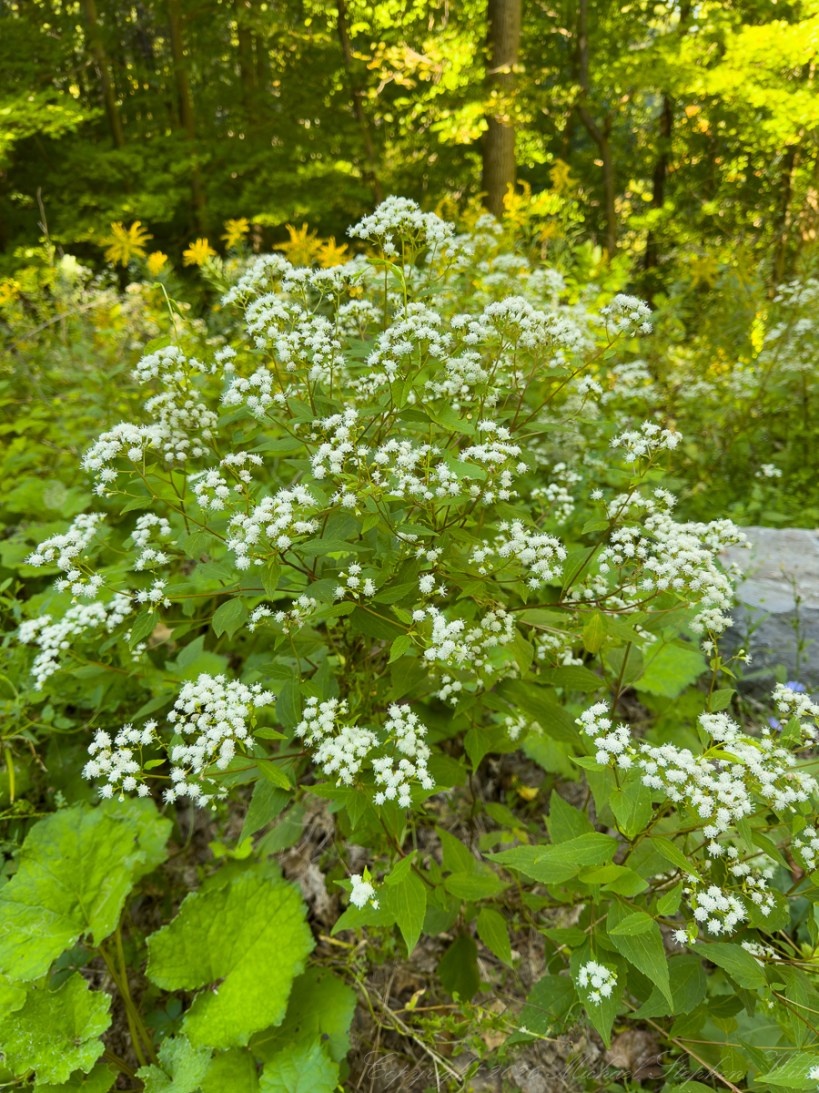
White snakeroot blooming in our Ithaca yard.

Then come the common names, each one carrying a fragment of human encounter. White snakeroot is the one most often used, and it preserves an old belief that the root could be used against snakebite. Other names collected around it over time: richweed, white sanicle, fall poison, deerweed, Indian sanicle, milk-sickness plant, white top. These names are not synonyms so much as testimonies of different encounters. One person saw the habitat and called it richweed. Another remembered a medicinal resemblance and called it white sanicle. Another learned danger and named it fall poison. The plant stayed where it was, in the shade and edge-growth, while people kept finding new reasons to name it.

The word “snakeroot” is especially revealing. It belongs to a time when usefulness and fear were not separate categories. A root that might heal a bite, a plant that might hold a hidden power, a white bloom appearing at the border of pasture and wood—such things entered household knowledge before they entered botany. The old belief was wrong, but the name endured. Names often do. They are less like labels than sediments, deposited by generations of need, mistake, memory, and caution.

Around the Finger Lakes, white snakeroot seems at home in the broken places where wildness and human passage touch: the edge of a gorge trail, the bank above a creek, a roadside ditch beneath maples, a yard border neglected long enough to become interesting. It does not require the open blaze of a meadow. It tolerates shade. It stands in those green rooms where goldenrod, asters, jewelweed, wood nettle, grasses, young trees, and invasive shrubs may all be negotiating for light. In the late season it becomes part of the pollinator economy of scarcity, offering nectar and pollen when many summer blooms are finished. Bees, butterflies, wasps, flies, beetles, and moths may visit it; extension and conservation sources note its value to late-season pollinators.
A small bouquet spared by the lawnmower.

But this is not a harmless innocence. White snakeroot is one of those plants that shows how beauty and hazard may occupy the same stem. Its toxic history is bound to grazing animals, milk, and settlement. When cattle consumed the plant, toxic compounds could pass into milk, producing the illness once known as milk sickness in people who drank it. Research has associated the toxicity with tremetol, a lipophilic mixture of compounds, and with tremetone-related compounds; the old rural names “trembles” and “milk sickness” record the symptoms and route of harm.

This intersection with humanity is sobering because it was not dramatic in the way a venomous snake is dramatic. The danger did not announce itself with fangs. It entered through the ordinary domestic trust of milk. A cow grazed a shaded edge. A household drank what it had always drunk. Illness followed from a chain no one had yet learned to see. The plant was not malicious. It was only doing what plants do: making compounds in its tissues, surviving in the shade, waiting out the season.

That is one reason I find the plant moving. White snakeroot asks us to look without simplifying. Native does not mean safe. Poisonous does not mean expendable. The same plant that feeds late-season insects also carries the history of milk sickness and frontier fear. It has been cleared from pastures and is welcomed in our woodland garden.

By October its whiteness will give way to seed. The heads will loosen, and the plant will fade into the brown grammar of the season. But in September, around the Finger Lakes, it still stands in the half-light: white, poisonous, useful to insects, burdened with names, and easy to pass by.

Click me to visit Michael Stephen Wills Online Finger Lakes Gallery.

Enter your email to receive notification of future postings. I will not sell or share your email address.
Exploring Taughannock Falls State Park: September Light in the Finger Lakes

A September walk at Taughannock Falls reveals layered cliffs, white snakeroot, drifting clouds, Cayuga Lake, and the quiet threshold between summer and autumn.

On September 14, 2026, Taughannock held itself between seasons. Summer had not yet departed; autumn had not yet claimed the gorge. The trees still wore their full green abundance. Yet, here and there, high on the rims and tucked into the ravine walls, yellow had begun its quiet work. I experienced it as hints, as first thoughts, as small flames beginning among the maples and shrubs.

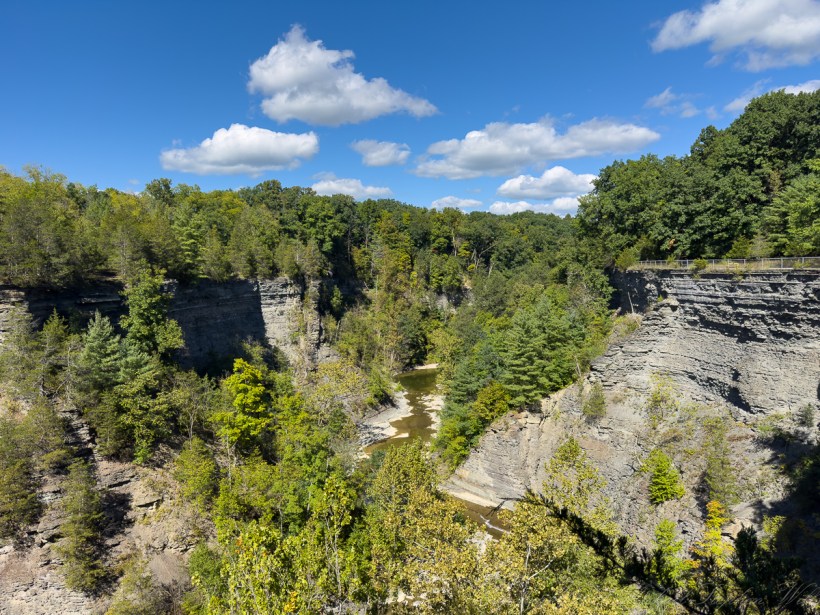
The view from the South Rim Trail. From a walk around Taughannock Falls State Park, down the South rim Trail, up the North Rim Trail. September 14, 2026

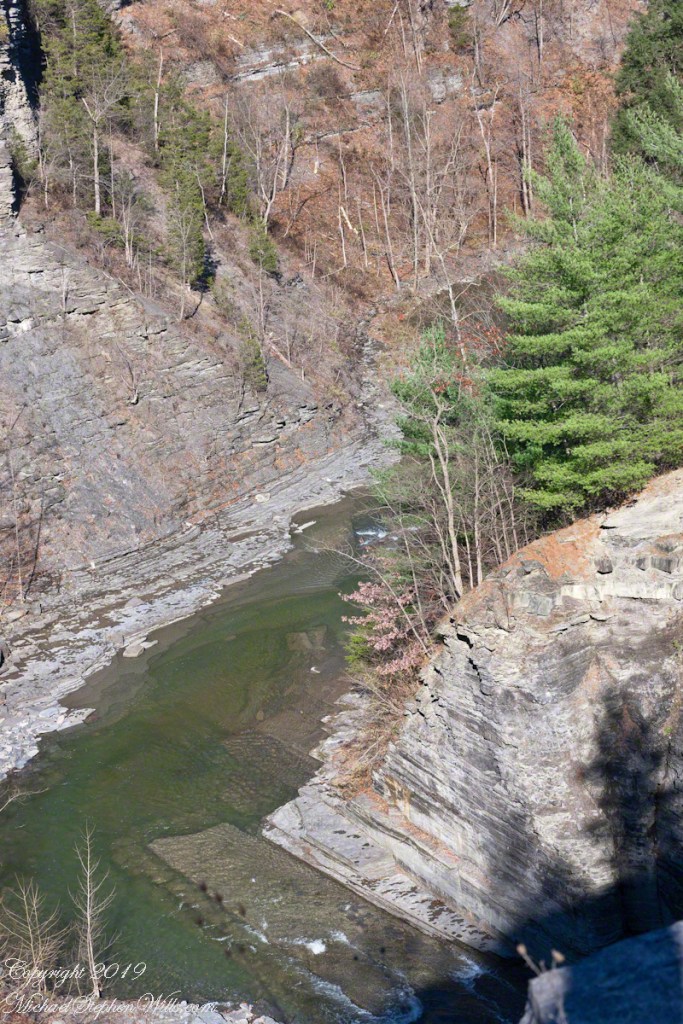
The gorge opened first as architecture: a long cleft of layered stone, inhuman shades of gray, cut by water through an immensity of time. From the rim, the creek below seemed almost modest, a brown-green ribbon moving through a corridor it had patiently made. The cliffs did not appear carved so much as remembered into shape. Bed after bed, ledge after ledge, they held the ancient sea in their faces. The rock seemed written in lines, a ledger of vanished depths, pressure, uplift, frost, collapse, and flow. Trees clung wherever they could. Roots found cracks. Cedars leaned over voids. Hardwood trunks rose from impossible perches, answering stone with leaf.

An extravagant sky above all. This blue, saturated and clean, carried great white clouds across the park like slow, wandering thoughts; too soft for a place so sternly cut by geology. Yet that contrast is part of Taughannock’s power: air and stone, cloud and shale, the brief and the enduring sharing one frame. The clouds drifted without urgency while the gorge below testified to forces that measure themselves in millennia. Standing there, the human mind is pulled in two directions at once—toward the fleeting weather of the day and toward the deep patience of the earth.

Snakeroot, a poisonous perennial herb

Along the wooded trail, the eye dropped from grandeur to intimacy. White snakeroot bloomed in loose clusters, each tiny flower a small, tufted star gathered into a milky constellation above serrated leaves. Behind it, the forest glowed with the filtered green light of late summer. Goldenrod rose farther back, blurred into warmth. The plants seemed not lesser than the falls or cliffs, only quieter. Requiring a different scale of attention. The gorge overwhelms; the flower invites. One must bend inward to see it properly.

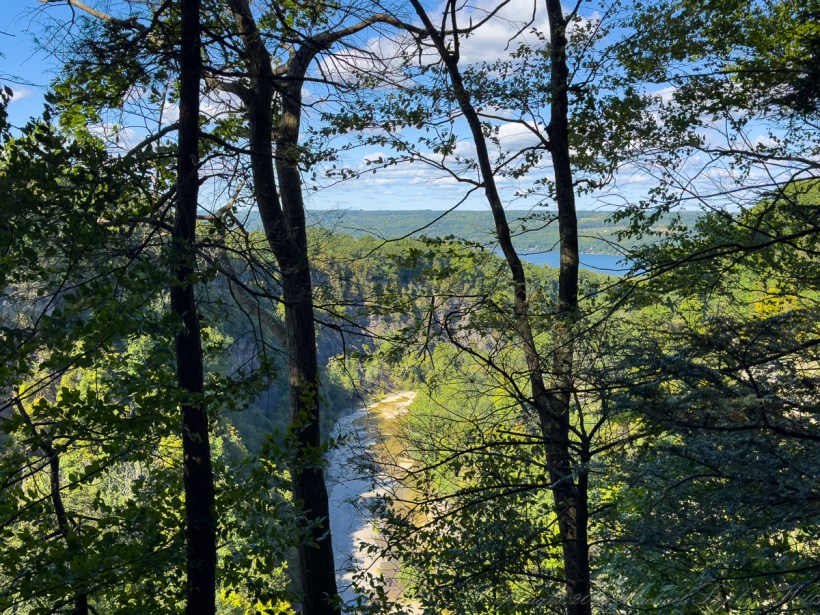
Seen from the South Rim Trail.

Through the trees, Cayuga Lake appeared like a blue promise beyond the gorge. Branches crossed the view in dark strokes, turning the scene into a natural stained-glass window: cliff, water, sky, leaf. The lake lay beyond the ravine’s mouth, broad and reflective, suggesting release after confinement. The creek that had moved through shadow and stone would eventually find that open water. There was comfort in that progression: narrowness giving way to breadth, descent becoming arrival.

Mouth of Taughannock Creek as it enters Cayuga Lake

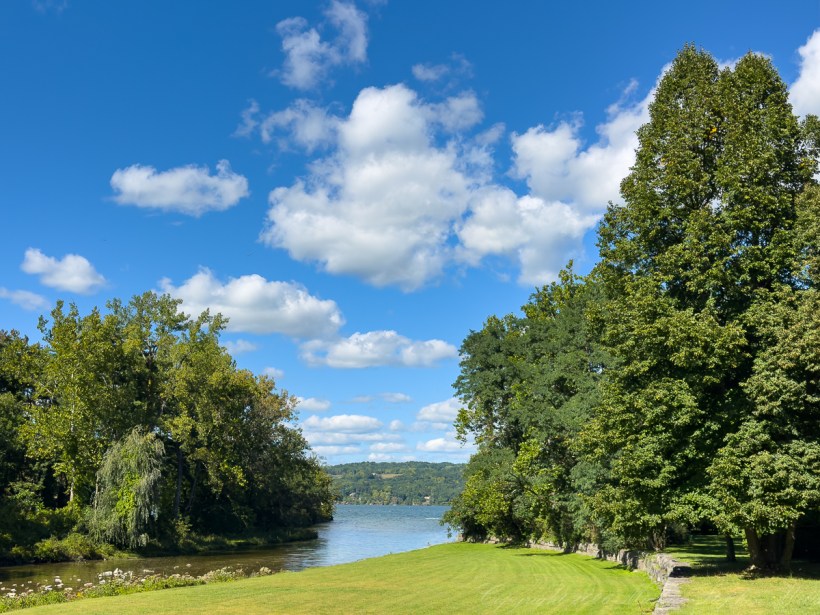
At the lakeside, the mood changed again. The same day, the same park, but another world. A green lawn sloped toward the water, bordered by trees heavy with leaves. The lake opened between them, wind-textured and blue-gray beneath the marching clouds. The place felt pastoral after the sternness of the gorge. Here the land breathed easily: gorge cliffs were replaced by open distance, by the far shore softened with trees and scattered houses. The park became a threshold between cultivated calm and wild excavation.

I enjoy the layered effects of clouds.

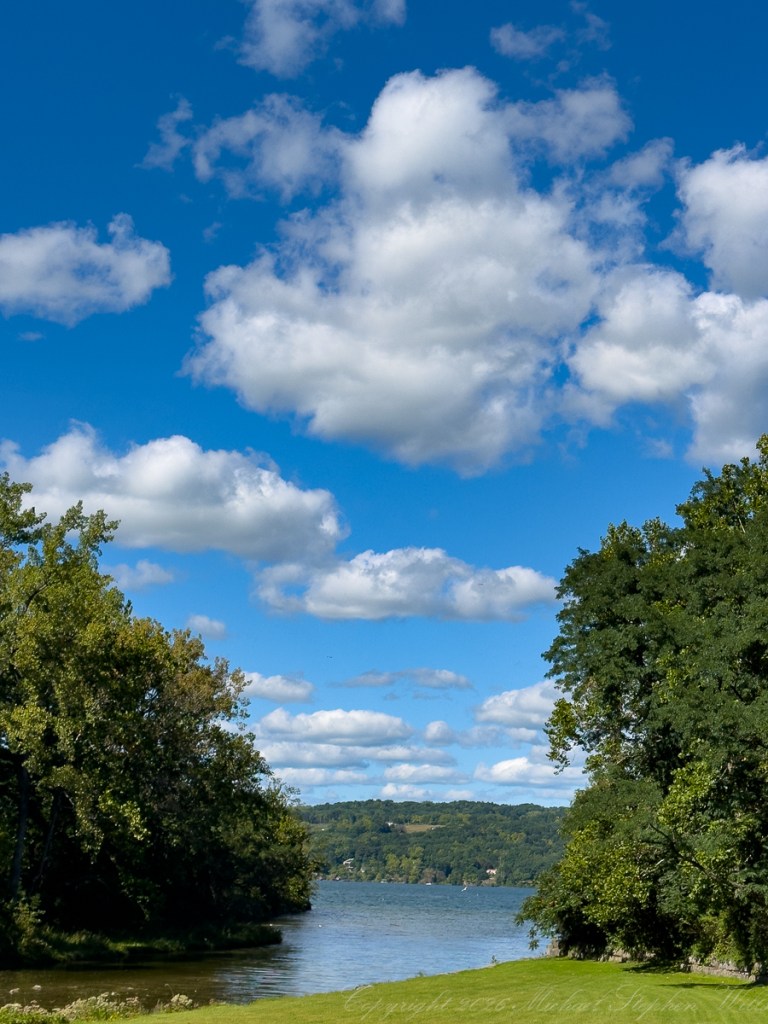
Then the camera turned upward, giving the sky its own portrait. The clouds took on presence, no longer background but subject—rounded, luminous, casting faint shadows upon themselves. Below them, lake and shore narrowed into a band, as though the world had been rearranged so that sky could speak first. There is a kind of mercy in such a sky. It loosens the mind. It reminds us that even above a gorge, above evidence of erosion and collapse, there is spaciousness.

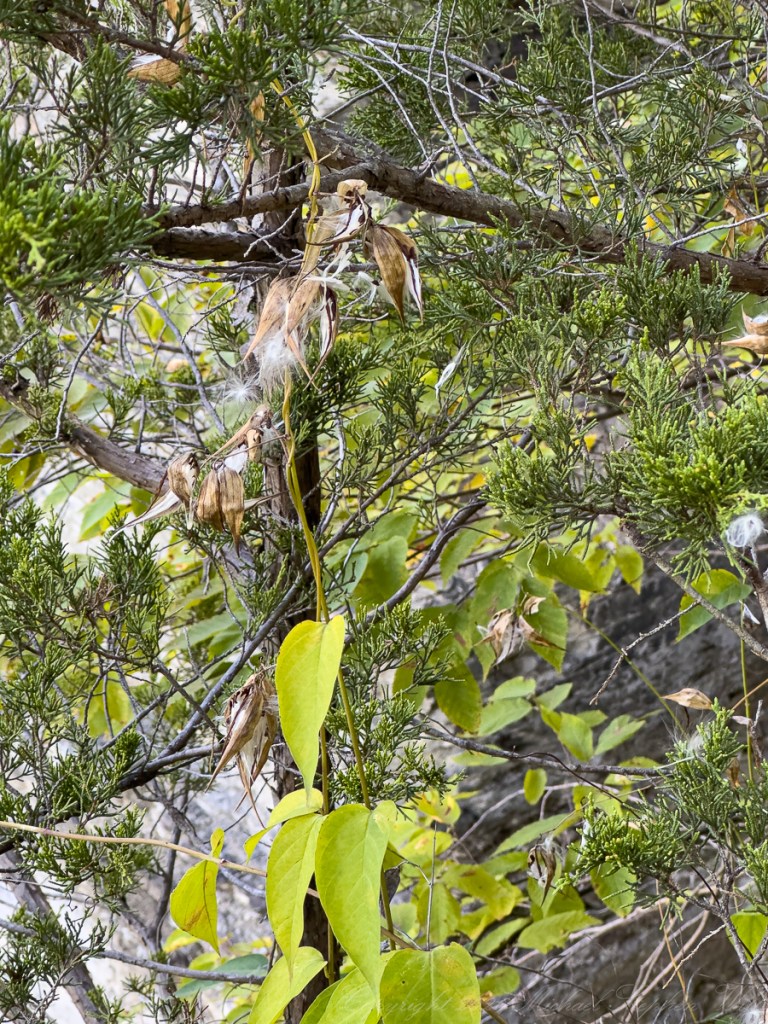
Black Swallow-wort (Vincetoxicum nigrum). Found along the North Rim Trail.

Among the cedars, split pods had released their silk. Pale filaments caught on rough branches and evergreen sprays, small scraps of flight arrested in mid-escape. The pods hung dry and curled, their work nearly done. Seeds that had been hidden were now entrusted to air. This, too, was September’s language: opening, loosening, letting go. Not the dramatic fall of leaves yet, but a subtler surrender. The season had begun to unfasten its clasps.

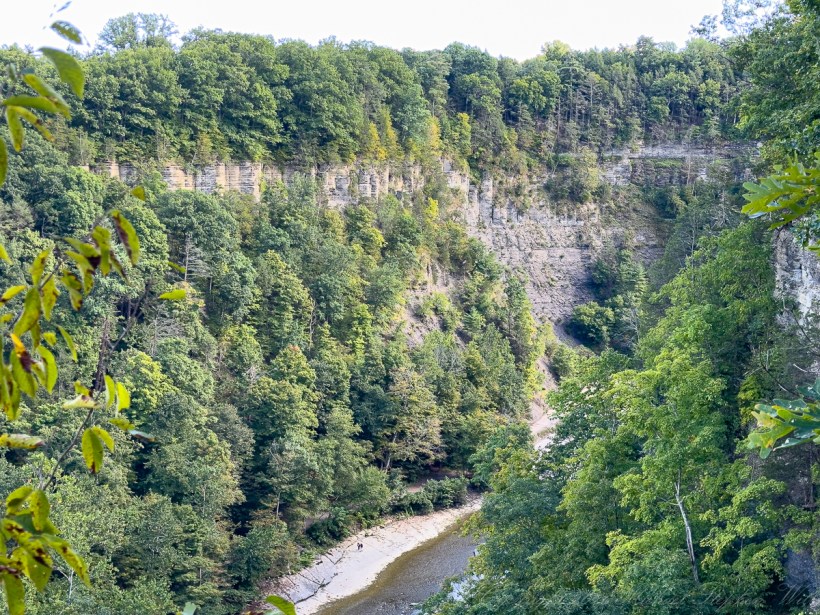
A view from the North Rim Trail.

From another rim view, the gorge wall rose in broken columns and pale faces, half-covered by green. Vegetation softened the precipice but did not conceal it. The cliff remained adamant, a vertical memory of water’s persistence. Far below, the creek bent through bars of exposed stone, and tiny figures on the gorge floor gave scale to the scene. The people were scarcely marks against the immensity, yet their presence mattered. They reminded the eye that wonder is not abstract. Someone stands there, looks up, and receives the place.

The visitors are on the overlook, in the gorge on the bridge and below the falls.

At the overlook, Taughannock Falls appeared framed by stone and leaf, descending in a long white irrepressible column into the dark basin below. The falls seemed both powerful and delicate, a veil and a force. Water dropped from the high lip in strands, gathered itself in motion, then shattered into mist and sound. Around it, the cliffs bore stains, fractures, alcoves, and ledges—the wounds and ornaments made by time. Layers of visitors receed in the foreground, small and temporary, held for a moment before the great amphitheater.

For this view proceed south on the North Rim Trail from the observation area parking. Did you spot the gathering of crows?

Farther along the North Rim Trail, the falls filled the vision. Sunlight touched the rim above; shadow deepened the plunge pool below. The water seemed to fall from brightness into mystery. That is often how memory works: a clear edge, a shining beginning, then a descent into depths we cannot entirely see. Yet the sound continues. The motion continues. The stream that vanishes in shadow reappears downstream, moving toward the lake.

Watch on YouTube for the best experience.

For me, what remains from this walk is a whole sequence: cliff and cloud, snakeroot and seed silk, lake and lawn, distant figures and enduring stone. Taughannock on September 14, 2026, offered no single lesson. It offered a composition of scale. The vast does not cancel the small. The flower belongs beside the gorge. The seed silk belongs beside the falls. The human figure belongs, briefly, gratefully, at the overlook.

By God’s Grace the water keeps falling.

Click me to visit Michael Stephen Wills Online Finger Lakes Gallery.

Enter your email to receive notification of future postings. I will not sell or share your email address.
The Wonder of Purple-Flowered Raspberry: Nature’s Thornless Native Treasure

The purple-flowered raspberry is a native shrub that confounds expectations, combining rose-like blossoms, maple-shaped leaves, edible fruit, and thornless stems into one of eastern North America’s most enchanting woodland plants.

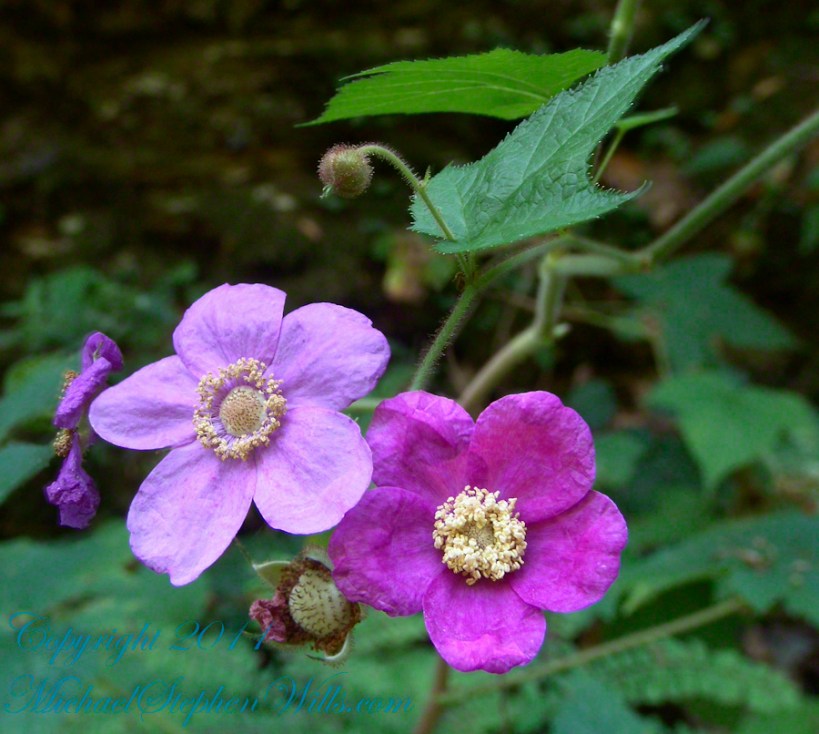
I first encountered the purple-flowered raspberry while walking the Gorge Trail at Fillmore Glen State Park. Dry Creek murmured below, working patiently within ancient shale walls that confine its course. Waterfalls spilled from ledges overhead, cool mist drifted through the narrow passage, and sunlight filtered down in shifting patches through the summer canopy. It was a landscape dramatic enough to command all of one’s attention.

Yet it was a flower growing quietly beside the trail that stopped me in my tracks.

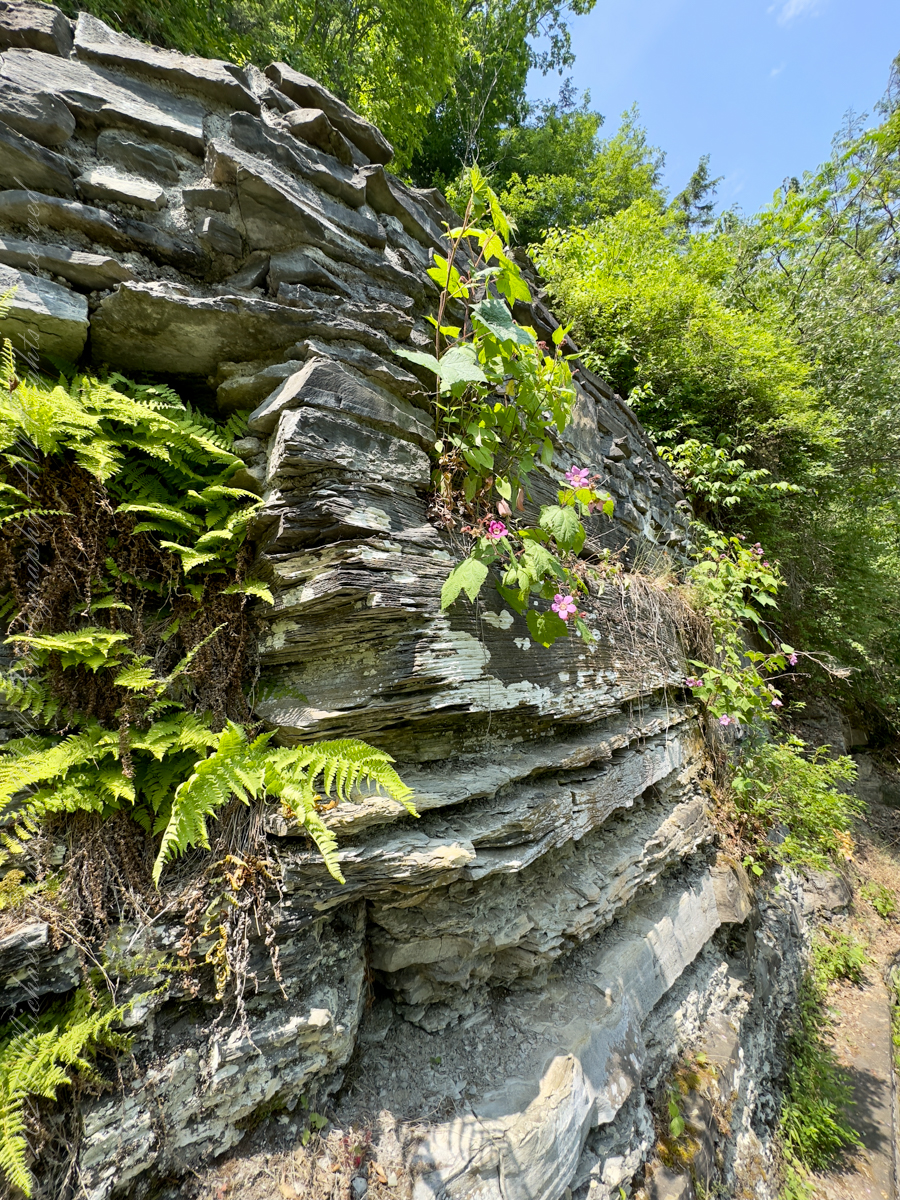
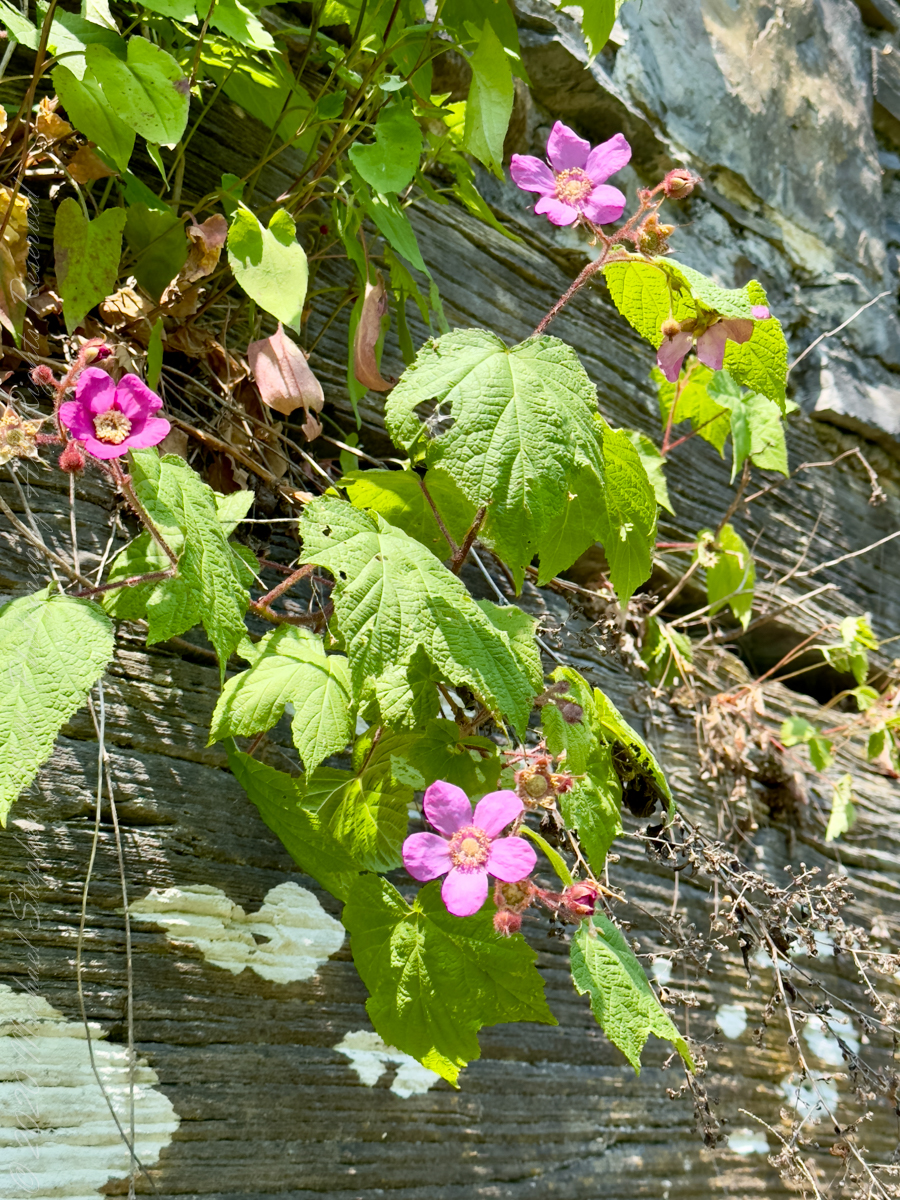
Purple-flowered Raspberry Growing Within Treman Gorge by the South Rim Trail

At first glance, I thought I had stumbled upon an escaped garden plant. The blossoms were  impossible to ignore—large, open, and an exuberant shade of rose-purple that glowed against the surrounding green. They seemed too extravagant for the subdued palette of a northeastern woodland. The petals had the simple elegance of wild roses, but there was something else about the plant that resisted easy identification.

The purple-flowered raspberry, Rubus odoratus, is a plant of delightful contradictions. Its blossoms are among the largest in the raspberry family, often two inches across. They appear over an extended season, beginning in early summer and continuing well toward autumn. Unlike the brief fireworks of many woodland wildflowers, this plant stages an encore performance, offering fresh blooms long after others have taken their final bow.

Over the years, I returned often to Fillmore Glen. Dry Creek became an old acquaintance, its voice changing with the seasons—boisterous after spring rains, subdued during the heat of late summer. And almost every year, somewhere along the Gorge Trail, I would encounter those same remarkable shrubs. Familiarity deepened into appreciation, and appreciation eventually became affection.

The flowers also serve a practical purpose beyond their beauty. Native bees and other pollinating insects visit them regularly, gathering nectar and pollen throughout the season. The plant has become part of an intricate ecological conversation that has been unfolding for thousands of years.

Then there are the leaves. The first time I noticed them closely, they triggered another moment of confusion. Broad and softly textured, divided into five lobes, they looked uncannily like oversized maple leaves. Some can grow nearly ten inches across, creating islands of lush greenery along shaded streambanks and woodland edges.

It is as though nature, in one of her playful moods, decided to combine the leaf of a maple, the flower of a rose, and the fruit of a raspberry.

Most raspberries and blackberries demand respect from a distance. Their prickles and thorns snag clothing and skin with equal enthusiasm. Purple-flowered raspberry breaks that expectation as well. Its stems are fuzzy rather than fierce. There are no hooked defenses waiting to punish curiosity. The plant invites close examination.

By late summer, the blossoms yield to flattened red fruits. Technically, they are raspberries, though they lack the sugary richness of their cultivated cousins. I have sampled them occasionally, appreciating them more for the experience than the flavor. Birds, however, are less discriminating. The fruits provide nourishment for wildlife, becoming another thread in the web of life that surrounds Dry Creek and countless other woodland habitats.

Native to eastern North America, purple-flowered raspberry ranges from Nova Scotia westward into Ontario and Wisconsin, extending south through the Appalachian Mountains. It thrives along forest margins, rocky slopes, stream corridors, and disturbed areas where sunlight penetrates the canopy. Through underground shoots, it gradually forms colonies that stabilize soil and provide shelter for small creatures.

It belongs exactly where I first found it. There is a temptation, especially among gardeners, to seek novelty elsewhere—to import the exotic, the unusual, the unfamiliar. Yet some of the most extraordinary plants are those that have quietly shared our landscapes all along.

The purple-flowered raspberry reminds me of this truth each time I encounter it. It teaches the value of paying attention. A hurried walk through Fillmore Glen might focus exclusively on the waterfalls, the sculpted rock formations, or the cool refuge of the gorge itself. All are worthy of admiration. But along the margins of the trail stand these shrubs, offering their own quieter marvels.

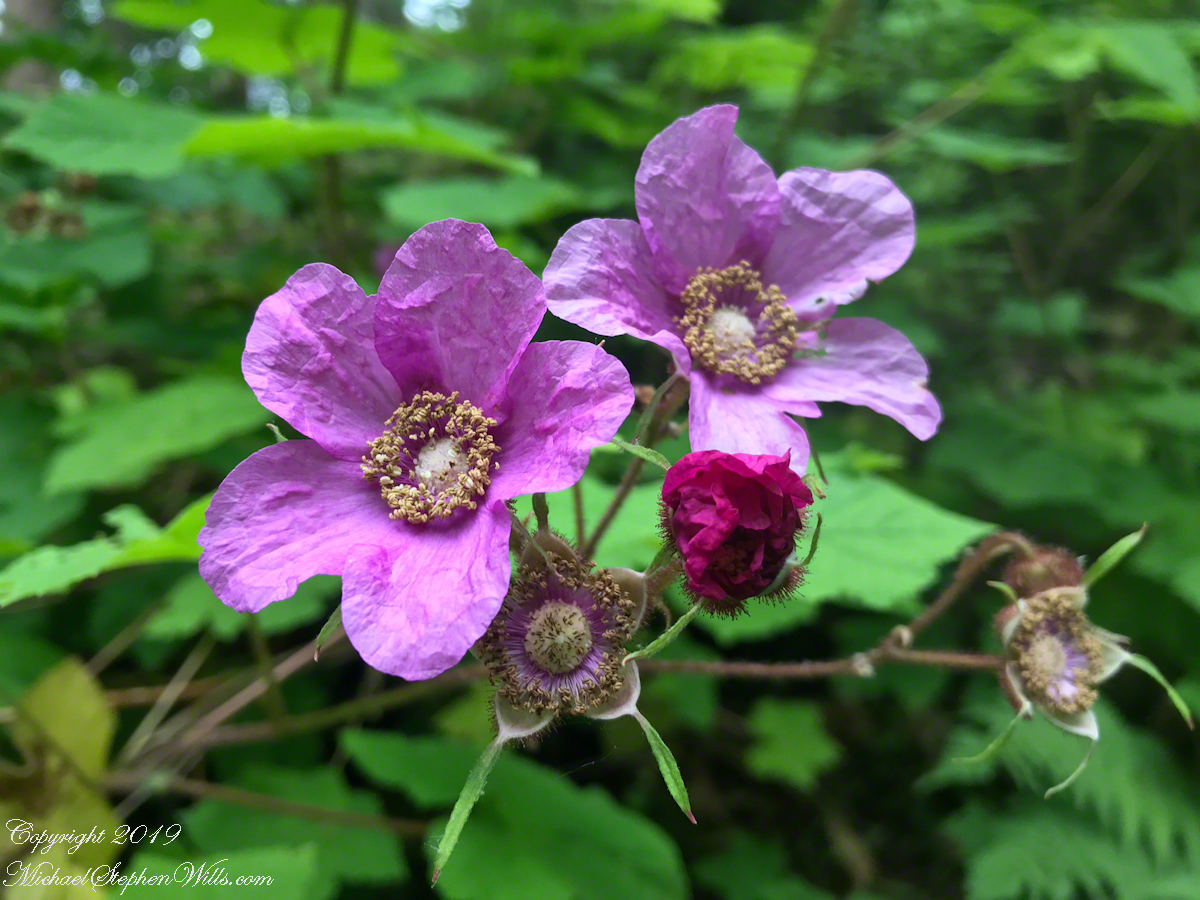
My photograph captures all flowering forms of this member of the Rose family. This specimen was blooming in August within the shade of Fillmore Glen in the Finger Lakes of New York State.

A rose-colored flower where one expects white. Maple leaves on a raspberry cane. Soft stems where thorns should be. Fruit that feeds the forest. A native plant that asks for nothing more than the chance to flourish where it has always belonged. Years after that first encounter beside Dry Creek, the sight of those blossoms still stops me as I find them in all the Finger Lakes gorges.

Certain plants become landmarks in our personal geography. They root themselves not only in the soil but in memory. The purple-flowered raspberry has become one of those companions for me—a recurring presence marking the passage of summers, a familiar face in a beloved landscape.

Dry Creek continues its patient work of carving stone. The waterfalls continue to descend in silver ribbons through the gorge. And each year, as if renewing an old friendship, the purple-flowered raspberries lift their improbable blossoms toward the filtered light. In their presence, wonder becomes less an emotion than a habit of attention.

Sometimes the greatest discoveries are not rare because they are hidden. They are rare because we have not yet learned to see them. The purple-flowered raspberry taught me to look more closely. Along a trail I thought I knew by heart, it revealed that nature still keeps delightful surprises in reserve.

Click me to visit Michael Stephen Wills Online Finger Lakes Gallery.

Enter your email to receive notification of future postings. I will not sell or share your email address.
Winter Walking at Taughannock Falls: Finding Connection and Quiet Along the Gorge Rim Trails

Winter distills Taughannock Gorge to stone, water, and silence, where careful footsteps along icy rim trails reveal deep connections between landscape, memory, and quiet joy.

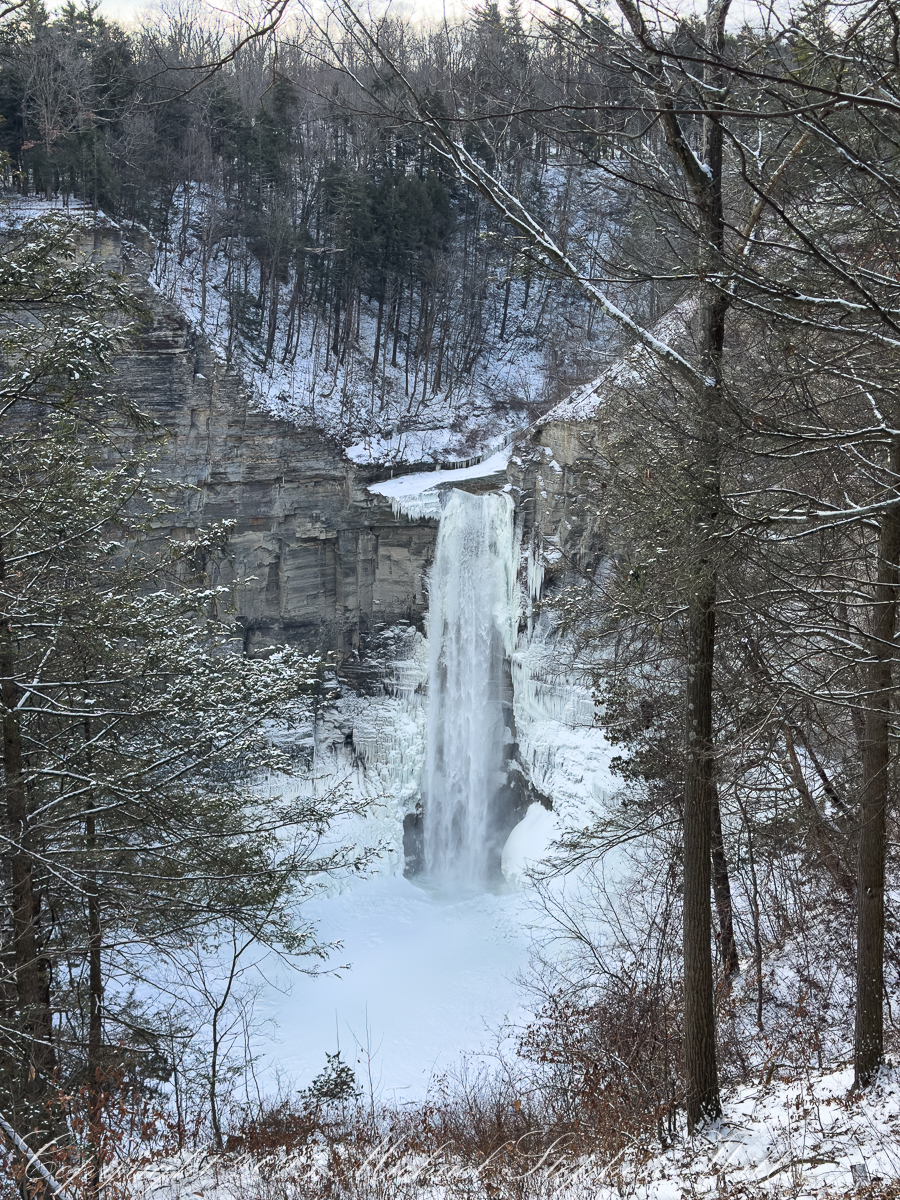
Winter pares the world down to its essential lines, and nowhere is that more apparent than on the rim trails of Taughannock Falls State Park. On a Wednesday afternoon walk, a three-mile pilgrimage, the gorge revealed itself as a living corridor of connections—between water and stone, past and present, effort and joy. The season sharpened every sensation: the crunch and slip of ice underfoot, the hush of leafless woods, the long exhale of the falls echoing unseen below.

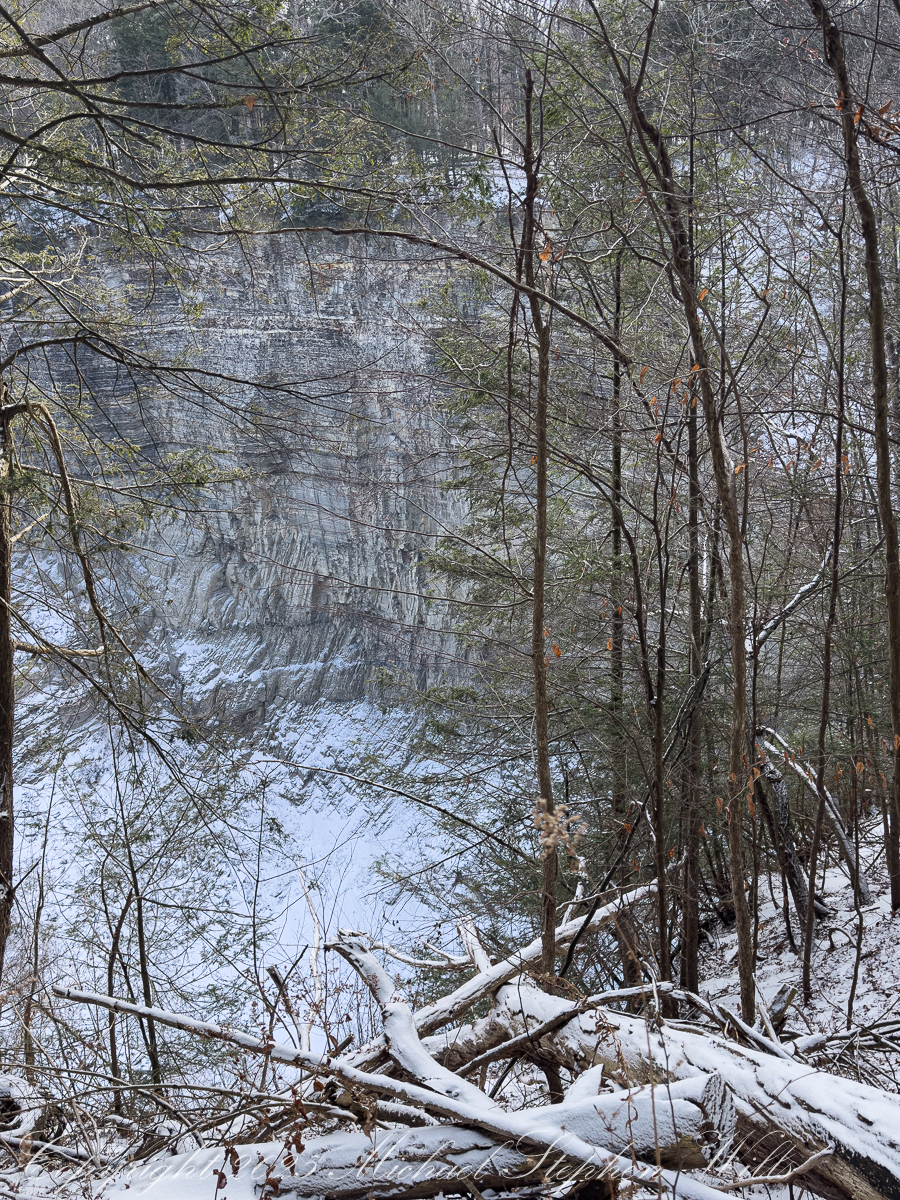
From the overlook, the gorge opens like a vast stone book, its pages written in shale and time. Taughannock Falls drops away in the distance, not so much seen as felt—its presence announced by scale and gravity. Even before stepping onto the trail, the walk establishes its rhythm: pause, look, breathe. Winter insists on this slower tempo. Ice dictates caution, and caution invites attention.

Heading along the Rim Trail my progress became deliberate. The path, glazed in places with solid ice, turned each step into a negotiation. Yet this was no impediment to pleasure. Slowness allowed for noticing the quiet labor of the park maintenance crew, whose careful clearing and repairs spoke of spring already anticipated. Their work stitched the present moment to the coming season, a reminder that parks, like stories, are maintained through this unseen devotion.

The gorge itself is a system of thresholds. A bridge crossing the creek marks the transition from North to South Rim, but it also frames one of the most dramatic views in the park. Standing above the chasm, one senses connection: water flowing beneath, trails diverging and rejoining, human passage layered lightly atop geological endurance. The gorge is a conversation between forces, ongoing and unresolved.

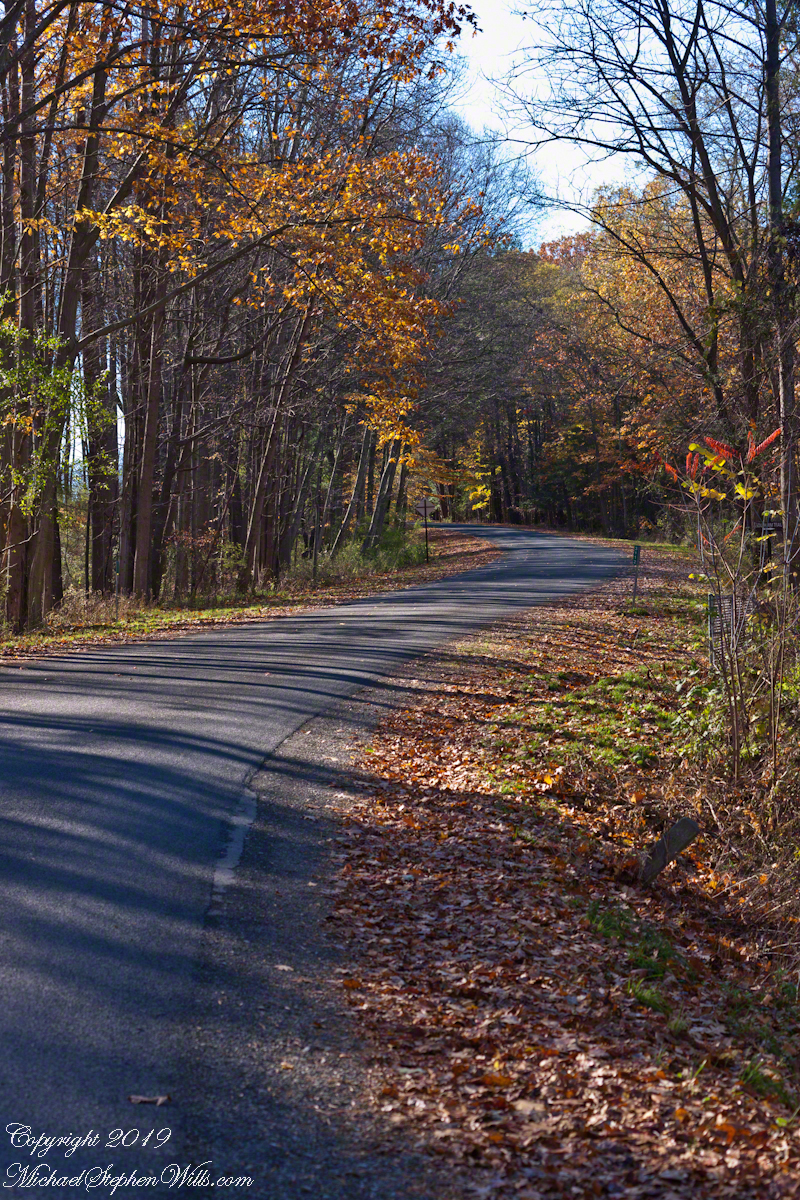
Gorge Road, early November
From the South Rim Trail. Taughannock Falls, New York State Park, Ulysees, Tompkins County, Finger Lakes Region.
Click any photograph for a larger image

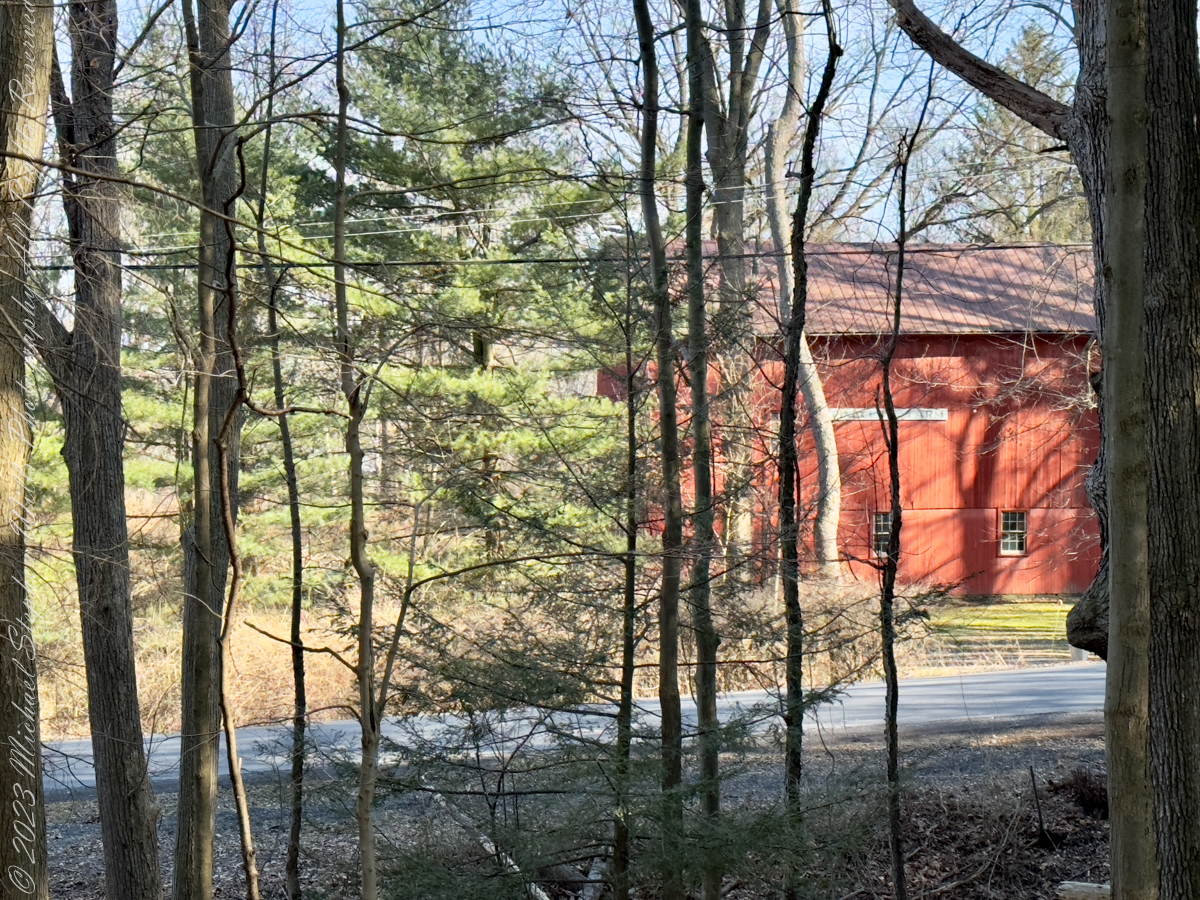
Ice eventually nudged my walk onto Gorge Road, which parallels the South Rim Trail like a quieter narrative strand. Here, the landscape shifts from wild drama to human memory. A curve in the road reveals a farmhouse, modest and fragile beside its outsized barn. In winter, the absence of leaves makes the scene stark and honest. The farmstead buildings do not ask for nostalgia; they simply stand, bearing witness to lives tethered to this steep land. The structures emerge gradually as I walk downhill, as if the land itself were choosing when to reveal them.

Overview of this small cemetery overlooking Cayuga Lake

A short detour leads to a small cemetery perched on a shelf above Cayuga Lake, near the Taughannock Farms Inn. In winter, cemeteries feel less like places of mourning and more like rooms of quiet conversation. Headstones rise from frozen ground, their inscriptions softened by time and distance. From this vantage point, lake and sky merge in pale bands, and the lives commemorated here feel gently folded into the larger story of the landscape. The dead, too, are part of the park’s web of connections.

Another detour brings the lower falls into view—a more intimate expression of the same water that plunges dramatically upstream. Here the sound is closer, the movement more conversational. It is easy to imagine this water traveling, moment by moment, linking ravine to lake, winter to spring, memory to presence.

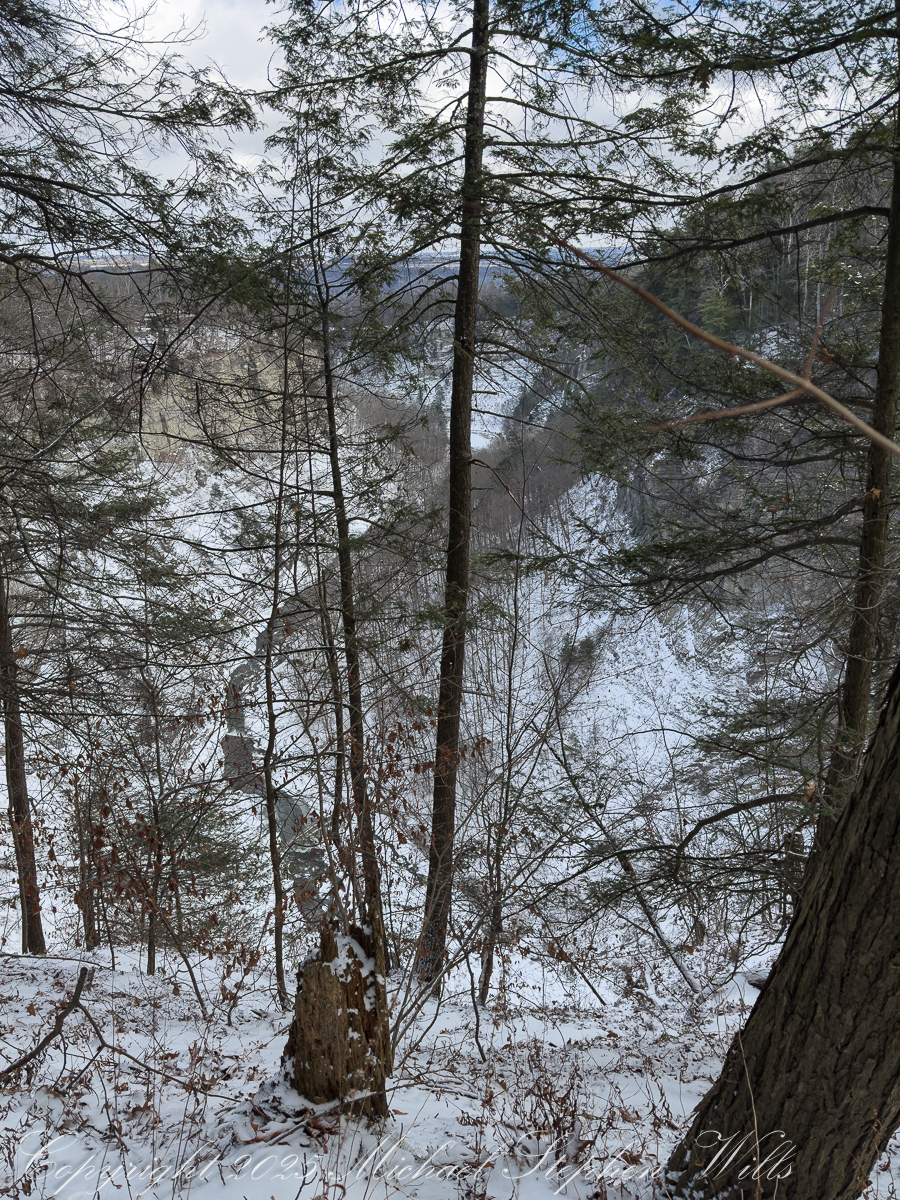
One of many Rim Trail overlooks. That is the Gorge Trail, below.

Rejoining the rim trail for the final climb north, the gorge offers repeated overlooks where the Gorge Trail can be seen threading below. These moments collapse distance: walker and walker, above and below, bound by the same route at different elevations. Over the course of roughly three miles and almost 600 feet of cumulative elevation change, effort becomes its own reward. Two hours pass not as measured time but as a sustained attentiveness, a gift winter offers to those willing to meet it on its terms.

Walking these trails in winter is about entering a conversation with the land—listening to ice, stone, water, and history speak in a quieter register. The joy lies in connection: trail to trail, gorge to road, past to present, and walker to place. In winter, Taughannock invites, gently and honestly, those who are willing to walk slowly enough to see.

Enter your email to receive notification of future postings. I will not sell or share your email address.
Distant Sapphire III

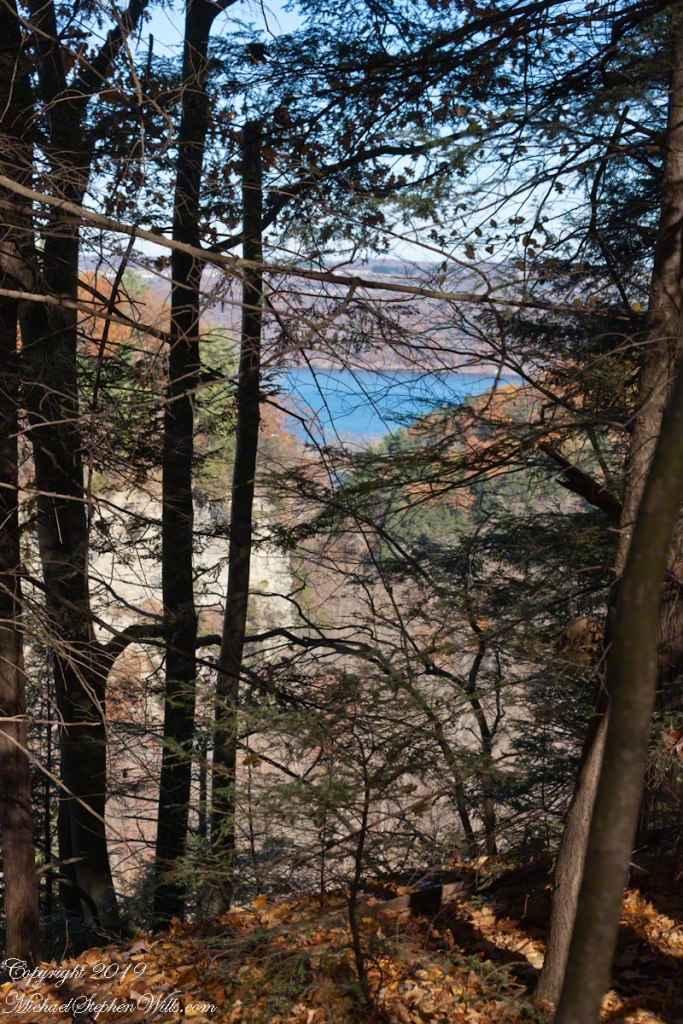
From a modest bench above Taughannock Gorge, Cayuga Lake shifts from distant glimmer to presence—a quiet invitation to pause, breathe, and follow the water down.

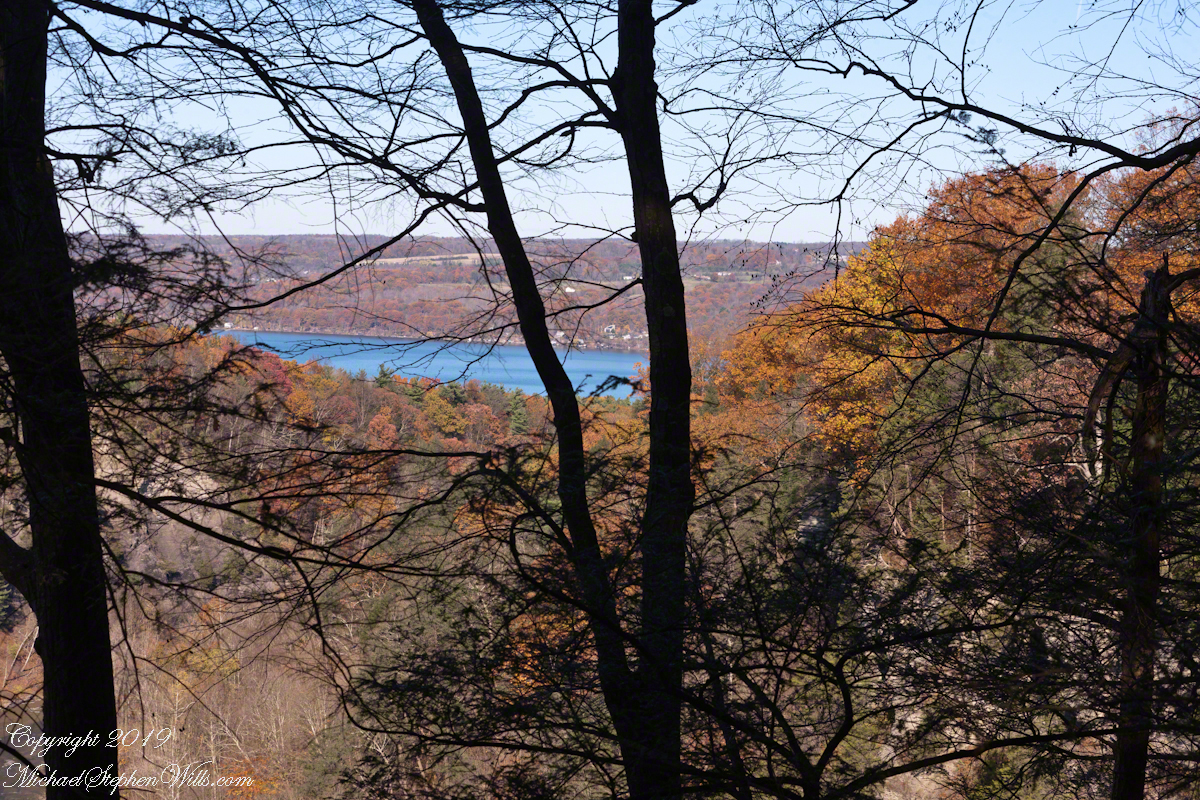
From the south rim of Taughannock Gorge, Cayuga Lake appears like a distant strip of sapphire, framed today by a soft veil of hemlock and oak. The overlook here is modest—a fence, a bit of open sky—but someone wisely added a comfortable bench, an invitation to pause between gorge and lake, rock and water.

I stood in front of that bench, resting the camera body on the fence, fingers braced against the wood to steady the shot. This is not the grand, sweeping vista of a postcard. Instead, it is a quieter, more human vantage point, the way a person actually encounters the lake after walking the rim: emerging from the trees, breath easing, eyes adjusting to the light on water.

From here, the trail descends toward Cayuga’s shore, each turn bringing you lower and closer, trading the lofty perspective for the intimate sounds of waves and stone. In Distant Sapphire I and II, the lake was a glimpse—caught between branches, distant beyond the gorge. Now, in this “Bench View,” the water feels nearer, almost within reach, as though the landscape itself is drawing you gently down.

Click photograph for a larger view. To do this from WordPress Reader, you need to first click the title of this post to open a new page.

I’ve gathered the three photographs—Glimpse of Cayuga Lake, Gorge View with Oak Leaves, and this Cayuga Lake Bench View—into a small gallery, a progression of approach. Each frame is a step closer: from suggestion, to invitation, to the quiet promise of the bench, waiting for whoever needs to sit and look a little longer.

A gallery of the three Cayuga Lake photographs for comparison.

Enter your email to receive notification of future postings. I will not sell or share your email address.
Distant Sapphire II

Cayuga waters reflect a blue November sky.

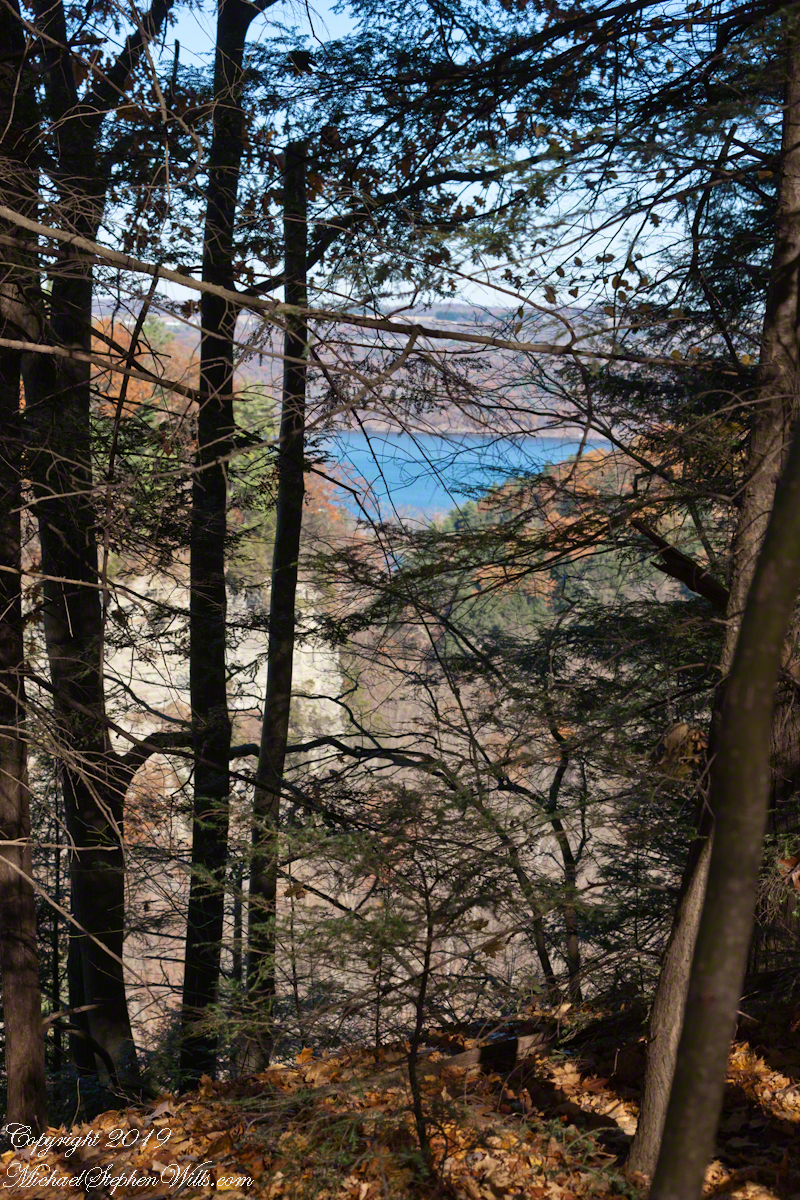
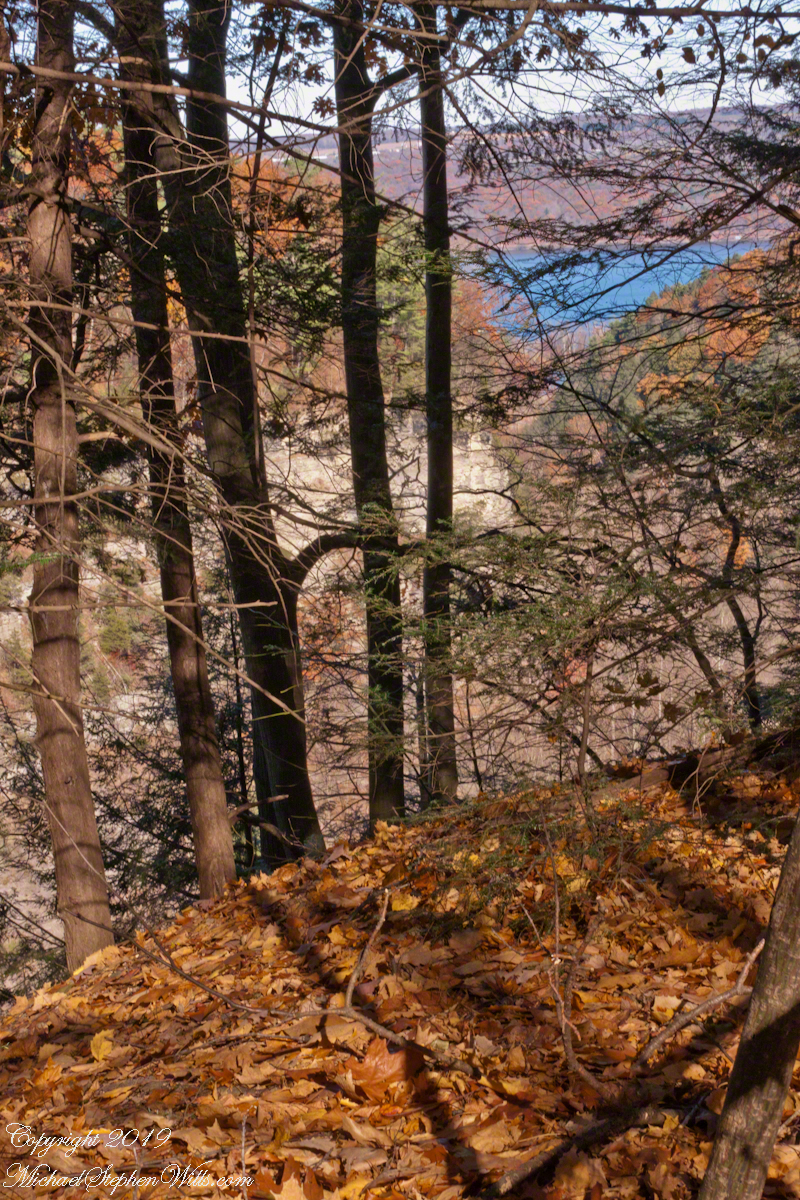
Cayuga Lake from the south rim of Taughannock Gorge, seen through a veil of hemlock with a carpet of fallen oak leaves, foreground. This is a companion to the previous post, both were handheld. For this the foreground was included to increase interest. For added stability, I rested the camera body on the fence bracketed with my fingers.

Click photograph for a larger view. To do this from WordPress Reader, you need to first click the title of this post to open a new page.

A gallery of the two photographs for comparison.

Enter your email to receive notification of future postings. I will not sell or share your email address.
Distant Sapphire I

Cayuga waters reflect a blue November sky.

Cayuga waters reflect a blue November sky.

Click photograph for a larger view. To do this from WordPress Reader, you need to first click the title of this post to open a new page.

Photographs in Gallery

Enter your email to receive notification of future postings. I will not sell or share your email address.
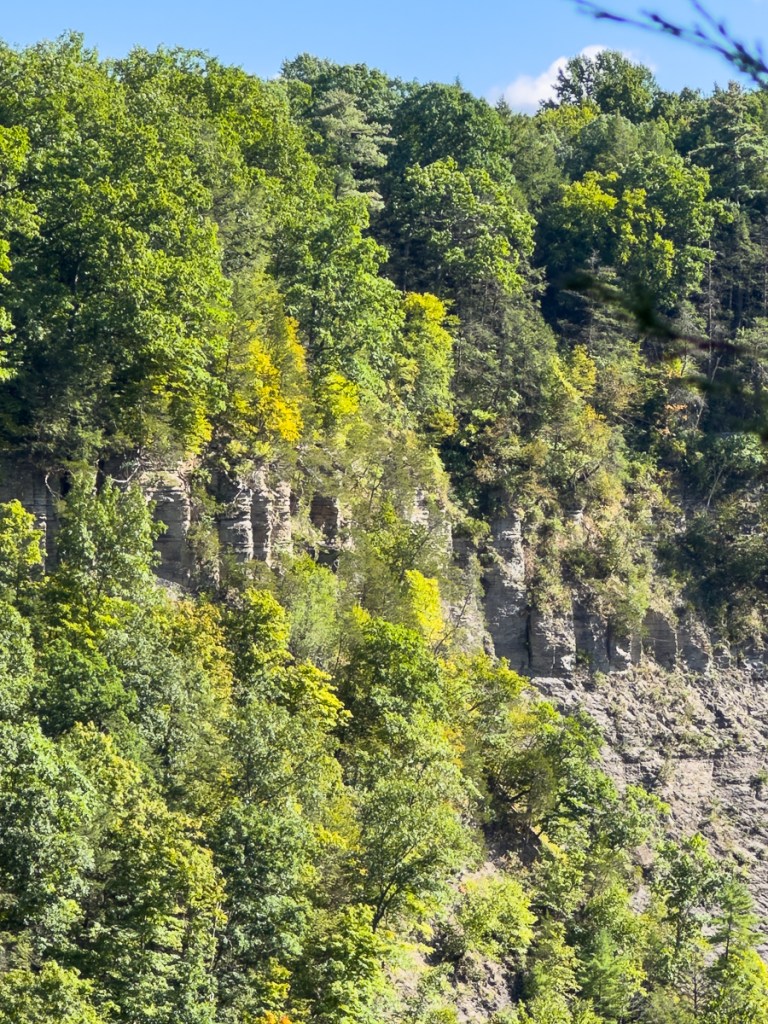
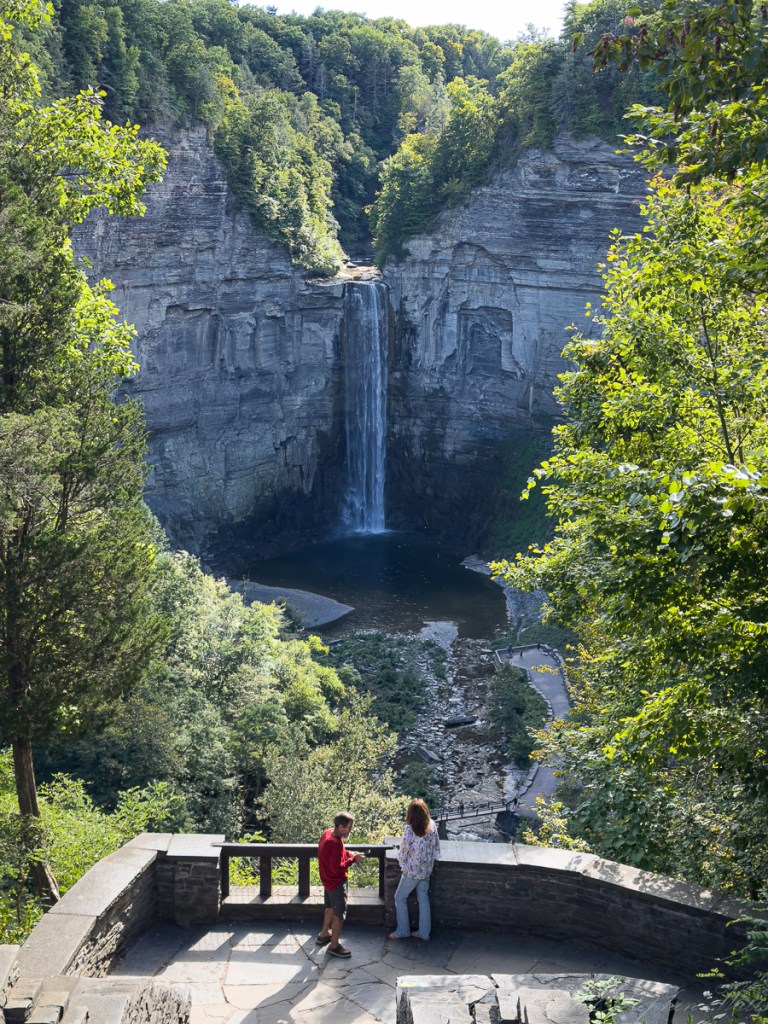
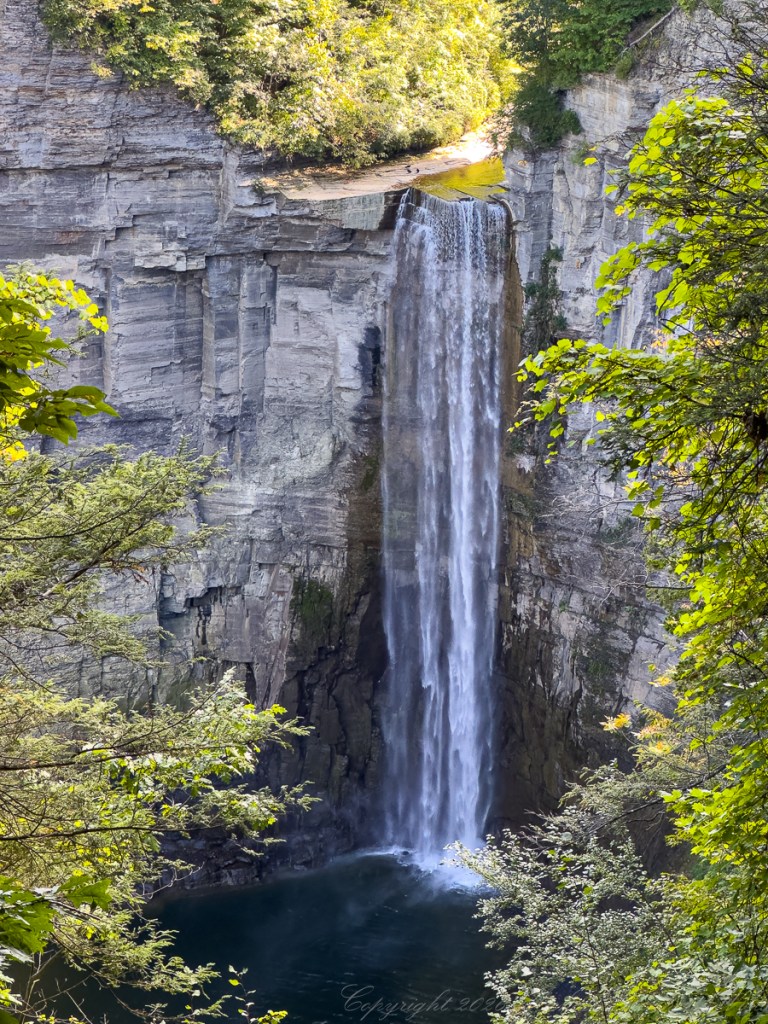
On The Edge of Time Above Taughannock Gorge

Perched above Taughannock Gorge, a moss-covered ledge and cascading falls reveal ancient stories—where Devonian seas once flowed and time’s layers whisper through stone and water.

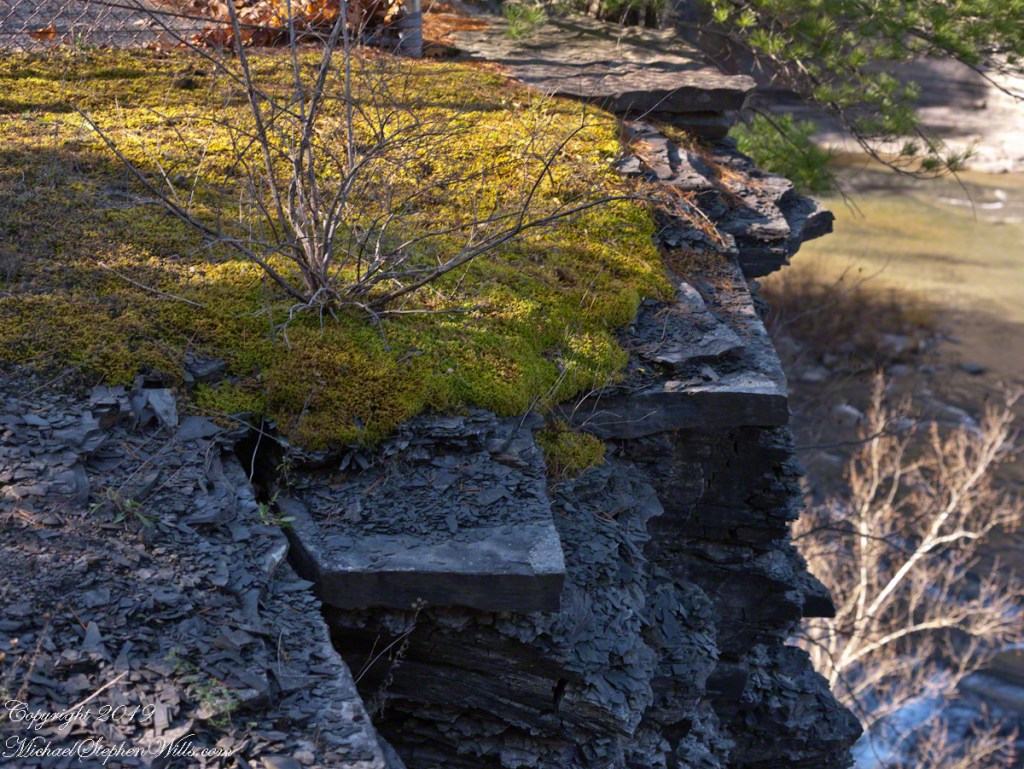
The morning sun had only just breached the rim of the gorge, sending long slants of golden light across the forest floor. Walking the South Rim Trail of Taughannock Falls State Park, I came upon a quiet, unassuming spot—just a few paces off the path—where the forest seemed to pause in reverence. What greeted me was a small marvel of persistence and time.

There, rooted precariously atop a slab of brittle shale, was a tenacious shrub rising from a bed of moss, its spindly frame etched in sharp contrast to the soft, green sprawl beneath it. The moss had taken hold on a shelf of rock cantilevered over the gorge like a green tongue of earth defying gravity. Cracks traced the shale’s surface like veins, silent records of the forces that shaped this place—heat, ice, pressure, time. Together, the moss and the bush formed an improbable community, surviving against odds, bound together by the thin soil cradled in stone.

This ledge, suspended over the abyss, seemed less a part of the earth than a question it asked—how much life can cling to the edge before the edge itself gives way?

Beneath this living fragment, the gorge dropped away. Layers upon layers of shale revealed themselves, stacked like a collapsed library of time. Here, the Devonian Period lies exposed to wind and rain, and to those willing to pause and wonder. Each stratum holds the fossil whisper of ancient seas, where trilobites scuttled and coral reefs once stood. This gorge was not carved quickly. It was not born of a moment, but of many—countless raindrops, millennia of ice melt, the slow, sure work of water over stone.

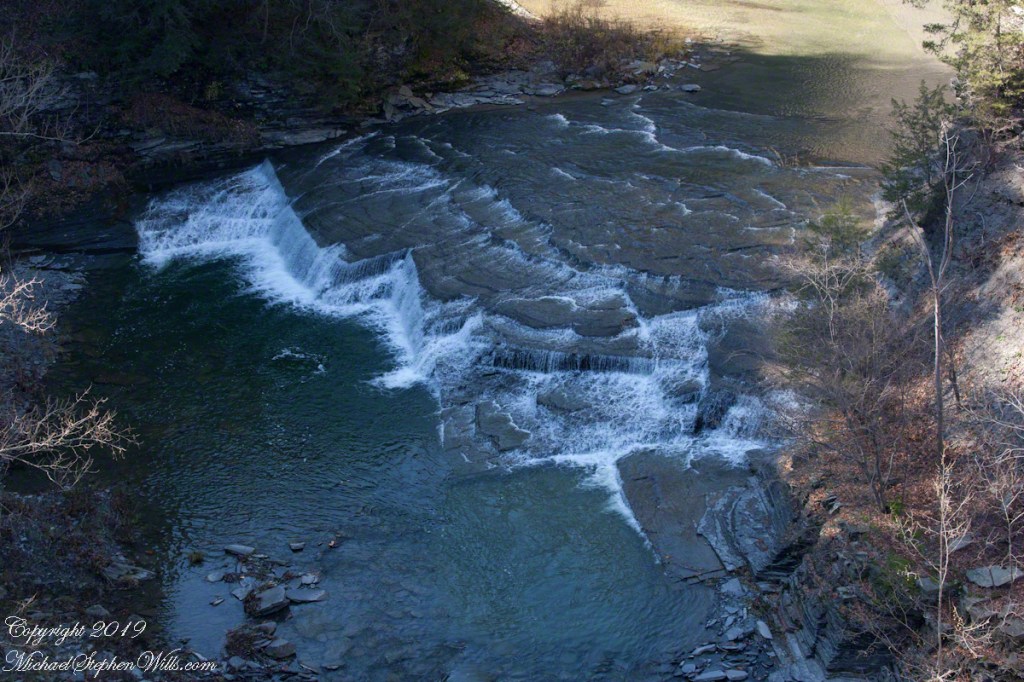
From this natural balcony, I looked out and down to the gorge floor where the creek shaped the land with an artist’s patient hand. The falls, seen from above, no longer thundered—they danced. Spread like the folds of a fan, water curled over smooth stone in steps of white silk. From here, the cascade looked deliberate, choreographed—an elemental performance halfway between gravity and grace.

How many times had this water flowed, reshaped, receded? How often had it carved these grooves, smoothed those ridges, erased the footprints of what came before? Looking at the exposed rock, one could trace the signature of ancient glaciers, feel the memory of long-gone floods. It was humbling—this intersection of change and continuity.

Above it all, the trees stood still. Pine and oak, rooted well back from the edge, offered a kind of sentinel presence. Their shadows stretched long and angled, tracing the contours of both earth and memory. For a moment, I let go of all thought and simply listened—to the murmur of wind through leaves, the faint rush of water far below, and the silence that presses in when the land itself seems to be remembering.

This spot—so easily missed by a hurried hiker—offered a parable of resilience and impermanence. The moss did not grow with certainty, nor the shrub reach with confidence. They survived on the edge because they adapted. They made do with less. They took root where others could not. There was no security in that place, only presence. Only the now.

And isn’t that a lesson worth carrying?

We so often seek stability, firm ground, a clear path. Yet, some of the most beautiful things live just beyond comfort—on ledges, in cracks, in the margins of the known. To pause here was to acknowledge that life thrives not only in sheltered valleys but also at the edge of what seems possible.

As I stepped back onto the trail and continued along the South Rim, the image of that mossy outcrop stayed with me. I carried it in my thoughts like a talisman—proof that even on the brink, life finds a way. And that from above, the most chaotic falls can appear as ordered motion, as a flow toward something larger.

Later, when the sun climbed higher and the light lost its slant, I would look back on this moment not as a spectacular highlight but as something more intimate: a quiet encounter with nature’s subtle artistry, its layered truths, and its enduring invitation to look closely, feel deeply, and walk softly.

For here, above the gorge, at the edge of earth and time, even a whisper leaves a mark.

Enter your email to receive notification of future postings. I will not sell or share your email address.
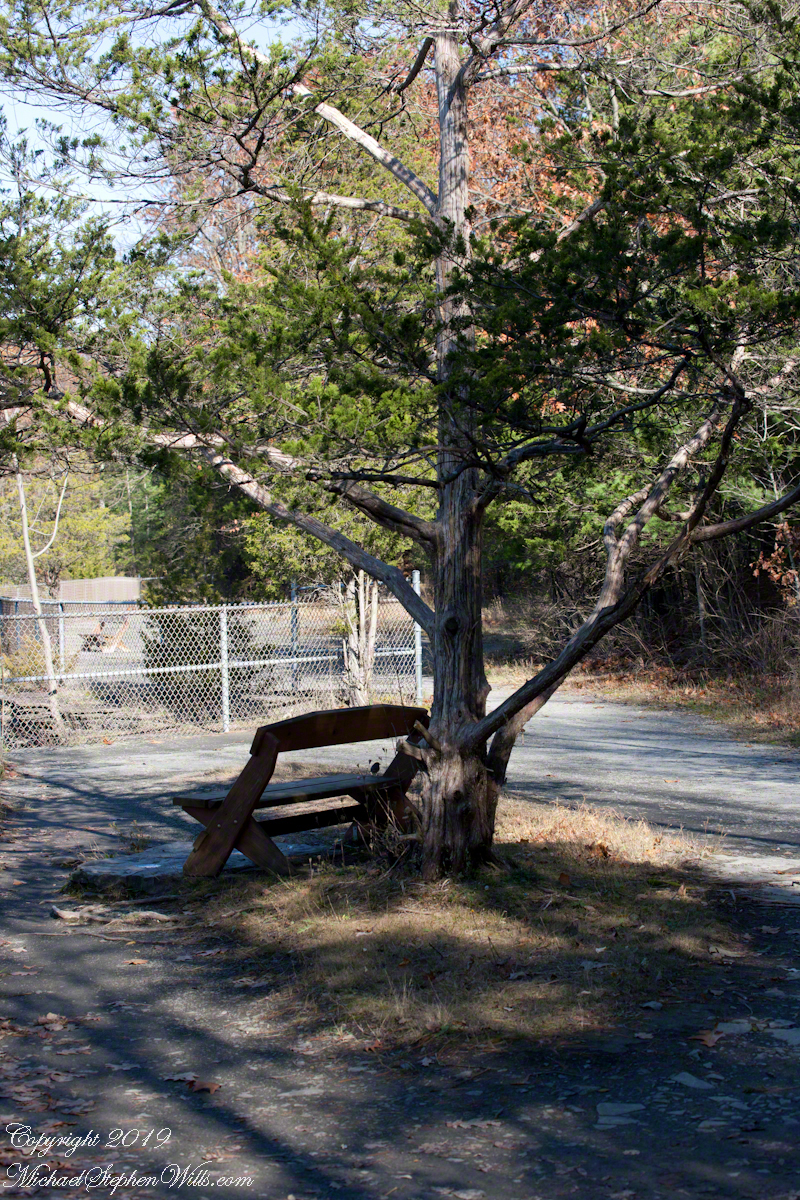
Discovering Stillness in Nature’s Embrace

A bench beside a cedar, unchanged through time, stirred memory and gratitude—reminding me that some places wait quietly, holding space until we find them again.

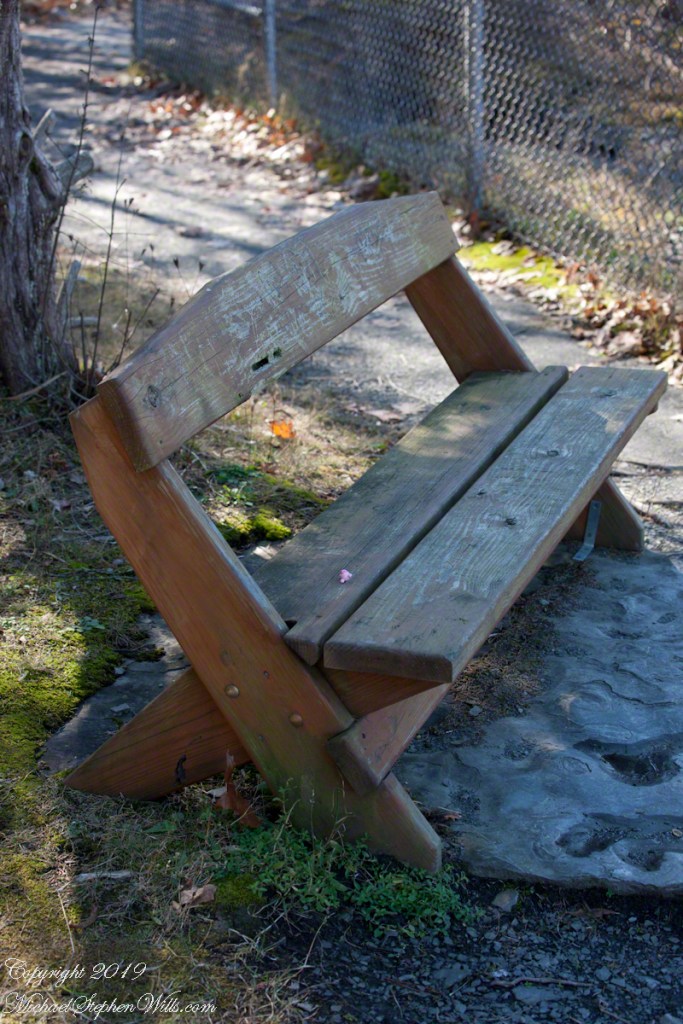
A lingering memory hovers over this spot. The soft crunch of gravel beneath my boots, the filtered light through pine and oak, the scent of warm stone and moss—all of it felt at once familiar and distant, like a half-remembered tune that returns in full when you hear the first few notes. I hadn’t thought about the simple bench until I turned the bend this summer day on the South Rim Trail.

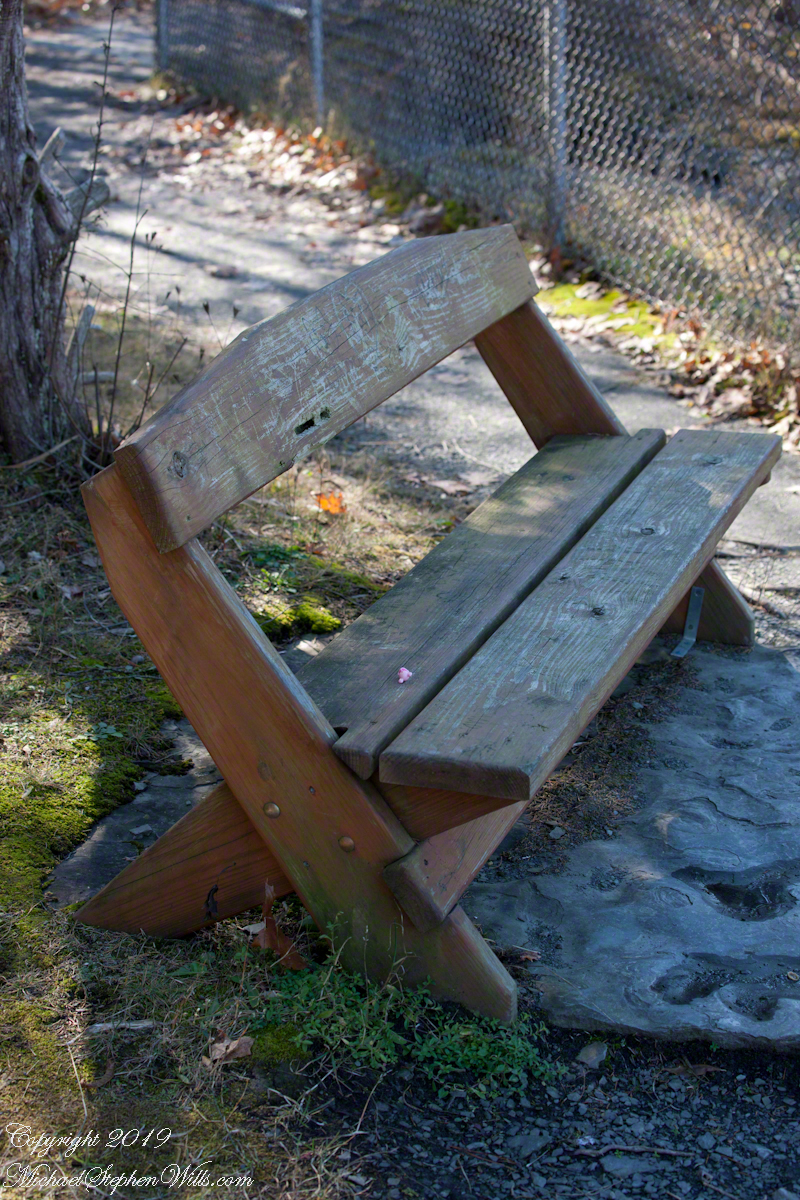
It was still there. The same humble bench nestled beside a cedar, its weathered frame now bearing the patina of years. The tree remained slightly bowed as if in silent conversation with the bench it had embraced.. The space between them, still and shaded, seemed to invite reflection without demanding it.

I sat down, letting the moment settle around me. In the gorge below, water moved quietly through sculpted shale, the same layered gray that once caught my attention through a camera lens long packed away. From this overlook, the view had scarcely changed: stone and water, green clinging to cliff, sky rolling in above it all. My photograph captures it now just as it might have then—perhaps from the same angle. The gorge unfolding in a graceful arc, with trees perched impossibly along the sheer face.

It struck me, not as a grand revelation but with quiet certainty, that very few places in life offer such stillness. So much shifts in the world—landscapes erode, trails are rerouted, lives move forward. Yet here I was again, sitting in the same spot, as though the intervening decades had folded in on themselves.

Back then, I had rested here out of curiosity, pausing to take in the view, enjoy a respite. Now, I sat with a deeper kind of stillness. The second photograph holds the space as I found it—quiet, dappled with shadow, edges softened by time. The fence beyond it remains, unchanged, a modest boundary between the trail and the deep gorge beyond.

I don’t remember what thoughts filled my mind that first time. But today, a kind of gentle gratitude rose instead. Gratitude for the bench, yes—but also for the path that led me here again, for the act of remembering, and for the rare gift of finding something familiar, something steady.

A final image frames just the bench, its surface worn smooth, its structure slightly leaning now. A single flower petal had fallen on the wood—a quiet grace note in the morning light. I stood and took that last photo as a way of holding the moment, though I knew no picture could fully capture what it meant to find something that had waited without fanfare.

As I turned and walked back along the rim, I felt lighter. Not because time had reversed or been conquered, but because it had been witnessed—and somehow, that was enough.

Enter your email to receive notification of future postings. I will not sell or share your email address.
Ecological Significance of False Solomon’s Seal

In Taughannock Falls State Park, False Solomon’s Seal captivates with its beauty, ecological role, and historical medicinal uses.
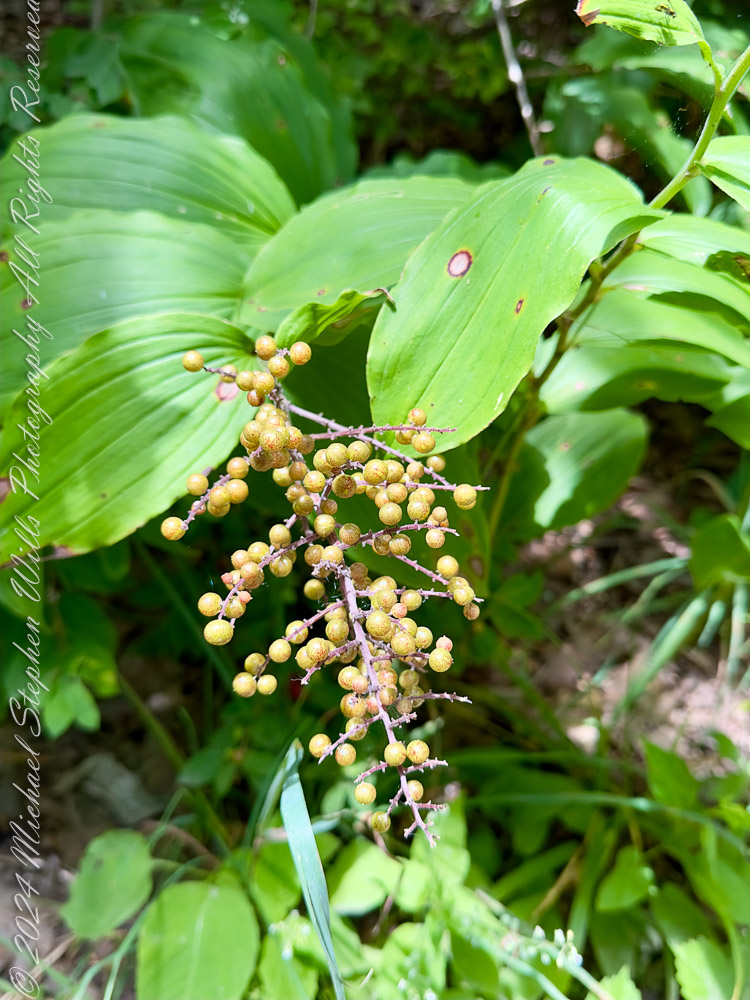
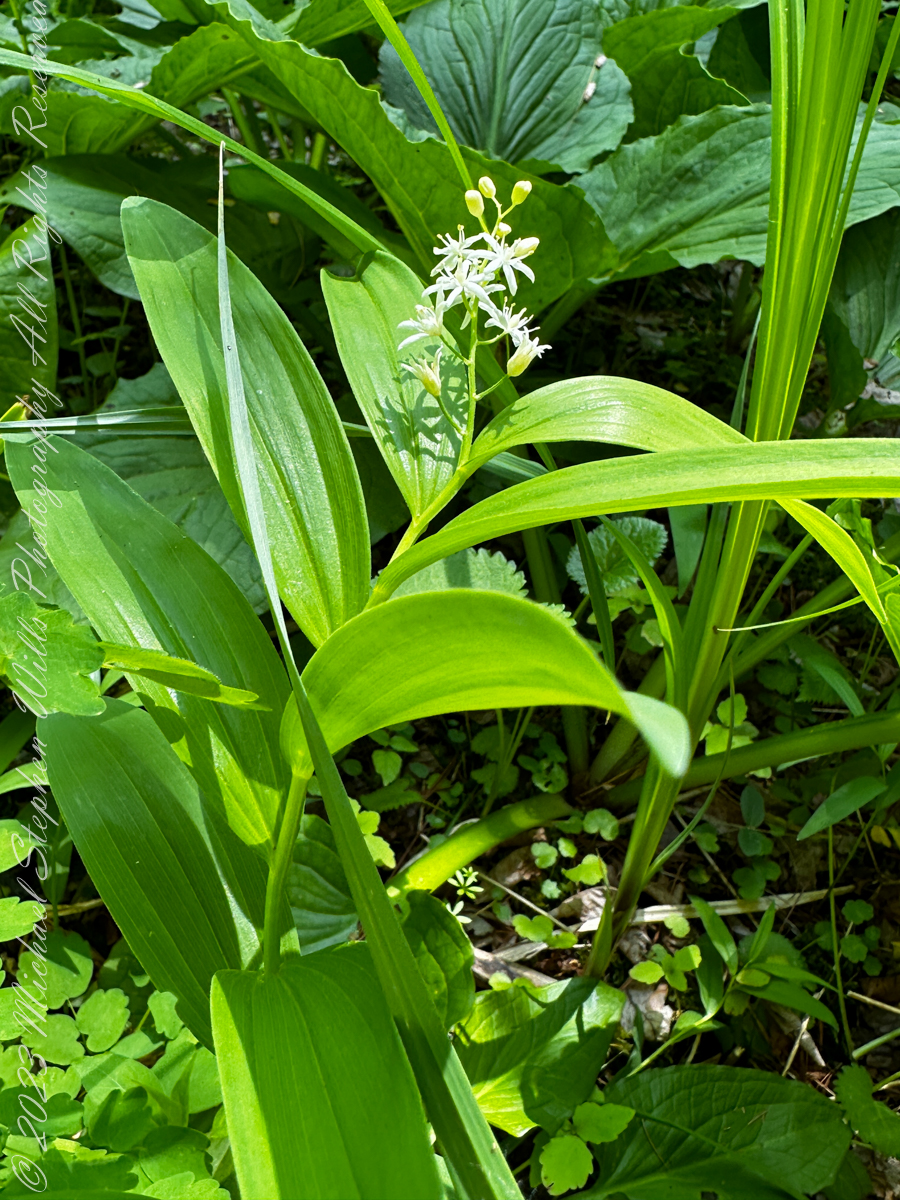
The trails of Taughannock Falls State Park always hold surprises, and on that July day, they did not disappoint. As I paused to take in the tranquility of the woods, my gaze fell upon a plant whose graceful arch and clusters of berries demanded attention. Its broad, lance-shaped leaves alternated along the stem, framing the stem’s terminal cluster of small green berries. Recognizing the plant as Maianthemum racemosum, commonly known as False Solomon’s Seal, I took a moment to admire its understated elegance.
False Solomon’s Seal, scientific name Maianthemum racemosum, is common in the Finger Lakes Region. I found this specimen during a walk with the grandchildren in a local fen among the post-glacial terrain of the Finger Lakes Region. Eames Memorial Natural Area, Cornell Botanic Gardens, Town of Dryden, Tompkins County, Finger Lakes Region, New York State

Characteristics of the Plant

False Solomon’s Seal is a perennial herbaceous plant belonging to the asparagus family (Asparagaceae). It can grow up to three feet tall, its arching stems giving it a unique and recognizable silhouette. The leaves are broad and lance-shaped, with prominent veins running their length, arranged alternately along the stem. At the tip of each stem is a cluster of tiny, spherical green berries, which later in the season ripen to a speckled reddish hue. The plant blooms in late spring to early summer, producing delicate, star-shaped white flowers before transitioning to its fruiting phase.

Found throughout much of North America, Maianthemum racemosum thrives in moist, shaded woodlands, making the lush forests of Taughannock Falls State Park an ideal home. Its ability to grow in the dappled light beneath the forest canopy highlights its adaptability to varying light conditions.

Etymology of the Name

The genus name, Maianthemum, comes from the Greek words “mai” (May) and “anthemon” (flower), reflecting the plant’s tendency to bloom in late spring or early summer. The species name, racemosum, refers to the plant’s inflorescence, which forms a raceme—a cluster of flowers or berries along a single stem. Its common name, False Solomon’s Seal, derives from its superficial resemblance to Solomon’s Seal (Polygonatum spp.), though the latter has bell-shaped flowers hanging beneath its stems, in contrast to the terminal clusters of Maianthemum racemosum.

History and Folklore

False Solomon’s Seal has long been valued for its medicinal and culinary uses by Indigenous peoples and early settlers. The young shoots were harvested and cooked as a vegetable, while the ripe berries were sometimes used in jellies or preserves, though their slightly bitter flavor limited their appeal. Medicinally, teas made from the roots and leaves were used to treat a variety of ailments, including digestive issues, coughs, and sore throats. The roots were also applied as poultices for cuts and bruises, reflecting the deep understanding of natural remedies held by those who lived in harmony with the land.

The plant’s name has sparked legends. While the “false” in its name denotes its distinction from Solomon’s Seal, some folklore suggests that the plant was used to counterfeit the medicinal properties of its namesake. Others believe that its graceful arch and persistent berries symbolize resilience and adaptability, qualities often attributed to those who lived in its native habitats.

Uses and Ecological Role

Although not widely cultivated, Maianthemum racemosum is a valuable plant in its native ecosystems. Its flowers provide nectar for pollinators such as bees and butterflies, while the berries are a food source for birds and small mammals. Its rhizomatous roots also play a role in stabilizing soil in forested environments, preventing erosion and supporting the health of the woodland floor.

For those contemplating harvesting these plants be advised that collection of plants from New York State Parks is prohibited to protect natural resources and maintain ecological balance. According to the New York State Office of Parks, Recreation and Historic Preservation (OPRHP) regulations, “No person shall… remove… any… plant life” within state parks without proper authorization. Therefore, collecting plants in state parks without explicit permission is not allowed. If you have a specific research or educational purpose, you may contact the park administration to inquire about obtaining the necessary permits. However, for casual visitors, it’s best to enjoy the flora from a distance. False Solomon Seal ecological contributions are significant. In addition to its pollinator support and soil stabilization, the plant’s presence is an indicator of a healthy woodland ecosystem.

A Moment of Reflection

As I rose from my crouched position, having taken in the details of Maianthemum racemosum, I felt a quiet gratitude for the opportunity to encounter such a plant. False Solomon’s Seal, with its graceful leaves and unassuming berries, serves as a reminder of the interconnectedness of life in the forest. Its role in the ecosystem, its history with humans, and its understated beauty all speak to the richness of the natural world.

Walking onward, I carried with me a sense of awe for the intricate web of life that thrives in the woods. The False Solomon’s Seal, standing quietly among the ferns and leaf litter, seemed to embody the resilience and balance of the forest—a gentle presence in a vibrant community.

Enter your email to receive notification of future postings. I will not sell or share your email address.