White Snakeroot: A Native Finger Lakes Wildflower with a Dangerous History

White snakeroot around the Finger Lakes reveals a native wildflower of beauty, poison, pollinator value, layered names, and deep human history.

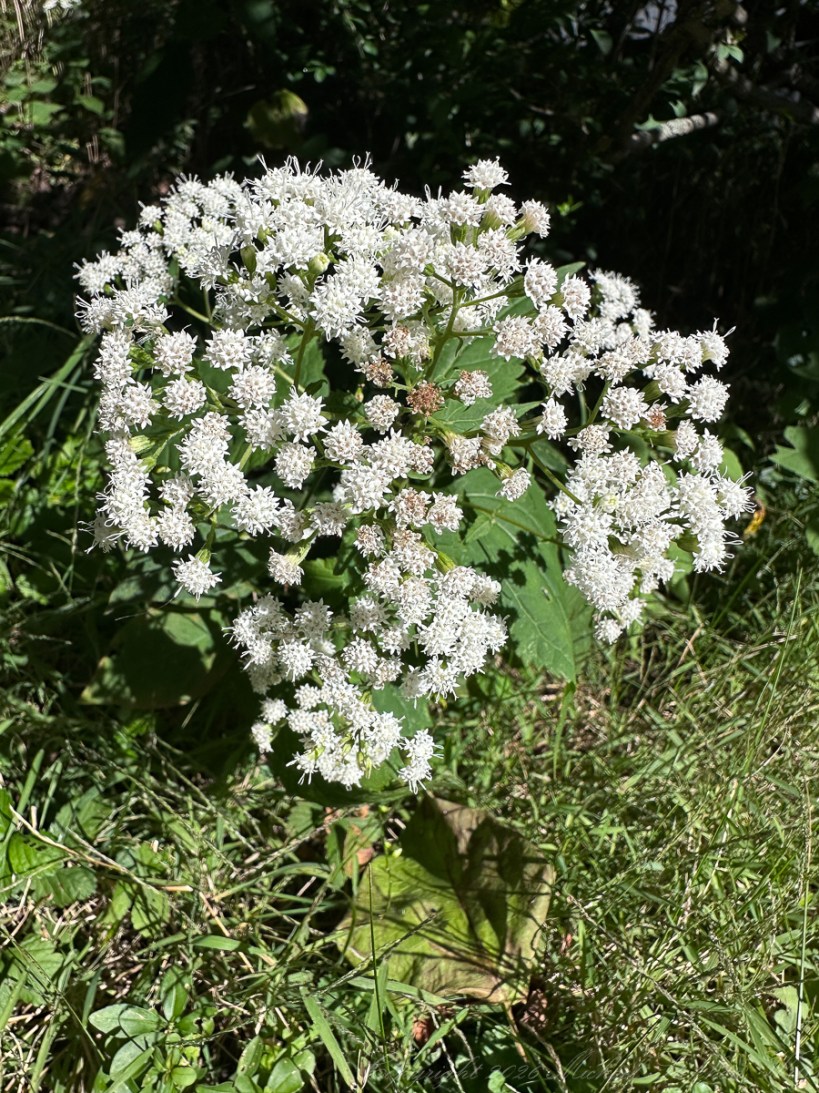
The white snakeroot stood near the woods along the South Rim Trail, a pale branching spray of flowers lifted out of the shade. I had gone to Taughannock for the gorge walls, the lake light, the shale ledges, and the first yellowing leaves, but this modest herb held its own at the edge of the scene. It was knee to waist high, easy to overlook; yet once seen, it seemed to gather the late summer around itself.
Found along the South Rim Trail. From a walk around Taughannock Falls State Park, down the South rim Trail, up the North Rim Trail. September 14, 2026

White snakeroot, Ageratina altissima, is a poisonous perennial herb in the aster family. It is native to woodland places in the eastern United States and often grows in rich or rocky woods, thickets, stream edges, roadsides, and disturbed ground. Its current accepted botanical name is Ageratina altissima, though older guides may still remember it as Eupatorium rugosum.
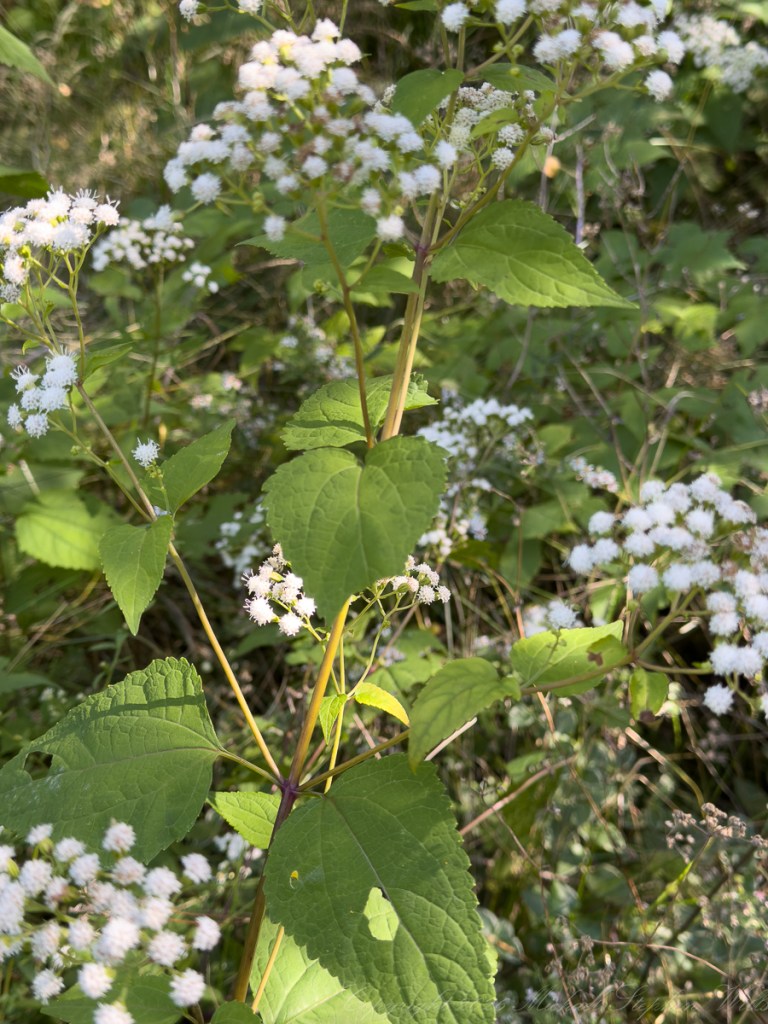
Leaves and flower clusters of white snakeroot, Tompkins County, New York.

Later, I began seeing the same composed plainness in the white snakeroot growing in our own yard. Its leaves are opposite, toothed, broadly ovate to somewhat heart-shaped, with pointed tips and slender petioles. The stems rise and divide, and at their ends appear flat-topped clusters of white flower heads. At a closer look, the flowers are not like daisies or other familiar asters. They have no showy rays spreading outward like petals. They are made of small disk flowers, each head a tuft, and the whole plant in bloom becomes a cloud of minute, bristling whiteness. What looks from a distance like foam resolves, near at hand, into many small parts.
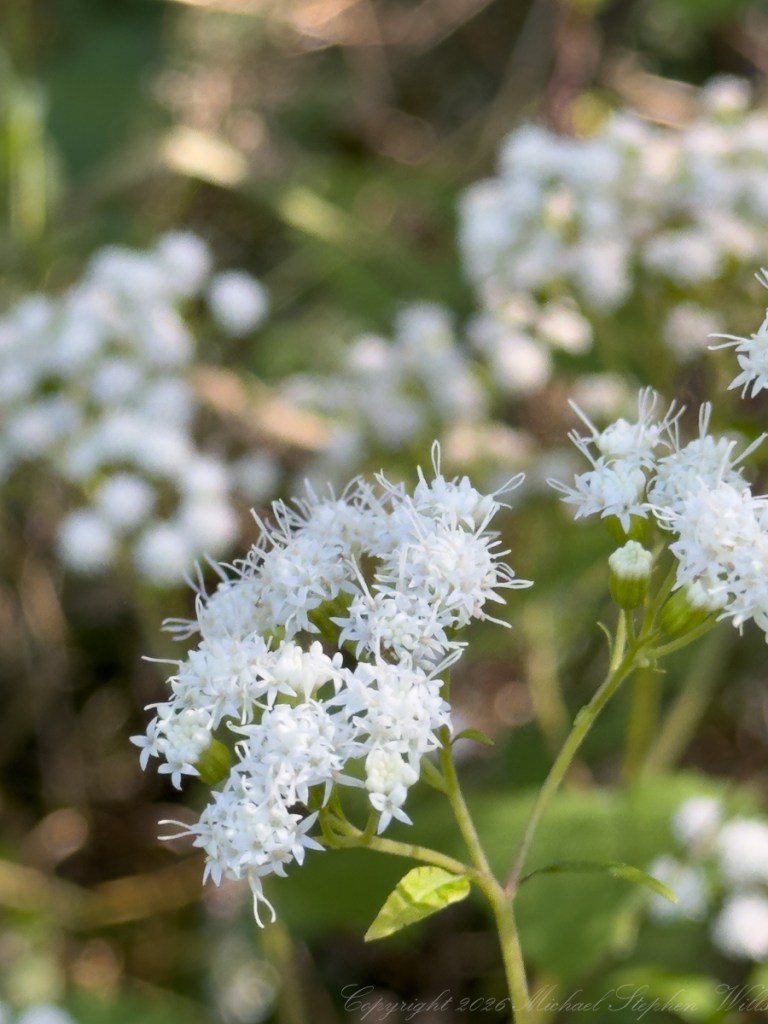
A closer look at the flowers of this member of the Aster family

The scientific name begins in a paradox. Ageratina comes from the same root as Ageratum, from Greek language associated with “not aging,” a reference to flowers that keep their color for a long time. The species name altissima means tallest or very tall, and in this case refers to its stature within the genus. A plant found in shade, at the edge of paths, among fallen leaves and shale-gray rock, is given a name that speaks of lasting freshness and height. The name seems, at first, too grand for it. But by September, when many flowers have passed into seed or exhaustion, white snakeroot is still offering its small whiteness to the air.
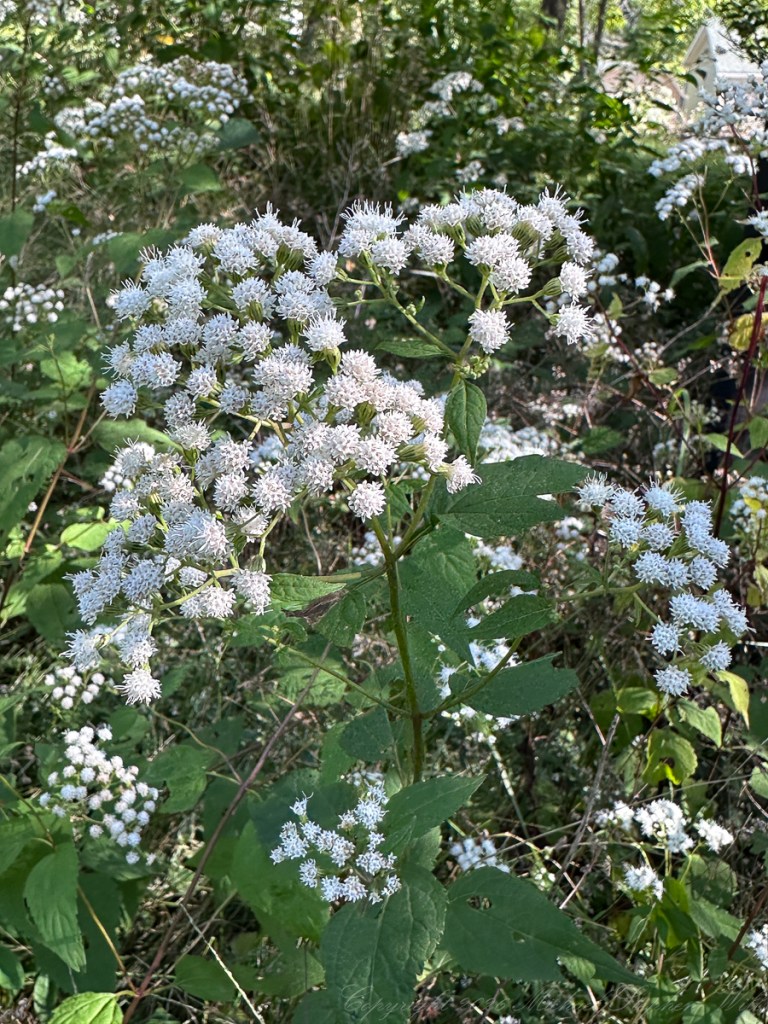
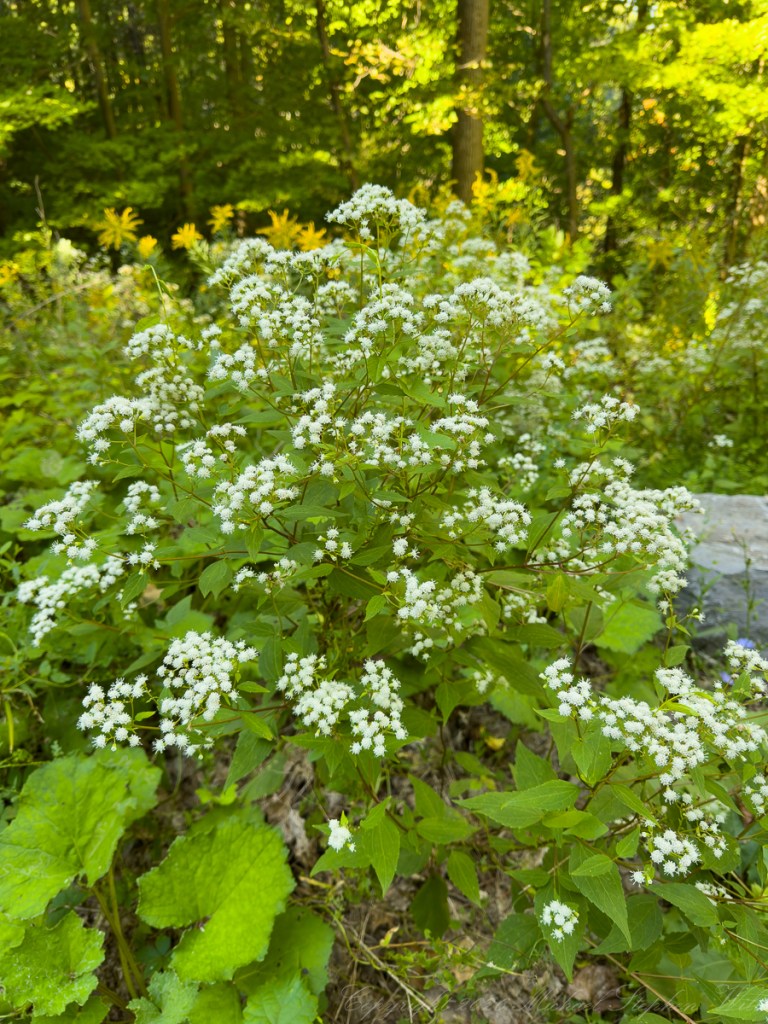
White snakeroot blooming in our Ithaca yard.

Then come the common names, each one carrying a fragment of human encounter. White snakeroot is the one most often used, and it preserves an old belief that the root could be used against snakebite. Other names collected around it over time: richweed, white sanicle, fall poison, deerweed, Indian sanicle, milk-sickness plant, white top. These names are not synonyms so much as testimonies of different encounters. One person saw the habitat and called it richweed. Another remembered a medicinal resemblance and called it white sanicle. Another learned danger and named it fall poison. The plant stayed where it was, in the shade and edge-growth, while people kept finding new reasons to name it.

The word “snakeroot” is especially revealing. It belongs to a time when usefulness and fear were not separate categories. A root that might heal a bite, a plant that might hold a hidden power, a white bloom appearing at the border of pasture and wood—such things entered household knowledge before they entered botany. The old belief was wrong, but the name endured. Names often do. They are less like labels than sediments, deposited by generations of need, mistake, memory, and caution.

Around the Finger Lakes, white snakeroot seems at home in the broken places where wildness and human passage touch: the edge of a gorge trail, the bank above a creek, a roadside ditch beneath maples, a yard border neglected long enough to become interesting. It does not require the open blaze of a meadow. It tolerates shade. It stands in those green rooms where goldenrod, asters, jewelweed, wood nettle, grasses, young trees, and invasive shrubs may all be negotiating for light. In the late season it becomes part of the pollinator economy of scarcity, offering nectar and pollen when many summer blooms are finished. Bees, butterflies, wasps, flies, beetles, and moths may visit it; extension and conservation sources note its value to late-season pollinators.
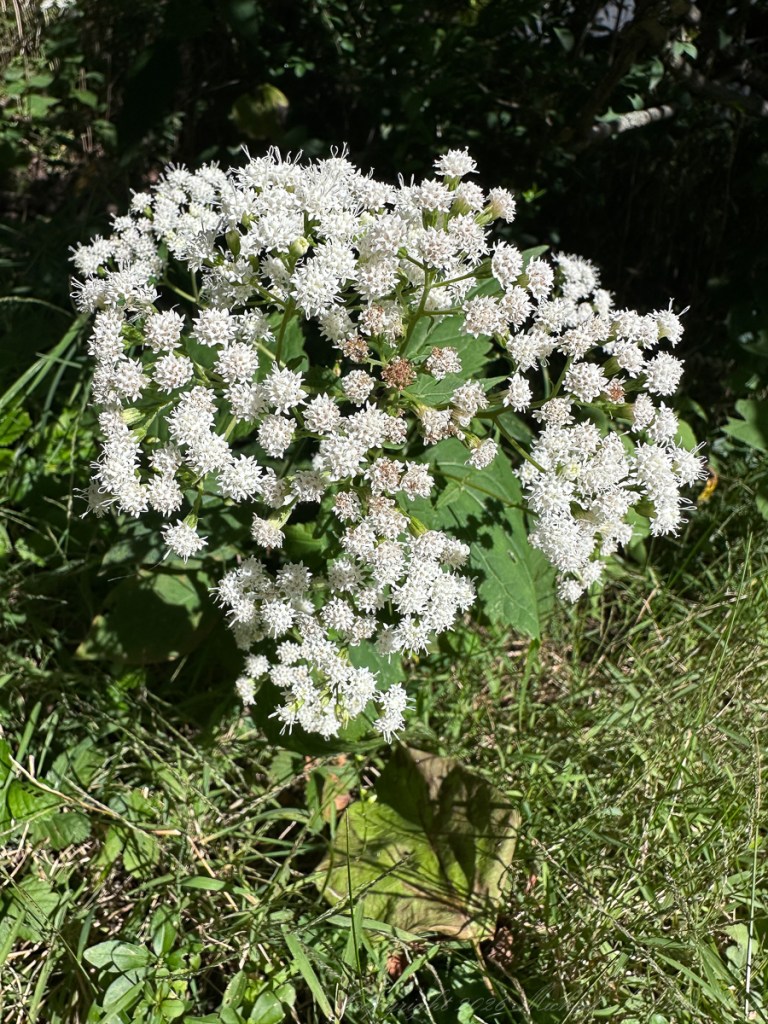
A small bouquet spared by the lawnmower.

But this is not a harmless innocence. White snakeroot is one of those plants that shows how beauty and hazard may occupy the same stem. Its toxic history is bound to grazing animals, milk, and settlement. When cattle consumed the plant, toxic compounds could pass into milk, producing the illness once known as milk sickness in people who drank it. Research has associated the toxicity with tremetol, a lipophilic mixture of compounds, and with tremetone-related compounds; the old rural names “trembles” and “milk sickness” record the symptoms and route of harm.

This intersection with humanity is sobering because it was not dramatic in the way a venomous snake is dramatic. The danger did not announce itself with fangs. It entered through the ordinary domestic trust of milk. A cow grazed a shaded edge. A household drank what it had always drunk. Illness followed from a chain no one had yet learned to see. The plant was not malicious. It was only doing what plants do: making compounds in its tissues, surviving in the shade, waiting out the season.

That is one reason I find the plant moving. White snakeroot asks us to look without simplifying. Native does not mean safe. Poisonous does not mean expendable. The same plant that feeds late-season insects also carries the history of milk sickness and frontier fear. It has been cleared from pastures and is welcomed in our woodland garden.

By October its whiteness will give way to seed. The heads will loosen, and the plant will fade into the brown grammar of the season. But in September, around the Finger Lakes, it still stands in the half-light: white, poisonous, useful to insects, burdened with names, and easy to pass by.

Click me to visit Michael Stephen Wills Online Finger Lakes Gallery.

Enter your email to receive notification of future postings. I will not sell or share your email address.
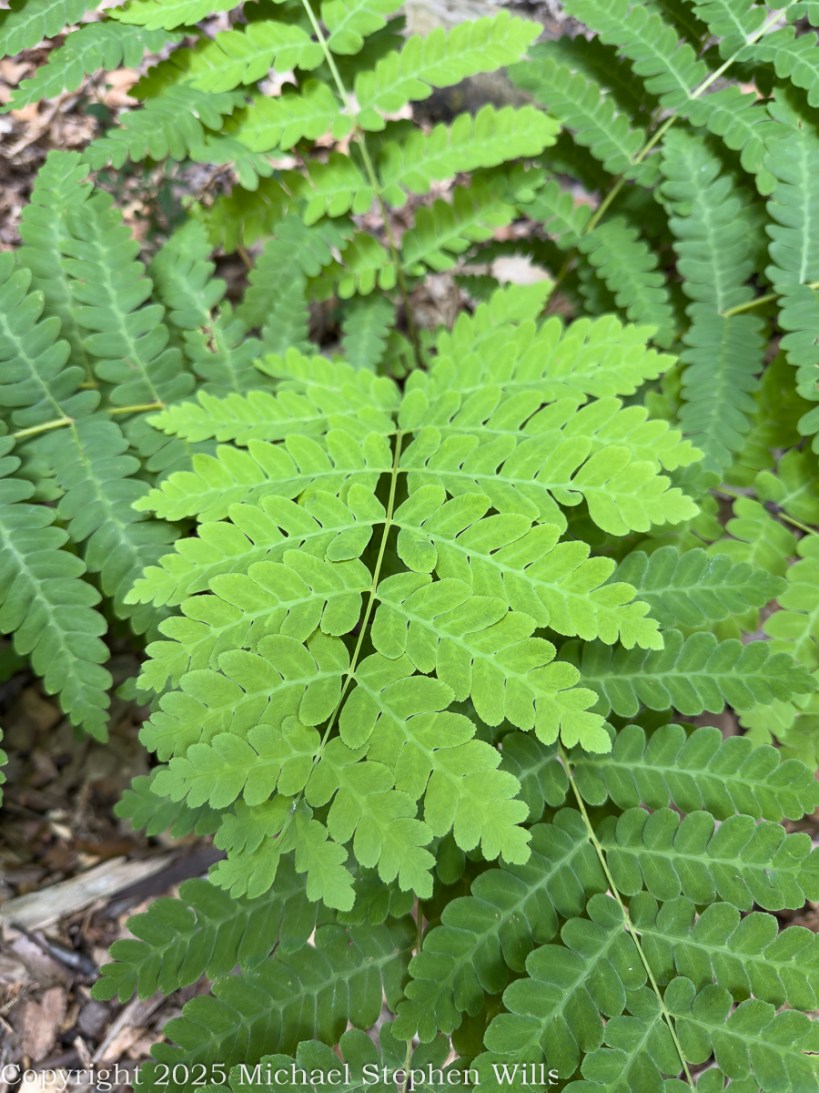
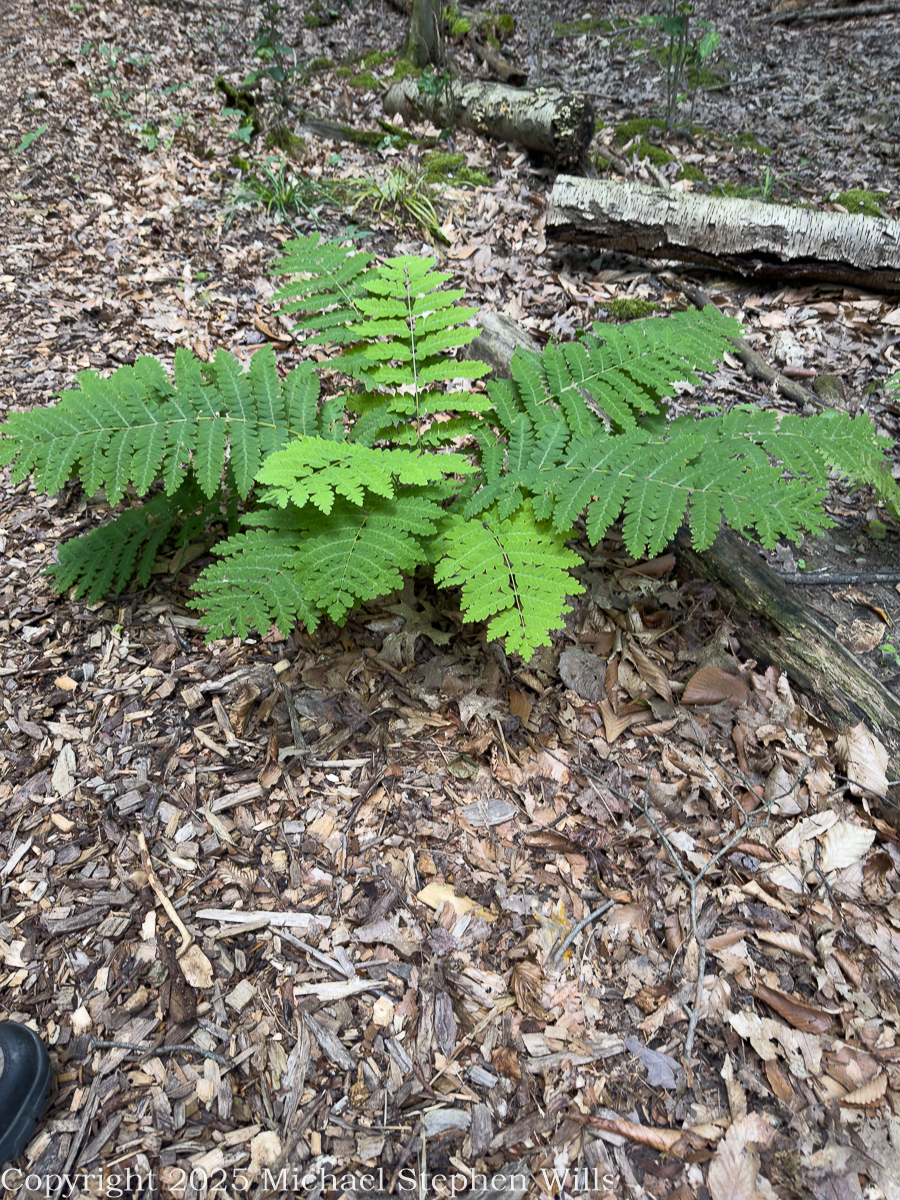
Unveiling the Ancient Beauty of Interrupted Ferns

In the hush of Sapsucker Woods, Interrupted Ferns unfurl their ancient green with quiet grace—guardians of time, rooted in myth, memory, and moss.


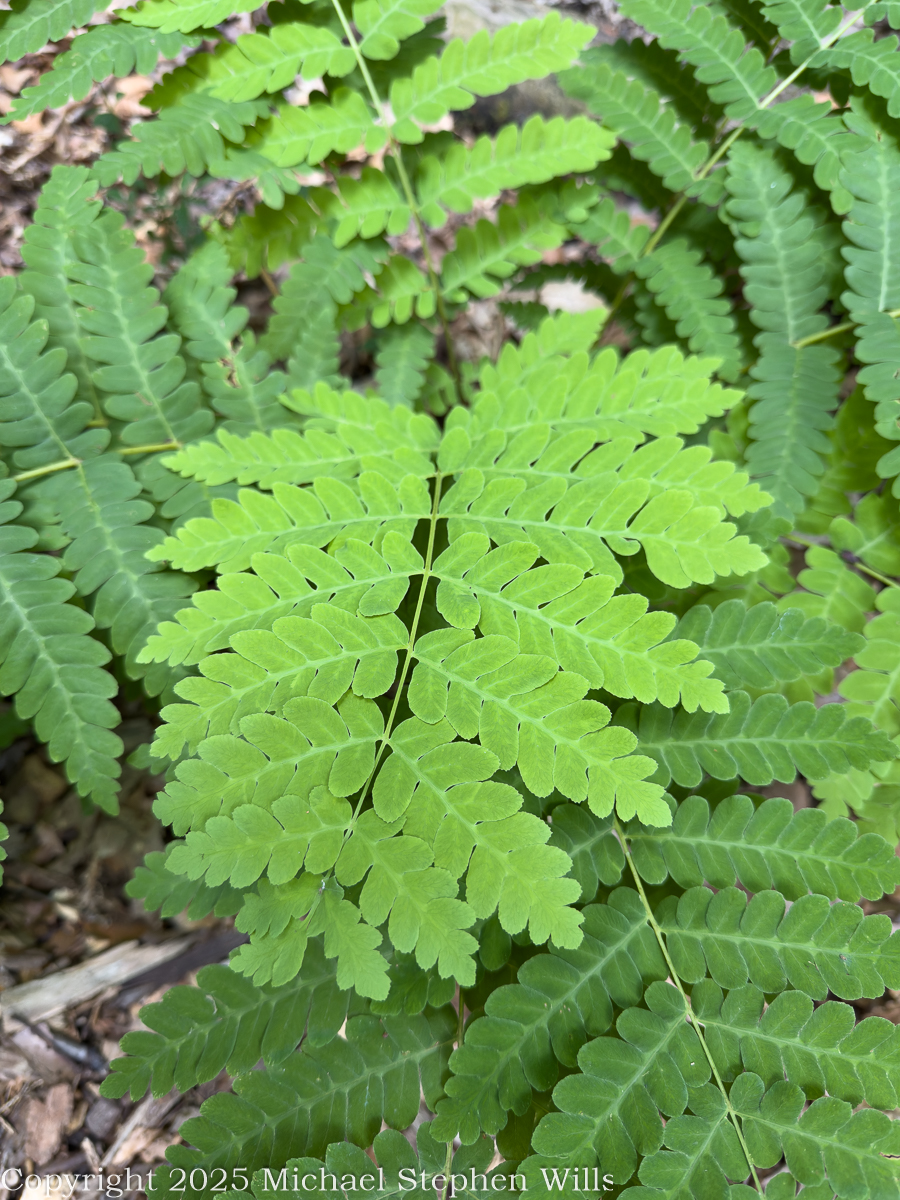
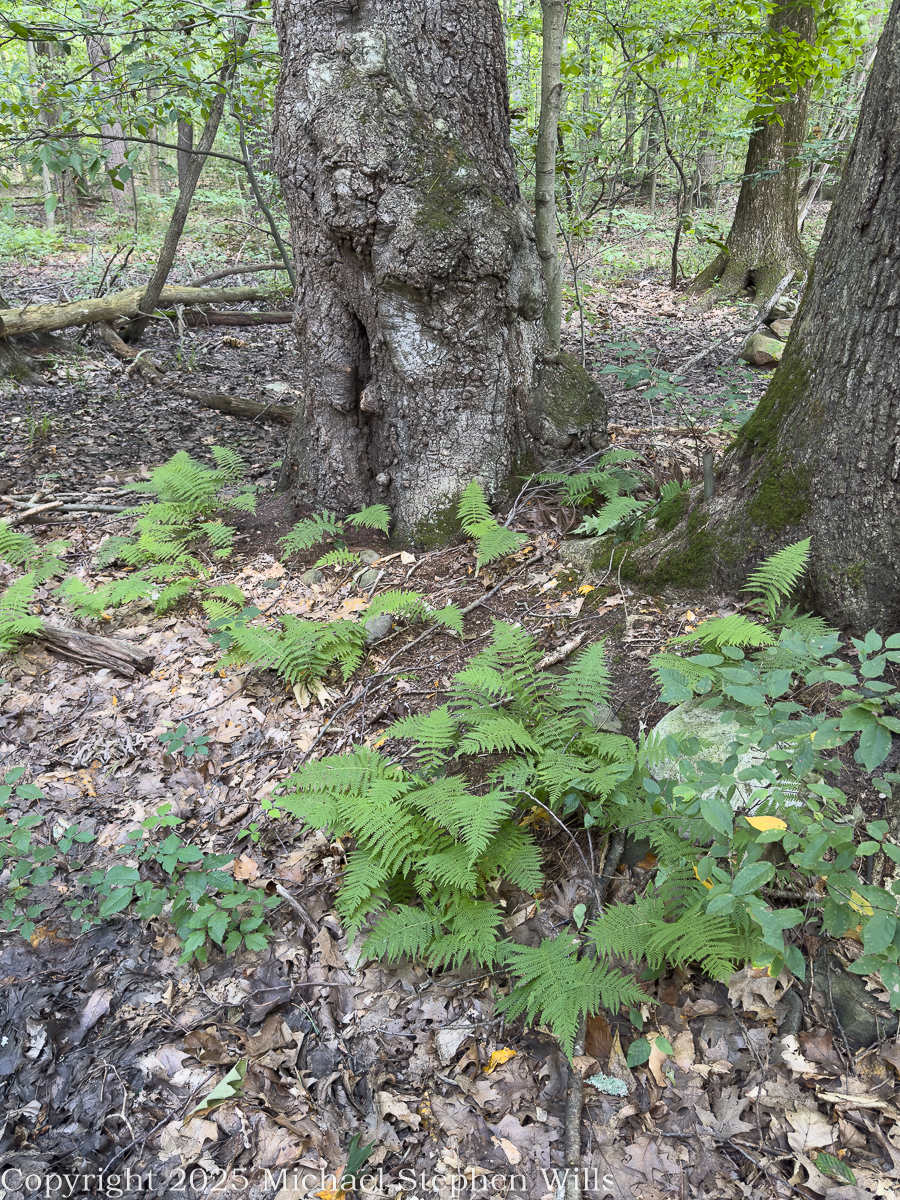
In a shaded hollow of Sapsucker Woods, where the hush of ancient time lingers like mist among the trees, the Interrupted Fern rises from the soft, damp floor with a quiet grace. Its fronds, broad and arching, seem less grown than unfurled—as if unrolling a memory held for millions of years.

The plant’s name, Osmunda claytoniana, carries echoes of two worlds. “Osmunda,” perhaps once spoken in the sacred groves of northern Europe, is thought to honor a forgotten god—Osmunder, one of Thor’s names, a guardian of strength and storm. The species name pays tribute to John Clayton, an early colonial botanist who walked Virginia’s forests centuries ago and recognized in this fern a quiet marvel worth remembering.

And so this plant, whose lineage reaches back more than 200 million years, is rooted not just in soil and stone, but in language and lore.

The fern’s common name—Interrupted—describes the curious habit of its fertile fronds, which rise briefly in midsummer, dark and beadlike, then wither and vanish, leaving a ghostly gap midway up the blade. It is as though the plant had paused mid-sentence, letting silence speak where others would persist. In this interruption, the forest itself seems to take a breath.

The roots of Osmunda claytoniana twist into fibrous mats beneath the soil. These rhizomes, dense and springy, were once harvested as osmunda fiber, prized by horticulturists for cradling delicate orchids—a gentle reminder of how often nature’s strength serves human fragility. And though the Interrupted Fern is not celebrated in pharmacopeias, its kin were used by Indigenous peoples as poultices for wounds, or brewed into mild tonics to ease internal aches—suggesting a long, quiet partnership with humankind.

Forest Floor in Sapsucker Woods on a summer afternoon

There is little need for blossoms or fragrance here. The beauty of this fern is in its restraint. Its fronds do not shout, but rather whisper of deep time, of shaded ravines and glacial meltwaters, of forests that once stood where oceans now roll. Some said ferns were touched by magic—that they bloomed only on Midsummer’s Eve and vanished before the eye could see. The Interrupted Fern, with its appearing and disappearing fronds, might well have inspired such tales.

And so, in the filtered light beneath the canopy, this ancient fern lives on—not as a relic, but as a quiet thread in the fabric of the living forest. To stand in its presence is to feel a kind of reverence—not for what is rare, but for what endures.

Enter your email to receive notification of future postings. I will not sell or share your email address.
Hylodesmum glutinosum: Characteristics and Ecology

The author reflects on hiking at Taughannock Falls State Park, discovering the Large-Flowered Tick Trefoil’s beauty and ecological significance.

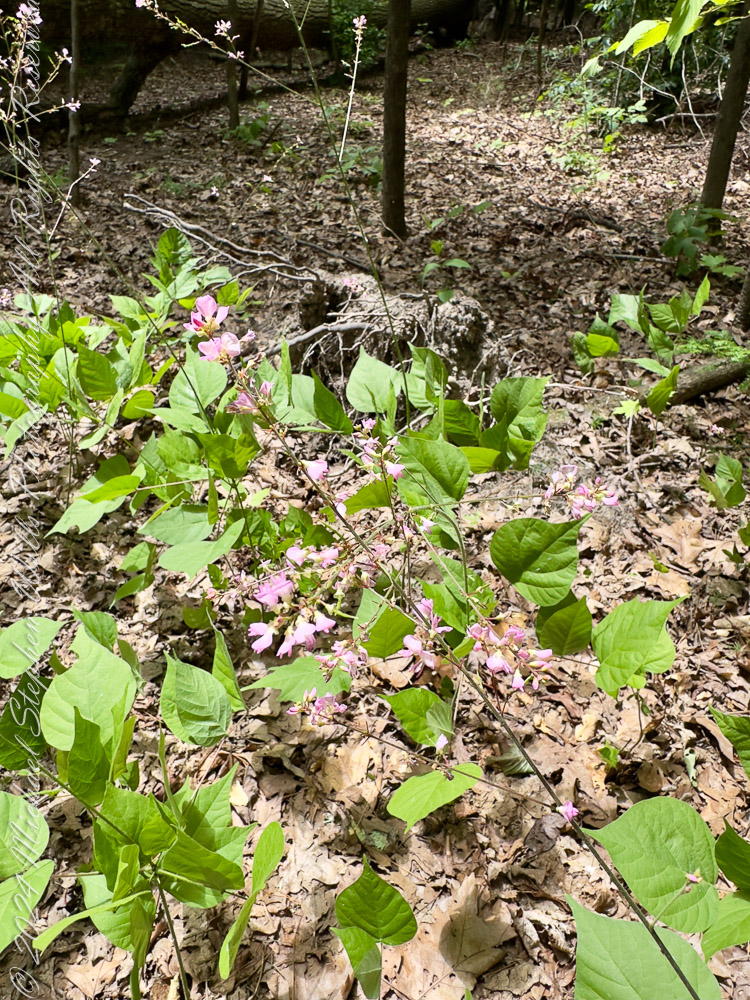
It was a high summer day as I enjoyed a customary hike around of Taughannock Falls State Park on the South and North Rim trails. Here sunlight filtered through the dense canopy, dappling the forest floor with shifting patches of light. Along the trail, my attention was drawn to a cluster of pink blossoms rising on slender, upright stems. Intrigued by their delicate beauty, I crouched down for a closer look. The plant rose above the forest floor, its trifoliate leaves broad and prominently veined, each leaflet slightly larger than I would have expected. These leaves seemed to anchor the plant to the shaded understory, while its flowers reached upward, as though eager to catch the fleeting rays of sun. I captured the plant in this photographs, later used it to identify Hylodesmum glutinosum, or Large-Flowered Tick Trefoil.

Characteristics of the Plant

The Large-Flowered Tick Trefoil is a striking member of the pea family (Fabaceae). Its pink, pea-like flowers are arranged in graceful racemes along the upper portions of its stems, their vibrant color contrasting beautifully with the green foliage around them. The leaves, broad and trifoliate, lend the plant its distinctive appearance. The name “tick trefoil” refers to the plant’s seed pods, which are flat and segmented, equipped with tiny hooks that cling stubbornly to passing animals or hikers, hitchhiking their way to new locations.

The plant is native to eastern North America, including the forests and trails of New York State. Its preference for rich, well-drained soils in partially shaded woodlands makes it a common sight in places like Taughannock Falls State Park. Blooming from mid to late summer, it provides an essential nectar source for bees and other pollinators, playing its part in the intricate web of the forest ecosystem.

Etymology of the Name

The genus name, Hylodesmum, was established only twenty-five years ago when the plant was reclassified from the genus Desmodium to a new genus within the tribe Desmodieae. The name reflects its forested habitat, with “hylo” derived from the Greek word for “wood” or “forest.” Previously described in 1802 as Hedysarum glutinosum and later placed in Desmodium, the species name glutinosum remains unchanged, meaning “sticky” in Latin. This aptly describes the plant’s seed pods, which adhere to anything that brushes past them. Together, these names encapsulate both the botanical structure and the unique dispersal strategy of this plant.

History and Folklore

Native Americans and early settlers were intimately familiar with tick trefoils. The plant’s seeds, notorious for clinging to clothing and fur, earned it a reputation as a nuisance, but its resilience and utility could not be overlooked. Indigenous peoples utilized various parts of the plant for medicinal purposes. The roots and leaves were brewed into teas to treat fevers and digestive ailments, while poultices made from the leaves were applied to wounds to promote healing. Such uses highlight the depth of knowledge early inhabitants had about their environment.

The plant’s sticky seed pods also became the subject of folklore. Children in rural communities would playfully call it “hitchhiker’s weed,” competing to see who could collect the most seeds on their clothing during outdoor adventures. These seeds, so adept at attaching themselves to passersby, were seen as symbols of persistence and adaptability, traits that many admired.

Uses and Ecological Role

While Hylodesmum glutinosum is not commonly cultivated, its ecological contributions are significant. As a member of the Fabaceae family, it has the ability to fix nitrogen in the soil through a symbiotic relationship with rhizobia bacteria in its root nodules. This makes it a valuable plant in maintaining soil fertility in its native ecosystems. Its flowers attract pollinators like bees and butterflies, ensuring that the forest remains vibrant and full of life.

In addition to its ecological importance, the plant’s seeds have a curious modern use: they’ve been studied for their ability to help detect movement in the environment. Researchers have examined the sticky pods’ structure as a natural model for creating adhesives and tracking devices, proving once again that even the smallest details in nature can inspire human ingenuity.

A Moment of Reflection

As I rose to my feet, brushing the leaf litter from my hands, I felt a renewed sense of wonder for the intricate lives of the plants surrounding me. The Large-Flowered Tick Trefoil, with its vivid pink flowers and ingenious seed pods, seemed to embody the essence of the forest: a harmonious blend of beauty, resilience, and interconnection.

Walking away, I carried with me not just the memory of its vibrant blooms, a deep respect for its role in the natural world. In the quiet of Taughannock’s wooded trails, Hylodesmum glutinosum had shared its story, a tale of persistence, adaptation, and the hidden wonders that flourish when we take the time to notice.

Enter your email to receive notification of future postings. I will not sell or share your email address.
Discovering the Beauty of White Bluebells: An Exploration of Hyacinthoides non-scripta (alba)

Discover the enchanting white bluebells blooming around our home! Explore their natural history, ethereal beauty, and fascinating folklore. Uncover the wonders of Hyacinthoides non-scripta (alba) in our latest blog post.

The surprise of finding white bluebells blooming around our home this spring was nothing short of magical. Known scientifically as Hyacinthoides non-scripta (alba), these delicate flowers add a touch of elegance and tranquility to our garden. As I delved into the history, etymology, and folklore of these enchanting blooms, I discovered a world rich in cultural significance and natural wonder.

Bluebell Natural History

White bluebells, a variant of the common bluebell, belong to the Asparagaceae family. Native to the woodlands of Western Europe, these perennials are renowned for their striking appearance and pleasant fragrance. The white bluebell, though less common than its blue counterpart, is equally captivating with its pure white, bell-shaped flowers that hang gracefully from slender stems.

Hyacinthoides non-scripta thrives in shady, moist environments, often forming dense carpets that transform forest floors into a sea of blossoms in spring. These plants are well-adapted to their woodland habitats, where they bloom before the canopy closes, taking advantage of the early spring light.

White Bluebell (Hyacinthoides non-scripta (alba)) growing around our home, May 2024

Etymology of the Scientific and Common Names

The scientific name “Hyacinthoides” is derived from the Greek word “hyakinthos,” referring to the mythological youth Hyacinthus, who was transformed into a flower. “Non-scripta” means “unmarked” or “not written,” distinguishing it from the classical hyacinth described by ancient authors. This epithet underscores the plant’s unique identity in the botanical world.

The common name “bluebell” comes from the flower’s resemblance to small bells and its predominant blue color. The “white” prefix simply describes this particular variety’s color, adding to its distinction.

White Bluebells in Folklore and History

Bluebells, including their white variants, are steeped in folklore and myth. In England, bluebells are often associated with fairy enchantments and woodland magic. Folklore suggests that bluebells ring to summon fairies, and to disturb a bluebell patch was to risk falling under a fairy spell. The white bluebells, with their ethereal appearance, add an extra layer of mystique to these tales.

Historically, bluebells were used for practical purposes as well. The sticky sap from the bulbs was employed to bind pages in books and to glue feathers onto arrows. However, it’s important to note that all parts of the plant are toxic if ingested, a fact that has also contributed to its aura of cautionary folklore.

The Surprise and Wonder of White Bluebells

Discovering white bluebells around our home has been a source of immense joy. These flowers, with their serene beauty and historical significance, connect us to the past and the natural world in a profound way. The surprise of seeing them bloom each spring reminds us of nature’s unpredictability and generosity.

Their presence in our garden brings a sense of peace and wonder, inviting us to pause and appreciate the small miracles that surround us. The delicate white bells, swaying gently in the breeze, create a visual symphony that enchants the senses and uplifts the spirit.

White bluebells serve as a testament to the rich tapestry of life that thrives in our gardens, often unnoticed. They remind us to look closely, to explore, and to cherish the natural beauty that graces our lives. As we continue to nurture our garden, the white bluebells stand as a symbol of purity, resilience, and the timeless charm of nature’s wonders.

Copyright 2024 Michael Stephen Wills All Rights Reserved

Reflections on Hawkweed: A Meditative Journey Along Buttermilk Creek

Discover the enchanting hawkweed along Buttermilk Creek’s path. Explore its vibrant yellow blooms, unique reproduction, and rich folklore in our latest nature essay. Dive into the captivating world of this resilient wildflower!


Walking along the path that climbs from the lower park into the gorge of Buttermilk Creek, I am drawn to the vibrant splash of yellow that punctuates the verdant green and shale, limestone of the path. Here I encounter the humble yet striking hawkweed (Hieracium spp.). These yellow flowers, seemingly modest in their simplicity, invite me into a deeper contemplation of nature’s intricacies.

A Closer Look

The hawkweed’s leaves form a basal rosette, their slightly toothed edges and hairy surface distinguishing them from other woodland plants. The leaves are a deep green, the tiny hairs catching the sunlight, giving them a silvery sheen. From this rosette emerges an erect stem, slender and bristling with fine hairs, reaching upwards to support the flower heads. The stems stand tall, bearing clusters of small, dandelion-like flowers that open into a cheerful yellow bloom.

These Hawkweed grow profusely along the climb along Buttermilk Creek and into the gorge. Buttermilk Falls Park, Ithaca, Tompkins County, New York State. Finger Lakes Region

Each flower head consists of numerous tiny florets, collectively forming a radiant disc. The petals are intricately fringed, almost feathery, a delicate contrast to the sturdy stem that holds them aloft. This contrast is a reminder of the balance in nature—strength and fragility coexisting in harmony.

Relationship and Reproduction

Hawkweeds belong to the Asteraceae family, sharing familial ties with daisies and dandelions. Despite their visual similarity to dandelions, hawkweeds possess unique reproductive strategies. They are known for their ability to reproduce asexually through a process called apomixis. This means that the seeds produced by hawkweed are genetically identical to the parent plant. In a grouping of hawkweeds, what appears to be a diverse collection of individuals may, in fact, be clones of a single genetic ancestor.

This method of reproduction ensures the rapid spread and establishment of hawkweed populations, a survival strategy that has both fascinated and frustrated botanists and gardeners alike. While this cloning capability allows hawkweeds to thrive in various environments, it also poses a challenge for those trying to control their spread.

Etymology and Origins

The genus name “Hieracium” is derived from the Greek word “hierax,” meaning hawk. According to ancient lore, hawks were believed to consume the sap of this plant to sharpen their vision. This mythological connection to hawks underscores the plant’s perceived potency and its storied place in folklore.

Hawkweed is not native to the Finger Lakes region but was introduced from Europe. Despite its non-native status, it has adapted well to the local environment, often found in meadows, along roadsides, and within open woodlands. Its ability to colonize disturbed areas has enabled it to become a common sight across the landscape.

Historical Uses and Lore

Throughout history, hawkweed has been used for various medicinal purposes. Traditional herbalists valued it for its purported benefits in treating respiratory ailments, digestive issues, and skin conditions. The plant was often brewed into teas or concoctions believed to have diuretic and astringent properties. Some cultures also used hawkweed as a charm against evil spirits, further embedding it in the tapestry of folklore and superstition.

In medieval times, hawkweed was sometimes used in love potions and to enhance psychic abilities. Its association with hawks and keen vision lent itself to these mystical uses, as people sought to harness the plant’s reputed powers for their own needs.

A Contemplative Pause

As I stand on the path, surrounded by the quiet beauty of Buttermilk Creek, I reflect on the hawkweed before me. This unassuming plant, with its bright flowers and tenacious growth, embodies resilience and adaptability. It thrives in the cracks and crevices of the rocky soil, a testament to nature’s relentless drive to flourish even in the most challenging conditions.

The hawkweed’s ability to clone itself, creating vast networks of genetically identical plants, speaks to the interconnectedness of life. Each plant is a reflection of its predecessors, a living link in the chain of existence. This genetic continuity is a reminder of the ways in which life persists and propagates, ensuring survival through the ages.

I found this growing along the South Rim Trail of Taughannock Falls Park during a Fathers Day Walk, June 16, 2024.Picris hieracioides, or hawkweed oxtongue, is a species of flowering plant in the family Asteraceae. Invasive Species Hawkweed Oxtongue is considered an invasive species in North America because it has the ability to outcompete native plants, reduce biodiversity, and alter ecosystems. The plant spreads rapidly and can form dense monocultures, making it difficult for other plants to grow. Additionally, Hawkweed Oxtongue produces a chemical that inhibits the growth of other plants, further contributing to its invasive nature. Control and Management The control and management of Hawkweed Oxtongue can be challenging. The plant has a deep taproot that makes it difficult to remove by hand, and it can regrow from small root fragments left in the soil. Herbicides can be effective in controlling the plant, but they can also harm other plants in the area. The best approach to managing Hawkweed Oxtongue is to prevent its spread by avoiding the movement of soil or plant material that may contain seeds or root fragments. Uses Despite its invasive nature, Hawkweed Oxtongue has some traditional medicinal uses. The plant contains compounds that have been used to treat digestive problems, skin conditions, and respiratory issues. However, the use of this plant for medicinal purposes is not recommended due to the potential for toxicity. In conclusion, Hawkweed Oxtongue is an invasive species that has the potential to cause significant ecological damage. It is important to prevent the spread of this plant and to take measures to control its growth where it has already become established. While it has some traditional medicinal uses, the potential for toxicity means that it should not be used for this purpose. Text taken from http://www.wildflowerweb.co.uk/plant/2453/hawkweed-oxtongue

In the stillness of the gorge, I find a sense of peace and connection. The hawkweed, with its storied past and practical resilience, offers a lesson in simplicity and strength. It reminds me that beauty often lies in the small, overlooked details of the natural world, and that every plant, every flower, has a story worth discovering.

As I continue my journey along Buttermilk Creek, the hawkweed’s bright blooms remain a vivid memory, a symbol of the enduring spirit of nature.

Copyright 2024 Michael Stephen Wills All Rights Reserved

The Delight of Woodruff: An Exploration of Galium odoratum

Discover the enchanting woodruff growing around our home! Explore its natural history, delightful fragrance, and fascinating role in folklore and history. Uncover the wonders of this perennial plant in our latest blog post.

As spring breathes new life into our surroundings, the delight of identifying the plants that grow around our home is a joy like no other. This year, I was thrilled to discover that the delicate and fragrant woodruff (Galium odoratum) has been gracing our garden. Known for its charming clusters of white flowers and vibrant green leaves, woodruff brings both aesthetic beauty and a rich historical tapestry to our home.

Natural History of Woodruff

Woodruff, scientifically known as Galium odoratum, is a perennial plant native to Europe, North Africa, and parts of Asia. It thrives in shady, woodland environments, often forming dense mats that carpet the forest floor. The plant typically blooms in late spring to early summer, producing tiny white flowers that contrast beautifully with its whorls of bright green leaves.

Galium odoratum is a member of the Rubiaceae family, which also includes coffee and gardenias. Its ability to spread quickly through its creeping rhizomes makes it an excellent ground cover. In addition to its visual appeal, woodruff is known for its sweet scent, which intensifies when the plant is dried. This fragrance is due to the presence of coumarin, a natural compound that also contributes to its medicinal properties.

This woodruff (Galium odoratum) grows around our home.

Etymology of the Scientific and Common Names

The scientific name Galium odoratum provides insights into the plant’s characteristics. “Galium” is derived from the Greek word “gala,” meaning milk. This refers to the plant’s historical use in curdling milk. “Odoratum,” on the other hand, highlights the plant’s pleasant aroma.

The common name “woodruff” has an interesting origin as well. The word “wood” refers to the plant’s typical habitat in wooded areas, while “ruff” is thought to be derived from the Old English “rūwe,” meaning rough or hairy, describing the texture of the plant’s leaves and stems.

Woodruff in Folklore and History

Woodruff has a storied past, steeped in folklore and history. In medieval Europe, it was used for its aromatic properties to freshen up linens and as a strewing herb to mask odors in homes and churches. Its sweet scent was believed to ward off evil spirits and bring good fortune, making it a popular choice for wreaths and garlands during festivals and celebrations.

The plant also played a role in traditional medicine. Woodruff was used to treat various ailments, including liver and gallbladder issues, and as a mild sedative. Its medicinal use is attributed to the coumarin content, which has anticoagulant and anti-inflammatory properties. However, it’s worth noting that high doses of coumarin can be toxic, so its medicinal use has largely fallen out of favor in modern times.

In Germany, woodruff is famously associated with May Wine, a traditional beverage enjoyed during spring festivals. The plant is infused into white wine, imparting its unique flavor and aroma. This custom dates back centuries and is still practiced today, symbolizing the arrival of spring and the renewal of life.

This woodruff (Galium odoratum) grows around our home.

The Surprise and Wonder of Woodruff

Discovering woodruff around our home has been a source of wonder and delight. Its presence connects us to the rich tapestry of nature and history, reminding us of the timeless beauty and utility of the plants that surround us. As I watch the delicate flowers sway gently in the breeze, I am filled with a sense of gratitude for the surprises that nature continually offers.

Woodruff’s modest appearance belies its profound impact on the landscape and our lives. It serves as a reminder that even the smallest plants can hold significant historical, cultural, and medicinal value. As we continue to explore and appreciate the natural world around us, the humble woodruff stands as a testament to the enduring connection between humanity and nature.

Copyright 2024 Michael Stephen Wills All Rights Reserved