Exploring Taughannock Falls State Park: September Light in the Finger Lakes

A September walk at Taughannock Falls reveals layered cliffs, white snakeroot, drifting clouds, Cayuga Lake, and the quiet threshold between summer and autumn.

On September 14, 2026, Taughannock held itself between seasons. Summer had not yet departed; autumn had not yet claimed the gorge. The trees still wore their full green abundance. Yet, here and there, high on the rims and tucked into the ravine walls, yellow had begun its quiet work. I experienced it as hints, as first thoughts, as small flames beginning among the maples and shrubs.
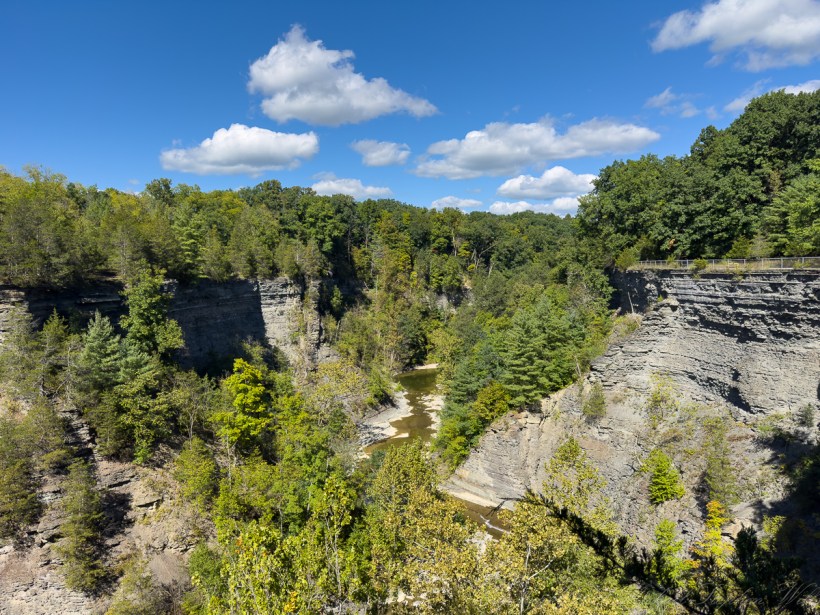
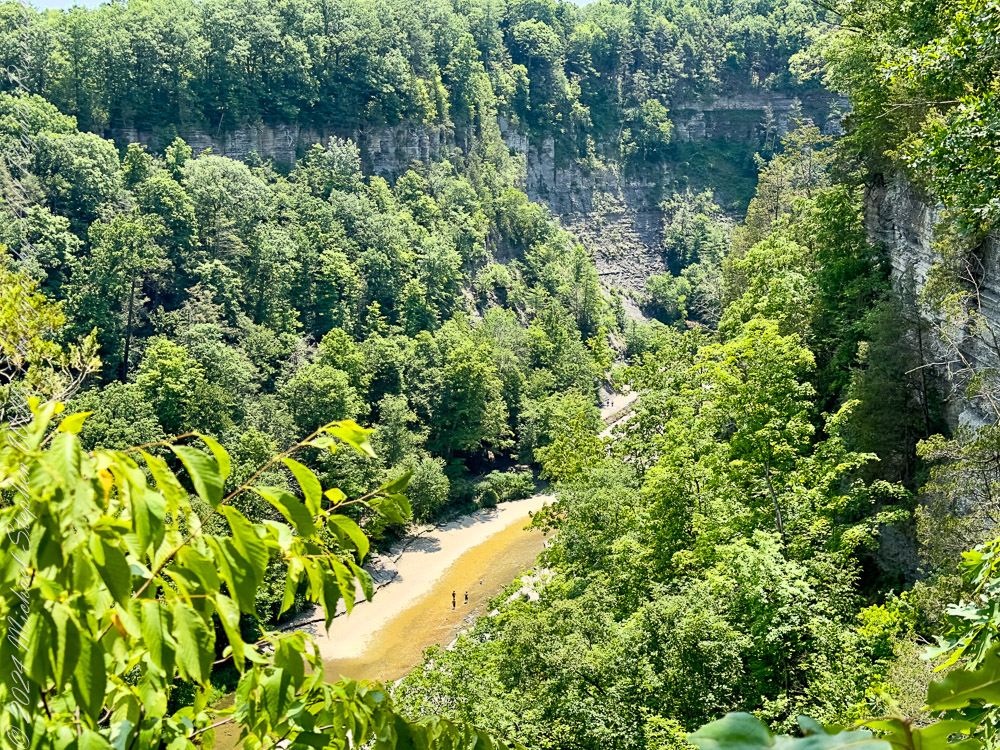
The view from the South Rim Trail. From a walk around Taughannock Falls State Park, down the South rim Trail, up the North Rim Trail. September 14, 2026

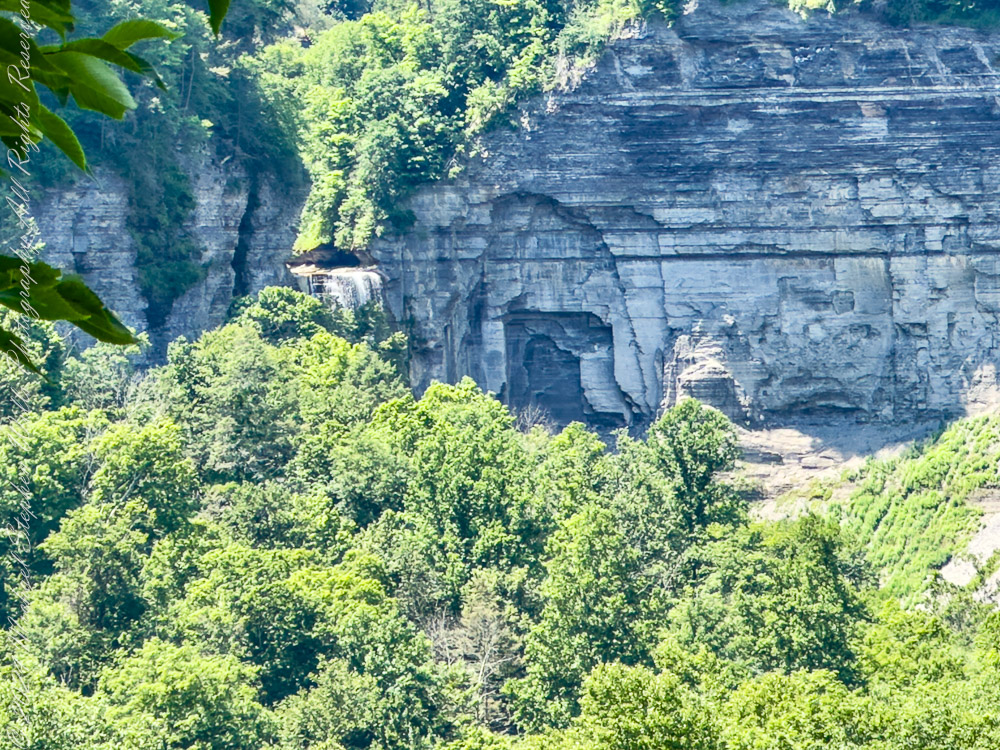
The gorge opened first as architecture: a long cleft of layered stone, inhuman shades of gray, cut by water through an immensity of time. From the rim, the creek below seemed almost modest, a brown-green ribbon moving through a corridor it had patiently made. The cliffs did not appear carved so much as remembered into shape. Bed after bed, ledge after ledge, they held the ancient sea in their faces. The rock seemed written in lines, a ledger of vanished depths, pressure, uplift, frost, collapse, and flow. Trees clung wherever they could. Roots found cracks. Cedars leaned over voids. Hardwood trunks rose from impossible perches, answering stone with leaf.

An extravagant sky above all. This blue, saturated and clean, carried great white clouds across the park like slow, wandering thoughts; too soft for a place so sternly cut by geology. Yet that contrast is part of Taughannock’s power: air and stone, cloud and shale, the brief and the enduring sharing one frame. The clouds drifted without urgency while the gorge below testified to forces that measure themselves in millennia. Standing there, the human mind is pulled in two directions at once—toward the fleeting weather of the day and toward the deep patience of the earth.
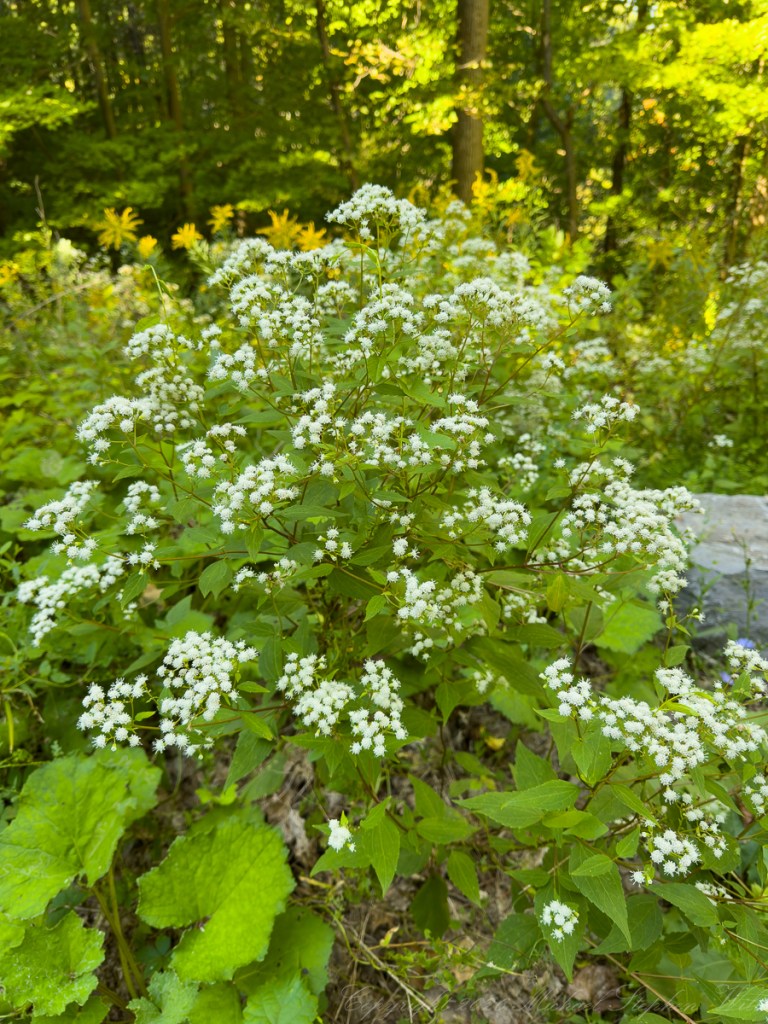
Snakeroot, a poisonous perennial herb

Along the wooded trail, the eye dropped from grandeur to intimacy. White snakeroot bloomed in loose clusters, each tiny flower a small, tufted star gathered into a milky constellation above serrated leaves. Behind it, the forest glowed with the filtered green light of late summer. Goldenrod rose farther back, blurred into warmth. The plants seemed not lesser than the falls or cliffs, only quieter. Requiring a different scale of attention. The gorge overwhelms; the flower invites. One must bend inward to see it properly.
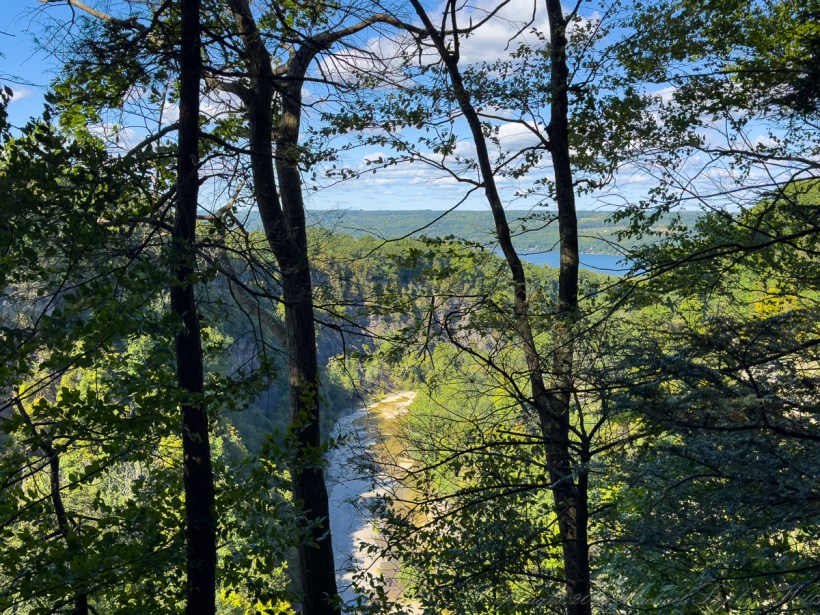
Seen from the South Rim Trail.

Through the trees, Cayuga Lake appeared like a blue promise beyond the gorge. Branches crossed the view in dark strokes, turning the scene into a natural stained-glass window: cliff, water, sky, leaf. The lake lay beyond the ravine’s mouth, broad and reflective, suggesting release after confinement. The creek that had moved through shadow and stone would eventually find that open water. There was comfort in that progression: narrowness giving way to breadth, descent becoming arrival.
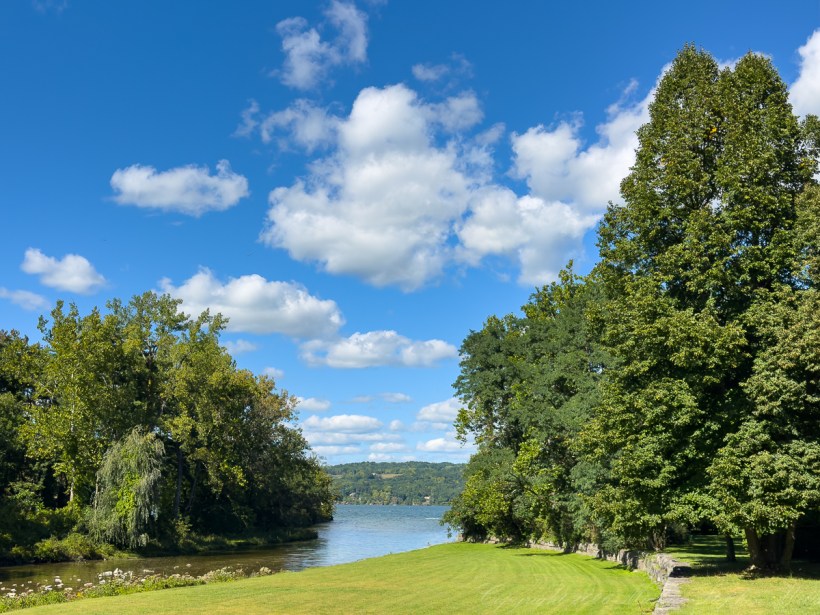
Mouth of Taughannock Creek as it enters Cayuga Lake

At the lakeside, the mood changed again. The same day, the same park, but another world. A green lawn sloped toward the water, bordered by trees heavy with leaves. The lake opened between them, wind-textured and blue-gray beneath the marching clouds. The place felt pastoral after the sternness of the gorge. Here the land breathed easily: gorge cliffs were replaced by open distance, by the far shore softened with trees and scattered houses. The park became a threshold between cultivated calm and wild excavation.
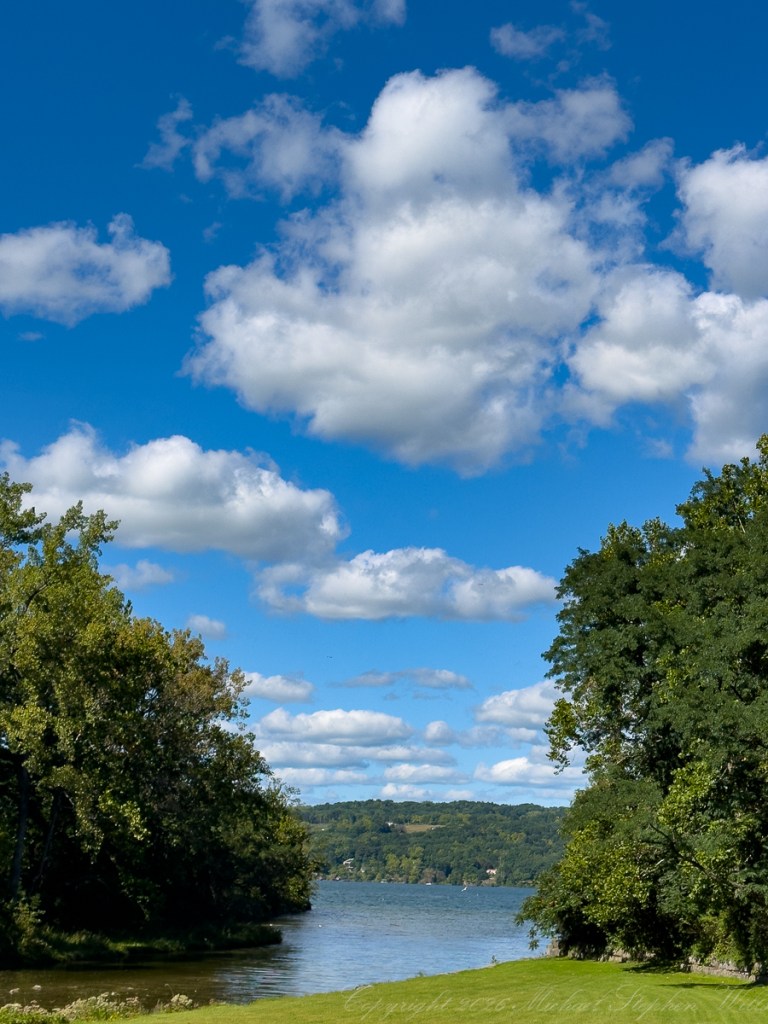
I enjoy the layered effects of clouds.

Then the camera turned upward, giving the sky its own portrait. The clouds took on presence, no longer background but subject—rounded, luminous, casting faint shadows upon themselves. Below them, lake and shore narrowed into a band, as though the world had been rearranged so that sky could speak first. There is a kind of mercy in such a sky. It loosens the mind. It reminds us that even above a gorge, above evidence of erosion and collapse, there is spaciousness.
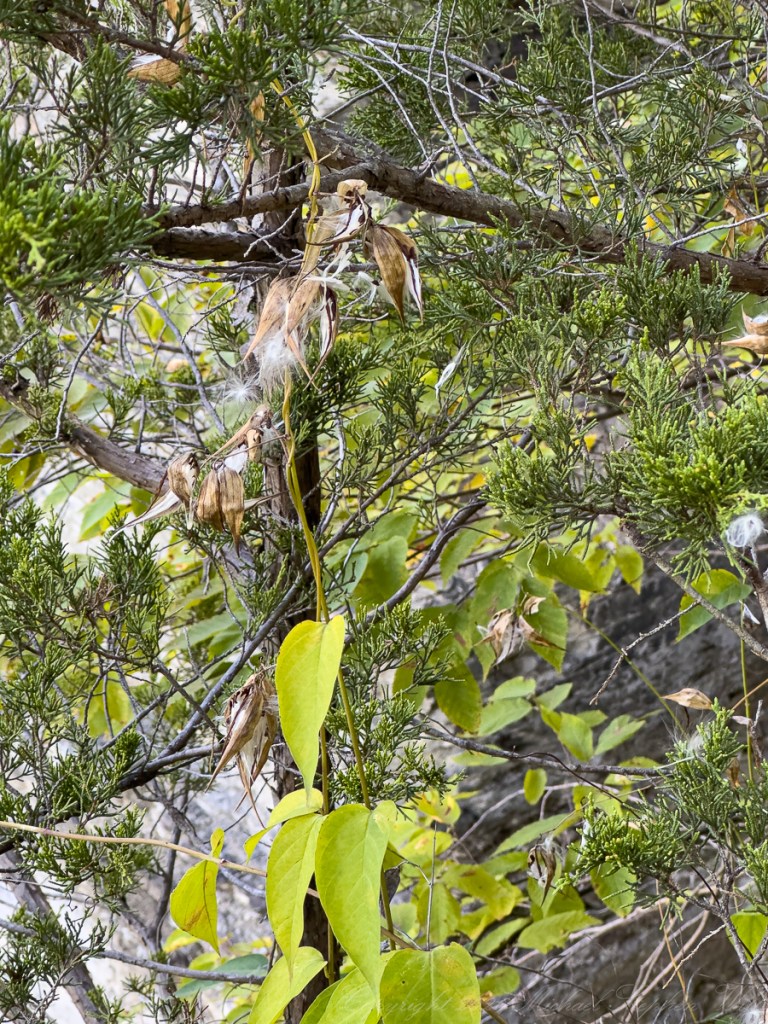
Black Swallow-wort (Vincetoxicum nigrum). Found along the North Rim Trail.

Among the cedars, split pods had released their silk. Pale filaments caught on rough branches and evergreen sprays, small scraps of flight arrested in mid-escape. The pods hung dry and curled, their work nearly done. Seeds that had been hidden were now entrusted to air. This, too, was September’s language: opening, loosening, letting go. Not the dramatic fall of leaves yet, but a subtler surrender. The season had begun to unfasten its clasps.
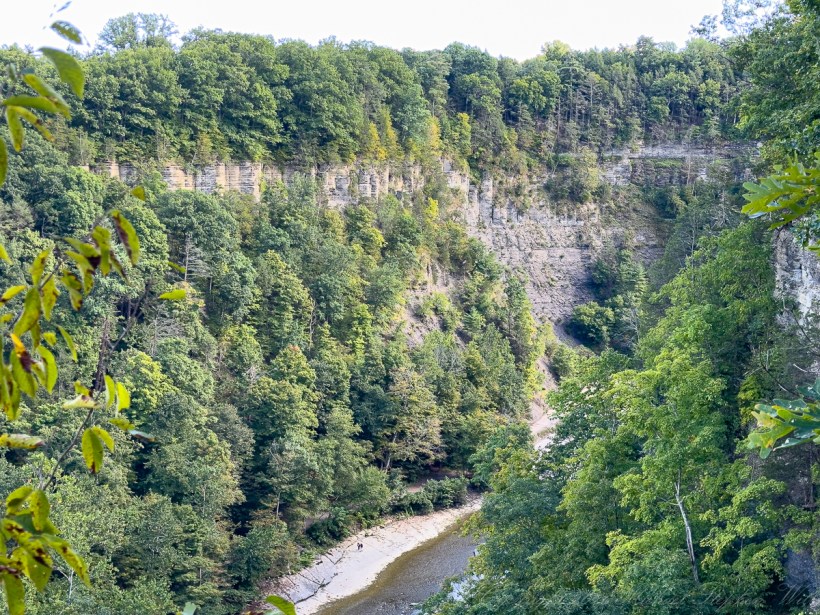
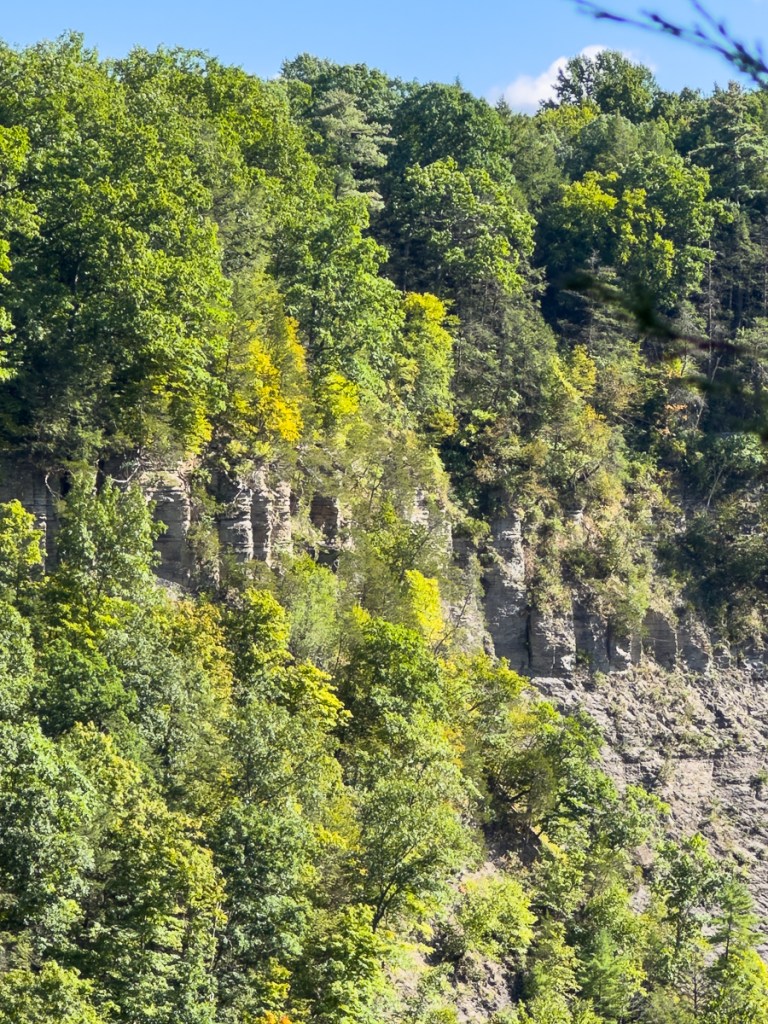
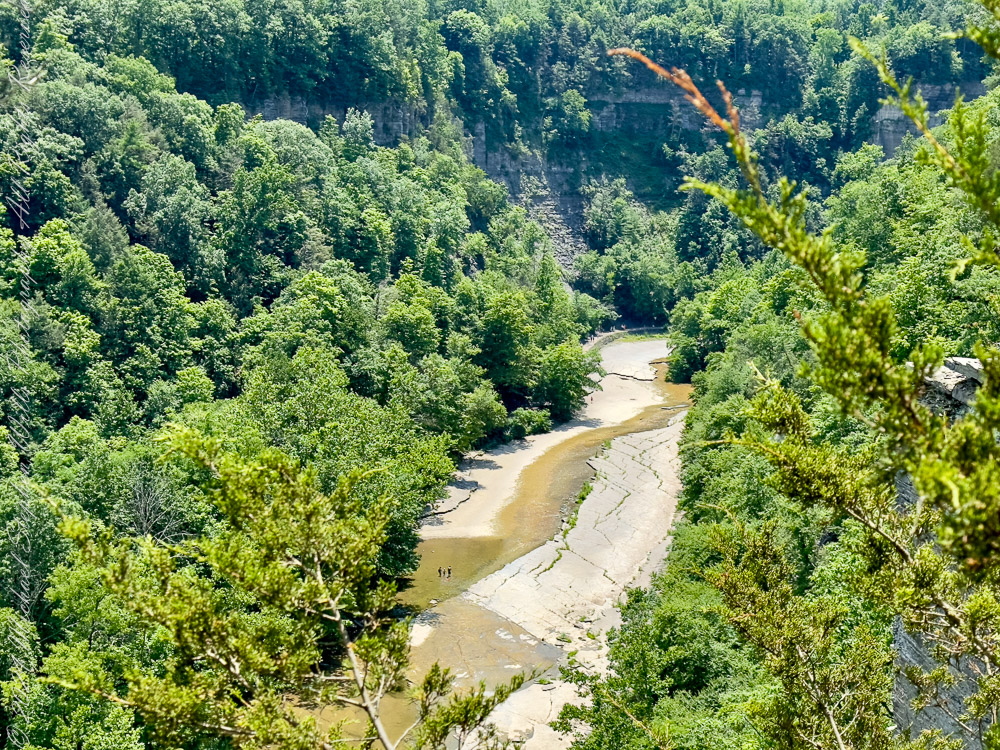
A view from the North Rim Trail.

From another rim view, the gorge wall rose in broken columns and pale faces, half-covered by green. Vegetation softened the precipice but did not conceal it. The cliff remained adamant, a vertical memory of water’s persistence. Far below, the creek bent through bars of exposed stone, and tiny figures on the gorge floor gave scale to the scene. The people were scarcely marks against the immensity, yet their presence mattered. They reminded the eye that wonder is not abstract. Someone stands there, looks up, and receives the place.
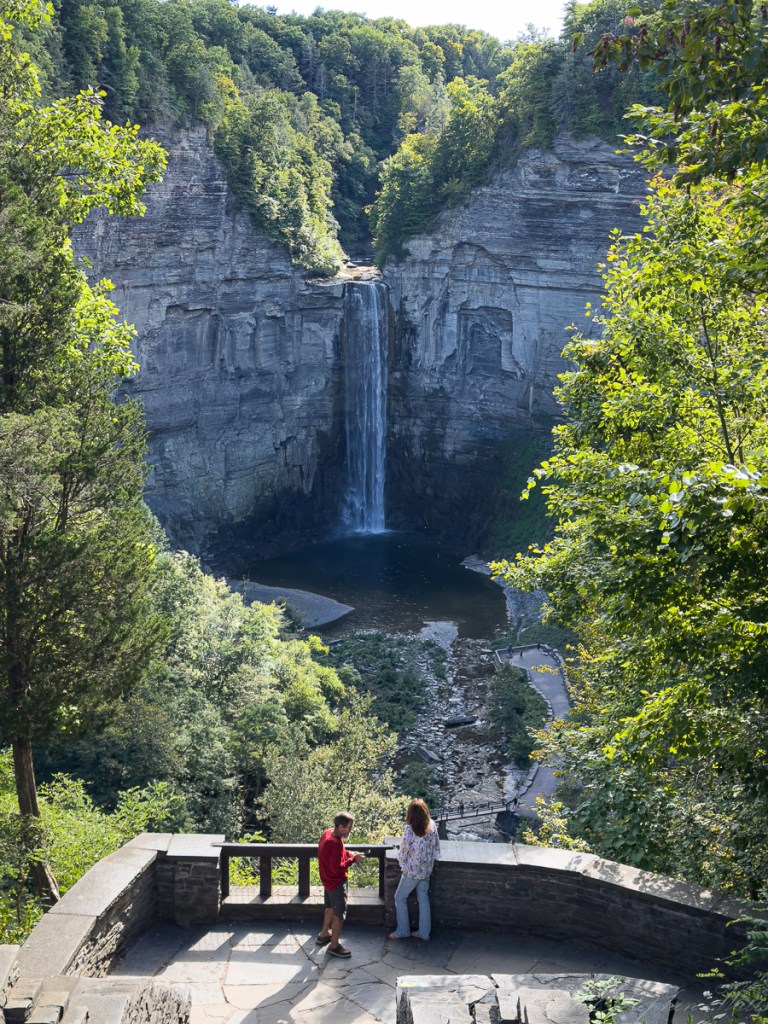
The visitors are on the overlook, in the gorge on the bridge and below the falls.

At the overlook, Taughannock Falls appeared framed by stone and leaf, descending in a long white irrepressible column into the dark basin below. The falls seemed both powerful and delicate, a veil and a force. Water dropped from the high lip in strands, gathered itself in motion, then shattered into mist and sound. Around it, the cliffs bore stains, fractures, alcoves, and ledges—the wounds and ornaments made by time. Layers of visitors receed in the foreground, small and temporary, held for a moment before the great amphitheater.
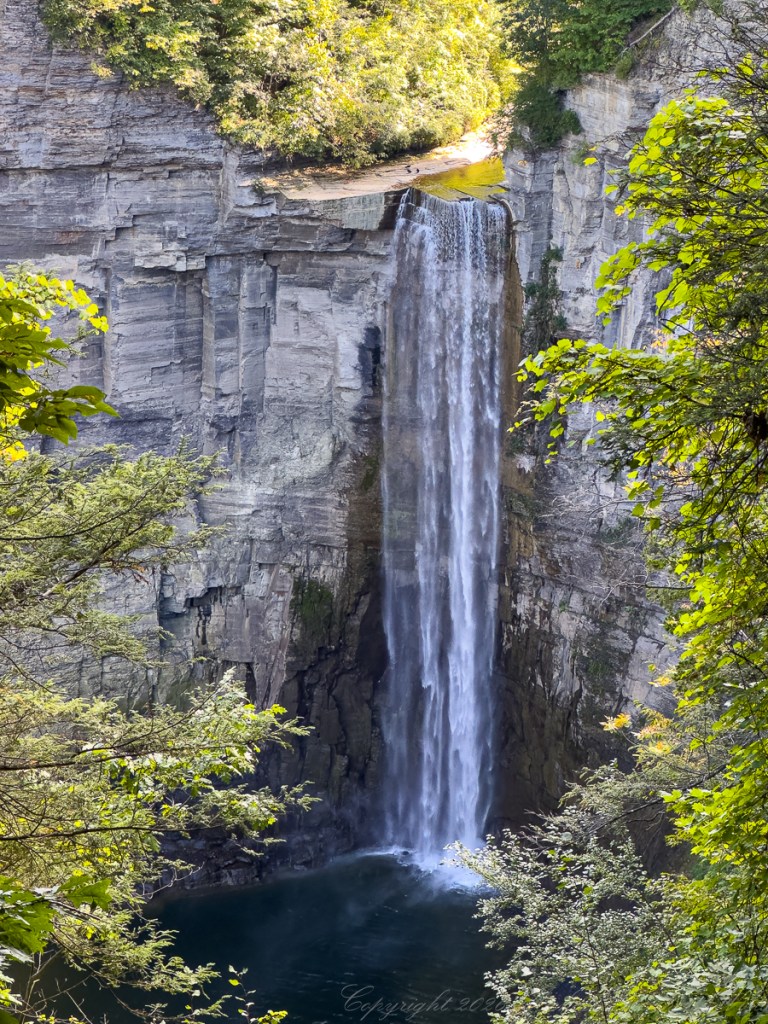
For this view proceed south on the North Rim Trail from the observation area parking. Did you spot the gathering of crows?

Farther along the North Rim Trail, the falls filled the vision. Sunlight touched the rim above; shadow deepened the plunge pool below. The water seemed to fall from brightness into mystery. That is often how memory works: a clear edge, a shining beginning, then a descent into depths we cannot entirely see. Yet the sound continues. The motion continues. The stream that vanishes in shadow reappears downstream, moving toward the lake.

Watch on YouTube for the best experience.

For me, what remains from this walk is a whole sequence: cliff and cloud, snakeroot and seed silk, lake and lawn, distant figures and enduring stone. Taughannock on September 14, 2026, offered no single lesson. It offered a composition of scale. The vast does not cancel the small. The flower belongs beside the gorge. The seed silk belongs beside the falls. The human figure belongs, briefly, gratefully, at the overlook.

By God’s Grace the water keeps falling.
Click me to visit Michael Stephen Wills Online Finger Lakes Gallery.

Enter your email to receive notification of future postings. I will not sell or share your email address.

Taughannock Falls State Park: A Geological and Ecological Marvel

Taughannock Falls, a majestic 215-foot waterfall, showcases nature’s beauty and power, intertwining geological history with vibrant ecosystems in New York.


Introduction
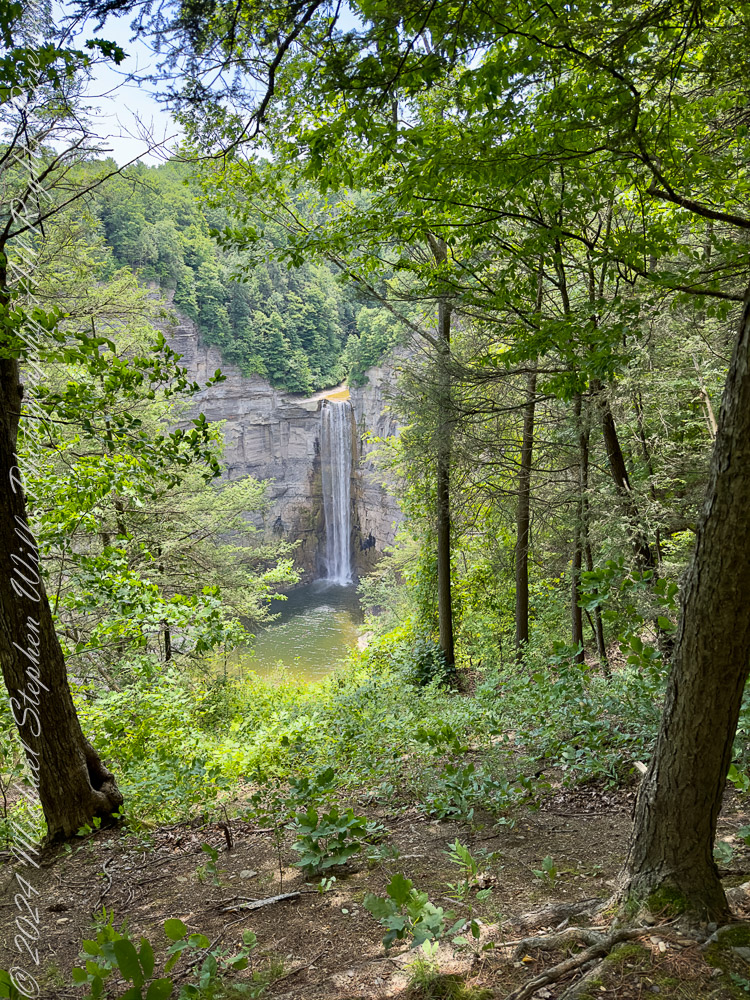
Nestled in the heart of the Finger Lakes region of New York, Taughannock Falls stands as a testament to the delicate balance of power and beauty in nature. This iconic waterfall plunges 215 feet—one of the tallest single-drop waterfalls east of the Rocky Mountains—into a gorge whose story is written in stone. The park surrounding this natural wonder offers a symphony of sights, from towering cliffs to lush greenery, inviting visitors to explore its ancient secrets and vibrant life.

View of taughannock Falls from the South Rim Trail. Taughannock Falls New York State Park, Trumansburg, Tompkins County, Finger Lakes Region

A Story Written in Stone
The rocks of Taughannock Falls tell a story that stretches back 380 million years to the Devonian Period, a time when the region was submerged beneath a shallow inland sea. Layer upon layer of shale, sandstone, and limestone formed as sediment settled to the ocean floor, preserving the fossils of marine life that once thrived here. These rocks have endured the passage of eons, but the gorge itself is a far more recent creation.

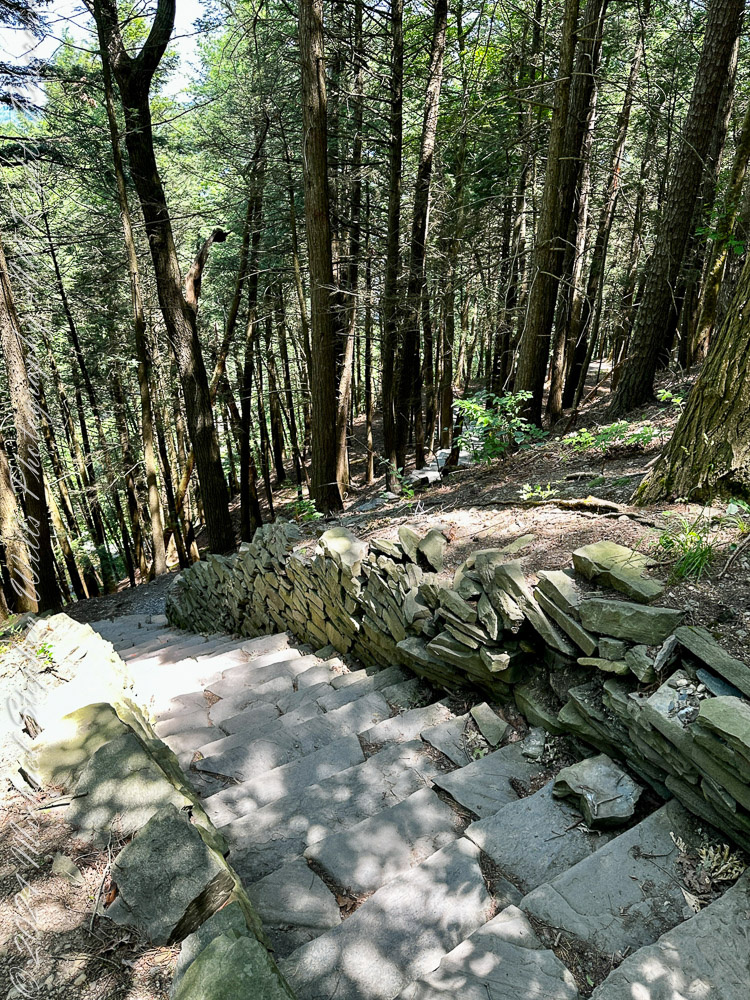
Limestone Steps on the South Rim Trail descend to the gorge floor.

It was the retreat of the mighty Laurentide Ice Sheet, approximately 10,000 years ago, that set the stage for Taughannock’s grandeur. As glaciers melted, torrents of water carved the U-shaped valleys that now cradle the Finger Lakes. Taughannock Creek, a tributary of Cayuga Lake, began its work, etching its path through ancient rock, sculpting the gorge we see today. In just 10,000 years—a fleeting moment in geological time—the relentless force of water carved its way 3/4 of a mile upstream, creating the awe-inspiring chasm and waterfall that continue to evolve even now.

Taughannock Creek carved this landscape over thousands of years.

The Gorge’s Living Tapestry
Beyond its geological wonders, Taughannock Falls State Park bursts with life. Along the North and South Rim Trails, Eastern Hemlocks (Tsuga canadensis) stand tall, their evergreen branches weaving shadows that dance across stone stairways and forest floors. These silent sentinels are habitats for myriad creatures and protectors of the delicate ecosystem.

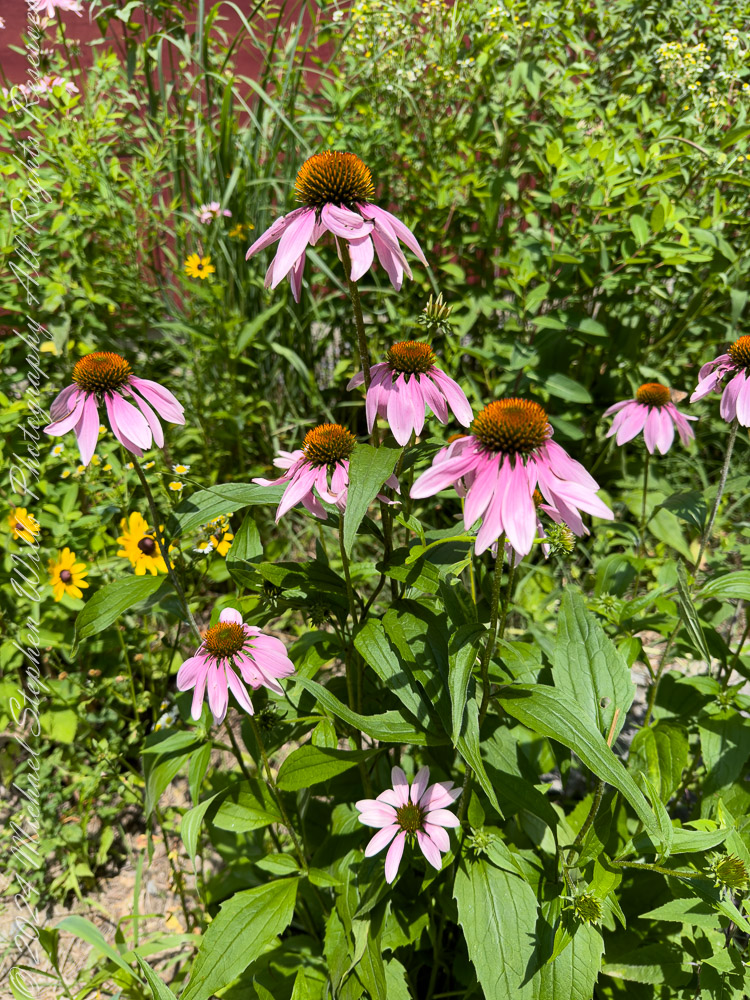
Wildflowers were planted by park staff at the Falls Overlook. The bright yellow of Black-eyed Susans (Rudbeckia hirta) and the vibrant purple of Coneflowers (Echinacea purpurea) attract bees and butterflies, their nectar fueling the intricate web of life that thrives here. Along the trail, on the forest floor, mosses and ferns cling to rocks, softening the edges of the gorge with their verdant touch.

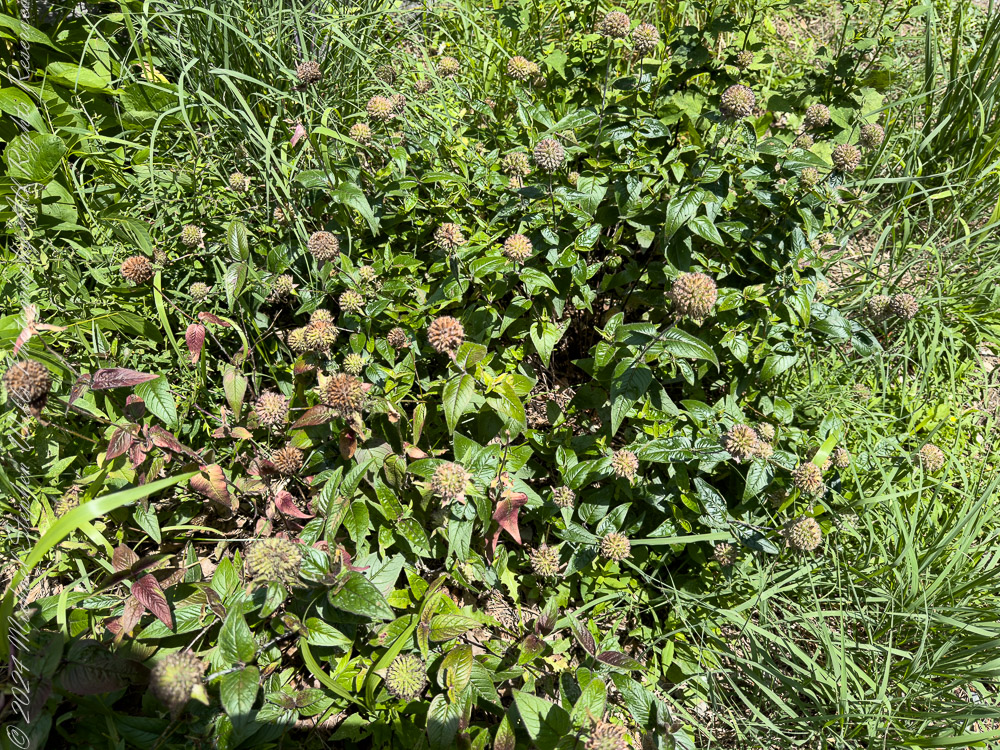
Cone Flowers
Cone Flowers gone to seed
From a walk around Taughannock Falls State Park “Rim Trails” October 22nd, 2024. Trumansburg, Tompkins County, Finger Lakes Region, New York State.

The Fall’s Eternal Dance
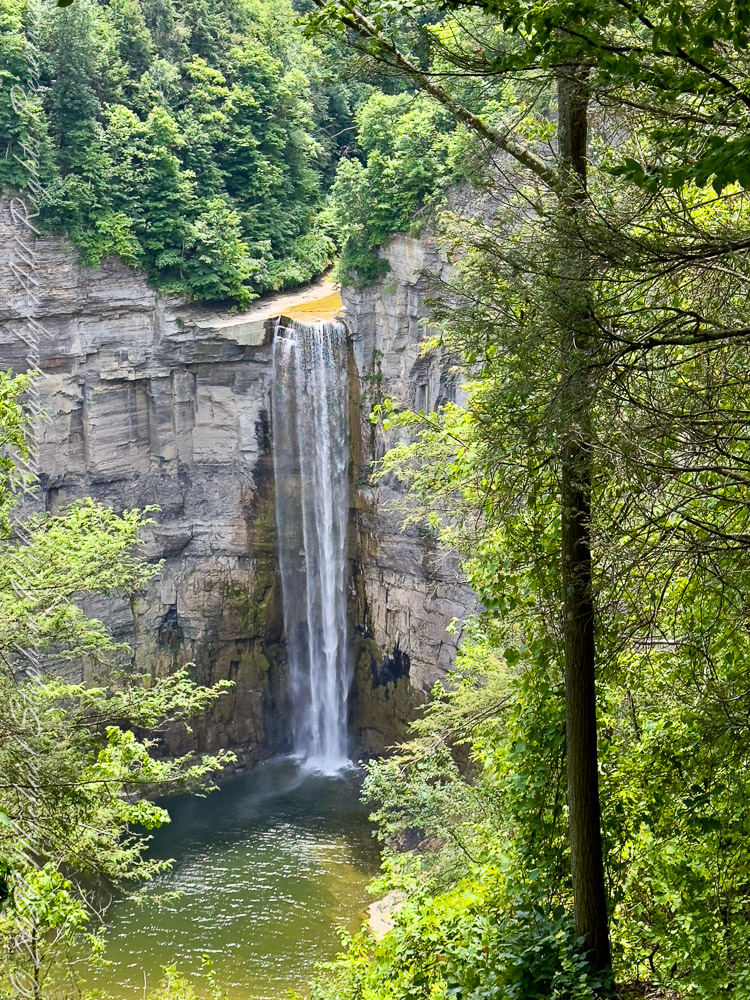
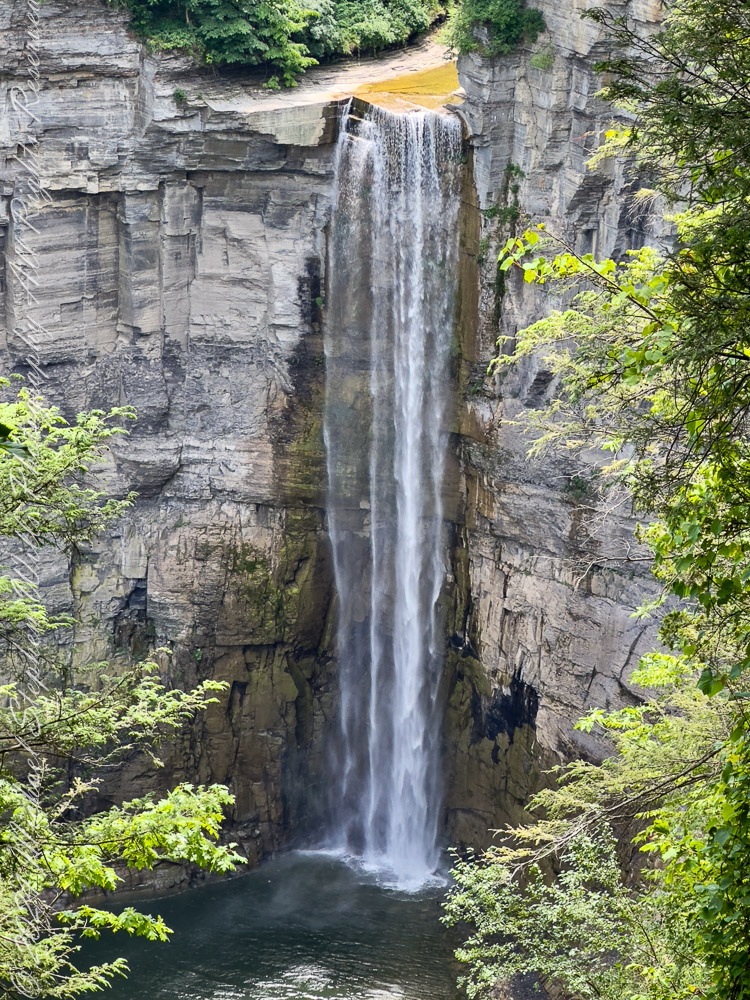
At the heart of the park is the waterfall itself, its roar both a hymn and a whisper of time’s passage. The view from the North Rim Trail reveals the waterfall framed by steep cliffs, their striations like pages in a book written by water, wind, and time. The plunge pool below, shimmering in sunlight, seems almost sacred—a place where the forces of nature meet in harmony.

Viewed from the North Rim Trail on a summer morning. Taughannock Falls New York State Park, Trumansburg, Tompkins County, Finger Lakes Region

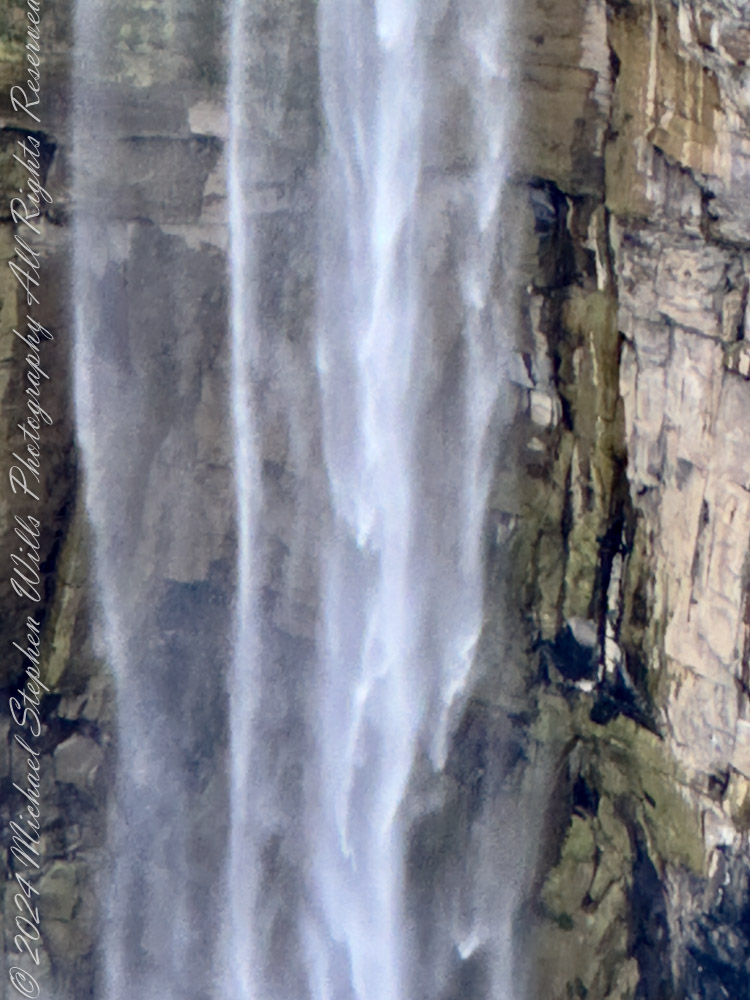
Even as we marvel at its beauty, the falls are a reminder of the earth’s constant transformation. Each drop of water that cascades down the cliff face carries away tiny fragments of rock, continuing the slow, deliberate work of reshaping the land. What we witness today is but one moment in an ongoing process—a fleeting glimpse of a masterpiece in progress.

A Place of Wonder
To stand at the edge of Taughannock Falls is to feel both small and connected. The cliffs, formed over hundreds of millions of years, whisper of ancient seas and forgotten worlds. The gorge, carved in the blink of an eye by geological standards, speaks to the power of water and time. And the vibrant life that fills the park reminds us of nature’s resilience and beauty.

As the sun filters through the trees, illuminating the mist that rises from the falls, it’s easy to believe that this place holds magic. Perhaps it’s in the way the water sparkles like diamonds in the sunlight or the way the breeze carries the scent of pine and earth. Or maybe it’s in the knowledge that here, in this park, we are witnesses to a story billions of years in the making.

Conclusion
Taughannock Falls State Park is a place of wonder where geology, ecology, and history converge. It invites us to reflect on the immense forces that shape our world and to cherish the fleeting beauty of each moment. Whether you come to marvel at the towering waterfall, walk among the hemlocks, or simply stand in awe of the gorge, Taughannock Falls leaves an indelible mark on the heart—a reminder of nature’s power, resilience, and enduring grace.

Enter your email to receive notification of future postings. I will not sell or share your email address.

Erosion and Beauty: Cocoa Beach’s Sand Sculptures

At Cocoa Beach, sand castles succumb to time, showcasing beauty in decay, while desert monoliths endure. Both narratives reveal nature’s artistry through impermanence and transformation.

On the shores of Cocoa Beach, where the January winds dance freely, the once-proud towers of sand now stand humbled. What was sculpted by human hands—carefully packed and shaped with laughter—has become a relic of its former grandeur. The wind, with its gentle yet relentless touch, carves away at their edges, smoothing and softening their once-crisp lines. The castles, now mere echoes of their original form, hold a quiet dignity in their decay. Impermanence is their fate.

Cocoa Beach, Brevard County, Florida, Space Coast, January 2025

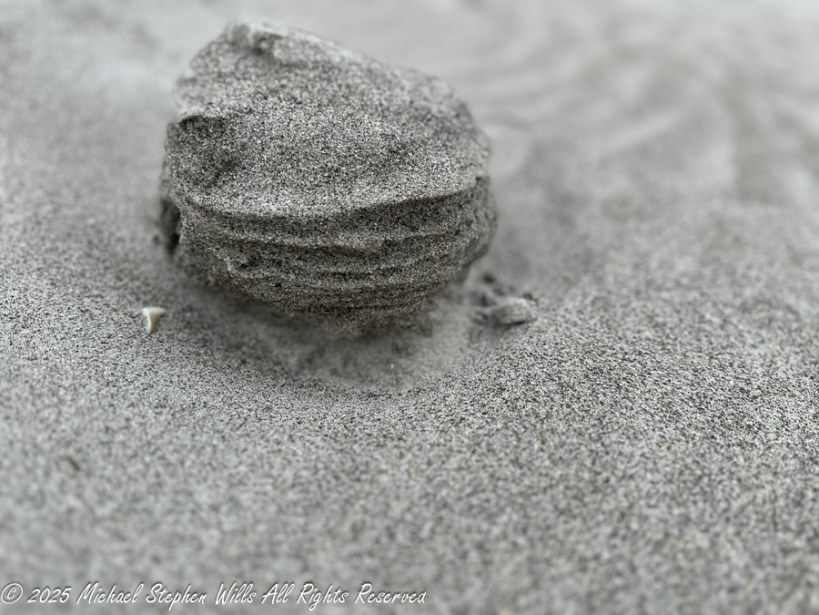
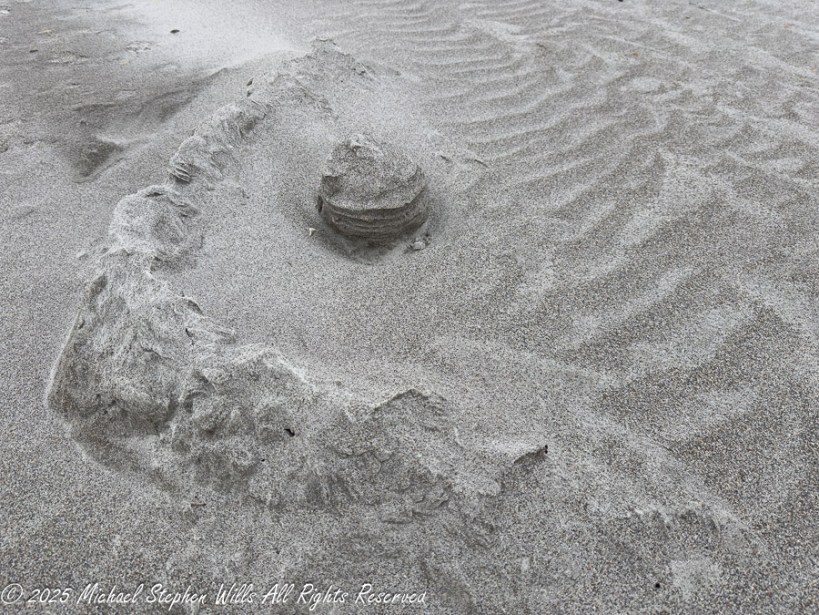
In the first photograph, the remnants of a sand fortress curve in a gentle arc, protecting a lone pillar—perhaps the last bastion of a crumbling empire. The textures of wind-blown ridges ripple across the sand like waves frozen in time, whispering of the invisible forces that shape the land. The delicate striations of the eroded peak, captured in close detail in the second image, reveal the layers of creation and destruction, each grain bearing witness to the ceaseless march of time.

Cocoa Beach, Brevard County, Florida, Space Coast, January 2025

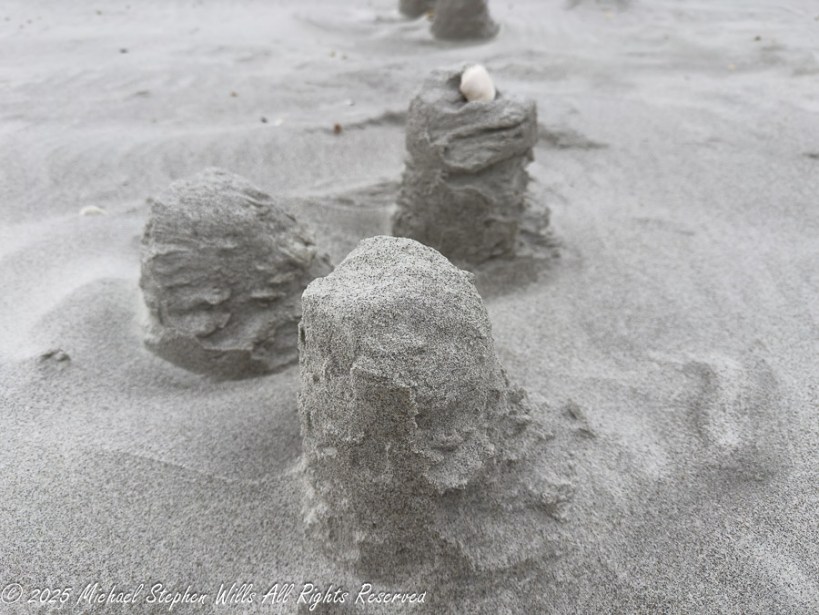
The third image brings a sense of companionship to this landscape of change. Like silent sentinels, the remaining sand pillars stand together, weathered but resolute. One wears a crown of a single shell—a reminder that even in the face of erosion, beauty persists. These fleeting structures, built in joy, now bow to nature’s artistry, embracing the inevitable with quiet grace.

Cocoa Beach, Brevard County, Florida, Space Coast, January 2025

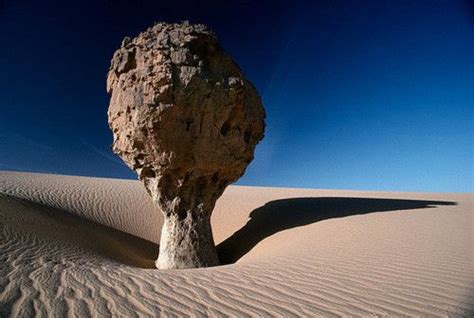
And yet, beyond the gentle shores of Cocoa Beach, in the vast and timeless expanse of the Sahara Desert, wind-carved monoliths stand as testament to the power of patience. The fourth photograph—an imposing formation shaped by millennia of desert winds—towers over the golden dunes, its shadow stretching far into the sands. Where the beach’s castles fall in a day, the desert’s sculptures endure for centuries, silent witnesses to the ebb and flow of time on a grander scale.

Wind carved geological formation, Sahara desert. Credit “scraped from the web”

But are they so different? Whether in the fleeting impermanence of Cocoa Beach or the enduring vastness of the Sahara, the hand of the wind shapes all things. Each formation tells the same story—of creation, of erosion, and of transformation. They whisper to us that beauty is not defined by permanence, but by the dance between time and the elements.

As the sun sets over the beach, casting long shadows across the sand, one cannot help but marvel at the artistry of nature. Whether lasting an afternoon or an age, the sculptures of wind and sand remind us that all things are in motion, and every grain, every ripple, every fleeting moment holds a story waiting to be told.

Enter your email to receive notification of future postings. I will not sell or share your email address.

A Dance of Light and Sand in Antelope Canyon

Antelope Canyon, a sacred space in the Navajo Nation, reveals the dance of light and sand within its ancient walls. The interplay of erosion and transformation highlights beauty in impermanence, emphasizing patience and reverence for nature’s ever-changing essence.

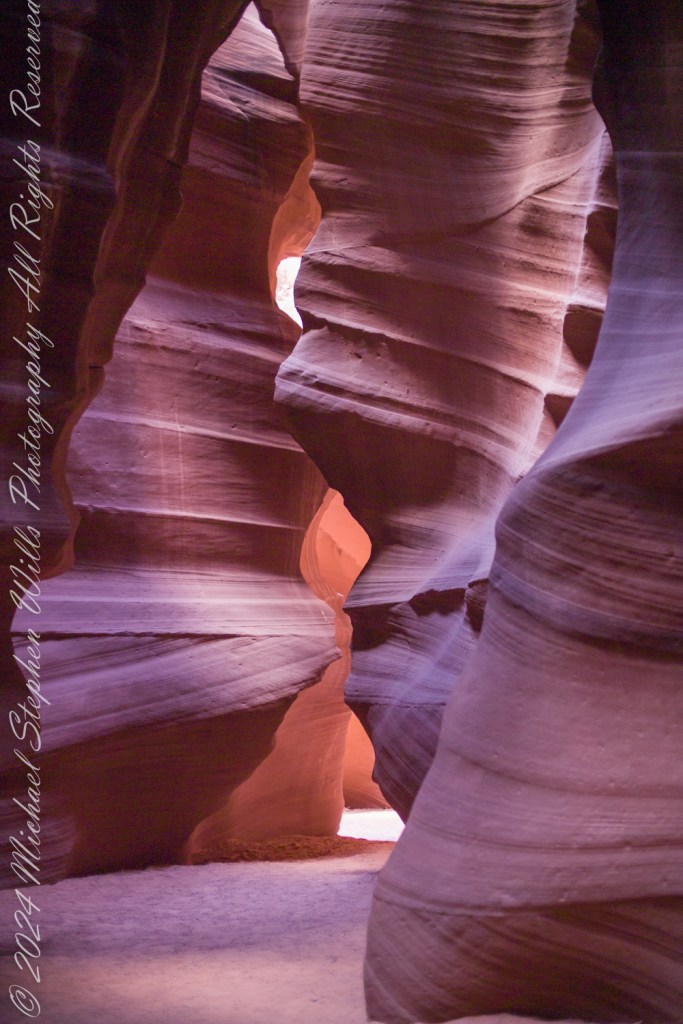
Enveloped by shadows and light in the stillness of Antelope Canyon the air carries silence—vast and ancient—interrupted only by the whispers of grains shifting under unseen currents. Here the red rock of the northwestern corner of the Navajo Nation was pulverized into sand by the action of wind, water, sun, and cold. The walls, carved by patient time, cradle the moment as if holding a sacred breath.

Antelope Canyon is in the Navajo Nation near Page, Coconino County, Arizona

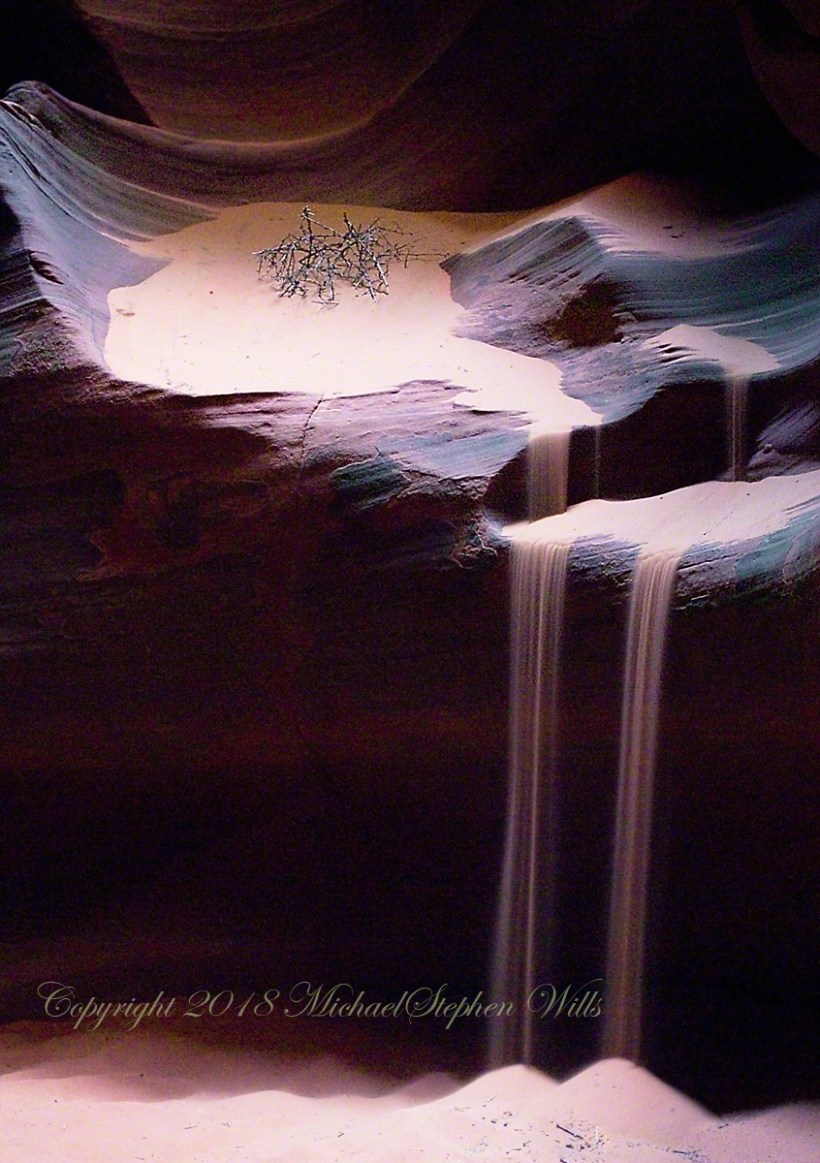
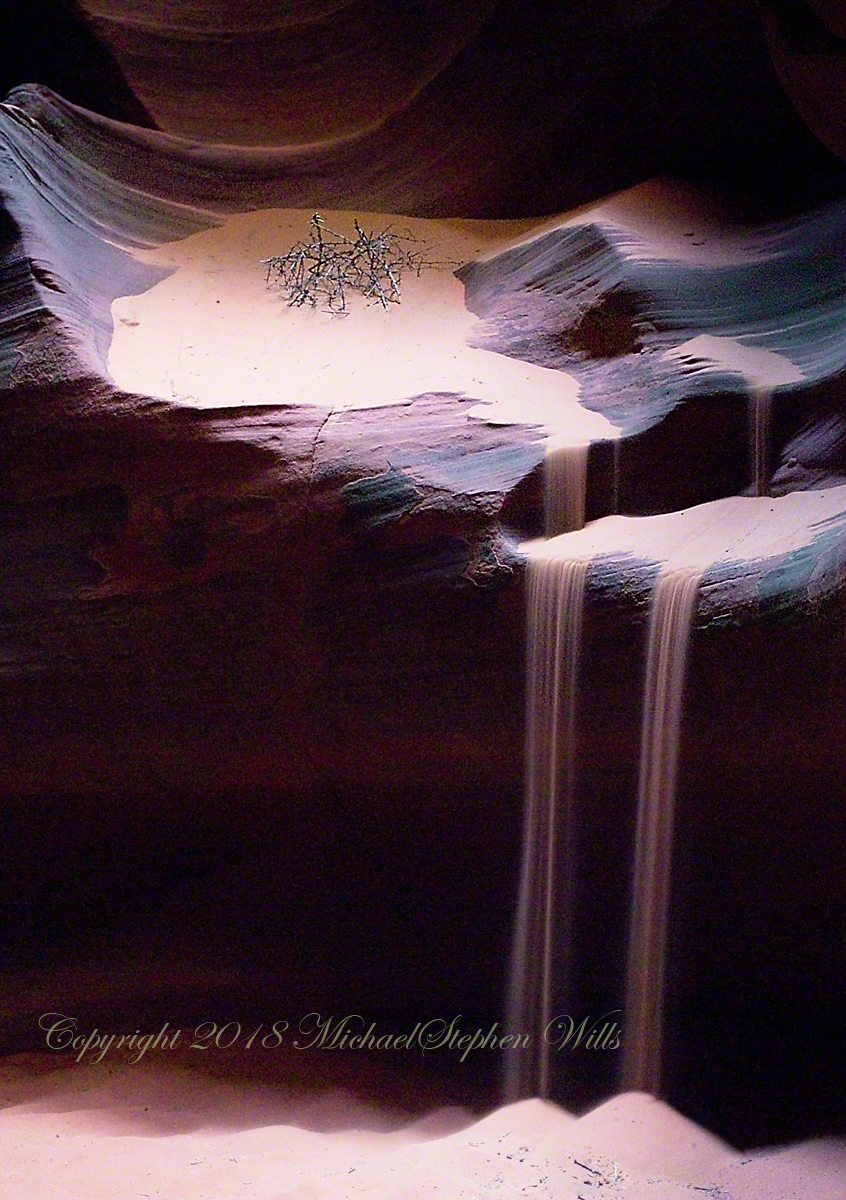
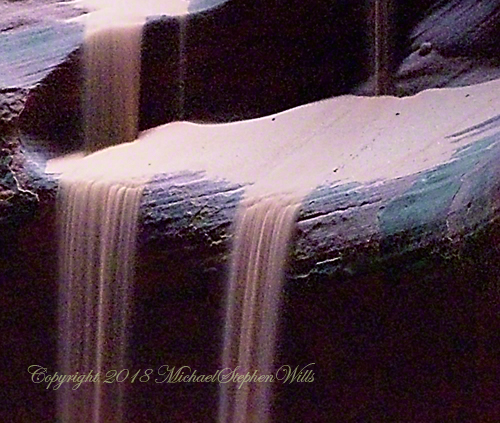
Antelope Canyon, timeless and transient, has summoned me to witness something unique—a dance between light and matter. The delicate, insistent sand flows like water from a carved bench, shaping the scene with quiet power. It tumbles as if alive, forming ephemeral cascades, revealing that erosion is not destruction but transformation. Each grain a story—a fragment of the ages, polished smooth by untold moments of pressure and release.

A Slot of Shadows and Light


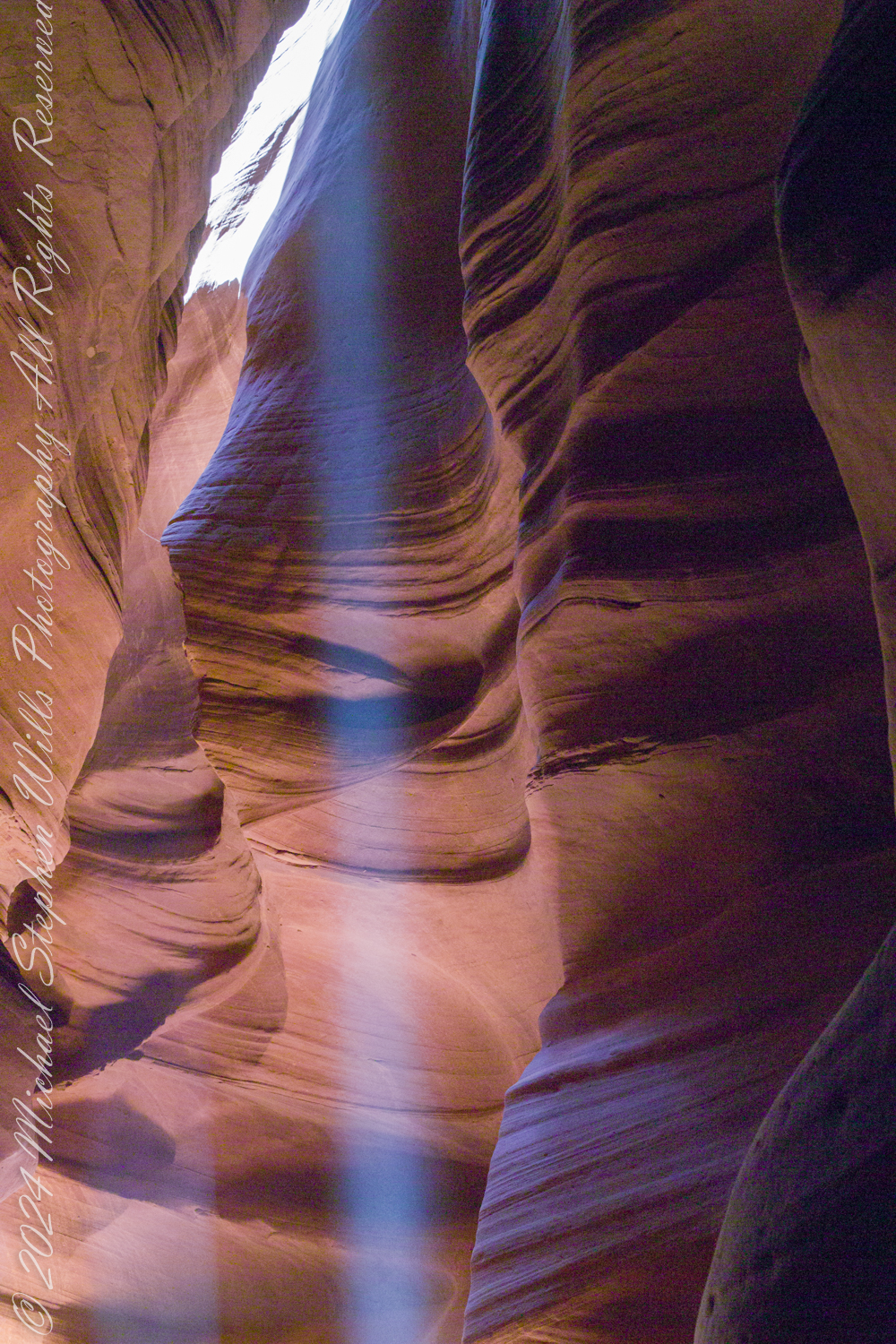
I wait in the dry darkness of upper Antelope Canyon for the perfect moment to capture the spirit of the place. Light penetrates the narrow slot above, a thin beam spilling through the crevice, drawn by something deep below. In this confined space, sunlight becomes an entity. It touches the red sand and animates the space, revealing stone textures and the fleeting movement of sand in freefall.

Antelope Canyon is in the Navajo Nation near Page, Coconino County, Arizona

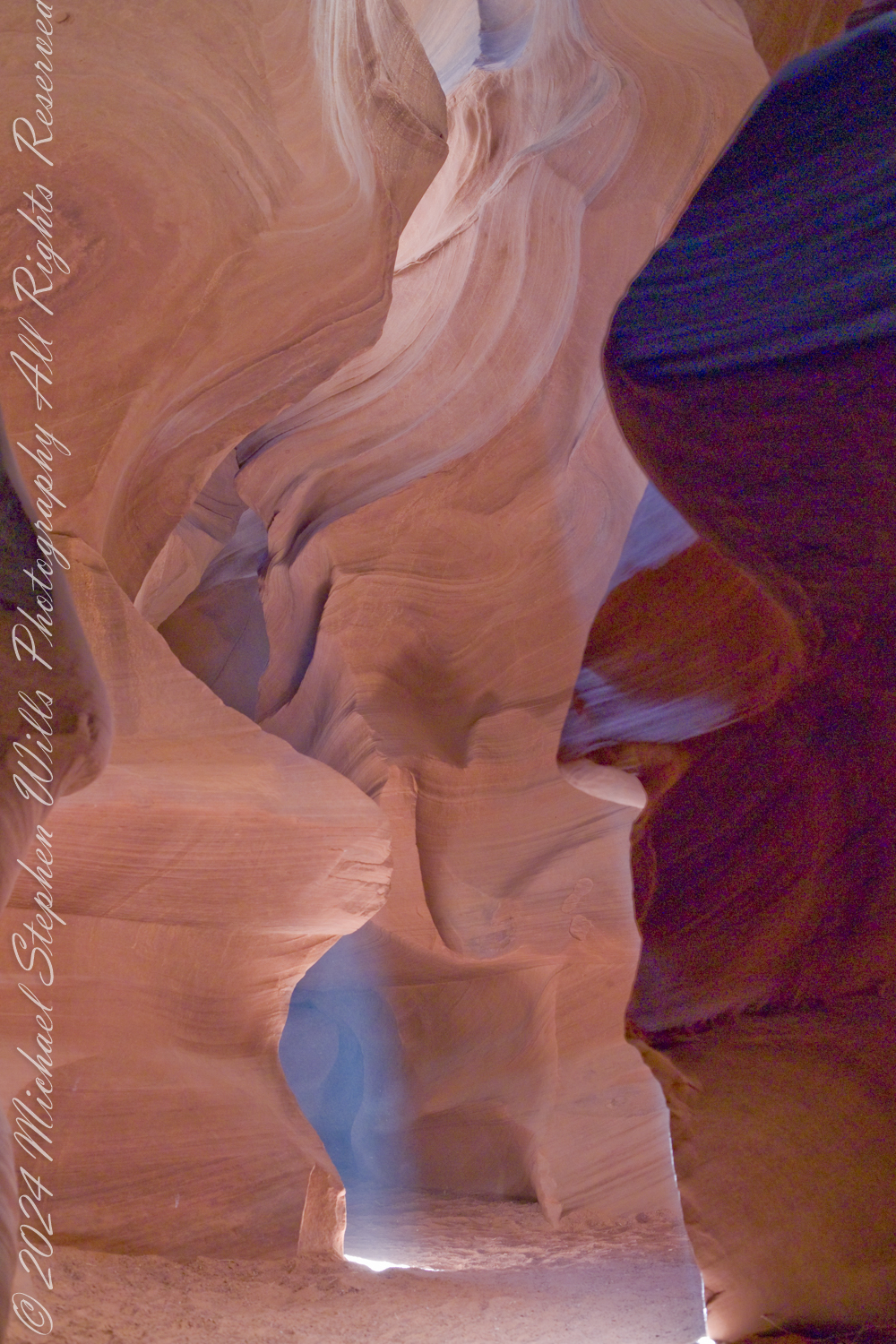
The play between dark and light reminds me that beauty often lies in contrast. The polished walls that surround me were once jagged, raw stone. They have become smooth under nature’s relentless touch—proof that endurance shapes elegance. The canyon’s walls, though fixed in place, seem to sigh as the sand slips over them, embodying a paradox of permanence and impermanence.

An Elemental Meditation


I am a visitor as well as part of a conversation held in languages older than words—spoken by rock, sand, shadow, and light. I sense the ancient stories etched into the stone and carried within each grain that spills like an hourglass. Here, nothing is wasted; everything contributes to a continuous process of becoming. The sand, which once formed the walls, now shapes the canyon floor, each element recycling into the next chapter of this landscape’s life.

Antelope Canyon is in the Navajo Nation near Page, Coconino County, Arizona

The act of waiting for a right moment teaches me that patience is both passive and an active engagement with time. I am reminded that what I witness will never be exactly the same again. Even though the canyon may stand for millennia, each second contains a uniqueness. The sand cascading before my eyes will settle, be disturbed, and flow again—but never in quite the same way.

Capturing the Spirit of Place


I set the camera on a rented tripod, knowing photography is an imperfect attempt to hold onto what cannot be possessed. This place does not belong to me—it belongs to itself, shaped by forces far greater than any human hand. My role is not to own the scene but to honor it, to acknowledge its fleeting magnificence by framing a moment within the lens.

The shutter clicks, the cascade of sand becomes immortalized held in that instant. Yet I know that the photograph, while capturing the image, will not fully encompass the spirit of what I have experienced. This place is a meditation, a reminder that life itself flows in ways we cannot control. Like the red sand, we are carried by forces—sometimes gentle, sometimes fierce—shaping and reshaping us through time.

As I gaze at the sand, a quiet sense of reverence flows through me. This moment, like the grains tumbling in front of me, is already slipping into the past. But in its passing, it leaves behind something intangible yet enduring—a memory of beauty found not in permanence but in change.

Click this link for my Fine Art Photography gallery.

Click this link for another Arizona post, “A Dry Piece of Paradise.”

Enter your email to receive notification of future postings. I will not sell or share your email address.

Treman Early Autumn Walk VII

Unnamed though memorable

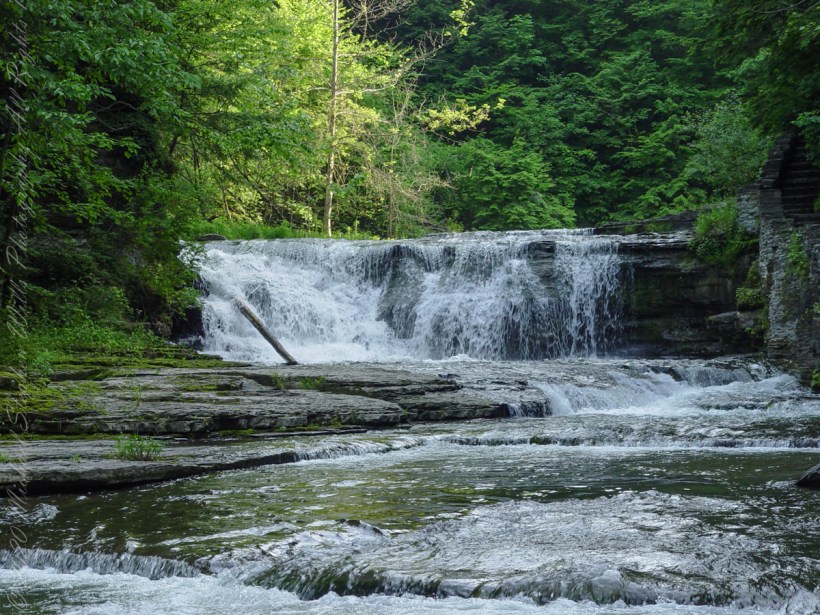
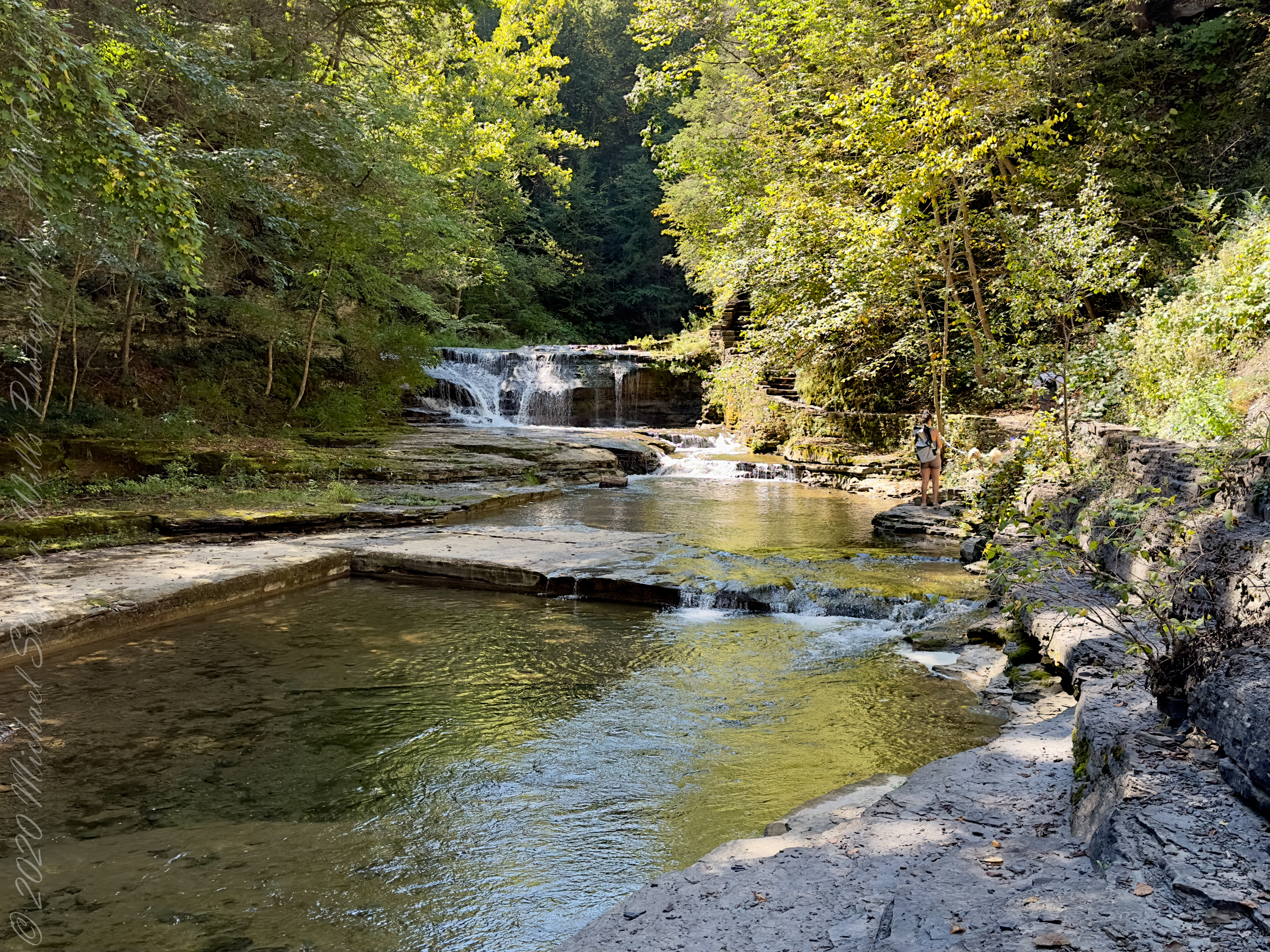
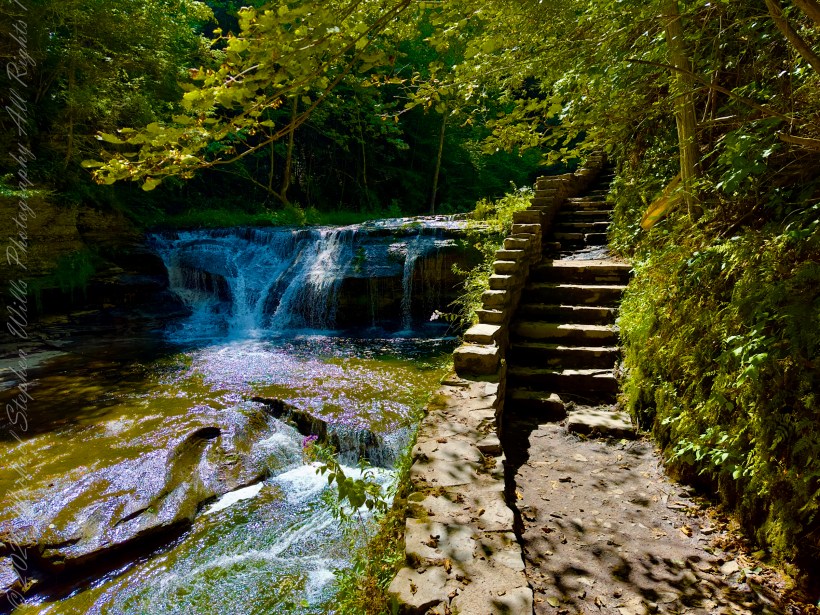
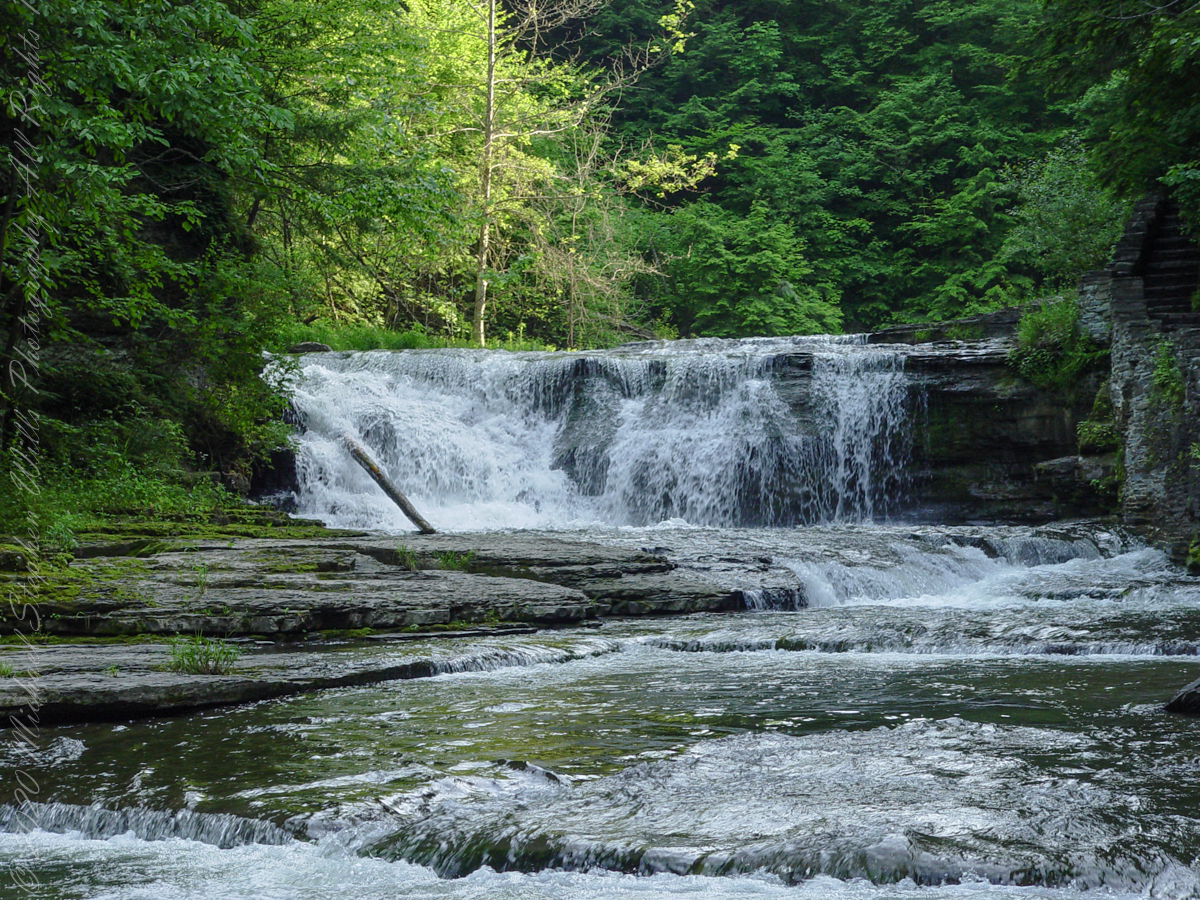
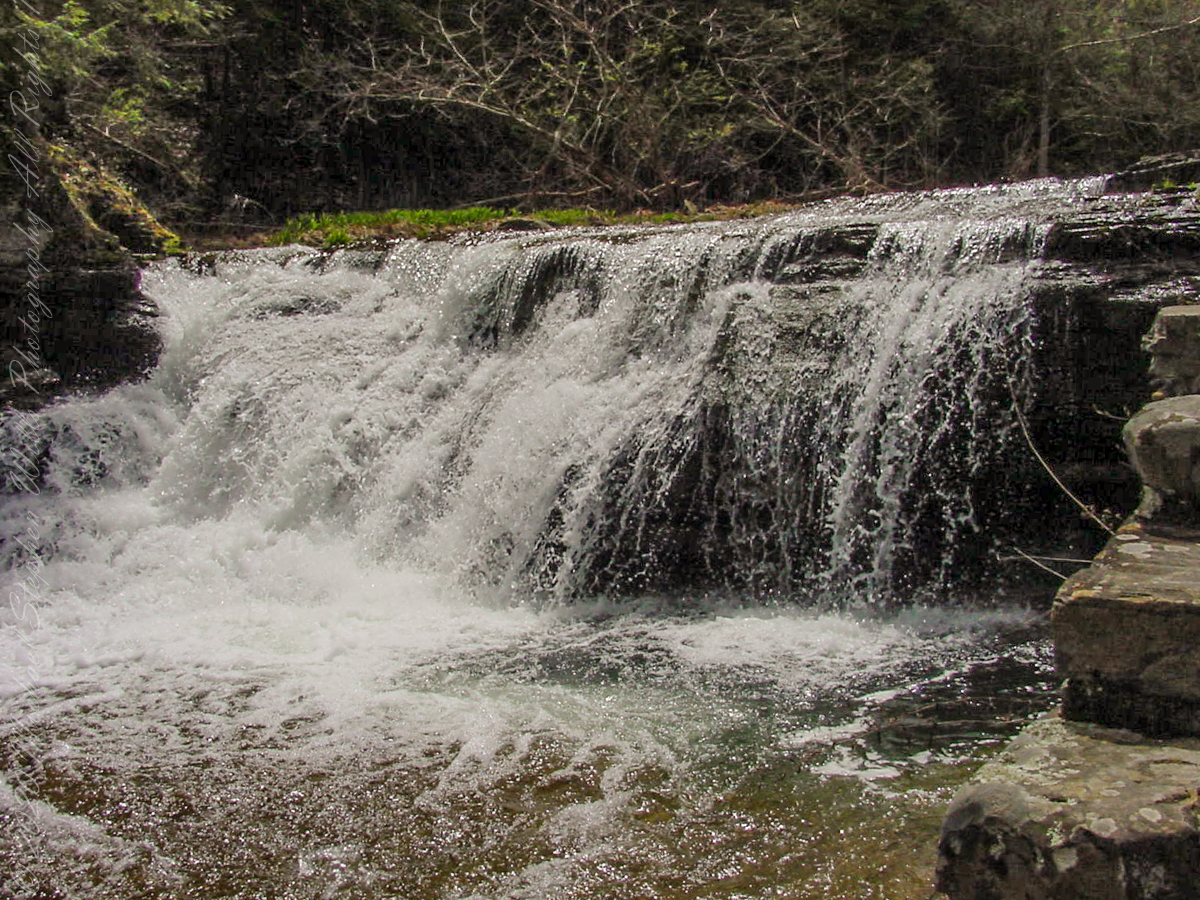
An unnamed waterfall along the Gorge Trail is memorable for the steps alongside.

I have captured it in all seasons from the beginning of my photography interest. Here it is at midday, early autumn, 2023, taken with the Apple Iphone 14 proMax. Bright sunlight ruins the shot.

Here, evening, early summer 2003, the foreground shaded, late day sunlight on trees beyond. The Sony dsc F828 camera, on a tripod, was used.

Here, bright sunlight at midday is handled by framing the brightly lit waterfall, April, 2002. A handheld Sony Mavica was used.

Daring visitors jump from the wall at right into a plunge pool, seen here as the quiet water at base of wall. It is a doubly dangerous activity as the force of water can hold a swimmer under indefinitely, missing the narrow pool results in striking the rocks. Robert H. Treman New York State Park, Tompkins County, Ithaca, New York.

“Plunge pools are formed by the natural force of falling water, such as at a waterfall or cascade; they also result from man-made structures such as some spillway designs. Plunge pools are often very deep, generally related to the height of fall, the volume of water, the resistance of the rock below the pool and other factors.[4] The impacting and swirling water, sometimes carrying rocks within it, abrades the riverbed into a basin, which often features rough and irregular sides. Plunge pools can remain long after the waterfall has ceased flow or the stream has been diverted. Several examples of former plunge pools exist at Dry Falls in the Channeled Scablands of eastern Washington. They can also be found underwater in areas that were formerly above sea level, for example Perth Canyon off the coast of Western Australia.”

“Plunge pools are fluvial features of erosion which occur in the youthful stage of river development, characterized by steeper gradients and faster water flows. Where softer or fractured rock has been eroded back to a knickpoint, water continues to bombard its base. Because this rock is often less resistant than overlying strata, the water from the higher elevation continues eroding downward until an equilibrium is achieved.”

Reference: text in italics and quotes is from the Wikipedia, “Plunge Pool.”

Copyright 2023 All Rights Reserved Michael Stephen Wills