Among the Trees: Encountering Treman State Park’s Enfield Falls in Autumn

For years, I admired a distant waterfall on Enfield Creek. This autumn, a newly discovered path revealed its hidden beauty, cascading waters, and remarkable geological character.

From a distance, the waterfall is a glimmer among the trees. Across a broad stretch of grasses and low shrubs, Enfield Creek folds into a wooded hollow, where water tumbled over a series of rock ledges. In autumn, the surrounding trees offered glimpses of orange and gold, while the darker evergreens stood behind them. The falls were there, unmistakable once I knew where to look, but the distance concealed much of their character.
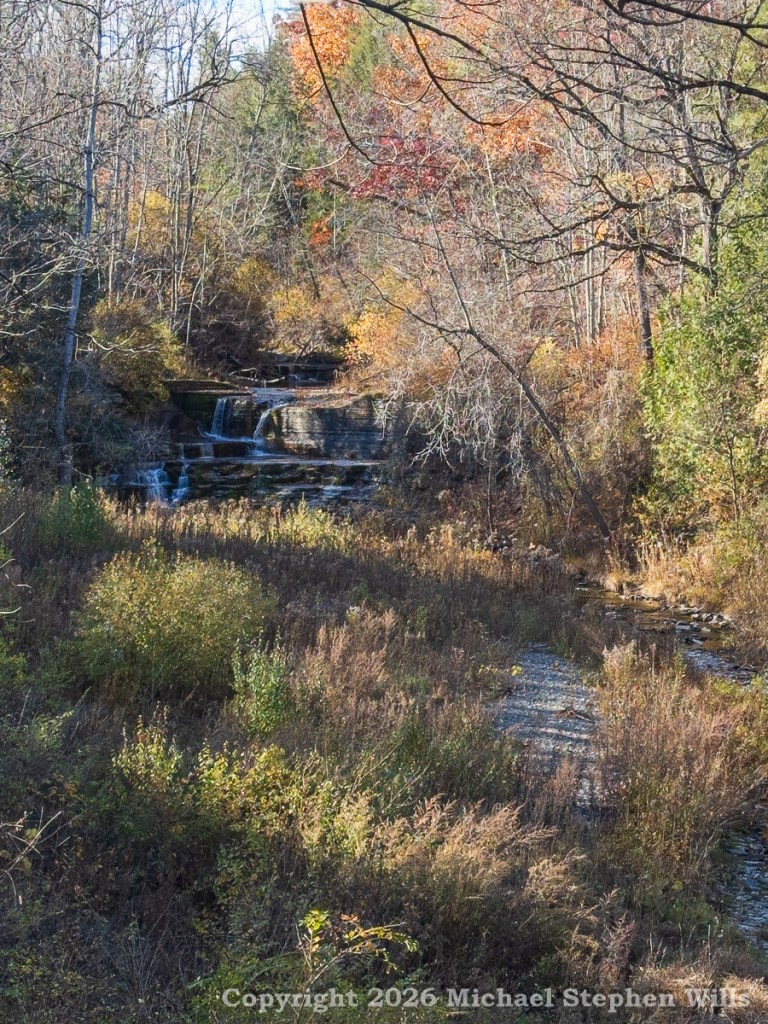
Small waterfall flowing through an autumn forest surrounded by colorful foliage and tall grasses

For years, I stopped to admire this scene in Robert H. Treman State Park, above the place where Enfield Creek and Fish Creek meet. Sometimes I photographed it, hoping to capture the waterfall through the tangle of branches. The view changed with the seasons. Summer foliage nearly swallowed the creek. Autumn opened the scene, revealing the pale ribbons of falling water. Even then, the falls remained frustratingly remote, unmarked, unnamed on all the maps.

I wondered what they looked like up close. From my usual vantage point, I could make out several drops, but not their arrangement. Nor could I see much of the rock formations that shaped them. I had explored other parts of Treman Park many times, yet this particular stretch of Enfield Creek remained unfamiliar.

That changed this autumn of 2026 when I noticed what appeared to be a path leading toward the creek. I had overlooked it on previous walks, perhaps because it was tucked out of the way, vegetation had obscured the opening. On that autumn afternoon curiosity won out. I followed the path, making my way toward the sound of water.

I followed little more than a deer trail, untended, and found the familiar distant view gave way to something entirely different. The stream became louder, and through the trees I began to distinguish the individual cascades. What had appeared from afar as a modest waterfall was a much more elaborate arrangement of ledges, pools, and falling water.

I had finally reached the place I had been photographing for years.

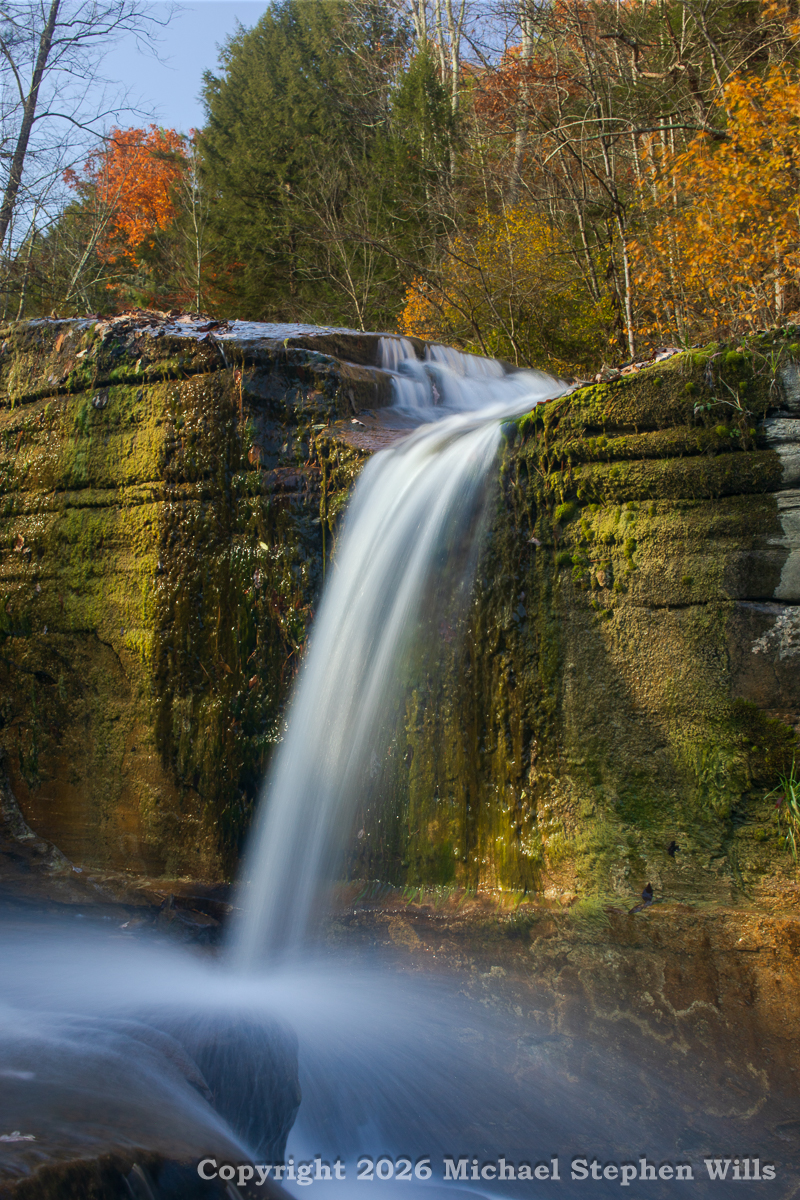
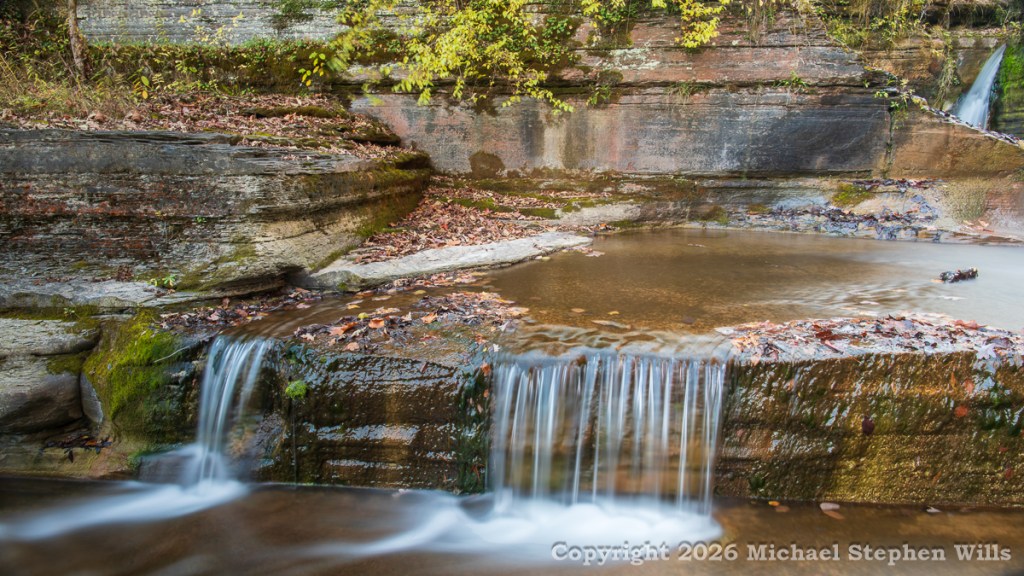
After several weeks of low rainfall the falls divided into two separate streams. On the left, water spread across the lip of a broad rock shelf before dropping in a nearly vertical curtain. To the right, a narrower, more concentrated flow swept over another edge, its smooth white column standing out against the dark, moss-covered stone.
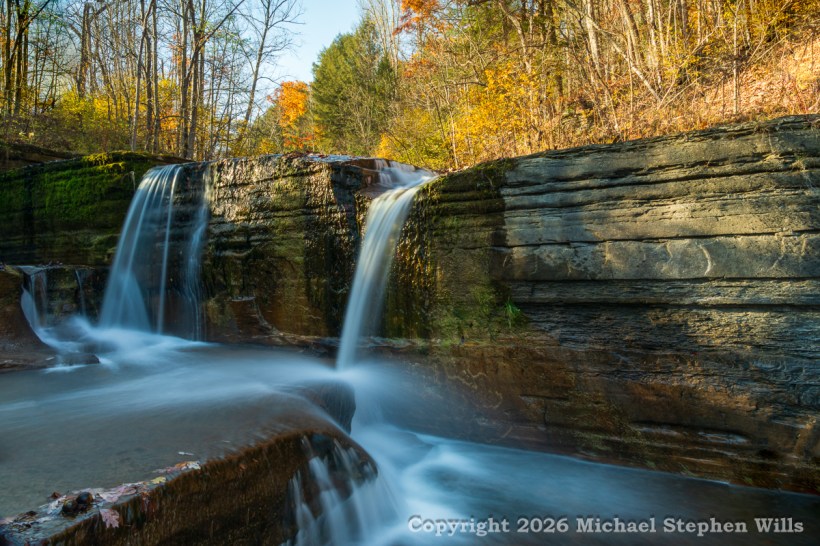
Twin waterfalls flowing over layered rock ledges in an autumn forest
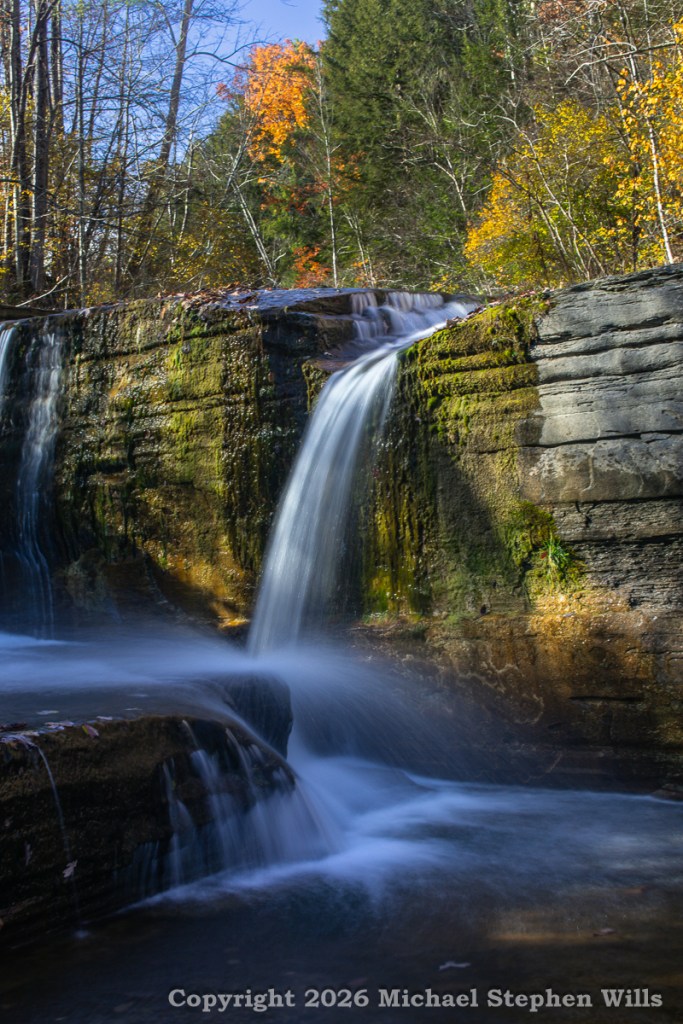
Waterfall cascading over moss-covered rock ledges in an autumn forest

Below, the two streams entered a shallow pool before spilling over yet another ledge. Water moved through this little basin in several directions, finding channels along the irregular rock surfaces. Standing nearby, I could appreciate something the distant view had never revealed: the falls were not a single event, but a succession of them.
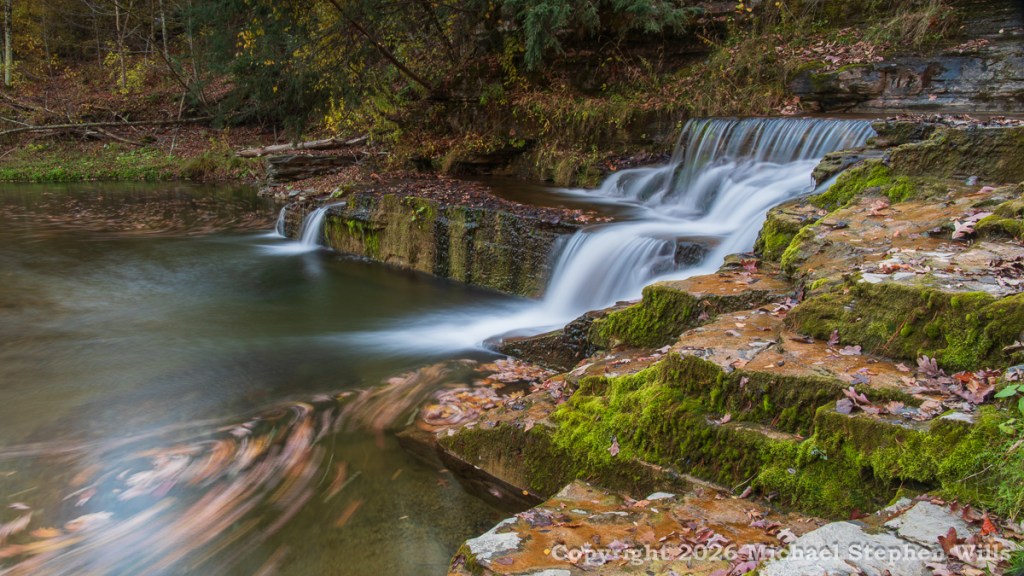
The rock itself deserved attention. Horizontal layers, exposed by the cutting action of Enfield Creek, formed a substantial wall beside the falls. Some surfaces were dark with moisture; others caught the afternoon sunlight. Moss occupied the wetter sections, especially where water seeped down the stone. A few small plants had established themselves in narrow crevices.
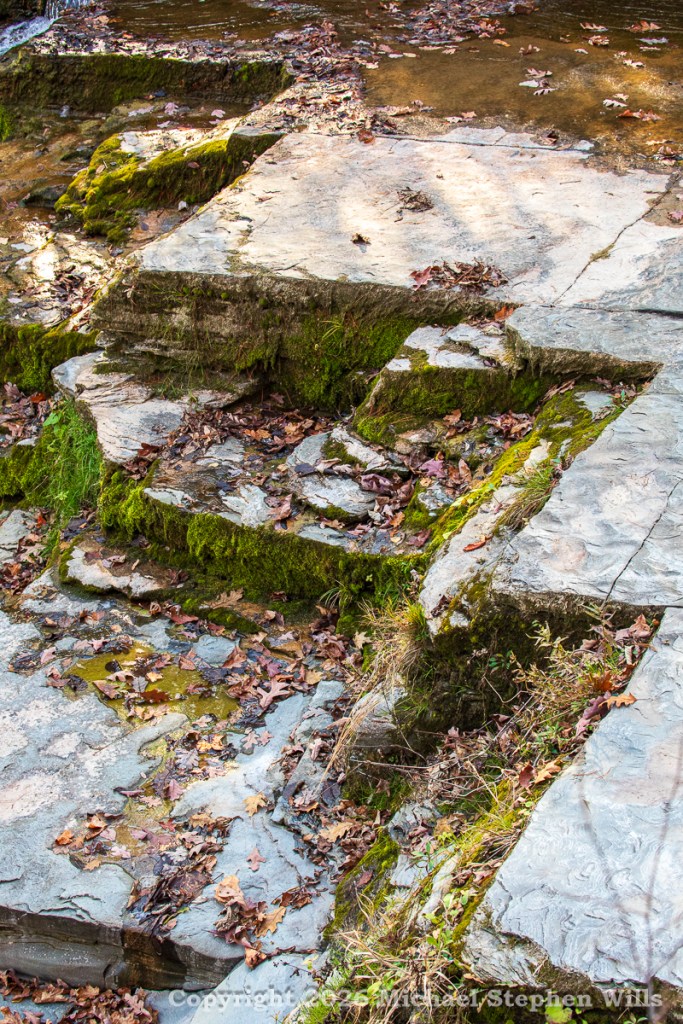
Ancient, horizontally layered sedimentary rock, intersected by angular joints formed under tectonic stress.

Above the falls, the trees were well into their autumn transformation. Golden leaves brightened the upper slopes, while a few brilliant orange crowns stood against the deep green of the conifers. Many branches were already bare. Sunlight reached through them to illuminate portions of the rock face, leaving the lower pool in shadow.

I settled into photographing the falls, trying different compositions and lenses. The long exposures transformed the rushing water into flowing white veils. In one frame, I concentrated on the right-hand cascade. In another, I included both upper falls and the lower spillway, allowing the water to lead the eye through the picture. The vertical compositions emphasized the succession of drops, while the wider view revealed the broad, layered rock wall.
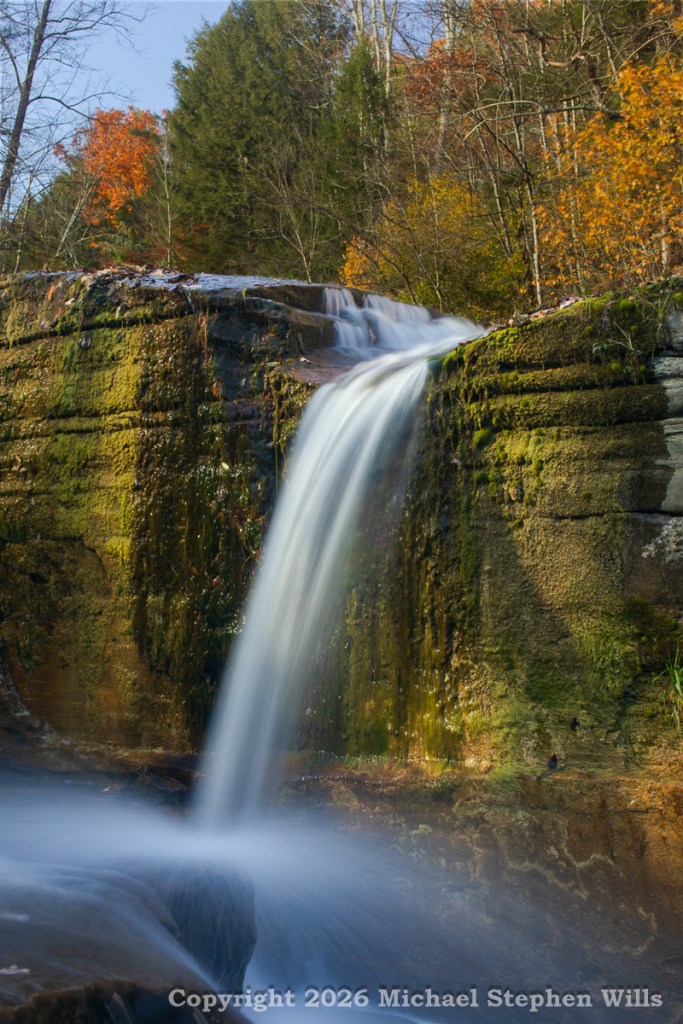
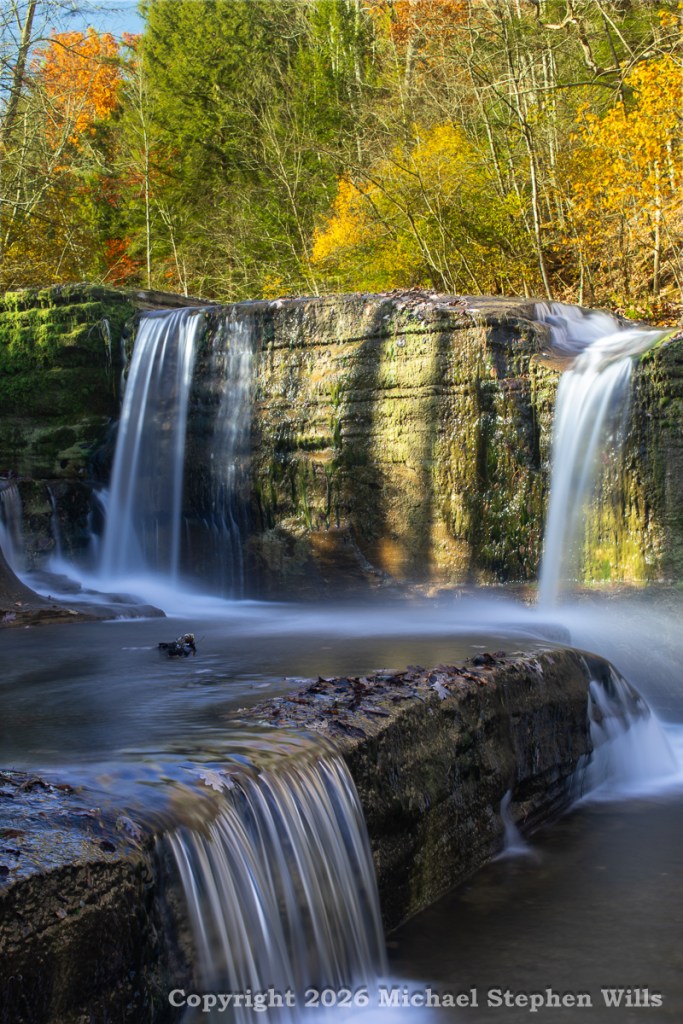
Long-exposure waterfall cascading over moss-covered rocks in an autumn forest
Multi-tiered waterfall flowing over moss-covered rock ledges in an autumn forest

There was also human history close at hand. During the nineteenth century, this part of the park belonged to the thriving hamlet of Enfield Falls. Mills, houses, a hotel, and other businesses once occupied the surrounding landscape. Cornell archaeologists have excavated nearby sites, uncovering foundations and household artifacts that preserve details of that vanished community.
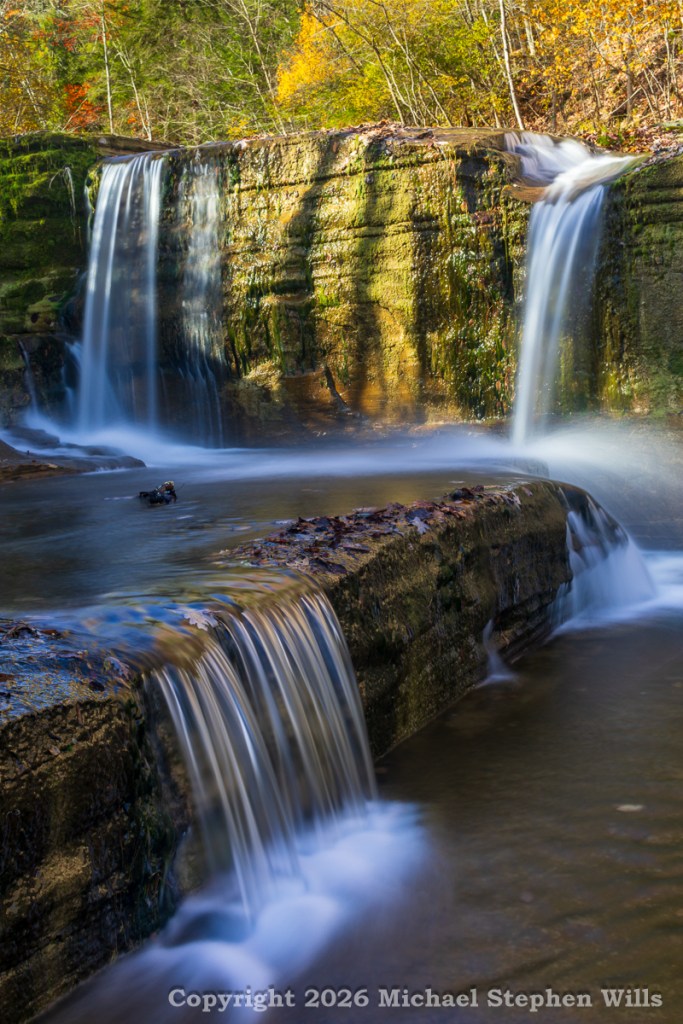
Long-exposure view of cascading waterfalls over moss-covered rock ledges in an autumn forest

I thought about those earlier residents, whose daily lives unfolded beside these same creeks. They depended upon the water for work, while visitors came to admire the scenery. The wooded landscape I know today was once more settled place, these falls echoed in their homes. Possibly the hamlet, Enfield Falls, was named after these; now unnamed, unremarked
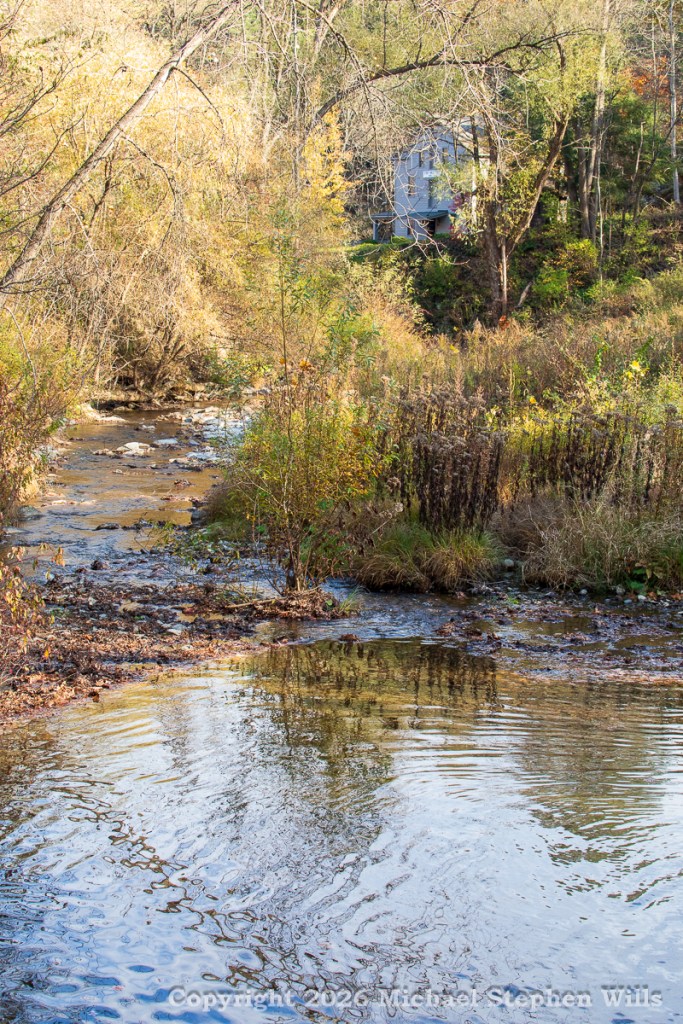
Eventually, I returned along the path, pleased to have discovered a new perspective on a familiar landscape. The waterfall had not changed, of course. It had been flowing over those ledges throughout all the years I stood at a distance, wondering what lay beyond the trees.
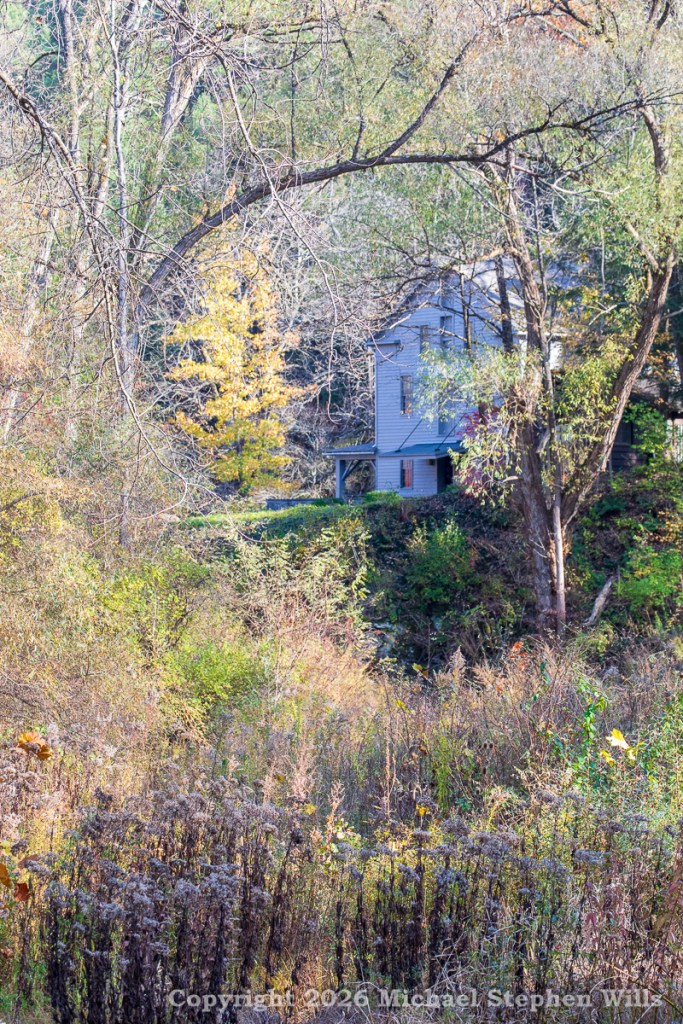
What had changed was my experience of it. I still appreciate that distant view, with the falls tucked into the autumn woods. Now, however, I know the details hidden within it: the twin curtains of water, the moss-covered ledges, the shallow pool, and the final cascade spilling toward the creek below.

After so many years of looking, it was a pleasure simply to have found my way there.
Click me to visit Michael Stephen Wills Online Finger Lakes Photography

Enter your email to receive notification of future postings. I will not sell or share your email address.

Exploring Taughannock Falls State Park: September Light in the Finger Lakes

A September walk at Taughannock Falls reveals layered cliffs, white snakeroot, drifting clouds, Cayuga Lake, and the quiet threshold between summer and autumn.

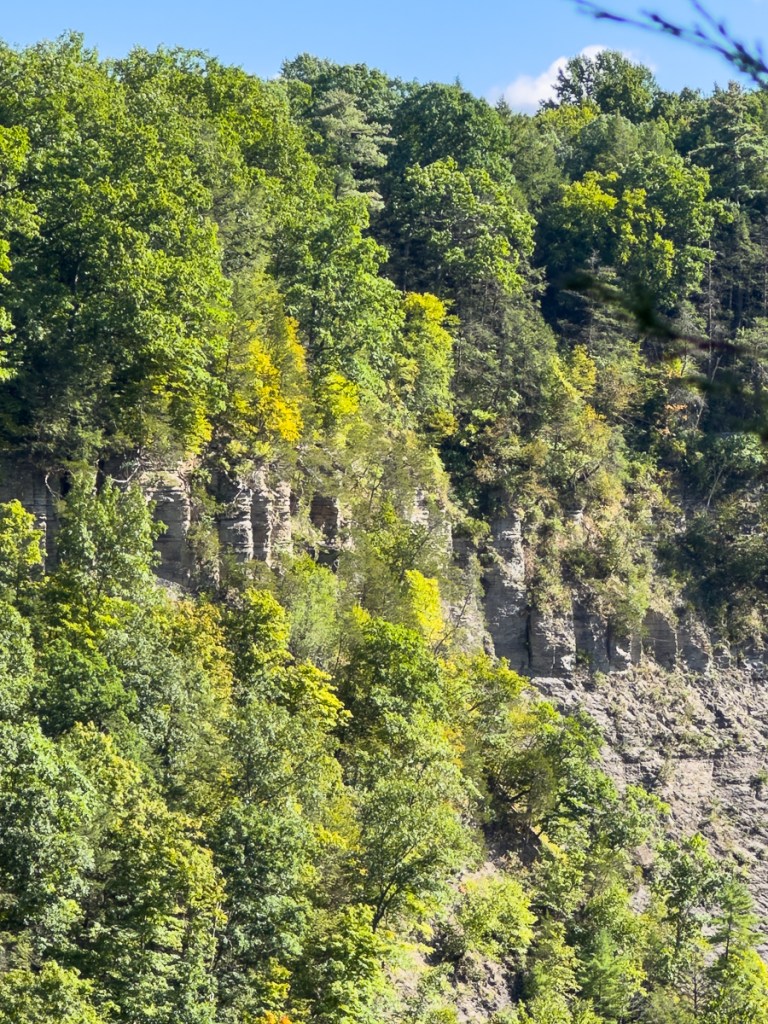
On September 14, 2026, Taughannock held itself between seasons. Summer had not yet departed; autumn had not yet claimed the gorge. The trees still wore their full green abundance. Yet, here and there, high on the rims and tucked into the ravine walls, yellow had begun its quiet work. I experienced it as hints, as first thoughts, as small flames beginning among the maples and shrubs.

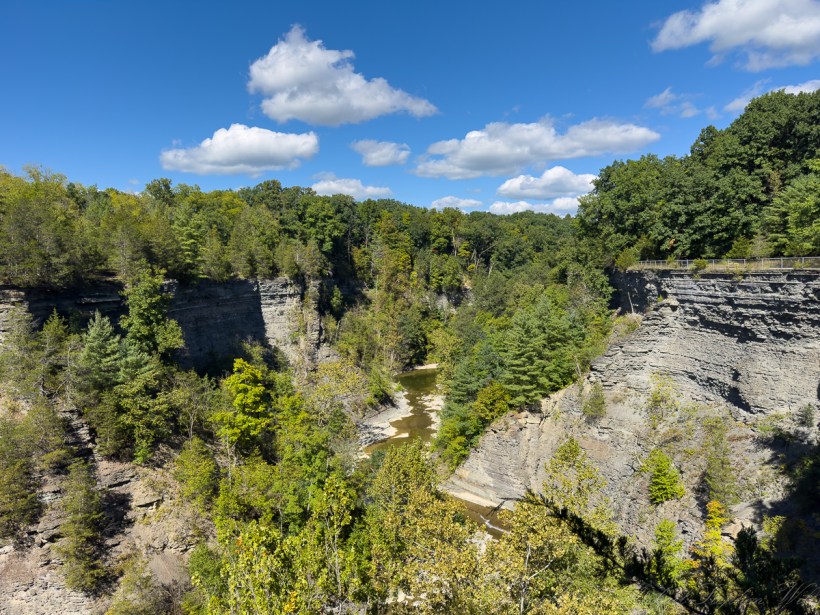
The view from the South Rim Trail. From a walk around Taughannock Falls State Park, down the South rim Trail, up the North Rim Trail. September 14, 2026

The gorge opened first as architecture: a long cleft of layered stone, inhuman shades of gray, cut by water through an immensity of time. From the rim, the creek below seemed almost modest, a brown-green ribbon moving through a corridor it had patiently made. The cliffs did not appear carved so much as remembered into shape. Bed after bed, ledge after ledge, they held the ancient sea in their faces. The rock seemed written in lines, a ledger of vanished depths, pressure, uplift, frost, collapse, and flow. Trees clung wherever they could. Roots found cracks. Cedars leaned over voids. Hardwood trunks rose from impossible perches, answering stone with leaf.

An extravagant sky above all. This blue, saturated and clean, carried great white clouds across the park like slow, wandering thoughts; too soft for a place so sternly cut by geology. Yet that contrast is part of Taughannock’s power: air and stone, cloud and shale, the brief and the enduring sharing one frame. The clouds drifted without urgency while the gorge below testified to forces that measure themselves in millennia. Standing there, the human mind is pulled in two directions at once—toward the fleeting weather of the day and toward the deep patience of the earth.

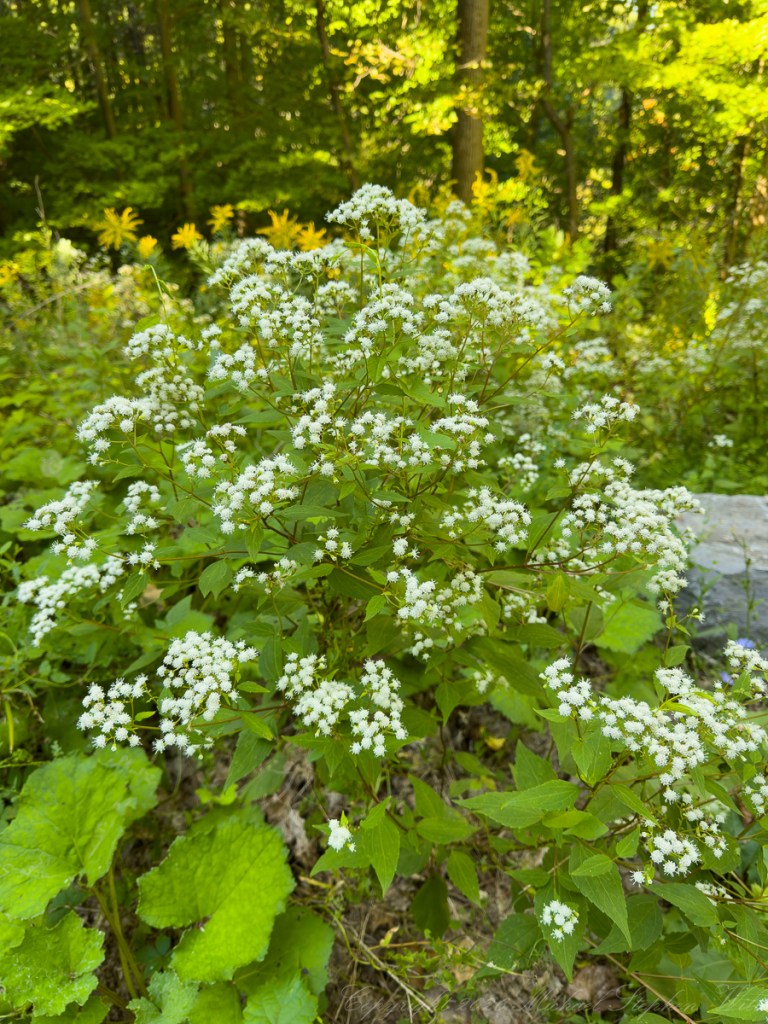
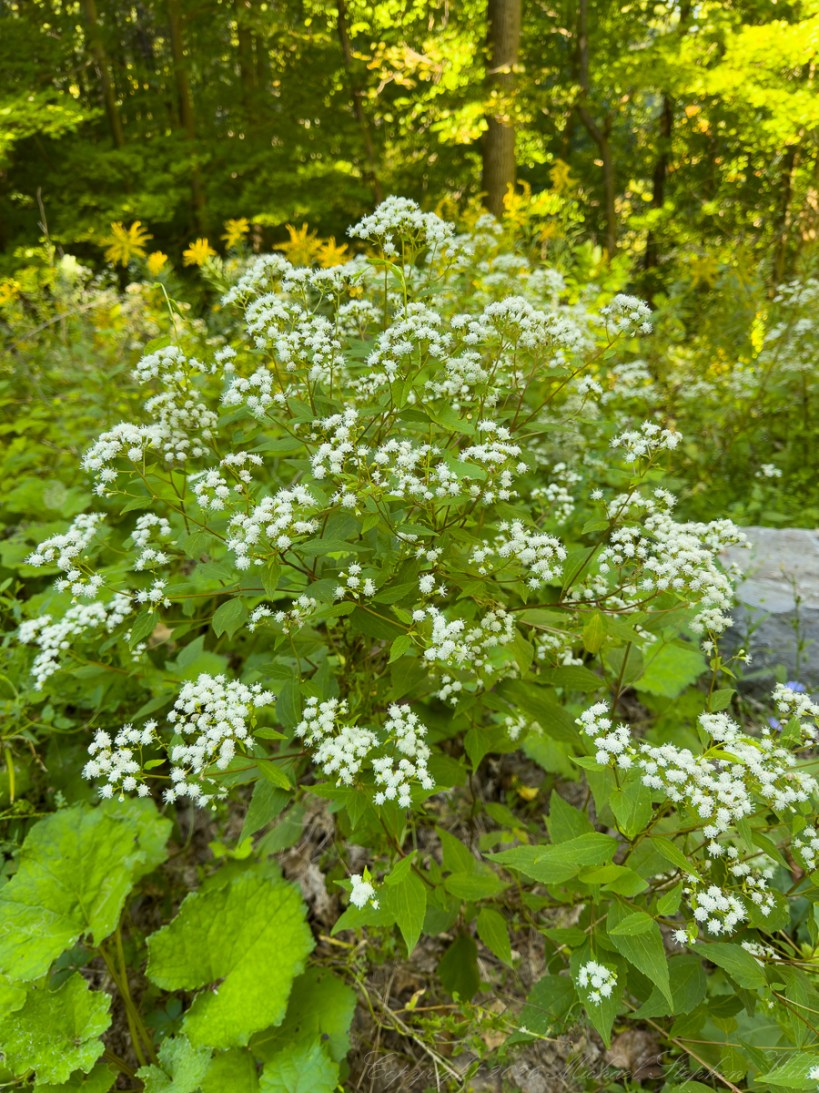
Snakeroot, a poisonous perennial herb

Along the wooded trail, the eye dropped from grandeur to intimacy. White snakeroot bloomed in loose clusters, each tiny flower a small, tufted star gathered into a milky constellation above serrated leaves. Behind it, the forest glowed with the filtered green light of late summer. Goldenrod rose farther back, blurred into warmth. The plants seemed not lesser than the falls or cliffs, only quieter. Requiring a different scale of attention. The gorge overwhelms; the flower invites. One must bend inward to see it properly.

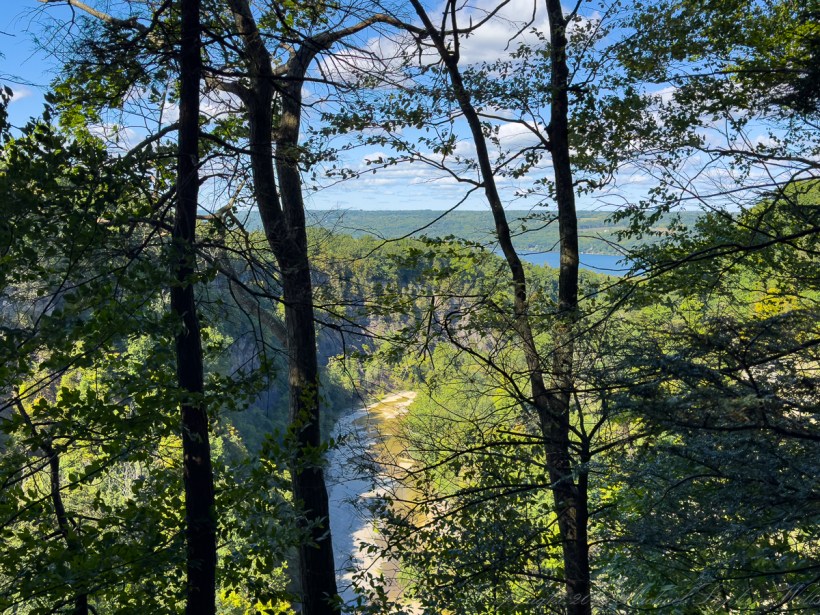
Seen from the South Rim Trail.

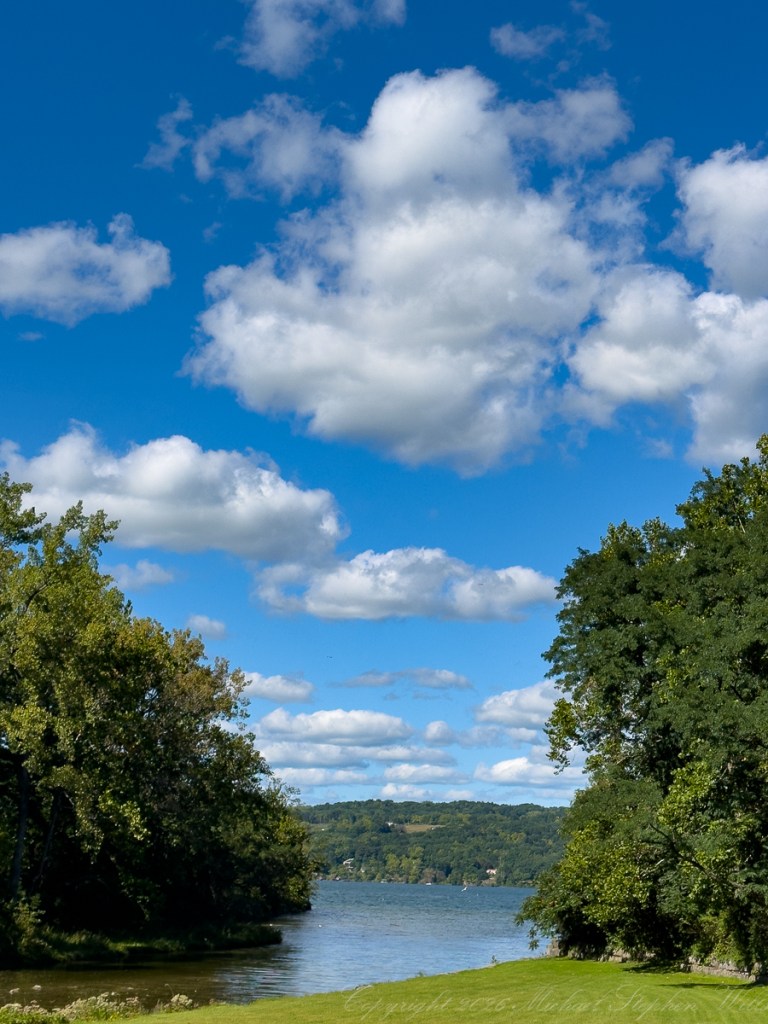
Through the trees, Cayuga Lake appeared like a blue promise beyond the gorge. Branches crossed the view in dark strokes, turning the scene into a natural stained-glass window: cliff, water, sky, leaf. The lake lay beyond the ravine’s mouth, broad and reflective, suggesting release after confinement. The creek that had moved through shadow and stone would eventually find that open water. There was comfort in that progression: narrowness giving way to breadth, descent becoming arrival.

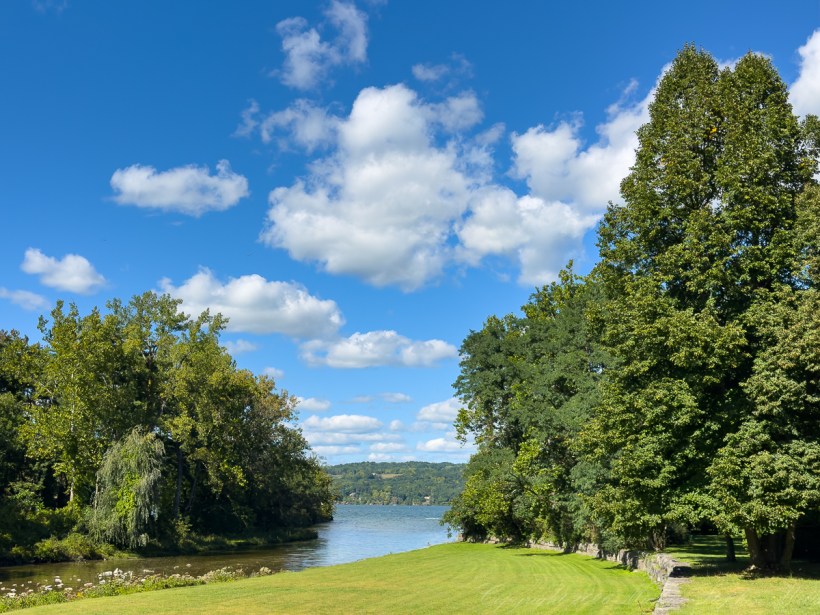
Mouth of Taughannock Creek as it enters Cayuga Lake

At the lakeside, the mood changed again. The same day, the same park, but another world. A green lawn sloped toward the water, bordered by trees heavy with leaves. The lake opened between them, wind-textured and blue-gray beneath the marching clouds. The place felt pastoral after the sternness of the gorge. Here the land breathed easily: gorge cliffs were replaced by open distance, by the far shore softened with trees and scattered houses. The park became a threshold between cultivated calm and wild excavation.

I enjoy the layered effects of clouds.

Then the camera turned upward, giving the sky its own portrait. The clouds took on presence, no longer background but subject—rounded, luminous, casting faint shadows upon themselves. Below them, lake and shore narrowed into a band, as though the world had been rearranged so that sky could speak first. There is a kind of mercy in such a sky. It loosens the mind. It reminds us that even above a gorge, above evidence of erosion and collapse, there is spaciousness.

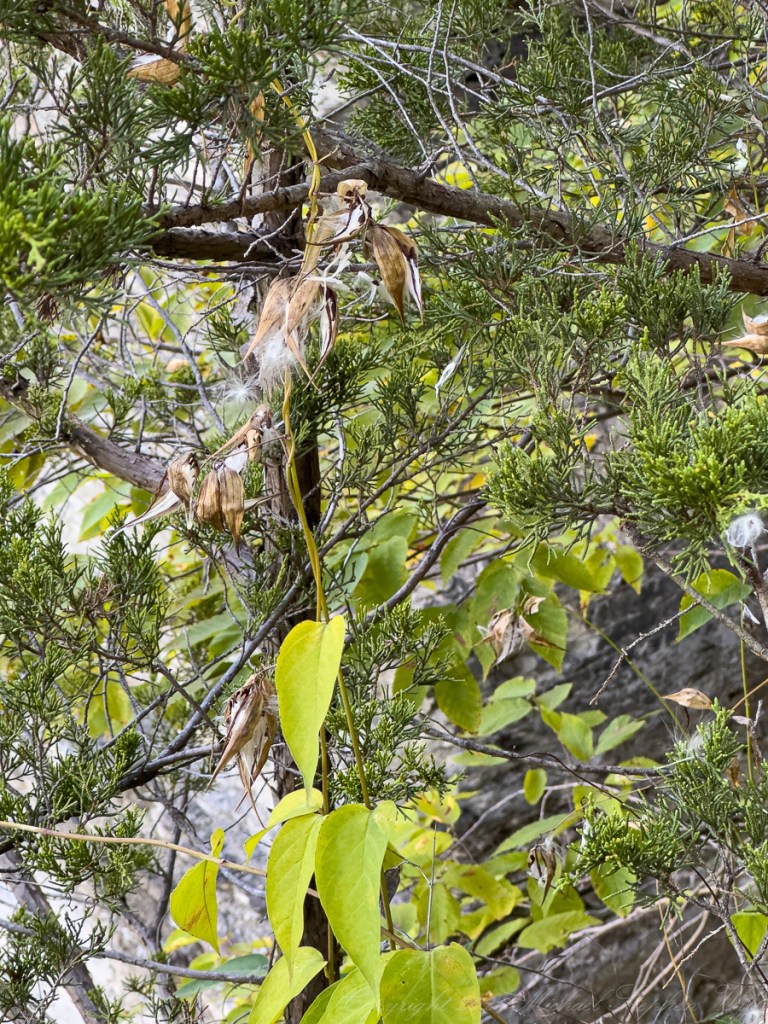
Black Swallow-wort (Vincetoxicum nigrum). Found along the North Rim Trail.

Among the cedars, split pods had released their silk. Pale filaments caught on rough branches and evergreen sprays, small scraps of flight arrested in mid-escape. The pods hung dry and curled, their work nearly done. Seeds that had been hidden were now entrusted to air. This, too, was September’s language: opening, loosening, letting go. Not the dramatic fall of leaves yet, but a subtler surrender. The season had begun to unfasten its clasps.

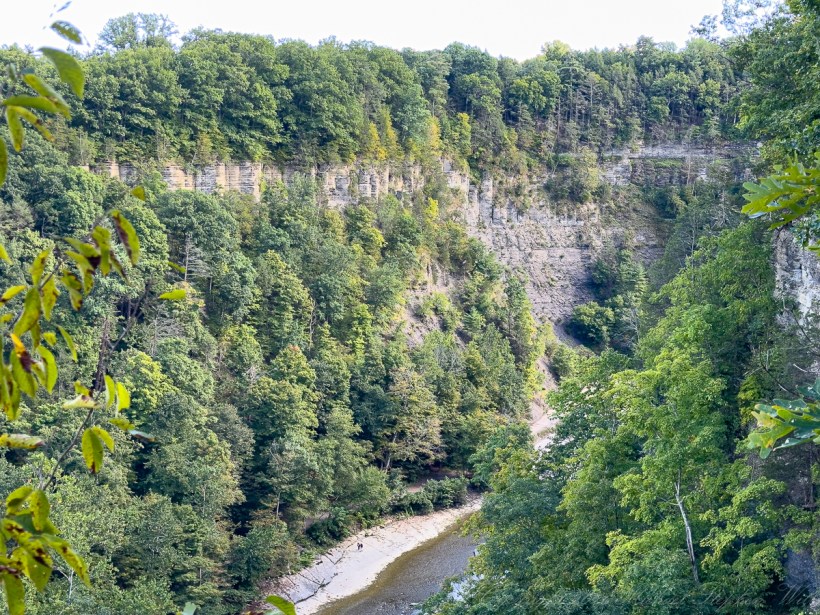
A view from the North Rim Trail.

From another rim view, the gorge wall rose in broken columns and pale faces, half-covered by green. Vegetation softened the precipice but did not conceal it. The cliff remained adamant, a vertical memory of water’s persistence. Far below, the creek bent through bars of exposed stone, and tiny figures on the gorge floor gave scale to the scene. The people were scarcely marks against the immensity, yet their presence mattered. They reminded the eye that wonder is not abstract. Someone stands there, looks up, and receives the place.

The visitors are on the overlook, in the gorge on the bridge and below the falls.

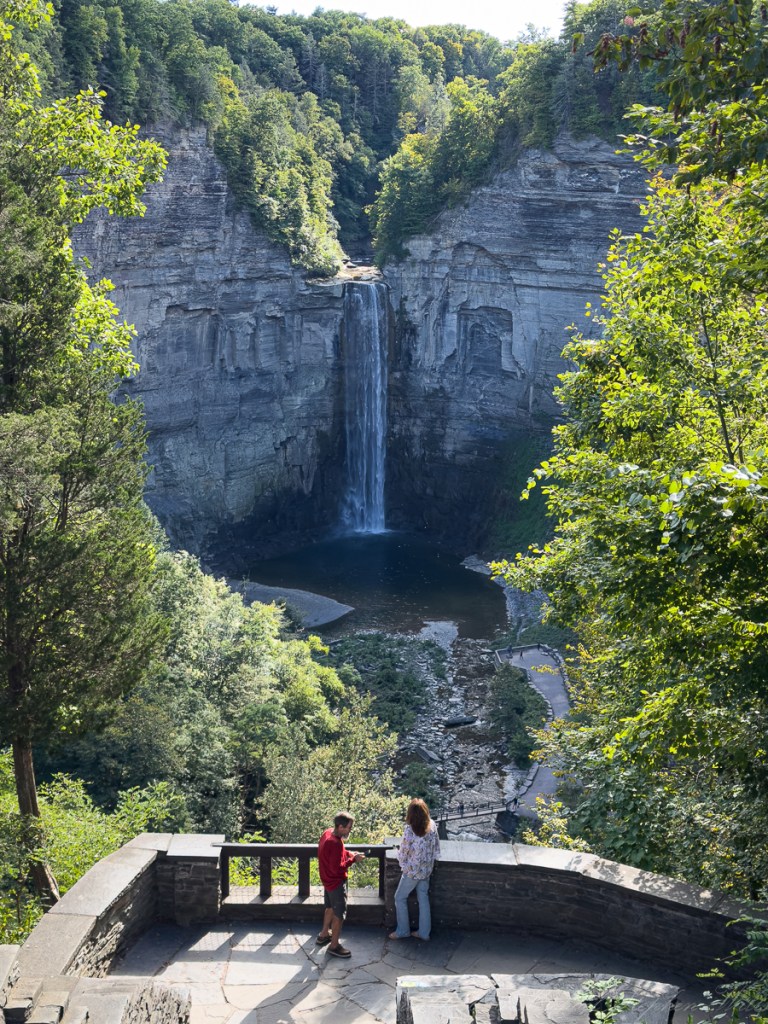
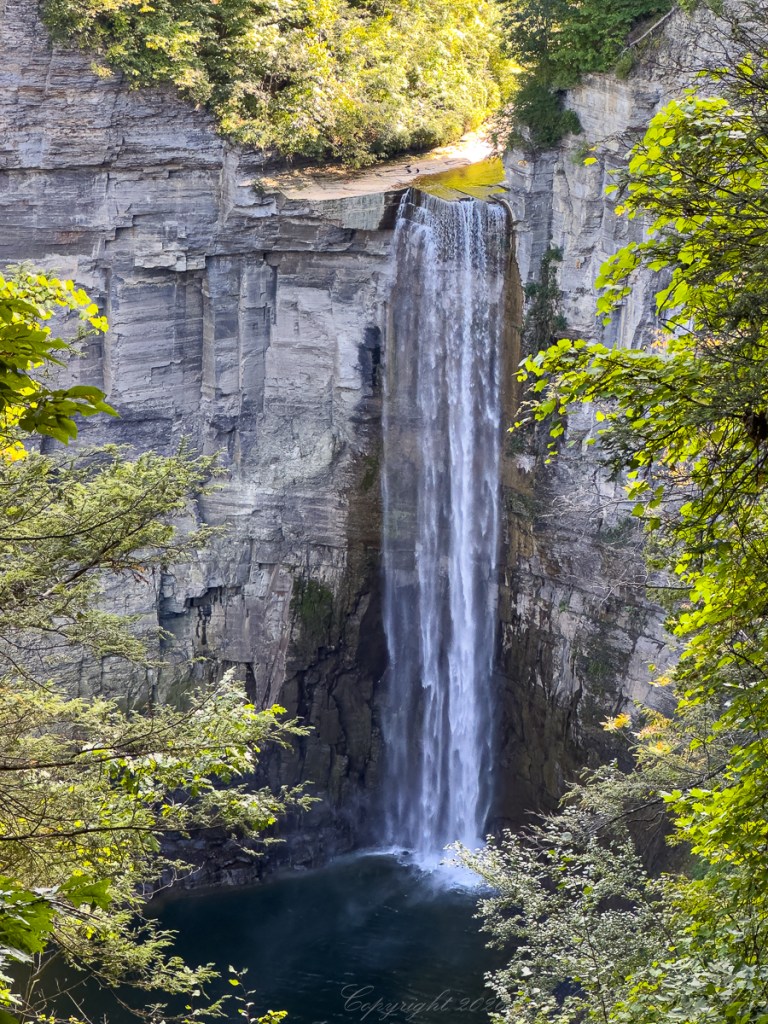
At the overlook, Taughannock Falls appeared framed by stone and leaf, descending in a long white irrepressible column into the dark basin below. The falls seemed both powerful and delicate, a veil and a force. Water dropped from the high lip in strands, gathered itself in motion, then shattered into mist and sound. Around it, the cliffs bore stains, fractures, alcoves, and ledges—the wounds and ornaments made by time. Layers of visitors receed in the foreground, small and temporary, held for a moment before the great amphitheater.

For this view proceed south on the North Rim Trail from the observation area parking. Did you spot the gathering of crows?

Farther along the North Rim Trail, the falls filled the vision. Sunlight touched the rim above; shadow deepened the plunge pool below. The water seemed to fall from brightness into mystery. That is often how memory works: a clear edge, a shining beginning, then a descent into depths we cannot entirely see. Yet the sound continues. The motion continues. The stream that vanishes in shadow reappears downstream, moving toward the lake.

Watch on YouTube for the best experience.

For me, what remains from this walk is a whole sequence: cliff and cloud, snakeroot and seed silk, lake and lawn, distant figures and enduring stone. Taughannock on September 14, 2026, offered no single lesson. It offered a composition of scale. The vast does not cancel the small. The flower belongs beside the gorge. The seed silk belongs beside the falls. The human figure belongs, briefly, gratefully, at the overlook.

By God’s Grace the water keeps falling.

Click me to visit Michael Stephen Wills Online Finger Lakes Gallery.

Enter your email to receive notification of future postings. I will not sell or share your email address.

On The Edge of Time Above Taughannock Gorge

Perched above Taughannock Gorge, a moss-covered ledge and cascading falls reveal ancient stories—where Devonian seas once flowed and time’s layers whisper through stone and water.

The morning sun had only just breached the rim of the gorge, sending long slants of golden light across the forest floor. Walking the South Rim Trail of Taughannock Falls State Park, I came upon a quiet, unassuming spot—just a few paces off the path—where the forest seemed to pause in reverence. What greeted me was a small marvel of persistence and time.

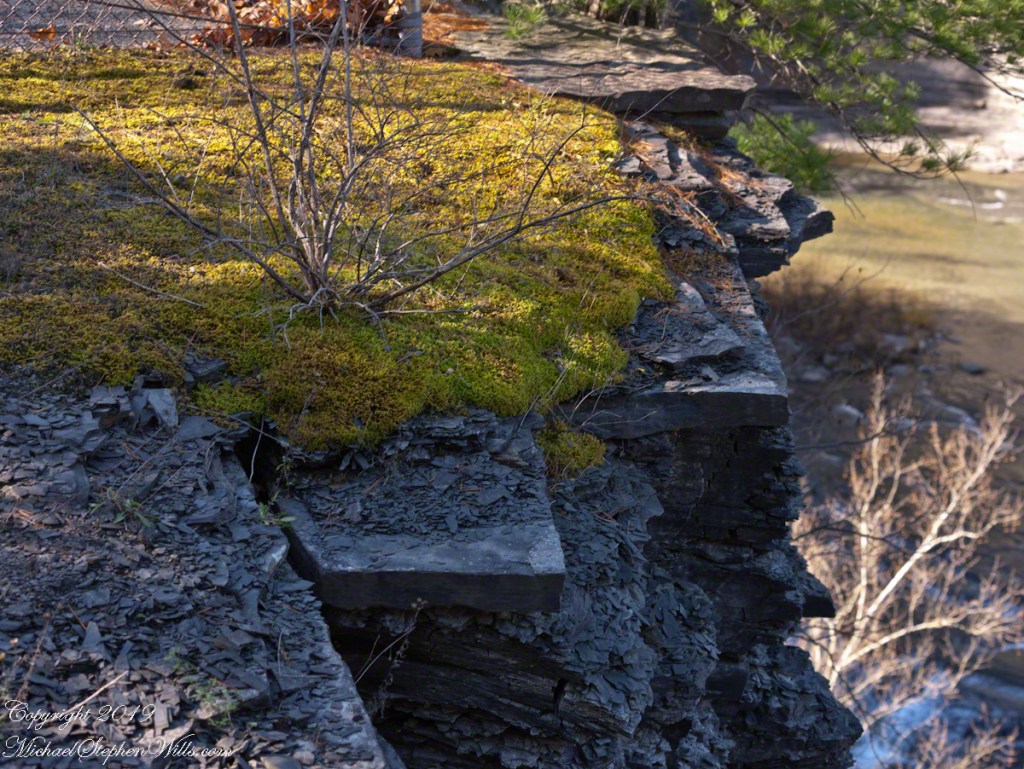
There, rooted precariously atop a slab of brittle shale, was a tenacious shrub rising from a bed of moss, its spindly frame etched in sharp contrast to the soft, green sprawl beneath it. The moss had taken hold on a shelf of rock cantilevered over the gorge like a green tongue of earth defying gravity. Cracks traced the shale’s surface like veins, silent records of the forces that shaped this place—heat, ice, pressure, time. Together, the moss and the bush formed an improbable community, surviving against odds, bound together by the thin soil cradled in stone.

This ledge, suspended over the abyss, seemed less a part of the earth than a question it asked—how much life can cling to the edge before the edge itself gives way?

Beneath this living fragment, the gorge dropped away. Layers upon layers of shale revealed themselves, stacked like a collapsed library of time. Here, the Devonian Period lies exposed to wind and rain, and to those willing to pause and wonder. Each stratum holds the fossil whisper of ancient seas, where trilobites scuttled and coral reefs once stood. This gorge was not carved quickly. It was not born of a moment, but of many—countless raindrops, millennia of ice melt, the slow, sure work of water over stone.

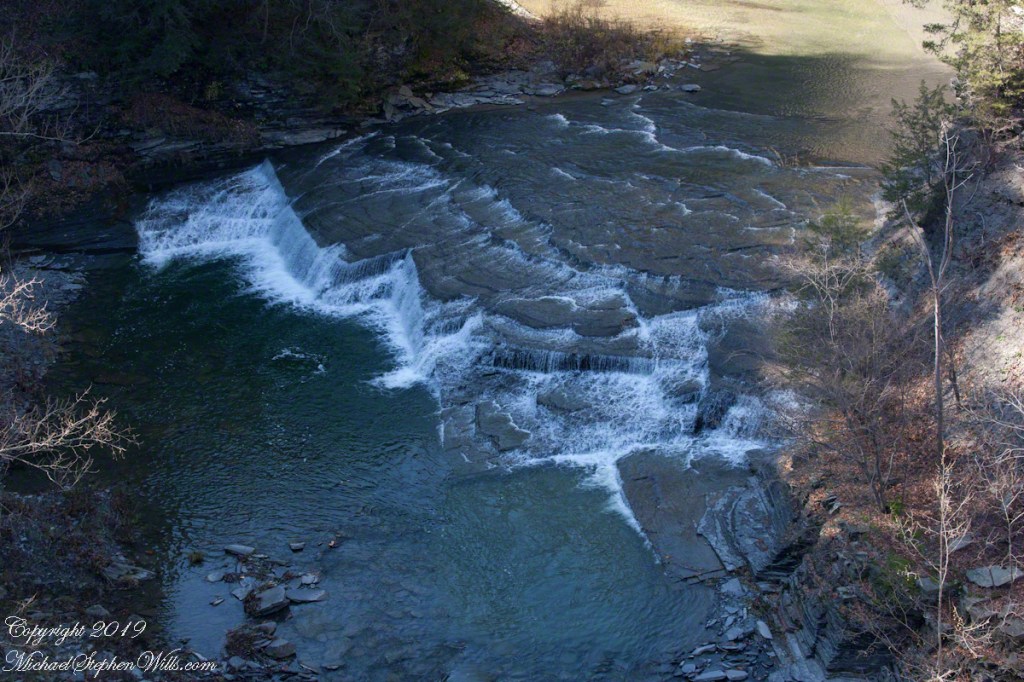
From this natural balcony, I looked out and down to the gorge floor where the creek shaped the land with an artist’s patient hand. The falls, seen from above, no longer thundered—they danced. Spread like the folds of a fan, water curled over smooth stone in steps of white silk. From here, the cascade looked deliberate, choreographed—an elemental performance halfway between gravity and grace.

How many times had this water flowed, reshaped, receded? How often had it carved these grooves, smoothed those ridges, erased the footprints of what came before? Looking at the exposed rock, one could trace the signature of ancient glaciers, feel the memory of long-gone floods. It was humbling—this intersection of change and continuity.

Above it all, the trees stood still. Pine and oak, rooted well back from the edge, offered a kind of sentinel presence. Their shadows stretched long and angled, tracing the contours of both earth and memory. For a moment, I let go of all thought and simply listened—to the murmur of wind through leaves, the faint rush of water far below, and the silence that presses in when the land itself seems to be remembering.

This spot—so easily missed by a hurried hiker—offered a parable of resilience and impermanence. The moss did not grow with certainty, nor the shrub reach with confidence. They survived on the edge because they adapted. They made do with less. They took root where others could not. There was no security in that place, only presence. Only the now.

And isn’t that a lesson worth carrying?

We so often seek stability, firm ground, a clear path. Yet, some of the most beautiful things live just beyond comfort—on ledges, in cracks, in the margins of the known. To pause here was to acknowledge that life thrives not only in sheltered valleys but also at the edge of what seems possible.

As I stepped back onto the trail and continued along the South Rim, the image of that mossy outcrop stayed with me. I carried it in my thoughts like a talisman—proof that even on the brink, life finds a way. And that from above, the most chaotic falls can appear as ordered motion, as a flow toward something larger.

Later, when the sun climbed higher and the light lost its slant, I would look back on this moment not as a spectacular highlight but as something more intimate: a quiet encounter with nature’s subtle artistry, its layered truths, and its enduring invitation to look closely, feel deeply, and walk softly.

For here, above the gorge, at the edge of earth and time, even a whisper leaves a mark.

Enter your email to receive notification of future postings. I will not sell or share your email address.