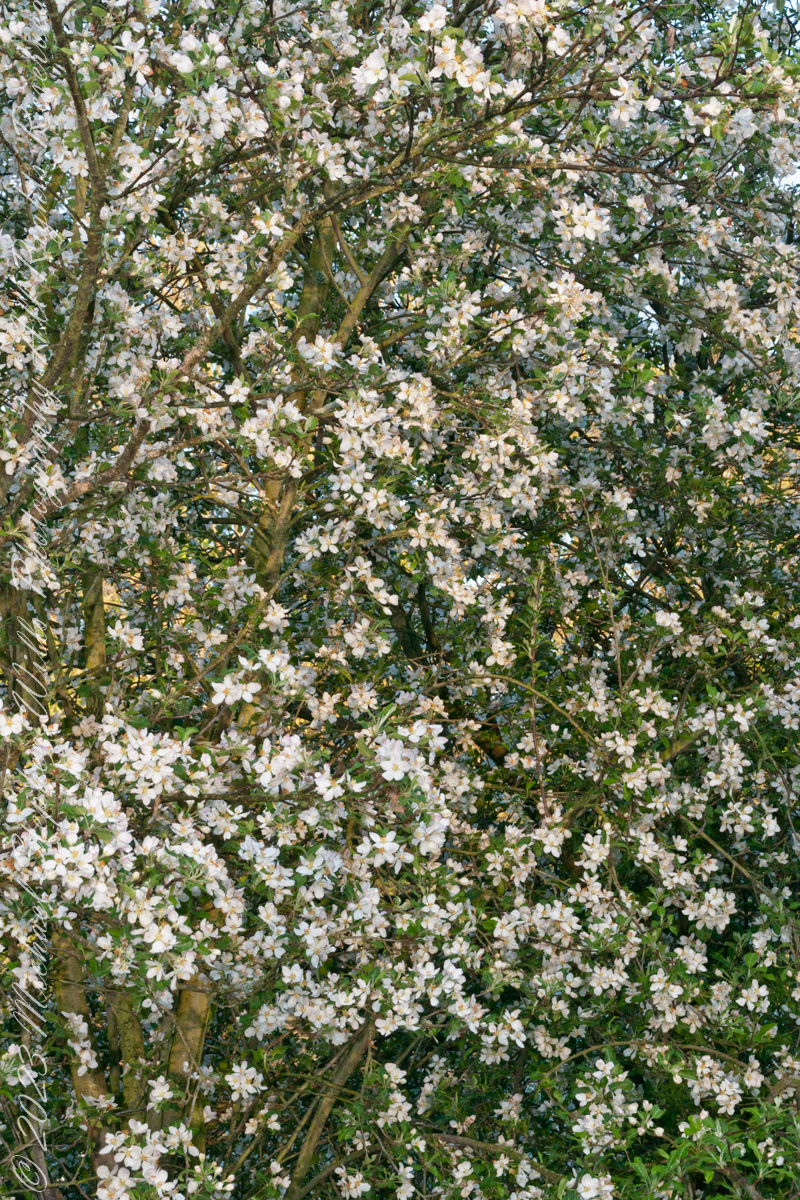
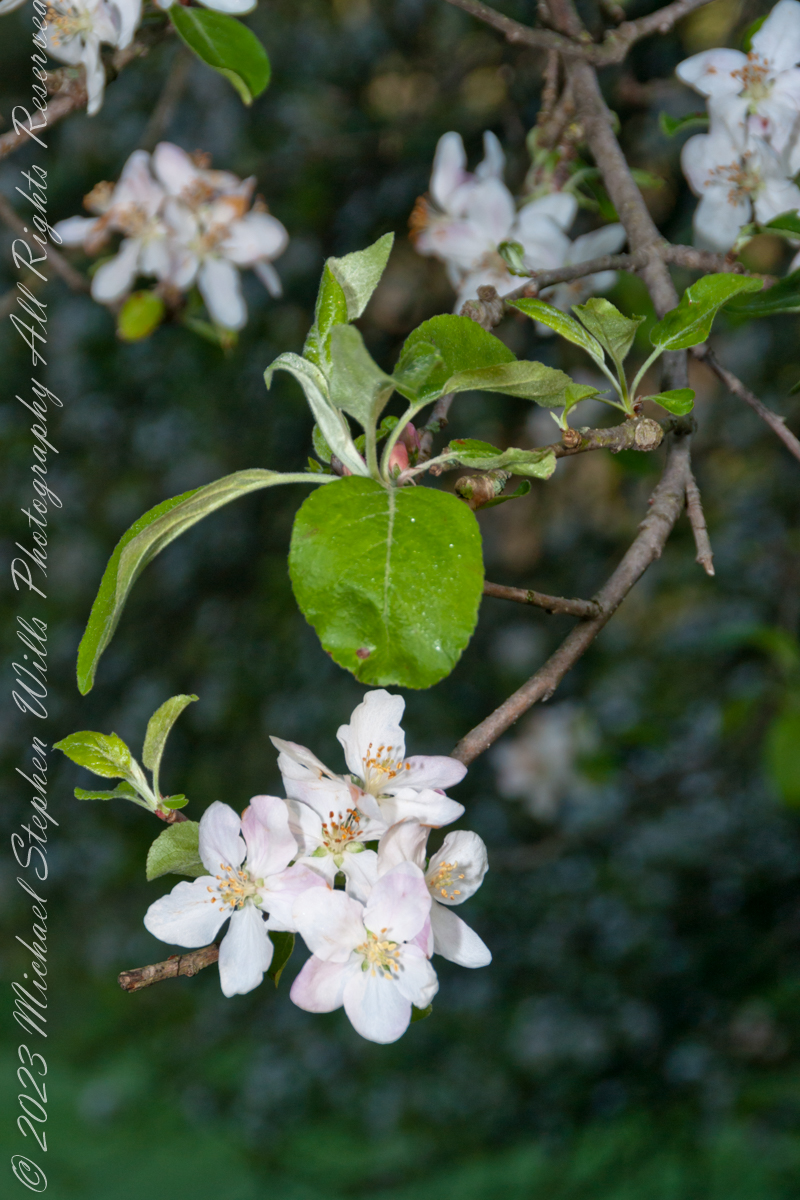
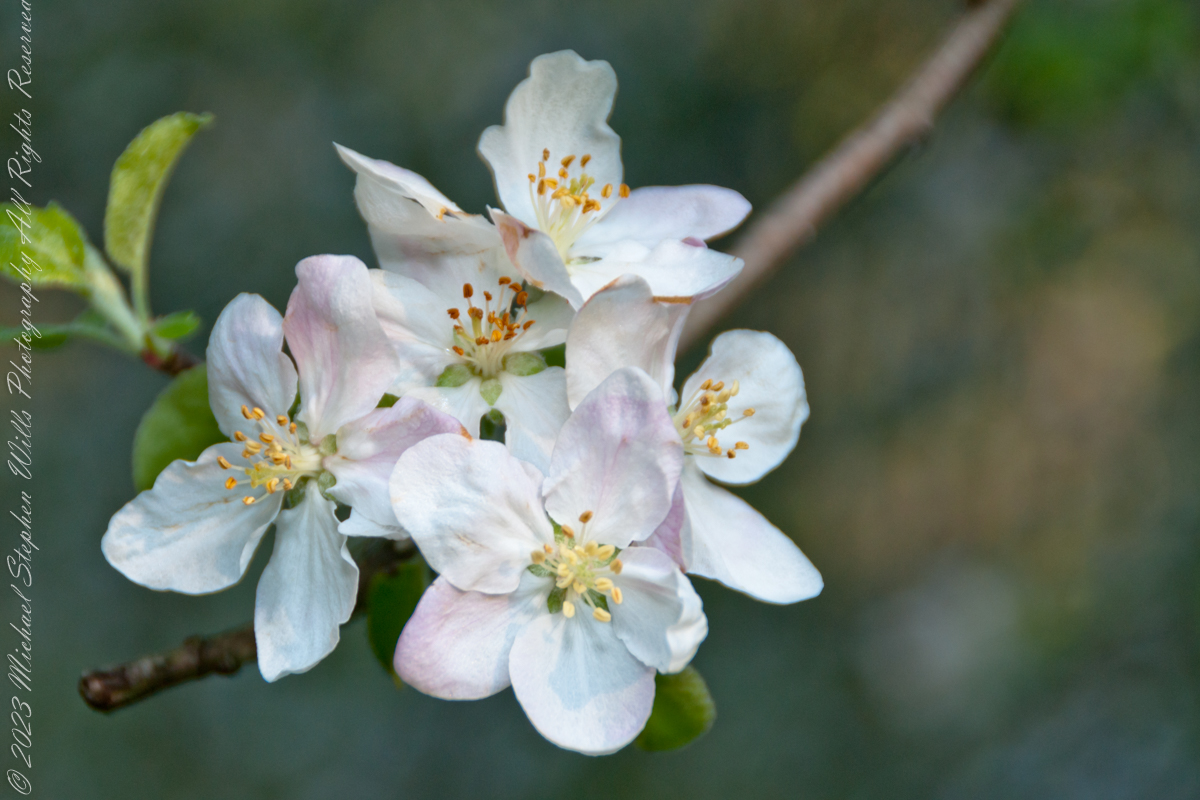
Our home at Malloryville, New York has an orchard of three apple trees, seen here on early one spring morning in the year 2010. The varieties are Delicious, Cortland and McIntosh. Freeville, Tompkins County, New York State
The original wild ancestor of Malus domestica was Malus sieversii, found growing wild in the mountains of Central Asia in southern Kazakhstan, Kyrgyzstan, Tajikistan, and northwestern China. Cultivation of the species, most likely beginning on the forested flanks of the Tian Shan mountains, progressed over a long period of time and permitted secondary introgression of genes from other species into the open-pollinated seeds.
Chinese soft apples, such as M. asiatica and M. prunifolia, have been cultivated as dessert apples for more than 2000 years in China. These are thought to be hybrids between M. baccata and M. sieversii in Kazakhstan.
Among the traits selected for by human growers are size, fruit acidity, color, firmness, and soluble sugar. Unusually for domesticated fruits, the wild M. sieversii origin is only slightly smaller than the modern domesticated apple.
At the Sammardenchia-Cueis site near Udine in Northeastern Italy, seeds from some form of apples have been found in material carbon dated to around 4000 BCE.[20] Genetic analysis has not yet been successfully used to determine whether such ancient apples were wild Malus sylvestris or Malus domesticus containing Malus sieversii ancestry. It is generally also hard to distinguish in the archeological record between foraged wild apples and apple plantations.
There is indirect evidence of apple cultivation in the third millennium BCE in the Middle East. There was substantial apple production in the European classical antiquity, and grafting was certainly known then. Grafting is an essential part of modern domesticated apple production, to be able to propagate the best cultivars; it is unclear when apple tree grafting was invented.
The proverb, “An apple a day keeps the doctor away”, addressing the supposed health benefits of the fruit, has been traced to 19th-century Wales, where the original phrase was “Eat an apple on going to bed, and you’ll keep the doctor from earning his bread”. In the 19th century and early 20th, the phrase evolved to “an apple a day, no doctor to pay” and “an apple a day sends the doctor away”; the phrasing now commonly used was first recorded in 1922.
Reference: Wikipedia “Apple”
 Michael Stephen Wills Photography
A beautiful memory
LikeLiked by 1 person
I visit them now and then, this year the grandchildren help to fertilize them.
LikeLiked by 1 person
😎
LikeLiked by 1 person
Fascinating journey! Michael, thanks for sharing this blessed rendezvous with apple blossoms and so much more. Years ago I was teaching in western Montana’s Bitterroot Valley. There were still a few active McIntosh apple orchards still in operation.
LikeLiked by 1 person
McIntosh is a great eating apple!!
LikeLike
I lived for decades in NYS apple country, but had never known any of these fascinating histories! Thanks for a very informative post and beautiful photos.
LikeLiked by 1 person
My pleasure….apples are a world fruits and a part of American life.
LikeLiked by 1 person
Interesting facts about apples plus beautiful shots of their flowers! Made my day!
LikeLiked by 1 person
Thanks for the good words, Hien.
LikeLike