A hoverfly buzzing with cheer, Lands softly, no sting to fear. With wings all a-glitter, It’s no wasp, just a critter, Whose mimicry tricks year to year.
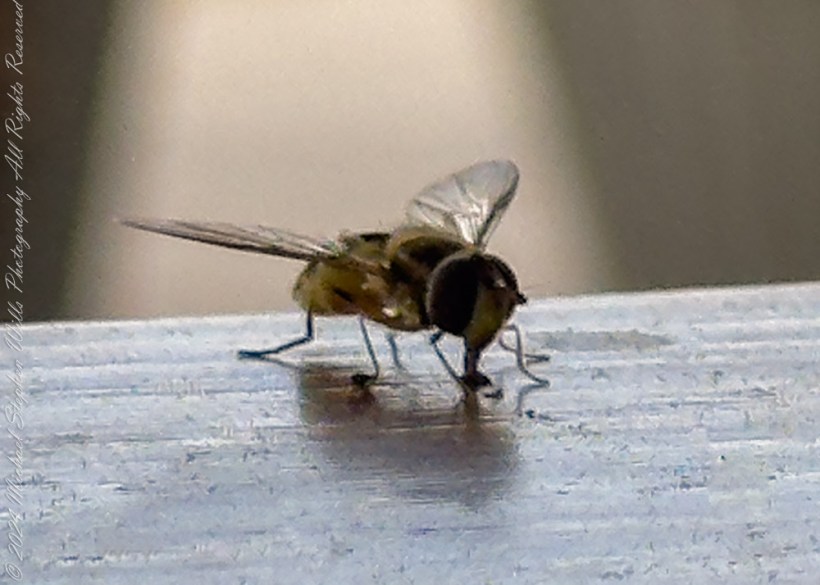
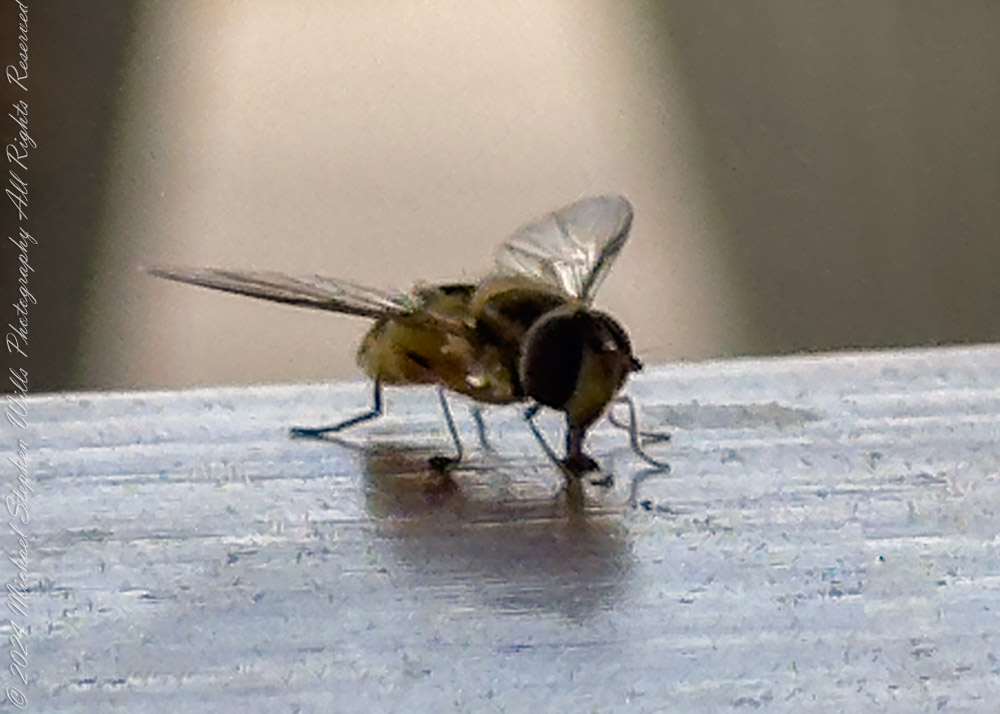
The photo shows the hoverfly on a smooth surface, possibly resting or feeding. Hoverflies are abundant in the fall as they are drawn to late-blooming flowers for nectar and pollen.
A hoverfly stopped for a snack, On a table, just taking a crack. It posed for a shot, Not moving a lot, Then flew off to plan its next act.
A hoverfly thought it was sly, As it zipped ‘round, too quick for the eye. “Are you a bee?” folks said, With confusion widespread, “Just a poser!” it said with a sigh.
Some useful facts about this relatively harmless visitor
This insect is a Hoverfly (family Syrphidae). Hoverflies are often mistaken for bees or wasps due to their yellow and black striped body, but they are harmless and lack the ability to sting. They are beneficial pollinators and are common in gardens, meadows, and near flowers.
Some key identifying features include:
Large compound eyes that meet at the top of the head in males.
Two clear wings (unlike bees/wasps, which have four wings).
A short, stubby antennae.
Mimicry coloration (yellow and black stripes) that helps them avoid predators.
Once a year when Pam’s gardens are at a summer peak, I venture out to capture her work in early morning light. For this fourth image of the begonia series, I used the same handheld Canon EOS 1Ds Mark III SLR but with the Canon lens EF 100 mm f 2.8L IS USM variable lens.
Click photograph for a larger view.
Tiny Mirrors
Begonia flowers have no petals. The colorful structures surrounding the male and female parts are the structure in many flowers, such as roses, that lay beneath the flower petals and are green are called the sepal. These are the cover protecting the flower as a bud and, when open, can provide support. In begonias it is the entire flower and it glows.
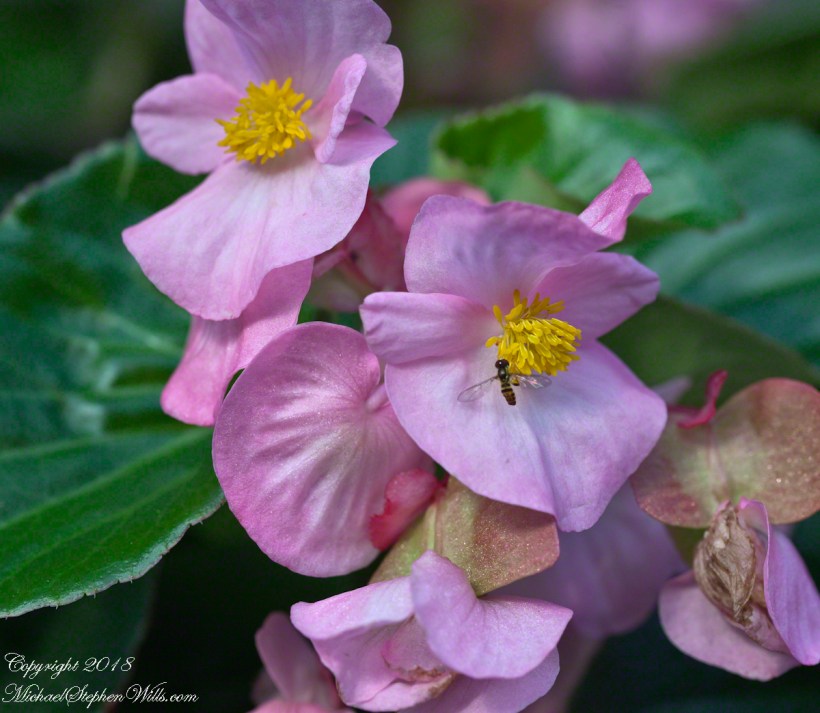
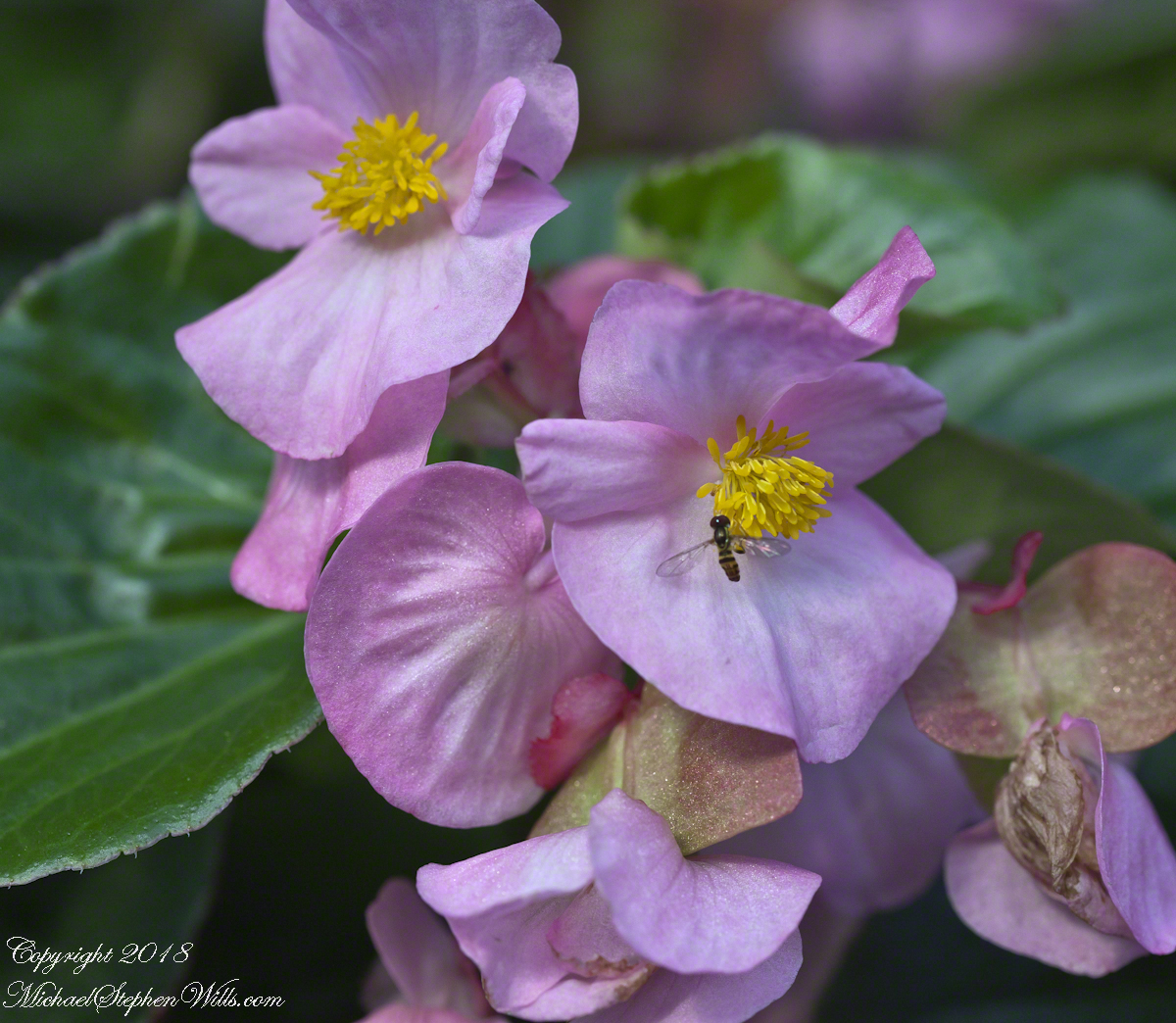
The angle of morning light in today’s macro captures the reflections of thousands of tiny mirrors in the flowers, more noticeable in the darker undersides. Also present is a subtle iridescence, a shiny surface imparting, in this begonia, slight color changes. These are signals to the pollinators, “Here I am — this is delicious.” Also, in low light tropical environments iridescence can enhance light gathering of leaves.
Hoverfly
Woodland sunbeams are special places where I first noticed hoverflies, they have a behavior of staying motionless, beating wings a blur, in sunlight making its way to the forest floor. It was only after the fact, in the virtual darkroom of Lightroom, I noticed the tiny creature in today’s photograph.
On a quick look, it appears to be a yellow jacket, a type of wasp. Look closely and you will see the eyes are on the top of the head and touch in places. The wings stand perpendicular to the thorax, wasp wings fold along the thorax and abdomen and there are differences in the veining of the wings. The identify of this creature is a beneficial fly, a hoverfly, genus Episyrphus. The shiny black shield on the upper thorax suggests to me this is a Episyrphus viridaureus.
This fly is beneficial to humans in two ways. One we observe in the photograph, as flower pollination. It is one of the few flies with mandibles capable of crushing pollen grains and, in the course of feeding, some pollen clings to the fly to be transported flower to flower. The second benefit is less obvious. The larval form is a predator of aphids. After feeding, it transforms into a resting state, called diapause and survives the winter this way.
Human beings suppose the benefit of looking like a wasp is protection against predators who fear being stung, increasing survival of the individual.
The lens is designed for macro work and is a fixed focus, it can capture small details without needed to be close to the subject. I decided to crop the image down to emphasize the hoverfly. It was in writing this post I noticed the sepal iridescence.
Copyright 2022 Michael Stephen Wills All Rights Reserved
 Michael Stephen Wills Photography