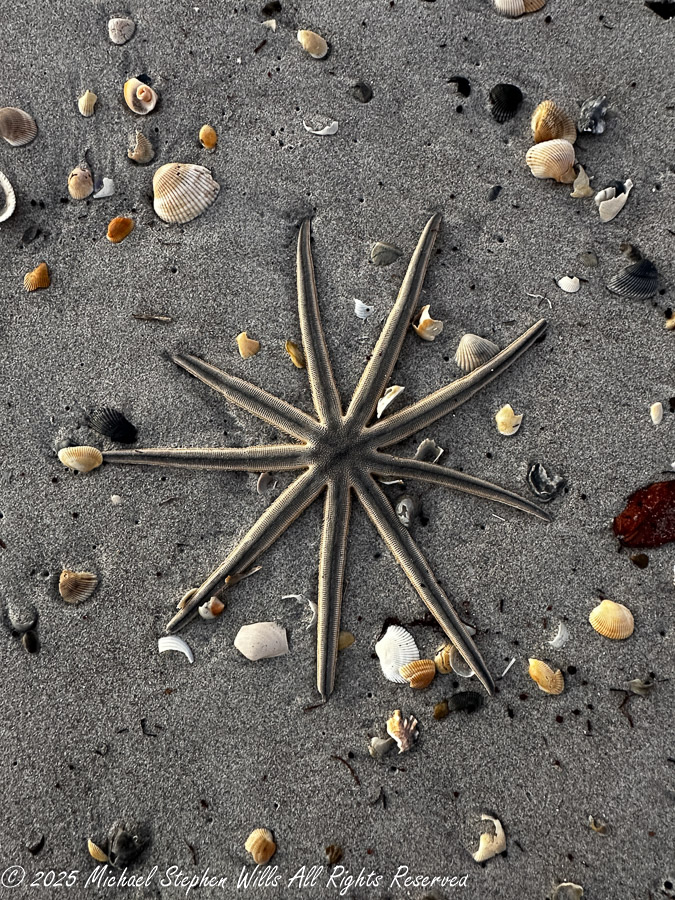
Walking along the shoreline of Cocoa Beach in the early morning light, I encountered a remarkable sight—a Nine-armed Sea Star (Luidia senegalensis) sprawled on the damp sand. Its long, slender arms stretched outward in a perfect starburst pattern, each limb tapering to a fine point. The sandy beige coloration of its body blended with the surrounding beach, accentuated by a darker stripe running down the center of each arm. Scattered around it were small shells and fragments, remnants of the ocean’s ebb and flow, testifying to the high tide that had deposited this fascinating creature ashore.
The scientific name Luidia senegalensis provides insight into the taxonomy and classification of this intriguing sea star. The genus Luidia is named after the 18th-century Portuguese naturalist Francisco Luid, who contributed significantly to marine biology. The species name senegalensis refers to its first recorded discovery along the coast of Senegal in West Africa. As a member of the phylum Echinodermata and the class Asteroidea, the Nine-armed Sea Star shares lineage with other starfish, sea urchins, and sand dollars, distinguished by their radial symmetry and water vascular system used for movement and feeding.
As I paused to observe it more closely, I marveled at the intricate details of its structure. Unlike the more familiar five-armed sea stars, this specimen had nine arms radiating from a small central disc. The surface of its body appeared smooth, with tiny tube feet lining the underside of each arm—a biological marvel designed for locomotion and feeding.
The Nine-armed Sea Star, common along Florida’s coastline, is a voracious predator within the benthic ecosystem. It primarily preys on bivalves such as clams and mussels, using a fascinating feeding strategy. Unlike most predators that rely on speed and strength, this sea star employs patience and ingenuity. It wraps its flexible arms around a bivalve, exerting a slow and steady force to pry the shell open. Once a small gap is achieved, the sea star everts its stomach through its mouth and into the prey’s shell, secreting digestive enzymes that liquefy the soft tissues within. This external digestion allows the sea star to consume its prey without the need for teeth or jaws—a perfect example of nature’s ingenuity.
Despite its delicate appearance, the Nine-armed Sea Star plays a crucial role in the marine ecosystem. By preying on bivalves, it helps regulate their populations, preventing overgrazing of seagrass beds and maintaining a balanced food web. Additionally, it serves as a food source for larger marine predators, such as fish and sea turtles. Its presence signifies a healthy intertidal environment, where nutrient cycles and predator-prey relationships are in dynamic equilibrium.
As I considered the sea star’s role in the ecosystem, I wondered about its journey to this point. These creatures undergo a fascinating life cycle, starting as tiny, free-swimming larvae that drift with ocean currents. Over time, they undergo metamorphosis, settling onto the seabed and gradually developing into their iconic star shape. The resilience and adaptability of these creatures are truly astounding, capable of regenerating lost arms and thriving in diverse habitats.
Realizing that this sea star likely found itself stranded by the receding high tide, I felt a sense of responsibility to help it return to its natural environment. Picking it up gently, I carried it toward the water’s edge, where the ebb tide was beginning to pull the sea back into its vast domain. With a final look at its striking form, I placed it carefully into the shallow waves, hoping that the ebb current would carry it back to the sandy seabed where it belonged.
As the waves lapped around my feet, I imagined the sea star resuming its journey, gliding along the ocean floor in search of its next meal. The interconnectedness of all marine life became evident in that moment—each creature playing its part in an intricate and delicate dance of survival.
Walking back along the shoreline, I reflected on the experience. My fleeting encounter with the Nine-armed Sea Star was a reminder of the wonders hidden beneath the ocean’s surface and our role in preserving them. Every tide brings new discoveries, and every ebb offers a second chance—for the sea star, and perhaps for us as well.
Cocoa Beach, with its gentle waves and abundant life, had once again provided an unforgettable encounter with nature. The starfish, now safely returned to the ocean, would continue its unseen work beneath the waves, a quiet but essential denizen of the underwater world.
 Michael Stephen Wills Photography