As Pam and I wander near the Nevin Welcome Center at the Cornell Botanical Gardens on a bright, early autumn day, my eye catches on a cluster of verdant, broad-leaved foliage. The sunlight filters through the leaves, casting a luminous green glow, while hints of red and burgundy add warmth to the scene. The plants here have a presence, a boldness that draws me in, and as I approach, I notice an array of information signs, thoughtfully placed to explain the rich tapestry of flora surrounding me.
The first sign I encounter is titled “A Ditch That Cleanses Water.” It immediately piques my curiosity. In just a few sentences, it describes how this landscape is designed to capture and cleanse stormwater runoff, turning what might otherwise be a simple drainage area into a living, breathing ecosystem. Instead of funneling water into a standard drainpipe, a filter strip and bioswale—a kind of vegetative trench—work in tandem to trap silt and pollutants. There’s a delicate choreography happening here, as water flows from the parking lot into river stone beds, slowing down, and then into the plant-lined filter strip, which encourages suspended particles to settle out.
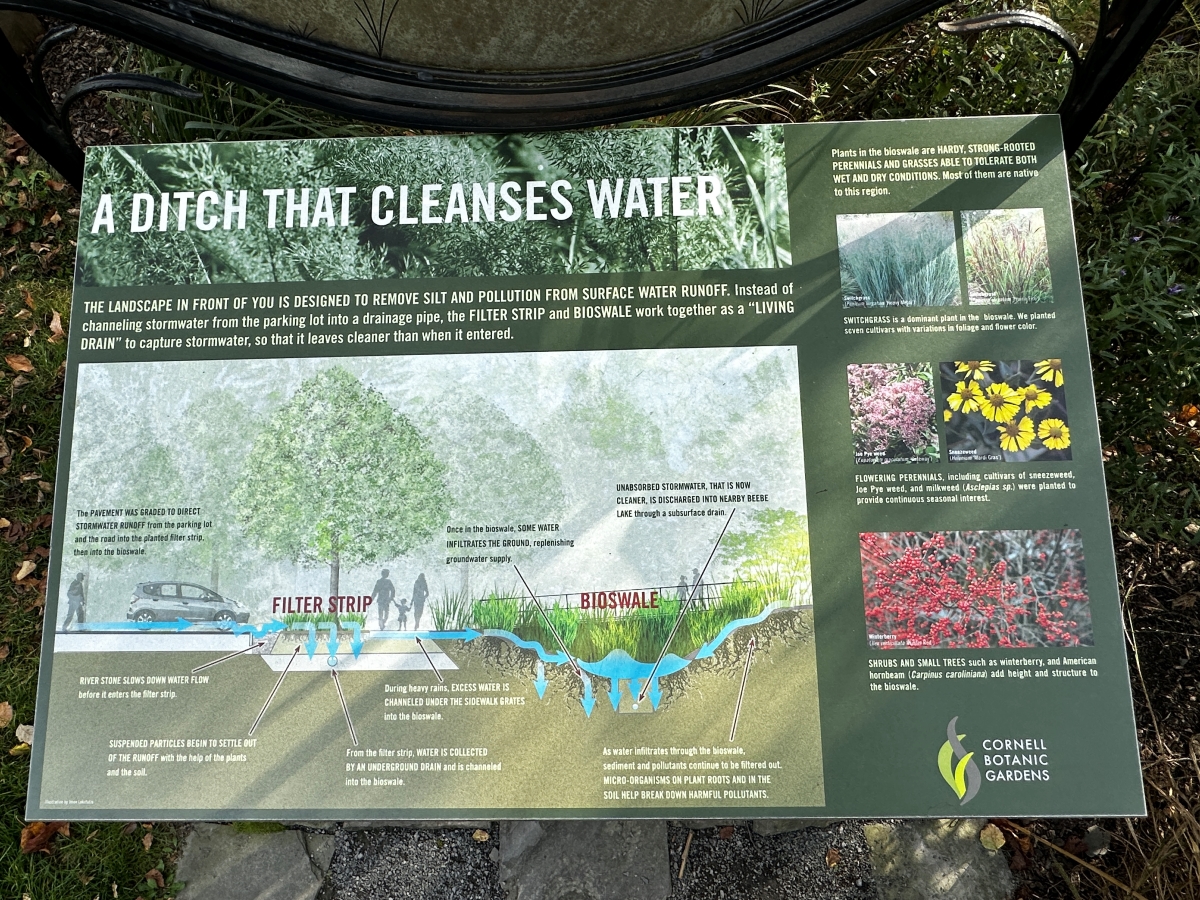
The bioswale itself is lush and resilient, filled with hardy, native plants that thrive in both wet and dry conditions. The sign explains that these plants are carefully chosen varieties such as Switchgrass and flowering perennials—sneezeweed and Joe Pye weed among them—that provide color through the seasons. Small trees like winterberry and American hornbeam add height and structure, giving this ecological marvel both function and form. I’m struck by how much thought has gone into something as mundane as stormwater runoff, transforming it into a process that supports the environment but also creates a pleasing view. Here, the bioswale captures the stormwater, filters it, and releases it cleaner than before, a quiet miracle of natural engineering.
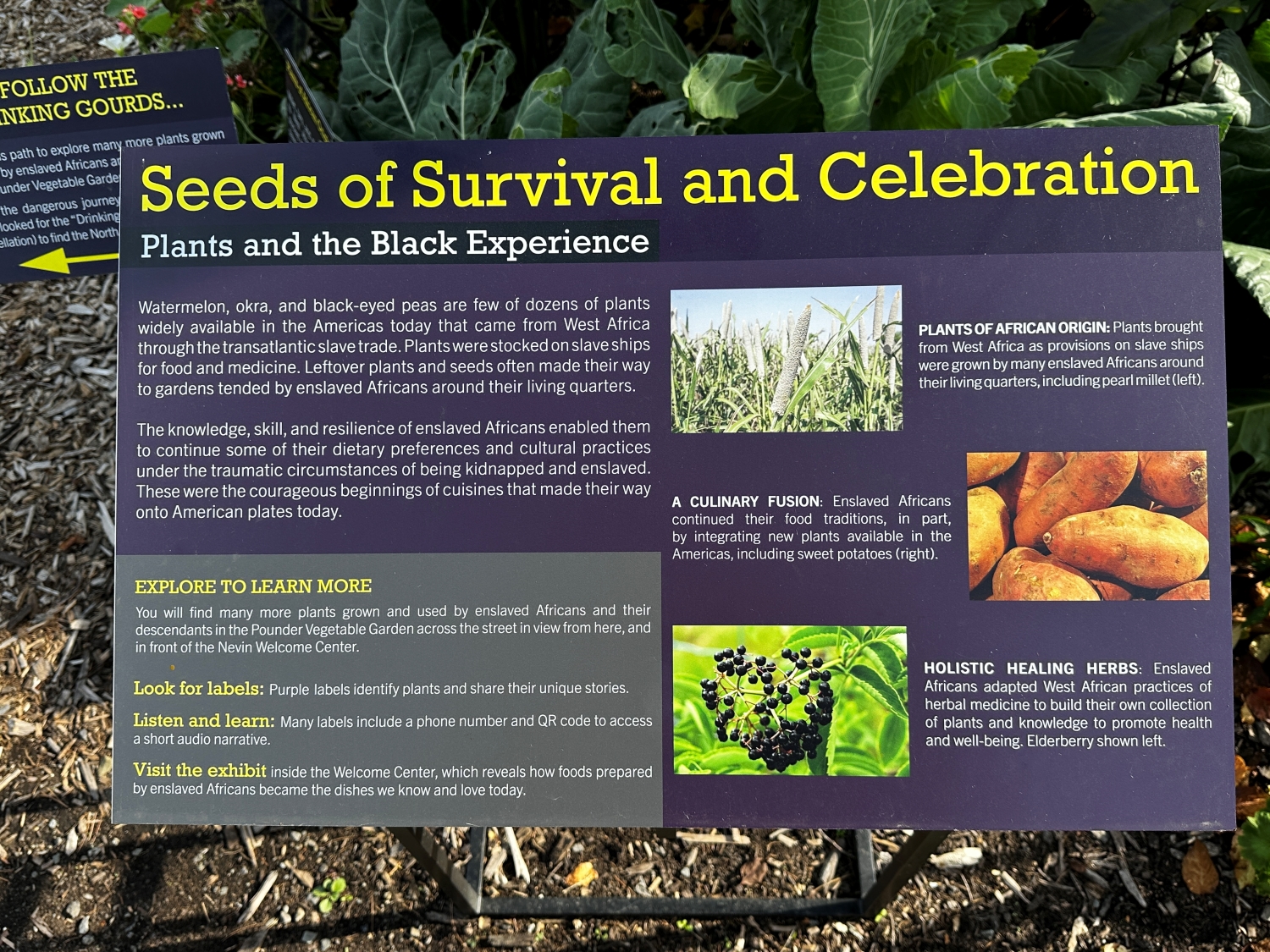
Moving on, I find another sign titled “Seeds of Survival and Celebration: Plants and the Black Experience.” This sign feels more intimate, as it dives into the deep history of plants brought from West Africa during the transatlantic slave trade. I’m reminded that gardens can be repositories of history, culture, and resilience. Plants like watermelon, okra, and black-eyed peas were brought by enslaved Africans who tended them near their quarters, ensuring a piece of home remained with them, even under unimaginable conditions. These plants became the foundation of African American culinary traditions, and I can almost taste the sweet potatoes and other foods that have become part of our shared heritage. The sign even nods to holistic healing herbs like elderberry, which were used to promote health and well-being, demonstrating how enslaved Africans maintained aspects of their culture through the plants they grew.
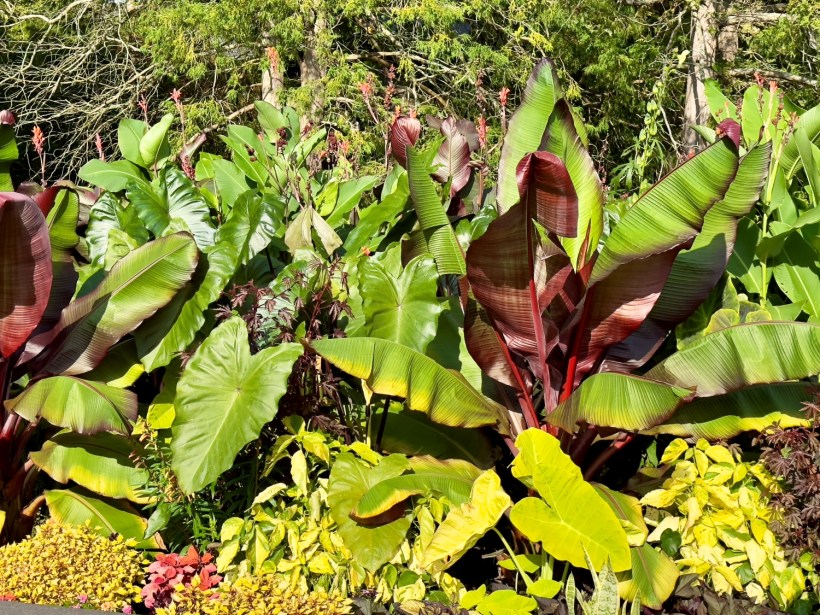
As I reflect on the stories woven into these signs, I find myself surrounded by a stunning mix of bold, leafy plants in vibrant greens, reds, and yellows—an almost tropical display that stands defiant against the approaching cold season. Banana leaves, elephant ears, and coleus fill the garden beds, their leaves large, showy, and unabashedly lush. The scene feels alive, a burst of tropical splendor amid the Finger Lakes. These aren’t plants native to upstate New York, yet they’ve been incorporated here with care and skill, bringing a hint of warmth as the days grow shorter. Their wide, smooth surfaces reflect the sunlight, catching my eye with every slight breeze, and they create an atmosphere that is both exotic and inviting.
This day, the Cornell Botanical Gardens have offered Pam and I beauty along with education. The signage has guided us through ecological engineering, the resilience of African American foodways, and the artistry of landscape design, blending these narratives into the landscape itself. Each sign, each plant, tells a story, and as I walk away, I carry these tales with me, reminded that gardens are not merely for looking—they are for learning, for remembering, and for celebrating the resilience of life in all its forms.
 Michael Stephen Wills Photography
Beautiful!
LikeLiked by 1 person
Thanks for the compliment, Sheree.
LikeLiked by 1 person
Pleasure Michael
LikeLiked by 1 person
The reference to elderberry, a species of which grows natively in central Texas as well as upstate New York, sent me searching. The Wikipedia article about the genus Sambucus lists 25 species that it says are recognized in that genus, along with the geographical range of each species. Only one of those ranges mentions Africa at all, the one for Sambucus ebulus, which the Wikipedia article says grows in northwest Africa. A separate search for Sambucus ebulus turned up an occasional article showing the species along the western Mediterranean coast of Africa.
All of which has me wondering where/when sub-Saharan Africans who were kidnapped into slavery and sent to the American colonies or states would have become acquainted with elderberry. One possibility is that the Arabs, who were heavily involved in slave trading, might have introduced elderberry to native peoples in sub-Saharan Africa. Similarly, people from European countries that colonized Africa could have introduced elderberry. Yet another possibility is that some of the first black slaves in the Americas could have become acquainted with elderberry here, and that it happened long enough ago that people now mistakenly assume that black slaves brought elederberry with them from Africa.
Any thoughts or information about that?
LikeLiked by 1 person
Hi Steve,
Thank you for your thoughtful and intriguing comment! It’s fascinating how a simple reference to elderberry can lead to such a deep dive into history and geography.
Your research highlights the complexity of tracing the movement of plants like elderberry (genus Sambucus) across continents and cultures. The question of when and where sub-Saharan Africans first encountered elderberry is indeed a compelling one. I think your suggested possibilities are quite plausible, especially the idea that elderberry may have been introduced to sub-Saharan Africa through Arab or European trade and colonization. It’s worth noting that trade routes between the Mediterranean, North Africa, and sub-Saharan Africa were well established long before the transatlantic slave trade, potentially facilitating the spread of plants and knowledge.
The alternative possibility you raised—that enslaved Africans first encountered elderberry in the Americas—also makes sense, especially considering the historical context. Many plants, foods, and medicinal traditions in the Americas were shared and adapted across cultures as different groups interacted, often under dire circumstances.
Elderberry (Sambucus nigra) has a rich history in traditional medicine, particularly in Europe and North America, where it’s been used to treat ailments like colds, flu, and inflammation. Its berries and flowers are known for their immune-boosting and antiviral properties.
In West Africa, traditional herbal medicine relies heavily on indigenous plants, with remedies passed down through generations. The West African Herbal Pharmacopoeia documents numerous native plants used for medicinal purposes.
However, elderberry is not native to West Africa, and there’s limited evidence of its use in traditional West African herbal practices. It’s possible that elderberry was introduced to the region through European contact or trade, but it doesn’t appear to have become a significant part of West African herbal medicine.
In the Americas, enslaved Africans encountered new plants and remedies, leading to a blending of African, European, and Indigenous healing traditions. Elderberry, being prevalent in North America, may have been adopted into African American herbal practices during this period.
In summary, while elderberry holds an esteemed place in European and North American herbal medicine, its role in West African traditional practices seems minimal, likely due to its non-native status in the region. The integration of elderberry into African American herbal traditions likely occurred post-introduction in the Americas, rather than being brought from Africa.
I appreciate you bringing this up—it’s a reminder of how plants often carry untold stories of cultural exchange and adaptation. If I come across additional information on elderberry’s historical presence in Africa or its integration into African American traditions, I’ll be sure to share it. In the meantime, this could be a great topic for deeper research!
Best regards,
Michael
LikeLiked by 1 person
Beautiful Cornell Botanical garden! Lots of plants are there! Well shared with good description
LikeLiked by 1 person
Thanks so much, Priti!
The diversity of plants there makes every visit feel like stepping into a living encyclopedia.
I’m glad you enjoyed the descriptions—nature certainly gives us plenty to talk about!
LikeLiked by 1 person
💐
LikeLiked by 1 person