As I stood within the hallowed confines of Saint Fin Barre’s Cathedral in Cork City, Ireland, I found myself drawn to the intricate artistry that tells the story of faith, resilience, and devotion. The figures and symbols within this magnificent edifice bring to life the history of Saint Fin Barre as well as the broader narrative of Christian tradition and its enduring influence on the region.
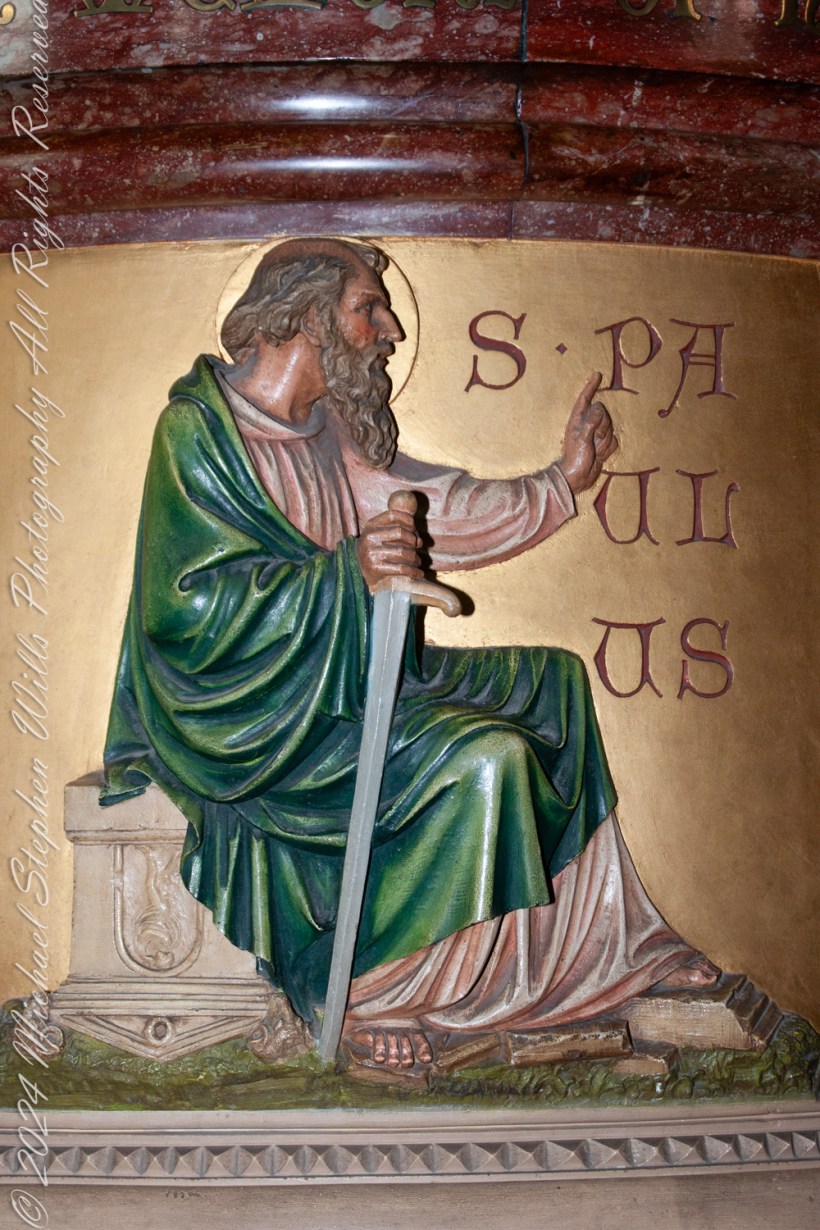
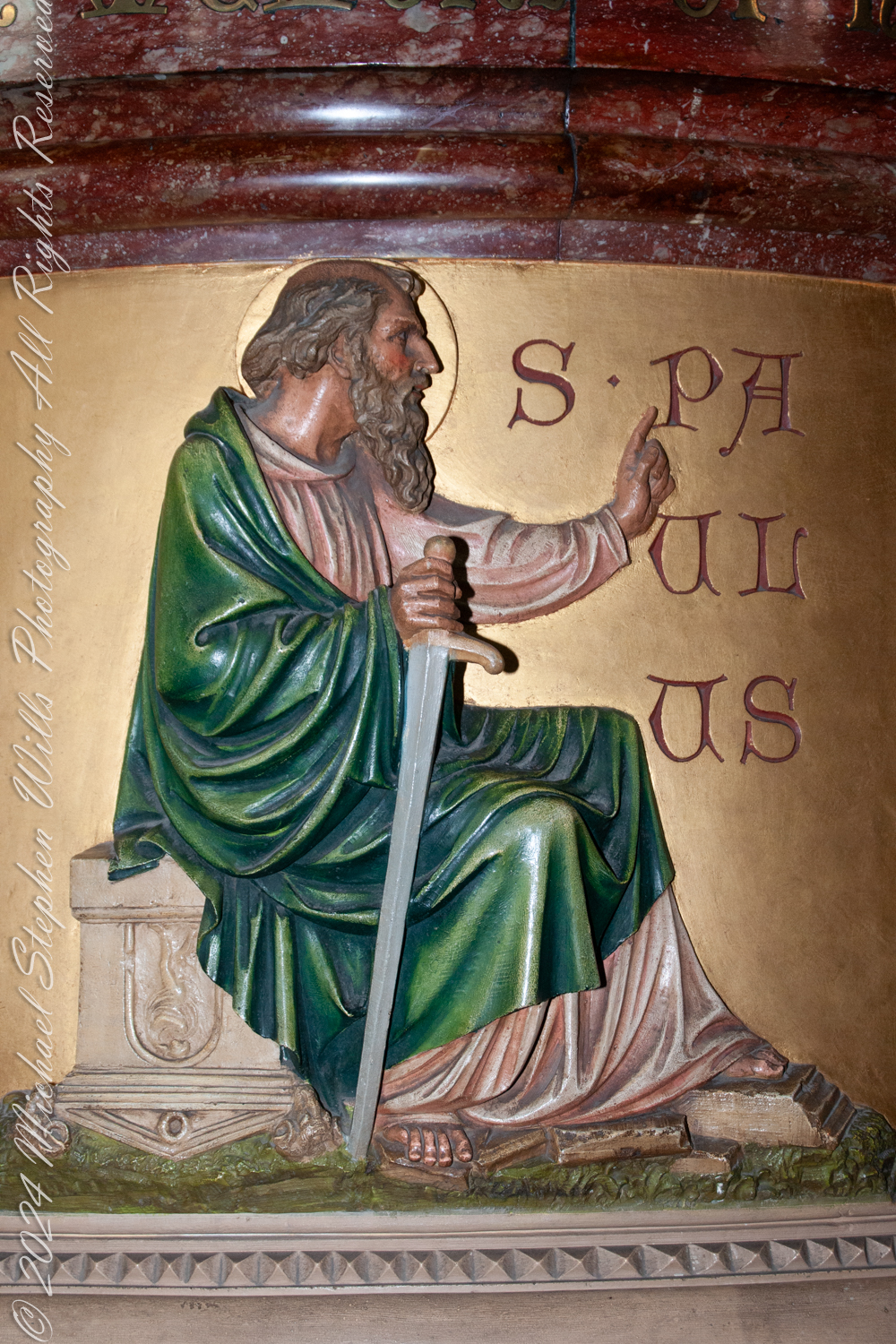
Near the entrance, the cylindrical pulpit’s relief figures of five evangelists captured my imagination. Here was the relief of Saint Paul seated with his characteristic sword, a symbol of both his martyrdom and the “sword of the Spirit” from chapter 6, verse 17 of the New Testiment Epistle to the Ephesians. His hand gestures toward the heavens, as if calling upon divine guidance to symbolize his role as an intermediary or messenger of God’s revelation. The rich green of his robes, juxtaposed against the golden background, speaks of hope, growth, and the everlasting promise of salvation. Here I found Saint Paul embodying the courage and conviction needed to preach and defend the faith—a sentiment that resonates deeply in the cathedral’s design and purpose.
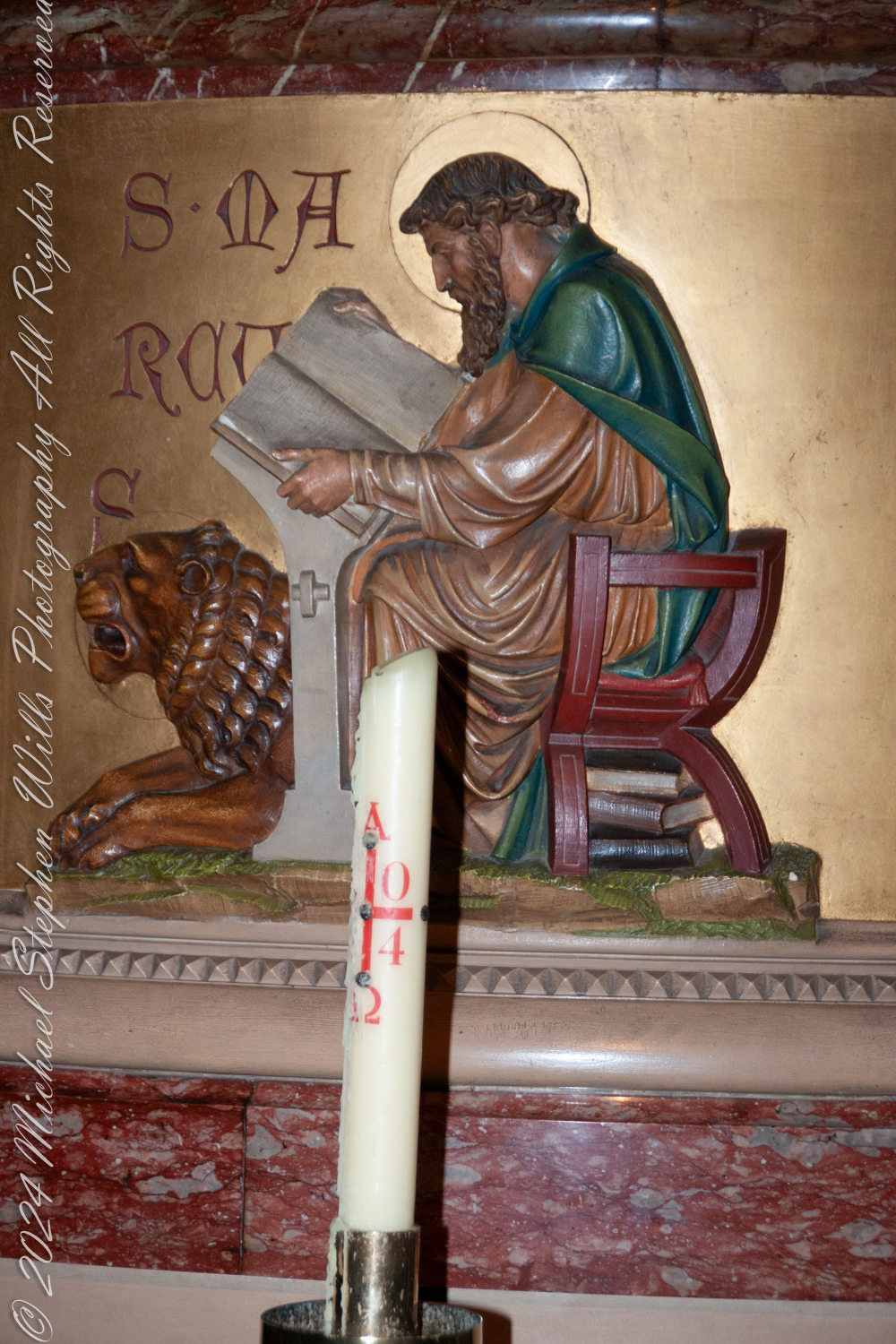
Rounding the circle, another relief brought Saint Mark to life. With the lion at his side, Saint Mark writes intently, reminding us of his contributions to the Gospels. The warm, earthy tones of his attire and the contemplative tilt of his head evoke the diligence and introspection of a writer who draws inspiration from divine revelation. The lion, its expression both fierce and loyal, represents courage and the Gospel’s enduring power.
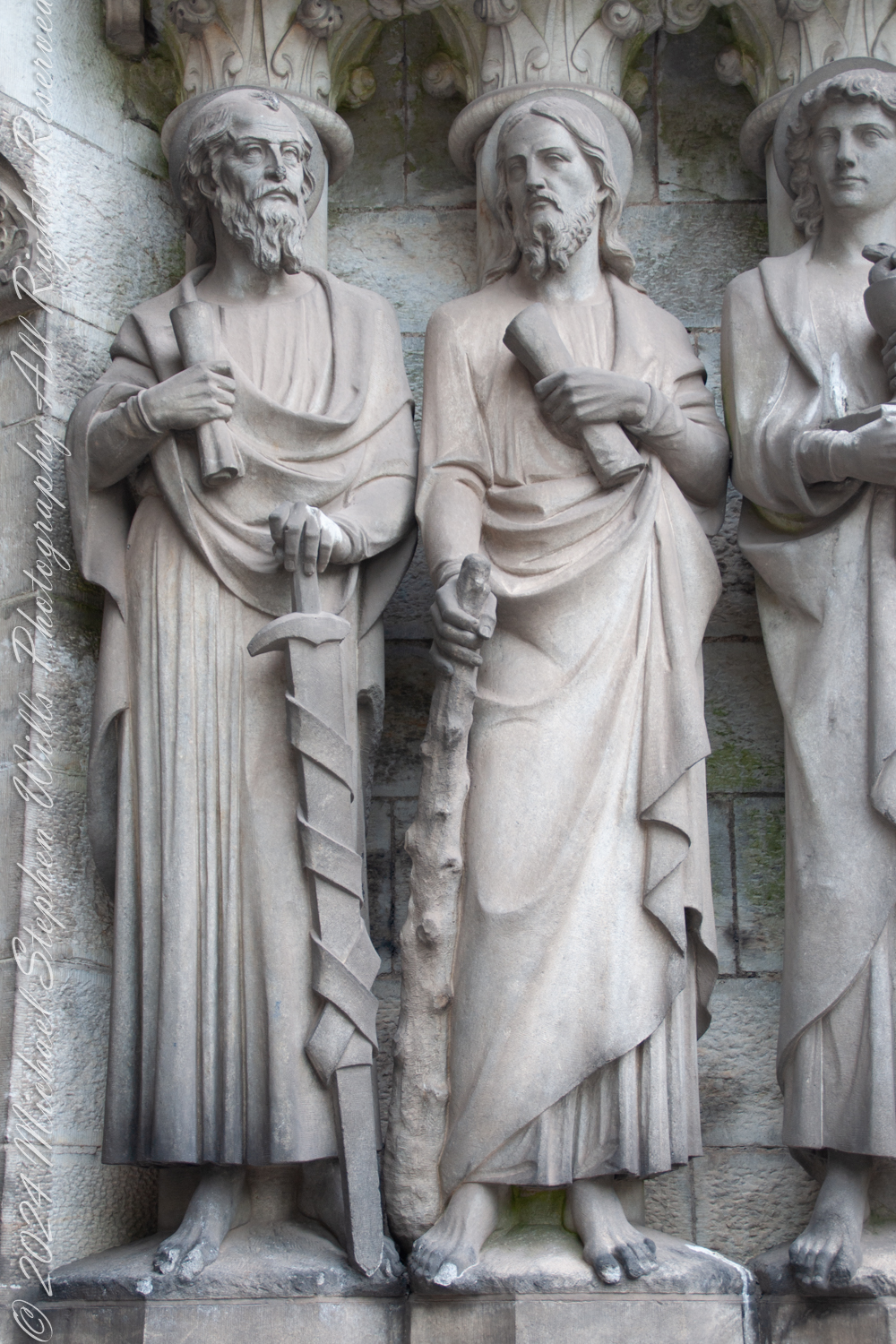
The cathedral’s external sculptures echo these individual representations of the apostles, where stone figures silently stand guard at the west entrance. The central figure of my photograph, holding a scroll in his left hand and a long cudgel (club) in his right, is Saint James the Less (also known as James the Minor). The scroll symbolizes his role spreading the word of God. The cudgel alludes to his martyrdom, as tradition holds that his executioners brutally beat him to death with such a club. His serene expression contrasts with Saint Paul, on the left, who holds the traditional “sword of the spirit” of his Epistle to the Ephesians. These carvings are spiritual sentinels, inviting visitors to contemplate the legacy of those who laid the foundations of the Church.
As the patron saint of the city, Saint Fin Barre’s enduring legacy profoundly impacts Cork’s spiritual and cultural history. His legacy dates back to the 7th century when he established a monastic settlement on the site where the cathedral now stands. This sacred location has witnessed centuries of devotion, destruction, and renewal. The visionary architect William Burges designed the cathedral in the 19th century as both a tribute to Saint Fin Barre’s enduring influence and a testament to William Burges’s own artistic genius.
Walking through the cathedral, I felt the interplay of past and present, earth and heaven. These saints and apostles are figures from history, embodiments of virtues and struggles that are timeless. Their stories invite us to reflect on our own faith, perseverance, and the ways we leave our mark on the world.
Saint Fin Barre’s Cathedral is a place of worship and a narrative in stone, wood, and glass. The intricate carvings and the evocative sculptures, among much else, create a space that transcends the ordinary. Here, the saints and apostles stand as eternal witnesses to the human journey toward the divine. As I left the cathedral, the image of Saint Paul, resolute and unyielding, stayed with me—a reminder that we must build faith, much like the cathedral itself, stone by stone, moment by moment, to endure the test of time.
 Michael Stephen Wills Photography