October 23, 2026 | United Airlines Flight 490 | Chicago to San Antonio, Texas
We had an otherwise crystal morning under the haze above Chicago’s O’Hare International Airport when I settled into my First Class window seat on the starboard side of United Airlines Flight 490. Our destination was San Antonio, Texas, but before we could leave Chicago behind, I had an opportunity to watch one of the world’s busiest airports go about its morning business.
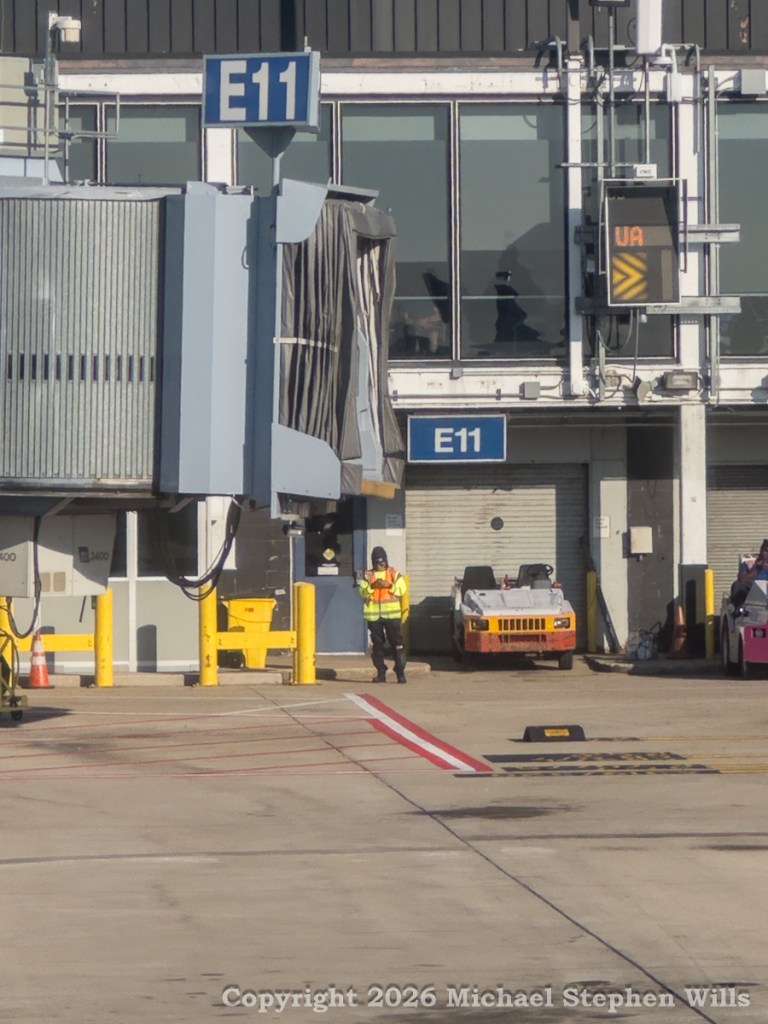
I had my iPhone 14 Pro Max ready. At 9:25 a.m., my attention was drawn our departure Gate E11, where a solitary ground crew member stood beneath the jet bridge, dressed in fluorescent yellow and orange. Above him, electronic signs directed aircraft toward their assigned positions. He appeared small against the terminal’s glass windows, enormous boarding bridge, and surrounding equipment. He was one among hundreds of workers, part of an essential operation requiring precise coordination.
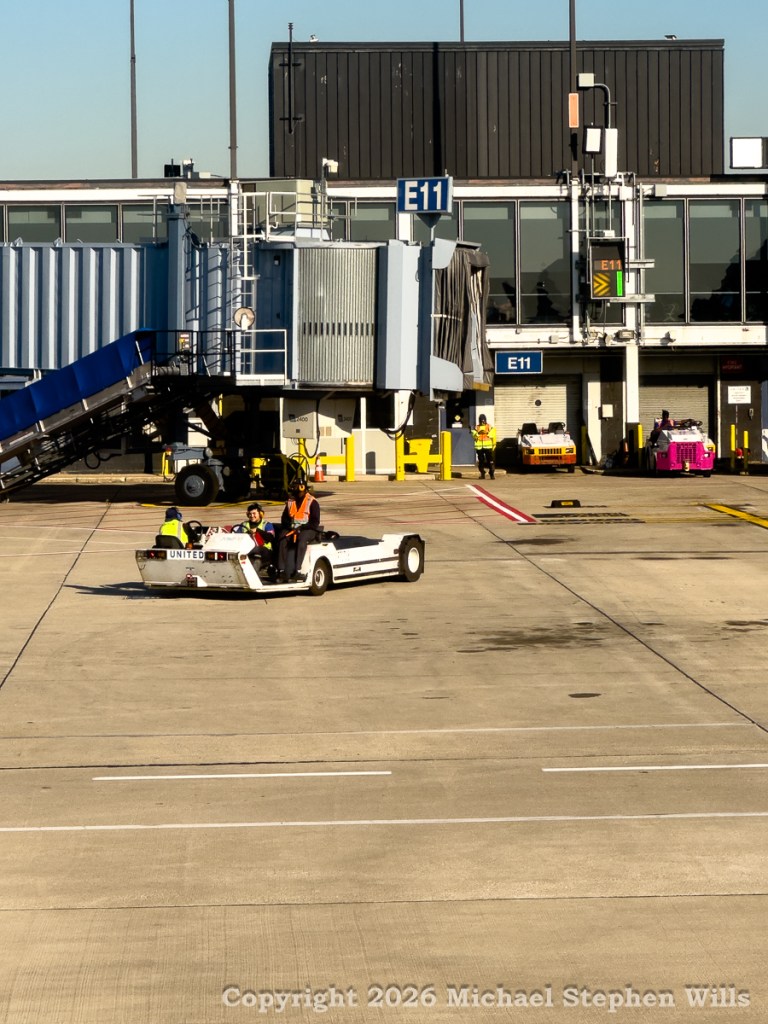
The apron was full of activity. A white United Airlines tug carried several workers across the concrete, while baggage tractors, service vehicles, and aircraft-handling equipment waited near the terminal. Nothing seemed hurried, but little was standing still for long. Every vehicle and every worker had a particular assignment.
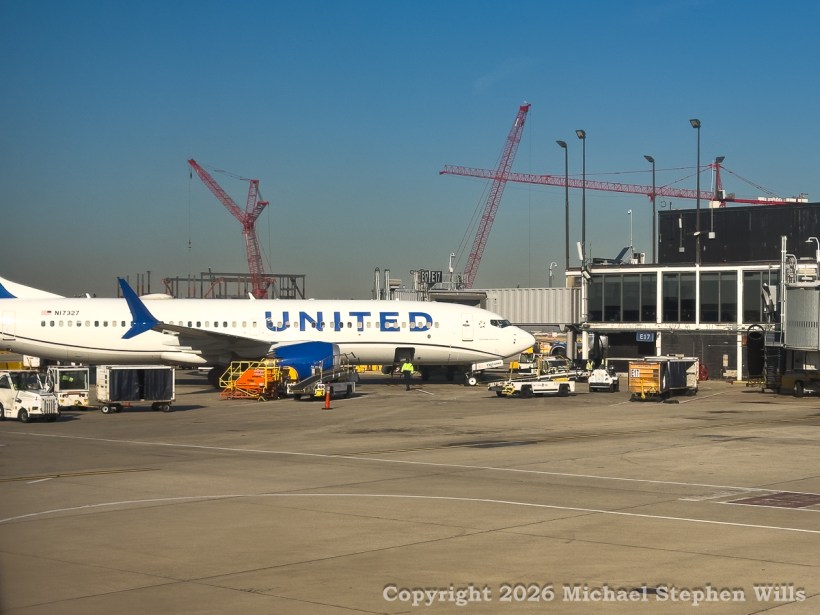
Beyond the jet bridge, a United Boeing 737 MAX 8 stood near Gate E17. Its registration, N17327, was visible in my photograph. My research confirms that the aircraft had entered United’s fleet in December 2023, making it a relatively recent addition to the airline’s growing inventory of narrow-body jets.
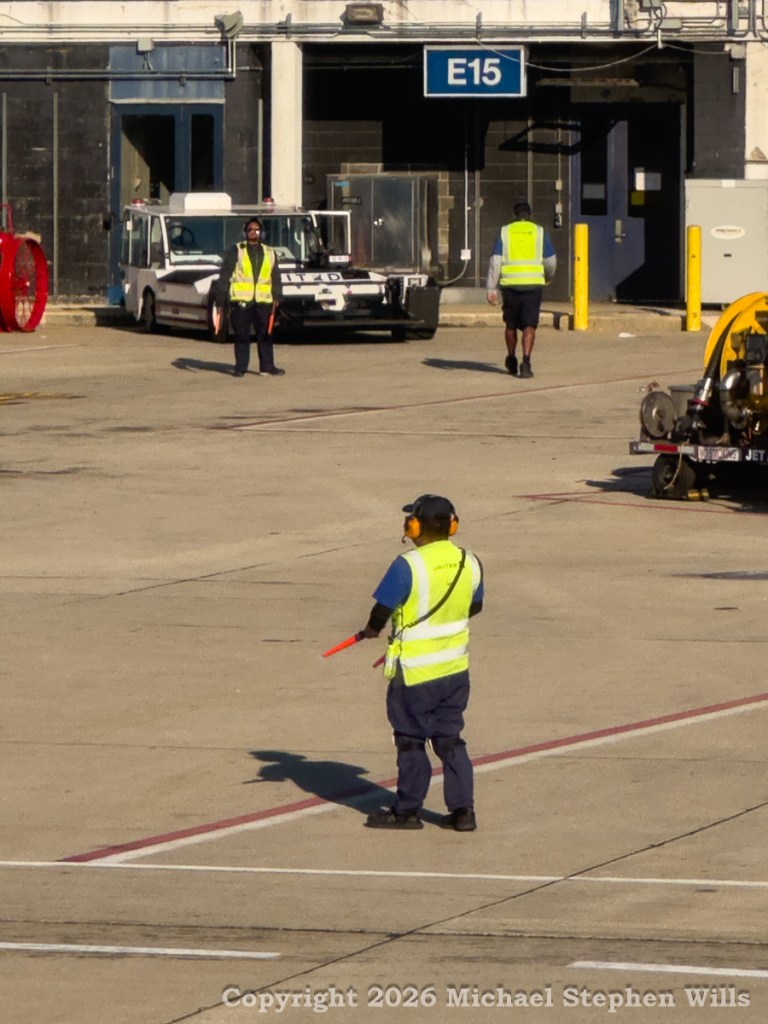
Another photograph captured the activity around Gate E15. A ramp worker wearing hearing protection held an orange signaling wand, while colleagues moved about near a pushback tractor. These are the people passengers rarely notice, although safe departures depend upon their work. From my window, I could appreciate the considerable distance between the people working below and the aircraft they were responsible for guiding.
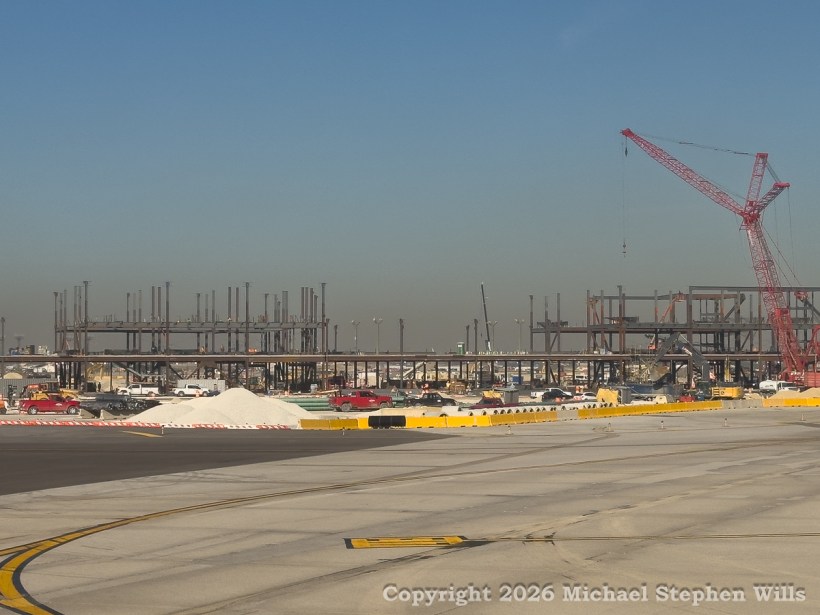
As our aircraft began moving away from the terminal, something unexpected drew my attention beyond the parked airplanes: a vast construction site. Red cranes rose above an unfinished framework of structural steel. Trucks, excavators, concrete barriers, and piles of construction material occupied an enormous portion of the airfield.
I later learned that I had photographed the construction of O’Hare’s new Concourse D, part of the ORDNext modernization program. Work had begun in August 2025, and by October 2026, the steel superstructure was taking shape. The planned 19-gate satellite concourse, scheduled for completion in late 2028, would accommodate both narrow-body and wide-body aircraft. What I was seeing was not simply another construction project, but a substantial expansion of Chicago’s aviation infrastructure.
There was something fascinating about watching an airport operate while simultaneously rebuilding itself. Aircraft continued arriving and departing, even as cranes swung above steel columns that would eventually support the terminal facilities of the future.
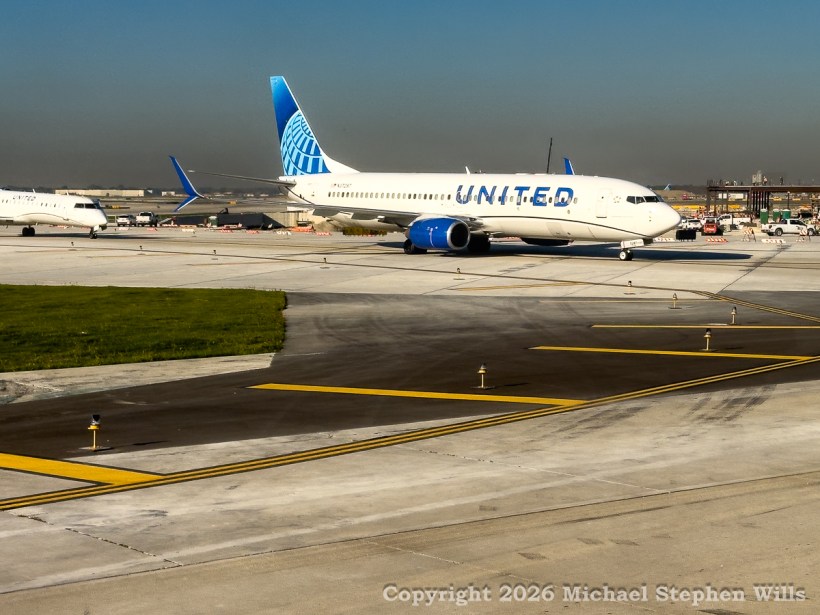
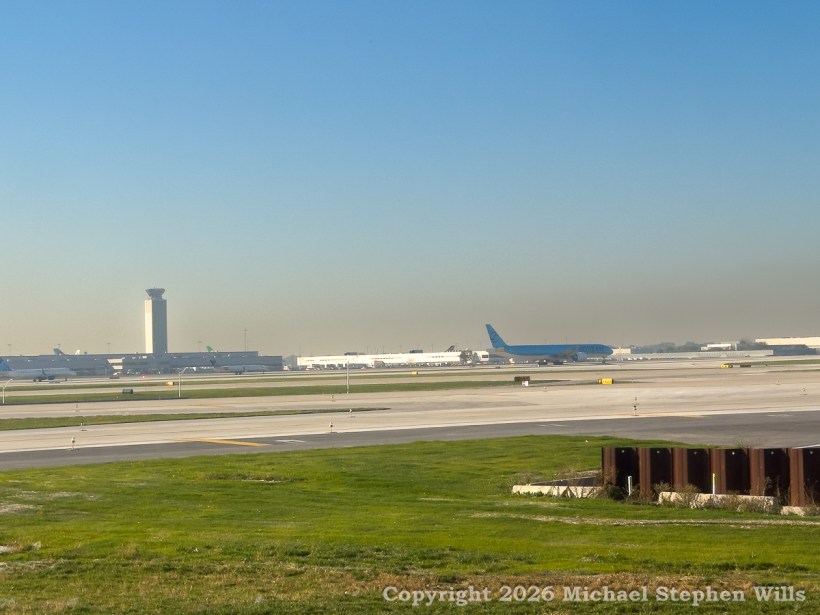
Our taxi continued. Through the window, I could see a succession of United aircraft, including a familiar blue-and-white jet taxiing across an intersection. In the distance stood one of O’Hare’s air traffic control towers, rising above a complex landscape of terminals, runways, taxiways, and service roads.
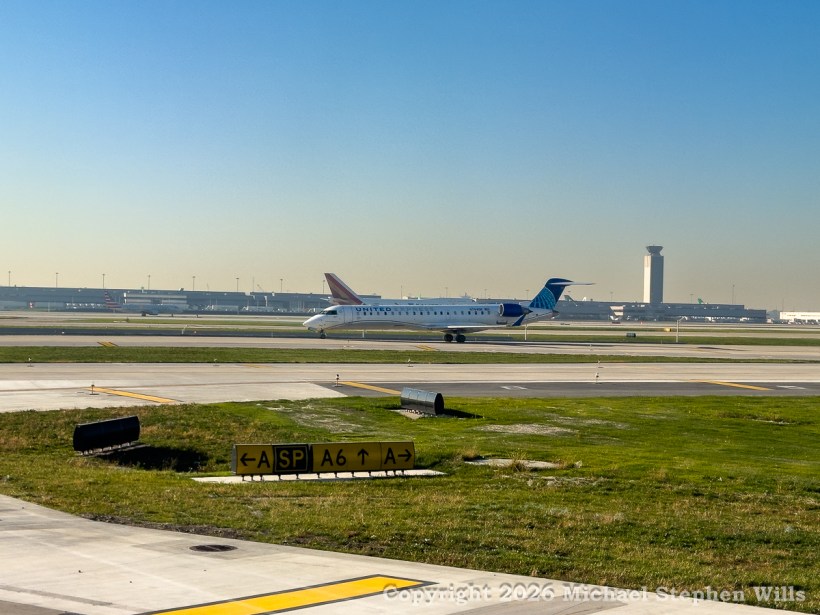
A United Express regional jet appeared across the field, its comparatively small fuselage contrasting with the much larger aircraft we would soon encounter. Nearby, a yellow-and-black taxiway sign identified routes A, SP, and A6. These apparently cryptic markings help pilots navigate the airport’s extensive network of paved surfaces.
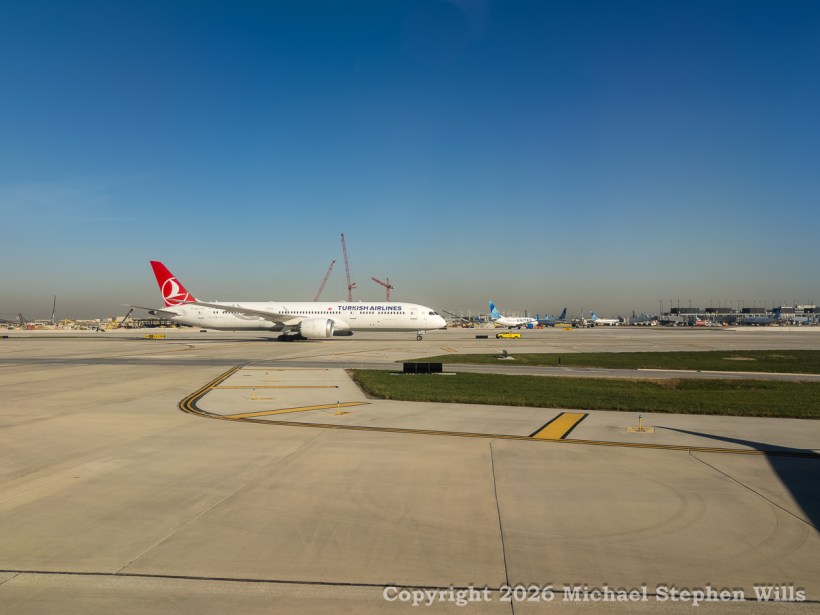
At approximately 9:37, a magnificent Turkish Airlines wide-body aircraft passed across my view. Its white fuselage, bright red tail, and distinctive emblem stood out against the clear blue October sky. Behind it, cranes marked the expanding airport, while a line of United aircraft occupied the distant gates. The juxtaposition was striking: one airplane represented international travel spanning continents, while the construction behind it anticipated decades of future journeys.
A few minutes later, an even more impressive aircraft crossed our path.
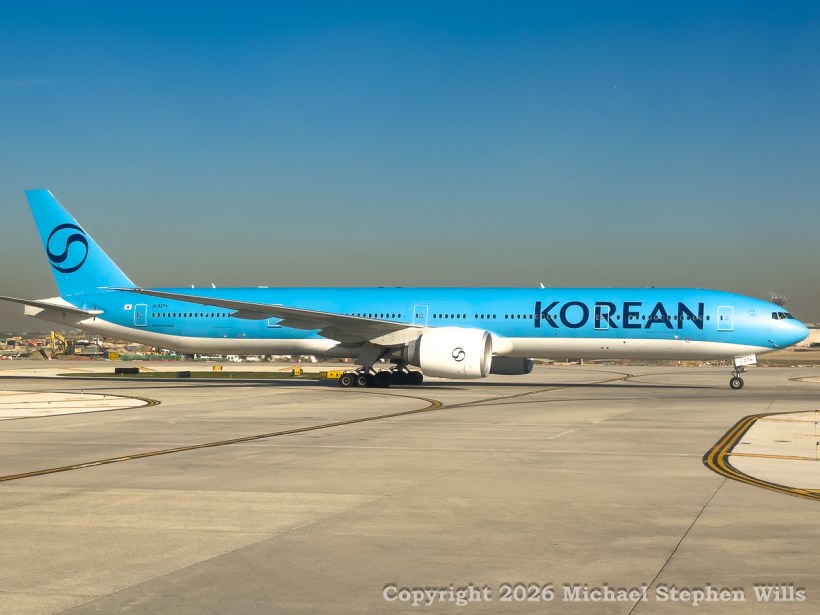
It was a Korean Air Boeing 777-300ER, painted in the airline’s distinctive light-blue livery. Its registration, HL8274, was legible near the rear fuselage. My research revealed that this particular aircraft dated from February 2013. The enormous twin-engine airliner filled almost the entire width of my photograph. From our window, its engines, landing gear, and extended wings were clearly visible.
Its enormous fuselage was painted a luminous shade of blue, but what particularly caught my attention was the unusual emblem on its tail. At first glance, it resembled a gracefully curling ribbon, almost an abstract letter S. I later discovered that the design carried a fascinating story, reaching back into Korean philosophy, national identity, and centuries of cultural tradition.
The emblem is a modern interpretation of the Taegeuk, the ancient Korean symbol of complementary forces in the universe. Most recognizable as the red-and-blue circular design at the center of South Korea’s national flag, the Taegeuk expresses the relationship between yin and yang: darkness and light, rest and activity, and the perpetual interaction of apparently opposing forces. Neither can exist independently of the other. Together, they represent harmony within a constantly changing universe. The Taegeuk became part of Korea’s officially adopted national flag in 1883, during the reign of King Gojong.
Korean Air first incorporated a stylized red-and-blue Taegeuk into its aircraft markings in 1984. For more than four decades, that emblem traveled around the world on the tails of Korean passenger jets.
Then, in March 2025, the airline unveiled its first major redesign in 41 years. The familiar red and blue were replaced by a single flowing form in deep blue, part of a sweeping modernization associated with Korean Air’s acquisition of Asiana Airlines. The aircraft passing my window wore this new identity.
But the designers had drawn upon something more unexpected than the national flag.
Their inspiration included Sangmo Nori, a traditional Korean folk performance in which dancers wear special hats fitted with long, flowing ribbons. With rhythmic movements of their heads and bodies, the performers send these ribbons swirling through the air, tracing magnificent circles, spirals, and sweeping arcs. The dance is associated with prosperity, abundance, and celebration.
The international design firm Lippincott incorporated the graceful movement of these ribbons into Korean Air’s reinvented Taegeuk. What appears to be a simple blue curve is therefore a meeting of two traditions: the philosophical symbolism of the Taegeuk and the exuberant physical artistry of Korean folk dance.
Even the aircraft’s lettering tells a story. The enormous word KOREAN stretches across the forward fuselage, deliberately omitting AIR. The designers wanted the country’s name itself to become the dominant visual identity, reflecting the airline’s position as South Korea’s national flag carrier. Its distinctive sky-blue paint was also updated with a subtle metallic finish.
Looking again at my photograph, I see the aircraft differently. That dark-blue emblem on the tail carries ideas developed across centuries: the balance of natural forces, the continuity of national tradition, and the flowing ribbons of dancers celebrating life.
There is something wonderfully appropriate about placing such a symbol on an airplane. The dancers’ ribbons describe graceful paths through the air, while the aircraft itself traces an invisible arc across the sky.
For a few moments on an October morning in Chicago, centuries of Korean cultural history passed directly before my window, painted on the tail of a modern jetliner.
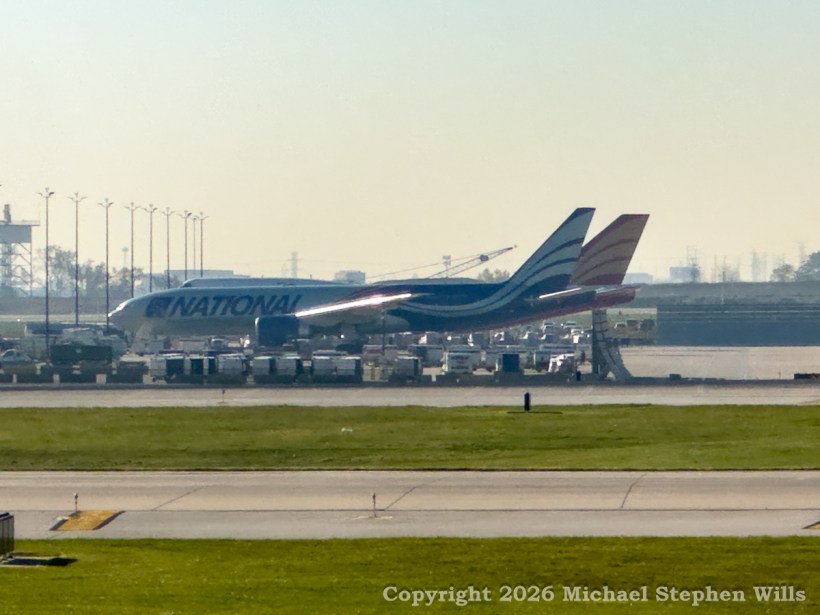
As we continued toward our departure runway, I spotted a National Airlines aircraft in the distance, surrounded by cargo-handling equipment. An American Airlines tail rose behind it, adding another splash of color to the crowded scene. National specializes in passenger and freight charter operations, including heavy air cargo. National Airlines It was another reminder that O’Hare handles much more than the scheduled passenger traffic familiar to most travelers.
By 9:40 a.m., we had moved well beyond the terminal complex. The foreground was now a succession of taxiways, strips of grass, and concrete pavement. The terminal buildings seemed more distant, and the aircraft that had dominated my earlier photographs were becoming part of a broader landscape.
The next stage of our journey was approaching.
After the measured pace of taxiing, takeoff would bring a sudden change: accelerating engines, the gathering speed of the aircraft, and the remarkable moment when the wheels leave the runway. From my window, Chicago’s enormous airport would begin to diminish beneath us.
I had spent the preceding fifteen minutes photographing an airport that was both familiar and constantly changing. Ground crews, airplanes from three continents, construction workers, towering cranes, and the quiet geometry of taxiways had all passed before my window.
And now, with San Antonio ahead of us, it was our turn to join the traffic in the sky.

