Stargazing Winter’s Crab: Watching the 2019 Total Lunar Eclipse Near Cancer’s Beehive Cluster

Join me as a full moon slips into Earth’s shadow, turning copper beside Cancer’s Beehive—science, illusion, and wonder entwined in a winter night.

Colored lights of our skies are lifelong triggers for the imagination. On any moonless, crystal night—far from the town-glow—three thousand or so stars and the wandering planets scatter across the dark. We read them instinctively, stitching patterns the way our ancestors did, turning a brilliant chaos into stories. Along the ecliptic, twelve of those patterns became the constellations, a starry calendar by which careful observers told the seasons. When Cancer, the Crab rides high, winter has the northern hemisphere in its grip
Click Photograph for my OnLine Galleries
Click photograph for my OnLine Galleries. Clicking the other photographs in this post will yield a larger image.

On the night of January 20–21, 2019, a full moon climbed from the horizon and slid into Earth’s shadow, transforming a familiar face into a copper coin. As it rose, that low-horizon “larger” moon—an illusion born of context—felt close enough to pocket. Hours later, the moon darkened to a dull copper color and appeared to float amid Cancer’s dim stars.

I set up a Canon DSLR on a tripod with a 24mm f/1.4 lens, pushed the ISO to 3200, and shortened the exposure to 1.3 seconds—a compromise between freezing star points and preserving the feel of the sky. The moon, of course, was overexposed in that wide frame; later, I overlaid a correctly exposed moon (from a telephoto shot later in the night) at its true apparent size to match the scene as the eye saw it. Is it the most “technical” astrophotograph of the eclipse? No. But it is faithful to the moment I witnessed and good enough to carry the story forward.

The Moon on the Crab’s back

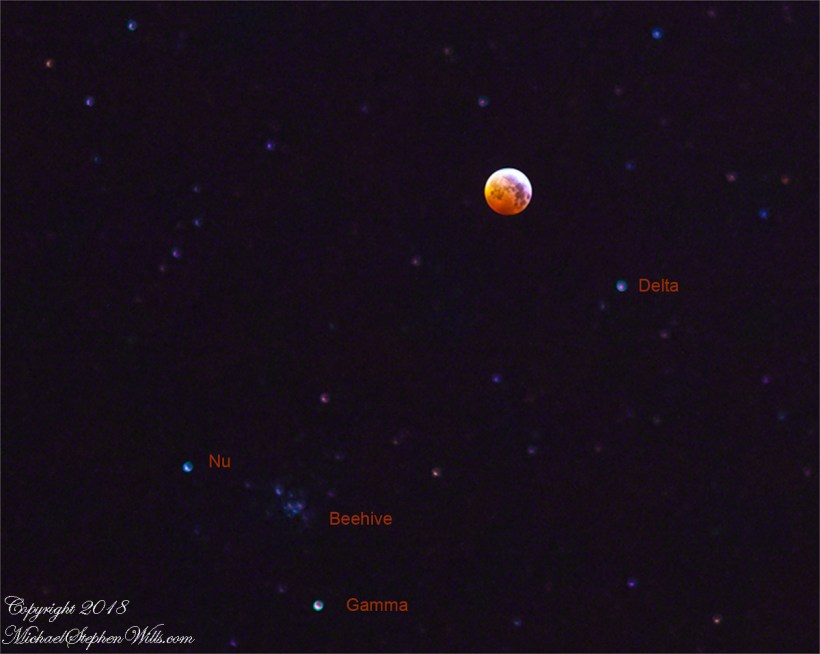
Cancer is never an easy connect-the-dots. Its stars are modest, more suggestion than signature. Look just to the side of the moon’s position that night and you come to Delta Cancri, the orange giant nicknamed the Southern Donkey. Draw a mental line down and slightly right to the faint pair Nu and Gamma Cancri—white stars that only masquerade as twins. They are not physically bound, merely near each other by line of sight: Nu about 390 light-years away, Gamma at 181. Scatter in Alpha and Beta off the Crab’s back and the outline becomes more plausible, the way a minimal sketch becomes a creature once the eye knows what to look for.

The Beehive

Between Nu and Gamma, edged closer to the moon, lies the real prize: the Beehive Cluster—also known as Praesepe or M44. Even with modest binoculars, Praesepe explodes into a field of delicate sparks, a thousand stars loosely wrapped into a hive. Galileo famously turned his early telescope on this cloud and teased forty separate points from the mist; modern optics reveal a populous neighborhood of stellar siblings in shades from ice-blue to ember-red. It is one of those sights that converts a casual sky-gazer into a repeat offender.

Click for more information about this view
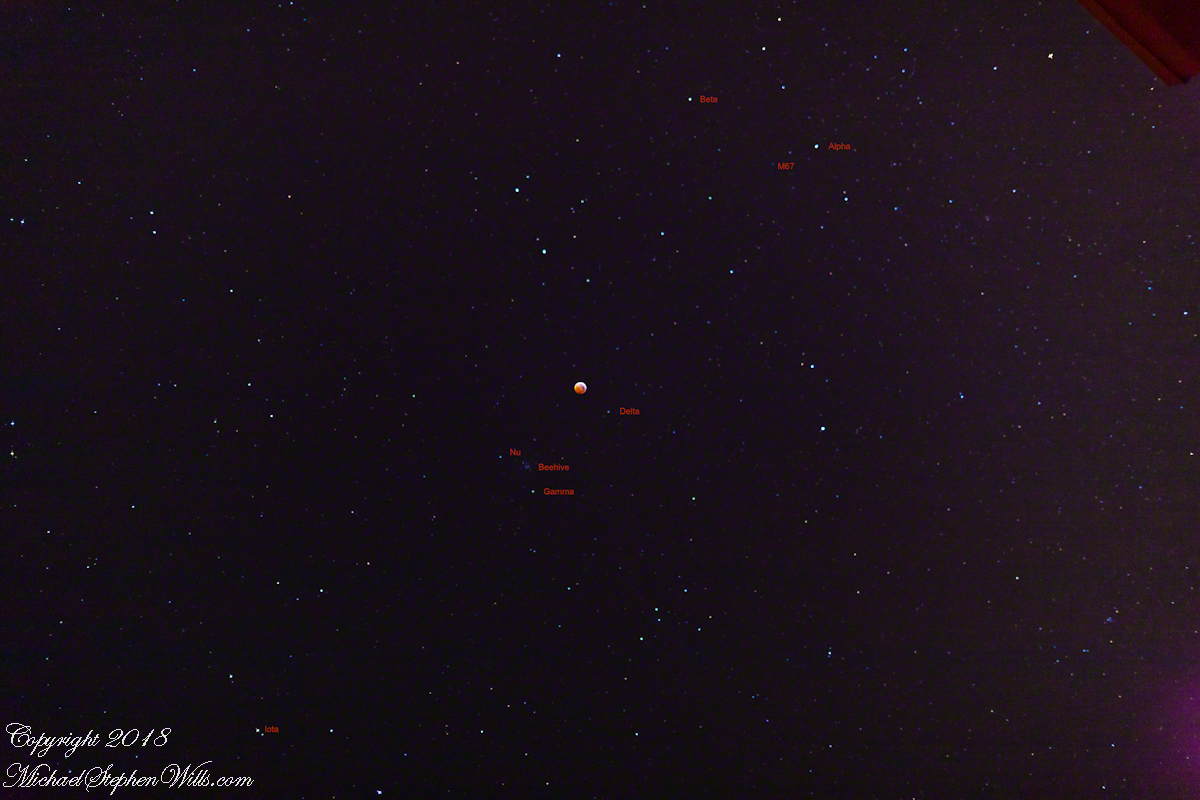
Click photograph for a higher resolution version
Total Lunar Eclipse and Surrounding Sky with labels for primary element of the Cancer constellation

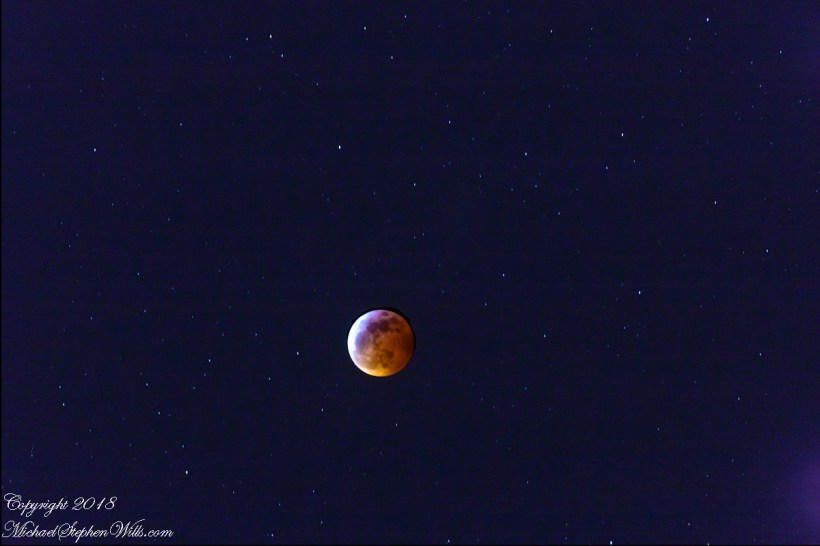
Later in the night I lifted the telephoto—70–300mm at 300mm, ISO 3200, 3.2 seconds—and let the moon fill more of the frame. At totality, the light thinned to a clay-jar red as Earth’s atmosphere bent sunlight around the planet and into its shadow. The effect is both simple and profound: every sunset on Earth happening at once, projected onto the moon’s face. Craters and maria softened into relief, and the globe stopped being a flat disk and became a round, ancient body again. Even without Delta, Gamma, Nu, and the Beehive in that tighter field, the sense of placement remained; I knew the Crab’s back was there in the dark, and that the moon had joined it—just for an hour—as a guest at the manger.
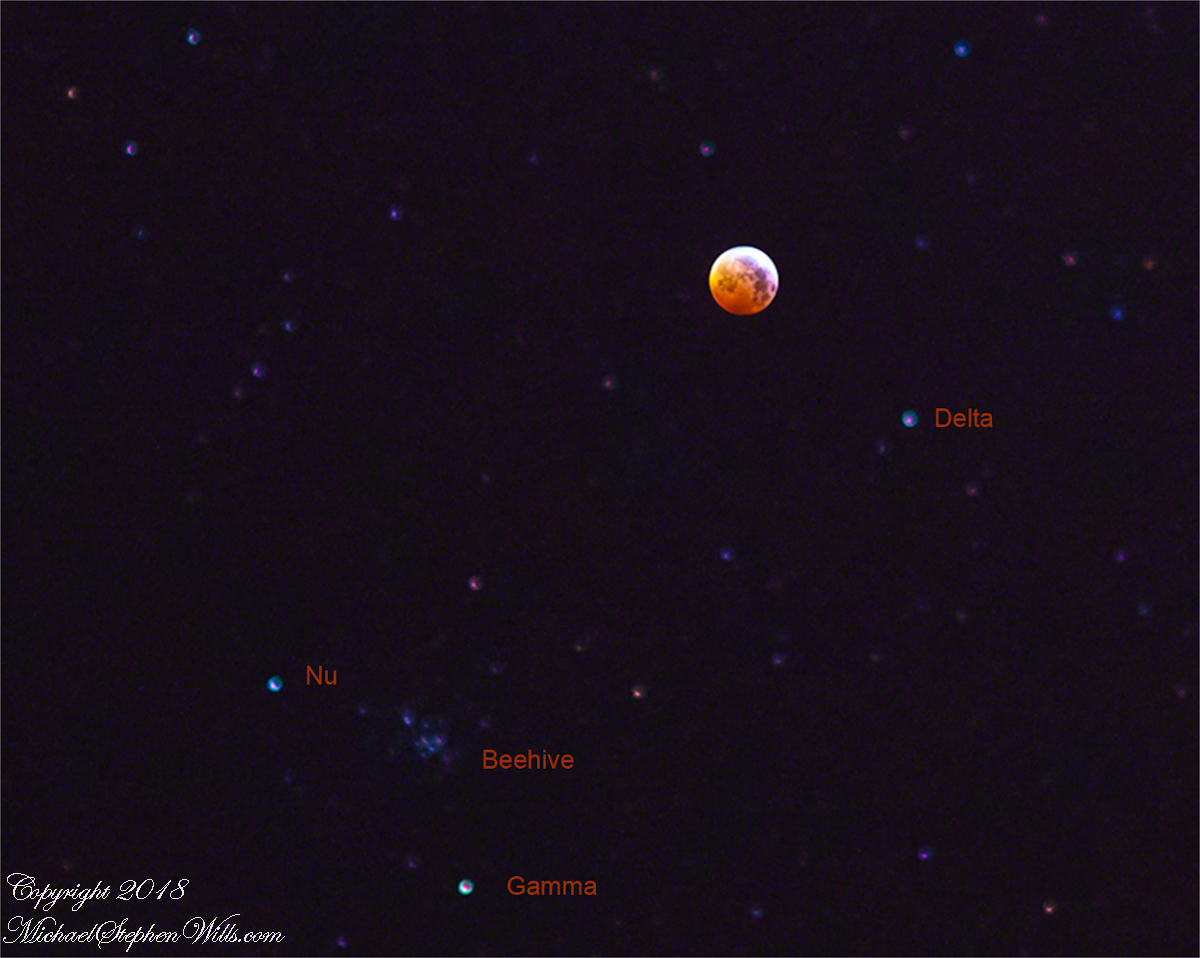
Click photograph for a higher resolution image
“Beehive” with Total Lunar Eclipse with labels for primary elements of Cancer Constellation

The Total Eclipse

What I love most about an eclipse is its pace. Nothing is impatient: the bite appears, the light drains, the color warms, and the world around you changes temperament. As the bright glare wanes, neighborhood sounds recalibrate—the hush between footfalls, the small click of a door, even the steadying breath you didn’t know you were holding. A total lunar eclipse is an astronomy lesson that behaves like a poem; it teaches by arranging time and light until awe and understanding meet.
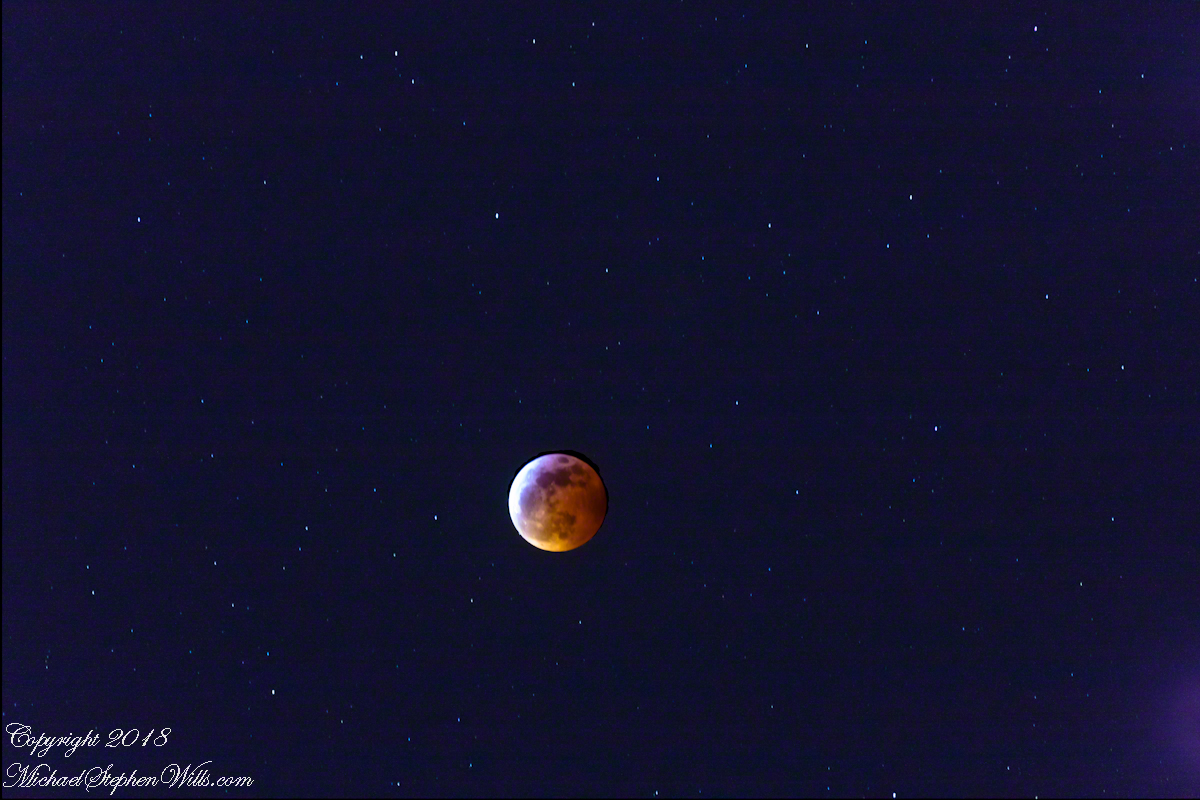
Click photograph for larger image

And then, quietly, it returns what it borrowed. A thin wedge of white blooms at one edge, a rehearsal for dawn. Copper gives way to pearl, and the old moon looks new again, just higher and smaller against the deepening night. Cancer recedes into suggestion; Praesepe goes back to being a faint cloud to the unaided eye. The camera is packed away, the tripod shoulders its own shadow, and you keep the best exposure of the night where it can’t be corrupted: in memory.
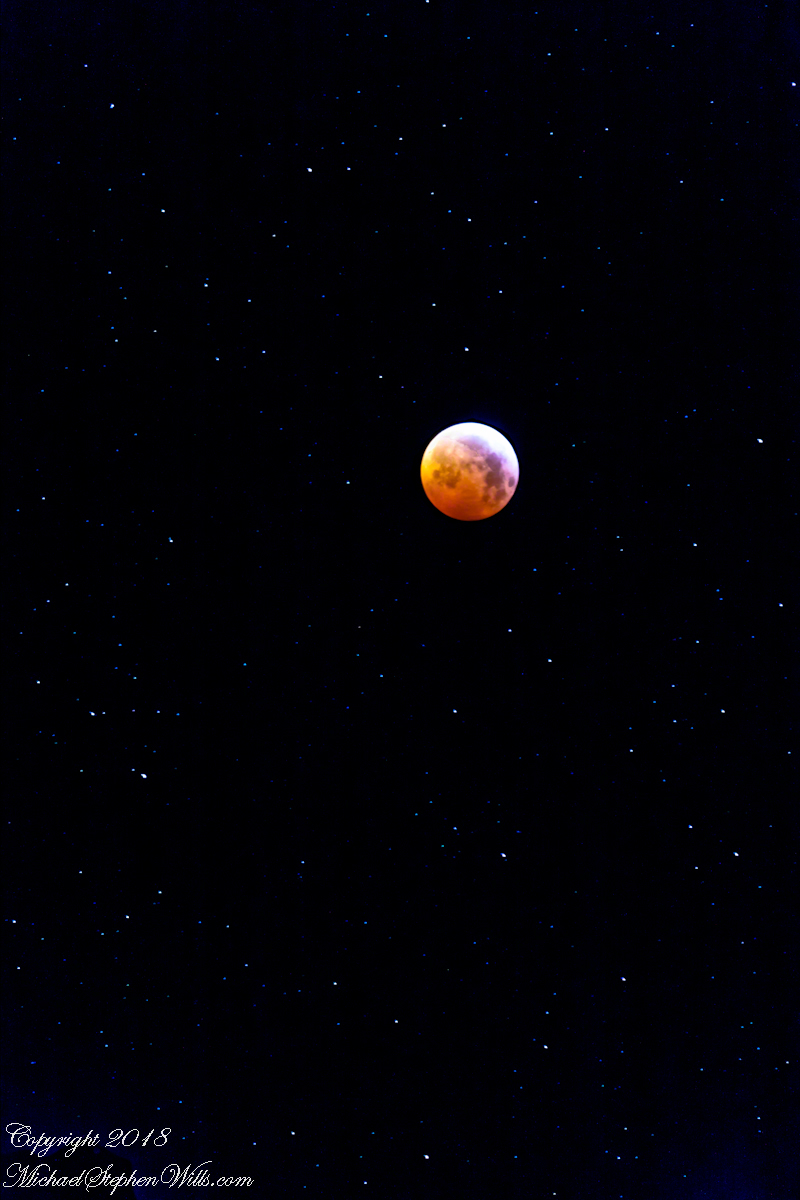
Click photograph for larger image

If you have binoculars, mark Cancer on a winter chart and step outside when the sky is clear. Find Delta, sweep toward the dim pair of Nu and Gamma, and then rest your gaze on that hazy patch between them. Bring a friend into the circle and let the cluster resolve, star by star, into something alive with depth. It will not be the last time you look for it. And if you’re lucky enough, as we were that January, the moon will pass nearby, reminding you that even the most familiar companion can be made strange and beautiful by the turn of a shadow.

The sky is a storybook, yes—but also an instrument. Nights like this tune both.

Enter your email to receive notification of future postings. I will not sell or share your email address.

Growth and Beauty

a exploration of logarithmic spirals and symmetry

Growth

An early thought of mine, as a child, was to wonder, “How large does a person grow?” If growth was perpetual, there was no end to how large I will become; yet, tested against observed reality, “Why was it the case this was unlikely?” Years later, when recalling this, I understood my intuition touched upon the logarithmic spiral and mollusk shell.

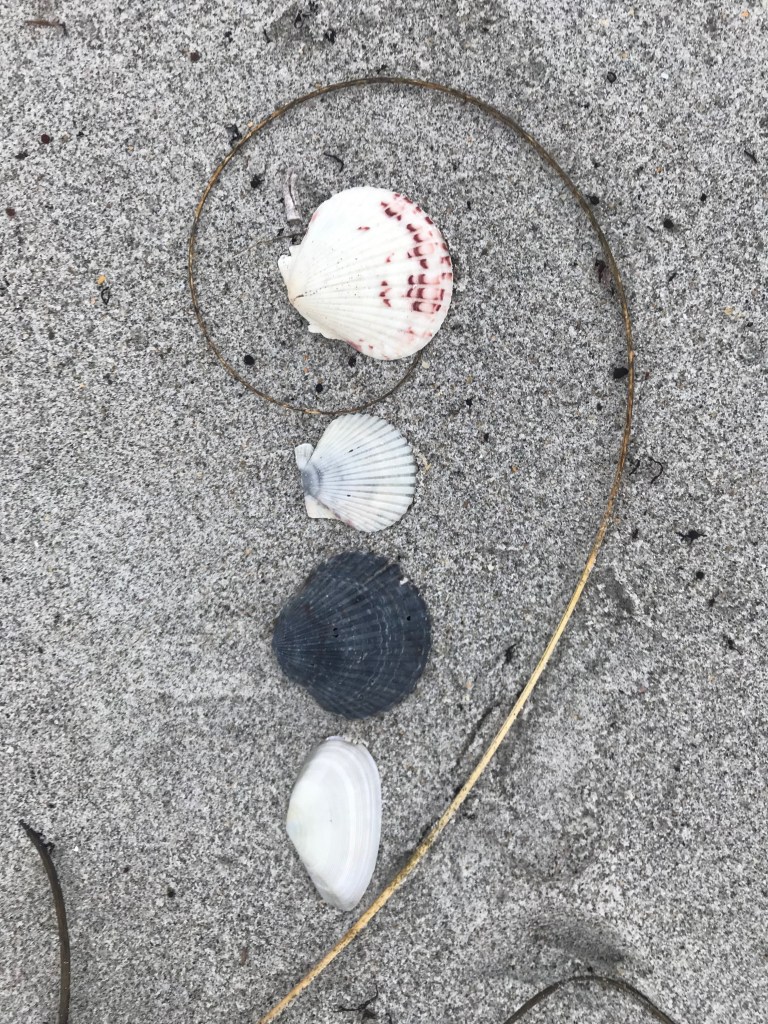
Three Scallops and One Tallin

Sea Oat stalk, photographed above, after it dries slowly in the sun and wind, curls into a logarithmic spiral. One two dimensional spiral may be compared to another by measuring the rate and direction of opening, the increase in distance between the part closer to the source and the outer swirl. The growth of all shells follow a logarithmic spiral in three dimensions where the progression from a staring plane, as well as the direction, up or down from the plane, is an element.

Sea shells give evidence to my question of “how large can one grow.” The size of each of the millions encountered on a beach is an example of a life ended. Each of record of the length and character of the organism. For example, a close inspection of the bottom shell of the above photograph, a tellin of the family Tellinidae, reveals the spiral is growing toward the surface of the sand. Imagine wrapping your hand around the outer edge of the tellin with your thumb pointed down.

Each of the four shells of the above photograph had a mate, were one of a pair. Types of shells share characteristic pair symmetries. For example, a pair of tellins display a type of asymmetry called chirality, also called “handed-ness” after the same property of your right and left hands. One shell half (from the same individual) is the mirror image of the other, each unbalanced as the growth spirals toward opposite directions.

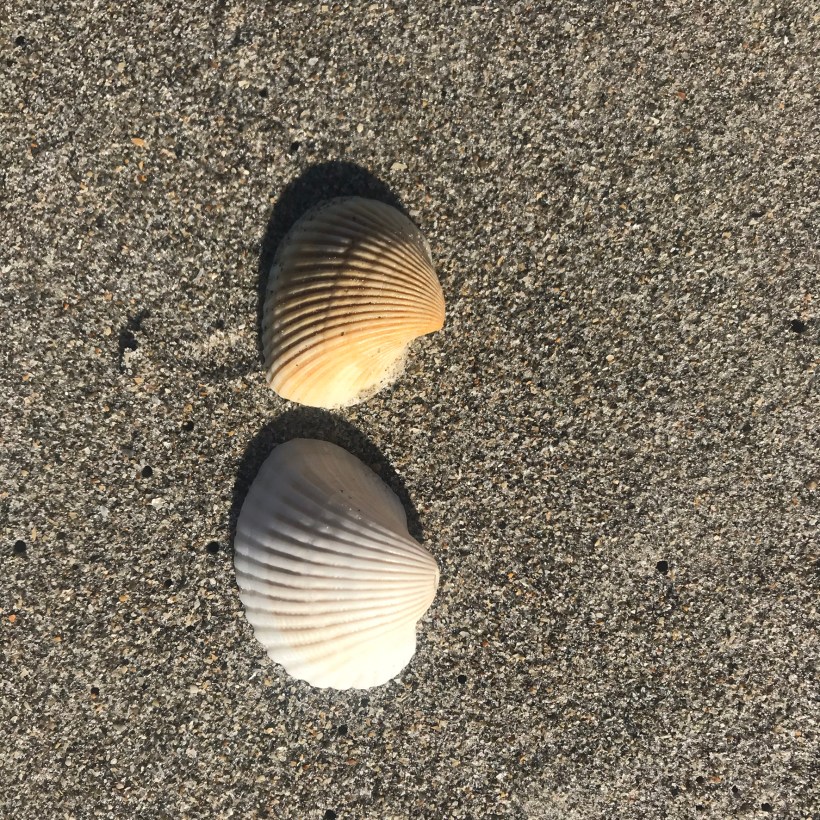
Asymmetry, halves from different individuals

When I started beachcombing, examining collected shells I did not have a pair from the same individual and incorrectly concluded direction of growth was unique to an individual. The ribbing of the above two shells illustrate three concepts: the logarithmic spiral growth pattern, chirality, as well as how I came to that wrong conclusion: that two individuals can grow in different directions. It was a logical hop to understand how, to make two shells hinged at the source of the growth spiral, each individual requires two halves, each a mirror image of the other. That every member of the species demonstrated the same asymmetry, each half grows in the opposite direction.

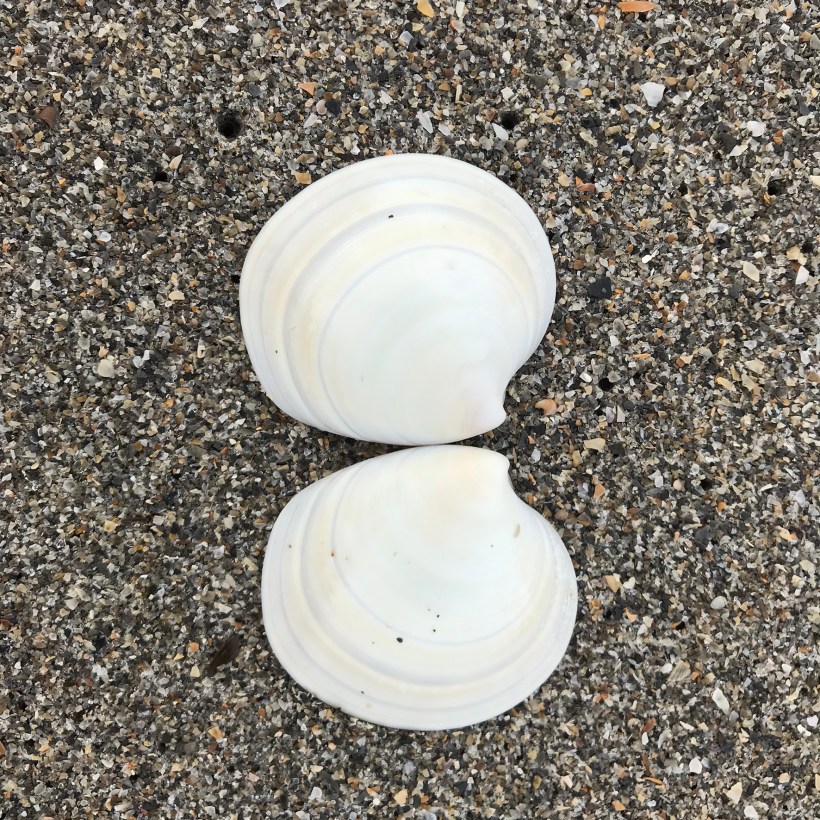
Asymmetry, attached matching halves

The above photograph shows attached matching halves. The attachment point was a surprise: the apparent source point is not attached to the ligament joining the halves? I have yet to understand this. Do you?

Beauty

The association of beauty with scallop shells bridges thousands of years. For example, a fresco of the Roman goddess Venus, born from the ocean riding a shell, was unearthed from Pompeii. The living organism is not part of the story, just the shell. Why the scallop? My answer is, “Each half is completely, in itself, symmetrical.”

The top three shells of the first photograph are scallops. The first and last, broken by the waves, are missing parts. The middle scallop, small and off-white, is complete. Place an imaginary line down the center and each side is identical. Applying the real world (i.e., physics) to myth, a scallop shell allows the goddess to move forward in a straight line. Sailing an asymmetrical shell, she moves in an eternal circle.

An object with symmetry is visually complete unto itself, self-contained; functionality aside, one scallop does not required a partner. The paired shells are interesting in they do not match, one is deeper, it encloses more volume. The deeper side rests under the surface, allowing the top halve to present a lower profile the better to hide from predators.

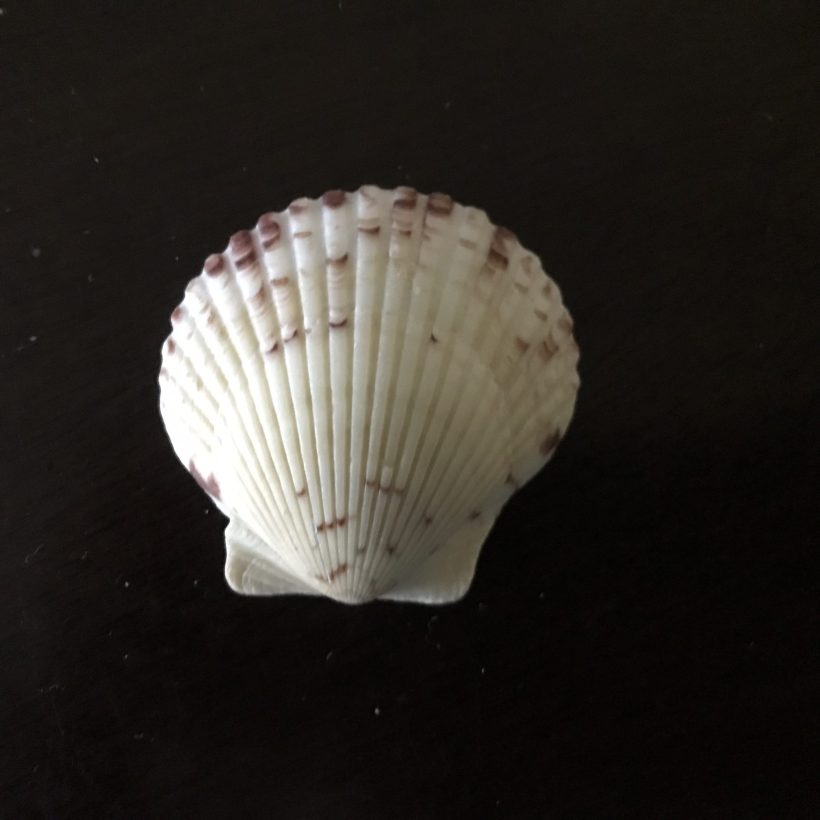
Calico Scallop Shell

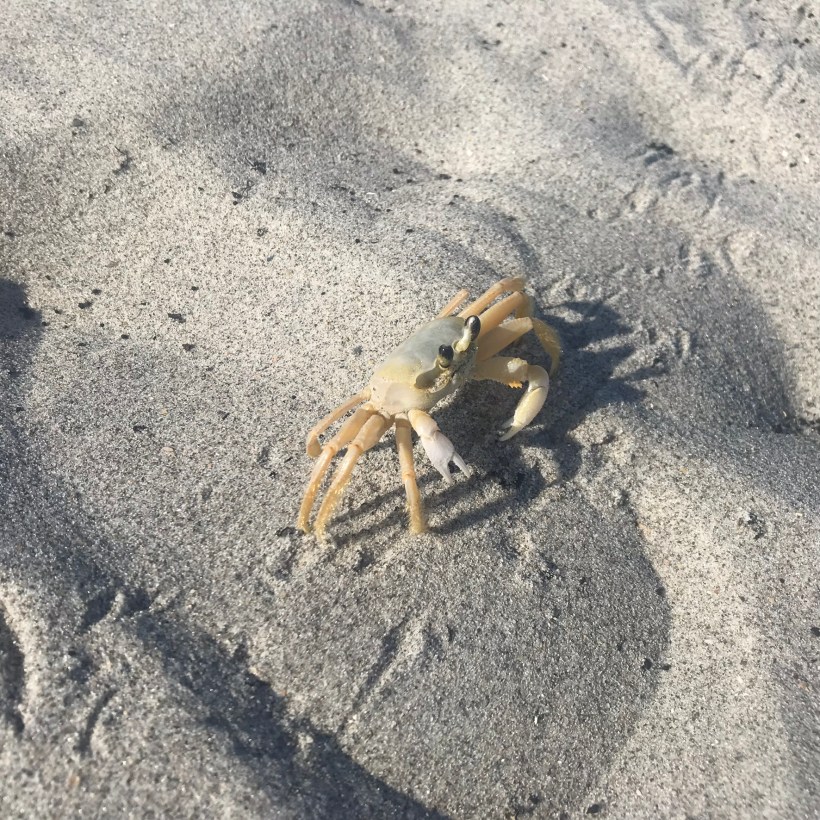
The scallop echoes the beauty of Venus. Symmetry enhances human features (earch “Venus (mythology)” for images of her face through the ages), though it does not define beauty. An overly symmetrical face seems strange. I will close with an extreme example, the other day I came upon this beach crab wandering around in the daylight. Symmetry does NOT enhance the alien eyestalks, menacing claws, a pallid, tough exterior. Safe travels, little one.

Exploring the Cancer Constellation: A Detailed Guide

Here are labeled photographs, detailing its major elements, and including visual guides for enhanced viewing.

Pam proofed my post, “When the Moon Dined from a Stellar Mangar”and found some improvements, including adding text labels to aid in finding Cancer constellation elements.

Labels!!

You will find I replaced photographs in the original post and well, all the major elements of Cancer are labeled. Here is an explanation of the new elements.

You can now trace the “Y” constellation pattern, with Alpha and Beta Chancri (Latin for “of Cancer”) the two claws and Iota the tail. Both elemetns of Iota, a visual binary star system, are there. They are wonderful viewed with a telescope. Near Alpha is M67 (Messier Object 67), another galactic cluster of gravitationally bound stars. It is quite faint in this photograph.

Click photograph for a higher resolution version
Total Lunar Eclipse and Surrounding Sky with labels for primary element of the Cancer constellation
Enter your email to receive notification of future postings. I will not sell or share your email address.