Saint Fin Barre’s Cathedral: Resilience and Devotion in Cork

Saint Fin Barre’s Cathedral embodies faith and history through intricate artistry and significant apostolic representations.

As I stood within the hallowed confines of Saint Fin Barre’s Cathedral in Cork City, Ireland, I found myself drawn to the intricate artistry that tells the story of faith, resilience, and devotion. The figures and symbols within this magnificent edifice bring to life the history of Saint Fin Barre as well as the broader narrative of Christian tradition and its enduring influence on the region.

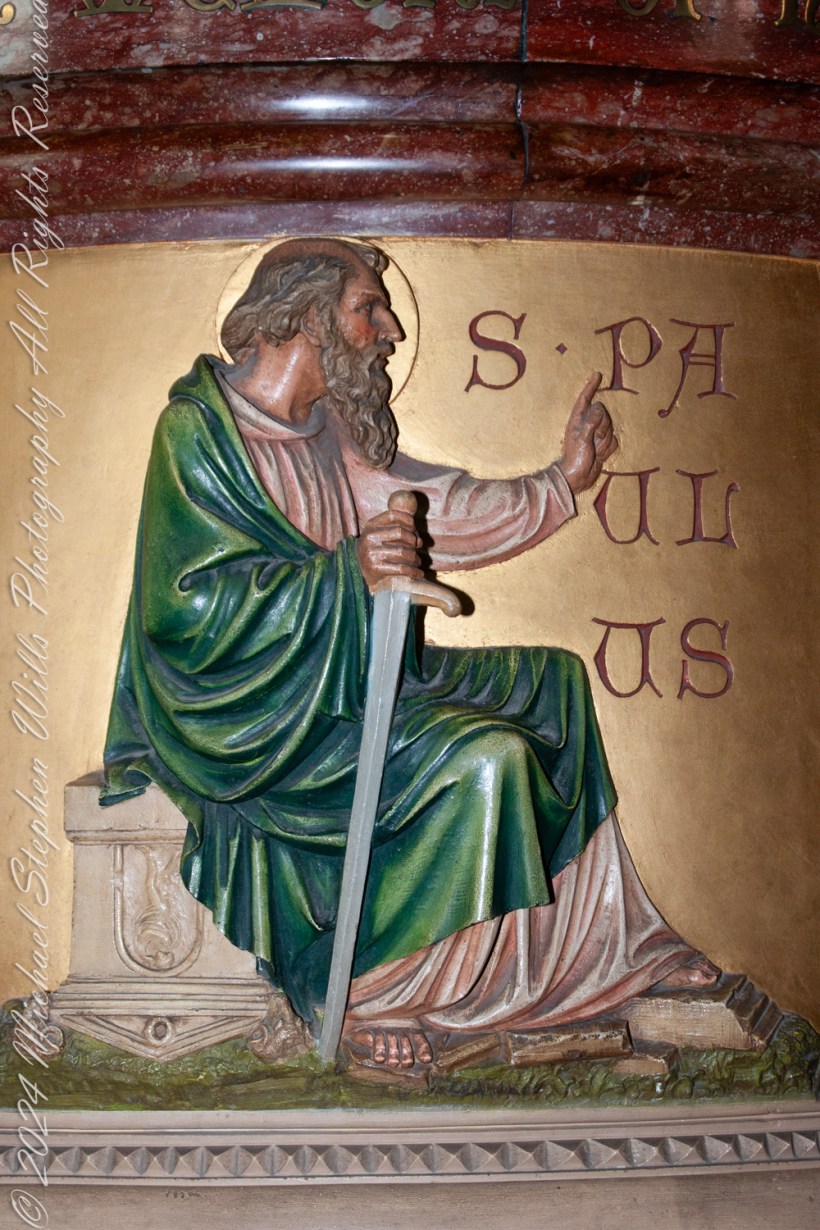
Near the entrance, the cylindrical pulpit’s relief figures of five evangelists captured my imagination. Here was the relief of Saint Paul seated with his characteristic sword, a symbol of both his martyrdom and the “sword of the Spirit” from chapter 6, verse 17 of the New Testiment Epistle to the Ephesians. His hand gestures toward the heavens, as if calling upon divine guidance to symbolize his role as an intermediary or messenger of God’s revelation. The rich green of his robes, juxtaposed against the golden background, speaks of hope, growth, and the everlasting promise of salvation. Here I found Saint Paul embodying the courage and conviction needed to preach and defend the faith—a sentiment that resonates deeply in the cathedral’s design and purpose.
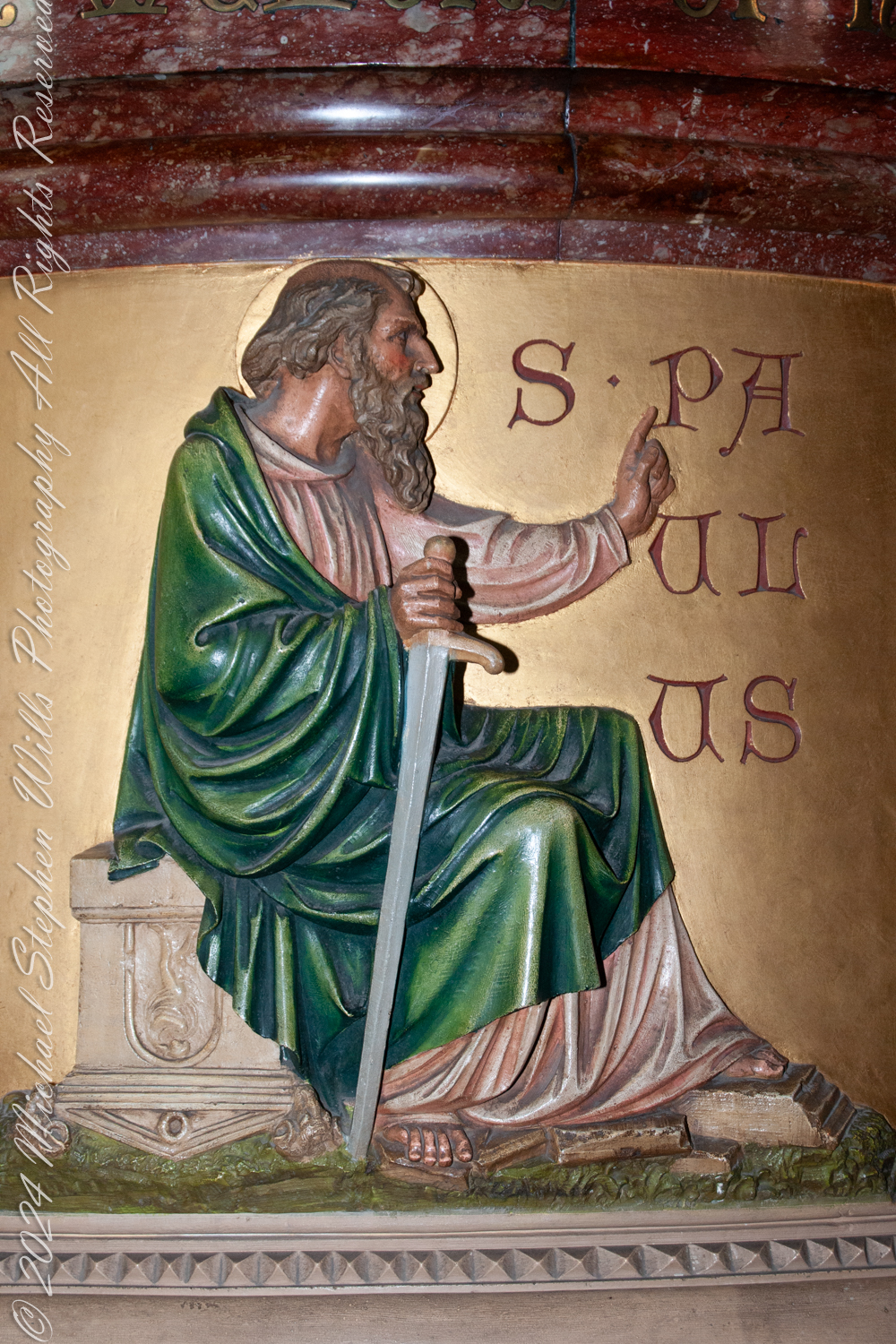
Saint Paul

Rounding the circle, another relief brought Saint Mark to life. With the lion at his side, Saint Mark writes intently, reminding us of his contributions to the Gospels. The warm, earthy tones of his attire and the contemplative tilt of his head evoke the diligence and introspection of a writer who draws inspiration from divine revelation. The lion, its expression both fierce and loyal, represents courage and the Gospel’s enduring power.
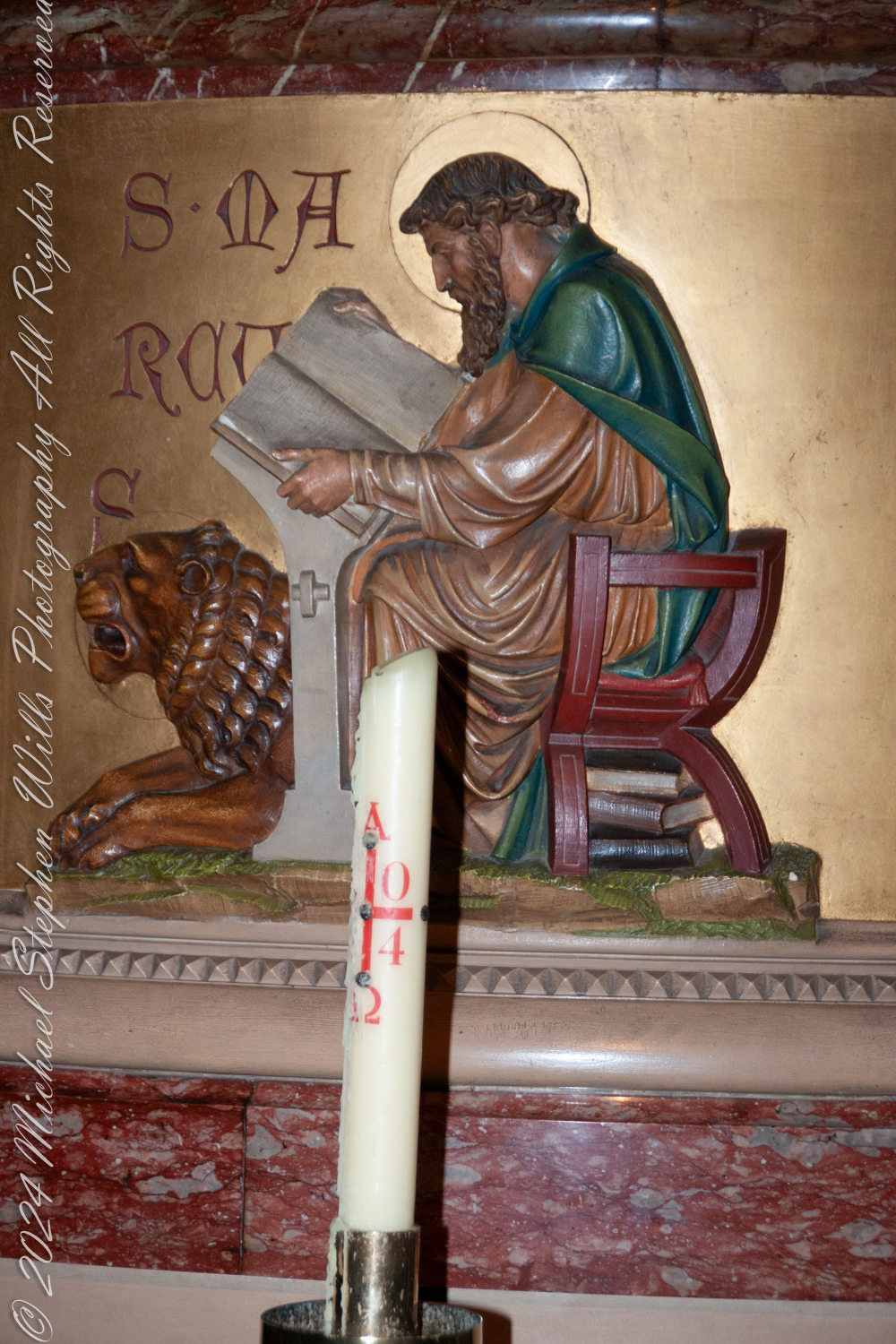
Saint Mark

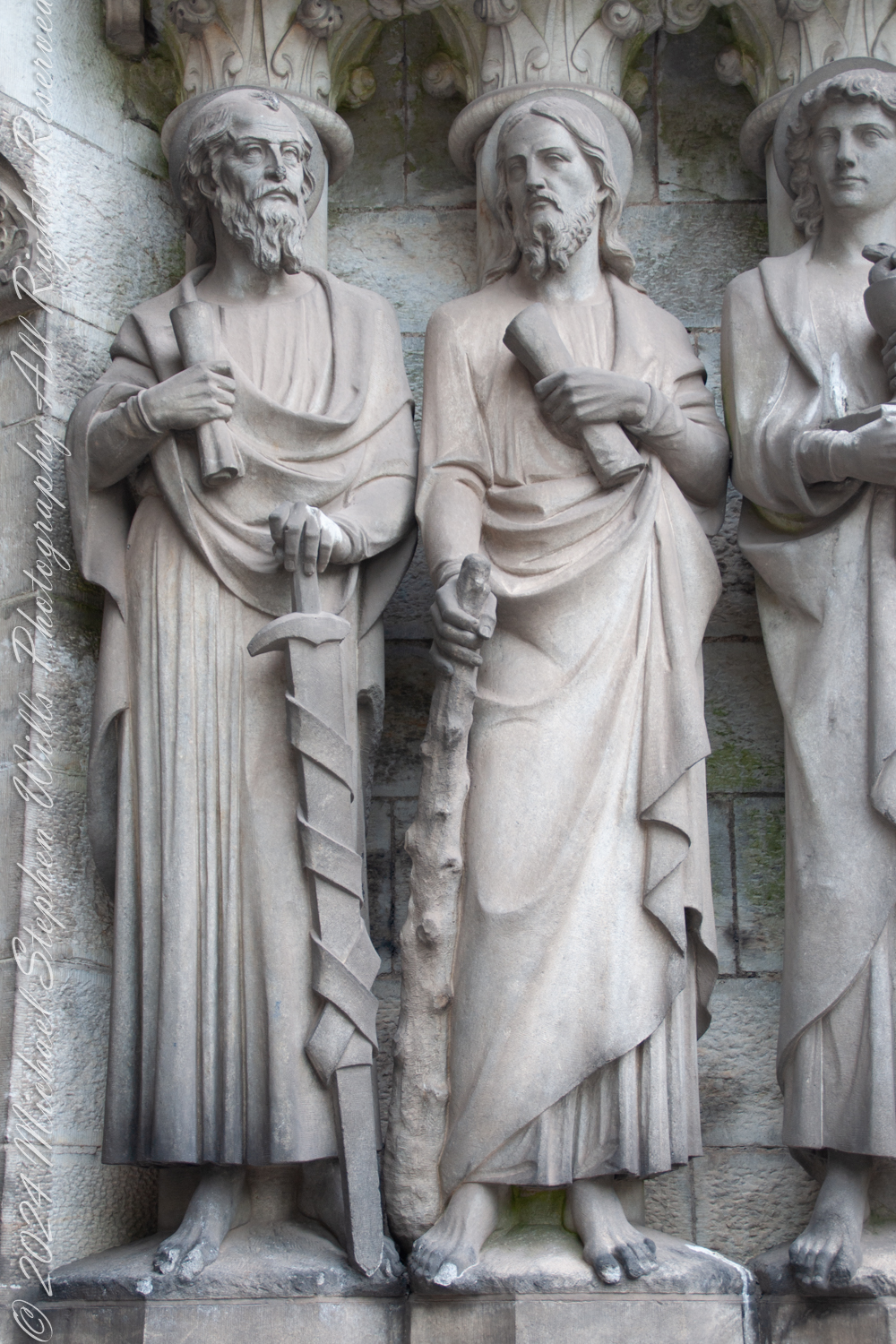
The cathedral’s external sculptures echo these individual representations of the apostles, where stone figures silently stand guard at the west entrance. The central figure of my photograph, holding a scroll in his left hand and a long cudgel (club) in his right, is Saint James the Less (also known as James the Minor). The scroll symbolizes his role spreading the word of God. The cudgel alludes to his martyrdom, as tradition holds that his executioners brutally beat him to death with such a club. His serene expression contrasts with Saint Paul, on the left, who holds the traditional “sword of the spirit” of his Epistle to the Ephesians. These carvings are spiritual sentinels, inviting visitors to contemplate the legacy of those who laid the foundations of the Church.
As the patron saint of the city, Saint Fin Barre’s enduring legacy profoundly impacts Cork’s spiritual and cultural history. His legacy dates back to the 7th century when he established a monastic settlement on the site where the cathedral now stands. This sacred location has witnessed centuries of devotion, destruction, and renewal. The visionary architect William Burges designed the cathedral in the 19th century as both a tribute to Saint Fin Barre’s enduring influence and a testament to William Burges’s own artistic genius.

Walking through the cathedral, I felt the interplay of past and present, earth and heaven. These saints and apostles are figures from history, embodiments of virtues and struggles that are timeless. Their stories invite us to reflect on our own faith, perseverance, and the ways we leave our mark on the world.

Saint Fin Barre’s Cathedral is a place of worship and a narrative in stone, wood, and glass. The intricate carvings and the evocative sculptures, among much else, create a space that transcends the ordinary. Here, the saints and apostles stand as eternal witnesses to the human journey toward the divine. As I left the cathedral, the image of Saint Paul, resolute and unyielding, stayed with me—a reminder that we must build faith, much like the cathedral itself, stone by stone, moment by moment, to endure the test of time.
Enter your email to receive notification of future postings. I will not sell or share your email address.

The Architectural Symbolism of Saint Fin Barre’s Cathedral

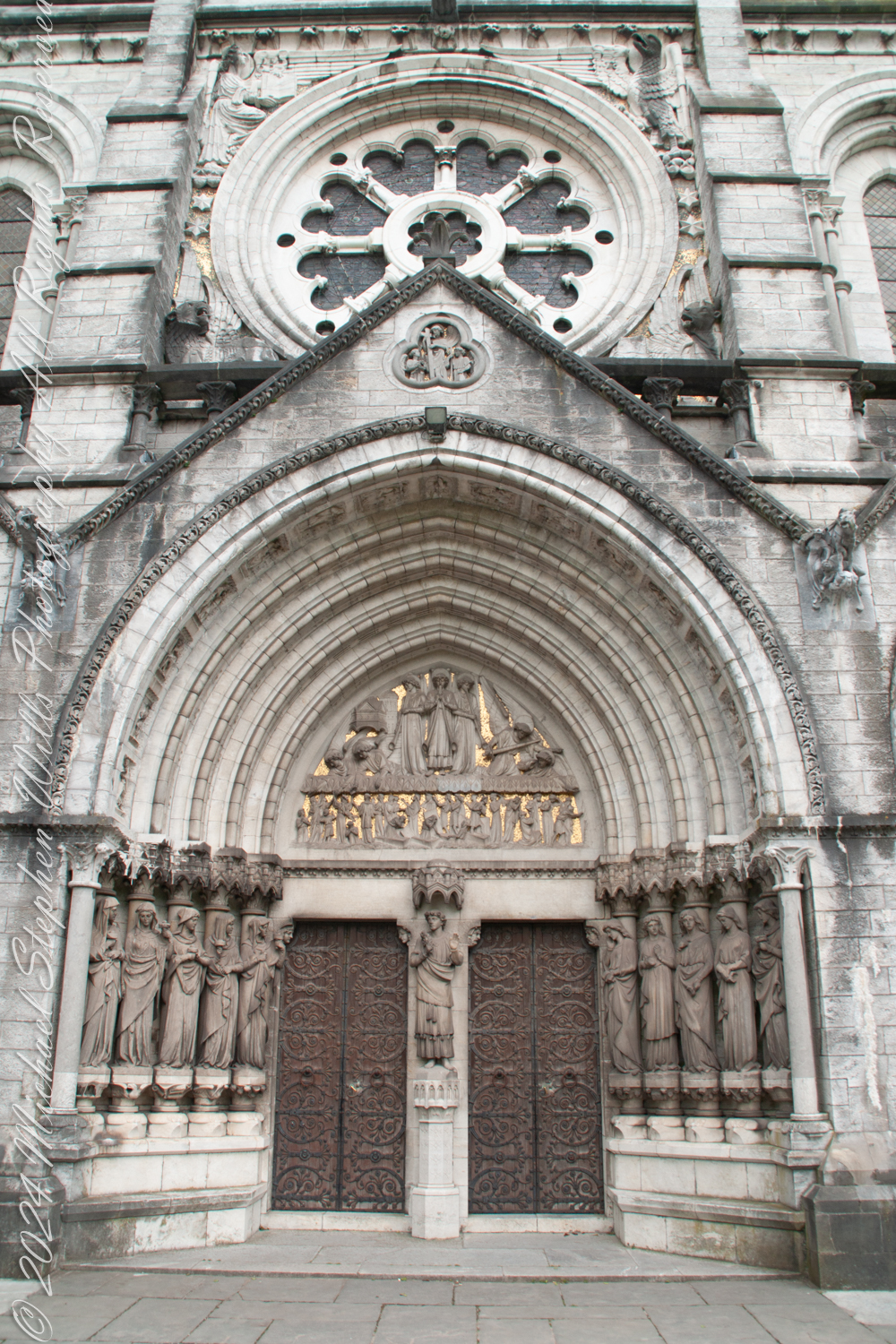
The Western Portico of Saint Fin Barre’s Cathedral illustrates the parable of the ten virgins, emphasizing spiritual preparedness and divine judgment.

The towering Western Portico of Saint Fin Barre’s Cathedral leads into the sacred space of the church while serving as a canvas for a profound narrative of divine judgment and grace. Standing before it, I am drawn into its intricate details, particularly the central set of doors flanked by the ten virgins—five wise and five foolish—embodied in stunning columnar statues. Their story is drawn from the Gospel of Matthew (25:1–13), a parable of spiritual preparedness that echoes throughout the cathedral’s architecture.

The parable tells of ten virgins who go out to meet the bridegroom, each carrying a lamp. The wise virgins take oil with their lamps, while the foolish take none. When the bridegroom is delayed, all ten fall asleep. At midnight, the cry rings out, “Here is the bridegroom! Come out to meet him!” The virgins awaken and trim their lamps. The foolish ones, realizing their lamps are going out, plead with the wise to share their oil, but the wise refuse, saying, “There may not be enough for both us and you. Instead, go to those who sell oil and buy some for yourselves.” While the foolish virgins are away buying oil, the bridegroom arrives, and the wise virgins go with him into the wedding banquet. The door is shut. Later, the foolish virgins return, crying, “Lord, Lord, open the door for us!” But he replies, “Truly I tell you, I do not know you.” The parable concludes with the warning: “Therefore, keep watch, because you do not know the day or the hour.”

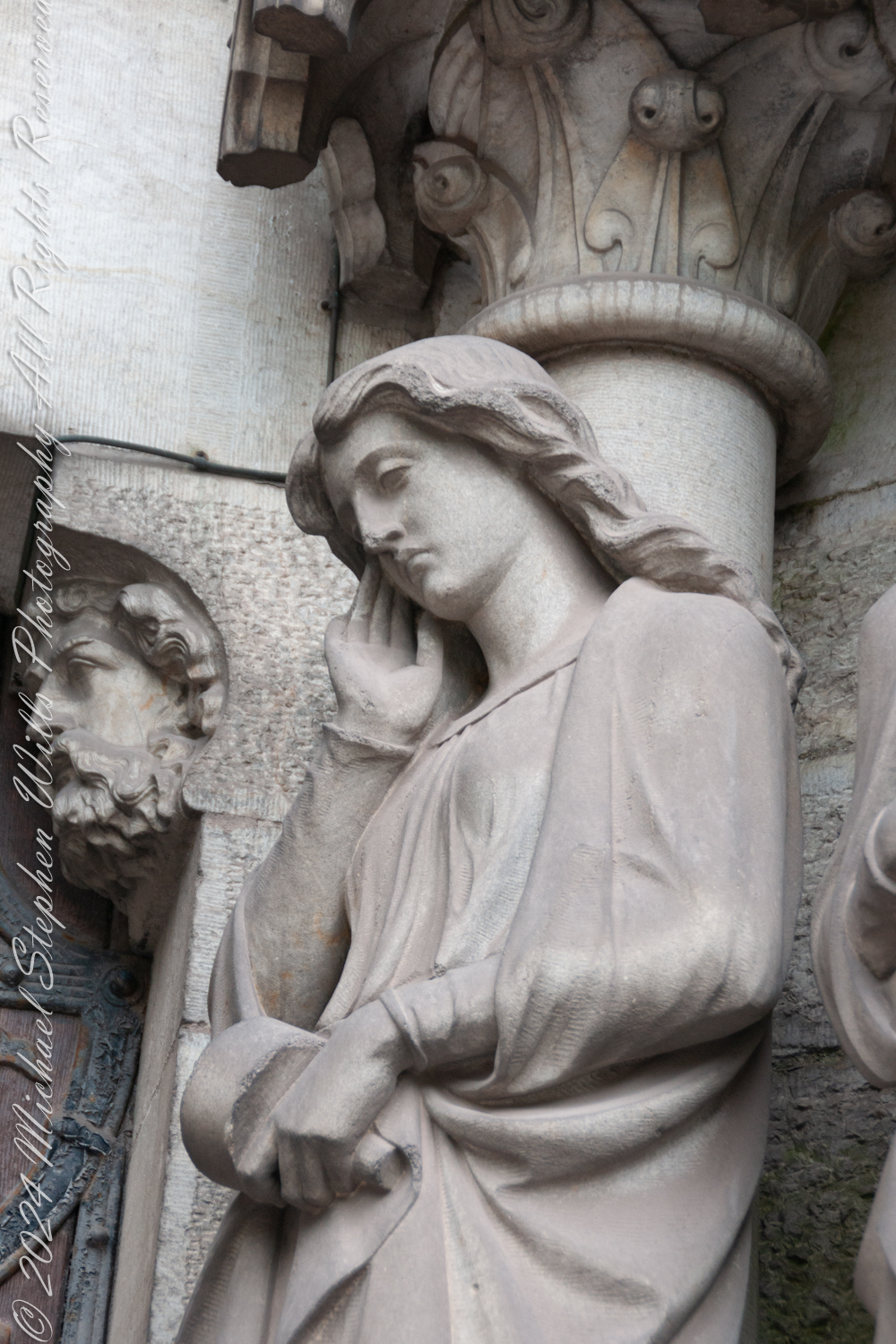
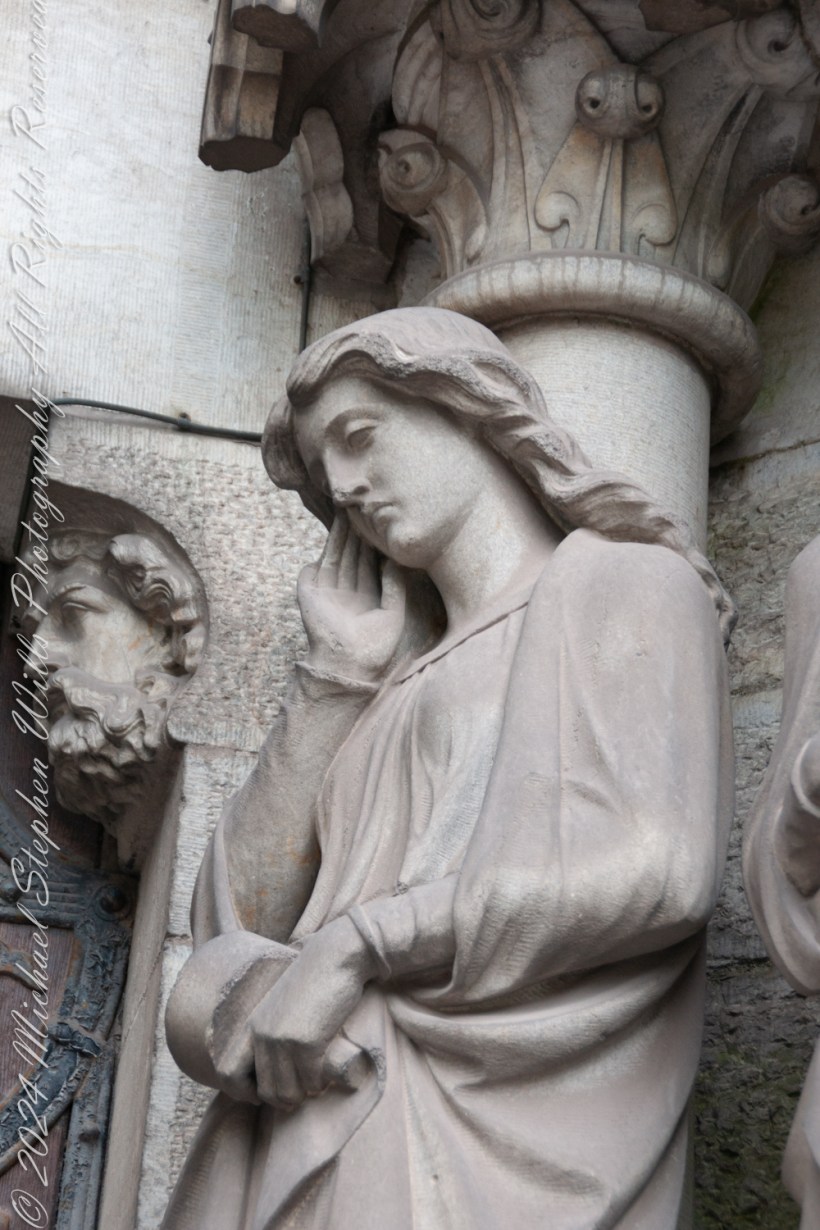
On either side of the central door, the virgins stand as sentinels, embodying this story. The wise virgins, to the right of Christ, hold their lamps aloft, flames burning brightly, symbols of readiness and spiritual vigilance. Their faces are serene, reflecting a sense of fulfillment in their preparedness to meet the bridegroom. To the left, the foolish virgins clutch their unlit lamps, their postures and expressions marked by despair and regret. The detail in their sculpting is exquisite—draped garments, forlorn gazes, and, in the case of the leftmost virgin, a subtle gesture of mourning, her hand resting thoughtfully against her cheek as though lamenting her unpreparedness.

Beneath each figure lies a pedestal adorned with imagery that amplifies their symbolic meaning. The wise virgins stand upon a foundation of flourishing life: vines, flowers, and fruits, evoking the vitality and promise of spiritual readiness. In contrast, the pedestals of the foolish virgins are carved with desolation—withered branches, skeletal forms, and motifs of death, stark reminders of the spiritual decay brought by neglect and complacency.

At the heart of the narrative stands Christ, the Bridegroom. His figure, commanding yet compassionate, turns toward the wise virgins, his gesture one of welcome and blessing. The flowing robes and the serene expression of the Christ figure emphasize his dual roles as judge and redeemer. It is a moment of movement captured in stone—Christ leaning into the wise while his back turns on the foolish, a subtle yet striking commentary on divine justice.

Above the door, the tympanum deepens this narrative, depicting the ultimate moment of judgment. Surmounted by three angels announcing the resurrection, their imagery and gold background harking to the Resurrection Angel of the east cathedral side with gold a symbol of purity and divine light; the dead rise from their graves, their fates determined by their spiritual choices. On the right, angels extend their hands to the faithful, pulling them upward toward eternal life. Their forms radiate lightness, their wings creating a sense of ascension and joy. On the left, the scene is markedly darker: angels, stern and unyielding, drive the condemned downward, their bodies twisted in expressions of agony. Flames lick at the edges of the scene, signaling the fires of damnation.

The weight of this imagery is palpable. The parable of the ten virgins, brought to life in stone, underscores the centrality of vigilance and readiness in the Christian faith. The Western Portico is a story carved in stone, a vivid testament to the choices each person must make. Standing before it, I am not merely a viewer but a participant, invited to reflect on my own readiness and my place in this cosmic drama. The intricacy and theological depth of this space leave an indelible impression, a reminder of the eternal truths that the cathedral seeks to communicate through its art.

Enter your email to receive notification of future postings. I will not sell or share your email address.

Saint Fin Barre’s Cathedral: A Marvel of Victorian Architecture

Saint Fin Barre’s Cathedral, a Gothic Revival masterpiece by William Burges, symbolizes artistry and faith in Cork, Ireland.

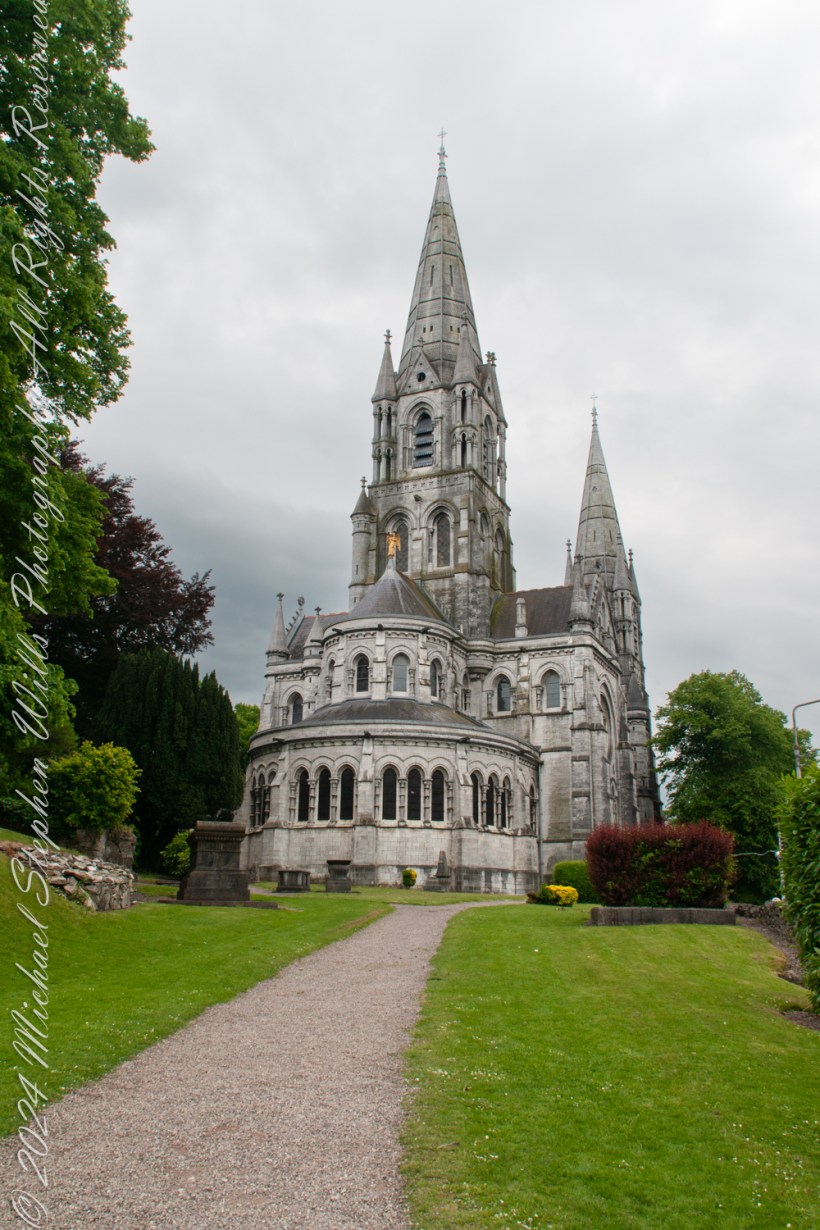
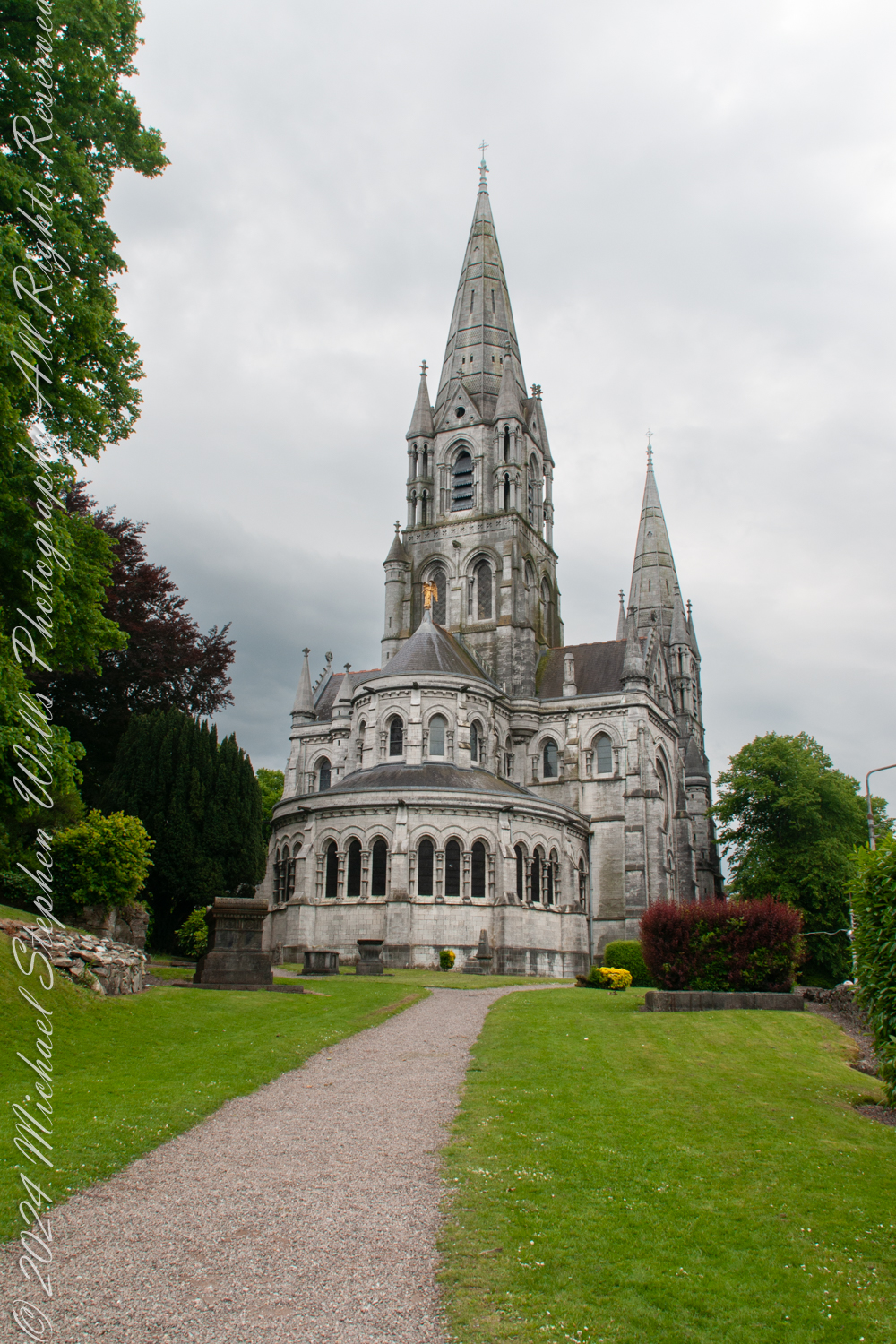
Approaching from the east, we see the polygonal apse at the eastern end houses the high altar and is a key liturgical and architectural feature. Each angular bay is delineated with tall lancet windows filled with stained glass, adding to the richness of the design. Saint Fin Barre’s Cathedral, a masterpiece of Gothic Revival architecture, stands as a beacon of faith and artistry in the heart of Cork, Ireland. Designed by the renowned Victorian architect William Burges, the cathedral is both a testament to the spiritual fervor of its time and a bold statement of artistic vision.

Approaching from the east, we see the polygonal apse at the eastern end houses the high altar and is a key liturgical and architectural feature

Commissioned in 1862, the cathedral replaced an earlier structure, marking a new chapter in Cork’s ecclesiastical history. William Burges, known for his theatrical approach to design, was the perfect choice for this ambitious project. His vision for Saint Fin Barre’s Cathedral blended medieval inspiration with Victorian ingenuity, creating a building that is as much a work of art as a place of worship.

Burges, a figure of eccentric brilliance, was deeply influenced by the principles of the Gothic Revival movement, which sought to recapture the grandeur of medieval European architecture. Drawing from this aesthetic, he designed the cathedral with meticulous attention to detail. Its three spires dominate the Cork skyline, with the central spire rising to an impressive height of 73 meters. These spires are not merely structural; they are symbolic, reaching heavenward in a gesture of devotion.

The exterior of the cathedral, constructed from Cork limestone and Bath stone, is adorned with intricate carvings and sculptures. These include depictions of biblical scenes, saints, and gargoyles, all painstakingly crafted under Burges’s watchful eye. Every detail reflects his belief that architecture should educate as well as inspire. Bishop Street, The Lough, Cork City, County Cork, Ireland

Enter your email to receive notification of future postings. I will not sell or share your email address.