The fog haunted Cocoa Beach for days, softening the edges of the afternoon. I had been walking along Cocoa Beach, feeling the cool ocean breeze on my face, when I noticed a change in the light. It was a little after four, the sun drifting lower in the western sky, its warmth fading into a hazy glow. The air smelled of salt and mist, and waves lapped gently at the shore, their rhythm unbroken by the deepening fog.
And then I saw it.
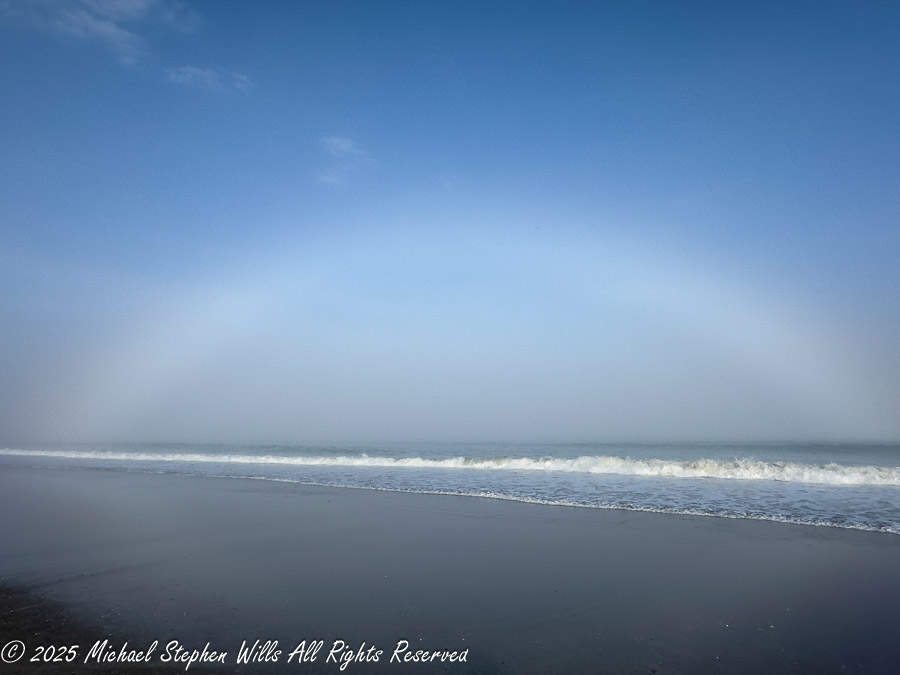
A pale arc stretched across the horizon, a ghost of a rainbow bending above the waves. At first, I wondered if my eyes were playing tricks on me—where were the usual bright bands of red, orange, and violet? But no, the arc was real, a fogbow, forming where sunlight met the fine sea mist. Unlike the rainbows that appear after summer storms, this one was almost entirely white, as if the ocean had conjured it from air and silence.
Sailors once whispered of such things—a white rainbow at sea, a sign of hidden land or wandering souls. Some believed it to be a bridge between realms, a fleeting passage where the living and the lost might momentarily brush against one another. Others saw it as an omen, a spectral warning of treacherous fog ahead. I wondered what the mariners of old might have thought, standing at the bow of a ship, watching a pale arc rise from the mist, its edges dissolving like breath against glass.
I stood still, watching, as the science of the moment unfolded before me. Unlike traditional rainbows, which form when light bends through large raindrops, fogbows are born from infinitesimally smaller droplets, often less than 0.1 millimeters in diameter. Their size diffuses the light, scattering it so finely that the colors blend together into a spectral whisper rather than a vibrant shout. The physics of it fascinated me—this was diffraction in action, nature bending light in a way that rendered it nearly colorless.
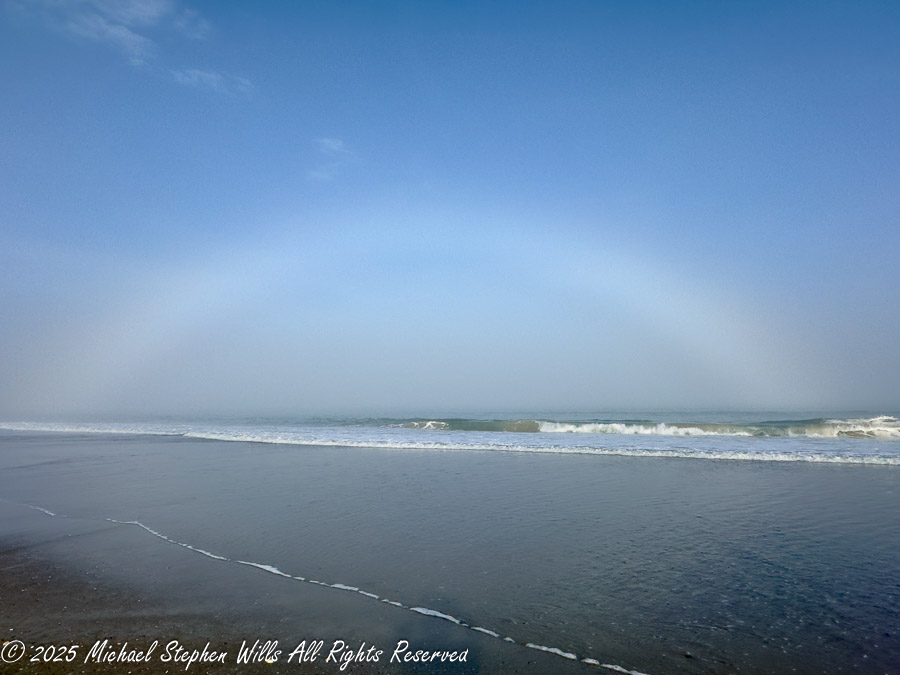
The effect was surreal. The fogbow arched over the breaking waves like something out of a dream, a halo of sea and sky, momentary yet timeless. It seemed to pulse in the shifting mist, visible one moment, fading the next, as if deciding whether to reveal itself fully or slip back into the fog’s embrace.
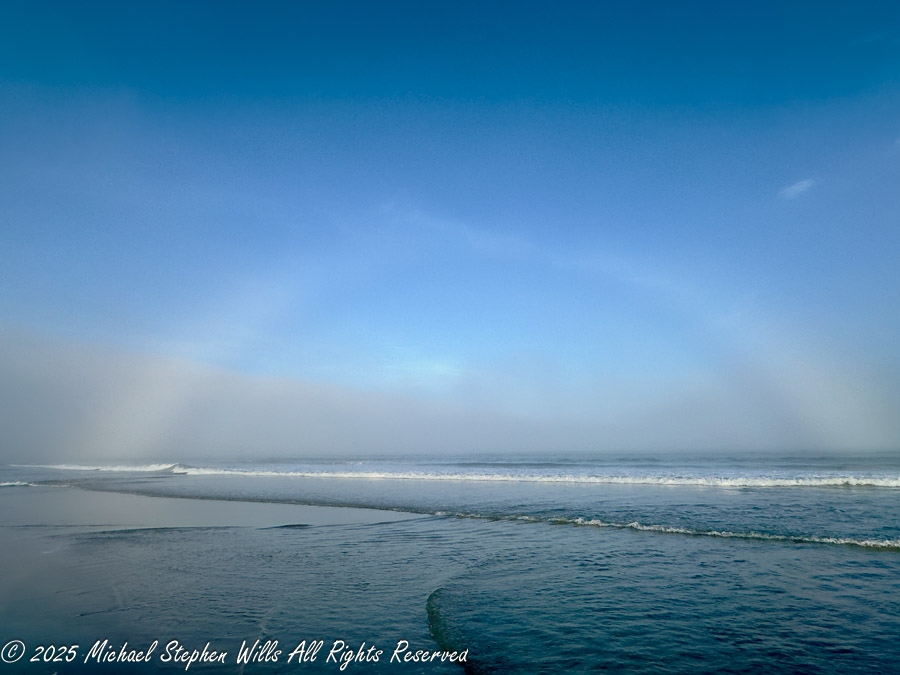
For several minutes, I just stood there, taking it in. The world felt different inside that mist, quieter, more reflective. The fog dampened the usual sounds of the beach—the calls of shorebirds, the laughter of distant walkers—leaving only the hush of the waves and the distant hum of the ocean’s breath.
I knew that fogbows were rare, requiring just the right balance of thin fog, moisture, and a low-angled sun. I was lucky to be in the right place at the right time, a witness to something subtle yet profound.
And just as silently as it had appeared, the fogbow began to dissolve. The mist thickened, swallowing its arc, the sky shifting back to its usual muted gray. But the memory of it lingered—a white rainbow over the sea, ephemeral and elusive, like a secret the ocean had briefly chosen to share.
 Michael Stephen Wills Photography
So cool! A fogbow is a new one to me.
LikeLiked by 1 person
Glad you found it interesting, Marie! They’re such an unusual sight. Have you ever come across any other rare weather phenomena?
LikeLiked by 1 person
I’ve seen a waterspout on Lake Superior (from a distance). It took me a while to believe my eyes!
LikeLiked by 1 person
Best seen from a distance — must have been a wonderful sight.
LikeLiked by 1 person
Amazing! I never knew of that before!
LikeLiked by 1 person
Isn’t it incredible, Lynne? Nature always has a way of surprising us! I’m so glad I could introduce you to something new.
LikeLiked by 1 person
How amazing and well done for capturing it
LikeLike
What an interesting phenomenon. It reminds me of sundogs on a frigid day. Maggie
LikeLiked by 1 person
Yes, Maggie, Sundogs are a cold weather corollary to Fogbows in that Sundogs appear in frigid weather due to ice crystals, producing bright, rainbow-like spots beside the sun. They differ from fogbows in producing colorful spots. This leads me to believe the ice crystals are larger than the water droplets that produce fogbows.
LikeLiked by 1 person
A fogbow is such a breathtaking sight. No colors, yet even more beautiful and mysterious than a rainbow. You captured it perfectly.
LikeLiked by 1 person
Thank you, Matroos! I agree—there’s something uniquely mysterious about a fogbow, almost otherworldly in its quiet beauty. I’m glad the post captured that feeling!
LikeLiked by 1 person
Interesting. I have never seen one.
LikeLiked by 1 person
They’re quite a rare sight! Fogbows require just the right mix of fog and sunlight to appear. I hope you get to witness one someday—it’s a truly ethereal experience!
LikeLike
First time I heard about fogbow! Interesting!
LikeLiked by 1 person
Maybe, now, you’ll see one. Thanks for visiting, Chen.
LikeLiked by 1 person
Whisper seems an appropriate description for a fogbow. Michael, thank you for sharing your discovery.
LikeLiked by 1 person
My pleasure, BigSkyBuckeye. More wonders to come, “stay tuned,” as they used to say.
LikeLike
Beautiful capture of the faint foggy white rainbow. I’ve never seen one like that before.
LikeLiked by 1 person
Thanks so much, Linda! They really are a rare treat to witness. I was lucky to be in the right place at the right time! If you ever find yourself near a foggy coast or a misty field with the sun low in the sky and at your back, keep an eye out—you just might see one too!
LikeLiked by 1 person