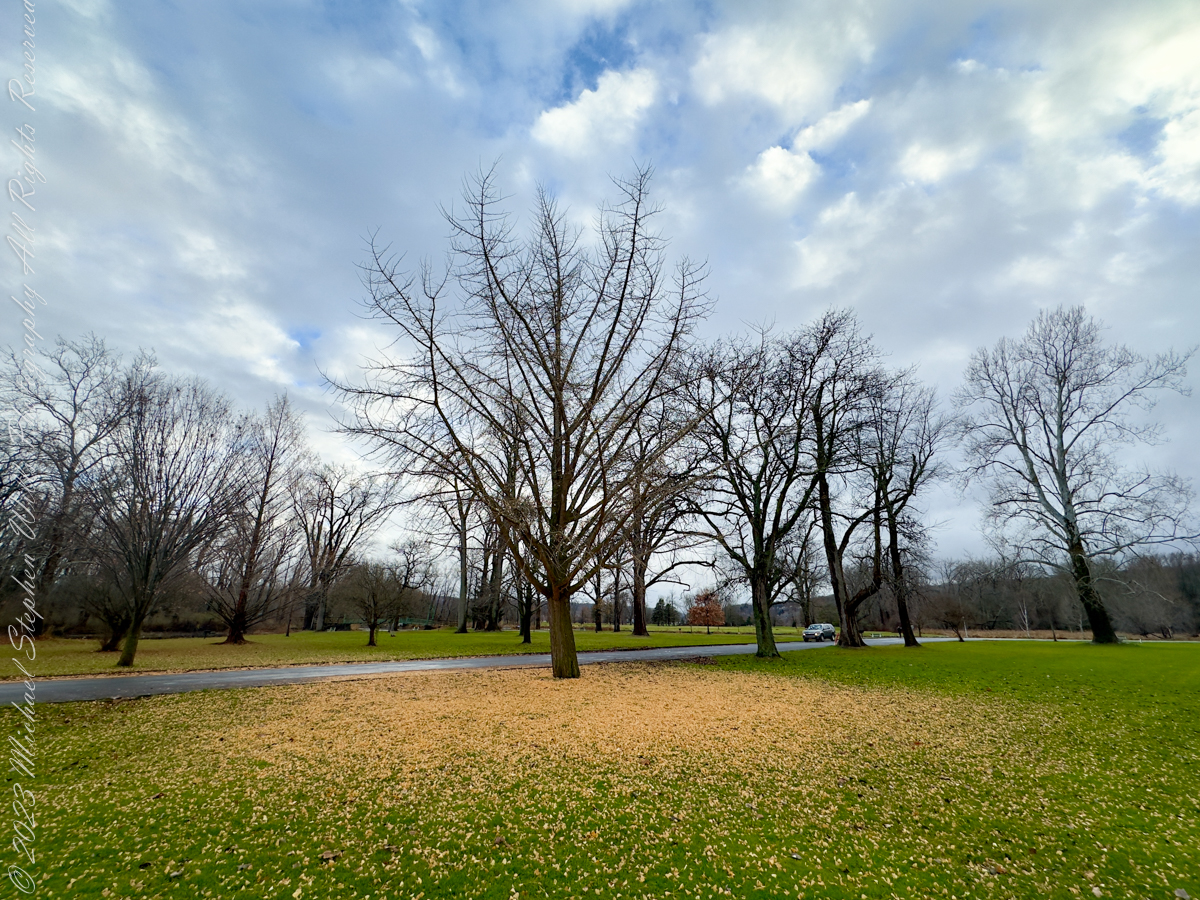
Standing before these two trees on a unseasonably warm autumn day, I am struck by the intricate patterns of their fallen leaves. Against the vibrant green of the grass, the golden leaves form halos around the trunks, as if nature herself were sketching mandalas. There’s something profoundly mathematical about these arrangements—a quiet order amidst what might initially seem like chaos.
The first tree, its barren branches reaching skyward, stands on a carpet of yellow that radiates outward in near-perfect symmetry. The leaves have fallen in such a way that their density decreases as the distance from the trunk increases. It reminds me of the inverse square law—a principle in physics that governs how light, gravity, and sound diminish with distance. Here, instead of energy dispersing, it’s the leaves thinning out, their graceful scatter dictated by the wind’s whims and gravity’s pull. There’s an undeniable harmony in this seemingly random process, a convergence of natural forces creating an elegant gradient.
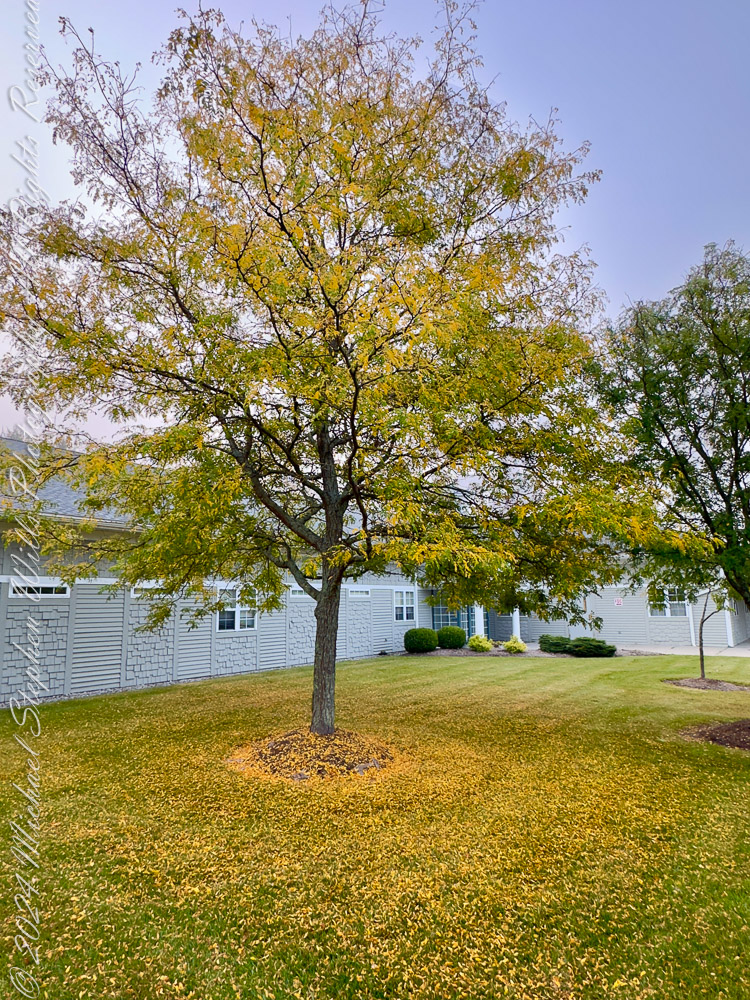
The second tree presents a different story, yet one equally mesmerizing. Its leaves, still clinging in part to the branches, form a looser ring at the base. The distribution is uneven, hinting at prevailing winds or the sheltering influence of nearby buildings. But even in this asymmetry, I see fractals—the self-similar patterns that repeat at different scales throughout nature. Look closely, and you’ll notice clusters of leaves mimicking the broader structure of the canopy above. It’s as if the tree’s essence is echoed in the ground below, a reminder of how deeply interconnected every part of a system can be.
These patterns invite reflection on the mathematical principles governing our world. Fibonacci sequences, golden ratios, and fractals—abstract concepts are not confined to textbooks. They are etched into the fabric of existence, visible in the spiral of a sunflower’s seeds, the curve of a nautilus shell, and the fall of leaves beneath a tree. Even the chaos of autumn is underpinned by order, a dance choreographed by countless variables: the angle of the branches, the strength of the wind, the moisture in the air.
I find myself wondering about the unseen forces at play. How many leaves fell straight down, obeying only gravity? How many were carried aloft by a breeze before settling farther afield? Could we model these patterns with algorithms, tracing the arc of each leaf’s descent? Would the data reveal a perfect equation, or would it remind us that some mysteries resist full comprehension?
As I stand here, I feel a deep gratitude for these natural equations. They ground me in the present moment while also connecting me to the infinite. The pattern of leaf fall is a reminder of life’s balance: chaos and order, randomness and structure, fleeting moments and timeless principles. The trees, now shedding their golden crowns, invite me to pause, observe, and marvel at the beautiful mathematics of autumn.
 Michael Stephen Wills Photography
Simply beautiful! Beautifully written and illustrated, Michael.
LikeLiked by 1 person
I wrote this last year while taking Pam to physical therapy at this medical complex. Your compliment is most appreciated, Sheree.
LikeLiked by 1 person
You’re very welcome
LikeLiked by 1 person
I wanted to post about chaos theory but couldn’t put it down the way you did.
Beautiful writing as always, and the photos perfectly reveal the mathematical beauty of autumn.
LikeLiked by 2 people
Go for it, nesfelicio!! Your original take will be exceptional, to be sure.
LikeLiked by 2 people
I love your poetic reflections/meditations! And of course, the gorgeous photos – autumn is my favourite season because of the trees.
LikeLiked by 2 people
Thank you, Lynne—what a lovely note. Autumn’s geometry and glow feel like a shared language, especially through the trees. I’m so glad the reflections and photos resonated; do you have a favorite grove or spot you return to each fall?
LikeLiked by 2 people
No but I have great memories of my first 20 years in Ontario – Autumn was extremely vibrant there 😊
LikeLiked by 2 people
Lovely, Lynne, Those first 20 years sound like a masterclass in arbor glory.
LikeLiked by 2 people
A meditational read, Michael. Autumn is my favourite season for so many reasons. Spring, my second best. As you enjoy Fall, I am watching the leaves bursting forth from our deciduous trees. So fascinating!
LikeLiked by 2 people
Thank you, Carolyn—how lovely to trade seasons across hemispheres. As our leaves resolve into autumn’s quiet math, yours are unfurling. Which trees are you watching leaf out this spring?
LikeLiked by 2 people
We planted a couple of deciduous Chinese Tallow trees in 2012. They were more than 10metres tall last month when we decided to have them ‘reduced’ quite considerably. This past week lovely little leaves are escaping from everywhere, including the trunk. There are, naturally, many new shoots appearing everywhere in the neighbourhood, including my veggie garden coming alive with lettuce and arugula this season. As I type Keith is preparing yet another row of soil. I will wait until late afternoon to sow seeds. Such a wonderful season for planting!
LikeLiked by 2 people
Last weekend we went apple picking with the family and I set some apples aside for a trip to another relative to experience their cranberry harvest in New Jersey Pinelands.
LikeLiked by 1 person
Beautiful with and without leave!
LikeLiked by 2 people
Thank you, Joke—so true: trees are beautiful both in full leaf and in their winter bones. I’m glad this piece spoke to you!
LikeLiked by 2 people
Welcome reflections. Michael, you are so right about the beauty of each fallen leaf. Hopefully winter will wait until the final leaf finds its resting place.
LikeLiked by 3 people
Thank you, BigSkyBuckeye—beautifully said. Each leaf feels like a small benediction, and I’m with you: may winter linger at the gate until the last one settles, keeping in mind the persistent hold of our Oak trees.
LikeLiked by 2 people