Monarch Butterfly Life Cycle: Egg to Adult (Danaus plexippus) with Photos

From milkweed egg to striped caterpillar, jade chrysalis, and fluttering monarch, witness metamorphosis, migration, and our role in protecting Danaus plexippus across North America today.

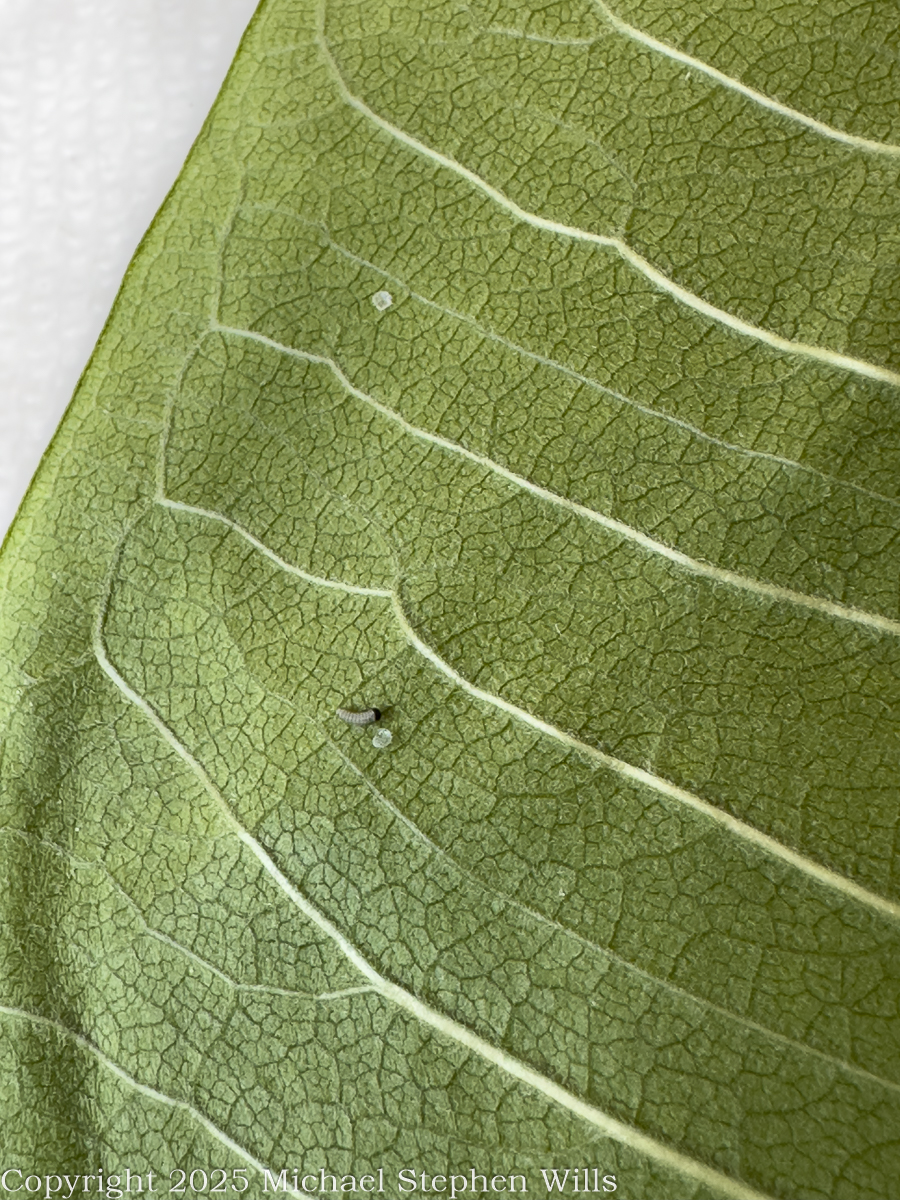
On the underside of a milkweed leaf, the world begins small enough to miss unless you kneel and look closely. In this first photograph the newborn is still a whisper of life, a pale pinhead egg collapsed into a glistening scrap, the tiny caterpillar beside it like a gray comma punctuating the green. It has just eaten the soft shell that cradled it—its first meal, its first thrift. The leaf’s pale roads of veins radiate around the hatchling; within that simple map lies all the geography it needs.
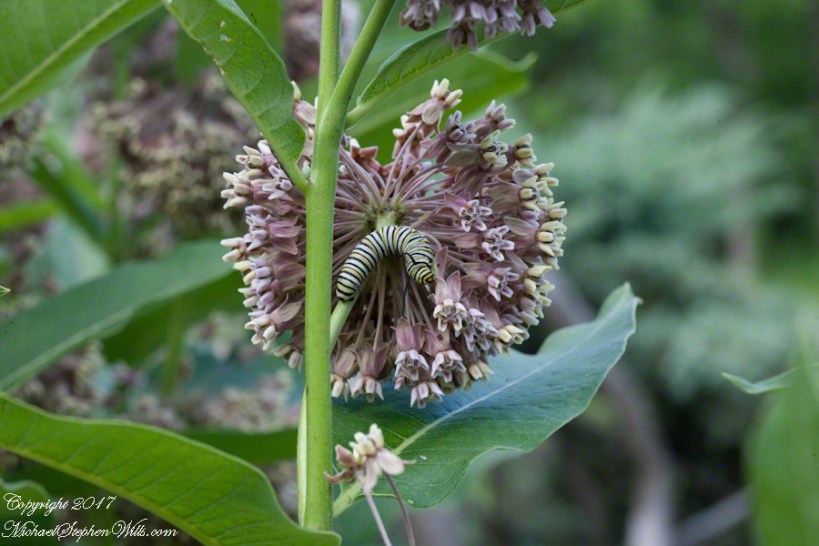
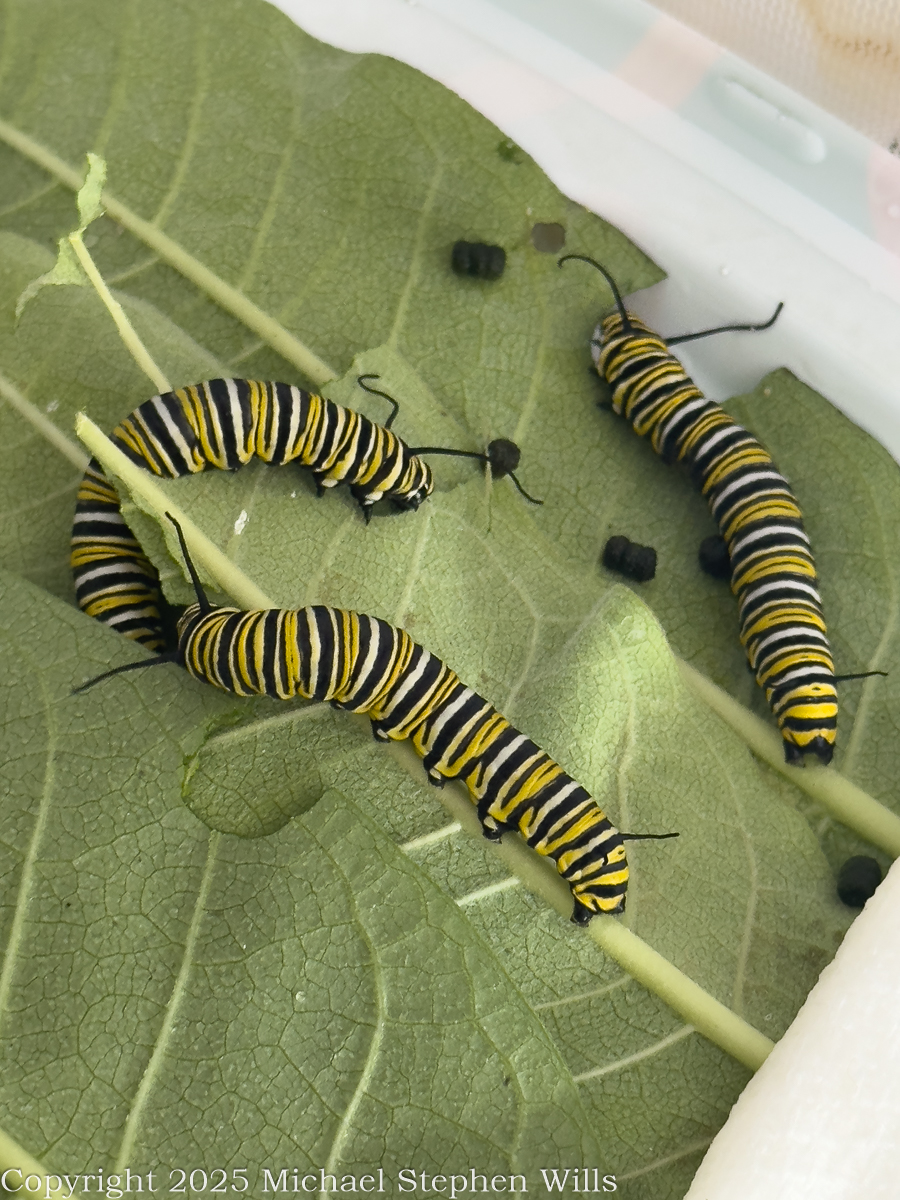
By the second photograph appetite has taken its proper throne. These pilgrims wear a uniform of warning: bands of yellow, black, and white—stripes as bright as hazard tape, a heraldic banner advertising the bitterness borrowed from milkweed. Each bite draws down defensive latex; yet the caterpillars feed undeterred, pausing to snip the leaf’s veins to quiet the flow. Their black, threadlike “tentacles” nod as they travel, and their peppery pellets—frass—collect like midnight hail. Five times they will outgrow themselves, shrugging off skins to reveal wider, hungrier versions within. The room is strewn with green rib and ragged edges; the air has the gentle smell of cut stems. All the while, milkweed’s poisons, the cardenolides, pass into growing bodies and become their bodyguard.
At last a hush. A final meal, a purposeful wander. The caterpillar chooses a high eave of the world—a stem, a stick, the corner of your rearing tent—and hooks itself into a downward J. Within hours the skin splits like a soft zipper; the striped creature pours itself out of itself and seals into a smooth chrysalis.
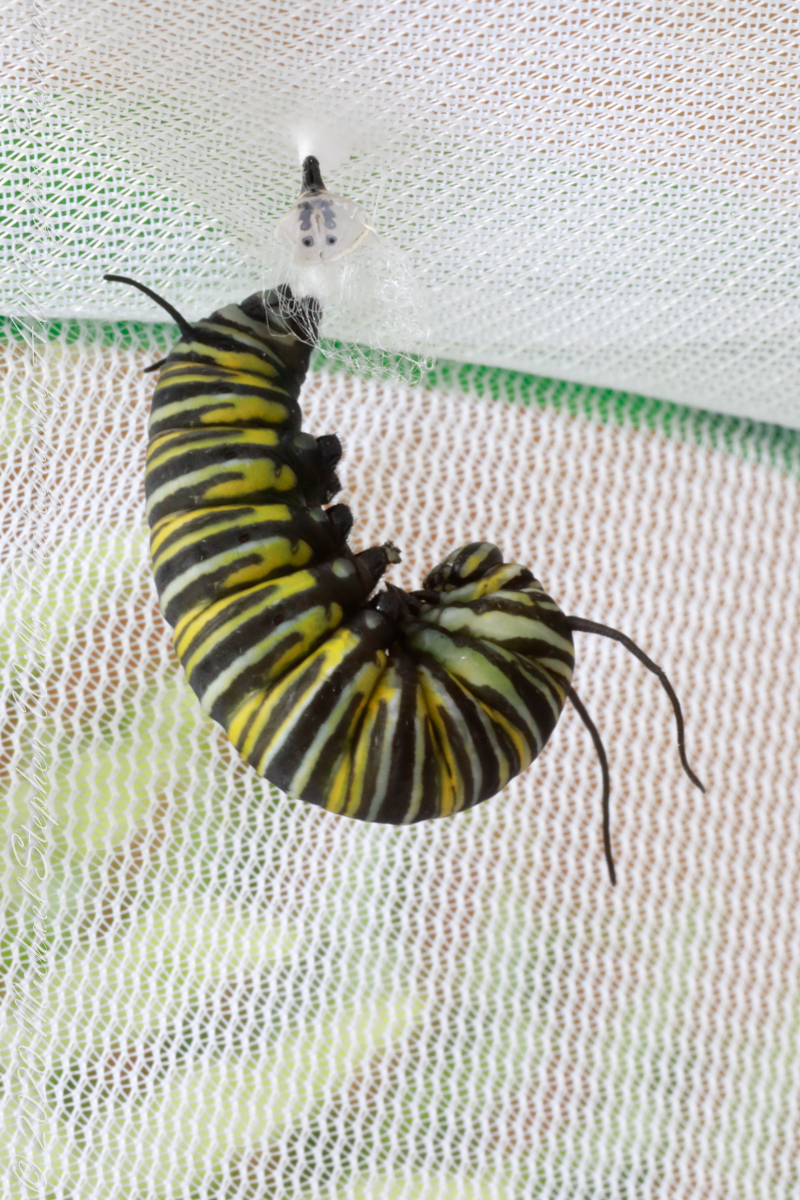
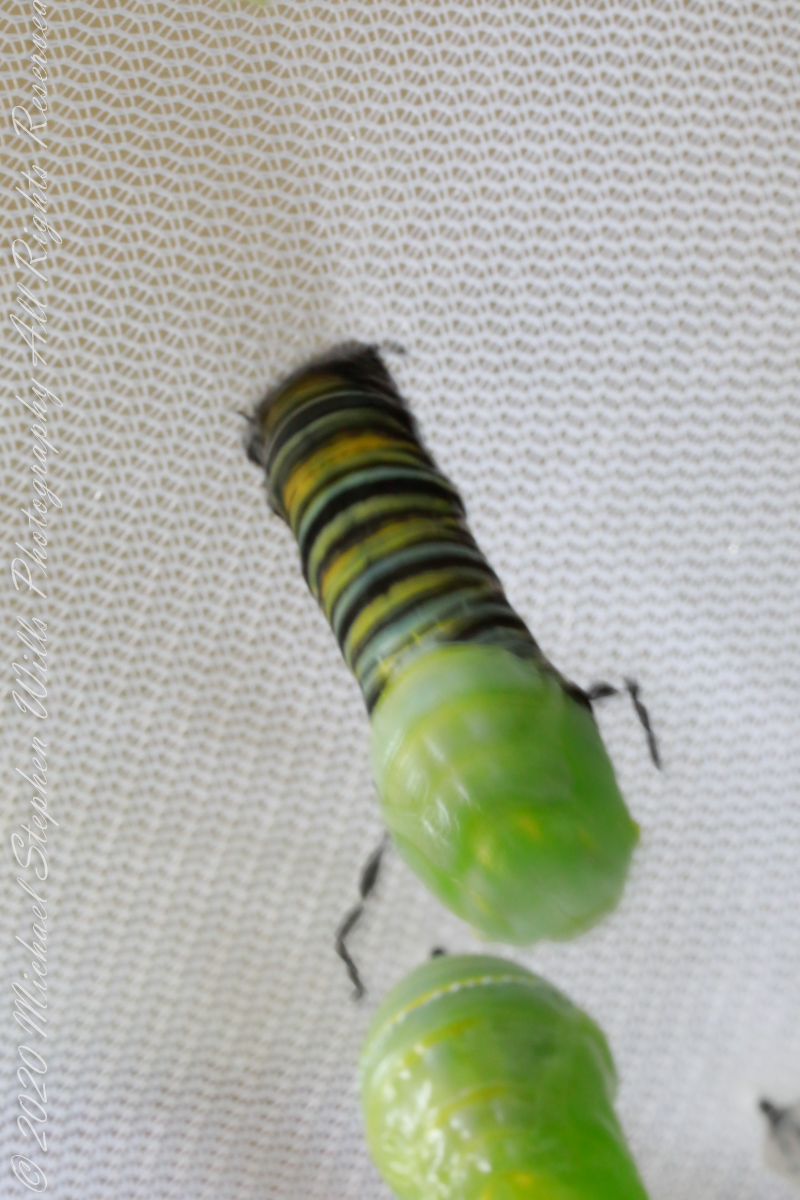
Here, the caterpillar has attached itself to a silk pad from which it hangs. Underneath the skin, the caterpillar is transforming to the chrysalis. In these photographs the silk pad and chrysalis attachment from a previous transformation are in the foreground.
Macro of the Monarch butterfly chrysalis. The black stalk attached to the silk pad is call a cremaster.

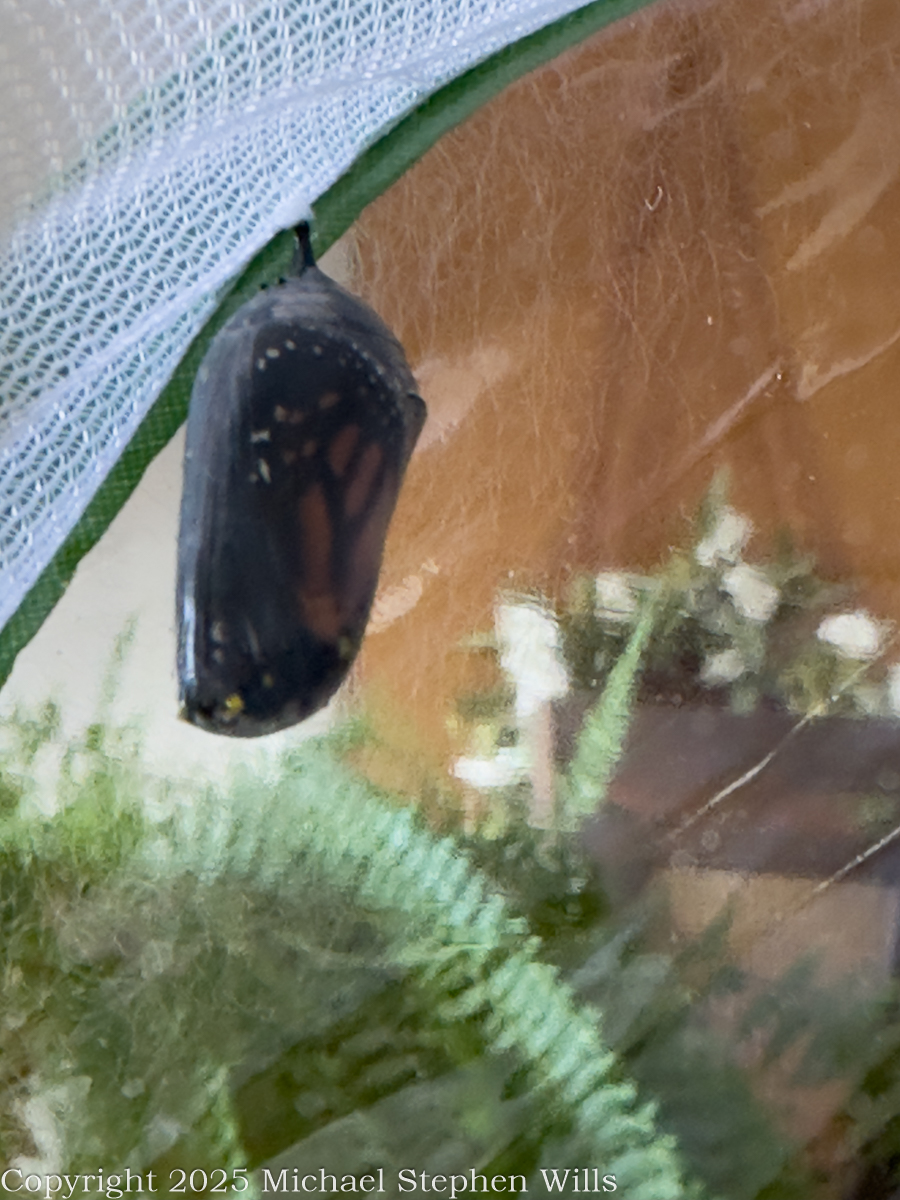
The following photograph and video catch the moments into becoming: the jade lantern has become transparent, darkening, its gold studs glinting like constellation points, and through the thinning walls the folded wings show, orange smoldering under smoke. Inside, old tissues have dissolved into a living broth; imaginal discs—tiny blueprints carried since the egg—have flowered into legs, eyes, and flight. To call it “metamorphosis” is correct; to call it mystery is truer.
Watch on YouTube for a better experience. Please “like” and “subscribe”

When the case opens the butterfly backs into the bright. It clings while the crumpled wings fill and flatten, hemolymph pumping life into every cell. In the next image the adult drinks from a petunia trumpet, a jeweled ember with white-spotted hems. The monarch—Danaus plexippus—tests the wind with new, purposeful wings. Its scientific name nods to ancient stories: Danaus after the Greek mythic king of Argos, a father who fled with his fifty daughters across the sea; plexippus for Plexippus, a figure of the same old tales—his name carried forward into this wanderer of the sky. The English name “monarch” is said to honor both its regal size and domain, and, some say, the orange-and-black of William of Orange. Kings and myths gathered like cloak and scepter around a creature that weighs less than a paperclip.

No butterfly has entered human life more completely. Schoolchildren cradle jars of milkweed sprigs and tape handwritten labels to chrysalides lined like seed pearls along a classroom window. Taggers kneel in September light, add a tiny disc to a wing, and write down time and place so the journey south can be traced. In the mountains of Mexico, where oyamel firs hold winter like a secret, people fold the monarch’s return into the Days of the Dead, believing that souls ride home on those wafers of flame. Gardeners tuck swamp milkweed into narrow beds and call their yards “waystations.” Photographers, such as myself, record the stories that happen leaf by leaf.
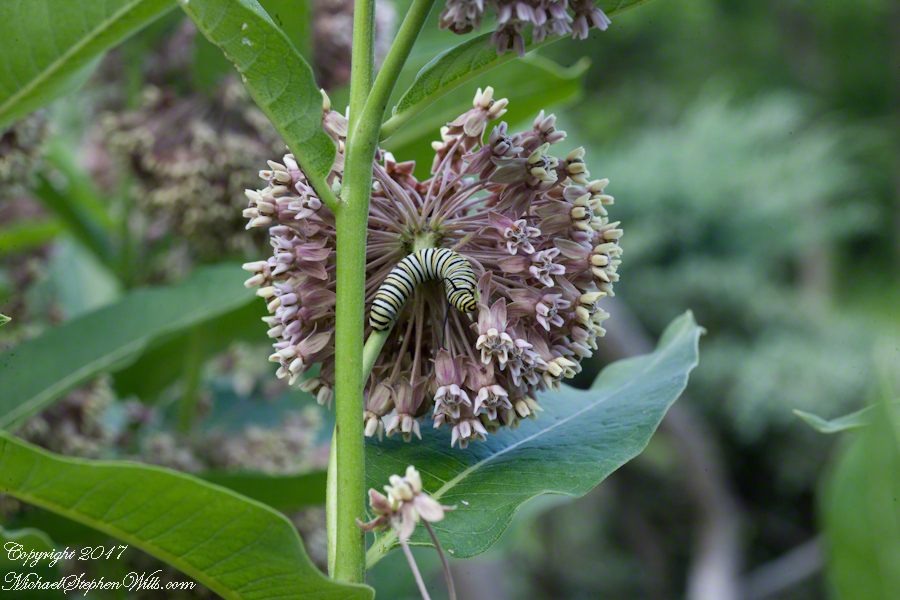
In early July a Monarch caterpillar revels in milkweed flowers.

Yet our touch is not simple. Fields simplified by herbicides have shaved milkweed from fencerows; tidy mowing removes nectar from roadsides in the tender weeks of migration; captive rearing in vast numbers, though done with reverence, may carry unintended risks of disease and weakened orientation. The monarch asks us to enlarge our sense of home beyond the fence: to let patches of milkweed lift their pale crowns in rough corners; to choose late-blooming asters and goldenrod; to keep a few ditches shaggy until the travelers pass. Conservation, like metamorphosis, is work that happens inside ordinary days.

Watch the cycle again in my images—egg to appetite, appetite to stillness, stillness to wing—and hear what it whispers in the steady voice of milkweed leaves and soft fall air. Rachel Carson wrote that “those who contemplate the beauty of the earth find reserves of strength that will endure as long as life lasts.” Here beauty wears stripes and beads of gold, sips from garden petals, and threads a continent with its frail insistence. The monarch’s life is a ribbon we can follow with our eyes and, if we are willing, with our hands—gentle hands that leave room for milkweed to rise, for caterpillars to feed, for a chrysalis to darken and a window to fill, one bright morning, with wings.

On a personal note, this season was a success. Monarchs visited our milkweed patch several times allowing me to save/harvest nineteen eggs/caterpillars and raise them until release.

Selected references
Carson, Rachel. The Sense of Wonder. New York: Harper & Row, 1965. (Reissued: HarperCollins, 1998; Open Road Media e-book, 2011.) The quoted passage (“Those who contemplate the beauty of the earth…”) appears early in the book; the Open Road edition places it on p. 41.
Wikipedia contributors. “Monarch butterfly — Etymology and taxonomy.” (useful overview with primary citations).
Oberhauser, K. S., and M. J. Solensky, eds. The Monarch Butterfly: Biology and Conservation. Cornell University Press, 2004.

Enter your email to receive notification of future postings. I will not sell or share your email address.

Two Laughing Gulls of Cocoa Beach: A Dance of Adaptation and Survival

Discover the captivating world of Laughing Gulls, the jesters of Cocoa Beach’s shores. Dive into their lives, exploring the dance of courtship, the adaptability in their diet, and their vital role in the coastal symphony.

The Coastal Sentinels

On the shores of Cocoa Beach, where the Atlantic’s waves gently knead the sands of Brevard County, Laughing Gulls (Leucophaeus atricilla) enact their daily ballet of survival and adaptation. In the span of mere minutes, the shifting light of Florida’s coastal theater presents two scenes, each with the same protagonist yet donned in starkly different costumes.

The Many Faces of Adaptation

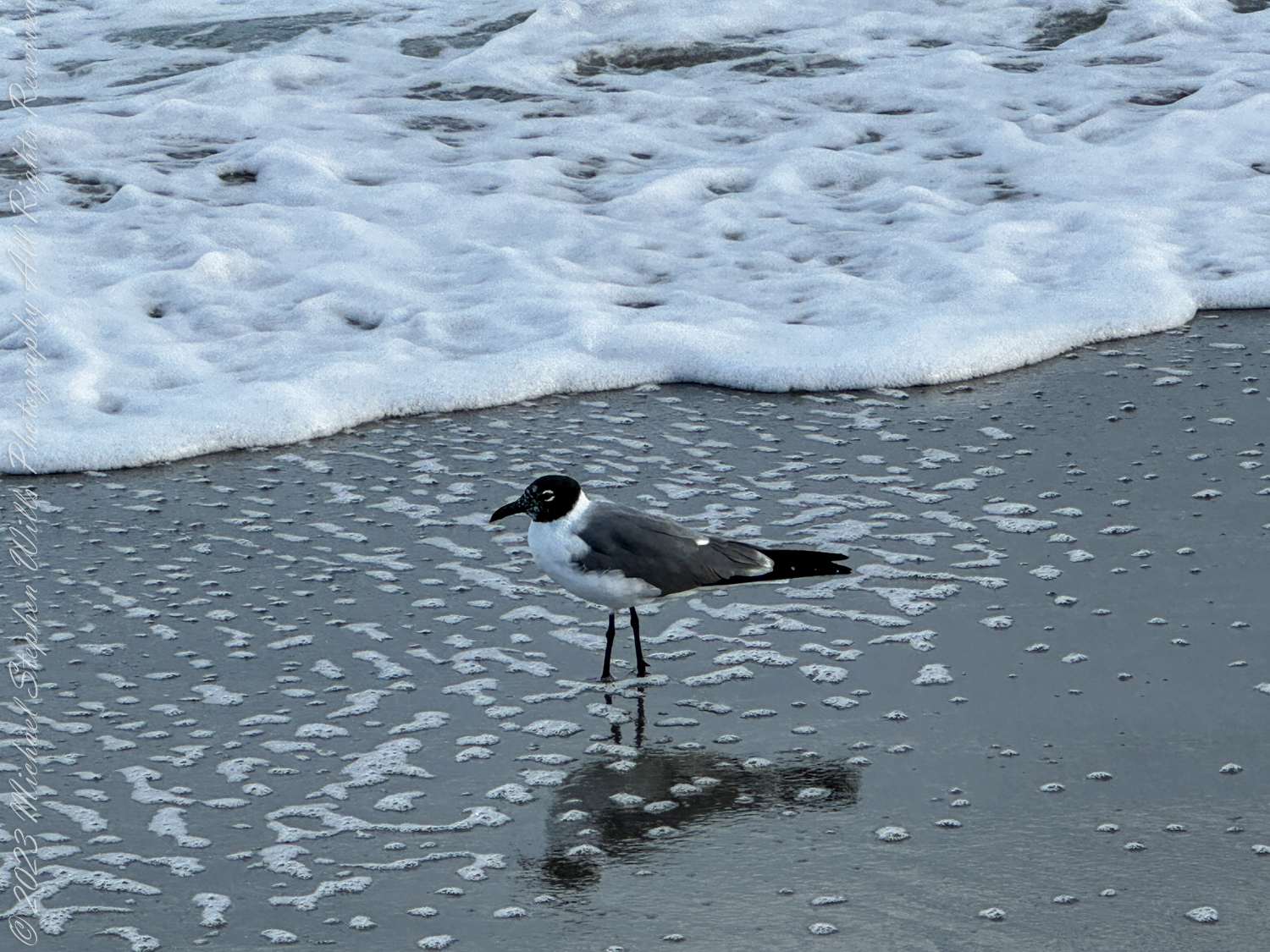
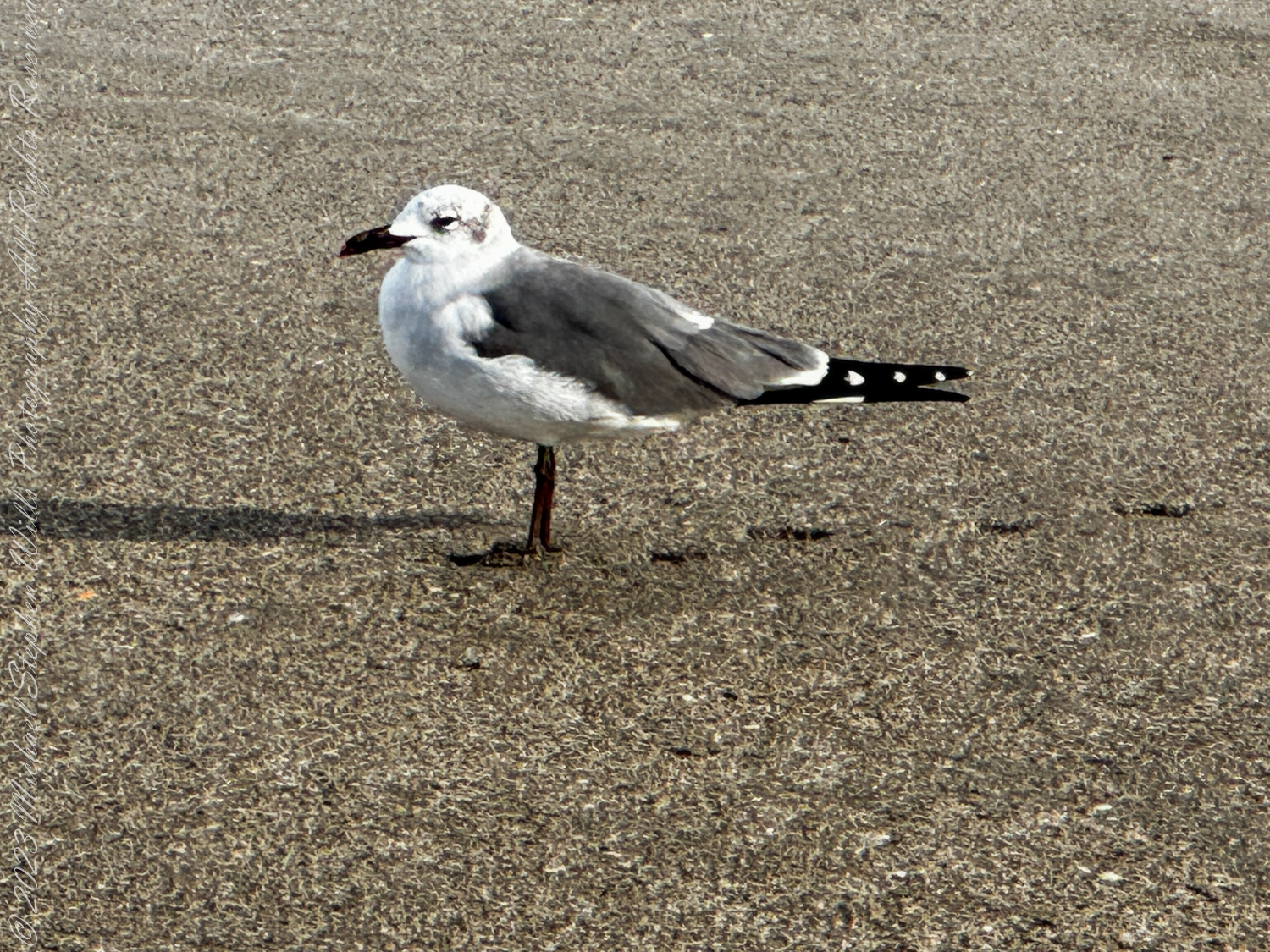
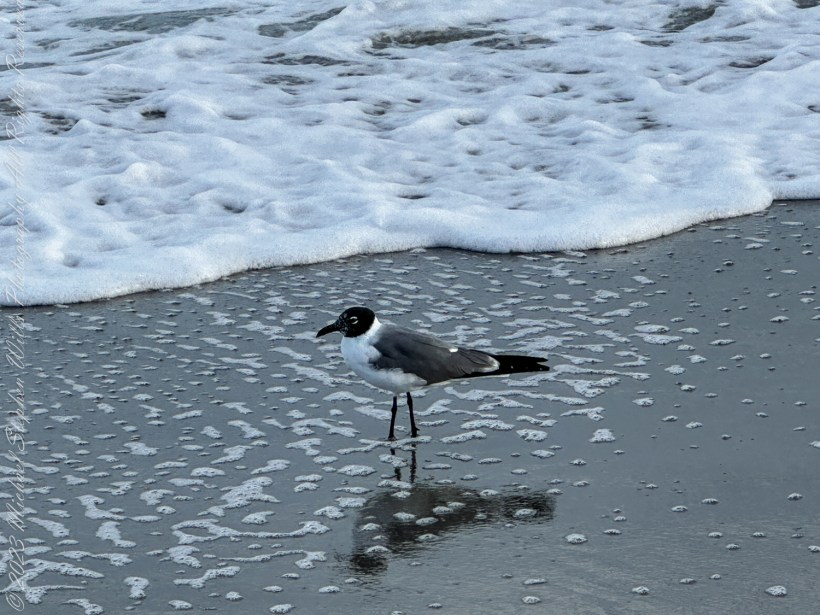
The first gull, captured against the frothy lace of the incoming tide, is the epitome of the breeding plumage: a sleek, black hood that starkly contrasts its pearl-grey wings. This attire is not merely for allure but speaks of its readiness to engage in the rituals of courtship and the responsibilities of rearing the next generation. This black hood, a seasonal crown, fades as the duties of breeding wane, revealing the less conspicuous garb of the non-breeding season—a mottled grey head atop the same sturdy body, ready to blend into the off-season’s landscape.

Laughing Gull with breeding plumage

Laughing Gull, nonbreeding plumage

Minutes Of Separation

The mere minutes that separate the two photographs are but a whisper in the grand dialogue of evolutionary time. Yet, they offer a glimpse into the ever-present duality of the Laughing Gull’s life. In one, the gull stands resolute, black-headed and bold against the soft chaos of the sea’s edge. In the other, its head appears dusted with the wisdom of age, a visual softening that speaks to the less confrontational time of year.

Here are some observations to make sense of this disparity:

Overlap of Molting Periods: Laughing Gulls do not all breed at the same time; some individuals may start molting into or out of breeding plumage earlier or later than others. This can result in birds with different plumage being seen together.

Varied Maturity: Younger gulls or those not yet of breeding age may not have developed the breeding plumage, while adults in the same flock may display full breeding colors.

Breeding Colonies: Gulls often nest in colonies where birds in different stages of the breeding cycle can be observed together, including those that may have lost mates or failed to breed and therefore did not develop breeding plumage.

Health or Nutritional Status: Sometimes a bird’s plumage can be affected by its health or nutritional status. A gull in poor health might not molt into breeding plumage as expected.

Geographic and Climatic Factors: Local environmental conditions can influence the timing of molting. Birds in the same location can experience different environmental cues that might affect their molt.

Non-breeding Visitors: During the breeding season, some non-breeding birds may still be present and intermingle with breeding birds, either because they are passing through the area or they are non-breeding residents.

Extended Breeding Season: In areas with a long breeding season, such as in subtropical and tropical regions, the breeding and non-breeding plumages can be seen at the same time due to the extended period over which breeding can occur.

Masters of the Coastal Realm

The Laughing Gulls are more than just residents of the coast; they are its caretakers and witnesses. Their laughing calls are synonymous with the ocean’s breath, a soundscape that harmonizes with the rhythmic crashing of waves. These birds thrive in the intertidal zone, a challenging environment where land and sea engage in a perpetual tussle. Here, they must be opportunistic, agile, and resourceful, for the beach offers both a cornucopia of food and the threat of unpredictability.

The Ebb and Flow of Existence

The life of a Laughing Gull is intimately tied to the ebb and flow of the tides. Their diet is a testament to their adaptability, comprising anything the sea yields—fish, crustaceans, and even the unfortunate insects that stray too close to the brine. They are pirates of the shore, unafraid to snatch a meal from another bird or scavenge the remains of human activity.

Reflections on Change and Constancy

Laughing Gulls are the embodiment of the sea’s narrative around us—a story of change and constancy. Their lives are a testament to the tumultuous history of the ocean, and their presence is a thread that connects us to the vast, blue mystery. They remind us that, while the sea’s moods are many and its faces ever-changing, it remains a central force in the narrative of life on Earth.

In the Face of Tomorrow

In the space between these two images, we find a profound lesson on the nature of time and the resilience of life. The Laughing Gulls of Cocoa Beach, with their shifting plumage and timeless cries, are messengers of the past, envoys of the present, and harbingers of the future. As we contemplate their existence, we are reminded of our own place within the natural world—a world that requires our understanding and protection, lest the laughter of these gulls fades into the silent archives of history.

The Laughing Gulls of Cocoa Beach continue their dance, unfazed by the human gaze, their lives a fluid adaptation to the sea’s caprices. And as the sun marches across the sky, casting the story of these gulls into relief against the shifting sands, we are privileged to observe, to learn, and to cherish the Atlantic Ocean’s enduring tale.

Copyright 2024 Michael Stephen Wills All Rights Reserved