The dawn greeted me with a bashful light as I took the road to Killen, tracing the path from the farmhouse that cradled my mother’s youth. The air was laced with a mist that seemed to carry whispers of the past, each one a fleeting messenger from a time long folded into memory.
This pilgrimage, a journey to the roots of my family tree, began with the creak of an old gate at the farmhouse, now standing as a silent guardian to stories and laughter long since quieted. The dew on the grass was like a blanket of tears, perhaps shed in joy for a homecoming long overdue, or in sorrow for the time lost.
Slievenaglogh, the mountain of the stones, watched over me, its presence a constant through the shifting shadows. The land here speaks in a language of its own, one that doesn’t need words, just an open heart and a quiet mind to understand its tales of endurance and resilience.
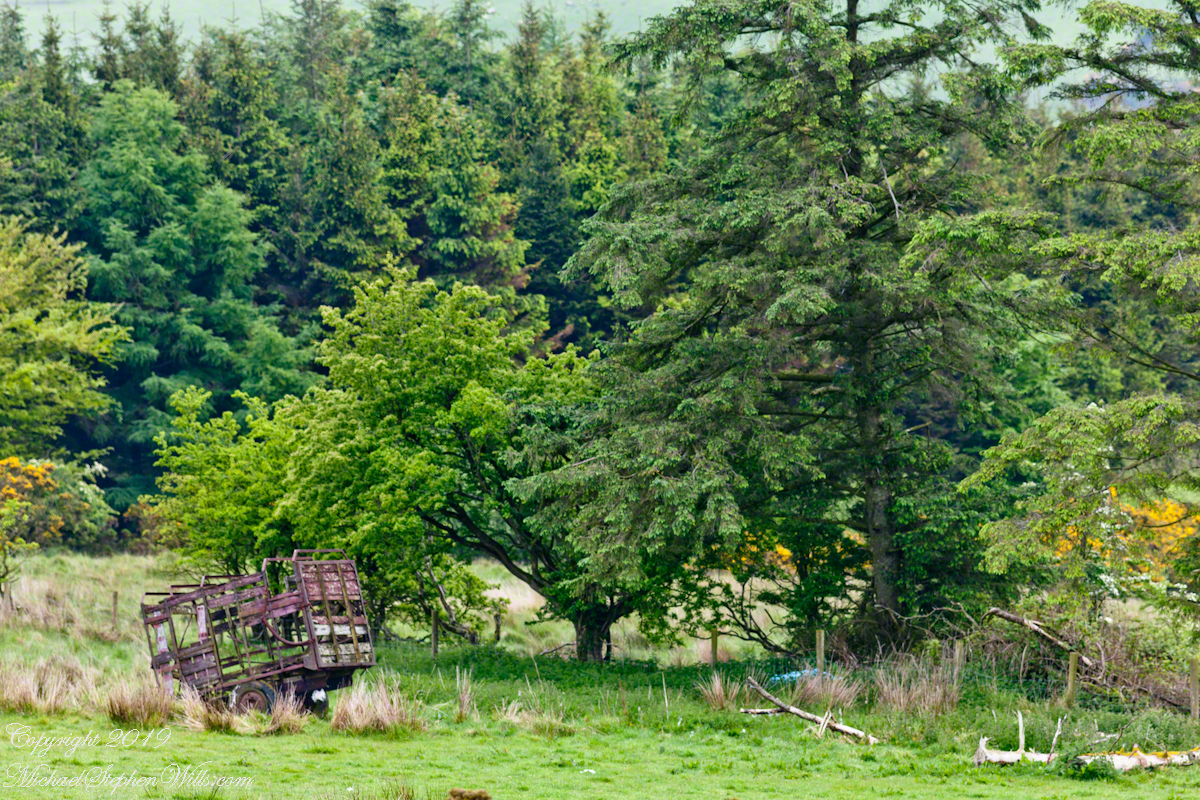
This abandoned hay wagon I encountered was a working relic, a piece of the puzzle that is my heritage. Unused since the twentieth century, it lay in the mountainside pasture, surrounded by a congregation of sheep that grazed with an air of solemnity. It was as if they, too, knew the importance of this place and this moment.
The wagon, weathered and worn, was a monument to the agricultural lifeblood that once flowed through these lands. It stood as a testament to the hard work of those who came before me, who toiled under the same sun, whose hands turned the soil and whose breath became part of the wind.
The name of the townland, Slievenaglogh, whispered of the ruggedness of this terrain and of the people who shaped it. The ancient Irish knew the power of a name, a power that seems to have seeped into the very stones here, etching stories of the past into the wild beauty of the Cooley Peninsula.
My journey to Killen was more than just a walk through a scenic route; it was a walk through time, a walk through the lineage of my family. With each step, I felt the pulse of my ancestors’ lives beating in time with my own heart.
As I walked, I couldn’t help but think of the Táin Bó Cúailnge, the great cattle raid that is the stuff of legends in these parts. The cattle raid may have been mythic, but the connection I feel to this land and its history is as real as the solid earth beneath my feet.
This is not just a story of returning to one’s roots. It’s a story of discovering the unbreakable threads that connect us to our past, and the understanding that while we may venture far and wide, there is always a piece of us that remains tethered to the land of our forebears.
The road to Killen, lined with the vibrant green that only Ireland can wear, was a path of introspection. The farmhouse, the hay wagon, the mist-shrouded morning—they were all chapters in the narrative of my family, pages that I turned with reverence.
As the sun climbed higher and began to burn away the morning mist, clarity settled upon me. The history of this land, the stories of my family, they were mine to cherish and to share, mine to carry forward as I made my way back to the place where my mother’s journey began. And as I looked back one last time, the silhouette of the hay wagon against the awakening day seemed to nod in silent acknowledgment of my visit, a custodian of the past granting its blessing for the future.
Click Me for another interesting Ireland story


Indeed, so much depended on it. Seeds, fabric, food, water barrels, tools.
Thanks for taking this shot. It may influence my story. Benjamin
LikeLiked by 1 person
my pleasure…looking forward to reading….
LikeLiked by 1 person
Silly me. Hay wagon
LikeLiked by 1 person
Coffee first. Read second.
LikeLiked by 1 person
That would make a wonderful painting
LikeLiked by 2 people
I’m inordinately fond of old farm equipment in landscapes. Sometimes, a truck will do as well, but it has to be a really old truck, with lots of decorative rust. This is great.
LikeLiked by 2 people
We’ll all end up a half remembered piles…what makes it enjoyable to contemplate these scenes, in part. It is picturesque here. Thanks for visting!!
LikeLiked by 2 people
This picture is breathing, it has so much life!
LikeLiked by 1 person
Grateful to learn some of the feeling I had for the place came across. Your compliment is appreciated, Jessica. Thank You.
LikeLiked by 1 person
Such beautiful colours
LikeLiked by 1 person
Green is my favorite color and I wore green and gold as a school uniform for eight years.
LikeLiked by 1 person
It’s the colour of nature
LikeLiked by 1 person