In the embrace of Happy Valley Saddle, within the Rincon Wilderness of Arizona, I discovered a world etched with antiquity and adorned with a mosaic of lichens—a testament to resilience and the march of time. The following are impressions of my encounter, both grand and minute, with these fascinating life forms.
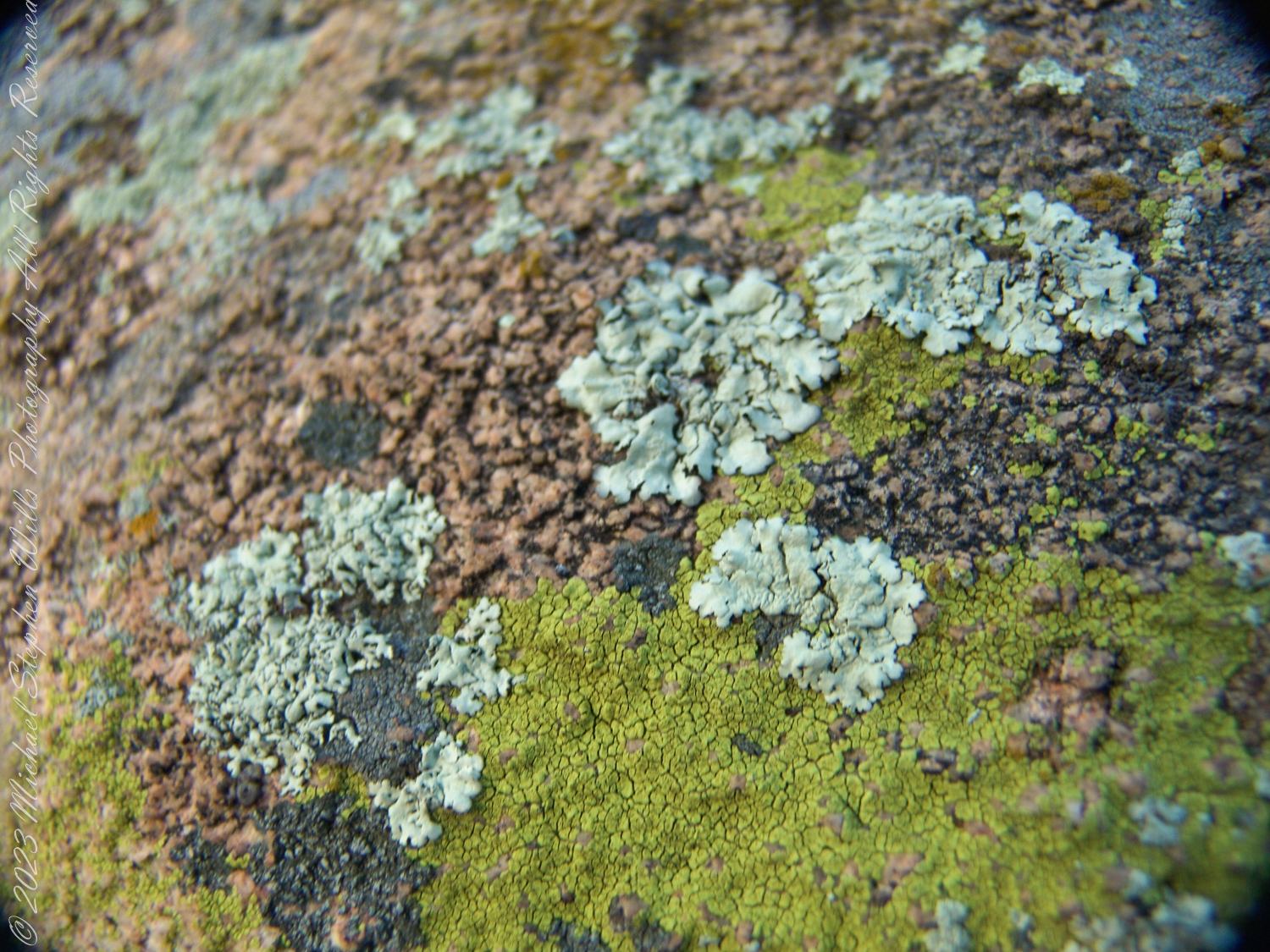
Lichens are not mere organisms but a symphony of life, where fungi and algae or cyanobacteria interlace in a delicate dance of survival. These entities—neither plant nor purely fungal—thrive where others falter, making the harsh landscapes their canvas. They’re an amalgam of endurance, capable of withstanding desiccation only to reawaken with the slightest kiss of moisture. Their chemistry is complex, their existence, a marvel that speaks to an Earth before our time.
“Common names for lichens may contain the word moss (e.g., “reindeer moss”, “Iceland moss”), and lichens may superficially look like and grow with mosses, but they are not closely related to mosses or any plant. Lichens do not have roots that absorb water and nutrients as plants do, but like plants, they produce their own nutrition by photosynthesis. When they grow on plants, they do not live as parasites, but instead use the plant’s surface as a substrate.”
“The English word lichen derives from the Greek λειχήν leichēn (“tree moss, lichen, lichen-like eruption on skin”) via Latin lichen. The Greek noun, which literally means “licker”, derives from the verb λείχειν leichein, “to lick”. In American English, “lichen” is pronounced the same as the verb “liken” (/ˈlaɪkən/). In British English, both this pronunciation and one rhyming with “kitchen” (/ˈlɪtʃən/) are used.”
Chronicles of Survival
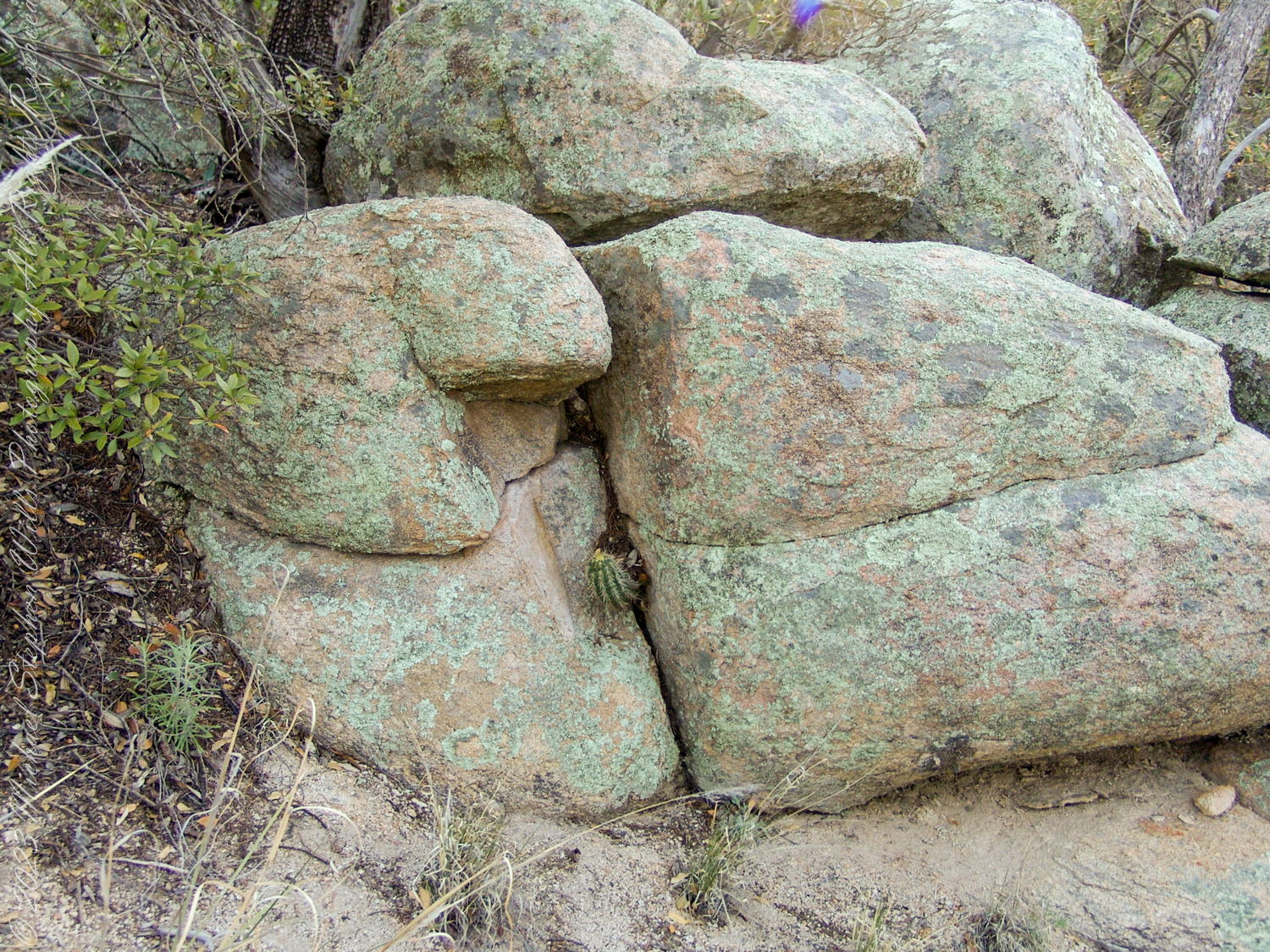
Peering closely at the lichen-clad boulders in my photographs, one might wonder about the age of these intricate life forms. They are nature’s timekeepers, aging with a stoicism that outpaces the fleeting human epoch. Some lichens in the Canadian Rockies span 600 years within a mere three inches of growth, while their Swedish counterparts can date back 1,600 years at twice the diameter. “An Arctic species called ‘map lichen’ (Rhizocarpon geographicum) has been dated at 8,600 years, apparently the world’s oldest living organism.” To discern their age is to embark on a journey through lichenometry, where every millimeter adds another year to their storied existence.
Lichen as Metaphor
“In early Midrashic literature, the Hebrew word “vayilafeth” in Ruth 3:8 is explained as referring to Ruth entwining herself around Boaz like lichen. The 10th century Arab physician, Al-Tamimi, mentions lichens dissolved in vinegar and rose water being used in his day for the treatment of skin diseases and rashes. The plot of John Wyndham’s science fiction novel Trouble with Lichen revolves around an anti-aging chemical extracted from a lichen.”
Palette of the Wilderness
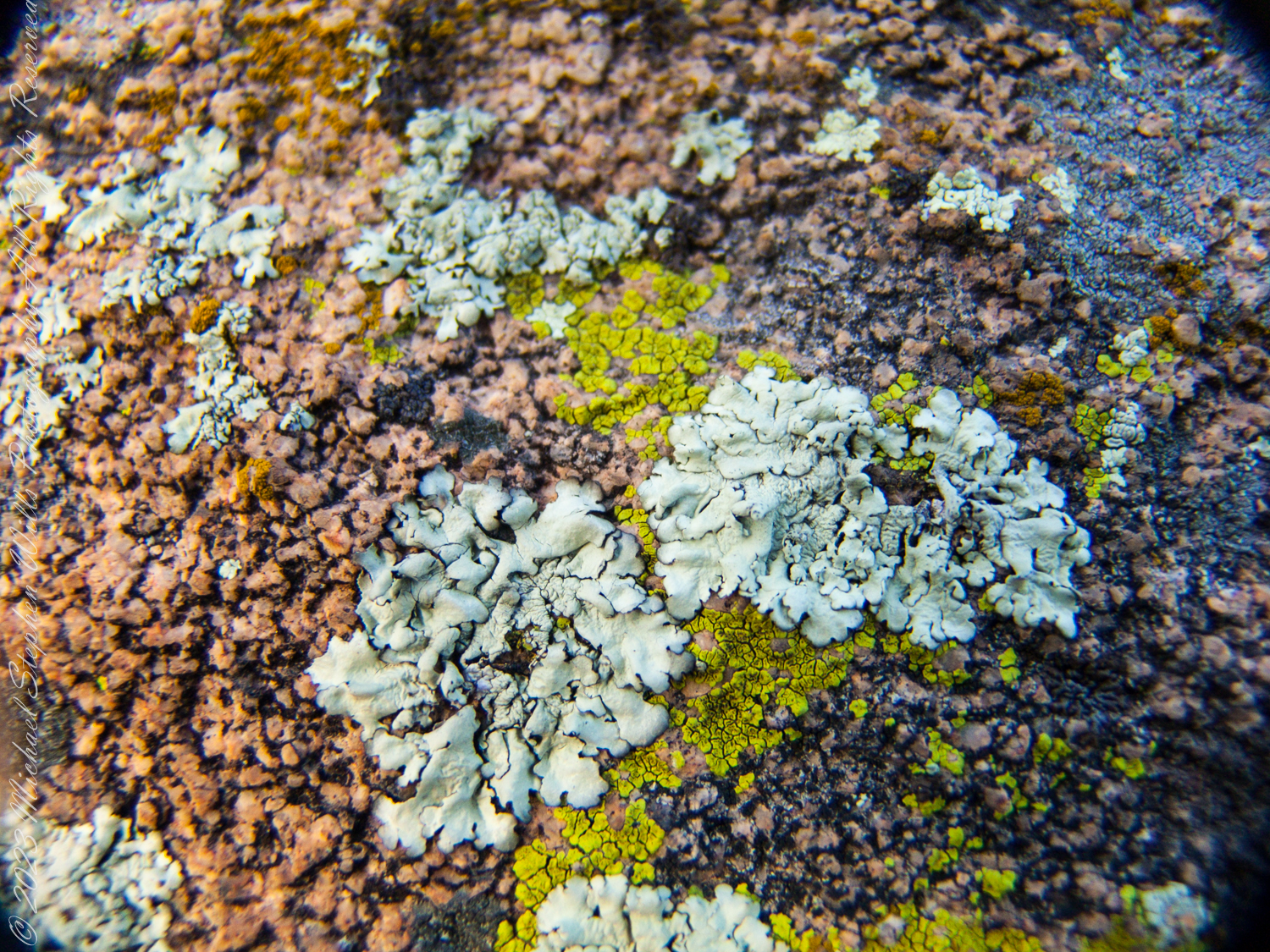
The colors that burst forth from the lichens in my images—a spectrum ranging from dusty greys to vibrant greens—are not just visual delights. They are the manifestations of lichen chemistry, reflecting their adaptive prowess and environmental narratives. These hues, whether muted or vivid, paint a portrait of ecological balance and geological transformation.
Ecological Sentinels
In the expanse of the Rincon Wilderness, lichens do more than just survive; they shape the environment. As pioneers in the most austere terrains, they contribute to soil formation, whisper tales of air quality, and offer sustenance to a myriad of life forms. Their ecological significance is colossal, often unnoticed yet deeply interwoven with the survival of many other species.
Companions in the Wilderness
Accompanying the lichen-festooned stones are the resilient hedgehog cacti, known scientifically as the genus Echinocereus. These spiny sentinels of the desert stand watch among the boulders, their presence a stark contrast to the soft complexity of lichens.
In the quietude of Happy Valley Saddle, I found a landscape that narrates the tale of time through lichens. They are the unsung architects of ecosystems, the patient artists of the geological canvas, and the subtle guardians of our planet’s history. My photographs are but a glimpse into their world—a world that continues to flourish against the odds, a testament to the enduring spirit of nature.
References:
Sections in quotes and italics are from the Wikipedia article on lichen.
britannica.com/science/lichen
oxfordbibliographies.com/lichenEcology
ucmp.berkeley.edu/fungi/lichen
weekand.com/home-garden/article/long-lichens-live
primaryresearch.org/stonewalls/nylund
britishlichensociety.org.uk/learning/lichen-ecology
Click Me to view my photographs on Getty.


Beautiful post 🌹
LikeLiked by 1 person
I ❤️ lichens!
LikeLiked by 1 person
You are not alone.
LikeLiked by 1 person
Thanks!!
LikeLike
I didn’t realize—as many others probably don’t, either—that lichens can be thousands of years old. What a different time scale they live by, compared to us,
LikeLiked by 1 person
Plants that reproduce by division, particularly those that can propagate vegetatively (asexually), exhibit a form of potential functional immortality. This is because they can produce genetically identical offspring through the division of their parts, essentially allowing them to continue living through their clones indefinitely under optimal conditions. Here are three examples of such plants:
Quaking Aspen (Populus tremuloides): Quaking aspens are known for their extensive clonal colonies, where a single root system gives rise to many genetically identical trees, called ramets. The most famous example is the “Pando” colony in Utah, USA, which is considered one of the largest and oldest living organisms. Pando covers over 106 acres and is estimated to be thousands of years old, showcasing how clonal growth can contribute to a form of functional immortality.
Strawberry Plants (Fragaria spp.): Strawberry plants reproduce by sending out runners (stolons) that touch the ground and root, forming new plants that are genetically identical to the parent. This method of vegetative reproduction allows strawberry plants to spread and persist in an area, continually renewing themselves with genetically identical individuals.
Creeping Sedums (Sedum spp.): Also known as stonecrop, many sedum species can reproduce vegetatively through division, cuttings, or leaves that fall and take root in the soil. This ability enables individual sedums to propagate and spread over an area, creating new plants that are genetically identical to the parent and potentially immortal in a functional sense, as they can keep producing new plants indefinitely.
LikeLike
I didn’t know that lichens can be so old. Quite amazing, I’ll be kinder to them when I see them next 🙂 Maggie
LikeLiked by 1 person
The lichen I found in the Rincons were quite beautiful, another reason to let them grow.
LikeLiked by 1 person
Beautiful capture of the colourful lichen. It’s incredible to hear just how long-lived lichens are.
LikeLiked by 1 person
On learning this while researching this post, it amazed me as well.
LikeLiked by 1 person
So interesting, Michael! Lichens are symbols of quiet persistence.
LikeLiked by 1 person
Thank you so much, Audrey, for your insightful observation! I couldn’t agree more; lichens truly are remarkable symbols of quiet persistence, thriving in even the most challenging environments with a resilience that’s both admirable and fascinating. Their unique symbiotic relationship and ability to endure, adapt, and flourish is a powerful reminder of nature’s resilience. It’s wonderful to share this appreciation with someone who understands the profound symbolism they represent. Looking forward to more discussions on such intriguing aspects of nature!
LikeLiked by 1 person