Click me for my Getty flower photography.
Late April – Robert H. Treman State Park
I follow a winding trail through hemlock and maple woods, the air cool and earthy after a spring rain. Under the canopy of budding leaves, I spot a flash of deep burgundy among the moss. Kneeling, I find a red trillium blooming at the base of an old oak. Its three velvety petals are a rich wine color against the green moss and damp leaf litter. A faint musky scent wafts from the flower – no wonder some call it “Stinking Benjamin.” Nearby stands another trillium, but this one is a pristine white star facing upward toward the light. Its broad petals have a gentle wavy edge and no noticeable odor. The red flower droops modestly while the white one opens itself to the sky. Different in color and posture, I realize these are two distinct species1 sharing the same springtime stage.
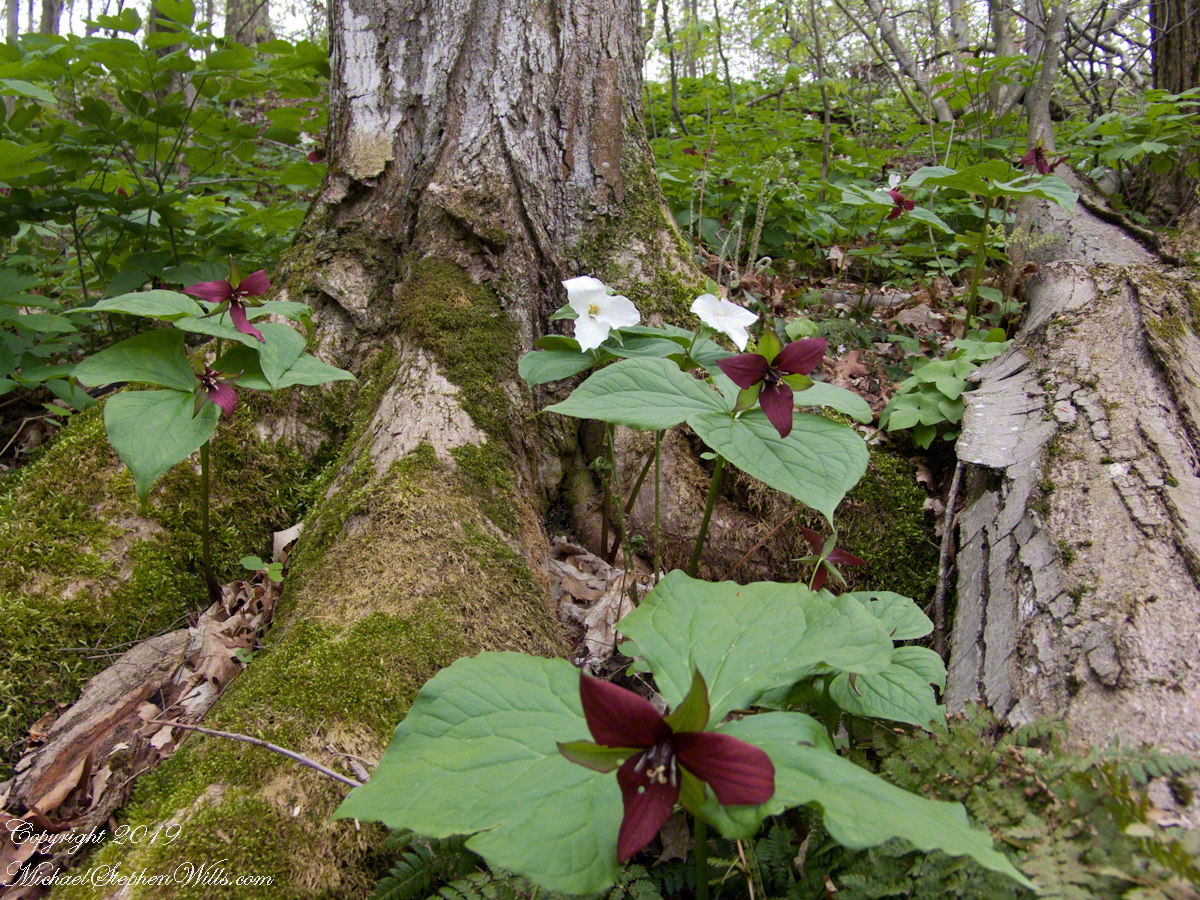
Seeing the red and white blooms side by side feels like meeting two woodland siblings – each unique yet part of the same family. The white trillium is almost luminous in the forest gloom, while the red trillium blends into the shadows with its dark hues. Both emerge from the soil after long, cold months, timing their bloom for the brief sunny window before the trees fully leaf out. Knowing how slowly these perennials grow and how long they live makes their yearly return even more special to witness. Their resilience in coming back each spring fills me with quiet awe.
Early May – Fillmore Glen State Park
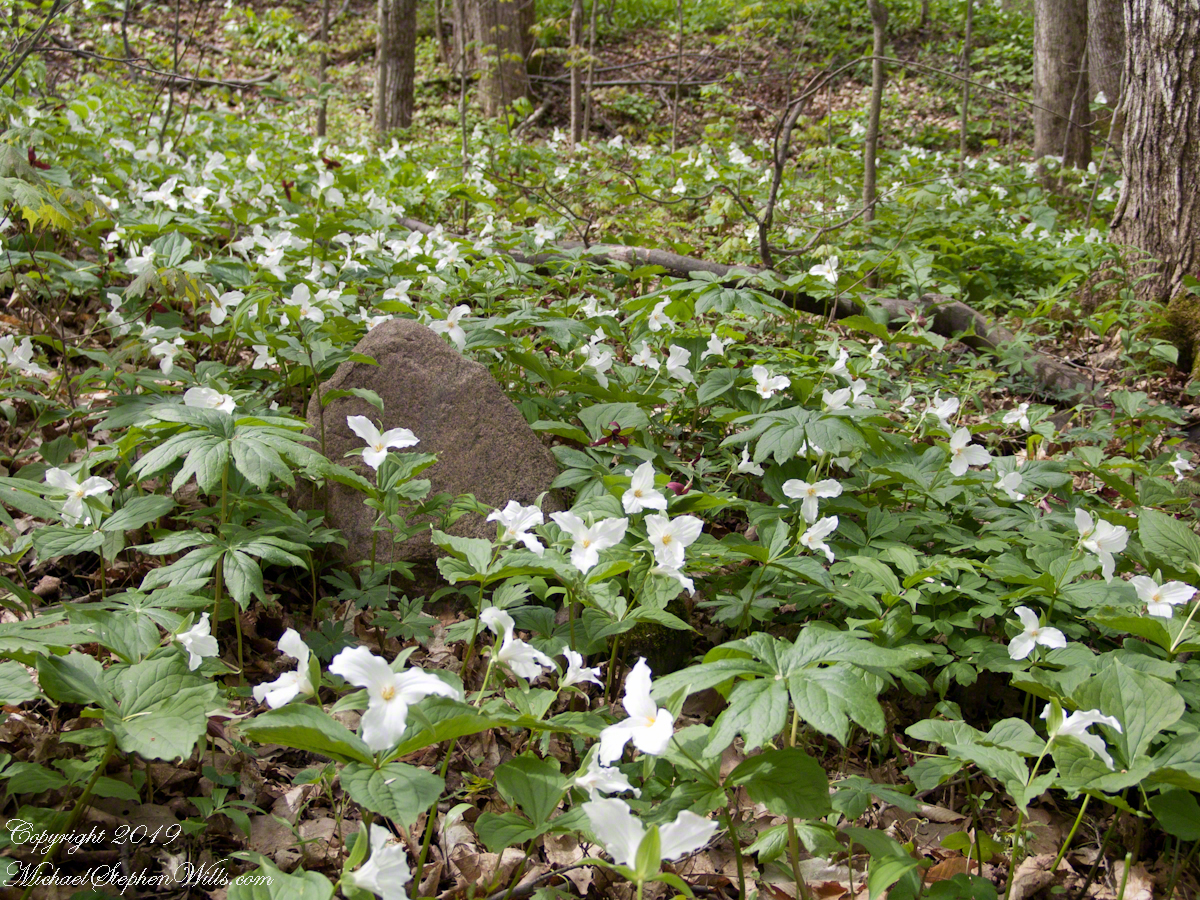
A week later, I wander the lush gorge of Fillmore Glen. The trail is alive with birdsong and the rush of a creek. Dappled sunlight slips through the greening canopy, illuminating patches of the forest floor. Rounding a bend, I catch my breath — the hillside ahead is blanketed with hundreds of white trilliums, a breathtaking constellation of blooms across the ground that feels almost sacred. Careful not to tread on any, I step closer to admire them at eye level.
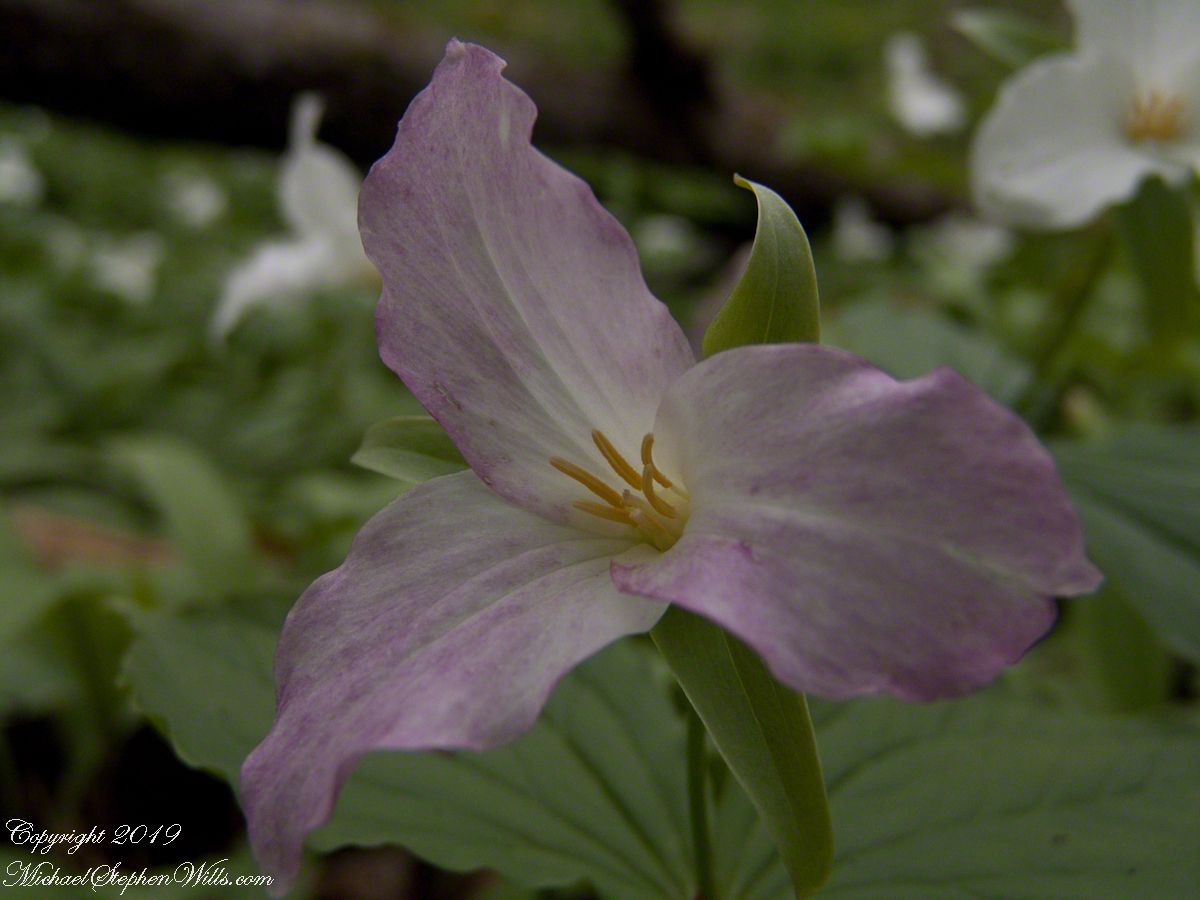
Up close, one large white trillium reveals a surprise: a delicate wash of pink across its aging petals, as if it were blushing. It’s known that after pollination the snow-white petals of Trillium grandiflorum often turn rose-pink with age2. Indeed, many blossoms here wear a faint pink tint, especially those that have been open for a while. This blush of maturity gives the colony a quietly celebratory air – fresh ivory blooms mingling with older siblings tinted softly rose.
In a shaded nook at the edge of the colony, a lone red trillium blooms among the white. I wonder if the red and white trilliums ever hybridize. I see no intermediate colors and recall that the white trillium rarely hybridizes with other species3. The red trillium, by contrast, can swap pollen with certain close relatives, yielding various forms elsewhere. But a true red–white cross never occurs here – each species keeps to its own.
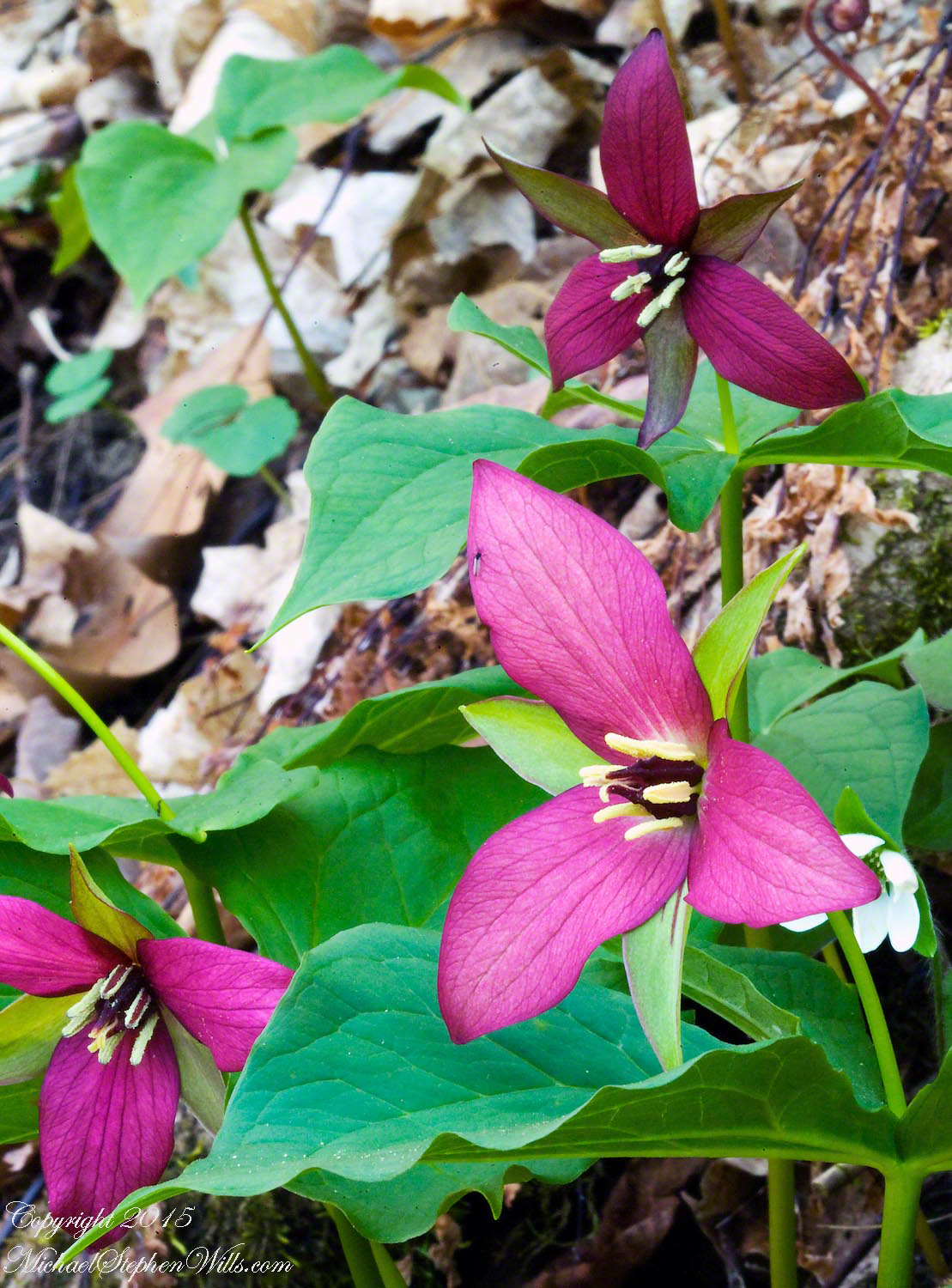
The red trillium even has a rare white-petaled form4 easily mistaken for its white-flowered cousin. I linger a bit longer among these graceful “trinity flowers,” my questions answered and my appreciation deepened. As I turn to go, a sunbeam breaks through and illuminates one last trillium by the trail, its white petals touched with pink. I smile, grateful for the chance to witness this woodland wonder.
Click me for another Trillium posting
Enter your email to receive notification of future postings. I will not sell or share your email address.

Copyright 2025 All Rights Reserved Michael Stephen Wills
Footnotes
- Different species: Red trillium and white trillium are separate species (Trillium erectum and Trillium grandiflorum, respectively), distinguished by traits like flower orientation and petal shapeidentifythatplant.com.
- White petals turn pink: The large white trillium’s petals are pure white upon opening but gradually develop a rose-pink or purple tint as the flower agesnj.gov.
- Rare hybridization: Unlike some trilliums that hybridize readily, Trillium grandiflorum (white trillium) is not known to form hybrids with other speciesen.wikipedia.org. Trillium erectum can hybridize with its close relatives, but a red–white trillium cross is not observed in nature.
- White form of red trillium: Trillium erectum (normally red) has a variety with white petals, classified as T. erectum var. album, which can be mistaken for a white trillium at a glancemidatlanticnature.blogspot.com.
 Michael Stephen Wills Photography
I like all three!
LikeLiked by 4 people
hard not to
LikeLiked by 1 person
These are beautiful. My friend just gave me a couple plants and I’ve been considering where to put them in my yard. Somewhere in a shady area where they have space to spread, it seems, from your lovely post. :0)
LikeLiked by 5 people
most trillium sold were collected in the wild as they are difficult to propagate. Wild populations are at risk from this. Not to run your joy……just a heads up about getting some more. Good luck with them. They need some sun, better under a deciduous tree that will be leafless in the spring.
LikeLiked by 2 people
My friend has them growing in her years and just pulled a couple out for me. They’re beautiful.
LikeLiked by 2 people
enjoy!!
LikeLiked by 2 people
And thanks for the tip. I know just where to plant them now.
LikeLiked by 2 people
my pleasure, Pam
LikeLiked by 2 people
beautiful
LikeLiked by 3 people
So much beauty to see in this world. Thank you!
LikeLiked by 4 people
my pleasure
LikeLiked by 1 person
Wow. Gorgeous.
LikeLiked by 4 people
Very nice shots! 🙂 We have trillium growing in the woods near us here in Illinois. 🙂 I’ll post some one of these days.
LikeLiked by 4 people
Looking forward to it, Tom. Better hurry of you need the photos, it is late in the season here and maybe Illinois as well. Have a great weekend.
LikeLiked by 1 person
I have only seen white trillium here in southern Ohio. The others are lovely!
LikeLiked by 3 people
Trillium are a gift
LikeLiked by 2 people
Agreed! I look forward to them every year.
LikeLiked by 2 people
White or red, it is pure beauty !
LikeLiked by 3 people
Amen
LikeLiked by 1 person
Very informative post. Thank you.
LikeLiked by 3 people
my pleasure, Janet
LikeLiked by 1 person
Trilliums are the provincial Flower of Ontario. I am looking forward to seeing them out on the forest trails where I go with my horse. Sadly as Ima up up on the horse it’s not possible for me to take good photos of them. Most are white that I see here.
LikeLiked by 3 people
It is possible you will notice the reds, or maybe already have seen them?
LikeLiked by 2 people
No they are not out yet. I know the places where they grow in the forest. I can see leaves but no blooms yet. But the weather is warming up so next week I think they will be up.
LikeLiked by 2 people
similar to here…a cold early spring
LikeLiked by 2 people
What gorgeous plants and so delightfully discovered
LikeLiked by 1 person
Beautiful. We don’t have much trillium in this part of Canada, and I don’t think I’ve ever seen red. Maggie
LikeLiked by 1 person
Thank you, Maggie! How lovely to hear from you again. Red Trillium is such a striking sight—it always stops me in my tracks. I hope one day you’ll happen upon one, perhaps on a visit to a southern Ontario woodland, such as the Niagara Escarpment or Bruce Peninsula, might reward her with its deep crimson blooms in late April to May. They’re a quiet treasure of the forest understory.
LikeLiked by 1 person
I love trillium! 😊
LikeLiked by 1 person
Thank you, Pepper! 😊 Trillium has a special way of capturing hearts, doesn’t it? Their quiet beauty and early spring arrival make them unforgettable. I’m so glad the post resonated with you!
LikeLiked by 1 person
It sure does. 😊
LikeLiked by 1 person
We do not know this flower in Europe. The three colors are beautiful.
LikeLiked by 1 person
Thank you, Joke! Trillium is a North American treasure, but its quiet elegance might remind you of the European Anemone nemorosa (Wood Anemone)—another woodland flower that carpets the forest floor in early spring. Both share that same ephemeral grace and love of dappled light. So glad you enjoyed the trio of colors!
LikeLiked by 2 people
Yes I know our european anemone 🙂
LikeLiked by 1 person
I don’t think I’ve seen a red trillium before. It’s stunning.
LikeLiked by 1 person
Thank you, Linda! Red Trillium really is a showstopper with its deep, velvety tones. It’s native to parts of eastern Canada, so if you ever find yourself in a rich hardwood forest in Ontario or Quebec in spring, keep an eye out—it might surprise you beneath the trees.
LikeLiked by 1 person
Beautiful photos well captured 👌👌
LikeLiked by 1 person
Thank you, Priti! I’m glad the beauty of the Trillium came through—nature did the posing, I just clicked the shutter! 🌿📸
LikeLiked by 1 person
Welcome 🙂 Hi visit my YouTube channel.https://youtube.com/@pritilatanandi2010?si=2_ZkuyykLSLvvXiW. If possible then subscribe to it. It will be my pleasure 😊 thank you ☺️ stay blessed 🙏🏼
LikeLiked by 1 person
done!!
LikeLiked by 1 person
Thank you 😊
LikeLike