Walking through Treman Gorge in early May, I am always struck by the lush greenery that carpets the forest floor. The delicate ferns and emerging wildflowers create a tapestry of colors and textures. On this particular visit, my attention is drawn to a cluster of striking flowers that stand out against the verdant backdrop. These are the Trilliums, a genus known for their three-petaled blooms.
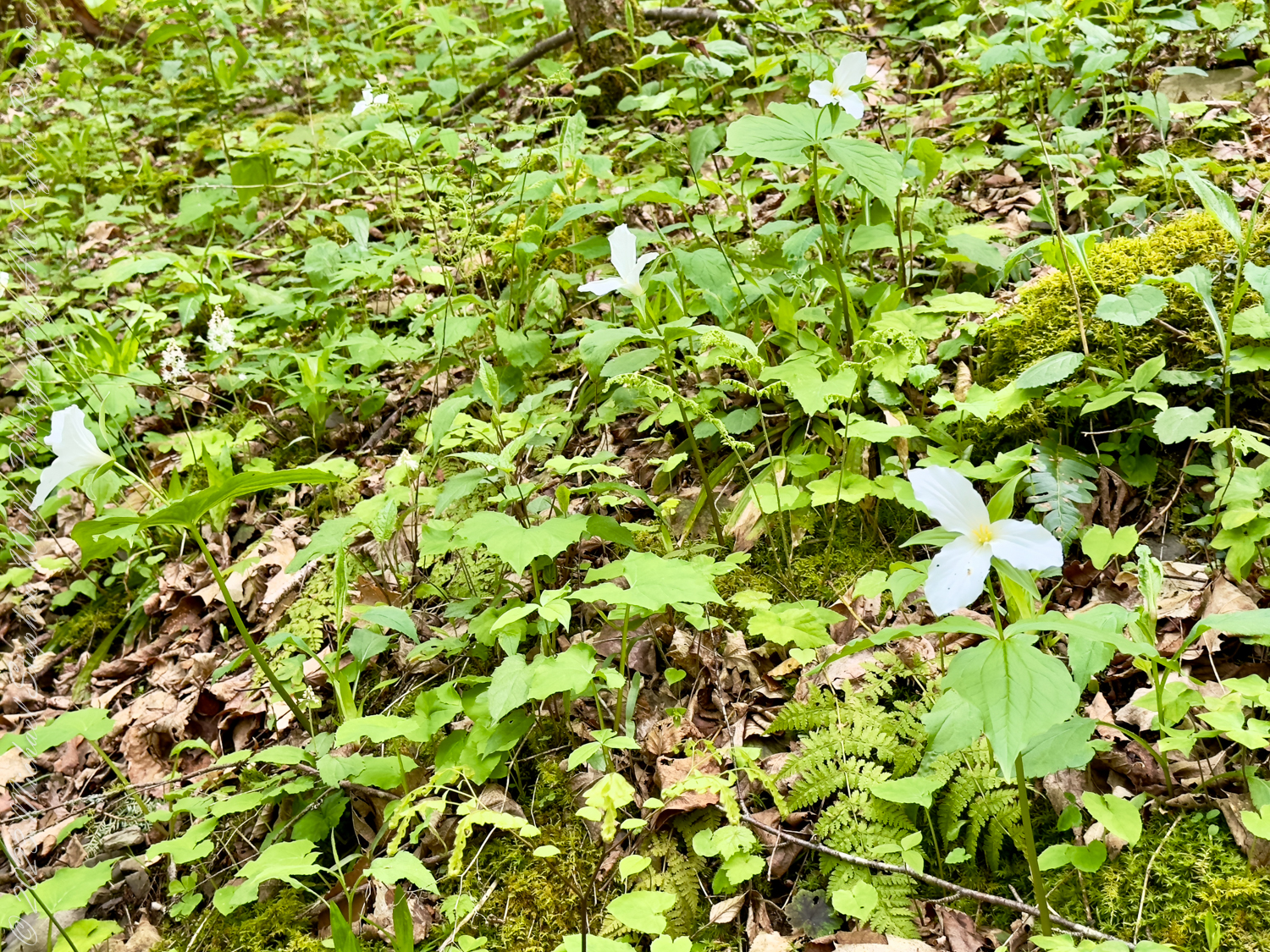
A Closer Look at Trillium grandiflorum
As I approach the flowers, I recognize them as Trillium grandiflorum, commonly known as the Great White Trillium. The species name “grandiflorum” aptly describes its large, showy flowers. Each blossom consists of three pure white petals that gently arch outward, giving the flower a graceful appearance. The petals are complemented by three green sepals and three broad leaves that form a whorl beneath the bloom.

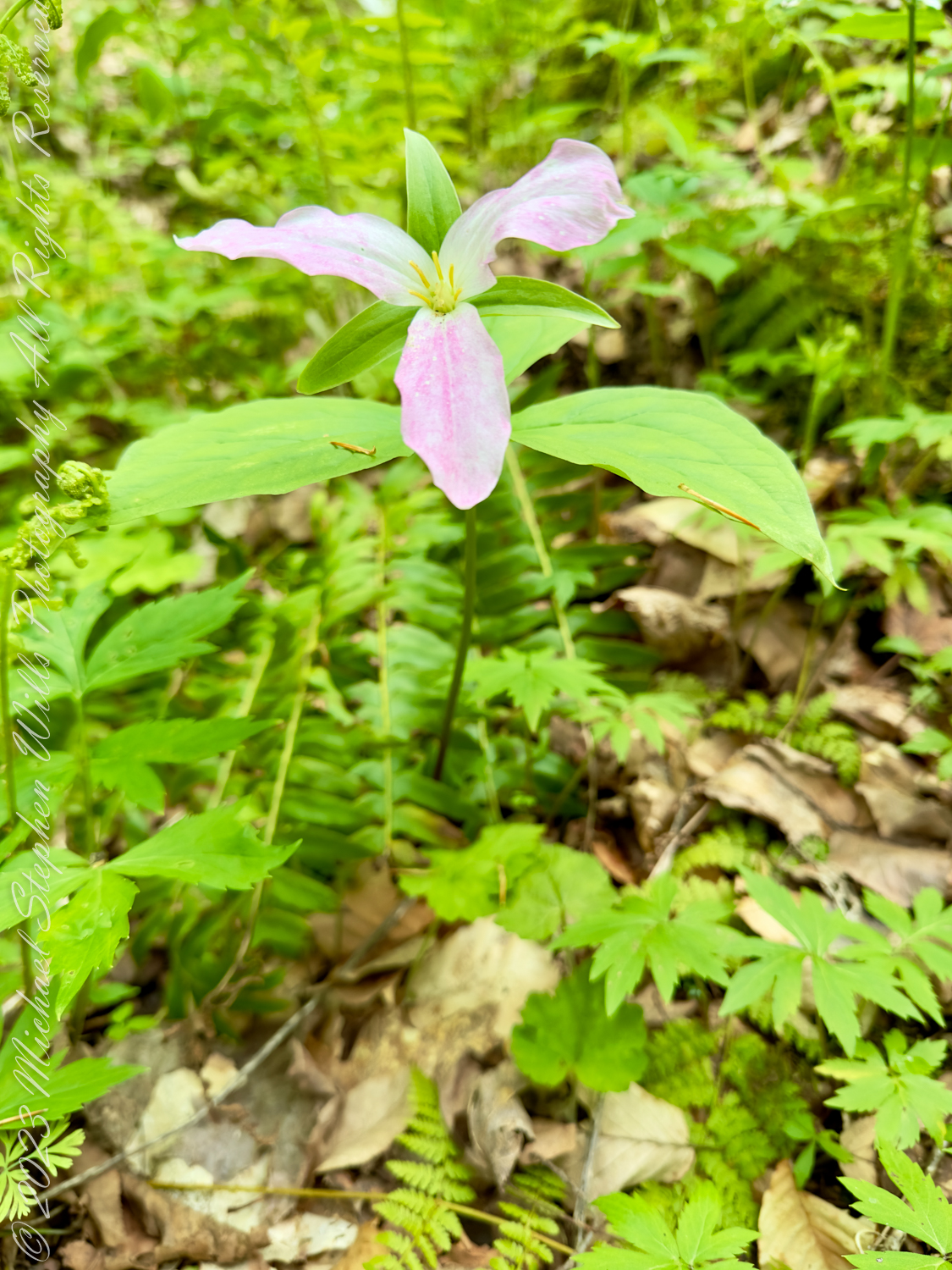
Some flowers, in particular, catch my eye. They have a faint pink hue, the end of its blooming period approaches. This natural aging process transforms the white petals into a soft pink, adding another layer of beauty to these already stunning plants. This subtle pink tint is a sign of the flower’s progression through its lifecycle, a gentle reminder of the ever-changing nature of the forest.

The Natural History of Trilliums
Trillium grandiflorum is native to the deciduous forests of North America, thriving in the rich, moist soils found in areas like Treman Gorge. These perennial plants emerge in early spring, often before the tree canopy fully develops, taking advantage of the available sunlight.
Trilliums have a unique reproductive strategy known as myrmecochory. This means their seeds are dispersed by ants. The seeds have a fatty appendage called an elaiosome, which attracts ants. The ants carry the seeds back to their nests, consume the elaiosome, and discard the seed, effectively planting it in a nutrient-rich environment.
Historical and Modern Uses
Historically, another trillium species, Trillium erectum, held significance for both Native American tribes. Various parts of the plant were used for medicinal purposes. The roots, in particular, were valued for their astringent and antiseptic properties. They were used to treat wounds, inflammation, and other ailments. Some tribes referred to Trillium as “birthroot” because it was used to ease childbirth and labor pains.
European settlers also adopted these uses and incorporated Trillium into their herbal remedies. The roots were used to facilitate labor, manage menstrual disorders, and treat wounds and inflammations. Because of its association with childbirth and its perceived benefits in regulating menstrual cycles, the plant became widely known as “Bethroot.”
In modern times, while the medicinal use of Trillium has waned, the plant is still admired for its beauty and ecological role. Conservation efforts are in place to protect wild populations of Trillium grandiflorum, as habitat loss and over-harvesting have threatened some local populations.
Capturing the Moment
Photographing these Trilliums is a delight. Using the Apple IPhone 14 ProMax I carefully frame each shot to capture the intricate details of the flowers. Macros reveal the delicate veins on the petals and the fine texture of the leaves. I developed the images in Adobe Lightroom to highlight the contrast between the white flowers and the lush green foliage. Some of the images beautifully capture the pink tints on the petals, showcasing the flower’s natural aging process and adding depth to their already stunning appearance.
Reflecting on the Experience
Encountering Trillium grandiflorum in full bloom is a profound experience. These flowers, with their simple yet elegant structure, embody the essence of spring’s renewal. They remind me of the intricate connections within ecosystems and the historical ties humans have to the natural world.
As I continue my walk through Treman Gorge, I carry with me a sense of gratitude for the opportunity to witness such beauty. The Trilliums, with their timeless grace and the gentle pink tints of their aging petals, have left an indelible mark on my heart. I look forward to returning each year to see these perennial wonders, knowing that each visit offers a chance to reconnect with nature’s enduring splendor.
 Michael Stephen Wills Photography
Hello Michael,
Hope you had a wonderful weekend, those photos are amazing, flowers looks beautiful and
that place looks very relaxing , must be an amazing experience.
Thank’s for share, nice day.
LikeLiked by 1 person
We so much look forward to our springtime Trillium. Have a great week, Elvira.
LikeLiked by 1 person
Thank you Micahel for your kindness Michael.
You as well have a great week.
LikeLiked by 1 person
Indeed it is ‘beauty’, Michael, as you wrote. We are very blessed to see such delights in the natural world. Even in its waning period it is still beautiful.
Your images are wonderful.
LikeLiked by 1 person
Thank you, Carolyn, for your kind words. I’m glad you enjoyed the post and the images. The beauty of the Trillium truly is a blessing, and it’s remarkable how it maintains its elegance even in its waning period. I’m delighted to share these natural delights with you. Thank you again for your lovely comment!
LikeLiked by 1 person
Your post motivates me to be on the lookout for Trillium flowers on my walks!
LikeLiked by 1 person
Best wishes on sighting Trillium in your “neck” of New Jersey, Hien.
LikeLike
Lovely quartet
LikeLiked by 1 person
They play a lovely melody.
LikeLike
What a lovely compliment to one of Nature’s beauties.
LikeLiked by 1 person
Jacqui, Trillium are all too brief beauty of our woodlands. Best wishes for the week ahead.
LikeLiked by 1 person
I loved learning about the Trillium flowers, Mike!
LikeLiked by 2 people
Some roadside corners around here are thick with them, other sites are well into the woods. Worth seeking out and remembering. Enjoyed reading your appreciative message. “spread the word” Cheers!!
LikeLiked by 1 person
What a beautiful display of trilliums. The white trillium is actually Ontario’s provincial flower. I didn’t know that about how their seeds are dispersed by ants. Thanks for sharing.
LikeLiked by 1 person
The white trillium has also become a symbol of conservation efforts in Ontario. It is a reminder of the importance of protecting natural habitats and preserving the province’s biodiversity.
LikeLiked by 1 person
Trilliums are some of my favorite flowers!
LikeLiked by 1 person
The surface of the petals is covered with epidermal cells that have a smooth or slightly textured surface. These cells can reflect light, giving the petals a bright and sometimes slightly glossy appearance. At times I notice these appear to be tiny mirrors in photographs.
LikeLiked by 1 person
Wow, I did not know that!
LikeLiked by 1 person
Thank you Michael. I’ve been enjoying posts from the Treman Gorge. In this rugged terrain, nature offers a blessed home for these delicate wildflowers. In this post, I found it interesting how ants assist in transporting life-sustaining seeds.
LikeLiked by 1 person
Thank you, BigSkyBubkeye!
I’m glad you’re enjoying the Treman Gorge posts.
Nature’s symbiotic relationships, like ants aiding Trillium seed dispersal, are truly fascinating.
Your support means a lot!
LikeLiked by 1 person