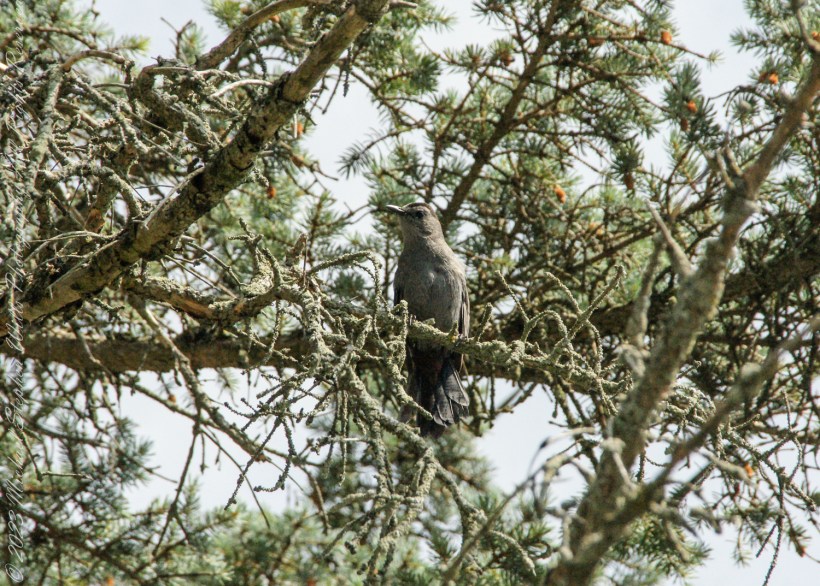
The Hidden Songster of Ithaca: My Afternoon with a Gray Catbird

Amidst spruce needles, a Gray Catbird’s mew captivated me; a hidden minstrel whose dulcet mimicry and secretive charm turned my backyard in Ithaca into an amphitheater of nature’s most intricate symphonies.

In my backyard, amidst the spruce trees that seem to touch the sky, I had a unique encounter with a little gray bird known as the Dumetella carolinensis, or more commonly, the Gray Catbird. I learned that “Dumetella” comes from the Latin word for “thorny thicket”, hinting at its penchant for skulking in dense underbrush, often hidden from sight. Its species name, “carolinensis”, pays homage to the Carolinas, though this bird has certainly made a comfortable home here too.

This particular visitor had a call reminiscent of a cat’s mew, a curious sound that first drew my attention. As I peeked through the window, I noticed it wasn’t just imitating felines; it was a veritable mimic, echoing the songs of other birds, even copying the croaks of tree frogs, and sometimes the mechanical noises of our own making. Its syrinx, a true marvel of nature, allows it to produce two sounds simultaneously – an impressive feat for such a small creature.

Unlike the showy northern mockingbird or the brown thrasher, which repeat their musical phrases several times, this Gray Catbird preferred to sing each of its phrases just once. Its song was a bit raspier, less melodic but still captivating in its own right.

It’s interesting that the Gray Catbird often chooses to remain hidden when it sings, favoring the inner sanctuary of bushes or trees like the spruce in my yard, a natural stage set by verdant leaves and branches. And while I watched, it seemed content in its concealment, a master of melody cloaked in foliage.

As I observed it, I recalled reading that the Gray Catbird’s diet is as varied as its repertoire of sounds. Fruits and berries make up about half of its diet. This little bird has quite the palate, enjoying a smorgasbord that includes mealworms, earthworms, beetles, and other insects, not to mention the bounty of summer offerings such as ants, beetles, grasshoppers, caterpillars, moths, and a selection of berries from holly, cherry, elderberry, poison ivy, bay, and blackberries.

I made a mental note of the date, captured in the metadata of the photograph I snapped: 2021, from my home in Ithaca. A simple image, yet it encapsulated a serene moment of connection with a creature so adept at concealment and mimicry, a moment I would treasure. The Gray Catbird, with its unique song and dietary habits, has become a beloved part of my backyard symphony.

Reference: wikipedia, Gray Catbird.

Copyright 2024 Michael Stephen Wills All Rights Reserved

Tuxedos on Tour: Three Majestic Mergansers

Join the escapade as you witness three majestic Mergansers, donning nature’s finest tuxedos, in a graceful ballet on the springtime stage of Cayuga Lake.

As you gaze upon these three fine feathered fellows, all members of the exclusive Common Merganser men’s club, they seem to glide upon the watery stage of Cayuga Lake with all the confidence of Broadway stars on opening night. They are the aquatic equivalent of a sharply dressed barbershop quartet, minus one, in their matching tuxedos, ready to sing the springtime serenade of their species.

The chap at the forefront is Captain Black-Crest, sporting a glossy noggin that shimmers with an inner light, undoubtedly the envy of every duck on the pond. He’s streamlined and debonair, with a white body that’s as crisp as the first snowfall and a dark back that’s as sleek as a shadow in moonlight. If ducks had monocles and top hats, he’d be first in line.

In the middle, there’s Sir Dapper-Diver, a mirror image of his companion, with a neck as white as the driven snow and a dignified black back that gleams like polished onyx in the dappled sunlight. He’s the quiet achiever of the group, poised and ready to make the plunge into the depths below, proving that style need not be sacrificed for substance.

And to the right, meet Admiral Feather-Finesse. His poise on the water suggests a mastery of the waves, a commander of the current. He carries his elegant attire with an air of grace that only comes with a natural pedigree. In synchronized perfection, he and his brethren form a regatta of refinement, a display of nature’s own black-tie affair.

These are male Common Merganser (Mergus merganser) in breeding plumage, characterized the body white with a variable salmon-pink tinge, the head black with an iridescent green gloss, the rump and tail grey, and the wings largely white on the inner half, black on the outer half. Like the other mergansers, these piscivorous ducks have serrated edges to their bills to help them grip their prey, so they are often known as “sawbills”. In addition to fish, they take a wide range of other aquatic prey, such as molluscs, crustaceans, worms, insect larvae, and amphibians; more rarely, small mammals and birds may be taken. As in other birds with the character, the salmon-pink tinge shown variably by males is probably diet-related, obtained from the carotenoid pigments present in some crustaceans and fish. When not diving for food, they are usually seen swimming on the water surface, or resting on rocks in midstream or hidden among riverbank vegetation, or (in winter) on the edge of floating ice.

Together, these three Common Mergansers (Mergus merganser) in their prime are a trifecta of elegance, a testament to the timeless beauty found in nature’s simplicity. They paddle forth with purpose, their matching plumage a striking contrast to the rippling blues and grays of the water, a parade of poise and plumage that delights the observant eye.

So, dear reader, as you observe this photo, take a moment to appreciate the charming uniformity and the subtle quirks that make each bird, despite their shared wardrobe, uniquely magnificent. It’s a snapshot of life at its most graceful, a picture worth far more than a mere thousand words.

Copyright 2024 Michael Stephen Wills All Rights Reserved