Monarch Butterfly Life Cycle: Egg to Adult (Danaus plexippus) with Photos

From milkweed egg to striped caterpillar, jade chrysalis, and fluttering monarch, witness metamorphosis, migration, and our role in protecting Danaus plexippus across North America today.

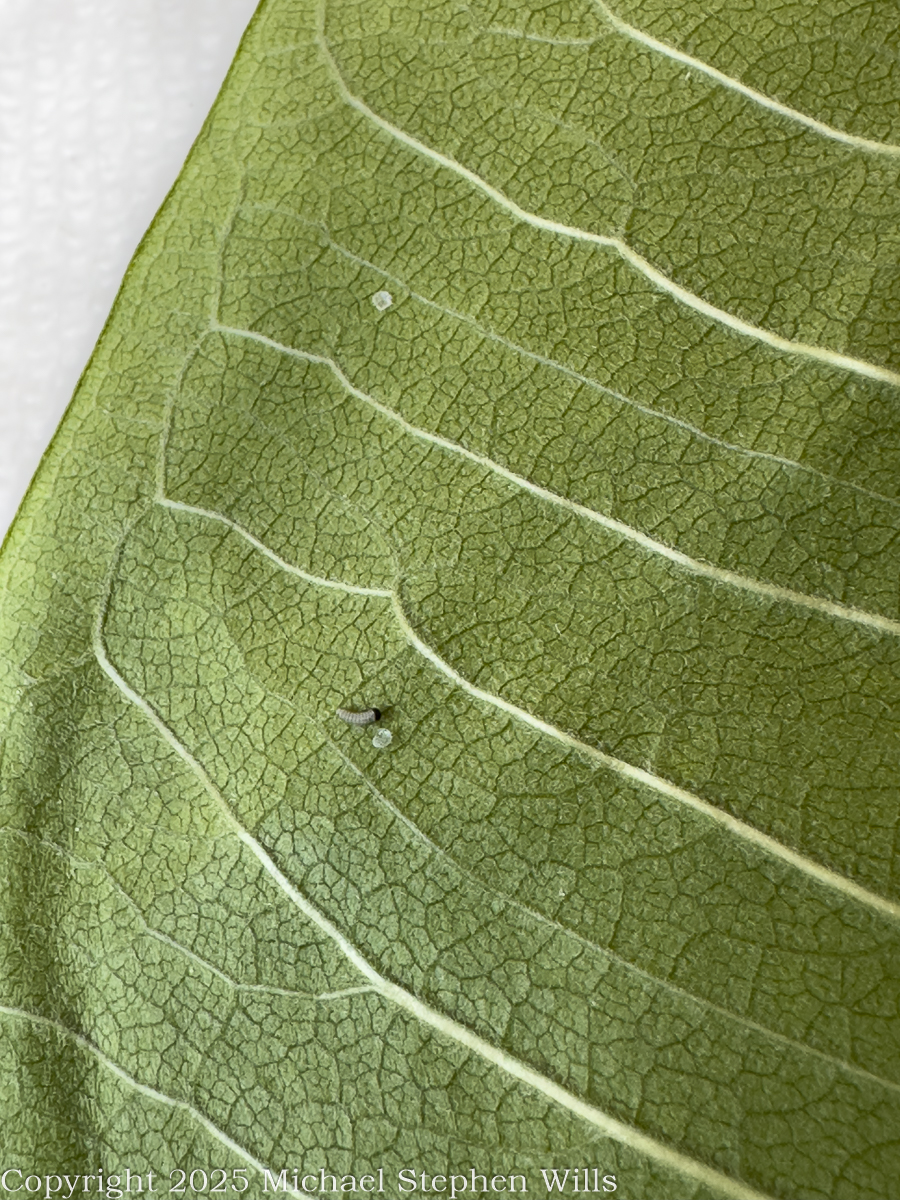
On the underside of a milkweed leaf, the world begins small enough to miss unless you kneel and look closely. In this first photograph the newborn is still a whisper of life, a pale pinhead egg collapsed into a glistening scrap, the tiny caterpillar beside it like a gray comma punctuating the green. It has just eaten the soft shell that cradled it—its first meal, its first thrift. The leaf’s pale roads of veins radiate around the hatchling; within that simple map lies all the geography it needs.
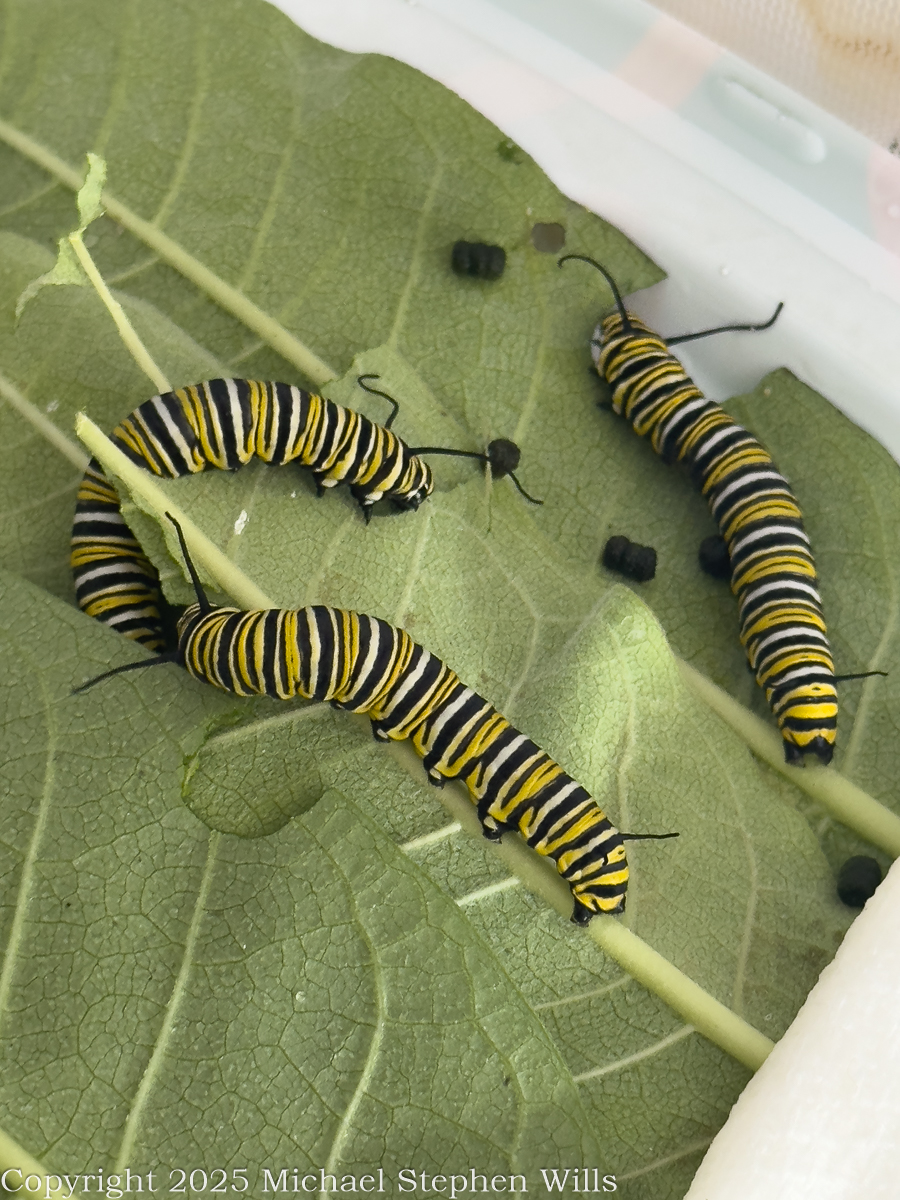
By the second photograph appetite has taken its proper throne. These pilgrims wear a uniform of warning: bands of yellow, black, and white—stripes as bright as hazard tape, a heraldic banner advertising the bitterness borrowed from milkweed. Each bite draws down defensive latex; yet the caterpillars feed undeterred, pausing to snip the leaf’s veins to quiet the flow. Their black, threadlike “tentacles” nod as they travel, and their peppery pellets—frass—collect like midnight hail. Five times they will outgrow themselves, shrugging off skins to reveal wider, hungrier versions within. The room is strewn with green rib and ragged edges; the air has the gentle smell of cut stems. All the while, milkweed’s poisons, the cardenolides, pass into growing bodies and become their bodyguard.
At last a hush. A final meal, a purposeful wander. The caterpillar chooses a high eave of the world—a stem, a stick, the corner of your rearing tent—and hooks itself into a downward J. Within hours the skin splits like a soft zipper; the striped creature pours itself out of itself and seals into a smooth chrysalis.
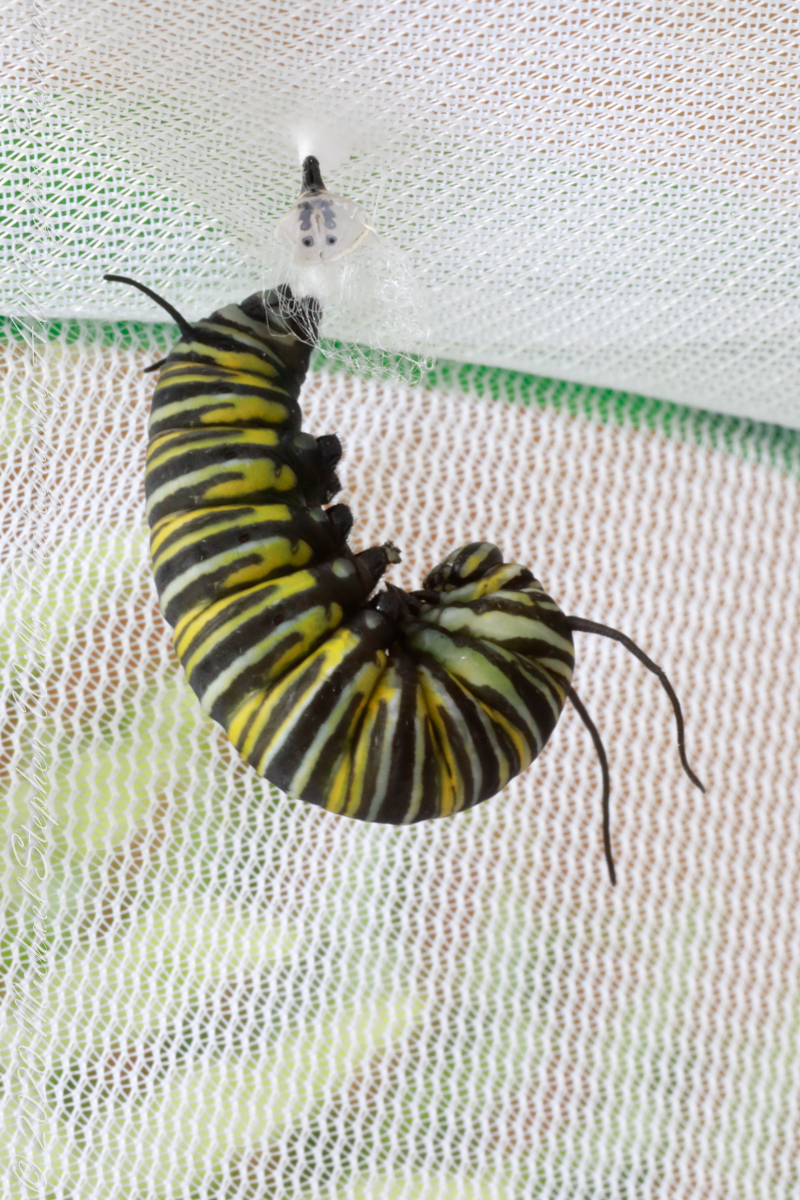
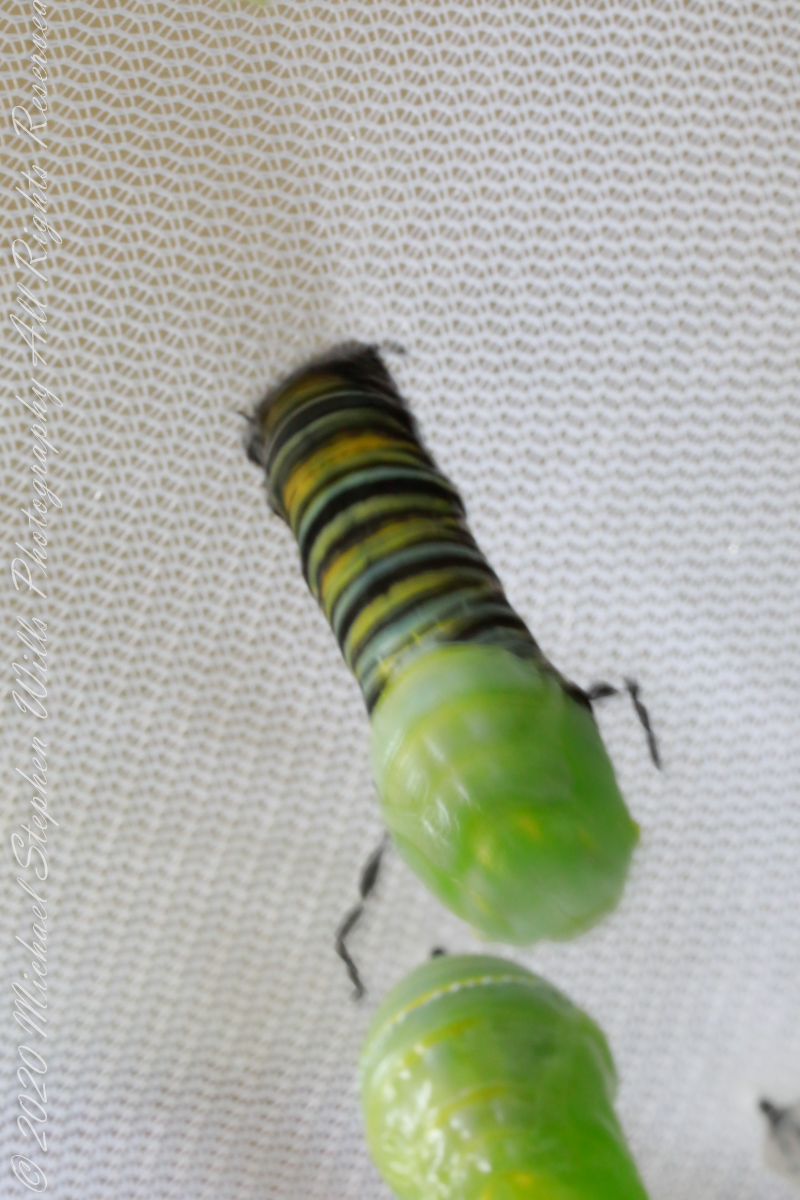
Here, the caterpillar has attached itself to a silk pad from which it hangs. Underneath the skin, the caterpillar is transforming to the chrysalis. In these photographs the silk pad and chrysalis attachment from a previous transformation are in the foreground.
Macro of the Monarch butterfly chrysalis. The black stalk attached to the silk pad is call a cremaster.

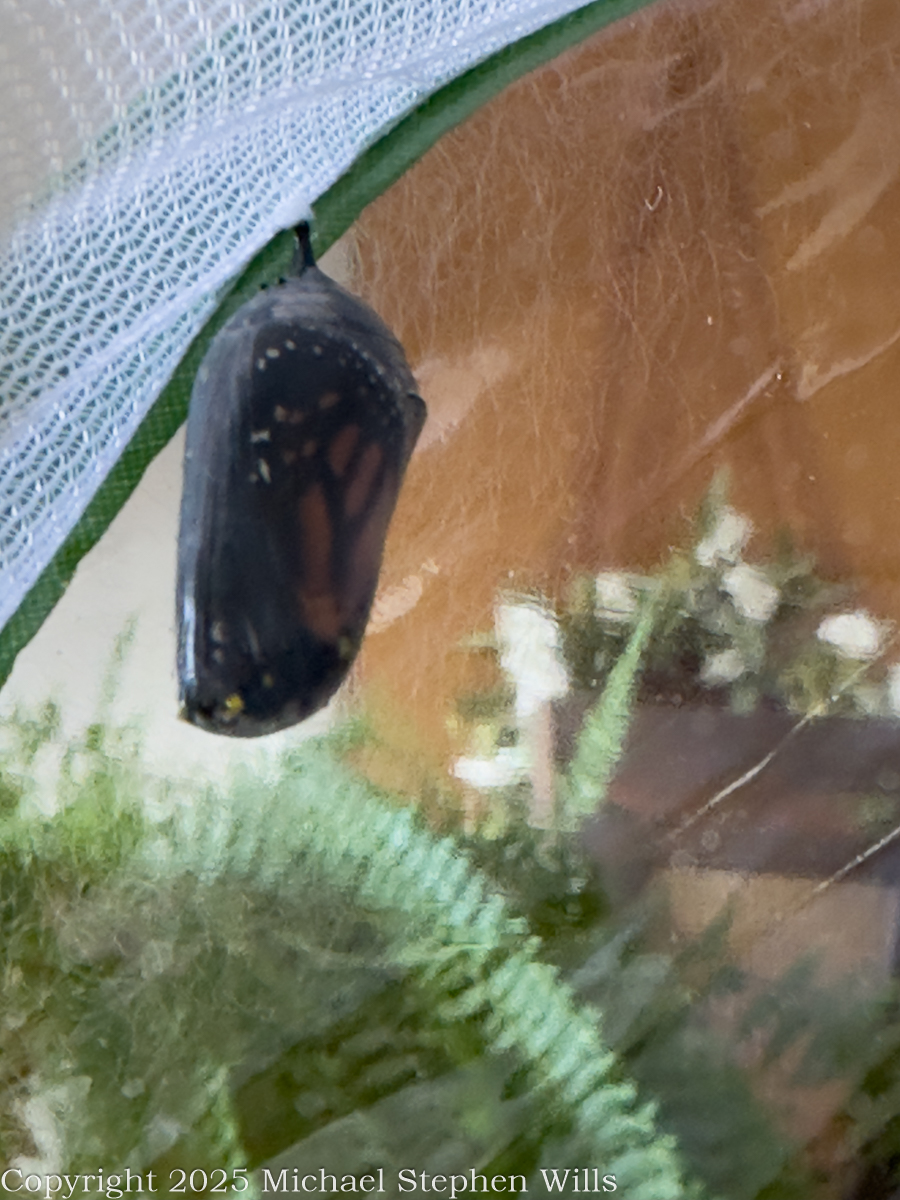
The following photograph and video catch the moments into becoming: the jade lantern has become transparent, darkening, its gold studs glinting like constellation points, and through the thinning walls the folded wings show, orange smoldering under smoke. Inside, old tissues have dissolved into a living broth; imaginal discs—tiny blueprints carried since the egg—have flowered into legs, eyes, and flight. To call it “metamorphosis” is correct; to call it mystery is truer.
Watch on YouTube for a better experience. Please “like” and “subscribe”

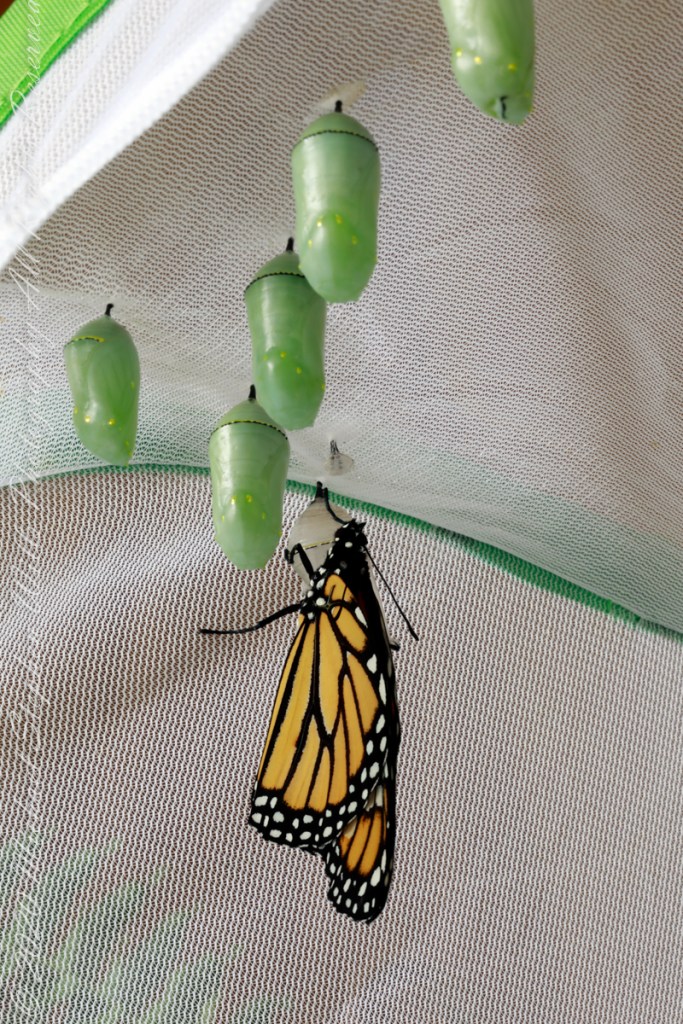
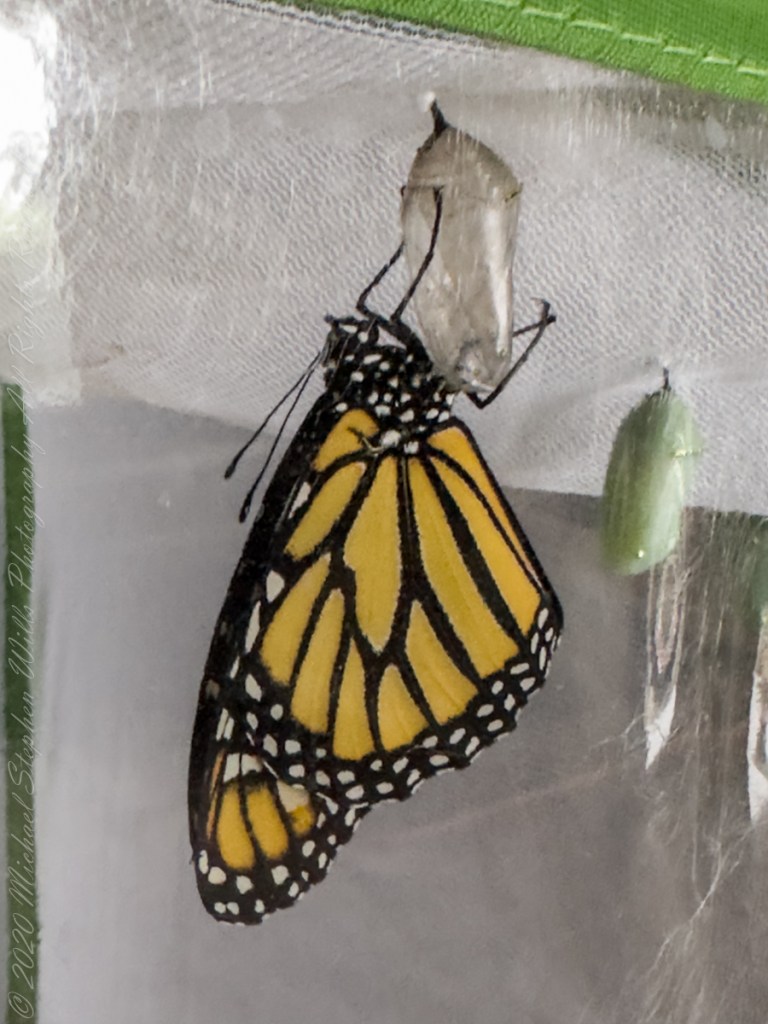
When the case opens the butterfly backs into the bright. It clings while the crumpled wings fill and flatten, hemolymph pumping life into every cell. In the next image the adult drinks from a petunia trumpet, a jeweled ember with white-spotted hems. The monarch—Danaus plexippus—tests the wind with new, purposeful wings. Its scientific name nods to ancient stories: Danaus after the Greek mythic king of Argos, a father who fled with his fifty daughters across the sea; plexippus for Plexippus, a figure of the same old tales—his name carried forward into this wanderer of the sky. The English name “monarch” is said to honor both its regal size and domain, and, some say, the orange-and-black of William of Orange. Kings and myths gathered like cloak and scepter around a creature that weighs less than a paperclip.

No butterfly has entered human life more completely. Schoolchildren cradle jars of milkweed sprigs and tape handwritten labels to chrysalides lined like seed pearls along a classroom window. Taggers kneel in September light, add a tiny disc to a wing, and write down time and place so the journey south can be traced. In the mountains of Mexico, where oyamel firs hold winter like a secret, people fold the monarch’s return into the Days of the Dead, believing that souls ride home on those wafers of flame. Gardeners tuck swamp milkweed into narrow beds and call their yards “waystations.” Photographers, such as myself, record the stories that happen leaf by leaf.
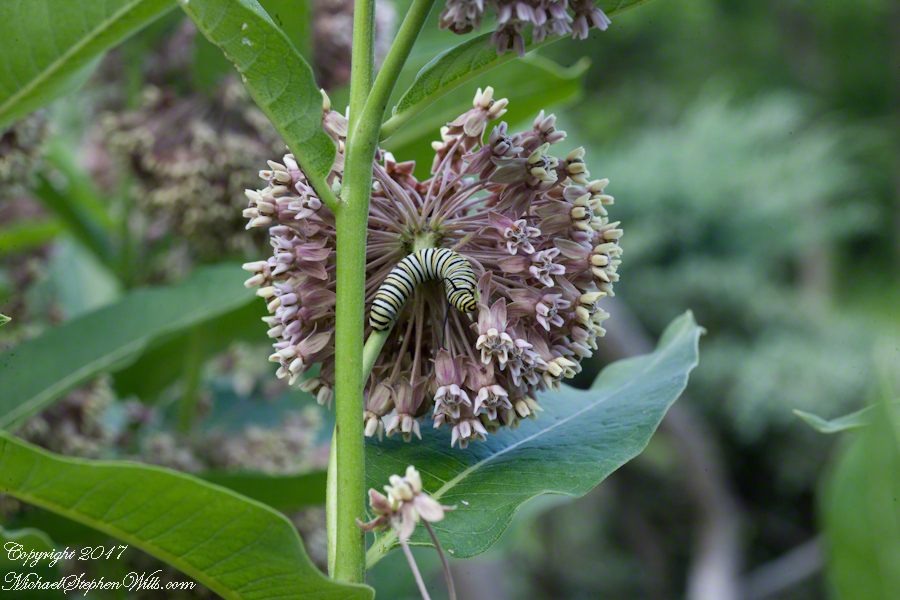
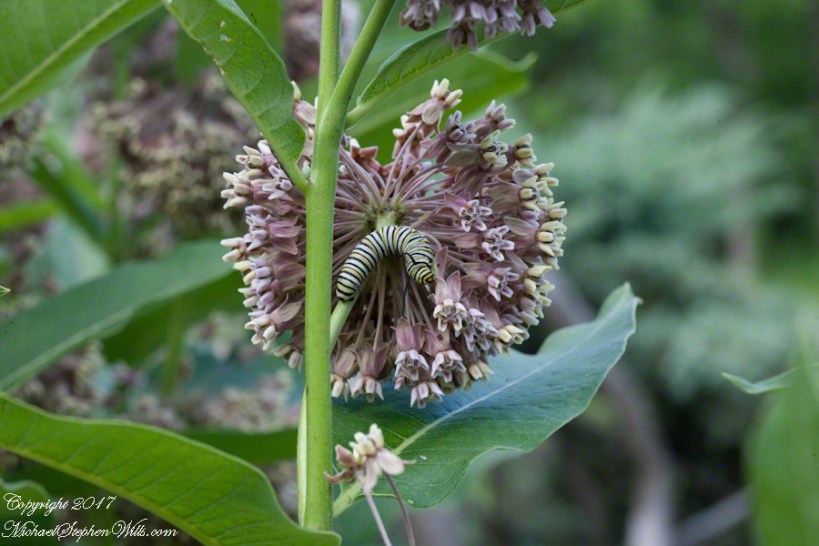
In early July a Monarch caterpillar revels in milkweed flowers.

Yet our touch is not simple. Fields simplified by herbicides have shaved milkweed from fencerows; tidy mowing removes nectar from roadsides in the tender weeks of migration; captive rearing in vast numbers, though done with reverence, may carry unintended risks of disease and weakened orientation. The monarch asks us to enlarge our sense of home beyond the fence: to let patches of milkweed lift their pale crowns in rough corners; to choose late-blooming asters and goldenrod; to keep a few ditches shaggy until the travelers pass. Conservation, like metamorphosis, is work that happens inside ordinary days.

Watch the cycle again in my images—egg to appetite, appetite to stillness, stillness to wing—and hear what it whispers in the steady voice of milkweed leaves and soft fall air. Rachel Carson wrote that “those who contemplate the beauty of the earth find reserves of strength that will endure as long as life lasts.” Here beauty wears stripes and beads of gold, sips from garden petals, and threads a continent with its frail insistence. The monarch’s life is a ribbon we can follow with our eyes and, if we are willing, with our hands—gentle hands that leave room for milkweed to rise, for caterpillars to feed, for a chrysalis to darken and a window to fill, one bright morning, with wings.

On a personal note, this season was a success. Monarchs visited our milkweed patch several times allowing me to save/harvest nineteen eggs/caterpillars and raise them until release.

Selected references
Carson, Rachel. The Sense of Wonder. New York: Harper & Row, 1965. (Reissued: HarperCollins, 1998; Open Road Media e-book, 2011.) The quoted passage (“Those who contemplate the beauty of the earth…”) appears early in the book; the Open Road edition places it on p. 41.
Wikipedia contributors. “Monarch butterfly — Etymology and taxonomy.” (useful overview with primary citations).
Oberhauser, K. S., and M. J. Solensky, eds. The Monarch Butterfly: Biology and Conservation. Cornell University Press, 2004.

Enter your email to receive notification of future postings. I will not sell or share your email address.

Monarch Chrysalis: A Symbol of Nature’s Resilience

On a September day, a Monarch chrysalis symbolizes resilience amidst environmental threats, prompting reflection on stewardship and hopeful change.

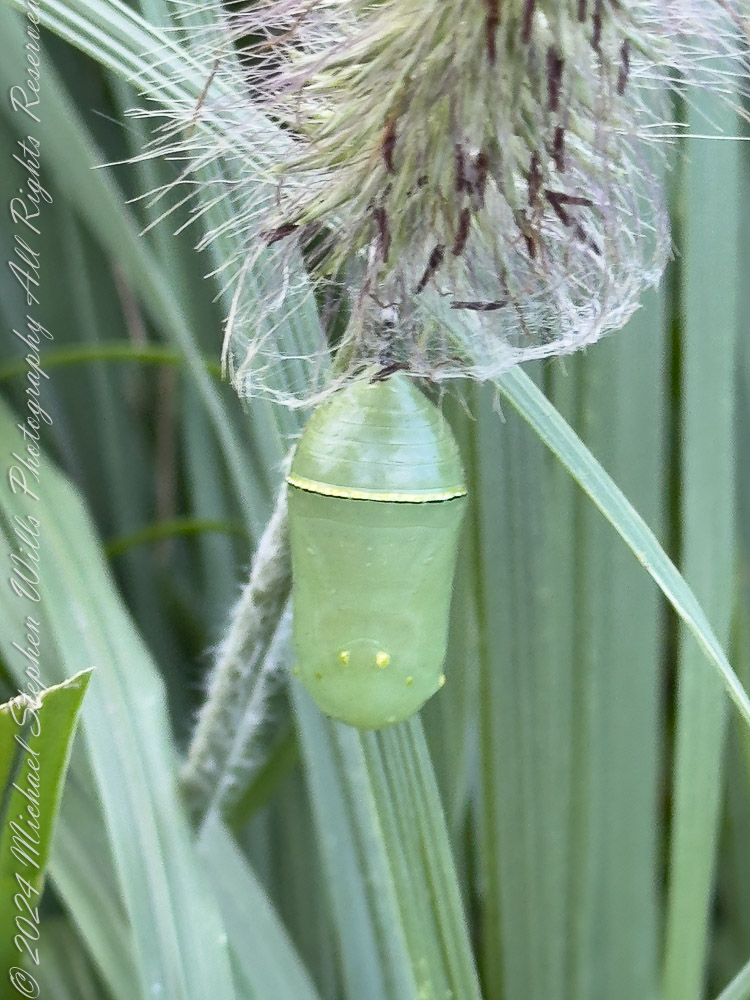
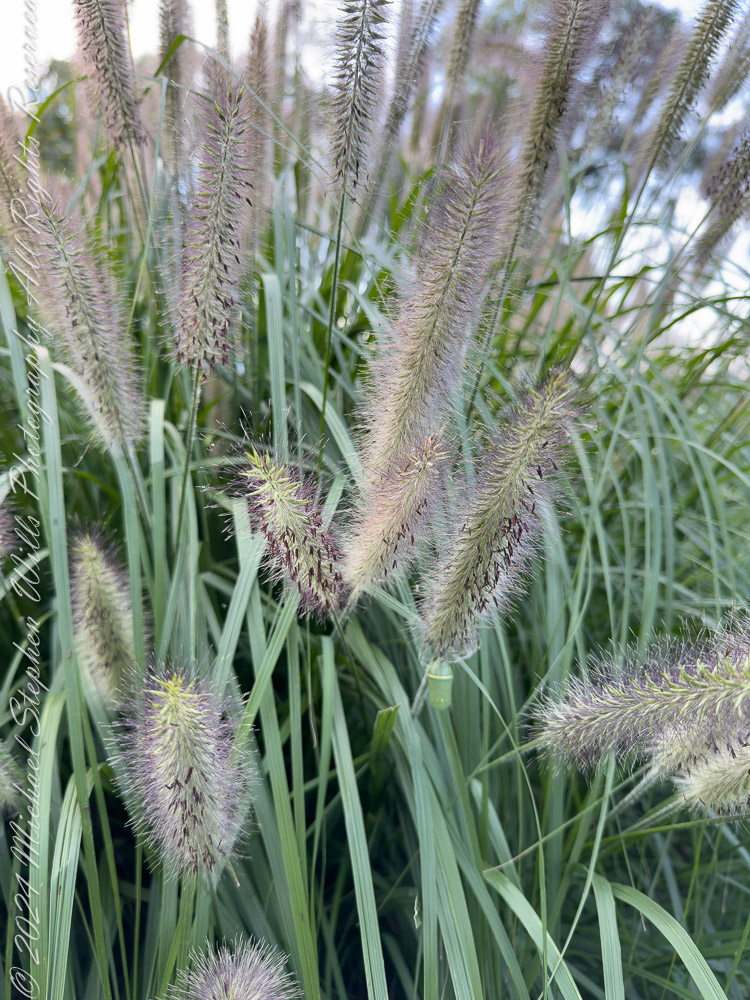
On a warm September afternoon, 2024, Pam and I passed a planting of shimmering grasses along the Cayuga Lake shore, the tips of their feathery plumes swaying in a gentle breeze. Amidst the verdant tapestry, my eyes caught a flash of delicate green—a Monarch chrysalis, hanging like a precious jewel beneath one of the seed heads. It was an unexpected encounter, a moment of grace that felt almost otherworldly. The chrysalis, pale jade with gold accents, looked like something born of magic rather than biology. For a moment, time paused.

The only Monarch chrysalis we found in 2024, notable for the absence of caterpillars around our home. Tompkins Park, Ithaca, New York, Finger Lakes Region

I knelt carefully, mindful not to disturb the fragile life suspended before me. As I leaned in closer, I marveled at the perfection of its design. The intricate gold dots along its casing seemed impossibly precise, as though a divine hand had painted them there. Yet, this chrysalis was also a paradox: it was a shield of stillness, promising the coming transformation of a creature known for motion and migration.

The significance of this discovery didn’t escape me. Just two years ago, the International Union for Conservation of Nature officially classified the Monarch butterfly as “endangered.” Habitat destruction, pesticide use, and climate change have decimated their numbers. Monarchs, once so plentiful they seemed a seasonal certainty, now teeter on the edge of disappearance. To find this chrysalis was to witness a quiet rebellion against those odds, a solitary emblem of resilience in a world fraught with loss.

I thought of their epic journey—a migration that spans thousands of miles, linking Canada to the forests of central Mexico. For generations, these butterflies have followed ancestral paths with unerring precision, defying every obstacle in their way. How can something so small carry the weight of such immense journeys? And how, in a world that seems to grow harsher each year, do they still persist?

This chrysalis, tucked in the grasses of Stewart Park, felt like an answer to those questions. It was a reminder of the resilience of life, the determination of nature to continue despite all that works against it. And yet, it also felt like a fragile promise. The Monarch’s survival is no longer assured; its future, like the butterfly within this chrysalis, hangs by a thread.

As I rose and continued our walk, I carried the image of the chrysalis with me, letting its quiet beauty settle in my mind. I thought of the interconnectedness of all things: the milkweed plants that sustain Monarch caterpillars, the winds that guide their migrations, and the people whose choices shape the landscapes they traverse. Stewardship is not just a responsibility; it is a privilege—an opportunity to ensure that these miraculous creatures continue to grace our skies.

By the time I left the park, the sun had sunk toward the west, its light no longer graced the grasses. I looked back one last time, hoping that this chrysalis would complete its transformation safely. In its stillness, I saw not just hope, but a call to action. The Monarch’s story is not just about survival; it’s about the courage to evolve and adapt, even when the odds seem insurmountable. And perhaps, in witnessing this moment of metamorphosis, we too are reminded of our capacity to change—to become better stewards of the world we share.

Enter your email to receive notification of future postings. I will not sell or share your email address.
Lessons in the Woods: A Grandfather’s Nature Walk

On a crisp September morning, a grandfather leads his grandsons on a nature walk, discovering the mysteries of the forest. Together, they encounter a curious caterpillar and uncover the wonders of the natural world.

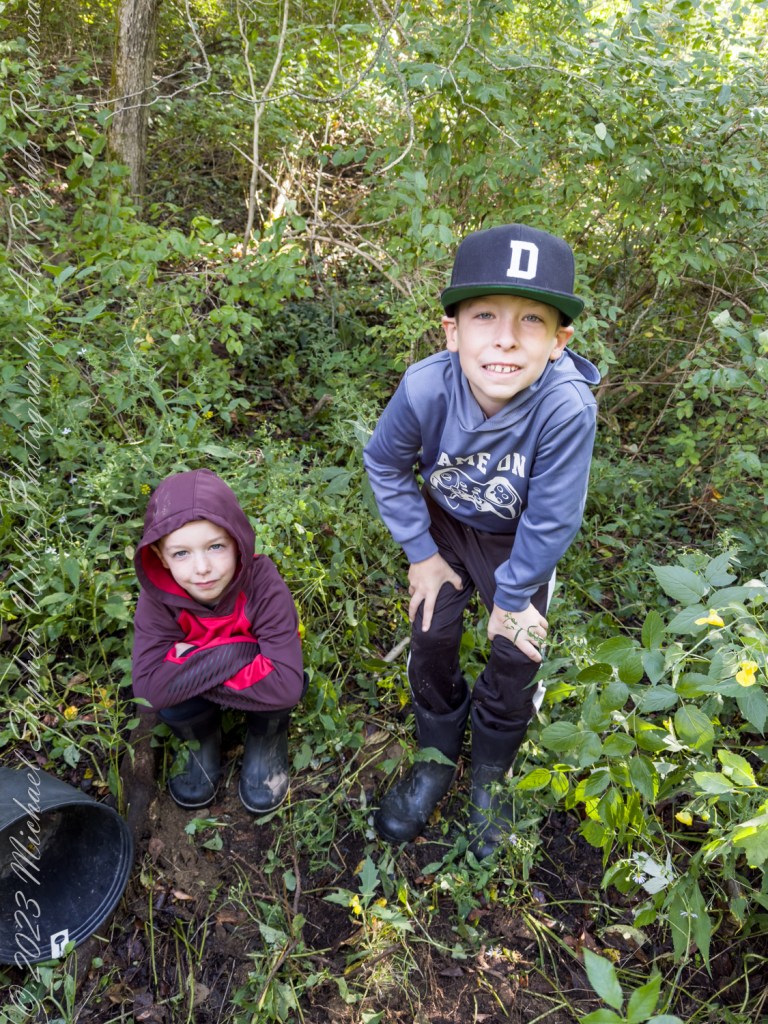
Unseasonably warm September morning air gently stirred the leaves as I guided my grandsons, Sam and Rory, through our woods near Freeville. Our boots crunched softly on the damp earth, and the sounds of nature enveloped us like an old, familiar melody. Today we were on a mission of discovery, with Mother Nature as our guide.

“Grandpa, look at this!” Sam called, excitement radiating from his face. Rory, always close behind his older brother, crouched down, his bright eyes scanning the ground for any movement. I smiled. Sam’s sharp curiosity and Rory’s quiet attentiveness reminded me so much of myself at their age, exploring the woods.

We stopped at a patch of earth, where the boys had found a small hole in the ground, evidence of something recently disturbed. “Do you think it’s a mole, Grandpa?” Rory asked, his voice a mix of wonder and uncertainty.

“Maybe,” I said, leaning down beside them. “Or it could be something larger, like a chipmunk. These woods are full of surprises.”

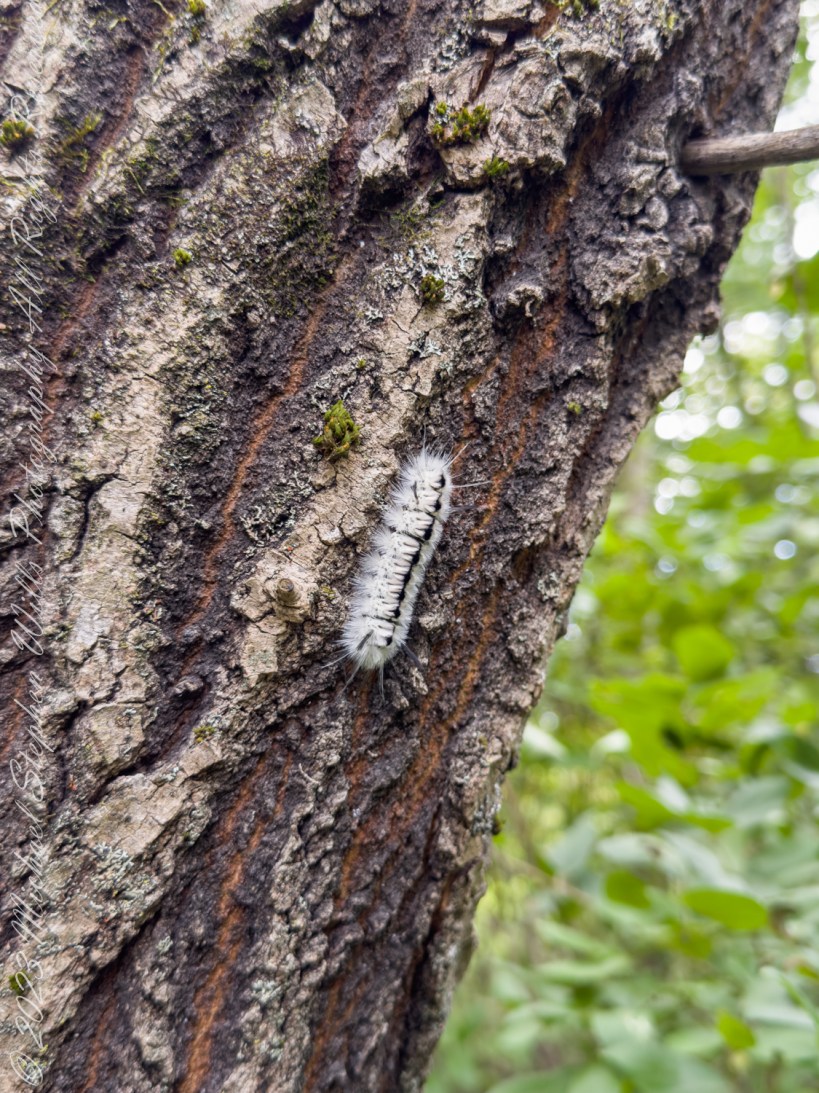
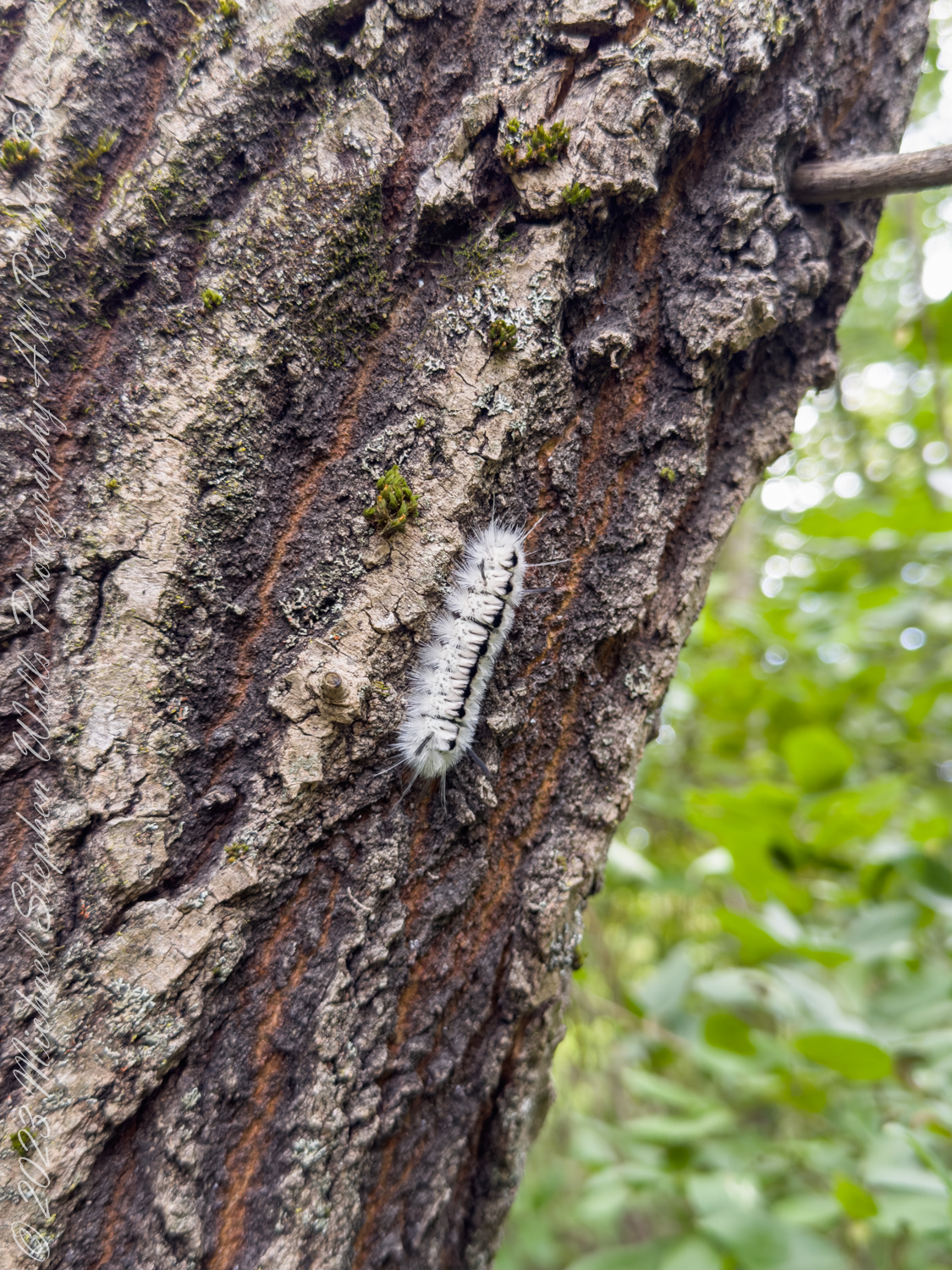
As they explored further, I glanced at the trees, their trunks coated in a rich tapestry of moss and lichen. Then, something caught my eye—a familiar white and black figure on the bark of a young tree, I’ll call it a hickory.

“Hey, boys, come over here for a second. I’ve got something to show you,” I called, my voice calm but laced with excitement. Sam and Rory, ever eager, bounded over. “Look at this caterpillar.”

Their faces lit up when they spotted it. “Whoa, it’s so fuzzy!” Sam exclaimed.

“Yeah, but don’t touch,” I warned gently, kneeling to get a better look. “This little guy is called a Hickory Tussock Moth Caterpillar. See those long white hairs? Some of them can irritate your skin. Always good to admire from a distance.”

Rory looked up at me, wide-eyed. “What does it turn into?”

I smiled. “That’s the magic of it. This caterpillar will eventually become a moth, a Hickory Tussock Moth, in fact. But right now, it’s preparing for a long journey. In just a few weeks, it’ll spin itself a cocoon and wait all winter before emerging as a moth in the spring.”

Sam squinted at the caterpillar, studying its every bristle. “So it’s it’s going to sleep for the winter?”

“Exactly,” I said, pleased with his understanding. “It’s one of nature’s ways of resting and preparing for something new.”

The boys stared at the caterpillar in silence for a moment, and I could tell their young minds were spinning with thoughts. Maybe they were thinking about their own journeys—how each season brought something new to learn, something new to experience.

As we moved on from the caterpillar, deeper into the woods, I couldn’t help but feel a quiet sense of gratitude. These moments, small as they may seem, were the kinds of memories that last a lifetime. I was passing down not just knowledge but a love for the natural world, a connection to the earth that I hoped would stay with them long after I was gone.

We finished our adventure with planting two oak saplings. The boys dug in the rich soil, each working carefully as we prepared a young sapling to take root. I watched as they placed the sapling into the earth, their hands gentle yet sure. Together, we packed the soil around its base.

“You know,” I said softly, “these oaks will grow just like you two. Stronger every year. And one day, you’ll bring your own children here to see it.”

Sam and Rory exchanged a look, a flicker of understanding passing between them, and I knew the lesson had landed. Nature has a way of teaching us that growth, whether in a tree or in ourselves, takes time and patience.

As we packed up to leave, I glanced back at the hickory tree where the caterpillar still clung, a tiny, determined creature, preparing for the change to come. In that moment, I felt the same sense of wonder I’d seen in the boys’ eyes earlier. Even after all these years, nature never ceased to amaze me.

“Come on, boys,” I said, with one last glance at the woods. “Let’s see what other adventures await us.”

Copyright 2024 Michael Stephen Wills All Rights Reserved

Echoes of Flight: The Summer the Monarchs Did Not Come

Contemplate the quiet sorrow of a summer without monarchs. Click on the photo to read the full story and reflect on this profound sense of loss on my blog.

This past summer, an absence visited our garden—a loss more profound than the quieting of wind. It was the virtual silence of an empty sky where monarch butterflies should have danced. Each day, we waited, hoping to catch a glimpse of those delicate wings, vibrant with orange and black, fluttering above the milkweed. But the familiar sight never came.

Monarch butterflies, those ethereal creatures that once graced our summers, seemed to have forgotten us.

Macro of the Monarch butterfly chrysalis. The black stalk attached to the silk pad is call a cremaster.

The photograph of the monarch chrysalis, a delicate gem hanging on a thread of life, speaks to the fragility of nature itself. Each chrysalis is a promise—a quiet, patient promise of transformation and renewal. Yet this summer, those promises vanished, leaving us to wonder where the monarchs had gone, what changes in the world pulled them away from our home in the Finger Lakes.

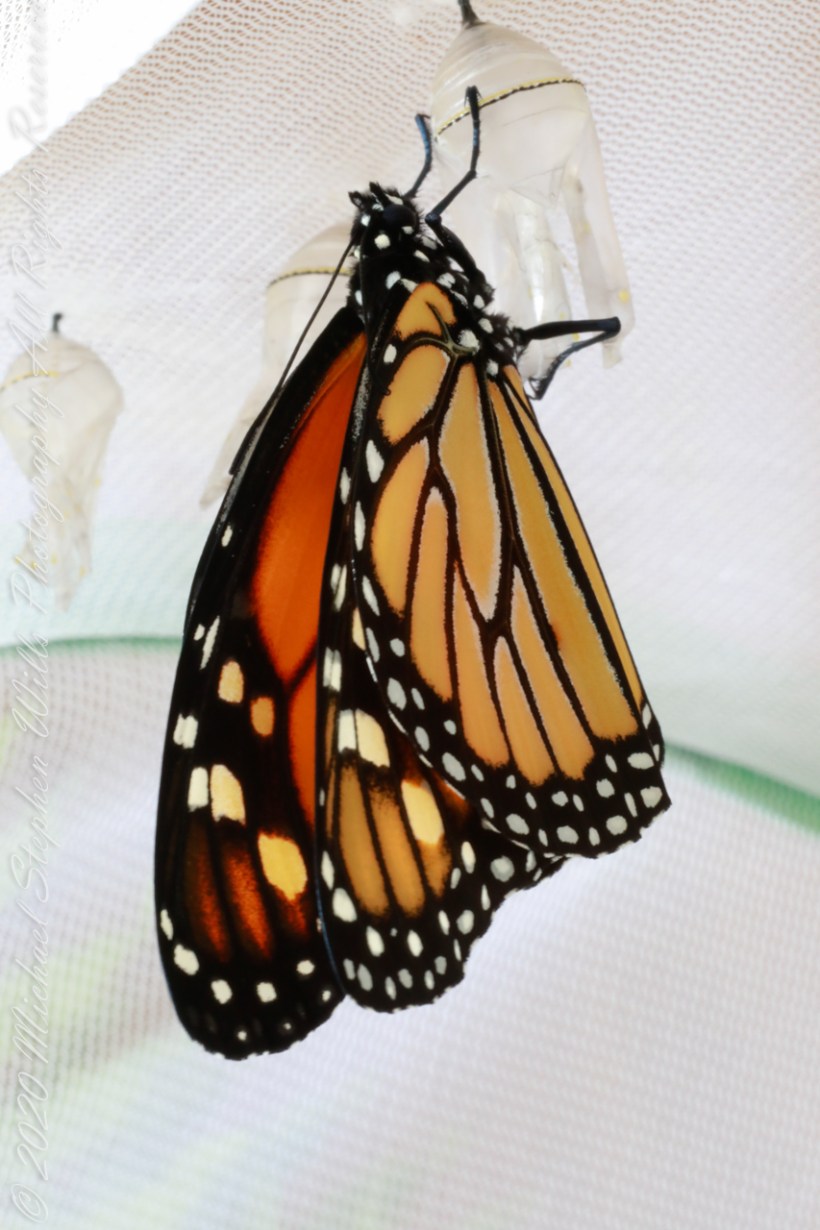
Our first monarch butterfly of 2023 just after emergence from the chrysalis and after wing expansion. This female will hang for several hours while the wings dry.

Another image from a time not so long ago, yet now seeming distant, shows a monarch caterpillar nestled among the milkweed blossoms. This was a time when our garden was alive with their presence, each caterpillar a testament to the cycle of life that once thrived here. The sight of them devouring the leaves was a sign of hope, a prelude to the transformation that would soon unfold. Now, that vibrant energy has vanished, leaving behind a quiet that speaks of loss and absence.

We are left to reflect on this silence, on the empty milkweed leaves and the air where monarchs once flew. The memories of summers past, when the monarchs filled our garden with their grace, are bittersweet now. They remind us of a time when the connection between the earth and its creatures was still intact, when the balance of nature had not yet been so precariously tipped.

In their absence, the monarchs leave behind a message—a reminder that their delicate beauty is not guaranteed, that the balance we once took for granted can be lost. The summer without monarchs urges us to look inward, to consider what must change, what must be protected, so that future summers may once again be filled with the fluttering of wings and the promise of life renewed.

The garden absence this year is a call to action, a plea from the earth itself to remember the delicate threads that connect us all. May we answer that call, so that this summer of loss will not reach into the future, but will be a pause, a moment of reflection before the return of the monarchs, and with them, the return of hope.

Request to my North American readers: leave comments exploring your experiences of Monarch butterflies the summer of 2024

Here are links to more Monarch photographs and videos.

Flight

Monarch Caterpillar to Chrysalis

Monarch Emergence

Copyright 2024 Michael Stephen Wills All Rights Reserved