
In March 2008, we followed the Dutchman Trail deep into Arizona’s Superstition Wilderness. At the junction near the springs draining Charlebois, Music and LaBarge canyons, we stopped for water before beginning the climb toward Peter’s Mesa.
After a respite among the cool spring waters, we headed up Peters Trail for the top of Peter’s Mesa where, for all we knew, there was no water.
The trail climbed hard from the canyon. As we gained elevation, a little more than 1,300 feet in a mile, the country behind us opened wider with every turn.
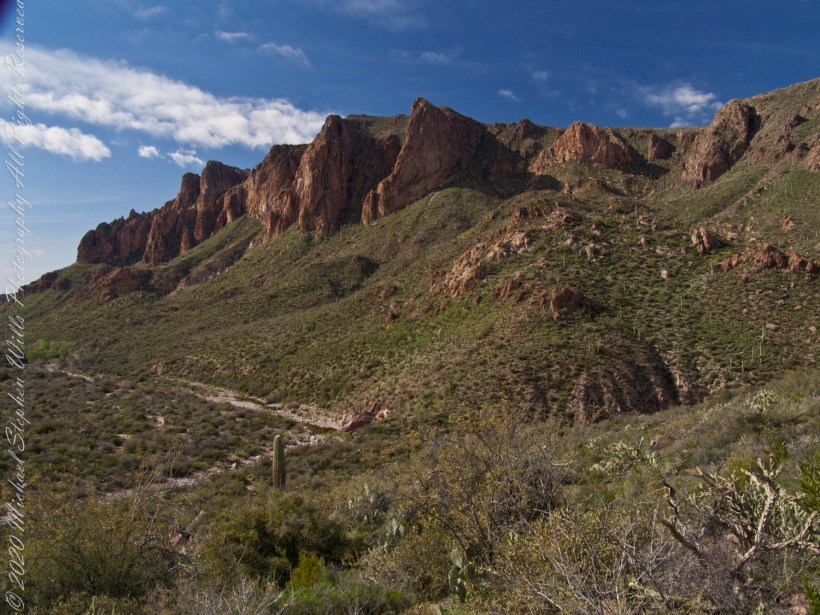
In my photograph “Black Mountain — Million Dollar View,” I am facing northwest, looking down toward Dutchman Trail. Black Mountain is the peak toward the upper left. The cleft of Charlebois Canyon lies below and to the right. Staghorn cholla grows in the foreground, with prickly pear scattered through the brush and young saguaros on the lower slopes. Looking carefully, I could still make out the pooled water where we had stopped.
What I saw as wilderness had been traveled and worked for generations. From above, it looked like country untouched by people. It was not.
Apache and Yavapai people traveled these mountains long before Europeans entered them, gathering plants and roasting agave in earth pits. Evidence of that use has been found on Peter’s Mesa. By the late nineteenth century, cattlemen were moving stock through the Superstitions, in part to supply mining settlements such as Silver King. Mexican woodcutters also worked these mountains, cutting mesquite and transporting wood by burro.
The origin of the name Peter’s Mesa is uncertain. Superstition Mountain historian Tom Kollenborn believed it may have come from an early cattleman or drover named Peter. The mesa also became associated in later years with the prospectors and treasure hunters drawn into the mountains by stories of the Lost Dutchman Mine.
Charlebois Canyon has its own history. Charlebois Spring was once known as Black Mountain Spring or Alamo Spring. Around the beginning of the twentieth century, Martin “Mart” Charlebois, a French-Canadian cattleman, lived there. He built a cabin and used spring water to irrigate a small garden. His cabin later burned.
Knowing this changes the way I look at the photograph. The canyon below appears empty, but a man once lived there, tending cattle and coaxing a garden from a desert spring.
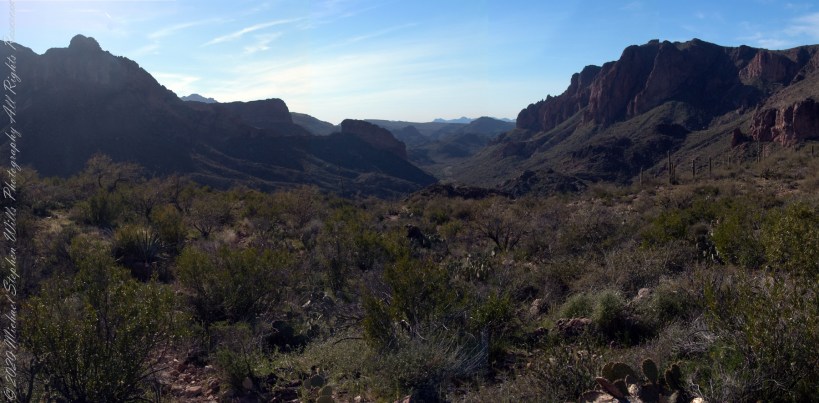
Higher on Peters Trail I made the panorama I called “Superstition Glory.” Black Mountain stands to the right and Bluff Spring Mountain to the left, while LaBarge Canyon reaches away through the center toward the Red Hills. The photograph makes the terrain look almost orderly. Hiking through it was different. Each ridge concealed another wash or canyon, and distances were difficult to judge.
The geology accounts for those abrupt walls and broken mesas. Much of the Superstition Mountains consists of volcanic rock produced by major eruptions millions of years ago. Ash flows, lava and collapsing volcanic structures were later cut apart by erosion, leaving the cliffs, mesas and pinnacles that surround Peters Trail.
Water has done much of that work. On our hike it was scarce enough to govern our plans; over geological time it had carved the country beneath our feet.
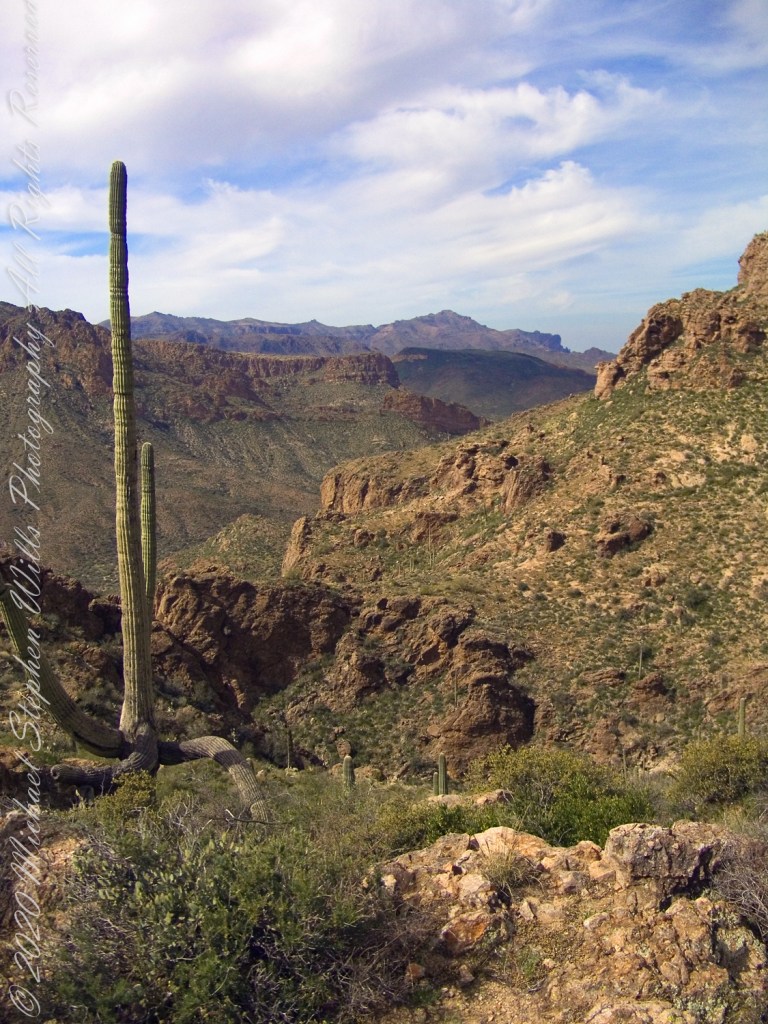
Near the mesa top I stopped for another photograph, “World at our Feet.” A mature saguaro rises in the foreground above Charlebois Canyon. Beyond it are Black Mountain, Bluff Spring Mountain and Black Top Mesa, with Flatiron farther away. The tall cactus gives some measure of the distances beyond it.
By then we had climbed well above the springs.
I remember the view more clearly than the effort: saguaros standing on the slopes, volcanic cliffs catching the light, canyons dropping out of sight and one ridge following another toward the horizon. Somewhere below was the Dutchman Trail and the patch of water where we had rested.
From Peter’s Mesa, it seemed very far away.
Click me to visit Michael Stephen Wills Online Superstition Wilderness Photography
Enter your email to receive notification of future postings. I will not sell or share your email address.
Copyright 2026 All Rights Reserved Michael Stephen Wills

