The Science and Poetry of Melting Ice: Cayuga Lake During a Winter Thaw

Under a blue February sky, Cayuga Lake keeps its icy grip, revealing how light, time, and physics conspire to make winter’s farewell a slow, luminous negotiation.

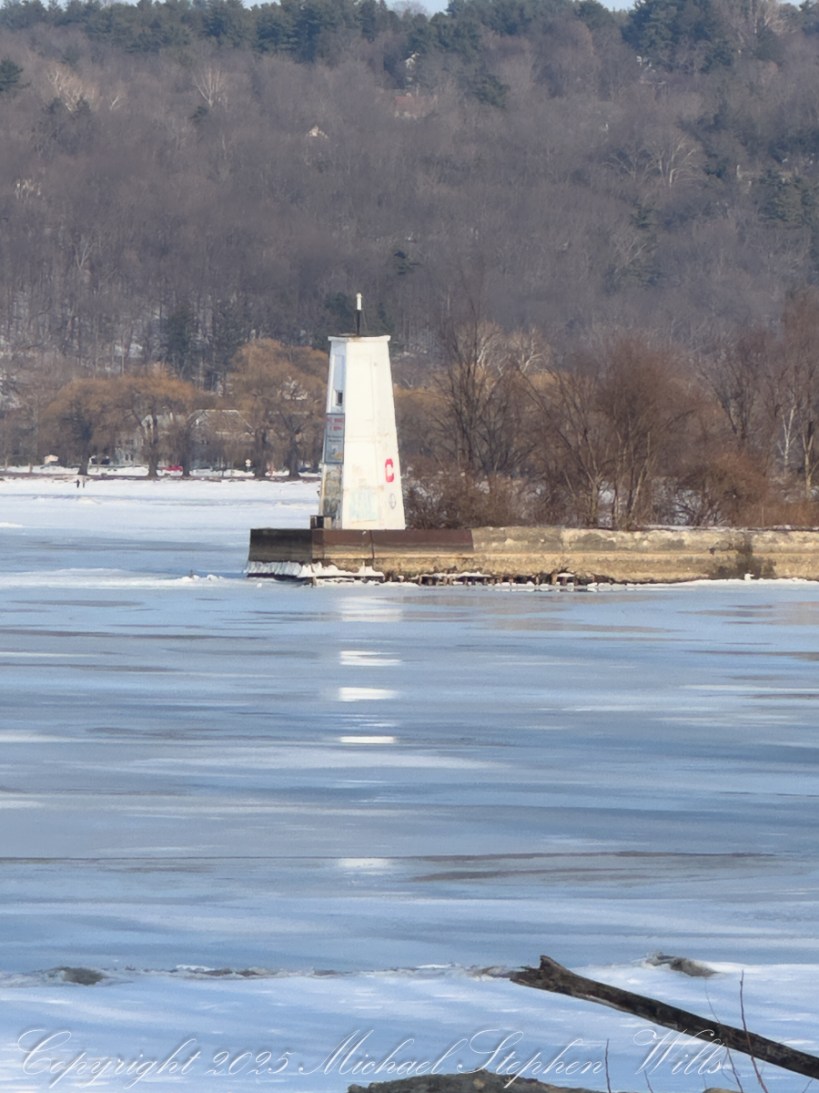
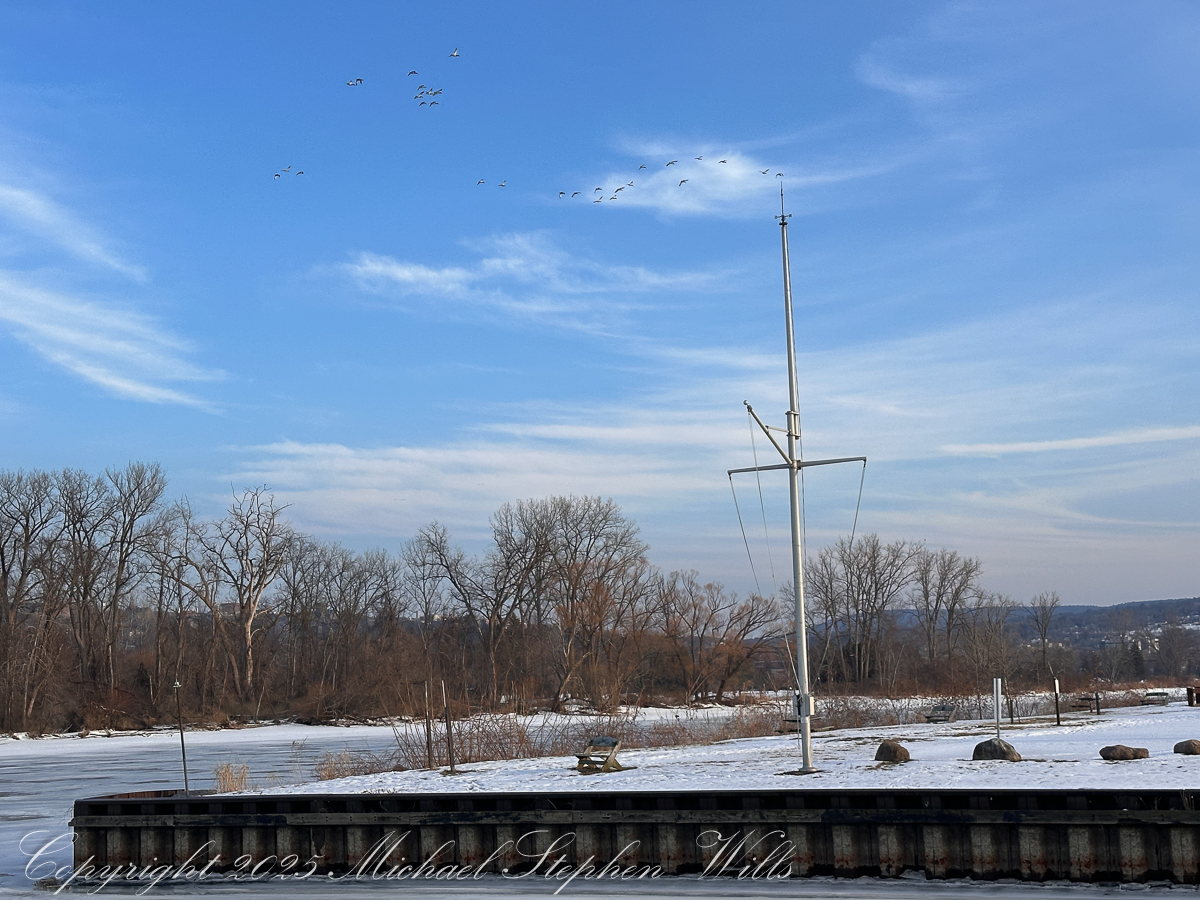
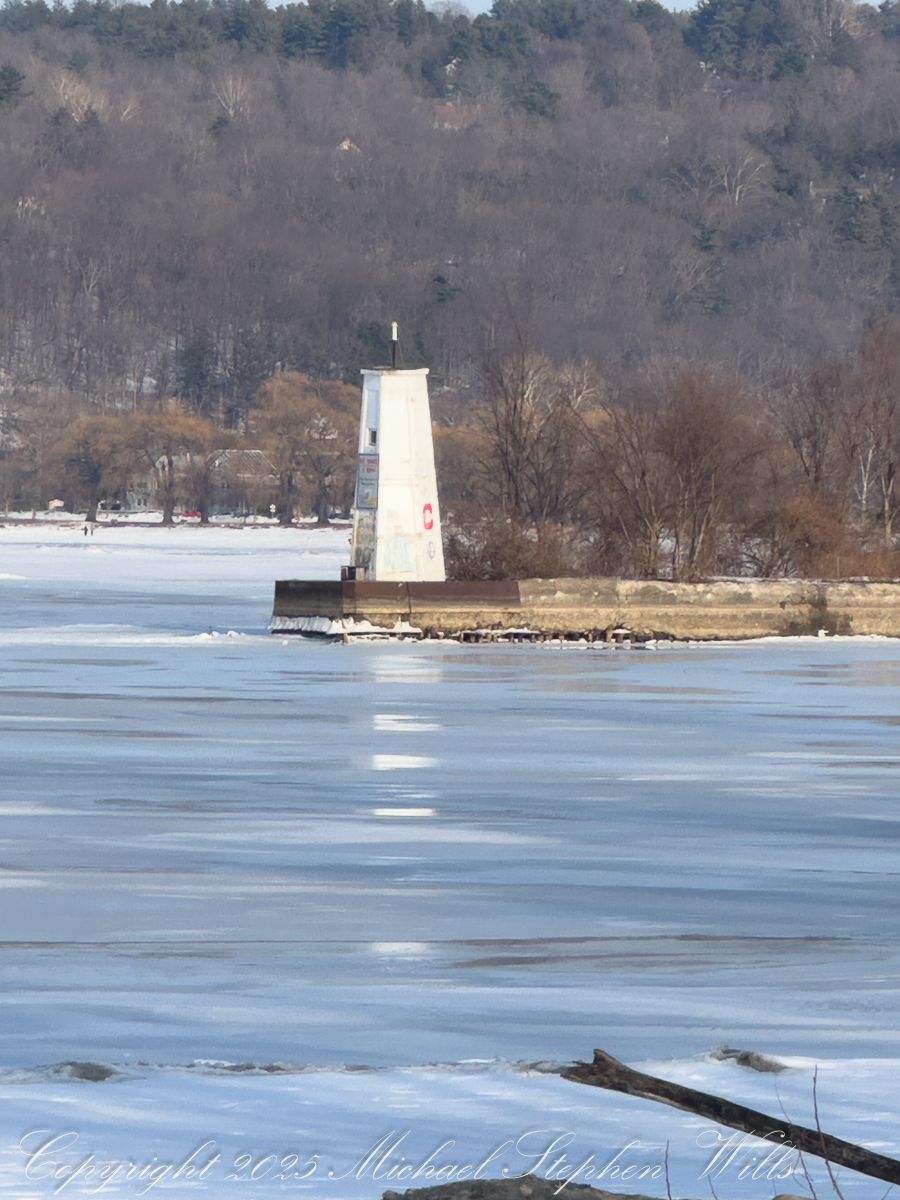
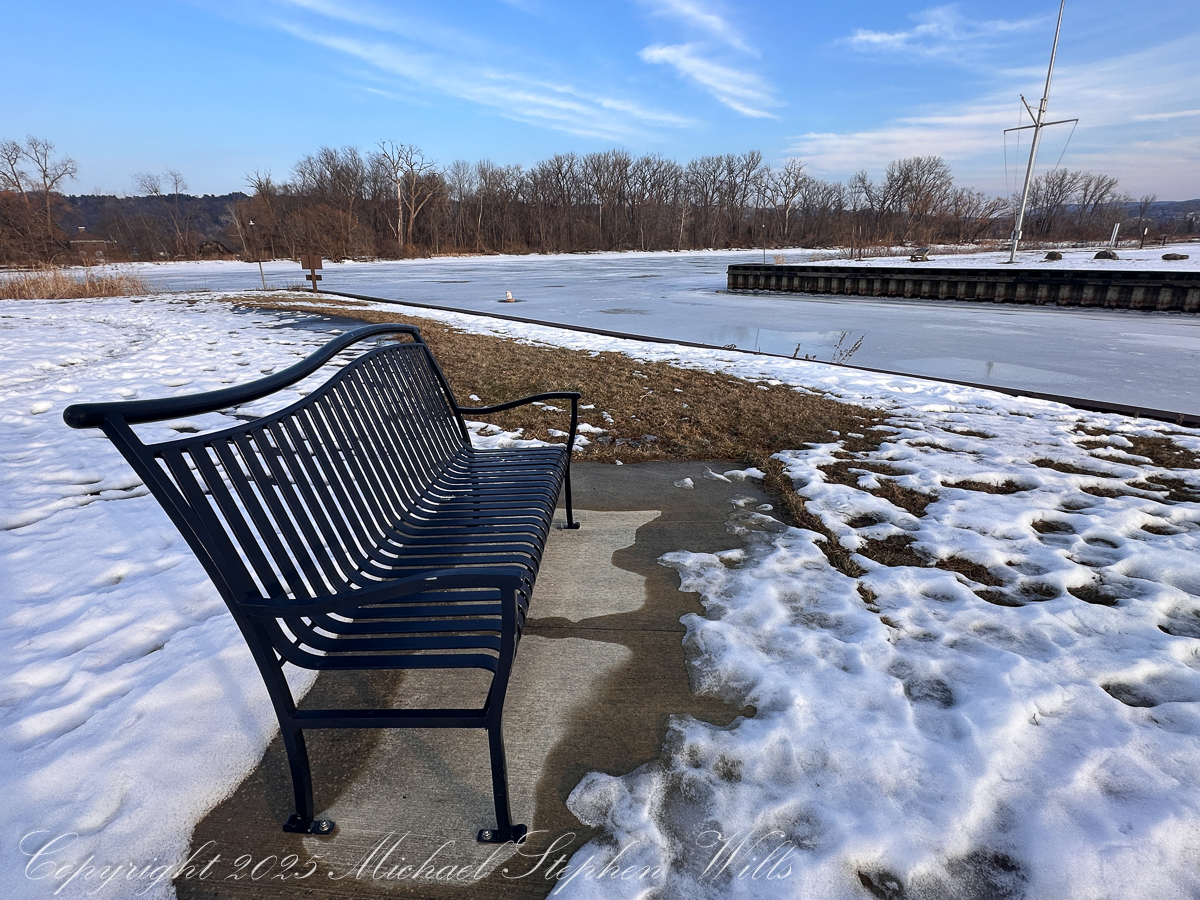
These photographs, made along the frozen margin of Cayuga Lake at Cass Park in mid-February 2026, carry a quiet paradox. The sky is a lucid blue, the light has that late-winter clarity that hints at spring, and yet the lake remains locked under a pale, glassy skin. A few geese stitch the air. A bench waits. Red and white beacons stand where water should be moving. The moment is fixed: late afternoon light in February, Finger Lakes winter—but the deeper story is written in physics, not pixels: why does lake ice linger so stubbornly during a thaw?
The short answer is that water is a hoarder of heat and ice is a keeper of promises. The long answer is the reason these scenes feel suspended between seasons.

Start with the cost of melting itself. Ice does not simply warm into water; it must first be converted, and that conversion demands a large, fixed payment of energy known as the latent heat of fusion. To melt just one kilogram of ice takes about 334,000 joules—and that energy raises the temperature not at all. It is spent entirely on changing solid to liquid.
Scale that up to a lake surface and the numbers become sobering. Even a modest sheet of ice—say ten centimeters thick—contains roughly ninety kilograms of ice per square meter. Melting that much requires on the order of thirty million joules per square meter. To put this in a human context, in 1 kcal there are 4,184 joules. Melting a square meter of ice requres 7,170 kilocalories (kcals) or 3.6 days for a person expending 2,000 kcals per day. Spread across square kilometers of lake, the energy bill climbs into the tens of terajoules. That is the hidden arithmetic behind the familiar disappointment of a February thaw: a few warm days feel dramatic to us, but to a lake they are only a small down payment.

This leads to the second, more subtle constraint: melting ice keeps itself cold. As long as ice is present, the surface of the lake is pinned near 0 °C (32 °F). Incoming heat does not make the surface warmer; it simply converts more ice into water at the same temperature. The thin layer of meltwater that forms on top is also near freezing, so the entire interface remains locked at winter’s threshold. There is no “warming momentum” here—no quick rise in temperature to accelerate the process. The system quietly consumes energy without changing its outward thermal expression.

That is why the lake in these images can look bright and almost springlike while remaining physically winterbound. Sunlight is being spent on erasure, not on warming.

A third rule of water deepens the delay. Freshwater is densest not at freezing, but at about 4 °C (39 °F). In early spring conditions, the coldest water—near 0 °C—floats. The slightly warmer, denser water below tends to stay below. This creates a stable stratification: a cold, near-freezing surface layer sitting like a lid on the lake.
The consequence is crucial. The lake cannot easily mix warmer subsurface water upward to attack the ice from below. The thaw must work mainly from the top and the edges—where sunlight, mild air, rain, and shoreline heat can do their work—rather than through a coordinated, whole-lake turnover. In practical terms, the ice is dismantled by margins and seams, not by a sudden, uniform collapse.
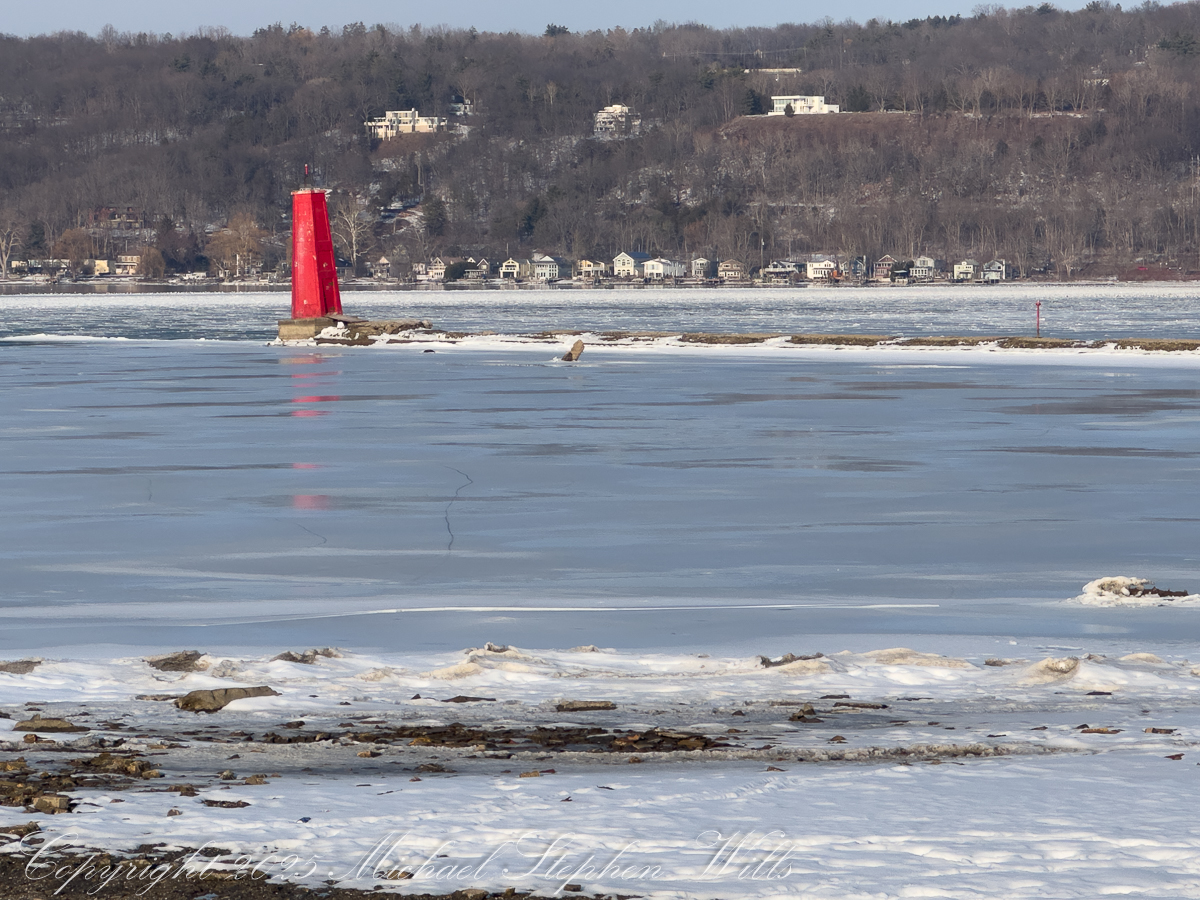
Add to this the reflective nature of ice and snow. The pale surface in these photographs is not merely beautiful; it is also defensive. Bright ice and snow reflect a significant fraction of incoming sunlight back into the sky. Dark, open water would absorb that energy eagerly and warm quickly. As long as the lake remains light-toned, it is actively rejecting some of the very energy that could hasten its release.

Thickness and structure matter too. Winter does not lay down a single, simple sheet. It builds layers: clear black ice, milky refrozen crusts, snow-ice composites, trapped bubbles—each a page in winter’s ledger. A brief thaw may soften the surface, open a lead near shore, or trace fine cracks across the sheet, but the bulk remains. In the closer views—the lighthouse and the red beacon standing in frozen sheen—you can see subtle tonal shifts and faint stress lines, the calligraphy of slow change. These are signs of negotiation, not surrender.

Scale, finally, is destiny. Cayuga is long and deep; it behaves more like a small inland sea than a pond. Small waters can change their minds quickly. Large waters are conservative. They remember. The heat they lost in autumn must be repaid, carefully and in full, before winter loosens its hold. This is why harbors and shallows darken first, why the margins in these scenes show hints of movement while the center keeps its pale composure.
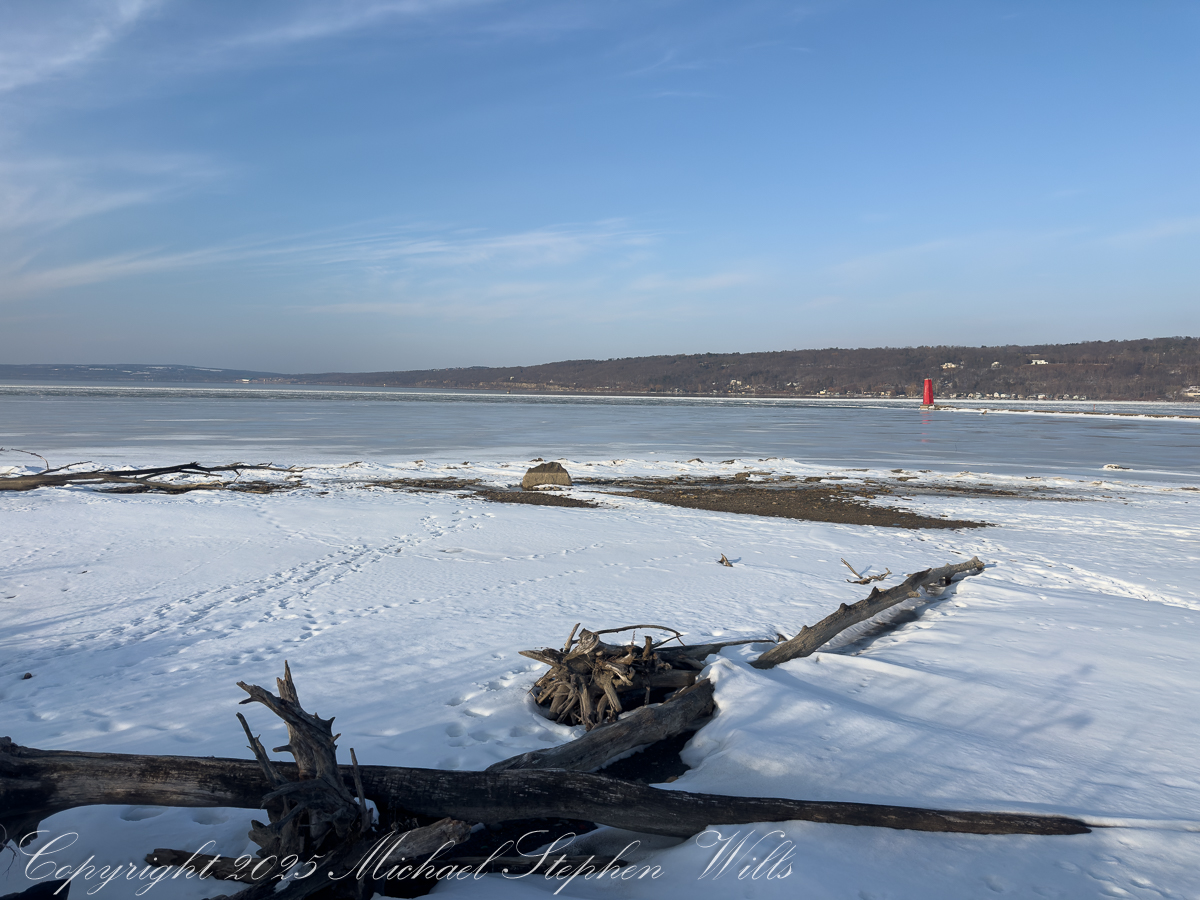
Put together, these rules explain the peculiar patience of February ice. The thaw is not a switch but an accounting. Enormous quantities of energy must be delivered just to accomplish the phase change. While that work is underway, the surface temperature barely moves. The cold meltwater stays on top, limiting mixing. The bright surface reflects sunlight. The lake, in effect, resists haste through the ordinary, unromantic laws of physics.

There is an austere beauty in this. Ice is a temporary architecture built by the loss of heat, and its demolition requires an equally disciplined repayment. The quiet in these images is the quiet of bookkeeping—joules being transferred, layers being undone, thresholds being approached but not yet crossed. When the change finally comes, it often feels sudden: a windy day that breaks the sheet into plates, a warm rain that darkens the surface, a week when the margins retreat visibly. But that drama is only the visible last act of a long, invisible exchange.

So the lake lingers. Not out of stubbornness, but out of fidelity to the rules that govern it. Under a sky that already looks like April, Cayuga is still paying winter’s invoice. The ice remains until the account is settled—and when it finally goes, the benches will no longer face a mirror of light, but a moving field of dark water, ready once again to begin the long work of storing heat for another year.
Enter your email to receive notification of future postings. I will not sell or share your email address.

Stargazing Winter’s Crab: Watching the 2019 Total Lunar Eclipse Near Cancer’s Beehive Cluster

Join me as a full moon slips into Earth’s shadow, turning copper beside Cancer’s Beehive—science, illusion, and wonder entwined in a winter night.

Colored lights of our skies are lifelong triggers for the imagination. On any moonless, crystal night—far from the town-glow—three thousand or so stars and the wandering planets scatter across the dark. We read them instinctively, stitching patterns the way our ancestors did, turning a brilliant chaos into stories. Along the ecliptic, twelve of those patterns became the constellations, a starry calendar by which careful observers told the seasons. When Cancer, the Crab rides high, winter has the northern hemisphere in its grip

Click Photograph for my OnLine Galleries
Click photograph for my OnLine Galleries. Clicking the other photographs in this post will yield a larger image.

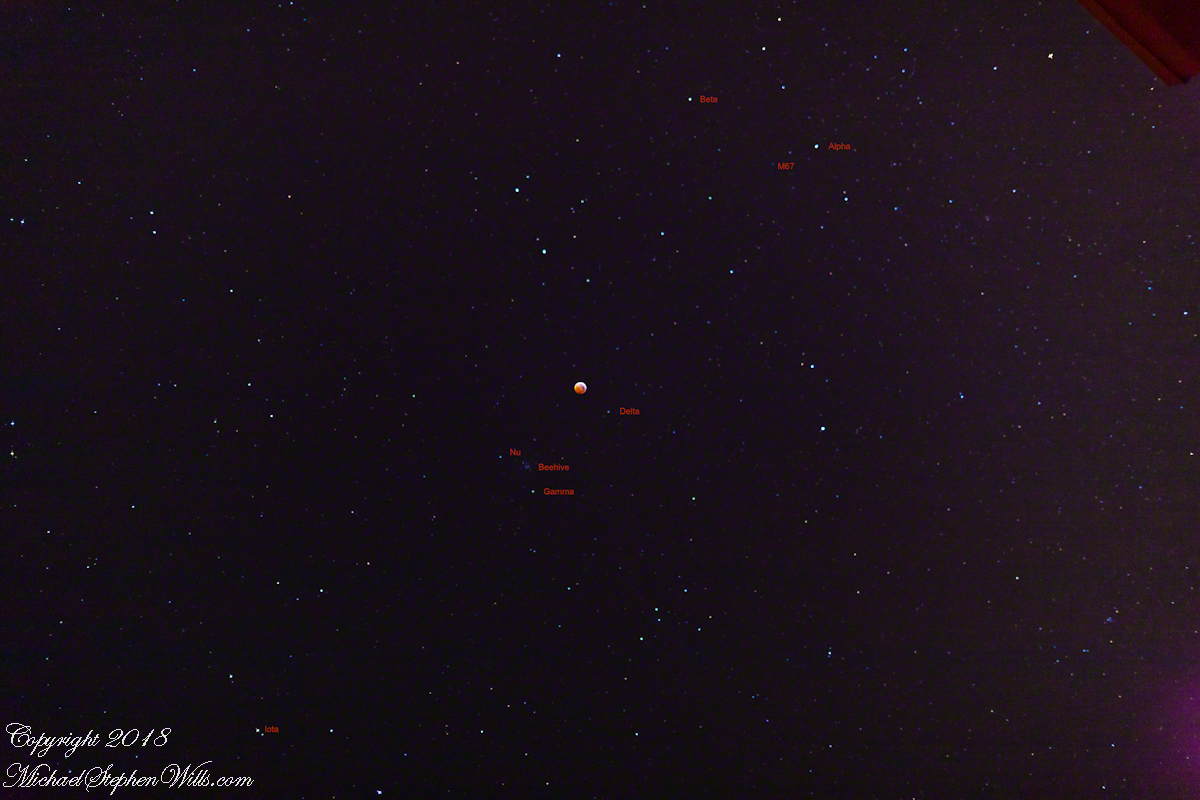
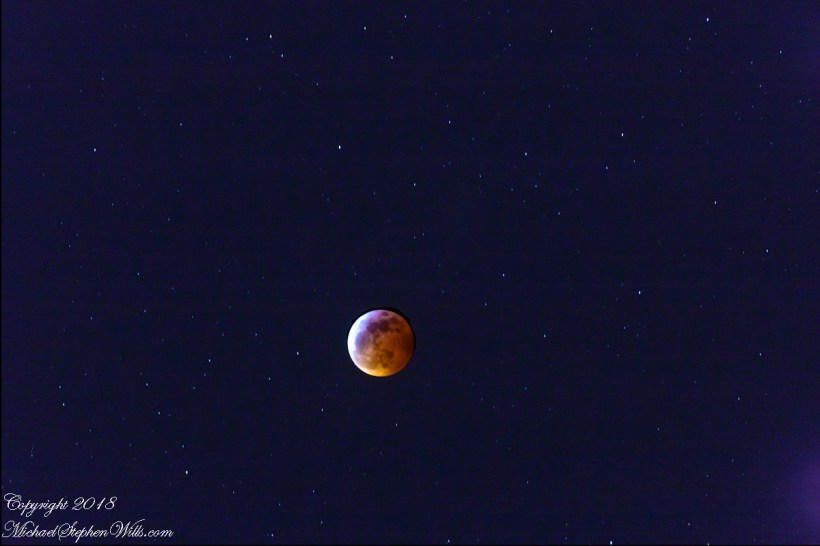
On the night of January 20–21, 2019, a full moon climbed from the horizon and slid into Earth’s shadow, transforming a familiar face into a copper coin. As it rose, that low-horizon “larger” moon—an illusion born of context—felt close enough to pocket. Hours later, the moon darkened to a dull copper color and appeared to float amid Cancer’s dim stars.

I set up a Canon DSLR on a tripod with a 24mm f/1.4 lens, pushed the ISO to 3200, and shortened the exposure to 1.3 seconds—a compromise between freezing star points and preserving the feel of the sky. The moon, of course, was overexposed in that wide frame; later, I overlaid a correctly exposed moon (from a telephoto shot later in the night) at its true apparent size to match the scene as the eye saw it. Is it the most “technical” astrophotograph of the eclipse? No. But it is faithful to the moment I witnessed and good enough to carry the story forward.

The Moon on the Crab’s back

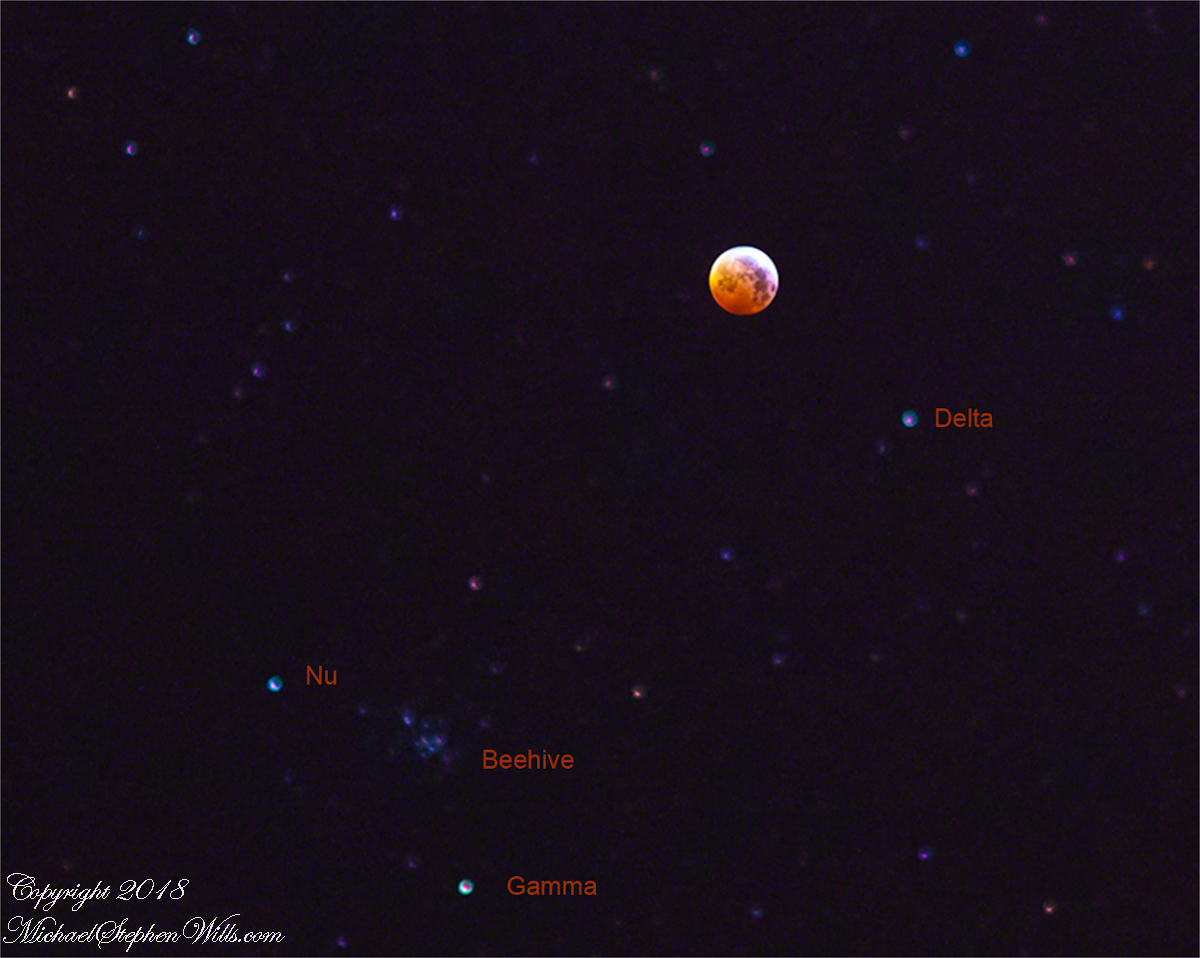
Cancer is never an easy connect-the-dots. Its stars are modest, more suggestion than signature. Look just to the side of the moon’s position that night and you come to Delta Cancri, the orange giant nicknamed the Southern Donkey. Draw a mental line down and slightly right to the faint pair Nu and Gamma Cancri—white stars that only masquerade as twins. They are not physically bound, merely near each other by line of sight: Nu about 390 light-years away, Gamma at 181. Scatter in Alpha and Beta off the Crab’s back and the outline becomes more plausible, the way a minimal sketch becomes a creature once the eye knows what to look for.

The Beehive

Between Nu and Gamma, edged closer to the moon, lies the real prize: the Beehive Cluster—also known as Praesepe or M44. Even with modest binoculars, Praesepe explodes into a field of delicate sparks, a thousand stars loosely wrapped into a hive. Galileo famously turned his early telescope on this cloud and teased forty separate points from the mist; modern optics reveal a populous neighborhood of stellar siblings in shades from ice-blue to ember-red. It is one of those sights that converts a casual sky-gazer into a repeat offender.

Click for more information about this view

Click photograph for a higher resolution version
Total Lunar Eclipse and Surrounding Sky with labels for primary element of the Cancer constellation

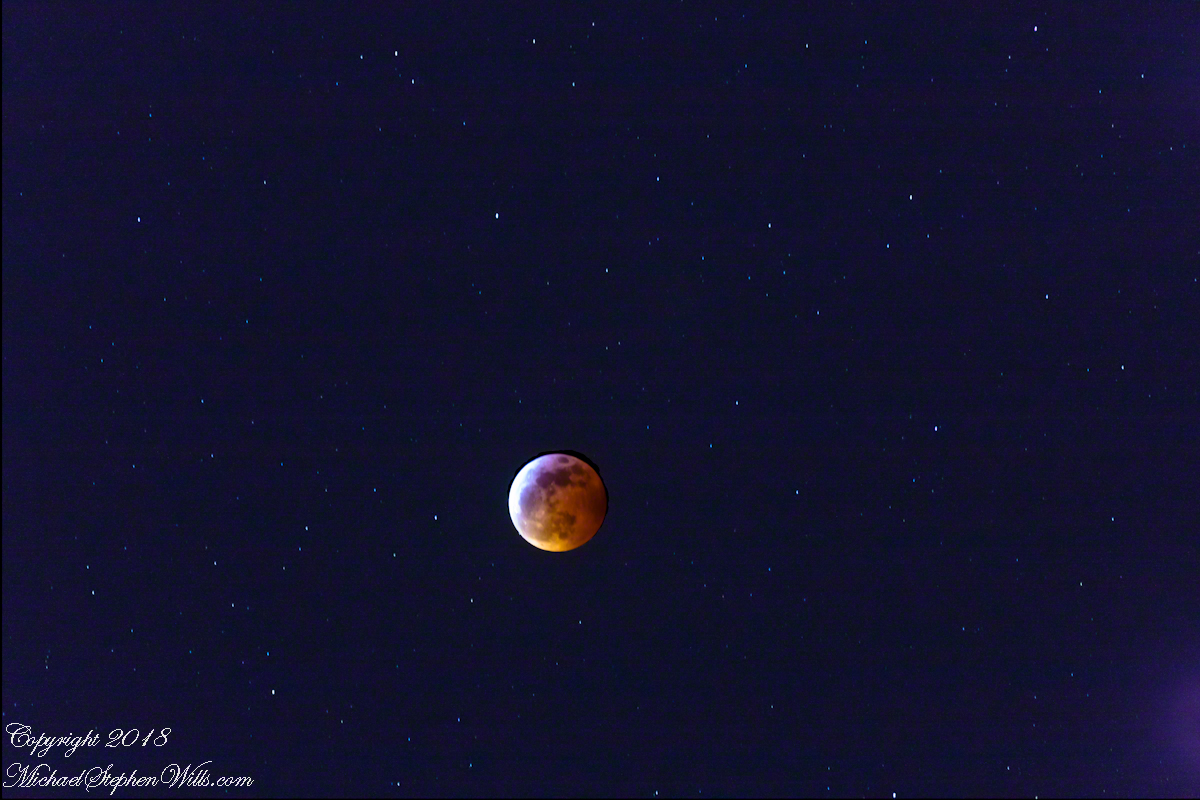
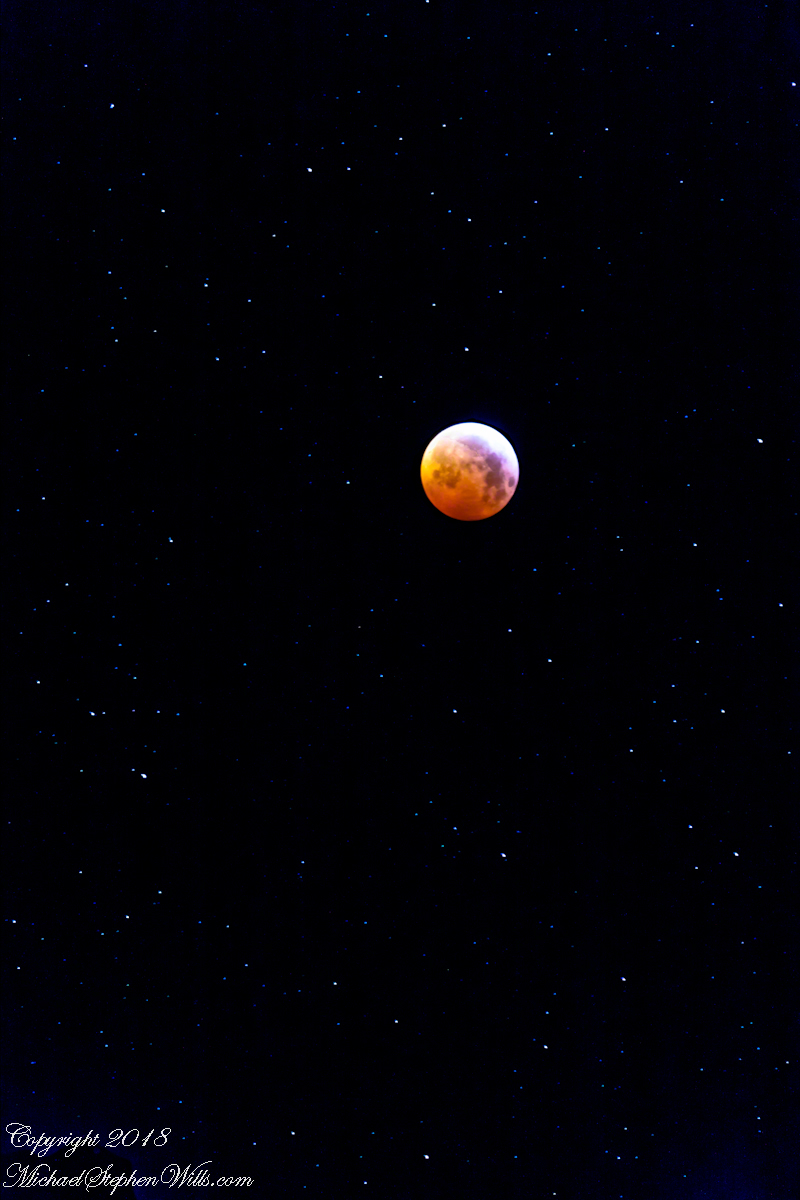
Later in the night I lifted the telephoto—70–300mm at 300mm, ISO 3200, 3.2 seconds—and let the moon fill more of the frame. At totality, the light thinned to a clay-jar red as Earth’s atmosphere bent sunlight around the planet and into its shadow. The effect is both simple and profound: every sunset on Earth happening at once, projected onto the moon’s face. Craters and maria softened into relief, and the globe stopped being a flat disk and became a round, ancient body again. Even without Delta, Gamma, Nu, and the Beehive in that tighter field, the sense of placement remained; I knew the Crab’s back was there in the dark, and that the moon had joined it—just for an hour—as a guest at the manger.

Click photograph for a higher resolution image
“Beehive” with Total Lunar Eclipse with labels for primary elements of Cancer Constellation

The Total Eclipse

What I love most about an eclipse is its pace. Nothing is impatient: the bite appears, the light drains, the color warms, and the world around you changes temperament. As the bright glare wanes, neighborhood sounds recalibrate—the hush between footfalls, the small click of a door, even the steadying breath you didn’t know you were holding. A total lunar eclipse is an astronomy lesson that behaves like a poem; it teaches by arranging time and light until awe and understanding meet.

Click photograph for larger image

And then, quietly, it returns what it borrowed. A thin wedge of white blooms at one edge, a rehearsal for dawn. Copper gives way to pearl, and the old moon looks new again, just higher and smaller against the deepening night. Cancer recedes into suggestion; Praesepe goes back to being a faint cloud to the unaided eye. The camera is packed away, the tripod shoulders its own shadow, and you keep the best exposure of the night where it can’t be corrupted: in memory.

Click photograph for larger image

If you have binoculars, mark Cancer on a winter chart and step outside when the sky is clear. Find Delta, sweep toward the dim pair of Nu and Gamma, and then rest your gaze on that hazy patch between them. Bring a friend into the circle and let the cluster resolve, star by star, into something alive with depth. It will not be the last time you look for it. And if you’re lucky enough, as we were that January, the moon will pass nearby, reminding you that even the most familiar companion can be made strange and beautiful by the turn of a shadow.

The sky is a storybook, yes—but also an instrument. Nights like this tune both.

Enter your email to receive notification of future postings. I will not sell or share your email address.