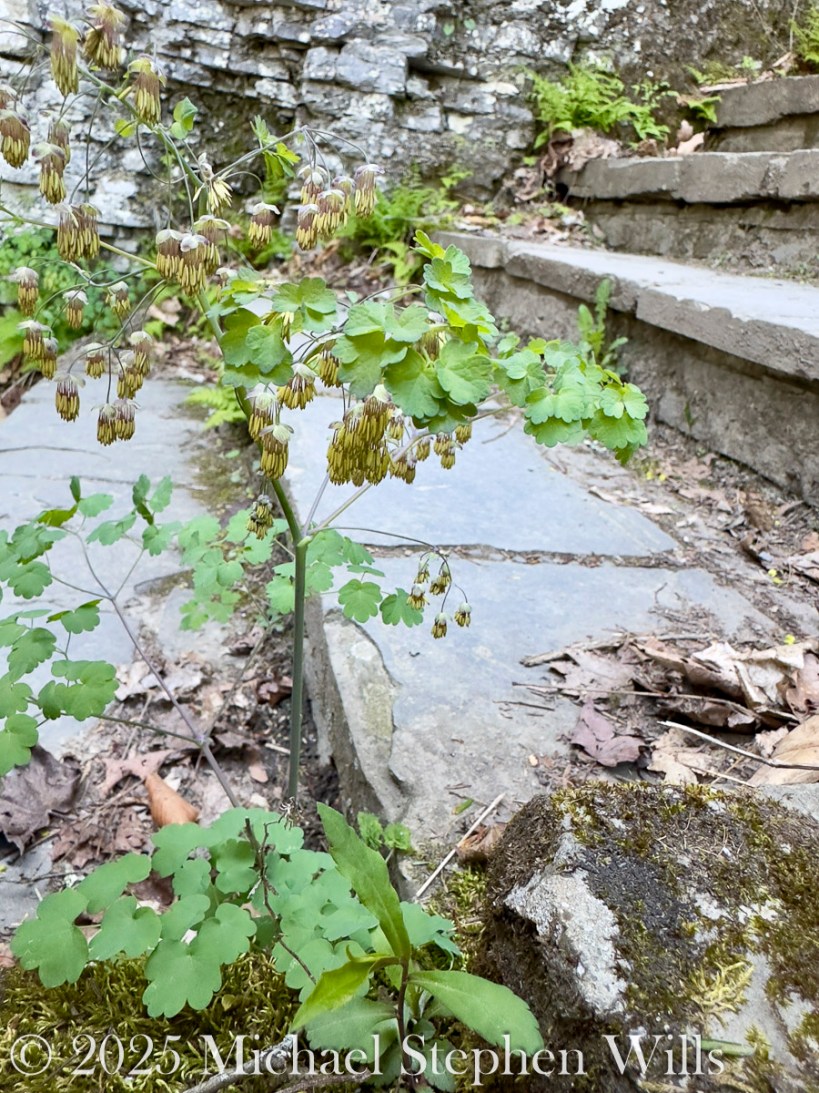
April 28, 2025 – Robert H. Treman State Park, Ithaca, NY. I step lightly along the damp stone stairs of the Gorge Trail, hemmed in by towering rock walls and the whisper of waterfalls. There, at a turn in the path, I encounter an unassuming woodland plant waving in the breeze. Its delicate green foliage could be mistaken for a young fern or columbine, but from its arching stems hang dozens of tiny yellow tassels, swaying like fairy lanterns. This is a male Thalictrum dioicum – commonly known as early meadow-rue, or more whimsically, quicksilver-weed. One of the earliest wildflowers to emerge in spring forests of the Northeast, it offers a subtle spectacle: golden anthers dangling in the cool April breeze, each tiny stamen a pendulum of pollen.
Delicate Botany of a Woodland Rue
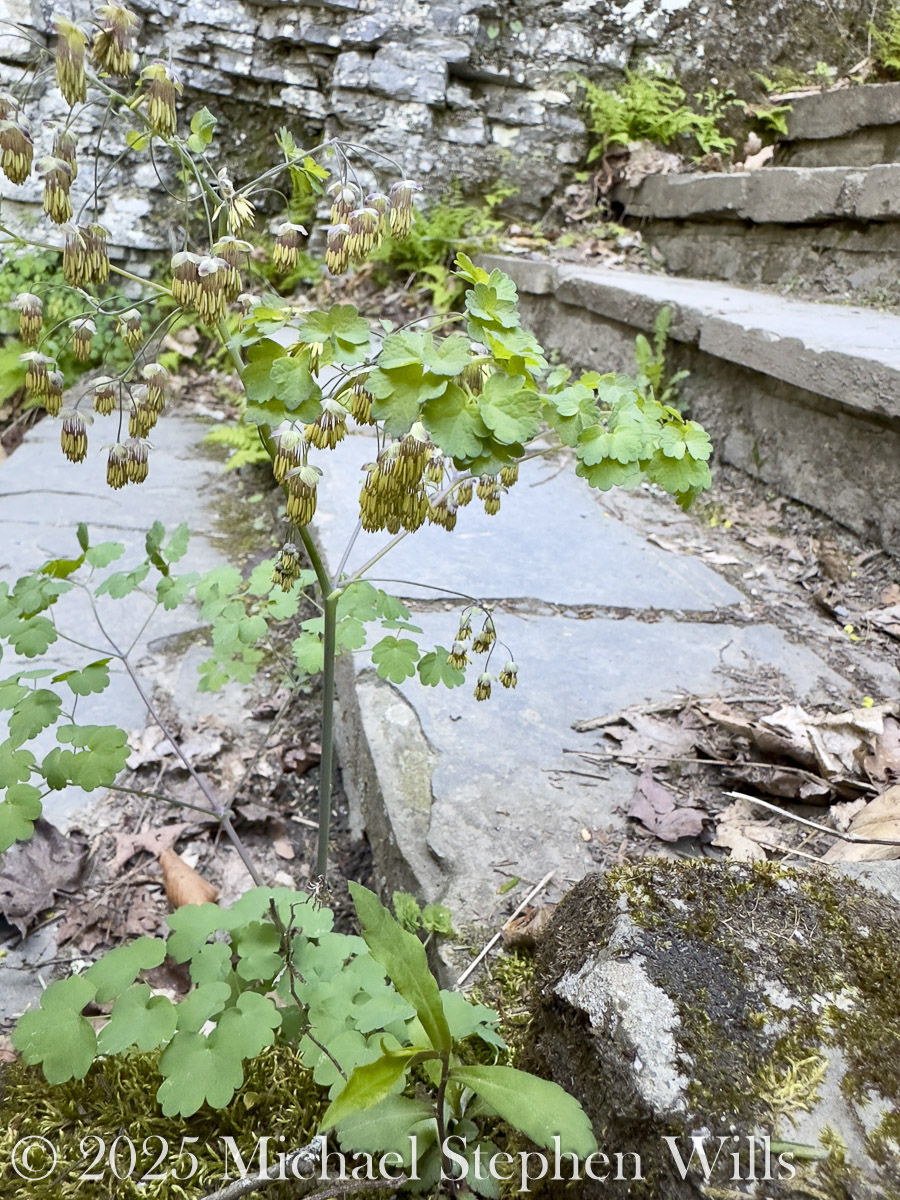
At a glance, Thalictrum dioicum might not shout for attention – standing barely one to two feet tall – yet a closer look reveals intricate beauty. Each male plant is a miniature chandelier of blossoms, the flowers having no petals at all but instead a simple fringe of sepals and a flurry of stamens. In fact, the male flowers are the showiest part of this species, with numerous slender, dangling yellow stamens that earn meadow-rue a second look. These dangles are the anthers – pollen-bearing organs – swinging freely to release golden dust on the wind. Female plants, on separate nearby stalks, are more reserved: their flowers hold up clusters of pale pistils like tiny green stars, which, if wind-blessed with pollen, will swell into achenes (dry fruits) later in the season. The separation of sexes in different “houses” is the trait that gives the species its name dioicum, meaning “of two households” in Greek. Early meadow-rue’s foliage is equally enchanting. The leaves are twice or thrice divided into lobed leaflets that resemble the herb rue (Ruta) – hence the common name “meadow-rue”. A misty green above and silvery underside, the leaflets have a rounded, almost columbine-like form with soft scalloped edges. As botanist Eloise Butler once noted, casual hikers often exclaim “what a pretty fern!” upon seeing the airy foliage before noticing any flowers. Indeed, the plant’s fern-like grace and early spring timing give the forest understory a verdant, lacy trim well before the summer plants take over.
What’s in a Name (Etymology and Lore)
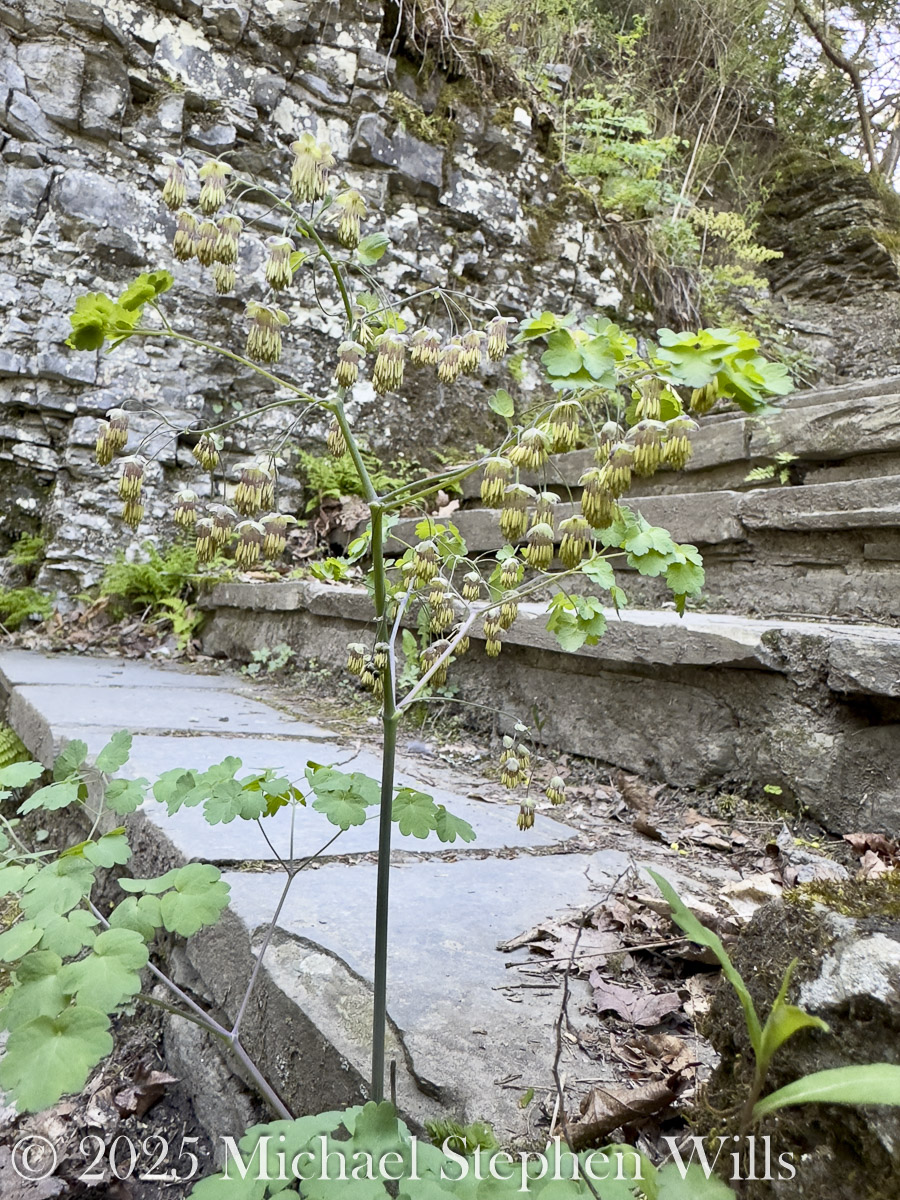
Even the name of this humble wildflower carries poetry. The genus Thalictrum harkens back to the Greek word thaliktron, a term used by the ancient physician Dioscorides to describe plants with finely divided leaves. It’s a fitting nod to the meadow-rue’s delicate foliage. The species name dioicum, as mentioned, translates to “two houses,” nodding to its dioecious nature – male and female flowers on separate plants. As for “quicksilver-weed,” an old folk name, one can only imagine it arose from the plant’s ephemeral shimmer: appearing quickly in spring and perhaps glinting with dew like liquid silver. Early meadow-rue also earns its “early” title by being among the first woodland perennials to bloom as the snow melts – a true harbinger of spring in the eastern North American woods. The “rue” in meadow-rue is a bit of a misnomer botanically (meadow-rue is in the buttercup family, not related to true rue). However, the moniker stuck because of a shared appearance – those divided leaves echo the shape of true rue’s foliage. There’s no strong odor or bitterness here, though. Instead, Thalictrum dioicum is gentle in aspect and entirely non-toxic, making it a welcome companion in shady gardens and wild places alike. Gardeners sometimes cultivate it for its graceful foliage and dangling blooms, a little wild treasure in cultivated shade gardens.
A Quiet Role in the Forest Understory
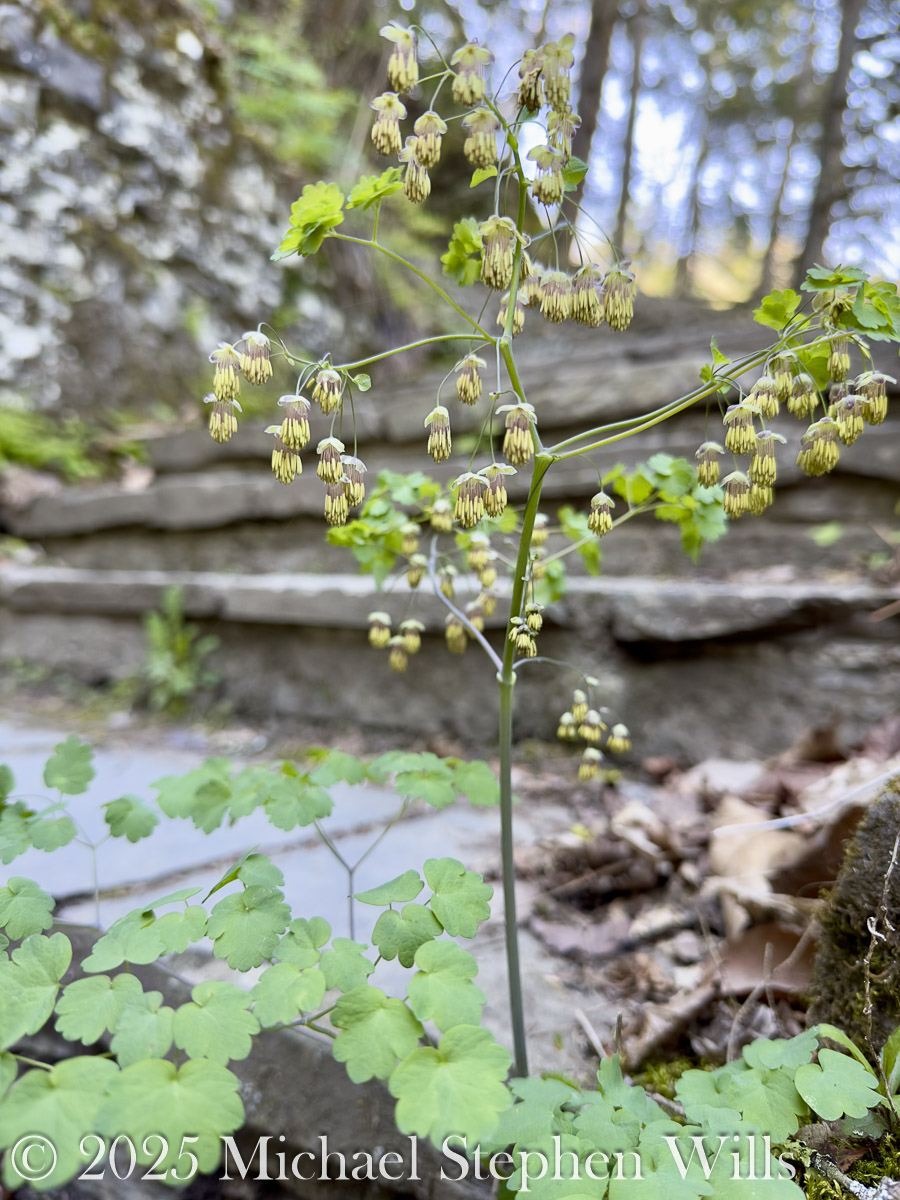
In its native habitat, early meadow-rue lives a low-key life in the understory. It thrives on dappled woodland slopes, often on rich, rocky soils near streams – exactly the sort of place the Gorge Trail winds through. Preferring partial shade, it is comfortable in both moist and well-drained sites. As a spring ephemeral, it takes advantage of the window before the canopy fully leafs out, unfurling its leaves and flowers in April and May, then quietly dying back by midsummer to wait out the year’s end. This strategy allows it to catch the sunlight of early spring and avoid competition later on. Unlike showy wildflowers that beckon bees and butterflies, meadow-rue’s pollinator is the breeze. Being wind-pollinated (anemophilous), it has no need for bright petals or nectar rewards. Instead, those dangling stamens tremble with each gust, shedding pollen into the air – a dance of chance that some of it will drift over to a waiting female flower nearby. The light, swinging tassels are perfectly adapted to this purpose, increasing the odds of pollen dispersal with every sway. Even without offering nectar, early meadow-rue still contributes to its ecosystem. Its tender leaves provide an early snack for rabbits and deer venturing out after winter. A few specialized moth species also use it as a host plant in their caterpillar stage, nibbling on the foliage. By going dormant in summer, meadow-rue returns nutrients to the soil and opens space for later-emerging plants, maintaining the ebb and flow of diversity in the forest floor community. In autumn and winter, only its fibrous roots and a small caudex (rootstock) persist under the leaf litter, ready to send up new growth when spring returns.
Roots in Culture and Folklore
This demure wildflower has also found its way into human stories and herbal traditions. Native American communities, especially in the Northeast, knew and used early meadow-rue in subtle ways. Though not a superstar of indigenous medicine, it had its roles. Cherokee healers brewed tea from the roots to treat diarrhea and stomach troubles, and to ease vomiting. In Haudenosaunee (Iroquois) lore, a decoction of meadow-rue roots was used as a wash for sore, tired eyes, and even taken to steady a palpitating heart – perhaps the gentle plant lending calm through belief or mild effect. Beyond medicine, Thalictrum dioicum tiptoes into the realm of romance and harmony.
According to ethnobotanical notes, young Blackfoot women in the northern Plains would weave the pretty tassels or seed clusters into their hair, believing it would help them attract the attention of a desired young man – a bit of springtime love charm from the wilds. Among some eastern Woodlands tribes, such as the Ojibwa and Potawatomi, the seeds of meadow-rue were a secret tool for domestic peace: slipping a pinch of seeds into the food of a quarreling couple was thought to help dispel discord and restore harmony to the relationship. Whether through mild pharmacological effect or sheer faith, one imagines it brought a hopeful smile to those administering this folk remedy.
Early meadow-rue even made a brief appearance in early colonial folklore. In Canada, it’s said that some of the First Peoples used the crushed roots to treat venomous snake bites, likely as a poultice. The plant’s leaves were also dropped into spruce beer – the fermented drink made by settlers and Natives alike – perhaps as a flavoring or tonic ingredient. Interestingly, despite these uses, meadow-rue never became a staple in European-American herbal medicine. 19th-century herbal texts noted that American Thalictrums were largely ignored by formal medicine, overshadowed by their European cousins. This lends our Thalictrum dioicum an aura of a plant mostly known by those who dwell close to the land – a quiet ally in the forest, employed in pinch when needed and otherwise simply appreciated for its beauty and symbolism.
Reflections on a Spring Encounter
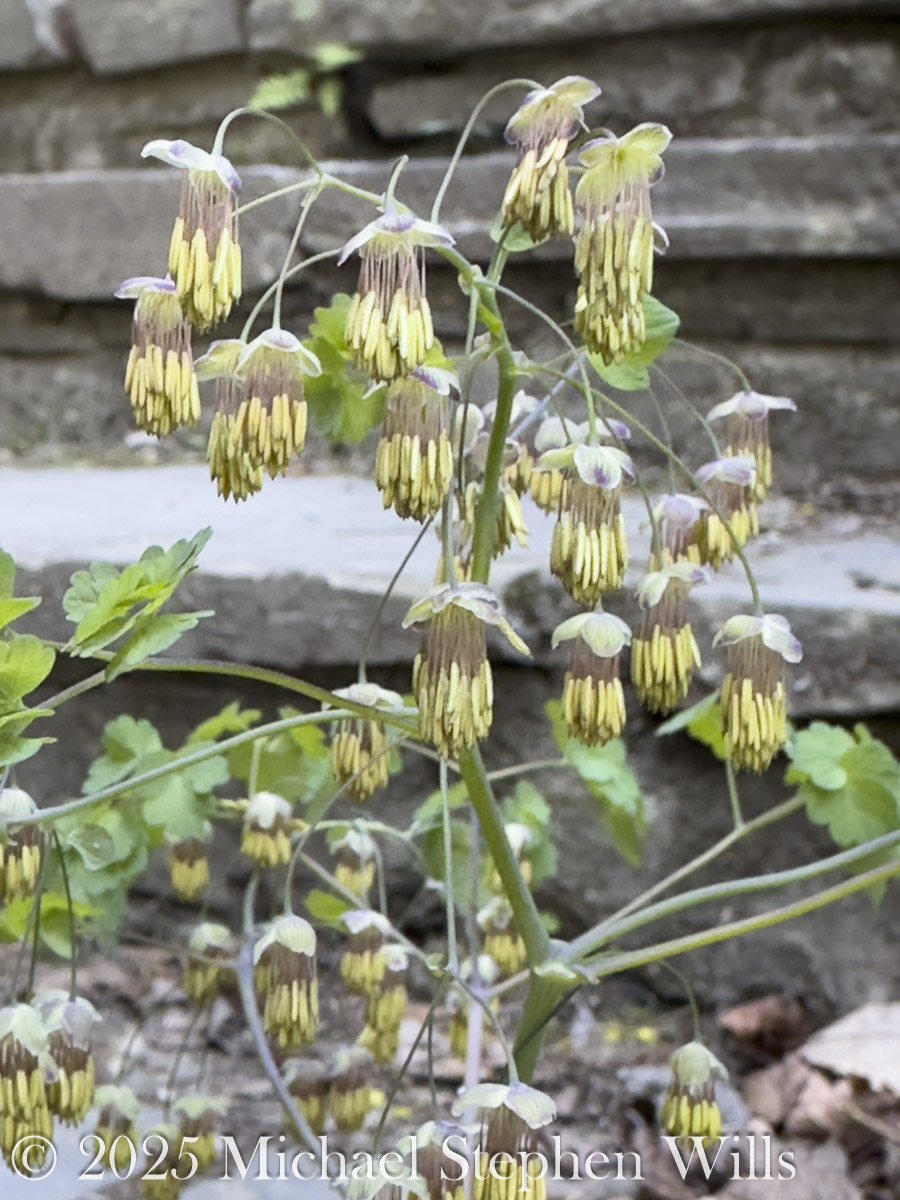
A close-up of Thalictrum dioicum male flowers, often called “quick-silver weed” for the way these golden tassels catch the light. The plant’s lack of petals is evident – instead, dozens of pollen-laden stamens dangle, ready for the wind’s call.
Encountering this early meadow-rue along the gorge felt like stumbling upon a small secret of the woods. In the waterfall haunted gorge, with slate-gray cliffs towering overhead, these frail yellow tassels swayed and twirled as if performing for an unseen audience. There was a breezy playfulness in that moment – the plant nodding in the wind, pollinating by dancing rather than by the busy work of bees.
I was struck by how ancient and new it all felt: this same species blooming every April for thousands of years, used by generations of indigenous peoples for healing and hope, yet to me on that day it was a delightful surprise, as fresh as the spring itself. As I crouched to take a closer look, I imagined the threads of history and myth that early meadow-rue carries. Its presence here is a sign of a healthy, layered woodland. It whispered of resilience – how something so delicate survives the torrents of spring rain and the deep freezes of winter underground, year after year. In the golden afternoon light of the gorge, those dangling blossoms were like drops of quicksilver sunlight, fleeting and brilliant.
I felt grateful to have noticed this little plant, to share a moment of connection across time and cultures. The next bend of the trail would lead me on, but the image of quicksilver weed in bloom stayed with me – a reminder that even the quietest corners of nature are filled with stories waiting to be noticed.
Enter your email to receive notification of future postings. I will not sell or share your email address.

Copyright 2025 All Rights Reserved Michael Stephen Wills
References
Thalictrum dioicum (Early Meadow-rue) – Wikipedia
Friends of the Wild Flower Garden – Early Meadow-rue (Thalictrum dioicum) plant description and naming
henriettes-herb.com
Institute for American Indian Studies – Medicinal Monday: Early Meadow Rue, blog post (Jan 22, 2024)
Henriette’s Herbal – Thalictrum dioicum excerpt from Drugs and Medicines of North America (1884-1887)
henriettes-herb.com
Friends of the Wild Flower Garden – Eloise Butler’s note on Early Meadow-rue (1911)



 Michael Stephen Wills Photography