Saint Fin Barre’s Cathedral: Resilience and Devotion in Cork

Saint Fin Barre’s Cathedral embodies faith and history through intricate artistry and significant apostolic representations.

As I stood within the hallowed confines of Saint Fin Barre’s Cathedral in Cork City, Ireland, I found myself drawn to the intricate artistry that tells the story of faith, resilience, and devotion. The figures and symbols within this magnificent edifice bring to life the history of Saint Fin Barre as well as the broader narrative of Christian tradition and its enduring influence on the region.

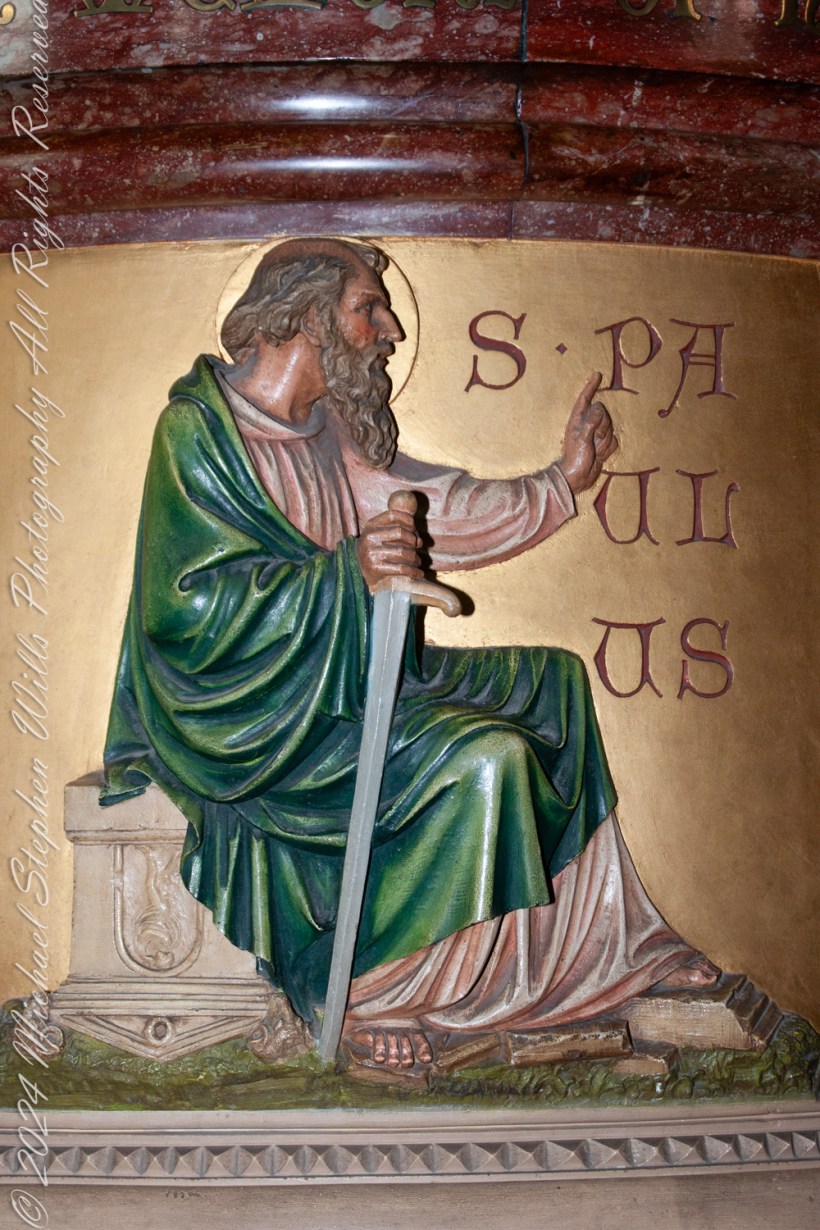
Near the entrance, the cylindrical pulpit’s relief figures of five evangelists captured my imagination. Here was the relief of Saint Paul seated with his characteristic sword, a symbol of both his martyrdom and the “sword of the Spirit” from chapter 6, verse 17 of the New Testiment Epistle to the Ephesians. His hand gestures toward the heavens, as if calling upon divine guidance to symbolize his role as an intermediary or messenger of God’s revelation. The rich green of his robes, juxtaposed against the golden background, speaks of hope, growth, and the everlasting promise of salvation. Here I found Saint Paul embodying the courage and conviction needed to preach and defend the faith—a sentiment that resonates deeply in the cathedral’s design and purpose.
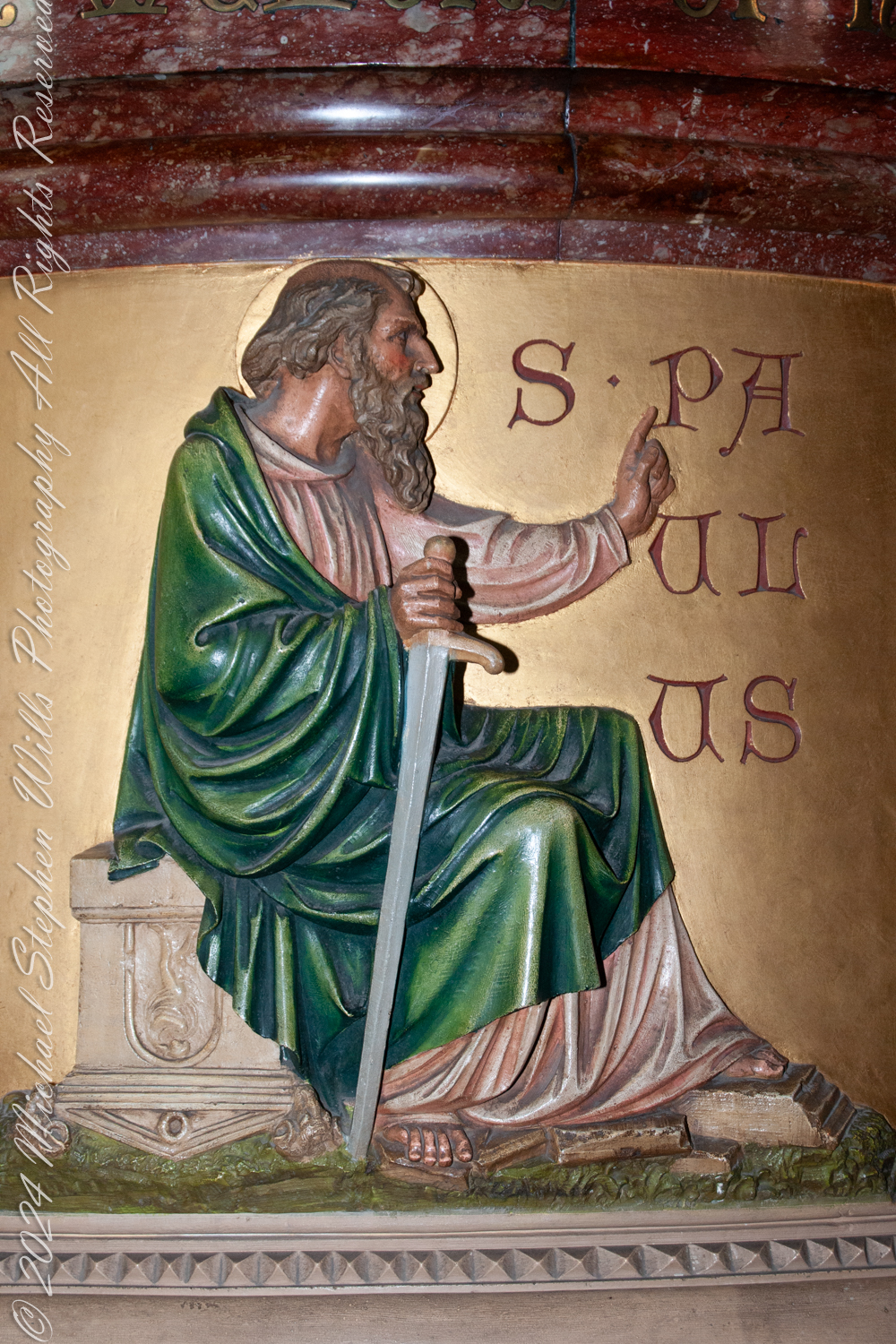
Saint Paul

Rounding the circle, another relief brought Saint Mark to life. With the lion at his side, Saint Mark writes intently, reminding us of his contributions to the Gospels. The warm, earthy tones of his attire and the contemplative tilt of his head evoke the diligence and introspection of a writer who draws inspiration from divine revelation. The lion, its expression both fierce and loyal, represents courage and the Gospel’s enduring power.
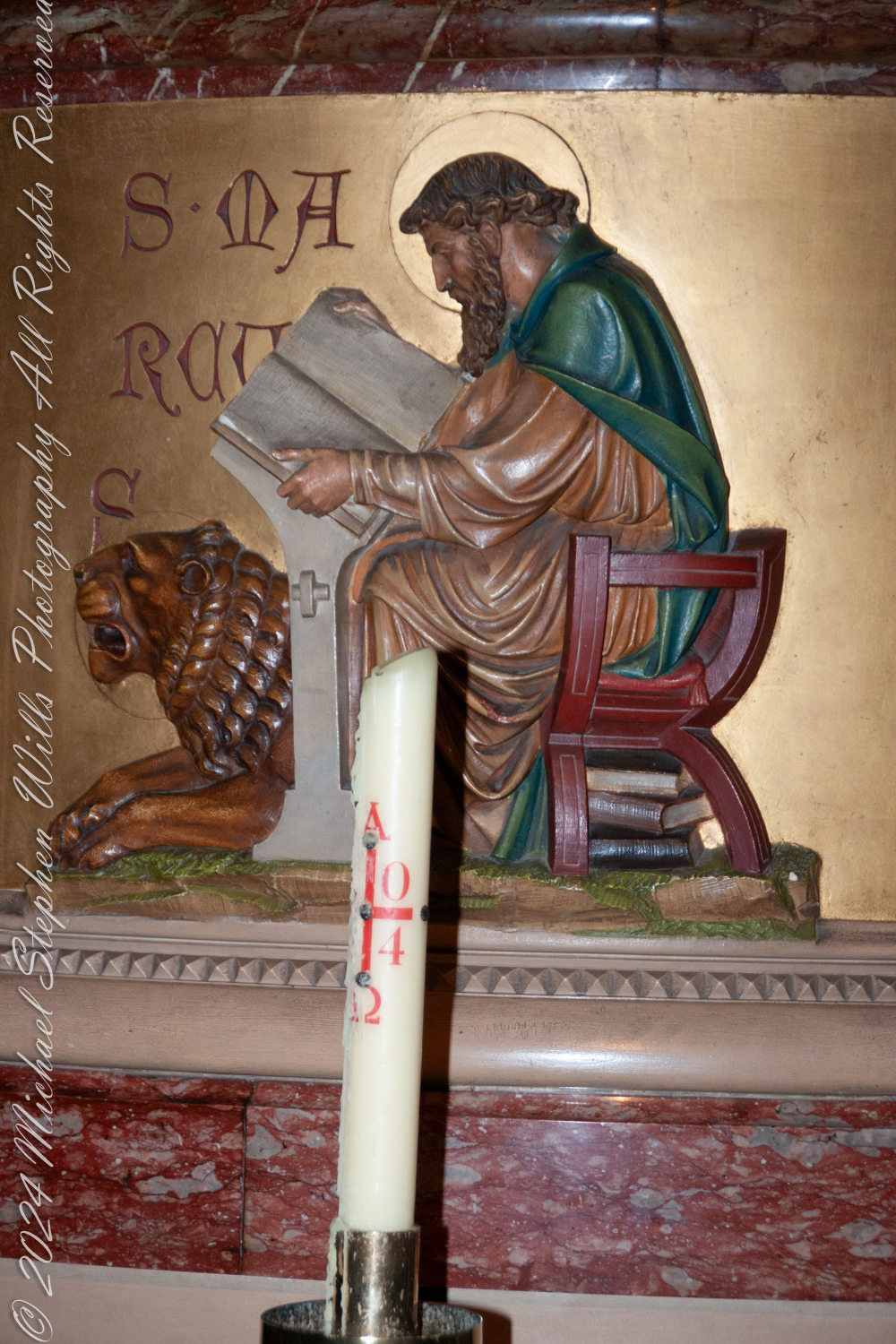
Saint Mark

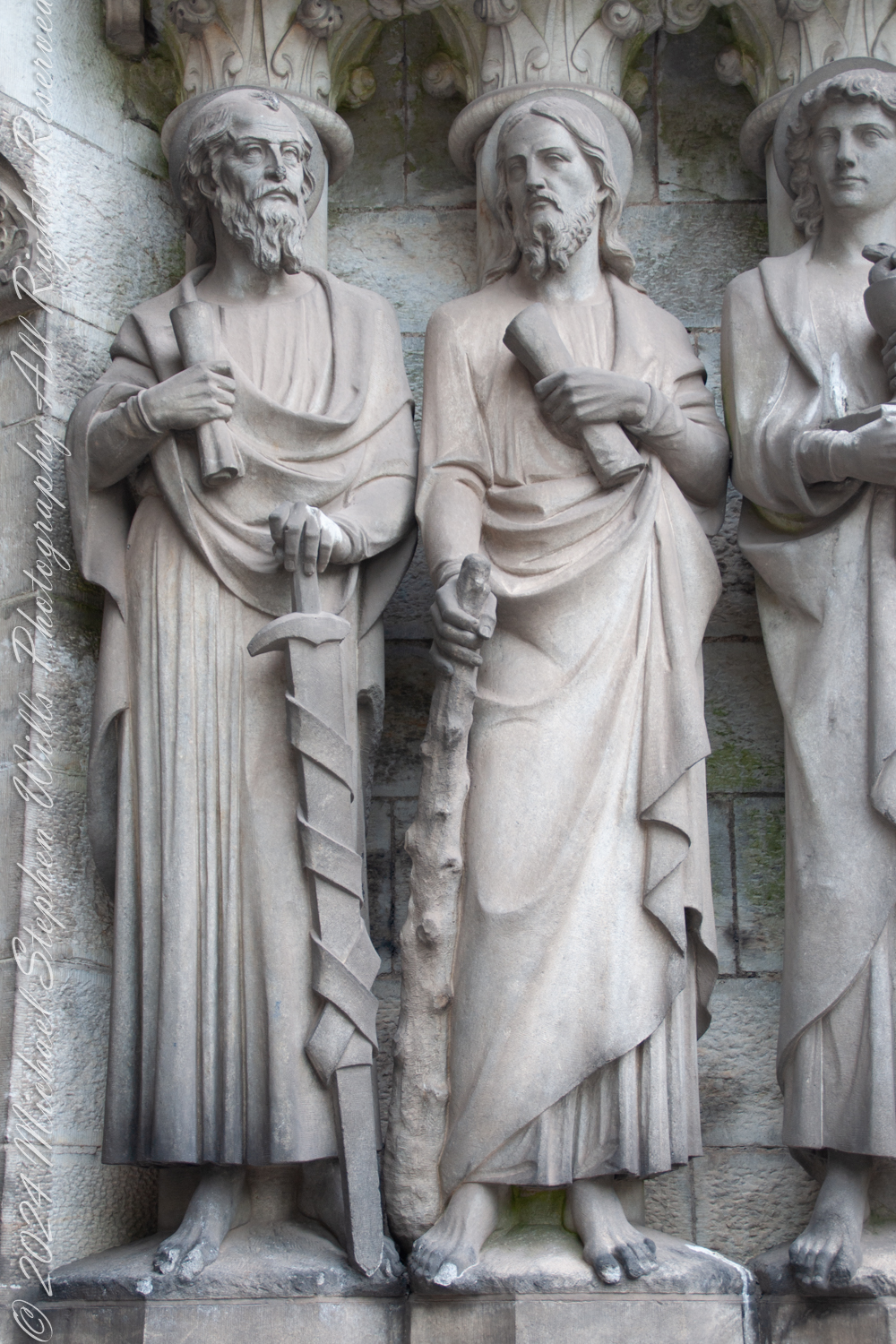
The cathedral’s external sculptures echo these individual representations of the apostles, where stone figures silently stand guard at the west entrance. The central figure of my photograph, holding a scroll in his left hand and a long cudgel (club) in his right, is Saint James the Less (also known as James the Minor). The scroll symbolizes his role spreading the word of God. The cudgel alludes to his martyrdom, as tradition holds that his executioners brutally beat him to death with such a club. His serene expression contrasts with Saint Paul, on the left, who holds the traditional “sword of the spirit” of his Epistle to the Ephesians. These carvings are spiritual sentinels, inviting visitors to contemplate the legacy of those who laid the foundations of the Church.
As the patron saint of the city, Saint Fin Barre’s enduring legacy profoundly impacts Cork’s spiritual and cultural history. His legacy dates back to the 7th century when he established a monastic settlement on the site where the cathedral now stands. This sacred location has witnessed centuries of devotion, destruction, and renewal. The visionary architect William Burges designed the cathedral in the 19th century as both a tribute to Saint Fin Barre’s enduring influence and a testament to William Burges’s own artistic genius.

Walking through the cathedral, I felt the interplay of past and present, earth and heaven. These saints and apostles are figures from history, embodiments of virtues and struggles that are timeless. Their stories invite us to reflect on our own faith, perseverance, and the ways we leave our mark on the world.

Saint Fin Barre’s Cathedral is a place of worship and a narrative in stone, wood, and glass. The intricate carvings and the evocative sculptures, among much else, create a space that transcends the ordinary. Here, the saints and apostles stand as eternal witnesses to the human journey toward the divine. As I left the cathedral, the image of Saint Paul, resolute and unyielding, stayed with me—a reminder that we must build faith, much like the cathedral itself, stone by stone, moment by moment, to endure the test of time.
Enter your email to receive notification of future postings. I will not sell or share your email address.

Discovering the Beauty of Saint Fin Barre’s Cathedral in Cork

Saint Fin Barre’s Cathedral features stunning Victorian Gothic artistry, with symbolic ceilings and intricate designs reflecting divine themes and craftsmanship.

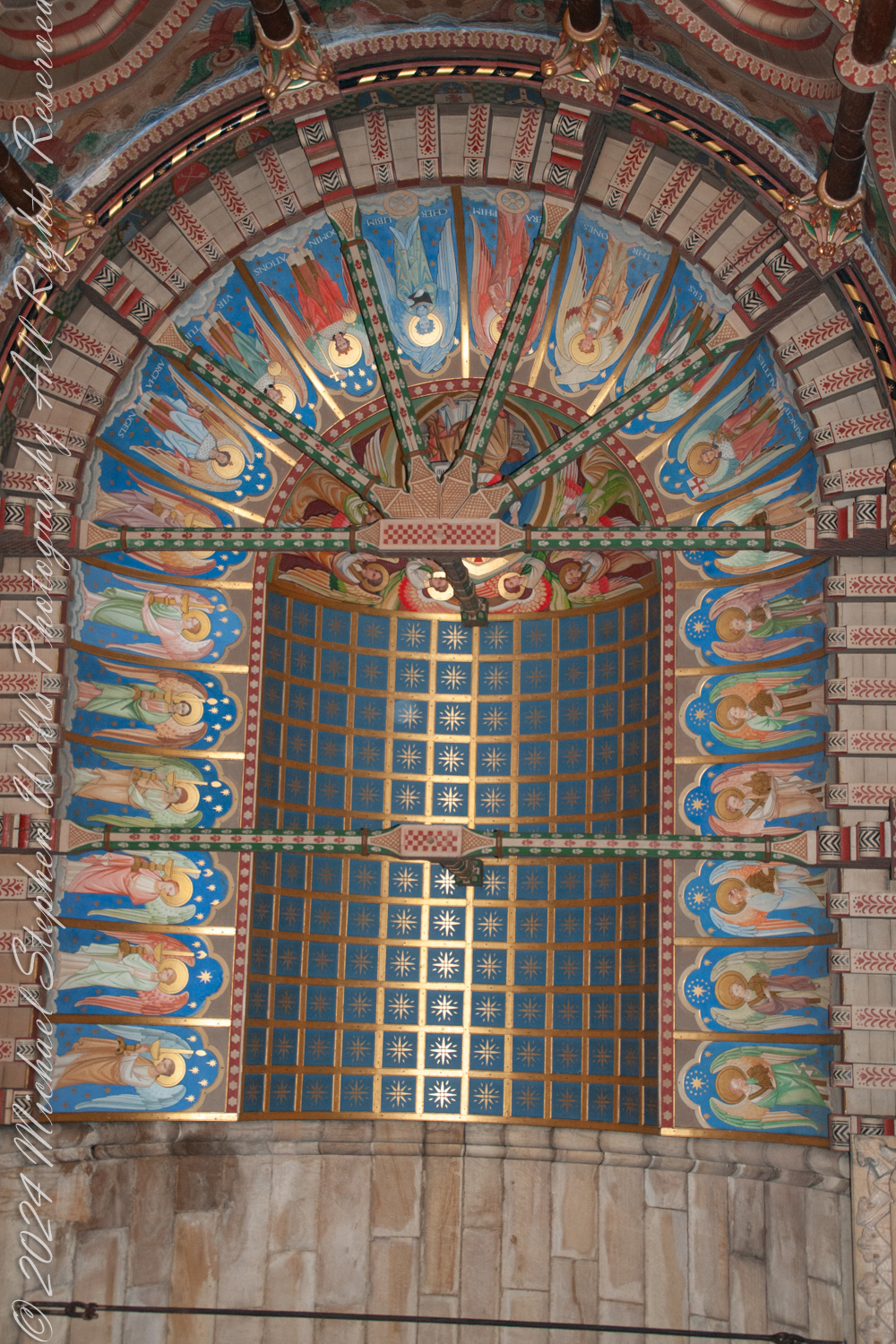
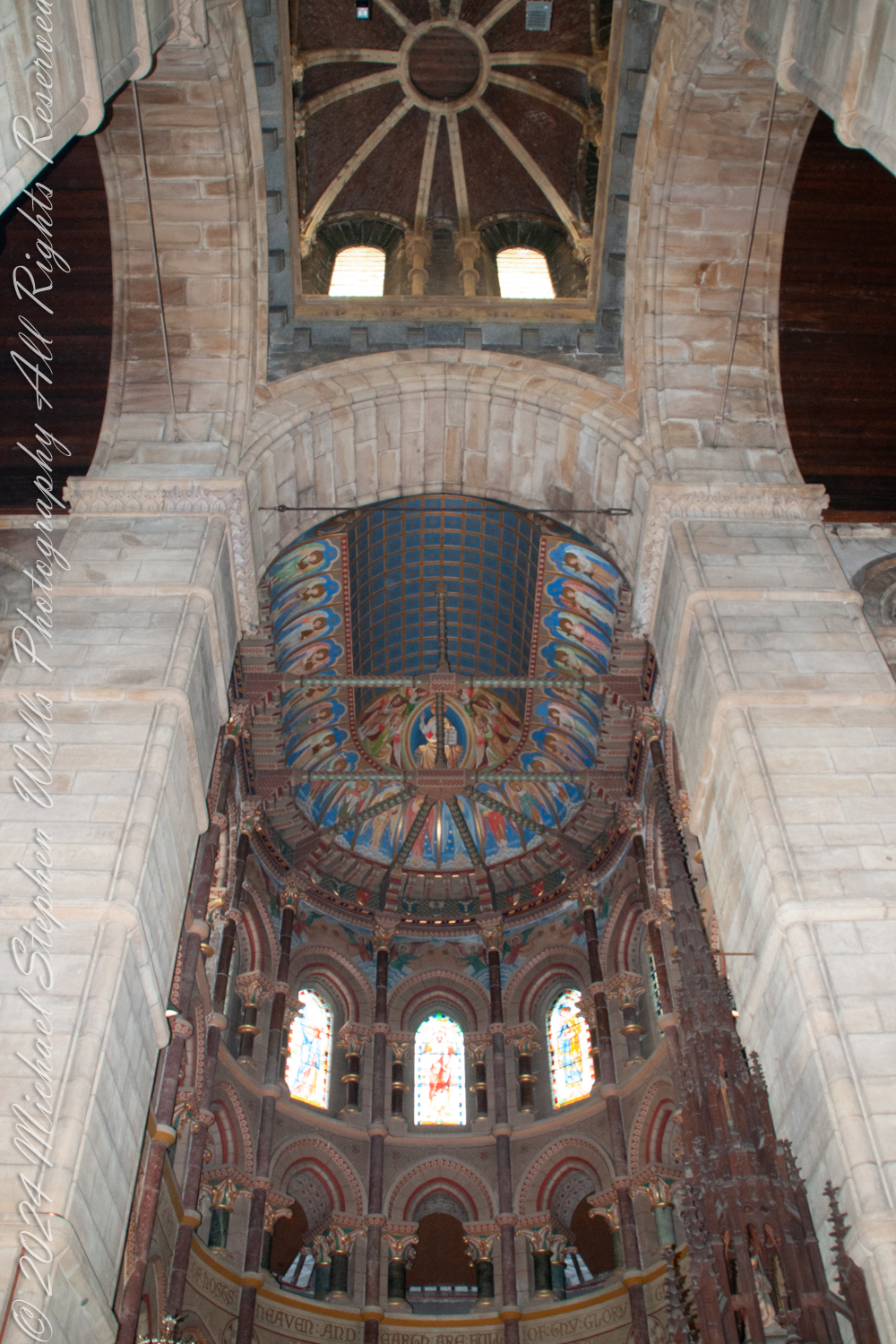
As I stood on the floor of Saint Fin Barre’s Cathedral in Cork, Ireland, I gazed upward toward the Apse and sanctuary ceiling at the eastern end. Turning my eyes directly to the west, I found myself captivated by the crossing ceiling—the very heart where the nave intersects with the transepts, forming the iconic cross shape typical of Gothic cathedral architecture.

In my imagination the central tower and spire soared majestically above the crossing ceiling. The ceiling there featured intricate architectural elements like ribbed vaults and a lantern tower, allowing light to flood into the space below. This crossing served as a beautiful transitional space between the sanctuary and the main body of the cathedral, the nave.

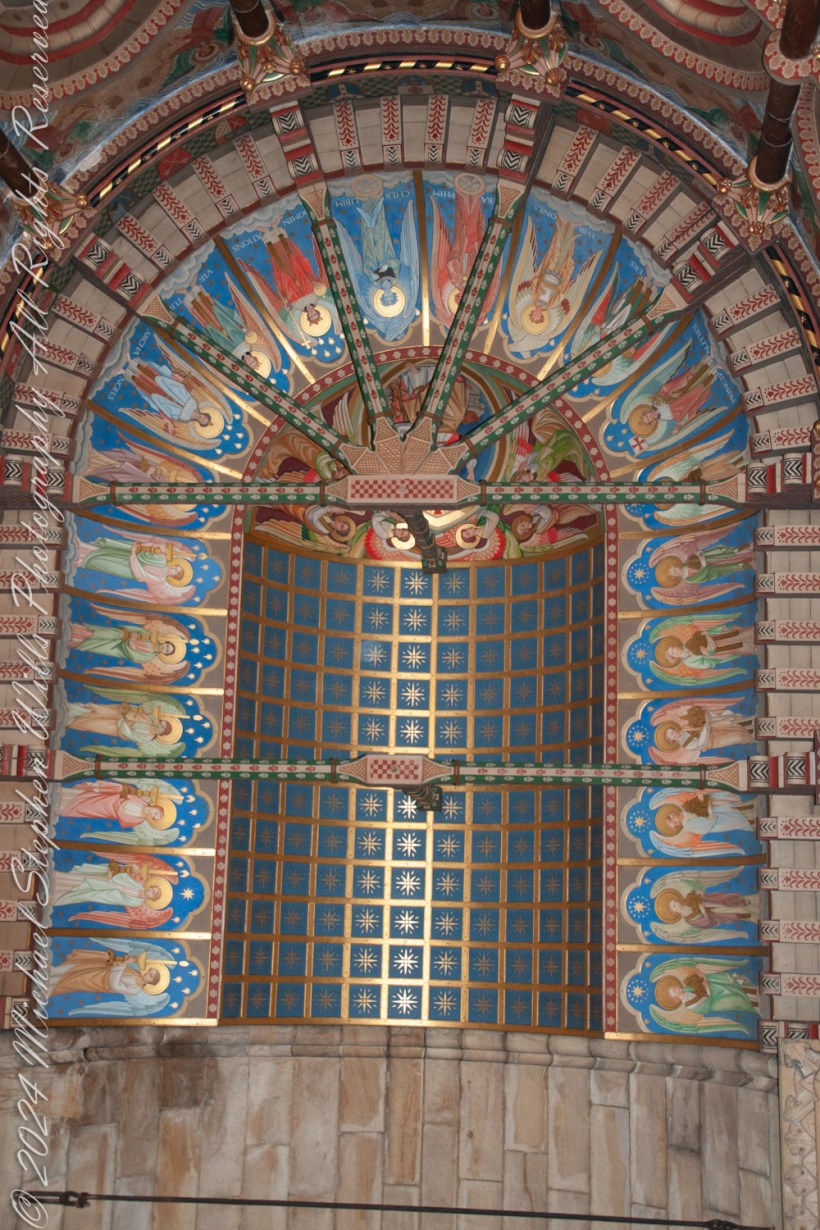
Focusing my camera on the Sanctuary Ceiling of Saint Fin Barre’s Cathedral, I was struck by the stunning example of Victorian Gothic Revival artistry before me. Designed by the architect William Burges, who envisioned every detail of the cathedral, the ceiling reflected his meticulous attention to detail and his love for vibrant colors and symbolic ornamentation.

The rich iconography drew me in. Angels adorned the ceiling, likely representing the celestial hierarchy or the glorification of Christ. Each angel held symbolic items—trumpets, stars, or scrolls—emphasizing their roles as messengers and worshippers of God.

The radiant color scheme was breathtaking. Deep blues, shimmering golds, lush greens, and vivid reds combined to create a striking visual effect, symbolizing heaven and divine majesty. Gold accents caught and reflected the light, reinforcing the idea of heavenly glory.

Geometric and star patterns embellished the vaults. The blue panels dotted with gold stars symbolized the heavens—a common motif in Gothic church ceilings. These stars seemed to represent divine guidance or eternity, adding another layer of meaning to the already rich tapestry above me.

The structural elements themselves were works of art. Painted ribs intersected across the ceiling, highlighting the Gothic architecture’s ribbed vaulting. Their intricate designs in green and red emphasized both structural beauty and functional elegance.

The symbolism was profound. The angels with their instruments and the starry heavens collectively evoked themes of divine worship and the glory of God’s kingdom. This alignment with the Victorian Gothic ideal of infusing spiritual symbolism into architectural elements was evident in every brushstroke.

Knowing that William Burges envisioned Saint Fin Barre’s Cathedral as a “Bible in stone,” I felt a deep connection to his purpose. Standing beneath the Sanctuary Ceiling—the focal point above the altar—I sensed how it served to elevate worshippers’ gaze and spirits toward the divine.

Capturing these scenes through my lens, I was documenting a testament to the artistic and architectural achievements of the 19th century. Saint Fin Barre’s Cathedral is a place of worship and also a living gallery of history, faith, and unparalleled craftsmanship.

Enter your email to receive notification of future postings. I will not sell or share your email address.

What the Resurrection Angel Symbolizes for Cork City

The Resurrection Angel at Saint Fin Barre’s Cathedral symbolizes hope and vigilance, reminding Cork’s citizens of life’s transience and resilience.

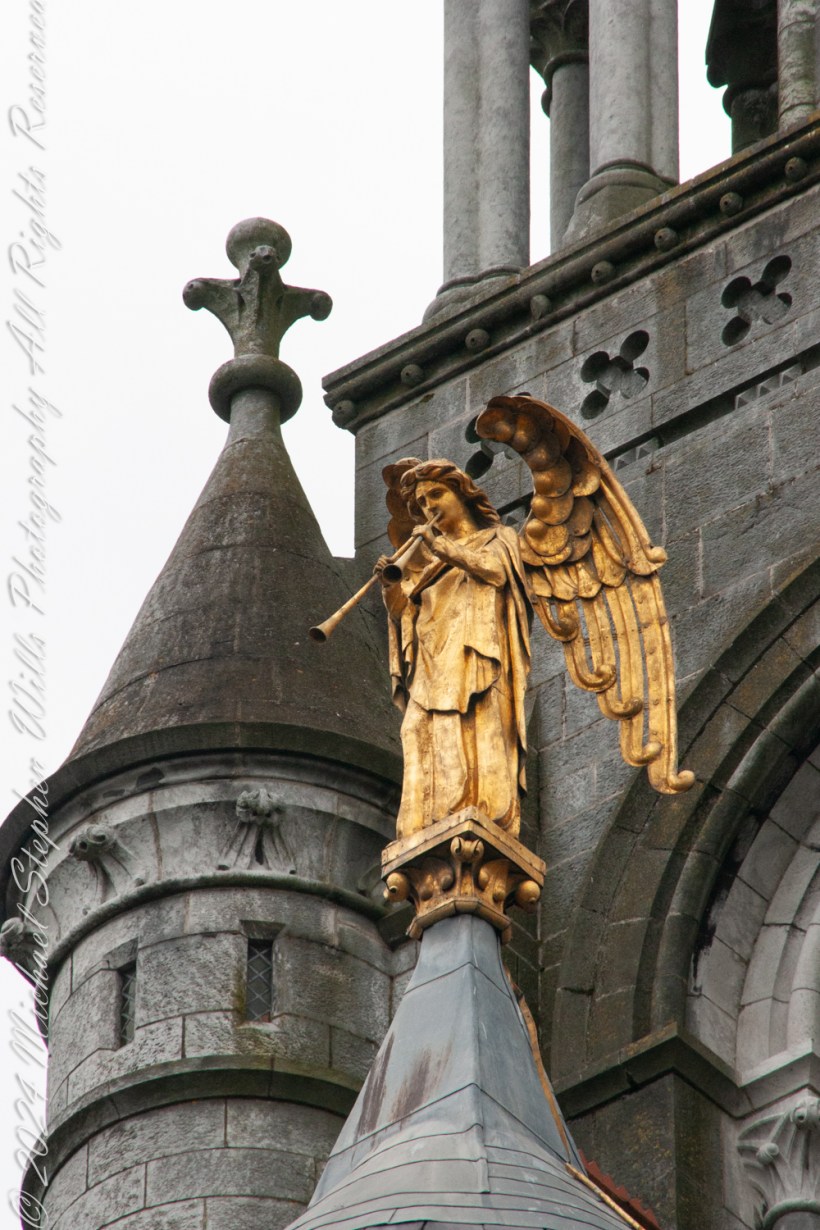
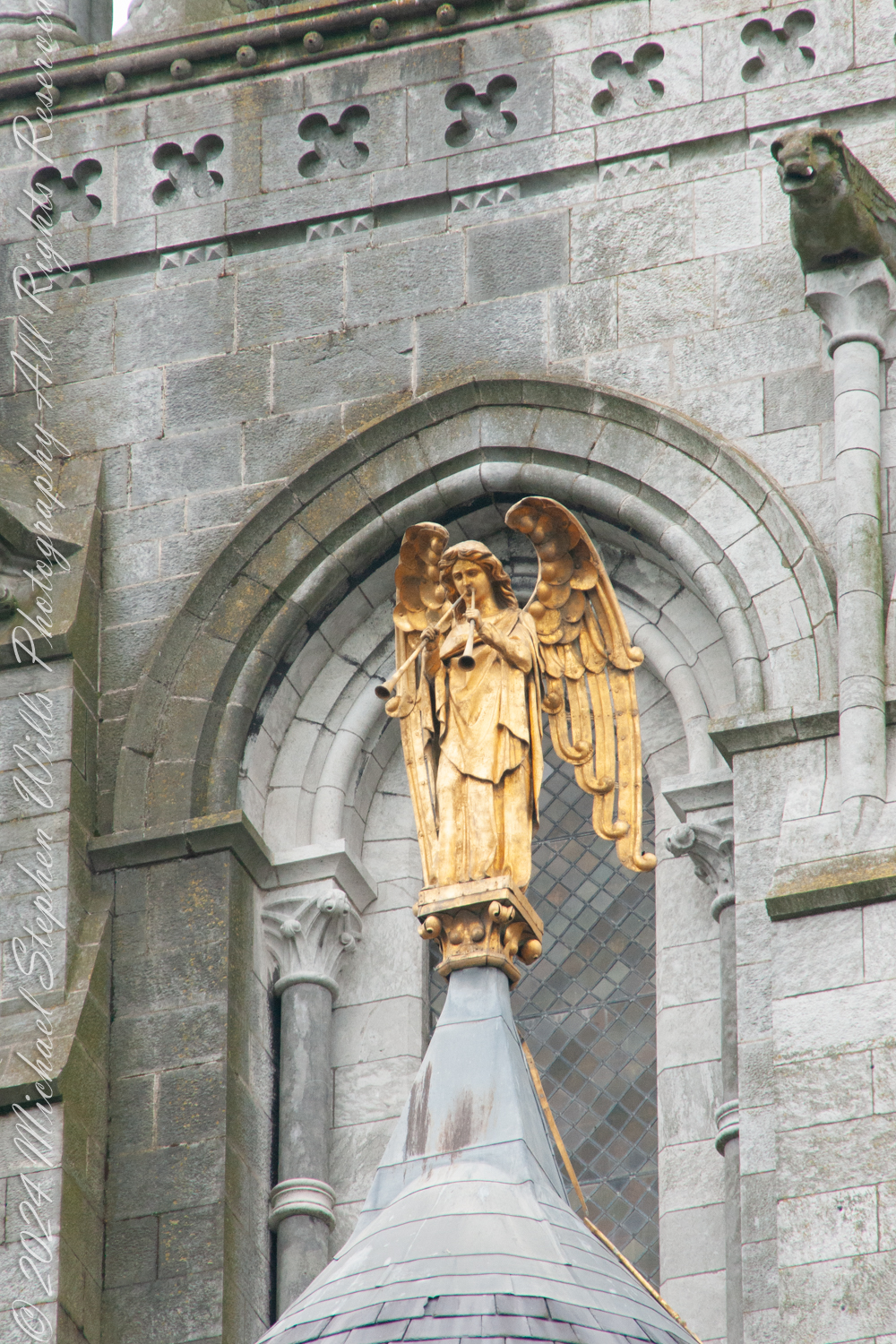
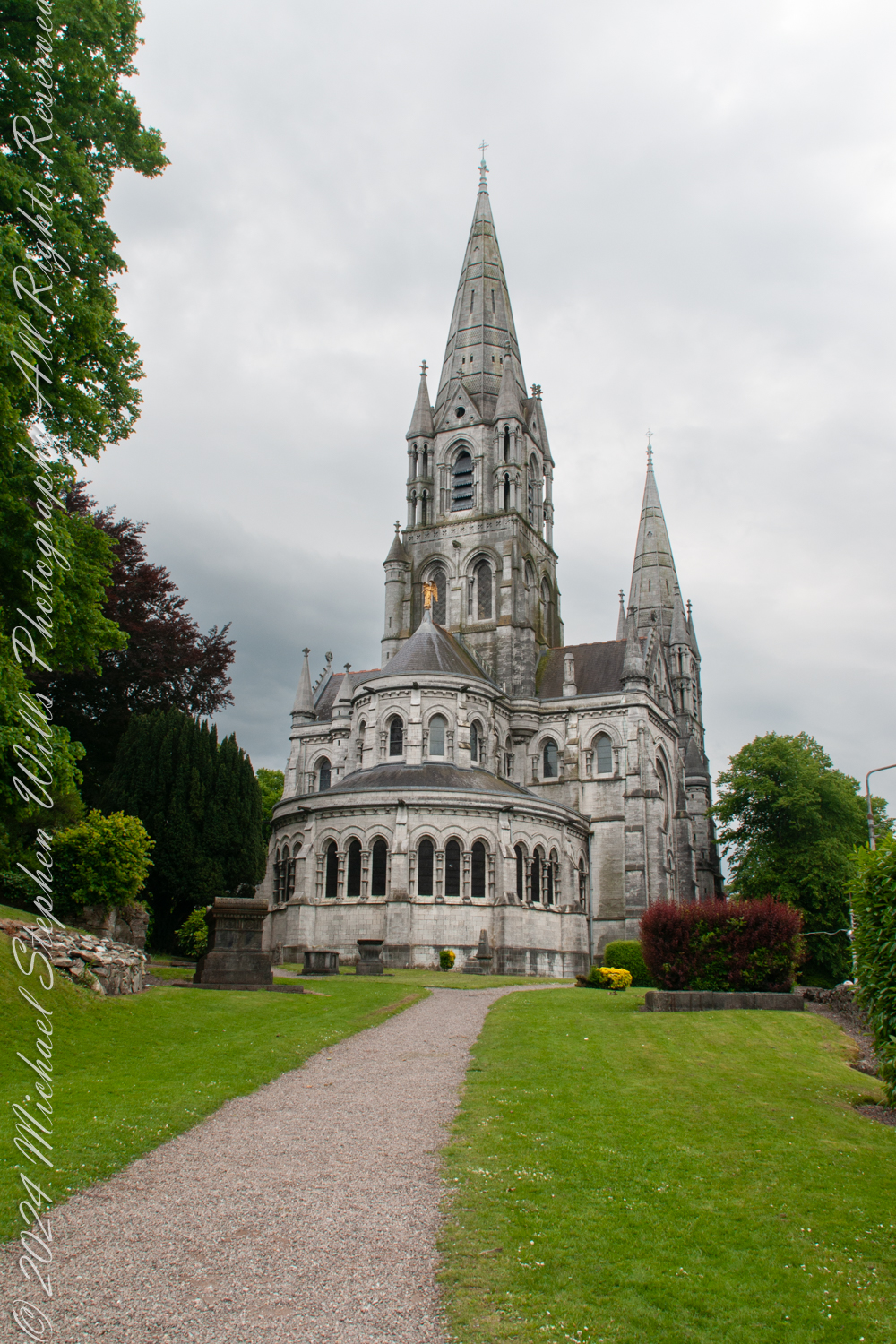
Standing on the east side of Saint Fin Barre’s Cathedral, I lift my gaze to the gilded angel high above the polygonal apse. Known as “The Resurrection Angel,” this radiant figure with its trumpet held aloft commands both awe and contemplation. As an enduring symbol of hope, renewal, and spiritual vigilance this angel carries a profound and dramatic promise: the sound of its trumpet will one day warn the people of Cork of the world’s imminent end, giving them the opportunity to be among the first to ascend to heaven.

The Resurrection Angel’s trumpet echoes the apocalyptic imagery of the Book of Revelation, particularly Revelation 11:15, where the seventh trumpet announces, “The kingdoms of this world have become the kingdoms of our Lord.” Yet in Cork, this celestial figure is imbued with a uniquely local significance. It stands as both guardian and guide, poised to fulfill its divine purpose when the end of days draws near. The legend elevates the angel’s presence beyond theology or art—it becomes a tangible connection between the celestial and the earthly, rooted in the lives of Cork’s citizens.

From an epistemological perspective, the Resurrection Angel poses fascinating questions about how we prepare for the unknown. What does it mean to live in the shadow of an angelic trumpet, one that might sound at any moment? Its silence is a paradox, a quiet yet profound proclamation of life’s transience. The legend suggests that the people of Cork, by virtue of the angel’s warning, are uniquely favored—a notion that intertwines faith with identity and imbues the city with a sense of divine guardianship.

The angel’s golden form shines brightly against the gray stone of the cathedral, a deliberate contrast that speaks to its otherworldly purpose. Gold, a symbol of purity and divine light, captures the eternal amid the temporal. The Resurrection Angel reflects the ambitions of the cathedral’s architect, William Burges, who intended every detail of Saint Fin Barre’s to serve as a testament to faith and artistry. This angel was the final piece installed, marking the cathedral’s completion and fulfilling Burges’ vision of a “perfect work.” According to lore, Burges himself declared that if the angel were ever to fall, it would signal the end of the world—a statement that deepens the mystique surrounding this celestial figure.

For Cork, the angel embodies the city’s resilience and collective spirit. Over centuries, Cork has weathered fires, floods, and rebellion, yet it has always risen anew. The angel, with its legend of warning and redemption, mirrors this cyclical journey of challenge and renewal. Its trumpet, silent but ever-present, reminds the people of Cork to stay vigilant, to hope, and to strive for goodness in the time they have.

As I stand beneath its watchful gaze, I feel the weight of the legend and its implications. If the angel’s trumpet were to sound today, would we be ready? It invites not fear but reflection—a challenge to live with purpose and awareness of the sacred in the everyday. And as I step away, the angel remains, steadfast and golden, a silent guardian over Cork, holding its promise and its warning aloft for generations to come.

Enter your email to receive notification of future postings. I will not sell or share your email address.

Saint Fin Barre’s Cathedral: A Marvel of Victorian Architecture

Saint Fin Barre’s Cathedral, a Gothic Revival masterpiece by William Burges, symbolizes artistry and faith in Cork, Ireland.

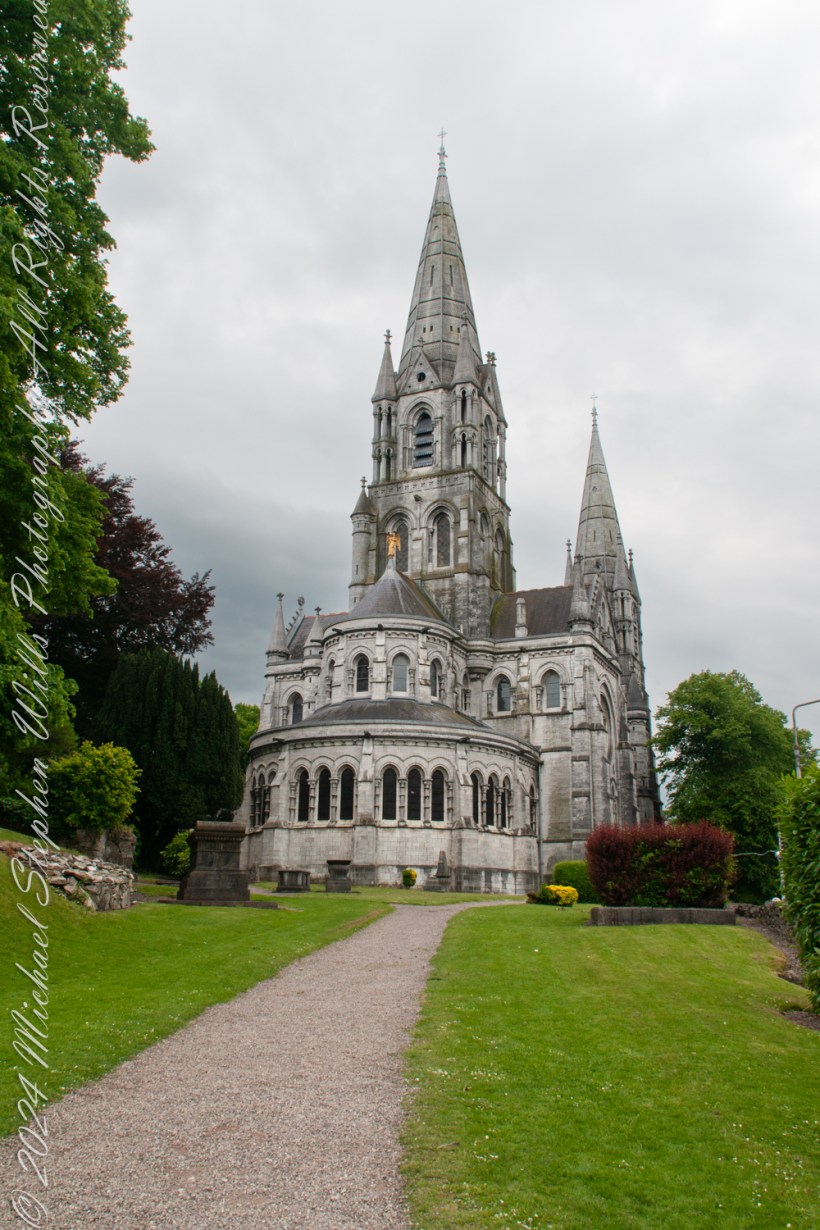
Approaching from the east, we see the polygonal apse at the eastern end houses the high altar and is a key liturgical and architectural feature. Each angular bay is delineated with tall lancet windows filled with stained glass, adding to the richness of the design. Saint Fin Barre’s Cathedral, a masterpiece of Gothic Revival architecture, stands as a beacon of faith and artistry in the heart of Cork, Ireland. Designed by the renowned Victorian architect William Burges, the cathedral is both a testament to the spiritual fervor of its time and a bold statement of artistic vision.

Approaching from the east, we see the polygonal apse at the eastern end houses the high altar and is a key liturgical and architectural feature

Commissioned in 1862, the cathedral replaced an earlier structure, marking a new chapter in Cork’s ecclesiastical history. William Burges, known for his theatrical approach to design, was the perfect choice for this ambitious project. His vision for Saint Fin Barre’s Cathedral blended medieval inspiration with Victorian ingenuity, creating a building that is as much a work of art as a place of worship.

Burges, a figure of eccentric brilliance, was deeply influenced by the principles of the Gothic Revival movement, which sought to recapture the grandeur of medieval European architecture. Drawing from this aesthetic, he designed the cathedral with meticulous attention to detail. Its three spires dominate the Cork skyline, with the central spire rising to an impressive height of 73 meters. These spires are not merely structural; they are symbolic, reaching heavenward in a gesture of devotion.

The exterior of the cathedral, constructed from Cork limestone and Bath stone, is adorned with intricate carvings and sculptures. These include depictions of biblical scenes, saints, and gargoyles, all painstakingly crafted under Burges’s watchful eye. Every detail reflects his belief that architecture should educate as well as inspire. Bishop Street, The Lough, Cork City, County Cork, Ireland

Enter your email to receive notification of future postings. I will not sell or share your email address.

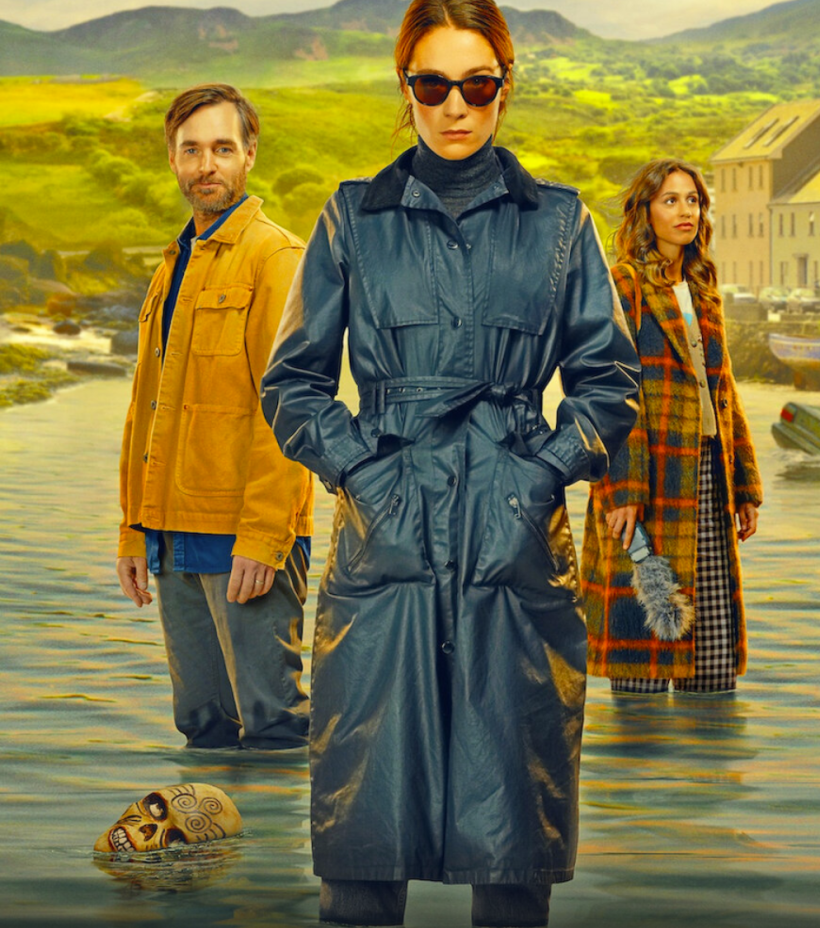
A Review of the Netflix Series “Bodkin.”

“Bodkin” on Netflix masterfully blends intrigue and dark humor, offering razor-sharp storytelling and stellar performances. Dive into a world of enigma and suspense, where every detail demands attention and rewards you with compelling drama.

The word “bodkin” evokes images of a small, sharp tool, deftly navigating the tightest of spaces. This precision and ability to cut through complexities is mirrored in Netflix’s new series, “Bodkin,” a masterful blend of intrigue and dark humor that carves out its own niche in the crowded landscape of modern television.

From the opening scenes, “Bodkin” plunges viewers into a world brimming with enigma and suspense. The series is a taut narrative tapestry, meticulously woven with threads of mystery, psychological depth, and unexpected wit. Its storytelling is as sharp and incisive as the tool it’s named after, deftly unpicking the tangled skeins of its characters’ lives and secrets.

The show is anchored by an ensemble cast delivering performances that are nothing short of stellar. Each actor brings a unique shade to their character, creating a rich mosaic of personalities that are as compelling as they are multifaceted. The writing is crisp and clever, peppered with dialogue that crackles with intelligence and dry humor. It’s this blend of sharp wit and deep emotion that sets “Bodkin” apart from its peers.

Visually, “Bodkin” is a feast for the eyes. The cinematography captures the essence of its settings, transforming them into integral characters in their own right. The lush, atmospheric shots heighten the sense of place and mood, drawing viewers deeper into the show’s intricate world. The pacing is perfect, unspooling its mysteries with a rhythm that keeps viewers perpetually on the edge of their seats.

However, “Bodkin” is not without its minor flaws. At times, the labyrinthine plot can seem almost too dense, requiring viewers to pay close attention to every detail. But these moments are fleeting and overshadowed by the series’ many strengths.

In summary, “Bodkin” is a razor-sharp triumph, a series that cuts through the clutter with its incisive storytelling, brilliant performances, and visual splendor. It’s a show that demands and rewards attention, a true gem in Netflix’s ever-expanding treasure trove of content.

Copyright 2024 Michael Stephen Wills All Rights Reserved

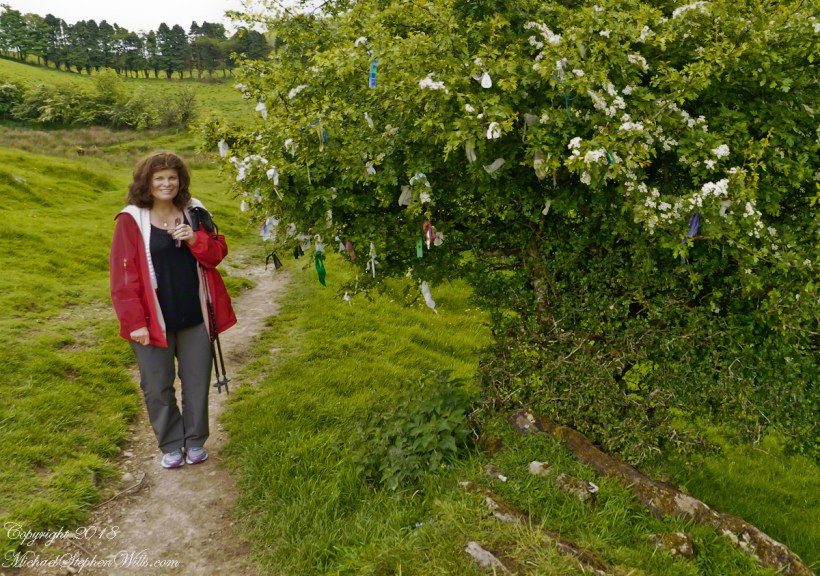
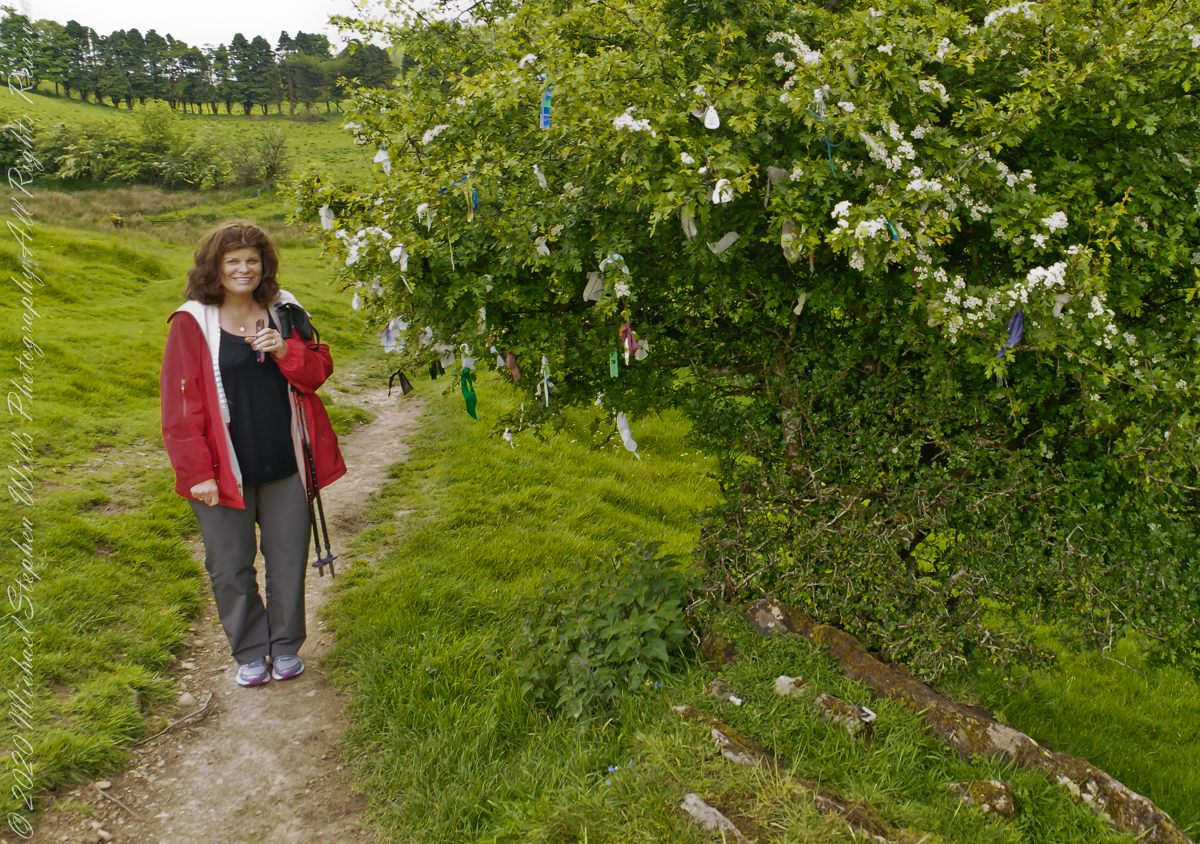
Pam Wills at Loughcrew, County Meath, Ireland

Pam and I were lucky enough to plan our tour of Ireland for May and June when the Hawthorne trees are in bloom.  Named sceach gheal in Gaelic, the white clusters of blossoms symbolize hope.  Hawthorns are plentiful throughout the island.  The Irish revere the tree and associate each Hawthorn with the Little People.  There are roads in Ireland that curve around a Hawthorn tree because the local people convinced the engineers to do so, to save the tree.

This specimen, covered with offerings (to the Little People?), is on the trail to Loughcrew.  Even with her knee trouble, Pam made it to the top of the Hag’s Mountain to visit Cairn T of the Loughcrew Passage tombs.

The steep path to Loughcrew passes a hawthorn covered with flowers and may offerings.

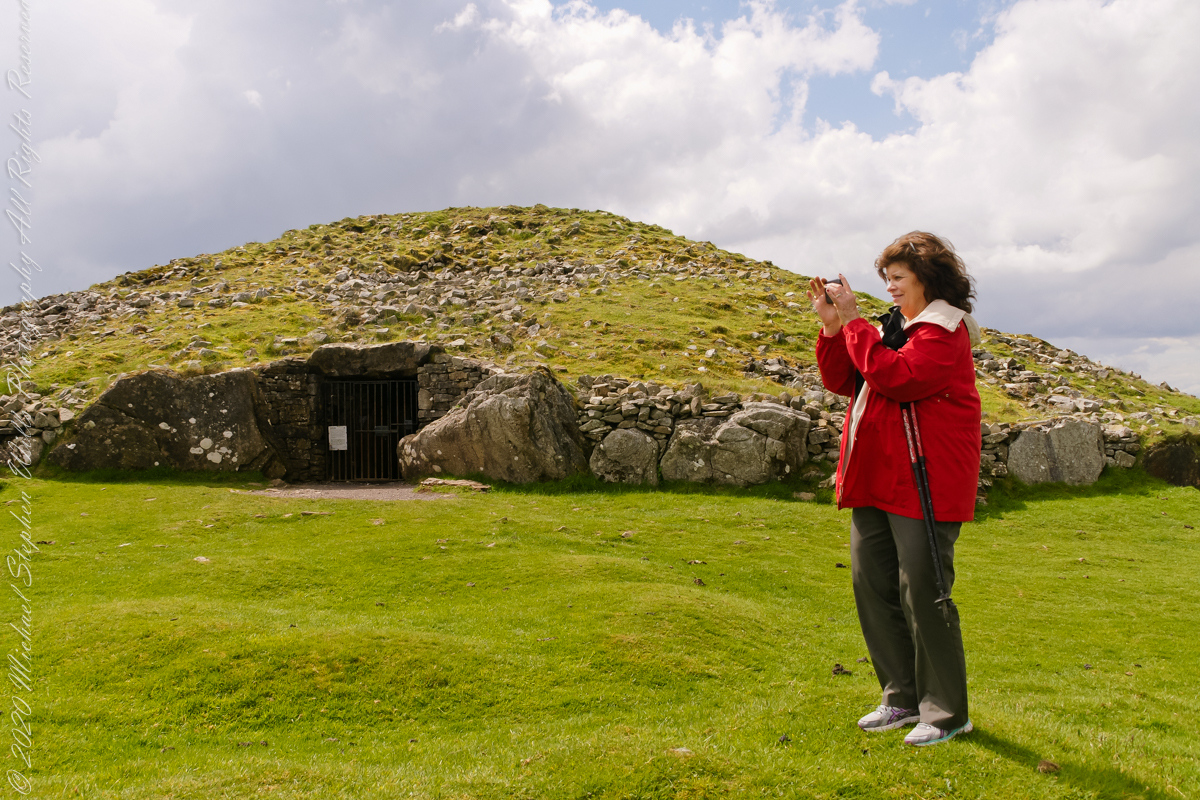
Pam loves to capture images and returned from Ireland with a large collection.  Most of the photos of me at work are by Pam.  Here Pam is capturing the summit view of Hag’s Mountain with the Cairn T entrance gate in the background.  Lucky for us, a fellow visitor made the trip to Loughcrew Gardens and picked up the  gate key from the café.  In a later post I will share my work from inside this passage tomb.

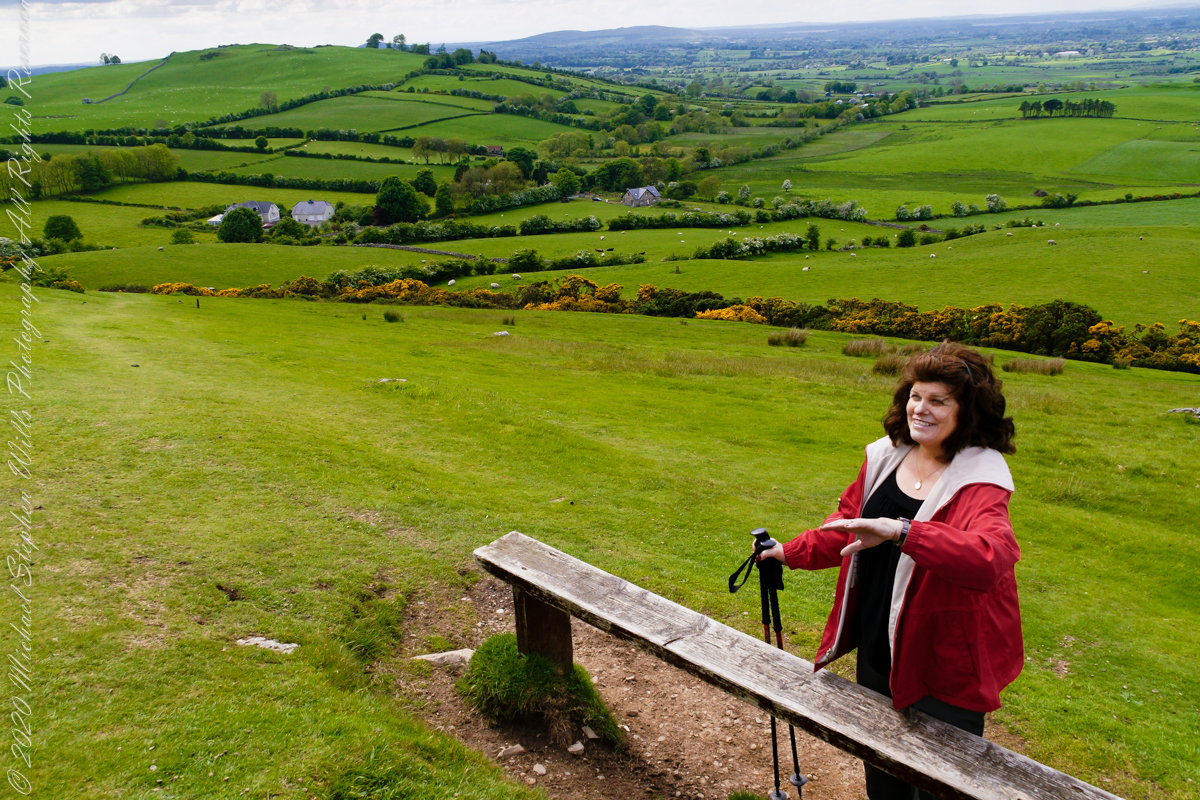
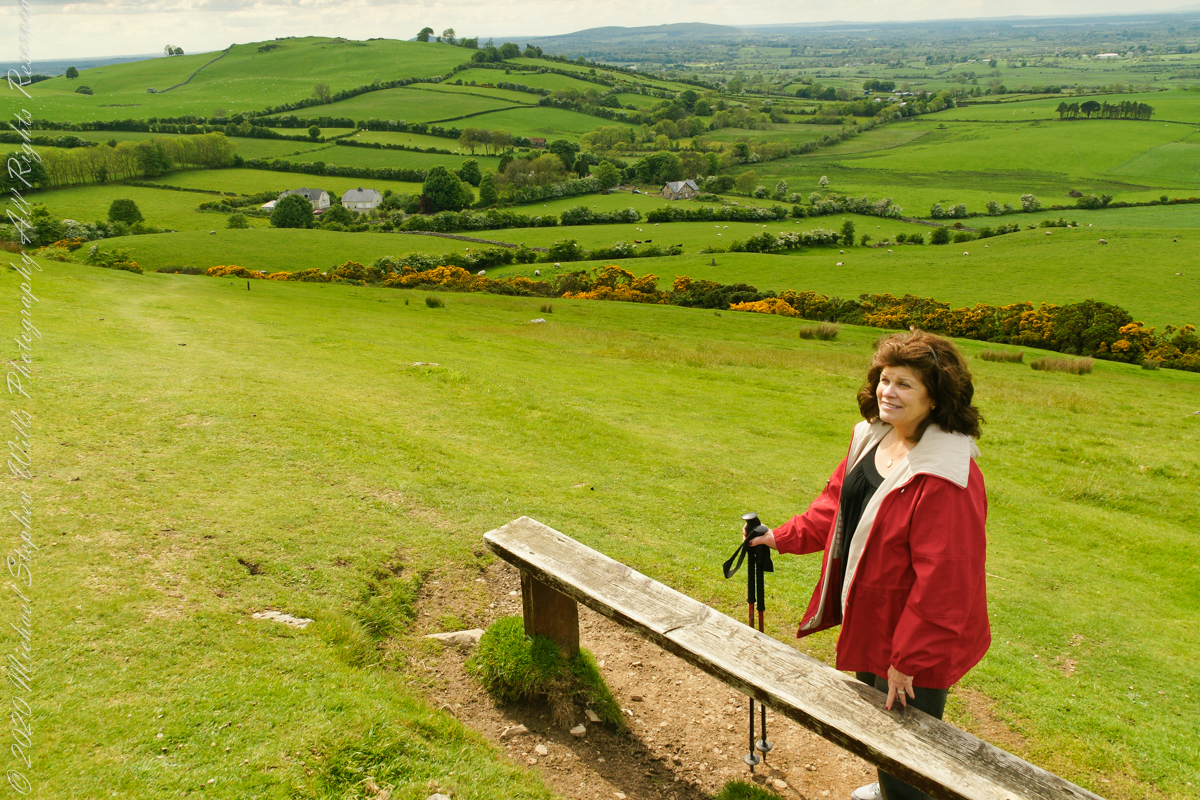
Pam makes friends wherever we go.  She started down the mountain before me to take it easy on her knees.  When I caught up, Pam and a young Irish family were deep in conversation.  I took the opportunity to capture Pam with that gorgeous view to the northwest, Irish countryside with Lake of the Branches in the far distance.

Copyright 2023 Michael Stephen Wills All Rights Reserved

Our Sally II

Thrifty

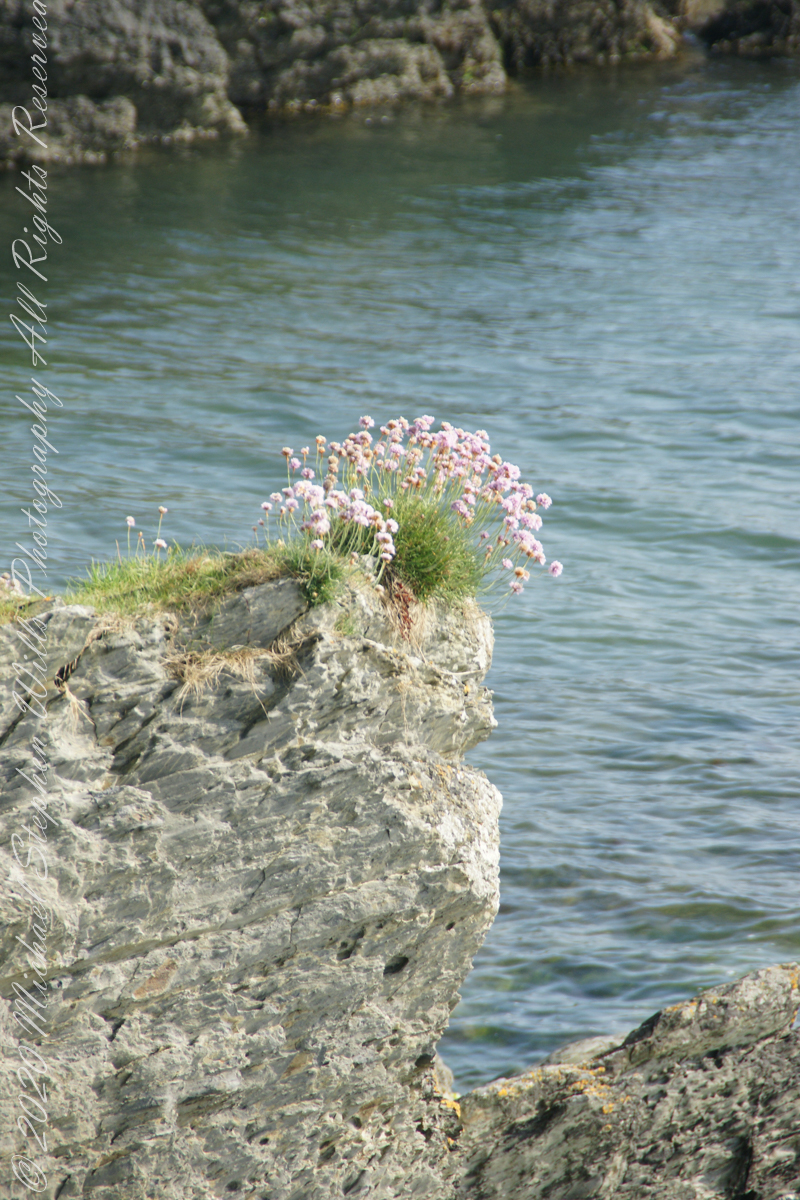
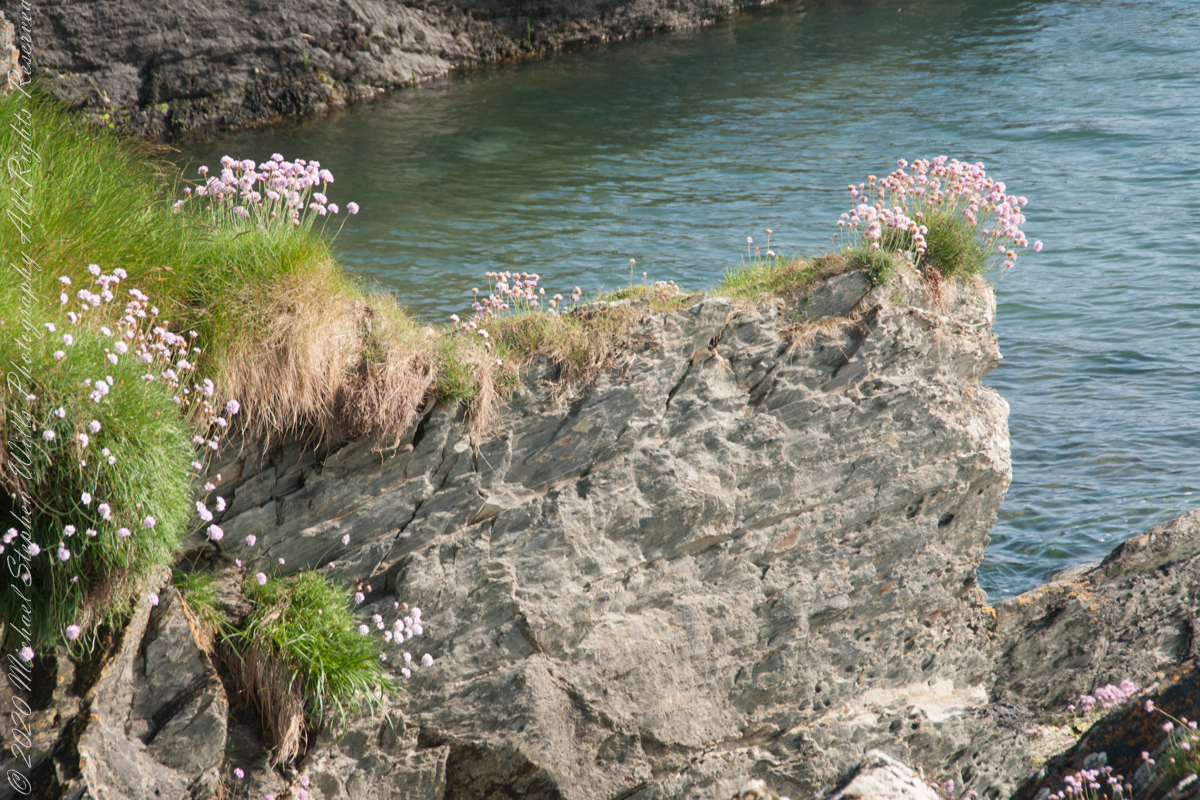
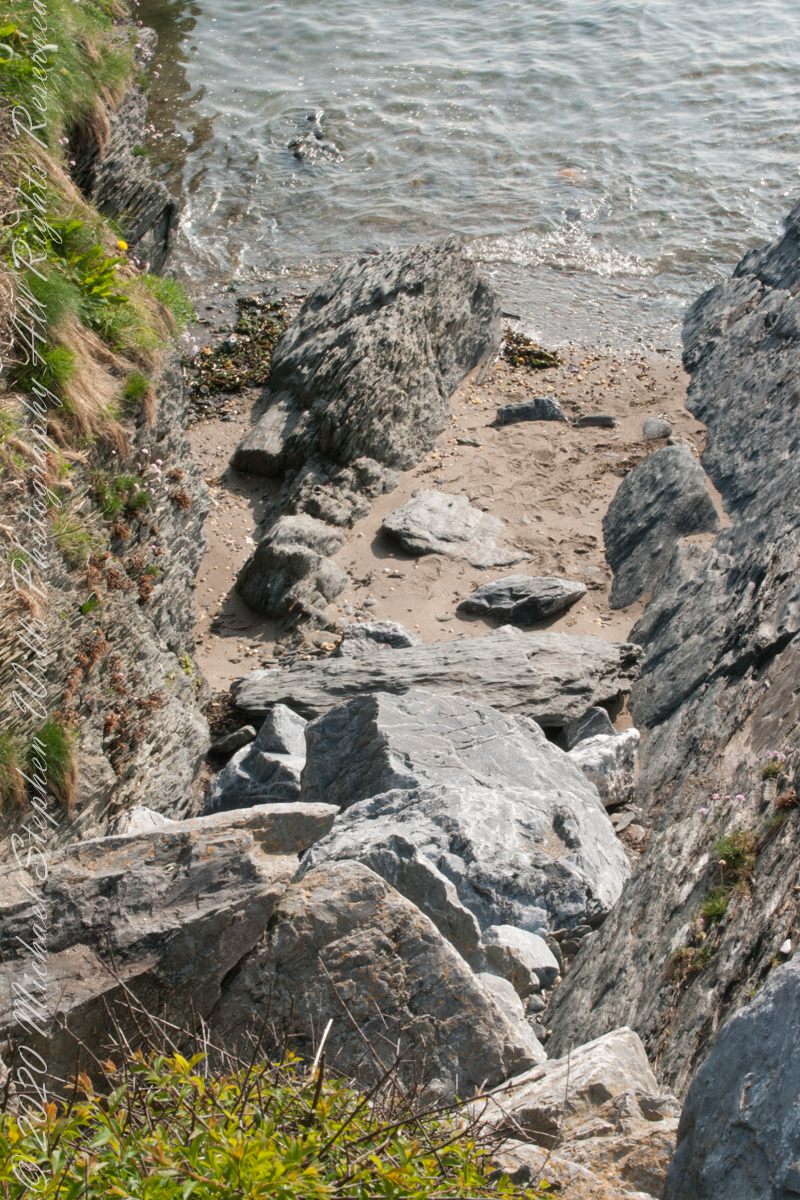
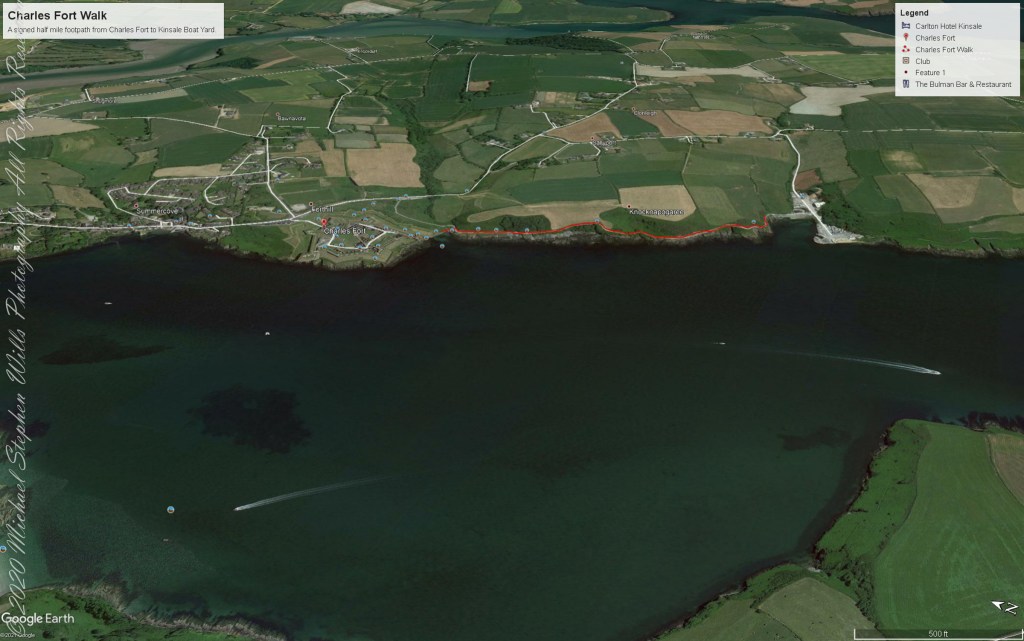
We continued down the half mile “Sallyport” footpath, marked in red on the Google Earth view provided at the end of this post, along shoreline cliffs to find these croppings of Sea Pink on jagged rocks.

Oddly, the jags being perfect places for Sea Pink to perch. Scientific name, Armeria maritima, and also known by Thrift or Sea Thrift, a reason these evergreen perennials are found on the obverse of the British Three Pence coin issued 1937 – 1952. Thrifty can mean to buy a lot for a little money — three pence is very little money.

Click any pic for a larger view, in a new tab, or a slide show. When using WordPress Reader, you need to open the post first.

Another sign informing hikers of the view.

Reference

Armeria maritima” – wikipedia

Copyright 2023 Michael Stephen Wills All Rights Reserved

Our Sally I

Views of Celtic Sea

A half mile footpath, marked in red on the following Google Earth view, leads from the Charles fort sallyport, along the shoreline cliffs, surmounted by working farmland and looks toward the Celtic Sea.

To “sally” is to suddenly charge out from a besieged place against the enemy. The word is also used as a noun. It can also be used to describe our walk, as a sally to an unusual place.

Here is a view of the Celtic Sea from the Sallyport

From Wikipedia: “The Celtic Sea receives its name from the Celtic heritage of the bounding lands to the north and east. The name was first proposed by E. W. L. Holt at a 1921 meeting in Dublin of fisheries experts from Great Britain, France, and Ireland. The northern portion of this sea was considered as part of Saint George’s Channel and the southern portion as an undifferentiated part of the “Southwest Approaches” to Great Britain. The desire for a common name came to be felt because of the common marine biology, geology and hydrology of the area. It was adopted in France before being common in the English-speaking countries; in 1957 Édouard Le Danois wrote, “the name Celtic Sea is hardly known even to oceanographers.”[3] It was adopted by marine biologists and oceanographers, and later by petroleum exploration firms. It is named in a 1963 British atlas.. A 1972 article states ‘what British maps call the Western Approaches, and what the oil industry calls the Celtic Sea […] certainly the residents on the western coast [of Great Britain] don’t refer to it as such.'”

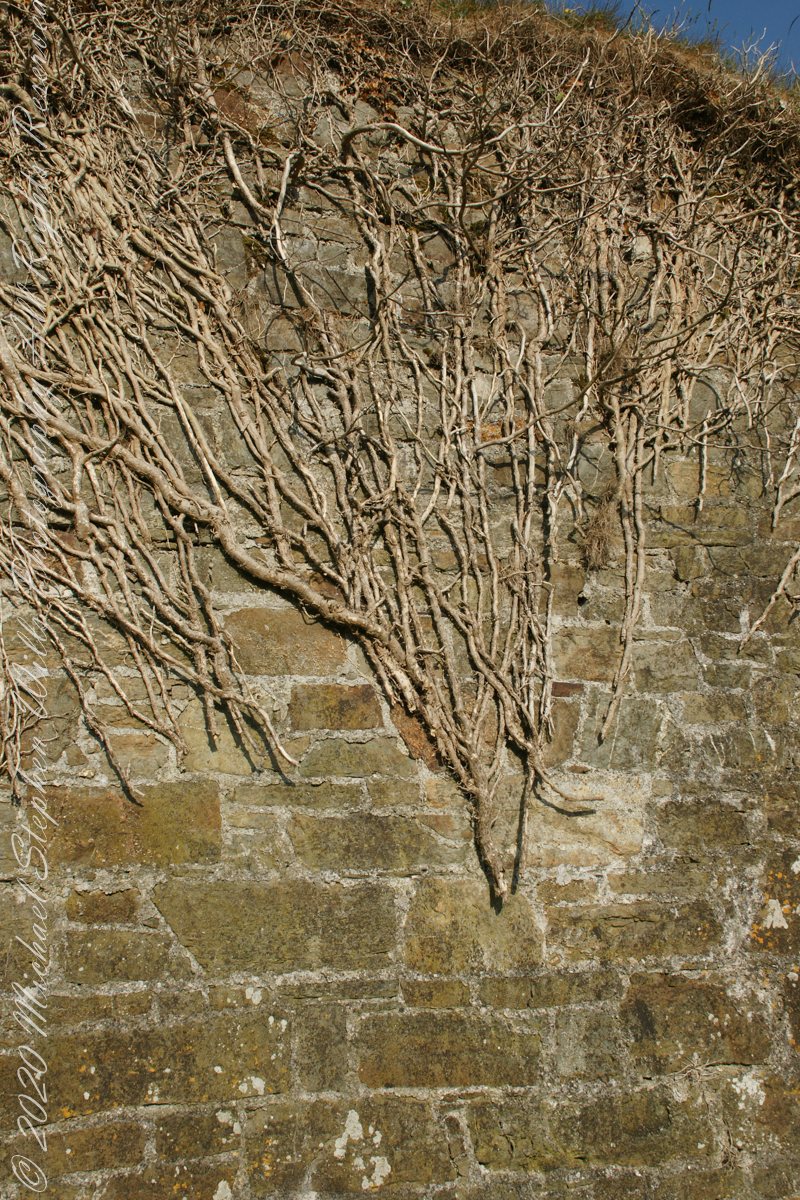
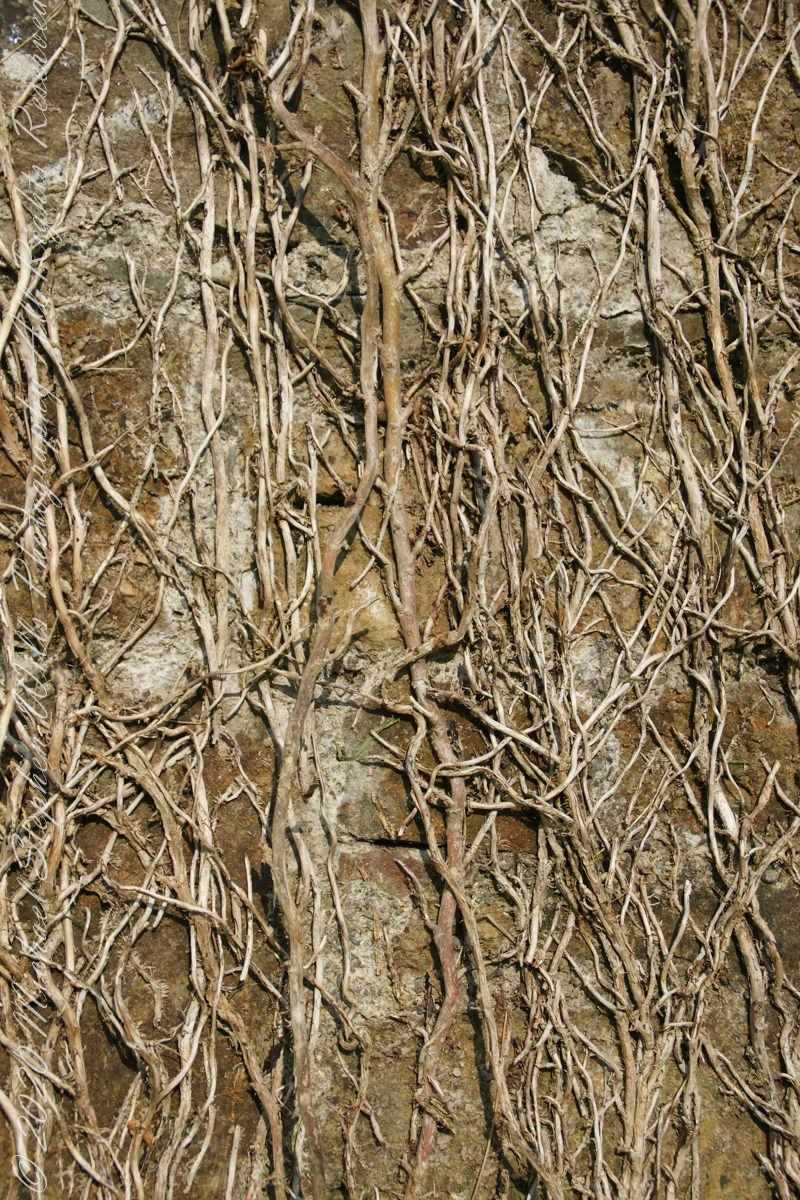
Views of the wall from previous photograph. The vines were separated from roots to preserve the walls, leaving interesting patterns.

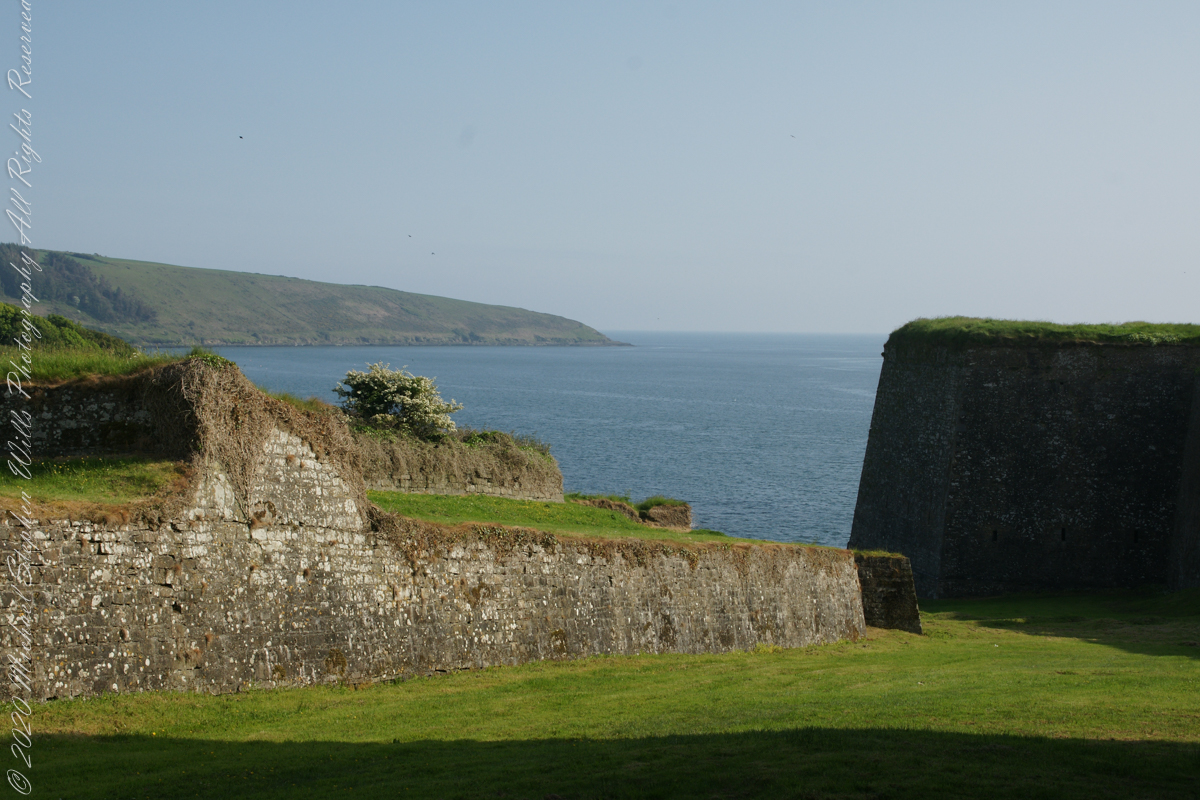
The distant land to the right, beyond the walls, is the Old Head of Kinsale.

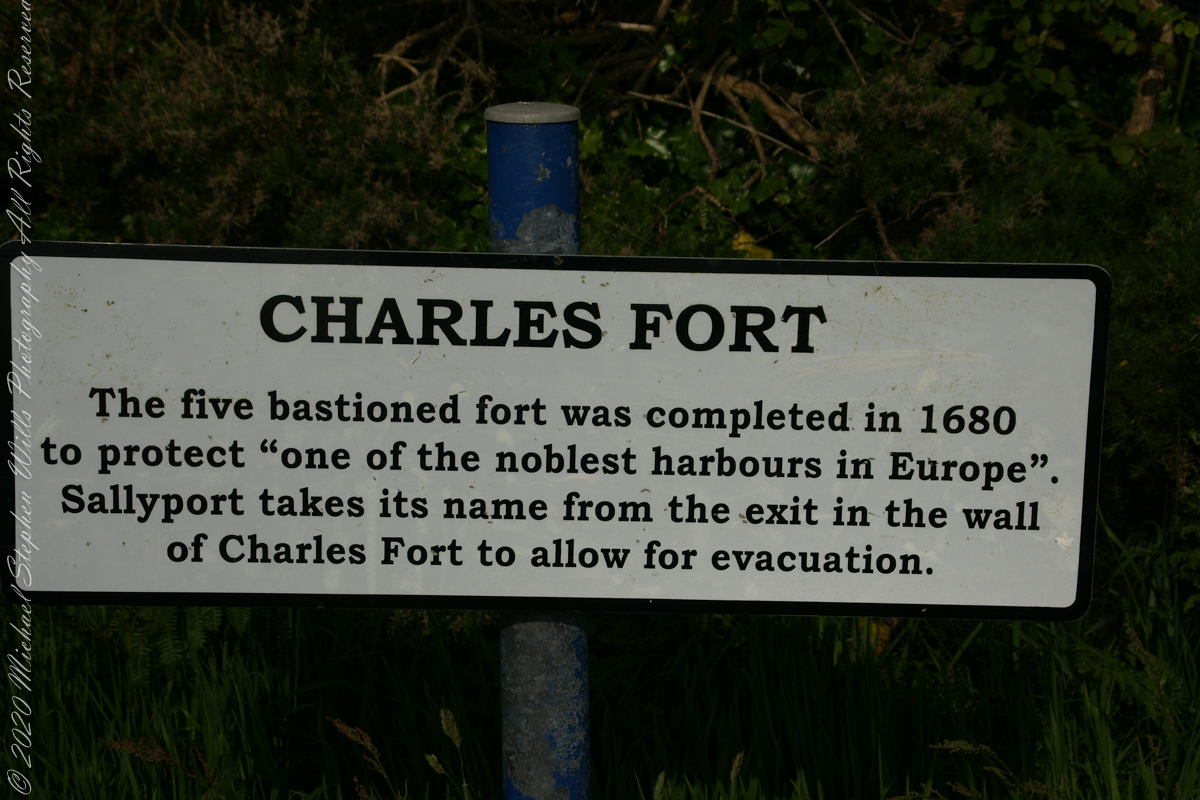
Informational placards along the walk give background to the views enjoyed by hikers.

Here is the above view.

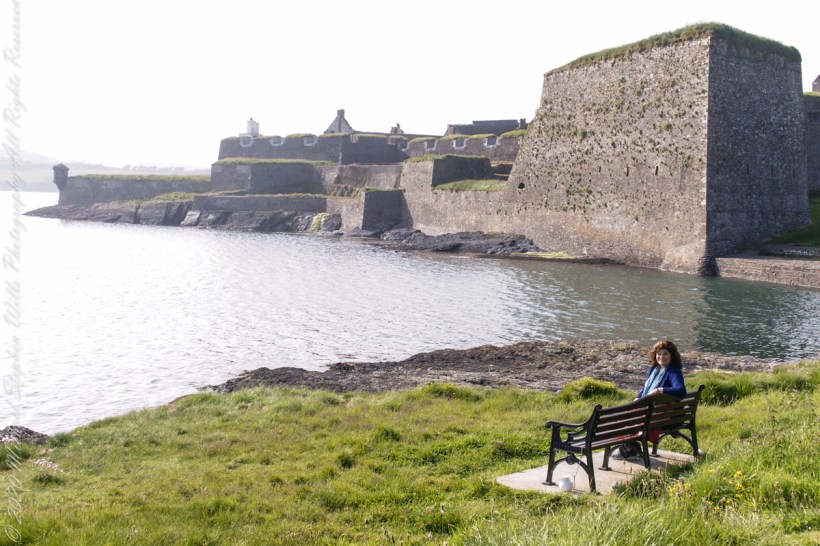
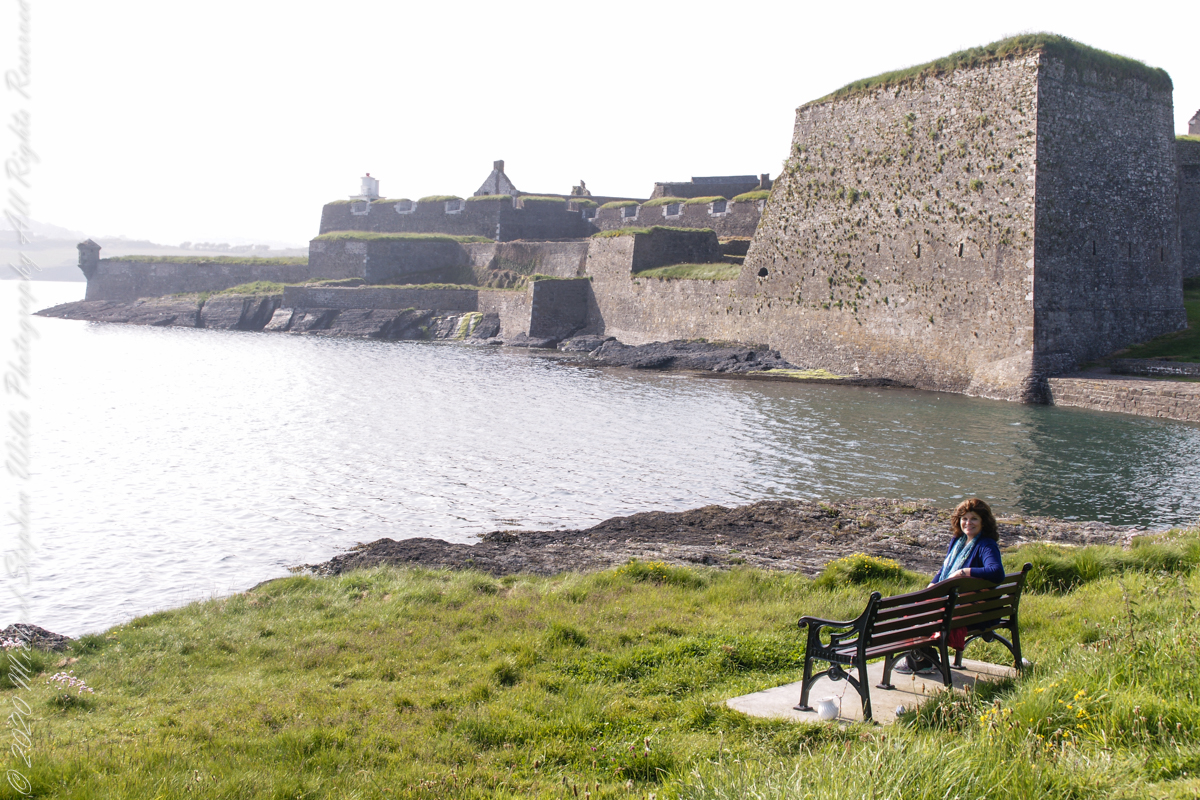
Pam, at start of our walk. Poking above the walls is the Charles Fort Lighthouse. “This lighthouse is a directional light marking the way to safe anchorage close to Kinsale. In 1665 King Charles II granted letters patent to Sir Robert Reading to erect six lighthouses on the coast of Ireland, including one at Barry Oge’s castle, near Kinsale later to become Charles Fort. The original structure would have had a coal fire on its roof. In 1810 powers given to the Commissioners for Barracks and others between 1767 and 1806 were all vested in the Corporation for Preserving and Improving the Port of Dublin or the Ballast Board. This board took over the general lighting and marking of the coast when fourteen lighthouses were transferred to it including that at Charles Fort. This lighthouse, built in 1929, is one of the more recent to be found along the coast, with most dating to the nineteenth century. A new mains powered light at Charles Fort Lighthouse was put into operation on the 14 April 2004 marking the end of a long era of gas and oil powered lights in Ireland.” Quote is from the link provided in references.

References

“Celtic Sea” – wikipedia

“Charles Fort Lighthouse” — Charles Fort Lighthouse, FORTHILL, CORK – Buildings of Ireland

Copyright 2022 All Rights Reserved Michael Stephen Wills

Charles Fort People II

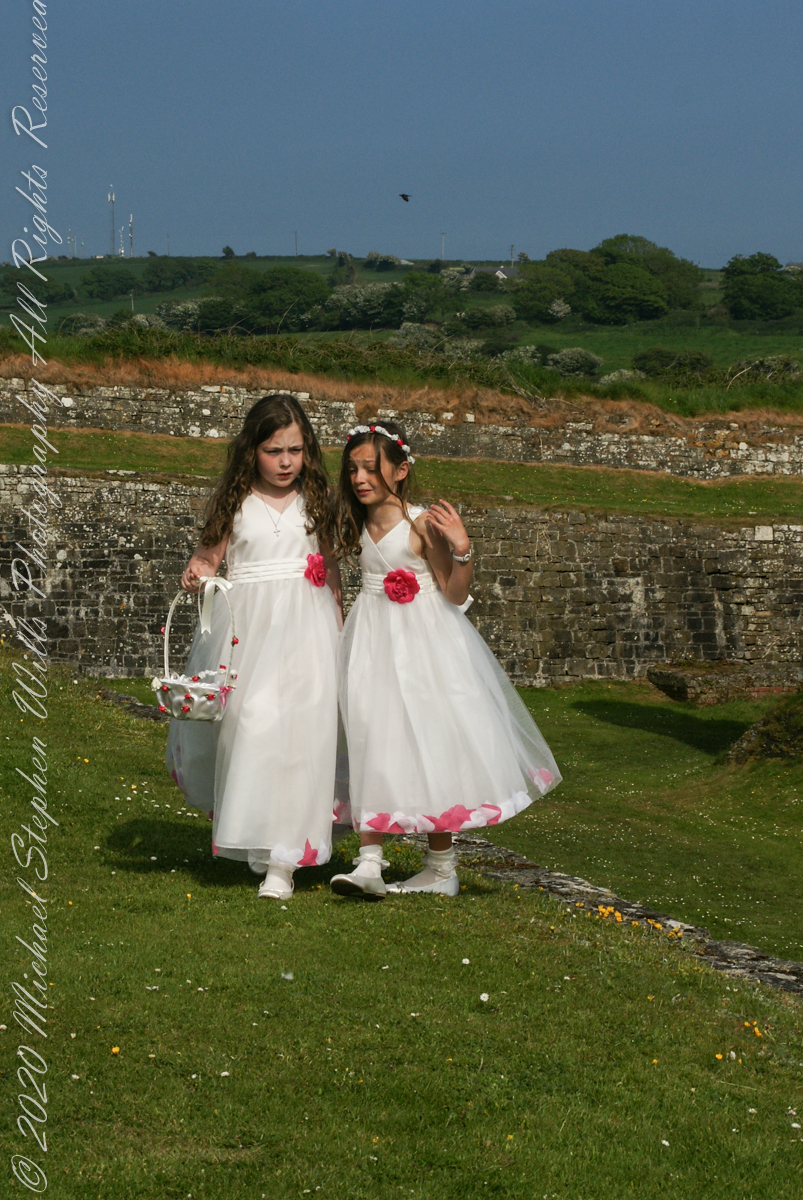
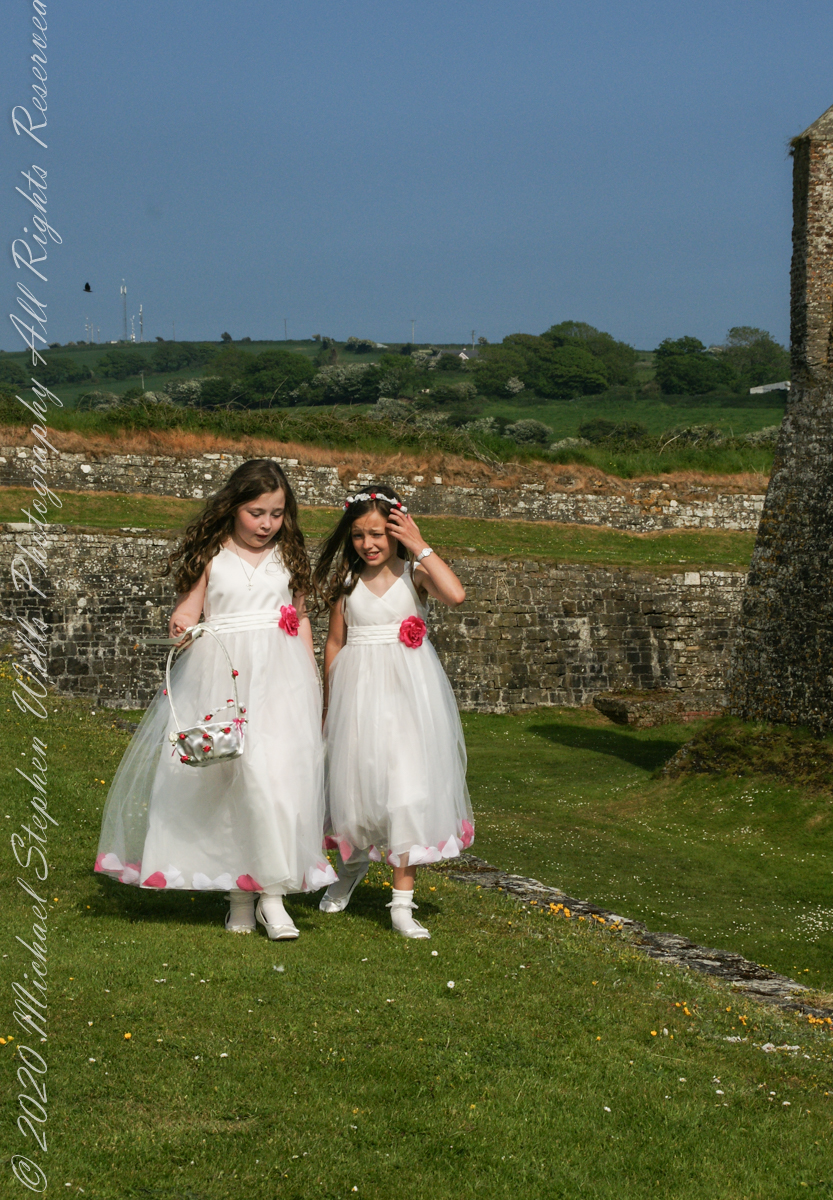
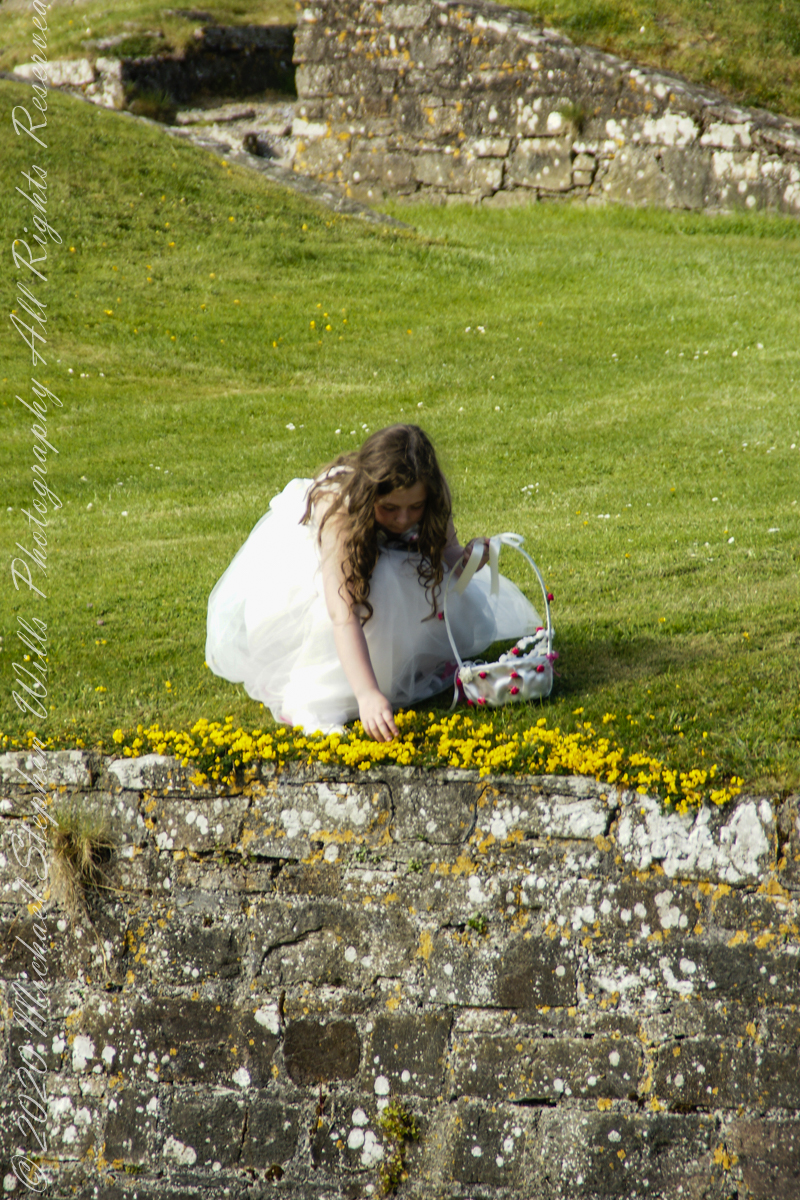
flower girls

Arriving at Charles Fort, the “new” fort compared to the “old” James Fort across the cove, late in the day after our walking tour of Kinsale and lunch, the gate to the interior was closed. Pam and I made do with exploring the outer battlements where the citizens of Kinsale were enjoying themselves.

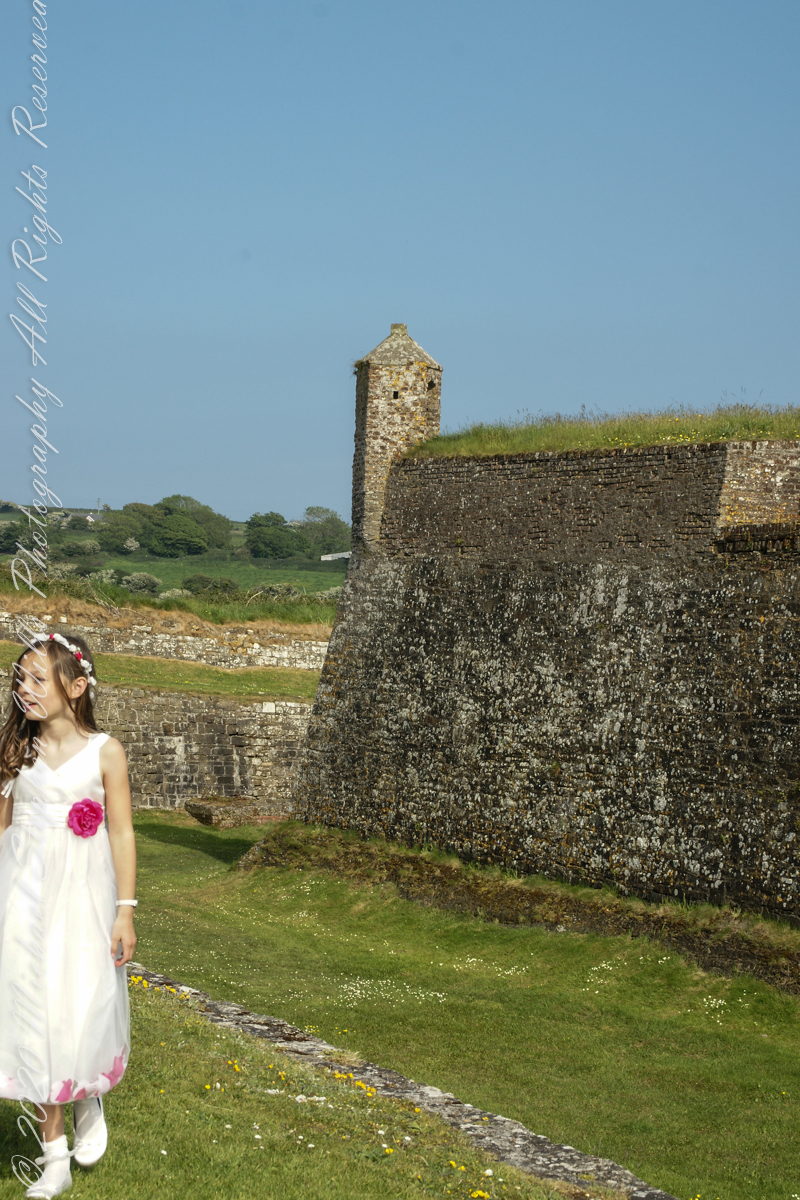
A shortcoming of Charles Fort was the high ground you can see behind the figures. The defenses are strong on the seaward side and open to attack from the land.

Two friends conversing.

Preparations

Click Me for Part I of this series.

References

“Hurling and Charles Fort” – wikipedia

Enter your email to receive notification of future postings. I will not sell or share your email address.

Charles Fort People I

echoes across time

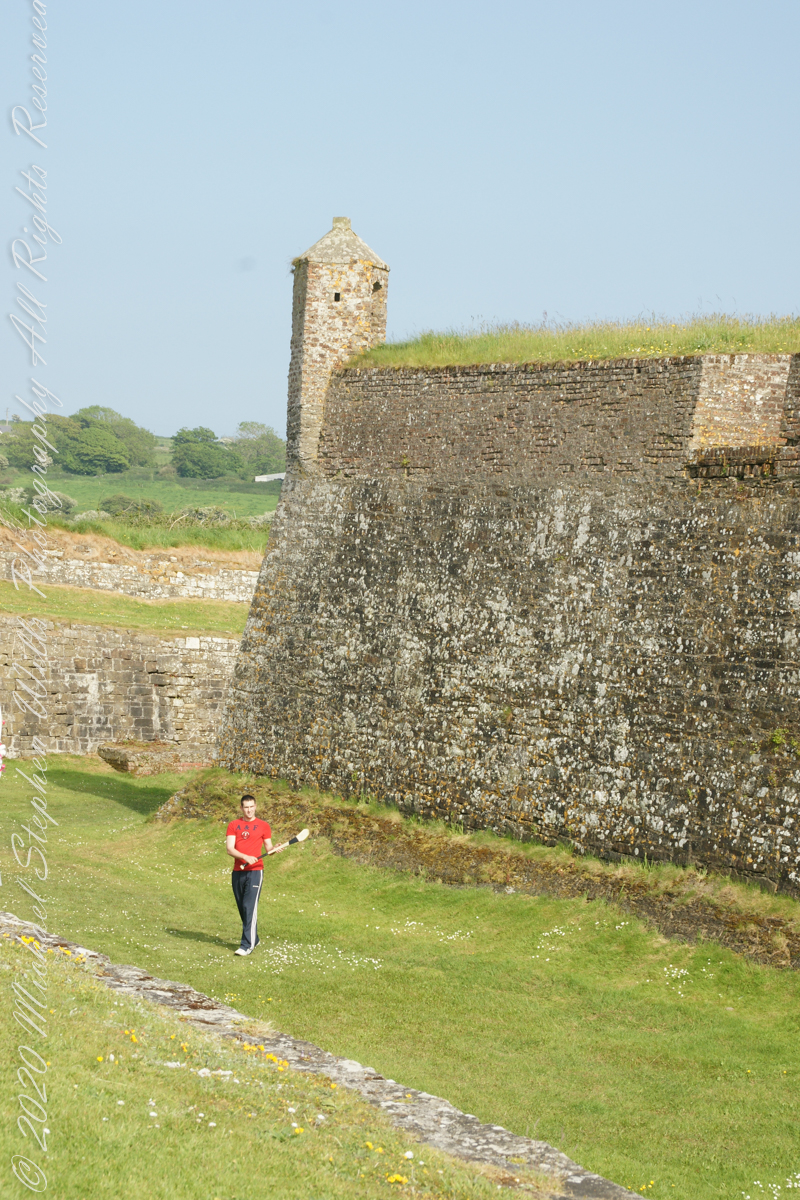
After exploring Kinsale town and lunch Pam and I drove two miles, along the east side of the cove, to the ruins of Charles Fort, one of a pair of fortifications protecting Kinsale from seaward attack. The “New Fort,” Charles, faces the “Old Fort”, James, across the cove.

Built in the 17th century on the site of an older fortification, Ringcurran Castle, it is named for Charles II, the English monarch of the time. The fort was burned during by retreating anti-treaty forces in 1922 during the Irish Civil war. It lay derelict until today’s 1971 until now restoration.
Upon our arrival this young man was handling a hurley and sliotar beneath the fort wall, an incarnation of  Cúchulainn playing hurling at Emain Macha. From Wikipedia, “Hurling is older than the recorded history of Ireland. It is thought to predate Christianity, having come to Ireland with the Celts. The earliest written references to the sport in Brehon law date from the fifth century. Seamus King’s book A History of Hurling references oral history going back as far as 1200 BCE of the game being played in Tara, County Meath. The tale of the Táin Bó Cuailgne (drawing on earlier legends) describes the hero Cúchulainn playing hurling at Emain Macha.”

Click Me for Part II of this series.

References

“Hurling and Charles Fort” – wikipedia

Enter your email to receive notification of future postings. I will not sell or share your email address.