Reflections on Hawkweed: A Meditative Journey Along Buttermilk Creek

Discover the enchanting hawkweed along Buttermilk Creek’s path. Explore its vibrant yellow blooms, unique reproduction, and rich folklore in our latest nature essay. Dive into the captivating world of this resilient wildflower!


Walking along the path that climbs from the lower park into the gorge of Buttermilk Creek, I am drawn to the vibrant splash of yellow that punctuates the verdant green and shale, limestone of the path. Here I encounter the humble yet striking hawkweed (Hieracium spp.). These yellow flowers, seemingly modest in their simplicity, invite me into a deeper contemplation of nature’s intricacies.

A Closer Look

The hawkweed’s leaves form a basal rosette, their slightly toothed edges and hairy surface distinguishing them from other woodland plants. The leaves are a deep green, the tiny hairs catching the sunlight, giving them a silvery sheen. From this rosette emerges an erect stem, slender and bristling with fine hairs, reaching upwards to support the flower heads. The stems stand tall, bearing clusters of small, dandelion-like flowers that open into a cheerful yellow bloom.

These Hawkweed grow profusely along the climb along Buttermilk Creek and into the gorge. Buttermilk Falls Park, Ithaca, Tompkins County, New York State. Finger Lakes Region

Each flower head consists of numerous tiny florets, collectively forming a radiant disc. The petals are intricately fringed, almost feathery, a delicate contrast to the sturdy stem that holds them aloft. This contrast is a reminder of the balance in nature—strength and fragility coexisting in harmony.

Relationship and Reproduction

Hawkweeds belong to the Asteraceae family, sharing familial ties with daisies and dandelions. Despite their visual similarity to dandelions, hawkweeds possess unique reproductive strategies. They are known for their ability to reproduce asexually through a process called apomixis. This means that the seeds produced by hawkweed are genetically identical to the parent plant. In a grouping of hawkweeds, what appears to be a diverse collection of individuals may, in fact, be clones of a single genetic ancestor.

This method of reproduction ensures the rapid spread and establishment of hawkweed populations, a survival strategy that has both fascinated and frustrated botanists and gardeners alike. While this cloning capability allows hawkweeds to thrive in various environments, it also poses a challenge for those trying to control their spread.

Etymology and Origins

The genus name “Hieracium” is derived from the Greek word “hierax,” meaning hawk. According to ancient lore, hawks were believed to consume the sap of this plant to sharpen their vision. This mythological connection to hawks underscores the plant’s perceived potency and its storied place in folklore.

Hawkweed is not native to the Finger Lakes region but was introduced from Europe. Despite its non-native status, it has adapted well to the local environment, often found in meadows, along roadsides, and within open woodlands. Its ability to colonize disturbed areas has enabled it to become a common sight across the landscape.

Historical Uses and Lore

Throughout history, hawkweed has been used for various medicinal purposes. Traditional herbalists valued it for its purported benefits in treating respiratory ailments, digestive issues, and skin conditions. The plant was often brewed into teas or concoctions believed to have diuretic and astringent properties. Some cultures also used hawkweed as a charm against evil spirits, further embedding it in the tapestry of folklore and superstition.

In medieval times, hawkweed was sometimes used in love potions and to enhance psychic abilities. Its association with hawks and keen vision lent itself to these mystical uses, as people sought to harness the plant’s reputed powers for their own needs.

A Contemplative Pause

As I stand on the path, surrounded by the quiet beauty of Buttermilk Creek, I reflect on the hawkweed before me. This unassuming plant, with its bright flowers and tenacious growth, embodies resilience and adaptability. It thrives in the cracks and crevices of the rocky soil, a testament to nature’s relentless drive to flourish even in the most challenging conditions.

The hawkweed’s ability to clone itself, creating vast networks of genetically identical plants, speaks to the interconnectedness of life. Each plant is a reflection of its predecessors, a living link in the chain of existence. This genetic continuity is a reminder of the ways in which life persists and propagates, ensuring survival through the ages.

I found this growing along the South Rim Trail of Taughannock Falls Park during a Fathers Day Walk, June 16, 2024.Picris hieracioides, or hawkweed oxtongue, is a species of flowering plant in the family Asteraceae. Invasive Species Hawkweed Oxtongue is considered an invasive species in North America because it has the ability to outcompete native plants, reduce biodiversity, and alter ecosystems. The plant spreads rapidly and can form dense monocultures, making it difficult for other plants to grow. Additionally, Hawkweed Oxtongue produces a chemical that inhibits the growth of other plants, further contributing to its invasive nature. Control and Management The control and management of Hawkweed Oxtongue can be challenging. The plant has a deep taproot that makes it difficult to remove by hand, and it can regrow from small root fragments left in the soil. Herbicides can be effective in controlling the plant, but they can also harm other plants in the area. The best approach to managing Hawkweed Oxtongue is to prevent its spread by avoiding the movement of soil or plant material that may contain seeds or root fragments. Uses Despite its invasive nature, Hawkweed Oxtongue has some traditional medicinal uses. The plant contains compounds that have been used to treat digestive problems, skin conditions, and respiratory issues. However, the use of this plant for medicinal purposes is not recommended due to the potential for toxicity. In conclusion, Hawkweed Oxtongue is an invasive species that has the potential to cause significant ecological damage. It is important to prevent the spread of this plant and to take measures to control its growth where it has already become established. While it has some traditional medicinal uses, the potential for toxicity means that it should not be used for this purpose. Text taken from http://www.wildflowerweb.co.uk/plant/2453/hawkweed-oxtongue

In the stillness of the gorge, I find a sense of peace and connection. The hawkweed, with its storied past and practical resilience, offers a lesson in simplicity and strength. It reminds me that beauty often lies in the small, overlooked details of the natural world, and that every plant, every flower, has a story worth discovering.

As I continue my journey along Buttermilk Creek, the hawkweed’s bright blooms remain a vivid memory, a symbol of the enduring spirit of nature.

Copyright 2024 Michael Stephen Wills All Rights Reserved

Nature’s First Green….

…is gold, / her hardest hue to hold, / her early leaf’s a flower; / but only so an hour… Robert Frost

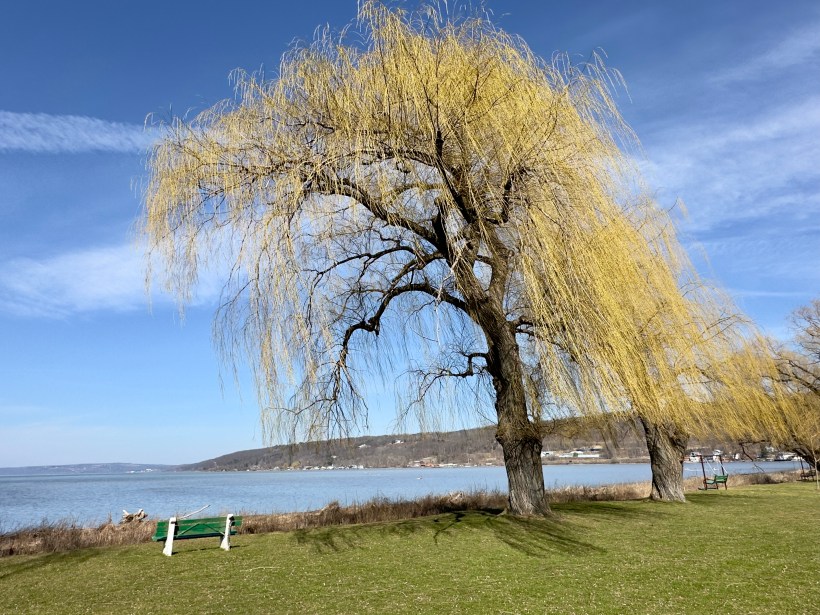
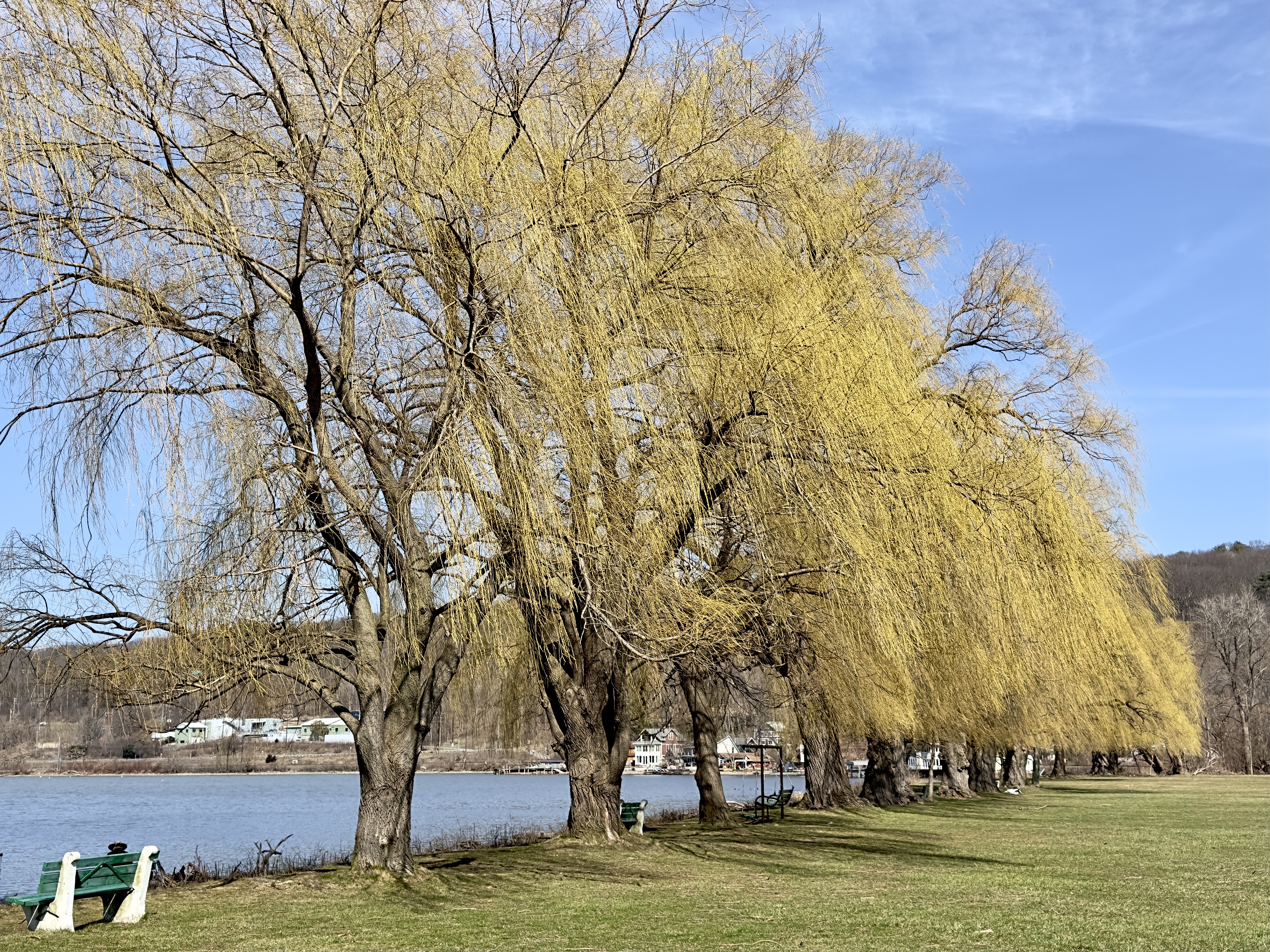
You walk alone by the waters of Cayuga Lake in Stewart Park, nestled in the heart of Ithaca’s Finger Lakes, where Salix alba, the white willow, stands proudly along the shoreline. You’re immediately drawn to the flurry of yellow flowers, a stark contrast to the still chilly early March air.

The white willow (Salix alba), with its rough, gray bark, is beginning to dress in its spring finery, its branches teeming with tiny, starburst-like flowers. Each one is a miniature sun, casting a glow against the intricate lattice of branches. These aren’t the soft catkins of the pussy willow but the yellow inflorescences that are characteristic of the white willow’s early bloom, a signpost that winter’s grip is loosening.

These trees, you learn, are dioecious, with separate male and female trees. The blossoms you see are likely the male flowers, their stamens dusting your fingers with pollen as you brush against them. It’s this pollen that will soon beckon the bees, urging them to emerge from their hives and begin the work that sustains the ecosystem. You can almost hear the faint buzz, a prelude to the symphony of life that summer will bring. Return in midsummer to find the female catkins comprise numerous small (4 mm) capsules, each containing numerous minute seeds embedded in silky white hairs, which aids wind dispersal.

As you wander further, you note the presence of the white willow’s kin, other deciduous companions some still bare and stretching into the sky and others leafing out. You stand there, at the cusp of seasonal change, where the slumbering trees are on the verge of awakening, and you feel a kinship with them. Like these trees, you have weathered the cold, dark months, and now you stand poised to greet the renewal that comes with spring.

The stark, knotted forms of the white willow branches against the clear sky speak to you of endurance and resilience. These trees have weathered storms and droughts; they have been companions to the lake, mirrors to its moods, and now they are beginning to celebrate the cycle of rebirth and growth.

You take a seat on a bench, the cool wood through your clothes a reminder of the lingering winter. You gaze out across the lake, the water reflecting the brilliance of the sun like a vast, rippling mirror, framed by the elegant silhouettes of the white willows. You feel the peace of the park seep into you, the slow, rhythmic lapping of the water syncing with your breath.

This is a moment of transition, from the sleeping to the awakening world. You think about the Salix alba, how its presence here is a testament to nature’s adaptability, thriving in the moist soil by the lake, offering shade in summer and shelter in winter, its branches a playground for the winds.

As you leave Stewart Park, you take with you the memory of the white willows in early March, the quiet guardians of Cayuga Lake. They remind you of the enduring beauty of nature, the seamless flow from one season to the next, and the quiet joy of standing witness to the first whispers of spring on the shores of the Finger Lakes.

Copyright 2024 Michael Stephen Wills All Rights Reserved