A Dance of Light and Sand in Antelope Canyon

Antelope Canyon, a sacred space in the Navajo Nation, reveals the dance of light and sand within its ancient walls. The interplay of erosion and transformation highlights beauty in impermanence, emphasizing patience and reverence for nature’s ever-changing essence.

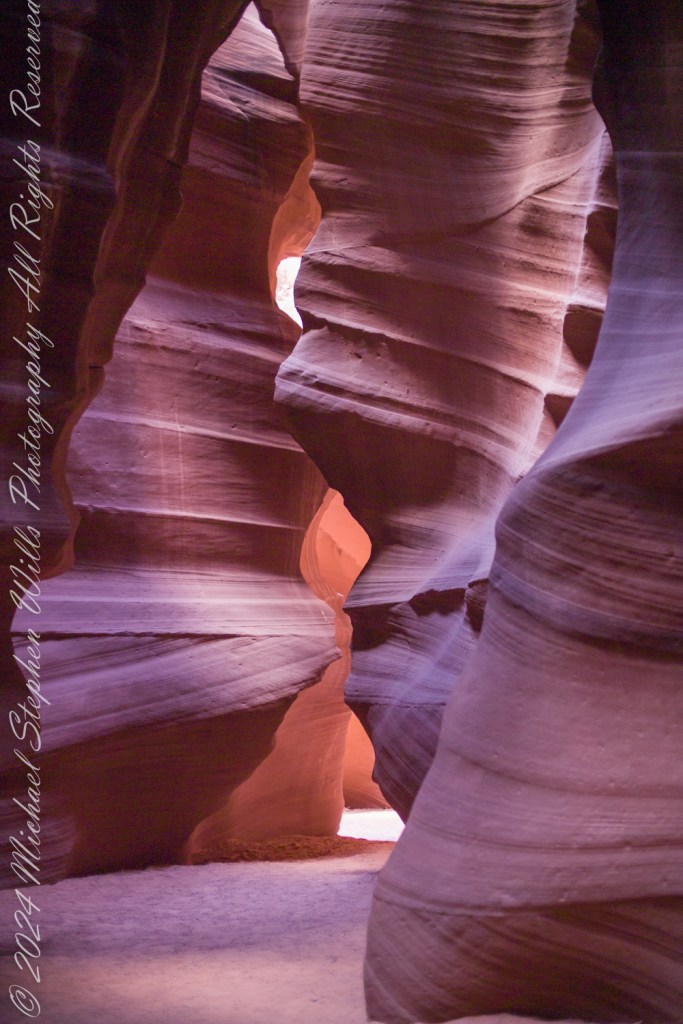
Enveloped by shadows and light in the stillness of Antelope Canyon the air carries silence—vast and ancient—interrupted only by the whispers of grains shifting under unseen currents. Here the red rock of the northwestern corner of the Navajo Nation was pulverized into sand by the action of wind, water, sun, and cold. The walls, carved by patient time, cradle the moment as if holding a sacred breath.
Antelope Canyon is in the Navajo Nation near Page, Coconino County, Arizona

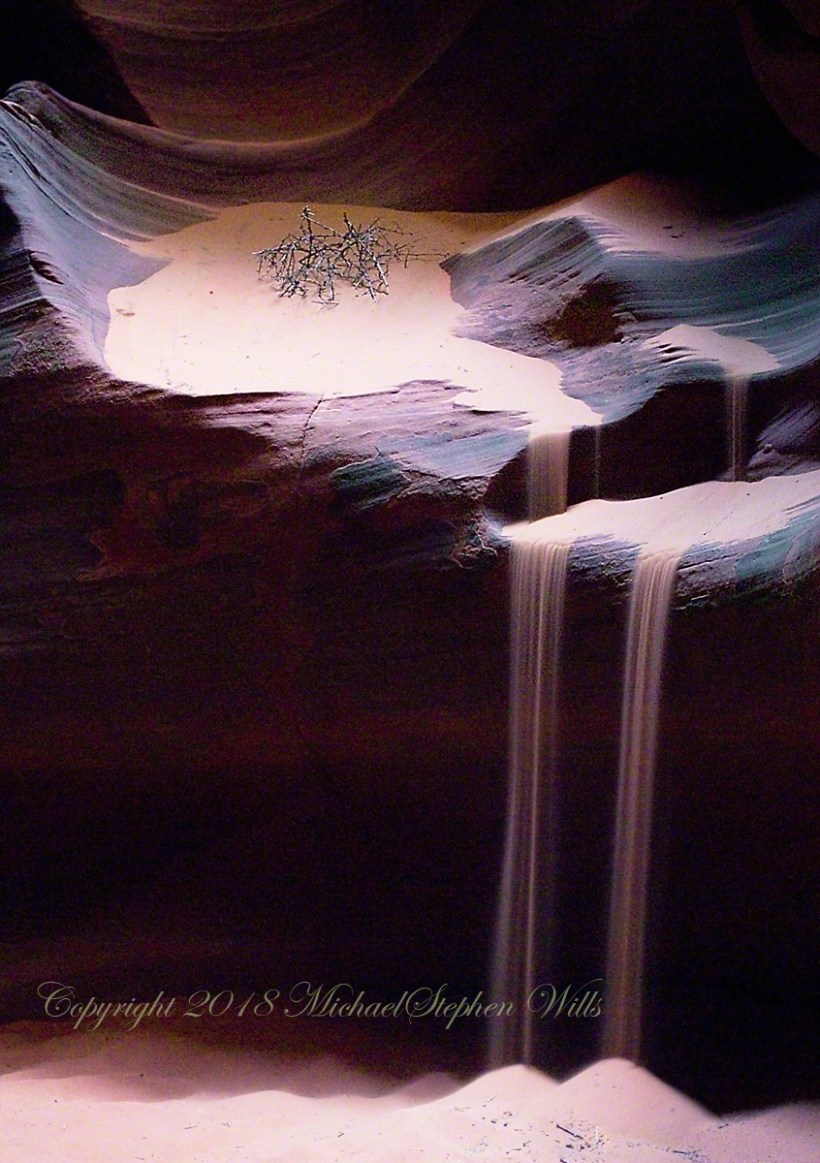
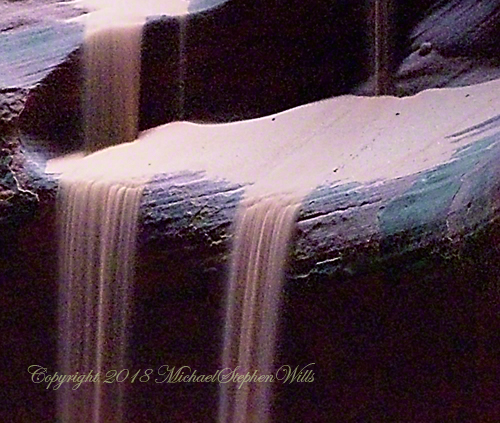
Antelope Canyon, timeless and transient, has summoned me to witness something unique—a dance between light and matter. The delicate, insistent sand flows like water from a carved bench, shaping the scene with quiet power. It tumbles as if alive, forming ephemeral cascades, revealing that erosion is not destruction but transformation. Each grain a story—a fragment of the ages, polished smooth by untold moments of pressure and release.

A Slot of Shadows and Light


I wait in the dry darkness of upper Antelope Canyon for the perfect moment to capture the spirit of the place. Light penetrates the narrow slot above, a thin beam spilling through the crevice, drawn by something deep below. In this confined space, sunlight becomes an entity. It touches the red sand and animates the space, revealing stone textures and the fleeting movement of sand in freefall.
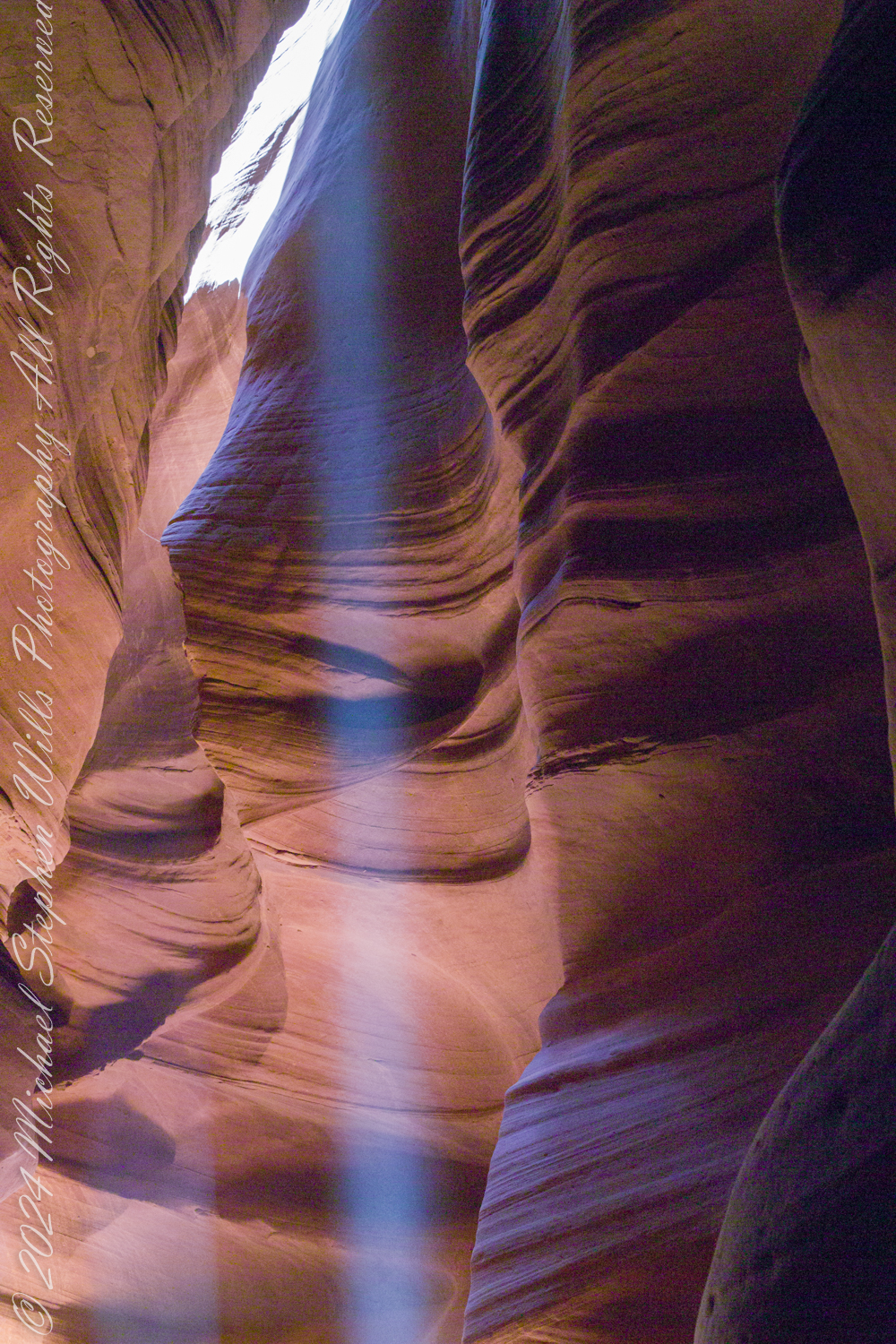
Antelope Canyon is in the Navajo Nation near Page, Coconino County, Arizona

The play between dark and light reminds me that beauty often lies in contrast. The polished walls that surround me were once jagged, raw stone. They have become smooth under nature’s relentless touch—proof that endurance shapes elegance. The canyon’s walls, though fixed in place, seem to sigh as the sand slips over them, embodying a paradox of permanence and impermanence.

An Elemental Meditation


I am a visitor as well as part of a conversation held in languages older than words—spoken by rock, sand, shadow, and light. I sense the ancient stories etched into the stone and carried within each grain that spills like an hourglass. Here, nothing is wasted; everything contributes to a continuous process of becoming. The sand, which once formed the walls, now shapes the canyon floor, each element recycling into the next chapter of this landscape’s life.
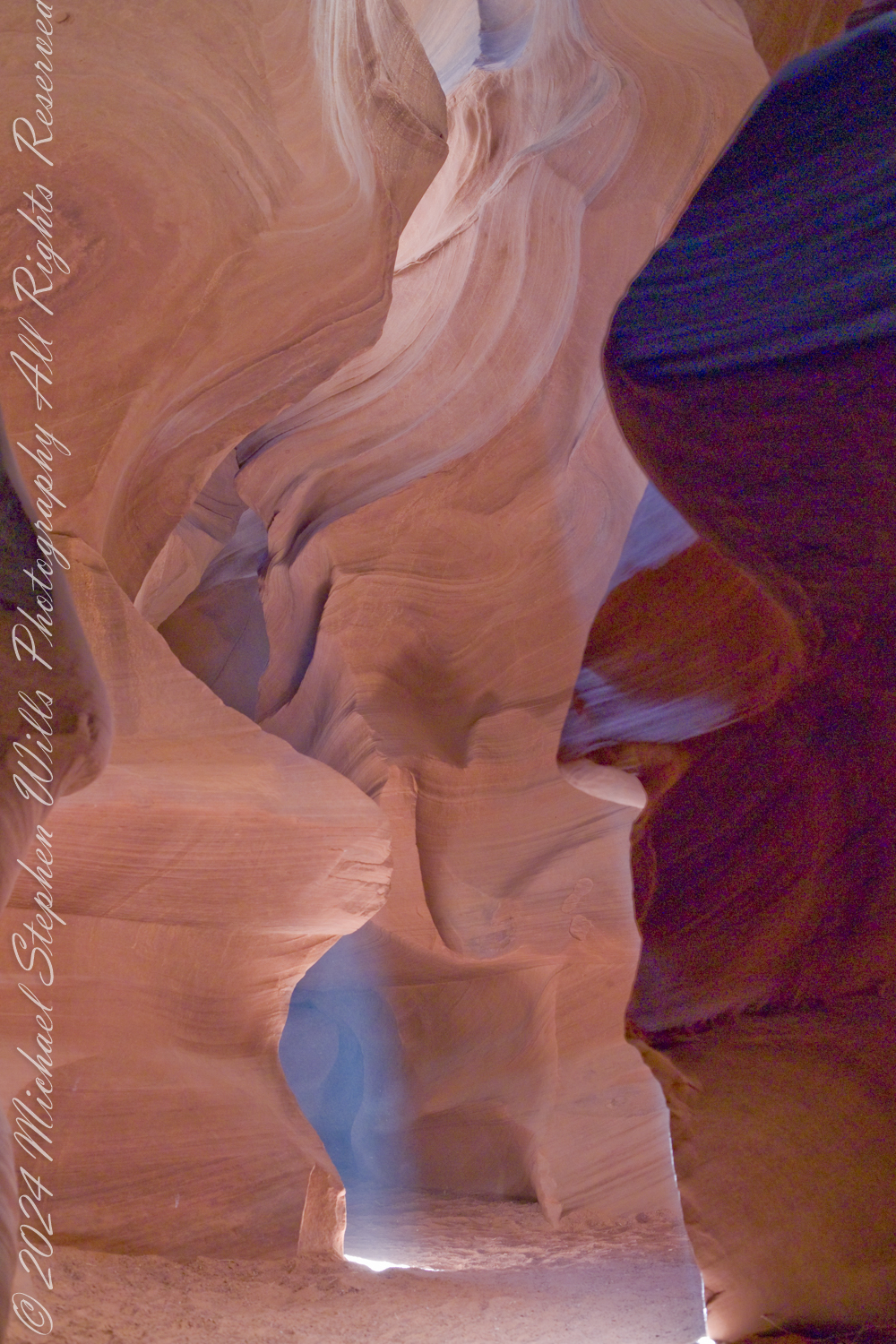
Antelope Canyon is in the Navajo Nation near Page, Coconino County, Arizona

The act of waiting for a right moment teaches me that patience is both passive and an active engagement with time. I am reminded that what I witness will never be exactly the same again. Even though the canyon may stand for millennia, each second contains a uniqueness. The sand cascading before my eyes will settle, be disturbed, and flow again—but never in quite the same way.

Capturing the Spirit of Place


I set the camera on a rented tripod, knowing photography is an imperfect attempt to hold onto what cannot be possessed. This place does not belong to me—it belongs to itself, shaped by forces far greater than any human hand. My role is not to own the scene but to honor it, to acknowledge its fleeting magnificence by framing a moment within the lens.

The shutter clicks, the cascade of sand becomes immortalized held in that instant. Yet I know that the photograph, while capturing the image, will not fully encompass the spirit of what I have experienced. This place is a meditation, a reminder that life itself flows in ways we cannot control. Like the red sand, we are carried by forces—sometimes gentle, sometimes fierce—shaping and reshaping us through time.
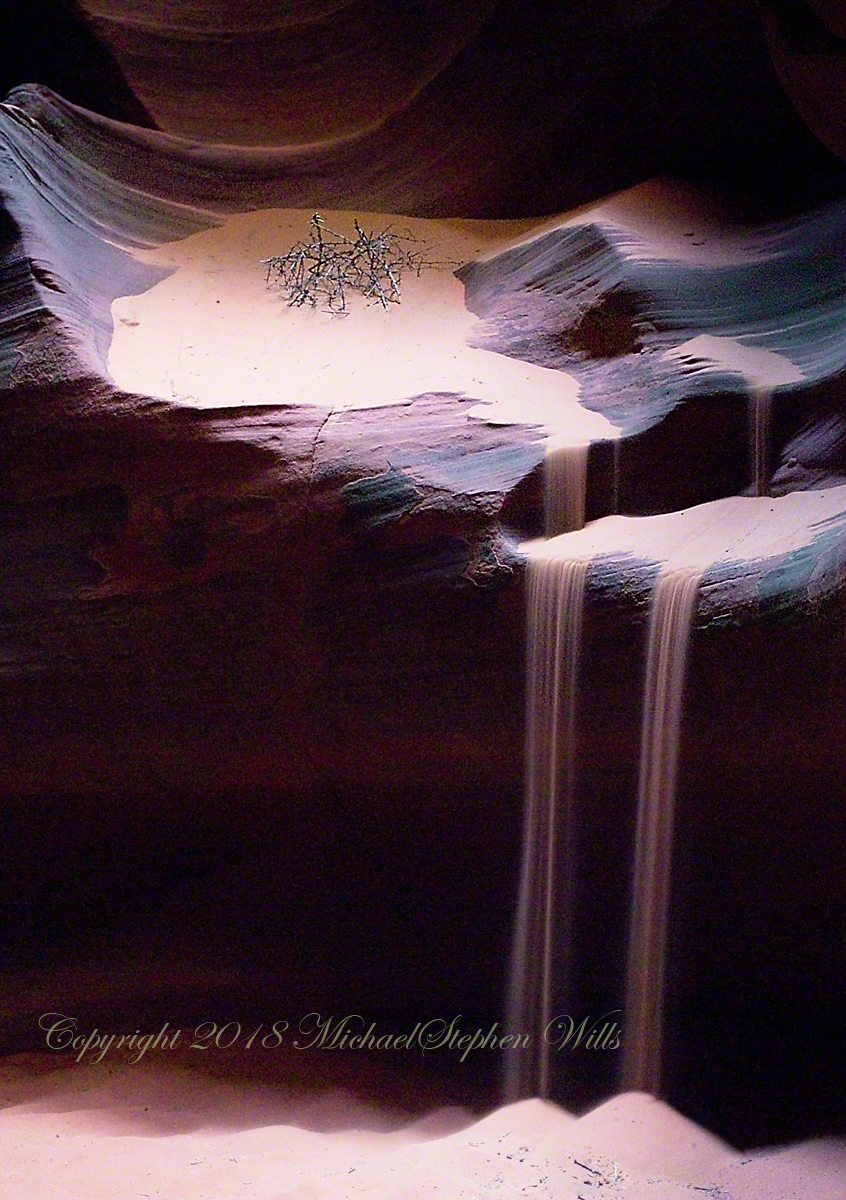
As I gaze at the sand, a quiet sense of reverence flows through me. This moment, like the grains tumbling in front of me, is already slipping into the past. But in its passing, it leaves behind something intangible yet enduring—a memory of beauty found not in permanence but in change.
Click this link for my Fine Art Photography gallery.

Click this link for another Arizona post, “A Dry Piece of Paradise.”

Enter your email to receive notification of future postings. I will not sell or share your email address.

Floral Anchors: Early Saxifrage’s Survival Dance in Treman Gorge

Step into the serene realms of Robert H Treman State Park, where the Early Saxifrage blossoms amidst ancient stones, embodying resilience and the timeless beauty of nature’s persistence against all odds.

Ambling along the rugged Gorge Trail within the serene expanse of Robert H Treman State Park, my gaze is caught by the delicate clusters of Early Saxifrage (Micranthes virginiensis), formerly known as Saxifraga virginiensis. Nestled in nooks and crannies along the limestone-rich corridors, this resilient plant, also colloquially known as “Virginia saxifrage” or “rockfoil,” presents a mesmerizing spectacle against the moss-draped backdrop of the gorge’s ancient stones.

Early Saxifrage thrives in these modest crevices, its roots gripping tightly to the scant soil amidst the rocks, drawing nourishment from the most unlikely of places. The plant’s small, white star-like flowers blossom in dense clusters, creating a soft contrast against the rugged gray of weathered stone. The base of the plant, typically hidden, burgeons with rosettes of spoon-shaped leaves, which persist through the winter, ready to embrace the spring with vigor.

This plant not only captures the eye but also whispers tales of medicinal lore. Historically, Early Saxifrage has been utilized in folk medicine, primarily valued for its supposed efficacy in dissolving kidney stones—a testament to its name, “saxifrage,” which means “stone-breaker.” Though modern usage does not commonly reflect these ancient practices, the plant’s presence here speaks to the deep-rooted herbal knowledge passed down through generations.

As I tread lightly over the worn paths that weave through the gorge, the sight of Early Saxifrage serves as a poignant reminder of the park’s ecological tapestry. This flora, modest yet striking, symbolizes the tenacity of life, blooming splendidly in the stark environment it calls home. It is a beacon of endurance and beauty, inviting us to pause and appreciate the quieter, often overlooked wonders of nature.

In this corner of the Finger Lakes, where water and stone sculpt the landscape, Early Saxifrage flourishes. It stands as a testament to the persistence of the wild, a delicate yet resilient inhabitant of this storied terrain, weaving its subtle magic into the fabric of the gorge. Here, among the whispers of streams and the echoes of stone, it finds its place, a fragile star in the vast, enduring sky of green.

Copyright 2024 Michael Stephen Wills All Rights Reserved

Whispers from the Rocks: The Vivid World of the Red Columbine

Discover the vibrant Red Columbine of Treman Gorge, a masterpiece of adaptation and survival nestled among ancient rocks. Explore how this delicate beauty thrives in the harsh cliffs of the Finger Lakes.

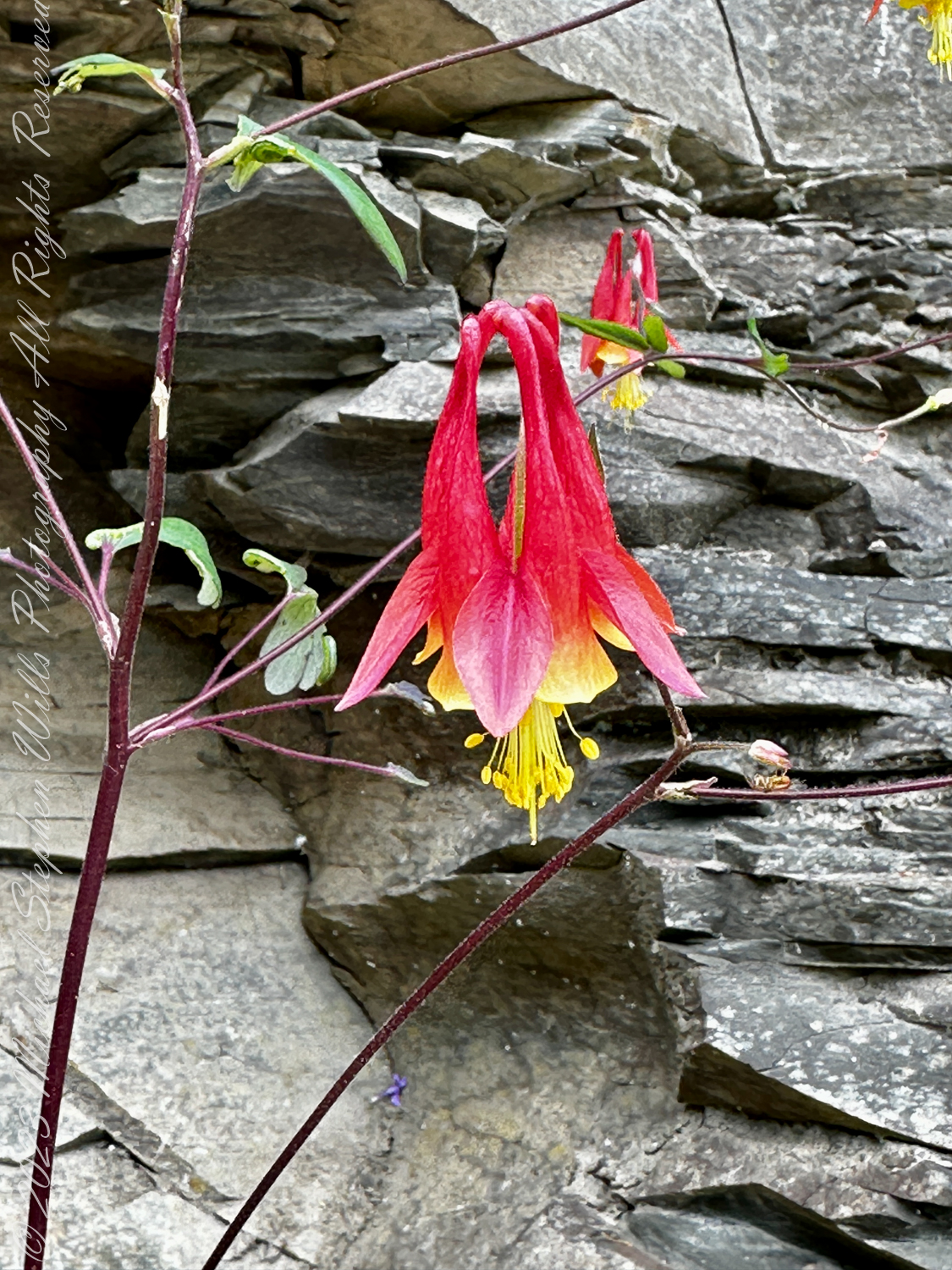
Wandering through the verdant paths of Treman Gorge, amidst the rough-hewn charm of the Finger Lakes Region, I find myself entranced by a striking botanical jewel, the Red Columbine (Aquilegia canadensis). Amid the prehistoric tapestry of shale and limestone, these delicate red and yellow flowers stand out with a vivacity that seems almost audacious against the stoic gray of their rocky backdrop.

The Red Columbine, with its unique, nodding bell-like flowers, is more than just a feast for the eyes. Each bloom is a masterclass in the art of survival and adaptation. The elongated, tubular structure of its flowers, splashed with a bold red that fades into a sun-kissed yellow, is nature’s perfect lure for its pollinators. The petals curve back, as if arching away in a graceful flare, exposing the stamens and pistils in an inviting display for hummingbirds, which, in their quest for nectar, become unwitting partners in the dance of pollination.

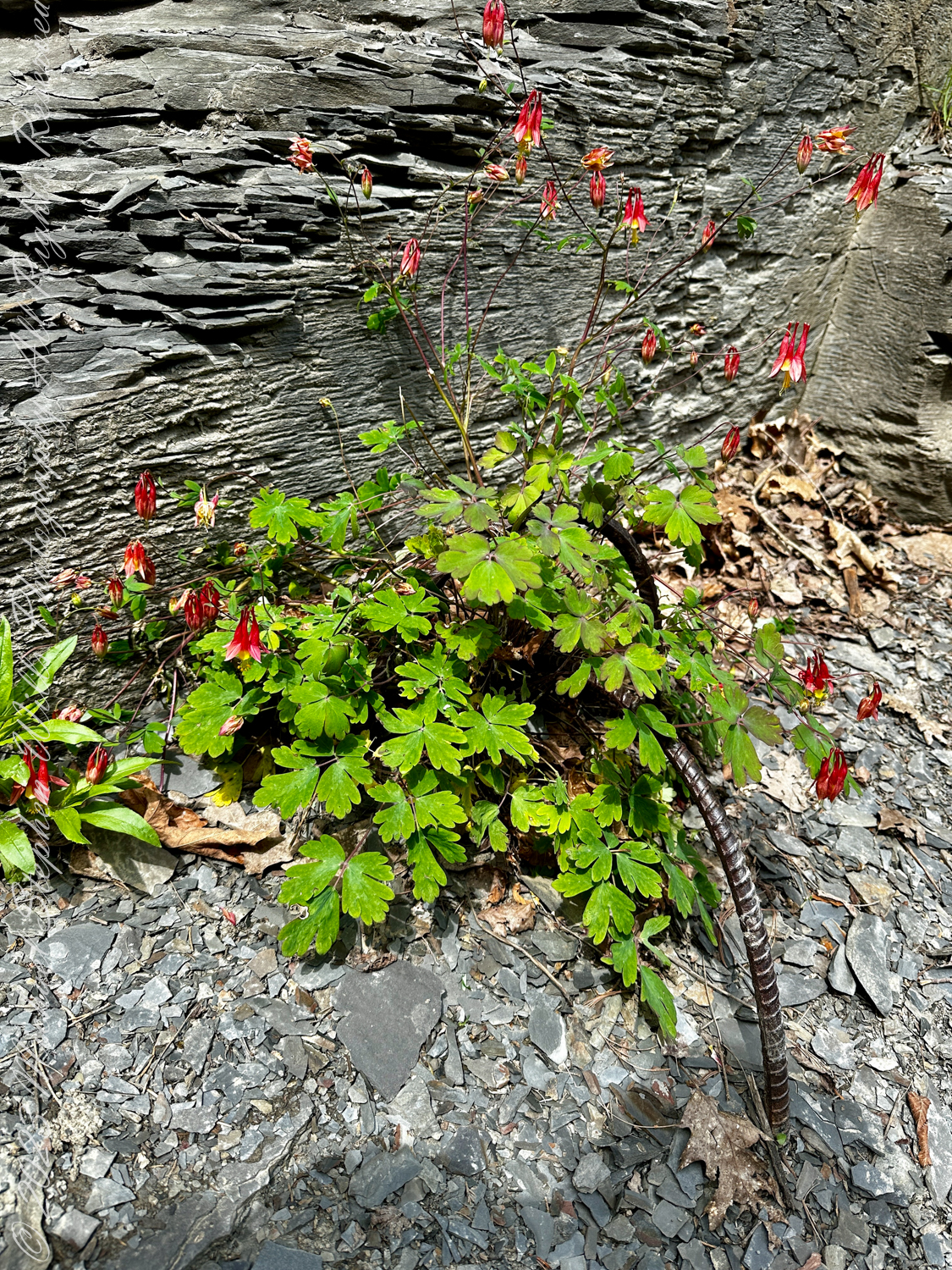
As I tread softly along the mossy stones, the sheer cliff faces of the gorge serve as a stark reminder of the relentless passage of time. Yet here, in this ancient cradle, the Red Columbine thrives in pockets of soil that seem to defy gravity. It’s a botanical ballet, with each plant performing its survival routine rooted in crevices that gather just enough humus to sustain life.

The air is cool and moist, the faint murmur of Enfield Creek a constant whisper beneath the chorus of bird calls. This is a place of subtle enchantment where every glance reveals the rugged beauty of nature intertwined with the delicate persistence of life. The columbines, with their whimsical spirals of spurs and lush, lobed leaves, appear almost otherworldly. They thrive here in the dappled sunlight, a testament to their resilience and a reminder of nature’s quiet defiance against the odds.

Red Columbine with steel rebar driven into the rock to anchor lifesaving lines. Found near Lucifer Falls, Robert H Treman New York State Park, Ithaca, Tompkins County

In this serene alcove, time slows. The Red Columbine’s pendulous blooms sway gently with the breeze, each movement a soft ballet in the verdant amphitheater of Treman Gorge. This flower, with its fiery hues and intricate form, embodies the spirit of the wild that surrounds us. It stands as a vibrant contrast against the somber stones, a living splash of color against the monochrome palette of the gorge.

As I pause to capture this moment, camera in hand, I am reminded of the fragile beauty that thrives in these hidden corners of the earth. The Red Columbine, with its enchanting flowers and rugged perseverance, is a symbol of the wild heart that beats strong within the quiet solitude of Treman Gorge. Here, in the heart of the Finger Lakes, beauty and resilience bloom in the most unexpected places, painting the landscape with strokes of floral brilliance.

Copyright 2024 Michael Stephen Wills All Rights Reserved