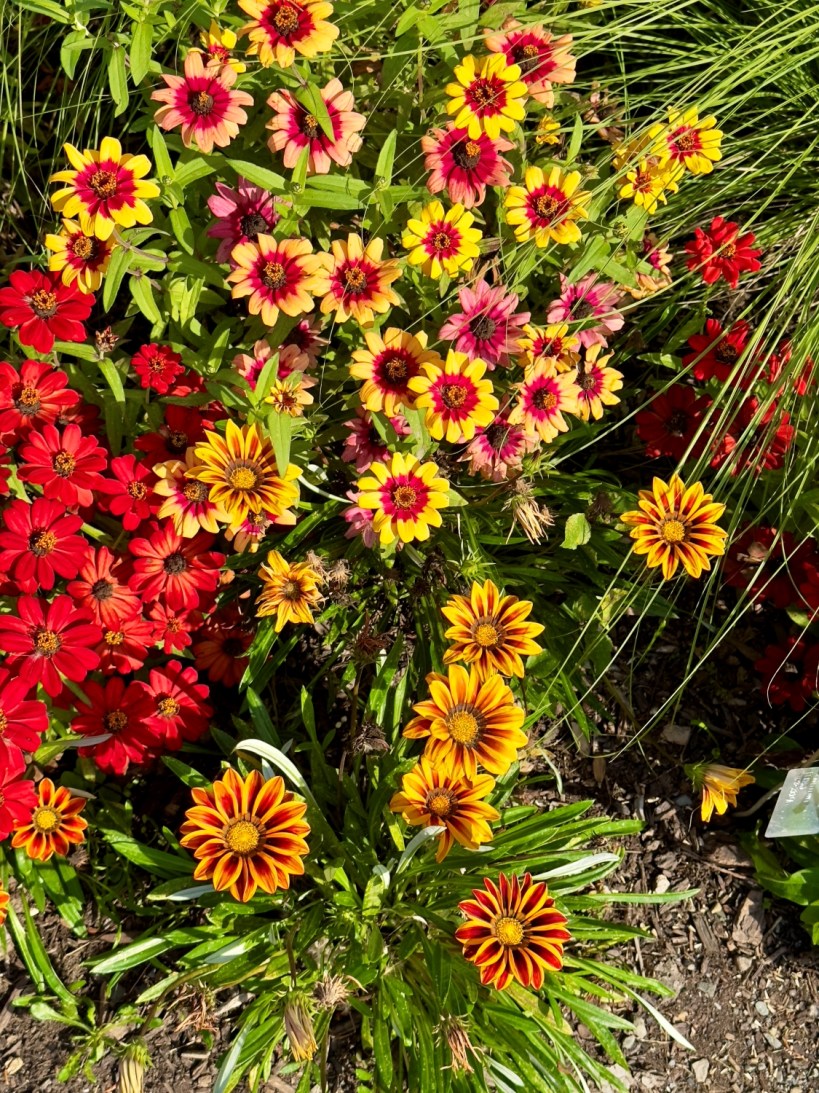
Vibrant Blooms of Zinnias and Gazanias at Cornell Botanical Gardens

Join me in admiration of these Zinnias and Gazanias at the Cornell Botanical Gardens, highlighting their vibrant beauty and rich botanical history.

As I stroll around the Nevin Center at the Cornell Botanical Gardens, my eye is drawn to a bed of bright, cheerful flowers that seem to beam with personality. Here, amidst the lush plantings, Zinnias and Gazanias bring their vivid colors to life, each bloom a tiny celebration of nature’s artistry. These flowers, from a family spanning two continents, share a surprising harmony that only the language of color and form could convey.
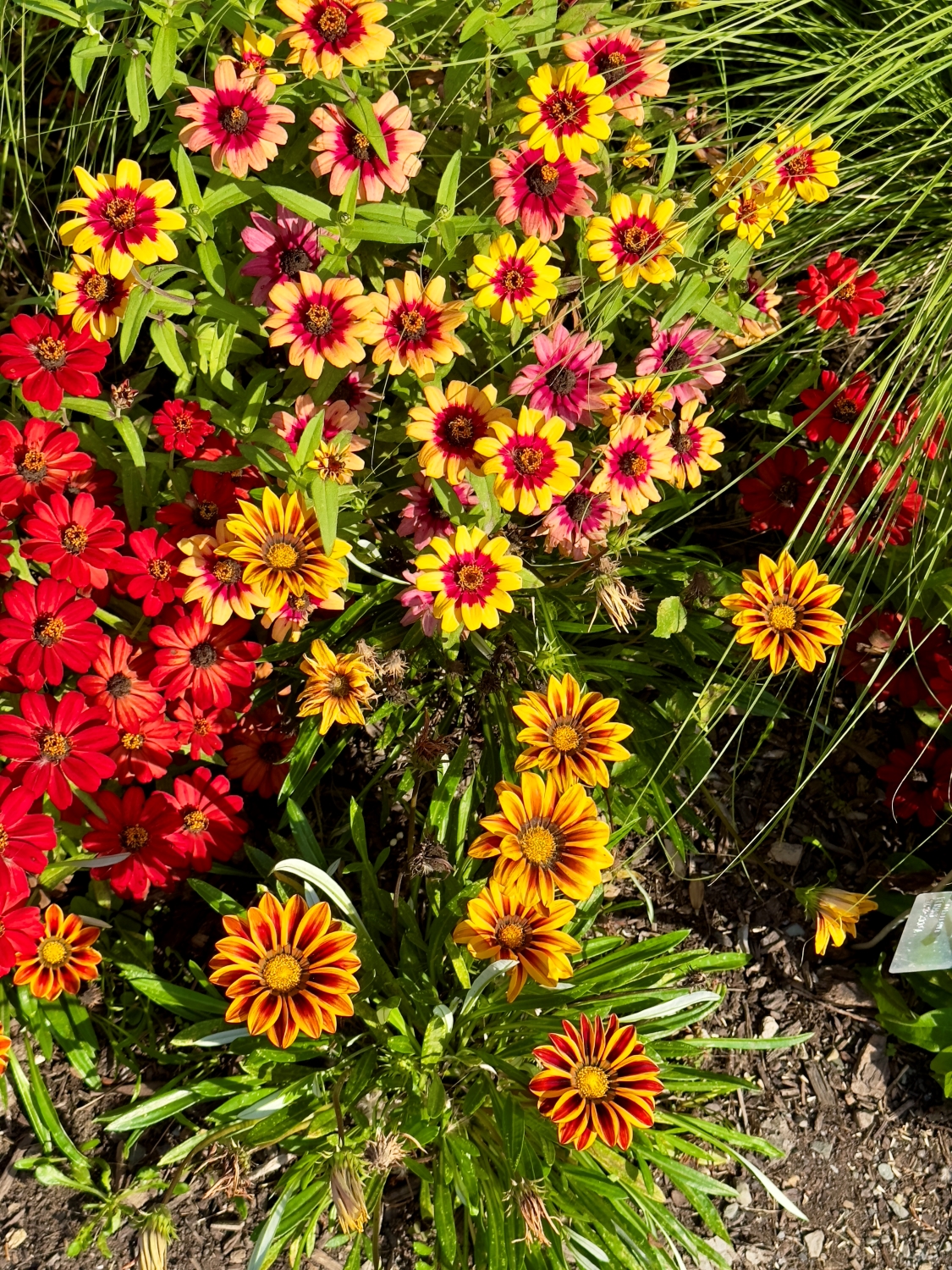
The Zinnias (family Asteraceae), little fireworks exploding in hues of yellow, red, pink, and orange. They belong to the daisy family, which includes many well-known wildflowers and ornamental plants. Native to the warm regions of Mexico and Central America, Zinnias were first documented by Dr. Johann Gottfried Zinn, an 18th-century German botanist. Dr. Zinn initially set out to study human anatomy, but he turned to botany after inheriting the job of garden inspector at the University of Göttingen. His study of these cheerful flowers was eventually immortalized when the genus was named in his honor. Every time I see a Zinnia, I think about Dr. Zinn’s unexpected journey into botany and how these resilient, sun-loving flowers carry on his legacy.

Growing alongside them are Gazanias (family Asteraceae as well), which, despite their similarity in form, come from an entirely different part of the world. These stunning blooms are native to South Africa, thriving under the intense African sun. Also known as “treasure flowers,” Gazanias have radiant, striped petals that look like they’ve been painted by hand, with shades of fiery orange and deep red. The name Gazania honors Theodorus Gaza, a 15th-century Greek scholar who translated many important botanical works from Greek into Latin. I can’t help but feel that these flowers, with their bold, jewel-toned colors, live up to the name “treasure,” each one a small gem in the landscape.

As I stand here, admiring these blooms, I’m struck by the way they bring a sense of vibrancy and warmth to the Nevin Center. Both Zinnias and Gazanias are sun-worshippers, thriving in full sunlight and well-drained soil, making them ideal for this bright spot. Their colors seem even more dazzling against the verdant greens of the surrounding plants, and they attract bees and butterflies, adding another layer of life to this already lively space.

In a way, the planting here feels like a dialogue between continents, with the Zinnias representing the New World and the Gazanias embodying the spirit of Africa. It’s a conversation that reminds me of the global heritage of our gardens, how each plant carries a story, a name, and a lineage across borders and centuries. Here at the Cornell Botanical Gardens, they’ve found a new home, far from where they first bloomed, but as vibrant as ever.

I leave the Nevin Center with a sense of joy and gratitude for these botanical ambassadors. Zinnias and Gazanias, each named for pioneers in botany, remind me that discovery often comes in unexpected forms, just as beauty does. They teach us to look closely, to celebrate color and form, and to appreciate the living history all around us.

Enter your email to receive notification of future postings. I will not sell or share your email address.

The Wonder of Penstemon hirsutus in Treman Gorge

Discover the enchanting Hairy Beardtongue nestled in Treman Gorge. Learn about its striking lavender blooms, unique adaptations, and fascinating history in our latest nature exploration. Dive into the beauty of Penstemon hirsutus!

On a sunny day at the end of May 2024, I embarked on one of my cherished walks through Robert H. Treman Park, located in the heart of Ithaca, New York. The park, with its stunning gorges and waterfalls, never ceases to amaze me with its natural beauty and diverse plant life. This time, my exploration led me to a delightful discovery along the south-facing walls of Treman Gorge: Penstemon hirsutus, commonly known as the Hairy Beardtongue.

As I navigated the rocky terrain, my attention was caught by a cluster of delicate, tubular flowers emerging from the crevices of the gorge walls. Their soft lavender hues stood out against the rugged backdrop of moss-covered rocks and shale. Upon closer inspection, I noticed the characteristic hairy stems and leaves, confirming that I had indeed found Penstemon hirsutus.

Penstemon hirsutus is a perennial herbaceous plant native to eastern North America. It typically reaches a height of 1 to 3 feet, with erect stems covered in fine hairs. The leaves are lanceolate, arranged oppositely along the stem, and also bear a slight fuzziness. The flowers, which bloom from late spring to early summer, are tubular and two-lipped, resembling a small beard—a feature that likely inspired the common name “Beardtongue.” Each flower is about 1 to 1.5 inches long, with a delicate lavender color that fades to white at the throat.

The genus name “Penstemon” is derived from the Greek words “pente,” meaning five, and “stemon,” meaning stamen, referring to the plant’s five stamens—four fertile and one sterile, the latter often appearing as a small, hairy tongue within the flower. The species name “hirsutus” comes from Latin, meaning hairy, a nod to the plant’s hirsute stems and leaves.

The Hairy Beardtongue thrives in well-drained soils and can often be found in rocky, open woodlands, meadows, and along cliffs—exactly the kind of environment provided by Treman Gorge. This plant is well-adapted to the microhabitats created by the gorge’s south-facing walls, where sunlight and moisture create ideal growing conditions. The rock walls not only offer physical support but also help retain heat and moisture, creating a microclimate that supports a variety of plant species.

Historically, Penstemon hirsutus and its relatives have been valued for their ornamental beauty and ecological benefits. The flowers attract a variety of pollinators, including bees, butterflies, and hummingbirds, making them an important component of the local ecosystem. Native Americans also recognized the medicinal properties of some Penstemon species, using them to treat ailments such as toothaches, sore throats, and respiratory issues.

In recent times, gardeners and horticulturists have come to appreciate Penstemon hirsutus for its hardiness and low maintenance requirements. It is often used in native plant gardens, rock gardens, and naturalized areas to add a touch of wild beauty. The plant’s ability to thrive in poor soils and its resistance to deer browsing make it a valuable addition to any garden aiming to support local wildlife and biodiversity.

Finding the Hairy Beardtongue in Treman Gorge was a moment of pure joy and wonder. It reminded me of the resilience and adaptability of nature, as this delicate yet sturdy plant has carved out a niche for itself in the rocky walls of the gorge. The sight of its soft lavender blooms swaying gently in the breeze was a testament to the beauty and tenacity of life in even the most rugged environments.

As I continued my hike, I felt a renewed sense of connection to the natural world. The discovery of Penstemon hirsutus was not just a botanical find but a reminder of the intricate and interconnected web of life that thrives in Treman Gorge. Each plant, each flower, has a story to tell—a story of survival, adaptation, and beauty that enriches our understanding of the natural world and our place within it.

Copyright 2024 Michael Stephen Wills All Rights Reserved

Winterberry Warmth

Here we discover and learn to admire the winterberry shrub, or Ilex verticillata, during a frosty February morning. Its crimson berries, which symbolize hope, sustenance, and life’s enduring cycle, are a stark contrast to the pall of winter.

Continue reading “Winterberry Warmth”