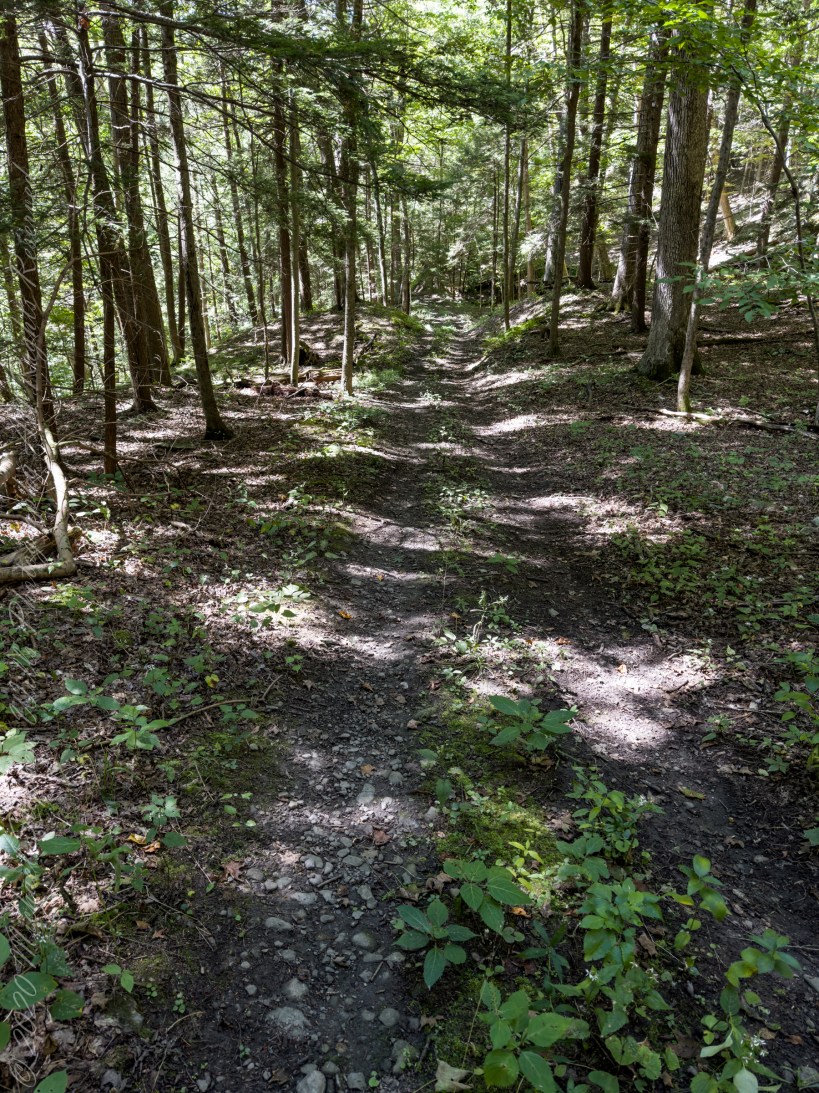
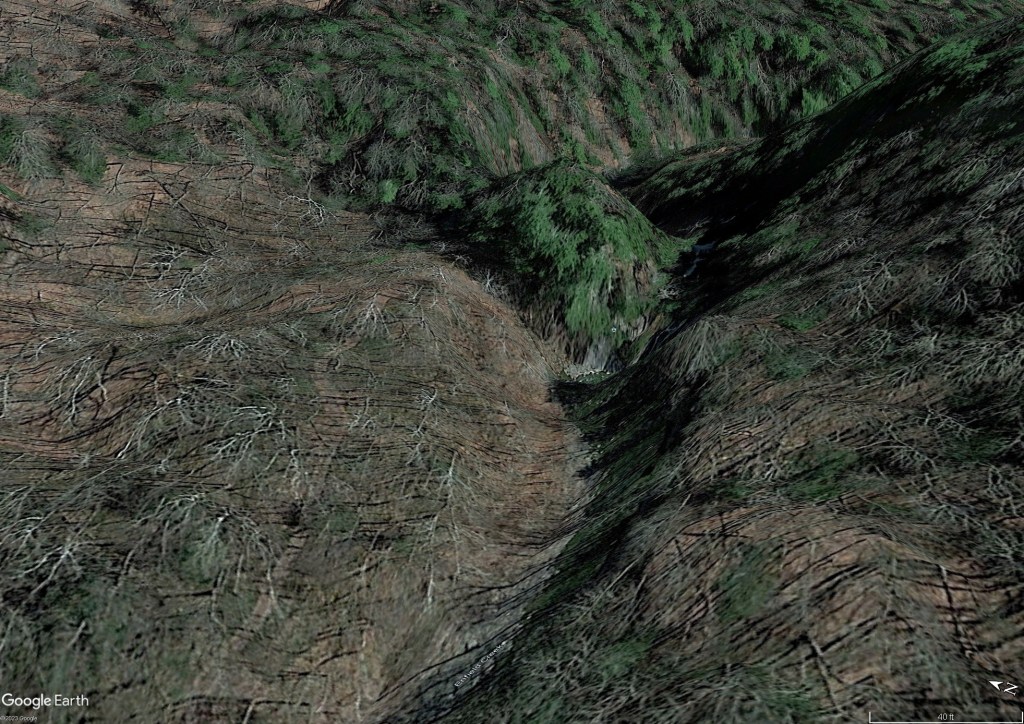
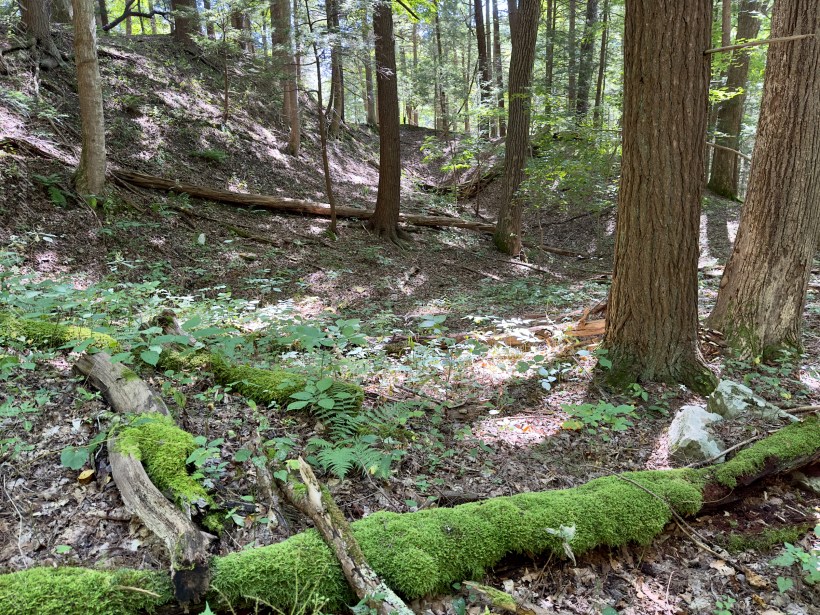
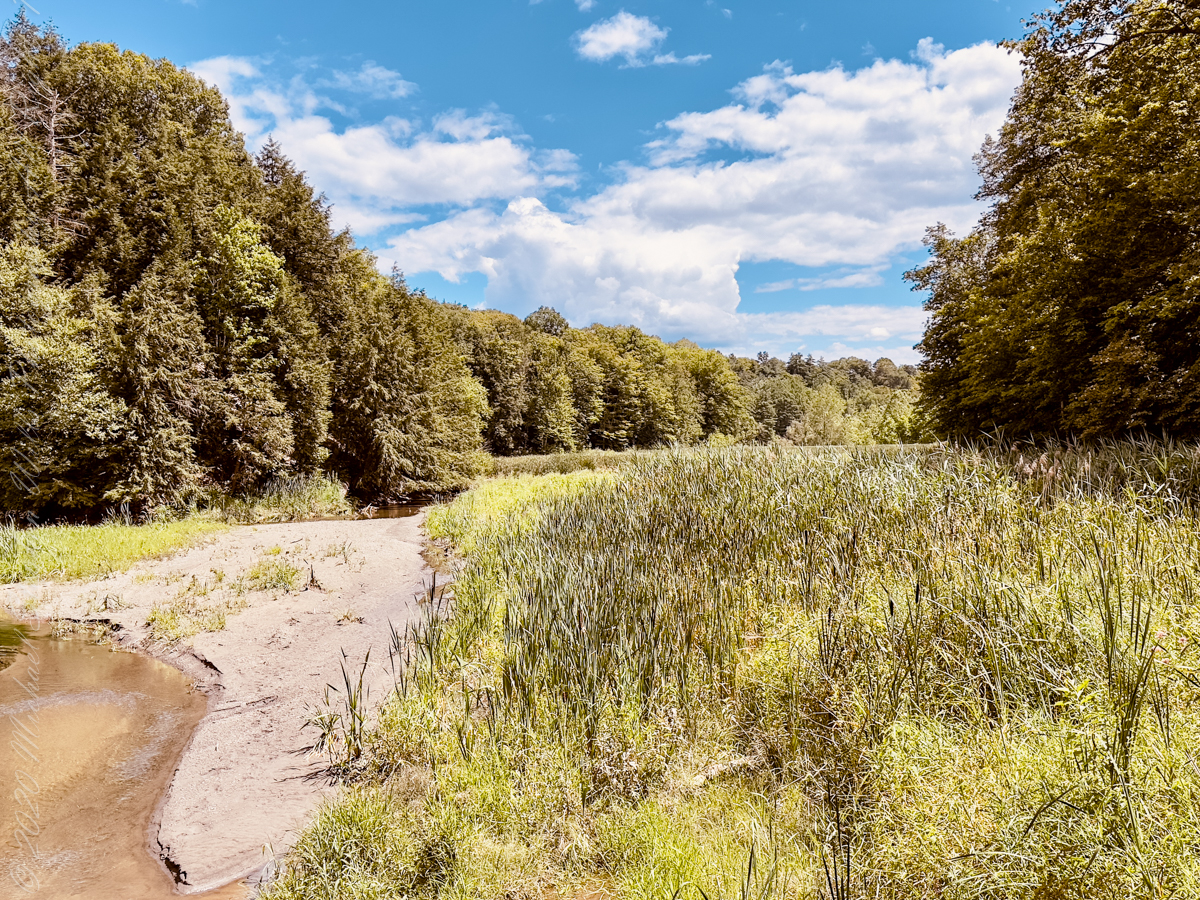
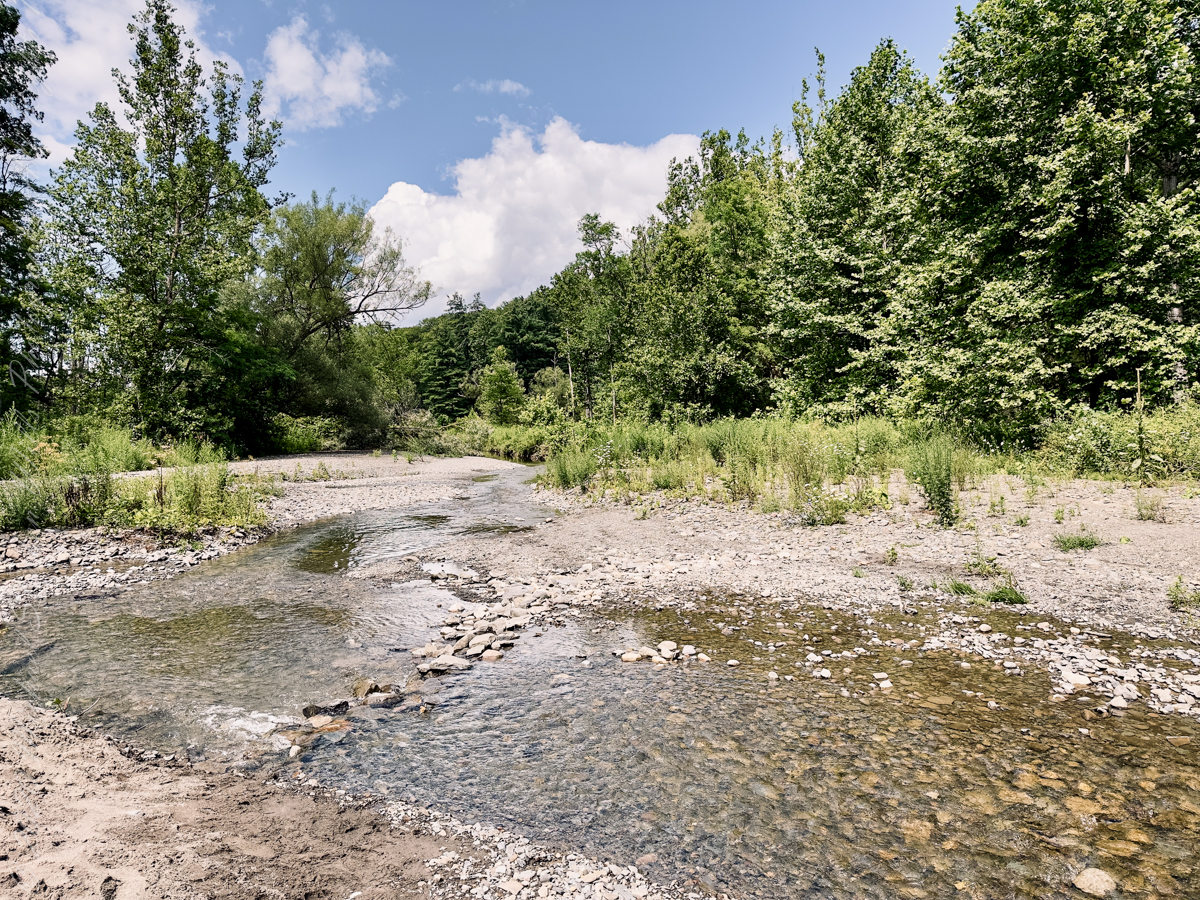
Wisconsin Glacial Episode was only the latest of a series of ice wall incursions. For this walk I went off the path to bushwack, following a drift filled stream bed, evidence of multiple glacial incursions with subsequent changing the stream bed of Enfield Creek. Here I am walking on glacial deposition to the north of the current creek bed. A park ranger informed us of this location, it is difficult to comprehend or imaging a 50 foot hill of material deposited in this way. The creek does bend at this point and the deposition is easily seen from above.
Enfield Creek flows to the right of the deposition.
The surface of the hill is hummocky, typical of glacial deposition.
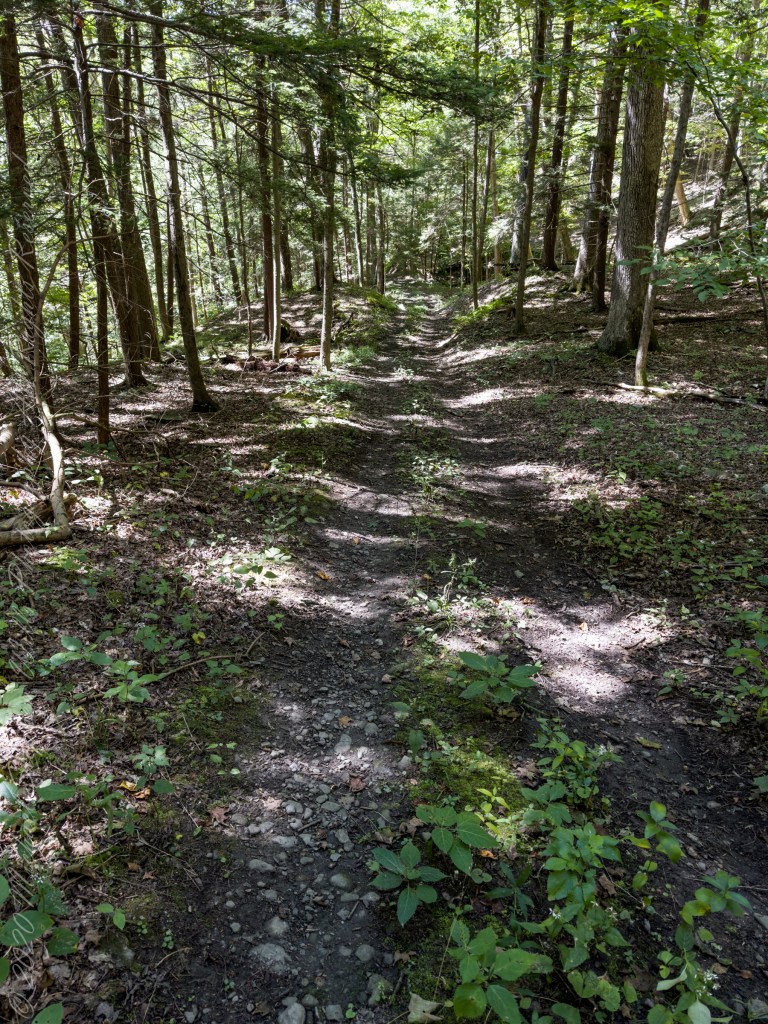
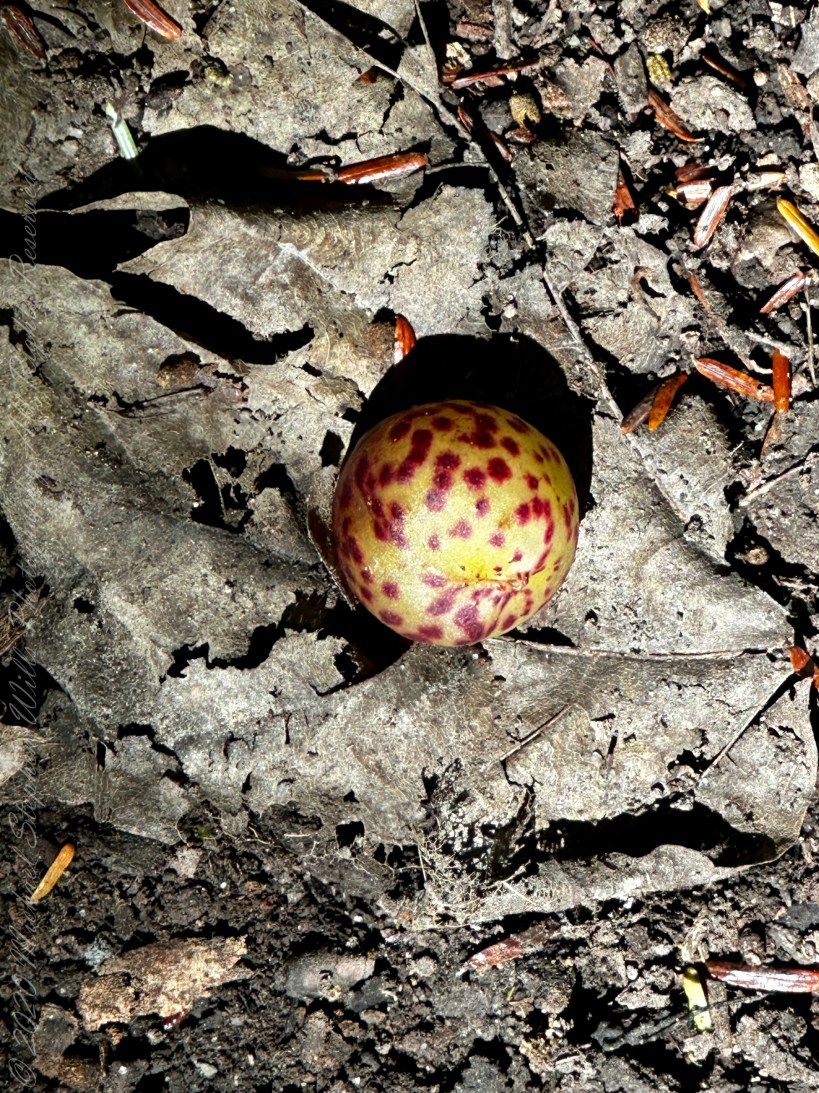
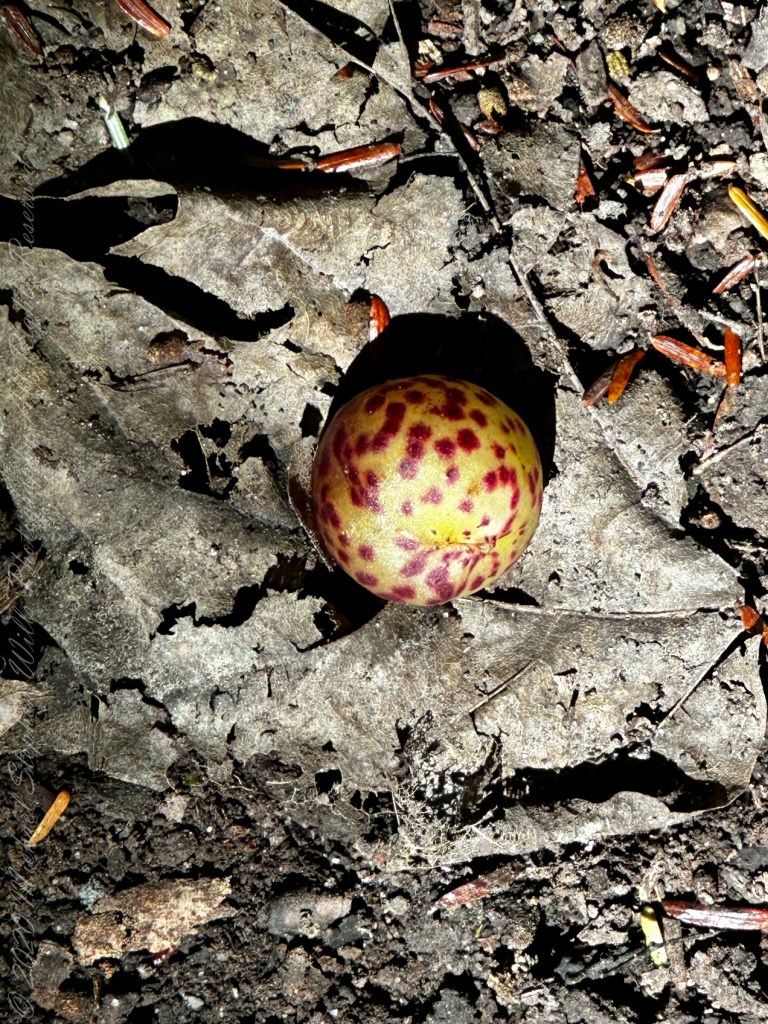
Eventually the former stream bed intersects with a work road sloping back down to the Gorge Trail. It was here I found the oak apple gall of yesterday’s posting.
Copyright 2023 All Rights Reserved Michael Stephen Wills
This is an Oak Apple gall. An adult female wasp lays single eggs in developing leaf buds. The wasp larvae feed on the gall tissue resulting from their secretions, which modify the oak bud into the gall, a structure that protects the developing larvae until they undergo metamorphosis into adults.
“Oak galls have been used in the production of ink since at least the time of the Roman Empire. From the Middle Ages to the early twentieth century, iron gall ink was the main medium used for writing in the Western world.”
“Gall nuts are a source of tannin in the production of iron gall ink. Tannins belong to a group of molecules known as polyphenols and can be taken from different parts of plants such as leaves, pods, fruits, and gall nuts.”
“Along with gall nuts, other important ingredients in the production of iron gall ink include iron sulfate and gum arabic. The reaction between the tannins from the gall nut and the iron produces a complex that gives the iron gall ink its color. The gum arabic makes the ink more viscous and helps bind the ink to the writing surface.”
“According to recent research, traces of iron-gall ink have been found on the Dead Sea scrolls and on the ‘lost’ Gospel of Judas. Iron-gall ink may have been used for 1,800 years, but it does not withstand the test of time well. Over the course of centuries, the ink fades, and discolours and damages the paper. Iron gall ink is manufactured chiefly by artists enthusiastic about reviving old methods or possibly forgers of old documents.”
Reference: text in italics and quotes is from the Wikipedia, “Oak Apple Gall” and “Oak Marble Gall.”
Copyright 2023 All Rights Reserved Michael Stephen Wills
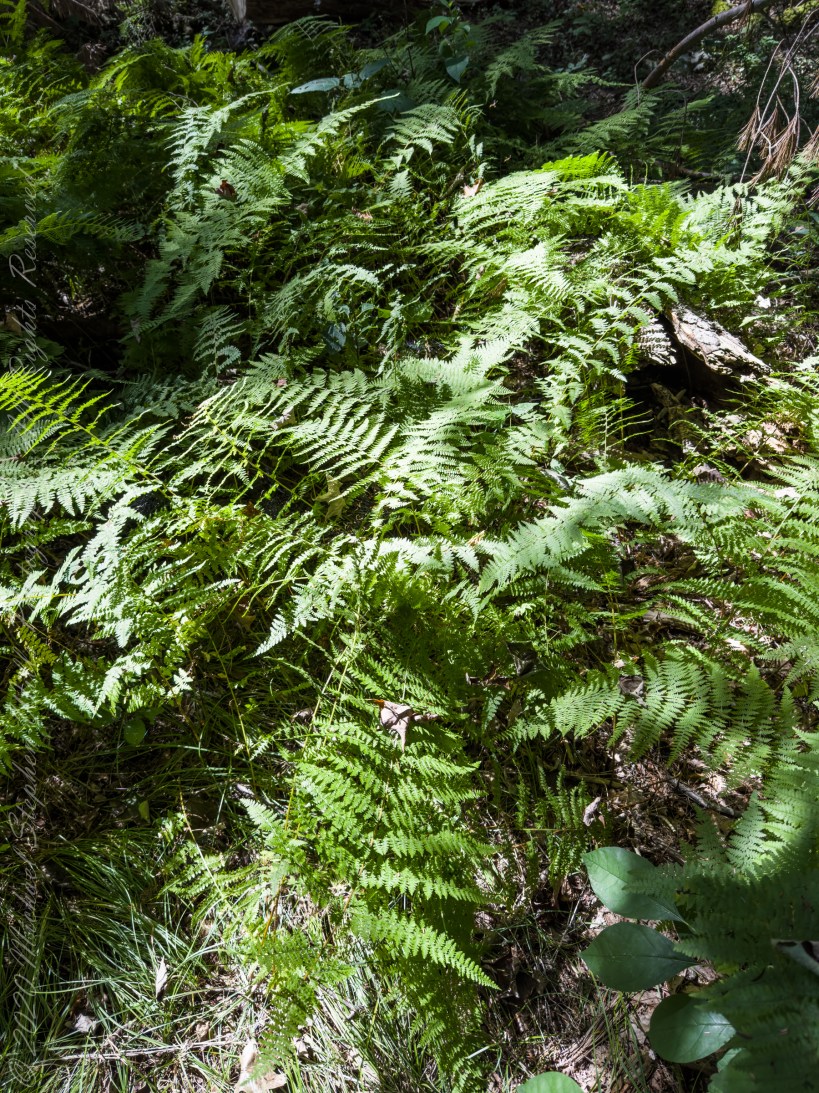
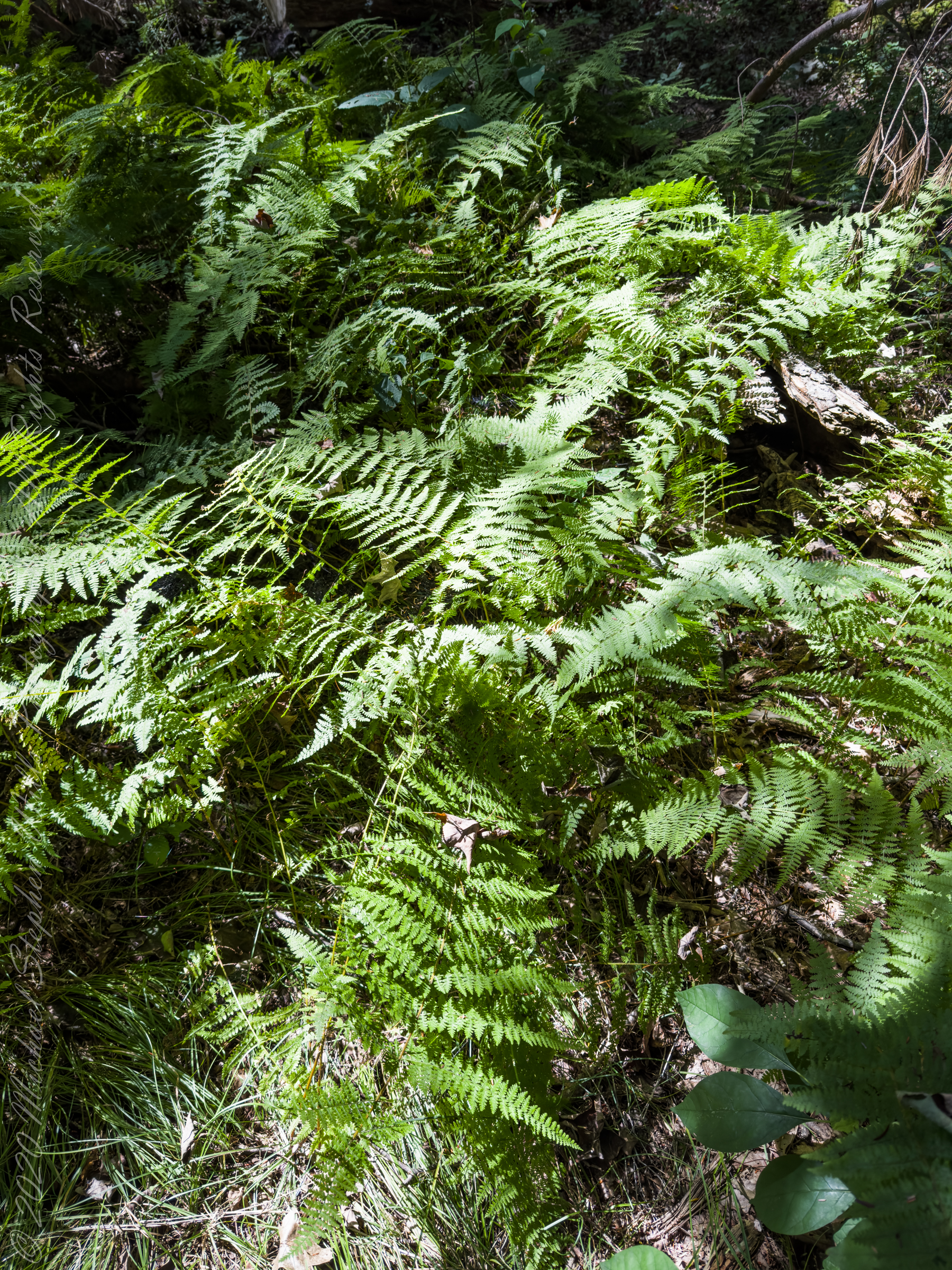
“Dennstaedtia punctilobula, the eastern hayscented fern or hay-scented fern, is a species of fern native to eastern North America, from Newfoundland west to Wisconsin and Arkansas, and south in the Appalachian Mountains to northern Alabama; it is most abundant in the east of its range, with only scattered populations in the west.”
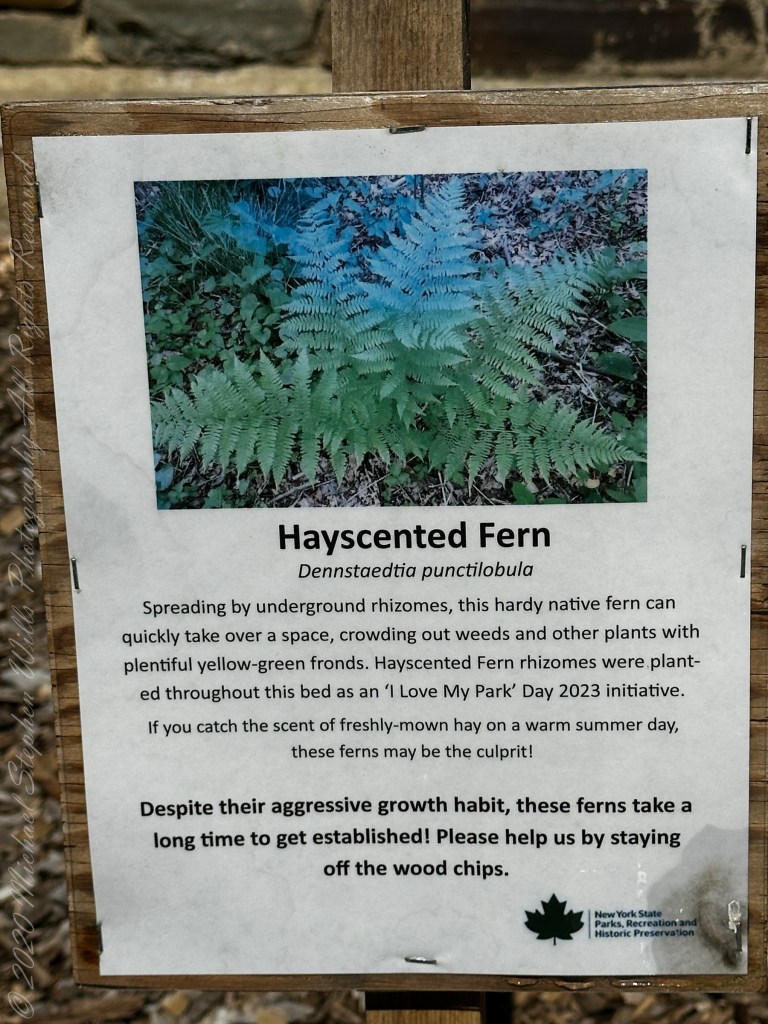
Hayscenter Fern ( Dennstaedtia punctilobula), spreading by underground rhizomes, this hardy fern native to the Finger Lakes Region of New York State, can quickly take over a space, crowding out weeds and other plants with plentiful yellow-green fronds.
“It is a deciduous fern with fronds growing to 40–100 cm (rarely 130 cm) tall and 10–30 cm broad; the fronds are bipinnate, with pinnatifid pinnules about three times as long as broad. It occurs in damp or dry acidic soils in woods or open woods, from sea level up to 1,200 m altitude.”
“Dennstaedtia punctilobula can exhibit varying degrees of phototropism. The common name “Hay-scented Fern” comes from the fact that crushing it produces an aroma of fresh hay.“
“The presence of D. punctilobula influences the dynamics of the understory vegetation of many forests in the eastern United States. An abundance of highbush blackberry (Rubus allegheniensis) in open areas encourages new tree seedlings. Where the effects of herbivorous animals (such as deer) reduce the abundance of R. allegheniensis, D. punctilobula, which is not browsed by deer, takes over. Where D. punctilobula becomes common, the growth of tree seedlings is restricted.”
Reference: text in italics and quotes is from the Wikipedia, “Dennstaedtia punctilobula.”
Copyright 2023 All Rights Reserved Michael Stephen Wills
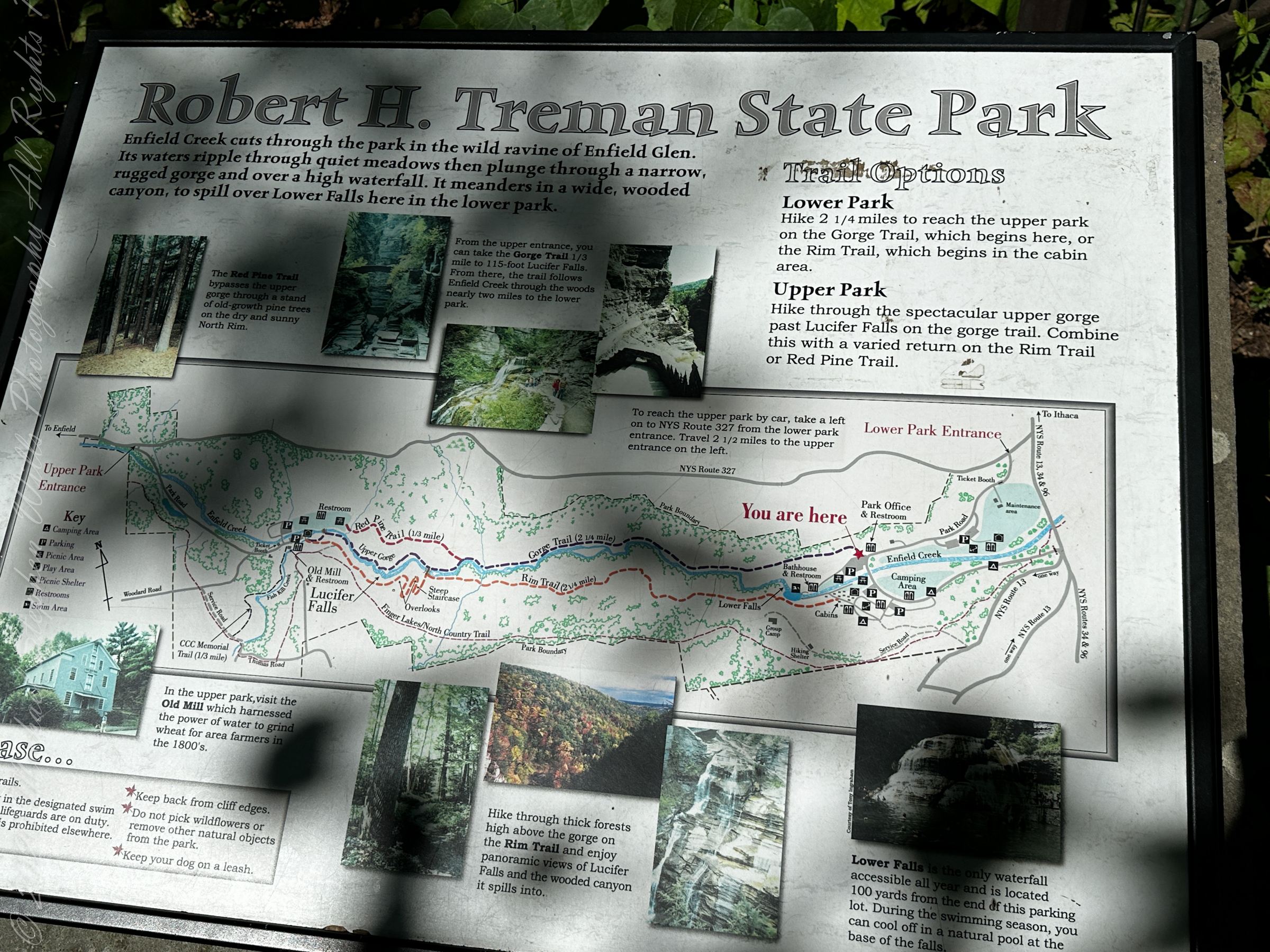
Today I walked the Gorge Trail to below Lucifer Falls, crossed the bridge and returned via the South Rim Trail, a trip of over 5 miles according to the Apple IPhone 14 Pro Max used for these photographs.
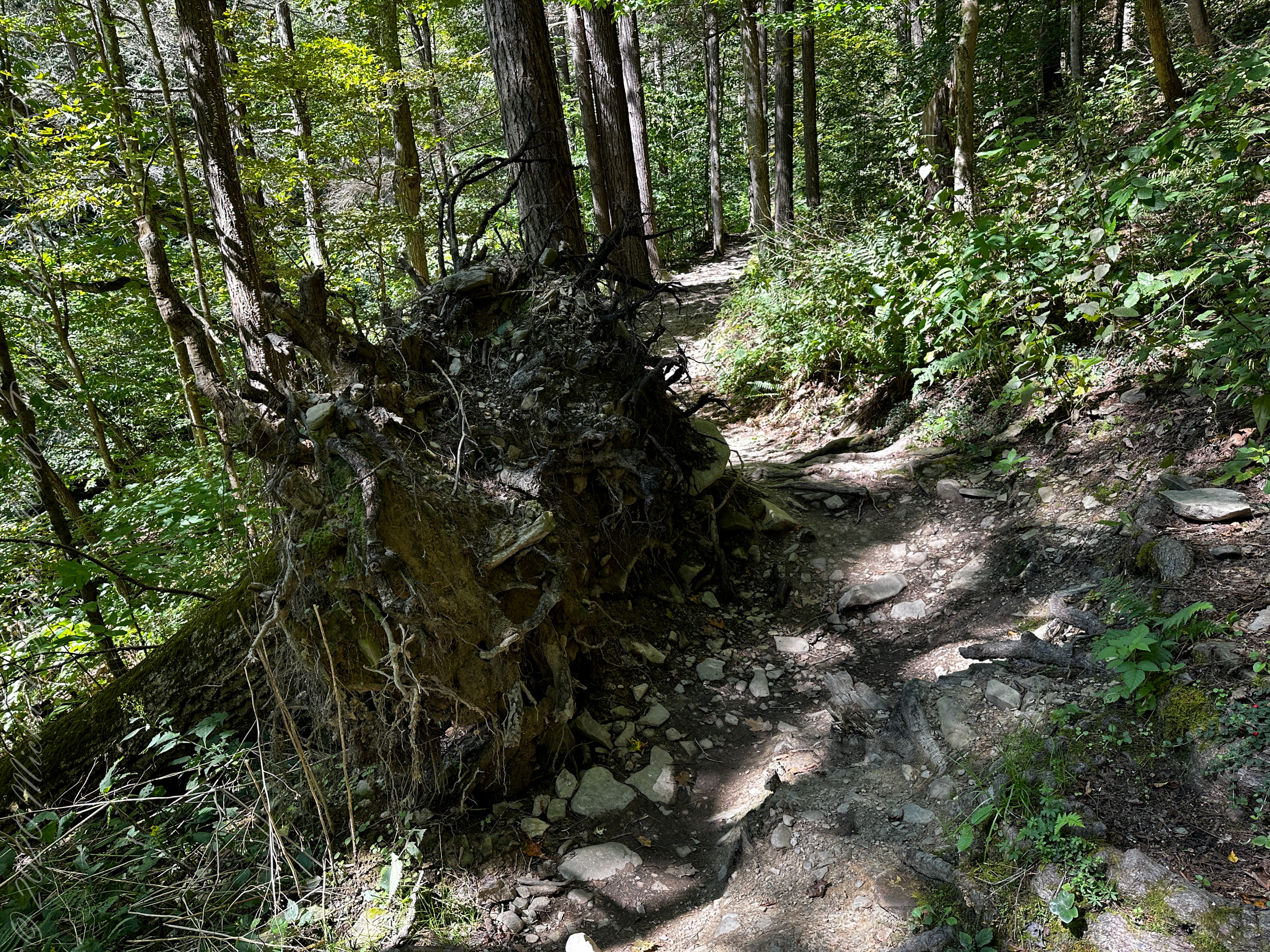
Thankful I was not here when this tree gave way across the trail.
Information about a cultivated fern, followed by a photograph of the wild version, trailside.
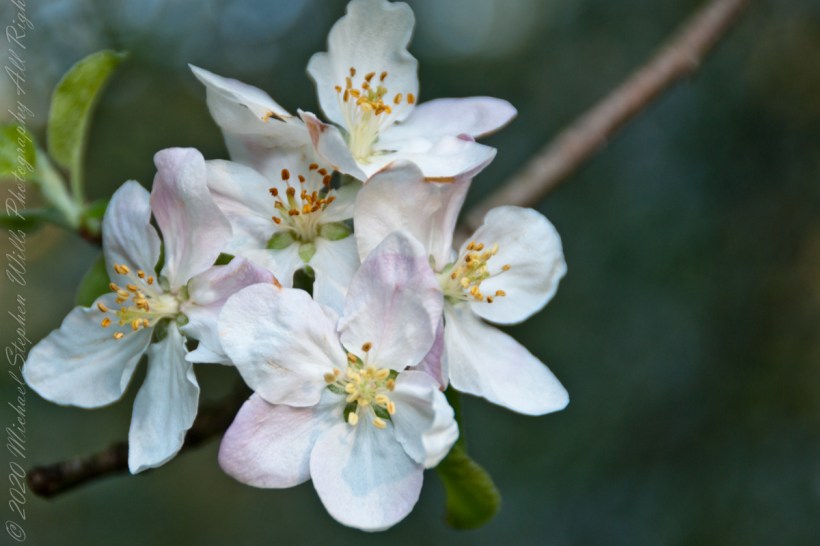
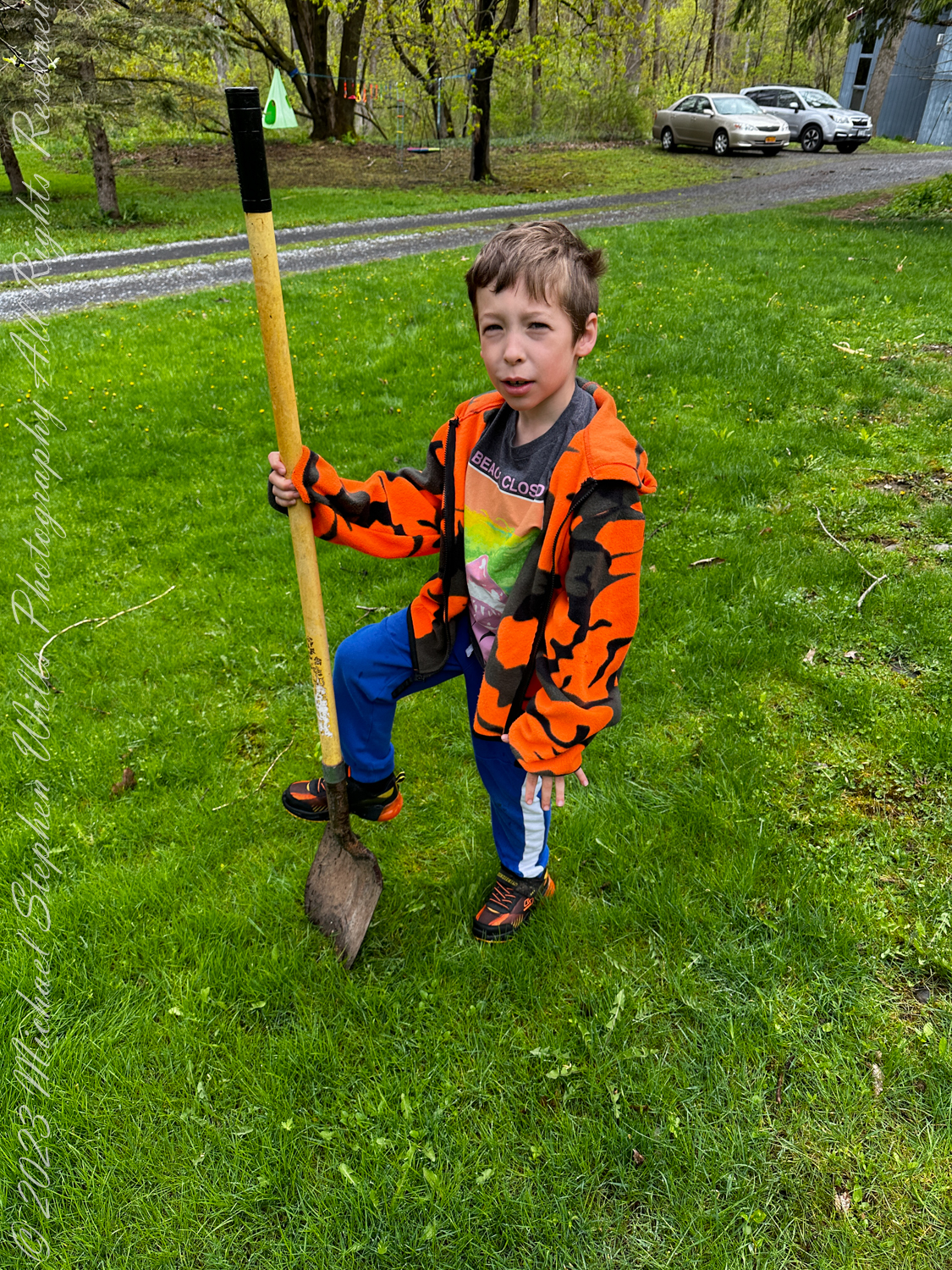
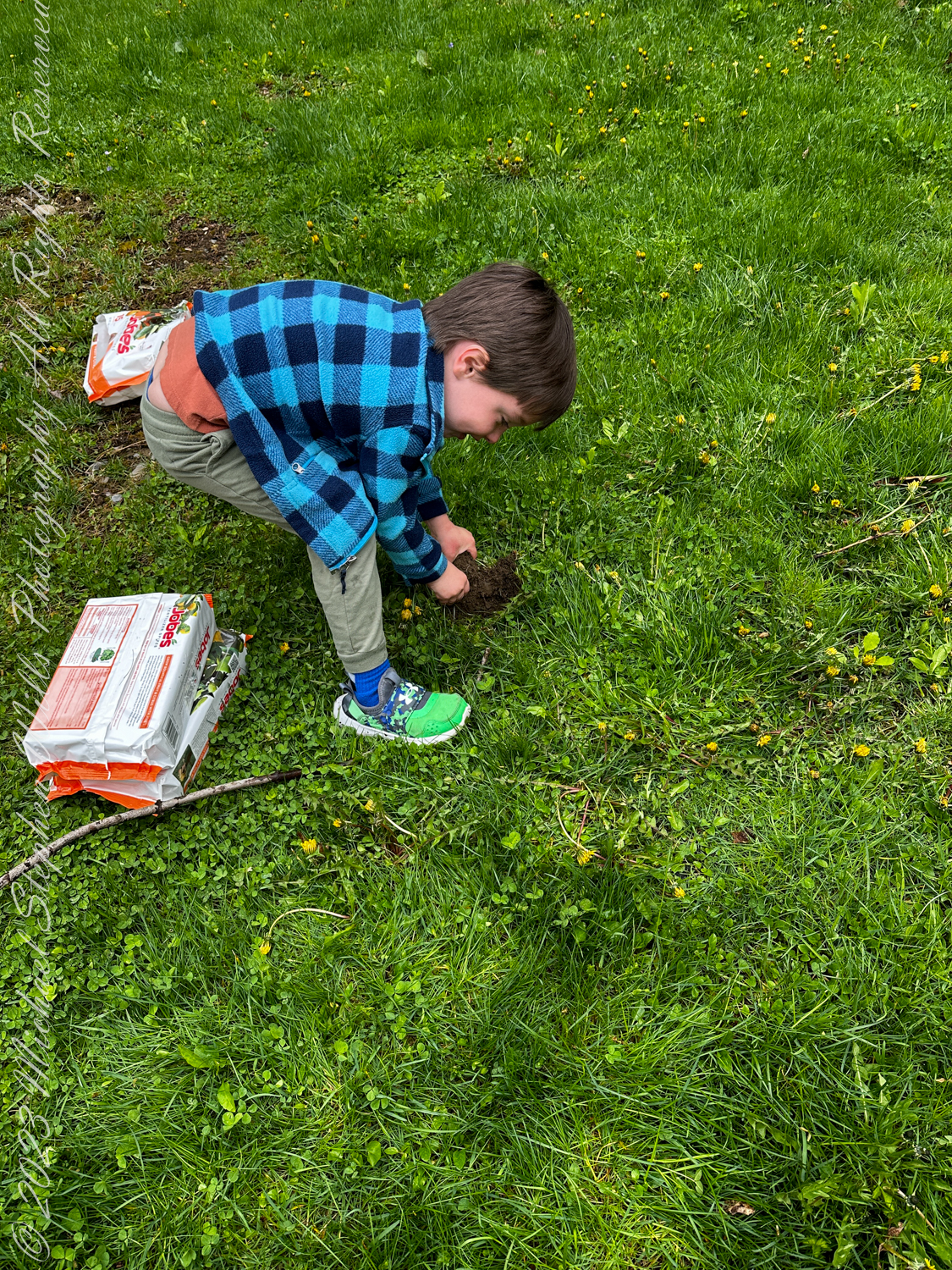
A spring rite of ours is caring for three apple trees. We provide each, a Cortland, a McIntosh, a Delicious, with 15 fertilizer spikes ; 45 in all.
I am way past using a hammer to pound in each. The preferred method is to drive a space into the ground beneath the drip line (the other reach of the branches), lift the handle and drop the spike into the ground, remove the spade and tamp down the ground.
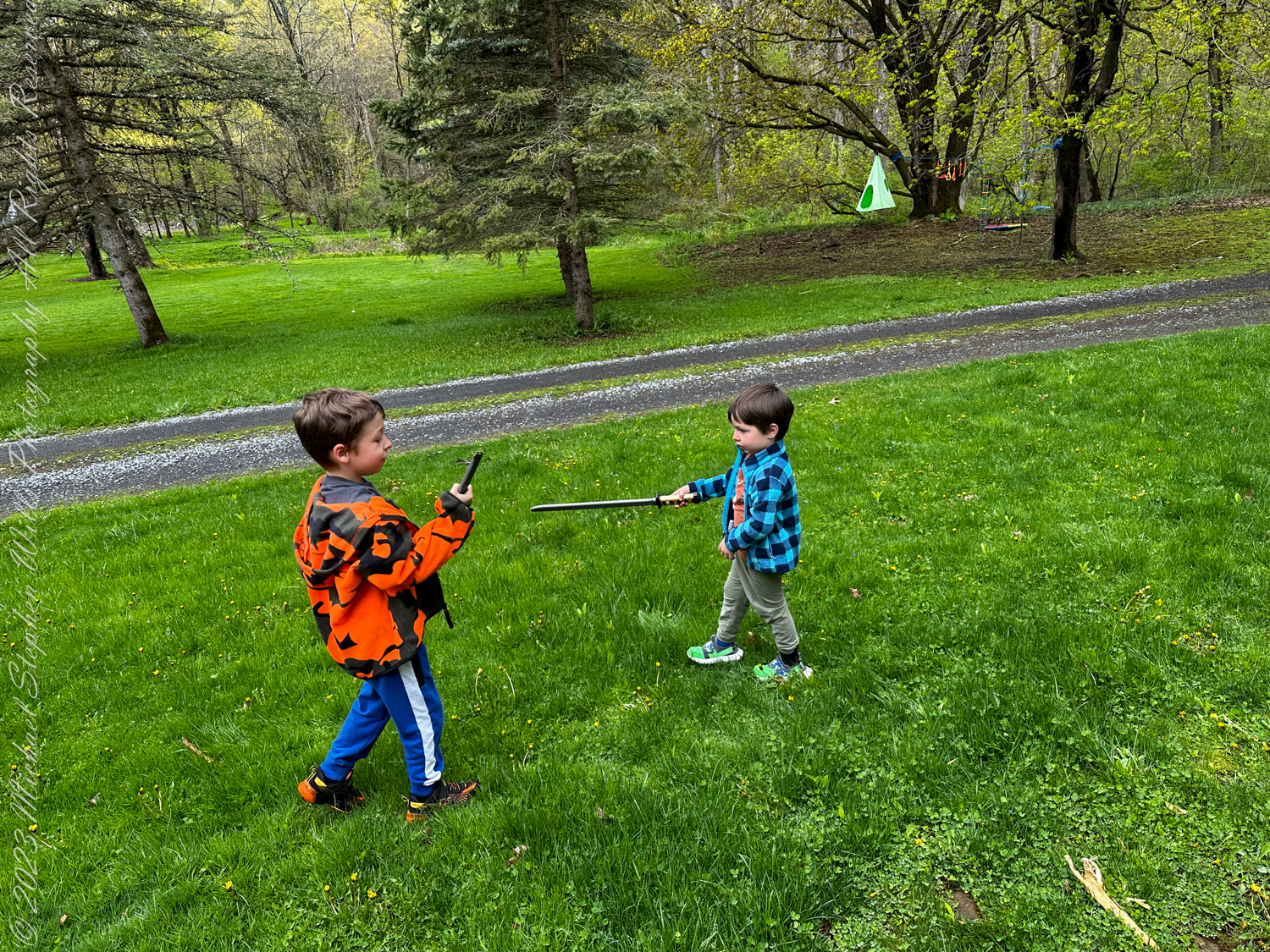
These helpers are now experts in the dropping and counting. Then, enough is enough, time for play.
And lunch….
Copyright 2024 Michael Stephen Wills All Rights Reserved
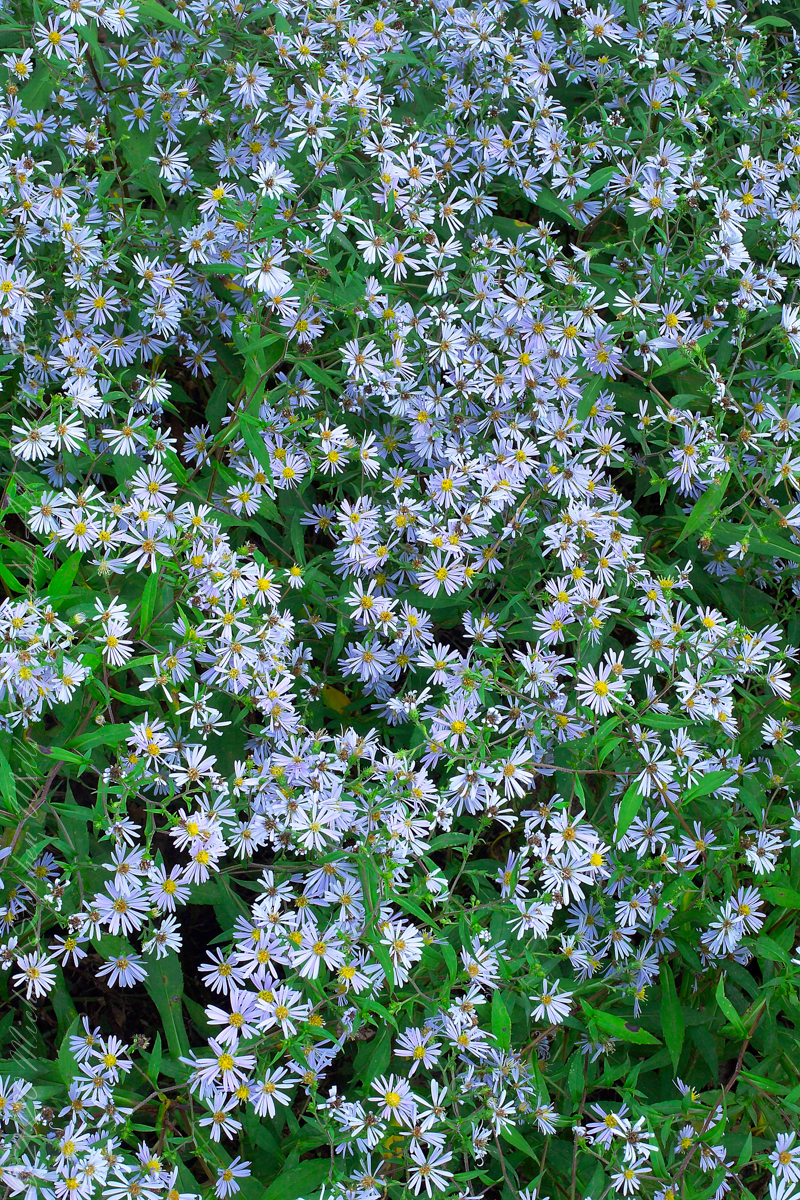
A mass of lavender asters produced for a painterly, restful esthetic. Over the years I have tended beds of these wildflowers. The sunlight of late August/early September here in the Finger Lakes is especially clear and this is when these asters bloom. This were caught on a clear September evening with the sun just behind a stand of large Ash trees.
“Symphyotrichum novi-belgii (formerly Aster novi-belgii), commonly called New York aster. Symphyotrichum, a genus in the family Asteraceae, whose species were once considered to be part of the genus Aster. Plants in both these genera are popularly known as Michaelmas daisy because they bloom around September 29, St. Michael’s Day. The Latin specific epithet novi-belgii (literally “New Belgium”) refers not to modern Belgium, but the 17th century Dutch colony New Netherland which was established on land currently occupied by New York state (as Belgica Foederata was the Latin term for the United Netherlands at the time).“
Reference: Wikipedia “Symphyotrichum novi-belgii.”
Copyright 2023 Michael StephenWills All Rights Reserved
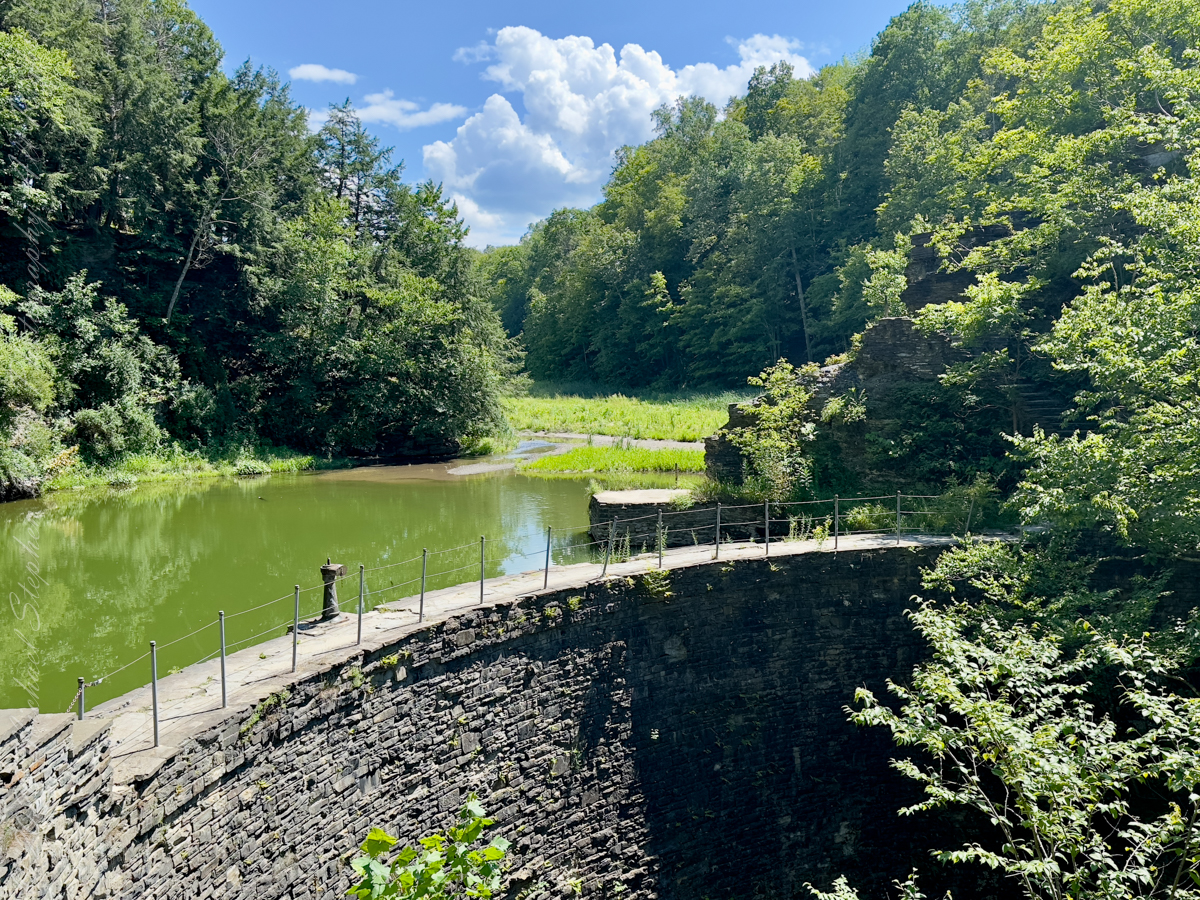
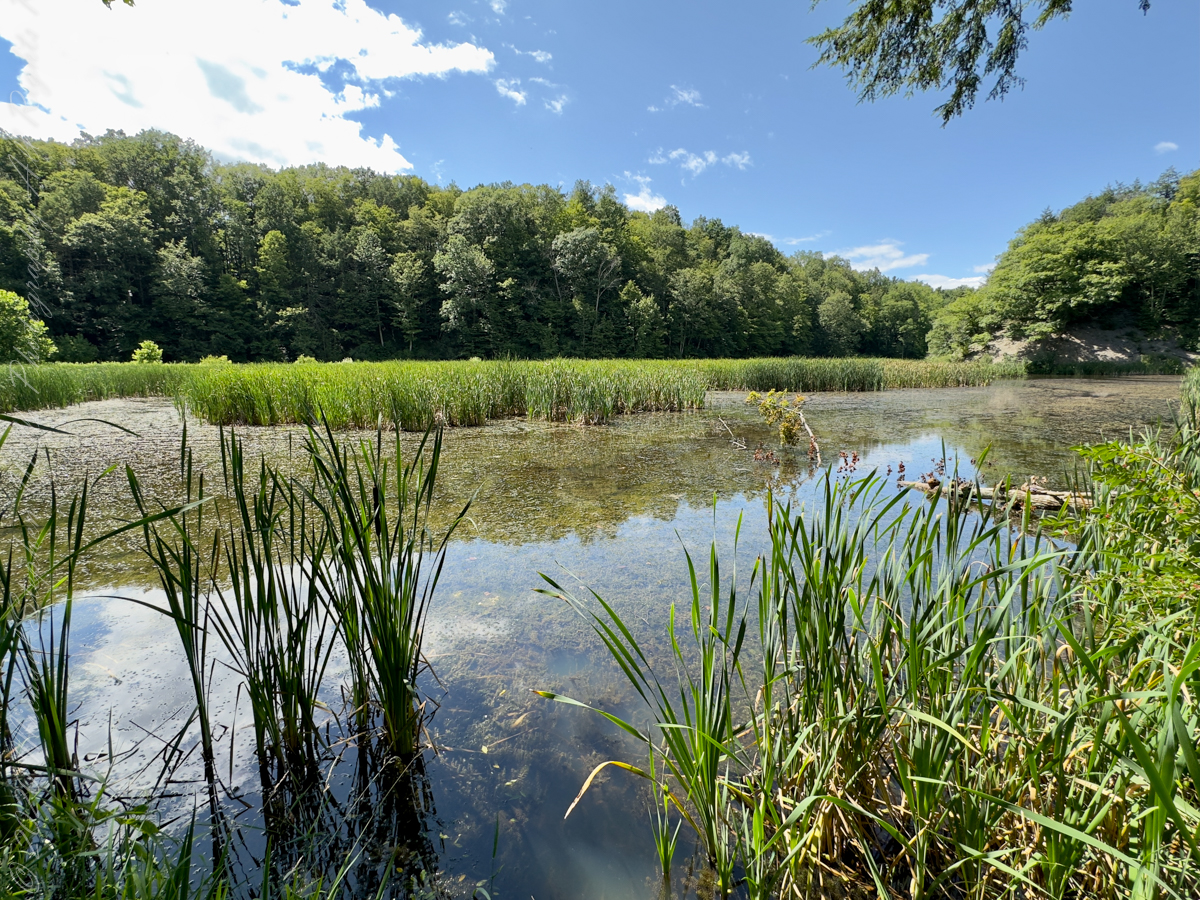
Dam on Buttermilk creek that forms Lake Treman. Here is stunning Civilian Conservation Corp (1930’s) work in this 36-foot-high stone dam that is not only a spectacle to observe but also serves as part of the trail that encircles Lake Treman. The man-made lake’s wooded shores and placid waters are a stark comparison to the gorge’s rocky cliffs and surging water
August 2023, Buttermilk Falls New York State Park, Ithaca, Tompkins County, New York.
Copyright 2023 Michael Stephen Wills All Rights Reserved
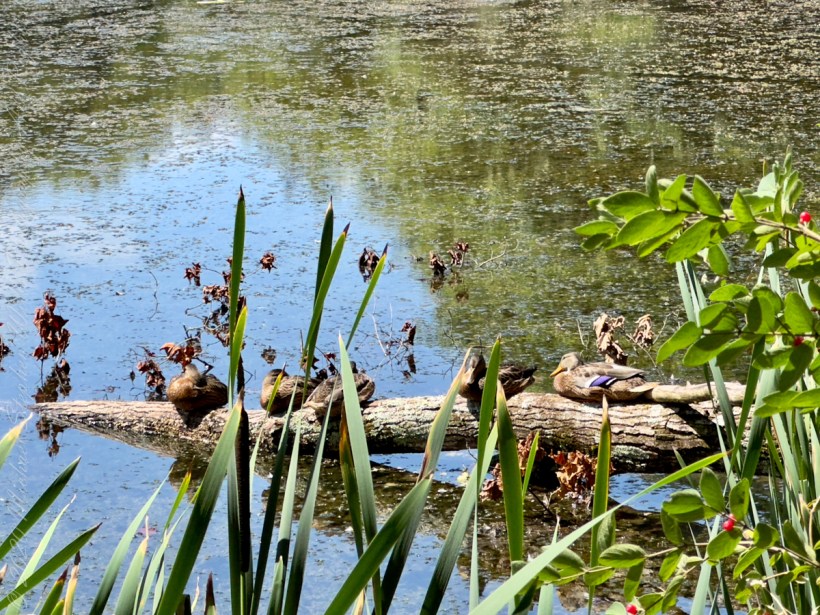
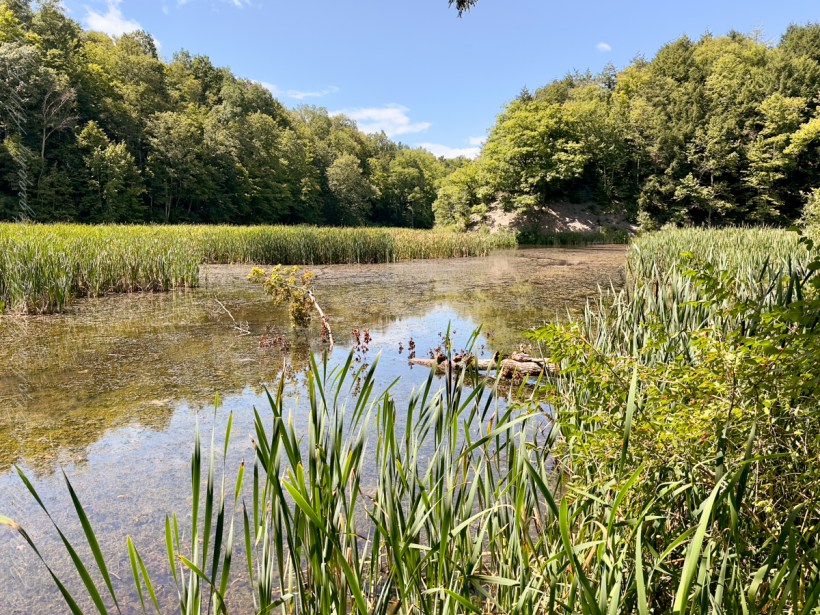
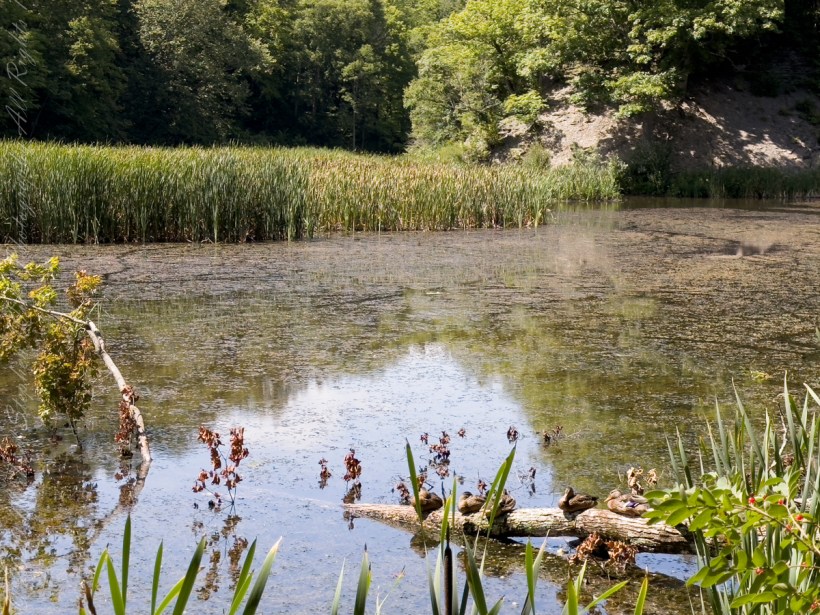
Two species of wild ducks rest on a fallen tree trunk.
That is a female Wood Duck (Aix sponsa) on right.
Wood Ducks mainly eat berries, acorns, and seeds, but also insects, making them omnivores. They are able to crush acorns after swallowing them within their gizzard.
August 2023, Buttermilk Falls New York State Park, Ithaca, Tompkins County, New York.
Copyright 2023 Michael Stephen Wills All Rights Reserved